‘US-led effort to isolate Russia failed’
Samizdat – August 5, 2022
The US-led drive to isolate Russia through sanctions has not succeeded, as half the countries in the Group of Twenty leading global economies refused to sign on, Bloomberg reported on Friday.
According to the publication, senior officials from leading Western nations are surprised by the lack of support within the wider G20, despite their efforts to make the case for restrictions against Russia.
Argentina, Brazil, China, India, Indonesia, Mexico, Saudi Arabia, South Africa, and Turkey have not joined the sanctions that were adopted by the US, UK, EU, and their allies Australia, Canada, Japan, and South Korea. Some nations, like China and South Africa, have openly criticized the restrictions. The G20 nations account for around 85% of global economic output.
According to Bloomberg, the reasons for the lack of support include strong trade ties, historical affinities to Moscow, and a distrust of former colonial powers.
UK policy on Ukraine must change before the public suffer any more
By Anthony Webber | TCW Defending Freedom | August 5, 2022
It is increasingly evident that the UK government under Boris Johnson got its policy over the Russia-Ukraine war wrong from the start. What good it did for world security and stability for our government to be involved in stirring up tensions in Ukraine is open to serious questions.
With hindsight it seems that Nato miscalculated: we should have left well alone and not interfered in this area of the world beyond encouraging talks with Russia.
Our failure to do that has brought calamity for Ukraine, and energy and food consequences which dramatically affect Europe and much of the rest of the world. It has allowed a US-led Nato to be influenced by globalist vested interests whose stated aim has been to bring down Russia, arguably to control the vast natural resources of both Russia and Ukraine.
Looking at the facts, Ukraine has 5 per cent of the world’s natural and mineral resources. Its reserves of lithium are amongst the largest in Europe. In terms of extraction, it is second globally in gallium, fifth in germanium, sixth in titanium, seventh in iron and eighth in manganese.
Ukraine has the second biggest gas reserves in Europe, apart from Russia-Asia (much of it not exploited). Europe is dependent on 40 per cent of its supplies from Russia, which Russia also supplies about 13 per cent of the world’s crude oil.
Ukraine produces 50 per cent of the world trade in sunflower oil, 14 per cent of rapeseed, 12 per cent of the maize and 9 per cent of barley. It produces 9 per cent of the world’s wheat. Russia itself is the world’s third largest producer of wheat.
Ukraine supplies 0.8 per cent of the world’s fertilisers, while Russia supplies 15 per cent.
This brief glance shows the importance of these commodities to the rest of the world. It is clear that a shortage in any of these areas will send up prices. So it should have also been clear that any sanctions against such a major supplier as Russia would only rebound on the sanctioning countries, harming them far more.
The damage done to Ukraine’s economy is inestimable. The dire effects on the economies of major European countries are reported daily. Spain is controlling the use of air conditioning. The lights have gone out in Berlin. Germany’s entire manufacturing industry is threatened. This winter will see serious energy rationing as well as unprecedented price rises and inflation
Much of this could have been avoided had not Europe committed itself to suicidal net zero policies. But there is no doubt that Britain and the EU’s intransigent position and refusal to countenance a diplomatic solution has acted as a catalyst of this crisis.
The deep irony is that it looks as if Zelensky’s Ukrainian government will have no choice but to open talks with Russia and have unnecessarily put their country through destruction, turmoil and loss of territory. At the same time the ‘Western’ countries, especially the UK, are putting their citizens through an entirely avoidable nightmare.
Johnson’s involvement with the Zelensky cause in Ukraine was always suspect. He needed a convenient distraction from the ‘partygate’ scandal. The man who never visited Afghanistan when he went along with Nato’s sell out ‘deal’ with the Taliban, letting down millions of Afghans and of course all the veterans who were sacrificed there, was ready to go to Ukraine for freedom fighting photo opportunities. There were no British interests involved in Ukraine and no defence obligations.
As this foreign proxy war progressed into a disastrous mess the media encouraged continued involvement, telling the public that Russia was hopeless and Ukraine were winning though the truth is they had been losing since day one, at a cost to the UK of more than £4.5billion, most in military aid.
The best thing the UK government under a new PM can do now is to carry out an urgent damage-limitation exercise. This means adopting a neutral position in the Ukraine conflict, stopping sanctions against Russia, and encouraging a peaceful resolution. The UK must look after its economic interests, which are not served by taking sides in this region. This is essential to halt the escalating energy, fuel and food crisis.
About a week ago the two Conservative leadership contenders had the opportunity to change their Ukraine policy when the issue came up at a debate. They both failed miserably and instead had the gall to say that they expected the public to contend with more suffering to support their Ukraine policy.
The public does not have to stand by silently. A Parliamentary petition has been started that makes the simple point that the policy on Ukraine has no electoral mandate. It states that it is the British public who must be given the right by referendum to decide on this issue if the government will not change the policy themselves.
Please click this link, sign, share and promote this: it involves the future of our country.
Shipping’s New ESG Rules Could Starve Millions
By Paul Homewood | Not A Lot Of People Know That | August 4, 2022
A shipping expert gives his views on the latest climate regulations for international shipping:
A new report found that more than 75% of ships will not meet the International Maritime Organization’s (IMO) new Environmental social and corporate governance (ESG) index aimed at decarbonizing the industry. This means that many ship owners will be forced to slow ships down to reduce emissions but doing so could deepen the global food and energy crisis by reducing available ship capacity.
“IMO decarbonization targets will cause ships to slow down delaying food shipments and people will starve,” a global security analyst told gCaptain. “How many people will die as a result of the IMO’s ESG efforts is unknown at this time. I don’t think most shipowners even understand the severity of the EEXI threat but it could be millions of lives.”
IMO EEXI ESG INDEX
“Prior to any efficiency modifications, more than 75% of the fleet — including bulkers, tankers, and containerships — will not be compliant with the Energy Efficiency Existing Index (EEXI) that will enter into force next year,” said cargo analyst Joey Daly, in the new VesselsValue report.
The challenge of decarbonization will extend to all areas of shipping, and EEXI alone will present a myriad of challenges to owners, operators and financiers. Simon Hodgkinson, who heads loss prevention at West P&I, has suggested that the new rule could be one of the most significant new shipping regulations in years. He believes it has the potential to shift the entire industry.
The International Maritime Organization’s Energy Efficiency Existing Index is a voluntary, incentive-based system that encourages ships to improve their energy efficiency. The Index uses a vessel’s speed, cargo-carrying capacity, and other factors to calculate a numerical score. The higher the score, the more energy efficient the vessel. More specifically EEXI (Energy Efficiency Existing Ships Index) is a measure of a ship’s CO2 emissions per transport work. It is similar to the Energy Efficiency Design Index (EEDI), which has been in force since 2013, but applies to existing ships rather than new ones.
The Index is designed to motivate shipowners and operators to invest in energy efficiency measures that will reduce fuel consumption and greenhouse gas emissions.
Ships have to attain EEXI approval once in a lifetime, by the first periodical survey in 2023 at the latest.
Slow Steaming
Ship owners can meet the target by building new eco-friendly ships, investing in new decarbonization technology, and upgrading existing ships to burn cleaner fuels like LNG, or by slow steaming.
Slow steaming is a technique used by shippers to reduce fuel consumption and emissions by slowing down vessels. The process involves sailing at a slower speed, typically around 50% of the vessel’s maximum speed. This can be done by reducing the revolutions per minute (RPM) of the propellers.
While older ships can be retrofitted with devices to lower emissions and meet EEXI requirements, analysts say the fix most ship owners will take is just to go slower, with a 10% drop in cruising speeds slashing fuel usage by almost 30%, according to marine sector lender Danish Ship Finance.
“They’re basically being told to either improve the ship or slow down,” said Jan Dieleman, president of Cargill Ocean Transportation, the freight division of commodities trading house Cargill, which leases more than 600 vessels to ferry mainly food and energy products around the world.
This strategy also reduces the amount of wear and tear on the vessel, which can help extend the life of the ship. But there is one ancillary effect: a potentially massive reduction in fleet capacity.
Full story here.
As I understand it, the new regulations are voluntary, so will likely be ignored by many countries. However, shipping lines ignoring the diktat may find themselves punished by banks and insurers, operating to strict ESG rules:
“As the IMO prepares to rate the energy efficiency of ships on a EEXI scale of A to E, shipping companies will come under increasing pressure to meet these targets not just from regulators but also from banks.
In 2019, a group of banks committed to efforts to cut carbon emissions when lending to shipping companies. This group of banks established the Poseidon Principles, a global framework that is consistent with IMO policies on environmental grounds. As of today, 28 banks have signed on to the Poseidon Principles.
The Poseidon Principles are fairly new but are already having a ripple effect on finance and insurance, as banks and other lenders begin to factor in a company’s carbon emissions when making lending decisions.
What this means for shipowners is that even if they find a way around the IMO’s ESG regulations, steaming at normal speeds could increase their carbon scores and have a negative effect on financing options and stock prices”
This demented obsession with decarbonisation brings a painful dilemma:
Slow steaming means in effect less global shipping capacity, leading to a potential bottleneck on supplies. As the article explains:
“Is a reduction of capacity really a troubling problem? Yes.
Nobody is calculating the price of a good ESG score in terms of human lives,” said one global security analyst who wished to stay anonymous. “The question is no longer if people will starve to death because of IMO decarbonization targets. The question is how many?”
The most troubling fact from our conversations with global security analysts was that millions could die before famine even sets in.“
And longer shipping times mean higher journey costs, despite the savings on fuel, adding to the cost of everything we import.
The alternative, of course, is to simply build more ships to bring shipping capacity back into equilibrium. The building of these ships will, of course, carry an enormous carbon footprint of its own, eliminating any potential savings from fuel efficiency for many years to come.
And China?
Any discussion about international shipping must take into account the role of China, who are believed to control the world’s second-largest shipping fleet by gross tons and constructed over a third of the world’s vessels in 2019.
Will they follow these rules?
One of the reasons for their global dominance of shipping lies in a complicated and opaque system of formal and informal state support that is unrivalled in size and scope, and which includes subsidised finance from state banks, who are unlikely to be concerned with ESG.
While China may pay lip service to these new regulations, given their total disregard for ESG in other industries, I would strongly suspect that they will just carry on building up their shipping industry, taking advantage of the West’s weakness.
And the West’s economic dependence on China will grow ever more dangerous.
Swiss People’s Party Says Anti-Russian Sanctions Violate Switzerland’s Constitution
Samizdat – August 3, 2022
The adoption of anti-Russian sanctions violates Switzerland’s Constitution, Swiss People’s Party, also known as Democratic Union of the Centre (UDC), stated on Wednesday.
“The introduction of sanctions violates the neutrality of the country, and, consequently, its Constitution. The Constitution stresses that Switzerland is neutral. We are against sanctions,” UDC press secretary Andrea Sommer said.
The statement was made shortly after the Swiss Federal Council announced that the seventh package of sanctions against Russia had been given a green light.
“… the Federal Council imposed further sanctions against Russia on 3 August in line with the EU’s latest sanctions on gold and gold products. The measures come into force at 6pm on 3 August,” the council said. The latest sanctions also include an asset freeze on Sberbank.
Last week, a Swiss bank also froze a personal account of Russian Permanent Representative to the United Nations in Geneva Gennady Gatilov.
According to the Russian permanent mission to the UN office, the fact that Switzerland lost its neutrality did not only affect its political and economic relations with Russia but also daily life of diplomats in Geneva.
“The situation is also escalated by artificial obstacles in the daily life of our diplomatic mission. A number of banks, insurance and car maintenance companies, with which we had long-standing partnerships, decided to abandon the contracts they had with us, while openly saying the reason – because we are from Russia. Even the personal account in the local bank of the Russian permanent representative in Geneva, which was used, among other things, to cover medical expenses, was frozen,” the mission told Sputnik.
Switzerland has adopted seven packages of sanctions against Russia that include an embargo on Russian oil supplies, import of caviar, seafood, coal, timber and cement, among others. Switzerland prohibited support for Russian entities in public ownership and registration of trusts for Russian nationals or residents.
The sanctions were imposed in response to Russia’s special military operation to de-Nazify and demilitarize Ukraine and protect the Donbass population.
Former German chancellor says Russia wants a ‘negotiatated solution’
Free West Media | August 3, 2022
Former German Chancellor Gerhard Schröder has expressed confidence that Russia would seek a negotiated solution to the Ukraine war. During his recent trip to Moscow, he also met with the Russian President. According to him, the Kremlin would like to negotiate.
“The good news is that the Kremlin wants a negotiated solution.”
In an interview with Stern magazine and RTL/ntv broadcaster, he said that the recently reached agreement on grain exports from Ukraine was an “initial success” that could perhaps “slowly be expanded into a ceasefire”.
In addition, the SPD politician again defended his contacts with Russia stating that it was not illegal.
In view of the gas crisis, the former chancellor also recommended commissioning the Nord Stream 2 pipeline from Russia and described this as the “simplest solution” in view of possible gas bottlenecks.
“It’s over. When things get really tight, there is this pipeline, and with the two Nord Stream pipelines there would be no supply problem for German industry and German households.”
“If you don’t want to use Nord Stream 2, you have to bear the consequences. And they will also be huge in Germany,” said Schröder. Anyone who heats with gas is already feeling the effects: that is half of the country’s 40 million households. Compared to the prices of December 31, 2022, gas will quadruple after further increases for consumers have been announced.
Chinese firm’s US plans paused over Pelosi
Samizdat | August 3, 2022
China’s CATL, the world’s largest battery maker, will delay a decision on building a multibillion-dollar factory in the US, due to the controversial visit by House Speaker Nancy Pelosi to Taiwan, Bloomberg reported on Tuesday.
Contemporary Amperex Technology Co (CATL) was expected to announce its choice for a site in the US in the coming weeks, but will now wait until September or October, Bloomberg quoted sources familiar with the matter as saying.
It was reported in May that CATL was in the final stages of vetting locations to build electric vehicle batteries that would supply Ford, Tesla and BMW. Potential sites were said to include South Carolina and Kentucky, where those automakers have assembly plants. Locations in Mexico are also reportedly under consideration.
Tuesday’s visit to Taiwan by US House of Representatives Speaker Nancy Pelosi was strongly condemned by China, which views the island as its sovereign territory. Beijing branded Taiwan and the US “destroyers of peace” on the same day.
What The Future Holds For Our Climate Leaders
By Francis Menton | Manhattan Contrarian | July 28, 2022
If my posting has been a little light for the last month or so, it’s because I’ve been working on a big Report for the Global Warming Policy Foundation on the subject of energy storage as a means to back up electricity generation from wind and solar facilities. The Report is basically finished, and now going through an editing process. It will probably be published some time in September.
In doing the research for the Report, I have had occasion to look carefully into the plans of many countries and U.S. states that claim to be the “leaders” in climate virtue, specifically on the subject of how they intend to reach the goal of Net Zero carbon emissions from generation of electricity. These climate “leaders” include, in Europe, Germany and the UK, and in the U.S., California and New York. One would think that for any jurisdiction pursuing Net Zero ambitions, and seeking to abolish use of fossil fuels, it would be completely imperative that some energy storage solution absolutely must be found to provide back-up for the electricity system when the wind and sun are not producing. But what my research has shown is that every one of these jurisdictions seeking to be the leader toward Net Zero has given astoundingly insufficient consideration to the energy storage problem.
I previously have covered some of the more incredible deficiencies in the Net Zero planning of these places, for example in “Can California Really Achieve 85% Carbon-Free Electricity By 2030?” on May 16, and “And The Winner Is, Germany!” on June 29.
The single most astounding universal failure of all jurisdictions pursuing Net Zero is the failure to pursue any sort of working prototype or demonstration project of a Net Zero electricity system before committing the entire jurisdiction to the project on the basis of a blank check to be paid by the taxpayers and ratepayers. Who has ever heard of such a thing? in the 1880s, when Thomas Edison wanted to start building central station power plants to supply electricity for his new devices like incandescent lightbulbs, he began by building a prototype facility in London under the Holborn Viaduct, and followed that with a larger demonstration plant on Pearl Street in Lower Manhattan that only supplied electricity to customers within a few square blocks. Only after those had been demonstrated as successful did a larger build-out begin. Similarly, the provision of nuclear power began with small government-funded prototypes in the late 1940s and early 1950s, followed by larger demonstration projects in the late 1950s and early 1960s. Only in the late 1960s, twenty years into the effort and after feasibility and cost had been demonstrated, were the first large-scale commercial nuclear reactors built. No competent person would take any other approach.
But somehow our politicians have now become so filled with hubris that they think they can just order up a functioning wind/solar electricity system and assume that backup energy storage devices will magically get invented and it will all work fine and not be financially ruinous, all by some arbitrarily-ordered date in the 2030s.
Today, all the mentioned jurisdictions and many more have embarked on ambitious Net Zero plans, and yet there does not exist anywhere in the world a functioning prototype or demonstration project that has actually achieved Net Zero in electricity generation, or anything even close. Indeed, it’s worse than that. There is a fairly substantial project that set out to achieve Net Zero (although they weren’t using the term at the time, which was 2014), and has fallen remarkably short. That project is on the island of El Hierro, one of the Canary Islands off the coast of Spain. El Hierro installed a collection of wind turbines and a pumped storage/hydro reservoir as back-up to great fanfare, but it struggles to achieve 50% of the electricity from the wind/storage system over the course of a year. The rest comes from a diesel generator. The system operator puts out monthly statistics (with substantial lag), typically with excited verbiage about “tons of carbon emissions saved,” without ever admitting that the system has totally failed in its original goal of getting rid of the fossil fuel piece. Instead they now have three redundant systems for providing the electricity — wind turbines, hydro reservoir and turbines, and the diesel generator — all of which must be paid for, and all to provide the same electricity that the diesel generator was fully capable of providing on its own. The cost has been calculated at about 80 euro cents per KWh, roughly 7 to 8 times average U.S. consumer rates; but the cost is largely hidden from El Hierro ratepayers by subsidies from the EU and government of Spain.
My research also covered in depth the question of how much energy storage would be needed for various jurisdictions to fully back up a predominantly wind/solar generation system without any use of fossil fuels. Credible calculations previously discussed here have included the calculation of Roger Andrews, done in 2018, that either California or Germany would require at least about 25,000 GWh of energy storage to back up a fully wind/solar generation system for a year without use of fossil fuels; and a calculation by Ken Gregory done on very similar methodology in late 2021 showing that the full U.S. (lower 48 states) would require about 250,000 GWh of storage for the same purpose. These are truly huge numbers.
Facing such requirements to reach Net Zero and banish fossil fuels from the electricity system, the plans of these jurisdictions for acquisition of storage are quite shocking. The consultancy Wood Mackenzie reported on April 11, 2022 that Germany had announced plans to acquire all of 8.91 GWh of energy storage by 2031 — a ridiculously puny amount if Germany is actually serious about Net Zero. Utility Dive reported on April 12, 2022 that New York had plans to acquire all of 6 GW of storage (likely corresponding to about 24 GWh, since the batteries are to be of the lithium-ion type that generally have capacity for four hours of discharge at full capacity). This figure is only slightly less puny than Germany’s. Another piece from Utility Dive on April 6, 2022 reported that California’s regulators had ordered utilities to acquire what would be the equivalent of about 42 GWh of storage as part of the Net Zero plans of that jurisdiction. All of these storage acquisition plans are in the range of about 0.1% to 0.2% of the storage that would actually be needed to achieve the Net Zero goal.
So what will the future of energy usage actually look like in these places as fossil fuels get phased out and wind and solar take over, with woefully insufficient energy storage to cover the intermittencies? To get an idea, let’s take another look at the Report for California put out by consultancy Energy Innovations on May 9, with the title “Achieving an Equitable and Reliable 85 Percent Clean Electricity System by 2030 in California.” Note that this in not actually Net Zero, but only 85% of same. Here are a few tidbits. First, their graphic on the nature of the transition:
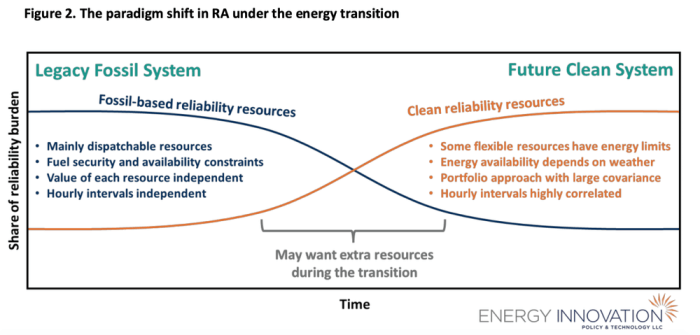
We’re going to have a “paradigm shift” in “RA,” which seems to mean “Resource Adequacy.” Check out that list on the right under “clean reliability resources” — “Energy availability depends on weather.” Are you starting to get the picture now?
Read through the report until you get into pages in the mid-30s, where the subject becomes what they euphemistically call “demand response.” It’s a lot of bafflegab to make it seem oh so pleasant. Excerpt:
Demand-side measures can substitute for supply-side resources and therefore contribute to resource diversity; their increased availability hedges against the risk of deploying new clean supply-side resources too slowly (including generators and storage). For example, the technical report finds that deploying Load Shift could reduce load by 1,500 MW in the early evening hours solar output falls, hedging against battery deployment challenges such as supply chain. . . . Demand-side measures also provide complementary reliability, resiliency, and public safety benefits to supply-side solutions or imports, as they lie closest to the affected load. While centralized generators provide the bulk of our power under most system conditions, they can be rendered less effective or useless under certain disaster conditions.
This is bureaucratese meaning “we’ll turn off your electricity at random times when we feel like it.” Get ready for this, California, Germany, et al. I guess New York is on the same path too, but I have my secret escape plans ready.
Japanese firms in no rush to leave Russia
Samizdat | July 30, 2022
Japanese companies are no in a hurry to quit the Russian market, amid fears of being unable to return and having to find new suppliers, the Japan Times reported this week, citing a survey from the statistics center Teikoku Databank.
According to the report, within the past month no Japanese companies have announced a suspension or cessation of operations in Russia.
Since Russia became subject to numerous sanctions due to its military operation in Ukraine, 74, or about 40%, of the 168 listed Japanese companies working in Russia announced intentions to leave the country. Of these, however, most said they would only halt some form of operation, while a mere five companies said they would withdraw from the Russian market completely.
According to the survey, Japanese companies attributed their reluctance to withdraw from Russia to fears of losing their niche in what they consider an important emerging market and potential difficulties in finding alternative suppliers.
Earlier this year, reports emerged that the Japanese government had urged the conglomerates Mitsui and Mitsubishi to retain their stakes in the Russian liquefied natural gas (LNG) project Sakhalin-2, which now operates under a new Russian operator, in order to ensure continued LNG flows. Also, a number of Japan’s major automakers, including Toyota, have suspended their activities in Russia over the past several months but have not yet closed their businesses in the country.
Western sanctions against Moscow have forced many international companies to quit the Russian market. However, according to a Yale University survey, just 5% of Japanese companies that had operations in Russia have left, which is tied with Italy for the lowest shares in the G7. This contrasts with 46% for the UK, 33% for Canada, and 27% for the US.
Lavrov is on Blinken’s list of people to call
BY M. K. BHADRAKUMAR | INDIAN PUNCHLINE | JULY 28, 2022
The US Secretary of State Antony Blinken at a press availability at the State Department on Wednesday made the dramatic announcement that he intends to speak to his Russian counterpart Sergey Lavrov “in the coming days … for the first time since the war began” in Ukraine on February 24.
Interestingly, he gave an alibi that harks back to the Soviet era — prisoner exchange.
The US is offering a swap of a Russian entrepreneur Viktor Bout, who was arrested in Thailand in 2008 on a US warrant and later convicted to 25 years in prison on charges of weapons trafficking, in exchange for Brittney Griner, a basketball star who has been detained at Moscow airport on drug charges and, importantly, Paul Whelan, an ex-US Marine, who was arrested in Russia in 2018 and sentenced to 16 years in prison two years later on charges of espionage.
Whelan surely was a prize catch for the Russians. The American ambassador in Moscow had been visiting him in prison.
Blinken also added a second topic he’d like to discuss with Lavrov — implementation of the recent “grain deal”. Washington played no role in negotiating the deal and is presumably hoping to make a lateral entry into the matrix now. Blinken claimed he is “seeing and hearing around the world a desperate need for food, a desperate need for prices to decrease. And if we can help through our direct diplomacy encourage the Russians to make good on the commitments they’ve made, that will help people around the world, and I’m determined to do it.”
Interestingly, in a veiled reference to the US, Turkish Foreign Minister Mevlut Cavuсoglu stated Wednesday on broadcaster Tv100 that there were countries who “wanted to block” the grain deal between Russia and Turkey, who want the Ukraine conflict “to prolong”, as they think the longer Moscow’s special military operation continues, “the weaker Russia will be.”
Fair enough. Blinken then came to the real purpose of his forthcoming call with Lavrov — “the plans that Russia now has to pursue the annexation of Ukrainian territory.”
Blinken repeated the hyperbole that sanctions are having “a powerful and also growing effect” and has “weakened Russia profoundly” and the Biden administration will do all that it can “to strengthen Ukraine’s position on the battlefield so it has the strongest possible position at the negotiating table.”
However, what comes through is the growing disquiet in Washington that to its utter disbelief, the Russian stance has only hardened lately. Blinken said it is “causing alarms.” In particular, he noted Lavrov’s remark last week that the Kremlin’s goals in Ukraine had expanded. “Now they seek to claim more Ukrainian territory, beyond the Donbas,” he commented.
Indeed, the war has spun out of US algorithm. As Hungarian PM Orban pointed out last week, anti-Russian sanctions “have not shaken Moscow,” but Europe has already lost four governments and is in an economic and political crisis.
Russia is paying back to the US and NATO in the same coin that the latter did when they dismembered Yugoslavia. The NATO’s war in Yugoslavia came at a time when Russia was weak and it helplessly watched the West carving up a fellow Slavic country.
Russia will not be deterred now, as it is already past the mid-stream. Blinken noted frantically, “I think it’s very important now that we see what Russia’s next plan is – that is, the annexation of more Ukrainian territory – that the Russians, Foreign Minister Lavrov, hear directly from me on behalf of the United States that we see what they’re doing, we know what they’re doing, and we will never accept it. It will never be legitimised. There will always be consequences if that’s what they do and that’s what they try to sustain.”
However, the paradox is, the initiative still lies with the US. The Russian army will move deeper into Ukraine in proportion to the US’ supply of advanced weapons with long reach into Russian territory. But Moscow is interested only so that Russian territory is safe from any attack from Ukraine.
It is the Biden administration’s choice to extend the duration of the war or escalate the scope of the Russian operation. Washington made a catastrophic mistake to torpedo the Russian-Ukrainian deal stuck in April in Istanbul when Kiev agreed to settle for the modest Russian demands.
But those were halcyon days when US Defence Secretary Lloyd Austin quipped — with Blinken by his side — after a quick trip to Kiev that the US wanted to see Russia “weakened to the degree that it cannot do the kinds of things that it has done in invading Ukraine.” Austin boasted that Russia had “already lost a lot of military capability” and “a lot of its troops. We want to see them not have the capability to very quickly reproduce that capability.”
Hearing Austin’s battle cry, Blinken chimed in: “The strategy that we’ve put in place, the massive support for Ukraine, the massive pressure against Russia, in solidarity with more than 30 countries engaged in these efforts, is having real results. And we’re seeing that when it comes to Russian war aims.”
“Russia is failing. Ukraine is succeeding,” Blinken claimed. That triumphalism was not there in Blinken’s performance yesterday.
A great beauty about press conferences is that some journalists make it lively and revealing. So, one American journalist asked Blinken, “you have been talking about how Russia is isolated internationally, and yet we see Foreign Minister Lavrov jetting off around Africa and the Middle East and President Putin going to Tehran… They make the case that they’re not isolated, and now you’re about to have this conversation with them. So what does that say about the administration’s efforts to isolate Russia when you are actually now reaching out to them to talk about the issues?”
Blinken’s explanation: “Matt, in terms of some of the travels that the foreign minister, for example, is engaged in, what I see is a desperate game of defence to try somehow to justify to the world the actions that Russia has taken…”
Yet, EU foreign policy chief Josep Borrell bitterly complained yesterday, “Lavrov visits to try to convince Africans that European sanctions are to blame for everything that is happening … and the entire western press repeats this. When I’m going to Africa to say the opposite, that sanctions have nothing to do with it, no one picks it up!”
The spectre of the collapse of EU economies is rattling the Biden Administration. A CNN report yesterday was titled US officials say ‘biggest fear’ has come true as Russia cuts gas supplies to Europe. It said the Biden administration “is working furiously behind the scenes to keep European allies united” as the blowback from the sanctions against Russia hits them and the “impact on Europe could boomerang back onto the US, spiking natural gas and electricity prices.”
The report quoted an unnamed US official saying Russia’s retaliation for western sanctions has put the West in “unchartered territory.” Suffice to say, Blinken’s call underscores the desperate urgency in Washington to open a line of communication to Moscow at the political level.
How this volte-face plays out in European capitals, especially Kiev remains to be seen. Blinken led the western boycott of Lavrov at the G20 Foreign Ministers’ Meeting in Bali as recently as July 7-8. President Biden extended a glamorous welcome to Zelensky’s wife Olena Zelenska to the White House who was on a high-profile visit last week, even as Blinken was preparing his stunning announcement.
Ukraine is Losing the War, and So is Europe
By Oscar Silva-Valladares | Ron Paul Institute | July 27, 2022
Beyond the damage in Ukraine, the war also has significant casualties in the rest of Europe as the continent is losing its most competitive energy supplies, compromising the region’s manufacturing edge and accelerating an inflation wave that through higher energy costs will severely affect the wellbeing of its population this coming winter.
Europe has been trying for years to diversify its energy sources but it did not have a comprehensive contingency plan to counteract the impact of abruptly severing access to Russia’s oil and gas since the beginning of the Ukraine war. European politicians have grossly exaggerated the substitution potential of other energy sources (like LNG) and are facing the need to accept alternatives that not too long ago were considered politically unpalatable, like the reopening of coal production in Germany.
How did this gross miscalculation take place? Clearly, the European leadership has been unable to foresee the true economic consequences in Europe and beyond of the economic war unleashed against Russia. One explanation for the boldness and self-confidence surrounding the European standing against Russia at the beginning of the war was a strong belief that the combination of anti-Russian sanctions and military support to Ukraine would cause a significant weakening of Russia’s political, social and military standing leading to its defeat. This explains for instance bold statements that the war would only be solved in the field as it was confidently said by the EU’s foreign affairs representative back in March.
It can be argued that the wrong assessment on the war outcome has its roots in faulty US-British intelligence which forecasted Russia’s defeat through economic warfare and, therefore, a limited impact of sanctions on Europe. This not being the case has now made European leadership to scramble for solutions. Meanwhile, the political fallout is already taking place, with Britain and Italy’s prime ministers being the most visible casualties as victims of domestic political events unleashed by their own Russian sanctions. More importantly, it doesn’t seem that the remaining European leadership (led by von der Leyen, Macron and Scholz) is willing to change course without losing significant credibility.
On the other hand, dissenting and unorthodox European political views are sounding louder, as Hungarian prime minister Orban’s recent speech where he boldly mentioned that Russian sanctions and arming Ukraine have failed, Ukraine can’t win the war, the more weapons go to Ukraine the more territory it will lose and that the West should stop arming Ukraine and focus on diplomacy.
At the heart of Europe’s current troubles is its inability to balance its economic and security interests with enough autonomy to be able to look after its own interests. European ambiguity is not new, it has roots in the post-World War II architecture and the aftermath of the collapse of the Soviet Union, and in relation to Ukraine it manifested in its ineptitude to enforce the Minsk agreements that clearly offered a Russo-Ukrainian peace path but were unable to be enforced by France and Germany due to relentless US and Ukrainian pressure.
It seems that only significant political alterations in the European countries that matter -namely France, Germany and Italy- will allow a meaningful change of course from the current path of confrontation with Russia and ultimately economic self-destruction. Otherwise, any political initiative towards solving the war will be left in the hands of Russia and the United States and, if that is the case, any lasting agreement will not have European interests at heart. It would be tragic that a core European problem like the Ukraine war is finally solved through the dealings of an Euro-Asian and an American power.
Oscar Silva-Valladares is a former investment banker that has lived and worked in North and Latin America, Western & Eastern Europe, Saudi Arabia, Japan, the Philippines and Western Africa. He currently chairs Davos International Advisory, an advisory firm focused on strategic consulting across emerging markets.
Copyright © 2022 by RonPaul Institute
German mayors want Nord Stream 2 opened
Samizdat | July 27, 2022
Berlin’s policy of trying to give up imports of Russian natural gas is likely to create hardship and spark unrest, seven mayors from the German island of Ruegen wrote in a letter sent to the regional and federal governments on Wednesday. They also urged the federal government to allow gas imports via the Nord Stream 2 pipeline, given the current technical difficulties with Nord Stream 1 – something Berlin has steadfastly rejected.
In the letter addressed to federal economy minister Robert Habeck and Manuela Schwesig, prime minister of Mecklenburg-Vorpommern, the mayors “strongly condemn” the current conflict in Ukraine but urge the government to consider the damage its policy could do to the German population and the economy, according to the news agency DPA.
“We are of the opinion that the path taken by the federal government to disconnect from Russian energy sources is not the right one,” the seven mayors wrote. Initially drafted by the leaders of Bergen, Binz and Sassnitz, the letter was later signed by four more jurisdictions on Ruegen, Germany’s largest island and a popular tourist destination.
Giving up gas imports from Russia would mean an explosion in the cost of living, which would lead to social instability and unrest that could get out of control, the mayors wrote, according to German media. Calls from the federal government to save energy – such as showering less and foregoing hot water – “defy understanding,” they added.
“As the mayors of this island, we don’t want to have to accept any further restrictions,” Sassnitz city manager Frank Kracht told the Mecklenburg-Vorpommern affiliate of the TV station NDR.
Rejecting the proposals to expand the number of wind turbines near residential areas, calling them a health hazard, the mayors advocated “a general rethinking of the solution to the current problems in relations with Russia.”
Among their suggestions was to get additional natural gas via the Nord Stream 2 pipeline. Finished in late 2021, the pipeline from Russia to Germany under the Baltic Sea was just waiting for the operating permit from Berlin – which was suspended indefinitely on February 22, two days before Russia sent troops into Ukraine.
NS2 was supposed to double the volume of Russian gas exports, but was delayed by US sanctions seeking to protect Ukraine’s gas transit earnings. Nord Stream 1, which continues to supply Germany with gas, is currently operating at only 20% capacity, due to maintenance requirements. Its operator, Gazprom, says several turbines at the Portovaya compressor station need servicing to maintain certification. The first one was held up by Canada, citing anti-Russian sanctions over the conflict in Ukraine, until Berlin intervened seeking an exemption. NS2 does not use Siemens turbines, and can be maintained regardless of the sanctions.
Berlin has refused to even consider the possibility of using NS2, however. Economy minister Habeck has said that the pipeline cannot operate without certification. He also accused Russian President Vladimir Putin of trying to damage EU solidarity with Ukraine by driving up the price of gas.
“Putin has the gas, but we have the power,” Habeck said on Tuesday, appealing to Germans to stand together.
Recent polls showed widespread pessimism in German industry regarding future business prospects. Commenting on the turbine delay last week, Foreign Minister Annalena Baerbock said gas shortages could lead to an insurrection.
“If we don’t get the gas turbine, then we won’t get any more gas, and then we won’t be able to provide any support for Ukraine at all, because then we’ll be busy with popular uprisings,” she told the TV outlet RND. Baerbock hastened to add that this may have been “exaggerated” and insisted most Germans supported sending weapons to Ukraine, though.
Featured Video

Seyed M. Marandi: Toward Total War in the Middle East
or go to
Aletho News Archives – Video-Images
From the Archives
The Geopolitics behind the War in Yemen (I)
By Mahdi Darius NAZEMROAYA | Strategic Culture Foundation | 30.03.2015
The United States and the Kingdom of Saudi Arabia became very uneasy when the Yemenese or Yemenite movement of the Houthi or Ansarallah (meaning the supporters of God in Arabic) gained control of Yemen’s capital, Sanaa/Sana, in September 2014. The US-supported Yemenite President Abd-Rabbuh Manṣour Al-Hadi was humiliatingly forced to share power with the Houthis and the coalition of northern Yemenese tribes that had helped them enter Sana. Al-Hadi declared that negotiations for a Yemeni national unity government would take place and his allies the US and Saudi Arabia tried to use a new national dialogue and mediated talks to co-opt and pacify the Houthis.
The truth has been turned on its head about the war in Yemen. The war and ousting of President Abd-Rabbuh Manṣour Al-Hadi in Yemen are not the results of «Houthi coup» in Yemen. It is the opposite. Al-Hadi was ousted, because with Saudi and US support he tried to backtrack on the power sharing agreements he had made and return Yemen to authoritarian rule. The ousting of President Al-Hadi by the Houthis and their political allies was an unexpected reaction to the takeover Al-Hadi was planning with Washington and the House of Saudi. … continue
Blog Roll
 Aletho News
- HE SAVED LIVES. NOW HE FACES PRISON.
- Israeli lobby seeks to bind US fate to ‘Israel’: Araghchi
- Pakistan-Iran talks secure LNG shipment to Islamabad through Hormuz
- Black Sea grain crisis puts global wheat supplies under pressure
- IRGC air defenses destroy another US MQ-1 drone over Strait of Hormuz
- Imran Khan’s entire immediate family detained in Pakistan ahead of mass protest demanding his release
- EU nation detains former presidential frontrunner
- Leaked: Britain’s Sham Conviction Of Hashim Thaci
- Seyed M. Marandi: U.S. Strike Imminent – Toward Total War in the Middle East
- Russia Voted Under Fire. Washington Is Loading the Tankers.
- If Americans Knew
- Israeli Attacks in Gaza Kill at Least Seven Palestinians Over Three Days, including Woman and Child
- Trump’s militarization of Washington DC as he pursues Israel’s war against Iran
- Why Israel Fears This Searing New Documentary
- Huckabee aide solicited cash gifts from Israelis
- This isn’t sci-fi, AI is already killing people
- ‘The Most Brutal Thing’: Investigation Reveals Execution of Elderly Woman in Rafah
- Inside Israel’s ‘soft’ ethnic cleansing plan for Gaza through the eyes of its victims
- New online database tracks pro-Israel political donations in the United States
- Israeli president pardons soldier convicted for killing wounded Palestinian
- Singer Ed Sheeran says his ‘heart broken’ by Gaza devastation, addresses Macklemore controversy
- No Tricks Zone
- 2025 Nature Paper Claiming Worsening Global Drought Gets RETRACTED …Heavily Flawed
- New Study: ‘Global Drought Shows No Detectable Recent Acceleration Under Climate Warming’
- Economic Masterminds: German Socialists Suggest Taxing Productivity Gains Stemming From Using AI
- The South China Sea Has Not Been Cooperating With The Climate Change Narrative
- Energy Crisis: Germany Enters Heating Season With Historically Low Gas Reserve Fill Levels
- New Study: The Antarctic Ice Sheet Gained Mass From 2020-2024 Due To Staggering Snow And Ice Accumulation
- Study: Ocean Heating Rates From Thousands Of Years Ago ‘Dwarf’ Modern Ocean Heating Rates
- Climate Extremists Target, Attack Large-Scale Power Grid Infrastructure In Germany!
- New Study: Antarctic Ice Melt Has Contributed Less Than 1 Centimeter To Sea Level Rise In The Last 30 Years
- Fear Of Debate: Alarmist German Climate Scientist Calls On Mainstream Media To Discredit Skeptic Voices
 Aletho News
