Israeli Generals Urge Political Command to Make Concessions to Lebanon in Maritime Conflict to Avoid Hezbollah War
Al-Manar – July 15, 2022
In light of the threats made by Hezbollah Secretary General Sayyed Hasan Nasrallah over the Zionist infringement on the Lebanese maritime borders, the Israeli media reflected calls on the government to eliminate Hezbollah pretexts to escalate the confrontation.
The US officials accompanying President Joe Biden during his visit to the occupied Palestinian territories stressed that they support the efforts exerted to reach a solution.
In this regard, the US National Security Council spokesman John Kirby said, “We listened to the ‘threats’, and we support reaching a solution.”
The US mediator, Amos Hochestein, told the Israeli media that he was still optimistic about achieving a solution, adding that his target concentrates on facilitating the negotiations.
Hochestein also revealed that he would visit Lebanon to meet the senior officials in the context of resuming the negotiations soon.
Meanwhile, the Zionist media reflected the Israeli circles frustration with Biden’s remarks which did not voice a clear support to ‘Israel’ pertaining the maritime border demarcation.
The Israeli army generals urged the Zionist government to avoid any escalation with Hezbollah by making concessions to Lebanon in the negotiations in order to avoid any military escalation with Hezbollah.
Sayyed Nasrallah warned on Wednesday the Israeli enemy and the United States that if Lebanon is prevented from extracting its maritime resources, none will be able to extract or sell gas and oil.
In a televised speech, Sayyed Nasrallah indicated that Hezbollah military forces are monitoring all the Zionist platforms across the occupied Palestinian coast, adding that the Resistance may resort to ground, maritime or air capabilities in order to attack the enemy and secure Lebanon’s rights.
According to Sayyed Nasrallah, the new equation is Karish, what’s beyond Karish and what’s far beyond Karish.
Iran’s petrochemical output capacity to rise by 54% in 2025
Press TV – July 14, 2022
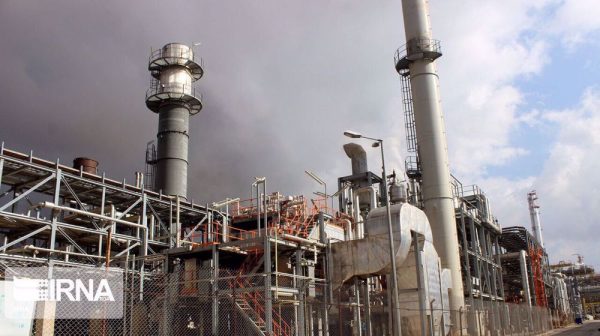
Iran will increase its production capacity for petrochemical products by more than a half in the next three years as the country moves ahead with plans to increase added value in its petroleum sector.
A Thursday report by the official IRNA news agency said Iran will launch a total of 35 new petrochemical plants by 2025 to increase the output capacity in the sector by 54% to 140 million metric tons per annum (mtpa).
It said petrochemical output capacity in Iran had increased by 7% in the calendar year to March 2022 to reach nearly 91 million mtpa thanks to the completion of seven new petrochemical projects across the country.
Iran’s sales of petrochemicals, including exports to other countries, also rose by 4.4% in the calendar year to late March with government figures showing that exports proceeds from the sector reached nearly $12.5 billion over that period.
Iran has relied on petrochemicals as a major source of earning hard currency in recent years as the country has been facing a series of tough American sanctions targeting its direct exports of crude oil.
China has been the top customer of Iranian petrochemical shipments in recent years while exports to countries in the region have also surged since the United States imposed its sanctions on Iran in 2018.
The expansion of the Iranian petrochemical sector has also led to a significant rise in the number of jobs in the country. Estimates suggest the number of direct jobs in the sector is more than 920,000 compared with a total of 107,000 direct jobs registered in the upstream sector of the oil and gas industry in Iran.
Russia Continues To Earn More By Exporting Less Oil
By Tyler Durden | Zero Hedge | July 14, 2022
Russian export revenues in June rose by $700m to the $20 billion mark, despite that oil exports fell by 250k b/d m/m to 7.4m b/d, the lowest since August 2021, Bloomberg’s Sherry Su reports citing the IEA’s latest Oil Market Report.
Compared to a post-war peak level in April, total Russian oil exports in June were down 530k b/d, Or 7%, but export revenues were up by $2.3 billion, or 13%.
Crude oil exports were down by 250k b/d in June to just above 5m b/d, still slightly higher than the pre-war average level according to Su. Shipments to the EU fell below 3m b/d for the first time since November 2020, bringing the EU share of Russian oil exports to 40%, compared to 49% in January-February.
Crude oil loadings to EU destinations fell 190k b/d m/m to 1.8m b/d, partly because of lower offtake on the Druzhba pipeline due to maintenance at a Hungarian refinery in June. Meanwhile, product loadings to the European Union fell by 135k b/d to 1.13m b/d, the IEA said.
The fall in crude oil volumes came mostly from lower loadings on the Black Sea, as Rosneft’s 240k b/d Tuapse refinery reportedly came back online in June after a three-month shutdown.
Total product exports out of Russia were relatively unchanged in June. Diesel exports increased slightly m/m to 825k b/d, 300k b/d lower than the pre-war average. Diesel Loadings to EU countries ticked up to 650 kb/d, returning to January-February average levels.
Starving Italians storm town hall
Free West Media | July 15, 2022
Are these the kind of conditions that we will soon see more often in Europe? In an Italian city, angry citizens stormed the city hall because they had no more money to afford groceries. The mayor refused to receive the angry crowd.
Italian citizens stormed La Spezia City Hall after the mayor refused to receive them: “I have no money to buy bread, what will my daughter eat tonight?” cried a disappointed mother at the official residence of the city. The incident is said to have taken place in the Italian city on Wednesday.
The mayor Pierluigi Peracchini decided to ignore the problems that his constituents have been facing. He is said to have even denied the citizens access to the town hall for a discussion. Rather, as video recordings show, police officers from the local municipality prevented the angry people from penetrating further into the building.
Mayor Peracchini (58) ran for the Coraggio Italia party, a centre-right party. In Italy, the ruthless hammer of inflation has been brought down on citizens. Just recently, shocking video footage of a never-ending line of people circulating outside a food bank in Milan surfaced on Twitter.
Draghi government implode
Many blame Italy’s prime minister, ex-ECB boss Mario Draghi (74). In German-speaking countries, Draghi is however often referred to as a “blessing” (Neue Zürcher Zeitung), a “moderniser” or “Super Mario” (Frankfurter Allgemeine Zeitung). Italians, on the other hand, who have been on the receiving end of his policies, have strongly criticized the social and economic direction of the Prime Minister, who has been in office since February 2021.
In the meantime, Draghi is facing the collapse of his government, because the Five Star Movement [Cinque Stelle] is planning to withdraw from the multi-party coalition over Italian arms deliveries to Ukraine.
In Rome this week, workers, taxi drivers, farmers, fishermen, street vendors and truckers are on the hunt for politicians and masses of angry people have besieged parliament for the second consecutive day.
The Uber Files scandal – leading to the liberalization of taxi licenses imposed by Mario Draghi – has stirred up citizens in particular. At the seat of government, a crowd was seen chanting on Friday: “Come down or we will go up!” A heavy police presence has been noted in the Italian capital.
After the fall of Boris Johnson
After the demise of Boris Johnson the implosion of the Draghi government in Italy is not formally connected to the situation in Ukraine, but it was most certainly this that ruined his tenure. The economic consequences of this war for Italy were such that the ruling coalition could not agree on measures to support the Italian economy due to the economic crisis generated by the war.
Draghi’s resignation, coupled with Johnson’s resignation, now makes it clear that European politicians do not have the opportunity to cover the growing economic crisis and falling living standards with cries of “Putin is to blame”. According to Italian pundit Lorenzo Vita, the premier was “recognized in the EU, NATO and major international circuits” as an important leader, but certainly not at home.
The likely defeat of the Democrats in the midterm congressional elections in the US, for the same reasons, will most probably confirm this trend.
The refusal of the President of Italy to accept Draghi’s resignation in the conditions of the collapse of the coalition does not change much – Italy will most likely move towards new elections.
‘EU may cut financial aid to Ukraine’
Samizdat – July 15, 2022
The funds promised to Ukraine by the EU have been delayed due to concerns over the bloc’s own economic troubles and infighting in Brussels, Bloomberg reported on Friday, citing people familiar with the discussions.
Back in March, the European Commission proposed a €9 billion ($9 billion) loan to Ukraine that would be backed by the guarantees of EU members’ governments. However, so far the bloc has managed to agree only on a first tranche worth €1 billion, which was unveiled on Tuesday.
According to Bloomberg, the hang up is because Germany tried to convince the EU to provide non-refundable grants through the International Monetary Fund rather than loans to Kiev.
A German official was quoted as saying that Berlin does not want to bear the brunt of guaranteeing Ukrainian loans and has asked other members to chip in more.
Separately, a €1.5 billion loan by the European Investment Bank was said to have been blocked within the EU because more guarantees are needed to secure the sum.
The news comes as the EU is grappling with soaring inflation. Germany has been particularly concerned that sanctions and tensions with Russia could compel Moscow to cut off the flow of Russian gas, which could cripple the German economy.
The German government has repeatedly warned that such a scenario would increase unemployment and poverty. Fuel shortages would be “catastrophic” for some industries, Economy Minister Robert Habeck told the magazine Der Spiegel last month.
Hungarian Prime Minister Viktor Orban raised a similar point on Friday, saying that by imposing sanctions “the European economy has shot itself in the lungs, and it is gasping for air.”
According to Bloomberg, around a third of the 27 member states warned at a meeting of EU finance ministers on Tuesday that additional support was needed for “the most vulnerable groups inside the bloc affected by the ongoing crisis to prevent disaffection toward Kiev.”
An EU official was quoted as saying that Paolo Gentiloni, the bloc’s economy commissioner, told colleagues at a closed-door meeting that national governments needed to “avoid the risk of fatigue among Europeans.”
Western countries, including EU nations, imposed sweeping sanctions on Russia after it sent troops to Ukraine in late February. Last month, the Group of Seven (G7), which includes EU economic powerhouse Germany, pledged to support Kiev “for as long as it takes.”
US Gets 14 Straight Months of Roaring Inflation Since Biden Regime Dubbed Issue ‘Transitory’
Samizdat – 15.07.2022
Data put out by the Labor Department this week showed that the Consumer Price Index hit 9.1 percent in June, its sharpest monthly increase since 1981 and the height of the ‘malaise days’ of the late Carter and early Reagan years. On Thursday, Treasury Secretary Janet Yellen admitted that inflation was “unacceptably high,” but blamed Russia.
The United States has lived through 14 straight months of higher and higher inflation since President Biden and his economic advisors deemed the issue a “temporary” and “transitory” issue that would quickly be brought under control.
“I really doubt that we’re going to see an inflationary cycle, although I will say that all the economists in the administration are watching that very closely. As my colleagues have said… we expect somewhat higher inflation over the next several months for a variety of essentially technical reasons… but that’s a transitory thing, not something that’s associated with a buildup in wage pressures,” Yellen said in a press conference on May 7, 2021.
Two months later, in mid-July 2021, President Biden assured Americans that recent price increases were “temporary,” and not connected in any way, shape or form to his administration’s spending plans. “As our economy has come roaring back, we’ve seen some price increases. Some folks have raised worries that this could be a sign of persistent inflation, but that’s not our view. Our experts believe and the data shows that most of the price increases we’ve seen were expected and are expected to be temporary,” Biden insisted.
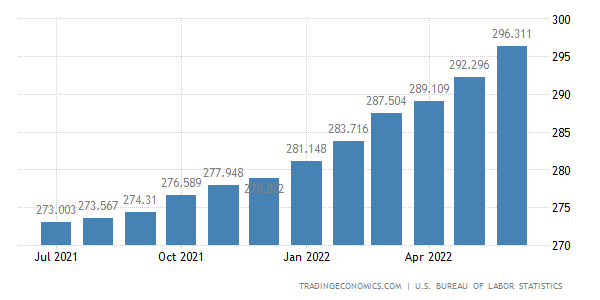
What followed has been a steady ladder-shaped month-by-month increase in the Consumer Price Index (CPI) – the national inflation measure based on the price of a weighted basket of consumer goods and services purchased by households. Inflation crept up 5.4 percent year-on-year (YOY) in July of 2021, 6.2 percent YOY in October, 7.5 percent YOY in January, 8.3 percent YOY in April and YOY 9.1 percent in June.
source: tradingeconomics.com
On Thursday, Treasury Secretary Janet Yellen expressed support for the Federal Reserve’s decision to double interest rates to bring down the “unacceptably high” level of inflation, and assured that the issue was the administration’s “top priority.”
Yellen echoed Mr. Biden’s claims that America’s economic problems were partly Russia’s fault, calling the inflation rate one of the “spillover effects” caused by “Putin’s war” in Ukraine. Yellen added that broken supply chains were part of the problem, and called on G20 economies to “make our economies and our supply chains stronger and more resilient and avoid the sort of costly disruptions that have driven up inflation in America and globally.”
Last month, Fed Chairman Jerome Powell broke with the Biden administration’s “Putin’s price hike” talking point, telling lawmakers at a Senate Banking Committee hearing that “inflation was high before – certainly before the war in Ukraine broke out,” and that the phenomenon is caused by a number of factors, including supply chain disruptions, regulations that constrain supply, and “excessive fiscal spending.”
June’s inflation rate hike constituted the sharpest jump since 1981 – the height of the ‘malaise days’ of raging inflation, low growth, and soaring energy costs. The problem was ultimately resolved by temporarily increasing the interest rate to double digits, easing restrictions on adding to the federal debt, steep government spending cuts and a consumer credit boom.
Record US defence spending approved
Samizdat | July 15, 2022
The US House of Representatives has authorized $840 billion in defense spending in 2023, boosting President Joe Biden’s proposed record military budget by $37 billion.
The annual National Defense Authorization Act (NDAA), which sets military expenditure, was passed on Thursday by a vote of 329-101.
The bill offers $1 billion in aid to Ukraine, including a program to train Ukrainian pilots to fly F-15, F-16 and other US aircraft. The Ukrainians should familiarize themselves with US-made planes “while the administration continues to consider sending such equipment,” said a statement on Congressman Adam Kinzinger’s website last month.
The bill also bans the supply of the F-16s to Turkey unless the US president guarantees to Congress that Ankara has not “violated the sovereignty of Greece, including through territorial overflights” for 120 days prior to the transfer.
Last month, the Senate Armed Services Committee proposed its own version of the budget, attaching an additional $45 billion to Biden’s original plan.
Both chambers will vote for a compromise budget later this year. Jack Reed, the chair of the Senate Armed Services Committee, told Politico magazine on Wednesday that he expects the debate on the matter in September.
The boost to defense spending comes during Russia’s military campaign in Ukraine, and continuing tensions with China over Taiwan and the larger Asia-Pacific.
The US has committed around $5.6 billion in security aid to Kiev after Russia launched its military campaign in late February. The heavy weapons delivered by Washington include M142 HIMARS multiple rocket launchers, M777 howitzers. It has also supplied radars, helicopters, and drones.
The Kremlin has stated that “flooding” Ukraine with foreign weapons would only exacerbate the conflict.
Moscow and Kiev agree to create a “coordination center” on grain exports in Istanbul
Samizdat | July 13, 2022
Russia and Ukraine have agreed to establish a joint coordination center on grain exports in Istanbul that will include representatives from all parties, Turkish Defense Minister Hulusi Akar told local media following the four-way talks that also involved Turkey and the UN.
On Wednesday, negotiators from Russia, Ukraine, Turkey and the UN met in the Turkish city to discuss the situation regarding the held-up Ukrainian exports.
Ahead of the meeting, Ukraine’s Foreign Minister Dmitry Kuleba said that Kiev and Moscow had been close to breaking the impasse on the issue.
“An agreement has been reached on technical issues such as joint controls at the destination points and … the safety of navigation on the transfer routes,” Akar told journalists. Russian and Ukrainian delegations “should meet again in Turkey next week,” he said, adding that the parties would “review all the details once again” during that meeting.
Ukraine is one of the world’s leading grain exporters. Yet, it has been unable to export its grain by sea due to the ongoing conflict with Russia. Kiev and Western nations have accused Moscow of preventing Ukrainian grain shipments from leaving the nation’s Black Sea ports. Russia has denied such accusations and, in turn, blamed Kiev for the crisis, arguing that its forces mined the Black Sea waters, thus creating a threat to the cargo ships.
The West has also accused Moscow of attempting to cause a global food crisis by supposedly blocking shipments of Ukrainian grain and “using hunger as a weapon.”
Last month, President Vladimir Putin said that Russia was not impeding exports and criticized the West for its “cynical attitude” towards the food supply of developing nations, which have been the most affected by the soaring prices. Moscow is ready to provide free passage to international waters for ships carrying grain, he added.
Russia’s oil earnings continue to soar – IEA
Samizdat | July 13, 2022
Russia’s oil export revenue surged above $20 billion in June thanks to rising energy prices and despite lower shipments abroad, the International Energy Agency (IEA) said in its monthly oil market report on Wednesday.
The agency’s statistics showed an increase of $700 million in June from the previous month, even as Russia’s daily exports of crude oil and products fell by 250,000 barrels to 7.4 million barrels, the lowest since August.
The country’s drop in exports last month was led by crude oil, which fell to just above 5 million barrels per day, according to the IEA. Daily flows to the EU fell below 3 million barrels, which is the lowest since November.
Meanwhile, global oil prices have been surging on strong demand and tight supply. The Brent benchmark averaged more than $117 a barrel last month, while Russia’s Urals rose 10.7% from May to average $87.25 a barrel.
Oil and gas revenue accounted for nearly half of Russia’s federal budget in 2021, according to IEA estimates.
Moscow said earlier it expects up to 1 trillion rubles (over $17 billion) in additional oil and gas revenues this year.
Asia Won’t Reject Russia’s Hydrocarbons or China’s Rare Earths Despite US Pressure
By Ekaterina Blunova – Samizdat – July 12, 2022
The International Energy Agency (IEA) and the United State have called upon Asian countries to reduce reliance on Russia and China in terms of both fossil fuels, solar power technology, and critical minerals needed for electric vehicles and batteries.
“Given that energy is the lifeline of modern economies, modern economic growth patterns, there are not that many alternatives available and there are only a few countries that are players in the global energy market. Russia certainly cannot be counted out and Russia cannot be marginalized in the global energy landscape,” says Harsh V. Pant, professor of international relations at the King’s College London India Institute and director of the strategic studies program at the Observer Research Foundation.
International Energy Agency (IEA) Executive Director Fatih Birol and US Energy Secretary Jennifer Granholm on 12 July urged Indo-Pacific countries at the Sydney Energy Forum to diversify their supply chains for energy and critical minerals to reduce “dependency” on Russia over its special operation in Ukraine, as well as on China.
“At a time when the energy prices are going up and affecting some of the poorest and most vulnerable countries around the world very significantly, I think Asian countries will continue to cooperate with Russia in order to support their economies and their domestic requirements,” says Pant.
He explains that dealing with Russia has become an economic imperative at a time of energy crunch given that Moscow is offering discounted oil to a number of countries. Furthermore, maintaining economic relations with Russia is a question of survival and the people’s well-being for some Asian nations and countries of the Global South, according to the professor. Under these circumstances it’s highly unlikely that they will succumb to the pressure from Washington and sever ties with Russia, he says.
“For political leaders across the world, at a time when economies are just beginning to grow after the long COVID pandemic, they can [not] afford a lack of energy and higher energy prices,” Pant stresses.
Anti-Russia Sanctions: India and EU Approaches
To illustrate his point, the professor cites India’s approach to Russia’s affairs and the Ukraine crisis. New Delhi continues to import energy from Russia despite the US and Europe urging India to join sweeping anti-Russia sanctions.
“What we have seen in the last two months is a gradual, significant increase in what India is buying from Russia when it comes to oil,” the professor says. “This is particularly relevant again because Russia has offered India discounted oil and India’s economic requirements demand that India continues buying this oil. The challenges facing India’s population mean that the Indian leadership has an incentive in continuing to engage with Russia on this question.”
At the same time, the European Union’s decision to slap sanctions on Russia and slash energy supplies from the country have backfired on Europe’s economy, sending fuel prices up and accelerating inflation.
“We have seen how Europe is struggling to reduce its dependence and the kind of costs that it is imposing on Europeans,” says Pant. “Most Asian countries would be reluctant to go down that route.”
The disruptions in the supply of crude after the imposition of ban on imports from Russia have given a dramatic boost to energy prices and inflation, echoes Suranjali Tandon, assistant professor at the Delhi-based National Institute of Public Finance and Policy.
“The current inflationary trends are the most serious challenge for policy makers,” she says. “Central banks around the world have begun the process of unwinding loose monetary policy… The current inflation rates have led to internal economic strains and as seen in Sri Lanka, a political upheaval. The cooperation between Russia and Asian countries may be economically prudent.”
Moreover, major Asian economies – India and China – are ready to absorb crude supplies from Russia rejected by the West, according to her.
At the same time, Washington’s plan to force Asian states to join anti-Russia sanctions is fraught with severe risks for the global economy, Tandon warns.
“The ban, if carried out by other Asian economies, will further cut off supplies of refined petroleum and related products,” she says. “This could lead to an unmanageable inflationary spiral while depressing global growth.”
Are There Alternatives to Russia & China?
According to Tandon, India sets an important precedent for other Asian states by withstanding the US pressure when it comes to energy sanctions against Russia. By doing this, India is defending its internal interests in the first place, the professor underscores.
She hails the idea that single technology or fuel dependence should be avoided. This principle could be applied to Russia, China, or Western countries in a similar way. However, when the West is calling upon Asian nations to shift to wind, solar, and even nuclear power and abandon fossil fuels, it’s clear that this shift cannot be done immediately, the professor emphasizes.
Sri Lankan president caught fleeing country
Samizdat | July 12, 2022
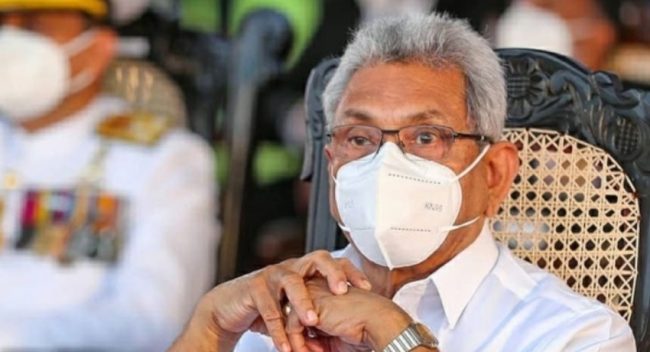
Airport staff refused to stamp the passport of Sri Lankan President Gotabaya Rajapaksa on Monday, preventing the soon-to-be ex-president from leaving the country for Dubai, AFP reported. Driven from office by mass protests, Rajapaksa is reportedly looking for other means of escape.
Immigration officers refused to enter the VIP suite at Bandaranaike International Airport to stamp Rajapaksa’s passport for exit, AFP’s sources said. Declining to queue with the general public for fear of reprisals, Rajapaksa and his wife spent Monday night at a nearby military base after missing four flights to the United Arab Emirates.
A similar attempt at escape was made by Rajapaksa’s younger brother, Basil, who served as his older sibling’s finance minister until April. According to AFP’s sources, Basil Rajapaksa was prevented from using the airport’s fast-track boarding lane, and left the airport after passengers began protesting.
President Rajapaksa announced on Saturday that he would resign this Wednesday, and is immune from arrest until that point. He is believed to be fleeing to avoid the possibility of being detained once his resignation becomes effective. Officials said that he is considering taking a Sri Lankan Navy vessel to either India or the Maldives.
Rajapaksa’s resignation came after months of protests. Under his leadership, Sri Lanka has been driven to bankruptcy, defaulting on its foreign loan debts in May and introducing fuel rationing earlier this month. The economic turmoil has been blamed on a loss of tourism revenue due to the coronavirus pandemic, and a climate-motivated ban on chemical fertilizers that halved the country’s agricultural output in a matter of months.
Rajapaksa’s government responded to rising costs by printing more money, further accelerating inflation. Concurrently, tax cuts deprived Sri Lanka of vital revenue needed to import food, fuel, and medicine.
As protesters forced their way into Rajapaksa’s presidential palace on Saturday, Prime Minister Ranil Wickremesinghe told opposition party leaders that he too would step down after just two months in office. According to Sri Lankan law, Wickremesinghe will automatically take over as president should Rajapaksa resign as planned on Wednesday, until parliament elects a replacement and an interim all-party government takes over until new elections are called.
Critical Norwegian gas platform and transportation hub forced to shut down
Samizdat | July 12, 2022
A Norwegian gas platform and the transportation hub Sleipner Riser at the same field were shut down on Tuesday after separate gas leaks occurred, operator Equinor said, according to Reuters. The company indicated it was unclear when operations would resume.
“A gas leak at the Sleipner A {platform} occurred yesterday morning,” an Equinor spokesperson stated, adding “No person was injured and production was shut. When we tried to restart, a new gas leak occurred, late Monday night … this time at Sleipner Riser.”
Sleipner Riser is a key hub for the transport of North Sea gas to Britain and Belgium.
“We don’t know when we will back in normal production. The facility is shut,” the spokesperson added.
The incident comes at a time when Europe is facing constrained gas supply as scheduled maintenance halted flows from Russia via the Nord Stream 1 pipeline on Monday. The repairs are expected to take 10 days.
Norway is Europe’s second largest gas supplier and currently meets around 25% of gas demand on the continent, according to S&P global. Its role has come into sharper focus since Russia moved to reduce gas deliveries to Europe.
This month, the Norwegian government ended a strike by the country’s offshore oil and gas workers, who had been demanding wage increases to compensate for rising inflation. The strike, which resulted in the closure of three fields, threatened to exacerbate Europe’s energy crisis.
Featured Video
Seyed M. Marandi: Toward Total War in the Middle East
or go to
Aletho News Archives – Video-Images
From the Archives
The Geopolitics behind the War in Yemen (I)
By Mahdi Darius NAZEMROAYA | Strategic Culture Foundation | 30.03.2015
The United States and the Kingdom of Saudi Arabia became very uneasy when the Yemenese or Yemenite movement of the Houthi or Ansarallah (meaning the supporters of God in Arabic) gained control of Yemen’s capital, Sanaa/Sana, in September 2014. The US-supported Yemenite President Abd-Rabbuh Manṣour Al-Hadi was humiliatingly forced to share power with the Houthis and the coalition of northern Yemenese tribes that had helped them enter Sana. Al-Hadi declared that negotiations for a Yemeni national unity government would take place and his allies the US and Saudi Arabia tried to use a new national dialogue and mediated talks to co-opt and pacify the Houthis.
The truth has been turned on its head about the war in Yemen. The war and ousting of President Abd-Rabbuh Manṣour Al-Hadi in Yemen are not the results of «Houthi coup» in Yemen. It is the opposite. Al-Hadi was ousted, because with Saudi and US support he tried to backtrack on the power sharing agreements he had made and return Yemen to authoritarian rule. The ousting of President Al-Hadi by the Houthis and their political allies was an unexpected reaction to the takeover Al-Hadi was planning with Washington and the House of Saudi. … continue
Blog Roll
 Aletho News
- HE SAVED LIVES. NOW HE FACES PRISON.
- Israeli lobby seeks to bind US fate to ‘Israel’: Araghchi
- Pakistan-Iran talks secure LNG shipment to Islamabad through Hormuz
- Black Sea grain crisis puts global wheat supplies under pressure
- IRGC air defenses destroy another US MQ-1 drone over Strait of Hormuz
- Imran Khan’s entire immediate family detained in Pakistan ahead of mass protest demanding his release
- EU nation detains former presidential frontrunner
- Leaked: Britain’s Sham Conviction Of Hashim Thaci
- Seyed M. Marandi: U.S. Strike Imminent – Toward Total War in the Middle East
- Russia Voted Under Fire. Washington Is Loading the Tankers.
- If Americans Knew
- Israeli Attacks in Gaza Kill at Least Seven Palestinians Over Three Days, including Woman and Child
- Trump’s militarization of Washington DC as he pursues Israel’s war against Iran
- Why Israel Fears This Searing New Documentary
- Huckabee aide solicited cash gifts from Israelis
- This isn’t sci-fi, AI is already killing people
- ‘The Most Brutal Thing’: Investigation Reveals Execution of Elderly Woman in Rafah
- Inside Israel’s ‘soft’ ethnic cleansing plan for Gaza through the eyes of its victims
- New online database tracks pro-Israel political donations in the United States
- Israeli president pardons soldier convicted for killing wounded Palestinian
- Singer Ed Sheeran says his ‘heart broken’ by Gaza devastation, addresses Macklemore controversy
- No Tricks Zone
- 2025 Nature Paper Claiming Worsening Global Drought Gets RETRACTED …Heavily Flawed
- New Study: ‘Global Drought Shows No Detectable Recent Acceleration Under Climate Warming’
- Economic Masterminds: German Socialists Suggest Taxing Productivity Gains Stemming From Using AI
- The South China Sea Has Not Been Cooperating With The Climate Change Narrative
- Energy Crisis: Germany Enters Heating Season With Historically Low Gas Reserve Fill Levels
- New Study: The Antarctic Ice Sheet Gained Mass From 2020-2024 Due To Staggering Snow And Ice Accumulation
- Study: Ocean Heating Rates From Thousands Of Years Ago ‘Dwarf’ Modern Ocean Heating Rates
- Climate Extremists Target, Attack Large-Scale Power Grid Infrastructure In Germany!
- New Study: Antarctic Ice Melt Has Contributed Less Than 1 Centimeter To Sea Level Rise In The Last 30 Years
- Fear Of Debate: Alarmist German Climate Scientist Calls On Mainstream Media To Discredit Skeptic Voices
 Aletho News