Referendum on Joining Russia Not On Current Agenda of Kherson Region – Authorities
Samizdat – 04.06.2022
SIMFEROPOL – A referendum on joining Russia is currently not on the agenda of the Kherson region, which plans to focus on returning to normal life first, Kirill Stremousov, the deputy head of the regional military-civil administration, told Sputnik.
“Today, the priority for us is the stabilization of life in the Kherson region. Issues of paying pensions, social benefits, and launching the region’s economy are being resolved. The referendum is not on the agenda today,” Stremousov said.
He added that a referendum is possible after the situation in the region fully stabilizes.
On Tuesday, Stremousov told Sputnik that the Kherson region plans to hold a referendum on joining Russia, and it is estimated that at least 60-70 percent of the local population will agree to become a part of Russia.
Russia launched its special military operation in Ukraine on February 24, after the Donetsk and Lugansk People’s Republics (DPR and LPR) appealed for help in defending themselves against Ukrainian provocations.
Moscow has said that the aim of its special operation is to demilitarize and “denazify” Ukraine. In response to Russia’s operation, Western countries have rolled out a comprehensive sanctions campaign against Moscow and have been supplying weapons to Ukraine.
The Russian military has already taken control of the Kherson Region in the south of the country and part of the Zaporizhzhia Region. Military-civilian administrations have been formed in the regions, broadcasting of Russian TV channels and radio stations was launched, and trade ties with Crimea are being restored.
Global food crisis a result of policy mistakes by US and EU: Putin aide
Samizdat | June 3, 2022
The looming global food crisis that could result from skyrocketing food prices was enabled by a series of policy mistakes by Washington and Brussels, Maksim Oreshkin, economic adviser to Russian President Vladimir Putin, told RT.
The conflict in Ukraine alone could not have caused the crisis on such a massive scale, Oreshkin said.
The UN Food and Agriculture Organization’s international food price index shows that between April 2020 and April 2022, global food prices rose by more than 60%. The increase occurred for the most part before February 2022, when Russia launched its military operation in Ukraine.
In the four years from 2016 to 2020, the index grew by less than 7 points, but it increased by a whopping 27 points, from 98.1 to 125.7, in 2020-21. After the second year of the pandemic, the index stood at 141.1.
Since Russia’s military operation began, the index has risen by a further 17 points.
“Swings like that, with such huge increases in prices, are not happening due to one reason. It’s always a combination of a number of reasons which is leading to such a result,” Oreshkin, Russia’s economic development minister from 2016 to 2020, said.
He points to America’s overreaction to the Covid-19 pandemic as one of the first major factors that triggered the food price hikes. Since February 2020, the US “increased the money supply by almost 40%,” he said, adding that the $6 trillion the US printed to support its economy ended up flooding global markets, and led to the rise in food, commodity and energy prices.
Europe’s over-reliance on renewable energy, which drew resources away from food production, and on short-term gas contracts that led to gas price hikes in late 2021, are also significant factors, according to Oreshkin.
In early May, German Economic Cooperation and Development Minister Svenja Schulze said that the focus of some nations on green energy contributed to the food shortage. According to Schulze, up to 4% of biofuel in Germany is made from food and animal feed. “It needs to be reduced to zero, and not just in Germany but potentially internationally,” she told Bild at the time.
Oreshkin said these factors also led to a decrease in fertilizer production, which in turn hit harvests and drove up food prices. The waves of sanctions unleashed by the US and its allies on Moscow after the start of the military operation in Ukraine significantly exacerbated the crisis.
“It’s about a lot of sanctions imposed on the different fertilizer producers in Belarus, in Russia, it’s sanctions on ships, it’s sanctions on payments which halted trade,” he said, adding that Russia and Belarus both want “to export more food … more fertilizers,” but the “sanctions are blocking access to the global market and, of course, limit supply.”
According to Oreshkin, the 20 million tons of wheat supposedly blocked in Ukraine, which has become a hot topic among Western politicians and media, account for 2.5% of global wheat production. He also stated that Russia is prepared to partially substitute potential losses of Ukrainian wheat by exporting 13 million more tons this year than in 2021.
He also pointed to global food inequality as a root cause. “In reality, there is enough food on this planet,” but developed nations such as the US are simply consuming much more food than the others, he said, adding that people in the US consume on average “more than 50% calories per day more” than people around the world.
“They’re printing the money, they’re taking all the food, and of course they are taking the food from those who cannot afford it.”
He added: “if countries like the United States consume less, there will be enough food for everyone.”
Political West ‘shocked’ by polls indicating most of world population likes Russia
By Drago Bosnic | June 3, 2022
Russophobia is defined as a racist or supremacist attitude towards Russia, its people, culture, etc. It most certainly isn’t a new phenomenon and it has intermittently been spiking or subsiding at various historical stages. This is especially true for the political West and their client states, particularly those with predominantly (neo)liberal views. In the last several months, especially since the start of Russia’s special military operation, this hatred has reached levels which can only be described as borderline mass psychoneurosis. Oftentimes, it’s so extreme, that it should be treated by highly trained medical specialists such as psychiatrists and studied thoroughly by clinical psychologists.
There were some claims that anti-Russian sanctions and generally anti-Russian actions of various Western institutions, governments and supranational organizations were not aimed against the Russian people, Russian culture, language, etc. And yet, this is precisely what has been happening. Sanctions imposed on Russia were designed specifically to target and bring down the Russian economy. And it’s not even a conspiracy theory, as most Western leaders openly stated this was their primary goal.
This attempt didn’t only fail miserably, but it even backfired, sending Western markets into a frenzy of high inflation and economic stagnation (or even recession), otherwise known as stagflation, a dreadful and volatile mix for anyone’s economy. And yet, the political West didn’t only fail to address the mounting issues resulting from their own actions, but they also decided to capitalize on these exact problems to push for more Russophobia by blaming Russia for literally everything.
That’s precisely how we got the mythical “Putin’s price hike” in the US, which started over a full year before Russia’s special military operation. However, even in the atmosphere of raging, media-incited hatred, people affected by the so-called “Putin’s price hike” are well aware this has nothing to do with Russia’s president. And yet, the hatred not only needs to be kept alive, but also fanned up to new extremes.
The latest trend is to blame Russia for global food shortages, including the shortages of baby food in the US. Some Western officials went as far as to blame Russia for the widespread man-made famine which has been ravaging Yemen for the last 7 years. One problem with this, however, is the involvement of the political West and its regional allies and clients, which have been keeping Yemen in a state of perpetual siege, blocking food imports and bombing the country daily. The sheer amount of hypocrisy and mental gymnastics necessary for one to blame Russia for the war crimes committed by the political West requires a thorough analysis in itself. Some of it medical.
When it comes to global food shortages, they can only be explained as entirely man-made. Russia expects a record harvest this year, as do many other countries. So, how come there is a shortage announced months in advance? Well, we should ask those announcing it. The statements about coming food shortages also drive up the prices, but the actual reason behind it can only be explained by Western sanctions which are preventing normal trade between Russia and other countries which need Russian food. The political West is also using this to capitalize on Russophobia, by blaming the Russian counteroffensive in Ukraine as the reason behind food shortages. A portion of the accusations is heavily focused on the nonexistent Russian blockade of Ukrainian ports. But the crews of ships stranded in Odessa, Nikolayev and Kherson tell a very different story. It was the Kiev regime’s placement of thousands of sea mines that makes sea transit from Ukraine virtually impossible.
But, it’s all Russia’s fault in the minds of clinical Russophobes. And no matter how much evidence is presented to disprove this false narrative (just one of many), they will find ways to spin it to their advantage. Still, the vast majority of the world simply doesn’t believe any of it. And the fact that the world doesn’t fall for Russophobia and anti-Russian propaganda is what truly “shocks” the political West. The ever-belligerent, (neo)colonialist block cannot comprehend why the world doesn’t share their views. Well, maybe because much, if not most of that same world has suffered tremendously under the jackboot of global (neo)liberalism for decades, centuries even. The most recent polls confirm this. The Guardian published the “shocking” statistics on 30 May.
“The sharp polarisation between mainly Western liberal democracies and the rest of the world in perceptions of Russia has been laid bare in an annual global poll of attitudes towards democracy. The annual Democracy Perception Index covers 52 countries in Asia, Latin America, the US and Europe. Majorities in Greece, Kenya, Turkey, China, Israel, Egypt, Nigeria, Indonesia, South Africa, Vietnam, Algeria, the Philippines, Hungary, Mexico, Thailand, Morocco, Malaysia, Peru, Pakistan, Saudi Arabia and Colombia thought economic ties with Russia should not be cut. Also, positive views of Russia have been retained in China, India, Indonesia, Egypt, Vietnam, Algeria, Morocco, Malaysia, Pakistan and Saudi Arabia. By contrast, among the 31 countries that favoured cutting ties, 20 were in Europe. The countries with a widely held most negative view of Russia included Poland (87%), Ukraine (80%), Portugal (79%), Italy (65%), UK (65%), Sweden (77%), US (62%) and Germany (62%). Thus, negative views of Russia are largely confined to Europe and other liberal democracies,” the report says.
Statistics such as this should always be taken with a grain of salt, as they could easily be rigged to further an agenda, if not through data manipulation, then through ambiguous questions which result in (intentionally) confusing or unclear answers. And yet, the results must be highly disappointing, with the massive trillion-dollar propaganda machine exposed as largely impotent outside of the political West. Long gone are the days when entire nations, such as Serbs, Iraqis or Syrians, among many others, could be demonized and then killed en masse with impunity.
Drago Bosnic is an independent geopolitical and military analyst.
Brazilian front-runner slams US billions for Ukraine
Samizdat | June 2, 2022
Brazilian presidential candidate Luiz Inacio Lula da Silva called out US President Joe Biden in two campaign speeches this week, citing the $40 billion in military aid Washington has pledged to Ukraine. Lula is polling far ahead of the incumbent, Jair Bolsonaro, in the upcoming presidential election.
“Biden, who has never made a speech to give $1 to those who are starving in Africa, announces $40 billion to help Ukraine buy weapons,” Lula said on Wednesday in Porto Alegre. “This can’t be!” he added.
The 76-year-old is the candidate of the leftist Party of Workers (PT), and currently the favorite to win the presidential election in October.
Speaking in Sao Paulo on Tuesday, Lula brought up the $40 billion in another context. How is it possible, he asked, that the world’s supposedly strongest economy is reduced to scouring the globe for baby formula – amid shortages in the US – even as Biden pledges billions in weapons sales to Kiev?
About half of the $40 billion package is directly earmarked for US weapons headed to Ukraine, while the rest would fund the government in Kiev, replenish the depleted Pentagon stockpiles, and fund US military deployments in Europe. Biden signed it on May 21 after both chambers of Congress passed it with token Republican opposition. The physical bill was flown to Asia, where Biden was visiting at the time, so he could formally attach his signature.
Lula has previously criticized Biden over the conflict in Ukraine, saying the US leader could have prevented it, but instead chose to give a blank check to Ukrainian President Volodymyr Zelensky.
“The United States has a lot of political clout. And Biden could have avoided [the conflict], not incited it,” Lula said in an interview with Time magazine in early May.
“And now we are going to have to foot the bill because of the war on Ukraine. Argentina, Bolivia will also have to pay. You’re not punishing [Russian President Vladimir] Putin. You’re punishing many different countries, you’re punishing mankind,” he added.
Lula was president of Brazil from 2003 to 2010 and remains one of the most popular Brazilian politicians ever. He was convicted on corruption charges and jailed in 2018 – during the interim presidency that had impeached his successor, Dilma Rousseff – but the conviction was annulled in 2021. The Brazilian Supreme Court ruled that Lula did not receive a fair trial, and cleared him to run for office again.
The most recent polls by Datafolha show Lula with a 21-point lead over Bolsonaro.
The REAL agenda behind the created food crisis
By Kit Knightly | OffGuardian | June 1, 2022
We’re in the early stages of a food crisis.
The press has been predicting this for years, but up until now it always appeared to be nothing more than fearmongering, designed to worry or distract people, but the signs are there that this time, to quote Joe Biden, it “is going to be real”.
Nobody knows how bad it could get, except the people who are creating it.
Because the evidence is pretty clear, it is being deliberately & cold-bloodedly created. We’ve been documenting it for months.
We have Russia’s “special operation” in Ukraine driving up the price of staple foods, wheat and sunflower oil, as well as fertiliser.
We have the sudden “bird flu outbreak” driving up the price of poultry and eggs.
The soaring price of oil is driving up the cost of food distribution.
The inflation caused by huge influxes of fiat currency means families are spending more money on less food.
And as all this is happening, the US and UK (and maybe others, we don’t know) are literally paying farmers not to farm.
It’s pretty clear this is The Great Reset: Food Edition. The lockdown melody with slightly different lyrics. A process of breaking down the structures already in place so we can “build back better” with a more controlled and more corporatised food system
Just as the Covid “pandemic” was said to highlight “weaknesses in the multilateral system”, so this food crisis will show that our “unstable food systems are in need of reform” and we need to ensure our “food security”…or a thousand variations on that theme.
That’s not supposition. They already started, over a year ago.
The Journal of Agriculture, Food Systems & Community Developments published a paper in February 2021 titled:
Dismantling and rebuilding the food system after COVID-19: Ten principles for redistribution and regeneration
In an interview from July last year, Ruth Richardson the Executive Director of the NGO Global Alliance for the Future of Food literally said:
Our Dominant Food System Needs to Be Dismantled and Rebuilt”
Later, in September 2021, the UN convened the first-ever “Food Systems Summit”, whose mission statement included the line:
Rebuilding the food systems of the world will also enable us to answer the UN Secretary-General’s call to “build back better” from COVID-19.
Writing in the Guardian two weeks ago, George Monbiot, weathervane for every deep state agenda, states with his trademark lack of subtlety:
The banks collapsed in 2008 – and our food system is about to do the same… The system has to change.
But what does “change” and “rebuilt” actually mean in this context?
Well, that’s no mystery, they’ve been talking it up for years.
- It will mean press and politicians alike pushing the WEF’s “planetary health diet”.
- It will mean conditioning children to eat bugs and seaweed.
- It will mean increased pushing of “gene-edited” or genetically modified foods.
- It will mean stigmatising meat-eaters whilst perpetually fluffing veganism.
- It will mean promoting lab-grown “meat” and bacterial slime mixed in giant vats over natural food.
- It will mean “carbon taxes” on red meat and imported food of all kinds.
- It will mean “obesity” taxes on foods high in sugar or fat.
- It will mean propaganda efforts to rebrand staple foods as “luxuries”.
Almost all of these are stories from just the past month or so, many of them talking points at the World Economic Forum’s Davos Conference.
As is almost always the case, the problem to which they’re currently “reacting” already has a series of pre-ordained solutions.
Just as we saw lockdowns break the economy to pieces whilst the billionaire class land record profits whilst corporate megaliths expanded their monopolies, so too will any proposed food security policies end up benefiting the already mega-rich or installing infrastructure for corporate control.
They just announced the building of the largest “cultured meat factory” in the world. Fake meat, of course, can’t be raised at home and is subject to patented processes of creation. Genetically edited or modified plants and animals are likewise subject to patents.
Supranational companies, with profits larger than the budget of some nations, are developing carbon footprint tracker apps which reward people for making the “right decisions”. That could easily be applied to food.
Bill Gates has quietly become the largest owner of agricultural land in the United States. Land on which he can grow new Frankencrops, or which the US government will pay him not to use.
The play is clear: Right now they’re getting ready to tear all our old food systems down, with the stated aim of building them back better.
But better for them, not us.
Biden pitches advantages for US stemming from EU’s Russian oil embargo
Samizdat | June 2, 2022
The US may try to buy some cheap Russian oil after the European oil embargo drives the price down, US President Joe Biden indicated on Wednesday. He aired the idea while talking to media about his administration’s plan to deal with the shortage of baby formula and surging prices for basic commodities such as food and gas.
Biden took credit for keeping US gas prices, currently at all-time highs, from going even higher. He blamed Russia and its military campaign in Ukraine for driving food and energy prices up and said his administration was working hard to deal with the problems.
“The issue that is occurring now is you have Europe deciding that they’re going to further curtail the purchase of Russian oil,” he said, referring to the sixth package of anti-Russian sanctions.
EU members reached an agreement several days ago partially banning imports of Russian crude. The Europeans want to cut oil trade with Russia by 90% by the end of the year. But Russia’s loss of European market may be an opportunity for the US, Biden implied.
“There’s a whole lot of consideration going on about what can be done to maybe even purchase the oil but at a limited price so that it has to be sold,” he said. “There’d be an overwhelming need for the Russians to sell it, and it would be sold at a significantly lower price than the market is generating now.”
The president warned that his administration would not be able to “click a switch, bring down the cost of gasoline” in the near term and that the same was true for food.
Moscow downplayed Biden’s remarks, saying the global oil market would rebalance itself despite EU restrictions.
“Certainly, Russia will not sell anything without a profit. The demand may fall in one place and rise elsewhere. The supply chains reorient as parties seek the best conditions for trade,” Kremlin spokesman Dmitry Peskov said on Thursday.
Inflation is currently the biggest concern for many American voters. Political experts predict that Biden’s Democratic Party may be wiped out at the ballot box come November, unless his administration manages to rein in the surging prices soon.
The White House has repeatedly pointed the finger at Russia, and personally President Vladimir Putin, for the ongoing problems. It even coined the term “Putin’s price hike” to explain why American working families find it harder to make both ends meet with every passing month.
However, food and energy prices were going up globally long before Russia attacked Ukraine in February. The disruption of supply chains amid the Covid-19 pandemic was a major factor. Moscow said Washington’s blame game ignored many causes of the problems, including some that resulted from the US campaign to punish Russia with economic sanctions.
The US banned all imports of Russian oil, liquified natural gas and coal in March.
EU plotting to force Hungary to pay more for oil
Samizdat | June 1, 2022
The EU is reportedly considering imposing import tariffs on Russian crude if any members of the bloc refuse to implement the terms of the newly announced embargo on oil from the country, the FT reported on Wednesday.
Earlier this week, EU member states reached an agreement on a partial ban of Russian crude from the bloc’s market. The cushioned embargo will affect about 75% of Russian oil imports, with that percentage growing to 90% by the end of the year.
However, the measure allows a temporary exemption for pipeline supplies, which was introduced to win the support of Hungary and other landlocked countries that had been blocking the proposal for about a month. The exemption reportedly didn’t come with any agreed timeframe, raising concerns that Budapest may continue importing Russian crude for as long as it wishes.
To avoid this scenario, the EU is seeking tariffs on Russian oil imports if Hungarian prime minister Viktor Orban doesn’t ultimately commit to a cut-off date, according to a senior European Commission official, as quoted by media.
The proposal of tariffs would reportedly require a qualified majority vote among the 27 member states, rather than the unanimity that is needed for normal sanctions, so Hungary could not veto the measure.
“The preferred option is the import ban,” the senior commission official told the FT, adding that tariffs are an “alternative possibility we can look into”.
If imposed, the tariffs are expected to make Russian oil less competitive, potentially forcing Moscow to discount its crude or Hungary and other nations to pay more.
Russian crude delivered through the Druzhba pipeline to Hungary, Slovakia and the Czech Republic, is reportedly 20% cheaper than the alternatives other member states have to use.
Greek Opposition Demands Legal Clarification for Confiscation of Iranian Oil at US Behest
Samizdat | May 31, 2022
ATHENS – Greek largest opposition party, Coalition of the Radical Left – Progressive Alliance (SYRIZA), on Tuesday asked the Greek government to clarify the legal grounds for the confiscation of Iranian oil from a former Russian-flagged tanker at the request of the United States.
“What was the legal basis for the US request for legal assistance in confiscating oil from the tanker? Was the proposal of the [Greek] anti-money laundering authority to continue the detention of the Russian ship contrary [to the US request]? On what legal basis did the ship remain detained during the time between the cancellation of the original decision about its arrest by the anti-money laundering authority and the decision of the one-judge trial court of Chalcis to grant the US request?” the party said in a statement.
The party added that initially, the anti-money laundering authority decided not to confiscate Iranian oil or detain the tanker. US sanctions against Iran are not considered legal by the EU and Greece, the party noted.
The party also asked what actions had been taken for the immediate release of the crew, and why Greece did not receive significant support from the US, which initiated the process of confiscation.
Last Friday, Iran’s armed forces captured two Greek-flagged oil tankers — the Delta Poseidon and the Prudent Warrior — in Persian Gulf waters, reportedly in response to the seizure of the Iranian-flagged tanker Lana in Greek waters in mid-April on suspicion that it was avoiding EU sanctions. The US claimed that the vessel was carrying Iranian crude, subject to US sanctions, and requested that the cargo be handed over to it, despite later reports that it was a Russian-flagged tanker Pegas that had changed its ownership before entering Greek waters.
MIT Weighs In On Energy Storage
By Francis Menton | Manhattan Contrarian | May 26, 2022
As I’ve been pointing out now for a couple of years, the obvious gap in the plans of our betters for a carbon-free “net zero” energy future is the problem of massive-scale energy storage. How exactly is New York City (for example) going to provide its citizens with power for a long and dark full-week period in the winter, with calm winds, long nights, and overcast days, after everyone has been required to change over to electric heat and electric cars — and all the electricity is supposed to come from the wind and sun, which are neither blowing nor shining for these extended periods? Can someone please calculate how much energy storage will be needed to cover a worst-case solar/wind drought, what it will consist of, how long it has to last, how much it will cost, and whether it is economically feasible? Nearly all descriptions by advocates of the supposed path to “net zero” — including the ambitious plans of the states of New York and California — completely gloss over this issue and/or deal with it in a way demonstrating total incompetence and failure to comprehend the problem.
And then suddenly appeared in my inbox a couple of weeks ago a large Report with the title “The Future of Energy Storage: An Interdisciplinary MIT Study.” MIT — that’s America’s premier university for matters of science and technology. The Report is 378 pages long, full of lots of detail, charts and graphs, mathematical equations, and technical jargon. It lists as authors some 18 members of the MIT faculty. Surely, if anyone can address this “net zero” energy storage problem competently, these will be the people.
Sorry. This is a product of modern American academia. MIT is as extreme left as any of them.
Having now spent about a week trying to wade through this morass, I am not impressed. The Report is an exercise by genius would-be central planners concocting enormously complex models that just happen to come to the results that the authors are hoping for, while at the same time they avoid ever directly addressing the critical question, namely what is the plan to get through that worst case sun/wind drought. Implicit in every page of the Report is that it is an advocacy document for the proposition that the U.S. should embark full speed ahead on crash “net zero” plans for our multi-tens-of-trillions-of-dollars economy without ever doing any kind of demonstration project to show it can work on any scale no matter how small.
You start to get an idea where this is going at the very beginning, when you come on page romanette v to a list of members of an “Advisory Committee” that appears to have given direction to the project. Members include John Podesta of the Center for American Progress, someone from the Environmental Defense Fund, an “Alternative Energy Research” guy from the Bank of America, an ex-World Bank guy (the World Bank being an organization dedicated to keeping poor countries from having access to energy that works), an environmental bureaucrat from the Massachusetts state government, several people from other alternative energy investors and environmental advocacy groups, and so forth. Clearly, this Report had to come to a pre-determined conclusion that energy storage issues do not pose any major impediment to net zero ambitions.
This being a product of left-wing academia, you can expect the usual touching faith in the ability of the federal government to solve all problems, no matter how intractable, by the magic of spending money out of the infinite federal pile. Thus, early in the Executive Summary, we find a recognition that the only battery storage technology currently being deployed in large amounts in commercial applications — namely Lithium Ion — cannot provide backup for periods longer than about 12 hours:
Li-ion batteries will continue to be a leading technology for EVs and for short-duration storage, but their storage capacity costs are unlikely to fall low enough to enable widespread adoption for long-duration (> 12 hours) electricity system applications.
OK then, what is the technology that will step up for the periods of a week or two that may need to be covered in a world without fossil fuels. From page xv:
To enable economical long-duration energy storage (> 12 hours), the DOE should support research, development, and demonstration to advance alternative electrochemical storage technologies that rely on earth-abundant materials. Cost, lifetime, and manufacturing scale requirements for long-duration energy storage favor the exploration of novel electro-chemical technologies, such as redox-flow and metal-air batteries that use inexpensive charge-storage materials and battery designs that are better suited for long-duration applications. (Emphasis in original).
The feds will “support research” into “novel technologies,” of course using the infinite money pile, and the technology will magically appear. And what exactly is the technology that will then emerge to rescue us? They have no idea:
While several novel electrochemical technologies have shown promise, remaining knowledge gaps with respect to key scientific, engineering, and manufacturing challenges suggest high value for concerted government support. Innovation in these technologies is being actively pursued in other countries, notably China.
You’ve got to hate those “knowledge gaps,” but clearly all that is needed to fill them is enough federal funding. And you can’t let those Chinese beat us!
Well, how about just using that ubiquitous element hydrogen, easily available through the electrolysis of water? They discuss that too:
[H]ydrogen produced via electrolysis can serve as a low-carbon fuel for industry as well as for electricity generation during periods when VRE [variable renewable energy] generation is low. . . . We support the effort that the DOE is leading to create a national strategy that addresses hydrogen production, transportation, and storage. In particular, the ability of existing natural gas transmission pipelines to carry hydrogen without suffering embrittlement, either at reduced pressures or if hydrogen is blended with natural gas or other compounds, remains an open question that deserves government-supported study by the DOE and the U.S. Department of Transportation.
Funny that private investors aren’t putting any real money into this “hydrogen economy” thing. That’s because to get hydrogen out of water is extremely costly, and once you have it, it is inferior to natural gas in every way as a source of energy for the people. It’s less dense, more dangerous, and more difficult to transport and store. But again, throw in some of the infinite pile of federal money and it will all magically work.
Many of the charts and graphs are very complicated and technical, but if you spend some time with them, you start to realize that they are an insult to your intelligence. I’ll give you just one of my favorites, this one from page 191. Here we are considering what the electricity generation system will look like for two regions, the Northeast (New York and New England) and Texas, in various low and no-carbon scenarios. The cutoffs of 0g, 5g, 10g and No Limit at the left refer to how much carbon emissions are allowed per kWh of electricity generated.
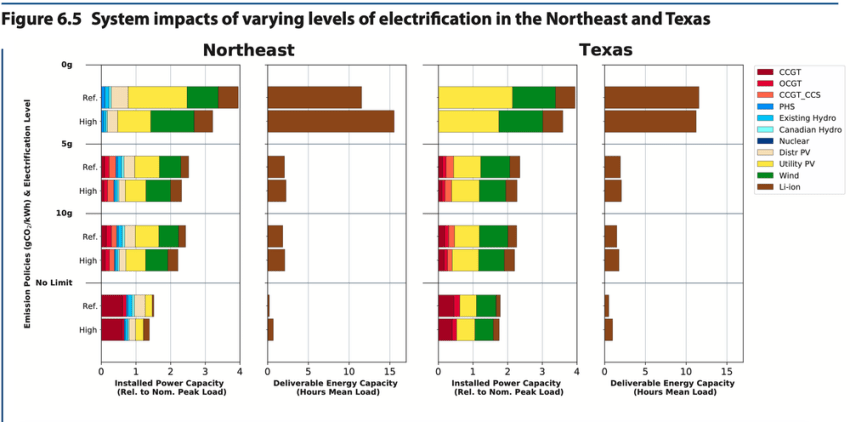
Thus at the top right we see what a zero-carbon scenario will look like for Texas. Supposedly, with about a 3 to 4 times overbuild of a system having only wind and solar generation, then we will only need battery storage for about 50% of capacity and about 11 hours duration. Really? Does anybody remember February 2021? Texas’s wind and solar generators produced at less than 10% capacity for days on end. Can a three times overbuild of wind capacity and 12 hours of battery storage solve that? The answer is no. Not even close. And you could get a wind/solar drought of a full week. If you have no fossil fuel backup, you had better have enough storage to cover that.
And if you take some time to study this chart (not saying that I would recommend that) you can find multiple other equally implausible assertions.
Bottom line: I’m not trusting anybody’s so-called “model” to prove that this gigantic energy transformation is going to work. Show me the demonstration project that actually works.
They won’t. Indeed, there is not even an attempt to put such a thing together, even as we hurtle down the road to “net zero” without any idea how it is going to work.
Lavrov: Recent Sanctions Unlikely to Be Lifted, This Is What US Is Telling Allies Behind Closed Doors
Samizdat | May 29, 2022
Russian Foreign Minister Sergey Lavrov says that the latest Western sanctions against Russia were prepared long ago and are unlikely to be lifted.
“The speed with which they were introduced and their volume indicate that they were not created overnight, they were being prepared for quite a while. It is unlikely that these sanctions will be lifted,” Lavrov said in an interview with French broadcaster TF1.
“At least, the US, not publicly but during contacts with its allies, says that when all this [the crisis in Ukraine] is over the sanctions will remain anyway,” Lavrov added.
Lavrov noted that in the wake of these revelations, it’s clear the West’s main priority isn’t defending the Ukrainian regime, which he described as a mere “bargaining chip,” but about curbing Russia’s development. According to the diplomat, the US considers Russia an obstacle to its goal of establishing a unipolar world – a vision “which Washington proclaimed with the submissive consent of Europe.”
According to him, the West was also indifferent to the fact that Ukraine publicly refused to comply with the UN Security Council resolution urging the implementation of the Minsk Accords signed by France and Germany.
At the same time, Lavrov noted that liberating Donbass remains a top priority.
Russia launched a military operation last month with the stated goal of putting an end to war crimes committed by Ukrainian troops against civilians during an eight-year offensive against Donbass. President Vladimir Putin said that for eight years, people in Donbass have been subjected to what he called a “genocide” by the Kiev regime.
German Farmers Set To Lose Up to 3 Million Tonnes of Harvest Due to EU Ukraine-Related Sanctions
Samizdat – 29.05.2022
The European Union is currently working on a new wave of sanctions that might further limit fertiliser imports from Russia and Belarus despite the looming agricultural crisis that may affect millions.
German farmers are sounding the alarm over a potential contraction in their output and further price increases this year caused by the EU’s sanctions against Russia and Belarus, Deutsche Wirtschafts Nachrichten has reported.
EU sanctions imposed in the context of Russia’s special military operation in Ukraine limit fertiliser imports, namely potassium chloride and potash fertilisers, which many European farmers rely upon.
German farmers expect that this year’s output may be 3 million tonnes less than previous years as a result of current measures. The fertiliser shortage will hit grain crops particularly heavily as countries already fear shortages in their global supplies due to the conflict in Ukraine and difficulties in maritime trading routes.
Another aftermath of the EU’s Ukraine-related sanctions targeting fertilisers may be the growth of consumer food prices, the German news outlet warned. In 2021, Europe imported 4.6 million tonnes of a total 13 million of fertilisers from Belarus and Russia. With shipments from these countries limited by April’s sanctions package, the supply shortage is set to raise already high fertiliser prices – and as such consumer prices – even more, farmers warned.
Boosting local fertiliser production in the EU and elsewhere in hopes of reducing prices is also scheduled to confront challenges posed by western sanctions, as manufacturing requires large power consumption and cheap energy sources, both areas which have been impacted by the Ukraine-related measures.
Despite these difficulties, EU countries continue to seek to do away with Russian gas even amid prospects of surging energy prices and unemployment. For his part, Germany’s Minister of Labour and Social Affairs Hubertus Heil has gone on the record as stating that an immediate ban on Russian gas will lead to a notable reduction of jobs in Germany. Heil has called to avoid such an outcome.
EU countries are currently discussing their sixth package of sanctions against Russia and Belarus. With many member-states already experiencing negative economic results from earlier packages, the EU is struggling to negotiate conditions on banning or limiting oil imports from Russia due to the opposition of several countries within the bloc. The new sanctions package also reportedly includes proposals on further limiting fertiliser imports from Russian and Belarusian chemical companies, even as the threat of global hunger and the lack of grain and crops looms.
Poland Wants Billions From Brussels to Support Ukrainian Refugees
Samizdat – 28.05.2022
Over 3.6 million Ukrainians, equivalent to nearly 10 percent of Ukraine’s population, have fled to Poland in recent months, with millions more making their way to Russia, Romania, Germany, Hungary, Moldova, the Czech Republic, and other nations to escape the crisis in their home country.
Poland will need billions of additional euros from the European Union to help support the millions of Ukrainian refugees in the country, Deputy Minister of the Interior Pawel Szefernaker has indicated.
“From the very start we said that the aid we provide costs in the billions, not millions of euros. The European Union’s aid for countries which help refugees should also be counted in the billions – just as it was in the case of Turkey or Greece between 2015-2016”, Szefernaker said, speaking to the Polish Press Agency (PAP) on Saturday.
The official, who is tasked with coordinating Poland’s response to the refugee crisis, complained that the European Commission has yet to transfer any funds to assist the Polish government via its Recovery Assistance for Cohesion and the Territories of Europe (REACT-EU) programme. The fund was topped up with 3.4 billion euros to help members absorb Ukrainian refugees in April by the European Parliament, and is expected to be allocated to EU countries bordering Ukraine, as well as those whose refugee intake is greater than one percent of their total population.
PAP says Warsaw is expected to receive a 144.6 million euro payout from a 400 million euro tranche of funding allocated to five countries, including Poland, Romania, Hungary, Slovakia, and the Czech Republic for refugee assistance. However, even that money has not yet been delivered, with an EC spokesperson saying the European Commission will discuss subsidy agreements with Warsaw “in the coming weeks.”
Szefernaker suggested a separate, new fund needs to be established by the EU to deal with the financial burden. “The measures referred to by the European Commission are not additional measures. These are resources shifted from various other funds that were already in the European Union’s budget”, he said.
The official noted that 95 percent of the remaining funds given to Poland by Brussels were committed to various other investments, and could not be redirected to help refugees.
Over 42 billion euros were earmarked for Poland from the bloc’s REACT cash pile last year, but was frozen over the Polish government’s intransigence on “LGBT-free” zones – municipalities where LGBT “propaganda” marches and other events are banned.
Poland has long been a net beneficiary when it comes to contributions to the EU budget, getting billions more euros than it pays into the bloc, which is funded mainly by Germany, France, Italy, and, until 2020, Britain.
Poland spent years battling Brussels in the mid-late 2010s over EU demands that the country take in refugees from Syria, Libya, Afghanistan, and other countries turned into failed states by US and NATO interventions, with the European Commission finally dropping its “refugee quotas” initiative in 2020 amid Polish, Hungarian, and Czech intransigence.
When the Ukraine crisis exploded in February, Warsaw rushed to accept millions of Ukrainians with open arms, on top of millions more already working and living in the country. Since the 2014 Euromaidan coup, over two million Ukrainians have taken up roles in sectors of the Polish economy, ranging from construction and agriculture to logistics and housework, with Polish businessmen valuing them as a source of cheap but skilled labour.
Featured Video
Seyed M. Marandi: Toward Total War in the Middle East
or go to
Aletho News Archives – Video-Images
From the Archives
The Geopolitics behind the War in Yemen (I)
By Mahdi Darius NAZEMROAYA | Strategic Culture Foundation | 30.03.2015
The United States and the Kingdom of Saudi Arabia became very uneasy when the Yemenese or Yemenite movement of the Houthi or Ansarallah (meaning the supporters of God in Arabic) gained control of Yemen’s capital, Sanaa/Sana, in September 2014. The US-supported Yemenite President Abd-Rabbuh Manṣour Al-Hadi was humiliatingly forced to share power with the Houthis and the coalition of northern Yemenese tribes that had helped them enter Sana. Al-Hadi declared that negotiations for a Yemeni national unity government would take place and his allies the US and Saudi Arabia tried to use a new national dialogue and mediated talks to co-opt and pacify the Houthis.
The truth has been turned on its head about the war in Yemen. The war and ousting of President Abd-Rabbuh Manṣour Al-Hadi in Yemen are not the results of «Houthi coup» in Yemen. It is the opposite. Al-Hadi was ousted, because with Saudi and US support he tried to backtrack on the power sharing agreements he had made and return Yemen to authoritarian rule. The ousting of President Al-Hadi by the Houthis and their political allies was an unexpected reaction to the takeover Al-Hadi was planning with Washington and the House of Saudi. … continue
Blog Roll
 Aletho News
- Finland’s Stubb tells European leaders to calm down
- Defeating Russia on battlefield impossible – Fico
- Finland’s Gender Clinic Reversal
- Massachusetts Wants Mental Health Visits, Why Does Government Use ‘Health’ to Enter Our Homes & Families?
- US lawmaker admits American people footing bill for Trump’s failed aggression against Iran
- Pfizer Gave $500,000 to Groups That Lobbied to End Religious Exemption in Massachusetts
- HE SAVED LIVES. NOW HE FACES PRISON.
- Israeli lobby seeks to bind US fate to ‘Israel’: Araghchi
- Pakistan-Iran talks secure LNG shipment to Islamabad through Hormuz
- Black Sea grain crisis puts global wheat supplies under pressure
- If Americans Knew
- Gaza desperately needs tents, wheelchairs, fuel… and everything else (Israel blocks it all) – Daily Update
- Israeli Attacks in Gaza Kill at Least Seven Palestinians Over Three Days, including Woman and Child
- Trump’s militarization of Washington DC as he pursues Israel’s war against Iran
- Why Israel Fears This Searing New Documentary
- Huckabee aide solicited cash gifts from Israelis
- This isn’t sci-fi, AI is already killing people
- ‘The Most Brutal Thing’: Investigation Reveals Execution of Elderly Woman in Rafah
- Inside Israel’s ‘soft’ ethnic cleansing plan for Gaza through the eyes of its victims
- New online database tracks pro-Israel political donations in the United States
- Israeli president pardons soldier convicted for killing wounded Palestinian
- No Tricks Zone
- 2025 Nature Paper Claiming Worsening Global Drought Gets RETRACTED …Heavily Flawed
- New Study: ‘Global Drought Shows No Detectable Recent Acceleration Under Climate Warming’
- Economic Masterminds: German Socialists Suggest Taxing Productivity Gains Stemming From Using AI
- The South China Sea Has Not Been Cooperating With The Climate Change Narrative
- Energy Crisis: Germany Enters Heating Season With Historically Low Gas Reserve Fill Levels
- New Study: The Antarctic Ice Sheet Gained Mass From 2020-2024 Due To Staggering Snow And Ice Accumulation
- Study: Ocean Heating Rates From Thousands Of Years Ago ‘Dwarf’ Modern Ocean Heating Rates
- Climate Extremists Target, Attack Large-Scale Power Grid Infrastructure In Germany!
- New Study: Antarctic Ice Melt Has Contributed Less Than 1 Centimeter To Sea Level Rise In The Last 30 Years
- Fear Of Debate: Alarmist German Climate Scientist Calls On Mainstream Media To Discredit Skeptic Voices
 Aletho News