France entered ‘war economy’ – Macron
Samizdat | June 13, 2022
France will adjust its six-year military spending plan in the wake of the Russia-Ukraine conflict, President Emmanuel Macron announced on Monday.
Macron said he instructed the government to “carry out a reassessment of the military spending program in the coming weeks, in the light of the geopolitical context.”
France “has entered into a war economy in which I believe we will find ourselves for a long time,” he said during the opening of the Eurosatory arms expo in Paris. The French president said that Russia’s military campaign in Ukraine created “an additional need to move faster and become stronger at a lower cost.”
“As for anyone doubting the urgency of these efforts, we only need take another look at Ukraine, whose soldiers are in demand of quality weapons and are entitled to a response from us,” Macron noted.
France and other NATO members are supplying Kiev with weapons, including armored vehicles, missiles, and drones.
Macron said Europe needs “a much larger defense industry” and should not rely on procuring weapons from elsewhere. The current program entails spending €295 billion ($308 billion) between 2019 and 2025 on modernizing the French military. The annual military budget is set to reach €41 billion ($43 billion) this year and €50 billion ($52 billion) in 2025.
Last month, European Commission President Ursula von der Leyen said that Europe would boost its defense in the wake of the Russia-Ukraine conflict. She said EU countries had announced increases of their defense budgets to an additional €200 billion ($209 billion) in the coming years.
Russia attacked Ukraine in late February, following Kiev’s failure to implement the terms of the Minsk agreements, first signed in 2014, and Moscow’s eventual recognition of the Donbass republics of Donetsk and Lugansk. The German- and French-brokered protocols were designed to give the breakaway regions special status within the Ukrainian state.
The Kremlin has since demanded that Ukraine officially declare itself a neutral country that will never join the US-led NATO military bloc. Kiev insists the Russian offensive was completely unprovoked and has denied claims it was planning to retake the two republics by force.
Lockdowns: the evidence revisited
Professor Marilyn James, Professor of Health Economics, Professor David Paton, Professor of Industrial Economics | Health Advisory & Recovery Team | June 10, 2022
“It is possible that lockdown will go down as one of the greatest peacetime policy failures in modern history” – Professor Douglas Allen[1]
In March 2021, we wrote two sections in ‘Covid-19 the evidence’, namely ‘Economic impacts – the true cost of lockdown’ and ‘Lockdowns – do they work?’. Over a year later, we have revisited not only the financial costs of lockdowns but also the societal costs, the impact on healthcare and the lack of evidence for overall benefit.
Assessing the economic costs of lockdowns and other Covid-19 restrictions is not easy, partly because the pandemic itself would have impacted economic activity independent of Government restrictions. However, we do now have considerable evidence that both voluntary behaviour change and government restrictions have significant economic effects.[2],[3] Further, voluntary changes tend to have most impact on the activity of groups most vulnerable to Covid, whilst Government restrictions have a disproportionate effect on those least vulnerable. This means that not only do most mandatory restrictions have a significant economic impact, but any benefits in terms of reductions in hospitalisations or deaths are minimal.[4]
Many of the immediate economic consequences of lockdowns were masked by the eye-watering amount of money spent by governments on furlough and business support schemes. Given the limited evidence that stay-at home measures and business closures have any significant impact on infection rates[5], the question needs to be asked whether the billions spent paying business to shut down and people not to work could have been used better by building up capacity in the health system. The stay at home message of “protect the NHS” may have been no more than elaborate code for don’t highlight years of dwindling funding that failed to keep pace with growing population and demand in health care, with the NHS entering the pandemic with spending per GDP at the lowest level since 2009.[6]
Although furlough and business support schemes have had success in limiting the impact on unemployment, the longer-term economic consequences of lockdowns are now becoming clear. The lack of spending opportunities during lockdown contributes to a build-up of personal and corporate savings. As restrictions have eased, people begin to spend these savings and, combined with the supply chain issues that have built up in the meantime, sustained inflation is the inevitable result. Even worse, having spent about £70 billion[7] paying healthy people not to work via the furlough scheme and some £150 billion in total on support measures[8], the ability of the government to respond to this lockdown-induced cost-of-living crisis via either tax cuts or increased benefits, is limited due to the hit to public finances caused by lockdown-induced government spending.
It is perhaps no surprise that a series of research papers looking at data from Australia[9], the UK[10], Canada[11] and the US[12], have concluded that the costs of lockdowns exceed any plausible estimate of the benefits many times over.
The pandemic saw one disease prioritised over all others. It is now painfully clear that the “all others” are set to suffer with longer and larger health consequences than those of the covid-19 crisis itself. The report issued by the BMA is terrifying in every sense.[13] At the start of the pandemic 4.24m were waiting for elective treatment this now stands at 6.18m. Ridsdale makes the point “stay home” may well have contributed to excess deaths as people died at home without access to care and government policy prioritised covid above all other health concerns[14]. This figure of 6.18m masks and continues to mask the lack of referrals that occurred. There is no reason to suppose demand has dropped for elective care, yet, since the pandemic there have been 4.51 m fewer elective referrals. The latest figures show some 300,000 are waiting over a year for treatment. Again, this figure is masked by GPs under referring, reporting their ability to make referrals is severely constrained, yet the patients are still sitting at primary care level needing care. If the elective surgical figure continues to remain well below pre pandemic levels, NHS waiting lists will only continue to rise. Add to this routinely soaring long waits of over 12 hours at emergency department level and the gap between target time for cancer surgery and actual time to getting surgery increasing, the health picture created by covid prioritisation in the UK is frightening.
Lockdowns created isolation from our social and working worlds. The latest report from MIND states “Isolation and loneliness have made people’s mental health worse – with young people particularly badly affected.”[15] Similar can be said for older people especially those in care homes. The unintended consequences of removing activity, family and social interaction from the elderly may be more serious than the direct disease consequences of covid, with isolation being listed as cause of death in a number of care homes in the USA.[16]
Given what we now know, it is hard to disagree with the conclusion of Professor Doug Allen’s analysis of lockdown costs and benefits in Canada that “lockdown will go down as one of the greatest peacetime policy failures in modern history.” 1
References
- https://doi.org/10.1080/13571516.2021.1976051
- www.sciencedirect.com/science/article/pii/S0047272720301754?dgcid=rss_sd_all
- https://direct.mit.edu/rest/article-abstract/doi/10.1162/rest_a_01108/107399/Do-Stay-at-Home-Orders-Cause-People-to-Stay-at
- https://link.springer.com/article/10.1007/s42973-021-00077-9
- https://onlinelibrary.wiley.com/doi/10.1111/eci.13484
- https://www.health.org.uk/news-and-comment/charts-and-infographics/health-spending-as-a-share-of-gdp-remains-at-lowest-level-in
- Coronavirus Job Retention Scheme: statistics – House of Commons Library (parliament.uk)
- https://commonslibrary.parliament.uk/research-briefings/cbp-9309/#:~:text=Current%20estimates%20of%20the%20cost,per%20person%20in%20the%20UK
- https://link.springer.com/content/pdf/10.1007/s40592-021-00148-y.pdf
- https://www.cambridge.org/core/journals/national-institute-economic-review/volume/87652BB968C8244B2E478DAA353C7DF9
- https://doi.org/10.1080/13571516.2021.1976051
- https://sites.krieger.jhu.edu/iae/files/2022/01/A-Literature-Review-and-Meta-Analysis-of-the-Effects-of-Lockdowns-on-COVID-19-Mortality.pdf
- https://www.bma.org.uk/advice-and-support/nhs-delivery-and-workforce/pressures/nhs-backlog-data-analysis
- http://dx.doi.org/10.1136/bmj.m3515
- https://www.mind.org.uk/media/8962/the-consequences-of-coronavirus-for-mental-health-final-report.pdf
- https://www.nbcnews.com/news/us-news/hidden-covid-19-health-crisis-elderly-people-are-dying-isolation-n1244853
One in Six Germans Forced to Skip Meals Thanks to Food Price Crunch: Survey
Samizdat – 11.06.2022
Europeans face a perfect storm of soaring inflation, self-inflicted energy price shocks caused by sanctions on Russia, and fears of a looming recession. In Germany, the region’s traditional economic and industrial powerhouse, ordinary people have taken a hit to their wallets, while businesses have warned of large-scale losses and layoffs.
Nearly one in six Germans (16 percent) have been forced to go without regular meals to make ends meet, and another 13 percent may face a similar situation if food prices continue to rise, a new survey by the Institute for New Social Answers (INSA) for Germany’s Bild newspaper has found.
According to the survey, people from low-income households whose income after taxes is less than 1,000 euros per month have been the most heavily affected, with 32 percent of respondents forced to skip meals regularly.
42 percent of those polled also indicated that they are forced to cook more sparingly due to inflation, leaving out certain ingredients in meals, or dessert. Another 41 percent said they rely on supermarket special offers and discounts to stretch their euros as far as possible.
INSA’s study was conducted on 7 June, with a representative sample of 1,002 people queried.
Adolf Bauer, president of the German Association for Social Affairs, told Bild he was “greatly worried” by the survey’s results, saying it was a “clear sign that the measures taken by the federal government to date are not sufficient.” Bauer had previously warned Berlin not to introduce an energy embargo on Russia, saying it would add to suffering among ordinary people caused by out of control energy, food and rent prices.
Verena Bentele, president of the Social Association of Germany, a major Berlin-headquartered socio-political advocacy organization, echoed Bauer’s concerns, saying the figures show that people are “suffering greatly from the increased prices.”
“Members tell us they can only afford pasta and toast. We urgently need the VAT on fresh foods to be abolished and financial relief for those who have so far received nothing from the government’s energy price flat-rate,” Bentele urged.
Germans and other Europeans have faced out of control inflationary and price pressures in recent months, with Handelsblatt reporting double-digit growth on some food items in April. Last month, Deutsche Wirtschafts Nachrichten reported that EU sanctions on fertilizer imports from Russia and Belarus would result in losses of up to 3 million tonnes of harvest in the current year. Europe relied on the two countries for some 4.6 million tonnes of its 13 million tonnes-worth of fertilizer consumption last year, while local production efforts have been hampered by the large amount of energy required to produce them.
Russian President Vladimir Putin has lamented at the European Union’s decision to commit “economic suicide” by depriving itself of cheap and reliable Russian energy supplies, and expressed sympathy for ordinary Europeans and Americans suffering as a result of their leaders’ decision-making. “The truth is that the current problems that millions of people in the West face are the result of many actions by the ruling elites of their states, their mistakes, myopia and ambitions. These elites are not thinking about how to improve the lives of their citizens. They are obsessed with their own selfish interests and surplus profits,” he suggested at a briefing in March.
US policies led to ‘new G8’ – Moscow
Samizdat | June 11, 2022
The United States “with its own hands” pushed the countries, which are not participating in “sanctions wars,” to form a “new Big Eight” group with Russia, the Russian State Duma speaker Vyacheslav Volodin said on Saturday.
Following the launch of Russia’s military offensive in Ukraine in late February, the US, EU, UK and many other countries imposed hard-hitting restrictions on Moscow, making Russia the most sanctioned country in the world.
In a Telegram post, Volodin included a table with IMF data on GDP based on purchasing power parity of countries he calls the “new G8” and of countries forming the current G7 (after Russia’s participation in the bloc was suspended over Crimea’s vote to join the country in 2014, the G8 effectively turned into the G7).
“The group of eight countries not participating in the sanctions wars – China, India, Russia, Indonesia, Brazil, Mexico, Iran, Turkey – in terms of GDP at PPP is 24.4% ahead of the old group,” Volodin wrote.
In his opinion, the economies of the G7 members – the United States, Japan, Germany, Britain, France, Italy and Canada – continue “to crack under the weight of sanctions imposed against Russia.”
“The rupture of existing economic relations by Washington and its allies has led to the formation of new points of growth in the world,” Volodin claimed.
While having serious economic difficulties, the US, according to the Duma speaker, continues “doing everything to solve their problems at the expense of others.” Creating tensions will “inevitably” lead the US to lose its world domination, Volodin stressed.
“The United States created the conditions with its own hands for countries wishing to build an equal dialogue and mutually beneficial relations to actually form a ‘new Big Eight’ together with Russia,” he said.
Meanwhile, on Friday, US Deputy Assistant Secretary of State Eric Woodhouse said that Washington and its allies had realized that they would get “spillovers” of anti-Russia sanctions into their own economies. Their determination in imposing sanctions on Moscow, he claimed, has demonstrated a willingness to “accept those costs.”
US Treasury Secretary Janet Yellen admitted on the same day that the anti-Russia sanctions have made a “huge difference to food and energy prices,” amid record-setting inflation. The remarks followed the statement by the Russian President Vladimir Putin who said that “many years of mistakes made by Western nations” in their economic and sanctions policies have caused “a global wave of inflation, disruption of established logistical and manufacturing chains, a surge in poverty and a deficit of food.”
‘Boeing falls victim to anti-Russia sanctions’
Samizdat | June 10, 2022
Boeing’s decision to pause production of its popular 737 MAX plane may be due to sanctions imposed on Moscow, air safety expert Roman Gusarov told the newspaper Izvestia. Russia provides critical parts and components to the American aircraft maker.
Last week, the Wall Street Journal reported that Boeing had to bring production of narrow-body jets to a halt for 10 days in May due to supply-chain snarls.
“Boeing’s dependence on Russian titanium is extremely high, amounting to about 30-40%, meaning that at least every third Boeing aircraft is assembled entirely from Russian titanium,” Gusarov said, adding that apart from titanium, which is vital to aircraft engineering, the company also imports titanium products from Russian producer VSMPO-AVISMA.
The analyst added that the US aircraft manufacturer previously received nearly finished parts that were produced at a jointly-run factory in the Russian town of Verkhnyaya Salda.
In March, Boeing suspended titanium purchases from Russia, saying that it had substantial inventory of the metal and could secure additional supplies from other sources. This decision was made after Russia was hit with severe sanctions by the US and its allies.
According to Gusarov, the temporary halt in production of the 737 MAX jets could be attributable not only to the suspension of Russian titanium deliveries but also to the global disruption of supply chains. The expert added that the annual global production of up to 600 planes typically involves engaging nearly all of the global manufacturing capacity of the relevant components.
“After all, Russia has also imposed indirect retaliatory sanctions that target supplies of nonferrous metals and products of gas-to-chemicals industry, which are widely used by microchip producers across the world,” Gusarov said, adding that the products for Boeing are made by thousands of global companies.
In March, Bloomberg reported that the ban of Russian aircraft from US airspace could also hit Boeing because the company used to contract giant Antonov An-124 cargo planes, operated by Russia’s Volga-Dnepr Group, to move supplies to its plants in the US.
Grading the uses of the Defense Production Act during COVID Mania
By Jordan Schachtel | June 6, 2022
With President Biden beginning this week by invoking the Defense Production Act (this time, to build solar panels) we figured it’s time to take a look at what happened to the DPA during COVID Mania, and explore how it has been used (abused) since March of 2020.
For starters:
The Defense Production Act is a federal law that was enacted in 1950 after the commencement of the Korean War.
The explanation of the bill, via Congress, goes as follows:
“To establish a system of priorities and allocations for materials and facilities, authorize the requisitioning thereof, provide financial assistance for expansion of productive capacity and supply, provide for price and wage stabilization, provide for the settlement of labor disputes, strengthen controls over credit, and by these measures facilitate the production of goods and services necessary for the national security, and for other purposes.”
In short, these are emergency powers granted to the executive with a precedent for being enacted during an actual war. These powers allow the president to compel private companies to work with the government on developing material goods that are supposed to be used for national security purposes.
During COVID Mania, the DPA has been routinely abused for our manufactured national emergency.
Let’s take a look at how the DPA has been utilized to “fight the virus.”
- March 27, 2020: President Trump defines ventilators and PPE as “essential to the national defense,” and orders GM to start producing ventilators. The move came with bipartisan insistence. We later discovered that ventilators were possibly killing COVID patients.
Grade: F - April 2, 2020: President Trump invokes the DPA to compel several American companies to produce N95 masks. Masks don’t work, though.
Grade: Hysteria Sells - April 28, 2020: President Trump issues an executive order via the DPA to combat food insecurity and “to ensure a continued supply of protein to Americans.”
Grade: Shrug Emoji - January 21, 2021: President Biden invokes the DPA to pursue a “sustainable public health supply chain.”
Grade: Total Scam - March 2, 2021: Biden uses the DPA to give money to Merck so that they can produce more Johnson & Johnson COVID injections
Grade: Facepalm Emoji - September 2021: Biden invokes the DPA to supply fire hose materials to California, citing the climate hoax, because Gavin Newsom’s regime did not effectively manage California’s forests.
Grade: Avoidable Crisis - May 18, 2022: Biden uses the DPA to import baby formula from overseas because American supply became catastrophically short.
Grade: Cringeworthy - June 6, 2022: Biden issues DPA to advance the climate hoax narrative and give government funds to solar panel companies that otherwise would go bankrupt due to the unproductive nature of their businesses.
Grade: Boondoggle
Poles told to forage for wood to heat homes
Samizdat | June 6, 2022
Authorities in Warsaw have allowed citizens to forage for firewood in forests to keep their homes heated amid spiralling energy costs. Poland is in the midst of a coal shortage after banning Russian imports.
“It is always possible, with the consent of foresters, to collect branches for fuel,” Deputy Minister of Climate and Energy Edward Siarka was quoted by Next Gazeta as saying on Monday.
Those wishing to gather wood must first undergo training and obtain permission from the local forestry unit. The report went on to clarify that people can only take branches already lying on the ground, and cannot cut down trees.
“Only branches can be gathered. At the same time, the collected branches cannot be thicker than seven centimeters,” said Katowice Directorate of State Forestry official Marek Mroz.
He explained that branches should be taken to the local forester, who will issue an invoice. Collectors will have to pay between seven and 30 zlotys ($7.02) for approximately 0.25 cubic meters of firewood.
Polish Prime Minister Mateusz Morawiecki’s government has blamed the war in Ukraine for skyrocketing energy costs. Critics, however, say the conflict is only partially to blame, arguing that costs have risen for the past seven years. Inflation in Poland has climbed to 14% in recent weeks, with fuel prices hitting 8 zlotys ($1.87) per liter.
Demand for raw materials in Poland has far exceeded domestic output since a ban on Russian coal was imposed. Throughout the military conflict in Ukraine, Warsaw has been calling for a complete embargo on Russian energy. In March, the EU nation said it would end all Russian energy imports, including oil, gas, and coal by the end of 2022.
According to media reports, Poland’s wood imports from Russia and Belarus stopped completely at the outbreak of the conflict, and those from Ukraine have fallen by around 75%.
Hezbollah: US First Side to Blame for Preventing Lebanon from Gas Drilling
Al-Manar – June 6, 2022
Head of Hezbollah’s Executive Council Sayyed Hashem Safieddine stressed on Sunday that the United States is the first side to blame for preventing Lebanon from gas drilling.
In a local ceremony in south Lebanon, Sayyed Safieddine said “Lebanon has potentials to extract gas and oil off its shores,” calling on the Lebanese state not to subdue to all forms of pressures exerted by foreign sides in this regards.
The Hezbollah official called on the Lebanese state to officially announce the Lebanese maritime borders and the disputed areas, “in order for the Resistance, Army and People to throng together and retrieve Lebanon’s rights regardless of the US stance.”
Sayyed Safieddine in this regard, stressed the importance of Lebanese unity in order to cope with the country’s political and economic crises.
“Resistance is the only choice to defend Lebanon’s wealth and preserve our victories,” he said in remarks carried by Al-Manar.
Biden’s Most Preposterous Lie Is Too Much Even For The Washington Post
By Francis Menton | Manhattan Contrarian | June 03, 2022
When President Biden talks, there may or may not be any connection between what he says and the real world. Yes, you need to give every politician some leeway, since most of what any politician says will fall in the general realm of political exaggeration or hyperbole. But even within the disreputable category of politicians, Biden can take the lack of connection with reality to a whole new level.
You may have your own favorite among Biden’s preposterous statements. For me, the very most preposterous is one that he has been making repeatedly for the past several months, namely that his energy plans, including expansion of wind and solar electricity generation together with fossil fuel suppression, will save American families the very specific amount of $500 per year each. This claim has popped up in multiple places and multiple formulations. One example came in the State of the Union speech back in March, where Biden said, “Let’s cut energy costs for families an average of $500 a year by combatting climate change.”
It’s just not possible for anyone who thinks about the subject for even a few minutes to believe that building more and more wind and solar generation facilities as our primary sources of energy will do anything other than vastly increase the costs of energy for the American people. Even in the early phases of the process, where wind and solar generation are well less than half of electricity generation (and electricity is then only about a third of total energy consumption), you obviously need full backup from some dispatchable source, almost always fossil fuels, to make your electricity grid work. That means that you will come to have two fully redundant electricity generation systems, when previously you had only one to produce the same amount of electricity. Two fully redundant systems can’t possibly be cheaper than just one. Then, if you insist on phasing out the fossil fuel backup and replacing it with battery or some other storage, you have to add the cost of that storage to the mix. Readers here know that the cost of backing up wind and solar electricity generation with battery storage is truly monumental, potentially a large multiple of the entire U.S. GDP. For more on that subject, see some of my prior posts, for example here and here.
And this is not just a question of models and projections that can be debated. As more and more wind and solar generation facilities have been added to the electrical grid in various places, the inevitable dramatic rise in cost to the consumer has in fact occurred. Steven Hayward at PowerLine in a post on Wednesday reproduces graphs showing the results for two of the most enthusiastic adopters of the wind and sun for electricity, California and Australia. Here is the chart for California:
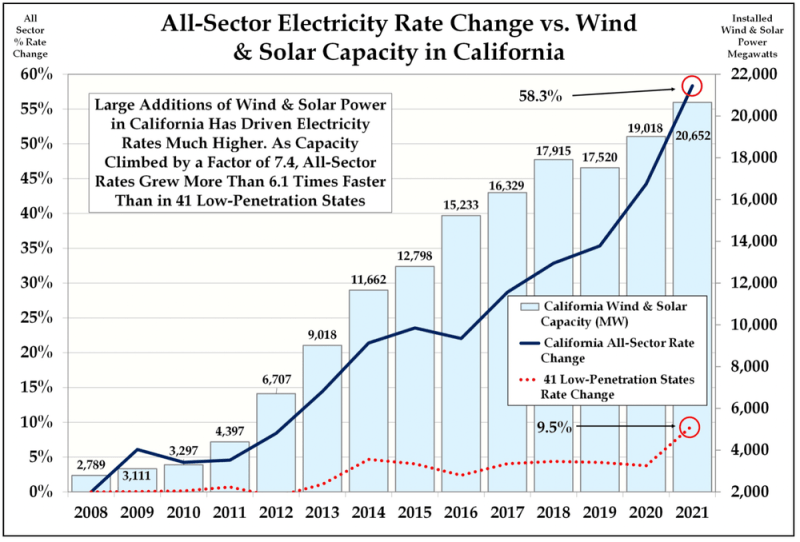
As California has added more and more wind and solar generation, its electricity rates to the consumer have followed a sharply increasing pattern, up some 58.3% from 2008 to 2021. Even after adding all that renewable capacity, the percent of California’s electricity production from the wind and sun in 2020 was still only about a third, according to a February 2022 Report from the California Energy Commission. Thus California has not yet even begun to confront the challenge of phasing out fossil fuel production and trying to back up its electricity grid with batteries — that will occur when the percentage of electricity from intermittent renewables gets past 50%. But note that dotted red line near the bottom of the chart: the 41 states with “low penetration” of wind and solar generation only had rate increases of 9.5% between 2008 and 2021.
And here’s the chart for Australia:
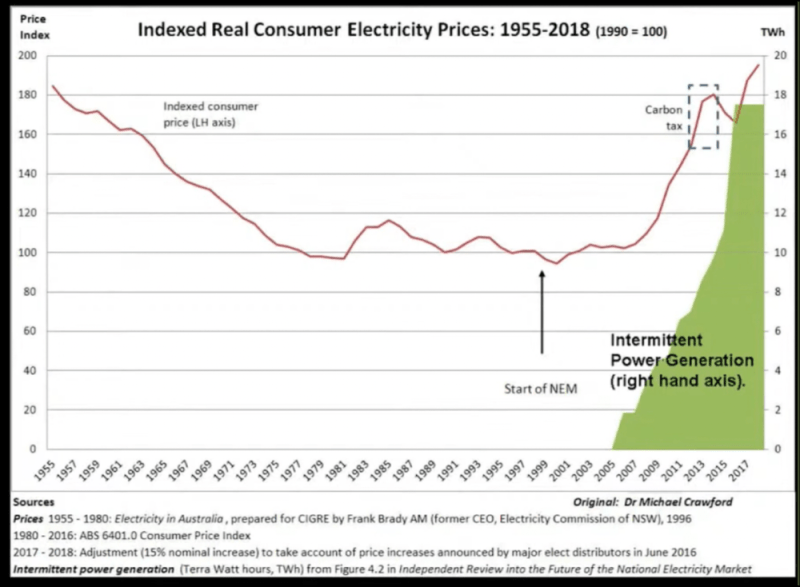
After declining gradually for decades, Australia’s consumer electricity prices have about doubled since 2005. The doubling coincides with the rapid addition of new wind and solar generation facilities since that time. And as with California, Australia’s generation from the intermittent renewables remains well below 50% of electricity generation, meaning that again the vast cost increases inherent in phasing out fossil fuel backup have not yet begun to hit to any significant degree.
Similar patterns of electricity prices soaring as renewable generation increases can be found in other places with high penetration of renewables, for example Germany and Denmark.
With these data and plenty more like them out there, Biden continues to double down on his assertion of the supposed $500 per family per year “savings” from his plan for green energy transition. In a an op-ed published in the Wall Street Journal on May 30, Biden put it this way:
A dozen CEOs of America’s largest utility companies told me earlier this year that my plan would reduce the average family’s annual utility bills by $500 and accelerate our transition from energy produced by autocrats.
That line finally got the Washington Post’s “fact checker,” Glenn Kessler, on the job. Kessler’s June 2 piece has the headline “Biden’s fantastical claim of $500 in annual utility savings.” Kessler started by tracking down a White House transcript of the meeting that Biden held in February with the group of utility executives. There was no mention at all of a supposed $500 projected saving in “annual utility bills”:
But when we located the transcript of Biden’s conversation with utility executives on Feb. 9, we found no reference to $500 in utility savings. The figure was also not mentioned in the White House readout of the meeting.
When Kessler asked the White House for the source of Biden’s number, he was then referred to a report of something called Rhodium Group that projected an approximate $500 per household saving by 2030 not from lower utility bills, but largely from consumers switching to electric cars. Putting aside for a moment whether consumers switching to electric cars could save anybody any money as the government strives to destroy the electrical grid, Kessler points to these obvious flaws in Biden’s statement:
But he didn’t hear that [$500 figure] from utility executives. And the report he is citing is not about household utility-bill savings. Most of the claimed savings comes from the reduced cost of driving. And the estimate is for 2030 — when he would no longer be president, even if he served a second term.
Kessler then awards Biden four Pinocchios. And that’s without even figuring out that Biden’s plan to add more wind and solar to the grid is guaranteed to make electricity prices soar.
‘Putin’s Price Hike’? US National Gas Prices Officially Double Since Biden Took Office
Samizdat | June 4, 2022
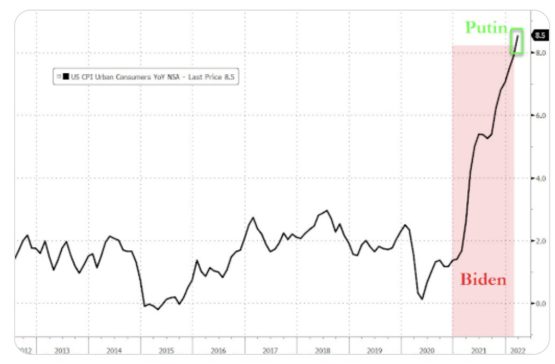
Gas prices began to climb soon after the 2020 election, with President Joe Biden blaming Covid, and then Vladimir Putin, and insisting that his administration’s policies had nothing to do with the situation. The Russian president dismissed Biden’s claims, saying Western ruling elites’ greed, “mistakes, myopia and ambitions” were responsible.
The national average price of a gallon of gasoline has officially more than doubled under President Biden, climbing from $2.39 a gallon on 20 January 2021 to $4.81 a gallon as of Saturday, the American Automobile Association (AAA) has reported.
According to the AAA’s national stats, Californians are paying the most, with the state’s retail price averaging $6.29 a gallon. Meanwhile, observers in northern California outside San Francisco spotted prices as high as a whopping $9.60 a gallon for regular on Friday afternoon. Georgia enjoys the lowest average prices in the union, with its residents paying $4.25 per gallon on average.
For perspective, the Ford F-150, America’s best-selling vehicle, has a 23-gallon fuel tank, meaning that someone who owns one in California would have to spend nearly $145 to fill ‘er-up. Georgian F-150 owners, meanwhile, would have to fork out about $97.75.
Gas prices unexpectedly became a top concern for the Biden administration amid the looming November midterms, with the White House tapping the Strategic Petroleum Reserve this week and expressing support for an OPEC move to boost global output after spending months trying to blame forces outside its ability to control and foreign governments.
Republicans place the blame squarely at the feet of Biden and the Democrats, suggesting that the ruling party’s federal spending programmes and ill-considered push away from hydrocarbons toward renewable energy were responsible.
“Joe Biden’s war on American energy has forced families across the country to empty their wallets to fill their tanks,” RNC Chairwoman Ronna McDaniel said in a statement.
“Unfortunately, Biden is doubling down on his disastrous agenda because he’s not the one paying the price – the American people are.”
Biden Press Secretary Karine Jean-Pierre deflected the administration’s responsibility in a briefing on Tuesday, blaming a resurgent pandemic and Putin. “This – when we talk about the gas prices right now, this is indeed Putin’s gas hike. This is what we have seen in the most recent months of what we’ve seen at the gas pump. And so, that is a fact,” she said.
The Russian president addressed attempts by Biden and other Western leaders to blame him and Moscow for the inflation, food and fuel crunch facing the US and its European allies. “The truth is that the current problems that millions of people in the West face are the result of many actions by the ruling elites of their states, their mistakes, myopia and ambitions. These elites are not thinking about how to improve the lives of their citizens. They are obsessed with their own selfish interests and surplus profits,” Putin said in a briefing back in March.
Grain prices go down after Putin’s pledge
Samizdat | June 4, 2022
Global grain prices have fallen to April levels following Russian President Vladimir Putin’s promise to ensure the safe export of Ukrainian grain through Black Sea ports controlled by Russia.
Wheat was trading at $10.4 per bushel (27.2kg) on Friday, data from the Chicago Board of Trade shows. That was its lowest price since April 7, when it was quoted at $10.2 per bushel, and a 10% drop from its peak price in mid-May.
Prices of corn for animal fodder were also down this week, falling to $7.27 per bushel.
Grain prices rose last month on fears that Russia’s ongoing military operation would prevent Ukraine’s grain exports from reaching buyers. Western countries accused Russia of preventing exports, but Moscow has repeatedly stated that it is not to blame and that the ships carrying Ukrainian grain are unable to leave ports due to mines placed in the area by Kiev’s forces. Putin on Friday once again said that Russia is in no way responsible for holding up shipments and promised to assist in the ships’ passage.
“As for the export of Ukrainian grain, we do not interfere with this… It was not we who mined the passages to the ports. Ukraine mined them. I have already told all of our colleagues many times: [Ukraine] should clear the mines and allow the ships with grain leave the ports. We guarantee peaceful passage without any problems,” Putin said during an interview with the Rossiya 24 TV channel. He also noted that there are several other ways to export grain, including via the ports of Berdyansk and Mariupol, which are under Russia’s control, or via the Danube River, through Hungary, Poland or Belarus.
Fears over the fate of Ukrainian grain have led to warnings of food insecurity and hunger in the past weeks, especially in poorer nations. According to Coldiretti, Italy’s association representing agricultural producers, Ukrainian ships must be allowed to move from ports as soon as possible, especially as the country’s warehouses will soon need to accommodate the new harvest.
“The departure of ships from the ports of the Black Sea means the emptying of Ukrainian warehouses where over 20 million tons of grain including wheat, barley and corn destined for exports are stored… The [ship] blockade raises risks of riots and famine,” Coldiretti said in a statement published on its website on Friday.
Ukraine ranks sixth among the world’s wheat exporters. Together, Russia and Ukraine supply nearly 30% of the wheat exported globally. According to Coldiretti, countries such as Egypt, Turkey, Bangladesh and Iran buy more than 60% of their wheat from Russia and Ukraine, while Lebanon, Tunisia, Yemen, Libya and Pakistan are also heavily dependent on supplies from the two countries.
Featured Video

Seyed M. Marandi: Toward Total War in the Middle East
or go to
Aletho News Archives – Video-Images
From the Archives
The Geopolitics behind the War in Yemen (I)
By Mahdi Darius NAZEMROAYA | Strategic Culture Foundation | 30.03.2015
The United States and the Kingdom of Saudi Arabia became very uneasy when the Yemenese or Yemenite movement of the Houthi or Ansarallah (meaning the supporters of God in Arabic) gained control of Yemen’s capital, Sanaa/Sana, in September 2014. The US-supported Yemenite President Abd-Rabbuh Manṣour Al-Hadi was humiliatingly forced to share power with the Houthis and the coalition of northern Yemenese tribes that had helped them enter Sana. Al-Hadi declared that negotiations for a Yemeni national unity government would take place and his allies the US and Saudi Arabia tried to use a new national dialogue and mediated talks to co-opt and pacify the Houthis.
The truth has been turned on its head about the war in Yemen. The war and ousting of President Abd-Rabbuh Manṣour Al-Hadi in Yemen are not the results of «Houthi coup» in Yemen. It is the opposite. Al-Hadi was ousted, because with Saudi and US support he tried to backtrack on the power sharing agreements he had made and return Yemen to authoritarian rule. The ousting of President Al-Hadi by the Houthis and their political allies was an unexpected reaction to the takeover Al-Hadi was planning with Washington and the House of Saudi. … continue
Blog Roll
 Aletho News
- Finland’s Stubb tells European leaders to calm down
- Defeating Russia on battlefield impossible – Fico
- Finland’s Gender Clinic Reversal
- Massachusetts Wants Mental Health Visits, Why Does Government Use ‘Health’ to Enter Our Homes & Families?
- US lawmaker admits American people footing bill for Trump’s failed aggression against Iran
- Pfizer Gave $500,000 to Groups That Lobbied to End Religious Exemption in Massachusetts
- HE SAVED LIVES. NOW HE FACES PRISON.
- Israeli lobby seeks to bind US fate to ‘Israel’: Araghchi
- Pakistan-Iran talks secure LNG shipment to Islamabad through Hormuz
- Black Sea grain crisis puts global wheat supplies under pressure
- If Americans Knew
- Israeli Attacks in Gaza Kill at Least Seven Palestinians Over Three Days, including Woman and Child
- Trump’s militarization of Washington DC as he pursues Israel’s war against Iran
- Why Israel Fears This Searing New Documentary
- Huckabee aide solicited cash gifts from Israelis
- This isn’t sci-fi, AI is already killing people
- ‘The Most Brutal Thing’: Investigation Reveals Execution of Elderly Woman in Rafah
- Inside Israel’s ‘soft’ ethnic cleansing plan for Gaza through the eyes of its victims
- New online database tracks pro-Israel political donations in the United States
- Israeli president pardons soldier convicted for killing wounded Palestinian
- Singer Ed Sheeran says his ‘heart broken’ by Gaza devastation, addresses Macklemore controversy
- No Tricks Zone
- 2025 Nature Paper Claiming Worsening Global Drought Gets RETRACTED …Heavily Flawed
- New Study: ‘Global Drought Shows No Detectable Recent Acceleration Under Climate Warming’
- Economic Masterminds: German Socialists Suggest Taxing Productivity Gains Stemming From Using AI
- The South China Sea Has Not Been Cooperating With The Climate Change Narrative
- Energy Crisis: Germany Enters Heating Season With Historically Low Gas Reserve Fill Levels
- New Study: The Antarctic Ice Sheet Gained Mass From 2020-2024 Due To Staggering Snow And Ice Accumulation
- Study: Ocean Heating Rates From Thousands Of Years Ago ‘Dwarf’ Modern Ocean Heating Rates
- Climate Extremists Target, Attack Large-Scale Power Grid Infrastructure In Germany!
- New Study: Antarctic Ice Melt Has Contributed Less Than 1 Centimeter To Sea Level Rise In The Last 30 Years
- Fear Of Debate: Alarmist German Climate Scientist Calls On Mainstream Media To Discredit Skeptic Voices
 Aletho News