Von Der Leyen’s Proposal to Reduce Heating Temperature by 2 Degrees ‘Naive’, Analysts Say
Samizdat – 21.06.2022
BRUSSELS – The proposal voiced by European Commission President Ursula von der Leyen to lower domestic thermostats in Europe by 2 degrees Celsius to replace gas supplies from Russia’s Nord Stream 1 is “incredibly naive,” energy experts said on Tuesday.
On Monday, the EC head said that Europeans can replace gas supplies coming via Russia’s Nord Stream 1 pipeline by lowering the heating or air conditioner temperatures by 2 degrees, adding that the EU has comprehensive emergency plans in place, including energy savings.
Samuele Furfari, a professor of geopolitics of energy at ULB university in Brussels, believes that von der Leyen’s proposal is “ridiculous,” as a two-degree reduction in heating cannot replace energy demand of 194 million European households.
“It is incredibly naive of the President of the European Commission to present a 2-degree reduction in domestic heating, for more than 194 million households in the Europe at 27 [countries], as a solution to the end of the supply of Russian gas by Nord Stream 1. It is moreover only the capacity of Nord Stream 1 which would be ‘covered’ by this theoretical and simplistic reduction. There are other gas pipelines delivering Russian gas. She even specifies, since the commission seems to have thought about this ridiculous idea, that it would also apply to air conditioning. We navigate in a pure dream,” Furfari said.
Gas demand is inelastic, so Europe cannot lower the heating in hospitals or schools, and it is “a dream” to believe that EU residents will simply comply with von der Leyen’s proposal, which will “hit people hard” in their comfort zone, he added.
“How are we going to apply this theoretical measure seriously? By installing ‘limited’ room thermostats, such as for car or motorcycle engines? Are we being prepared for Orwell’s society? No EU government is going to accept that Brussels gives them temperature reduction instructions or face sanctions. I am not even talking about the electricity market, which does not work in Europe, with the emphasis wrongly put on pseudo-renewable energies. Obviously, the European Commission is totally stuck, and Brussels does not know what to do. There is no other solution than that of Russian gas supplies for a long time to come. We are waiting for the next ‘brilliant’ idea from the European Commission,” Furfari said.
According to the professor, 70% of the gas consumed in Europe is allocated to the production of heat, and even when Germany relaunches its coal power stations, which emit large amounts of CO2, it will be far too little to compensate for the loss of gas.
Damien Ernst, a Liege university professor in Belgium and a specialist of electromechanical engineering and energy, said that von der Leyen’s proposal shows how much the EU is “at a loss.”
“Europe will suffer terribly in terms of energy prices and scarcity. This astonishing reaction from Ursula von der Leyen is even scary, as she is so naive, and shows how much the EU is at a loss. The EU is not going to send armies of controllers to check the ambient temperature in people’s homes. At best, Europe can only carry out awareness campaigns on the need to save energy,” Ernst said.
If there is a signal that the price will become “astronomically high,” people and businesses will spontaneously reduce their consumption, causing a sharp decrease in demand and reducing the competitiveness of European producers compared to those from Asia and the US, Ernst explained.
“Europe has it all wrong,” he lamented.
AfD spokesman in the Bundestag Economic Affairs and Energy Committee Steffen Kotre, in turn, said that the EC head should advise her German colleagues to immediately open the Nord Stream 2 pipeline, instead of proposing to reduce domestic heating.
“Mrs von der Leyen, the head of the European Commission, should advise Germany to open Nord Stream 2 immediately to compensate for the loss of throughput of Nord Stream 1, and to restart German nuclear power plants for electricity production, rather than make ridiculous statements about the energy savings Europeans should make by reducing their thermostat to compensate for Europe’s misguided policy in the Ukrainian conflict. It would impose a loss of comfort to all the citizens of the union,” Kotre said.
According to the expert, the German federal government is endangering the country’s future with its “energy policy narrow-mindedness,” and the six nuclear power plants, which were shut down at the end of 2021, or scheduled to be shut down at the end of 2022, could replace a significant part of Russia’s natural gas, which is converted into electricity. To cover the rest, the phase-out of Russian gas must be halted.
“Minister [Robert] Habeck’s energy policy is driving our country against a wall,” the professor concluded.
EU Commission comments on Lithuania’s restrictions
Samizdat | June 21, 2022
The EU Commission reiterated its support for Lithuania’s decision to heavily restrict the transit of goods to Kaliningrad Region, Russia. At a regular press conference on Tuesday, European Commission chief spokesman Eric Mamer said the country has merely implemented the EU sanctions on Russia rather than imposing an economic blockade.
“We’re not talking about the Commission giving a recommendation to a country. This is a member state implementing decisions that they have taken when it comes to the sanctions against Russia. And Lithuania is basically doing what it is supposed to do under the sanctions regime,” Mamer stated, noting that the bloc’s stance was “extensively” explained by top EU diplomat Josep Borrell a day before.
Speaking at a press conference on Monday, Borrell insisted that Vilnius’ move does not constitute a blockade against the small exclave sandwiched between Poland and Lithuania, but was merely the implementation of the EU’s sanctions on Moscow, imposed over the ongoing conflict in Ukraine. On Saturday, Lithuania’s national railway operator banned the flow of sanctioned goods between the region and the rest of Russia, citing instructions from the European Commission.
“Lithuania has not taken any unilateral national restrictions. But, in accordance with European Union sanctions, there are import and export restrictions that apply in relation with certain goods, including the prohibition of transit from those goods through European Union territory. Lithuania is doing nothing else than implementing the guidelines provided by the Commission,” Borrell stated.
A similar take on the situation was given by senior Lithuanian officials. Earlier on Tuesday, Lithuanian PM Ingrida Simonyte told public broadcaster LRT that the decision was based on the sanctions imposed by the EU, and not an attempt to escalate tensions with Russia. The flow of non-sanctioned goods and passenger transit will continue uninterrupted, she said.
The Russian government labeled the move an “economic blockade” of Kaliningrad Region, saying it violates the country’s international obligations to ensure the uninterrupted transit of goods to the exclave. Kremlin spokesperson Dmitry Peskov said on Monday that Vilnius’ decision was unprecedented, and in “violation of anything and everything.”
The head of Russia’s Security Council, Nikolay Patrushev, warned that the ongoing “blockade” will trigger a response from Moscow that will “have a serious negative impact on the people of Lithuania.”
“Of course, Russia will respond to hostile actions. Appropriate measures are in the works, and will be adopted in the near future,” Patrushev told reporters during a visit to Kaliningrad on Tuesday.
Explain It to Me, Please
If you want a war with Iran, Russia, China and Venezuela tell me why and how it would benefit Americans
BY PHILIP GIRALDI • UNZ REVIEW • JUNE 21, 2022
So Honest Joe Biden is now going to give another $1.2 billion to the Ukrainians on top of the sixty or so billion that is already in the pipeline, but who’s counting, particularly as Congress refused to approve having an inspector general to monitor whose pockets will be lined. The money will be printed up without any collateral or “borrowed” and the American taxpayer will somehow have to bear the burden of this latest folly that is ipso facto driving much of the world into recession. And it will no doubt be blamed on Vladimir Putin, a process that is already well under way from president mumbles. But you have to wonder why no one has told Joe that the whole exercise in pushing much of the world towards a catastrophic war is a fool’s errand. But then again, the clowns that the president has surrounded himself with might not be very big on speaking the truth even if they know what that means.
Having followed the Ukraine problem since the United States and its poodles refused to negotiate seriously with Vladimir Putin in the real world, I have had to wonder what is wrong with Washington. We have had the ignorant and impulsive Donald Trump supported by a cast of characters that included the mentally unstable Mike Pompeo and John Bolton followed by Biden with the usual bunch of Democratic Party rejects. By that I mean deep thinkers about social issues who would not be able to run a hot dog stand if that were what they were forced to do to make a living. But they are real good at shouting “freedom” and “democracy” whenever questioned concerning their motives.
Indeed, opinion polls suggest that there is a great deal of unrest among middle and working class Americans who see a reversion to Jimmy Carter era financial instability, at that time caused by the oil embargo. Well, there is a new energy embargo in place brought about by the Biden Administration’s desire to wage proxy war to “weaken” Russia. Analysts predict that the costs for all forms of energy will double in the next several months and surging energy costs will impact the prices of other essentials, including food. Given all that, the fundamental issue plaguing both Democrats and Republicans is their inability to actually explain to the American people why the country’s foreign and national security policy always seems to be on the boil, searching for enemies and also creating them when they do not exist, even when the results are damaging to the interests of actual Americans.
That a serious discussion of why the United States needs to have a military that costs as much as the next nine nations in that ranking combined is long overdue and rarely addressed outside the alternative media. The 2023 military budget has been increased from this year’s, totaling $858 billion, and, if one includes the constantly growing largesse to Ukraine, approaching a hitherto unimaginable trillion dollars. The military budget has become a major driver of the country’s unsustainable deficits. The deaths of millions of people directly and indirectly in the wars started in 9/11 aside, the wars of choice have cost an estimated $8 trillion.
The Constitution of the United States makes it clear that a national army was only acceptable to the Founders when it was dedicated to defending the country from foreign threats. Do Americans really believe that bearing the burden of having something like 1,000 military bases scattered around the world really makes them safer? The recent rapid collapse of the security situation in Afghanistan suggests that having such bases turns soldiers and bureaucrats into potential hostages and is therefore a liability. One might also suggest that the insecurity currently prevailing in the country can in large part be attributed to the government’s depiction of numerous “threats” in order to justify both the commitment and the expense.
So where does all the money go? And what are the threats? Starting with a war that the United States is de facto though not de jure involved in, Ukraine, what was the Russian threat that demanded Washington’s intervention? Well, if one discards the nonsense of a “rules based international order” or a plucky little democracy Ukraine fighting valiantly against the Russian bear, Moscow did not threaten the United States in any way before the missiles starting flying. Putin sought to negotiate a settlement with Ukraine based on a number of perceived existential Russian national security interests, all of which were negotiable, but the US and its friends were uninterested in compromise while also plying the corrupt Zelensky regime with weapons, money and political support. The final result is a conflict that will likely only end when the last Ukrainian is dead and it includes the possibility that a misstep by the United States and Russia could lead to a nuclear holocaust. To put it succinctly, what is going on does not enhance US national security, nor does it benefit Americans economically.
And then there is China. Biden let the cat out of the bag on his recent trip to the Far East. He stated that the United States would defend Taiwan if China were to attempt to annex it. In saying that, Biden demonstrated that he does not understand the strategic ambiguity that the US and the Chinese have preferred over the past fifty years as an alternative to war. The White House for its part quickly issued a correction to the Biden statement, explaining that it was not true that Washington is obligated to defend Taiwan. Some uber hawkish congressmen have apparently found the Biden gaffe appealing and are promoting a firm US commitment to defend Taiwan, coupled with a $4.5 billion military assistance package, of course.
At the same time, some officials in the Pentagon and the usual gaggle of congressmen also keep warning about the over the horizon threat from China as an excuse to boost defense spending. Most recently, there was alarm over Chinese participation in a meeting in May in Fiji to consider a China-Pacific Islands free trade pact! In reality, the only serious current threat from China is as an economic competitor. A trade war with China would be a disaster for the US economy, which is heavily dependent on Chinese manufactured goods, but Beijing, with its relatively small military budget, does not pose a physical threat to the United States.
And let’s not ignore Iran which has been hammered by economic sanctions and also through the covert killing of its officials and scientists. The US/Israeli war on Iran has also spilled over into neighboring Syria, where Washington actually has troops on the ground occupying the country’s oil producing region and stealing the oil. Iran’s possible expansion of its nuclear program to produce a weapon was effectively impeded through monitoring connected to a multilateral 2015 agreement called the Joint Comprehensive Plan of Action (JCPOA) but Donald Trump, unwisely and acting against actual American interests, withdrew from it. Joe Biden has been warned by Israel not to re-enter the agreement, so he will no doubt comply with Prime Minister Naftali Bennett’s determination to have Washington continue to apply “extreme pressure” on the Islamic Republic. Does either Iran or its ally Syria threaten the United States in any way? No. Their crime is that they are in the same neighborhood as the Jewish state, which finds the US government easy to manipulate into acting against its own interests.
Finally, in America’s own hemisphere there is Venezuela, which has been elevated to the status of Washington’s most hated nation in the region. Venezuelans have been subjected to increasingly punitive US sanctions, including some new ones just last week, which hurt the poorer citizens disproportionately but have not brought about regime change. Why the animosity? Because the country’s leader Nicolas Maduro is still in power in spite of a US assertion that the country’s opposition leader Juan Guaido should rightfully and legitimately be in charge after a possibly fraudulent election in 2018. The latest therapy applied by the United States on Caracas consisted of blocking the country as well as Nicaragua and Cuba from participating in the recent meeting of the Ninth Summit of the Americas which was held in Los Angeles. A State Department spokesman explained that the move was due to the three countries “lacking democratic governances.” Mexican President Lopez Obrador protested against the move and removed himself from his country’s delegation, saying “There can’t be a Summit of the Americas if not all countries of the American continent are taking part.” The despicable US Senator Robert Menendez of the Senate Foreign Relations Committee then felt compelled to add his two cents, criticizing the Mexican president and warning that his “decision to stand with dictators and despots” would hurt US-Mexico relations. So where was the threat from Venezuela (and Cuba and Nicaragua) and why is the US involved at all? Beats me.
What all of this means is that there is absolutely no standard of genuine national security that motivates the US’s completely illegal aggression in many parts of the world. What occurs may be linked to a desire to dominate or a madness sometimes described as “exceptionalism” and/or “leadership of the free world,” neither of which has anything to do with actual security. And the American people are paying the price both in terms of decline in standards of living due to the upheaval created in Ukraine and elsewhere as well as a completely understandable loss of faith in the US system of government. By all means, let us shrink the US military until it is responsive to actual identifiable threats. Let’s elect a president who will follow the sage advice of President John Quincy Adams, who declared that “Americans should not go abroad to slay dragons they do not understand in the name of spreading democracy.” At this point, one can only imagine an America that is at peace with itself and with what it represents while also being considered a friend to the rest of the world.
Philip M. Giraldi, Ph.D., is Executive Director of the Council for the National Interest, a 501(c)3 tax deductible educational foundation (Federal ID Number #52-1739023) that seeks a more interests-based U.S. foreign policy in the Middle East. Website is councilforthenationalinterest.org, address is P.O. Box 2157, Purcellville VA 20134 and its email is inform@cnionline.org.
‘Stop NATO,’ protesters chant at massive rally in heart of EU
Samizdat | June 20, 2022
A trade union-organized protest numbering 70,000 to 80,000 demonstrators packed the streets of Brussels on Monday, bringing the city to a standstill. In addition to expressing anger at the rising cost of living in Belgium, many condemned the US-led NATO alliance and its involvement in the Ukrainian conflict.
Trade unions said that 80,000 people attended the protest, while police said that the turnout was closer to 70,000, Reuters reported. In addition to packing the streets, the protest led to mass cancellations of flights at Brussels Airport, as unions representing security personnel went on strike. Public transit routes around the city were also operating at drastically reduced capacity.
Inflation hit 9% in Belgium in June, a four-decade high. With spending power declining, protesters demanded salary hikes and tax cuts.
However, many linked their dire economic straits to the EU’s sanctions regime on Russia and with the NATO alliance’s rush to arm Ukraine.
Protesters demanded that their leaders “spend money on salaries, not on weapons,” and chanted “stop NATO.”
While similar protests against rising costs have taken place across Europe as of late – thousands of trade unionists marched in London on Saturday – few have linked the soaring prices with the actions of NATO and its members.
Just three months ago, some protesters in Brussels waved Ukrainian flags and demanded that the EU cut itself off from “Putin’s Oil.” Weeks before that, there was a demonstration outside European Parliament buildings calling for “sanctions for Russia.”
Brussels is home to headquarters of both the EU and NATO. It was also the city from where US President Joe Biden chose to announce a round of sanctions on Moscow in March, before immediately telling a reporter that “sanctions never deter” those targeted by them.
Despite predicting in April that these measures would “wipe out the last 15 years of Russia’s economic gains,” Russia’s energy earnings have hit record levels since February, and the Russian ruble is currently at a seven-year high against the euro.
Russian President Vladimir Putin has accused European countries of committing economic “suicide” via sanctions, and predicted last week that the EU’s “direct losses” from this sanctions policy “could exceed $400 billion in a year.”
Iran and Russia Revive the North-South Transport Corridor
By Vladimir Platov – New Eastern Outlook – 20.06.2022
Following agreements reached during the January official visit to Moscow by Seyyed Ebrahim Raisi, President of the Islamic Republic of Iran, to further develop and deepen bilateral relations between Iran and Russia, the countries have decided to jointly revive the North-South Transport Corridor. This decision has become particularly relevant against the background of the unlawful sanctions policy pursued by the United States and its Western allies against Russia and Iran, and Tehran’s and Moscow’s desire to establish trade routes that are not linked to the West.
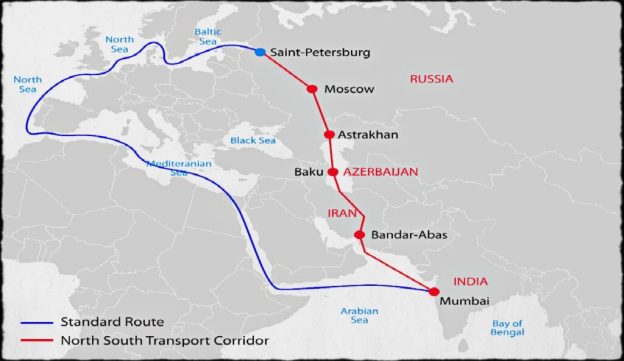
In order to implement this decision, Iranian authorities are seeking to revive the recently stalled International North-South Transport Corridor (INSTC) project, which traverses Russian and Iranian territory and the two countries’ waters to connect with Asian export markets. As the Islamic Republic News Agency (IRNA) reported on June 11, in order to implement the International North-South Transport Corridor, the Islamic Republic of Iran Shipping Lines (IRISL) has initiated the transit of cargo from Russia to India or to South Asia through the project, using just one consignment note for the entire transit route.
According to Dariusz Jamali, director of the joint Iranian-Russian terminal in Astrakhan, such transits have taken place occasionally in recent times. However, this route has clear advantages: lower transport costs (such as port and customs charges in particular),shorter waiting periods for containers, faster delivery of goods, elimination of dangers in transferring empty or full containers, issuance of legal documents and compensation for possible losses, and faster banking transactions.
The first pilot Russian-Iranian transit proposed by IRISL consists of two 41-ton containers of wood laminated plastic. The consignor is in St. Petersburg and the transit port is Astrakhan. The cargo will then be transported by the Caspian Sea to the northern Iranian port of Anzali (Bandar-e Anzali) and then by road through Iranian territory from the port of Anzali to the southern port of Bandar Abbas on the Persian Gulf and further by sea to the Indian port of Nhava Sheva. IRISL is the operator. The estimated delivery time is 25 days.
It is assumed that the main Russian exports through Astrakhan could be cereals (wheat), timber and scrap metal.
This transport corridor could go to Afghanistan via Iran’s Sistan and Baluchestan Province. The plan for further joint use of the North-South Transport Corridor even includes the construction of a railway line that could bring goods arriving at Iranian Caspian Sea ports to the south-eastern port of Chabahar. In addition, the construction of a railway line from Chabahar to the Hajigak iron ore mine in Afghanistan, where India has made large investments, is also under consideration.
The International North-South Transport Corridor emphasizes the Russian port of Astrakhan and the Iranian Chabahar as bases for further transport to Eurasia. The development of the latter, as well as the construction of a large petrochemical complex and an export terminal near the port of Jask, are projects being implemented by the Iranian government as part of the Mokran coastal development strategy.
Nevsky Shipyard, which produces multipurpose dry-cargo ships of RSD49 (deadweight of 7150 tons, container capacity of 289 TEU) and 005RSD03 (container capacity of 225 TEU) projects, is also engaged in the work of the North-South transit corridor in building ships for the Caspian Sea.
As part of its increased participation in the North-South Transport Corridor, Iran is considering expanding international road transport cooperation with the countries participating in the Transport Corridor Europe-Caucasus-Asia (TRACECA) program, the Tehran Times reported, citing the Iranian Ministry of Roads and Urban Development. This issue was brought up in particular during a meeting between Aset Assavbayev, Secretary General of the Permanent Secretariat of the TRACECA International Transport Program, and Dariush Amani, Head of Iran Road Maintenance and Transportation Organization (RMTO). The negotiations focused on developing international road transport cooperation with TRACECA member countries and increasing the volume of transit traffic along the corridor. As you may know, the TRACECA International Transport Program, in which the European Union and 12 countries of Eastern Europe, Southern Caucasus and Central Asia now participate, was set up in Brussels in May 1993. The aim of the program is to strengthen economic ties, trade and transport links.
Russian Foreign Minister Sergey Lavrov plans to visit Iran in the near future to discuss, among other things, further steps of cooperation between Russia and Iran. The year 2022 has already seen two important visits in Russian-Iranian interaction. First, Iranian President Ebrahim Raisi’s visit to Moscow in January 2022, which was a clear diplomatic breakthrough for the new head of the Iranian government. And second, Russian Deputy Prime Minister Alexander Novak’s visit to Iran in May, which took place against the backdrop of unprecedentedly harsh sanctions imposed by the West in the wake of the Ukrainian events. The biggest change in regional policy is undoubtedly the prospect of a full-fledged free trade area (FTA) agreement with the EEU. It is expected to be signed by the autumn of this year to replace the interim FTA that came into force on October 27, 2019, and which has already had a positive impact on bilateral trade between Russia and Iran.
In the rapprochement between the two countries, Moscow takes into account the compromise position taken by Iran after the start of Russia’s special operation in Ukraine: while not proclaiming its support for Russia’s actions per se, Tehran has not joined the wave of international condemnation of Moscow, instead placing the main blame for what is happening on the US and NATO. Russia also takes into account that Iran’s potential as an economic partner far exceeds the current level of relations.
West at inflection point in Ukraine war
BY M. K. BHADRAKUMAR | INDIAN PUNCHLINE | JUNE 19, 2022
Henry Kissinger predicted some three weeks ago that the Ukraine war was dangerously close to becoming a war against Russia. That was a prescient remark. The NATO Secretary-General Jens Stoltenberg in a weekend interview told Germany’s Bild am Sonntag newspaper that in the alliance’s estimation, the Ukraine war could wage for years.
“We must prepare for the fact that it could take years. We must not let up in supporting Ukraine. Even if the costs are high, not only for military support, also because of rising energy and food prices,” Stoltenberg said. He added that the supply of state-of-the-art weaponry to Ukrainian troops would increase the chance of liberating the Donbass region from Russian control.
The remark signifies a deeper NATO involvement in the war based on the belief not only that Russia can be defeated in Ukraine (“erase Russia”) but the cost shouldn’t matter. The NATO chiefs traditionally take the cue from Washington, and Stoltenberg was speaking just a fortnight before the alliance’s Madrid summit.
Curiously, UK Prime Minister Boris Johnson in an op-ed for London’s Sunday Times after a surprise visit to Kiev on Friday virtually complemented Stoltenberg’s words, stressing the need to avoid “Ukraine fatigue.” Johnson noted that with Russian forces gaining ground “inch by inch” it was vital for Ukraine’s friends to demonstrate their long-term support, which meant ensuring “Ukraine receives weapons, equipment, ammunition and training more rapidly than the invader”.
Johnson outlined “four vital steps to recruit time to Ukraine’s cause.” First, he said, “we must ensure that Ukraine receives weapons, equipment, ammunition and training more rapidly than the invader, and build up its capacity to use our help.” Second, “we must help preserve the viability of the Ukrainian state.”
Third, “We need a long-term effort to develop the alternative overland routes” for Ukraine so that its economy “continues to function.” Fourth, crucially, the Russian blockade of Odessa and other Ukrainian ports must be lifted and “we will keep supplying the weapons needed to protect them.”
Johnson admitted that all this requires “a determined effort … lasting for months and years.” But the imperative to strengthen President Zelensky’s capacity to wage the war is also vital for “protecting our own security as much as Ukraine’s.” Stoltenberg and Johnson spoke up after the EU executive recommended that Ukraine should be officially recognised as a candidate to join the bloc (which is expected to be endorsed at a summit set for June 23-24.)
Meanwhile, Russian forces are steadily marking tactical successes in the region of Donbass and in the stabilisation of the frontline in other sectors. The most intense fighting is ongoing in the Severodonetsk-Lysichansk area and around Slavyansk, but the situation is also tense in the Kharkiv region and in Mykolaiv and Kherson Regions in the south.
The Russian forces are pounding the military infrastructure and equipment gatherings of Ukrainian forces. As per Russian MOD, in the five-day period between June 13-17 alone, according to the Russian version, it appears that 1800 Ukrainian soldiers have been killed and 291 pieces of military equipment and 69 objects of military infrastructure were destroyed.
A defeat in Donbass will be catastrophic for Zelensky, as the destruction of its best military units deployed there virtually leaves the southern regions as low-hanging fruit for Russian forces. For NATO too, its international standing will be seriously eroded. On Friday, two US war veterans detained on Donetsk frontline were put on display on Russian TV appealing to their families for help. More such visuals can be expected in the coming days.
Johnson wrote alarmingly that the Putin Doctrine arrogates to Russia an eternal right to “take back” any territory ever inhabited by Slavs and this “would permit the conquest of vast expanses of Europe, including Nato allies.” This is hyperbole. To take their eastern and southern territories back, the Ukrainians will indeed have to wage a long war but they also will critically depend on enormous military, financial and economic assistance from Europe. On the other hand, European unity is fragile and there is “fatigue” setting in.
There is no coherent vision about the ultimate NATO objective, either. Ukraine is a black hole unworthy of a Marshall Plan. Unsurprisingly, there is great circumspection on the part of Germany to waste its resources over Ukraine.
Finally, the deepening economic crisis in the West — high inflation and cost of living and growing likelihood of recession — is at the gates like wolves howling in a winter wonderland. The European public no longer becomes sentimental at the sight of Ukrainian refugees. The alibi that Putin is responsible for all this won’t fly.
Fundamentally, the Western economies are facing a systemic crisis. The complacency that the reserve-currency-based US economy is impervious to ballooning debt; that the petrodollar system compels the entire world to purchase dollars to finance their needs; that the flood of cheap Chinese consumer goods and cheap energy from Russia and Gulf States would keep inflation at bay; that interest rate hikes will cure structural inflation; and, above all, that the consequences of taking a trade-war hammer to a complex network system in the world economy can be managed — these notions stand exposed.
When the money printing presses whirred in Europe and America, no one felt uneasy about the structural flaws in the system. In a haze of ideological bluster, the Biden Administration and its junior partner in Brussels didn’t pay any due diligence before sanctioning Russia and its energy and resources. Europe is much worse off than America. Inflation in Europe is well into double digits. A European sovereign debt crisis may already have begun.
The accelerating inflationary crisis threatens the standing of western politicians, as they will encounter real popular anger once inflation eats away at the middle class and high energy prices gut business profits.
How to arrest the unfolding slow burn political debacle for both Europe and the US? The logical way is to force Zelensky to go to the negotiating table and discuss a settlement. The narrative of continuing the attrition against Russian forces for the coming months, to inflict hurt on Russia, does not help European politicians. Mariupol, Kherson and Zaporizhzhia have fallen. Donbass might also, soon. What’s the next red line? Odessa?
Paradoxically, the long war in Ukraine could only work to Russia’s advantage. President Putin’s speech at the SPIEF at St. Petersburg on Friday shows how thoroughly Moscow studied the western financial and economic system and identified its structural contradictions. Putin is adept at using the weight and strength of his opponents to his own advantage rather than opposing blow directly to blow. The West’s overextension can ultimately be its undoing.
That’s where the actual inflection point lies today — whether the structural contradictions in the western economies have matured into disorder. Putin sees the West’s future as bleak, hit simultaneously by the blowback from its own imposition of sanctions, and the resultant spike in commodity prices, but lacking agility to deflect the blows due to institutional rigidities.
The big question today is at what point Russia retaliates against the countries who are involved in the gun-running business in Ukraine if they accelerate on that path. The air strikes by Russian jets last Thursday on the militant terror groups harboured in the US garrison at Al-Tanf on the Syrian-Iraqi border may well have carried a message.
Running on empty
By Carl Friedrich | Free West Media | June 18, 2022
You have to repeat this over and over again for the simpletons in our politics – almost everyone – and for the dumb morons and notorious liars in the media: Russia has been fighting in the Russia-friendly part of Ukraine, i.e. in the Donbass, quite considerately for weeks now, because it doesn’t want to kill its own friends and destroy their land and property, which is about to be taken over.
The anti-Russian Zelensky junta in Kiev, on the other hand, for whom the Donbass is enemy territory, shoots and bombs everything without hesitation, destroying to their heart’s content, ruthlessly killing civilians there as hostages and their own compatriots, who are also “Ukrainians” in the Donbass, and then blames everything on Russia. And the western press repeats this fake news…
Thus, on June 13, the Tagesschau reported on the shelling of Donetsk, and stupidly and insidiously blamed the Russians for this fact and did not correct it. But why would the Russians shoot at themselves? Of course, the fact that Zelensky shot at a maternity clinic in Donetsk was not on state television.
Mariupol is also repeating itself. There, more than 2 000 Nazi Azov mercenaries were stuck in the bunkers of the Azov steel before they were arrested and taken away by the Russians as prisoners of war and war criminals. Some have received death sentences. And now similar numbers of extremists are sitting in the bunkers of the Azot chemical plant in the besieged eastern Ukrainian city of Severodonetsk with hundreds of civilians they have taken hostage, hoping that they can escape under the protection of the hostages, because they are threatened with the same scenario from Russia. It is as clear as day that the Russians will let the civilian hostages go at any time.
Even with the reduction of gas delivery volumes through the Nord Stream 1 Baltic Sea pipeline to Germany by 40 percent, only half are reported. There are delays in repair work by Siemens, Gazprom announced. A gas compressor unit was not returned in time from repairs but that is rarely reported in the German media. Instead, the accusation is that Russia is using this as an excuse to blackmail Germany. But Siemens Energy confirmed on Tuesday that it would not be able to deliver gas turbines to Gazprom. Why?
For technical reasons, this could only be done in Montreal, Siemens Energy said on Tuesday. But then the Canadian sanctions came into play.
“Against this background, we had informed the Canadian and German governments and are working on a viable solution,” a company spokeswoman told Reuters news agency. And Spiegel Online reported on Tuesday that the German government was trying to get an exemption from the sanctions from the Canadian government. It’s so obvious, but some media outlets persist with the fake news.
Following the curtailment of gas supplies by the Russian Gazprom Group, Federal Minister of Economics Robert Habeck has once again called on people to save energy.
In a video distributed on Twitter on Wednesday evening, the Green politician thanked the population and the companies for their efforts so far. At the same time, Habeck appealed with regard to saving energy: “Now is the time to do it. Every kilowatt hour helps in this situation.”
He said the situation was serious, but it did not endanger the security of supply in Germany. Habeck warned, “We have to be vigilant. We must continue to work in a concentrated manner. Above all, we must not allow ourselves to be divided. Because that is what Putin is up to.”
But who manoeuvred Germany into this ridiculous situation in the first place? Certainly not Putin! The sanctions seem to be backfiring quite spectacularly, while Germany pretends to be surprised that Russia is reacting.
Chancellor Scholz’s visit, who is currently in Kiev chumming up with the chief cokehead together with President Macron, saw Zelenski taking advantage of the arrival of his “democracy” supporters to dissolve one of the main opposition parties on the same day.
At the St. Petersburg International Economic Forum, President Putin was lucid about how the simpletons in the EU and US got themselves into this mess: “The sanctions regime was built on the fraudulent assumption that Russia is not economically sovereign. It appears that, planning their economic Blitzkrieg, they believed in their own propaganda about Russia’s backwardness.”
China doubles down on vision with Russia
BY M. K. BHADRAKUMAR | INDIAN PUNCHLINE | JUNE 16, 2022
The most animating template of the West’s “information war” lately against Russia is, perhaps, its distorted projection of the China-Russia relationship in the context of the Ukraine crisis. This dubious enterprise has practical implications for the “endgame” in Ukraine, the West’s efforts to “erase” Russia and the US’ struggle with China — above all, it is fraught with consequences for the emerging world order.
Henry Kissinger, who is responsible for the hypothesis of the US-Russia-China triangle in Cold War history, recently made a pitch to invoke the spectre of a “permanent alliance” between Russia and China to give a shock therapy to the Western audience over their craving to isolate Russia from Europe. Kissinger advised Kiev to make territorial concessions to Moscow. The relevance of Kissinger’s hypothesis is debatable today, and, perhaps, a much bigger rationale needs to be found to explain the epochal nature of the China-Russia relationship, which is at an all-time high level historically.
Clearly, neither China nor Russia is seeking an alliance and their relationship is certainly not in the nature of a classic alliance but, paradoxically, it also goes far beyond the definable scope of an alliance. This comes out vividly from the document issued during Russian President Vladimir Putin’s visit to Beijing in February titled Joint Statement of the Russian Federation and the People’s Republic of China on the International Relations Entering a New Era and the Global Sustainable Development.
Against such a backdrop, the conversation between Putin and Chinese President Xi Jinping on June 15 should conclusively scatter the West’s information war. Xi Jinping chose his birthday to make this call, attesting to the deep friendship between the two leaders over a decade, which provides not only a solid foundation to the relationship but great stability, considering the nature of the two political systems and the “alchemy” of their statecraft. The centrality of this singular factor is either deliberately obfuscated or not properly grasped in the West’s discourses.
From the readouts of the June 15 phone conversation (here and here), the following salients are to be noted:
- At its most obvious level, the two leaderships have underscored beyond doubt that the China-Russia strategic partnership characterised by a high degree of trust is not buffeted by the current events or the turbulence and uncertainty in the international situation.
- China and Russia remain committed to extending mutual support on matters regarding each other’s core interests and matters of paramount concern, such as sovereignty and security. The Chinese readout emphasised Putin’s support for China on Taiwan, Hong Kong and Xinjiang.
- The West’s efforts to create daylight in the China-Russia partnership remain futile.
- Notwithstanding the West’s sanctions against Russia, the trade and economic cooperation between China has good momentum and is poised to make steady progress. China is willing to push for the steady and long-term development of practical bilateral cooperation despite the western sanctions against Russia.
- On the “Ukraine issue”, China assesses the situation in both its historical context and the merits of the issue and seeks a proper settlement in a responsible manner. In a significant rhetorical departure, there was no reference to sovereignty and territorial integrity questions or to “war” or ceasefire, etc.
- Broadly speaking, more than 100 days into the war in Ukraine, Xi has focused squarely on his support for Russia. The big message is that the events in Ukraine have not dented Xi’s basic commitment to the Sino-Russian partnership.
The bottom line is that China doubles down on its vision with Russia as spelt out in the joint statement of February 4. It is to be noted that Xi’s call was timed shortly before a European summit is slated to put on a show of solidarity with Ukraine and, equally, as countdown begins for a NATO summit at the end of this month, which is expected to approve a new “strategic concept” that will upgrade vigilance against Russia and also mention potential challenges to the alliance from China for the first time. The leaders of Japan and South Korea will be attending the NATO summit for the first time.
The key message here is that China and Russia have no choice but to jointly resist NATO’s all-round suppression through close strategic coordination, and further maintain the balance of the global strategic situation. Indeed, the 13-hour joint air patrol in late May by a task force of Russian and Chinese strategic bombers over the Sea of Japan and East China Sea bang in the middle of the Ukraine conflict speaks for itself.
The fact that Tokyo has overnight breathed life into the dispute over Russian “occupation” of the Kuril Islands just when Moscow is involved in a conflict on the western front, would bring Russia and China on the same page with regard to the ascendency of Japanese militarism, with US support and encouragement, as a new factor in the Asia-Pacific.
All in all, Xi Jinping’s call and the vehement expression and display of Chinese support and understanding has come at a time when Putin needs it most. The Kremlin readout explicitly stated: “It was agreed to expand cooperation in energy, finance, the manufacturing industry, transport and other areas, taking into account the global economic situation that has become more complicated due to the illegitimate sanctions policy pursued by the West. The further development of military and defence ties was touched upon as well.”
To borrow the undiplomatic words of European Commission President Ursula von der Leyen, Xi may have inflicted “a major reputational damage for China” in the West. Quite obviously, Xi has ignored the repeated warnings by US officials that the “sanctions from hell” to weaken Russia would visit China too if Beijing gave support to Moscow. Curiously, Xi rebooted the China-Russia partnership although Biden Administration officials are spreading a notion lately that a “thaw” is on the cards in US-China relations.
Following the meeting on Monday between Yang Jiechi, CCP Politburo member and Jake Sullivan, Biden’s national security advisor at Luxembourg, the White House characterised the discussion as “candid, substantive, and productive,” while the Chinese press release was noticeably circumspect: “The United States should put China in the right strategic perspective, make the right choice, and translate President Biden’s remarks into concrete actions that the United States does not seek a new Cold War with China; it does not aim to change China’s system; the revitalisation of its alliances is not targeted at China; the United States does not support “Taiwan Independence”; and it has no intention to seek a conflict with China. The United States needs to work with China in the same direction to earnestly implement the important consensus reached by the two heads of state.”
Yang warned that “The Taiwan question concerns the political foundation of China-U.S. relations, and if it is not handled properly, it will have a subversive impact. This risk not only exists, but will continue to rise.” The Chinese readout described the discussion as “candid, in-depth and constructive communication and exchanges.”
Xi’s call with Putin came two days later.
Russia to export agricultural products to ‘friendly countries’ only
Samizdat | June 16, 2022
Russian Minister for Agriculture Dmitry Patrushev said on Thursday that the country’s grain harvest could reach 130 million tons this year, which would be enough to cover both domestic needs and ensure export potential.
Speaking on the sidelines of the St. Petersburg International Economic Forum (SPIEF), he pointed to numerous challenges including broken supply chains and difficulties with financial calculations.
Patrushev said Russia has to overcome these obstacles in order to provide food to the countries that need it most. “Our [agricultural] products will be on foreign markets, but only in those countries that are friendly to us, that do not create hurdles and difficulties for us,” he told reporters.
Russia is expecting a bumper grain crop this year, including a record wheat harvest, President Vladimir Putin said last month. He added that a number of countries are facing the threat of famine, stressing that the blame for this situation lies entirely with “the Western elites.”
The grain crisis is being felt across the globe as wheat prices have surged to record highs over the past two months. The global food market, already affected by weather and the Covid pandemic, was dealt another blow due to the Russia-Ukraine conflict and Western sanctions on Moscow. This has sparked fears of global food insecurity and hunger.
The Realities Of “Going Green”

By Paul Homewood | Not A Lot Of People Know That | June 14, 2022
I came across this on Facebook, translated from Norwegian. It’s a good summary:
Batteries do not create electricity – they store electricity produced elsewhere, especially through coal, uranium, natural-powered power plants or diesel-powered generators. So the claim that an electric car is a zero-emission vehicle is not true at all.
Since forty percent of the electricity produced in the United States comes from coal power plants, thus forty percent of the electric cars on the road are carbon-based.
But that’s not all of it. Those who are excited about electric cars and a green revolution should take a closer look at the batteries, but also wind turbines and solar panels.
A typical electric car battery weighs a thousand pounds, roughly the size of a suitcase. It contains 25 pounds of lithium, sixty pounds of nickel, 44 pounds of manganese, 30 pounds of cobalt, 200 pounds of copper and 400 pounds of aluminum, steel and plastic. There are over 6,000 individual lithium ion cells inside.
To make each BEV battery, you’ll need to process 25,000 pounds of salt for lithium, 30,000 pounds of ore for cobalt, 5,000 pounds of resin for nickel, and 25,000 pounds of ore from copper. In total, you have to dig out 500,000 pounds of dirt for a battery. ”
The biggest problem with solar systems is the chemicals used to turn silicate into the gravel used for the panels. To produce sufficient clean silicon, it must be treated with hydrochloric acid, sulfuric acid, fluoride, trichlorotane and acetone.
In addition, gallium, arsenide, copper-indium-gallium diselenide and cadmium telluride are needed, which are also highly toxic. Silicone dust poses a danger to the workers and the tiles cannot be recycled.
Wind turbines are non-plusultra in terms of cost and environmental destruction. Each windmill weighs 1,688 tonnes (the equivalent of the weight of 23 houses) and contains 1300 tonnes of concrete, 295 tonnes of steel, 48 tonnes of iron, 24 tonnes of fiberglass and the hard-to-win rare soils Neodym, Praseodym, and Dysprosium. Each of the three blades weighs 81,000 pounds and has a lifespan of 15 to 20 years, after which they must be replaced. We cannot recycle used rotor blades.
Admittedly, these technologies can have their place, but you have to look beyond the myth of emission freedom.
“Going Green” may sound like a utopian ideal, but if you look at the hidden and embedded costs in a realistic and impartial way, you’ll find that “Going Green” does more damage to earth’s environment than it seems.
I’m not opposed to mining, electric vehicles, wind or solar energy. But I show the reality of the situation.
Featured Video
Seyed M. Marandi: Toward Total War in the Middle East
or go to
Aletho News Archives – Video-Images
From the Archives
The Geopolitics behind the War in Yemen (I)
By Mahdi Darius NAZEMROAYA | Strategic Culture Foundation | 30.03.2015
The United States and the Kingdom of Saudi Arabia became very uneasy when the Yemenese or Yemenite movement of the Houthi or Ansarallah (meaning the supporters of God in Arabic) gained control of Yemen’s capital, Sanaa/Sana, in September 2014. The US-supported Yemenite President Abd-Rabbuh Manṣour Al-Hadi was humiliatingly forced to share power with the Houthis and the coalition of northern Yemenese tribes that had helped them enter Sana. Al-Hadi declared that negotiations for a Yemeni national unity government would take place and his allies the US and Saudi Arabia tried to use a new national dialogue and mediated talks to co-opt and pacify the Houthis.
The truth has been turned on its head about the war in Yemen. The war and ousting of President Abd-Rabbuh Manṣour Al-Hadi in Yemen are not the results of «Houthi coup» in Yemen. It is the opposite. Al-Hadi was ousted, because with Saudi and US support he tried to backtrack on the power sharing agreements he had made and return Yemen to authoritarian rule. The ousting of President Al-Hadi by the Houthis and their political allies was an unexpected reaction to the takeover Al-Hadi was planning with Washington and the House of Saudi. … continue
Blog Roll
 Aletho News
- Defeating Russia on battlefield impossible – Fico
- Finland’s Gender Clinic Reversal
- Massachusetts Wants Mental Health Visits, Why Does Government Use ‘Health’ to Enter Our Homes & Families?
- US lawmaker admits American people footing bill for Trump’s failed aggression against Iran
- Pfizer Gave $500,000 to Groups That Lobbied to End Religious Exemption in Massachusetts
- HE SAVED LIVES. NOW HE FACES PRISON.
- Israeli lobby seeks to bind US fate to ‘Israel’: Araghchi
- Pakistan-Iran talks secure LNG shipment to Islamabad through Hormuz
- Black Sea grain crisis puts global wheat supplies under pressure
- IRGC air defenses destroy another US MQ-1 drone over Strait of Hormuz
- If Americans Knew
- Israeli Attacks in Gaza Kill at Least Seven Palestinians Over Three Days, including Woman and Child
- Trump’s militarization of Washington DC as he pursues Israel’s war against Iran
- Why Israel Fears This Searing New Documentary
- Huckabee aide solicited cash gifts from Israelis
- This isn’t sci-fi, AI is already killing people
- ‘The Most Brutal Thing’: Investigation Reveals Execution of Elderly Woman in Rafah
- Inside Israel’s ‘soft’ ethnic cleansing plan for Gaza through the eyes of its victims
- New online database tracks pro-Israel political donations in the United States
- Israeli president pardons soldier convicted for killing wounded Palestinian
- Singer Ed Sheeran says his ‘heart broken’ by Gaza devastation, addresses Macklemore controversy
- No Tricks Zone
- 2025 Nature Paper Claiming Worsening Global Drought Gets RETRACTED …Heavily Flawed
- New Study: ‘Global Drought Shows No Detectable Recent Acceleration Under Climate Warming’
- Economic Masterminds: German Socialists Suggest Taxing Productivity Gains Stemming From Using AI
- The South China Sea Has Not Been Cooperating With The Climate Change Narrative
- Energy Crisis: Germany Enters Heating Season With Historically Low Gas Reserve Fill Levels
- New Study: The Antarctic Ice Sheet Gained Mass From 2020-2024 Due To Staggering Snow And Ice Accumulation
- Study: Ocean Heating Rates From Thousands Of Years Ago ‘Dwarf’ Modern Ocean Heating Rates
- Climate Extremists Target, Attack Large-Scale Power Grid Infrastructure In Germany!
- New Study: Antarctic Ice Melt Has Contributed Less Than 1 Centimeter To Sea Level Rise In The Last 30 Years
- Fear Of Debate: Alarmist German Climate Scientist Calls On Mainstream Media To Discredit Skeptic Voices
 Aletho News