German chemicals major BASF may be forced to halt production at the world’s biggest chemicals plant in Ludwigshafen, the Wall Street Journal reported on Monday, citing shortages of cheap and abundant Russian gas.
According to the report, BASF has used Russian natural gas for years to generate power and as feedstock for products that make it into toothpaste, medicine, and cars. However, dwindling Russian gas supplies are proving a threat to the company’s vast manufacturing hub, it says.
“Cutting down production at this site will be a huge task,” said BASF senior economist Peter Westerheide, as quoted by the WSJ. “We’ve never seen situations like this before. It’s hard to imagine.”
With an area of approximately ten square kilometers, the Ludwigshafen complex spanning some 200 plants, accounts for about 4% of the total gas demand in Germany. Approximately 60% of the gas used at the plant is meant to generate electricity, while the remaining 40% is feedstock for the production of chemical products, including ammonia and acetylene.
BASF estimates that if the chemical complex continues to receive more than 50% of the maximum volume of gas, the operations could be continued. Otherwise, the work of the complex will have to be stopped.
Earlier this month, Russian gas flows to Germany through the undersea Nord Stream pipeline were cut by as much as 60% due to technical issues arising from Western sanctions against Moscow. In response to the crisis, the German government has launched the second “alarm” phase of its three-level gas emergency plan. Berlin has warned it’s facing a severe shortage of the fuel amid diminishing flows from Russia.
ACCORDING TO the Cambridge Dictionary, a sanction is ‘a strong action taken in order to make people obey a law or rule, or a punishment given when they do not obey’. The purpose is pretty obvious, to try to deter an action that is not deemed by the sanctioner as acceptable.
A child thus may be sanctioned for poor behaviour with no sweets for a week. A country is equally sanctioned in some way deemed to harm the errant country and not those giving the sanction. Russia has been sanctioned by primarily the US, UK and EU in an unprecedented fashion due to the war in Ukraine. But who is it hurting?
This article is not about the morality of the situation in Ukraine. It is simply about whether the sanctions have been effective, or have they actually been counter-productive? At the most basic level, has applying sanctions made it more, or less likely, that UK policy goals will be achieved?
A third of a year into war, the only conclusion one can sanely draw so far is that the West’s sanctions have been an unmitigated disaster in self-harm undermining domestic prosperity while causing serious inflationary and monetary dislocation.
There is very little evidence that Western sanctions have materially harmed Russia’s ability to prosecute war or (as much as we can judge) diminish Russian domestic support for it. Far from Government’s expectations that it would cripple the Russian economy and perhaps lead to regime change, if anything it is Western economies that are in desperate trouble. It seems that US, UK and EU sanctions are proving to be a lose-lose trade.
A simple test – what currency traders would say
We were told sanctions were going to cripple the Russian economy and stop its war machine. For around two weeks, judging by the currency market’s reaction to a then collapsing rouble, that superficially seemed right.
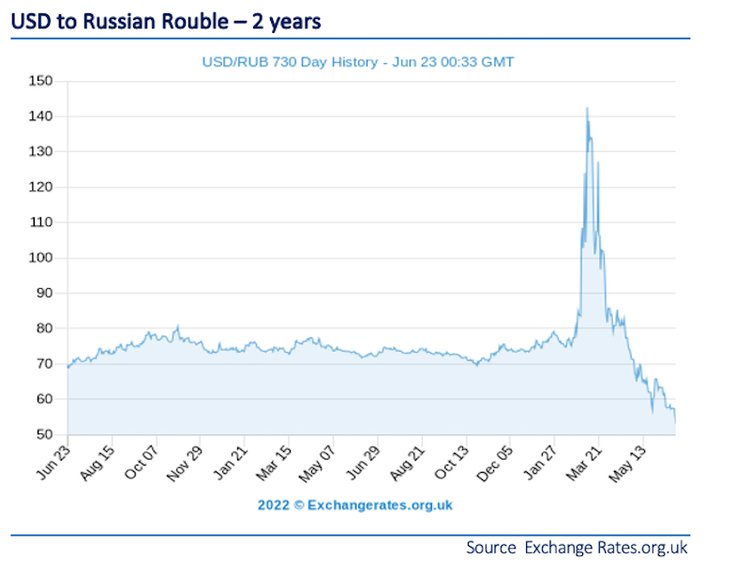
Initially the rouble halved from a pre-war 75 to the USD to a low of 140 as the West confiscated over $300billion of Russia’s sovereign assets held in the West. This, coupled with a wholesale withdrawal of Western companies, from BP to McDonald’s, and a tightening of oil and gas sanctions, resulted in currency collapse.
Such a collapse, if prolonged, would have been very dangerous for Russia’s stability as it simply destroys its terms of trade, potentially resulting in material inflation as the cost of importing goods rises significantly.
But Western policy makers did not think through the second derivative which is coming back to bite. Economically Russia to an extent is the polar opposite of the West.
The West undoubtedly has significant technological and soft power advantage over Russia. However, most Western economies have growing and inefficient public sectors and weak central banking systems impeded by the Global Financial Crisis (GFC) and particularly lockdowns, with substantial growing public debt and debased monetary systems through a new-found belief in Modern Monetary Theory (MMT) – accompanied by all the associated Quantitative Easing over the last decade. Britain and the US also run substantial trade deficits.
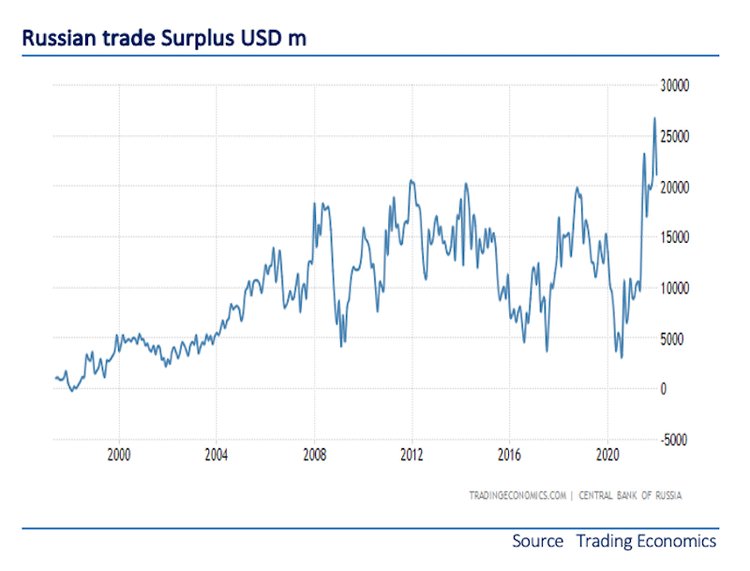
Russia, on the other hand, is a commodity- and primary products-led export economy running a substantial trade surplus, with weak technology and service sector exports and soft power. Its public finances are very strong with low public debt, low taxes (14 per cent flat rate income tax) and substantial cash reserves even after half were sanctioned.
This asymmetry of strategic advantage between Russia and the West has profound implications if sanctions are applied. Thus quite quickly currency traders realised what extraordinarily almost none of our current crop of virtue signalling politicians dare to say – that the sanctions were potentially more of a threat to the West (UK and EU in particular) as the impact of ‘cancelling’ Russian carbon was highly inflationary.
There are no cheap short or medium term substitutes. Much of the West is dependent on Russian primary products, while only some Russians might be upset the Prada store in Moscow had closed (but the back door from China remained wide open). An inconvenience, sure; a game changer, probably not.
Thus the rouble strengthened materially and at the time of writing is 55 to the USD, almost 30 per cent stronger than before the conflict in Ukraine. If one compares the sterling- rouble exchange rate, sterling’s underperformance is even starker.
It is quite simple. Cancel Russian oil (13 per cent global production) and India joyfully buys the discarded stock at a discount while the global price goes up as the West scrambles to find new supply. Worse, cancel Russian gas and the EU has a major crisis, as does the UK given the UK’s foolish decade-plus de-emphasising of carbon, including the closure of strategic gas storage facilities. The list goes on well beyond carbon – from titanium to fertiliser, from wheat to cod.
But it is oil and gas that are so critical as power is essential to the manufacture, to a greater or lesser extent, of most things. The irony is that as well as Saudi, Iran and Venezuela, the greatest beneficiary of soaring hydrocarbon prices is Russia. Putin’s Russia has run consistent trade surpluses but the current surplus is a record, as a direct result of sanctions, taking the spot price of oil from a pre-war $80 a barrel to $120 today.
While the rouble strengthens and the Russian trade surplus expands, the effect on Western economies has been devastating. In fairness the West had been severely undermining its own advantage for many years prior to the invasion of Ukraine, fuelled by Governmental policies based on a double fallacy: that monetary policy could solve all ills, and that centralised decision-making and excessive public spending could solve all ills.
Both fallacies are now coming with a substantial price, but to multiply that with an ill-thought-out sanctions regime that is achieving none of its underlying goals and is harming Western economies is frankly hard to fathom.
The West, particularly the EU and UK, is now in a pickle. This pickle has the potential to be calamitous as Governments remain in denial at the scale of the challenge they are facing.
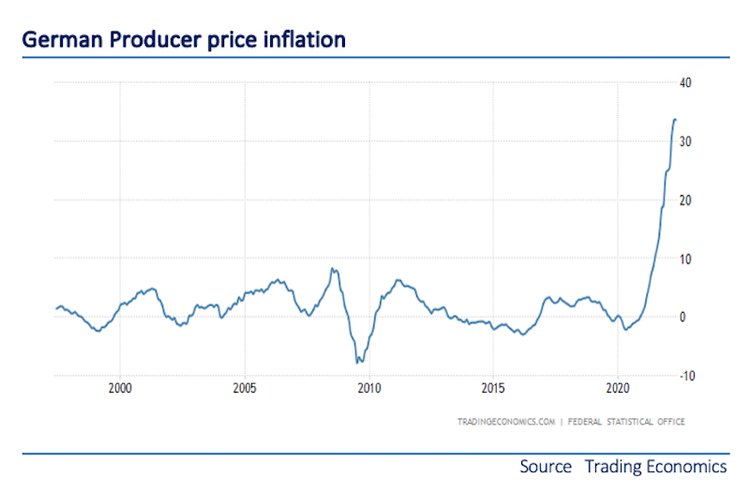
We are in a situation where the inflationary surge, given supply chains, is in its embryo stage, not close to its conclusion. Sure, the price rise at the pumps is immediate, but domestic energy prices are set to increase by a further 40 per cent in September when the price cap comes off. As a warning, German producer price inflation (see chart below) is over 30 per cent, a rate not seen since post-war ruination in 1946.
I sincerely hope I am wrong but this has the potential to get very nasty. Rishi Sunak said on Wednesday: ‘We are using all the tools at our disposal to bring inflation down and combat rising prices. We can build a stronger economy through independent monetary policy, responsible fiscal policy which doesn’t add to inflationary pressures, and by boosting our long-term productivity and growth.’ That says to me he hasn’t a clue about the scale of the challenge or indeed the underlying causes.
The reality is unfortunately that both the Bank of England and the ECB are so far behind the curve as to make you weep. Interest rates of 1.25 per cent when RPI is 11 per cent are so far off-kilter while the ECB, with arguably an even greater inflation headache given German industrial reliance on Russian gas, is only now coming off negative rates.
Moreover, expanding a wantonly inefficient public sector to around half the entire economy coupled with an unprecedented regulatory stranglehold can only spell a productivity disaster. It is throwing money at the bad, paid for by the good.
Where this will end remains uncertain, so many unknowns are there. What we can predict is that this is the beginning not the end of the maelstrom. Governments do not like short-term pain as elections approach and we risk yet another debt-funded stimulus papering over the ever-wider cracks. How credible would that really be when inflation is 11 per cent? Would they dare print money again in such circumstance? I fear they would.
This country and indeed Europe generally is enduring enormous self-harm. Sanctions have backfired but the cocktail of sanctions, massive public sector expansion, delusional monetary policy and delusional energy policy risk an economic disaster of immense proportion.
There is no easy fix but unless we wish to become a northern version of Argentina, with a debased currency, constant crisis and missed opportunity, we need to understand the scale and multiple layers of our challenge.
It’s too late to avoid prolonged and meaningful inflation, and in time recession, but it’s not too late to start to rectify policy error. I can’t see the current crop of politicians analysing forensically the impact of sanctions but a great start would be to toss away the gateway drug to our delusions, the strange idea that Modern Monetary Theory works and governments can print and spend their way out of a crisis. Frankly they can’t and with that acceptance perhaps we can start the process of an appropriately balanced economy focused on private activity, not state direction. Government got us in this mess, only the people can free us from it.
According to a recent study by the World Bank, published in the journal Nature, lockdowns and the response to Covid-19 have pushed an additional 75 million people into extreme poverty, living on less than US $1.90 a day.
In the typical Walter Duranty style that’s become a kind of twisted journalistic norm since March 2020, the World Bank and Nature of course blame this on “the pandemic” rather than lockdowns. I remain baffled as to how seemingly well-meaning people are able to sleep at night repeating such nonsense—are they somehow blind to the role of their own sycophancy in perpetuating these policies?
Nonetheless, there are signs that the political mainstream is starting to realize lockdowns were a disaster. Today, the Wall Street Journal published an excellent piece titled The Revenge of the Locked-Down Voters, noting the growing political backlash against lockdown politicians from voters at the lower end of the income scale.
This comes shortly after the New York Timesquietly acknowledged a study showing that Covid lockdowns and mandates led to over 170,000 excess deaths among young Americans.
And, as in America, this comes shortly after the London Times, the UK’s centre-left newspaper of record, published a cautiously-introspective piece on its support for lockdowns.
These are promising indications that the political mainstream, especially on the right, is coming around to the fact that lockdowns were a policy catastrophe more quickly than some might have worried.
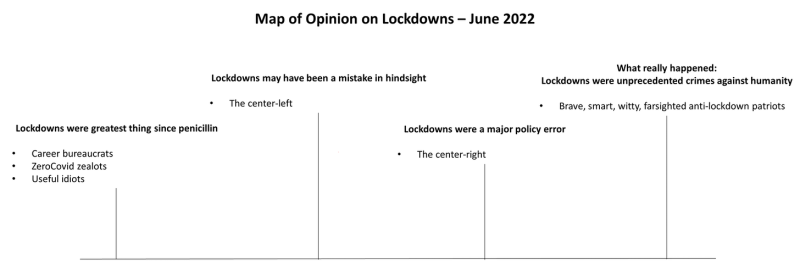
Still, there’s much more to be done. Currently, the mainstream left and right are starting to realize lockdowns were a big mistake, while many career bureaucrats are still stuck pretending lockdowns were the greatest medical breakthrough since penicillin. There really needs to be a bipartisan consensus that lockdowns were an unprecedented policy catastrophe before we can start to see justice and have undue foreign and financial influence taken seriously.
The retreat of Ukrainian troops from Severodonetsk city in the Luhansk Oblast of the country is a pivotal moment in the ongoing conflict. The Russian forces are now almost in total control over the Luhansk region. The latest reports from front lines say Russian forces entered the last remaining city of Lysychansk in Luhansk on June 25.
In a briefing today, the Russian Ministry of Defence announced in Moscow: “On June 25, the cities of Severodonetsk and Borovskoye, the settlements of Voronovo and Sirotino passed under control of the Lugansk People’s Republic. The localities liberated… are inhabited by about 108,000 people. Total area of the liberated territory is about 145 square kilometres.
“Success of the Russian army… considerably diminishes the morale and psychological condition of the Ukrainian army personnel. In 30th Mechanised Brigade deployed near Artyomovsk, there are mass cases of alcohol abuse, drug use and unauthorised abandonment of combat positions.”
However, peace is a long way off — several months away, perhaps. In the speech by Russian President Vladimir Putin last week at the SPIEF in St. Petersburg, he made no references to peace negotiations. Putin hardly referred to the fighting.
Meanwhile, three highly provocative moves by the opposing side within the past week are significant markers indicating that the conflict may aggravate. If the missile strike at a Russian oil rig in the Black Sea has been an act of provocation, the US supply of High Mobility Artillery Rocket Systems (HIMARS), a powerful long-range weapon system is intended as a potential game changer that can help Kiev turn the tide of the conflict, and, third, the bizarre move by Lithuania to block Russia’s rail transit to Kaliningrad is a reckless escalation of tensions.
On the arrival of the HIMARS, Ukraine Defence Minister Oleksiy Reznikov ecstatically wrote wrote on Twitter on Thursday, “HIMARS have arrived to Ukraine. Thank you to my colleague and friend @SecDef Lloyd J. Austin III for these powerful tools! Summer will be hot for russian occupiers. And the last one for some of them.”
Washington claims it has received assurances from Kiev that HIMARS would not be used to attack Russian territory. Moscow has warned it will attack targets in Ukraine that it has “not yet been hitting” if the West supplies longer-range missiles to Ukraine for use in high-precision mobile rocket systems.
The Lithuanian move is a blatant violation of international law and Vilnius would only have acted on the basis of prior consultation with the US and NATO to test the Russian reaction. Kaliningrad is a major Russian base with nuclear missiles, where its Baltic Fleet is headquartered, apart being the only Russian port on the Baltic that is ice-free throughout the year. Evidently, there are some insane fellows in the NATO camp who are itching to climb the escalatory ladder.
For Russia too, there is “unfinished business” ahead insofar as it holds roughly the same amount of territory in Donetsk only as the separatists controlled in February before the special military operation began. Now, seizing the administrative territories of the Donbass is only Moscow’s minimal goal. There is going to be a sprawling battlefield in the next phase, stretching from Kharkiv in the northeast to Mykolaiv and Odessa in the southwest. Much fighting lies ahead.
The New York Times reported that “Pentagon officials expect that the arrival of more long-range artillery systems will change the battlefield in Donetsk.” Gen. Mark A. Milley, the chairman of the US Joint Chiefs of Staff told reporters recently, “If they (Kiev) use it properly, practically, then they’re going to have very, very good effects on the battlefield.”
The Russian military approach doctrinally is centred on attrition warfare, which aims to grind the way toward incremental territorial gains. Therefore, the advantage goes to the side which has greater staying power on the battlefield. In a sustained war of attrition, one military is ultimately going to be depleting the capability of the other. This is where the fault lines in the western unity come into play if the current traces of “war fatigue” in Europe turns into “solidarity fatigue.”
Ukraine’s ability to shift the military balance depends critically on sustained military support from the US and other European countries. That, of course, hinges on political will and cohesiveness of the western allies. As for Russia, it is not only committed to a protracted war but also has the capacity to sustain it.
Unlike the case with Ukraine, Russia is not dependent on any other country for boosting its military capability or training and advising its military. Also, historically speaking, a defining characteristic of the Russian military is its incredible endurance and ability to sustain prolonged attrition.
The US is still betting that the Russian economy cannot hold out for a long time, since the full impact of sanctions and export controls is yet to be felt. In this calculus, the rebound of the ruble currency is seen as largely due to the strict government controls on capital flows and plummeting imports into Russia. Equally, the US has convinced itself that the restrictions on technology exports to Russia will gradually stunt the growth of its industries. Thus, the focus of the G7 summit in Germany currently under way (June 26-28) is on new plans to further “tighten the screws” on Russia’s economy.
But not much Russian budget data is available to make such daring assumptions and it is even harder to quantify how much Moscow is spending on the war in Ukraine. Certainly, there is no evidence to suggest that the Kremlin’s ability to finance the war effort is coming under pressure from sanctions.
While President Biden boasted in March that sanctions were “crushing the Russian economy” and that “the ruble is reduced to rubble,” the exact opposite has happened. Russian oil revenues have set new records and the ruble hit a 7-year high this week against the dollar. Expert opinion is also that Russia’s financial system is back to business as usual after a few weeks of severe bank runs.
Going forward, Biden must retain control over the Congress in the midterm elections in which Republicans are sure to capitalise on the rising cost of living. As for Europe, cooler temperatures in the coming months will raise alarms about energy shortages as Moscow has cutdown natural gas supplies to Europe, which would aggravate the economic pressure they now are experiencing.
Therefore, the big question is, whether the desire to resist Russia will be sustainable as the war itself grinds away. The matrix has changed. After all, Biden uttered the following about Putin as recently as in end-March: “For God’s sake, this man cannot remain in power.” But in 3 months’ time, today, Biden only says he is striving to help Ukraine negotiate optimally with Russia for a settlement. Here too, Biden needs to make sure Russia is losing ground, while also constantlyweighing that new weapons do not escalate the conflict too fast.
Admittedly, Biden is under little political pressure at home to back away. And the crack in western unity is, arguably, not to be construed as amounting to anything like a rift in the fundamental strategy towards Russia and the Ukraine conflict. That said, the bottom line is that this is also a perilous moment for the global economy.
Post-pandemic economic recovery, supply-chain disruptions, rapid price increases, infrastructure investment, trade practices, global oil prices, world’s food supply, recession — these issues surely impact the western leaders’ standing in the polls. It means economic and political pain is coalescing.
The West needs to keep arming Ukraine instead of seeking a peaceful resolution to the conflict between Kiev and Moscow, UK Prime Minister Boris Johnson told French President Emmanuel Macron, according to Downing Street. Any attempt to resolve the conflict peacefully will lead to global instability, he said at a meeting on the sidelines of the G7 Summit on Sunday.
The military action in Ukraine is at a “critical moment,” the two leaders agreed, but there is still “an opportunity to turn the tide.” According to the statement, Johnson and Macron have agreed to continue supporting Kiev militarily to “strengthen their hand in both the war and any future negotiations.”
The prime minister also cautioned the French leader against seeking alternatives to resolving the conflict.
The Prime Minister stressed any attempt to settle the conflict now will only cause enduring instability and give Putin licence to manipulate both sovereign countries and international markets in perpetuity.
Johnson took a similar stance at a meeting with Canadian Prime Minister Justin Trudeau on Sunday. “Ukraine is on a knife-edge and we need to tip the balance of the war in their favor. That means providing Ukraine with the defensive capabilities, training and intelligence they need to repel the Russian advance,” a statement from Downing Street read.
On Sunday, Johnson tweeted that Ukraine’s “security is our security, and their freedom is our freedom.”
Ahead of the summit, London pledged an additional £429 million ($525 million) in guarantees for World Bank loans in 2022 as a form of financial assistance to Kiev. According to Downing Street, the UK’s total financial support for Ukraine, including loan guarantees, amounted to £1.3 billion ($1.5 billion) and the combined UK economic and humanitarian support for Ukraine amounted to £1.5 billion ($1.8 billion) this year.
Johnson has been one of Kiev’s most ardent supporters after Russia’s military operation in Ukraine began in late February. He has visited Kiev twice since then and repeatedly called on Western nations to provide more weapons. The UK is one of Kiev’s major arms suppliers, including heavy weaponry.
In June, Johnson warned that the West must brace for a long war between Kiev and Moscow. On Saturday, he said he would consider resigning if he has to abandon Ukraine at some point.
Finland’s flag carrier Finnair has reportedly become the latest casualty of the sanctions war between Russia and the West. The airline suffered heavy financial losses due to the forced necessity to fly around Russia, after the country closed its airspace in retaliation to Western sanctions.
Since the beginning of 2022, the operating loss of one of the world’s oldest airlines amounted to €133 million, of which €51 million in expenses fell on fuel costs, the Finnish newspaper Helsingin Sanomat reports.
EU countries and a number of other Western states closed their airspace to Russian flights after Moscow launched its military operation in Ukraine in late February. Russia responded in kind, banning the airlines of 36 states and territories from its skies and, in so doing, closing the traditional routes from Europe to Asia to Western carriers.
The tit-for-tat restrictions have forced airlines in Europe to re-route flights, and have deprived some nations of the monthly air navigation fees that they used to receive when flights from neighboring states passed through their airspace.
Since December 2021, Finnair’s fuel costs have reportedly surged from 30% to 55% of its total expenses. Apart from a nearly twofold increase in prices, the Finnish airline has faced the need to change air routes.
As a result of closing skies Helsinki has lost a key advantage over other Scandinavian countries – the shortest distance to China, Japan and South Korea. Some flights to the Asia-Pacific region, which had been generating for Finnair up to 50% of its profit, were canceled. The journey to Japan that previously took about nine hours now takes 13 hours.
Moreover, the loading of Finnair planes has also significantly dropped due to the absence of Russian tourists, who used to make up about 20% of its passenger traffic. Meanwhile, EU residents have slashed their travel spending amid increased economic instability, with a reluctance to fly exacerbated by constantly rising cost-of-living expenses.
Russia’s special operation in Ukraine may cause a two-year global food crisis even if the standoff ends tomorrow, The Telegraph claims, citing Western officials. They insist that exporting grain “trapped” in Ukraine is the remedy, while remaining mute about West’s sanctions paralyzing larger food exports from Russia to third-world countries.
“We are very clear that this grain crisis is urgent, that it needs to be solved within the next month otherwise we could see devastating consequences,” UK Foreign Secretary Liz Truss told the press on June 23.
The ongoing conflict has disrupted production, “causing global food prices to soar to record levels,” claims The Telegraph. In particular, wheat prices increased to an average of 56.2% in May, 2022 above their value last year, according to the UN Food and Agriculture Organization (FAO).
The newspaper’s source says that the British officials see current efforts to move Ukrainian grain over land and road as “far below” what is needed. They insist that the commodity needs to be exported by sea, accusing Russia of blocking Ukraine’s food supplies from leaving Ukraine’s Black Sea ports. According to UK Prime Minister Boris Johnson, Moscow was trying to hold the world “ransom.”
The newspaper also cites “newly declassified US intelligence” claiming that the Russian navy “has been given orders to lay mines” in Odessa and Ochakov and “mined” the Dnieper River “as part of its blockade of Ukrainian grain exports.” According to BoJo, the UK is helping Ukraine “at a technical level to help demine Odessa.”
Western Press Remain Mute About Russia’s Black Sea Corridors
Russia denounced the US and the UK claims, stressing that the Ukrainian military mined their own ports during the retreat. Furthermore, Ukraine continues to stampede Russo-Turkish efforts to demine the area and ensure the safe passage of ships from the country’s territorial waters.
On June 2, Russia’s Permanent Representative to the UN Vasily Nebenzya made it clear that Russia is ready to provide safe corridors for Ukrainian ships carrying 20 million tons of grain if Kiev demines the water area surrounding its ports.
In late May, the Russian Ministry of Defense announced that the Russian Navy had created safe zones in the Black and Azov Seas for ships leaving Ukraine along humanitarian corridors. The corridors with a length of 139 miles and 3 miles wide are operating daily from 8:00 am to 7:00 pm (GMT+3) in the Black Sea for vessels stationed in the ports of Kherson, Nikolaev, Chernomorsk, Ochakov, Odessa and Yuzhny.
Nevertheless, the Kiev authorities “continue to do everything possible to evade interaction with representatives of foreign states and ship-owning companies in resolving the issue of ensuring the safe exit of blocked ships,” according to the MoD.
Turkey, which has worked with Russia in demining the Black Sea and providing safe passage to vessels, echoes Moscow’s concerns. Turkish Foreign Minister Cavusoglu told Anadolu Agency last month that the two major obstacles hindering grain exports are mines placed by the Ukrainian military in the Odessa water area as well as Western sanctions slapped on Russian ships in terms of insurance and the provision of services at international ports.
Ukraine’s Role in Food Crisis Largely Overestimated
The Western press is shying away from discussing how anti-Russian sanctions, imposed on the country’s trade, finance, transportation and crucial agricultural commodities have backfired on the global food market sending prices high.
Senegalese President and African Union chief Macky Sall raised the alarm earlier this month over Western restrictions preventing Russia’s grain and fertilizers exports to Africa.
“Sanctions against Russia have aggravated the situation with the supply of grains and fertilizers to African countries. We no longer have access to them, and this poses a serious threat to food security on the continent,” Sall warned on 3 June during an official visit to Russia.
Together Ukraine and Russia produce about a third of the wheat traded in global markets, according to the Washington-based International Food Policy Research Institute (IFPRI). Still, Russia is the world’s largest exporter of wheat, providing more than 17% of all wheat sold in the global market while Ukraine’s share amounts to roughly 10%.
For comparison’s sake, Russia exported 44.64 million tons of wheat in 2018, while Ukraine provided the global market with 16.91 tons of the commodity the same year, according to FAO.
Ukraine’s role as a food commodity exporter is deliberately overestimated by the West, Russian President Vladimir Putin said in a June interview with Rossiya-1.
“The world produces about 800 million tons of grain and wheat per year. Now we are told that Ukraine is ready to export 20 million tons. 20 million tons compared to the 800 million tons the world makes is 2.5% of that figure. But if we proceed from the fact that wheat makes up only 20% of the total food supply (and this is the reality, these are not our figures but those of the UN) this means that these 20 million tons of Ukrainian wheat make up 0.5 percent,” the Russian president told the broadcaster.
Putin dismissed claims that Russia was supposedly trying to block the export of Ukrainian grain, calling the allegations a “bluff.” The Russian president stressed there were no obstacles to the export of grain from Ukraine. He stressed that ships carrying wheat could enter the Black Sea any time if Kiev clears ports of mines. World wheat prices have fallen by 10% after Putin signaled Russia’s readiness to ensure the transport of grain from Ukrainian ports.
G7 & NATO to Double Down on Further Isolating Russia
While the British government continues to castigate Russia’s special operation for the unfolding global food crisis, the British prime minister is calling for Europe to step up military aid to Ukraine.
In particular, BoJo came up with a new plan offering Ukraine a training campaign for its military personnel and urging Western leaders to provide “constant funding and technical help” to Ukraine to ensure Kiev’s longstanding resistance to Russia.
BoJo is expected to push France and Germany to strengthen their support for Ukraine during the G7 summit next week, “as he fears that [Ukrainian President] Volodymyr Zelensky could be bounced into agreeing a ‘s***y’ peace deal [with Russia],” according to the Telegraph.
For its part, Reuters projects that next week G7 and NATO leaders will work to “increase pressure” on Russia over its special operation in Ukraine, while seeking to further isolate the country from the global economy.
Argentina’s President Alberto Fernández requested BRICS membership for his country during the 14th summit of the international organization, which the Argentinian leader attended among other high-ranking guests.
“We aspire to be a full member of this group of nations that already represents 42% of the world’s population and 24% of the global gross product”, the president said.
Fernández noted that his country could supplement the union of five countries as a reliable supplier of food, as well as a recognized player in the field of biotechnology and logistics. He further stressed Argentina’s ability to train specialists in various fields, as well as provide various services on the international scale.
The president expressed an eagerness for his country to join the BRICS group (Brazil, Russia, India, China and South Africa) during its 14th summit, which is taking place in a videoconference format this year. It formally kicked off on June 22 and has continued through June 24.
Its members meet to discuss acute political and economic trends and mildly coordinate their own political and economic policies. They also discussed how to jointly navigate the currents of global trade and exercise their considerable influence (24% of global GDP) to change them.
The Covid era gave rise not only to popular mania but also to astonishing intellectual pretension. The experts were everywhere. They had all the answers. They knew for certain that a path never tried in anyone’s lifetimes was the certain way to go in order to control a virus. And this fanatical attachment to one goal caused all other considerations to be pushed aside.
The end of the story was baked in from the start. The experts were proven to have massively exaggerated their prowess and understanding of events. On point after point, their models blew up. The epidemic would end the way they always have, through acquired immunity and endemicity. Nowhere did the methods of the vaunted experts achieve the goal; at best they delayed the end point and created tremendous destruction along the way.
Now there is a problem: how to dial it all back without admitting profound error. This is a particular problem for those who wrote books before the story was complete. And by complete I am referring especially to the tremendous waves of infections that came 20 months after lockdowns were first imposed.
A paradigmatic case is Devi Sridhar, professor and chair of global public health at the University of Edinburgh, Scotland. During the pandemic, she became a ubiquitous presence on television for two years both in the UK and the US. Her main message was to advocate and defend lockdowns, masking, mandates, and the entire apparatus of compulsion that characterized the pandemic response in nearly every country in the world. Her message was always geared toward what is called eliminationism or zero Covid.
As a Rhodes scholar in a high prestige position, she was well positioned to be this messenger. She has a compelling way and presents well in the medium. Plus, the message she delivered was the one that earned an official stamp of approval from all mainstream media. She was also a pro at delivering an attitude of disdain toward anyone who dared question the zero Covid story.
Now she has a book out that further elaborates on her point of view. It has the right title: Preventable: How a Pandemic Changed the World and How to Prevent the Next One. It’s a pretentious title, presuming that she knows for certain that the pandemic was preventable and therefore she should be trusted to tell us what to do next time.
What’s striking is the contrast between the certitude of the body of the book in which she is an unapologetic defender of China-style lockdowns and the afterword, which must have been written only days before the book went to print. Here we have a very different tone, discussed toward the end of this review.
Sadly for her, the book came out just before a wave of new lockdowns came to China that wrecked the lives and liberties of hundreds of millions of people and made an enormous mess of the entire economic mission of the country. She must not have had time to revise the manuscript.
Of China, her book says:
The way China set about eliminating SARS-CoV-2 could be described as draconian. It undertook house-to-house testing and removed individuals to quarantine facilities if they tested positive (sometimes against their will); it used tracking technology to trace 99–100 per cent of those who had had contact with the infected; it locked down entire buildings so individuals could not leave their flats or have free movement; and it constructed completely new hospitals within days…
The Chinese government understood well that the virus moves when people move. So it stopped people moving internally…
The efforts to contain the spread within Wuhan were effective and focused on reducing the R number…
These measures to contain spread worked…
[China showed that] containment strategies (however draconian) could be effective at stopping this respiratory pathogen…
The evidence in February 2020 showed that containment was successful…
Within the span of three months, China had eliminated the virus fully within its borders…
This is the same message she delivered to millions day after day for two years.
We could just stop this review here, observing that none of the above turns out to be true. Currently, China faces an enormous problem. If we are to believe the data, vast swaths of China’s population still lack acquired immunity to Covid. Millions or billions need the exposure, and, as with all places in the world, the result for nearly everyone moderately healthy and not elderly will be recovery. This will happen with or without lockdowns.
President Xi Jinping, however, became convinced either by virtue of his ego or his circle of sycophants that his lockdowns two and a half years ago were his greatest achievement. He was celebrated by the World Health Organization and nearly every country in the world copied his brutal methods of virus suppression. He regarded it then as evidence that the CCP was destined to rule the future, by virtue of its masterful social, economic, and now medical management of society.
So of course the CCP cannot turn back now. He has stated repeatedly that there will be no compromise of the zero Covid stance that both he and Dr. Sridhar have long advocated. He must now either continue to threaten and enact lockdowns or figure out some clever way to back away from the position without admitting past error. He may in fact figure it out at some point.
After all, nearly every other government in the world has finally figured it out. Even under the best of assumptions that lockdowns offer some contribution to mitigate the ill-effects of a pathogen, the costs far outweigh those benefits. And those costs not only include economic, educational, and nutritional ones but also costs in terms of deaths from overdoses, despair, and self-harm from the inevitable demoralization from being treated like a prisoner or lab rat.
So I did read Dr. Sridhar’s book in search of some insight as to why she could have made such a profound error. All I found was a relentless and single-minded attachment to a zero Covid agenda, or some version of it, a genuine belief that the right deployment of human force could somehow make a virus go away. It truly boggles the mind.
The rest of the narrative is utterly predictable.
Countries that locked down are good, especially New Zealand and Australia. Countries that did not are bad, especially Sweden but also the UK and the US after reopening. Countries that kept lockdowns longer are good. Countries that opened up too soon are corrupt and rejecting “the science.” The Great Barrington Declaration is bad. Ramdesivir is good while Ivermectin is bad. And so on.
Her hard-core bias extends even to a rousing defense of Rebekah Jones, the low-level data employee in Florida who wrongly accused the Governor’s office of manipulating data in a case that was later tossed out.
The book is so partisan that she sometimes lets her politics even race ahead of her epidemiological position. For example, and this probably won’t surprise you, she comes to the defense of the George Floyd protests even in the midst of lockdowns:
In late May 2020, I was asked whether protesters were wrong to take to the streets. I replied that racism is also a pandemic, and one that Black Americans feel can’t be swept under the carpet any longer. While clearly mass gatherings during a pandemic are risky, I could understand that people were willing to take this risk in order to effect change for their children and the children of their children. This is how the civil rights movement has attempted to progress racial equality over decades.
In any case, you get the point here. She has a tribe and she wants to be its messenger. Still, I struggled through the entire text to see if I could find insight. This one jumped out at me:
While WHO was at the forefront of press briefings and leading technical and normative guidance to the pandemic, the World Bank had the financial power to help governments respond with key policies, whether through building up health systems and testing, putting in place economic packages to support lockdown measures, or in acquiring and distributing vaccines.
There we go: the World Bank subsidized lockdowns. Fascinating. That I did not know. This is a serious problem that needs to be fixed. How many millions face malnutrition as a result?
So much for the body of the book.
Probably the most telling part of the book is the afterword, written January 2022. Here our author jumps in with the latest information, namely that China had not in fact eradicated the virus and now keeps locking down, which she says is due to inferior vaccines. Within a few paragraphs, she – for the first time in the book – recognizes that even the best vaccines do not stop infection and do not stop the spread..
Whoops. Is she willing to rewrite the entire book in light of this last-minute realization that lockdown eliminationism and even mass vaccination cannot achieve the goal? No. Is she willing to rethink? Perhaps a bit but not enough.
While some say we should adapt normal social relations and mixing for the foreseeable future, I struggle with this line of thought. Humans are social: we need to hug, talk, dance, sing, kiss and be around others. We’re not bears or rhinos or other solitary creatures. We like seeing each other’s faces. And we know that a sense of community and connection are vital to wellbeing too. A holistic approach to public health is vital, and this includes not just people’s mental health but also their ability to pay rent, feed their family, stay warm through the winter and have a meaningful role in society, be that going to church or being part of a glee club. For a certain period of time, altering these made sense, so that we could avoid preventable illness and deaths; allow vaccines to be created, trialled and distributed in 2020 and into 2021; allow clinicians to better understand how to treat COVID-19; and allow a better understanding of transmission and risk.
Again, very interesting, especially because the change in tone from the rest of the book is so sharp. She doesn’t come close to repudiating her entire book – and she still believes that totalitarian measures somehow make sense for a “period of time” – but she does say that she is tired and exhausted and perhaps ready for some rethinking.
“I’ve taken a step back from media work… I’ve been testing several times a week, and, while I cautiously avoid crowded spaces, and wear masks on public transport and in shops, I continue to go to the gym and to hot yoga and to see friends outside or in small groups. I’ve found a sustainable way to live alongside COVID-19 for now… You’ve heard enough from me.
These are hopeful signs. It’s possible that even Devi Sridhar might eventually come to see the error of her ways. Or perhaps like most of the exalted experts who assisted in driving the world into the greatest calamity of the modern era, she will quietly disappear from the op-ed pages and television screens and go back to her prior life as a public health professor with degrees in anthropology. At some point, too, she will get Covid and discover with millions of others that it is part of the human experience to get sick and get well and become stronger as a result.
We will wait in vain for any sort of extended literary mea culpas. Not even the pensive afterword comes close. After all, when the next great health crisis presents itself, the WHO pushes for lockdowns again, and the major media empires need some great excuse to order people back home to be glued to the screen, the expertise of these compelling pundits – now with real media experience – will need to be called upon again.
Jeffrey A. Tucker is Founder and President of the Brownstone Institute and the author of many thousands of articles in the scholarly and popular press and ten books in 5 languages, most recently Liberty or Lockdown.
The leaders of Brazil, Russia, India, China, and South Africa held their 14th annual summit on Thursday virtually. This year, the summit was chaired by China.
BRICS members vowed to widen the Shanghai-based New Development Bank (NDB) on Thursday, following the successful admission of Bangladesh, Egypt, the United Arab Emirates (UAE) and Uruguay in September 2021.
“We look forward to further membership expansion in a gradual and balanced manner in terms of geographic representation and comprising of both developed and developing countries, to enhance the NDB’s international influence as well as the representation and voice of Emerging Market and Developing Countries (EMDCs) in global governance,” the 75-point joint declaration released after the summit read.
BRICS has supported the NDB’s goals of attaining the highest possible credit rating and institutional development. The BRICS member nations have also stressed that they have a similar approach to the global economic governance, and their mutual cooperation can make a valuable contribution to the post-Covid economic recovery.
Geopolitical Concerns
Leaders also discussed the ongoing crisis in Eastern Europe, recalling their national positions at different global forums, including the United Nations’ Security Council and General Assembly.
“We support talks between Russia and Ukraine. We have also discussed our concerns over the humanitarian situation in and around Ukraine,” the joint declaration said.
Amid border tensions between India and China, the leaders committed to “respect the sovereignty and territorial integrity of all States,” stressing the peaceful resolution of differences and disputes through dialogue and consultation.
The BRICS countries – which represent 24 percent of the global GDP and 16 percent of worldwide trade – further reiterated the need to resolve the Iranian nuclear issue through peaceful and diplomatic means as per international law. They stressed the importance of preserving the Joint Comprehensive Plan of Action, a deal reached between Iran and the five permanent members of the UN Security Council in 2015. The stand-off between Iran and western nations continues following the US’ withdrawal from the JCPOA in May 2018.
RAMALLAH – The Israeli occupation forces today destroyed an access road to Ras Karkar village, northwest of Ramallah, hampering the movement of people, according to the head of Ras Karkar village council, Marwan Nofal.
He said that the destroyed road had been partially paved for 20 years and that three months ago, following coordination with the Israeli military government, work on the rehabilitation of the road started. However, two days after the start of the work, the military forces raided the area and seized the vehicles used in the work, imposing a fine on their owners.
Nofal said that despite continuous promises to allow the rehabilitation work, the army sent its bulldozers today to destroy the road under the pretext that the road is located on “state land”.
The destruction of the road led to depriving farmers of access to their lands on the western side of the village, he said, and isolating several houses, noting that this is not the first time the Israeli military has targeted the village.
Ras Karkar suffers from the presence of seven iron gates at its entrances that limit the movement of people and access to their homes and lands.
At the same time, the Israeli military government does not allow it to carry out any work to improve the village’s infrastructure, said Nofal.
Apparently, Volodymir Zelensky’s popularity in Ukraine is very low. The Ukrainian leader called for a virtual diplomatic meeting with African heads of state, but the event failed completely. Almost all African leaders declined to participate, hampering Zelensky’s plans to make the meeting a pro-Kiev propaganda stage. Meanwhile, the Russian government’s popularity is growing in Africa, where citizens take the streets in support for the special military operation in Ukraine and ask for Russian help in combating terrorism.
On June 20, the Ukrainian president met with representatives of the African Union in order to discuss matters concerning the current conflict situation in Eastern Europe and the role of Africa on the world arena. Of the fifty-five heads of state invited to the meeting, only four attended. The other countries sent only diplomats or ministers, with the heads of state and government not willing to attend, even with the meeting being virtual.
The heads of state who attended the meeting were Macky Sall of Senegal, Alassane Ouattara of Côte d’Ivoire, Mohammed el-Menfi, President of the Libyan Council, and Denis Sassou Nguesso of Congo. It is important to note that Sall is the current president of the African Union, which is why his presence was essential for the event to take place. Therefore, his attendance does not necessarily mean an expression of his real desire – even more considering his recent conversations with Russian President Vladimir Putin and the effort to increase Russia-Africa cooperation.
The virtual meeting was operated in secret, behind closed doors. According to official sources, Zelensky reiterated the Ukrainian position on the conflict, calling the Russian operation an unjustified “aggression”. He also commented on the current food crisis affecting Africa as a result of the conflict’s impact on the grain market. According to Zelensky, the African continent is Russia’s “hostage” because food shortages would be the result of such “aggression” and would only end when Russia decided to retreat.
Commenting on the event, Macky Sall took the most neutral and impartial stance possible, demonstrating that the Africa Union did not adhere to Zelensky’s appeals, but was concerned only with African states’ interests and the proper functioning of international law.
“Africa remains committed to respecting the rules of international law, the peaceful resolution of conflicts and the freedom of trade”, he said in a publication in his Twitter account.
It is interesting to note how Zelensky’s attempt to convince African leaders to adhere to the Kiev-Western narrative absolutely failed. Not only did most African heads of state refuse to listen to the Ukrainian leader, but there was no adherence to the pro-Kiev speech on the part of those who attended the conference. For the African Union, the meeting was just a diplomatic formality, with no real gains or changes in position – which reveals that Zelensky’s plans did not work as expected.
This failure, however, was predictable for any realistic analyst. For African leaders, it is really hard to believe the fallacious narrative that Ukraine is a simple “victim” of an “unjustified aggression”. African countries are used to centuries of Western interventionism and violence and the peoples of this continent react to this with strong distrust of everything that Western nations support. As Zelensky is the ally of the US and Europe, he will likely be viewed with suspicion by countries that suffer so much from Western colonialist mentality and praxis.
In addition, there are other factors that need to be mentioned. Zelensky’s arguments that the food crisis is caused exclusively by Russia are no longer able to convince public opinion and state authorities. It is evident that, more than the conflict itself, the crisis has been caused by the sanctions against Russia, which motivates emerging countries to be enthusiastic about the end of these sanctions. Also, there are many reports that Kiev is exporting grain to the US and Europe in exchange for weapons, which is unacceptable.
Furthermore, there has recently been a strong wave of popular support for the operation in Ukraine from citizens of several African countries, especially in the regions most affected by terrorism. After the abandonment that Africa has suffered from the West in terms of security policies and defense cooperation, seeking Russian support has become the greatest hope for the members of the African Union, which is why recently there have been popular demonstrations in support of all Moscow’s actions, alongside requests for help to solve Africa’s internal problems.
In fact, in international relations, nothing matters more than cooperation. Zelensky will not be able to garner African support if he does not show interest or conditions to cooperate with Africa. Kiev currently has nothing to offer African countries, as it is economically broken and militarily virtually neutralized. On the other hand, Russia shows itself as a pillar for African food security and as a hope against terrorism in the continent. It is absolutely expected that in this context the African Union will decline its ties with Kiev and seek to approach the side that offers the best opportunities for cooperation.
Lucas Leiroz is a researcher in Social Sciences at the Rural Federal University of Rio de Janeiro; geopolitical consultant.
By Mahdi Darius NAZEMROAYA | Strategic Culture Foundation | 30.03.2015
The United States and the Kingdom of Saudi Arabia became very uneasy when the Yemenese or Yemenite movement of the Houthi or Ansarallah (meaning the supporters of God in Arabic) gained control of Yemen’s capital, Sanaa/Sana, in September 2014. The US-supported Yemenite President Abd-Rabbuh Manṣour Al-Hadi was humiliatingly forced to share power with the Houthis and the coalition of northern Yemenese tribes that had helped them enter Sana. Al-Hadi declared that negotiations for a Yemeni national unity government would take place and his allies the US and Saudi Arabia tried to use a new national dialogue and mediated talks to co-opt and pacify the Houthis.
The truth has been turned on its head about the war in Yemen. The war and ousting of President Abd-Rabbuh Manṣour Al-Hadi in Yemen are not the results of «Houthi coup» in Yemen. It is the opposite. Al-Hadi was ousted, because with Saudi and US support he tried to backtrack on the power sharing agreements he had made and return Yemen to authoritarian rule. The ousting of President Al-Hadi by the Houthis and their political allies was an unexpected reaction to the takeover Al-Hadi was planning with Washington and the House of Saudi. … continue
This site is provided as a research and reference tool. Although we make every reasonable effort to ensure that the information and data provided at this site are useful, accurate, and current, we cannot guarantee that the information and data provided here will be error-free. By using this site, you assume all responsibility for and risk arising from your use of and reliance upon the contents of this site.
This site and the information available through it do not, and are not intended to constitute legal advice. Should you require legal advice, you should consult your own attorney.
Nothing within this site or linked to by this site constitutes investment advice or medical advice.
Materials accessible from or added to this site by third parties, such as comments posted, are strictly the responsibility of the third party who added such materials or made them accessible and we neither endorse nor undertake to control, monitor, edit or assume responsibility for any such third-party material.
The posting of stories, commentaries, reports, documents and links (embedded or otherwise) on this site does not in any way, shape or form, implied or otherwise, necessarily express or suggest endorsement or support of any of such posted material or parts therein.
The word “alleged” is deemed to occur before the word “fraud.” Since the rule of law still applies. To peasants, at least.
Fair Use
This site contains copyrighted material the use of which has not always been specifically authorized by the copyright owner. We are making such material available in our efforts to advance understanding of environmental, political, human rights, economic, democracy, scientific, and social justice issues, etc. We believe this constitutes a ‘fair use’ of any such copyrighted material as provided for in section 107 of the US Copyright Law. In accordance with Title 17 U.S.C. Section 107, the material on this site is distributed without profit to those who have expressed a prior interest in receiving the included information for research and educational purposes. For more info go to: http://www.law.cornell.edu/uscode/17/107.shtml. If you wish to use copyrighted material from this site for purposes of your own that go beyond ‘fair use’, you must obtain permission from the copyright owner.
DMCA Contact
This is information for anyone that wishes to challenge our “fair use” of copyrighted material.
If you are a legal copyright holder or a designated agent for such and you believe that content residing on or accessible through our website infringes a copyright and falls outside the boundaries of “Fair Use”, please send a notice of infringement by contacting atheonews@gmail.com.
We will respond and take necessary action immediately.
If notice is given of an alleged copyright violation we will act expeditiously to remove or disable access to the material(s) in question.
All 3rd party material posted on this website is copyright the respective owners / authors. Aletho News makes no claim of copyright on such material.




 Aletho News