India, BRICS in cold war conditions
BY M. K. BHADRAKUMAR | INDIAN PUNCHLINE | JULY 2, 2022
The phone conversation on Friday between Prime Minister Modi and Russian President Putin conveyed a big signal, coming on the morrow of the release of the new Strategic Concept by NATO which called Russia the alliance’s “most significant and direct threat.” The readouts from Moscow and New Delhi both highlighted the two leaderships’ determination to carry forward the momentum of economic cooperation despite the western sanctions against Russia. (here and here)
Ironically, the West’s “sanctions from hell” have given a big stimulus to India-Russia bilateral trade, giving it a dynamism that one never suspected would be recaptured in the post-Soviet era.
Friday’s call was agreed upon in the sidelines of the BRICS summit (June 23-24). Curiously, it has come at a time when the Western powers have stepped up their efforts to create discord among the BRICS member countries, and brainwash India, in particular, to join their bandwagon in the new Cold War conditions. India is of course cherrypicking.
But that is understandable at a time when the economy is in “stagflation.” India’s relationship with Russia was the leitmotif of Modi’s visit to Japan in April and three visits to Europe in May as well as his two meetings with US President Biden during this period. In the West’s calculus, China and India are giving what analysts would call “strategic depth” to Russia, which nullifies its frantic efforts to “erase” Russia. Interestingly, the western attempts to create paranoia in the Indian mind about the close ties between Russia and China are no longer having the desired effect of Delhi becoming wary of Russia’s intentions. India sees, on the contrary, great opportunities to tap into Russia’s tilt to Asia-Pacific region for economic partnerships.
Without doubt, India is “balancing” between Washington and Moscow and BRICS summit was a great occasion to monitor that trapeze act. An unabashedly pro-western internet paper from Delhi had predicted that Modi would act as a vigilante for US President Biden, blocking any BRICS statement critical of the US. Whether that was true or not, Modi made a rather anodyne speech at the BRICS summit.
On the other hand, Putin had stated in his speech at the summit that “Considering the complexity of the challenges and threats the international community is facing, and the fact that they transcend borders, we need to come up with collective solutions. BRICS can make a meaningful contribution to these efforts.”
Putin added, “We are confident that today, as never before, the world needs the BRICS countries’ leadership in defining a unifying and positive course for forming a truly multipolar system of interstate relations… we can count on support from many states in Asia, Africa and Latin America, which are seeking to pursue an independent policy.”
In his speech, Chinese President Xi Jinping made an even more direct appeal to the BRICS partners: “Our world today is overshadowed by the dark clouds of Cold War mentality and power politics and beset by constantly emerging traditional and non-traditional security threats. Some countries attempt to expand military alliances to seek absolute security, stoke bloc-based confrontation by coercing other countries into picking sides and pursue unilateral dominance at the expense of others’ rights and interests. If such dangerous trends are allowed to continue, the world will witness even more turbulence and insecurity.
“It is important that BRICS countries support each other on issues concerning core interests, practice true multilateralism, safeguard justice, fairness and solidarity and reject hegemony, bullying and division.”
Frankly, no matter the impressive-looking XIV BRICS Summit Beijing Declaration, the fact remains that the grouping is performing far below its actual potential and one principal reason for this is India’s zero-sum mindset regarding China, which makes it difficult for it to work with China collectively in any regional forum.
However, any apprehension in the Indian mind that China would “dominate” BRICS is unwarranted. Russia undoubtedly occupies a special place in the structure of the BRICS. In fact, BRICS was Moscow’s brainchild and Russia was responsible for launching the format. The first ministerial meeting (in the BRIC format) took place at the suggestion of Putin in September 2006, on the sidelines of the UN General Assembly session in New York. Thus, the idea of creating BRICS matured in Russia.
Second, BRICS is a “de-ideologised” format. It shows no animus against America although it challenges western hegemony of the international political and economic order. The very fact that the Manmohan Singh government welcomed Putin’s BRIC initiative at a most sensitive juncture when India’s negotiations for a nuclear deal with the US (with eye on Washington’s embargo on technology transfer) speaks for itself.
Moscow conceived the BRICS concept for the strengthening of the formation of a multipolar system of international relations and the growth of economic cooperation — and it has indeed contributed to the birth of a new economic system, based on the equal access of countries to financing and sales markets, a combination of state planning and market economy.
India has a problem to appreciate that the BRICS paradigm does not lie in expanding the capabilities or ambitions of the group’s member countries, but in fostering a qualitative change in the economic development model of the Global South. India’s dog-in-the-manger attitude — sulking and politicising the forum with extraneous issues (primarily to embarrass China) — doesn’t make sense.
Unlike India, China takes BRICS seriously. The Chinese initiative to create a BRICS Vaccine Centre has been under development and the implementation of this project amid the current conditions can be a significant achievement that will bolster the entire format of the association. Ideally, India should cooperate with the project instead of teaming up with its QUAD partners which has turned out to be a wild goose chase.
Again, industrial innovation is slated to be a priority for China’s BRICS Presidency in 2022. Expectations are high that during its presidency, China will come up with a number of breakthrough initiatives. Clearly, now that the construction of the BRICS’ New Development Bank headquarters in Shanghai has finished, new proposals are expected from China on the development of its operations, including possibly an expansion of the number of shareholders of the bank.
Of course, China will promote its own projects, including Belt and Road initiative. But then, China is also putting into the projects the most financial resources. It is high time for India to have a serious reassessment of values within the BRICS framework, and the changing internal balance of power in the grouping in the new Cold War conditions.
BRICS is at the crossroads and this realisation has propelled the concept of a “BRICS+” format to the centerstage of discussions. China’s BRICS chairmanship 2022 witnessed the launch of the extended BRICS+ meeting at the level of Ministers of Foreign Affairs. Participants included Egypt, Nigeria, Senegal, Argentina, Indonesia, Kazakhstan, Saudi Arabia, UAE and Thailand.
During the ministerial, China also announced plans to open up the possibility of developing countries joining the core BRICS grouping. Argentina and Iran have been mentioned as candidates for BRICS expansion. Be that as it may, “BRICS+” is certain to be on the agenda of global governance in times to come.
And The Winner Is, Germany!
By Francis Menton | Manhattan Contrarian | June 29, 2022
Just over six months ago, in December 2021, I asked the question that was on the tip of the tongue of everybody who follows the subject of the ongoing massive “green” transition to fossil-fuel-free energy. Actually, that’s a lie. The question I asked was not on the tip of the tongue of everybody who follows the subject, or even of most of the people who follow the subject, for reasons that to me are completely inexplicable. The question was : “Which Country Or U.S. State Will Be The First To Hit The Green Energy Wall?”
The candidates that I nominated in that post as potentially the first to hit the “green energy wall” were California, New York, the UK and Germany. At the time, I thought it was obvious that one of those jurisdictions would hit the wall sooner than almost anybody expected. Indeed, I was quite bold in the short time frame that I predicted:
A prolonged period of unfavorable weather (calm and overcast) could cause a serious energy crunch to hit one or both of Germany or the UK as soon as this winter. Or they could get lucky and go another year or two.
Now here we are in June 2022, and I think it’s hard to deny that Germany has in fact hit the “green energy wall.” Let’s consider.
First, here is the definition of the “green energy wall” that I gave in the post:
[O]ne or another of [those states or countries] is highly likely to hit a “wall” — that is, a situation where the electricity system stops functioning, or the price goes through the roof, or both, forcing a drastic alteration or even abandonment of the whole scheme.
And here’s the reason I gave why one or another (or all) of the nominated jurisdictions would soon be hitting the “wall”:
All these places, despite their wealth and seeming sophistication, are embarking on their ambitious plans without ever having conducted any kind of detailed engineering study of how their new proposed energy systems will work or how much they will cost. Sure, a wind/solar electric grid can function with 100% natural gas backup, if you’re willing to have the ratepayers foot the bill for two overlapping and redundant generation systems when you could have had just one. But “net zero” emissions means no more fossil fuel backup. What’s the plan to keep the grid operating 24/7 when the coal and natural gas are gone?
As is (or should be) obvious to everyone, a predominantly wind/solar electricity generation system needs full backup from some source to keep the lights on 24/7. The options are few: fossil fuels plants (coal, oil or natural gas), nuclear, or storage (i.e., batteries). Germany has ruled out the fossil fuel and nuclear options. It never had much in the way of oil-fired electricity generation, and it spent the last ten-plus years phasing out its coal and nuclear plants. So, that leaves storage. Surely, you might think, having embarked on a multi-trillion dollar transition to a predominantly wind/solar electricity system, and having ruled out both fossil fuels and nuclear for backup, Germany must have been focused like a laser beam on the storage issues to make the whole thing work.
You would be wrong. It is truly unbelievable the extent to which Germany — seemingly the country with the most sophisticated engineering in the world — put its head in the sand and ignored the storage problem until it just ran its energy system into the wall.
Let’s compare how much energy storage Germany would need to back up its wind/solar electricity system to the amount of storage actually developed to date or in the pipeline. At this website, I have followed the energy storage question closely, and have discussed and linked to the most competent calculations of how much storage would be needed to back up a predominantly or fully wind/solar electricity system for various jurisdictions, including Germany. In this post in November 2018 I linked to and extensively discussed work by a man named Roger Andrews, who calculated the storage requirement for Germany to back up a fully wind/solar system as approximately 25,000 GWH. In that post, I also examined some reasons why Andrews’s calculation might be low — for example, Andrews assumed a 100% return from energy put into storage (which is unrealistic), and also based his calculations on actual generation and weather data for a particular year (2016), which could prove more favorable than another year. But that said, Andrews’s calculation appeared to me to be in the right ballpark. More recently, in a post in March 2022, I discussed and linked to work of two German scientists named Oliver Ruhnau and Staffan Qvist. Ruhnau and Qvist calculated a storage requirement for Germany to back up a fully wind/solar system as 56,000 GWH.
If you figure that Andrews may be on the low side, and Ruhnau/Qvist on the high side, that would put a good rough estimate of Germany’s need for grid-scale energy storage to back up a wind/solar system somewhere in the range of about 40,000 – 50,000 GWH.
So how much storage does Germany have currently existing or in the pipeline? Here is an April 11, 2022 piece from consultancy Wood Mackenzie reporting excitedly about Europe’s plans to solve the wind/solar intermittency problem with storage, “Europe’s grid-scale energy storage capacity will expand 20-fold by 2031.”:
Europe has set out some of the world’s most ambitious decarbonisation targets. And the pace of change is accelerating. . . . [T]he region’s nascent grid-scale energy storage segment is growing fast. We forecast that total capacity will expand 20-fold between now and 2031.
Here’s their chart showing what that “20-fold expansion” will mean by 2031:
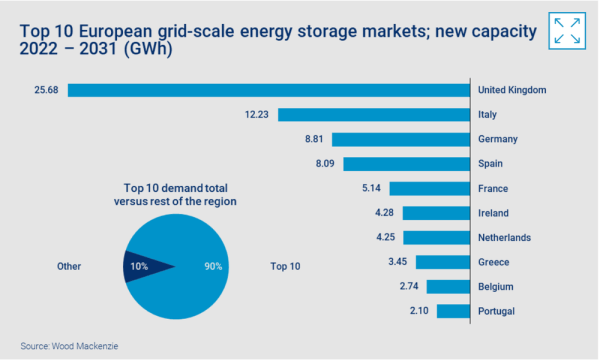
For Germany, this enormous expansion will supposedly mean all of 8.81 GWH of grid-scale energy storage. Is there a decimal place error here? Unfortunately no. Against a requirement of 45,000 GWH +/- of grid-scale storage, they’re not planning on 9000 GWH, or even 900 GWH or 90 GWH, but 9. They’re off by a factor of around 5000 against what they would need.
In other words, they haven’t even begun to solve the storage problem that would need to be solved to make their wind/solar system work, and they will barely if at all have begun to solve it by 2031. Indeed, the problem may not be solvable at all, and as yet they haven’t really put any meaningful effort into trying to figure that out. The result, as we all know, is that they left themselves completely dependent on natural gas from Russia. Now the Russian gas is effectively unavailable, and other potential sources have seen insufficient supply and massive price spikes. Here are a few observations on Germany’s current energy predicament. From Walter Russell Mead in the Wall Street Journal, June 27, “End of the German Idyll”:
As recently as 2020, almost the entire world agreed with the smug German self-assessment that Germany had the world’s most successful economic model, [and] was embarking on the most ambitious—and largely successful—climate initiative in the world. . . . [Now we understand that] German energy policy is a chaotic mess, a shining example to the rest of the world of what not to do. . . . Green energy, despite massive German investment, will be unable to supply German industry with reliable and cheap power for a long time.
From Energy Intelligence Group, June 28, “King Coal Makes Comeback in Europe”:
[German] officials are working on emergency laws that would allow roughly 9-10 gigawatts of idle coal and lignite capacity to return to service until 2024, replacing some of the 16% market share now held by gas. The country is home to seven of the EU’s 10 most polluting power stations, according to NGO Ember. . . . Economy Minister Robert Habeck said laws allowing more coal use and less gas-fired generation should pass the Bundesrat — upper house of parliament — in early July. . . . The government says there are no plans to change the coal phase-out date, with the last units still earmarked for closure by 2030.
It’s a complete reversal of the prior policy of shutting down the coal plants. Economy Minister Habeck says that the reversal is temporary, and that they are still on track to close all the coal plants by 2030. And how exactly are they going to accomplish that, with all of 9 GWH of grid-scale energy storage? There is only one possible method, which is to go back to natural gas, either using alternative suppliers (U.S.?), or because Russia re-enters the good graces of the world. But using natural gas for backup is just as much a complete abandonment of the “net zero” fantasy as is using coal.
So I say that Germany has in fact hit the “green energy wall,” and will not be going back, no matter what they are saying at the moment. Time could prove me wrong, but I don’t see any realistic plans that they have in the works to do away with, or even meaningfully reduce, full fossil fuel backup of their wind and solar generators.
Sanctions can be perceived as casus belli – Medvedev
Samizdat – June 30, 2022
Unilateral sanctions can be perceived as an “act of international aggression” and invoke Russia’s right to self-defense, former Russian President Dmitry Medvedev has warned.
Speaking at the 10th International legal forum in Saint Petersburg, Medvedev blasted the “cynical practice of unilateral restrictive measures against Russia, the illegality of which has been repeatedly emphasized at all levels.”
This practice is “somewhat akin to a declaration of economic war, as our opponents themselves say,” he added.
“Under certain circumstances, such hostile steps can be perceived as an act of international aggression. And even as a casus belli. In response to them, the state has the right to individual and collective self-defense.”
However, Moscow still holds “weak hope” that the West will abandon its “vicious practices” and “repent of its own stupidity,” Medvedev stated. “It is our hope that our former Western partners will have the courage to admit their strategic miscalculations, which, according to the UN itself, have affected more than 1.5 billion people and provoked a surge in global inflation, food shortages, and the growth of poverty,” he said.
Should such hopes not materialize, Russia “will live” on its own without the West, the ex-president explained. “Today’s world is not at all limited to the borders of Western countries,” he said.
Over the past few years, Russia has repeatedly been subjected to assorted sanctions by the US and its allies. The sanctions pressure began to grow exponentially after Moscow launched its large-scale military operation in neighboring Ukraine in late February. Since then, Russia has been hit by several waves of restrictions, ultimately becoming the most-sanctioned country in the world.
Russia sent troops into Ukraine on February 24, citing Kiev’s failure to implement the Minsk agreements, designed to give the regions of Donetsk and Lugansk special status within the Ukrainian state. The protocols, brokered by Germany and France, were first signed in 2014. Former Ukrainian President Petro Poroshenko has since admitted that Kiev’s main goal was to use the ceasefire to buy time and “create powerful armed forces.”
Biden: Americans will endure higher fuel prices
Samizdat | June 30, 2022
The US will bear high gasoline prices for as long as needed, President Joe Biden said on Thursday during a news conference at the NATO summit in Madrid.
When asked how long American motorists should expect to deal with high fuel prices, Biden told reporters “As long as it takes, so Russia cannot in fact defeat Ukraine and move beyond Ukraine.” He stressed that “this is a critical, critical position for the world.”
US gasoline prices, a key driver of the highest inflation seen in the country in 40 years, hit a record $5-a-gallon this month. The prices have been on the rise since the start of the year, reflecting significant consumer demand outstripping the supply of oil, as well as the ongoing turmoil in energy markets. Biden had earlier reassured the public that the US government was doing everything it can “to reduce this pain at the pump.”
The White House has repeatedly blamed Russian President Vladimir Putin for causing inflation in the US, with Biden describing it as “Putin’s price hike.”
However, the US Federal Reserve has recently rejected the assertion that soaring inflation in the country was mostly being driven by the crisis in Ukraine, pointing out that prices had been rising well before that.
US Supreme Court Limits Use of Clean Air Act in Major Blow to WH’s Climate Change Policy
Samizdat – 30.06.2022
The reduction of emissions, decrease in the use of fossil fuels and development of effective green energy sources are among the top priorities of Biden’s declared Build Back Better agenda. The latter already suffered a major blow last year when part of the legislation that was supposed to fund climate policies failed to pass Congress.
The US Supreme Court has ruled that the Environmental Protection Agency interpreted the Clean Air Act – the country’s main anti-air pollution law that allows the regulation of greenhouse gas emissions – too broadly, and ordered to limit its use. Six justices deemed “conservative” supported the decision, while three “liberal” justices opposed it.
The court specifically ruled that the EPA does not have the authority to limit emissions from power plants using the Clean Air Act.
The decision comes as a response to an appeal by 19 states, coal companies and power plants to prevent the EPA from abusing broad authority to regulate emissions. They asked the US Supreme Court to allow them greater flexibility in phasing out emissions-intensive plants, namely coal ones so that they could provide services reliably.
The ruling might undermine Joe Biden’s planned efforts to propose mandatory emission reductions at power plants in the US by the end of the year. It is supposed to be the first step in the POTUS’ broader plan to have the country’s power generation emissions-free in 13 years.
The idea of regulating power plant emissions dates back to the Obama administration and its plans to pass the Clean Power Plan that would have explicitly given the government the tools to retire emissions-intensive coal plans. The act was effectively blocked by a 5-4 US Supreme Court decision in 2016 and shelved for good under the Donald Trump administration.
Regardless of the Democrats’ efforts, the US power plant emissions have actually already sunk below the levels that should have been achieved only by 2030 under Obama’s original plan. They were achieved thanks to closures of the very same coal plants driven by market mechanisms [fracked gas].
Ukraine War: 120 Days
A no-nonsense analysis of the ongoing Ukraine war and its global impact
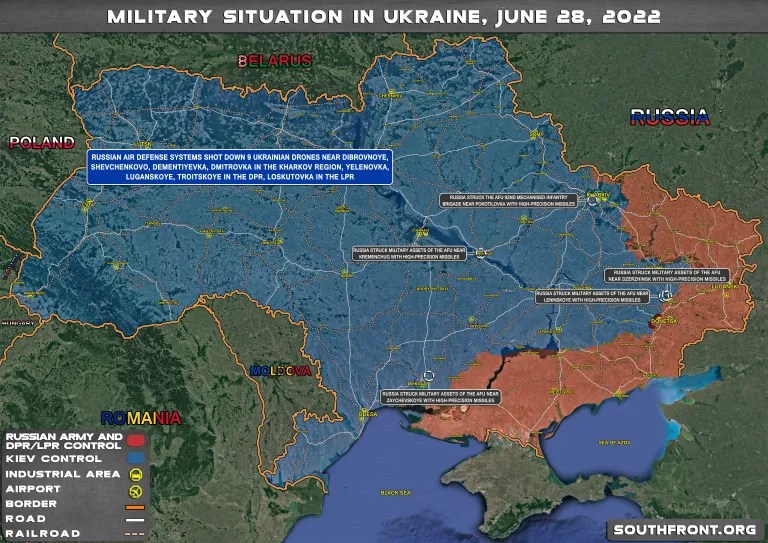
Military situation in Ukraine on June 28 (SouthFront)
Swiss Policy Research | July 2022
Military Situation
The initial Russian offensive (“phase 1”) consisted in a direct advance from Belarus to the northern gates of Kiev and the simultaneous opening of multiple fronts in the north-east, east, and south of Ukraine. There have been various theories as to what the initial Russian strategy was (e.g. conquering Kiev or ‘binding Ukrainian forces’), but most likely, Russia tried to force a collapse or capitulation of the Ukrainian government, in which case Russia would have won the war without really fighting it.
Indeed, just one day after the beginning of the invasion, Russian President Putin proposed a kind of “military coup” in Ukraine to make it easier to “reach an agreement”. There were also several rounds of negotiations between Moscow and Kiev in Belarus and Turkey.
Yet this initial, political-military plan failed and was halted in late March, about one month after the beginning of the invasion.
Nevertheless, already by early March Russia had conquered extensive territories in southern Ukraine connecting the Donbas and Crimea and had been able to restore water supply to the Crimean Peninsula (which had been cut off by Ukraine since 2014; see map above).
By late April, Russia had essentially conquered the important southern Ukrainian port city of Mariupol (500k pre-war inhabitants), and by late May, the remaining Ukrainian forces in the Azovstal steel plant of Mariupol had surrendered. In addition, Russia conquered the southern Ukrainian cities of Melitopol (150k inhabitants) and Kherson (300k) without meeting much resistance.
After the failure of the initial political-military strategy, Russia in early April withdrew all of its troops from the north of Kiev and redeployed them to the east in an attempt to encircle and defeat the main positions of the Ukrainian military and conquer the entire Donbas region.
However, the Russian advance in eastern Ukraine was much slower than expected by many observers, and Russian forces advanced only about 25 kilometers in about two months.
Many Western analysts got the impression that the Russian military was weaker than previously assumed, while many Russian and pro-Russian analysts have argued that the Russian military was advancing slow “on purpose”, allegedly to “minimize losses”.
Yet neither of these explanations were convincing. Instead, there are several substantial reasons that explain the steady, but rather slow advance of the Russian forces in eastern Ukraine.
First, in terms of the number of soldiers and tanks, the Ukrainian military is the largest military in Europe, second only to the Russian military (not counting the Turkish military).
Second, while Ukraine has already mobilized large parts of its men of fighting age, Russia has not yet mobilized at all, i.e. Russia is using only active soldiers, no reservists or conscripts. In fact, Russia has essentially deployed its peace-time army, which has resulted in a notable lack of manpower and infantry. A likely explanation for this decision is that the Russian government wants to keep up the impression, at least domestically, that it is just conducting a “special military operation”, not a full-scale war, and that it wants to avoid the political repercussions of having to conscript additional men (i.e. civilians). This is consistent with the fact that Russia has offered high-paid short-term military contracts to volunteers, again avoiding conscription.
Third, Eastern Ukraine is probably the most strongly fortified region in Europe today, having been prepared against a potential Russian invasion for several years. Although some Ukrainian units have surrendered due to a lack of supply or guidance, the overall Ukrainian resistance against Russian forces remains at a very high level.
Fourth, the Ukrainian military has received large amounts of weapons from the US and NATO countries, including powerful artillery and modern anti-tank weapons. Without these supplies, the Ukrainian front would likely have collapsed rather quickly.
Fifth, the Ukrainian military has greatly enhanced the effectiveness of its artillery by using reconnaissance data from its own drones as well as from US satellites. Indeed, the use of commercial and simple military drones appears to have fundamentally transformed modern warfare at the tactical level.
Sixth, and contrary to claims by Western media, the Russian military is still trying to minimize civilian casualties and damage to civilian infrastructure, likely because it views Eastern Ukraine as Russian territory anyway. For instance, it has been noted that the Russian military delivered fewer airstrikes and fewer missiles during the entire first month than the United States did during the Iraq war in just one day. However, as the Ukrainian military has been fiercely defending most cities and villages, the end result is still large-scale destruction of urban infrastructure.
Although Russia has had the upper hand in Eastern Ukraine, it remains uncertain if the current Russian military strategy will be viable in the longer run, especially if Russia intends to conquer some of the larger Ukrainian cities, such as Kharkiv, Odessa or Dnipro (1M-1.5M) or even Kiev (3M). If the Ukrainian government or military do not surrender or agree to a negotiated solution, the Russian military may have to call up reservists and conscripts and/or switch to an (even) more destructive mode of warfare against the cities it intends to “liberate”.
Currently, the main Russian military advantage consists in relative (but not absolute) air superiority, more powerful artillery, and cruise missiles that can destroy strategic targets anywhere in Ukraine. Nevertheless, the Ukraine war is currently not an “asymmetric war”.
In terms of military strength, it is estimated that Russia deployed about 160,000 soldiers, the pro-Russian Donbas republics about 40,000 soldiers, and Ukraine about 300,000 military and paramilitary forces, of which about 50,000 in Eastern Ukraine. In terms of military losses, it is estimated that by late June, Ukraine may have lost close to 20,000 soldiers, Russia close to 5,000 soldiers, and the Donbas republics about 10,000 soldiers.
Future Developments
Russia will certainly try to fully conquer (or liberate) the Donbas republics, including the cities of Sloviansk and Kramatorsk (100k-150k pre-war inhabitants). Russia may also try to conquer Mykolaiv (500k) and Odessa (1M) in the south of Ukraine in order to establish a corridor to Moldova/Transnistria, which would cut off Ukraine from the Black Sea and turn the country into a landlocked rump state. After conquering the Donbas republics, Russia may further try to conquer or encircle Kharkov (1.5M) and advance to the Dnipr river.
Cities or districts conquered by Russia will likely hold referendums on becoming part of Russia. These referendums will likely turn out in favor of Russia, as a majority of the people in the east and south-east of Ukraine do indeed identify as Russians (or are leaning towards Russia), and Russia may then annex or absorb these territories. However, such a strategy will not work in Kiev, nor in northern and western Ukraine (see map below).
In terms of potential escalations, a Russian advance towards Moldova may trigger a preemptive Romanian invasion (“by invitation”) of Moldova. A further destabilization of Ukraine may trigger a Polish invasion (“peace mission”) of western Ukraine, which in turn could trigger a war between Poland and Belarus in western Ukraine.
Moreover, NATO countries could decide to deliver more powerful weapons to Ukraine or to establish a “safe zone” in western Ukraine (similar to the situation in eastern Syria). In general, the US will likely try to prolong the Ukraine war as much as possible in order to weaken Russia financially and politically (similar to the Afghanistan war in the 1980s.)
Outside of Ukraine, the situation in the Baltics (Lithuania/Kaliningrad), the Balkans (Bosnia-Serbia-Kosovo) and in the Caucasus (Georgia, Armenia-Azerbaijan) could further deteriorate. The situation in Syria, where the US, Israel, Turkey, Iran and Russia are already involved, could also further escalate. In Asia, China could decide to invade and annex Taiwan.
The global economic situation will also likely continue to deteriorate, especially in the fields of energy and food supply, price inflation and financial market stability. This deterioration is driven not just by the war itself, but also by Western sanctions against Russia as well as by two years of misguided pandemic lockdown policies, which have caused serious global supply chain disruptions.
The possibility of a nuclear escalation will be discussed further below.
War Crimes
In terms of war crimes, the current situation is in stark contrast to claims by Western media and Western governments, as most war crimes have been committed not by the Russian side, but by the Ukrainian side. This includes many major war crimes blamed on the Russian side, such as the infamous Bucha massacre, the Mariupol theater bombing, or the Kramatorsk railway station bombing. Other supposed Russian war crimes were simply made up by Ukrainian officials, such as allegations of systematic rape and mass looting.
Yet other events were taken out of context, such as the alleged Russian bombing of Ukrainian schools and hospitals or shopping centers, which in almost all cases had been turned into Ukrainian military bases or ammunition depots. In other cases, civilian buildings supposedly destroyed by Russian missiles were in fact destroyed by Ukrainian air-defense missiles (e.g. in Kiev) or Ukrainian artillery missiles (e.g. in Borodyanka).
In yet other cases, Ukrainian forces, poorly disguised as Russian forces, executed Ukrainian civilians that welcomed the false “Russian liberators”; Western media then presented the execution as a Russian war crime. In even other cases, the Ukrainian bombing of Donbas cities was presented as the Russian bombing of Ukrainian cities.
In the case of Bucha, the bodies seen in the streets were victims of Ukrainian shelling of residential areas during the Russian occupation and retreat, and of subsequent Ukrainian executions of “collaborators” (hence the white armbands, a sign of friendly status during Russian occupation). The bodies were then presented as victims of a supposed “Russian massacre”.
Ironically, the Ukrainian commander who oversaw the Bucha massacre previously was a Russian intelligence asset who had built up “neonazi groups” in Russia and Belarus. The international “marketing” of the Bucha massacre as a supposed Russian war crime may have been coordinated by British intelligence, similar to numerous chemical false-flag attacks in Syria.
In the case of the Mariupol maternity clinic, Western media claimed it was a Russian airstrike, but they could not provide any evidence for this hypothesis, and witnesses at the clinic said there was no airstrike. Yet the incident remains unresolved, and both a Russian attack (possibly targeting a nearby Ukrainian base) or a Ukrainian operation remain possible.
In the case of the recent Kremenchuk shopping center incident, the Ukrainian government claimed a Russian missile hit the shopping center with 1,000 people inside; in reality, the Russian missiles hit an adjacent military plant and the shopping center was either closed (non-operational) or almost empty. However, one of the Russian missiles did hit very close to the shopping center, which then caught fire and burnt down.
Documented, confirmed or potential Russian war crimes currently consist mainly in the shooting and killing of civilians that approached Russian checkpoints or military columns, on foot or by car, although the context of these events is sometimes unclear (e.g. if there were any warning shots). There are also allegations of several other crimes against individual Russian soldiers that are currently difficult to verify independently.
On the Ukrainian side, documented war crimes encompass mass torture and mass executions, both against prisoners of war and their own people (if deemed pro-Russian collaborators or sympathizers), including several cases of decapitation; the military use of civilian infrastructure (including schools) and “human shields”; and large-scale shelling of residential areas behind front lines, especially against the city of Donetsk (in one case even hitting a maternity clinic).
Moreover, several Western journalists, whose death was blamed on the Russian side, were in fact killed by the Ukrainian side (in friendly fire incidents).
False claims of major Russian war crimes (i.e. atrocity propaganda) have been used by Western governments to justify weapons supplies to Ukraine and sanctions against Russia. The heavy use of such atrocity propaganda is not a new phenomenon, of course. Important recent examples include the US/NATO wars against Yugoslavia and against Syria.
The topic of war crimes will be covered in a separate, detailed event-by-event analysis.
Propaganda and Censorship
On the Russian side, propaganda efforts depict the Ukraine war as a kind of continuation of the Second World War or Great Patriotic War against National Socialist Germany, focusing on the supposed “denazification” of Ukraine. At the same time, Russian President Putin has criticized Soviet leaders for having made Ukraine a quasi-independent political entity in the first place. Thus, Russian propaganda combines elements of both the former Soviet Union and the earlier Russian Tsarist empire.
Overall, the “Nazi narrative” appears to be quite effective, both in Russia and in the West, in part because many key aspects of the Second World War and NS Germany still cannot be questioned, neither in Russia nor in the sphere of Anglo-American countries, which during the Second World War were allied with Stalin’s Soviet Union against Hitler’s Germany.
On the NATO side, propaganda efforts mainly focus on Russian aggression, supposed Russian war crimes and supposed Ukrainian successes. NATO propaganda is produced by multiple PR agencies, coordinated by intelligence services, and distributed to Western media outlets by the three global news agencies AP (American), AFP (French) and Reuters (British-Canadian). The total number of NATO propaganda messages in Western media is likely approaching about one thousand.
In addition, both sides have introduced significant media censorship. In NATO countries, this includes the removal of Russian and pro-Russian media outlets from major Internet search engines Google, Microsoft Bing and even DuckDuckGo. Furthermore, British security state operatives were caught trying to suppress independent media coverage of the Ukraine war.
Nevertheless, independent media outlets and uncensored Telegram channels have continued to provide important real-time footage and analysis of the situation in Ukraine.
NATO Expansion or Russian Expansion?
Is the Ukraine war about NATO expansion or rather about Russian expansion? In truth, it is likely about both NATO and Russian expansion, although one may argue that the Russian expansion is a response to NATO expansion. It is clear that the current Russian government sees large parts of Ukraine as “historically Russian territory”, or indeed Ukraine as part of Russia. Only by seeking a neutral status and by accepting the loss of Crimea and the autonomy of the Donbas republics might Ukraine have avoided a Russian invasion.
It has been argued that NATO expansion into Ukraine wouldn’t be a threat to nuclear Russia, but this is hardly true. NATO expansion into Ukraine would pose a geostrategic threat (control over pipelines, ports etc.), a direct military threat (planned recapture of Crimea and the Donbas republics), and a strategic military threat (NATO military infrastructure and missile bases). For similar reasons, the US did not and would not accept Russian bases in Cuba, Mexico or Venezuela.
It has been noted that Russia is unlikely to invade Finland or Sweden, despite their intention to join NATO (in response to the Russian invasion of Ukraine). In fact, Russia already has a (small) land border with NATO founding member Norway and with Baltic states. Yet Finland and Sweden do not currently threaten Russian territory or Russian interests. Otherwise, a Russian military response may in fact be conceivable (see below).
Is the Russian military operation in Ukraine legal or illegal? From a Western perspective, the Russian operation is clearly illegal, not unlike previous US invasions (e.g. of Grenada, Panama and Iraq) and most US/NATO wars (e.g. against Serbia, Afghanistan, Libya and Syria). From a Russian perspective, the military operation is a legitimate intervention into an ongoing, illegal eight-year war against the Donbas republics. Russia will likely annex large parts of Ukraine, but it will try to “legitimize” these annexations by prior referendums.
Energy War: By Whom?
It has also been argued that Russia is waging an energy war by restricting oil and gas exports in order to destabilize NATO countries and especially Europe. Yet upon closer inspection, it is clear that the energy war is in fact waged via sanctions by NATO countries in order to financially destabilize Russia, although so far this seems to have failed and indeed backfired, with energy security in Europe becoming rather uncertain.
For instance, a reduction in gas flow through the Nord Stream pipeline from Russia to Germany was (and is) due to a broken turbine sent by Germany to Canada for repair, but then retained by Canada due to sanctions against Russia. Similarly, the Russian decision to accept energy payments only after conversion into rubles was simply in response to the prior freezing of billions of Russian Euro and dollar reserves by Western countries.
Indeed, neither during nor after the Cold War has Russia (or the USSR) ever used the “energy weapon” against (Western) Europe, as Russia is very much interested in both being seen as a reliable supplier and in foreign currency export revenue.
However, one can argue that Russia is relying on a kind of “indirect energy weapon”: by being a reliable energy supplier, Russia may hope that Europe and NATO will not turn hostile, regardless of Russian military actions. Moreover, if relations should further deteriorate, Russia could of course use the “energy weapon” and stop energy exports to Europe altogether.
The Russian government likes to emphasize that the impact of Western sanctions is rather minor and that the Russian ruble has remained strong. But Russia had to impose capital controls (i.e. the ruble is no longer free floating), and the economic impact is substantial, with tens of thousands of IT specialists having already left the country, for instance.
Nuclear War?
How likely is a nuclear war as a potential escalation of the Ukraine war?
A direct nuclear war targeting the mainland of nuclear states remains very unlikely, as this would lead to the destruction of all states involved. However, from a purely military and geostrategic perspective, there are two rational offensive uses of nuclear weapons, in addition to their defensive use as a deterrent: against hostile non-nuclear states and against overseas military infrastructure of nuclear states.
In this regard, there is a major geostrategic asymmetry between Russia and China on the one hand and the US on the other hand: whereas the US has several hundred overseas military bases and several dozen non-nuclear allies or client states (both in Europe and in Asia), Russia and China have almost no overseas military bases and very few non-nuclear allies.
Thus, Russia and China could consider coordinated nuclear strikes against all US overseas military bases in Eurasia (i.e. in Europe, the Middle East, Central Asia and East Asia). In addition, Russia and China could consider nuclear strikes against hostile non-nuclear countries, both in Europe and in Asia, targeting military/industrial centers or even population centers.
Theoretically, such a coordinated nuclear operation might remove the US military from the Eurasian continent (and by extension from Africa), limiting US military influence to North and South America. Thereafter, a new geo-economic Cold War between Eurasia/Africa, led by China and Russia, and the Americas would likely ensue.
Nuclear allies of the US in Eurasia, most notably Britain, France and Israel, would have to ensure robust sea- and air-based second strike capability even against modern hypersonic missiles with multiple nuclear warheads, in order to avoid being targeted themselves.
A nuclear attack against non-nuclear NATO states would be seen as an attack against NATO, and a nuclear attack against US overseas military bases would be seen as an attack against the United States, but because of the above-mentioned asymmetry, the US could not respond in a meaningful way without forcing its own destruction.
While such a scenario seems militarily conceivable and even rational (given the breakdown of the post-WWII security architecture), both China and Russia currently seem to follow a different economic, diplomatic and military strategy, using novel alliances such as BRICS, RCEP, the Eurasian Economic Union, and the Shanghai Cooperation Organization (SCO).
In contrast, the US may attempt to contain Russia and China via economic and political sanctions and to ultimately overturn regimes in both countries, thus paving the way for global US predominance, which was almost achieved after the end of the Cold War.
Figures
1) Results of 2010 Ukrainian presidential election.
Janukovych was the pro-Russian candidate, Tymoshenko was the pro-Western candidate.
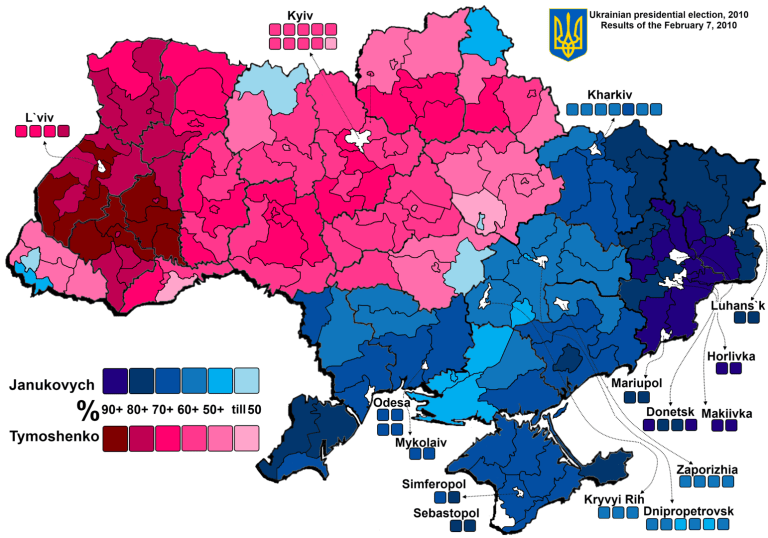
Results of 2010 Ukrainian presidential election (Wikimedia)
2) Mariupol: Before and after Russian conquest
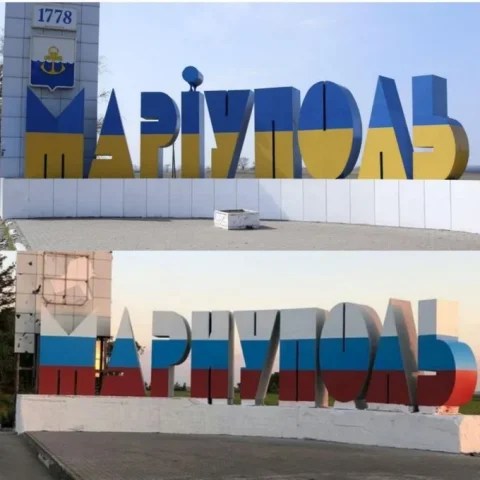
Mariupol: Before and after Russian conquest (Telegram)
3) Western propaganda vs. Russian propaganda
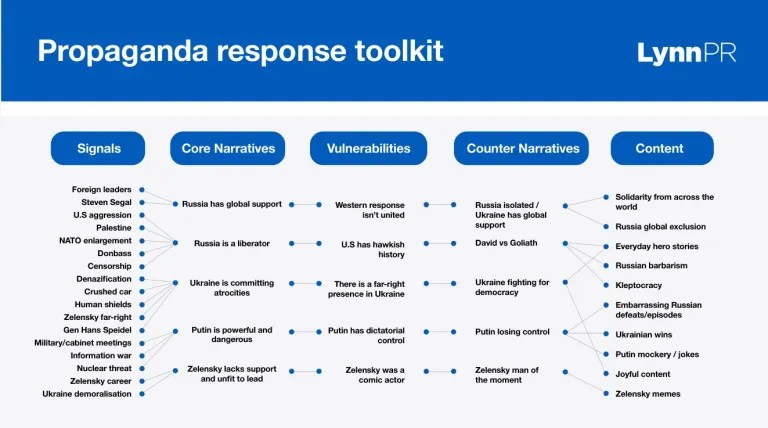
Western propaganda vs. Russian propaganda (Lynn PR)
Biden’s Ukraine Policies, Democratic Party’s Intolerance Help Drive Voter Exodus
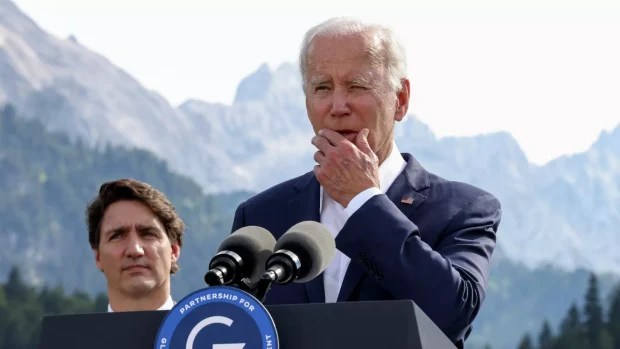
Samizdat – 29.06.2022
President Joe Biden’s approach to the conflict in Ukraine, concerns over his mental stability, and liberal intolerance could be among the reasons why over one million Democrats switched allegiances and joined the Republican Party in the past year, some analysts believe.
According to data collected by AP, more than one million Democrats have registered as Republicans during the course of the past twelve months, most notably in highly-populated suburbs, where presidential and national congressional elections are usually decided. AP in its report published on Monday said the switch also encompassed agricultural regions, poor inner cities, and small towns.
The Democratic voter mass defections coincide with Biden’s approval ratings sinking to historical lows as inflation runs at all-time highs with mid-term elections looming in November.
Meanwhile, the White House’s policies toward the conflict in Ukraine are also becoming less popular. A poll released on Tuesday by Morning Consult Global shows American support for sanctions against Russia is steadily declining – largely because of rising energy costs.
“Workers and seniors are ravaged by an inflationary curse sparked by an inept war against the fossil fuel industry,” political analyst and former hedge fund manager, Charles Ortel, said when asked about the Democratic voter exodus.
The Democratic voter defections and low approval ratings, he added, could indicate Biden administration efforts to rally patriotism around his “tough” policies against Russia over Ukraine have failed.
Political commentator and historian Dan Lazare believes the fact voters are switching parties is less an endorsement of the Republican Party than a loss of confidence in Democrats, especially in their handling of the Ukraine crisis and the related rise in gas prices.
“Skyrocketing gas prices are the gift that keeps on giving – for the Republicans, that is. The war in Ukraine is turning into a Democratic nightmare as Russia continues to reap real battlefield gains,” Lazare said. “So, what Democrat wouldn’t lose faith given a record like that?”
Ortel said history suggests that citizens reluctantly support foreign conflicts even when leaders provide compelling evidence that the causes are justified. Not to mention, US efforts that started under the Clinton administration to push NATO eastward have never been explained nor have potential costs and complaints by the Russian side, Ortel said.
“No sane actor wants perpetual conflict,” Ortel explained. “And no American would tolerate parallel expansion into Mexico or Canada by Russia.”
Other Drivers of Discontent
Ortel also attributed the voter surge away from the Democrats to the party’s “intolerant” attitude, including toward those who oppose the administration’s Ukraine policies. The Democratic Party used to be a group that embraced cooperation and was tolerant of perspectives that competed with liberal or progressive views. However, in recent years that has changed, Ortel said.
“Particularly under the Obama-Biden Administration, tolerance for other viewpoints was replaced with a ‘take-no-prisoners’ approach towards any challengers,” Ortel said.
To make matters worse, the analyst added, Biden administration officials propagate theories and slogans claiming they are succeeding “when even unschooled citizens see clearly that Biden and his team are rapidly wrecking the American economy and what remains of America’s standing abroad.”
Other drivers of voters fleeing the Democratic Party are the questions surrounding the commander-in-chief’s mental stability in light of nonstop gaffes and concerns over Vice President Kamala Harris’s capabilities, Ortel said.
“Joe Biden is clearly not playing with mental faculties intact nor is Kamala Harris fit to replace him,” Ortel said.
Lazare has pointed to Biden’s dismal domestic policy record as another culprit.
“Joe Biden is The Incredible Shrinking President: His one significant success, the $1.9-trillion COVID-19 relief bill that passed in February 2021, has roundly backfired by giving inflation a significant boost. Everything else has meanwhile flopped,” he said.
Meanwhile, Lazare added, voting reform is dead in the water, student debt relief is stalled, and there is a dispiriting deadlock over gun control in the wake of mass shootings.
Although the midterm congressional elections were still four months away, all signs already pointed to a historic catastrophe for the Democrats, Lazare warned.
“Predicting an election that’s still four months away is risky business. But given that Biden’s poll numbers are still sinking – the last is just 36%! – and given that inflation is accelerating, I don’t see how the midterms can be anything less than a Democratic debacle,” Lazare said.
EU Told to Prepare for Economic Hammering, Forget ‘Wildly Optimistic’ Plans to Replace Russian Gas
Samizdat – 29.06.2022
Economists on both sides of the Atlantic have recently urged their respective publics to prepare for a recession, and possibly a stagflationary crisis, amid surging inflation and soaring energy costs exacerbated by Washington and Brussels’ moves aimed at dramatically reducing dependence on Russian oil and gas.
The European Union’s plan to replace Russian gas before the end of the current year isn’t only “wildly optimistic,” but will add to the economic woes the bloc is already facing, London-headquartered macroeconomic forecasting consultancy TS Lombard has predicted.
In a recent report, TS Lombard researcher Christopher Granville calculated that the EU imported roughly 155 billion cubic meters (bcm) of natural gas from Russia in 2021, with all of Brussels’ proposed measures to replace it – including diversification of gas sources, heating efficiency measures, solar rooftops, biomethane, etc. account for the equivalent of about 102 bcm of gas, leaving about a third of supplies unaccounted for.
“Apart from implementation timings of commissioning German LNG-receiving terminals, Russia is also an important supplier of LNG, underlining the challenge for Europe of sourcing adequate LNG supplies,” Granville wrote.
Amid EU efforts to source gas from alternative suppliers, including the US, Qatar and Azerbaijan, Granville’s report warned that the EU will be made to “pay more on average for its [non-Russian] oil and gas than its peers. Asian countries will buy more Russian oil at discounted prices… LNG imported by Europe from the US will cost [much] more than the price paid by US consumers owing to transit and liquefication/re-gasification costs.”
Russian officials and European energy company officials have estimated that Russian pipeline gas flowing to Europe has been 40 and 50 percent cheaper than American LNG, and less expensive than all other alternatives, owing to the shorter transit distances, larger volumes, and competitive pricing.
Last month, Russian President Vladimir Putin suggested that Moscow’s “Western colleagues” had “forgotten” the elementary laws of economics by trying to cut themselves off from Russian energy, predicting that the decision would turn Europe into the region with the highest energy costs in the world. This would undermine the EU’s competitiveness vis-à-vis other agglomerations, he said.
“Obviously, together with Russian energy resources, economic activity will also be leaving Europe for other regions of the world. Such an economic suicide is of course the internal affair of European countries. We must proceed pragmatically and primarily from our own economic interests,” Putin said.
Russian natural gas exports to Europe have declined precipitously in recent months as EU bloc countries search for alternatives. The drop accelerated earlier this month after Russian gas giant Gazprom indicated that it would be forced to reduce flows to Europe by up to 60 percent due to problems with the repair and maintenance of German-sourced turbines pumping gas through the Nord Stream 1 network. Germany and Denmark activated emergency measures as supplies dropped. Brussels accused Moscow of artificially throttling exports, with the European commission calling the emergency measures “blackmail.”
Takahide Kiuchi, an economist at the Tokyo-based Nomura Research Institute economic consultancy, warned in a research note Tuesday that if the crisis surrounding the Nord Stream 1 shortfall escalates, Brussels could add gas to the list of other Russian energy supplies that have been banned or semi-banned. This, he predicted, would push the Eurozone into a “sharp slowdown,” and plunge Germany into a recession.
Kremlin: Russia’s offensive to end as soon as Ukraine forces lay down weapons
Press TV – June 28, 2022
The Kremlin says Russia will halt its months-long military offensive in neighboring Ukraine as soon as Ukrainian forces surrender.
Kremlin spokesman Dmitry Peskov told reporters on Tuesday that hostilities in Ukraine could end “before the end of today” if Kiev orders the nationalists to lay down their weapons and Moscow’s demands are met.
“The Ukrainian side can end all this before the end of today; an order is necessary for the nationalist units to lay down their weapons, an order is necessary for the Ukrainian military to lay down their weapons; and they must fulfill all Russia’s demands. Then everything will be over before the day ends,” Peskov said.
“Everything else are just speculations of the Ukrainian head of state,” he added. “We are guided by the statements of our President Vladimir Putin that the special military operation is going according to plan and achieving its goals.”
Asked whether the Russian side had any approximate timeframe for the end of the offensive in Ukraine, the Kremlin spokesman responded in the negative.
Peskov made the comment while reacting to Ukrainian President Vladimir Zelensky’s remark that he would like to end the hostilities before the end of the year.
Zelensky urged world powers on Monday to do their utmost to help end Russia’s offensive before the cold season, also saying that the time was not ripe for holding talks with Russia as Kiev was seeking to consolidate its positions.
In a statement on Monday, the Group of Seven (G7) countries expressed full support for Ukraine in the conflict with Russia, pledging to further tighten sanctions on Moscow.
Addressing G7 leaders at their summit in the Bavarian Alps via video link, the Ukrainian president called for arms supplies and air defenses to gain the upper hand in the conflict.
Since the start of Russia’s military strikes on February 24, the US and its Western allies have been imposing sanctions against Moscow. More than four months after the Kremlin launched its offensive against Ukraine, Russian troops have taken control of nearly the entire Donbass region, focusing their military attention on northeastern Ukraine.
In a separate development on Tuesday, G7 leaders in a statement denounced Russia’s offensive as “illegal and unjustifiable.”
“We, the leaders of the Group of Seven … were joined by the leaders of Argentina, India, Indonesia, Senegal and South Africa, as well as Ukraine,” they said in their draft final statement. “We re-emphasize our condemnation of Russia’s illegal and unjustifiable war of aggression against Ukraine.”
The G7 leaders also agreed to explore imposing a ban on transporting Russian oil that had been sold above a certain price, ramping up pressure on Moscow over the soaring global inflation and energy shortages fueled by the country’s offensive in Ukraine.
German Chancellor Olaf Scholz said an oil price cap would ratchet up the existing Western pressure on Russia, stressing that the sanctions would stay until Moscow accepted failure in Ukraine.
“There is only one way out: for Putin to accept that his plans in Ukraine will not succeed,” Scholz told a closing news conference at the three-day G7 summit, adding that the aim of the ban was to tie financial services, insurance, and the shipping of oil cargoes to a price ceiling. “We invite all like-minded countries to consider joining us in our actions.”
The International Energy Agency announced in its June monthly report that the revenues from Russian oil export had soared in May even as volumes had fallen.
The Kremlin said on Tuesday that Russian gas giant Gazprom could seek to change the terms of its delivery contracts if Western governments implemented a price cap on Russian gas.
Why G7’s Program for Developing Countries is Still No Match for China’s Belt & Road
Samizdat – 28.06.2022
The G7 on 26 June re-launched its previous Build Back Better World program to provide infrastructure funds to poor and developing nations under a new name, the Global Investment and Infrastructure Partnership. The project aims to compete with China’s Belt and Road Initiative kicked off by Beijing in 2013.
The Build Back Better World (B3W) program was pompously announced by the club of seven developed nations to counter China’s Belt and Road at the G7 Summit in Cornwall in July 2021. However, little had been heard of the G7’s endeavor since then. In June 2022, the Group of Seven decided to breathe new life into the project.
“So far, America has failed to build momentum on its plan to Build Back a Better World,” says Francesco Sisci, a Beijing-based China expert, author, and columnist. “However, with this new G7 plan, which includes other countries, this momentum could start to be built. It is a question mark. Nobody is sure until things are realized. But you cannot just underestimate and dismiss this plan, because there is a large commitment of many countries with a large economy and this plan could make big sense.”
The G7’s grand design envisages laying a secure sub-sea telecommunications cable that will connect Singapore to France through Egypt and the Horn of Africa; creating a COVID-19 vaccine plant in Senegal; expanding solar projects in Angola, including solar mini-grids and home power grids; and establishing an innovative modular nuclear reactor plant in Romania, among other issues.
The US president pledged to mobilize $200 billion in investments in global infrastructure projects over the next five years. The overall investment, including G7 member states and private capital, is expected to reach $600 billion.
“With two competing plans – size matters, at the end of the day,” says Sisci. “That is, China may be able to immediately finalize a lot of money in a short time in a number of projects. The G7 countries could be slower, but eventually they could build up momentum and they could channel much more money much more effectively, perhaps, in a much larger number of projects which could stifle Chinese projects.”
Sisci suggests that the club of developed capitalist countries “may end up being more effective in many ways [than China], a smaller non-capitalist country.”
“China, but also Russia, by far, don’t have the size, the gravitas to oppose even a divided G7, which is coming together because of this opposition to China or Russia-driven projects,” he notes.
G7 Economic & Geopolitical Hurdles
However, some other observers express skepticism over the ability of the US and G7 to implement the project given record-high inflation and cost of living crisis currently engulfing the states. The US, British and European central banks are struggling to tame skyrocketing inflation by raising interest rates to reduce demand, which is prompting recession fears.
“Washington claims they are going to be sending over $200 billion. But where’s the money coming from and how is it going to be really used?” asks Thomas W. Pauken II, the author of “US vs China: From Trade War to Reciprocal Deal,” a consultant on Asia-Pacific affairs and a geopolitical commentator.
He notes that previously the US Senate voted Biden’s landmark Build Back Better initiative down, and for good reason, as Republican congressmen feared that the Democratic administration’s spending spree would fan inflation and increase an already bloated national debt.
Pauken also expresses bewilderment over the G7’s apparent readiness to embark on the bold international project at a time when the group is involved in the Ukraine crisis with the UK trying to keep the military conflict dragging on. “I mean, it’s laughable that they have to think about [competing with] China at this time when they’re on the brink of a major war in Europe,” the commentator remarks.
Meanwhile, the G7’s Global Investment and Infrastructure Partnership cannot be regarded so far as a viable alternative to the Beijing-led Belt and Road Initiative that has been implemented for slightly less than a decade, according to Pauken.
“First of all, [the G7] actually need[s] to make these projects work,” says the geopolitical commentator. “Other than that solar plant in Angola, I don’t see any of these initiatives really working.”
In particular, China invested almost $59.5 billion in its comprehensive infrastructure project in 2021 alone. When it comes to crucial elements of the project, the West appears to be lagging behind. While the G7 is still considering building a subsea cable linking Europe and Southeast Asia, China kicked off its Digital Silk Road (DSR) almost seven years ago. The DSR’s backbone is the Pakistan and East Africa Connecting Europe (PEACE), a 9,300 mile long subsea cable network meant to tie Asia, Africa, and Europe together. The network is designed to transmit over 16Tbps per fibre pair with its Mediterranean section going from Egypt to France having already been laid.
Are Emerging Economies Interested in the G7 Agenda?
There is yet another problem as to how to make these Western projects attractive for Global South nations, the Asia Pacific expert continues. In particular, the G7 has been pushing ahead with a climate change agenda and the plan to cut carbon emissions, which is not relevant for the majority of third-world states which are still reliant on cheaper and more reliable fossil fuels and coal plants, he notes.
“You also have to deal with auditing issues as well as the so-called climate change consultants who go on the ground and on site,” he says. “You have to prove that those infrastructure projects are not causing much of a carbon footprint. But most of the major infrastructure does require a big carbon footprint, especially in the emerging markets, because they don’t have the same equipment or they don’t have the same standards or labor laws as they would have in Western Europe or the US.”
Many emerging economies, including African countries, are beginning to have a growing frustration with the US and Europe, according to Pauken. The reality is that Africans and many of the emerging markets want to focus on economic stuff, he notes. However, when the US officials come in, they’re talking about climate change or gender equity, and this is not as interesting to developing nations, the commentator emphasizes.
“[Developing nations] want help on improving their agricultural production levels and boosting their energy capacity, which the Russians and the Chinese have been doing,” Pauken notes.
Given all of the above, it is unlikely that the G7’s Global Investment and Infrastructure Partnership initiative is going to actually happen, argues the geopolitical commentator.
“They’re rebranding a failed policy, thinking it might work by using new names and new mergers. Last time it was separate between the EU and separate between the US and they somehow think that if you combine the two failed projects into one, that this will somehow succeed. That’s not going to work in the real world,” Pauken concludes.
Macron reveals if Saudis and UAE can rapidly ramp up oil output
Samizdat – June 28, 2022
Oil-rich countries Saudi Arabia and the UAE cannot radically increase crude production anytime soon, French President Emmanuel Macron was overheard saying to his US counterpart Joe Biden on Monday.
The leaders were contemplating how to curb Russia’s oil revenue without triggering more energy price increases.
The brief conversation between Macron and Biden was filmed by reporters on the sidelines of the Group of Seven (G7) summit in southern Germany.
Macron told his US counterpart that he had a call with Emirati leader Sheikh Mohammed bin Zayed Al Nahyan. “He told me two things. ‘I’m at a maximum [production capacity]’. This is what he claims,” Macron said.
The French president continued: “And then he said [the] Saudis can increase by 150 [thousands barrels per day]. Maybe a little bit more, but they don’t have huge capacities before six months’ time.”
Emirati Energy Minister Suhail Al Mazroui clarified on Twitter that “the UAE is producing near to our maximum production capacity based on its current OPEC+ production baseline” of 3.168 million barrels per day. He said the Gulf state would stay “committed” to the same baseline until the end of the year.
Western countries have been looking for ways to curb Russia’s revenue from the oil trade, all while trying to avoid further energy price hikes at home. Saudi Arabia and the UAE were seen as nations with spare capacity to boost oil production in order to reduce prices, according to Reuters.
Iran and Argentina apply to join BRICS
Samizdat | June 27, 2022
The Islamic Republic of Iran has officially submitted its application to join the group of five emerging economies made up of Brazil, Russia, India, China, and South Africa, the foreign ministry in Tehran announced on Monday. The move comes after the Iranian president addressed the BRICS summit last week.
While BRICS is not a treaty bloc, it has a “very creative mechanism with broad aspects,” Iranian Foreign Ministry spokesman Saeed Khatibzadeh said on Monday, according to the Tasnim news agency. He added that Tehran has already had “a series of consultations” with BRICS about the application.
Iran’s membership would “add value” for everyone involved, said Khatibzadeh, noting that BRICS members account for up to 30% of the world’s GDP and 40% of the global population.
On Friday, Iranian President Ebrahim Raisi addressed the BRICS virtual summit hosted by China, and expressed Tehran’s readiness to share its capabilities and potentials with the group.
Argentina has also applied to join BRICS. President Alberto Fernandez on Friday urged the creation of cooperation mechanisms that could represent the alternative to ostensibly private institutions run by – and in the interest of – the West.
During the session on Wednesday, Russian President Vladimir Putin said that the five-member group was working on setting up a new global reserve currency “based on a basket of currencies of our countries.”
Featured Video
Seyed M. Marandi: Toward Total War in the Middle East
or go to
Aletho News Archives – Video-Images
From the Archives
The Geopolitics behind the War in Yemen (I)
By Mahdi Darius NAZEMROAYA | Strategic Culture Foundation | 30.03.2015
The United States and the Kingdom of Saudi Arabia became very uneasy when the Yemenese or Yemenite movement of the Houthi or Ansarallah (meaning the supporters of God in Arabic) gained control of Yemen’s capital, Sanaa/Sana, in September 2014. The US-supported Yemenite President Abd-Rabbuh Manṣour Al-Hadi was humiliatingly forced to share power with the Houthis and the coalition of northern Yemenese tribes that had helped them enter Sana. Al-Hadi declared that negotiations for a Yemeni national unity government would take place and his allies the US and Saudi Arabia tried to use a new national dialogue and mediated talks to co-opt and pacify the Houthis.
The truth has been turned on its head about the war in Yemen. The war and ousting of President Abd-Rabbuh Manṣour Al-Hadi in Yemen are not the results of «Houthi coup» in Yemen. It is the opposite. Al-Hadi was ousted, because with Saudi and US support he tried to backtrack on the power sharing agreements he had made and return Yemen to authoritarian rule. The ousting of President Al-Hadi by the Houthis and their political allies was an unexpected reaction to the takeover Al-Hadi was planning with Washington and the House of Saudi. … continue
Blog Roll
 Aletho News
- US lawmaker admits American people footing bill for Trump’s failed aggression against Iran
- Pfizer Gave $500,000 to Groups That Lobbied to End Religious Exemption in Massachusetts
- HE SAVED LIVES. NOW HE FACES PRISON.
- Israeli lobby seeks to bind US fate to ‘Israel’: Araghchi
- Pakistan-Iran talks secure LNG shipment to Islamabad through Hormuz
- Black Sea grain crisis puts global wheat supplies under pressure
- IRGC air defenses destroy another US MQ-1 drone over Strait of Hormuz
- Imran Khan’s entire immediate family detained in Pakistan ahead of mass protest demanding his release
- EU nation detains former presidential frontrunner
- Leaked: Britain’s Sham Conviction Of Hashim Thaci
- If Americans Knew
- Israeli Attacks in Gaza Kill at Least Seven Palestinians Over Three Days, including Woman and Child
- Trump’s militarization of Washington DC as he pursues Israel’s war against Iran
- Why Israel Fears This Searing New Documentary
- Huckabee aide solicited cash gifts from Israelis
- This isn’t sci-fi, AI is already killing people
- ‘The Most Brutal Thing’: Investigation Reveals Execution of Elderly Woman in Rafah
- Inside Israel’s ‘soft’ ethnic cleansing plan for Gaza through the eyes of its victims
- New online database tracks pro-Israel political donations in the United States
- Israeli president pardons soldier convicted for killing wounded Palestinian
- Singer Ed Sheeran says his ‘heart broken’ by Gaza devastation, addresses Macklemore controversy
- No Tricks Zone
- 2025 Nature Paper Claiming Worsening Global Drought Gets RETRACTED …Heavily Flawed
- New Study: ‘Global Drought Shows No Detectable Recent Acceleration Under Climate Warming’
- Economic Masterminds: German Socialists Suggest Taxing Productivity Gains Stemming From Using AI
- The South China Sea Has Not Been Cooperating With The Climate Change Narrative
- Energy Crisis: Germany Enters Heating Season With Historically Low Gas Reserve Fill Levels
- New Study: The Antarctic Ice Sheet Gained Mass From 2020-2024 Due To Staggering Snow And Ice Accumulation
- Study: Ocean Heating Rates From Thousands Of Years Ago ‘Dwarf’ Modern Ocean Heating Rates
- Climate Extremists Target, Attack Large-Scale Power Grid Infrastructure In Germany!
- New Study: Antarctic Ice Melt Has Contributed Less Than 1 Centimeter To Sea Level Rise In The Last 30 Years
- Fear Of Debate: Alarmist German Climate Scientist Calls On Mainstream Media To Discredit Skeptic Voices
 Aletho News