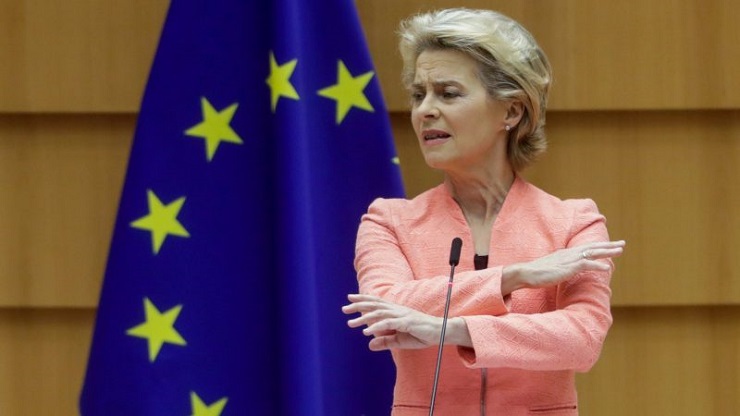
Economist Ernst Wolff believes that a hidden alliance of political and corporate leaders is exploiting the pandemic with the aim of crashing national economies and introducing a global digital currency.
How is it that more than 190 governments from all over the world ended up dealing with the COVID-19 pandemic in almost exactly the same manner, with lockdowns, mask mandates, and vaccination cards now being commonplace everywhere? The answer may lie in the Young Global Leaders school, which was established and managed by Klaus Schwab of the World Economic Forum, and that many of today’s prominent political and business leaders passed through on their way to the top.
The German economist, journalist, and author Ernst Wolff has revealed some facts about Schwab’s “Young Global Leaders” school that are relevant for understanding world events during the pandemic in a video from the German Corona Committee podcast. While Wolff is mainly known as a critic of the globalist financial system, recently he has focused on bringing to light what he sees as the hidden agenda behind the anti-Covid measures being enacted around the world.
Mysterious Beginnings
The story begins with the World Economic Forum (WEF), which is an NGO founded by Klaus Schwab, a German economist and mechanical engineer, in Switzerland in 1971, when he was only 32. The WEF is best-known to the public for the annual conferences it holds in Davos, Switzerland each January that aim to bring together political and business leaders from around the world to discuss the problems of the day. Today, it is one of the most important networks in the world for the globalist power elite, being funded by approximately a thousand multinational corporations.
The WEF, which was originally called the European Management Forum until 1987, succeeded in bringing together 440 executives from 31 nations already at its very first meeting in February 1971, which as Wolff points out was an unexpected achievement for someone like Schwab, who had very little international or professional experience prior to this. Wolff believes the reason may be due to the contacts Schwab made during his university education, including studying with no less a person than former National Security Advisor and Secretary of State Henry Kissinger. Wolff also points out that while Schwab was there, the Harvard Business School had been in the process of planning a management forum of their own, and it is possible that Harvard ended up delegating the task of organizing it to him.
The Forum initially only brought together people from the economic field, but before long, it began attracting politicians, prominent figures from the media (including from the BBC and CNN), and even celebrities.
Schwab’s Young Global Leaders: Incubator of the Great Reset?
In 1992 Schwab established a parallel institution, the Global Leaders for Tomorrow school, which was re-established as Young Global Leaders in 2004. Attendees at the school must apply for admission and are then subjected to a rigorous selection process. Members of the school’s very first class in 1992 already included many who went on to become important liberal political figures, such as Angela Merkel, Nicolas Sarkozy, and Tony Blair. There are currently about 1,300 graduates of this school, and the list of alumni includes several names of those who went on to become leaders of the health institutions of their respective nations. Four of them are former and current health ministers for Germany, including Jens Spahn, who has been Federal Minister of Health since 2018. Philipp Rösler, who was Minister of Health from 2009 until 2011, was appointed the WEF’s Managing Director by Schwab in 2014.
Other notable names on the school’s roster are Jacinda Ardern, the Prime Minister of New Zealand whose stringent lockdown measures have been praised by global health authorities; Emmanuel Macron, the President of France; Sebastian Kurz, who was until recently the Chancellor of Austria; Viktor Orbán, Prime Minister of Hungary; Jean-Claude Juncker, former Prime Minister of Luxembourg and President of the European Commission; and Annalena Baerbock, the leader of the German Greens who was the party’s first candidate for Chancellor in this year’s federal election, and who is still in the running to be Merkel’s successor. We also find California Governor Gavin Newsom on the list, who was selected for the class of 2005, as well as former presidential candidate and current US Secretary of Transportation Peter Buttigieg, who is a very recent alumnus, having been selected for the class of 2019. All of these politicians who were in office during the past two years have favored harsh responses to the COVID-19 pandemic, and which also happened to considerably increase their respective governments’ power.
Wolff believes that the people behind the WEF and the Global Leaders school are the ones who really determine who will become political leaders, although he stresses that he doesn’t believe that Schwab himself is the one making these decisions but is merely a facilitator. He further points out that the school’s alumni include not only Americans and Europeans, but also people from Asia, Africa, and South America, indicating that its reach is truly worldwide.
In 2012, Schwab and the WEF founded yet another institution, the “Global Shapers Community,” which brings together those identified by them as having leadership potential from around the world who are under 30. Approximately 10,000 participants have passed through this program to date, and they regularly hold meetings in 400 cities. Wolff believes that it is yet another proving ground where future political leaders are being selected, vetted, and groomed before being positioned in the world’s political apparatus.
Wolff points out that very few graduates of the Global Leaders school list it on their CVs. He says that he has only seen it listed on one: namely, that of the German economist Richard Werner, who is a known critic of the establishment. Wolff suggests that the school seems to like to include even critics of the system among its ranks, as another name among its graduates is Gregor Hackmack, the German chief of Change.org, who was in its 2010 class. Wolff believes this is because the organization wants to present itself as being fair and balanced, although it also wants to ensure that its critics are controlled opposition.
Another thing that the Global Leaders graduates have in common is that most of them have very sparse CVs apart from their participation in the program prior to being elevated to positions of power, which may indicate that it is their connection to Schwab’s institutions that is the decisive factor in launching their careers. This is most evident when the school’s alumni are publicly questioned about issues that they have not been instructed to talk about in advance, and their struggles to come up with answers are often quite evident. Wolff contends that their roles are only to act as mouthpieces for the talking points that those in the shadows behind them want discussed in public debate.
Schwab’s Yes Men in Action
Given the growing discontent with the anti-Covid measures put into practice by the school’s graduates who are now national leaders, Wolff believes it is possible that these people were selected due to their willingness to do whatever they are told, and that they are being set up to fail so that the subsequent backlash can be exploited to justify the creation of a new global form of government. Indeed, Wolff notes that politicians with unique personalities and strong, original views have become rare, and that the distinguishing character of the national leaders of the past 30 years has been their meekness and adherence to a strict globalist line dictated from above. This has been especially evident in most countries’ response to the pandemic, where politicians who knew nothing about viruses two years ago suddenly proclaimed that Covid was a severe health crisis that justified locking people up in their homes, shutting down their businesses, and wrecking entire economies.
Determining exactly how the school operates is difficult, but Wolff has managed to learn something about it. In the school’s early years, it involved the members of each class meeting several times over the course of a year, including a ten-day “executive training” session at the Harvard Business School. Wolff believes that, through meeting their classmates and becoming part of a wider network, the graduates then establish contacts who they rely on in their later careers. Today, the school’s program includes courses offered over the course of five years at irregular intervals, which in some cases may overlap with the beginnings of some of its participants’ political or professional careers – meaning they will be making regular visits to Davos. Emmanuel Macron and Peter Buttigieg, for example, were selected for the school less than five years ago, which means it is possible they have been regularly attending Young Global Leaders-related programs while in political office and may in fact still be attending them today.
A Worldwide Network of Wealth & Influence
Graduates from the Young Global Leaders school, and Global Leaders for Tomorrow before them, find themselves very well-situated given that they then have access to the WEF’s network of contacts. The WEF’s current Board of Trustees includes such luminaries as Christine Lagarde, former Managing Director of the International Monetary Fund and current President of the European Central Bank; Queen Rania of Jordan, who has been ranked by Forbes as one of the 100 most powerful women in the world; and Larry Fink, CEO of BlackRock, the largest investment management corporation internationally and which handles approximately $9 trillion annually. By tracing the connections between the school’s graduates, Wolff claims that you can see that they continue to rely on each other for support for their initiatives long after they participated in the Global Leaders programs.
Wolff believes that many elite universities play a role in the process determined by the WEF, and that they should no longer be seen as operating outside of the fields of politics and economics. He cites the example of the Harvard Business School, which receives millions of dollars from donors each year, as well as the Harvard School of Public Health, which was renamed the Harvard T. H. Chan School of Public Health after it received $350 million from the Hong Kong-born billionaire Gerald Chan. The same is true of the Johns Hopkins School of Public Health, which became the Johns Hopkins Bloomberg School of Public Health after media mogul Michael Bloomberg donated $1.8 billion to the school in 2018.
Wolff states that the WEF’s influence goes far beyond those who have passed through the Global Leaders and Global Shapers programs, however, as the number of people who participate in the annual Davos conferences is much larger than many suspect; he mentions being informed that approximately 1,500 private jets bring attendees to the event each year, overloading Switzerland’s airports.
The Alliance of Big Business & Government
The main goal of the WEF’s activities, Wolff believes, is to facilitate and further high-level cooperation between big business and national governments, something which we are already seeing take place. Viviane Fischer, another participant in the Corona Committee podcast, points out that the British-based company Serco processes migrants for the British government and also manages prisons around the world, among its many other activities. The pharmaceutical industry’s international reach is also considerable: Wolff mentions that Global Leaders alumnus Bill Gates, for example, had long been doing business with Pfizer, one of the main producers of the controversial mRNA anti-Covid vaccines, through his Foundation’s public health initiatives in Africa since long before the pandemic began. Perhaps not coincidentally, Gates has become one of the foremost champions of lockdowns and the Covid vaccines since they became available, and The Wall Street Journal has reported that his Foundation had made approximately $200 billion in “social benefits” from distributing vaccines before the pandemic had even begun. One can only imagine what its vaccine profits are today.
Digital technology, which is now all-pervasive, is also playing a prominent role in the elite’s global designs. Wolff highlights that BlackRock, run by Global Leaders alumnus Larry Fink, is presently the largest advisor to the world’s central banks and has been collecting data on the world financial system for more than 30 years now, and undoubtedly has a greater understanding of how the system works than the central banks themselves.
One of the goals of the current policies being pursued by many governments, Wolff believes, is to destroy the businesses of small- and medium-sized entrepreneurs so that multinational corporations based in the United States and China can monopolize business everywhere. Amazon, which was led until recently by Global Leaders alumnus Jeff Bezos, in particular has made enormous profits as a result of the lockdown measures that have devastated the middle class.
Wolff contends that the ultimate goal of this domination by large platforms is to see the introduction of digital bank currency. Just in the past few months, China’s International Finance Forum, which is similar to the WEF, proposed the introduction of the digital yuan, which could in turn be internationalized by the Diem blockchain-based currency network. Interestingly, Diem is the successor to Libra, a cryptocurrency that was first announced by Mark Zuckerberg’s Facebook, indicating that a global currency that will transcend the power of either the dollar or the yuan, and managed through the cooperation of Chinese, European, and American business networks, is currently being discussed. The International Finance Forum’s supervisory board includes such names as the WEF’s Christine Lagarde; Jean-Claude Trichet, the former President of the European Central Bank; and Horst Köhler, the former Head of the International Monetary Fund.
Wolff further explains that the lockdowns and subsequent bailouts that were seen around the world over the past two years left many nations on the verge of bankruptcy. In order to avoid an economic catastrophe, the governments of the world resorted to drawing on 650 billion special drawing rights, or SDRs, which are supplementary foreign exchange reserve assets managed by the International Monetary Fund. When these eventually come due, it will leave these same governments in dire straits, which is why it may be that the introduction of digital currency has become a sudden priority – and this may have been the hidden purpose of the lockdowns all along.
Wolff says that two European countries are already prepared to begin using digital currency: Sweden and Switzerland. Perhaps not coincidentally, Sweden has had virtually no lockdown restrictions due to the pandemic, and Switzerland has taken only very light measures. Wolff believes that the reason for this may be that the two countries did not need to crash their economies through lockdown measures because they were already prepared to begin using digital currency before the pandemic began. He contends that a new round of lockdowns may be being prepared that will finish off the world’s economies for good, leading to massive unemployment and in turn the introduction of Universal Basic Income and the use of a digital currency managed by a central bank. This currency might be restricted, both in terms of what individuals can spend it on as well as in the time frame that one has to spend it in.
Further, Wolff indicates that the inflation currently being seen around the world is an inevitable consequence of the fact that national governments, after taking loans from the central banks, have introduced approximately $20 trillion into the global economy in less than two years. Whereas previous bailouts were directed into the markets, this latest round has gone to ordinary people, and as a result, this is driving up the prices of products that ordinary people spend their money on, such as food.
Democracy Has Been Cancelled
The ultimate conclusion one must draw from all of this, according to Wolff, is that democracy as we knew it has been silently cancelled, and that although the appearance of democratic processes is being maintained in our countries, the fact is that an examination of how governance around the world works today shows that an elite of super-wealthy and powerful individuals effectively control everything that goes on in politics, as has been especially evident in relation to the pandemic response.
The best way to combat their designs, Wolff says, is simply to educate people about what is happening, and for them to realize that the narrative of the “super-dangerous virus” is a lie that has been designed to manipulate them into accepting things that run contrary to their own interests. If even 10% of ordinary citizens become aware of this and decide to take action, it could thwart the elite’s plans and perhaps open a window for ordinary citizens to take back control over their own destinies.
November 12, 2021
Posted by aletho |
Civil Liberties, Economics, Timeless or most popular | WEF |
Leave a comment
Back when the Soviet Union fell apart, there was much talk of a peace dividend — a big reduction in the United States government’s spending on militarism. The peace dividend did not arrive. Instead, the US government proceeded to spend big on the military and engage in a series of military actions across the world, including, as the dissolution of the Soviet Union proceeded, the US military’s first of two invasions of Iraq.
Now, about 30 years after the Soviet Union went away, US military members are still stationed across Europe, as well as aboard ships near Russia, ready to counter the ghost of red spread.
Special interests behind the scenes worked overtime in the 1990s to ensure that the money kept flowing to the military-industrial complex. Containment of the Soviet menace evaporated as an excuse, but people came up with new excuses.
Ron Paul explained the transition in his April of 2013 comments upon the founding of his Ron Paul Institute for Peace and Prosperity. Paul stated:
The Cold War, as we now know, was itself largely hyped up by beneficiaries of the military build-up, but at the very least we should have expected at the end of the thousands of missiles pointed at us some sort of peace dividend. Instead, thanks to those whose careers and fortunes depended in some manner on the military industrial complex, we stumbled from the end of the war on communism to the war to control the world. This war has failed.
One big part of the US government’s “war to control the world” that has failed is the Afghanistan War. After a 20-years war with an estimated over two trillion dollars cost that wrought destruction to Afghan infrastructure and lives on a grand scale, the US military left Afghanistan. The invasion and occupation of Afghanistan had failed to achieve promoted “nation building” objectives such as the women’s liberation objective then-First Lady Laura Bush promoted for Afghanistan in a November of 2001 as a substitute for her husband in his weekly presidential radio address and the combatting corruption objective President Barak Obama promoted in a December of 2009 speech. As the US troops left, Afghanistan returned for the most part to its status from before the war began, only worsened by the devastation of war.
But, at least we can obtain some sort of peace dividend due to the ending of the US government’s longest war? Nope. It looks like President Joe Biden and the US Congress are intent on ensuring that the militarism spending continues to increase nonetheless. With the Afghanistan War in the rearview mirror, the Washington, DC politicians and the special interests who gain from foreign interventions, including war, are now focused on new “monsters to destroy,” just as the people running the show in DC were focused when the Cold War wound down.
In a Sunday Intercept article, Peter Maass provided details regarding how politicians in Washington, DC appear to be ensuring there again will be no peace dividend, with legislation making its way through Congress that directs military spending to increase next year despite the ending of the Afghanistan War.
November 10, 2021
Posted by aletho |
Economics, Militarism | United States |
Leave a comment
The population problem has no technical solution; it requires a fundamental extension on morality.”
– Garret Hardin, “The Tragedy of the Commons”
In Part 1 we explored the ongoing process of defining of the global commons and the claim of the stakeholder capitalists they they should be the “trustees” both of the commons and society. We are now going to look at how systems have been established to enable those stakeholders to seize them.
We should be mindful of what “global commons” means for the Global Public Private Partnership (GPPP). For them it means possession of everything: every resource on the planet, all land, all water, the air we breath and the natural world in its entirety, including all of us.
PRINCIPLES OF THE GLOBAL COMMONS
The notion of the “global commons” sprang from an amalgam of two principles in International Law. The Tragedy of The Commons (ToC) and the Common Heritage of Mankind (CHM).
In his 1968 paper on the ToC, the U.S. ecologist and eugenicist Garrett Hardin, building upon the earlier work of the 19th century economist William Forster Lloyd, outlined the population and resource problems as he saw them. He said “a finite world can support only a finite population; therefore, population growth must eventually equal zero.”
While logically this is ultimately true, if a whole raft of assumptions are accepted, the point at which zero population growth becomes necessary is unknown. The evidence suggests we are nowhere near that limit. Eugenicists, like Hardin, have claimed and continue to claim that the Earth faces a population problem. There is no evidence to support their view.
Hardin theorised that when a resource, such as land, is shared in “common,” people acting in rational self-interest will tend to increase their use of that resource because the cost is spread among all. He called this type of thinking a tragedy because, if all act accordingly, he maintained that the resource would dwindle to nothing and everyone suffer as a result.
Hardin insisted that this tragedy could not be averted. Therefore, as human beings were, in his eyes, incapable of grasping the bigger picture, the solutions were “managed” access to resources and “population control.”
While Hardin’s elitist ToC concept suggested regulated, enclosed (private) access to “common” resources, the Common Heritage of Mankind (CHM) rejected the idea of enclosure (privatisation). CHM instead advocated that a special group should be created by international treaty as “trustees” of the global commons. Seen as more “progressive,” it was no less elitist that Hardin’s concept.
The philosophical concept of CHM emerged onto the global political stage in the 1950’s but is was the 1967 speech by the Maltese ambassador to the U.N., Arvid Pardo, which established it as a principle of global governance. This eventually led to the 1982 U.N. Convention on Law of the Sea (LOSC).
Citing the CHM, in Article 137(2) of the LOSC, the U.N. declared:
All rights in the resources of the Area are vested in mankind as a whole, on whose behalf the Authority shall act.”
That “Area”, in this case, was the the Earth’s oceans, including everything in and beneath them. The “authority” was defined in Section 4 as the International Seabed Authority (ISA). Article 137(2) of the LOSC is self contradictory.
The legal definition of “vested” implies that the whole of humanity, without exception, has an absolute right to access the global commons. In this instance, those commons were the oceans. While the legal definition speaks of ownership, “vested” seems to guarantee the no one can lay any individual claim to ownership of the oceans or its resources. Access is equally shared by all.
Supposedly, this alleged right can never be “defeated by a condition precedent.” This is repudiated entirely by “on whose behalf the Authority shall act.”
Who among the billions of Earth’s inhabitants gave the ISA this alleged authority? When were we asked if we wanted to cede our collective responsibility for the oceans to the ISA?
This authority was seized by U.N. diktat and nothing more. It is now the ISA who, by a condition precedent, control, limit and license our access to the oceans.
This is the essential deception at the heart of GPPP’s “global commons” paradigm. They sell their theft as stewardship of the resources vested in all humanity, while simultaneously seizing the entirety of those resources for themselves.
SEIZING THE GLOBAL COMMONS: THE OCEANS
When interpreted by International Law, the CHM appears to place the private ownership of the global commons, suggested by the ToC, beyond the reach of government stakeholder partners. They should have no more right to these riches than anyone else. Legal challenge to any claim should be a relatively straight forward process for any concerned individual or group to make one.
This is not even a remote possibility. International Law, as it pertains to the global commons, is a meaningless jumble of inconsistencies and contradictions that ultimately amounts to “might is right.” For anyone to challenge the GPPP’s claim they would need to retain a legal team capable of defeating the UN’s and a judiciary willing to find in their favour.
The “law” is ostensibly designed to leave us imagining that we have “protected” rights and responsibilities towards these shared resources. Whereas, if subjected to any reasonable scrutiny, the legal notion of the global commons looks more like a diversion to facilitate a robbery.
If we look at the ISA’s record of stakeholder engagement we quickly find their Strategic Plan for 2019 – 2020. This succinctly outlines how the scam operates:
In an ever-changing world, and in its role as custodian of the common heritage of mankind, ISA faces many challenges… The United Nations has adopted a new development agenda, entitled ‘Transforming our world: the 2030 Agenda for Sustainable Development.’[…] Of most relevance to ISA is SDG 14 — Conserve and sustainably use the oceans, seas and marine resources.”
The shared resource – global commons – of the Earth’s oceans are not freely accessible to humanity as a whole anymore. Rather, the ISA determine who gets access to oceanic resources based upon Sustainable Development Goals (SDGs). Effectively they have turned access to the global commons into a new market.
The most vital questions we must ask is how these allocation decisions are made and by whom. This will reveal who controls these new highly regulated markets. The ISA state:
States parties, sponsoring States, flag States, coastal States, State enterprises, private investors, other users of the marine environment and interested global and regional intergovernmental organizations. All have a role in the development, implementation and enforcement of rules and standards for activities in the Area”
In addition, the ISA will:
Strengthen cooperation and coordination with other relevant international organizations and stakeholders in order to… effectively safeguard the legitimate interests of members of ISA and contractors… The rules, regulations and procedures governing mineral exploitation… are underpinned by sound commercial principles in order to promote investment… taking into account trends and developments relating to deep seabed mining activities, including objective analysis of world metal market conditions and metal prices, trends and prospects… based on consensus… that allows for stakeholder input in appropriate ways.”
The Global Public Private Partnership (GPPP) of governments, global corporations (other users of the marine environment), their major shareholders (private investors) and philanthropic foundations (private investors) are the stakeholders. They, not us, will have an input to ensure the rules, regulations and procedures will promote investment that will safeguard their interests.
In the space of a few short decades, broad concepts have evolved into principles of International Law which have subsequently been applied to create a regulatory framework for controlled access to the all the resources in the oceans. What was once genuinely a global resource is now the sole province of the GPPP and its network of stakeholder capitalists.
THE GLOBAL COMMONS ARE GLOBAL
We should be wary of falling into the trap of thinking the GPPP comprises solely of the western hegemony. The stories we are fed about the global confrontation between superpowers are often superficial.
While there are undoubtedly tensions within the GPPP, as each player jostles for a bigger slice of the new markets, the GPPP network itself is a truly global collaboration. This doesn’t mean that conflict between nation states is impossible but, as ever, any such conflict will be fought for a reason absent from the official explanation.

SDG’s led to net zero policies and they stipulate, among a swath of enforced changes, the end of petrol and diesel transport. We are all under orders to switch to electric vehicles (EVs) which the vast majority won’t be able to afford. In turn, this means a massive increase in demand for lithium-ion batteries.
Manufacturing these will require a lot more cobalt which is widely considered to be the most critical supply chain risk for producing EVs. The World Bank estimate that the growth in demand for cobalt between 2018 and 2050 will be somewhere in the region of 450%. To say this is a “market opportunity” is a massive understatement.
The ISA have granted 5 cobalt exploration contracts to JOGMEC (Japan), COMRA (China), Russia, the Republic of Korea and CPRM (Brazil). When located deposits become commercially viable, as they undoubtedly will, the corporate feeding frenzy can begin.
Corporations, such as the weapons manufacturer Lockheed Martin, with its wholly owned subsidiary UK Seabed Resources (UKSR), are also among the many ISA stakeholders. UKSR received their exploration license for the South Pacific in 2013. As an ISA exploration contractor, UKSR stakeholders are free to submit their recommendations for amendments to the ISA regulations governing their own mining operations.
For example, the ISA stated that mining corporations should provide a financial guarantee that would cover “unexpected costs, expenses and liabilities.” Lockheed Martin didn’t like this at all and so suggested a slight change. They recommended the addition of the following:
The Guarantee is not to cover costs, expenses and liabilities incurred as a result of tortious liability for environmental damage.”
This was presumably because, in their pursuit of SDG “protection” of the planet, Lockheed Martin don’t wish to be liable for the environmental damage they will inflict upon it in the process. This risk of this is high because the proposed method for “scraping the seabed” will almost certainly destroy it.
Fortunately for UKSR and other stakeholders like COMRA, the ISA’s is committed to regulations which promote sound commercial principles and safeguard their commercial interests. Destroying the seabed is a risk worth taking but not if you have to pay for it.
When it comes to fighting climate change, human life is even cheaper. Nearly all cobalt is currently mined from Africa’s copper belt and more than 60% of the world supply comes from the Democratic Republic of the Congo. It is clawed from the Earth by tens of thousands of child slaves.
This poisonous torture dramatically shortens the abject misery of their suffering on this Earth. However, it does mean other young people like Greta Thunberg can inspire more fortunate children to mobilise on social media, using their fully charged devices, to save the planet.
Only the commercial viability of deep-sea reserves seems capable of saving the cobalt mine slaves. Alas, it is difficult to envisage how deep see reserves will become viable until land based reserves near exhaustion.
This openly condoned child abuse has been ongoing for years. A fact which the world’s media admits but never mentions when it eulogises about the green revolution.
The estimated 94,000 tonnes of cobalt in the Clarion Clipperton Zone (CCZ) of the Eastern Pacific alone represents 6 times the known land based reserves. With total deep sea reserves estimated to be worth between $8 – $16 trillion, as we progress towards a carbon neutral economy, deep sea mining is an inevitability. Regardless of the environmental cost.
All the real environmental issues are to be ignored as the world embarks upon a transition to a new global economy based upon one highly questionable theory: namely anthropogenic global warming (AGW).
THE GLOBAL COMMONS NEW MARKET(S)
This transition to the green economy will see myriad new markets created as the Earths “common” resources are converted into proverbial investment gold mines. Cobalt scraped from the seabed is just one example, there are thousands more.
The GPPP will have exclusive access, and thus control, over these new, essential resources. The investment opportunities are endless. It is this prospect, not any concerns for the Earth or humanity, that is driving the seizure of the global commons.
The GPPP have recognised that if they can squeeze something into the “global commons” they can then control of it. Consequently, the list of alleged “commons” continues to grow, as the the GPPP seek more control over more of the planet and everything on it.
In 1996 the late John Perry Barlow, from the Electronic Freedom Foundation, presented a Declaration for the Independence of Cyberspace to the annual Davos conference of the World Economic Forum (WEF). It perhaps seems odd that the GPPP wanted to hear this radical, libertarian call for governments around the world to leave cyberspace unregulated.
However, as I stress in my book Pseudopandemic, the intent of ideas, political and economic philosophies or social doctrines is not what interests the GPPP. Rather, it is how those ideologies can be exploited to achieve their goals.
In making his address Barlow was, perhaps inadvertently, laying the groundwork to include cyberspace as part of the “global commons.”
As we shall discuss shortly, the GPPP already had a plan in place to appropriate everything defined as a global commons. It was this prospect which enthralled the assembled Davos (GPPP) crowd.
In their 2015 Davos executive summary the WEF illustrated how the GPPP manipulate narratives to reshape the context of our daily lives.
In this case, the objective was to institute the precepts for their claimed jurisdiction of cyberspace.
What is clear is that we are confronted by profound political, economic, social and, above all, technological transformations… resulting in an entirely ‘new global context’ for future decision-making… The World Economic Forum’s Annual Meeting provides an unparalleled platform for leaders to develop the necessary insights, ideas and partnerships to respond to this new context…
Based on the principle that a multistakeholder, systemic and future-oriented approach is essential in this new context, the issues to be addressed through sessions, taskforces and private meetings at the Annual Meeting 2015 include… The inability to significantly improve the management and governance of critical global commons, most notably natural resources and cyberspace.
We have considered the example of the oceans and their resources, but the process for creating regulated markets for all commons is the same. First something must be levered into the category of the global commons. Once declared to be among the “shared resources all life relies upon,” some GPPP quango is appointed to oversee access to the new regulated market.
This body will be formed to serve the stakeholders capitalists who will then have exclusive access to and control of that resource.
In accordance with the U.N. definition “stewardship of the global commons cannot be carried out without global governance.” Global governance is formally convened via the process of stealing the global commons. The entire operation is founded upon sustainable development.
THE AGENDAS FOR SUSTAINABLE GLOBAL COMMONS
As mentioned previously, this plan has been in-place for decades. Sustainable Development Goals (SDGs) are set in Agenda 2030 as way-points along the path to completion of the plan for the 21st century: Agenda 21.
When GPPP stakeholders say they are committed to SDG’s they mean Agenda 2030, in the short term, and ultimately Agenda 21. Agenda 21 has a lot to say about what it calls “human settlements.” It lays out how they will be planned, constructed and managed by a public-private partnership. However, in constructing human settlements, human beings do not appear very high on the priority list.
Objective 5.29 states:
In formulating human settlements policies, account should be taken of resource needs, waste production and ecosystem health.”
Resource allocation, waste management and environmental protections are the prerequisites for “human settlements.” Not the welfare of humanity.
The GPPP will oversee the construction or allocation of our settlements. Objective 7.30. d. states:
Encourage partnerships among the public, private and community sectors in managing land resources for human settlements development.”
All land, not just the commons, will be managed by the GPPP. Again, subsequent Agenda 2030 SDGs have provided the justification for the land grab.
Objective 10 of Agenda 21 states:
The broad objective is to facilitate allocation of land to the uses that provide the greatest sustainable benefits and to promote the transition to a sustainable and integrated management of land resources”
Clearly this raises issues of private land ownership and use. Not just among householders but by industry, farmers, train companies or any other private land owner. The trick in holding on to land will be to secure its designation as having a “sustainable” purpose. This allocation will need to be agreed by the GPPP, so friends in high places will be key.
Agenda 21 demands, under “Activities” in section 7.29, that all nations must develop:
A comprehensive national inventory of their land resources in order to establish a land information system in which land resources will be classified according to their most appropriate uses and environmentally fragile or disaster-prone areas will be identified for special protection measures.”
If the place where you live is deemed to be environmentally fragile, and we are told the whole planet is, then the GPPP will follow section 7.30. h and implement:
Practices that deal comprehensively with potentially competing land requirements for agriculture, industry, transport, urban development, green spaces, preserves and other vital needs.”
This will involve the creation of “protected areas.” Among many of their authoritarian powers, this means that the GPPP will have control of all drinking water. Water sources automatically become “protected areas” under Agenda 21, for the good of our “health.”
Activity 18.50 it states:
All States, according to their capacity and available resources, and through bilateral or multilateral cooperation, including the United Nations and other relevant organizations as appropriate, could implement the following activities:.. Establishment of protected areas for sources of drinking-water supply.”
By exploiting the deception of “sustainable development” a planetary system of global governance, under the auspices of the GPPP, is currently being established. This is “build back better,” the “Great Reset,” the “Green New Deal” or whatever the GPPP choose to sell it as.
It means GPPP dominion over absolutely everything. We truly will own nothing, although it seems unlikely that many of us will be happy about it.

Those who do not understand, or do not wish to admit the reality of this global coup d’état, are quick to point out that Agenda 21 – and 2030 – are not legislation. Nation-states are not compelled to go along with any of it. This observation fails to appreciate what “global governance” is.
Global governance is not the setting of either policy or legislation. It is the creation of policy agendas which individual nation states may or may not implement as policy or subsequent legislation. It can only have teeth if nation states comply.
The problem we face is that nation states are “partner organisation,” some might say junior partners, within the GPPP. While they remain sovereign entities they do not act as such. We only need look at how global markets are created by Agenda 21 to see how all nation states have willingly collaborated in the sustainable development scam.
In Agenda 21 the declared “Basis for Action” at section 8.41 states:
A first step towards the integration of sustainability into economic management is the establishment of better measurement of the crucial role of the environment as a source of natural capital… A common framework needs to be developed whereby the contributions made by all sectors and activities of society, that are not included in the conventional national accounts, are included… A programme to develop national systems of integrated environmental and economic accounting in all countries is proposed.”
The clearly stated plan, written in 1992, was to create “natural capital” to shift “sustainability into economic management.” All sectors and all society will be involved in this effort to transform nature into economic capital.
This will include the oversight of the “activities of society,” such as our use of cyberspace, which are “not included in the conventional national accounts.” The global commons in other words.
It doesn’t matter if Agenda 21 (2030) has legislative authority or not. All the matters is the complicity of legislative authorities. They are in full compliance.
Agenda 21 proposed the development of “national systems of integrated environmental and economic accounting in all countries.” This was envisaged to complete the transformation of the Earth and all of its natural resources into a centralised system of economic control.
As Whitney Webb explored in her excellent article, Wall Street’s Takeover of Nature Advances with Launch of New Asset Class that is precisely what has happened. By once again misusing the concept of the global commons, the GPPP has created Natural Asset Companies (NACs). These will allegedly:
Preserve and restore the natural assets that ultimately underpin the ability for there to be life on Earth.”
This allusion to caring for the global commons all sounds wonderful but when we consider its impact upon the oceans depths, for example, it is really just the creation of new markets. Concern for environmental destruction barely registers.
THE METRICS OF THE GLOBAL COMMONS
Clearly, the objective of NACs is to secure GPPP stakeholder’s exclusive access to resources which, hitherto, weren’t “owned” by anyone. Michael Blaugrund, the Chief Operating Officer of the New York Stock Exchange, admitted as much:
Our hope is that owning a natural asset company is going to be a way that an increasingly broad range of investors have the ability to invest in something that’s intrinsically valuable, but, up to this point, was really excluded from the financial markets.”
To put this into perspective, the current, total GDP of the whole planet is approximately $94 trillion. By converting the Earth into an asset portfolio, nature is projected to be worth $4000 trillion. More than 40 times world GDP. Needless to say, this is one hell of an investment opportunity.
The transformation of the global economy is well underway. The entire GPPP is, understandably, committed to the project. What disagreements that exist only extend to who gets what. There is no opposition to the new global economic model. As Webb pointed out:
The ultimate goal of NACs is not sustainability or conservation – it is the financialization of nature, i.e. turning nature into a commodity that can be used to keep the current, corrupt Wall Street economy booming under the guise of protecting the environment and preventing its further degradation.”
NACs will enable investors to acquire assets primarily in developing nations, as multinational corporations and financial funds hoover up former global commons and other resources. However, the financialization of nature is global, transforming the Globe into a bull market.

This will be achieved using Stakeholder Capitalism Metrics. Assets will be rated using environmental, social and governance (ESG) benchmarks for sustainable business performance. Any business requiring market finance, perhaps through issuing climate bonds, or maybe green bonds for European ventures, will need those bonds to have a healthy ESG rating.
A low ESG rating will deter investors and the project or business venture won’t get off the ground. A high ESG rating will see investors rush to put their money in projects which are backed by international agreements. In combination, financial initiatives like NACs and ESGs are converting SDG’s into market regulations.
This centralises authority over the global economy, placing it in the hands of the GPPP. Speaking in July 2019, then Governor of the Bank of England (BoE) and soon to be U.N. special envoy for Climate Action, Mark Carney, simply stated:
Companies that ignore climate change and don’t adapt will go bankrupt without question.”
Later, speaking at the Green Horizons Summit in November 2020, jointly hosted by The City of London Corporation, the Green Finance Institute and the World Economic Forum, Carney, acting in another role as UK Prime Ministerial Finance Adviser on COP26, said:
“Transition plans will reveal the leaders and laggers on the road to Glasgow… We will not get to net zero in a niche, it requires a whole economy transition.”
The leaders in the new global economy will be those selected by the GPPP through the appropriate rating of their issued securities. The laggers will be weeded out via the same mechanism. They will go bankrupt without question.
All business, not just global corporations, will be required to “adapt” to the new SDG based economic system. This isn’t some projection of what the future global economy will look like, it has already happened. While the world has been obsessing over the pseudopandemic the GPPP has initiated a global revolution.
At the eventual COP26 summit in Glasgow, Mark Carney, allegedly speaking as the U.N envoy – or perhaps as a Board Trustee of the World Economic Forum, it’s hard to say – launched something he called GFANZ:
The architecture of the global financial system has been transformed to deliver net zero. We now have the essential plumbing in place to move climate change from the fringes to the forefront of finance so that every financial decision takes climate change into account … [This] rapid, and large-scale, increase in capital commitment to net zero, through GFANZ, makes the transition to a 1.5C world possible.”
The UK Chancellor of the Exchequer, Rishi Sunak, followed up Carney’s statement with the declaration of the Glasgow Financial Alliance for Net Zero (GFANZ). The plan is to initially “align,” (force) 40% of the world’s current financial assets, amounting to $130 trillion, to commit to the transition towards a decarbonised global economy. The UK government press release reported:
The UK has convened over 30 advanced and developing countries from across 6 continents and representing over 70% of global GDP to back the creation of a new global climate reporting standards by the IFRS Foundation to give investors the information they need to fund net zero.”
All this is necessary, according to Carney, Sunak and all the other GPPP leaders, to control the Earth’s climate. They really imagine, or rather want you to imagine, that they can tweak the temperature of the Earth by centralising their authority over the world’s economy.
As Whitney Webb accurately observed on Twitter:
GLOBAL GOVERNANCE OF EVERYTHING
GFANZ is largely based upon double accounting and financial slight of hand. There isn’t really any commitment to actually reducing GHG emissions. The major banks will still be free to invest in fossil fuels while it remains profitable.
Once again the mainstream critics, or at least those reported by the financial MSM, utterly fail to understand what they are looking at. They fantasise that it is all about “saving the planet” or creating a greener economy for the good of all.
It is not, and it never was. It is about centralising financial and economic power.
It doesn’t matter if the numbers don’t add up. The real environmental impact is totally irrelevant. All that matters is that a mechanism is created by which the upper echelons of the GPPP hierarchy can firstly rescue and then extend their authority and control. That is the primary objective and until the pet economists and media commentators grasp this, they will never see that which is staring them in the face.
Presumably they still believe it is just an incalculable coincidence that this transformation has occurred just in time to save the failed IMFS (international monetary and financial system.) The GPPP have simply struck lucky. Saving the planet just happens to require exactly the same economic and financial restructuring needed to cover up the complete collapse of their former control structure.
At the 2019 annual G7 bankers symposium in Jackson Hole, Wyoming, just four months before the first cases of COVID 19 were reported, the second largest investment management firm in the world, BlackRock, presented their report Dealing With The Next Downturn to the gathered G7 central bankers. They reported:
Unprecedented policies will be needed to respond to the next economic downturn. Monetary policy is almost exhausted as global interest rates plunge towards zero or below. Fiscal policy on its own will struggle to provide major stimulus in a timely fashion given high debt levels and the typical lags with implementation… Conventional and unconventional monetary policy works primarily through the stimulative impact of lower short-term and long-term interest rates. This channel is almost tapped out.”
Unable to either spend or tax their way out of trouble, BlackRock admitted that, for the GPPP, the existing IMFS was a finished. This was the source of their power and therefore, if they were to retain their “authority,” a new system was required.
Mark Carney, on this occasion speaking as the governor of the BoE, affirmed BlackRock’s assessment:
Most fundamentally, a destabilising asymmetry at the heart of the IMFS is growing… a multi-polar global economy requires a new IMFS to realise its full potential. That won’t be easy… the deficiencies of the IMFS have become increasingly potent. Even a passing acquaintance with monetary history suggests that this centre won’t hold… I will close by adding urgency… Let’s end the malign neglect of the IMFS and build a system worthy of the diverse, multipolar global economy that is emerging.”
All agreed that a new IMFS was urgently needed. There was no time left to lose. In their paper BlackRock suggested that the new financial order could be created by “going direct:”
Going direct means the central bank finding ways to get central bank money directly in the hands of public and private sector spenders… enforcing policy coordination so that the fiscal expansion does not lead to an offsetting increase in interest rates.”
This was a revolutionary concept. Central banks theoretically served solely as the bank for commercial banks and government. Their official role was to invest in government bonds and manage settlements between commercial banks using central banks reserves called “base money.” The money you and I use every day is “broad money.” It had always circulated in the economy separately from base money.
Base money had never before been used to directly stimulate or manipulate broad money markets (in theory). With their going direct plan BlackRock were suggesting a mechanism by which it could. Effectively placing central banks in charge (enforcing policy coordination) of government fiscal policy: government taxation and spending.
Going direct represents a fundamental change in the nature of our political systems. It suggests that elected governments are no longer in charge of spending. It appears to be the establishment of taxation without representation: the end of any notion of democracy.
BlackRock added that going direct would be required if an “unusual conditions” arose. The center couldn’t hold, an extraordinary catalyst was needed to bring about the transformation.
In yet another remarkable and, for the GPPP, incredibly fortuitous coincidence, the U.S. “repo market” floundered just a month later. This delivered the necessary unusual condition, triggering BlackRock’s plan.
Things became extremely unusual just a few months later as the world was plunged into a global pseudopandemic. In response, by March 2020, going direct went into overdrive.
BlackRock said that going direct would only be required while the “unusual condition” persisted, although the nature of the arrangement would require a “permanent set-up.” Once fiscal policy objectives were achieved, which were also monetary policy objectives, the temporary permanent set-up could then move on to the “exit strategy” placed on the “policy horizon”.
We now know what that policy horizon is. It is the transformation of the IMFS, the seizure of the global commons, the financialization of nature and the establishment of a central financial body that rules it all. This process is more commonly referred to a “sustainable development” or the contruction of the green economy.

Mark Carney – formerly of Goldman Sachs & the Bank of England
ONE RING TO RULE THEM ALL
Prior to his GFANZ proclamation, in November 2020, Rishi Sunak stated that the UK intended to issue the world’s first sovereign green bond. The UK Government decreed that it would make reporting to the Task Force on Climate-related Financial Disclosures (TFCD) mandatory for all UK businesses by 2025. Sunak added that this would encourage investment in new technologies “like stablecoins and Central Bank Digital Currencies”.
The UK Government added:
The UK will become the first country in the world to make Task Force on Climate-related Financial Disclosures (TCFD) aligned disclosures fully mandatory across the economy by 2025… The UK will also implement a green taxonomy — a common framework for determining which activities can be defined as environmentally sustainable.”
The UK government’s pretence that it was in control of this initiative was comical. The Stakeholder Capitalism Metrics which determine ESG asset ratings, and the development of NACs, aren’t managed by the UK, U.S. or any other elected government. These financial levers are firmly rooted in the private sector.
GPPP leaders like the Bank for International Settlements, national central banks, BlackRock, Vanguard and WEF partners like Deloitte, PwC, McKinsey and KPMG are controlling these investment strategies. Governments are just junior, facilitating partners in the Global Public-Private Partnership.
The TCFDs are evaluated in response to a company’s “sustainability report.” According to the Financial Stability Board (FSB), the sustainability report “describes a company’s or organization’s impact on society, often addressing environmental, social, and governance issues.”
The TDFD assessment determines the ESG rating of its assets. This will be the deal maker, or breaker, whenever it wants to raise capital investment.
The sustainability report standards are set by the International Financial Reporting Standards (IFRS) foundation. The IFRS foundation states that it is a non profit, public-interest organisation.
It sets agreed accountancy standards in 140 jurisdictions for both public and private organisations. Its jurisdictions include the U.S., the EU, the UK, Canada, Australia, New Zealand, China and Russia.
However its claim to operate in the “public interest” is not supported by its own statements. The IFRS foundation also reports:
IFRS Standards are set by the International Accounting Standards Board and are used primarily by publicly accountable companies—those listed on a stock exchange and by financial institutions, such as banks.”
The International Accountancy Standards Board (IASB) is a private-sector organisation. Currently 12 people supposedly decide upon the IFRS standards which stipulate the sustainability report requirements for businesses and other organisations, including governments, across the planet.
Under the chairmanship of Mark Carney – he’s a busy man – the Financial Stability Board (FSB) created the TCFD in 2015:
The Financial Stability Board (FSB) announced today it is establishing an industry-led disclosure task force on climate-related financial risks.. The Task Force on Climate-related Financial Disclosures (TCFD) will develop voluntary, consistent climate-related financial risk disclosures for use by companies in providing information to lenders, insurers, investors and other stakeholders.
Five years later it was again Carney who, knowing that the “center cannot hold,” announced the consolidation and unification of the whole system at the COP26 summit. Inline with GFANZ, the IFRS announced the next step in the process, with the creation of its International Sustainability Standards Board (ISSB.)
The head auditor at PwC, Hemione Hudson, said:
The launch today of the International Sustainability Standards Board is an important step towards achieving a global common approach to ESG related disclosure standards. Harnessing the power of the financial markets to play a leading role in the transition to a net zero economy… Reporting standards are a critical component to achieving this”
We can now see how the whole system will work.
Every business, every project they wish to embark upon, every initiative they plan and every policy they pursue must adhere to SDGs. Their compliance to the agreed agenda will be measured via their “sustainability report.”
The Task Force on Climate-related Financial Disclosures (TCFD) will judge their performance. Their ESG subcommittees, such as the International Sustainability Standards Board, will approve the relevant ESG rating for that business.
The private investment ratings agencies like Deloitte who are “members” of the IFRS and, by definition, the GPPP, will effectively control every business’s investment strategy and thus their operations. Deep-sea mining, cybersecurity, digital currency innovation, exploitation of the global commons and anything else ordained as “sustainable” will receive the corresponding ESG rating.
All of this is centrally controlled through the TCFD system, operated by the FSB. They will be able to select who prospers and who doesn’t. The FSB secretariat is “hosted” and funded by the Bank for International Settlements (BIS) and is based at BIS headquarters in Basel, Switzerland.
Not only are the central banks, under the authority of the BIS, going direct and funding global fiscal policy, they are intent upon controlling all business, all commerce and all finances. They are seizing the global commons, financializing nature and moving beyond the old IMFS to establish true global governance.
If we don’t act. If we simply allow the puppets in our so-called governments to maintain their GPPP positions then the BIS, the central banks and other “valued stakeholders” are going to seize everything on this Earth. We will be beholden to them for the resources that “all life relies upon.”
If we allow that to happen then, just like the forgotten souls abandoned to the brutality of the cobalt mines, we will all be slaves.
November 8, 2021
Posted by aletho |
Economics, Environmentalism, Malthusian Ideology, Phony Scarcity, Timeless or most popular | United Nations, WEF |
Leave a comment
On Wednesday, an “industry-led and UN-convened” alliance of private banking and financial institutions announced plans at the COP26 conference to overhaul the role of global and regional financial institutions, including the World Bank and IMF, as part of a broader plan to “transform” the global financial system. The officially stated purpose of this proposed overhaul, per alliance members, is to promote the transition to a “Net-Zero” economy. However, the group’s proposed “reimagining” of international financial institutions (IFIs), according to their recently published “progress report”, would also move to merge these institutions with the private banking interests that compose the alliance; create a new system of “global financial governance”; and erode national sovereignty among developing countries by forcing them to establish business environments deemed “friendly” to the interests of alliance members. In other words, the powerful banking interests that compose this group are pushing to recreate the entire global financial system for their benefit under the guise of promoting sustainability.
This alliance, called the Glasgow Financial Alliance for Net Zero (GFANZ), was launched in April by John Kerry, US Special Presidential Envoy for Climate Change; Janet Yellen, US Secretary of the Treasury and former chair of the Federal Reserve; and Mark Carney, the UN Special Envoy for Climate Action and Finance and former chair of the Bank of England and Bank of Canada. Carney, who is also the UK Prime Minister’s Finance Advisor for the COP26 conference, currently co-chairs the alliance with US billionaire and former Mayor of New York City, Michael Bloomberg.
Upon its creation, GFANZ stated that it would “provide a forum for strategic coordination among the leadership of finance institutions from across the finance sector to accelerate the transition to a net zero economy” and “mobilize the trillions of dollars necessary” to accomplish the group’s zero emissions goals. At the time of the alliance’s launch, UK Prime Minister Boris Johnson described GFANZ as “uniting the world’s banks and financial institutions behind the global transition to net zero” while John Kerry noted that “the largest financial players in the world recognize energy transition represents a vast commercial opportunity.” In analyzing those two statements together, it seems clear that GFANZ has united the world’s most powerful private banks and financial institutions behind what they see as, first and foremost, “a vast commercial opportunity”, their exploitation of which they are marketing as a “planetary imperative.”
GFANZ is composed of several “subsector alliances”, including the Net Zero Asset Managers Initiative (NZAM), the Net Zero Asset Owner Alliance (NZAOA), and the Net Zero Banking Alliance (NZBA). Together, they command a formidable part of global private banking and finance interests, with the NZBA alone currently representing 43% of all global banking assets. However, the “largest financial players” who dominate GFANZ include the CEOs of BlackRock, Citi, Bank of America, Banco Santander and HSBC, as well as David Schwimmer, CEO of the London Stock Exchange Group and Nili Gilbert, Chair of the Investment Committee of the David Rockefeller Fund.
Notably, another Rockefeller-connected entity, the Rockefeller Foundation, recently played a pivotal role in the creation of Natural Asset Corporations (NACs) in September. These NACs seek to create a new asset class that would put the natural world, as well as the ecological processes that underpin all life, up for sale under the guise of “protecting” them. Principals of GFANZ, including BlackRock’s Larry Fink, have long been enthusiastic about the prospects of NACs and other related efforts to financialize the natural world and he has also played a key role in marketing said financialization as necessary to combat climate change.
As part of COP26, GFANZ – a key group at that conference – is publishing a plan aimed at scaling “private capital flows to emerging and developing economies.” Per the alliance’s press release, this plan focuses on “the development of country platforms to connect the now enormous private capital committed to net zero with country projects, scaling blended finance through MDBs [multilateral development banks] and developing high integrity, credible global carbon markets.” The press release notes that this “enormous private capital” is money that alliance members seek to invest in emerging and developing countries, estimated at over $130 trillion, and that – in order to deploy these trillions in invest – “the global financial system is being transformed” by this very alliance in coordination with the group that convened them, the United Nations.
Proposing a Takeover
Details of GFANZ’s plan to deploy trillions of member investments into emerging markets and developing countries was published in the alliance’s inaugural “Progress Report”, the release of which was timed to coincide with the COP26 conference. The report details the alliance’s “near-term work plan and ambitions,” which the alliance succinctly summarizes as a “program of work to transform the financial system.”
The report notes that the alliance has moved from the “commitment” stage to the “engagement” stage, with the main focus of the engagement stage being the “mobilization of private capital into emerging markets and developing countries through private-sector leadership and public-private collaboration.” In doing so, per the report, GFANZ seeks to create “an international financial architecture” that will increase levels of private investment from alliance members in those economies. Their main objectives in this regard revolve around the creation of “ambitious country platforms” and increased collaboration between MDBs and the private financial sector.
GFANZ Progress Report (Download)
Per GFANZ, a “country platform” is defined as a mechanism that convenes and aligns “stakeholders”, i.e. a mechanism for public-private partnership/stakeholder capitalism, “around a specific issue or geography”. Examples offered include Mike Bloomberg’s Climate Finance Leadership Initiative (CFLI), which is partnered with Goldman Sachs and HSBC, among other private-sector institutions. While framed as being driven by “stakeholders,” existing examples of “country platforms” offered by the GFANZ are either private-sector led initiatives, like the CFLI, or public-private partnerships that are dominated by powerful multinational corporations and billionaires. As recently explained by journalist and researcher Iain Davis, these “stakeholder capitalism” mechanism models – despite being presented as offering a “more responsible” form of capitalism – instead allow corporations and private entities to participate in forming the regulations that govern their own markets and giving them a greatly increased role in political decision-making by placing them on equal footing with national governments. It is essentially a creative way of marketing “corporatism,” the definition of fascism infamously supplied by Italian dictator Benito Mussolini.
In addition to the creation of “corporatist” “country platforms” that focus on specific areas and/or issues in the developing world, GFANZ aims to also further “corporatize” multilateral development banks (MDBs) and development finance institutions (DFIs) in order to better fulfill the investment goals of alliance members. Per the alliance, this is described as increasing “MBD-private sector collaboration.” The GFANZ report notes that “MDBs play a critical role in helping to grow investment flows” in the developing world. MDBs, like the World Bank, have long been criticized for accomplishing this task by trapping developing nations in debt and then using that debt to force those nations to deregulate markets (specifically financial markets), privatize state assets and implement unpopular austerity policies. The GFANZ report makes it clear that the alliance now seeks to use these same, controversial tactics of MDBs by forcing even greater deregulation on developing countries to facilitate “green” investments from alliance members.
The report explicitly states that MDBs should be used to prompt developing nations “to create the right high-level, cross-cutting enabling environments” for alliance members’ investments in those nations. The significantly greater levels of private capital investment, which are needed to reach Net-Zero per GFANZ, require that MDBs are used to prompt developing nations to “establish investment-friendly business environments; a replicable framework for deploying private capital investments; and pipelines of bankable investment opportunities.” GFANZ then notes that “private capital and investment will flow to these projects if governments and policymakers create the appropriate conditions”, i.e. enabling environments for private-sector investments.
In other words, through the proposed increase in private-sector involvement in MDBs, like the World Bank and regional development banks, alliance members seek to use MDBs to globally impose massive and extensive deregulation on developing countries by using the decarbonization push as justification. No longer must MDBs entrap developing nations in debt to force policies that benefit foreign and multinational private-sector entities, as climate change-related justifications can now be used for the same ends.

BlackRock CEO and GFANZ Principal Larry Fink talks to CNBC during COP26; Source: CNBC
This new modality for MDBs, along with their fusion with the private sector, is ultimately what GFANZ proposes in terms of “reimagining” these institutions. GFANZ principal and BlackRock CEO Larry Fink, during a COP26 panel that took place on November 2nd, explicitly referred to the plan to overhaul these institutions when he said that: “If we’re going to be serious about climate change in the emerging world, we’re going to have to really focus on the reimagination of the World Bank and the IMF.”
Fink continued:
“They are the senior lender, and not enough private capital’s coming into the emerging world today because of the risks associated with the political risk, investing in brownfield investments — if we are serious about elevating investment capital in the emerging world … I’m urging the owners of those institutions, the equity owners, to focus on how we reimagine these institutions and rethink their charter.”
GFANZ’s proposed plans to reimagine MDBs are particularly alarming given how leaked US military documents openly admit that such banks are essentially “financial weapons” that have been used as “Financial Instruments and Diplomatic Instruments of US National Power” as well as Instruments of what those same documents refer to as the “current global governance system” that are used to force developing countries to adopt policies they otherwise would not.
In addition, given Fink’s statements, it should not be surprising that the GFANZ report notes that their effort to establish “country platforms” and alter the functioning and charters of MDBs is a key component of implementing pre-planned recommendations aimed at “seizing the New Bretton Woods moment” and remaking the “global financial governance” system so that is “promote[s] economic stability and sustainable growth.”
As noted in other GFANZ documents and on their website, the goal of the alliance is the transformation of the global financial system and it is quite obvious from member statements and alliance documents that the goal of that transformation is to facilitate the investment goals of alliance members beyond what is currently possible by using climate change-related dictates, as opposed to debt, as the means to that end.
The UN and the “Quiet Revolution”
In light of GFANZ’s membership and their ambitions, some may wonder why the United Nations would back such a predatory initiative. Doesn’t the United Nations, after all, chiefly work with national governments as opposed to private-sector interests?
Though that is certainly the prevailing public perception of the UN, the organization has – for decades – been following a “stakeholder capitalist” model that privileges the private sector and billionaire “philanthropists” over national governments, with the latter merely being tasked with creating “enabling environments” for the policies created by and for the benefit of the former.
Speaking to the World Economic Forum in 1998, then-UN Secretary General Kofi Annan made this shift explicit:
“The United Nations has been transformed since we last met here in Davos. The Organization has undergone a complete overhaul that I have described as a ‘quiet revolution’… A fundamental shift has occurred. The United Nations once dealt only with governments. By now we know that peace and prosperity cannot be achieved without partnerships involving governments, international organizations, the business community and civil society…The business of the United Nations involves the businesses of the world.”
With the UN now essentially a vehicle for the promotion of stakeholder capitalism, it is only fitting that it would “convene” and support the efforts of a group like GFANZ to extend that stakeholder capitalist model to other institutions involved in global governance, specifically global financial governance. Allowing GFANZ members, i.e. many of the largest private banks and financial institutions in the world, to fuse with MDBs, remake the “global financial governance system” and gain increased control over political decisions in the emerging world is a banker’s dream come true. To get this far, all they have needed is to convince enough of the world’s population that such shifts are necessary due to the perceived urgency of climate change and the need to rapidly decarbonize the economy. Yet, if put into practice, what will result is hardly a “greener” world, but a world dominated by a small financial and technocratic elite who are free to profit and pillage from both “natural capital” and “human capital” as they see fit.
Today, MDBs are used as “instruments of power” that utilize debt to force developing nations to implement policies that benefit foreign interests, not their national interests. If GFANZ gets their way, the MDBs of tomorrow will be used to essentially eliminate national sovereignty, privatize the “natural assets” (e.g. ecosystems, ecological processes) of the developing world and force increasingly technocratic policies designed by global governance institutions and think tanks on ever more disenfranchised populations.
Though GFANZ has cloaked itself in lofty rhetoric of “saving the planet,” their plans ultimately amount to a corporate-led coup that will make the global financial system even more corrupt and predatory and further reduce the sovereignty of national governments in the developing world.
November 6, 2021
Posted by aletho |
Corruption, Economics, Environmentalism, Science and Pseudo-Science, Timeless or most popular | United Nations |
Leave a comment
The White House has just released new policies requiring all companies – big and small – to coerce their workers into accepting the vaccine, or face termination, as the Biden Administration continues to up the pressure on all working Americans to get vaccinated before Jan. 4.
According to Axios, President Biden is planning to announce Thursday that employers with more than 100 workers on their payroll must guarantee that their workers are fully vaccinated, or tested weekly, by Jan. 4, 2022. If not, they could face federal fines starting at tens of thousands of dollars per offense.
What’s more, health-care workers will face even tougher restrictions which will effectively require every health-care worker in the country to be vaccinated, or lose their job, despite the fact that millions of health-care workers have already been infected with the virus by natural means.
To be sure, managing weekly testing programs for a minority of corporate employees will be extremely costly, and the ramifications of this new policy will essentially force employees for the biggest companies in the US to accept the vaccine.
Per Axios, the new rules – formally known as the COVID-19 Vaccination and Testing Emergency Temporary Standard – will be enforced by OSHA. They will affect roughly two-thirds of America’s workforce, or roughly 80MM people. Many businesses and hospitals have already started to enforce vaccine mandates, and while Axios reports that they have seen “minimal” noncompliance, that doesn’t exactly square with the fact that less than 60% of the American population is fully vaccinated.
While corporations might be able to absorb some of these costs, small businesses will likely be left with some difficult decisions to make. However, there’s one important catch: OSHA will mostly rely on “complaints” to enforce the rule, meaning it will be up to American workers whether or not they want to hold their fellow workers accountable for defying the policy. This incentive to snitch out co-workers and neighbors has already elicited criticism from some, including Conservative Radio host Dan Bongino, who has pushed back against vaccine mandates in favor of bodily autonomy.
The strict mandate for health-care workers is already creating some problems because, while 40% of health-care businesses have purportedly already enforced the policy, the supposedly “minimal” level of noncompliance is reportedly exacerbating worker shortages at hospitals and other critical service providers.
In another indication of how companies are struggling with the mandate, some federal contractors had been expected to enforce the Biden Admin’s vaccine mandate by Dec. 8, but those expectations have now been pushed back to Jan. 4. When asked whether the pushback was due to worker shortages, or the timing of the holiday season, they refused to comment, saying only that the delay is meant to “align” with health-care facilities and US employers.
Perhaps President Biden (and VP/President-in-waiting Kamala Harris) have already forgotten the lessons of Tuesday’s “off-year” election?
November 4, 2021
Posted by aletho |
Civil Liberties, Economics | COVID-19 Vaccine, Human rights, Joe Biden, United States |
Leave a comment
President Joe Biden has called out Russia and OPEC countries for causing US energy prices to rise, even as he implements policies to curtail domestic oil and natural gas production.
“If you take a look at, you know, gas prices and you take a look at oil prices, that is a consequence of, thus far, the refusal of Russia or the OPEC nations to pump more oil,” Biden told reporters on Tuesday at the COP26 climate summit in Scotland. “We’ll see what happens on that score sooner than later,” he added.
Prices for the leading US crude benchmark, West Texas Intermediate (WTI), have surged to around $84 per barrel from $48 per barrel since the beginning of 2021, contributing to the nation’s highest inflation rate in 13 years. Gasoline prices are at a seven-year high. The key natural gas benchmark, Henry Hub, is nearing $6/mmBtu in Nymex futures trading after starting the year below $2.50/mmBtu.
While the president pointed the finger at Russia and OPEC for failing to help bring down oil prices, he said that inflation more broadly is being spurred by the Covid-19 pandemic’s impact on supply chains. US Transportation Secretary Pete Buttigieg said on Sunday that the supply-chain woes will continue until the pandemic ends.
The Biden administration called on OPEC in August to help bring oil prices down, raising the ire of major US producers, who argued that he should be encouraging higher domestic supplies.
The day he took office in January, Biden revoked a federal permit for a new pipeline needed to bring more Canadian oil to US refiners. A week later, he suspended the leasing of new oil and gas properties on federal lands and waters as part of his plan to slash reliance on fossil fuels.
The US surpassed Russia and Saudi Arabia as the world’s largest crude producer in 2018 and became the third-biggest exporter of liquefied natural gas in 2019. That same year, the country achieved net energy independence for the first time since the 1950s – reaching a goal that many observers thought impossible.
But US oil and gas output stumbled last year amid the Covid-19 pandemic, and domestic volumes are projected to decline again in 2021.
November 3, 2021
Posted by aletho |
Deception, Economics, Malthusian Ideology, Phony Scarcity, Russophobia | Joe Biden, United States |
Leave a comment
I have a simple question for every ‘expert’ who thinks they understand the root causes of the shipping crisis:
Why is there only one crane for every 50–100 trucks at every port in America?
No ‘expert’ will answer this question.
I’m a Class A truck driver with experience in nearly every aspect of freight. My experience in the trucking industry of 20 years tells me that nothing is going to change in the shipping industry.
Let’s start with understanding some things about ports. Outside of dedicated port trucking companies, most trucking companies won’t touch shipping containers. There is a reason for that.
Think of going to the port as going to WalMart on Black Friday, but imagine only ONE cashier for thousands of customers. Think about the lines. Except at a port, there are at least THREE lines to get a container in or out. The first line is the ‘in’ gate, where hundreds of trucks daily have to pass through 5–10 available gates. The second line is waiting to pick up your container. The third line is for waiting to get out. For each of these lines the wait time is a minimum of an hour, and I’ve waited up to 8 hours in the first line just to get into the port. Some ports are worse than others, but excessive wait times are not uncommon. It’s a rare day when a driver gets in and out in under two hours. By ‘rare day’, I mean maybe a handful of times a year. Ports don’t even begin to have enough workers to keep the ports fluid, and it doesn’t matter where you are, coastal or inland port, union or non-union port, it’s the same everywhere.
Furthermore, I’m fortunate enough to be a Teamster — a union driver — an employee paid by the hour. Most port drivers are ‘independent contractors’, leased onto a carrier who is paying them by the load. Whether their load takes two hours, fourteen hours, or three days to complete, they get paid the same, and they have to pay 90% of their truck operating expenses (the carrier might pay the other 10%, but usually less.) The rates paid to non-union drivers for shipping container transport are usually extremely low. In a majority of cases, these drivers don’t come close to my union wages. They pay for all their own repairs and fuel, and all truck related expenses. I honestly don’t understand how many of them can even afford to show up for work. There’s no guarantee of ANY wage (not even minimum wage), and in many cases, these drivers make far below minimum wage. In some cases they work 70 hour weeks and still end up owing money to their carrier.
So when the coastal ports started getting clogged up last spring due to the impacts of COVID on business everywhere, drivers started refusing to show up. Congestion got so bad that instead of being able to do three loads a day, they could only do one. They took a 2/3 pay cut and most of these drivers were working 12 hours a day or more. While carriers were charging increased pandemic shipping rates, none of those rate increases went to the driver wages. Many drivers simply quit. However, while the pickup rate for containers severely decreased, they were still being offloaded from the boats. And it’s only gotten worse.
Earlier this summer, both BNSF and Union Pacific Railways shut down their container yards in the Chicago area for a week for inbound containers. These are some of the busiest ports in the country. They had miles upon miles of stack (container) trains waiting to get in to be unloaded. According to BNSF, containers were sitting in the port 1/3 longer than usual, and they simply ran out of space to put them until some of the ones already on the ground had been picked up. Though they did reopen the area ports, they are still over capacity. Stack trains are still sitting loaded, all over the country, waiting to get into a port to unload. And they have to be unloaded, there is a finite number of railcars. Equipment shortages are a large part of this problem.
One of these critical shortages is the container chassis.
A container chassis is the trailer the container sits on. Cranes will load these in port. Chassis are typically container company provided, as trucking companies generally don’t have their own chassis units. They are essential for container trucking. While there are some privately owned chassis, there aren’t enough of those to begin to address the backlog of containers today, and now drivers are sitting around for hours, sometimes days, waiting for chassis.
The impact of the container crisis is now hitting residences in proximity to trucking companies. Containers are being pulled out of the port and dropped anywhere the drivers can find because the trucking company lots are full. Ports are desperate to get containers out so they can unload the new containers coming in by boat. When this happens there is no plan to deliver this freight yet, they are literally just making room for the next ship at the port. This won’t last long, as this just compounds the shortage of chassis. Ports will eventually find themselves unable to move containers out of the port until sitting containers are delivered, emptied, returned, or taken to a storage lot (either loaded or empty) and taken off the chassis there so the chassis can be put back into use. The priority is not delivery, the priority is just to clear the port enough to unload the next boat.
What happens when a container does get to a warehouse?
A large portion of international containers must be hand unloaded because the products are not on pallets. It takes a working crew a considerable amount of time to do this, and warehouse work is usually low wage. A lot of it is actually only temp staffed. Many full time warehouse workers got laid off when the pandemic started, and didn’t come back. So warehouses, like everybody else, are chronically short staffed.
When the port trucker gets to the warehouse, they have to wait for a door (you’ve probably seen warehouse buildings with a bank of roll-up doors for trucks on one side of the building.) The warehouses are behind schedule, sometimes by weeks. After maybe a 2 hour wait, the driver gets a door and drops the container — but now often has to pick up an empty, and goes back to the port to wait in line all over again to drop off the empty.
At the warehouse, the delivered freight is unloaded, and it is usually separated and bound to pallets, then shipped out in much smaller quantities to final destination. A container that had a couple dozen pallets of goods on it will go out on multiple trailers to multiple different destinations a few pallets at a time.
From personal experience, what used to take me 20–30 minutes to pick up at a warehouse can now take three to four hours. This slowdown is warehouse management related: very few warehouses are open 24 hours, and even if they are, many are so short staffed it doesn’t make much difference, they are so far behind schedule. It means that as a freight driver, I cannot pick up as much freight in a day as I used to, and since I can’t get as much freight on my truck, the whole supply chain is backed up. Freight simply isn’t moving.
It’s important to understand what the cost implications are for consumers with this lack of supply in the supply chain. It’s pure supply and demand economics. Consider volume shipping customers who primarily use ‘general freight’, which is the lowest cost shipping and typically travels in a ‘space available’ fashion. They have usually been able to get their freight moved from origination to delivery within two weeks. Think about how you get your packages from Amazon. Even without paying for Prime, you usually get your stuff in a week. The majority of freight travels at this low cost, ‘no guarantee of delivery date’ way, and for the most part it’s been fine for both shippers and consumers. Those days are coming to an end.
People who want their deliveries in a reasonable time are going to have to start paying premium rates. There will be levels of priority, and each increase in rate premium essentially jumps that freight ahead of all the freight with lower or no premium rates. Unless the lack of shipping infrastructure is resolved, things will back up in a cascading effect to the point where if your products are going general freight, you might wait a month or two for delivery. It’s already starting. If you use truck shipping in any way, you’ve no doubt started to see the delays. Think about what’s going to happen to holiday season shipping.
What is going to compel the shippers and carriers to invest in the needed infrastructure? The owners of these companies can theoretically not change anything and their business will still be at full capacity because of the backlog of containers. The backlog of containers doesn’t hurt them. It hurts anyone paying shipping costs — that is, manufacturers selling products and consumers buying products. But it doesn’t hurt the owners of the transportation business — in fact the laws of supply and demand mean that they are actually going to make more money through higher rates, without changing a thing. They don’t have to improve or add infrastructure (because it’s costly), and they don’t have to pay their workers more (warehouse workers, crane operators, truckers).
The ‘experts’ want to say we can do things like open the ports 24/7, and this problem will be over in a couple weeks. They are blowing smoke, and they know it. Getting a container out of the port, as slow and aggravating as it is, is really the easy part, if you can find a truck and chassis to haul it. But every truck driver in America can’t operate 24/7, even if the government suspends Hours Of Service Regulations (federal regulations determining how many hours a week we can work/drive), we still need to sleep sometime. There are also restrictions on which trucks can go into a port. They have to be approved, have RFID tags, port registered, and the drivers have to have at least a TWIC card (Transportation Worker Identification Credential from the federal Transportation Security Administration). Some ports have additional requirements. As I have already said, most trucking companies won’t touch shipping containers with a 100 foot pole. What we have is a system with a limited amount of trucks and qualified drivers, many of whom are already working 14 hours a day (legally, the maximum they can), and now the supposed fix is to have them work 24 hours a day, every day, and not stop until the backlog is cleared. It’s not going to happen. It is not physically possible. There is no “cavalry” coming. No trucking companies are going to pay to register their trucks to haul containers for something that is supposedly so “short term,” because these same companies can get higher rate loads outside the ports. There is no extra capacity to be had, and it makes NO difference anyway, because If you can’t get a container unloaded at a warehouse, having drivers work 24/7/365 solves nothing.
What it will truly take to fix this problem is to run EVERYTHING 24/7: ports (both coastal and domestic),trucks, and warehouses. We need tens of thousands more chassis, and a much greater capacity in trucking.
Before the pandemic, through the pandemic, and really for the whole history of the freight industry at all levels, owners make their money by having low labor costs — that is, low wages and bare minimum staffing. Many supply chain workers are paid minimum wages, no benefits, and there’s a high rate of turnover because the physical conditions can be brutal (there aren’t even bathrooms for truckers waiting hours at ports because the port owners won’t pay for them. The truckers aren’t port employees and port owners are only legally required to pay for bathroom facilities for their employees. This is a nationwide problem). For the whole supply chain to function efficiently every point has to be working at an equal capacity. Any point that fails bottlenecks the whole system. Right now, it’s ALL failing spectacularly TOGETHER, but fixing one piece won’t do anything. It ALL needs to be fixed, and at the same time.
How do you convince truckers to work when their pay isn’t guaranteed, even to the point where they lose money?
Nobody is compelling the transportation industries to make the needed changes to their infrastructure. There are no laws compelling them to hire the needed workers, or pay them a living wage, or improve working conditions. And nobody is compelling them to buy more container chassis units, more cranes, or more storage space. This is for an industry that literally every business in the world is reliant on in some way or another.
My prediction is that nothing is going to change and the shipping crisis is only going to get worse. Nobody in the supply chain wants to pay to solve the problem. They literally just won’t pay to solve the problem. At the point we are at now, things are so backed up that the backups THEMSELVES are causing container companies, ports, warehouses, and trucking companies to charge massive rate increases for doing literally NOTHING. Container companies have already decreased the maximum allowable times before containers have to be back to the port, and if the congestion is so bad that you can’t get the container back into the port when it is due, the container company can charge massive late fees. The ports themselves will start charging massive storage fees for not getting containers out on time — storage charges alone can run into thousands of dollars a day. Warehouses can charge massive premiums for their services, and so can trucking companies. Chronic understaffing has led to this problem, but it is allowing these same companies to charge ten times more for regular services. Since they’re not paying the workers any more than they did last year or five years ago, the whole industry sits back and cashes in on the mess it created. In fact, the more things are backed up, the more every point of the supply chain cashes in. There is literally NO incentive to change, even if it means consumers have to do holiday shopping in July and pay triple for shipping.
This is the new normal. All brought to you by the ‘experts’ running our supply chains.
November 1, 2021
Posted by aletho |
Economics | United States |
Leave a comment
The Biden administration is now suggesting federal employers and government contractors offer “flexibility” when enforcing COVID vaccine mandates against unvaccinated employees. This announcement is an about-face from the far-reaching rules President Biden laid out in a September speech where he lashed out at those who are hesitant to get the vaccine.
“Deadlines are not cliffs,” Jeff Zients, White House coronavirus response coordinator, told reporters at a briefing Wednesday. “The federal worker deadline is the 22nd of November, and the federal contractor deadline is not until December 8th,” he said.
Zients added:
“But even once we hit those deadlines, we expect federal agencies and contractors will follow their standard HR processes and that, for any of the probably relatively small percent of employees that are not in compliance, they’ll go through education, counseling, accommodations and then enforcement.”
This announcement followed a meeting earlier this week between business groups and the White House Office of Management and Budget during which business leaders asked the Biden administration to postpone its vaccine mandate until after the holiday season.
The National Retail Federation, American Trucking Association and Retail Industry Leaders Association asked the White House to give businesses 90 days to comply, which would pause the implementation of the mandate until no earlier than late January.
In an interview with CNBC, Retail Industry Leaders Association President Evan Armstrong warned the coming mandate could trigger resignations at places already facing severe staffing issues.
While business leaders are holding discussions with policymakers and airing their grievances regarding how mandates will affect their bottom line, thousands of workers are protesting the policy, with some walking off the job.
A recent survey by Kaiser Family Foundation, found 72% of unvaccinated workers say they will quit their job if their employer mandates the vaccine.
Earlier this week, in Elma, New York, hundreds of workers at Moog Facilities walked off the job to protest the federal vaccine mandate.
“We just want to work,” said Matt Schieber, a Moog employee. “We don’t want to be forced to take a medical procedure if we don’t want it.”
New York City is requiring all city workers to be vaccinated before the Nov. 1 deadline. According to CBS-NY, employees from all city departments are protesting the mandate, some by “not providing city services and others by organizing rallies.”
On Thursday, thousands of firefighters and fire union officials protested the vaccine mandate in front of Gracie Mansion, the main residence of New York City Mayor Bill DeBlasio.
“There is going to be a catastrophic manpower shortage if 3,500 firefighters that are currently unvaccinated are told not to go to work,” Uniformed Firefighters Association President Andrew Ansbro told ABC7.
The New York Post reported the New York City Fire Department is “preparing to shutter as many as 20% of all city fire companies and take an equal portion of its ambulances off the streets ahead of the impending deadline.”
Firefighters aren’t the only workers protesting the mandate in The Big Apple. Thirty-five percent of the workforce at the Department of Sanitation are unvaccinated and some have stopped showing up to work.
Residents of the Westerleigh neighborhood in Staten Island and the Bay Ridge neighborhood of Brooklyn are beginning to see the result of a city missing large swaths of its sanitation workforce.
One Bay Ridge resident told CBS, “It’s starting to smell. They’ve got tuna fish bags down the block.”
New York healthcare workers are currently in court over the state’s vaccine mandate, which did not make exemptions for those with religious objections to the COVID jab.
Also, scores of healthcare workers took to the streets of Rochester, New York, Monday to express their opposition to Mayo Clinic’s vaccine mandate.
As of Oct. 14, about 8,000 workers — or 12% of Mayo Clinic’s entire workforce — were unvaccinated. The clinic said employees not in compliance with the mandate by Jan 3 will be terminated.
One Mayo Clinic administrative assistant who recently resigned over the coming mandates estimated at least 700 employees are “ready to quit or be fired.”
In New Jersey, one of the largest hospital systems, RWJBarnabas Health, fired more than 100 of its employees this week who refused to comply with its vaccination policy.
Another behemoth hospital chain, Ballad Health, decided to forgo its vaccine mandate for healthcare workers after computer modeling suggested 15% of their nurses would quit.
Police in several states have resisted and protested the new mandate requirements. As reported by the DailySignal, “major cities across the United States risk losing one-third or more of their police forces” due to COVID vaccine mandates.
Chicago Fraternal Order of Police President John Catanzara said, “It’s safe to say that the city of Chicago will have a police force at 50% or less for this weekend coming up.”
NPR reported at least 150 Massachusetts State Police officers resigned ahead of the state vaccine mandate.
The Washington State Police force has also faced problems regarding COVID vaccine mandates, with 74 commissioned officers, 67 troopers, six sergeants and one captain resigning in protest to new vaccine policies.
The city of Seattle lost more than 300 officers over the past year. Earlier this month, Seattle’s police department had to send detectives and non-patrol officers to respond to emergency calls because of a shortage of patrol officers.
At the Los Alamos National Laboratory in New Mexico, 185 employees quit as a result of the lab’s COVID vaccine mandate, which they opposed in court. Their legal action failed. Newsweek reported, “more than 100 scientists, nuclear engineers, research technicians, designers, project managers, and other employees joined the attempt to block the mandate.”
City workers in Los Angeles have until Dec. 18 to get fully vaccinated. Those who refuse to get vaccinated should “prepare to lose their job,” Mayor Eric Garcetti said earlier this week.
The workers originally had until Oct. 20 to get fully vaccinated. During the extended period, unvaccinated workers will have $65 deducted from their paychecks twice a week to cover the cost of weekly testing.
In Lafayette, Indiana, workers at GE Aviation are protesting the company’s vaccine mandate for a second time. Employees have until Dec. 8 to be vaccinated or they could lose their jobs.
Protesters say many of them have already had COVID so they feel their natural immunity will protect them. They say they feel they should have the choice to get it or not.
Jeremy Loffredo is a freelance reporter for The Defender. His investigative reporting has been featured in The Grayzone and Unlimited Hangout. Jeremy formerly produced news programs at RT America.
© 2021 Children’s Health Defense, Inc. This work is reproduced and distributed with the permission of Children’s Health Defense, Inc. Want to learn more from Children’s Health Defense? Sign up for free news and updates from Robert F. Kennedy, Jr. and the Children’s Health Defense. Your donation will help to support us in our efforts.
October 30, 2021
Posted by aletho |
Civil Liberties, Economics, Science and Pseudo-Science | COVID-19 Vaccine, Human rights, Joe Biden, United States |
Leave a comment
Today, Governor Kristi Noem signed Executive Order 2021-14, protecting state employees from President Biden’s federal vaccine mandates. She also released this video announcing her decision.
“South Dakota is fighting back against President Biden’s illegal vaccine mandates,” said Governor Kristi Noem. “Our state has many contracts with the federal government, and President Biden is attempting to use those contracts to force state employees to be vaccinated against their will. My executive order will protect their rights to medical and religious exemptions under any federal vaccine mandates. I am already talking with legislators about extending these protections to private employees through legislation as well.”
For the medical exemption, employees need a written statement from a physician stating that the COVID-19 vaccination is contraindicated for medical reasons.
For the religious exemption, a form will be made available by the Bureau of Human Resources that shall read in full, “I, [insert person’s full name], dissent and object to receiving a COVID-19 vaccine on religious grounds, which includes moral, ethical, and philosophical beliefs or principles.”
Due to established precedent, this Executive Order does not apply to service members with the South Dakota National Guard who must meet federal readiness responsibilities for deployment.
During the 2022 legislative session, Governor Noem will work with the legislature to make these protections for state employees permanent, and to extend similar health and religious liberty protections to employees of private businesses who adopted mandatory COVID-19 vaccination policies.
Today, following Governor Noem’s promise to “see [President Biden] in court,” the State of South Dakota joined a lawsuit against the Biden Administration’s COVID vaccine mandate for federal contractors.
“South Dakota is standing up with other states to protect our people from the Biden Administration’s illegal mandates,” said Governor Kristi Noem. “Though they are delaying their announcement of other mandates because they know those would be unconstitutional, we will not wait to fight this federal contractor mandate. We set up our defense with an executive order earlier this week. Now it’s time to go on offense.”
Earlier this month, the Biden Administration sent notices to federal contractors, including state entities, indicating that they will be enforcing the federal contractor mandate. This lawsuit is in response to those enforcement steps.
This action follows Governor Noem’s executive order earlier this week to protect South Dakota state employees from the Biden Administration’s illegal mandate for federal contractors. Governor Noem’s order guaranteed medical and religious exemptions for these employees, and Governor Noem also announced her intention to bring legislation to extend similar protections to private workers.
South Dakota is joined in the lawsuit by the states of Missouri, Nebraska, Alaska, Arkansas, Iowa, Montana, New Hampshire, North Dakota, and Wyoming. You can find the court filing here.
October 30, 2021
Posted by aletho |
Civil Liberties, Economics, Science and Pseudo-Science | COVID-19 Vaccine, United States |
Leave a comment
Florida Gov. Ron DeSantis is calling for employers to be held liable if their employees suffer injuries from mandated vaccines — even if the mandates were a result of federal edicts.
“We need to take action to protect Florida jobs and we have a situation now, unfortunately, in our country where we have a federal government that is very much trying to use the heavy hand of government to force a lot of these injections,” DeSantis said.
Saying he and his constituents believe in “basic medical freedom and individual choice,” and that “your right to earn a living should not be contingent upon COVID shots,” DeSantis said
If OSHA ends up coming out with the mandate dictated by President Biden, he plans to contest it, DeSantis added. He also plans to contest federal mandates on contractors that work with the federal government, but also work on the state level.
He also plans to contest the mandate that the Centers for Medicare & Medicaid Services are talking about handing down on hospitals and health care providers that accept Medicare and Medicaid.
“So what we’re going to be doing in addition to mounting aggressive legal challenges to federal mandates [is to] be taking legislative action to add protections for people.”
October 30, 2021
Posted by aletho |
Civil Liberties, Economics | COVID-19 Vaccine, Human rights, United States |
Leave a comment
Kiev may soon increase firewood exports to the EU to help the bloc deal with energy shortages brought about by soaring gas prices, the head of Ukraine’s Analysis and Strategy Center, Igor Chalenko, says.
“Firewood is, undoubtedly, an interesting commodity for exports, especially for the European Union’s market. In this heating season, they fall short by 70 billion cubic meters to cover their needs until the Nord Stream 2 gas pipeline gets up and running,” Igor Chalenko told a press conference this week.
While Ukraine is among the continent’s top 10 forest-rich states, “the EU is considering firewood as an energy product,” Chalenko said, adding that the current situation with forest felling in western Ukraine is dire, but that Kiev may nevertheless soon lift the ban on massive timber exports to Europe for additional profits.
“The moratorium’s removal is a condition for Ukraine to receive a 600-million-euro tranche from the European Commission. Accordingly, our export of timber in all positions can only increase,” Chalenko said. He added that the step could badly affect the country’s timber processing industry, which has shown significant growth in recent years.
Authorities in Kiev signaled that they intend to lift the current moratorium on timber exports to the EU earlier in October, calling it a “trade irritant.” However, in order to do so, Ukraine intends to create a transparent timber trade system, introducing fines for illegal forest felling and the purchase of illegal timber from Ukraine by European companies.
Ukraine has experienced a shortage of firewood due to energy price hikes. Firewood prices in the country have jumped recently from 50% to 200%, Chalenko said.
Combined with the shortage of coal and gas, Ukraine itself might face serious problems in the current heating season, including sweeping blackouts and an increase in tariffs for both households and industry.
According to Mikhail Volynets, the head of the country’s miners’ union, there are 565,000 tons of coal in the warehouses of thermal power plants, which is 88,000 less than the country needs. Natural gas reserves in Ukraine’s storage facilities stand at 18.8 billion cubic meters, 9.4 billion cubic meters less than last year. And with Russia’s decision to stop deliveries of thermal coal to Ukraine from November 1, Volynets says the prospect is far from optimistic.
October 30, 2021
Posted by aletho |
Economics, Malthusian Ideology, Phony Scarcity | European Union, Ukraine |
Leave a comment
In the question and answer session that followed President Putin’s speech to the annual Valdai Discussion Club meeting in Sochi last week, Vladimir Vladimirovich said he was thankful to the European Union for imposing sanctions on Russia in 2014, because Russia’s counter-sanctions, banning food imports from the EU, resulted in an enormous boost to its agricultural industry. Russian farming coped magnificently with the challenge. Putin mentioned the $25 billion in agricultural exports that Russia booked in the last year and he went on to thank Russia’s workers in the sector who made this possible.
These remarks would suggest to both laymen and experts in the West the emergence of Russia as the world’s number one exporter of wheat and its leading position as global exporter of other grains. As we know, investments in industrialized farming by Russia’s oligarchs and agricultural industry giants have paid off in higher crop yields and insured their production volumes against weather imposed damage through farming in multiple regions. Moving beyond the traditional production centers in the ‘black soil’ belt of the south, Russian grain farmers have made excellent use of previously under or ill-used acreage in Western Siberia and elsewhere. Thus, when Canada or the United States have stumbled in wheat production from one season to another, Russia has carried on to new heights. Investments in grain storage and port facilities have made it possible to use the new surpluses to best advantage on world markets.
However, what Western readers know little or nothing about is how Russia’s agricultural sector has expanded into all food niches of the home consumer market during these years, so that supermarket shelves are now filled with a great variety of domestically grown fresh foodstuffs that rival the best and most sophisticated products Western Europe has to offer . This is something you will not find detailed in official statistics, and it is certainly not carried by mainstream Western media, whose only interest is denigration of Russia, serving propagandistic and not informational purposes. Nor is it covered by the Western ‘alternative media,’ who do not send journalists to visit Russia and least of all to report on what they see in the food stores.
I will discuss the changes in food supply below based on my latest, ongoing visit to St Petersburg. However, my eye has been focused on the subject now from the very start of the Western sanctions and Russian counter-measures in 2014. I was surely the first Western observer to write about what the Russian farmers’ markets and supermarkets had on offer then and I have refreshed my information during periodic visits to Russia ever since.
The collapse of international travel since the onset of the Covid pandemic has meant that the numbers of foreign visitors who can do what I have been doing have been cut to nearly nil. Even at present tourist visas are not being issued and apart from family members of Russian citizens, the visa category I enjoy, only a relatively small number of businessmen and other professionals arrive on narrowly defined missions.
* * * *
In keeping with the title above, let us begin with ‘greens,’ by which I mean salads and vegetables more broadly.
In the bad old days of the Soviet Union, this category of produce was almost non-existent. Traditional Russian cuisine featured ‘salads’ among the first course appetizers. But what was meant was potato salad of one variety or another, including the highly esteemed ‘salad Olivier’ named after a French chef in Moscow at the turn of the last century; this has chicken or meat chunks added to diced cooked potato and mayonnaise. Lettuce and other greens simply had no place in the Russian diet. This is not to say that there were no officials-dieticians preparing to change that reality. In 1979, at the invitation of the Ministry of Agriculture of the USSR, I accompanied executives from Castle & Cooke, the Hawaii based company that was then the world’s largest grower of iceburg lettuce, on a mission to set up such production in Russia’s south. That mission failed in the faltering days of détente.
Iceburg lettuce as well as other greens appeared on sale in Russia only in the mid-1990s when millions of citizens of the now free Russian Federation traveled the world and picked up new dietary habits including a high appreciation of green salads. At the time, all of these new delicacies for the arbiters of taste in the country and those with deep pockets were imported from Western Europe and sold at European prices.
Over time, early in the new millennium, the assortment of vegetables and fruits imported into Russia expanded quickly, in keeping with rising living standards and differentiated tastes of various demographic groups. After the ban on European imports was imposed, a geometric progression in the variety and quality of Russian grown greens set in. Now when you visit even ‘economy category’ supermarket chains in the cities or in their branches in the countryside, you find on offer leaf lettuce in transparent wrap sitting atop the little plastic pots in which they were raised in greenhouses; or cut lettuce packed in plastic bags and given long shelf life by their protective atmosphere. In higher category supermarkets for the middle and upper classes, there are mixed young shoots of beets and other highly fashionable salad components in protective atmosphere; or stalk green celery, a product until recently imported from Israel. Then there are extraordinary quality small cucumbers and tomatoes from various seed varieties produced in greenhouses year round.
The traditional Russian accompaniments to soups and main courses such as dill and green scallions are also now farmed locally year round and portion-packed in plastic.
By its nature, much of the new perishable produce is grown in greenhouse complexes on the outskirts of urban areas. Other items, like the aforementioned celery, are grown in one location, Kursk in the given example, to provide for the entire nationwide market.
All of the above assumes enormous investments in greenhouse capacity these past few years, as well as the import of seeds and know-how. Presumably, The Netherlands, which is Europe’s leader in many categories of greenhouse produce, has been Russia’s partner in these developments. Russia’s own inputs are essential to the economic success of the new produce: it has very cheap natural gas to heat the greenhouses and cheap electricity for lighting. It is no wonder then that the supermarket price for the produce I have described is several times below what you see in Western Europe.
Of course, not everything on the green grocer’s shelves is presently grown in Russia and there are imports to fill out the assortment: items like avocados and kiwis. However, considering Russia’s vast territory that cuts across several climatic belts, one may expect over time to see many such items also filled by local producers.
Beef and Pork
In the ‘bad old days’ of the USSR, there were chronic meat shortages due to a variety of failures in the food chain, including disastrous grain harvests. I knew the situation and its causes from the inside having in the late 1970s assisted a couple of U.S soy producers promote their meat extenders to the Meat and Dairy Industry. Lest anyone raise a critical objection about soy, I note that soy isolates or concentrates would have been far preferable to the potato or pea starch and similar that was then going into Russian sausages. As for fresh beef, it was not highly appreciated by consumers and for good reason. When available, it was tough and sinewy. Moreover, the butchers did not do their work with much professionalism, and what you got over the counter for the single official price per kilogram could just as easily be the worst cuts as it could be choice cuts. Pork was by nature more edible, commanded greater consumer demand and was more expensive than beef, an unnatural inversion of pricing.
In the 1990s Russian meat production collapsed, and what meat there was imported. This even extended to the least demanding meat sector in terms of return on capital, poultry.
Domestic beef and pork returned to life early in the new millennium though quality was generally poor and visits to the butchers’ stalls in farmer’s markets could turn anyone into a vegetarian, conditions were so medieval. However, in the last several years the situation has changed beyond recognition. First, at about 2018 premium restaurants began offering on their menus “marbleized” beef from grain fed cattle coming from the center of the country, in Kaluga and a few other production sites. Prize bulls were brought in from Japan and other countries to create admirable herds of beef cattle.
The beef industry moved on from its modest debut in luxury restaurants to enjoy in the past couple of years a major presence on supermarket shelves. Big corporations took the lead. One, in particular, Miratorg, achieved full vertical integration, from production of cattle feed through raising beef herds to slaughter, packaging and distribution. Its high quality ‘pepper steaks,’ ‘minute steaks’ and premium cuts, as well as ground meat and other meat culinary products sealed in special atmosphere plastic packaging have long shelf life and an appealing appearance. Consumer demand is generated by active television advertising.
A similar development has taken place in pork, where there are numerous competing producers. Their packs of pork chops and other cuts clearly state energy value, fat and protein content. This transparency is surely attributable to the producers’ confidence in their quality and pricing. By contrast, the vast array of sausage products on the Russian market have made it very difficult to read nutritional values which, if not disguised, would put the consumer off, given the 30 or 40% fat content of so many.
Whereas in Belgium and elsewhere in W. Europe the accent is on grass fed beef, which summons up images of calm meadows but yields rather tough meat on the plate, the Russians have chosen the American way: grain fed beef (250 days) and pork, placing a premium on tenderness.
Poultry
Chickens were no friends of Soviet agriculture. They had a hard life and were not treated well after their demise, so that the black and blue marks on their carcasses in shops did not raise optimistic expectations about the cooked product. In the years immediately after the crash of the Soviet Union, local production ended and what poultry you found in shops was nearly entirely imported from America, the popularly dubbed “Bush legs,” named for the American president under whom the imports began.
Domestically raised chickens returned to Russian stores in the new millennium, but the poultry industry only became wholly modern in the last few years. Now you find exactly the same product assortments as in Western Europe: eviscerated, whole chilled chickens or, chicken parts, meaning breast meat, legs, quarters weight portioned in plastic packaging.
Ducks, quails and similar are to be found in farmers’ market and in specialty premium level food stores. Some items are strictly seasonal, like turkey.
What is missing, strangely, from the offering is game. Here alone one can speak of a step in reverse from what prevailed in Soviet days. In the 1970’s even common food stores offered frozen partridges (feathers and all) coming from Siberia. Today there is nothing of the sort in the retail trade, although premium restaurants in major cities may have wild fowl and ‘exotic’ native game like bear or venison on their menus.
Fish
Going back to 2014, I commented on the fast growing trade in fresh fish that was reaching out from the capitals to the Russian countryside. I mentioned the new aquaculture industry in Karelia, producing wonderful salmon trout and fish farms in the Lower Volga producing starlet sturgeon that was being sold across the country. Then there were the choice flounder being shipped fresh to European Russia from the Murmansk region in the Far North. Now, very recently I note the expanding variety of luxury frutti di mare coming from Vladivostok and Sakhalin. My neighborhood Perekryostok supermarket is selling small whole calamari from the Russian Far East. More exclusive supermarkets offer mussels from the Far East and oysters grown in the Crimea. All of these delicacies are priced two to three times lower than in Western Europe.
Interestingly a similar price differential applies to several farmed Mediterranean fish that Russia is buying from Cyprus, which is not on Russia’s prohibited list, while Western Europe sources them in Greece. I have in mind sea bass and sea bream (daurade). By contrast, fresh farmed salmon bought in by Russia from Iceland is sold at only a modest discount to the banned Norwegian alternative. However, wild Baltic salmon, a seasonal Russia-sourced delicacy that is now in the markets is priced at a fraction of its cost in Western Europe, if you can find any there.
Though I have focused in the foregoing on fresh fish, the strong trend to resuscitation of long forgotten Russian smoked and cured fishes from the country’s interior has developed at a gallop in the last few years. These high priced delicacies are mostly sold through farmers’ markets or specialty stores. I think in particular of omul’ coming from the Baikal region, though there are many others. We may expect to see a lot more of this in future, replacing in part the now almost defunct trade in wild Caspian sturgeon that in Western Europe was synonymous with Russian extravagance during Soviet days.
Much lower in price though still much beloved in Russia, smoked Baltic sprats are one more example of Russia rising from its knees in food production since 2014 and the sanctions. The product was in the past produced and sold to Russia only by Riga fisheries-canners. When those sales were prohibited by the counter-sanctions, Russian producers stepped in. Their first offerings were pitiful, and it was puzzling why the know-how seemed to be beyond the reach of Russian factories. However, with time has come success. I opened a premium quality glass jar of these little fish a couple of days ago and was pleased to note their conformity to the best Latvian traditions. The label of this “Captain of Tastes” product showed proudly the medallion recording its award as a winner of “import substitution.”
Wines
Russia is a hard spirits country, as we all know. That was certainly true in the late 1990s when I was working in Moscow and promoting Absolut vodka and Smirnoff on behalf of my employers.
But even such givens are subject to change and have been changing since Russia came of age in the new millennium. Wines moved on from being a women’s drink to the status of a sophisticated beverage for all adults. Early in the new millennium, sweet wines were gradually replaced on store shelves by dry wines coming not only from France, Spain and Italy, the Continent’s biggest producers, but also from California, Argentina, South Africa, Australia. These wines continue to be sold in Russia, but are being squeezed by much larger assortments of Russia’s own burgeoning wine industry.
Until several years ago, Russian wines were an expression of patriotic wishes and not much more. The few market entries of wannabe quality Russian wine about five years ago started out well. These were from the Taman Peninsula along the Black Sea Coast of Krasnodar Region, just across the Straits from Crimea. But supply could not keep up with demand and the product was falsified, becoming inferior and in sharp discrepancy with its high pricing.
That initial failure has been corrected. Now when you visit premium wine stores or even the wine shelves of the better supermarket chains you find dry red and white wines from Taman and from Crimea which are serious and command respect. The only caveat is that the price/quality ratio compared to French wines, for example, does not favor the Russian bottle. That is not uncommon in countries that do not have a long existing tradition as wine producers. The consumer is buying pride and not just the beverage.
Meanwhile in the past couple of years the Russian industrial association of wine producers, led by Dmitri Kiselyov, has been very active working with the federal government and Duma to enact strict regulations on wine production and imports so as to ensure quality and reassure consumers. Kiselyov happens to be not only the owner of vineyards in Crimea but also the country’s director of state television news reporting. That this defender of Russia’s reputation and national interests is leading the prestigious end of the food industry is fitting.
In conclusion, I invite all skeptics about having a good meal in Russia based on local ingredients to make the trip here when the borders open and to see for themselves how and why I am for the moment enjoying every trip to my neighborhood supermarket.
©Gilbert Doctorow, 2021
October 30, 2021
Posted by aletho |
Economics | Russia |
Leave a comment