‘Russia not our enemy’: Rep. Paul Gosar
Samizdat | May 12, 2022
Republican Rep. Paul Gosar (Arizona) condemned the push from both parties in Washington to send billions of dollars worth of weapons to Ukraine. “Crippling debt, inflation and immigration problems,” he declared, are not “Putin’s fault.”
Gosar, an immigration hardliner and anti-interventionist, was one of 57 GOP lawmakers to vote against a $40 billion economic and military aid bill for Ukraine on Tuesday. While a number of Republicans have been vocal in their opposition to fueling a “proxy war” in Ukraine, the GOP establishment has shouted down these critics, with conservative talk show host Mark Levin on Wednesday referring to the anti-war contingent of the party as “Putin a**-kissers.”
“Calling us names is not a logical position,” Gosar shot back, stating: “I have no principle to follow but the path of peace and non-intervention. My grown children have known nothing except American war and intervention for naught.”
“Ukraine is not our ally,” he continued. “Russia is not our enemy. We need to address our crippling debt, inflation and immigration problems. None of this is [Russian President Vladimir] Putin’s fault.”
Americans are currently grappling with record gas prices, inflation that’s at a four-decade high, and shortages of vital food products, including baby formula. Furthermore, the expiration of a Trump-era immigration restriction this month will result in up to 18,000 migrants entering the US from Mexico daily, according to estimates from the Department of Homeland Security.
Since the beginning of Russia’s military operation in Ukraine in February, the Biden administration has sent nearly $4 billion worth of weapons and ammunition to Kiev, and revived a World War II-era act allowing a limitless supply of arms to be shipped to Ukraine on credit.
Meanwhile, at home the White House has banned Russian oil and gas imports, and although industry leaders are warning of an imminent diesel shortage, the Biden administration on Wednesday canceled the sale of drilling leases in Alaska and the Gulf of Mexico.
Despite the opposition of Gosar and his allies, the $40 billion funding bill passed by 368 votes to 57. It is expected to pass the Senate by next week at the latest, with Majority Leader Chuck Schumer (D-New York) saying the upper chamber “will move swiftly” to get it to Biden’s desk.
Disney reports $195 million loss in abandoning Russian market
Samizdat | May 12, 2022
The Walt Disney Company published a financial report on Wednesday, claiming it had lost $195 million from shutting down its Disney Channel alone in Russia.
“In the current quarter, the Company recorded charges totaling $195 million due to the impairment of an intangible asset related to the Disney Channel in Russia,” the document stated.
On March 10, Walt Disney announced it was suspending all business activities in Russia due to Moscow’s military operation in Ukraine. Disney’s dealings in the country included content and product licensing, cruise lines, the National Geographic magazine and tours, local content productions, and linear channels.
“After Russia’s unprovoked invasion of Ukraine, we announced that we were pausing the release of theatrical films in Russia and reviewing the rest of our businesses there,” Walt Disney’s statement said. “Given the unrelenting assault on Ukraine and the escalating humanitarian crisis, we are taking steps to pause all other businesses in Russia.”
Since the beginning of the year, Disney’s shares have fallen by nearly 33%, while its main competitor, Netflix, has lost over 72% in value. Netflix’s downturn is attributed in large part to the company’s loss of 700,000 Russian subscribers, after the streaming service also made the decision to bar Russian audiences from its content due to the ongoing crisis in Ukraine.
Russia stops gas transit through Poland
Moscow’s counter-sanctions ban the use of the Polish section of the Yamal-Europe pipeline
Samizdat | May 12, 2022
Russian energy major Gazprom said on Thursday it will not be able to use the Polish section of the Yamal-Europe pipeline for gas transit to Europe due to Moscow’s retaliatory sanctions.
Company spokesman Sergey Kupriyanov specified that the site belongs to EuRoPol GAZ, which is a joint venture between Gazprom and Polish gas major PGNiG. The latter is the operator of the Polish part of the Yamal-Europe gas pipeline.
On Wednesday, Moscow approved a list of companies in respect of which it will apply special economic measures. The list consists of 31 firms, including Polish EuRoPol GAZ, as well as the former German unit of Gazprom. The Russian-owned subsidiary was seized by the German authorities last month and could potentially be nationalized.
“For Gazprom, this means a ban on the use of a gas pipeline owned by EuRoPol GAZ to transport Russian gas through Poland,” the company said on its official Telegram channel.
Russian President Vladimir Putin decreed on May 3 that no Russian entity will be allowed to make deals with those on the sanctions list, or even fulfil its obligations under existing deals.
The decree forbids the export of products and raw materials to people and entities on the sanctions list.
Putin said the decree was in response to the illegal actions of the US and its allies meant to deprive Russia and its citizens and legal entities of property rights or to restrict their property rights.
The Yamal-Europe gas pipeline passes through Russia, Belarus, Poland, and Germany. Russia supplies nearly 40% of Europe’s overall gas demand, and this route accounts for nearly 15% of the country’s westbound deliveries. The pipeline has been operating in reverse mode recently, sending gas from Germany to Poland after Warsaw refused to accept Moscow’s demand to pay in rubles.
Ukraine’s partial gas cut to Europe could force activation of Nord Stream 2
Kiev attempts to blackmail Europe by partially halting gas flow from Russia
By Paul Antonopoulos | Aletho News | May 12, 2022
Ukraine’s decision to partially disable the flow of gas earmarked for Europe will be short-lived as it will not only cause major problems for the European economy, but it will also leave Kiev without billions of dollars in transit tax revenue – something it desperately needs as the economy is in ruin.
The Ukrainian gas transmission system operator (GTSOU) said it decided to suspend operations at a major transit point because of “interference by the occupying forces.” The decision to stop flows from Sokhranivka halts about a third of the Russian gas that arrives in Europe via Ukraine as the measuring station handles as much as 32.6 million cubic meters per day, according to GTSOU.
“As a result of the Russian Federation’s military aggression against Ukraine, several GTS facilities are located in territory temporarily controlled by Russian troops and the occupation administration,” the company said.
Kiev’s idea of transferring gas supplies from Sohranovka to the Suja gas station, which is in Ukrainian-controlled territory, has been dismissed by the Russian state gas company Gazprom as “technically impossible.” In addition, Gazprom said that it fulfills all its obligations to European consumers and delivers gas for transit in accordance with all contracts.
The disrupted transit of one-third of the gas that Europe needs would cause major damage to the continent’s economy. Europe already has less gas than it currently needs and the problem is not just that the price of gas will go up, but there will not be enough needed for industrial production.
If Russian gas does not arrive via Ukraine in the agreed quantity, Europe would have to consider extracting from reserves in underground storage facilities. The price of such gas will certainly be higher than in the case of gas arriving via Ukraine. Therefore, Kiev’s attempts to coax Europe into further involvement in the war with Russia will receive little accolade as it threatens Europe’s economy at a time when it is already suffering.
Kiev’s decision to reduce gas flows to European markets also means that it will suffer as it will lose transit fees that it desperately needs as its economy has stagnated. Another outcome that Ukraine did not consider is that it could force Europe to challenge the US’ opposition to the Nord Stream 2 pipeline. If Russian gas does not arrive via Ukraine, it could be the very catalyst needed to activate Nord Stream 2.
If Ukraine were to remain committed to reducing Russian gas flows to Europe, even at the expense of billions of dollars in transit fees, the question begs whether the EU would be willing to potentially run out of gas and/or see prices rise even further, or activate Nord Stream 2. Activating Nord Stream 2 would effectively mean the US’ failure after so much effort was made to prevent the pipeline from functioning.
For this reason, Ukraine’s decision to halt a third of Russian gas flows to Europe is likely a bluff as it needs all the money it can receive at the moment. At the same time, the Europeans hope to slowly wean themselves off Russian energy, understanding that an immediate cut is not sustainable and would collapse their economies.
Kiev’s incessant demand that Brussels put an embargo on Russian energy imports to the EU will be challenged so long as there are leaders, like Hungary’s Viktor Orban, who prioritize their state’s economy and people’s welfare, or entire major industries are threatened, such as Germany’s manufacturing and Greece’s shipping.
It is quite possible that this disunity and lack of consensus on the embargo in a situation where energy cannot be undermined, could force a rethink of Europe’s policies towards Moscow.
“We will have a peace to build tomorrow, let us never forget that,” Macron said in Strasbourg on May 9, adding: “We will have to do this with Ukraine and Russia around the table. The end of the discussion and the negotiation will be set by Ukraine and Russia. But it will not be done in denial, nor in exclusion of each other, nor even in humiliation.”
On the same day, he said in a tweet: “We are not at war with Russia. We work as Europeans for the preservation of the sovereignty and territorial integrity of Ukraine. For the return of peace to our continent. We will be there to rebuild Ukraine, as Europeans, always.”
However, despite the rhetoric of pan-Europeanism, Macron has already proven in deed that Europe’s elite are still very much under the orbit of Washington. If Ukraine are to partially halt the flow of Russian gas to Europe, the next test of Europe’s so-called “strategic autonomy” would be whether it activates Nord Stream 2 to protect their economic interests or continue following Washington’s demands on keeping the pipeline closed.
Paul Antonopoulos is an independent geopolitical analyst.
“Political European community” demands policy capitulation without EU benefits
Macron’s “European community” aims to completely align non-EU members with Brussels
Paul Antonopoulos | May 11, 2022
French President Emmanuel Macron said non-European Union countries, like the UK and Ukraine, could be offered a closer relationship with the bloc as part of a new type of “political European community”.
Speaking to the European parliament in Strasbourg on May 9, Macron said such an initiative would allow countries to decide on the level of integration they wanted with the EU. However, this loose form of political association is a rather hopeful attempt to unite all of Europe against Russia under the guise of aligning political and energy demands, but without giving non-EU countries like Ukraine participation in its institutions and financial funds.
It can only be imagined that such a “political European community” would exclude Belarus and Russia, and perhaps maybe even Serbia. The guise of uniting Europe’s energy and political policies will obviously be aimed towards Russia. It is almost certain Ukraine will continue to serve as a hostile country against Russia, except still without the ability to participate in European institutions or financial funds.
“It is our historic obligation … to create what I would describe before you today as a European political community,” Macron said. “This new European organisation would allow democratic European nations … to find a new space for political cooperation, security, cooperation in energy, transport, investment, infrastructure, the movement of people.”
However, it is more likely that the French president’s proposal comes in light of the fact that fatigue from EU enlargement remains ongoing. The inability to realistically expand the EU for new members is certain given all the difficulties the bloc has – from institutional-political crises, to energy problems, to failing to influence events in Ukraine.
Since the EU has opted to blindly follow US policy in Ukraine, even to the very detriment of member-states economies and the living standards of citizens, this proposal for a “political European community” is now an attempt by Macron to create a political manoeuvre to offer not only Ukraine, but probably other member-hopefuls like Moldova and Georgia, the possibility of participating in some form of new political alliance instead of full EU membership.
In this way, these countries would adhere to the political line of the EU but be denied the benefits that these states would have if they had full membership. The “political European
community” is effectively a manoeuvre by Macron to continue the façade that he supports “strategic autonomy” from Washington, something that was proven to be nothing but bravado when this policy was first tested in the context of the Ukraine war. For this reason, Macron is attempting to create an ad hoc framework for the political binding of states that cannot be admitted to the EU and thus force them to be dictated by Brussels on foreign policy matters, a small show of so-called European power.
It is likely that the most targeted countries will be in the Balkans and the Caucasus, but also Ukraine.
Since Kiev has opted for war and is backed by NATO and the EU, inclusion in this new political alliance would be important because they know they cannot achieve full membership, even if some member states, such as Poland and Lithuania, push and give political support.
During his speech, the French president said “we all know perfectly that the process of allowing (Ukraine) to join would take several years, in fact probably several decades.” Macron has not hidden away from the fact that Ukraine’s accession to the EU will likely take decades, but to ensure that Kiev does not give up in this ambition, the “political European community” proposal hopes to entice a capitulation to Western Europe’s interests. The reality is that such a “community” will actually serve as another EU lobby to force states such as Ukraine, Moldova and Georgia to follow Brussel’s geopolitical policies and interests.
Given Macron said a fast-track procedure for Ukraine would lead to lowering standards, in addition to suggesting the country’s accession process could take decades, his statement explicitly rules out full membership only for the sake of joining the blocs political line, which is now one of confrontation with Russia.
There will be an expectation for states to follow the EU’s geopolitical line in the context of the “political European community”, even though this will not contribute to progressing toward their EU membership. At the same time though, it can be expected that non-member countries will be punished in their accession process if they do not follow the EU’s demands.
With sanctions increasingly becoming unpopular in Europe as food and energy prices rise, leading to more countries challenging further sanction packages, adding voices from anti-Russia countries could also be a desperate attempt to make Europe appear far more united than it is. None-the-less, although it is likely that Ukraine, Georgia, Moldova and even the UK would welcome a “political European community”, it remains to be seen how effective it will be, and whether it will make Europe anymore united against Russia.
Paul Antonopoulos is an independent geopolitical analyst.
Biden Wanted $33B More For Ukraine. Congress Quickly Raised it to $40B. Who Benefits?
Tens of billions, soon to be much more, are flying out of US coffers to Ukraine as Americans suffer, showing who runs the government.
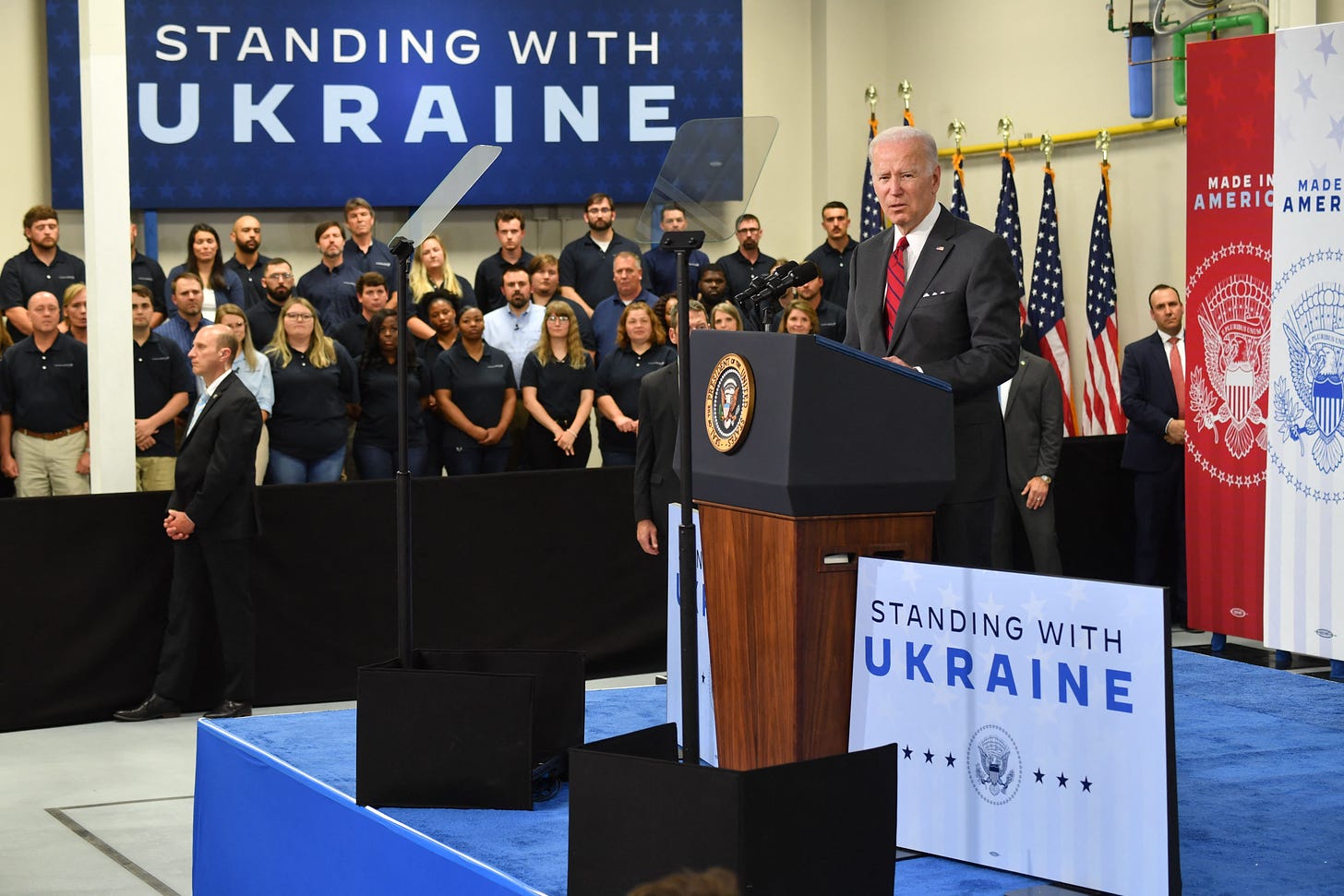
Joe Biden speaks about the conflict in Ukraine during a visit to Lockheed Martins’ Pike County Operations facility on May 3, 2022 (Photo: Nicholas Kamm/AFP via Getty Images)
By Glenn Greenwald | May 10, 2022
From the start of the Russian invasion of Ukraine on February 24, the Biden White House has repeatedly announced large and seemingly random amounts of money that it intends to send to fuel the war in Ukraine. The latest such dispatch of large amounts of U.S. funds, pursuant to an initial $3.5 billion fund authorized by Congress early on, was announced on Friday; “Biden says U.S. will send $1.3 billion in additional military and economic support to Ukraine,” read the CNBC headline. This was preceded by a series of new lavish spending packages for the war, unveiled every two to three weeks, starting on the third day of the war:
- Feb. 26: “Biden approves $350 million in military aid for Ukraine”: Reuters ;
- Mar. 16: “Biden announces $800 million in military aid for Ukraine”: The New York Times ;
- Mar. 30: “Ukraine to receive additional $500 million in aid from U.S., Biden announces”: NBC News;
- Apr. 12: “U.S. to announce $750 million more in weapons for Ukraine, officials say”: Reuters ;
- May 6: “Biden announces new $150 million weapons package for Ukraine”: Reuters.
Those amounts by themselves are in excess of $3 billion; by the end of April, the total U.S. expenditure on the war in Ukraine was close to $14 billion, drawn from the additional $13.5 billion Congress authorized in mid-March. While some of that is earmarked for economic and humanitarian assistance for Ukraine, most of it will go into the coffers of the weapons industry — including Raytheon, on whose Board of Directors the current Secretary of Defense, Lloyd Austin, sat immediately before being chosen by Biden to run the Pentagon. As CNN put it: “about $6.5 billion, roughly half of the aid package, will go to the US Department of Defense so it can deploy troops to the region and send defense equipment to Ukraine.”
As enormous as those sums already are, they were dwarfed by the Biden administration’s announcement on April 28 that it “is asking Congress for $33 billion in funding to respond to the Russian invasion of Ukraine, more than double the $14 billion in support authorized so far.” The White House itself acknowledges that the vast majority of that new spending package will go to the purchase of weaponry and other military assets: “$20.4 billion in additional security and military assistance for Ukraine and for U.S. efforts to strengthen European security in cooperation with our NATO allies and other partners in the region.”
It is difficult to put into context how enormous these expenditures are — particularly since the war is only ten weeks old, and U.S. officials predict/hope that this war will last not months but years. That ensures that the ultimate amounts will be significantly higher still.
The amounts allocated thus far — the new Biden request of $33 billion combined with the $14 billion already spent — already exceed the average annual amount the U.S. spent for its own war in Afghanistan ($46 billion). In the twenty-year U.S. war in Afghanistan which ended just eight months ago, there was at least some pretense of a self-defense rationale given the claim that the Taliban had harbored Osama bin Laden and Al Qaeda at the time of the 9/11 attack. Now the U.S. will spend more than that annual average after just ten weeks of a war in Ukraine that nobody claims has any remote connection to American self-defense.
Even more amazingly, the total amount spent by the U.S. on the Russia/Ukraine war in less than three months is close to the Russia’s total military budget for the entire year ($65.9 million). While Washington depicts Russia as some sort of grave and existential menace to the U.S., the reality is that the U.S. spends more than ten times on its military what Russia spends on its military each year; indeed, the U.S. spends three times more than the second-highest military spender, China, and more than the next twelve countries combined.
But as gargantuan as Biden’s already-spent and newly requested sums are — for a ten-week war in which the U.S. claims not to be a belligerent — it was apparently woefully inadequate in the eyes of the bipartisan establishment in Congress, who is ostensibly elected to serve the needs and interests of American citizens, not Ukrainians. Leaders of both parties instantly decreed that Biden’s $33 billion request was not enough. They thus raised it to $40 billion — a more than 20% increase over the White House’s request — and are now working together to create an accelerated procedure to ensure immediate passage and disbursement of these weapons and funds to the war zone in Ukraine. “Time is of the essence – and we cannot afford to wait,” House Speaker Nancy Pelosi said in a letter to House members, adding: “This package, which builds on the robust support already secured by Congress, will be pivotal in helping Ukraine defend not only its nation but democracy for the world.”
We have long ago left the realm of debating why it is in the interest of American citizens to pour our country’s resources into this war, to say nothing of risking a direct war and possibly catastrophic nuclear escalation with Russia, the country with the largest nuclear stockpile, with US close behind. Indeed, one could argue that the U.S. government entered this war and rapidly escalated its involvement without this critical question — which should be fundamental to any policy decision of the U.S. government — being asked at all.
This omission — a failure to address how the interests of ordinary Americans are served by the U.S. government’s escalating role in this conflict — is particularly glaring given the steadfast and oft-stated view of former President Barack Obama that Ukraine is and always will be of vital interest to Russia, but is not of vital interest to the U.S. For that reason, Obama repeatedly resisted bipartisan demands that he send lethal arms to Ukraine, a step he was deeply reluctant to take due to his belief that the U.S. should not provoke Moscow over an interest as remote as Ukraine (ironically, Trump — who was accused by the U.S. media for years of being a Kremlin asset, controlled by Putin through blackmail — did send lethal arms to Ukraine despite how provocative doing so was to Russia).
While it is extremely difficult to isolate any benefit to ordinary American citizens from all of this, it requires no effort to see that there is a tiny group of Americans who do benefit greatly from this massive expenditure of funds. That is the industry of weapons manufacturers. So fortunate are they that the White House has met with them on several occasions to urge them to expand their capacity to produce sophisticated weapons so that the U.S. government can buy them in massive quantities:
Top U.S. defense officials will meet with the chief executives of the eight largest U.S. defense contractors to discuss industry’s capacity to meet Ukraine’s weapons needs if the war with Russia continues for years.
Deputy Defense Secretary Kathleen Hicks told reporters Tuesday she plans to participate in a classified roundtable with defense CEOs on Wednesday to discuss “what can we do to help them, what do they need to generate supply”….
“We will discuss industry proposals to accelerate production of existing systems and develop new, modernized capabilities critical to the Department’s ongoing security assistance to Ukraine and long-term readiness of U.S. and ally/partner forces,” the official added.
On May 3, Biden visited a Lockheed Martin facility (see lead photo) and “praised the… plant that manufactures Javelin anti-tank missiles, saying their work was critical to the Ukrainian war effort and to the defense of democracy itself.”
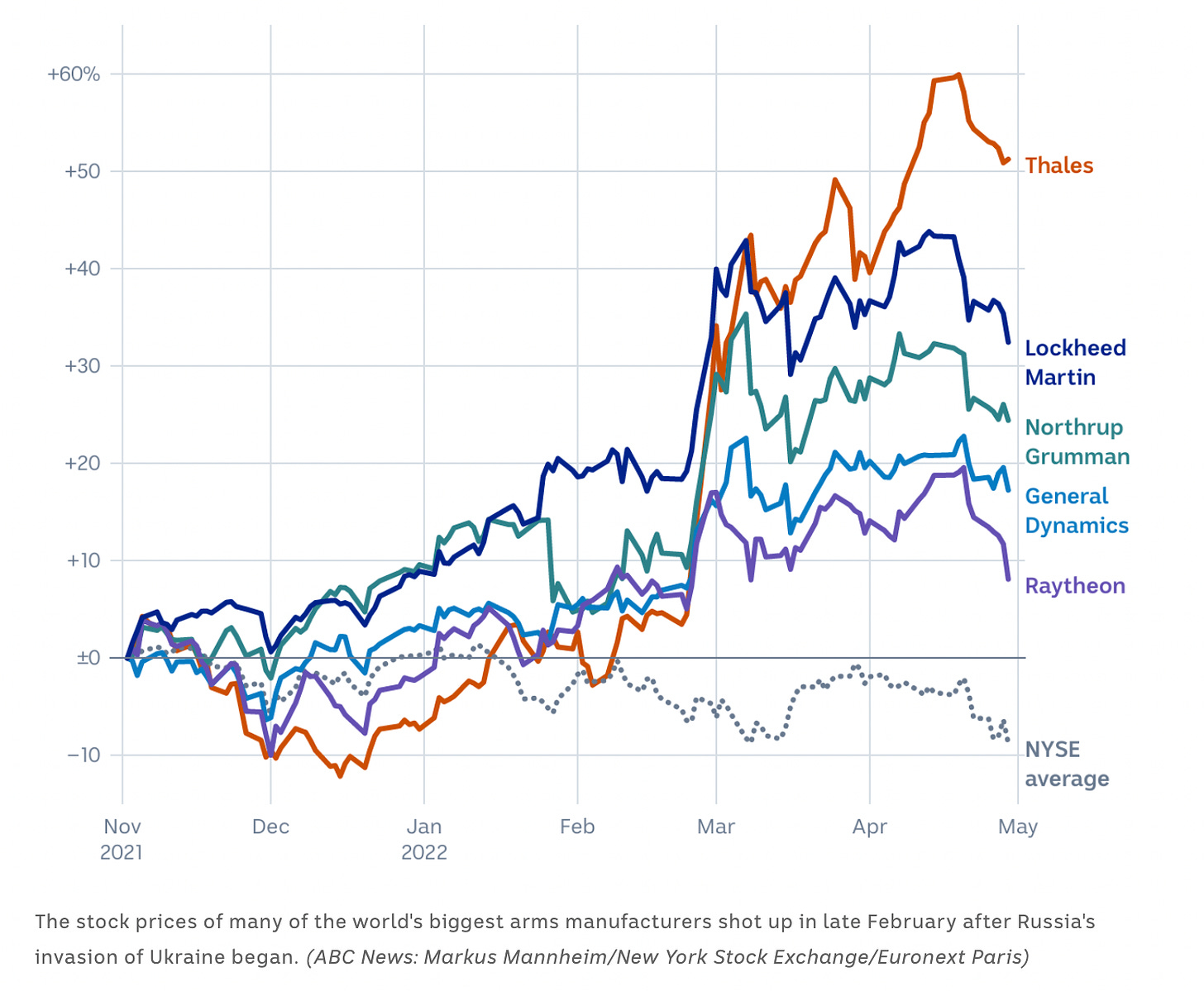
Indeed, by transferring so much military equipment to Ukraine, the U.S. has depleted its own stockpiles, necessitating their replenishment with mass government purchases. One need not be a conspiracy theorist to marvel at the great fortune of this industry, having lost their primary weapons market just eight months ago when the U.S. war in Afghanistan finally ended, only to now be gifted with an even greater and more lucrative opportunity to sell their weapons by virtue of the protracted and always-escalating U.S. role in Ukraine. Raytheon, the primary manufacturer of Javelins along with Lockheed, has been particularly fortunate that its large stockpile, no longer needed for Afghanistan, is now being ordered in larger-than-ever quantities by its former Board member, now running the Pentagon, for shipment to Ukraine. Their stock prices have bulged nicely since the start of the war:
But how does any of this benefit the vast majority of Americans? Does that even matter? As of 2020, almost 30 million Americans are without any health insurance. Over the weekend, USA Today warned of “the ongoing infant formula shortage,” in which “nearly 40% of popular baby formula brands were sold out at retailers across the U.S. during the week starting April 24.” So many Americans are unable to afford college for their children that close to a majority are delaying plans or eliminating them all together. Meanwhile, “monthly poverty remained elevated in February 2022, with a 14.4 percent poverty rate for the total US population… Overall, 6 million more individuals were in poverty in February relative to December.” The latest data from the U.S. Census Bureau found that “approximately 42.5 million Americans [are] living below the poverty line.” Americans with diabetes often struggle to buy life-saving insulin. And on and on and on.
Now, if the U.S. were invaded or otherwise attacked by another country, or its vital interests were directly threatened, one would of course expect the U.S. government to expend large sums in order to protect and defend the national security of the country and its citizens. But can anyone advance a cogent argument, let alone a persuasive one, that Americans are somehow endangered by the war in Ukraine? Clearly, they are far more endangered by the U.S. response to the war in Ukraine than the war itself; after all, a nuclear confrontation between the U.S. and Russia has long been ranked by the Bulletin of Atomic Scientists as one of the two greatest threats facing humanity.
One would usually expect the American left, or whatever passes for it these days, to be indignant about the expenditure of tens of billions of dollars for weapons while ordinary Americans suffer. But the American left, such that it exists, is barely visible when it comes to debates over the war in Ukraine, while American liberals stand in virtual unity with the establishment wing of the Republican Party behind the Biden administration in support for the escalating U.S. role in the war in Ukraine. A few stray voices (such as Noam Chomsky) have joined large parts of the international left in urging a diplomatic solution in lieu of war and criticizing Biden for insufficient efforts to forge one, but the U.S. left and American liberals are almost entirely silent if not supportive.
That has left the traditionally left-wing argument about war opposition to the populist right. “You can’t find baby formula in the United States right now but Congress is voting today to send $40 billion to Ukraine,” said Donald Trump, Jr. on Tuesday, echoing what one would expect to hear from the 2016 version of Bernie Sanders or the pre-victory AOC. “In the America LAST $40 BILLION Ukraine FIRST bill that we are voting on tonight, there is authorization for funds to be given to the CIA for who knows what and who knows how much? But NO BABY FORMULA for American mothers!,” explained Rep. Marjorie Taylor Greene (R-GA). Christian Walker, the conservative influencer and son of GOP Senate candidate Herschel Walker in Georgia, today observed: “Biden should go apply to be the President of Ukraine since he clearly cares more about them than the U.S.” Chomsky himself caused controversy last week when he said that there is only one statesman of any stature in the West urging a diplomatic solution “and his name is Donald J. Trump.”
Meanwhile, the only place where dissent is heard over the Biden administration’s war policy is on the 8:00 p.m. and 10:00 p.m. programs on Fox News, hosted, respectively, by Tucker Carlson and Laura Ingraham, who routinely demand to know how ordinary Americans are benefiting from this increasing U.S. involvement. On CNN, NBC, and in the op-ed pages of The New York Times and The Washington Post, there is virtually lockstep unity in favor of the U.S. role in this war; the only question that is permitted, as usual, is whether the U.S. is doing enough or whether it should do more.
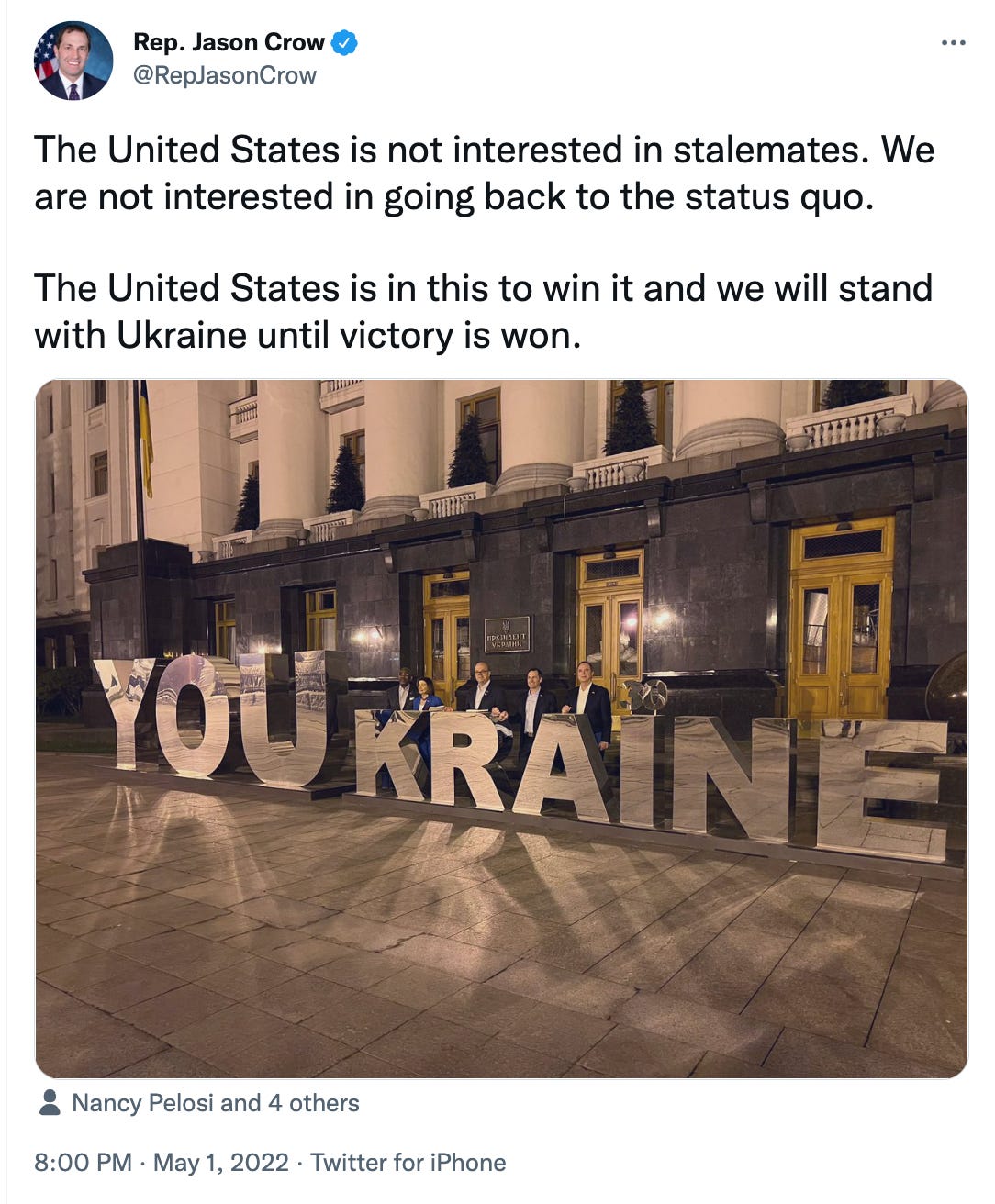
That the U.S. has no legitimate role to play in this war, or that its escalating involvement comes at the expense of American citizens, the people they are supposed to be serving, provokes immediate accusations that one is spreading Russian propaganda and is a Kremlin agent. That is therefore an anti-war view that is all but prohibited in those corporate liberal media venues. Meanwhile, mainstream Democratic House members, such as Rep. Jason Crow (D-CO), are now openly talking about the war in Ukraine as if it is the U.S.’s own:
Whatever else is true, the claim with which we are bombarded by the corporate press — the two parties agree on nothing; they are constantly at each other’s throats; they have radically different views of the world — is patently untrue, at least when it comes time for the U.S. to join in new wars. Typically, what we see in such situations is what we are seeing now: the establishment wings of both parties are in complete lockstep unity, always breathlessly supporting the new proposed U.S. role in any new war, eager to empty the coffers of the U.S. Treasury and transfer it to the weapons industry while their constituents suffer.
One can believe that Russia’s invasion of Ukraine is profoundly unjust and has produced horrific outcomes while still questioning what legitimate interests the U.S. has in participating in this war to this extent. Even if one fervently believes that helping Ukrainians fight Russia is a moral good, surely the U.S. government should be prioritizing the ability of its own citizens to live above the poverty line, have health insurance, send their kids to college, and buy insulin and baby formula.
There are always horrific wars raging, typically with a clear aggressor, but that does not mean that the U.S. can or should assume responsibility for the war absent its own vital interests and the interests of its citizens being directly at stake. In what conceivable sense are American citizens benefiting from this enormous expenditure of their resources and the increasing energy and attention being devoted by their leaders to Ukraine rather than to their lives and the multi-pronged deprivations that define it?
German industry faces economic ruin with ‘highly dangerous’ gas ban
Free West Media | May 10, 2022
BERLIN – A study by the German Hans Böckler Foundation has now calculated that the gross domestic product (GDP) could collapse by up to twelve percent within the first year if Russian gas supplies were to end immediately. It is the latest doomsday prediction for Germany’s industry.
Industrial production would fall by 114 to 286 billion euros. This alone would lead to a GDP slump of three to eight percent, which would be increased by another two to four percent because the higher energy prices reduce the financial scope of consumers for other expenditures.
According to the study author Professor Tom Krebs from the University of Mannheim, a gas supply ban would only be manageable from 2025 onwards if other sources were available.
In addition, Krebs warned of so-called “cascade effects” that could also affect sectors that are less dependent on natural gas and threatened to “drastically” increase the economic damage. He also drew attention to the fact that the German economy is still under severe stress after the 2009 financial crisis, the 2020 Corona pandemic and due to self-inflicted climate change pressure. Since the expected price shocks for energy and food would have to be borne primarily by poorer households, “social tensions could intensify”.
The warnings of the study correspond exactly to what other experts have said: The former EON boss Johannes Teyssen had described a ban on Russian energy supplies as “highly dangerous” just last week.
Teyssen does not consider the suggestions of taking cold showers made by Economics Minister Robert Habeck and Federal Network Agency boss Klaus Müller to make any sense: “If it were about that and it could be regulated, then we would have done it a long time ago.”
In fact, it is “really about an extensive collapse of the basic industrial structure that needs natural gas and the entire value chain behind it”. One has to understand how it works. Supply bottlenecks would arise in other industries if large energy companies were no longer able to produce anything.
The general manager of the chemical industry association, Wolfgang Große Entrup, also issued almost identical warnings at the beginning of April. In the event of a short-term, unlimited stop in the supply of Russian gas, “a severe recession and a massive loss of jobs” must be expected. It is “frequently massively underestimated” that other branches of industry such as agriculture, construction, food, automobiles or electronics would then also be badly hit. For the loss of natural gas there is “no short-term replacement option”.
Yet these industry heavyweights are totally ignored by EU chief Ursula von der Leyen, and the irresponsible demands of the Ukrainian Ambassador Andriy Melnyk or “Fridays-for-Future” activist Luisa Neubauer, goading Germany into an economic catastrophe, the consequences of which must be shouldered by ordinary citizens – and not by the privileged, wealthy or state-appointed authors of the measures.
“You hear so little about Gretl, the little climate siren from Sweden. No screaming ‘how dare you’, no shouting on our streets, the blond braided one has dedicated herself to inner emigration. The Fridays for Future sect, the radical arm of the eco-socialists, plays the ostrich. The hip Greta has fallen silent in the face of the honorable rearmament of the Western arms industry,” noted Austrian politician Gerald Grosz.
“Yes, the good girl believes that the F16 flies on an e-battery on its way to the Ukraine. Or does she believe that the atomic bombs are powered by solar panels and that only ‘organic makes you beautiful’ soybeans grow after the impact. And the artillery pieces move on rapeseed oil?”
Sanctions hurt US more than Russia – poll
Samizdat | May 10, 2022
A poll published on Saturday found that 53% of Americans believe that sanctions on Moscow hurt the US more than Russia. Amid soaring gas prices and a rising cost of living, voters are losing confidence in US President Joe Biden’s leadership, and 43% say they’re “OK” with Ukraine losing its ongoing conflict with Russia.
With inflation at a 40-year peak and gas prices near record highs, the Democracy Institute/Express.co.uk poll revealed that Biden is polling negatively in all policy areas, with foreign policy the worst. Some 56% disapprove of his handling of foreign matters, compared to 40% approving. On Ukraine specifically, only 38% approve of his stewardship, while 52% disapprove.
The Biden administration has attempted to blame Russia and its president, Vladimir Putin, for the rising cost of living at home, with his officials repeatedly referring to “Putin’s price hike.” However, living costs were rising for months before Russia sent troops into Ukraine, and voters are pointing the finger at Biden for their economic woes.
Some 50% said they’d back Republicans in November’s midterm elections, compared with 42% saying they’d vote Democrat. In addition to more voters being “OK” than “not OK” with Ukraine losing the conflict with Russia (43%-41%), more Americans think it would be better for Biden to leave office than for Putin to step down, by 53% to 44%.
Biden has sanctioned the Russian banking and energy sectors, and his administration has sent nearly $4 billion worth of weapons to Ukraine, with Defense Secretary Lloyd Austin promising last month to “move heaven and earth” to finance Kiev’s fighting. The US president has also asked Congress to approve another $33 billion aid package for Ukraine – of which $20 billion would be earmarked for military aid – and on Monday signed the Lend-Lease Act of 2022, allowing Washington to send unlimited quantities of arms to Kiev.
In the eyes of the Kremlin, this deluge of weapons plus the US and NATO’s intelligence-sharing arrangements with Kiev mean that the West is “essentially going to war with Russia through a proxy.”
American voters, however, are not as earnest as the Biden administration in fuelling this war. According to the latest poll, they consider Russia the fourth biggest threat to the US at 16%, behind North Korea (18%), Iran (20%), and China (40%).
“Americans were very pro sanctions at first, [but] they are not as keen on the sanctions as they were,” Democracy Institute Director Patrick Basham told Express. “Biden made these predictions at the outset – the ruble would be rubble, we were going to crash the Russian economy, people will rise up, Putin will be out, the Russians will run away from Ukraine … [but] none of those things have happened.”
This difference between expectation and reality has made people cynical, he claimed, comparing the apparent loss of trust to public disillusionment with coronavirus policies throughout the West.
“The problem [now] is that at least half of the country in America thinks they were hoodwinked over a lot of the Covid stuff, so they are even more cynical about government and media than they were two years ago,” he said.
Brazil rejected US oil request
Samizdat | May 10, 2022
The US asked Brazil in March to increase its crude oil output to curb soaring prices amid international sanctions against Russia, but Brazil refused, Reuters reported on Tuesday.
US government officials approached Brazil’s state-run oil company Petrobras, the outlet quoted its sources as saying, as crude prices started to rise against the backdrop of Russia’s military operation in Ukraine and the ensuing international sanctions.
The officials came away empty-handed, however, as Petrobras said that output levels were determined by business strategy rather than diplomacy and also that a significant short-term production boost would not be logistically possible, Reuters says.
Brazil is the world’s 11th largest oil exporter, with most of its crude going to China, the US, and India, according to the Observatory of Economic Complexity (OEC).
Also in March, the US approached Venezuela, which has the world’s largest proven oil reserves, offering to ease some of the sanctions on the country in exchange for increased oil exports to the US. However, Washington later backtracked on the issue.
Washington banned the import of Russian oil in early March, with US Energy Secretary Jennifer Granholm saying that the country was on “war footing,” and calling on domestic producers to boost output. Last year, the US got 8% of its total petroleum imports from Russia, according to the US Energy Information Administration, with other major suppliers being Canada, Mexico, and Saudi Arabia.
Sri Lanka’s Prime Minister Resigns Amid Anti-Government Protests
Samizdat – 09.05.2022
Sri Lanka has been rocked by mass protests for weeks, with people outraged over the government’s policies amid the country’s worst economic crisis in decades.
Sri Lanka’s Prime Minister Mahinda Rajapaksa has resigned, his spokesman Rohan Weliwita said.
The 76-year-old prime minister sent his letter of resignation to his younger brother, President Gotabaya Rajapaksa, clearing the way for a “new unity government”, the spokesman said, quoted by AFP.
Earlier, news about the prime minister’s resignation was broken by local media.
On Monday, the government imposed a nationwide curfew and deployed the army in the capital Colombo amid violent clashes between anti-government protesters and government supporters outside President Gotabaya Rajapaksa’s office. Dozens of people were injured in the clashes. Police used tear gas and water cannons to disperse the protesters.
Sri Lankans have been facing the worst economic crisis since gaining independence from British rule in 1948. People have been suffering amid acute shortages of food, fuel, and medicines, as well as months of power outages. The crisis broke out after Sri Lanka lost the vital income it had traditionally received from tourism and remittances. This happened due to the coronavirus pandemic and tough COVID-related restrictions that affected the entire region. As a result of this, Sri Lanka was no longer able to pay off its $51 billion foreign debt and banned the import of some goods.
Climate Colonialists Disrupt African Pipeline, Perpetuate Poverty

Vanessa Nakate
By Vijay Jayaraj | RealClear Energy | April 28, 2022
Climate activists’ ill-founded opposition to fossil fuels threatens to stop a major pipeline project in East Africa and stymie economic growth in Uganda and Tanzania — home to some of the world’s poorest people.
Uganda is betting big on its fossil fuel reserves. In February, China National Offshore Oil Corporation (CNOOC) and France’s TotalEnergies agreed to invest $10 billion to develop two Ugandan oil reserves. But the landlocked country needs the East African Crude Oil Pipeline project (EACOP) to transport its product to a port in Tanzania.
The 895-mile-long pipeline from Uganda’s Lake Alberta region to the seaport of Tanga will be the longest electrically heated crude oil pipeline in the world and will carry 216,000 barrels per day. The project received a green light for construction after the completion of an Environment and Social Impact Assessment.
The Africa Report says that the investment will be huge: “(A)bout $10 billion will be invested in the sector (oil and gas) before first oil is produced in 2025, mainly on the pipeline, refinery, and infrastructure. The government has been commissioning road construction in the region where oil will be produced, in Buliisa and Hoima districts, and an airport is also being constructed in the region.” The project is expected to generate around 10,000 jobs even after the construction phase.
The Government of Uganda expects massive employment of its citizens during construction: “This will be through direct employment of about 14,000 people by the companies, indirect employment of about 45,000 people by the contractors, and induced employment of about 105,000 people as a result of utilization of other services by the oil and gas sector. Of the direct employment, 57 percent are expected to be Ugandans, which is expected to result in an estimated $48.5 million annual payment to Ugandan employees.”
However, the global war against fossil fuel has now reached Ugandan soil and extremists are determined to stop this lifesaving, economically critical project.
Vanessa Nakate of StopEACOP rants against the pipeline in a recent column in the New York Times, saying the project would bring poverty and destruction to the people of Africa. She also references extreme weather in implying the pipeline will worsen the climate.
During a visit to the ultra-rich Vatican, Vanessa says: “It is evident that there is no future in the fossil fuel industry…. we know the impacts on our food. We know the impacts on our water. We know the impacts on our livelihood…… the climate crisis is already affecting so many people not only in Uganda, but the African continent.”
But her reasons for opposing the pipeline are scientifically inaccurate and logically senseless.
She points to a forecast by the Intergovernmental Panel on Climate Change (IPCC) that predicts African droughts. But IPCC, by its own admission, has indicated that extreme weather events have no significant correlation with rising global average temperatures. Neither has there been any significant increase in the frequency of extreme cyclones, droughts, rainfall, and fires. Even if droughts and cyclones were to increase, a better socio-economic condition would enable people to adapt more effectively.
Contrary to Vanessa’s hyperbole, the world is experiencing near optimum temperatures for global food production and the advancement of human society, much as it did 1,000 years ago during the Medieval Warm Period and 2,000 years ago during the Roman Warm Period. Globally, we now have better access to clean water, better access to nutritious food, people with higher income, and a very rapid increase in life expectancy rates. How are we in a crisis if climate is aiding the improvement of every metric used to measure the quality of people’s lives?
It is shocking how Vanessa ignores the plight of millions of her own people dwelling in persistent poverty and in need of affordable, dependable energy sources like coal, oil, and gas. It is less shocking if we understand the DNA of climate extremists, which has them deny the reality of energy needs and promote unreliable, primitive, and expensive wind turbines that even economic giants like Germany and the U.S. hesitate to adopt completely.
Climate extremists like Vanessa are fostering the continuation of abject poverty in Africa — a continent with the lowest level of electrification and highest rates of poverty in the world. Vanessa claims that the pipeline is another colonial project subjecting Africans to slavery. But, it is Vanessa and her ilk who are the colonialists and would-be slave masters.
Vijay Jayaraj is a Research Associate at the CO2 Coalition, Arlington, Va., and holds a Master’s degree in environmental sciences from the University of East Anglia, England. He resides in Bengaluru, India.
African Governments to Western Eco-Imperialists Who Tell Them Not to Drill Their Own Oil and Gas – Get Lost
By Chris Morrison | The Daily Sceptic | May 5, 2022
It was never going to work. Telling African countries to stop developing their economies by banning cheap, reliable fossil fuel is little more than an eco-imperialist dream. Writing in Monday’s Daily Telegraph, Uganda President Yoweri Museveni lauded the discovery of oil in Lake Albert, but noted it was a battleground for the green NGOs and activists who claim that Armageddon is nigh at every opportunity.
“We are accustomed to these lectures, but we are tired of hearing them,” he added.
For the last decade, the West through the IMF and the World Bank has imposed a moratorium on support for African fossil fuel development – initially coal and more recently oil and gas as well. Museveni notes that in Africa the population is set to double by 2050, “and it is becoming increasingly clear that our energy needs cannot be met with a sudden shift to more expensive and less reliable solar and wind alone”.
Rich Western eco elites, of course, argue that the world must rid itself of fossil fuel as soon as possible. They believe the world is facing climate breakdown, although as articles in the Daily Sceptic show on a regular basis, that belief is backed by surprisingly few scientific facts. These Western elites effectively seek a command-and-control economy based on Net Zero, and a neo-pagan return to ancient Gaia goddess worship that elevates nature as sacred and denigrates humanity as destructive of it.
It might all play better in Africa if so-called global warming could be detected.
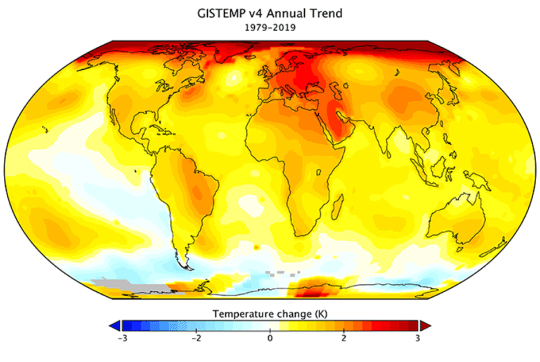
Atmospheric warming over the last 40 years has been more pronounced over the northern hemisphere, despite regular scare stories appearing about equatorial regions becoming uninhabitable. The GISS temperature database is run by NASA, and as with similar datasets it has been subject to considerable recent modifications, with the past cooled and later results warmed. Without these retrospective data adjustments, global recorded warming ran out of steam nearly two decades ago. Nevertheless, the contrast between the north, painted in fiery red, and most of Africa is clear from the GISS map (above).
The Lake Albert project is going ahead following a $10bn investment from the China National Offshore Oil Corporation and Total Energies of France. It includes the building of a 900 mile pipeline to the port of Tanga. According to Real Clear Energy, the project will provide $48.5m in annual payments to Ugandan employees living in one of the least developed countries in the world. But opposition is fierce. Writing in the New York Times the local green agitator Vanessa Nakate of StopEACOP said the project would bring “poverty and destruction to the people of Africa”. It is claimed by her activist group that building the East African crude oil pipeline would tip the world closer to “full blown climate catastrophe”.
It is comments such as these which mostly surface in mainstream media, rather than those of the President of Uganda. It might also be thought that most Africans are less impressed with other solutions advanced in the West to solve any problems caused by growing populations. Sir David Attenborough is on record as stating humans are a plague on the Earth, and it was “barmy” to send food to Ethiopia to solve the famine crisis. In Attenborough’s view, sending flour bags to under-developed countries was pointless.
In public in the West, many African politicians pay lip service to the aims of COP, not least because plenty of aid cash is on offer. Others take a more challenging and outspoken view. N.J. Ayuk is the Executive Chairman of the African Energy Chamber and he recently called the idea that you could develop Africa with handouts, “preposterous and sickening”.
He continued: “You cannot take people of any colour and exempt them from the requirements of civilisation – including work, free markets, behavioural standards, personal responsibility, fossil fuels, financial literacy and all the other basic things that the clever intelligentsia disdain – without ruinous consequences to them and society at large.”
In his view, no country has ever been developed by fancy wind and green hydrogen. Africans see oil and gas as a path to success and a solution to their problems. “The demonisation of oil and gas companies will not work,” he added.
Writing in 2015, the former Chancellor of the Exchequer Nigel Lawson commented that something deep inside the human psyche makes it receptive to apocalyptic warnings. By a cruel irony, he said, too many climate scientists and their hangers-on have become the high priests of a new age of unreason. Asking developing countries to abandon the cheapest available sources of energy is, at the very least, asking them to delay the conquest of malnutrition, to perpetuate the incidence of preventable diseases and to increase the number of premature deaths.
“Global warming orthodoxy is not merely irrational. It is wicked,” he concluded.
Featured Video

HE SAVED LIVES. NOW HE FACES PRISON.
or go to
Aletho News Archives – Video-Images
From the Archives
NATO Sanctions and the Coming Global Diesel Fuel Disaster
By F. William Engdahl – New Eastern Outlook – 11.04.2022
Amid the ongoing global inflation crisis, NATO heads of state and mainstream media repeat a mantra that high energy prices are a direct result of Putin’s actions in Ukraine since end of February. The reality is that it is the western sanctions that are responsible. Those sanctions including cutting SWIFT interbank access for key Russian banks and some of the most severe sanctions ever imposed, are hardly having an impact on the military actions in Ukraine. What many overlook is the fact that they are increasingly impacting the economies of the West, especially the EU and USA. A closer look at the state of the global supply of diesel fuel is alarming. But Western sanctions planners at the US Treasury and the EU know fully well what they are doing. And it bodes ill for the world economy.
While most of us rarely think about diesel fuel as anything other than a pollutant, in fact it is essential to the entire world economy in a way few energy sources are. The director general of Fuels Europe, part of the European Petroleum Refiners Association, stated recently, “… there is a clear link between diesel and GDP, because almost everything that goes into and out of a factory goes using diesel.” … continue
Blog Roll
 Aletho News
- Mahan Air Flight Lands in China Despite US Threat against Iranian Airlines
- US eyes $10bn fund to rebuild war-battered Gulf infrastructure
- Trump meets Rodríguez near Maduro’s prison as Venezuela’s oil flows to US
- Trita Parsi: Middle East Unraveling — Are We on the Path to World War?
- Iran FM meets with US envoy on UN meeting’s sidelines at American side’s insistence: Report
- Qatar PM calls for Gulf security framework with Iran, says war must be ‘wake-up call’
- China condemns US extortion of Iranian airlines, rejects Washington’s ‘illegal’ sanctions threats
- Italy to move military personnel from Taif base after missile strike
- Finland’s Stubb tells European leaders to calm down
- Defeating Russia on battlefield impossible – Fico
- If Americans Knew
- Sanctions are collective punishment: immoral and self-defeating
- Phosphorus Munitions Fired by Israel Burn Groves, Orchards in Southern Lebanon
- Israel Carries Out New Ceasefire Violations Across Gaza
- AI – Emphasis on the ‘I’: Israel Is Funding AI Chatbot Propaganda
- Israel Blocking Hundreds of Wheelchairs for Injured Children From Entering Gaza
- Israel Is Expanding and Upgrading Compounds for Palestinian Militias in Gaza
- The Palestinian-American Residents of This West Bank Town Are Wondering: Where Is Trump?
- Gaza desperately needs tents, wheelchairs, fuel… and everything else (Israel blocks it all) – Daily Update
- Israeli Attacks in Gaza Kill at Least Seven Palestinians Over Three Days, including Woman and Child
- Trump’s militarization of Washington DC as he pursues Israel’s war against Iran
- No Tricks Zone
- New Study: Earth And Venus Surface Warmth Largely Explained By Convection And Lapse Rate, Not CO2 Or Radiation
- 2025 Nature Paper Claiming Worsening Global Drought Gets RETRACTED …Heavily Flawed
- New Study: ‘Global Drought Shows No Detectable Recent Acceleration Under Climate Warming’
- Economic Masterminds: German Socialists Suggest Taxing Productivity Gains Stemming From Using AI
- The South China Sea Has Not Been Cooperating With The Climate Change Narrative
- Energy Crisis: Germany Enters Heating Season With Historically Low Gas Reserve Fill Levels
- New Study: The Antarctic Ice Sheet Gained Mass From 2020-2024 Due To Staggering Snow And Ice Accumulation
- Study: Ocean Heating Rates From Thousands Of Years Ago ‘Dwarf’ Modern Ocean Heating Rates
- Climate Extremists Target, Attack Large-Scale Power Grid Infrastructure In Germany!
- New Study: Antarctic Ice Melt Has Contributed Less Than 1 Centimeter To Sea Level Rise In The Last 30 Years

