India set to boost Russian energy imports
Samizdat – April 19, 2022
Indian importers plan to increase purchases of Russian crude oil and coal at discounted prices, media reports have stated.
According to The Economic Times, India’s state-owned oil refiners plan to boost Russian imports, shifting their purchasing strategy from tenders to negotiated deals in order to get larger discounts.
“In the coming weeks, Indian importers expect an increase in oil purchases from Russia. Due to the events in Ukraine and the outbreak of Covid-19 in China, India can get more oil at a more attractive price than before,” the publication stated, citing market sources. India has already increased purchases of Russian oil, having bought 15 million barrels of it since late February at a 25% discount. The discounts were offered by Moscow to secure trade contracts, amid the sanctions, placed on Russia by the US and its allies in response to its military operation in Ukraine. India has declined to join the sanctions campaign.
Separately, S&P reported that India is looking to raise imports of Russian coal amid stockpile shortages, as Moscow’s discounted prices are much lower than those on Australian and South African coal. Also, new purchase offers are expected soon, as, according to data from India’s Central Electricity Authority, stockpiles at Indian power plants as of April 13 were enough for little over eight days of coal burn. India imported 1.76 million metric tons of coal from Russia in 2021, according to data from Iman Resources. Market sources say that the only obstacle to buying Russian oil and coal for Indian importers is the difficulty in finding a payment method.
Western countries have cut off Russian banks from using the SWIFT financial messaging network, which facilitates interbank payments, and have limited their ability to conduct business using the US dollar and the euro.
However, at the end of March reports emerged that Russia and India were working to create a new transaction mechanism for bilateral trade, which would allow for settlements in national currencies, rubles and rupees. Reports say the countries may opt for adopting the Russian Financial Message Transfer System (SPFS) for bilateral trade, which is an analog of SWIFT.
According to analysts, a rupee-ruble trade mechanism is key to continued trade growth between the two countries, as India’s economy needs Russian energy and commodities to grow and Russia needs the huge Indian market to offset the impact of Western sanctions.
Russia Has Withstood West’s ‘Economic Blitzkrieg’ Attempt – Putin
Samizdat | April 18, 2022
The US and its allies have slapped a grand total of over 9,600 sanctions against Russian officials, the state, companies, tycoons and other entities in connection with the crisis in Ukraine. Moscow now has more restrictions against it than Iran, Syria, North Korea, Venezuela and Myanmar combined.
Russia has successfully withstood unprecedented sanctions pressure from the West, President Vladimir Putin has said.
“The calculation was to quickly undermine the financial and economic situation in our country, to provoke panic in the markets, the collapse of the banking system, and a large-scale shortage of goods in stores,” Putin said, speaking at a briefing on the economic situation on Monday.
“We can say with confidence that this policy against Russia has failed – that the strategy of the economic blitzkrieg has failed,” he added.
Meanwhile, the president said, ordinary Europeans and Americans have been made to suffer a deterioration in their living standards as a result of their leaders’ shortsightedness.
“Moreover, the sanctions were not without consequences for the initiators themselves. I am refering to the growth of inflation and unemployment, the deterioration of economic performance in the US and the countries of Europe, the decline in the standard of living of the Europeans and the devaluation of their savings,” Putin said.
Putin asked the government to continue to expand its programme of emergency measures to deal with Western pressure, including by accelerating the switchover to foreign trade in rubles and the currencies of Russia’s trade partners.
“The restrictions placed on Russia by unfriendly countries have undoubtedly affected the possibilities of our businesses. They have complicated the logistics of delivery in export and import, created obstacles for payment. It is necessary to assist entrepreneuers in solving these problems, including by speeding up the transition of foreign trade to settlements in rubles and the national currencies of countries which are reliable trade partners,” he said.
At the moment, the president said, the Russian economy has stabilized, and the ruble exchange rate has basically returned to the levels seen in early February, before Moscow and its Donbass allies kicked off their military operation in Ukraine.
Russia achieved a Q1 2022 current account balance of payments of over $58 billion, “a historic maximum,” Putin said.
The Russian ruble collapsed in late February and early March against major foreign currencies, falling 30 percent against the US dollar and by a similar amount against the euro. The move prompted a temporary halt in trading on the Moscow stock exchange, led the central bank to raise the interest rate to 20 percent, and prompted authorities to force companies to sell 80 percent of their foreign exchange reserves to stabilize the situation.
The ruble began to bounce back after Putin’s announcement on 23 March ordering payments for Russian gas to be made in rubles, and is trading for about 80.6 USD/ruble, approaching the 77.3 marker it hit before dropping once Russia recognized the sovereignty of the Donbass republics in February.
The Kremlin has since asked the relevant ministries to expand the list of goods to be traded for using national currencies.
The Future Of Energy In The U.S.: Which Projection Do You Believe?
By Francis Menton | Manhattan Contrarian | April 10, 2022
What will the production and consumption of energy look like in the United States in 2050? There are two very different answers to that question.
On Side One are those who assert that we face a “climate crisis” that can only be addressed by the rapid forced suppression of the production and use of fossil fuels. Therefore, some combination of government coercion, investor pressure and voluntary institutional action will shortly drive coal, oil and natural gas from the energy marketplace, to be replaced by carbon-free “renewables.” And thus by 2050 we will have achieved the utopia of “net zero” carbon emissions.
Those on Side Two think that the Side One vision is completely unrealistic fantasy. Simple arithmetic shows that without massive energy storage no amount of building of wind and solar generators can make much difference in fossil fuel use for electricity production; and adequate energy storage devices to fill the gap do not even exist as a technical matter, let alone at remotely reasonable cost. Result: no matter what the grandees say, fossil fuel production and use in 2050 will be as high or higher than they are now.
Which Side do you think is right?
At the moment, all of the Great and the Good seem to have planted their flags on Side One. President Biden leaves no doubt as to where he stands. By Press Release of April 22, 2021, Biden committed the U.S. to a “net zero” economy by 2050:
On Day One, President Biden fulfilled his promise to rejoin the Paris Agreement and set a course for the United States to tackle the climate crisis at home and abroad, reaching net zero emissions economy-wide by no later than 2050.
And by various Executive Orders, Biden has the whole federal bureaucracy committed to the fossil fuel suppression project, from stopping drilling to blocking pipelines to decommissioning power plants.
In the investment world, all of the biggest banks and money managers are on board. Here is a link to the “Road to Net Zero” web page of BlackRock, the nation’s largest mutual fund manager. Pithy quote:
We believe that the transition to a net zero world is the shared responsibility of every citizen, corporation, and government. . . . In January 2021, we committed to supporting the goal of net zero greenhouse gas emissions by 2050 or sooner – and announced a number of steps to help our clients navigate the transition.
And it goes without saying that the world of academia has joined Side One with full unanimity. After all, these are the “smartest” people; and the “smartest” people all know that the “climate crisis” can only be solved by suppressing fossil fuels. Here is a representative statement from President Peter Salovey of Yale University, June 24, 2021:
To avoid the most severe outcomes of climate change, experts recommend taking immediate action to reach world-wide carbon net neutrality in the next three decades. Yale will become a net zero carbon emissions campus in less than half of that time. Along our path to zero actual emission by 2050, we expect to reduce our actual emissions by at least 50 percent below 2005 levels by 2035.
So surely then, with this kind of unanimous agreement from the top, backed by the full force of federal government coercion, fossil fuels will be completely gone by 2050.
Perhaps before getting too confident in that conclusion, we should check in with the Energy Information Administration. The EIA is the part of the federal Department of Energy that provides data and statistics on U.S. energy production and consumption, both historical and projected. Once a year, generally in March, they issue what they call their Annual Energy Outlook, or AEO. AEO2022 just came out on March 3. The opening page of AEO2022 provides a wealth of links that can keep you busy for hours if you have the inclination.
The incredible thing about this AEO is it’s like nobody told them that the fossil fuels are about to be suppressed. Basically, they treat the whole “net zero by 2050” clamor as so much background noise. For example, what is the EIA’s view as to U.S. natural gas consumption from now through 2050? That’s in this chart:
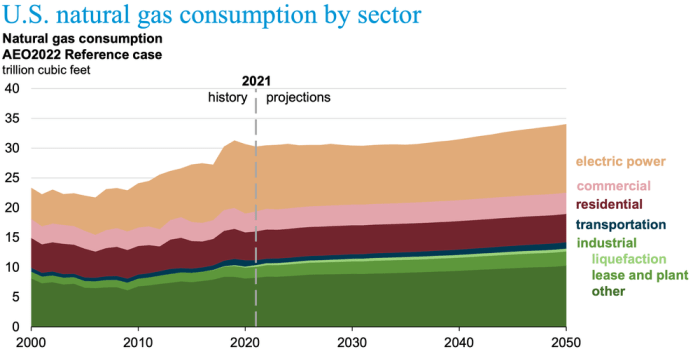
Net zero anyone? Instead, it looks like ongoing slow but steady growth throughout the entire projection period.
How about U.S. crude oil production? Surely that will plummet toward zero well before 2050. Not according to the EIA:
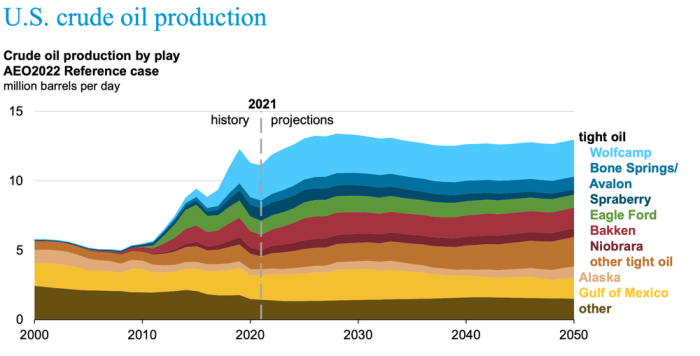
Basically, they predict that U.S. crude production will increase substantially over the next few years, and then level out and remain there through 2050.
To be fair, the two charts above represent what they call their “reference case.” They have other charts that show high production/consumption cases and also low production/consumption cases. However, the high cases are driven by high prices, and the low cases are driven by low prices. There is no effect discernible in the EIA projections resulting from regulatory suppression, let alone from woke investors or the pompous pronouncements of academia.
One of my favorite charts is this one covering projected “light duty vehicle” sales, aka cars.
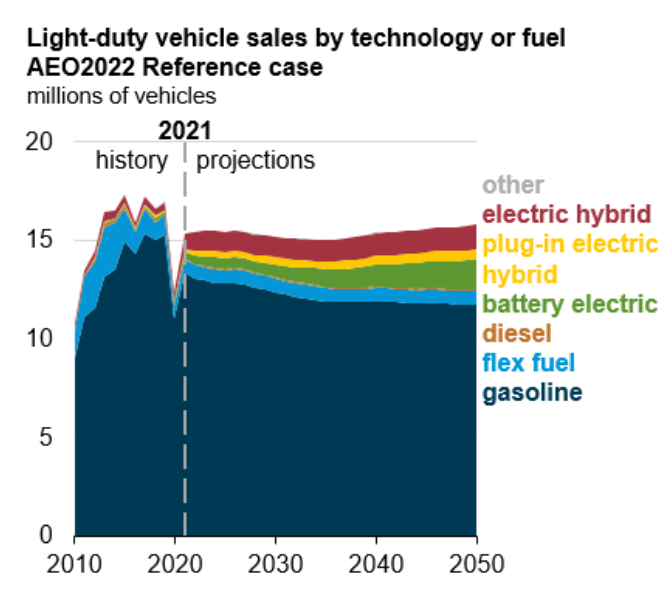
And you thought that buying anything but a fully-electric vehicle would be illegal by 2030? The EIA’s projection is that even by 2050, fully-electric vehicles will not have achieved 10% of the market, while fully gasoline-powered vehicles will still have a market share around 75%.
Numerous other links on the AEO2022 intro page provide for fascinating reading, essentially contradicting everything about our energy future that is coming out of the White House. For example, there is “EIA projects U.S. energy-related CO2 emissions fall in the near term, then rise.” In other words, the claims of “net zero” emissions by 2050 are so much hot air. Or there’s “Petroleum and natural gas are the most-used fuels in the United States through 2050.”
So place your bet as to which projections you believe. For myself, obviously I’m going with reality over fantasy.
Is There Anyone Taking This Green Energy Transition Thing Seriously?
By Francis Menton | Manhattan Contrarian | April 13, 2022
As reported in my last post, even the U.S. government’s own Energy Information Administration in the Department of Energy doesn’t believe for a minute that any kind of rapid transition to “net zero” carbon emissions is about to occur in this country. Although President Biden has supposedly committed the entire federal bureaucracy to the “net zero” by 2050 transition, the EIA projects steady and even increasing fossil fuel usage in the U.S. through the entire 28 intervening years.
But surely there must be somebody taking this green energy transition thing seriously. The obvious place to look for such serious commitment would be in New York State, and most particularly New York City. Here, deadly earnest climate campaigners dominate local politics. New York State’s Climate Leadership and Community Protection Act, enacted in 2019 and effective in 2020, commits the State to the energy transition. And to prove its own bona fides, the City Council just enacted legislation at the end of 2021 banning new buildings from burning natural gas starting for smaller buildings (up to six stories) in 2024, just two years from now, and then applying to all new buildings by 2027, just five years away. Yup, natural gas is definitely on the fast train to oblivion around here.
All of which led me to be greatly curious when I heard the jackhammers going out on the street starting around 8 AM for the last several days. On closer observation, they seem to be putting in new pipelines of some sort:


So I picked out a guy who looked like the job foreman, and asked him what is going on. Sure enough, they are installing new gas mains in the neighborhood. According to the foreman, it’s a new higher-pressure natural gas system, to replace the old low pressure system. He said that the old mains were close to 100 years old.
So it’s great to know that we will shortly have a new natural gas distribution system in Greenwich Village, ready for the next hundred years or so. Do you think that they will just shut off the gas one day? I’m willing to bet that that’s not going to happen.
Boris Johnson Supports Ukraine to the Detriment of the Brits
By Valery Kulikov – New Eastern Outlook – 15.04.2022
A highly sensationalist article by Bloomberg clearly shows that the British government left more than 5 million Britons without support in the current crisis in implementing its pronounced Russophobic policy!
As the publication emphasizes, a significant part of the British population feels the consequences of the cost of living crisis especially strongly, and this is due more to politics than to the economy. An increase in electricity bills and in the cost of food and loan rates has already become a difficult test for all the British without exception. Thus, since April 1, gas and electricity prices alone have increased by 54%! Prices for fruits and vegetables in Britain may soon rise by a third, which is already creating problems and a shortage of products on the shelves of British stores. At the same time, warehouses are already running out of sunflower oil, which jeopardizes the production of traditionally beloved British dishes, writes Daily Mail.
New statistics shows that food inflation in Britain has already increased by 5.3% year-on-year. The Bank of England warned last week that the incomes of many Britons will experience an “historic” shock after inflation jumped to a 30-year high last month, has already reached 6.2%, and, according to forecasts, may rise to 8% this spring, notes Daily Mail.
The independent Food Aid Network, which consists of more than 550 food banks from all over Britain, has sent a letter to Prime Minister Boris Johnson, writes The Independent, with a demand to take urgent measures, since the number of requests for help has increased enormously in recent weeks. This is due to high electricity bills, rising food prices and health insurance. For this very reason, many families are barely surviving, and in some food banks the number of requests has doubled since the end of 2021. Some food banks have already had to reduce the amount of food they provide.
Britain is witnessing the biggest decline in living standards since the 1950s, and many British families in such conditions have to wonder, “how to survive further”?
“Fuel poverty” has affected 88% of the British population, Sky News reports. As the British told the TV channel, against the background of rising energy prices, they are forced to go to bed earlier or take buses and trains all day to keep warm. At the same time, the country predicts that as energy prices continue to rise, it will be even more difficult for families already living on the brink.
However, instead of providing effective assistance to the residents of the kingdom and reducing unnecessary spending, at the expense of the British taxpayers, on “settling in and helping Ukraine,” the British government continues to take not just a wait-and-see stance, but one overtly contradicting the interests of its own people. Against this background, the “decision”, covered by The Sun, of the British company Octopus Energy to distribute blankets with electric heating to financially struggling customers in order to “help them survive a sharp rise in heating prices,” is perceived as a cruel joke on the impoverished Britons. This company did not even stop to think about how the British will pay bills for the use of electric blankets when they do not have enough money to pay for heating their homes! Do not forget that in early April, energy prices in the United Kingdom jumped by 54% due to a strong rise in wholesale gas prices. The rates increase has hit millions of households across the kingdom. Now the energy bill for the country’s residents will increase by an average of 700 pounds per year.
The results of a survey conducted by the National Statistical Service indicate that residents of the United Kingdom have to seriously reduce spending. More than half of respondents stated that they save on “non-essential” goods, 34% – on gas or electricity, and 31% – on food and essential goods.
On March 28, Chancellor of the Exchequer Rishi Sunak, speaking before the British Parliament, said that although rising costs have been hitting people across Europe in recent weeks, no major economy leaves its unemployed population in such a vulnerable position. There are 5.3 million people in Britain today who could work but depend solely on state aid, and more and more Britons are forced to resort to the services of food banks and apply for short-term cash loans at high interest rates. This number of disadvantaged Britons is approximately equal to the number of all residents of Scotland and accounts for a tenth of people of working age in the United Kingdom.
Against the background of the lack of financial assistance from the government to the catastrophically impoverished Britons, the inhabitants of the kingdom were perplexed at learning the results of the recent trip of the British Prime Minister to Kiev, where he arrived with a new package of financial and military assistance to this country. In particular, Boris Johnson said that Britain would supply Ukraine with an additional 120 armored vehicles and anti-ship complexes. In addition, Kiev will receive new loan guarantees from Britain worth USD 500 million through the World Bank, while the British Prime Minister expressed readiness to help in the restoration of Kiev and the Kiev region after the end of the Russian military operation.
This is causing new anti-government protests among Britons who are outraged by the sharp rise in the cost of living over the past couple of months and the failed government policies. Protest demonstrations took place across the country, including in Belfast, where the rally participants demanded that the government allocate an additional thousand pounds to each family in Northern Ireland to help the population reduce the rising costs of fuel and food. Similar actions took place in dozens of other cities across the kingdom. British households are telling the government that they are experiencing more blows to their finances amid an unprecedented crisis caused by the rising cost of living.
“The residents of Britain are facing difficult times due to anti-Russian sanctions, but the country’s authorities, apparently, do not realize the threat,” was the conclusion of retired General Jonathan Shaw made on the pages of The Independent. He is convinced that the Johnson government’s Russophobic policy of banning, in particular, imports of wheat and oil, will hit the standard of living of the population, which will become “much worse.” Shaw believes that many people in Britain, like the government, have “the wrong mentality” about the severity of the consequences of the “new cold war” with Russia.
Recall that in early March, the British government announced its intention to stop importing oil and petroleum products from Russia. After that, the cost of gasoline and diesel fuel at British gas stations went up sharply, breaking several records along the way.
Considering how much attention Boris Johnson pays to the sanctions policy against Russia, it is surprising how this Titanic still manages to stay afloat despite the widespread negative attitude towards it. At the same time, his criticism is growing every day, in proportion to the rate of decline in the standard of living of the population and the resolution of the issue of Scotland’s independence referendum.
In principle, it is already obvious to everyone today that the era of economic liberalism in its former form has come to an end. In fact, the current Western political elites openly follow the path of forming an ultratotalitarian supersystem, supranational hyperfascism, in which the former values of capitalism, free market and political freedoms of citizens have almost entirely lost their value. And the “welfare state” that the collective West was so proud of is already a thing of the past. And by trying to unleash an even more Russophobic sanctions policy, the rulers of Britain and some other parts of the West only accelerate the change of political power in their states.
What’s Keeping China From Buying More Russian Crude?
By Tsvetana Paraskova | Oilprice.com | April 13, 2022
Outbound shipments of Russian oil have yet to show signs of a major decline, as many analysts feared last month. In fact, Russia’s shipments of crude oil rebounded in the first full week of April to the highest level so far this year, Bloomberg News’ tracker of crude leaving Russian ports showed on Monday. Yet, a “buyers’ strike” in Europe with many majors refusing to deal with Russian spot cargoes is forcing Russian crude to make much longer and complicated voyages to reach willing buyers in Asia. While China and India are not shying away from Russian crude—which sells at hefty discounts attracting price-sensitive buyers—the logistics of shipping oil from Russia’s Black Sea and Baltic ports to Asia and the scarce tanker availability, bank guarantees, and insurance for Russian cargoes would limit the amount of oil that Asia could take and compensate for lost barrels that are no longer going to Europe, analysts say.
Due to major shifts in global trade routes to accommodate more Russian oil going to Asia, the world’s top-importing crude region will not be able to accommodate all the oil Europe is shunning.
Shifts in trade routes are already happening.
Some volumes previously bound for the West will be replaced by Asia, but not all, analysts say. That’s because of the two-month-long trip to Asia (and a four-month round trip) which will necessitate many supertankers that are not readily available on the global tanker market, says Zoltan Pozsar, Global Head of Short-?Term Interest Rate Strategy at Credit Suisse.
Before the war, 1.3 million bpd of Russian oil was shipped from the Baltic ports of Primorsk and Ust Luga to Europe on Aframax carriers, and these journeys to Hamburg or Rotterdam take a week or two to complete, Pozsar wrote in a market commentary on March 31.
“If Russia now needs to move the same amount of oil not to Europe but China, the first logistical problem it faces is that it can’t load Urals onto VLCCs in Primorsk or Ust Luga because those ports aren’t deep enough to dock VLCCs. Russia will first have to sail Aframax vessels to a port for STS crude transfer (ship -to -ship crude transfer) onto VLCCs,” Pozsar says.
The STS transfer takes weeks, and after the transfer is done, the VLCC will sail two months east, discharge, and go back to the Baltics, which is another two months.
“Conservatively, Russian crude traveled about a week or two before it fueled economic activity (the time it took to sail smaller Aframax carriers from Primorsk to Hamburg) and now will have to travel at least four months before it fuels economic activity,” Credit Suisse’s Pozsar notes.
“Worse, it’s not just the time to market that’s getting worse, but we also end up with a ship shortage and a corresponding surge in shipping freight rates,” he added.
According to OPEC’s analysis in its latest Monthly Oil Market Report published this week, “Tanker markets are being broadly impacted by uncertainties related to the conflict in Eastern Europe, which is expected to affect trade patterns.”
“Aframax spot freight rates around the Mediterranean are up more than 70% in March from January levels, while spot Suezmax rates in the Atlantic basin are some 50% higher over the same period. The strength filtered up to VLCCs, improving overall sentiment,” OPEC said.
The reshuffling of the Russian barrels is very attractive for buyers such as China and India due to the hefty discounts on Urals. But refiners in China and India face challenges in taking up too much Russian crude in the short term because of contractual obligations with Middle Eastern producers, according to Wood Mackenzie.
In addition, China hasn’t shown yet too much appetite for Russian crude because of several factors, WoodMac said. These include expensive freight for Russian cargoes due to the sanctions, challenges with payments and tanker insurance, the fact that a Urals voyage takes double the time compared to Middle Eastern grades going to China, and Chinese refiners’ long-term contracts with oil exporters from the Middle East.
Russia may still have willing buyers for its oil in developing Asia, and those buyers may not care about the ethics of buying Russian crude, but they will certainly care about tanker rates and availability and much longer voyages.
India defies Western pressure to stop Russia trade
Samizdat | April 14, 2022
Weeks after snapping up discounted Russian crude, India is setting for a major increase in its purchases of coal from the sanctioned country. The world’s sixth biggest economy is focused on its energy security, disregarding attempts by the US and its allies to isolate Moscow.
In March, India’s coal imports from Russia reportedly surged to a two-year high. The Asian country purchased 1.04 million tons of Russian coal, the highest amount since January 2020, according to Matthew Boyle, lead dry bulk analyst at commodity intelligence firm Kpler, as cited by CNBC.
Last week, US President Joe Biden signed an executive order banning the import of Russian coal along with crude oil, gasoline, petroleum products, oils and liquefied gas as part of a new batch of penalties against Moscow over its military operation in Ukraine. Later, the European Commission proposed banning Russian energy imports, including coal. However, the bloc’s policy-makers have failed to agree on a new package of sanctions.
“Markets suspect that India and China may boost coal imports from Russia, offsetting some of the impact of a formalized EU ban on Russian coal imports,” Vivek Dhar, director of mining and energy commodities research at the Commonwealth Bank of Australia told media.
Last week, India’s steel minister Ramchandra Prasad Singh said that the country is looking to double imports of Russian coking coal, a vital ingredient for steel-making. Singh added that India had imported 4.5 million tons but did not indicate the period he was referring to.
Coal accounts for nearly 70% of India’s electricity generation, according to the International Energy Agency’s 2021 outlook. The nation is ranked as the world’s second-biggest consumer and importer of coal, after China. Last year, India was hit by a coal shortage amid soaring post-pandemic power demand.
Russia is the world’s sixth-largest coal producer. In 2020, 54% of the nation’s coal exports reportedly went to Asia, while about 31% went to Europe.
“Despite warnings from the West, India continues to lean into their supply-chain relationship with Russia for natural resources like oil and coal,” Samir N. Kapadia, head of trade at government relations consulting firm Vogel Group explained.
According to the analyst, a currency swap agreement would help the partners “to bypass some of the financing challenges in the market.”
China rejects US ‘pressure or coercion’ over Russia
Samizdat | April 14, 2022
Beijing won’t sanction or condemn Russia over the conflict in Ukraine, and will reject American “pressure or coercion” to change its relationship with Moscow, Chinese Foreign Ministry spokesman Zhao Lijian told reporters on Thursday. China has remained publicly neutral on the conflict, with Zhao saying this position puts it “on the right side of history.”
“China is playing a constructive role in the Ukraine issue,” Zhao told a press briefing, claiming that Beijing has “made considerable efforts to de-escalate the situation, defuse the crisis and rebuild peace.”
“We oppose unfounded accusations and suspicions against China, nor will we accept any pressure or coercion,” Zhao continued. “Time will tell that China’s claims are on the right side of history.”
China has from the outset called for a negotiated settlement to the conflict in Ukraine, and has affirmed both Ukraine’s right to territorial integrity and Russia’s legitimate security concerns. It has continued to trade with Russia, and has joined Moscow in urging the investigation of the US’ alleged biological weapons development in Ukraine. Furthermore, Beijing’s diplomats have opposed or abstained from UN resolutions condemning Russia.
This stance has incurred the scorn of leaders in the US and Brussels. White House Press Secretary Jen Psaki has repeatedly called on China’s leaders to “assess where they want to stand as the history books are written,” NATO Secretary General Jens Stoltenberg has declared that China now poses a “challenge” to the alliance, and most recently, US Treasury Secretary Janet Yellen called for Beijing to use its “special relationship with Russia” to force an end to the conflict.
“The world’s attitude towards China and its willingness to embrace further economic integration may well be affected by China’s reaction to our call for resolute action on Russia,” Yellen told the Atlantic Council, a pro-NATO think tank partly funded by the weapons industry, on Wednesday.
China’s stance is unlikely to change. In addition to reaping the opportunities for trade that Russia’s excommunication from western markets has presented, Beijing has vowed to resist potential US sanctions on its companies as a result of this trade. Furthermore, China has dismissed US media reports suggesting it is preparing to offer Russia military assistance. US officials later admitted that these reports were based on faulty intelligence, and released to the press to win an “info war” against the Kremlin.
Sweden Saw Second Smallest Increase in National Debt Out of All EU Countries
By Noah Carl | The Daily Sceptic | April 13, 2022
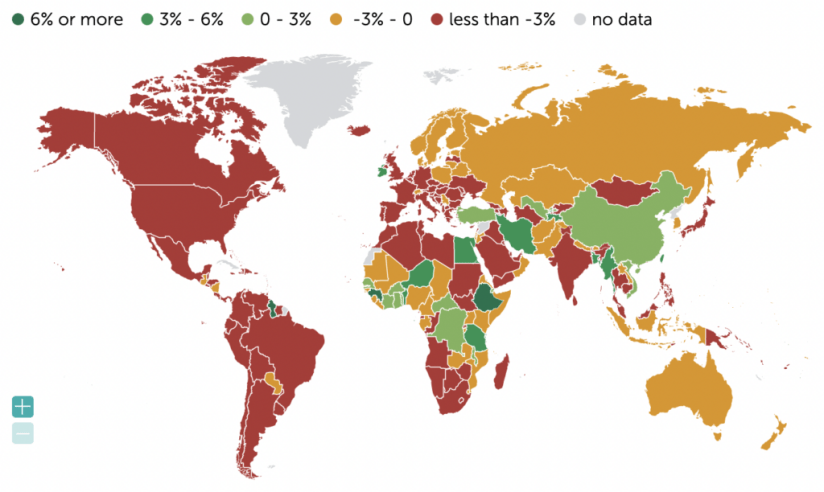
In 2020, the first year of the pandemic, almost every country in the world had a major recession. As this map from the IMF shows, most countries in Europe saw GDP decline by more than 3%, the only exception being Ireland (which in any case has an unusual way of counting GDP).
Despite this, unemployment in the EU only increased by a modest 1.2 percentage points, rising from 6.6% to 7.8% by the third quarter of 2020. One reason why unemployment didn’t rise more during months of lockdown is that governments spent unprecedented sums of money on furlough and other wage-support schemes.
In other words, they paid people to sit at home all day. For example, The U.K.’s Coronavirus Job Retention Scheme paid furloughed workers 80% of their previous salary, up to a cap of £2,500 a week.
While such wage-support schemes had the benefit of preventing large rises in unemployment, they had the cost of being extremely expensive. Data published by the ONS in January of this year show just how expensive.
The chart below shows change in general government gross debt (as a percentage of GDP) in percentage points from the fourth quarter of 2019 to the third quarter of 2021:
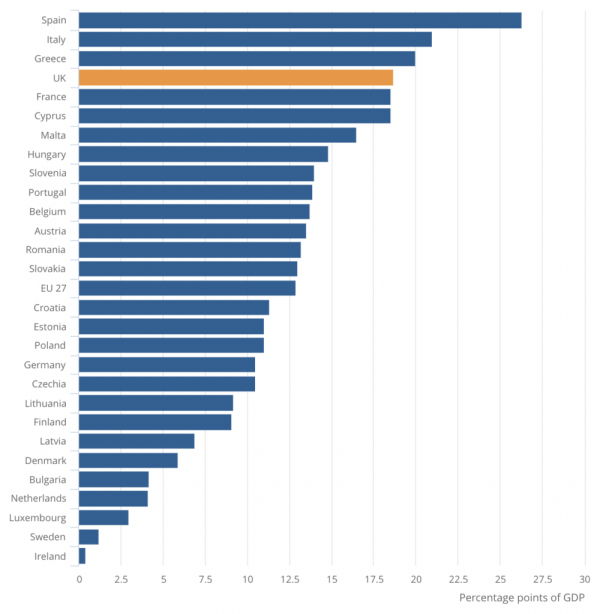
Many countries saw absolutely huge increases in debt. Over just seven quarters, Spain’s debt grew by 26 percentage points, Italy’s by 21 percentage points, and Greece’s by 20 percentage points. The UK wasn’t far behind, logging an increase of 18.7 percentage points.
At the other end of the spectrum, Ireland’s debt grew by less than one percentage point, while Sweden’s grew by only 1.2 percentage points. Of course, Sweden’s strong performance comes as no surprise, given it was the only major European country that didn’t lock down in the spring.
As I noted previously, The Economist ranked Sweden third in a league table of 23 rich countries for overall economic performance during the pandemic. And we know this didn’t come at the cost of Swedish lives – the country actually saw negative excess mortality between January of 2020 and June of 2021.
To compare European countries in a comprehensive way, I plotted change in general government gross debt against age-adjusted excess mortality. (Data were not available for Germany, Ireland, Norway and Switzerland.)
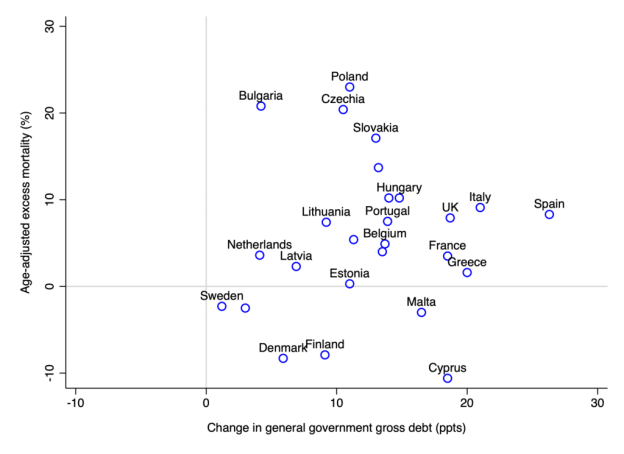
Taking into account both metrics, Sweden was one of the best overall performers in Europe, along with Luxembourg, Denmark and Finland. And it was by far the best performer among countries with a population over 10 million.
By contrast, Eastern European countries and large Western European countries – almost all of which had strict lockdowns – did poorly on both metrics. So lockdown was harmful to the public finances, with little corresponding benefit in terms of reduced mortality.
A picture is worth a thousand words, inflation was ready to go
The Naked Emperor’s Newsletter | April 13, 2022
A post on what is maybe the most obvious thing in the world but most can’t see, ignore or don’t want to talk about.
M1 money supply in the US since the ‘60s. It’s amazing how M1 money supply predicts Russia’s invasion of Ukraine and increases six fold, two years early.

Grrrrrr, I’m so angry that Putin has caused all this inflation. Sorry, I forgot to take my ‘triggered’ pills, I’m so easily triggered these days. As Neil points out below, the area highlighted in red should read Trump/Biden.
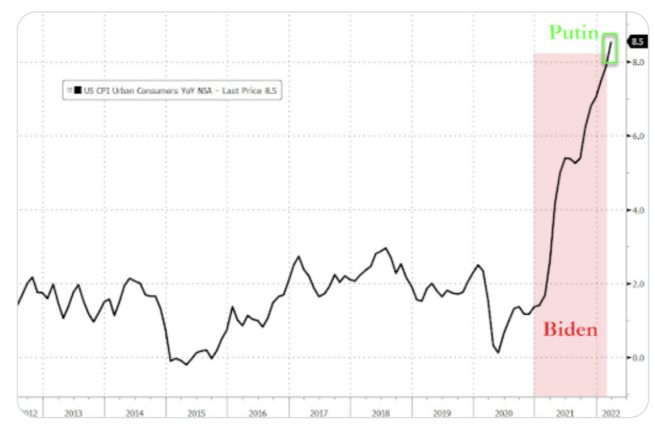
The inevitable, and only just beginning, conclusion.
Never stop telling the people that overreacted on Covid that their shrieking has caused today’s pain. Otherwise, it will just happen all over again. They selfishly got caught up in thinking about their own mortality without thinking about the complexity of the situation and the consequences that follow.
Government loans were necessary to support low income workers who were being denied a living by the wealthy laptop class but the economy should never have shut down in the first place. Moreover, much of the printed money was fraudulently taken by the wealthy who know how to game the system. I personally have heard many stories of loans being taken out to buy second homes or other assets and this is just the small scale stuff.
And if your argument is “it was necessary to save lives” then predominantly the lives that you saved were the elderly who you trapped and scared witless in their homes or care home rooms. They eventually died anyway, because that is life and what happens when you are old, but instead of happily enjoying those extra 6 months you gave them, they were forced to be alone with maybe the occasional zoom call if they were lucky.
As I’m typing I’m thinking back to a conversation I had with a doctor friend in early March 2020. He asked me if I was worried about dying from the virus. I said that I was more worried about what this is all going to do to the economy to which he replied that I need to get my priorities right.
Chinese energy major quits West – report
Samizdat | April 13, 2022
China’s state-owned oil and gas corporation China National Offshore Oil Corporation (CNOOC) is reportedly preparing to exit from the US, UK and Canada due to mounting concerns about sanctions, regulations and rising costs.
Relations between China and Western countries have soured over the past several years. Beijing’s ties with Washington were shattered after former US President Donald Trump launched a large-scale trade war, hitting a wide range of Chinese goods with import levies. Tensions have been mounting recently after China refused to condemn Russia’s military operation in Ukraine.
CNOOC, China’s top offshore oil and gas producer, is currently seeking to leave the West by selling “marginal and hard to manage” assets in the three nations, according to unnamed industry sources quoted by Reuters.
The sources, who spoke on condition of anonymity because of the sensitivity of the issue, told the agency that the company’s top management found it “uncomfortable” to manage its Western assets because of regulations and high operating costs.
CNOOC, which entered the three countries by a $15 billion acquisition of Canadian energy major Nexen in 2013, was delisted from the New York Stock Exchange after Trump’s anti-China campaign was launched. Prior to that the company had been listed on the NYSE for two decades. Joe Biden’s administration removed the firm from the blacklist about a year ago.
In the US, the Chinese energy major owns onshore assets in the Eagle Ford and Niobrara shale basins and also has offshore stakes in the Stampede and Appomattox fields in the Gulf of Mexico. In Britain, the company operates three sites in northeast Scotland, and has oil sands and shale gas assets in Canada.
“Assets like Gulf of Mexico deepwater are technologically challenging and CNOOC really needed to work with partners to learn, but company executives were not even allowed to visit the US offices,” a senior industry source said, as quoted by media.
“It had been a pain all along these years and the Trump administration’s blacklisting of CNOOC made it worse,” he explained.
Moreover, the latest sanctions imposed by the US on Russia may hit CNOOC’s assets, the sources also said. The company, which is getting ready to list on the Shanghai stock exchange in April, is reportedly planning to purchase assets in Latin America and Africa.
CNOOC reportedly produced some 1.57 million barrels of oil equivalent per day in 2021, of which 62,000 were from sites in Canada and 80,000 were from sites elsewhere in North America. Altogether, its assets in the US, UK and Canada produce nearly 220,000 barrels of oil equivalent per day, according to Reuters’ calculations.
Featured Video

Trita Parsi: Middle East Unraveling — Are We on the Path to World War?
or go to
Aletho News Archives – Video-Images
From the Archives
Trans agenda is ‘normalization of sadism’ – US author

RT | September 23, 2026
The US Democratic Party has embraced a transgender agenda that amounts to “the normalization of sadism,” author A.J. Rice has said, warning that radical trans policies would return if the party is allowed to regain power.
Speaking to RT’s America First host Scotty Nell Hughes about his new book, ‘The Curse of the Bearded Lady: How the Trans Mafia Whacked American Sanity’, Rice argued that activists have gained significant influence in schools, medicine, and corporate America while people who questioned the agenda have faced pressure to stay silent.
The author described the “trans mafia” as the sprawling network of people and institutions that have helped the movement gain influence. He singled out parts of academia, wealthy backers, and corporations, and stated that providers of transition-related treatment also have a financial incentive to keep young people in their care indefinitely.
Rice argued that the consequences of these policies ultimately fall on children who are being drawn toward gender-affirming medical treatments and on girls who are expected to share locker rooms or compete in sports with biological males.
He noted that while voters rejected the Democrats’ approach to gender in 2024, the party, which has been “captured by madness,” has since only doubled down and is seeking what is effectively “the normalization of sadism.” … Full article
Blog Roll
 Aletho News
- French-Lebanese man files war crimes complaint over Israeli attacks
- Mahan Air Flight Lands in China Despite US Threat against Iranian Airlines
- US eyes $10bn fund to rebuild war-battered Gulf infrastructure
- Trump meets Rodríguez near Maduro’s prison as Venezuela’s oil flows to US
- Trita Parsi: Middle East Unraveling — Are We on the Path to World War?
- Iran FM meets with US envoy on UN meeting’s sidelines at American side’s insistence: Report
- Qatar PM calls for Gulf security framework with Iran, says war must be ‘wake-up call’
- China condemns US extortion of Iranian airlines, rejects Washington’s ‘illegal’ sanctions threats
- Italy to move military personnel from Taif base after missile strike
- Finland’s Stubb tells European leaders to calm down
- If Americans Knew
- As Gaza languishes, world leaders gather at the UN – Daily Update
- Sanctions are collective punishment: immoral and self-defeating
- Phosphorus Munitions Fired by Israel Burn Groves, Orchards in Southern Lebanon
- Israel Carries Out New Ceasefire Violations Across Gaza
- AI – Emphasis on the ‘I’: Israel Is Funding AI Chatbot Propaganda
- Israel Blocking Hundreds of Wheelchairs for Injured Children From Entering Gaza
- Israel Is Expanding and Upgrading Compounds for Palestinian Militias in Gaza
- The Palestinian-American Residents of This West Bank Town Are Wondering: Where Is Trump?
- Gaza desperately needs tents, wheelchairs, fuel… and everything else (Israel blocks it all) – Daily Update
- Israeli Attacks in Gaza Kill at Least Seven Palestinians Over Three Days, including Woman and Child
- No Tricks Zone
- New Study: Earth And Venus Surface Warmth Largely Explained By Convection And Lapse Rate, Not CO2 Or Radiation
- 2025 Nature Paper Claiming Worsening Global Drought Gets RETRACTED …Heavily Flawed
- New Study: ‘Global Drought Shows No Detectable Recent Acceleration Under Climate Warming’
- Economic Masterminds: German Socialists Suggest Taxing Productivity Gains Stemming From Using AI
- The South China Sea Has Not Been Cooperating With The Climate Change Narrative
- Energy Crisis: Germany Enters Heating Season With Historically Low Gas Reserve Fill Levels
- New Study: The Antarctic Ice Sheet Gained Mass From 2020-2024 Due To Staggering Snow And Ice Accumulation
- Study: Ocean Heating Rates From Thousands Of Years Ago ‘Dwarf’ Modern Ocean Heating Rates
- Climate Extremists Target, Attack Large-Scale Power Grid Infrastructure In Germany!
- New Study: Antarctic Ice Melt Has Contributed Less Than 1 Centimeter To Sea Level Rise In The Last 30 Years

