India May Join China In Bid To Lower Oil Prices
By Tsvetana Paraskova | Oilprice.com | July 27, 2021
The world’s third-largest crude oil importer, India, could join China in tapping into its strategic petroleum reserve in a bid to sell lower-priced crude to its refiners amid rallying international oil prices.
India is reportedly considering selling half of its SPR to attract private participation in expanding its strategic storage capacity, government sources told Reuters last week.
The sale of crude from reserves could also be a move from one of the importers most sensitive to price hikes to reduce the price of crude for its refiners, Reuters columnist Clyde Russell says. India’s SPR currently holds around 36.5 million barrels of crude oil.
India has been the most vocal critic of the OPEC+ production reduction pact this year, saying that it does not support “artificial cuts to keep the price going up.” On several occasions, India’s top officials have criticized OPEC+ for keeping the market tight and prices high and have expressed concern that the higher crude and fuel prices in India would slow down the economic and oil demand recovery.
India’s move to commercialize half of its SPR is primarily aimed at raising financing for additional SPR storage, but it could also ensure cheaper oil from storage to Indian refiners, according to Reuters’ Russell.
Last week, reports emerged that the world’s top oil importer, China, is looking to tap its crude reserves.
China has started to release more than 20 million barrels of crude oil from its strategic reserve in a move seen as seeking to curb the recent oil price rally, Energy Intelligence reported last week, quoting trading sources. The reported release from the strategic petroleum reserve is also aimed at putting inflation under control.
Various market and trade sources told Energy Intelligence that China was about to release the equivalent of between 22 million barrels and over 29 million barrels, or between 3 million and 4 million tons.
Why the EU’s Carbon Border Tax will Fail to Stop Carbon Leakage
By Eric Worrall | Watts Up With That? | July 20, 2021
The EU is once again attempting to impose a carbon tax on all imports, to stop “carbon leakage”, the loss of manufacturing or other businesses relocating to lower cost countries. But a few simple economic calculations demonstrate why the EU’s plan will not stop the ongoing haemorrhage of business activity.
Carbon Border Adjustment Mechanism: Questions and Answers
Why is the Commission proposing a Carbon Border Adjustment Mechanism?
The EU is at the forefront of international efforts to fight climate change. The European Green Deal sets out a clear path towards realising the EU’s ambitious target of a 55% reduction in carbon emissions compared to 1990 levels by 2030, and to become a climate-neutral continent by 2050.
The July 2021 package in support of the EU’s climate targets is an integral part of our strategy to achieve this, and will further seal the EU’s reputation as a global climate leader. As part of these efforts, the Carbon Border Adjustment Mechanism (CBAM) is a climate measure that should prevent the risk of carbon leakage and support the EU’s increased ambition on climate mitigation, while ensuring WTO compatibility.
Climate change is a global problem that needs global solutions. As we raise our own climate ambition and less stringent environmental and climate policies prevail in non-EU countries, there is a strong risk of so-called ‘carbon leakage’ – i.e. companies based in the EU could move carbon-intensive production abroad to take advantage of lax standards, or EU products could be replaced by more carbon-intensive imports. Such carbon leakage can shift emissions outside of Europe and therefore seriously undermine EU and global climate efforts. The CBAM will equalise the price of carbon between domestic products and imports and ensure that the EU’s climate objectives are not undermined by production relocating to countries with less ambitious policies.
…
Read more: https://ec.europa.eu/commission/presscorner/detail/en/qanda_21_3661
Why does this tax put an EU producer at a disadvantage?

EU Border Tax – No Sale
Simple – selling to another EU entity is price competitive, so far, but selling outside the EU is impossibly expensive, because you are competing with other sellers who don’t pay EU carbon taxes. An exporter outside the EU has an advantage over a manufacturer inside the EU, even if they have to pay a carbon border adjustment.
What about if the EU tries to level the playing field for EU based exporters, and applies a tax credit to exports? This opens the door to massive global carbon carousel fraud.

EU Carbon Tax Carousel Fraud
Either the EU destroys their own exporters, in an attempt to protect their domestic industry, or they have a big firefight on their hands, trying to contain carbon carousel fraud, which will only get worse any time they try to ratchet up their carbon price.
What about the effect of carbon pricing on businesses inside the EU carbon tax zone?

Classic supply and demand graph, showing the impact on quantity of a tax driven rise in price per unit.
In this case quantity is assumed to be a proxy for economic activity.
Ever visited a shopping centre, and wondered why all the interesting shops are slowly replaced by clothes shops or other high turnover businesses? The reason is all those interesting shops are not profitable enough to pay the rent, and over time they are replaced by simpler, less interesting businesses – safe, boring, profitable, but still a contraction in the diversity of life choices available to consumers.
Pretty much the same thing would happen to domestic high carbon businesses afflicted by EU carbon pricing.
The EU at least in principle likely hopes that revenue from the carbon tax will drop to zero, as people discover low carbon or zero carbon alternatives to the high carbon goods they currently use such as alumina, or simply learn to live without.
But this is a huge gamble. The only reason for carbon leakage in the first place is because the carbon intensive goods targeted by the EU are difficult to replace with low carbon alternatives, and difficult to live without.
If a carbon intensive good is irreplaceable, continued dependency on that high carbon good will be an ongoing anchor dragging on the European economy.
Of course you could make an argument that the benefits the people of the EU receive from reduced CO2 emissions outweigh the costs, that one day our descendants will thank us for giving them the opportunity to experience cold weather. But this does not help consumers and businesses today.
In conclusion, the EU carbon border adjustment will do nothing to prevent carbon leakage. The EU does not control enough of the global economy to make it more than an inconvenience for multinationals. The only people the EU border carbon adjustment will hurt are people living in the EU, who will see their choices and opportunities contract.
Cuba and Color Revolution: A Cautionary Tale of the Next Phase of Forever-War
By Joaquin Flores | Strategic Culture Foundation | July 14, 2021
If one believes that the protests in Cuba can be explained within the rubric of 20th century economic systems, and then believes they can go on to extract some great truths about socialism vs. capitalism, then they are misinformed. No, this is about technocracy, color revolution, and forever-war.
The events in Cuba were caused by the staged economic collapse directed by the IMF under the advisement of the World Economic Forum, under the pretext of supply-line stoppages and economic closures to combat Covid-19. The socio-economic strife that such an imposed crisis is known to provoke, is then weaponised to destabilize ‘regimes’ so as to further the hegemonic agenda of the (admittedly divided) oligarchy ruling the global west. We saw this before in 2008 with the crash and crisis, and how this was weaponised to create a destabilization process known as the Arab Spring.
The planners involved are long-term planners, having transcended the quarter-driven constraints of the old market system. The new technocracy emerging is simply able to use Friedmanesque manipulations to keep the system afloat until the law of value is entirely transcended through automation. That was the crypto-Marxian understanding of economics promoted by Maynard Keynes.
Just as Cuba positioned itself away from socialism and towards further integration into global markets, the IMF moved openly to wind down the global market system and move towards a new type of totalitarian order which some critics have likened to communism.
Cubans are protesting against the mask-mandates and the lockdowns which have harmed people’s way of life. They are protesting the way that the government has effectively privileged those with dollar accounts who can buy from state-sanctioned dollar stores. Hence, those without families abroad sending dollars are negatively affected the most. This strikes against the whole narrative of Cuba and its gusano diaspora. Cuba produces its own vaccine, one that is not an experimental mRNA vaccine. The US would like very much to force a concession onto Cuba that it accept the mRNA vaccine. Perhaps the Cuban population of 11 million is just too high.
The fake news talking points that Cubans are protesting a lack of vaccines is a lie. We knew that trans-Atlantic talking points were a part of the Color scheme last year in Belarus when we were told that protestors rose up to oppose Lukashenko’s lackadaisical approach to the plandemic. Lukashenko in turn revealed that he refused an IMF offer of $980 million to play the lockdown deathmatch.
This is a Color Revolution
Anyone like Tom Fowdy for RT who writes that it is premature to say that the clear signs of a Color Revolution aren’t there, probably only says so because they don’t really know what those signs are.
They probably approach that question in terms of on-location forensics: identifying that a particular protest leader is actually an employee of the state department or Soros NGO in some fashion.
Yet for those who understand what the signs are, the signs of a Color Revolution are certainly there. But to understand this requires a long and broad view of the interplay between staged economic crises and the predictable turmoil they create in certain countries.
Because turmoil and protests are all but predictable even to OXFAM, once the FAO food index price surpasses about 210 (by 2012 ratios). Then, it becomes a question of which countries global lending institutions deem worthy of borrowing to subsidize against the newly inflated food price, or which countries the food production companies view in a lenient fashion.
As OXFAM wrote in 2012: “While concerns about high food prices are foremost about the spread of hunger and poverty, high food prices are also strongly correlated with political instability and have historically been a catalyst for mass protest in countries where legitimacy is already faltering. Research performed by the New England Institute for Science and Society has identified “a global food price threshold for unrest;”
Since 2007, food riots have broken out in more than 60 countries and have occurred with heightened frequency during periods of record-breaking food prices such as in 2008, when food riots erupted from Europe to the South Pacific. The FAO food price index crossed the 210 threshold, for the first time, in February 2008.”
Do we need to mention again that global economic crises are staged? Surely, there are structural problems broadly speaking, in the entire Neo-Keynesean system built in some large part from the ideas of Milton Friedman. So it should be clarified that while the timing of these economic crises are planned, they are also bound to happen. But when precisely they happen, and the point of them, would probably shock and confuse, then demoralize anyone who had a naïve understanding of global politics. You see, the point of planned economic crises is the upwards redistribution of wealth. Every firm except a handful of ‘zaibatsu’ style state-picked winners must absorb their own losses. This is corporatism 101.

Milton Friedman (July 31, 1912 – November 16, 2006) American economist and statistician who received the 1976 Nobel Memorial Prize in Economic Sciences
Each market crisis is structurally predetermined as these bubbles which define them, grow to a certain point. But it is a decision that is made to ‘pop the bubble’ at a particularly more fortuitous time as opposed to some other time – granted that it would need to be popped sooner or later. So these are both features of the structure, but also planned.
Understanding Color Revolutions requires an understanding of this phenomenon. In 2008, the massive bail-outs to banks using currency debasement, led to a geopolitical strategy on the part of the US deep state to buy up and corner the markets on perishable goods, especially those markets and firms which directed their energies towards Turkey, the Arab world, and Iran. This led to strife across the Maghreb region, Egypt, Syria, an increase of problems in occupied Iraq, and a boon to the Green movement in Iran.
The Crisis in Cuba
Further destabilization in Cuba will be a huge part in a coming global destabilization, and so it must be opposed. This is the case, even contemplating the reasonable grievances of the actual protesters, which in turn are not the same as the Sorosian demands placed in the mouths of anonymous protestors by the globalist media.
An inflation crisis has hit Cuba because of the staged political response to Covid, meant precisely to cause inflationary crises globally. The tourism industry has taken the biggest hit. Food and similar perishables are unaffordable for many without access to dollar accounts. There are state-picked favourites in the private sector (as is the case everywhere) as well as Communist Party bureaucrats who seem unaffected by the very same conditions that the protesters accuse them of bringing about. This much seems reasonable: in looking at who to blame for a problem, look to those who are making out.
The themes affecting Cuba are isolation and sovereignty, versus integration and dependence. Ever since the collapse of the USSR, which Cuba relied on for massive subsidies, Cuba has had both up and down periods as it struggles to balance between these two questions. Cuba is an island nation with just 11 million people, and so there can be no real sovereignty without the heavy price of isolation, nor can there be any integration into the globalist system without becoming a dependent state.
It’s a very tough predicament, because the Ideological State Apparatus of Cuba is its own variant of Marxism-Leninism, and this means that no matter how actually integrated and dependent Cuba is or is becoming, it must use the pages of Granma to pencil polemics declaring that Cuba is more sovereign and stable than ever before. Conversely, each undeniable period of crisis must be blamed on the very same socio-economic systems of global governance which Cuba relies upon in part for its own legitimacy.
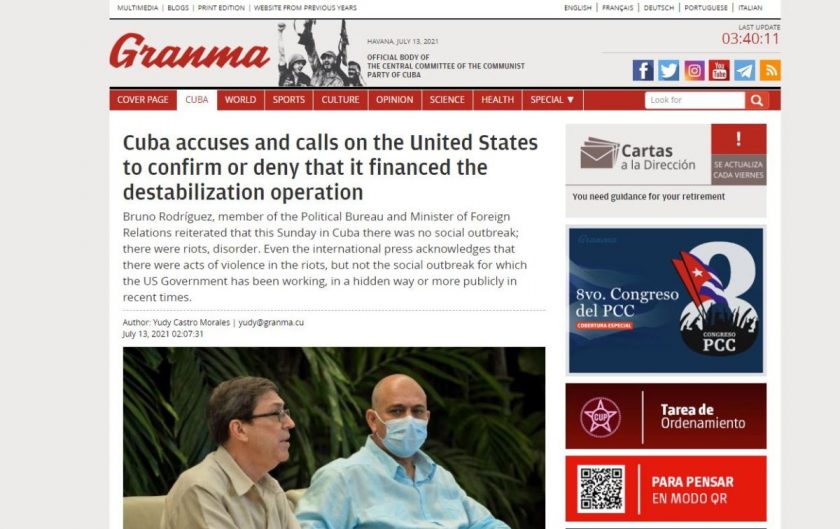
The July 13th Edition of Granma, Official Organ of the CC of the CP of Cuba
The problem then is when people really believe this state propaganda, or when people are forced to openly proclaim a public truth they know personally to be a lie. Because instead of the public understanding that Cuba has lost much of its sovereignty in its process of dollarizing so much of its economy, (and that the machinations of foreign actors, the IMF, the planned and staged collapse of the global speculative economy that Cuba is integrated in, is a large part of Cuba’s present woes) blame is laid by the public directly at the feet of a nominally sovereign state’s ruling government.
Quite the predicament. Because the government cannot really tell the truth, it must take the blame. Or do as it has done (and done so with no shame for provoking incredulity), and claim that the entire protest is a foreign provocation.
The Cuban government and its sinecure functionaries must always declare that any grassroots grievances expressed en masse are always at its core the work of foreign ‘imperialist’ intelligence operations bent on a destabilization strategy.
Yet such accusations of foreign plots are more likely to be true than not.
Another problem, and this is something where the Cuban government needs to make a fix, is the issue of dollar accounts.
Those with dollar accounts are tremendously less affected by the perishable goods inflation crisis in Cuba. But those deposits are only possible by having loved ones who have left Cuba for the US. So those who have ‘betrayed’ the revolution are the ones able to help those in Cuba. Those in Cuba living better off are not those who have been loyal to the socialism project of Cuba excepting a small layer of bureaucrats and professional snitches, but instead are the relatives of those gusanos in Florida and the rest of the US who have moved on to greener pastures.
What sort of message does that send? This greatly weakens the legitimacy of the government, because those common-folk who defend the Cuban system are left feeling like fools. When this layer joins a protest movement, the government’s days are numbered.
Cuba – Between a Rock and a Hard-Spot
Color Revolution schemes cannot work unless there are real-existing grievances shared among large segments of the population.
And yet going further, those real-existing grievances today, (while they compound longer standing ones which the Cuban government must account for), are directly caused by the IMF’s decision to bring global capitalism to a grinding halt for some period of time.
It is very difficult for a nominally sovereign government to tell a Thatcherite story of ‘TINA’ – there is no alternative. Cuba lacks alternatives except going either the path of the Khmer Rouge, or the path of laissez-faire. It has chosen some middle-path.
This really touches on a very big problem Cuba faces: its civilizational decision to place its legitimacy at the hands of international organizations related to global governance. Cuba strives to show its own citizens, and perhaps secondarily the US, that the rest of the world and especially the UN’s alphabet soup of agencies and organizations, recognize any number of successes that Cuba promotes having accomplished. To wit, at least within the rubric of those accounting systems, Cuba makes a decent case.
So a problem arises when this very same system of global governance, under the pretext of fighting Covid-19, instructs various countries to commit ritual seppuku at the altar of world health in order to preserve this status and these relationships to global trade and global governance.
And how? The western hemisphere is controlled almost entirely by the IMF and global banking systems. Cuba exists in some netherworld of ‘helpful harm’, if not through the US due to sanctions, then through the same banks in their Trans-Atlantic incarnations by way of Europe.
Since we understand that the WHO is effectively controlled by allies of the World Economic Forum like Bill Gates, which in turn is the think-tank of the IMF; and since the IMF includes in its bylaws and requirements that countries in a time of a declared global pandemic by the WHO must take the proscribed measures to combat this, then we understand what we have seen as a global phenomenon.
It’s been only a handful of leaders, several in Africa, in Haiti, and Belarus, that have openly bucked these provisions. And of these, all have been since eliminated except for Lukashenko in Belarus who no doubt enjoys some security provisions from the Russian Federation.
The Observatory of Economic Complexity (OEC) explains that in 2019, “The top exports of Cuba are Rolled Tobacco ($287M), Raw Sugar ($211M), Nickel Mattes ($134M), Hard Liquor ($97.3M), and Zinc Ore ($78.4M), exporting mostly to China ($461M), Spain ($127M), Netherlands ($65.5M), Germany ($64.7M), and Cyprus ($48.9M).
The top imports of Cuba are Poultry Meat ($286M), Wheat ($181M), Soybean Meal ($167M), Corn ($146M), and Concentrated Milk ($136M), importing mostly from Spain ($1.01B), China ($790M), Italy ($327M), Canada ($285M), and Russia ($285M).”
Hence Cuba was placed in a pincer move. It lost massively from the global plandemic and the restriction of supply lines, the tightened access to imports, the loss of tourism. The compliance of other countries to the IMF’s mandated economic implosion reduced demand for Cuba’s exports and damaged tourism as well.
But in order to maintain its own relationship with the IMF and also following the global narrative of the Socialist International (2nd International), (an EU driven social-democratic association of governments and political parties), it went along with the ‘solidarity’ driven component of woke politics seen in the ‘do-your-part’ masking and lockdowns.
But those harmed by the lockdowns were ordinary Cubans, not government officials or those with dollar accounts. And so the reaction we see today is a predictable one.
Conclusion
There can be no doubt: Cuba’s present crisis is not the direct result of its own economic mismanagement, but rather the staged demolition of finance, global trade, and supply lines using the Covid pandemic as a pretext. However, a number of social and political decisions by Cuban leaders have no doubt compounded the impact of the crisis and emboldened protesters.
What citizens in first world countries have seen as a ‘stock market rebound’ predicated by ‘too-big-too-fail’ type bailouts (socialism for the rich), are only possible so long as those moneys are held on the books but not really spent – hence the lockdowns. At least not spent in such a way as would this liquidity naturally circulate in the economy. For such velocity of moneys based on such extreme debasement of the currency, would lead to the largest inflationary crisis in the history of man on earth.
In raw-materials producing countries like Cuba, that has meant a tripled hardship. The aim of the centers of finance capital has been to do something like the Arab Spring, only more so.
At the same time, the Cuban government’s defensive and accusatory posture is poor optics and bad politics. It needs to better engage the protestors and validate some part of their grievances. Pointing the finger at Uncle Sam is tone deaf and only serves to satisfy a single demographic in Cuba.
Today, we are seeing only the start of a fresh wave of global destabilization efforts, never-ending wars. But now governments have prepared the civilian populations for these wars under the pretext of never-ending lockdowns due to a mystery illness. The right to protest, strikes, and the basic social contact needed to organize these can be revoked by instantaneous mandate as some new variant of Covid will always invariably be discovered. This is the biggest threat humanity faces since the Second World War, but in addition to destabilization campaigns, is the backdrop of a class-war gambit of the oligarchy against everyday people. Cuba needs to be understood in this light, and while it needs a better approach to managing the Covid narrative and hearing its people, foreign meddling in its affairs needs to be opposed.
Fit for 55 — EU Green Deal and the Industrial Collapse of Europe
By F. William Engdahl – New Eastern Outlook – 12.07.2021
One of the rare honest statements by Bill Gates was his remark in early 2021 that if you think covid measures are bad, wait until the measures for global warming. The European Union is in the process of imposing, top-down, the most draconian measures to date, that will effectively destroy modern industry across the face of the 27 states of the European Union. Under cute names such as “Fit for 55” and European Green Deal, measures are being finalized in Brussels by unelected technocrats that will cause the worst industrial unemployment and economic collapse since the crisis of the 1930s. Industries such as automobile or transport, power generation and steel are on the chopping block, all for an unproven hypothesis called manmade global warming.
While most EU citizens have been distracted by endless restrictions over a flu-like pandemic called covid19, the technocrats at the EU Commission in Brussels have been preparing a program of planned dis-integration of the EU industrial economy. The convenient aspect of an unelected supranational group far away in Brussels or Strasbourg is that they are not accountable to any real voters. They even have a name for it: Democratic Deficit. If the measures about to be finalized by the EU Commission under German President Ursula von der Leyen and Vice President for Global Warming Dutch technocrat Frans Timmermans, are enacted, here is a hint of what will happen.
“Fit for 55”
On July 14, the EU Commission presents its “Fit for 55” green agenda. While the title sounds more like an ad for a middle-ager health studio, it will be the most draconian and destructive de-industrialization program ever imposed outside of war.
Fit for 55 will be the central framework of new laws and rules from Brussels to reduce CO2 emissions dramatically, using schemes such as carbon taxes, emission caps and cap and trade schemes.
In April 2021 the EU Commission announced a new EU climate target: Emissions to be reduced by 55 percent by 2030 compared to 1990, up from the 40 percent as previously agreed. Hence the cute name “Fit for 55.” But the industry and workforce of the EU states will be anything but fit if the plan is advanced. Simply said, it is technocratic fascism being imposed without public debate on some 455 million EU citizens.
This Fit for 55 is the first time in the world that a group of countries, the EU, officially imposes an agenda to force an absurd “Zero” CO2 by 2050 and 55% less CO2 by 2030. EU Green Deal czar, Commissioner Frans Timmermans said in May, “We will strengthen the EU Emissions Trading System, update the Energy Taxation Directive, and propose new CO2 standards for cars, new energy efficiency standards for buildings, new targets for renewables, and new ways of supporting clean fuels and infrastructure for clean transport.” In reality it will destroy the transport industry, steel, cement as well as coal and gas fuel electric generation.
Here are major parts of the sinister Fit For 55.
Cars and Trucks
A major target of the EU Green Deal will be measures that will force internal combustion engine vehicles– gasoline or diesel cars and trucks—to adhere to such punitive CO2 emission limits that they will be forced off the roads by 2030 if not sooner. The plan will change the current target of a 37.5% reduction in vehicle CO2 emissions by 2030 to a rumored zero emissions by 2035.
On July 7 a coalition of trade unions, transport industry companies and suppliers including the European Trade Union Confederation and the European Automobile Manufacturers Association, wrote an urgent appeal to EU Green Czar Frans Timmermans. They stated, “… we want to see industrial transformation and innovation in Europe, rather than de-industrialisation and social disruption.” The letter pointed out that the EU has no plans for a so-called “Just Transition” for the EU auto industry including no new skills training for displaced workers: “Currently, there is no such framework for the 16 million workers in our mobility eco-system, and notably Europe’s automotive sector which is a powerhouse of industrial employment.”
This is no minor issue as the transition from internal combustion engine cars and trucks to E-autos will mean a huge unprecedented disruption to the present auto supplier chains. The letter points out that EU-wide, the auto sector has 8.5% of all European manufacturing jobs and in 2019 produced nearly 10% of GDP in Germany alone, along with 40% of the country’s research and development spending. The EU today makes up more than 50% of the world’s exports of auto products. They point out that the transition to zero CO2 vehicles will mean a loss of at least 2.4 million skilled, high-wage jobs across the EU. Entire regions will become depressed. The letter points out that Brussels has yet to even map the consequences for the auto sector of the Green Deal.
In April German EU Commission President Ursula von der Leyen indicated Fit for 55 could extend a draconian carbon emissions trading scheme (ETS) from beyond power plants or industry to cover road transport and buildings in a “polluter pays” add on. The tie to the ETS will automatically force financial penalties on drivers or home owners beyond the present carbon taxes despite a very limited impact of some 3% on emissions. This, on top of tighter auto emission standards, will deal a killer blow to consumers and industry. When the French government imposed such a carbon tax in 2018 it triggered the Yellow Vests national protests and forced Paris to withdraw it.
Steel
The drastic EU plan contains new provisions that will mean drastic change for the energy-intensive EU steel and cement industries. Steel is the second biggest industry in the world after oil and gas. Currently the EU is the second largest producer of steel in the world after China. Its output is over 177 million tons of steel a year, or 11% of global output. But the Timmermans plan will introduce new measures that ostensibly penalize steel imports from “dirty” producers, but that in fact will make EU steel less competitive globally. Leaks of the EU plan indicate that they plan to eliminate current free ETS pollution permits for energy-intensive industries such as steel or cement. That will deal a devastating blow to both essential industries. They call it the Carbon Border Adjustment Mechanism. As the Center for European Policy Network points out, EU steel exporters will “not receive any compensation for the discontinuation of the free allocation. As a result, they suffer considerable competitive disadvantages compared to their competitors from third countries.“
Coal Carbon Taxes
The EU’s new 55% climate target for 2030 implies a near-complete coal phase-out by 2030 in the whole EU. This will hit Germany, far the largest EU coal power user. The German government, already with the world’s most expensive electric power owing to the Merkel Energiewende transition to unreliable solar and wind that will see the last nuclear power plant closed in 2022, has just recently dropped its plan to phase out coal by 2038. It will phase out far earlier, but for obvious political reasons in an election year, has not revealed its new “zero coal” date.
The absurdity of believing the EU, especially Germany, will be able to achieve zero coal by 2030, replacing not even with natural gas, but rather unreliable solar and wind, is already clear. On January 1, 2021 as part of the Government mandate on coal power reduction, 11 coal-fired power plants with a total capacity of 4.7 GW were shut down. That phase out lasted eight days as several of the coal power plants had to be reconnected to the grid to avoid blackouts due to a prolonged low-wind period. The shut coal plants were ordered to operate on reserve status at the cost of the consumers. The Berlin government commission that drafted the coal phase-out plan included no power industry representatives nor any power grid experts.
With the new element of the destructive EU Commission Fit for 55 plan, the heart of European industry, Germany, is pre-programmed not only for severe industrial unemployment in steel, cement and auto sectors. It is also pre-programmed for power blackouts such as that that devastated Texas in early 2021 when wind mills froze. In 2022 in Germany, as noted, the last nuclear plant along with other coal power will be closed, removing 3% of the power. An added 6,000 wind turbines also will exit due to age, for a total cut of 7%. Yet planned addition of new wind and solar doesn’t come close to replace that, so that by 2022 Germany could have a shortfall of between 10% and 15% in capacity on the generation side.
WEF Great Reset and EU Green Deal
The hard thing for ordinary sane citizens to grasp with this EU Fit for 55 and the Davos Great Reset or the related UN Agenda 2030 globally, is that it is all a deliberate technocratic plan for dis-integration of the economy, using the fraudulent excuse of an unproven global warming danger that claims– based on dodgy computer models that ignore influence of our sun on Earth climate cycles– that we will see catastrophe by 2030 if the world does not slash harmless and life-essential CO2 emissions.
The ever-active Davos World Economic Forum as part of its Great Reset is also playing a significant role in shaping the EU Commission’s Europe Green Deal. In January 2020, the World Economic Forum at its Annual Meeting in Davos brought together leaders from industry and business with Executive Vice-President Frans Timmermans to explore how to catalyze the European Green Deal. The July 14 unveiling by Brussels is the result. The WEF supports the CEO Action Group for the European Green Deal to get major corporations behind the Brussels dystopian plan.
F. William Engdahl is strategic risk consultant and lecturer, he holds a degree in politics from Princeton University.
Alternative for Germany Party Leader Wants Exit From EU, More Cooperation With Moscow
By Ilya Tsukanov – Sputnik – 12.07.2021
The popularity of the nationalist Alternative for Germany (Alternative fur Deutschland – AfD) party shot up dramatically from a state of virtual obscurity in the mid-2010s as Germans struggled to deal with the migrant crisis of 2015-2016, with the party winning 94 seats and becoming the third largest party in the Bundestag in the 2017 elections.
Germany has no choice but to leave the European Union and to create a “new European space” in which Russia will also have a place, AfD parliamentary group co-chair Tino Chrupalla has said.
“Germany should exit today’s European Union, which simply cannot be reformed, and establish a new European economic and interest group,” Chrupalla said in an interview with Welt published on Sunday.
The politician lamented that Germany’s post-World War 2 national identity and culture had been heavily influenced by the “psychological warfare of the Allies, especially the Americans,” which he compared to the Nazis. As an example of such malign influence, the politician cited Washington’s strategy of trying to torpedo the Nord Stream 2 gas pipeline project between Germany and Russia, suggesting that the US was pursuing “strategic interests” via a “deliberate strategy of disinformation and the manipulation of public opinion” in Germany.
Chrupalla went into greater detail on his party’s vision of a new association of European nations to replace the EU in an op-ed in the Junge Freiheit newspaper, rejecting the concept of an EU “superstate” in favour of a ‘Europe of fatherlands’. The EU, he suggested, had failed utterly in tackling several major emergencies, including the euro crisis, and the migrant and coronavirus crises.
The politician also clarified that instead of the concept of a UK-style ‘Gexit’, AfD’s policy was to support ‘Neustart’, or ‘Reset’ – a “common reset for Europe” which includes an invitation for all AfD’s European sister parties “to join us.”
On the prospect of improved ties with Moscow, Chrupalla emphasized in his op-ed that “a good relationship with Russia is not negotiable,” and that Russia is “an integral part” of Europe economically, politically and culturally.
The politician accused EU elites of “sticking to old Cold War thought patterns” about Russia, and noted that while “communism in Eastern Europe has long been defeated, European opinion leaders were importing new Western ideologies from the US ‘New Left’,” such as identity politics and its promotion of positive discrimination, resulting in social unrest which he stressed “must be overcome.”
“With Russia, a large European state and an important trade partner has been excluded from the European Union. Furthermore, at the insistence of our US partners, we are constantly imposing new trade sanctions on the Russians for new reasons,” Chrupalla wrote.
According to the politician, these restrictions ultimately come back and hit the German economy and medium-sized businesses, causing them to lose out as Russia replaces its imports from Germany with new trade ties with Asia. “Trade between Germany and Russia fell by 25 percent between 2013 and 2019, and in Saxony by 70 percent. It cannot go on like this!” Chrupalla argued.
Ultimately, the politician suggested that both countries would benefit if sanctions are lifted and new ones are ruled out. “Russia is also an integral part of Europe culturally and politically, and Germany always does well when it has good relations with Russia,” Chrupalla stressed.
Chrupalla’s views on foreign policy aren’t representative of the AfD as a whole, with party co-chair Jorg Meuthen recently suggesting that a German exit from the EU is a “poorly thought out idea.” The party is also traditionally in favour of close ties to the US and Israel, and of keeping Germany a member of NATO. Since its emergence as a major political force in the Bundestag following the 2017 elections, the party has experienced an intense internal debate regarding these and other policies.
Germans will go to the polls on 26 September for general elections to the Bundestag and multiple state parliaments. Longtime German Chancellor Angela Merkel is set to retire after the elections. A recent INSA/YouGov poll indicated that Merkel’s Christian Democratic Union/Christian Social Union alliance enjoys a plurality of 28 percent support at the moment, with the Social Democratic Party and the Greens second with 17 percent support each. 12 percent of respondents said they plan to support the Free Democratic Party, 11 percent said they would vote for the AfD, and 8 percent said they plan to give their vote to the democratic socialist Die Linke. Like the AfD, Die Linke supports an improvement in Germany’s relations with Russia. The party also has a firm policy of opposition to NATO and proposes to replace the alliance with a new collective security system for Europe with Russia as a member. Despite their ideological differences, AfD and Die Linke occasionally cooperate on certain issues.
Afghanistan Faces a New Future With Some Positive Signs
By James ONeill – New Eastern Outlook – 12.07.2021
The news from Afghanistan is not good for the Americans. The troops abandoned the Bagram military base in the dead of night without bothering to advise their Afghanistan “allies”. Looters moved in before being replaced by the Taliban forces who naturally rejoiced at the treasure trove of weapons and other equipment that the Americans had abandoned.
Throughout the rest of the country the Taliban are making record advances and it is now likely only a matter of weeks before they control the whole of the country. The rapid defeat of the regular government troops has raised some alarm in countries on Afghanistan’s borders. In particular the rapidly changing situation in Afghanistan has raised concerns among member states of the Shanghai Cooperation Organisation (SCO) several of whom share borders with Afghanistan.
The rapidly changing situation has led to China’s foreign minister Wang Yi to make urgent visits to 3 countries that share a border with Afghanistan. The visits come at the invitation of the governments of Turkmenistan, Tajikistan and Uzbekistan and will take place between July 12th and 16th.
These meetings will precede a meeting of the Shanghai Cooperation Organisation-Afghanistan contact group. The object of the meeting is for the parties to exchange views on promoting peace in the region, including, importantly, increasing the level of cooperation between the SCO and Afghanistan.
The rapid United States withdrawal from Afghanistan has given rise to a level of instability in Afghanistan that China, among other neighbouring countries, fears create instability within their own territories.
The SCO has a potentially important role to play in promoting stability in Afghanistan which is one of four observer states of the SCO. Six of Afghanistan’s neighbours are members of the SCO. As such the SCO is uniquely placed to promote a range of development assistance to Afghanistan, including the promotion of projects to develop Afghanistan rich resources. The latter have largely been neglected through the 20 years of American occupation and that of its allies.
A Taliban spokesman Suhail Shaheen gave an interview to This Week in Asia last Wednesday. Mr Shaheen said that the Taliban sees China as a friend and once they hold power they will engage in talks with China about beginning the process of reconstruction of the country’s assets, neglected during the years of occupation.
And important announcement made by the Chinese government through its foreign minister Wang Yi was for an expansion of the huge Pakistan – China economic development corridor to include Afghanistan. If this succeeds it will play an important role in securing Afghanistan’s economic recovery, which has essentially been handicapped for the past 20 years by continuous warfare.
It is clear that Russia will be an important part of Afghanistan’s redevelopment. Although the Russian government does not officially recognise the Taliban group it has nonetheless played host to several important meetings in Moscow involving representatives of the Taliban regime. When asked about a possible Russian return to Afghanistan the foreign minister Sergei Lavrov was dismissive. It is clear that any future Russian involvement in the country will be in the context of the SCO.
At the request of the Tajikistan government Russia has sent a contingent of troops to that country to assist with border protection. The Tajikistan government became alarmed at the influx of Afghan refugees across its borders which threatened the country’s capacity to cope with a sudden and large influx of refugees.
The numbers however, remain relatively small. They do not begin to compare with the estimated 1.5 million Afghans who have sought refuge in Pakistan over the years. The Pakistan government is sympathetic to the Taliban, which is one reason why it refused an American request for the use of its military facilities following the United States withdrawal from Afghanistan, now scheduled for August.
The Americans have announced that they reserve the right to mount air attacks in Afghanistan, presumably flying from one of their Middle East bases. It is difficult to see the rationale behind this announcement. The United States has no sustainable interest in Afghanistan. The flights will presumably be in support of Afghan government troops, but it is difficult seeing the latter having any substantial role following the inevitable Taliban takeover of the country which must now be only a matter of time.
The position of other foreign troops must also be open to question. The Australian government for example, has been conspicuously quiet on the fate of its military contingent in Afghanistan which began 20 years ago. They were first committed to Afghanistan following 11 September 2001 attacks [?] on the World Trade Centre and have been there ever since. The then Australian Prime Minister John Howard cited the ANZUS treaty as the rationale for the involvement, the only time the treaty has ever been invoked.
A number of Australian troops are now under investigation for allegedly murdering Afghanistan prisoners. Whether that matter now proceeds in the light of Australia’s withdrawal of his troops from Afghanistan is an open question. Post withdrawal support for the Afghan government is now conspicuously absent. The response to a Taliban takeover is unknown, but it is unlikely to be favourable.
Afghanistan’s best hope for the future lies in its association with the SCO. The early signs are encouraging with a positive response being shown both by the Taliban leadership and also the major countries involved in the SCO, especially China and Russia. For the first time in several decades, Afghanistan future at last looks positive.
James O’Neill, an Australian-based former Barrister at Law
Singaporean Ministers Announce That Country Must Learn to Live With COVID-19
By Noah Carl • Lockdown Sceptics • June 29, 2021
Singapore has recorded fewer deaths from COVID-19 than almost any other country with reliable data: only 36 to date, which equates to a rate of just six per million. (The U.K.’s official COVID-19 death rate is 1,890 per million.)
And according to the World Mortality Dataset, Singapore has had zero excess mortality since the pandemic began. On the other hand, the country did take a sizeable economic hit last year – with GDP falling by 5.4% (compared to only 2.8% in Sweden).
What’s more, Singapore has not recorded more than 100 cases in a day since August of last year. If any advanced country has come close to “Zero Covid”, it’s Singapore.
Despite that record, three Singaporean ministers have announced that “COVID-19 may never go away” and “it is possible to live normally with it in our midst”.
Writing in The Straits Times, Gan Kim Yong, Lawrence Wong and Ong Ye Kung (the ministers for trade, finance and health) say that “COVID-19 will very likely become endemic”. This means that “the virus will continue to mutate, and thereby survive in our community”.
In other words, the Singaporean Government is under no illusion that it will be possible to eliminate COVID-19, contrary to the claims of the “Zero COVID” movement. Indeed, a survey by Nature of 119 experts found that 89% believe it is “likely” or “very likely” that SARS-CoV-2 will become an endemic virus.
“We can’t eradicate it”, the ministers write, “but we can turn the pandemic into something much less threatening, like influenza.” How do they propose to deal with the virus going forward?
First, they intend to proceed with their vaccination program, which aims to have two thirds of people vaccinated by August 9th. Second, they intend to continue testing, but “the focus will be different”. For example, the country will cease “monitoring COVID-19 infection numbers every day”. Third, they intend to keep using and developing effective treatments for COVID-19.
As Yong, Wong and Kung conclude, “History has shown that every pandemic will run its course.” Though one might object that even the few remaining measures are no longer necessary, the ministers seem to understand what they’re talking about. Their article is worth reading in full.
Pseudopandemic
By Iain Davis | OffGuardian | June 29, 2021
Covid 19 was and is a pseudopandemic. It was the gross exaggeration of the threat posed by a low mortality respiratory illness, comparable to influenza.
The pseudopandemic was a psychological operation (psy-op) designed to terrorise the public. The objective was to accustom the people to draconian system of government oppression by familiarising them with the mechanisms of a biosecurity state.
The pseudopandemic was based upon an influenza like illness which, regardless of its origin, was not and is not a disease which can legitimately be considered the cause of a “pandemic.” The only way it could ever be described as such was by the removal of any reference to mortality from the World Health Organisation’s definition.
COVID 19 is a disease which has a mortality age distribution profile indistinguishable from standard mortality. Unlike influenza, which disproportionately impacts the young, in terms of threat to life, COVID 19 was and is a wholly unremarkable illness.
Were it not for political theatrics and mainstream media propaganda, which began in China, no one, outside of the medical profession and COVID 19 sufferers, would have remarked on this disease.
The illusion of overwhelmed health services was created by massively reducing their capacity and staffing levels while simultaneously reorienting healthcare to treat everyone who presented with a respiratory illness as viral plague carriers.
In reality the pseudopandemic saw unusually low levels of hospital bed occupancy. However, due to the additional policies and procedures heaped upon them, healthcare services were thrown into into disarray.
This was combined with the use of tests, incapable of diagnosing anything, as proof of a COVID 19 “case.” This enabled governments around the world to make absurd claims about the threat level. They relied upon fake science and junk data throughout. As symptomatic illness and resultant disease mortality was relatively low, they asserted that people without any signs of illness (the asymptomatic) were spreading the contagion.
This was abject nonsense. There was no evidence that the asymptomatic infected anyone. Those at risk of severe illness were the small minority of people who already had serious comorbidities, often due to their age.
The mass house arrests (lockdowns) and other measures, such as wearing face masks, were then used to increase the infection risk, to reduce broad levels of population immunity and give the false impression of an extraordinary public health threat. The removal of health care for every other disease, including cancer and ischaemic heart disease, coupled with the health costs of increasing deprivation and immunosuppressant policies, were then exploited to bolster the illusion of a pandemic.
This does not mean that COVID 19 didn’t kill people but those who died of the disease were a small percentage of the total numbers claimed. COVID 19 had no discernible impact upon all-cause mortality. The increase above one of the lowest ever 5 year mortality averages was mainly caused by the withdrawal of health services, as increasing numbers of people died in their own homes or in overburdened care settings, without receiving normal medical attention.
Despite these efforts, mortality in 2020 was still only the 9th highest in the first two decades of the 21st century and one of the lowest age-standardised mortality rates in the last 50 years.
COVID 19 presented virtually no risk to those of working age an none at all to the young. There was no evidence that children were either at or presented any risk. The school closures were part of the pseudopandemic psy-op. They gave the misleading impression of an emergency and provided fraudulent justification for vaccinating children.
The pseudopandemic was planned to lead to the complete transformation of our culture and society. It has irrevocably changed our relationship with governments, has caused catastrophic economic disruption, shutdown global trade and saw millions become reliant on government subsidies. The pseudopandemic was the opening salvo in a global coup d’état.
The new pseudopandemic biosecurity apparatus is designed to control our behaviour as we are forced through a global transformation. Those behind the pseudopandemic intend to change the International Monetary and Financial System (IMFS) and establish global governance in the shape of technocracy. Technocracy is a neofeudal, totalitarian system based upon communitarian principles.
We will be offered the illusion of participatory democracy through our required participation and belief in “civil society.” Civil society will be a “stakeholder” in the Technocracy. However, civil society will only be allowed to pursue polices set at the global level.
Applied psychology was used throughout the pseudopandemic to fix our “choice environment.” We were conditioned to believe that following the rules was the responsible and moral choice. In reality our behaviour was being deliberately altered to ensure our compliance with the diktats of the biosecurity state, preparing society for the transition to technocracy.
The new global IMFS is built upon carbon trading and a $120 trillion carbon bond market is currently under construction. Assets are being defined in terms of their Stakeholder Capitalism Metrics which rate investments depending upon their environmental, social and governance (ESG) score.
These metrics have been established by the World Economic Forum working in partnership with the central banks, the Bank for International Settlements (BIS) and other stakeholder capitalists, such as the investment firm BlackRock.
The global system of central banks, headed by the BIS, are “going direct” by directly funding government policy. They have linked monetary policy to fiscal policy which means ultimate control of all government spending by the BIS. The Financial Services Board of the BIS regulates ESG’s and determines the value of sustainable financial assets.
In this way, the global technocracy will facilitate the continuation of crony capitalism, as only the right stakeholders will receive the approved ESG rating. Those who don’t will not be able to raise the investment capital they need and will be forced out of business.
“Going direct” began before the World Health Organisation (WHO) declared a global pandemic. All of the economic and financial responses to the pseudopandemic, such as furlough and business support packages, were agreed as part of the “going direct” plan in August 2019.
The so called economic stimulus of Quantitative Easing (QE) is a fraud. It is based upon the unbridled monetisation of debt on an unprecedented scale. Going direct means that the toxic junk assets of the financial institutions have been taken on to the balance sheets of the central banks. Thus creating unimaginable levels of public debt that can never, and will never, be repaid.
The QE money, created out of absolutely nothing, has been pumped into the financial markets for the continued enrichment of the right stakeholders. The vast expansion of the money supply will shortly lead to hyperinflation. The mass unemployment that will occur as a result of the austerity, caused both by the staggering levels of debt and our transition to a new IMFS, will create stagflation.
The new net zero carbon economy will mean permanent austerity for the majority. The Technate will provide a universal basic income (UBI), or some variation of the concept, to be paid in Central Bank Digital Currency (CDBC). This will mean that no one will have their own money, other than the chosen stakeholders, as all transactions will be monitored and controlled by the central banks.
Those who oppose the neofeudal authority of the corporate, stakeholder Technate and refuse to comply with the imposition of biosecurity obligations will have their CBDC restricted or switched off. The pseudopandemic has established the framework of the biosecurity state that will control all our lives. The vaccine passports are the gateway to full biometric identity for every citizen in the new normal Technate.
We will be required to show our biometric ID on demand. Access to goods and services will be monitored and restricted as desired by the Technate. UBI and CBDC combined with biometric ID will ensure our compliance. The central planners of the Technate will oversee the AI controlled system which will automatically limit the freedoms of those who defy the rules decreed by the stakeholder capitalists.
Money, as we currently understand it, is no longer required by those behind the pseudopandemic. The net zero carbon economy enables them to seize control of the “global commons.” This means that they will have dominion over all of the Earth’s natural resources. All land, the oceans, the atmosphere and even space is being converted into assets via Stakeholder Capitalism Metrics.
Not only will we have no money of our own, we will be unable to access the resources we need to survive without permission from the Technate. While this system of technocracy has been planned for more than a century, it was the financial collapse in 2008 that led the pseudopandemic planners to increase the pace of transformation. The monetisation of debt had long been the source of their authority but this IMFS was unsustainable. As all money was debt, its eventual collapse was inevitable. It passed the point of no return in 2008.
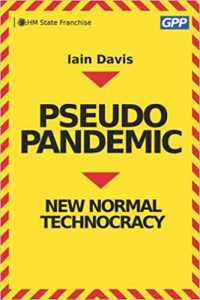 With their going direct plan in place, the stage was set for the pseudopandemic. SARS-CoV-2 provided the perfect opportunity and the core conspirators behind the pseudopandemic had trained extensively in readiness for the operation. We were then barraged by a mainstream media propaganda campaign and military’s information warfare units were deployed to control our “choice environment.”
Scientific and medical doubts were censored as the suspension of normal democratic processes was exploited to introduce the biosecurity state. Laws were passed to allow government to commit any crime it wished in pursuit of stakeholder capitalist sustainable development goals. Laws to end the right of protest and censor free speech are moving unopposed through the legislature as national governments, who are no more than stakeholder partners within the new normal technocracy, prepare us for the coming Technate.
For the core conspirators of the pseudopandemic this is the realisation of their long held dream of global governance. They are steeped in the mythology of eugenics and population control. Once they have total control of the global commons they will no longer need us as consumers and are intent upon significant population reduction.
As insane as this all sounds the evidence, explored in pseudopandemic, is overwhelming. We are facing global neofeudalism unless we act now. Herein lies our hope.
The core conspirators have no real power. It is an illusion that they are desperate to maintain. They invest billions in propaganda, hybrid warfare and security systems because they are terrified that we will realise what they are doing.
Their plan can only succeed if we believe their lies and comply with their orders. If we don’t there is nothing they can do about it.
We can reset the world.
Pseudopandemic, by Iain Davis, is available both in kindle and paperback, from Amazon and other sellers. Or you can subscribe to In This Together for a free copy.
Why Hasn’t the Government Published a Cost-Benefit Analysis of Lockdown?
By Noah Carl • Lockdown Sceptics • June 24, 2021
When considering a policy as unprecedented and far-reaching as a nationwide lockdown, you’d assume the Government would carry out a cost-benefit analysis. After all, such analyses are routine in policy-making.
For example, the Treasury maintains a document called ‘The Green Book’, which gives detailed guidance on how to compute the costs and benefits of particular actions. It refers to concepts such as opportunity cost, discount factors and adjusting for inflation.
You might say there wasn’t much time to carry out a detailed cost-benefit analysis before the first lockdown last March. (Though the Government could have provided a few rough numbers for the public to scrutinise.) However, it’s now more than a year later, and there still hasn’t been any attempt to weigh the costs and benefits.
In a report for the Institute of Economic Affairs published last December, the economist Paul Ormerod argued that the Government’s refusal to crunch the numbers reflects a general overreliance on epidemiological expertise, at the expense of economic expertise.
As Russ Roberts, another economist, has observed, “Knowing a lot about the human body does not make you an expert in risk analysis, tradeoffs, or unintended consequences.” Note: this is not to imply that all or even most economists are opposed to lockdowns, but simply that key insights from that discipline have been overlooked during the course of the pandemic.
Several cost-benefit analyses of the UK lockdowns have been published by persons outside the Government, and each one has concluded that the costs almost certainly outweighed the benefits.
Since the NHS typically pays up to £30,000 to extend a patient’s life by one quality-adjusted life-year, a reasonable estimate of the benefits of lockdown can be obtained by multiplying the expected number of life-years saved by 30,000.
For example, if we assume (generously) that lockdowns saved 50,000 lives and prevented 500,000 people from getting long COVID, then the total benefits would be about £16.5 billion. This figure then has to be weighed against some measure of the costs (including effects on the economy, health, education and civil liberties). Given that the fall in GDP alone last year was over £220 billion, it seems very unlikely that lockdowns would pass a cost-benefit test.
The Government’s lack of interest in cost-benefit analysis was highlighted in a recent LinkedIn post by Daniel Fujiwara – an expert in policy evaluation. Fujiwara was apparently invited to “meet with senior Government officials to discuss the pros and cons of lockdown”. However, despite offering his advice and input pro-bono, he “never heard back from them”.
In the post, Fujiwara goes on to say, “Lockdowns should have stopped at the point where an additional day of #lockdown causes more damage to our society than it benefits us… My analysis of the impacts of lockdown last year suggests that we have gone well beyond this threshold.”
One can only assume that the Government’s failure to publish even basic estimates of the costs and benefits of lockdown is due to fear of what those estimates might show…
Featured Video
Trita Parsi: Middle East Unraveling — Are We on the Path to World War?
or go to
Aletho News Archives – Video-Images
New Book
Trans agenda is ‘normalization of sadism’ – US author

RT | September 23, 2026
The US Democratic Party has embraced a transgender agenda that amounts to “the normalization of sadism,” author A.J. Rice has said, warning that radical trans policies would return if the party is allowed to regain power.
Speaking to RT’s America First host Scotty Nell Hughes about his new book, ‘The Curse of the Bearded Lady: How the Trans Mafia Whacked American Sanity’, Rice argued that activists have gained significant influence in schools, medicine, and corporate America while people who questioned the agenda have faced pressure to stay silent.
The author described the “trans mafia” as the sprawling network of people and institutions that have helped the movement gain influence. He singled out parts of academia, wealthy backers, and corporations, and stated that providers of transition-related treatment also have a financial incentive to keep young people in their care indefinitely.
Rice argued that the consequences of these policies ultimately fall on children who are being drawn toward gender-affirming medical treatments and on girls who are expected to share locker rooms or compete in sports with biological males.
He noted that while voters rejected the Democrats’ approach to gender in 2024, the party, which has been “captured by madness,” has since only doubled down and is seeking what is effectively “the normalization of sadism.” … Full report
Blog Roll
 Aletho News
- ‘We don’t seek permission to defend our country’: Snippets from President Pezeshkian’s UNGA address
- NATO chief wants Europeans to fight American wars [for Israel]
- German chemicals giant reveals details of downsizing
- Refaat Al-Areer Was The Canary In The Coal Mine In Israel’s War On The Truth
- Israeli election committee bars candidate from Knesset race over Gaza war opposition
- French-Lebanese man files war crimes complaint over Israeli attacks
- Mahan Air Flight Lands in China Despite US Threat against Iranian Airlines
- US eyes $10bn fund to rebuild war-battered Gulf infrastructure
- Trump meets Rodríguez near Maduro’s prison as Venezuela’s oil flows to US
- Trita Parsi: Middle East Unraveling — Are We on the Path to World War?
- If Americans Knew
- An error has occurred; the feed is probably down. Try again later.
- No Tricks Zone
- New Study: Earth And Venus Surface Warmth Largely Explained By Convection And Lapse Rate, Not CO2 Or Radiation
- 2025 Nature Paper Claiming Worsening Global Drought Gets RETRACTED …Heavily Flawed
- New Study: ‘Global Drought Shows No Detectable Recent Acceleration Under Climate Warming’
- Economic Masterminds: German Socialists Suggest Taxing Productivity Gains Stemming From Using AI
- The South China Sea Has Not Been Cooperating With The Climate Change Narrative
- Energy Crisis: Germany Enters Heating Season With Historically Low Gas Reserve Fill Levels
- New Study: The Antarctic Ice Sheet Gained Mass From 2020-2024 Due To Staggering Snow And Ice Accumulation
- Study: Ocean Heating Rates From Thousands Of Years Ago ‘Dwarf’ Modern Ocean Heating Rates
- Climate Extremists Target, Attack Large-Scale Power Grid Infrastructure In Germany!
- New Study: Antarctic Ice Melt Has Contributed Less Than 1 Centimeter To Sea Level Rise In The Last 30 Years

