Johnson’s govt taken to court by theatre bosses to force release of Covid-19 trial data
RT | June 24, 2021
A group of concert and theatre bosses led by Andrew Lloyd Webber has launched legal action against the British government in a bid to force it to publish data from a trial assessing the safety of indoor events during the pandemic.
The concert managers and theatre producers are demanding that the government provide data from its Events Research Programme – a trial assessing the safety of indoor events – so that they can plan to finally reopen their institutions.
In a statement on Thursday, they said the government had “refused to publish the results from the first phase of the Events Research Programme, despite saying that it would do so on numerous occasions.”
The statement adds that, in addition to not publishing the data from the trial, the government has not provided any form of insurance scheme to safeguard the industry against any further delays following 15 months of closures due to Covid curbs.
The entertainment bosses claim that, according to the government, the trial has been a huge success, which in turn has contributed to the increasing frustration within the entertainment sector concerning the industry’s continuing dormant state.
Pilot events under the programme, which the industry participated in, included the BRIT Awards at the O2 Arena, an outdoor festival event in Liverpool for 5,000 people, a snooker tournament at the Crucible Theatre in Sheffield, and the Download festival for 10,000 people last weekend.
The reopening of the theatre industry in England has been pushed back from its anticipated late June date until July 19, following the spread of the more infectious Delta variant.
Speaking later on Thursday, a spokesman for Prime Minister Boris Johnson said the government had made £2 billion available via a major arts funding package. He added that the government understands “the necessary delay to step four is challenging for live events.”
The impresarios note in their statement that live entertainment and theatre generate £11.25 billion for the UK economy each year, supporting just under one million jobs.
Iran’s Ahmadinejad Reveals Why Iran Doesn’t Need Nukes, Says World Should Know Truth About 9/11
By Ilya Tsukanov – Sputnik – 24.06.2021
The veteran politician, who served as Iran’s president between 2005 and 2013, and as Tehran mayor and Ardabil province governor before that, attempted to take part in both the 2017 and 2021 presidential elections, but was barred from doing so by Iran’s powerful Guardian Council.
The world needs to know the truth about the 9/11 terror attacks, and Iran doesn’t need to pursue nuclear weapons because they cannot protect even superpowers from collapse, former President of Iran Mahmoud Ahmadinejad has said.
“Deciphering the events of 11 September, 2001 will be the key to an understanding of all political events and processes in the sphere of global security over the past 70 years, and this will pave the way for us all to a better world,” Ahmadinejad said, speaking to Russian media in a broad ranging interview published on Thursday.
“When the terrorist attack took place, I announced to the United Nations the need to create a consolidated investigative group to establish all the circumstances of the incident and to find the culprit, and said that the Americans themselves were investigating this incident, holding court themselves, deciding everything themselves and fighting wars in other countries on this basis, not allowing anyone to comment on what is happening,” the former president recalled.
“I remember at this time the United States was very angry with me. But all I said was that there was a need for an international investigation, so that the whole world could know who carried out these attacks, and what connections [the attackers] could have to US intelligence and the American security apparatus to be able to break through all defensive barriers and destroy two towers in the very heart of the American nation,” Ahmadinejad added.
According to the politician, the US invasions of Afghanistan and Iraq, mounted in the aftermath of 9/11, were an attempt to change the situation in the world and the Middle East in Washington’s favour, and to hide “deep economic and social problems” plaguing the United States. Time has shown that neither war was a success, Ahmadinejad said, with both wars continuing to claim lives and forcing people to flee as their countries, while the states’ infrastructure collapses and their future remains uncertain.
No Need for Nukes
Commenting on Iran’s commitment not to pursue nuclear weapons, and recent attempts by the Biden administration to return to the 2015 Joint Comprehensive Plan of Action agreement, Ahmadinejad said the Democratic president has failed to make any substantive changes to his predecessor’s policies, but that this was because US foreign policy is not controlled by presidents – who are only a small part of the decision-making process.
As for nuclear weapons, Ahmadinejad suggested that “today, nuclear weapons have no practical application, so all the costs of their creation are superfluous. I in principle consider the production and accumulation of weapons an inhuman act and am categorically opposed to it. If world powers reject hegemony and are not looking for disagreements and wars, why start an arms race? Why should the wealth of nations be spent on the production of weapons intended only for murder and not for prosperity?”
“In my first meeting with Mr. Putin at the UN in 2005, I asked him if nuclear weapons could have prevented the collapse of the Soviet Union. These weapons were highly developed, yes, but they did not stop the collapse of the USSR. Because weapons, in principle cannot improve human relations. Today, the capitalist world order led by America is in decline. Can American atomic bombs stop the collapse of US global hegemony? I don’t think there is a single wise person in the world who would say yes,” the Iranian politician added.
World Needs Fundamental Changes
Ahmadinejad expressed certainty that the current world order is unsustainable and is in need of “fundamental changes.”
“Over the past 100 years, it has spawned hundreds of wars, assassinations, arms races, broad class divisions, poverty and social constraints for nations. I believe that we must all join hands and build a new world – a world in which all people will be free and respected –and where justice is central. And I believe that the noble people of Russia can play a very important role in this process,” he stressed.
Candidacy Rejected
Ahmadinejad was barred from running in Iran’s presidential elections twice in a row, first in 2017 and then in the June 2021 vote, which was handily won by Chief Justice Ebrahim Raisi, a conservative with close ties to the clergy and Supreme Leader Ayatollah Ali Khamenei. Ahmadinejad did not contest the decision to bar him, made by the Guardian Council – Iran’s powerful constitutional watchdog of six high-ranking Shiite clerics appointed by Khamenei and six lawyers chosen by parliament from nominations by the judiciary.
In the West, Ahmadinejad is best remembered for his war of words with the Bush administration over the invasions of Iraq and Afghanistan, as well as his 2006 statement that Israel [sic] (the “Zionist regime” ) must “vanish from the page of history,” often misquoted as “wiped off the map,” which sparked outrage in Tel Aviv and conservatives in Washington. Also in 2006, CNN famously misquoted his statement that Iran has a “right to nuclear energy” as Iran’s “right to nuclear weapons,” with that scandal prompting Iran to boot the US cable news network’s journalists out of the country.
In 2007, Ahmadinejad stirred up anger among liberals during a trip to New York when he told students at Columbia University that gays and lesbians “don’t exist” in Iran.
Since completing his term as president in 2013, Ahmadinejad has occasionally popped up in the news cycle, especially while quoting the lyrics of well-known American rap artists, who he apparently vibes to, to make a political point. Last year, the politician’s use of the late Tupac Shakur’s “Pull the trigger kill a N**** he’s a hero” to refer to the death of Minnesota black man George Floyd got him in trouble online.
In his home country, Ahmadinejad is better known for his ascetic lifestyle, populist economic policies, campaigns against corruption, and programmes to improve Iran’s self-sufficiency in a range of areas, including defence. During his time in office, he advocated for a compromise between Western-style capitalism and socialism. Under him, Tehran was also able to form a strategic alliance with Venezuela – with that partnership remaining strong to this day.
Schools Warned That Promoting Concept of “White Privilege” is Harming Disadvantaged White Students
While also potentially being a violation of the law
By Paul Joseph Watson | Summit News | June 21, 2021
Schools in the UK have been told by a cross-party committee of MPs that promoting the notion of “white privilege” could breach equality laws while also harming disadvantaged white students.
The committee report found that despite the relentless narrative that “white privilege” is holding back non-white students, white students are actually underperforming.
“In 2019, 17.7 per cent of free school meal eligible white British pupils achieved grade 5 or above in English and maths, compared with 22.5 per cent of all FSM-eligible pupils,” reports Schoolsweek.
The report notes that disadvantaged white children do not have “white privilege,” with MPs “(concerned) about the impact that hearing terms like that presented as fact will have on those children.”
Different language must be used when discussing racial disparities in order “to ensure that young people are not inadvertently being inducted into political movements,” states the report.
The MPs “hope that by highlighting the hardships faced by many white people from disadvantaged backgrounds” their recommendations “may help advance a new way to discuss disadvantage without pitting different groups against each other.”
The report also notes that using terms such as “white privilege” could be a violation of the Equality Act 2010 and only serves to increase racial tension by pitting groups against each other.
“Disadvantaged White children feel anything but privileged when it comes to education,” said Conservative MP, Robert Halfon, adding that there was a desperate need to move away from obsessing over “white privilege” when for most white students, it doesn’t exist.
Education systems in Europe and America are riddled with the cancer that is Critical Race Theory as well as attempts to “decolonise” curriculums, which is a euphemism for making white people feel ashamed of their history.
Despite the fact that “diversity and inclusion” extremists have largely hijacked the education system and weaponized it against white students, the ludicrous narrative that “systemic racism” only impacts non-whites still persists.
Indeed, the only form of acceptable “systemic racism” that still exists in the western world is practiced against white people.
Chinese drillers announce two MASSIVE oil & gas discoveries in Northwest China
RT | June 20, 2021
China has discovered a pair of new deposits containing roughly two billion tons of shale oil and gas, according to the state-controlled energy giant China National Petroleum Corporation (CNPC).
One of the wells was discovered in the Fuman oilfield – a major region for crude oil production in the Tarim Basin, in northwest China’s Xinjiang Uighur Autonomous Region. It reportedly contains a billion tons of super-deep oil and gas.
With a drilling depth of nearly 27,900 feet (8,500 meters) and a test oil column reaching 1,640 feet (550 meters), the reservoir set new records for the basin’s deepest oil production and highest oil column, and marks the largest discovery of oil in the area in a decade. It is expected to produce four million tons of oil and 49.4 billion cubic feet (1.4 billion cubic meters) of natural gas annually before 2025.
The oilfield is one of the world’s most difficult areas to drill, as most of the reserves are around 26,000 feet (8,000 meters) below the surface of the Earth. After it was discovered in 2015, annual output in the area grew from some 30,000 tons to 1.52 million tons in 2020, with an estimated production of about two million tons since the beginning of 2021.
Another deposit, in the Ordos Basin, also in the northwest, reportedly contains an estimated billion tons of shale oil, according to CNPC making it the biggest shale oil field in the country.
Discovered by Changqing Oilfield Co, a CNPC subsidiary, it is one of several major discoveries in the past three years. Two years ago, the firm discovered 359 million tons of shale oil in the Qingcheng region, in the northwestern Gansu Province.
Changqing has managed to significantly extend the range of its exploration over the past few years and its latest billion-ton discovery will be an important milestone in China’s oil-gas exploration history.
India’s lockdown may already have killed more people than “Covid”, and it will only get worse.
By Chase Reed | OffGuardian | June 18, 2021
India has a total population of 1.39 billion people . That is 18 percent of the total world population. The median annual per capita income is $616 . Hundreds of millions of people in India survive with a hand to mouth existence.
They work and earn a couple of dollars, and eat once they have earned the money. India has little or no social welfare system. For many people, if they don’t work and earn, they don’t eat.
In 2020, India reported 148,738 deaths due to the coronavirus. That equates to 0.0001 percent of the population. The average death rate in India in 2020 was 7.25 in 1000 of the population.
That means over 10 million people died in India in 2020, and only 1.5% were coronavirus deaths.
And that is assuming that the 148,738 coronavirus deaths reported were actually caused by coronavirus. The WHO guidelines for reporting deaths do not make clear the difference between dying ‘from’ coronavirus, and dying ‘with’ coronavirus.
At the end of March 2020, the India Government took the drastic action of locking down the Indian economy due to the coronavirus pandemic. The government took decisions as to whom they considered an ‘essential worker’ and who was considered ‘non-essential’.
Unlike its Western Government counterparts, the Indian government did not hand out $600 monthly cheques for those that it had determined to be ‘non-essential’ and told to stay at home and not work. And the initial enforcement of the lockdowns was pretty draconian.
Early last April I received a desperate plea from an associate who lives in the slums in Mumbai. His house is 20 square metres, and he lives with 7 of his family members.
He messaged me to say that he was locked down at home with his family and that they had no food and were starving. Could I please send him some money? The next day he called me and said:
Sir, thank you for sending the money. I tried to go out yesterday to buy rations but the police beat me with a lathi and would not let me out of the slum. We now have money but I cannot get outside to buy food.”
I had to intervene and request a friend who had a journalist pass and was considered an ‘essential worker’ to go and buy food and take the food into the slum for him and his family so that they would not starve to death.
They were the lucky ones.
A survey was carried out of the urban poor by a company called IDinsight, a market research firm in the social sector in India. They reported that the respondents that they surveyed had an average weekly income of ₹6858 ($93.6) in March 2020 and ₹1929 ($26.3) in May 2020. That is a 72% reduction in income from a very low base. And the percentage of respondents that reported having no work went up from 7.3% in March to 23.6% in May.
Another research agency called Dalberg reported that the percentage of respondents with no work in May was 52%.
It is a real struggle to understand why the Indian government would shut down large parts of the Indian economy and put potentially hundreds of millions of poor people’s lives at risk of starvation by locking them in their houses because a tiny fraction of the population has caught a flu virus.
There is little or no data available on the numbers of people who have died from starvation. Although, a study was done two years ago which found over 450,000 children alone died as a result of malnutrition in 2017. Those numbers will only have gone up thanks to lockdown.
It is therefore anybody’s guess as to how many of the poor in India have died.
When the dust settles, I would expect that more people will die from starvation in India, than from the coronavirus in the whole world. And there is very little information being collected or reported on it.
The situation on the ground for food distribution in 2021 is reported to be worse than 2020. The Indian food distribution system of getting produce from farm to table is highly inefficient at its best. The lockdowns were reported locally to have amplified the inefficiencies in the food supply chain manyfold.
The issue of potential starvation could become an even greater issue in 2021 as the lockdowns continue. Without data on starvation, the stories remain anecdotal. I have a serious fear that when the coronavirus hysteria blows over, we will discover in its wake, a huge tragedy of mass starvation in India.
David Beasley, executive director of the UNs World Food Programme made a statement on global starvation in April 2021.
We were already calculating 135 million people around the world before COVID marching to the brink of starvation. And now, with the new analysis with COVID, we’re looking at 260 million people, and I’m not talking about hungry. I’m talking about marching toward starvation. And that is a catastrophe in itself.”
Sorry Ukraine, US won’t be riding to your rescue: Essential wake-up call to Kiev, ending years of delusion
By Paul Robinson | RT | June 9, 2021
Since 2014, the US has encouraged Kiev’s leaders to believe that it has their back, come what may. Now, as the Nord Stream 2 pipeline nears completion, the Ukrainian president is screaming betrayal as he realizes he was misled.
A while back, it used to be popular in some circles to play up talk of the “Putinsliv” – the impending sell-out in which Russian President Vladimir Putin was apparently destined to throw the rebels of Donbass under the bus and surrender them to the tender mercies of the Ukrainian government. The irony is that, while Putinsliv never happened, the fury coming out of Kiev this week suggests that Ukraine itself has suffered a dramatic and unexpected “Bidensliv,” being sold out by US President Joe Biden.
Biden’s predecessor, Donald Trump, had a troubled relationship with the country, which he accused of trying to undermine his election campaign in 2016. Republicans also used the business dealings of Biden’s son, Hunter, in Ukraine to paint Trump’s Democratic opponent as corrupt. Consequently, Ukrainians generally welcomed Biden’s election as president and have viewed him as a much more reliable ally.
Until this week, that is. Now, things are looking a little different.
For the past few months, Ukrainian President Volodymyr Zelensky has been pressing Biden for a meeting. His position was that this should take place before Biden holds talks with Putin. Otherwise, the argument goes, the Russian and American leaders might stitch up Ukraine’s fate and then present Kiev with a fait accompli. Better that Zelensky gets to Biden first, they say, so as to forestall any attempt by the Americans to betray Ukraine to the Russians.
This, however, was not to be. Speaking to Zelensky by phone on Monday, Biden offered to host him in Washington later this summer, after Biden meets Putin in Geneva on 16 June. Apparently, the White House has decided that managing relations with Russia takes precedence over keeping Ukraine happy – a not unreasonable position given that Moscow has nearly 1,500 nuclear warheads in its arsenal, whereas Ukraine has not a single one. The safety of the world tends to focus the mind on what is really a priority.
In another blow to Zelensky, the Biden administration has finally given up its campaign to sabotage the Nord Stream 2 pipeline, which is designed to bring natural gas directly from Russia to Germany. At present, Russia exports natural gas to the rest of Europe largely through an old Soviet pipeline system running through Ukraine, and pays Kiev some $3 billion a year for the privilege. Kiev fears that, once the new underwater link is up and running, Russia will be able to stop the supply of gas through the country, thereby depriving it of much-needed cash.
For this reason, Zelensky and his allies have been lobbying the Americans to prevent the pipeline from being finished. To that end, the Trump administration imposed numerous sanctions on companies involved in the project. Now, though, the Biden government has waived those sanctions on the main German company involved, in effect giving the pipeline a green light for completion.
This was little more than a recognition of reality: Nord Stream 2 was going to be completed no matter what America did. So it made little sense for the US to degrade its relations with Berlin any more than it has already. Given a choice between the goodwill of rich and powerful Germany on the one hand, or of weak and impoverished Ukraine on the other, it was fairly obvious which one Washington would side with. The only surprise was that it took so long to work it out.
Adding insult to injury, Putin announced last week that the first section of the pipeline had been completed. This news provoked Zelensky into a mini tantrum. Speaking to the Axios news website, he complained that he was “confused” and “disappointed” by the American decision to waive sanctions on the project. He was “positive” that America could stop construction if it wanted, he said. Zelensky was also angered by the fact that the Americans didn’t tell him about their decision, and that he had to learn about it from a White House press briefing. “How many Ukrainian lives does the relationship between the United States and Germany cost?” he asked.
The Ukrainian president’s comments reveal a remarkable naivety. It seems he truly believed both that the United States is all-powerful; and that the Americans would prioritize relations with Kiev over relations with Moscow and Berlin. Now he is learning the hard way that in international politics, as Thucydides said, “the strong do what they will, and the weak suffer as they must.”
If the episode acts as a wake-up call for Zelensky’s government, that will be a good thing. For too long, Ukrainian leaders have given the impression they are living in a fantasy world in which the West will in due course induce Russia to abandon any support for the rebellion in Donbass with a campaign of massive economic, military and diplomatic pressure. This vision has manufactured an unwillingness in Kiev to make the concessions required to bring peace to Donbass under the Minsk II Agreement of February 2015, most notably the granting of “special status” to the provinces of Donetsk and Lugansk. As a result, it has played a major role in perpetuating the conflict in Eastern Ukraine.
To be fair to Zelensky, the Americans have done everything they can to encourage the fantasy that Russia can be pressured into surrender. As he notes in his interview with Axios, Biden had offered him “direct signals” that the US was prepared to block the [Nord Stream 2] pipeline. This is plausible. It fits a pattern of behavior in which Washington has led Kiev’s ruling elite to believe it will have their back come what may, including in its efforts to ignore the Minsk Agreement.
Consequently, it is perhaps not surprising that Zelensky feels betrayed. The American government has misled Ukraine’s leaders into thinking that it will go the whole hog on the country’s behalf. To an outside observer, this was never plausible. But in the desperate world of Ukrainian politics, it may well have appeared otherwise. Kiev’s bubble has long since needed bursting. To the extent that the Nord Stream 2 debacle has done that, it has paradoxically been a rather good week for Ukraine – no matter what Zelensky or his supporters may think.
Paul Robinson is a professor at the University of Ottawa. He writes about Russian and Soviet history, military history, and military ethics, and is author of the Irrussianality blog
Support for Lockdowns: A ‘Bootleggers and Baptists’ Phenomenon

By David McGrogan | AIER | June 8, 2021
One of the most striking characteristics of ‘lockdownism’ – though one which, seen in the cold light of day, is hardly surprising – is that support for it has been generated through confluences of interests. The most obvious example of this is the way in which the aims of public health bodies (preventing excess deaths) have aligned so closely with those of certain big, incumbent market actors, such as supermarkets, social media giants, and online marketplaces (that is, profit). Lockdowns appear to suit those with self-consciously virtuous motives; they also very often suit those who want to make money. When people stay at home, they stop the virus spreading – but they also spend more time online, buy more from online stores, and rely on big ‘essential’ supermarkets rather than small, independent ‘mom and pop’ nonessential retail.
In light of this, are we at all surprised that it is very often the big social media firms, streaming services and the like that have been most strongly in favor of restrictions? There is nothing conspiratorial about this, nor probably even anything intentional. It is just the straightforward application of one of the most fundamental lessons of classical economics: incentives matter, and the incentives of these actors just tend to point in the same direction. It’s not that these businesses consciously support lockdowns due to a naked profit motive, in other words; it’s simply that their incentives to reject lockdownism are not strong, or are lacking entirely, because their interests are not in conflict with it.
One of the most important, helpful, but least well-systematized concepts in the study of regulation is the ‘bootleggers and Baptists’ phenomenon, coined by Bruce Yandle. Yandle observed that political activism in favour of the prohibition of alcohol sales and Sunday closing laws in the US was often a combination of high and low motives. Baptists are in favor of restricting the selling of alcohol because it is ‘good for society.’ Bootleggers are in favor of it because, for their purposes, the less alcohol that is lawfully available the better. The two groups do not conspire with one another, openly or otherwise. But the alignment of their interests is a kind of pincer movement which regulators find difficult to resist.
Bootleggers’ and Baptists’ coalitions, then, are circumstantial alignments between virtue and the profit motive. And they are everywhere in public life. To pick just one example, the Scottish and UK governments increasingly regulate the consumption of alcohol and sugar, through a variety of price floors, mandatory packaging requirements, and surcharges. These measures satisfy public health advocates, whose motives are pure (if probably misguided). But they also satisfy big incumbents, who can usually swallow increased costs much more readily than smaller operators, and who are adept at finding ways to sell smaller portions of familiar brands for the same price. Is there a conspiracy taking place? No: it’s just that incumbents are not strongly incentivized to lobby against the measures in question, because those measures are not actually very harmful to them.
The alignment of interests between public health advocates and certain market actors during the Covid period is, then, readily conceptualized in bootlegger-and-Baptist terms. It isn’t that there is any conniving or ‘backstairs intrigue’ going on. It’s simply that public health advice has gone strongly in one direction, and there has been no real incentive for certain sections of the corporate world to push back against it – rather the opposite.
This is not an entirely novel observation, and will have been evident to many observers. What has been less well-noticed is that there is something of a psychological bootlegger-and-Baptist phenomenon taking place within individuals’ minds as well – and that this has been particularly important in building support for lockdowns among the professional classes.
This was brought home to me early on in the pandemic, when an acquaintance sent me an email proclaiming how important the stay-at-home message was, but also saying that he regretted the fact that, having recently bought a new house, he was (I quote directly) ‘too busy to enjoy lockdown.’ This person’s rather blithe allusion that lockdown was something one should be enjoying was strikingly indicative, I thought, of the general mood among professional people that I knew. And indeed this was hardly the only person who, accidentally or openly, admitted to me that they rather liked the prospect of being shut at home. (I am sure that most readers of this post will have noticed the same phenomenon.) Many people seem to have relished the opportunity to get lots more work done. Others have found the release from stressful commuting or other commitments blissful. Being able to work from home, and often having quite nice homes, a lot of professional people have felt that lockdown gave them a better work-life balance. In other words, lockdown simply wasn’t a great hardship for a certain chunk of the population – and in fact came as something of a blessing.
This is not to suggest for a moment that support for lockdowns has been selfish, of course. Far from it. Rather, it is simply to observe that there has, again, been a strong confluence of interests – except here it is within the individual mind. I do not doubt that people have generally felt that all the restrictions they have been subjected to have been morally right (the ‘Baptist’ motive). But it is also true that they have had self-interested reasons for finding that the measures have not been all that bad of an idea, as well (the inner ‘bootlegger’).
It is the combination of the bootleggers and the Baptists working in tandem that is so effective, in Yandle’s sketch, and the same is true within us, as well. Our internal respective bootlegger, and Baptist, impulses are strong in their own right, and if they had been at odds during the pandemic, they would have tended to cancel each other out and there may have been more of a pushback against the restrictions. But because they have been working together, they are very powerful. This goes a long way toward explaining the behavior of white collar professionals during the pandemic: they have been acting out of a genuine sense of virtue, but they have also done rather well out of doing so, at least in the short term. It’s not one or the other, and high and low motives are not mutually exclusive – it’s both in combination that does the trick.
David McGrogan is Associate Professor of Law at Northumbria Law School. Before entering academia, he lived and worked in Japan for the best part of a decade. His research focuses on human rights law and the law of contract, in respect of both of which he tends to adopt a classical liberal perspective.
Global heating: Study shows impact of ‘climate racism’ in US – BBC
By Paul Homewood | Not A Lot Of People Know That | May 26, 2021
The clown Matt McGrath is at it again:
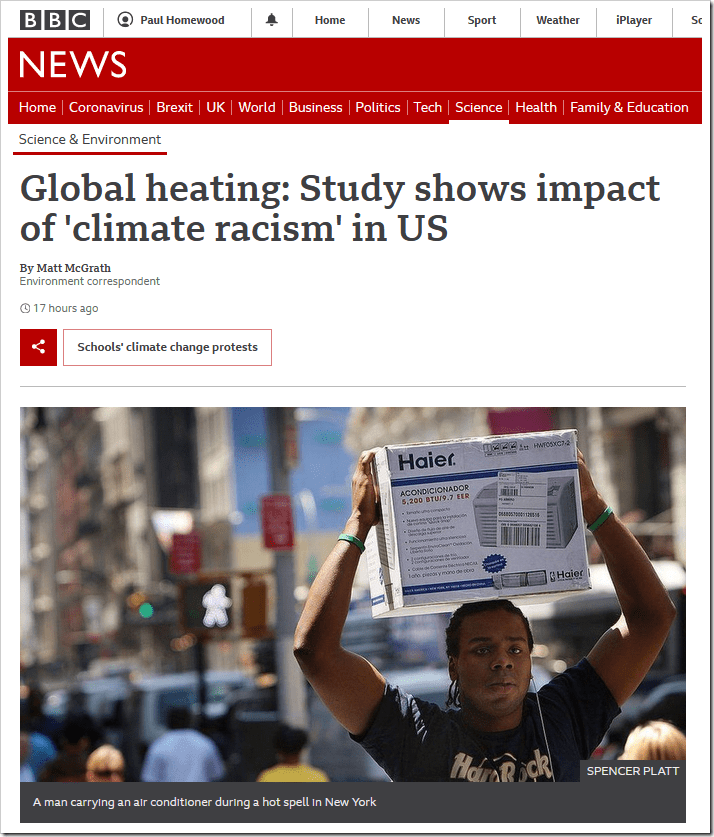
A new study says that black people living in most US cities are subject to double the level of heat stress as their white counterparts.
The researchers say the differences were not explained by poverty but by historic racism and segregation.
As a result, people of colour more generally, live in areas with fewer green spaces and more buildings and roads.
These exacerbate the impacts of rising temperatures and a changing climate.
Cities are well known magnifiers of a warmer climate.
The surface urban heat island effect is the technical term for the impact that the buildings, roads and infrastructure of cities have on temperatures.
All that concrete and asphalt attracts and stores more heat, ensuring that both days and nights in big urban areas are much warmer than the surrounding locations.
But, within cities, there are often large differences in this heat island impact, with areas rich in trees and green spaces noticeably cooler than those that are dense with housing and industry.
A previous study in the US found a correlation between warmer neighbourhoods in big cities with racist housing practices dating back to the 1930s.
Back then, areas with large African-American or immigrant populations were “redlined” in documents by federal officials, and deemed too hazardous for home loans and investment.
This led to a concentration of poverty and low home ownership rates in some parts of big cities.
This new study takes a broader look at these warmer neighbourhoods and the people who are affected by them.
Using satellite temperature data combined with demographic information from the US Census, the authors found that the average person of colour lives in an area with far higher summer daytime temperatures than non-Hispanic white people.
The actual paper, which is here, does not mention “racism” at all. So why does McGrath introduce it as a concept, never mind inventing the term “climate racism”?
Quite what the “racist” housing policies of the 1930s have to do with 21st century America is beyond me. There has been nothing to stop people moving out of those areas since, as millions have. (This is known as “black flight”, with first the black middle class, followed by the working class, moving out to the suburbs, as the whites did before them. What is left tends to be the “underclass”. See here for more details.)
It is well known that poor people, particularly in inner cities, all around the world suffer worse outcomes in all sorts of ways, for instance healthcare, education and job prospects. And, as McGrath now seems to have realised, the urban heat island effect is far more significant than the tiny amount of climate warming seen in the last century.
Maybe instead of wasting trillions on fighting climate change, we should spend a fraction of it on improving inner cities.
Add The Wall Street Journal To The People Who Can’t Do Basic Arithmetic
By Francis Menton | Manhattan Contrarian | May 17, 2021
Let’s face it, lots of people aren’t very good at math, even rather basic math. On the other hand, some people are quite good at it. If you aren’t very good at math, there are plenty of other things for you to do in life. My own field of law practice mostly does not require much skill at math, and there are plenty of math-challenged people who are nevertheless very good lawyers.
But some big societal decisions require a certain level of math competence. Some of these decisions can involve multi-hundreds of billions of dollars, or even multi-trillions of dollars. For example, consider the question of whether proposed electricity generation system X has the capability to deliver the amount of electricity a state or region needs, and at the times it is needed. Answering this question is just a matter of applied basic arithmetic. Given the dollars involved, you would think that when a question like this is being addressed, it would be time to call in some people who could do the arithmetic, or who at least would be willing to try.
Yet when the issue is replacing generation of electricity by fossil fuels with generation by “renewables,” it seems that the need to believe that the renewables will work and be cost effective is so powerful that all efforts to do the arithmetic get banished. I last considered this issue in a post last week titled “California’s Zero Carbon Plans: Can Anybody Here Do Basic Arithmetic?” The answer for the California government electricity planners was a resounding “NO.” Today, the Wall Street Journal joins the math-challenged club with a front page story headlined “Batteries Challenge Natural Gas As America’s No. 1 Power Source.” (probably behind pay wall)
The theme of the story is that “renewable” energy sources, such as solar, paired with batteries to balance periods of low production, are rapidly becoming so cheap that they are likely to “disrupt” natural gas plants that have only recently been constructed:
[T]he combination of batteries and renewable energy is threatening to upend billions of dollars in natural-gas investments, raising concerns about whether power plants built in the past 10 years—financed with the expectation that they would run for decades—will become “stranded assets,” facilities that retire before they pay for themselves. . . . But renewables have become increasingly cost-competitive without subsidies in recent years, spurring more companies to voluntarily cut carbon emissions by investing in wind and solar power at the expense of that generated from fossil fuels.
To bolster the theme, we are introduced to industry executives who are shifting their investment strategies away from natural gas to catch the new renewables-plus-batteries wave. For example:
Vistra Corp. owns 36 natural-gas power plants, one of America’s largest fleets. It doesn’t plan to buy or build any more. Instead, Vistra intends to invest more than $1 billion in solar farms and battery storage units in Texas and California as it tries to transform its business to survive in an electricity industry being reshaped by new technology. “I’m hellbent on not becoming the next Blockbuster Video, ” said Vistra Chief Executive Curt Morgan.
But how does one of these solar-plus-battery systems work? Or for that matter, how does a wind-plus-battery system work? Can anybody do the arithmetic here to demonstrate how much battery capacity (in both MW and MWH) it will take to balance out a given set of solar cells at some particular location so that no fossil fuel backup is needed? You will not find that in this article.
Here’s something that ought to be obvious: solar panels at any location in the northern hemisphere will produce less power in the winter than in the summer. The days are shorter, and the sun is lower in the sky and consequently weaker. Therefore, any system consisting solely of solar panels plus batteries, where the batteries are seeking to balance the system over the course of a year, will see the batteries drawn down continuously from September to March, and then recharged from March to September. Do batteries that can deal with such an annual cycle of seasons even exist? From the Journal piece:
And while batteries can provide stored power when other sources are down, most current batteries can deliver power only for several hours before needing to recharge. That makes them nearly useless during extended outages. . . . Most current storage batteries can discharge for four hours at most before needing to recharge.
OK, then, so if solar-plus-battery systems are about to displace natural gas plants, what’s the plan for winter? They won’t say. The fact is, the only possible plans are either fossil fuel backup or trillions upon trillions of dollars worth of batteries. But the author never mentions any of that. How much fossil fuel backup? That’s an arithmetic calculation that is not difficult to make. But the process of making the calculation forces you to actually propose the characteristics of your solar-plus-battery system, which then makes the costs obvious. How much excess capacity of solar panels and batteries do you plan to build to minimize the down periods? Do you need solar panel capacity of four times peak usage, or ten times? Do you need battery capacity of one week’s average usage (in GWH) or two weeks or a full month?
The simple fact is that wind/solar plus battery systems would not need any government subsidies if they were cost effective. The Biden Administration is proposing to hand out many, many tens of billions of dollars to subsidize building these systems. They are clearly not cost-effective, and not even close. But no one in a position to know will make the relatively simple calculations to let us know how much this is going to cost. Even the Wall Street Journal can’t seem to grasp the math involved. And President Biden? It’s embarrassing even to ask the question.
Rosneft announces launch of flagship gas project in the Arctic

RT | May 16, 2021
Russian energy giant Rosneft has revealed the launch of the Rospan International gas project in the Yamal region of the Arctic. It is expected to become the company’s gas production hub in the region.
“Regarding natural gas, we want to announce that in the first quarter of 2021 the company launched its flagship gas project called Rospan,” Eric Liron, Rosneft’s vice president for in-house services, told investors during a teleconference this week.
The project will provide annual gas production of more than 20 billion cubic meters, as well as production of 5 million tons of gas condensate and more than one million tons of propane and butane, he added.
“At the moment, both technological lines have already been put into operation. The railway terminal for the shipment of propane and butane has also been opened, all the necessary pipeline infrastructure is operating and the production potential has been fully technically confirmed,” Liron said.
Rospan International, a subsidiary of Rosneft, produces gas and gas condensate at the Vostochno-Urengoysky and Novo-Urengoysky license areas.
Featured Video

Trita Parsi: Middle East Unraveling — Are We on the Path to World War?
or go to
Aletho News Archives – Video-Images
New Book
Trans agenda is ‘normalization of sadism’ – US author

RT | September 23, 2026
The US Democratic Party has embraced a transgender agenda that amounts to “the normalization of sadism,” author A.J. Rice has said, warning that radical trans policies would return if the party is allowed to regain power.
Speaking to RT’s America First host Scotty Nell Hughes about his new book, ‘The Curse of the Bearded Lady: How the Trans Mafia Whacked American Sanity’, Rice argued that activists have gained significant influence in schools, medicine, and corporate America while people who questioned the agenda have faced pressure to stay silent.
The author described the “trans mafia” as the sprawling network of people and institutions that have helped the movement gain influence. He singled out parts of academia, wealthy backers, and corporations, and stated that providers of transition-related treatment also have a financial incentive to keep young people in their care indefinitely.
Rice argued that the consequences of these policies ultimately fall on children who are being drawn toward gender-affirming medical treatments and on girls who are expected to share locker rooms or compete in sports with biological males.
He noted that while voters rejected the Democrats’ approach to gender in 2024, the party, which has been “captured by madness,” has since only doubled down and is seeking what is effectively “the normalization of sadism.” … Full report
Blog Roll
 Aletho News
- ‘We don’t seek permission to defend our country’: Snippets from President Pezeshkian’s UNGA address
- NATO chief wants Europeans to fight American wars [for Israel]
- German chemicals giant reveals details of downsizing
- Refaat Al-Areer Was The Canary In The Coal Mine In Israel’s War On The Truth
- Israeli election committee bars candidate from Knesset race over Gaza war opposition
- French-Lebanese man files war crimes complaint over Israeli attacks
- Mahan Air Flight Lands in China Despite US Threat against Iranian Airlines
- US eyes $10bn fund to rebuild war-battered Gulf infrastructure
- Trump meets Rodríguez near Maduro’s prison as Venezuela’s oil flows to US
- Trita Parsi: Middle East Unraveling — Are We on the Path to World War?
- If Americans Knew
- Caught on Tape: AIPAC CEO Boasted of Controlling Trump’s National Security Officials
- Why Hamas Attacked Israel in October 2023 – Israeli professor Ilan Pappé
- They see them, then kill them: Israeli quadcopters track, deliberately target civilians in Gaza
- Winter could turn Gaza’s treacherous, war-damaged buildings into deathtraps
- Majority of Democratic Voters Want to Prosecute Both Biden and Trump Administration Officials Over Gaza
- As Gaza languishes, world leaders gather at the UN – Daily Update
- Sanctions are collective punishment: immoral and self-defeating
- Phosphorus Munitions Fired by Israel Burn Groves, Orchards in Southern Lebanon
- Israel Carries Out New Ceasefire Violations Across Gaza
- AI – Emphasis on the ‘I’: Israel Is Funding AI Chatbot Propaganda
- No Tricks Zone
- New Study: Earth And Venus Surface Warmth Largely Explained By Convection And Lapse Rate, Not CO2 Or Radiation
- 2025 Nature Paper Claiming Worsening Global Drought Gets RETRACTED …Heavily Flawed
- New Study: ‘Global Drought Shows No Detectable Recent Acceleration Under Climate Warming’
- Economic Masterminds: German Socialists Suggest Taxing Productivity Gains Stemming From Using AI
- The South China Sea Has Not Been Cooperating With The Climate Change Narrative
- Energy Crisis: Germany Enters Heating Season With Historically Low Gas Reserve Fill Levels
- New Study: The Antarctic Ice Sheet Gained Mass From 2020-2024 Due To Staggering Snow And Ice Accumulation
- Study: Ocean Heating Rates From Thousands Of Years Ago ‘Dwarf’ Modern Ocean Heating Rates
- Climate Extremists Target, Attack Large-Scale Power Grid Infrastructure In Germany!
- New Study: Antarctic Ice Melt Has Contributed Less Than 1 Centimeter To Sea Level Rise In The Last 30 Years

