Undercover Forces Kidnap Six Children in Raid on Village
By Saed Bannoura – IMEMC & Agencies – May 03, 2010
The Palestine Solidarity Project reported that undercover forces of the Israeli army kidnapped six children in Beit Ummar town, near the southern West Bank city of Hebron, and handed them to the army on Sunday evening.
The undercover forces, dressed as Palestinians, drove into the town in a White Ford Transit carrying a Palestinian license plate, and kidnapped six children, aged between 13 and 16. The forces then hurled several stun grenades and fired tear gas bombs into the narrow streets of the town and drove away.
One undercover soldier was hit in the head by a stone hurled by one of the protesters during clashes with the invading forces. Mohammad Awad, spokesperson for the Palestine Solidarity Project, stated that clashes took place near the Karmie Tzur illegal settlement, installed on Palestinian lands. Awad stated that it is believed that the kidnapped six youth were taken to the Karmie Tzur settlement.
Four of the six kidnapped children were identified as Hussein Shihda Sleiby, 16, Rashid Mohammad Awad, 15, Ali Said Sabarna, 16, and Odai Saady Ikhlayyil, 13.
On Sunday evening, a number of fundamentalist settlers of the Karmie Tzur settlement held a demonstration at Highway 60 and attacked several Palestinian villagers of Beit Ummar. The police arrived at the scene and used loud speakers to order the villagers back to their homes and fired tear gas and stun grenades at them instead of removing the settlers.
The army used excessive force against the villagers who were protesting the illegal settler-takeover of their land and the destruction of dozens of trees.
The Palestine Solidarity Project reported that Israeli soldiers were filmed in recent weeks while attacking and beating journalists. Also, a 10-year-old child was shot with a rubber coated bullet by soldiers from Karmie Tzur.
Video: Settler shoots at Palestinian demonstrators with soldiers present
Video: Qassem Saleh, resident of Asira al-Qibliya, volunteer with BTselems camera distribution project
On Friday, 26.2.2010, residents of the village of Asira al-Qibliya in Nablus District held a joint demonstration with Israeli activists from Combatants for Peace and Rabbis for Human Rights, protesting takeover of their lands by settlers. During the demonstration, youths from the village went over to a guard tent that settlers had erected near the outpost and took it down. Following their action, soldiers and armed settlers arrived at the scene. The soldiers fired tear gas and rubber-coated metal bullets at the demonstrators, and a settler standing near them opened fire from an M-16 rifle at the demonstrators, who posed no danger as they were running away from the spot.
Irish activist arrested and injured at anti-CRH protest in West Bank village
Ireland Palestine Solidarity Campaign | April 30, 2010
Irish activist and documentarian Tommy Donnelan, 63, was this afternoon wounded and detained for two hours by the Israeli Military in the West Bank.
 CRH placards lead the demo
While filming a non-violent protest against the role of Irish cement multinational CRH in building Israel’s apartheid wall in the village of Bil’in, Mr. Donnellan was rushed by an Israeli snatch-squad of 4 or 5 soldiers. His throat and shirt were grabbed, his gas mask was torn off, and after being wrestled to the ground he was arrested. During the arrest he sustained a 3 inch gash to his right leg and was bleeding hevaily from his left ear, from which a piece was torn off. About two hours later he was released without charge.
Speaking after his release, Mr. Donnellan stated: “Thank the Lord I’m ok now. I’ve lost a chunk of my ear – but not my dignity. I was plainly in the role of journalist, videoing the proceedings, I should not have been arrested, especially in such a violent manner.”
Mr. Donnellan continued: “This is yet another example of the impunity and inhumanity with which the Israli occupation forces operate on a daily basis. It is also shines an unflattering light of the shameful activities of the Irish cement company CRH, who are directly involved in the building of this monstrous wall and thus complicit in what happened to me today, and in the regular human rights abuses – including murder of anti-Wall activists – by the Israeli military in Bil’in and elsewhere.”
Every Friday afternoon residents of the West Bank village of bil’in, along with Israeli and International activists stage a non-violent protest against the construction of the Wall on their land.
Today’s demonsration focused on the role CRH plays in the building of the Wall – CRH owns 25% of Israel’s sole cement company, (Mashav) Nesher Cement. Palestinians led the demonstration – carring placards calling on CRH to divest from its Israeli cement subsidiary – to the spot where 31-year-old Bil’in resident Bassem Abu Rahmah was killed by the Israeli military last year.
At this spot, Mr. Iyad Burnat, coordinator of the Bil’in Popular Committee, addressed CRH dirctely saying “You are complicit in the murder and killing of my friend Bassem, and all the other non-violent activists that have been killed and injured for resisting this horrendous wall. CRH is directly implictict. I, as a Palestinian, am asking the Irish people to join the Ireland Palestine Solidarity Campaign, and get involved in the divestment campaign against CRH. This complicity must end.”
This year the CRH Annual General Meeting starts at 11am Wednesday May 5th, in the Royal Marine Hotel, Marine Road in Dun Laoghaire. The Ireland Palestine Solidarity Campaign (IPSC) is organising a protest outside. We will be assembling at at 10.15am at the Catholic church plaza.
Ethiopian Jews experience Israeli racism at a very early age
Response to Falasha demonstration against discrimination in blood donation
Palestine Information Center – 30/04/2010
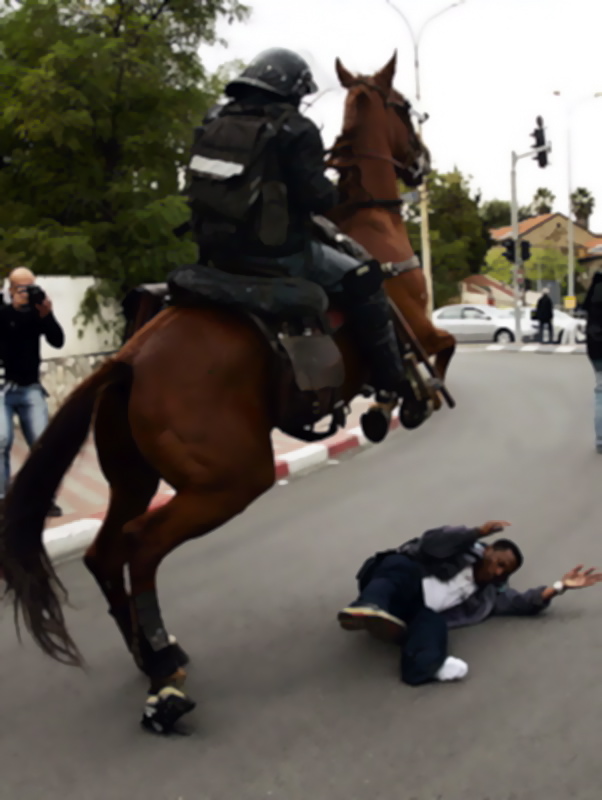
NAZARETH — An Israeli kindergarten in Beir al-Saba’ (Beersheba) in southern occupied Palestine was reported in the Israeli media to segregate Jewish children of Ethiopian descent from the rest of Jewish children.
Israeli channel 2 television reported that the kindergarten uses two separate rooms for the two groups of children and that the room used for the children of Ethiopian descent is much smaller than the room used for the other group.
Ethiopian Jews suffer discrimination in Israeli society basically because of the colour of their skin. Sometime ago they discovered that the blood they donate is disposed of and not used fearing that it is infected with aids.
Palestinians aside, Ethiopian Jews, or Falashas fare worst on the Israeli scale of discrimination, other Jewish groups such Mizrahis and Sephardis do suffer from discrimination too.
Yitzhar Settlers Vandalize Palestinian Homes, Torch Fields
Al-Manar TV | April 29, 2010
Israeli settlers from the illegally constructed area known as Yitzhar south of Nablus rioted Thursday morning, destroying Palestinian property in the town of Huwwara, following the Israeli occupation military arrest of seven settlers.
Palestinians said settlers set fire to agricultural lands and vandalizing homes and kindergartens as dozens of right-wing setters gathered in the Huwwara Park.
According to the Palestinians, the settlers threw stones, shattered windows and destroyed the roofs of local Palestinian homes. The Palestinians said Israeli occupation soldiers did not prevent the settlers from venting their rage.
According to an Israeli police spokesman, settlers were arrested for earlier vandalism and destruction targeting Palestinians, known by setters as a “price tag” policy, aimed at causing harm to Palestinians and making trouble for soldiers who one settler leaders told reporters were “out to get” the settlers.
“At least 60 or 70 settlers came down to the village and destroyed Muhammad el-Sabata’s home; then they entered a public garden and began torching olive trees and destroy trees. They burned at least 60 trees,” a Huwwara resident told Ynet.
Last week Nablus-area residents woke up to smashed and burning cars with the words “price tag” spray painted on torched vehicles.
Volvo equipment: Israel’s weapons to destroy al-Walaja homes
Adri Nieuwhof, The Electronic Intifada, 29 April 2010
On 16 April, approximately 100 Palestinian villagers and internationals walked towards the construction site of Israel’s wall in the occupied West Bank village of al-Walaja, four kilometers northwest of Bethlehem. When the protesters were leaving the village, four Israeli army jeeps and one police vehicle entered and surrounded a Palestinian home. At least 40 persons, including women and children, were trapped for two hours.
Meanwhile, Israeli forces raided several other homes, detaining three young men for allegedly throwing stones at Israeli forces. During the raids al-Walaja was closed off, and soldiers prevented the media from entering the area.
Six days later, Israeli bulldozers were working full speed deeper inside the village’s lands, leaving destruction in their wake. Ma’an news agency reported that border guards and soldiers had imposed a curfew early in the morning. A cameraman was denied entry to the village by the army, according to representatives of the village’s Popular Committee.
The following day approximately 200 villagers, together with a few internationals, came together for yet another demonstration. They walked from the mosque, which has an Israeli-imposed demolition order against it, to the lands which were bulldozed the previous day. Standing on the bulldozed lands, representatives of the village held speeches calling for more demonstrations. Youths used boulders to block the road used by the Israeli bulldozer operators.
A day later, approximately 50 Palestinians and internationals managed to stop the work of the bulldozers for several hours. The Israeli soldiers had to violently drag the villagers away one by one.
 |
| An uprooted olive tree in al-Walaja with the Har Gilo settlement seen in the background. |
History of injustices
The residents of al-Walaja have protested the confiscation and demolition of their property for many years. The Israeli settlements of Har Gilo and Gilo, established in the 1970s, are built on land confiscated from the village. While Israeli forces try to silence the protesters with harsh measures, Volvo and Caterpillar equipment is used by the Israeli forces in the illegal construction of the wall on the village’s land.
The old village of al-Walaja was occupied and destroyed by Zionist forces in October 1948 and its 1,200 Palestinian residents expelled. The 1948 Armistice line passed through the southern lands of the village and while most of the villagers fled to Jordan and Bethlehem, some villagers stayed on the lands of the village that were unoccupied at the time and eventually rebuilt a new town.
The remains of the old village of al-Walaja are two kilometers outside the new town, on the western side of the armistice line between Israel and the West Bank. According to Palestinian historian Walid Khalidi, a few stone houses still stand on the old village site. Today the old village of al-Walaja is used by Israeli settlers for picnicking and bathing.
Following the June 1967 war, Israel annexed the rest of al-Walaja’s lands, bringing them under the authority of the Israeli-controlled Jerusalem municipality. The villagers did not receive the right to live in Jerusalem, however, and they live under constant threat of expulsion. And while the villagers of al-Walaja are not allowed to build on their own lands, the settlement of Har Gilo is expanding.
After the Oslo accords of 1993, al-Walaja was designated “Area C,” giving Israel full military and administrative control. As a consequence, villagers who want to build a house on their own land have to ask permission from Israel. Israel denied 94 percent of the building permit requests of Palestinians in Area C of the West Bank from 2000 to 2007, according to Peace Now.
Villagers are facing increased pressure from the Israeli occupation forces to leave their land. The wall which is currently under construction will surround the village from all sides, isolating the villagers completely from their land, East Jerusalem and the old village.
 |
| Israel uses Volvo equipment to destroy homes and farmland in al-Walaja. |
Volvo equipment destroying homes
At the end of the 1980s Israel started to demolish Palestinian homes in al-Walaja and residents had to pay fines for their “illegally”-built homes. Since the outbreak of the second Palestinian intifada, Israeli forces demolished more than 24 houses in the village, according to the Applied Research Institute of Jerusalem.
On 18 March two house owners in al-Walaja found military orders in Hebrew on the front doors of their homes. The orders concern the demolition of the two houses because they are located too close to the path along which the wall will be built. The following day, volunteers from the Stop the Wall Campaign, the YMCA and other international volunteers gathered with the owners of the houses under demolition in order to show their solidarity.
ActiveStills photographer Anne Paq witnessed Volvo equipment being used to destroy a home in the nearby village of al-Khader. Two days earlier she had taken pictures of Volvo and Caterpillar equipment working between the road and the fence of Har Gilo settlement, just a few meters away from Palestinian houses in al-Walaja. There was an Israeli police car parked next to the works. When Paq asked what they were building, they refused to answer.
Two years ago The Electronic Intifada first reported the use of Volvo equipment in Israel’s violations of international law in the occupied West Bank. So far the company has taken no action to investigate the use of its equipment in Israeli violations of Palestinian rights.
Volvo Group’s vice president of media relations and corporate news, Marten Wikforss, wrote in response to The Electronic Intifada’s report: “we do not have any control over the use of our products, other than to affirm in our business activities a Code of Conduct that decries unethical behavior.”
While the villagers of al-Walaja steadfastly continue their protest against the construction of the wall, the confiscation of their land and the destruction of their property, Israeli forces are increasing the oppression. Some houses have been rebuilt three or four times. Director of the Joint Advocacy Initiative of the East Jerusalem YMCA and YWCA, Nidal Abu Zuluf, explained: “Israel’s current repressive policies aim to prevent acts of popular resistance. They don’t want the media and internationals to be around.”
Perhaps neither does Volvo, as its equipment continues to be photographed destroying Palestinian homes and violating Palestinian rights.
Walled Horizons
OCHAoPt — November 11, 2009 — Walled Horizons is narrated by and features Roger Waters (founding member of the rock band Pink Floyd), who visits the Wall in the Palestinian territories and comments on his observations as a musician and a songwriter who has written on walls. The film explores how Palestinians in urban and rural areas have been impacted by the Walls construction since the International Court of Justices Advisory Opinion in 2004, which declared the Wall’s route in the West Bank illegal. Several senior Israeli security officials are interviewed in the film, two of whom were directly responsible for planning the Wall route and who explain the Israeli position for constructing it. The film was made by the United Nations Jerusalem. http://www.ochaopt.org
Defending their land
ActiveStills — April 26, 2010
Report from the Popular Struggle Coordination Committee:
Palestinian, Israeli and international demonstrators managed to stop the construction of the Wall in the village of al Walaja, south of Jerusalem for the second time this week. If completed, the path of the Wall in the area will surround the village completely, isolating it from all its lands, the cities of Bethlehem and Jerusalem and essentially the rest of the world.
Demonstrators managed to block the bulldozers in the early morning, and even climb and take over one of the machines. A Border Police force at the scene arrested on of the demonstrators – 15 year old Nabil Hajajla – who was beaten and pepper-sprayed. Following Hajajla’s arrest, Border Police officers managed to drag the demonstrators away from the bulldosers and construction was resumed.
Al-Walaja is an agrarian village of about 2,000 people, located south of Jerusalem and West of Bethlehem. Following the 1967 Occupation of the West Bank and the redrawing of the Jerusalem municipal boundaries, roughly half the village was annexed by Israel and included in the Jerusalem municipal area. The village’s residents, however did not receive Israeli residency or citizenship, and are considered illegal in their own homes.
Once completed, the path of the Wall is designed to encircle the village’s built-up area entirely, separating the residents from both Bethlehem, Jerusalem, and almost all their lands – roughly 5,000 dunams. Previously, Israeli authorities have already confiscated approximately half of the village’s lands for the building of the Har Gilo and Gilo settlements, and closed off areas to the south and west of it. The town’s inhabitants have also experienced the cutting down of fruit orchards and house demolition due to the absence of building permits in Area C.
According to a military confiscation order handed to the villagers, the path of the Wall will stretch over 4890 meters between Beit Jala and alWallaja, affecting 35 families, whose homes may be slated for demolition.
Beit Jala is a predominantly Christian town located 10 km south of Jerusalem, on the western side of the Hebron road, opposite Bethlehem. Once completed, he Wall will Isolate 3,200 Dunams of the town’s lands, including almost 3,000 Dunams of olive groves and the only recreational forest in the area, the Cremisan monastery and the Cremisan Cellars winery.
Settler Sewage Ruins Palestinian Crops, Drinking Water
By Mel Frykberg | IPS | April 28, 2010

BEIT UMMAR, West Bank – Residents of this Palestinian village refuse to buy the idea that the flood of raw sewage from the adjacent Israeli settlement of Kfar Etzion, that destroyed vineyards and contaminated their drinking water, was an accident.
The Israeli Civil Administration, which administers the occupied West Bank, claims the spillage was the result of an accidental power malfunction which caused excess settlement sewage to overflow onto Palestinian land.
“This was no mistake,” says a British activist who has been documenting life in the village for several months. “The pipe was deliberately unscrewed by hand so that the sewage would spill over into Beit Ummar. That has nothing to do with an electricity cut,” he told IPS.
Villagers standing near a completely destroyed 70,000 sq m vineyard belonging to the Sabarneh family said they believe it was a deliberate act of sabotage and part of a concerted campaign by the settlers to harass their Palestinian neighbours and vandalise their property.
Beit Ummar has been the target of a number of Israeli military raids at night last month. Activists who have been organising non-violent protests against the expropriation of their land for the settlements have been arrested and the village blockaded.
In a similar incident last week the Palestinian village of Bruqin, in the northern West Bank, was flooded with sewage from the nearby Ariel settlement, causing contamination of underground water and springs and damaging crops.
These incidents are part of a larger problem of scarce water resources where a Palestinian population of 2.5 million survives on 17 percent of the West Bank’s main underground aquifer.
The remaining water is channelled towards the West Bank’s (including East Jerusalem) 500,000 Israeli settlers, and into Israel proper.
The water shortage is compounded by the lack of wastewater treatment plants and inefficient treatment of waste and sewage in the Palestinian territory which fouls its water sources.
Israeli rights group B’tselem released a study last year called ‘Foul Play: Neglect of wastewater treatment in the West Bank’.
According to the organisation, more than 90 percent of Palestinian wastewater is not treated while only 20 percent of Palestinian homes, primarily in towns and cities, are connected to sewerage systems.
Furthermore, only 81 of 121 illegal Israeli settlements are connected to wastewater treatment facilities. Over half of the settlements’ treatment plants are too small to treat waste effectively and are ill-equipped to handle the burgeoning settler population.
The result is continual technical breakdowns and sewage overflow. Most of the settlements are situated on ridges and hilltops so sewage flows down towards the Palestinian villages and towns in the valleys below, contaminating their drinking water supplies and destroying their crops.
The Israeli settlers are not affected by this as they are connected to Israel’s water supply.
The planning and building authorities in the settlements and Israeli industrial areas also ignore Jordanian building and planning laws which govern how wastewater is to be treated in the West Bank.
The B’tselem report further outlines the neglect of the territory’s water treatment plants by the Israeli Civil Administration during the decades of occupation and the current difficulties faced by Palestinian Authority (PA) water officials in trying to build new wastewater treatment plants or repair the old ones.
There is currently only one wastewater treatment plant operating in the West Bank in Ramallah. Three others have ceased to function and the PA has been unable to repair them or build new ones.
The West Bank is divided into Area A, which is under Palestinian control, Area B under joint Palestinian and Israeli control, and Area C which is under full Israeli control.
Area C comprises 60 percent of the West Bank. Areas A and B are mostly built up with little free land available.
However, in order to move around or build new wastewater treatment plants in Area C Palestinian officials from the PA Environment Authority require building permits from the Israeli Civil Administration.
B’tselem and PA officials complain of the delays these officials face in getting building approval if they get them at all.
“There is an enormous amount of red tape and bureaucracy that Palestinian officials have to overcome before they get the permits,” says Eyal Hareuveni, the author of the B’tselem report.
“The Israeli Civil Administration says that the Palestinians don’t provide the necessary detailed building plans as they have been instructed but I think the administration is being deliberately difficult,” Hareuveni told IPS.
Issa Moussa from the PA’s Environmental Authority denied that the PA provided insufficient details.
“We have the case of wanting to build a new wastewater treatment plant in Tulkarem in the northern West Bank. We provided absolutely everything requested but we were still waiting for a permit,” Moussa told IPS.xxxxx
Other difficulties facing the more efficient handling of wastewater are the restrictions placed on Palestinian movement in the West Bank by the Israeli military. This has led to increased costs for donors who support wastewater projects and who in turn have cut down on their expenditure.
A Joint Water Committee between Israel and the PA was established following the Oslo Peace Accord of 1993, to address water issues.
One of the disputes between the sides is the Israeli insistence that settlement sewage be connected to future Palestinian wastewater treatment plants.
The Palestinians reject this as this implies that the settlements are permanent and say their refusal to approve this condition is one of the reasons for approval being withheld on the construction of wastewater plants.
With no higher authority to settle the disagreement the situation will only worsen in the future.
“Neither side seems to be making the urgent issue of water and waste treatment a priority,” Hareuveni told IPS.
Israeli soldiers given minor reprimands over shooting of Palestinian civilians
By Catrina Stewart | The Independent | 28 April 2010
Israeli officers held responsible for the deaths of four Palestinians in the West Bank received only minor reprimands after an internal investigation concluded that the deaths could have been avoided.
Chief of Staff Gabi Ashkenazi, Israel’s military chief, admitted that the incidents last month “could have ended differently” and could have “avoided causing harm to civilians”.
The two fatal shooting incidents, just 24 hours apart, marked the most serious escalation of tensions in the occupied West Bank in months, and threatened to destroy the fragile calm that has persisted there in recent years.
In one case, Israeli soldiers fired on Palestinian protesters, killing two. In a second incident, a soldier killed two Palestinians who he claimed had tried to attack him. Mr Ashkenazi reprimanded two senior officers – a colonel and a lieutenant colonel – and removed a squad commander from his post, a military statement said. The soldiers who fired the lethal rounds appeared to escape censure.
Israeli human rights organisations denounced the military investigation, claiming that it failed to hold the soldiers accountable for their actions and upheld the army’s culture of impunity.
“It is extremely rare for the Israeli security forces to be held accountable in cases where they have killed or injured Palestinian civilians,” said Sarit Michaeli, a spokeswoman for B’Tselem, an Israeli NGO.
She said that the army should open criminal investigations into both cases rather than conduct “internal operational debriefs” that skirt the legal issues regarding the soldiers’ actions. “There are credible allegations, these must be investigated,” she said.
On 20 March, Israeli forces faced Palestinian protesters in the village of Iraq Burin as they tried to prevent clashes with extremist Jewish settlers from nearby Bracha. In the ensuing skirmish, Israeli soldiers killed two Palestinian teenagers, Mohammed Qadus and Osaid Qadus.
The military statement said Israeli forces had been authorised to use rubber bullets against the Palestinians, but, as reported by The Independent, medics who examined the body insisted that live ammunition had been used, and produced X-rays that appeared to show a conventional bullet lodged in the skull of Osaid Qadus.
The Israeli army said a Military Police investigation into the claims that live rounds were used was still ongoing. The army “could not verify the autopsy and could therefore not confirm that the rioters were in fact hit by live rounds,” the statement said.
In Awarta a day later, an Israeli soldier fired on two Palestinians who approached a checkpoint and started “acting suspiciously,” according to the statement. The first apparently tried to attack the soldier with a bottle, prompting the soldier to shoot him. The second then allegedly wielded a “sharp object” and was also shot dead.
The soldier fired seven bullets into Mohammed Qawariq and at least three into Saleh Qawariq, according to Palestinian doctors. “While the soldier, believing his life was at risk, acted subjectively, the Chief of the General Staff holds the officers responsible for training their soldiers to act in difficult operational situations,” the military said.
Relatives of the deceased denied that they tried to attack the soldier and said they were only metal workers looking for scrap.
Portland protest challenges AIPAC fundraiser
By Saed Bannoura – IMEMC News – April 26, 2010

Portland AIPAC Protest – IMEMC
A group of protesters in Portland, Oregon, USA, erected mock settlements, a ‘Wall of Shame’, and a checkpoint as part of a protest against the American Israel Public Affairs Committee (AIPAC)’s annual Oregon fundraiser on Sunday.
AIPAC is the largest and most powerful Zionist lobby in the US, with branches in all 50 US states and financial contributions to every US congressmember and senator. Recently, however, their meetings and fundraisers have been met by increasing protests, like the one held Sunday in Portland.
One protester represented the recent murder of a non-violent demonstrator in Iraq Bur’in village by staging a ‘die-in’ at the entrance of the event. He was not arrested, but was moved out of the way to allow the financial contributors to AIPAC to enter.
The mock settlements were constructed out of cardboard, and accompanied by a demonstrator dressed as Israeli Prime Minister Binyamin Netanyahu, wearing a helmet labeled ‘Caterpillar’ after the US-based construction company whose military bulldozers are used to destroy Palestinian homes.
In addition, some demonstrators dressed as Israeli soldiers demanded ID from those entering the event. Although the attendees did not oblige the protesters by showing ID, they were again stopped, just a few meters away, by an actual checkpoint set up by the event organizers to ensure that only paid ticket-holders were able to enter the controversial event.
The protesters also held up a representation of the Israeli Annexation Wall, painted with the words, “Wall of Shame”. These are words that a group of Jewish activists painted on the actual Wall in Qalqilia soon after the Wall was constructed there in 2002. The Wall is constructed on Palestinian land in the West Bank, and has made it impossible for any semblance of a normal life to continue in the West Bank.
The attendees of the AIPAC dinner included a number of local politicians including US Senator Ron Wyden and Oregon Governor Ted Kulongoski, as well as Oregon rabbis and leaders of Jewish organizations who pledged during the dinner to stand by Israel. The human rights violations and abuses brought out by the protesters were not addressed by the speakers at the fundraising dinner.
Featured Video

They Double Down on BLOOD PRESSURE Guidelines!
or go to
Aletho News Archives – Video-Images
From the Archives
The Ten Commandments of War Propaganda
By Michael Feldman · The Dissident · November 22, 2022
While researching World War I censorship for a larger project a few years ago, I stumbled upon a fascinating analysis of war propaganda.
In 1928, Baron Arthur Ponsonby published Falsehood in Wartime: Propaganda Lies of the First World War. Although Ponsonby’s book was eye-opening and remains relevant to media propaganda today, another work inspired by Ponsonby really caught my attention.
In 2001, Belgian historian Anne Morelli published Principes élémentaires de propagande de guerre (Basic Principles of War Propaganda). Based on Ponsonby’s writings, Morelli identified ten principles, often known as the Ten Commandments of War Propaganda:
1. We don’t want war. We are only defending ourselves!
2. Our adversary is solely responsible for this war!
3. Our adversary’s leader is inherently evil and resembles the devil
4. We are defending a noble cause, not our particular interests!
5. The enemy is purposefully committing atrocities; if we are making mistakes, this happens without intention
6. The enemy makes use of illegal weapons
7. We suffer few losses; the enemy’s losses are considerable
8. Recognized intellectuals and artists support our cause
9. Our cause is sacred
10. Whoever casts doubt on our propaganda helps the enemy and is a traitor
What’s most fascinating is that Morelli’s principles are based on a 73-year-old book, yet the commandments ring true today. You can pick just about any war, especially those in the twenty-first century, and see the commandments in action. … Full article
Blog Roll
 Aletho News
- The Death of Academic Freedom in Norway
- Another EU member revolts against €100 bn funding for Ukraine
- More Cigars Near the Powder Keg
- Russia Unearths Major New Reserves of Gold, Nickel, Copper, and Natural Gas
- I’M SO BLOODY FURIOUS: They Double Down on BLOOD PRESSURE Guidelines!
- The Israeli Nuclear Doctrine and the Turning Point of the Kennedy Assassination
- Striking Matches Near the Powder Keg
- Prominent Russia hawk: European leaders privately talk about war with Russia, first need ‘mass casualty event’
- China warned Trump not to touch Iran’s oil tankers: Larry Johnson
- EU Central Banker Plans To Plant Barren AI Crops Across The Continent
- If Americans Knew
- An error has occurred; the feed is probably down. Try again later.
- No Tricks Zone
- New Study: Modern Temps Are Among The Coldest Of The Last 10,000 Years In East Central Europe
- Germany’s Renewable Energies Lead to 1.4 Billion Euro Electric Power Trade Deficit
- Argentina’s Perito Moreno Glacier Joins Antarctica and Arctic In Defying Doomsday Melt Claims
- New Study: Barents Sea Temperatures Were Warmer And Sea Ice Less Extensive In The 1700s Than Today
- German Authorities Start Initiative To Evaluate Public Register For Climate “Disinformation” Spreaders!
- Zonal Asymmetry of Temperature Change in the Antarctic Circumpolar Current
- New Study: The Net Fossil Fuel Contribution To Rising Atmospheric CO2 Has Been Zero For 500 Years
- Germany’s Green Energy Transition Becoming Increasingly Expensive…Another 6 Trillion Euros!
- Sudden Stratospheric Warming, Powerful El Niño Combination May Lead To Extreme Europe Cold, Energy Crisis!
- Two New Studies Find Thwaites Glacier Melt Cannot Be Driven By Human Activity Or A Warming Ocean

