Palestinian Prisoners Club says Israel uses detention of solidarity activists to intimidate global supporters

MEMO | May 21, 2026
The Palestinian Prisoners Club said on Wednesday that Israel has turned the detention and abduction of international solidarity activists into a systematic policy aimed at intimidating supporters of the Palestinian cause worldwide.
In a statement, the organisation said Israeli authorities seek to send a message that anyone showing solidarity with the Palestinian people could face detention, abuse, arrest and torture.
The statement followed the circulation of videos released by Israeli National Security Minister Itamar Ben-Gvir showing the mistreatment of activists from the Freedom Flotilla Coalition and the “Global Solidarity Flotilla,” who were detained by Israeli forces while attempting to reach the Gaza Strip.
According to the Prisoners Club, Israeli authorities intercepted the activists in international waters and forcibly transferred them to the Port of Ashdod.
The organisation described the scenes shown in the videos as involving humiliation, mistreatment and abuse, arguing that they reflect treatment routinely experienced by Palestinian and Arab detainees in Israeli prisons.
The group further stated that the involvement of Ben-Gvir in the filmed incidents highlighted what it characterised as the broader policy of intimidation directed against international solidarity movements supporting Palestinians.
US Provided Most of Israel’s Missile Defense During Iran War
By Kyle Anzalone | The Libertarian Institute | May 21, 2026
The US fired hundreds of its most advanced interceptors to protect Israel from Iranian missiles during the first five weeks of the war.
According to a Department of War assessment described to The Washington Post, the US used 200 Terminal High Altitude Area Defense (THAAD) interceptors and over 100 SM-3 and SM-6 missiles in defense of Israel. Israel only used 100 Arrow interceptors and 90 David’s Sling missiles.
Speaking about the imbalance, an administration official told The Post, “In total, the U.S. shot around 120 more interceptors and engaged twice as many Iranian missiles.” The official added that “The imbalance will likely be exacerbated if fighting restarts.”
The imbalance occurs because Washington and Tel Aviv developed a strategy for the defense of Israel, where the US advanced interceptors handled the bulk of the Iranian missiles. The official said that the policy resulted in a significant “drawdown” of the US interceptor stockpile.
During the conflict, the US used about half of its stockpile of advanced interceptors, including Patriots, SM-3, SM-6, and THAAD interceptors. The US intelligence community says Iran has over 70% of its pre-war launchers and missiles. Additionally, Tehran has resumed drone production, and it’s rebuilding its military production at a surprising rate.
A US official also told The Post that Israel’s offensive capabilities were slowing down. They explained that by the end of March, Israel was conducting 50% fewer strikes against Iran because its air force was exhausted by operations against Lebanon and Yemen.
In recent days, President Donald Trump has threatened to restart the war against Iran if Tehran does not comply with his demands. However, the President had made similar threats throughout the six-week-long ceasefire and has always backed down.
The Post reports that the US has positioned additional naval assets near Israel to assist with missile defense if the war restarts.
‘Unprecedented act of savagery’: How Israel’s new law places Palestinians on death row by default
By Zeynep Conkar | TRT World | May 19, 2026
Israel has become the first Western-aligned “democracy” to legislate a mandatory death penalty targeting a single ethnic group under military occupation, and this week, it put that law into force.
The order was signed on Sunday by Major General Avi Bluth, commander of the Israeli army’s Central Command, at the request of Defence Minister Israel Katz, the same minister who once ordered the immediate cut-off of water supply to Gaza and has publicly threatened Gaza’s civilians with “total devastation” in what South African prosecutors and international legal experts cited as evidence of genocidal intent before the International Court of Justice.
Under the new law, military courts prosecuting Palestinians whose attacks resulted in the death of an Israeli must apply the death penalty as the sole available sentence, unless the court finds special circumstances allowing for life imprisonment instead.
Once a final ruling is handed down, the sentence must be carried out within 90 days.
Within Israeli courts, military orders always take precedence over Israeli and international law, according to Nasir Qadri, an international law practitioner and a critical legal scholar at Koc University.
“The system was never designed to adjudicate guilt; it was designed to administer a colonised population through the form of law, and a 96 percent conviction rate is its proof,” Qadri tells TRT World.
“The 90-day execution deadline and the prohibition on pardon or commutation remove formal residues from a structure already characterised by arbitrary arrest, incommunicado detention, secret evidence that defendants cannot challenge, and confessions extracted under torture,” he adds.
National Security Minister Itamar Ben Gvir, whose far-right Jewish Power party had long campaigned for the measure, hailed the signing as a political victory, declaring “we promised and we fulfilled.”
The law was passed by the Knesset on 30 March 2026, by a vote of 62 to 47, with Prime Minister Benjamin Netanyahu present in the chamber to support the bill.
Before the vote, it had already drawn wide condemnation, not only from Palestinian organisations and international human rights bodies, but from within Israel’s own legal establishment.
This is a discriminatory behaviour under international law, Qadri argues.
“This law converts the colonial administration of Palestinian life into the colonial administration of Palestinian death, and does so through the same legal instruments, military orders, security classifications, and jurisdictional exclusions,” says Qadri.
“The prohibition on arbitrary deprivation of life under Article 6 of the ICCPR, as interpreted by the Human Rights Committee in General Comment 36, requires in capital cases the strictest observance of fair trial guarantees.”
“The UN Committee on the Elimination of Racial Discrimination stated in May 2026 that the law is de facto applicable to Palestinians only, given that its threshold, intent to negate the existence of the state, structurally excludes Israeli Jewish defendants by definition,” says Qadri.
A dual discriminatory system
The legislation’s reach is defined by the dual legal system operating across the occupied West Bank.
Palestinians there live under military law, while Israeli settlers fall under civilian law, two parallel frameworks in the same territory.
The death penalty provision applies only through the military courts, which means it applies exclusively to Palestinians. In the civilian track, the law only covers those acting with the intent to deny the existence of the State of Israel, a definition designed to exclude Jewish defendants.
The law operates across two legal orders that share only a maximum penalty, according to Qadri.
“Palestinian defendants in the West Bank face military courts where judges are uniformed officers, confessions extracted under interrogation constitute primary evidence, and the conviction rate is 96 percent.”
“Israeli defendants face civilian courts with independent judges, full evidentiary standards, and a Supreme Court appellate structure. Placing the same capital sanction across both frameworks without equalising the procedural conditions that determine whether it is applied fairly is a structural guarantee of differential outcomes,” Qadri explains.
The UN Committee on the Elimination of Racial Discrimination said the law rolls back Israel’s long-standing de facto moratorium on executions, in place since 1962, and noted with concern that it “prohibits mitigation, commutation or pardon of the death penalty” once a sentence is handed down.
UN experts have warned that the mandatory nature of the sentence violates the International Covenant on Civil and Political Rights, which Israel ratified in 1991, under which mandatory death sentences are prohibited as inherently arbitrary.
What it means for Palestinians behind bars
The law comes into force against a backdrop of severe and worsening conditions for Palestinians in Israeli arbitrary detention.
As of March 2026, approximately 9,500 Palestinians are held in Israeli prisons, with about half under administrative detention or labelled “unlawful combatants,” held without charge and unable to defend themselves in court.
Palestinian prisoners’ rights groups have described the new law as an “unprecedented act of savagery,” accusing Israel of codifying violence against detainees amid mounting reports of torture and deaths in custody since the genocide in Gaza intensified.
“Administrative detention is a colonial relic, the bitter fruit of Britain’s 1945 Emergency Regulations, exported and perfected across an archipelago of twenty-five detention centres, prisons, and interrogation facilities, twenty-one of them inside Israel itself,” Qadri says.
“What the death penalty law changes is not the material conditions of detention; the torture, the medical neglect, the enforced disappearance of hundreds of families still unable to determine whether their loved ones are alive, detained, or dead; but the existential conditions, so that every unanswered question about a detained relative now carries the weight of an execution deadline,” he adds.
The Association for Civil Rights in Israel, alongside Adalah and several other rights organisations, has petitioned the High Court against the law, arguing it is racially discriminatory, unconstitutional, and that the Knesset has no authority to legislate directly for the occupied West Bank.
The court has yet to issue a final ruling. In the meantime, the law is in force, and for Palestinians facing military prosecution, the death penalty is the default sentence the law prescribes.
“This is the precise function of what international law has failed to name, not merely to kill, but to make an exposed population live in permanent, calibrated proximity to death as a technique of control over the living,” Qadri says.
“The law is not addressed to the defendant; it is addressed to the population,” he adds.
Naftali Bennett Is Running A Campaign To ‘Fix Israel’s Hasbara’
The Dissident | May 21, 2026
Naftali Bennett, the leader of the Israeli opposition challenging Benjamin Netanyahu’s government, shares the exact same genocidal, expansionist vision of greater Israel as Netanyahu, arguably in an even more extreme way.
Bennett, who has described himself as “more right-wing than Bibi”, has called to annex the majority of the West Bank, celebrated the genocide in Gaza, justified the IDF shooting Palestinian children, supports the Israeli occupation of South Lebanon, and supports the war on Iran.
As the Times of Israel noted, Bennett and his coalition partner, Yair Lapid, “broadly accept Netanyahu’s security assumptions — hardline on Iran, hawkish on Gaza and Lebanon, opposed to Palestinian sovereignty under current conditions”.
One of the major ways Bennett is differentiating himself from Benjamin Netanyahu is by campaigning on improving Israel’s propaganda machine, effectively supporting the same Greater Israel policies of the Benjamin Netanyahu’s government, but doing a better job in hiding them from the world.
Israel recently suffered another PR crisis after its national security minister, Itamar Ben-Gvir, released a video showing his forces abusing detained activists who were attempting to bring food aid to Gaza.
In repose, Naftali Bennett did not oppose the torture of international activists, but criticized the damage Ben-Gvir did to Israel’s propaganda machine by publishing the video of it, saying, “The Netanyahu-Ben Gvir-Deri coalition has weakened Israel’s international standing to an unprecedented low, endangering IDF soldiers abroad and arming our antisemitic enemies around the world.”
He then announced one of the key planks of his campaign platform, “how we will fix Israel’s hasbara”.
Announcing his plan, Bennett laid out an organized attempt to run social media troll farms and to plant Israeli propagandists in media in order to silence criticism and factual reporting on Israel’s war crimes.
He said that he will “establish a powerful national hasbara authority:
The authority will set Israel’s messaging strategy, coordinate between bodies, and ensure that the Israeli response is swift, unified, and professional. It will have an independent budget, a professional director, and its own power”.
This “powerful national hasbara authority,” according to Bennett’s plan, “will recruit experts in international media, social networks, public opinion research, crisis management, creativity, data, and technology”.
Bennet called to create a pool of Israeli propagandists in the media to be activated to do damage control for Israel.
As part of his plan, he called to “create a pool of spokespeople in major languages who will appear in global media, podcasts, universities, and social networks.
We will initiate a presence—in every language, in every arena, at every hour.”
He also called to establish a social media troll farm to silence criticism of Israel, calling to “establish a consciousness and technology war room” which “will operate an advanced war room that will monitor the discourse in real time, identify disinformation before it takes hold, and distribute sharp, accurate, and fast content.”
He called to coordinate this campaign with existing Israeli troll farms, writing, “Today, there are many excellent private hasbara efforts operating out of a sense of mission around the world, but they operate alone. We will connect them to a coordinated campaign, one fist for Israel.”
Finally, he called to work with Western government backing Israel in this major propaganda operation, writing, “Israel is not alone. There are other democracies grappling with disinformation attacks and attempts at influence by foreign actors. We will work together with technological, legal, and media tools to fight the lie machines that poison young people around the world.”
Naftali Bennett will be at least as genocidal and expansionist as the Netanyahu coalition government, but he will do a better job at hiding Israel’s crimes from the world by running an even more sophisticated propaganda operation, as he has openly admitted.
Boxed into a Corner: Iran Has Outsmarted Trump Every Step of The Way
By Robert Inlakesh | Palestine Chronicle | May 21, 2026
US President Donald Trump has boxed himself into a corner that his ego will not allow him to get out of. Instead of Tehran surrendering, it is Washington that has to accept defeat, or risk dragging this regional conflict into a much wider and bloody war. The bottom line– Iran is better at wars of attrition.
From the first moments of the US-Israeli attack in February 2024, up until the temporary cessation of hostilities came into effect, the Iranians were in the driver’s seat. Iran’s former leader, Seyyed Ali Khamenei, had remained in his publicly known office and was killed almost immediately, almost too easily, it should be noted.
Unlike at the beginning of the 12-Day War, last June, the Iranians didn’t take 15 hours to respond to the aggression against them. Instead, it took only a few hours until missiles were raining down across the Persian Gulf and on Israeli targets.
The message that has been sent to both the Israelis and the US appears to be one that they are incapable of comprehending: assassinations don’t win wars against the Iranian-led Axis of Resistance. Despite its overwhelming technical and military advantages, the US-Israeli alliance watched on as the Iranians absorbed hit after hit, maintaining the capability to continue firing every single day and inflicting significant retaliatory blows.
Around 16 US bases and hundreds of American military assets were crushed, while the military casualties numbered at least into the hundreds; that we know about. Iran, however, flipped the tables completely and decided to make what could be construed as a territorial gain– they now control the Strait of Hormuz.
The only answers the Trump administration has been able to come up with, in response to the Strait of Hormuz closure and Iran’s proven ability to continue fighting, are that he directs enormous strikes on civilian infrastructure or puts boots on the ground. Both these options will result in severe consequences, regionally and domestically, for the United States.
All of this could be solved if the US government were capable of making its own decisions, independent of Israel. However, we live in the real world, where President Trump openly says he isn’t thinking of his own citizens’ financial position, but instead about what Israel cares about (“Iran can’t have nuclear weapons”).
It is also apparent that Trump doesn’t actually care about Iran potentially building nuclear weapons, because if he did, the path to preventing this outcome is a deal that replicates the 2015 Nuclear Deal. The US’s problems with Iran have never been about nuclear weapons; they seek regime change in Tehran for two reasons: Iran is an independent nation, and Israel wants to see it fall.
Evidently, the Trump administration is in the back pocket of the US-based Israel Lobby and is incapable of saying no, which has gotten them into this current mess. A leader like Trump, whose shallow ego makes him incapable of admitting defeat, has been led into a disaster that he can’t get out of.
Instead of weakening the Islamic Republic, if the war were to end on the simple terms that Iran has set out – namely, a ceasefire on all fronts, a new system governing the Strait of Hormuz, and the lifting of sanctions, in addition to handing over frozen assets and compensation – then Tehran will be transformed into a major regional power. If it were militarily battered and had no leadership, as President Trump consistently claims, this would not even be on the table.
The Trump administration fell for the bait of attacking Iran and launching a decapitation strike; now it is being made to pay a price. The Iranians are not about to throw away their leverage for nothing; they want to use this opportunity to free their nation economically and to achieve victory across the region.
Then came the “Uno reverse card” strategy, Washington imposing a blockade on top of Iran’s blockade. If you were to believe the White House, the Iranians are already begging on their knees due to this strategy. If you instead trust your own perceptions, then the reality couldn’t be further from this fictional and egotistical depiction.
Iran can easily outlast its opponents when it comes to surviving an economic war, because it has suffered through this for 47 years. Which means that Trump is running out of time.
On the Lebanon front, Hezbollah is grinding down the Israeli ground forces who are currently attempting to impose an occupation in the south of the country. Washington’s solution has been to try to use the deeply unpopular Lebanese government in an attempt to stir civil unrest inside Lebanon, but also to drag it into a normalization agreement with Tel Aviv, one that will present the Israelis with a propaganda victory.
Hezbollah, both Washington and Tel Aviv told the world, was supposed to have been defeated in 2024. Instead, it is now using asymmetric warfare to batter the Israelis and impose a new equation that will eventually force a retreat that will represent an even more consequential retreat than occurred as a result of the 2000 liberation of South Lebanon.
So the Trump administration is running out of time, the economic pressure on his Persian Gulf Arab allies is immense and the Israelis are feeling the heat of Hezbollah’s blows. There are two ways forward: to escalate again militarily or to bow to Iranian demands. The military option is a non-option, because there is simply nothing more that can be achieved without enormous consequences. Yet, Donald J Trump, the weakest President in American history, appears incapable of saying no to Israel.
– Robert Inlakesh is a journalist, writer, and documentary filmmaker. He focuses on the Middle East, specializing in Palestine.
Iran blasts CENTCOM’s ‘shameless distortion’ on Minab school massacre
Press TV – May 20, 2026
The Iranian Foreign Ministry spokesman has rejected as totally “baseless” the US Central Command (CENTCOM)’s narrative regarding the missile strike on Minab’s Shajareh Tayyebeh school, saying the US is attempting to shun accountability for the massacre of more than 170 students and teachers.
In a post on his X account early Wednesday, Esmaeil Baghaei said that the “claim by US Central Command (CENTCOM) that the targeted #Shajareh_Tayyebeh Elementary School in #Minab was located within a ‘missile launch facility’ is a baseless fabrication and an appalling lie.”
On the very first day of the unprovoked war of aggression by a US-Israeli military coalition on February 28, US Tomahawk missiles struck Shajareh Tayyebeh Girls’ Elementary School in Minab, in southern Iran, killing at least 175 people, most of them schoolgirls.
Baghaei’s remarks came after Adm. Brad Cooper, the CENTCOM commander, claimed during a House committee hearing that the school was located near an active Islamic Revolution Guards Corps (IRGC) cruise missile base.
“This shameless distortion is a clear attempt to obscure the severe reality of the 28 February missile attacks, which resulted in the tragic slaughtering of over 170 school children and their teachers,” Baghaei stressed.
“Targetting an active educational institution during school hours constitutes a grave violation of international humanitarian law and is a clear war crime. The civilian nature of the site cannot be obscured by technical misrepresentations.
“The military commanders and United States authorities responsible for ordering and executing this catastrophic assault must be held fully accountable under international law,” the Iranian Foreign Ministry spokesman emphasized.
Multiple independent investigations, including visual analyses by CBC News and satellite imagery from Planet Labs, revealed a pattern of precision-guided munitions striking the school.
Former Pentagon targeting expert Wes Bryant concluded the attack was “absolutely deliberately targeted.” Leaked preliminary US military findings cited “outdated targeting data” as a factor.
Despite this, President Donald Trump claimed without evidence that “that was done by Iran, because they’re very inaccurate with their munitions.” Days later, when shown video of a US Tomahawk missile striking the site, Trump said “I haven’t seen it” and falsely asserted Iran possesses Tomahawks.
US war secretary Pete Hegseth told the BBC: “The only side that targets civilians is Iran.”
Five former US officials have criticized the Pentagon’s unprecedented lack of transparency, with Rep. Adam Smith calling Pentagon responses “pathetic and completely inadequate.”
Republican Senator John Kennedy broke with the administration, saying: “I think we made a mistake. It was a terrible, terrible mistake.” Former officials attribute the deflection to a “reluctance” to contradict Trump after he blamed Iran, a claim described as “really far-fetched and very clearly not true.”
The administration’s efforts to recast a school with children’s murals and a sports field as a military target continue as the investigation nears three months with no admission of responsibility.
The San Diego Shooting and the Effort to Silence Criticism of Zionism
By Kurt Nimmo | Another Day in the Empire | May 20, 2026
Not long after a couple kids shot up a mosque in San Diego, the Jewish American Security Act (JASA) was rolled out in the Senate by two uniparty “representatives,” Jacky Rosen (Democrat faction) and James Lankford (Republican faction).
From the Jewish Insider :
Rosen, leaders from the Anti-Defamation League, American Jewish Committee and BBYO International and local leaders whose communities have been impacted by antisemitic violence in recent years spoke in favor of the bill at a Jewish Federations of North America press conference on Capitol Hill on Tuesday. JFNA activists are on Capitol Hill this week meeting with more than 200 lawmakers to advocate for the bill and other legislation.
Rosen and Lankford are paid handsomely to violate your free speech. AIPAC gave Rosen $2,253,099 and Lankford received $311,655.
While you may have a difficult time filling up your car for the commute to work and are deep into foreclosure as a credit card burns a hole in your wallet, rest assured your uniparty “representatives” are poised to fork over a billion dollars in “federal support for security personnel costs that Jewish communities are forced to bear,” according to the Jewish Federations of North America.
There is not much you can do about it. Now that Thomas Massie was thrown out of Congress and a bought-and-paid-for AIPAC simp was put in his place, both chambers of the uniparty are that much closer to complete fealty to a tiny outlaw nation.
In addition to “addressing antisemitism [antizionism] on college campuses,” JASA will make sure you don’t say mean things online about ethnosupremacist baby killers. The proposed law promises to address the “spread of antisemitism online by requiring new transparency reports from social media companies.”
Addressing antisemitism online, the bill requires platforms with more than 50 million unique monthly American users to submit to the Federal Trade Commission and to share publicly a transparency report on their “content moderation practices and efforts to detect, remove, limit the visibility of, and prevent the amplification of antisemitic content” on their platform, twice each year.
The “transparency report” on social media users outraged over genocide, the murder of paramedics, journalists, and activists in Gaza and Lebanon
would include details on the specific review mechanisms and content moderation tools the platforms use; the total number of pieces of content on the platform that were determined to violate their policies on antisemitism and what action the platforms took; the amount of antisemitic content that reached more than 100 viewers or was promoted by the platform’s algorithms; the percentage of antisemitic content that violated the platforms’ policies but remained online; and details on accounts that were suspended or removed for sharing antisemitic content.
“Platforms that do not comply with these reporting requirements would be subject to penalties by the FTC.”
The suspicious shooting in San Diego and a subsequent “manifesto” were perfectly timed to inject urgency into JASA and additional legislation designed to banish and criminalize criticism of Israel’s crimes against humanity.
The teenager Caleb Vazquez, said to be the author of the manifesto, defined himself as a “Third Positionist,” an advocate of the Third Position, a far-right political ideology that rejects both capitalism and communism and is said to be tied to fascist movements. “I’d call myself a Third Positionist specifically aligning most with Nationalist Socialism and Eco Fascism though any Third Positionism especially those that prioritize its people, nationalism, racial homogeneity, nature, traditionalist ideals, etc.,” Vasquez allegedly wrote.
I find it rather unusual that an 18-year old kid would be this politically astute, but then maybe he was a genius or an idiot savant.
The suicidal manifesto writer name-drops John Earnest, the racist Poway synagogue shooter; Patrick Crusius, the white supremacist El Paso shooter; Phillip Manhaus, the Norwegian shooter at the Al-Noor Islamic Center; and Stephan Balliet, the German perpetrator of the Halle synagogue shooting. He also mentions “Saint Tarrant,” aka Brenton Tarrant, the perpetrator of the Christchurch mosque shootings in New Zealand.
“The number one goal of this New Crusade is to restart and bring back the momentum that Saint Tarrant had started, to convince many other would be Saints that the time is now, and most importantly to kick start the race war,” Vasquez writes.
Everyone has their own idea of who is to blame for all the wrong in the world, they will say its the government, the elite, the rich, the politicians, the 1%, the left, the right, the capitalists, the communists, the illuminati, the fags and trannies, the immigrants, and many more. All of them can be traced back to be or be caused by one group, the jews.
“IT’S THE JEWS,” he writes in all caps. “The Jews across all of time have been behind an EXTREMELY disproportionate amount of the world’s problems… There is no moderate option to this problem, they’ll always rise back to power or do the same again wherever you exile them to, for any sane man seeing all this the only logical solution would be to just kill them all,” he concludes.
It really is remarkable how the shooting in San Diego, Vasquez’s supposed manifesto, and JASA dovetail to create a perfect storm aimed at the Constitution and the Bill of Rights.
“In politics,” FDR said, “nothing happens by accident. If it happens, you can bet it was planned that way.” I don’t have definitive evidence that the San Diego shooting was a psyop designed to push through legislation that violates the natural right of free speech, but it sure looks that way.
If Thomas Massie Was President…
By Alan Mosley | The Libertarian Institute | May 20, 2026
If Thomas Massie were president, there would be no American involvement in the war in Iran. Rep. Massie (R-KY) introduced a bipartisan resolution barring “unauthorized hostilities” against Iran and said flatly that, “The ongoing war between Israel and Iran is not our war.” Massie respects the Constitution: Article I, Section 8, Clause 11 grants Congress the exclusive power to declare war. A Massie presidency would not begin hostilities at the behest of a foreign nation and then pretend the War Powers Resolution clock never started when Iran didn’t turn out like Venezuela (which he also wouldn’t have started).
If Thomas Massie were president, Americans wouldn’t be funding Ukrainian oligarchs to the tune of billions of dollars. He said, “We shouldn’t send another penny to Ukraine,” and demanded an audit before another dollar moved. Congress, meanwhile, appropriated more than $174 billion for Ukraine-related purposes through FY 2024, passed another $60.84 billion package in April 2024, and oversight bodies documented serious tracking failures for sensitive equipment. A government that cannot account for what it sends abroad has not earned the moral right to demand more from taxpayers at home.
If Thomas Massie were president, there would be no more regime change wars, period. Years before Iran returned to the front page, Massie was already trying to block unauthorized aid to Syrian rebels, restrain intervention in Yemen, require congressional authorization for any action in Venezuela, and later withdraw the United States from NATO. The antiwar right is perfectly encapsulated by the non-interventionist foreign policy supported first by Dr. Ron Paul, and now by Massie. America First means supporting the troops, and supporting the troops means not sending them to police the world.
If Thomas Massie were president, a foreign government (Israel) wouldn’t control America. Massie voted against Israel’s 2024 supplemental, proposed forcing politically active organizations that principally advance foreign interests to register under FARA, and argued that federal officeholders should disclose dual citizenship and abstain from votes uniquely benefiting those countries. It was when Massie told Tucker Carlson about his colleagues in Washington having an “AIPAC Guy,” a handler to make sure they were always putting Israel’s interests first, that the Rubicon had been crossed. Israeli billionaires would then make the Republican primary in Kentucky’s 4th district the most expensive such race in America. To be Israel First is to be America Last.
If Thomas Massie were president, Jeffrey Epstein’s co-conspirators would be in jail. He forced the U.S. House to vote on releasing the full Epstein files, gathered the signatures to bring the measure to the floor, and said Americans deserve to know “who’s implicated, and how deep this corruption goes.” Massie said we would know the movement to release the Epstein Files was a success when “rich men… powerful men are being perp-walked to the jail.” Such men have faced consequences abroad, but not in America. The Epstein class is politically active in the States.
If Thomas Massie were president, there would be no FISA Section 702, no warrantless spying on Americans. He has spent a decade attacking the “backdoor” searches that let intelligence agencies rummage through Americans’ communications without a warrant, and he warned in 2025 that, “The intelligence agencies will use these loopholes to spy on Americans.” His Republican colleagues were urged to unite behind extending Section 702, and Congress promptly bought more time for the program. A President Massie would be among the first since the days of Jefferson to repeal and restrict executive power, even when (or especially when) that executive is himself.
If Thomas Massie were president, there would be no automobile kill switch mandates. Massie authored a 2026 amendment to block federal funding for the impaired-driving technology mandate born in the 2021 infrastructure law, and he argued that a car should not become “your judge, your jury, and your executioner.” Regulators may prefer cleaner language, but the civil-liberties dispute is obvious enough: should Washington require vehicles to monitor drivers and intervene? Massie’s answer is no, and instead of being celebrated for voting to defund the Biden-era legislation, it became yet another grievance of those who prefer safety over liberty.
If Thomas Massie were president, there would have been no federal COVID mandates. He sued to end the CDC’s air-travel mask order, introduced legislation to terminate the vaccine mandate for international travelers, and condemned the “faceless bureaucrats” behind edicts Congress never enacted. The courts later blocked OSHA’s vaccine-or-test rule for large employers, and CMS eventually withdrew its healthcare-worker vaccine mandate. Massie was right earlier than most, and louder than nearly everyone who later pretended the whole episode had simply been an understandable excess.
If Thomas Massie were president, there wouldn’t have been record federal gun control prosecutions. His legislative instinct runs in the opposite direction: national constitutional carry, repeal of the Gun-Free School Zones Act, and fewer federal crimes piled onto conduct that the Second Amendment was written to protect. That outlook is irreconcilable with a Justice Department mentality that boasts it will “pursue every firearms case referred.” A Massie administration would treat gun ownership as a liberty to be secured, not as a pretext for one more bureaucratic dragnet.
If Thomas Massie were president, the national debt wouldn’t be $39 trillion and rising by trillions each year. Massie has spent years voting against omnibus bills and continuing resolutions, and he now calls the continuing resolutions ritual a “fake fight,” because both parties preserve the machinery that drives borrowing higher. The Biden-era spending levels were not only cut, but refusing to rubber-stamp said spending created yet more friction between him and the supposed party of “fiscal conservatism.” The 2025 tax-and-spending package was projected to add roughly $3.8 trillion more over a decade. In Washington, insolvency is bipartisan, but a President Massie would veto such bills, challenging Congress to keep trying until it could either balance the budget, or embrace shutdown.
If Thomas Massie were president, gas prices would be cheaper. His politics point toward more supply, fewer regulatory affectations, and less willingness to destabilize oil-producing regions in the name of grand strategy. In Congress he backed cross-border energy infrastructure, while current inflation data show energy prices surging and gasoline costs jumping as the Iran war drove up oil. A government that constrains energy at home and jeopardizes it abroad should not affect surprise when the reckoning arrives at the pump.
If Thomas Massie were president, grocery store prices would be cheaper. He has long argued that Washington makes food needlessly dear by burdening local production and intrastate processing, backing the PRIME Act, interstate raw-milk legislation, and country-of-origin transparency. USDA still shows food-at-home prices above year-earlier levels, and Federal Reserve research has noted that modern food inflation is driven heavily by supply-chain and processing costs, not merely by raw commodities. Massie attacks the most important problem facing everyday Americans, cost of living, from multiple angles, be it tackling inflation or clearing the path between producers and consumers.
If Thomas Massie were president, the swamp wouldn’t be bigger than ever. He calls out the political theater of Washington, attacks taxpayer-funded censorship programs, presses for foreign-agent transparency, and treats debt monetization as a racket and a ponzi scheme. In his view, the swamp is manned from all corners of DC: lobbyists, bureaucracies, intelligence agencies, subsidy-seekers, and legislators. A Massie presidency would work to dismantle the managerial state which is full to bursting with progressive lifers who somehow manage to retain their positions with each passing administration, both Democrat and Republican alike.
But with Donald Trump as president, the opposite is true. Under Trump, America enjoys new wars along with its decades-long police actions. It features extensions for spying apparati, even those used against Trump. It stares at $40 trillion in debt, not only without tapping the brakes, but with calls for even more spending. It navigates an evolving narrative on Epstein from releasing the files, to calling them a hoax, to then attacking those who demand justice. Above all else, America under President Trump puts the needs of Israel before the needs of its own citizens. And should a single Congressman from rural Kentucky both say America First and mean it, then he is Public Enemy #1.
If only Thomas Massie were president and not exiting Congress.
Italian port authorities halt Israel-bound shipments of ‘military-grade steel’ from India
The Cradle | May 19, 2026
Italian authorities are holding three shipments suspected of carrying military-grade steel from India to Israel after activists from the Boycott, Divestment and Sanctions (BDS) movement and No Harbour for Genocide (NHB) exposed their contents, Middle East Eye (MEE) reported on 18 May.
According to the activists, the shipments amount to roughly 806 tonnes of military-grade steel and could be used to manufacture up to 17,458 artillery shells for the Israeli army.
They said the cargo originated from R L Steels & Energy Limited in Aurangabad and was destined for IMI Systems, now known as Elbit Systems Land, in Ramat Hasharon.
Three consignments transported by the Mediterranean Shipping Company (MSC) are being held in Gioia Tauro and Cagliari, while another three were reportedly rerouted toward Sri Lanka after activists began tracking the vessels.
“We are seeing now a flood of military supplies from India to Israel,” Ilham Yaseen, military embargo coordinator with BDS, told MEE.
She called for pressure “to stop these supplies from reaching Israel and to hold the far-right Indian government and any complicit Indian company accountable for their complicity in Israel’s atrocity crimes.”
A spokesperson for NHB said the steel was heading to “the Ramat Hasharon ammunition plant, which has no civilian output. It’s all military production. We know this 100 percent.”
Activists say the deliveries underline India’s growing role in supplying Israel during its wars in Gaza and Lebanon, particularly as demand for 155mm artillery shells has surged.
The activists also accused shipping firms of obscuring routes and destinations to avoid scrutiny, after Spain reportedly blocked one vessel from docking, Greek dockworkers refused to unload cargo, and Italian authorities later detained three shipments for possible inspection.
On 6 February, dockworkers from more than 20 ports across Italy, Greece, the Basque Country, Morocco, and Turkiye carried out coordinated action under the banner “Dockworkers Don’t Work for War,” aiming to disrupt arms shipments and oppose the use of civilian ports for war logistics.
Italy’s Unione Sindacale di Base said the action sought to “ensure that European and Mediterranean ports are places of peace, free from any involvement in war.”
Francesco Staccioli of USB warned, “If we don’t take this step, all our other demands will be crushed under war.”
Across Europe, since the genocide in Gaza was launched in October 2023, court rulings, national bans, dockworker actions, and rail blockades have worked to obstruct Israeli military shipments.
Despite this, many European states continue to facilitate arms transfers to Israel, with Germany approving $7.8 million in arms exports during the first weeks of the US-Israeli war on Iran, despite lawyers pursuing German officials for aiding Israel’s genocide in Gaza through weapons deliveries.
Most recently, Israeli media reported that dozens of cargo planes transported ammunition through US military bases in Germany, as Washington and Tel Aviv intensified preparations for possible renewed attacks on Iran.
Kata’ib Hezbollah warns Jordan over allowing US-Israeli reconnaissance missions against Iraq
Press TV – May 19, 2026
The Kata’ib Hezbollah resistance movement has warned the Amman government against ongoing reconnaissance missions launched by the United States and Israel from Jordanian soil against Iraqi resistance fighters, particularly the Popular Mobilization Units (PMU).
“In the wake of unfolding developments across the region and US-Israeli actions against Iraq’s security and stability, the enemies are aggressively seeking to escalate tensions against the (Iraqi) resistance front and the PMU,” Abu Mujahid al-Assaf, the security chief of the group, said in a statement on Monday evening.
He warned that the patience of heroic resistance fighters in the face of blatant Israeli violations of ceasefire agreements and recurrent acts of aggression against Iraq’s national sovereignty is about to run out.
Assaf noted that the bulk of US and Israeli surveillance missions are being launched from Jordan, warning that this serves as a prelude for attacks against Iraq.
The Jordanian government, therefore, is strongly advised to take lessons from missile and drone operations conducted in retaliation for the US-Israeli war of aggression against Iran, as “patience is starting to run out,” the senior Kata’ib Hezbollah official emphasized.
He further said that the US and Israel, based on received information, are preparing for a fresh round of strikes against commanders of Iraqi resistance groups and the PMU, commonly known by its Arabic name Hashd al-Sha’abi.
Assaf warned Washington and Tel Aviv against any strikes on Iraq, stressing that the response to such a folly would be comprehensive, and the United States would have to shoulder responsibility for all serious repercussions in such a case.
The remarks come as US military aircraft have been scrambling over the past few days to transfer personnel and munitions from one military installation to another across Iraq.
General strike across Italy in solidarity with Gaza and in protest against the attack on Sumud Flotilla
Palestinian Information Center – May 18, 2026
ROME – Italy witnessed a nationwide general strike on Monday, affecting transportation, education, and logistics sectors, following calls by labor unions protesting military rearmament programs, rejecting Israel’s ongoing genocide in Gaza, and expressing solidarity with the “Global Sumud Flotilla” attempting to break the blockade on the Gaza Strip.
The strike coincided with demonstrations in several Italian cities under the slogan “Stop Everything,” organized by labor unions and civil society groups to protest rising living costs, military policies, and increased spending on weapons at the expense of healthcare and education, while also demanding an end to what protesters described as the genocide against Palestinians and supporting the flotilla heading to Gaza.
In the capital, Rome, protesters gathered in one of the city’s main squares, carrying banners urging the Italian government not to continue what they called “complicity in crimes” alongside Israel.
Demonstrators also waved Palestinian flags and chanted slogans, including “Free Palestine,” expressing outrage over the Israeli attack on the Global Sumud Flotilla.
The strikes disrupted several metro lines, including Rome’s Line C and Naples’ Line 1, while some suburban train services in Milan were suspended. Port workers in the city of Livorno also staged similar protests.
Among the participants in Rome was Spanish-Palestinian activist Saif Abu Kishk, one of the activists detained by Israel during the April 29 attack on the flotilla in international waters near the island of Crete.
Speaking to Anadolu Agency, Abu Kishk said some of the boats had been seized during the latest attack, but participants remain determined to continue toward Gaza while solidarity movements for the flotilla continue across European cities.
He described the Israeli attack as another violation of international law and maritime law, saying it forms part of a broader pattern of ongoing abuses against Gaza.
Abu Kishk also argued that the continuation of such operations is tied to the complicity of Western governments, including the Italian government, which continues to allow arms trade through ports and airports. He called for sustained public pressure to end that complicity and stop the war on Gaza.
He added that participants were fully aware of the risks before setting sail but said morale remains high, noting that many people responded to the call to support Palestine through the flotilla.
Italian protester Andrea Ziccaro said he joined the strike to express support for the Global Sumud Flotilla and opposition to militarization policies.
He added that the latest Israeli attack on the flotilla represents a dangerous escalation, criticizing governments for prioritizing military spending over healthcare and education in what he described as a “war economy.”
Meanwhile, protester Natalia Mancini said the attack on the flotilla was “another humiliation,” arguing that repeated incidents of this kind expose contradictions within Western democratic discourse.
Earlier Monday, Israeli naval forces began seizing boats from the “Global Sumud Flotilla” in international waters in the Mediterranean Sea and detaining activists onboard.
With the participation of 54 boats, the flotilla had sailed Thursday from the Turkish city of Marmaris in a renewed attempt to break the Israeli blockade imposed on Gaza since 2007.
On April 29, Israeli forces attacked flotilla boats in international waters near Crete. The flotilla included 345 participants from 39 countries, including Turkish citizens.
Israeli authorities then seized 21 boats carrying around 175 activists, while the remaining boats continued toward Greek territorial waters.
Featured Video
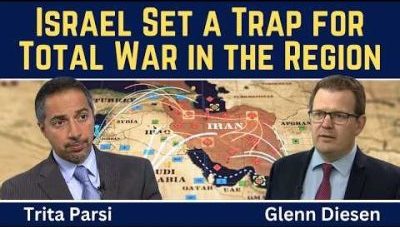
Trita Parsi: Israel Set a Trap for Total War in the Region
or go to
Aletho News Archives – Video-Images
From the Archive
Zionism’s Violent Legacy
By Donald Neff | Washington Report On Middle East Affairs | January 1996
On January 4, 1948, Jewish terrorists drove a truck loaded with explosives into the center of the all Arab city of Jaffa and detonated it, killing 26 and wounding around 100 Palestinian men, women and children.[1] The attack was the work of the Irgun Zvai Leumi – the “National Military Organization,” also known by the Hebrew letters Etzel – the largest Jewish terrorist group in Palestine. The Irgun was headed by Revisionist Zionist Menachem Begin and had been killing and maiming Arabs, Britons and even Jews for the previous ten years in its efforts to establish a Jewish state.
This terror campaign meant that at the core of Revisionist Zionism there existed a philosophical embrace of violence. … continue
Blog Roll
 Aletho News
- Trita Parsi: Israel Set a Trap for Total War in the Region
- Trump’s Iran war is on an Israeli leash
- Saudi oil boss issues global supply warning
- Riyadh Says Its Oil System Is Intact. The Numbers Say Otherwise.
- Trump and Netanyahu Want to “Finish the Job” on Iran
- US ‘one-sided dictation’ not Iran’s beliefs makes rational talks impossible: Baghaei
- Iran’s Next Strike May Not Explode. It Could Shut You Down /Col Doug Macgregor
- Iran: US political targets legitimate if assassinations return
- Iraq shuts key border crossing with Iran under US pressure: Report
- Undersea Internet cables could be targeted in retaliation for attacks on Iran: IRGC deputy chief
- If Americans Knew
- The Israel Lobby’s Changing Fortunes
- AIPAC has become such a political liability that it’s shifting to a more “nimble” approach to buying politicians
- At least 160 Israeli settler attacks in 2 weeks
- Will Gaza’s Ancient Christian Community Disappear Forever?
- Israel’s vision of regional security rests on keeping Arab states weak
- Heidi Levine recounts how Palestinian youths helped save her in settler attack
- DAILY UPDATE: Latest essential news on Palestine, Israel, & region
- Trump’s Intensifying Sabotage of the ICC, for Israel’s Sake
- Israeli military detain US and UK volunteers in West Bank including Democratic NY politician Brad Lander
- Americans at National Conservatism Conference held in Israel this year criticize Israel
- No Tricks Zone
- E-Cars Reduce CO2 Emissions By Only 41% Compared To Internal Combustion Engine Vehicles
- Predictions Made By Renowned Climate Professor Over Past Decades Have Been Proven To Be Poor
- New Study Suggests Large Regions Of The Pacific Ocean Have Been Cooling For The Last 80 Years
- Germany’s Green Energy Debacle: High Energy Costs Force Kahla Porzellan to Close After 182 Years!
- New Study: 50 Years Of The Most Aggressive ‘Net Zero’ Policies Can Only Affect The Global Climate By 0.03°C
- US September “Heat” Was No Record…Many Records Set Decades Ago
- Latest European Green Energy Debacle; Portugal’s Largest Flagship Solar Park Insolvent!
- Green Energy Debacle: German Expert Professor Fritz Vahrenholt Warns Of Severe Economic And Social Consequences
- Two More Paleo Reconstructions Affirm Meters-Higher Sea Levels Across Ireland, Brazil 7000-6000 Years Ago
- New Study: Earth And Venus Surface Warmth Largely Explained By Convection And Lapse Rate, Not CO2 Or Radiation

