Ceasefire no longer viable after 200 days of Israeli violations: Hamas
Al Mayadeen | May 2, 2026
One Palestinian was killed in an Israeli drone strike targeting the vicinity of al-Qastal Towers, east of Deir al-Balah in the central Gaza Strip, Al Mayadeen’s correspondent reported on Saturday.
In a separate development, Israeli forces carried out a large-scale demolition operation east of Khan Younis in southern Gaza, according to the same correspondent.
In light of the continued Israeli violations, Basem Naim, a member of the political bureau of Hamas, said that after 200 days, it is no longer possible to speak of a ceasefire in Gaza. He stated that the situation is a continuation of a “war of extermination,” despite the Resistance’s adherence to the agreement.
Speaking to Al Mayadeen on Saturday evening, Naim stressed that the future of the Gaza Strip and the broader Palestinian cause remains a solely internal Palestinian matter. He added that the Resistance has fulfilled all obligations requested of it, as confirmed by mediators, while Israeli attacks have continued.
Naim also stated that the Rafah crossing has not been opened in accordance with the agreement, noting that the number of people allowed to pass remains limited. He said mediators had been informed of the need to review the implementation of the first phase of the agreement before moving on to the second.
US providing cover for ‘Israel’ to violate ceasefire
The Hamas official further accused the United States of providing cover for Israeli violations, revealing that a technical committee comprising mediators and relevant parties is being supplied with daily documentation of the breaches.
According to Naim, the negotiating position is based on previous agreements and the rights of the Palestinian people, with insistence on the full implementation of the first phase, including the entry of humanitarian aid and reconstruction materials. He added that the agreement includes a political track aimed at securing Palestinian rights, including the establishment of a state with its capital in al-Quds.
Naim emphasized that armed resistance is a legitimate right and that its weapons are an essential component of that right. He also highlighted unity among Palestinian factions and ongoing coordination between them, while warning that the occupied West Bank is facing a “silent and continuous war,” amid escalating attacks on religious sites.
‘Israel’ working to ‘annex’ West bank as a ‘fait accompli’
In this context, Naim said “Israel” is working to consolidate the “annexation” of the West Bank as a “fait accompli”, while restricting the work of international organizations in Gaza unless they operate under its conditions.
He added that the negotiating delegation remains in Cairo and is serious about continuing talks, while maintaining its demand for the full implementation of the first phase. He stressed that the Resistance is not seeking war and does not oppose political pathways if they lead to ending the occupation, but rejects discussing the issue of its weapons separately from a permanent ceasefire.
Naim also praised international activists expressing solidarity with the Palestinian people and condemned attacks on ships attempting to break the blockade, stressing Gaza’s need for an international humanitarian corridor. He concluded by emphasizing the importance of Palestinian unity and rejecting internal divisions that could serve Israeli interests.
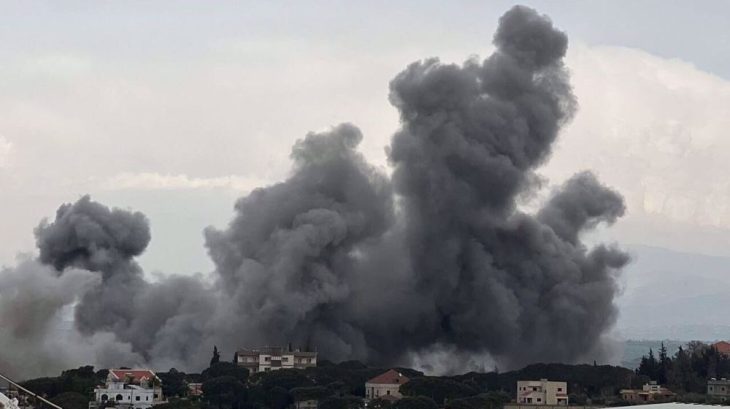
Israeli strikes intensify across southern Lebanon, casualties reported
Al Mayadeen | May 2, 2026
The Israeli occupation has intensified its attacks on villages and towns in southern Lebanon, with fresh airstrikes and artillery shelling reported across several districts, according to field reports from the south.
Al Mayadeen’s correspondent in southern Lebanon reported that three people were killed after an Israeli raid struck a house in the town of al-Louaizeh in the Jezzine district at dawn on Friday, with the escalation extending beyond the area as Israeli airstrikes also hit the towns of Harouf and Shoukin, as well as the al-Tuffah heights region.
The National News Agency (NNA) reported that an earlier strike on Shoukin resulted in the killing of civilians and the injury of several others, including the town’s mayor, Hussein Ali Ahmad.
Further raids targeted multiple towns in the Nabatieh district, including Zawtar al-Sharqiyah, A’dshit, Mayfadoun, Kfar Joz, and Ebba. An additional strike hit a vehicle on the Kfar Dajjal road in the same district.
Strikes across Tyre, Bint Jbeil, and Hasbaya
Southern Lebanon also came under intensified attacks across a wider area, with strikes hitting Majdal Zoun in the Tyre district and Burj Qalaway in the Bint Jbeil district.
The town of Qounine was targeted in an aerial attack, while heavy artillery shelling struck Touline and Qabrikha in the Marjeyoun district. Another airstrike hit Kfarshouba in the Hasbaya district.
Israeli artillery also struck residential areas and outskirts, including al-Mansouri in the Tyre district, while military aircraft maintained intensive overflights across southern Lebanese airspace.
The aggression has continued despite the so-called temporary ceasefire agreement, which took effect on April 17 for 10 days and was later extended for a further three weeks on April 24. However, since the agreement came into force, the Israeli occupation has maintained its attacks, while also facing continued retaliatory attacks from the Islamic Resistance in Lebanon, Hezbollah.
Since March 2, the cumulative toll has reportedly exceeded 2,618 martyrs and more than 8,094 injured, according to the Lebanese Ministry of Health. Officials say the ceasefire framework involving Lebanon has not prevented continued strikes, with repeated attacks reported across multiple regions.
Iran slams US leadership, debunking fabrications, false war costs
Al Mayadeen | May 1, 2026
Iranian officials criticized the United States over its leadership and its justification for the US-Israeli war on Iran, debunking Washington’s fabrications and scrutinizing its political coherence and legal rationale.
In reference to the reported cost of the US-Israeli war on Iran, estimated at 25 billion dollars by the US Department of War, Iranian Foreign Minister Abbas Araghchi maintained that “the Pentagon is lying.”
In a post on X, Araghchi asserted that “Netanyahu’s gamble cost America $100b so far, four times what is claimed.”
He further noted that “indirect costs for U.S. taxpayers are FAR higher. Monthly bill for each American household is $500 and rising fast.”
“Israel First always means America Last,” he assertively concluded.
Trump’s contradictions reveal US decision-making made elsewhere
Mohsen Rezaei, a member of Iran’s Expediency Discernment Council, said, also took a swing at the “America first” slogan, asserting that “the contradictory statements of Trump show that real decisions in US are being made somewhere else.”
In a post on X, he argued that key decisions in Washington were being shaped by “behind-the-scenes power networks” that do not align with the “America First” slogan associated with Trump and MAGA.
Rezaei added that this demonstrates “the kind of deadlock America is facing,” emphasizing that Americans “are the ones paying the price.”
‘Self-defense’ against what?: Baghaei
Separately, Iranian Foreign Ministry spokesperson Esmail Baghaei rejected US claims that the US-Israeli war on Iran was launched in “self-defense”.
In a post on X responding to a US claim that the war was launched “at the request of and in the collective self-defense of its Israeli ally,” he questioned the legal basis for such claims, asking, “Was there any ‘armed attack’ by Iran to justify ‘self defense’?”
Baghaei rejected the claim by Washington, emphasizing that the war was “an act of AGGRESSION against the nation of Iran.”
Israel pours $730m into global propaganda machine as reputation collapses
The Cradle | May 1, 2026
Israeli lawmakers last month approved a sharp increase in the 2026 public diplomacy budget, allocating roughly $730 million to the global messaging apparatus, also known as “Hasbara,” according to a report by the Jerusalem Post on 29 April.
Surveys point to a deepening collapse in international support, as Israel’s genocide in Gaza and continued aggression toward its neighboring countries have sent the Tel Aviv’s reputation into freefall on the global stage.
The funding accounts for more than four times the previous year’s allocation, and forms part of a broader push led by Israeli Foreign Minister Gideon Saar, who characterized the effort as a strategic imperative, saying it should be treated “like investing in jets, bombs, and missile interceptors” and calling it “an existential issue.”
The campaign spans large-scale digital outreach and political engagement aimed at bending perceptions and influencing narratives around Israel.
Around $50 million is being funneled into social media advertising, and roughly $40 million is going toward flying in foreign delegations such as politicians, clergy, and influencers as part of the outreach effort.
Officials insist the strategy improves perceptions abroad, with Israel’s consul general in Los Angeles, Israel Bachar, claiming that “Everyone who returns from the country understands better and is more supportive. But you have to fly out a lot of people.”
However, polling data cited in the reports shows a sharp collapse in public opinion towards Israel, particularly in the US.
A Pew Research Center survey found that 60 percent of US respondents now view Israel unfavorably, with declines cutting across political, religious, and demographic groups.
Analysts and researchers dismiss the spending outright, arguing it cannot offset the impact of Israel’s actions on the ground.
Communication scholar Nicholas Cull said, “Our conclusion was, it’s the policy, stupid,” referring to Israel’s policy of genocide and apartheid, and its broader military conduct as a central pillar of its expansionist agenda.
“Yes, you can do a lot with public diplomacy, and there are strategies that could help on the margins. But they’re only going to affect a small percentage, because the bulk of the impressions on issues that people care about are shaped by the actual policies, not how well you sell those policies.”
“The problem is that people don’t believe the state anymore,” said Ilan Manor, another expert cited in the report, warning that increased funding may expand reach but will not restore trust.
That push is reinforced by what Israeli officials describe as a parallel “Eighth Front” – a so-called “Digital Iron Dome” that combines mass reporting campaigns, AI-driven targeting, and coordinated influencer networks to suppress dissenting content and flood platforms with state-approved narratives in real time.
Israel had invested millions in coordinated digital influence campaigns, including a $6-million contract to shape AI outputs, targeted Gen Z messaging, and large-scale ad buys, in an effort to control online narratives and counter declining public support in the US.
The country’s propaganda arm had previously deployed a large network of at least hundreds of fake social media accounts and fabricated news sites to spread unverified claims linking UNRWA to Hamas’s 7 October Operation Al-Aqsa Flood in order to undermine its humanitarian mission in Palestine.
New US shipment of 6,500 tons of military aid arrives in Israel
MEMO | April 30, 2026
Israel said Thursday it received a new shipment of 6,500 tons of ammunition and military equipment from the US in 24 hours, Anadolu reports.
“Two cargo ships carrying thousands of air and ground munitions, military trucks, Joint Light Tactical Vehicles (JLTVs), and additional military equipment were offloaded at the ports in Ashdod and Haifa,” the Defense Ministry said in a statement.
The daily Maariv said the shipments are part of a “central effort to enhance Israel’s readiness for developments in the war.”
According to the paper, more than 115,600 pieces of military equipment have arrived in Israel via 403 airlifts and 10 maritime shipments since the start of the war with Iran in February.
Israel has been engaged in ongoing military offensives in Gaza since October 2023 with US backing, alongside escalating hostilities involving Lebanon and tensions with Iran.
Israeli strikes kill 10 in southern Lebanon, including 3 rescue workers
Press TV – April 29, 2026
At least ten people, including three rescue workers, have been killed in Israeli airstrikes against residential neighborhoods in southern Lebanon, marking the latest violations of a ceasefire that began on April 16 after weeks of fighting between the Tel Aviv regime and Hezbollah.
Lebanon’s official National News Agency (NNA) reported that an Israeli aerial raid destroyed a four-storey building in the village of Jabchit in the Nabatieh district on Tuesday night, killing Mohammad Jawad Bahja, his wife Lotfiya, as well as Amani Jaber and her daughters.
Lebanon’s Ministry of Public Health announced in a statement that at least 13 people also sustained injuries in the attack.
Separately, two successive Israeli strikes on a building in the town of Majdal Zoun on Tuesday killed five people, including three rescue workers who went to help those injured in the initial Israeli attack on the targeted building.
The three Lebanese civil defense rescue workers were later identified as Hussein Ghadbouri, Hussein Sati and Hadi Daher.
Prime Minister Nawaf Salam strongly condemned the deadly Israeli strike.“Targeting elements of the Civil Defense in Majdal Zoun, and their killing while carrying out their humanitarian duty, constitutes a new and described war crime perpetrated by Israel,” he wrote in a post on social media.
“It represents a flagrant violation of the principles and rules of international humanitarian law,” Salam said.
“The government will spare no effort to condemn this heinous crime in international forums and to mobilize all efforts to compel Israel to cease its ongoing violations of the ceasefire agreement.”
Israeli forces also shelled the towns of Mansouri, Chehabiyeh, Tiri, Jouaiyya, Touline and Khirbet Selm. There were no immediate reports about possible casualties and the extent of damage caused.
The occupation troops also dropped white phosphorus shells on Yohmor al-Shaqif village.
Elsewhere in Naqoura region, Israeli forces pressed ahead with their demolition activities. Residents of adjacent municipalities felt a strong tremor as the occupation troops set off a considerable amount of explosives to flatten designated buildings.
On Wednesday, kamikaze drones launched by Hezbollah resistance fighters targeted and destroyed two Israeli Merkava battle tanks in Naqoura.
Hezbollah said in a brief statement that the operation was carried out in defense of Lebanon as well as its nation, and in response to the Israeli aggression against villages in southern Lebanon.
Israeli military ‘failed on all fronts’: Poll
The Cradle | April 28, 2026
A poll published by Israel’s Public Broadcaster (KAN) on 28 April found that a majority of Israelis believe the state has failed to secure victory in any war since October 2023.
According to the survey, 57 percent of respondents said no victory had been achieved, while 28 percent believed success had been reached in at least one arena, and a further 15 percent said they were unsure.
The findings come after more than two years of Israel’s genocide in Gaza – which Israel threatens to reignite – during which Tel Aviv waged multiple offensive military campaigns against Gaza, Lebanon, and Iran, alongside attacks in Yemen and Syria and a campaign of destruction and displacement in the occupied West Bank.
Confidence levels across all the fronts remain low, with only 17 percent viewing operations in Syria as successful and 16 percent saying the same for Gaza and Iran.
Perceptions dropped further on the Lebanese front at 14 percent, followed by Yemen at 12 percent and the occupied West Bank at 11 percent.
The poll also points to persistent security concerns, with a total of 73 percent of respondents saying the continued armed presence of Hamas and Hezbollah poses a direct threat of a repeat of a 7 October-style event.
Only 10 percent dismissed that possibility, while 17 percent remained uncertain.
On the ground, Israel has reportedly begun withdrawing troops from southern Lebanon. Israeli outlet Maariv described the campaign as ending in “failure” and “bitterness,” as forces pull back under continued Hezbollah attacks, including drone strikes that exposed major gaps in Israeli preparedness.
The poll also showed divisions over Netanyahu’s legal status, with a majority – 56 percent – supporting a pardon for his corruption charges, while 26 percent opposed the move and 18 percent remained undecided.
Netanyahu had requested a presidential pardon on 30 November without admitting guilt or stepping down from office, despite Israeli law requiring an admission of guilt for such a measure.
He is currently facing trial in three separate corruption cases involving fraud, bribery, and abuse of power, with court proceedings ongoing since 2020 after charges were filed in 2019.
Netanyahu’s court testimony was delayed once again on 27 April over a “serious” security incident in southern Lebanon, as the prime minister seeks to prolong the wars to keep his corruption trial from moving forward.
At the same time, the International Criminal Court (ICC) has listed Netanyahu as wanted since 2024, issuing arrest warrants for him and former defense minister Yoav Gallant over their direct involvement and orchestration of the genocide in Gaza, as well as war crimes and crimes against humanity, including the use of starvation as a weapon.
Nuclear Apartheid: Iran’s Rise Exposes the NPT Fraud and the West’s Israel Exception
By Freddie Ponton – 21st Century Wire – April 29, 2026
The fight over Iran’s vice presidency at the 2026 NPT Review Conference looked procedural only if one ignored the history that walked into the room with it. The United States, the United Kingdom, speaking for France and Germany, Australia, and the United Arab Emirates objected to Iran’s appointment, yet Iran kept the post after a Non-Aligned Movement nomination and no blocking vote was forced, exposing a basic fact that now hangs over the treaty system. The United Arab Emirates did not merely object but formally and unequivocally disassociated itself from Iran’s election, while citing Tehran’s continuous violations of its safeguards obligations.
That moment is crucial because it revealed a shrinking gap between Western power and Western authority. The states that still dominate military alliances, financial coercion, and media narratives could denounce Tehran in New York, but they could not turn denunciation into institutional compliance, and they could not persuade the wider diplomatic field that their understanding of non-proliferation deserved automatic deference. What looked like a dispute over one vice presidency was in fact a public measure of a much deeper revolt against selective enforcement.
The bargain they broke
The deeper story begins in 1995, when the NPT was indefinitely extended on the basis of a broader political package that included the Resolution on the Middle East. That resolution called on all states in the region that had not yet done so to join the treaty and place their nuclear facilities under full-scope IAEA safeguards, and the UN Secretariat background paper explicitly records that the resolution was an essential element of the outcome on which indefinite extension was secured.
The 2010 Review Conference reaffirmed that point in unusually clear language. It said the 1995 resolution remained valid until its goals were achieved, recalled the importance of Israel’s accession to the treaty and the placement of all its nuclear facilities under comprehensive safeguards, and endorsed concrete steps toward a 2012 conference on a Middle East zone free of nuclear weapons and other weapons of mass destruction. The conference never delivered what it promised, and Algeria’s 2026 working paper now states bluntly that Israel’s stance helped render the 1995 resolution “devoid of substance,” while the UN Secretariat paper records that many states saw the failure of implementation as seriously undermining the treaty itself.
The Israeli exception
That is why so much of the Global South reads the current crisis through Israel rather than through Iran alone. The UN Secretariat background paper states in neutral terms that all states of the Middle East except Israel are parties to the NPT and that all states in the region except Israel have undertaken to accept comprehensive IAEA safeguards, giving documentary form to the asymmetry that the Non-Aligned Movement (NAM) and Arab states have been protesting for decades.
NAM’s own recent language is harsher because the political implications are harsher. At the 2024 IAEA General Conference record, Uganda speaking on behalf of NAM warned that a selective approach undermined the viability of the safeguards regime, expressed great concern over Israel’s acquisition of nuclear capability, and called for a total prohibition on nuclear-related transfers and assistance to Israel, while the April 2026 NAM statement to the UN Disarmament Commission again demanded that Israel renounce nuclear weapons, accede to the NPT without precondition or delay, and place all its facilities under full-scope safeguards.
That continuity was reaffirmed in the Kampala Declaration, which carried the same line through 2025 and closed the institutional bridge to the April 2026 NAM position. For the movement, this is not a side file or an ideological hobbyhorse. It is the living proof that the rules are preached as universal and applied as political.
The South’s quiet revolt
Once that history is acknowledged, the so-called silence of NAM and many Global South states on Iran’s vice presidency stops looking like ambiguity and starts looking like discipline. They did not need to issue sentimental declarations of love for Tehran in order to refuse a Western effort to re-police multilateral legitimacy, because the issue before them was larger than Iran’s image and deeper than one nomination. It was whether the same powers that had tolerated, normalized, or materially shielded the Middle East’s only non-NPT nuclear exception would now be allowed to decide who is morally disqualified from procedural office inside the treaty system.
That is why the resistance was institutional rather than theatrical. After dismissing the objections as baseless and politically motivated, Iran disassociated itself from the election of the United States as vice president, and according to one contemporaneous account, from Australia’s as well, turning the confrontation into a mirror held up to the old order. The 2025 report of the sixth session of the conference on a Middle East zone free of nuclear weapons and other weapons of mass destruction said Israel’s refusal to join the NPT and submit all its facilities and activities to comprehensive safeguards undermined the credibility of the non-proliferation regime and imposed additional burdens on regional states, while the same report condemned attacks on Iran’s safeguarded nuclear facilities as a grave threat to the credibility of the NPT and the integrity of the entire IAEA safeguards regime.
In that setting, refusing to let Washington, London, Paris, Berlin, and Canberra define the boundaries of legitimacy was not indulgence toward Iran, but a defense of sovereign equality against a one-sided nuclear order.
What their objection revealed
The objections from the United States, the E3, and Australia therefore boomeranged. They were intended to isolate Iran, but they instead illuminated the moral exhaustion of a bloc that speaks in the language of non-proliferation while presiding over an order in which disarmament obligations are endlessly deferred, nuclear sharing and modernization continue, and Israel’s opaque arsenal remains politically protected from the universality routinely demanded of others. The analysis from the European Journal of International Law (EJIL) long ago captured the pattern by showing how NAM kept international attention on Israel’s nuclear status and how double standards around Israel helped fuel resistance inside the regime, and the documents gathered since then show that this reading did not fade but hardened.
Australia’s place in this picture is revealing precisely because it is less central than Washington or the E3 and yet moved in lockstep with them against Iran’s vice presidency. That choice placed Canberra inside a camp that could still object loudly but could no longer command consent, and it tied Australia to a diplomatic posture that much of the Global South now experiences as selective guardianship rather than principled stewardship. The same is true of the E3, whose claim to defend the treaty sounds increasingly thin when the documentary record shows decades of unfinished obligations on the Middle East file and continued Western insistence that the burden of credibility falls primarily on disfavored treaty members rather than on the region’s protected exception.
A treaty stripped bare
What emerged in New York, then, was not simply a quarrel over Iran. In fact, we all witnessed the exposure of a treaty order whose founding compromise on the Middle East has been repeatedly postponed, diluted, and evaded, until many of the states asked to keep faith with the system now see the system itself as compromised at the core. The 2026 UN Secretariat paper, the 2026 Algeria submission, the April 2026 NAM statement, the 2024 IAEA record, and the 2025 IAEA safeguards resolution all converge on the same underlying reality that Israel’s non-accession, unsafeguarded status, and continuing exceptional treatment have become inseparable from the crisis of NPT credibility.
That is why Iran’s vice presidency is so significant, because it marks the point at which a large part of the non-aligned world stopped pretending that the greatest danger to the treaty’s legitimacy begins and ends in Tehran, and instead used procedure to register a quieter but more consequential judgment that the deeper non-proliferation crisis lies in a regime that punishes some, excuses others, and then demands respect for the imbalance it created.
On April 27th, the West could still denounce, but could no longer decide; and that, more than the vice presidency itself, is the message now being sent from the Global South to Washington, the E3, and Australia.
Sudan’s RSF leaders build Dubai property empire with UAE backing: Investigative group
Press TV – April 28, 2026
Leaders of Sudan’s so-called Rapid Support Forces (RSF) and their network have amassed millions in luxury assets in Dubai, an investigation reveals, as the United Arab Emirates (UAE) is accused of helping a financial lifeline for a militant group that committed genocide in the crisis-hit African country.
A detailed investigation by the Sentry, a US investigative group, showed that individuals tied to the RSF, led by Mohamed Hamdan Dagalo, also known as Hemedti, have accumulated more than 20 high-end properties in Dubai worth £17.7 million.
The report further exposed a sprawling “paramilitary-industrial complex” stretching across Africa and West Asia, with the UAE functioning as a critical hub for both wealth storage and financial operations linked to the militant group.
The probe by the Sentry maintained that the UAE acted as a “safe haven” for RSF leaders and their relatives, as well as for wealth derived from smuggled Sudanese gold.
After seizing Darfur’s largest gold mine back in 2017, Hemedti and his network reportedly leveraged UAE-based companies to convert illicit gold into hard currency, taking advantage of Dubai’s booming gold trade.
“In addition to arming the militia, the UAE allows the RSF to base part of its paramilitary-industrial complex in Dubai. Our investigation shows the Dagalo family has also found a safe haven for its wealth in the Emirates,” Nick Donovan, senior investigator at the Sentry, said.
Leaked real estate records also indicate that properties linked directly to the RSF network are worth about £7.4 million, while assets held by sanctioned associates add another £10.3 million to it. Among them are luxury six-bedroom villas near Dubai’s Meydan racecourse acquired through a UAE-registered firm – Prodigious Real Estate Management Supervision Services – tied to an individual sanctioned by the United States for supplying funding and military equipment to the RSF.
According to the probe, Dagalo family members clustered in these compounds, while Hemedti’s wife purchased land worth £627,000 in the vicinity of Trump International Golf Club six months into Sudan’s war.
Sanctioned RSF-linked figure Mustafa Ibrahim Abdel Nabi Mohamed is also reported to own a £516,000 apartment in Burj Khalifa.
The RSF – commanded by Hemedti and his sanctioned brothers – has been accused by both the United Nations and the US of atrocities amounting to genocide, including during an assault on El Fasher in the Darfur region.
Despite mounting evidence, the UAE, widely seen as the militant group’s chief foreign backer, “categorically rejects” claims that it has provided “weapons, funding, trainers or logistical support to the RSF.”
Citing a separate report last week, the Sentry also said that UAE-backed Colombian mercenaries played a decisive role in the fall of El Fasher.
Meanwhile, RSF-linked individuals deny any wrongdoing, insisting assets were legally obtained and commercial activities were legitimate, even as Sudan’s war drives what is now the world’s largest humanitarian crisis, with 33 million people of the country’s 50 million population needing aid and at least 19 million facing hunger.
The RSF, which has been fighting the Sudanese army over the past few years, currently controls large swathes of the country’s southwestern territories, including most of the region of Darfur.
The militants captured el-Fasher on October 26, 2025, with reports saying they massacred thousands of civilians who failed to flee the city.
A UN fact-finding mission found that RSF actions in el-Fasher show “hallmarks of genocide” against the Zaghawa and Fur ethnic communities.
Despite denials by the UAE, several reports have suggested that the Persian Gulf Arab country supports RSF militants in Sudan in a bid to get access to gold and secure control over Red Sea shipping lanes, as well as agricultural land.
US pension fund invests hundreds of millions in weapons firms supplying Israel
The Cradle | April 27, 2026
The Virginia Retirement System (VRS), which manages pension benefits for the US state of Virginia’s public sector workers, holds a staggering $394 million in investments linked to weapons makers and shipping companies supporting Israel’s genocide of Palestinians in Gaza and wars on Lebanon and Iran, according to a 23 April report released by a coalition of Palestinian advocacy groups.
The report was prepared by the VRS Divest from Weapons & War campaign, the Palestinian Youth Movement (PYM), and the People’s Embargo for Palestine. It draws on publicly available financial data and records obtained through Freedom of Information Act requests.
The report presents a detailed accounting of the VRS’s investments in many of the world’s largest weapons makers as part of its $122 billion portfolio.
Lockheed Martin is the VRS’s single largest holding at $94.8 million. The firm produces the F-35 fighter jet and AGM-114 Hellfire missiles. Both have been used extensively by the Israeli military during its more than two-year Genocide of Palestinians in Gaza.
The Virginia pension system is also invested in Boeing, which manufactures precision-guided munitions, known as JDAMs, that are used to kill and maim children in Gaza.
Other investments include General Dynamics, Northrop Grumman, Raytheon, Maersk, and Thyssenkrupp, all of which either manufacture or ship weapons for use by the Israeli military in Gaza, Lebanon, and Iran.
“These companies are critical in maintaining the weapons supply to Israel and the resulting massacres of thousands of people across the Middle East,” Bana Husseini, an organizer with the VRS Divest campaign and the Palestinian Youth Movement, told TRT World.
Husseini and other activists are lobbying the VRS to divest from companies supporting Israel’s military and its genocide and wars. A petition calling for divestment has gathered nearly 4,500 signatures.
However, the pension system has continued to express its support for Israel.
“The VRS has responded by dismissing the campaign’s demands, arresting a firefighter for delivering the petition, inviting a notorious war criminal to their yearly retreat, and further collaborating with war profiteers,” Husseini explained.
Joelle Rudney, a retired teacher from Virginia, told TRT World she was upset to learn her pension was invested “in the bombings of hospitals, schools, and houses in Gaza in attacks that have killed nearly 70,000 people, mostly civilians.”
In response, she has helped lobby the VRS Board of Trustees to divest from the companies supporting Israel’s war crimes.
Casey Rosales, a county public servant who has worked in mental health services, was also angered to learn how her pension contributions are being invested.
“It’s difficult to reconcile the fact that while I dedicate my career to supporting and strengthening communities, the money I earn may be contributing to harm elsewhere,” Rosales stated.
A Virginia public utilities employee said she felt betrayed to learn the money she contributes to her retirement fund is supporting genocide.
“It is profoundly sad that while doing work to help men, women, and children with health care services and resources here in Virginia, my tax money goes to buying and owning shares in companies contributing to genocide,” the employee stated.
“I demand the VRS Board of Trustees divest from these companies and commit to never again invest our future into the manufacturing of death,” the employee told TRT World.
Israel’s genocide of Palestinians in Gaza has killed over 72,000 Palestinians, the majority women and children. Tens, if not hundreds, of thousands more will likely die due to the indirect effects of years of Israeli bombing that has destroyed the basic health, electricity, and water infrastructure in the strip and displaced nearly 90 percent of the population.
Featured Video

Trita Parsi: Israel Set a Trap for Total War in the Region
or go to
Aletho News Archives – Video-Images
From the Archive
Zionism’s Violent Legacy
By Donald Neff | Washington Report On Middle East Affairs | January 1996
On January 4, 1948, Jewish terrorists drove a truck loaded with explosives into the center of the all Arab city of Jaffa and detonated it, killing 26 and wounding around 100 Palestinian men, women and children.[1] The attack was the work of the Irgun Zvai Leumi – the “National Military Organization,” also known by the Hebrew letters Etzel – the largest Jewish terrorist group in Palestine. The Irgun was headed by Revisionist Zionist Menachem Begin and had been killing and maiming Arabs, Britons and even Jews for the previous ten years in its efforts to establish a Jewish state.
This terror campaign meant that at the core of Revisionist Zionism there existed a philosophical embrace of violence. … continue
Blog Roll
 Aletho News
- Trita Parsi: Israel Set a Trap for Total War in the Region
- Trump’s Iran war is on an Israeli leash
- Saudi oil boss issues global supply warning
- Riyadh Says Its Oil System Is Intact. The Numbers Say Otherwise.
- Trump and Netanyahu Want to “Finish the Job” on Iran
- US ‘one-sided dictation’ not Iran’s beliefs makes rational talks impossible: Baghaei
- Iran’s Next Strike May Not Explode. It Could Shut You Down /Col Doug Macgregor
- Iran: US political targets legitimate if assassinations return
- Iraq shuts key border crossing with Iran under US pressure: Report
- Undersea Internet cables could be targeted in retaliation for attacks on Iran: IRGC deputy chief
- If Americans Knew
- The Israel Lobby’s Changing Fortunes
- AIPAC has become such a political liability that it’s shifting to a more “nimble” approach to buying politicians
- At least 160 Israeli settler attacks in 2 weeks
- Will Gaza’s Ancient Christian Community Disappear Forever?
- Israel’s vision of regional security rests on keeping Arab states weak
- Heidi Levine recounts how Palestinian youths helped save her in settler attack
- DAILY UPDATE: Latest essential news on Palestine, Israel, & region
- Trump’s Intensifying Sabotage of the ICC, for Israel’s Sake
- Israeli military detain US and UK volunteers in West Bank including Democratic NY politician Brad Lander
- Americans at National Conservatism Conference held in Israel this year criticize Israel
- No Tricks Zone
- E-Cars Reduce CO2 Emissions By Only 41% Compared To Internal Combustion Engine Vehicles
- Predictions Made By Renowned Climate Professor Over Past Decades Have Been Proven To Be Poor
- New Study Suggests Large Regions Of The Pacific Ocean Have Been Cooling For The Last 80 Years
- Germany’s Green Energy Debacle: High Energy Costs Force Kahla Porzellan to Close After 182 Years!
- New Study: 50 Years Of The Most Aggressive ‘Net Zero’ Policies Can Only Affect The Global Climate By 0.03°C
- US September “Heat” Was No Record…Many Records Set Decades Ago
- Latest European Green Energy Debacle; Portugal’s Largest Flagship Solar Park Insolvent!
- Green Energy Debacle: German Expert Professor Fritz Vahrenholt Warns Of Severe Economic And Social Consequences
- Two More Paleo Reconstructions Affirm Meters-Higher Sea Levels Across Ireland, Brazil 7000-6000 Years Ago
- New Study: Earth And Venus Surface Warmth Largely Explained By Convection And Lapse Rate, Not CO2 Or Radiation

