Macron: French citizens fighting for Israel cannot be labeled ‘genociders’
Press TV – February 18, 2026
President Emmanuel Macron has insisted that French citizens fighting for Israel cannot be labeled “genociders,” as French judges pursue legal action against nationals also holding Israeli passports who are accused of aiding Israel’s aggression on Gaza.
Speaking to Radio J, Macron said that the French who also hold Israeli passports are “children of France” who must never be accused of genocide.
“We cannot accept, we must never accept that any of our children, that any French person, be accused of being genocidal,” he stressed, adding, “That is impossible, and it represents a reversal of values to which we must not yield.”
Amid mounting legal scrutiny, Macron further claimed that “some people who sometimes played an active role in the anti-racist struggle, people who defended causes, have used, distorted what is happening internationally to try to dehumanize, essentialize” fellow French citizens who also hold Israeli passports.
On February 3, French authorities issued warrants requiring two French women who also hold Israeli passports to appear before an investigating magistrate for “complicity in genocide” over allegations they attempted to block humanitarian aid from entering the besieged Gaza Strip during Israel’s ongoing genocidal aggression.
The warrants, however, do not order their arrest.
The women, born in France and now living in the occupied Palestinian territories, are Nili Kupfer-Naouri, head of the group “Israel Is Forever”, and Rachel Touitou, an activist linked to Tsav 9, which is a far-right group formed by the families of Israeli settlers who were taken captive in Gaza.
Complaints were filed by the Palestinian Center for Human Rights, Al-Haq and Al-Mezan over direct obstructing of life-saving aid between 2023 and 2025.
Back in June 2024, the US Department of State designated Tsav 9 a “violent extremist Israeli group that has been blocking, harassing and damaging convoys carrying lifesaving humanitarian assistance to Palestinian civilians in Gaza.”
Additional legal action has targeted two French soldiers fighting for Israel, Sasha A and Gabriel B H, who are accused in a July NGO complaint of “war crimes, crimes against humanity and genocide” for killing dozens of unarmed Palestinian civilians outside combat zones in 2023 and 2024, according to Le Monde.
Although Israeli law exempts nationals that hold other passports and live abroad from mandatory service, Israeli military data indicates that more than 6,100 French nationals voluntarily served in the army during the genocide.
Meanwhile, Francesca Albanese, the United Nations special rapporteur for occupied Palestinian territory, rebuked Macron, writing, “We do not label someone a criminal or a genocidaire based on their nationality: it is up to the courts to decide.”
She also stressed that anyone serving in a military suspected of crimes may face investigation, prosecution and conviction if evidence warrants.
US eyes Gaza security force drawn from armed gangs
Al Mayadeen | February 19, 2026
The United States is advancing plans to establish a new Gaza security force, potentially staffed by members of armed clans with documented links to organized crime, according to multiple Western officials who spoke with The Telegraph.
The proposal, promoted by the Trump administration, envisions forming a Gaza police force drawn in part from existing anti-Resistance militias operating in the Strip. The initiative is understood to have the backing of “Israel”, which has armed and supported some of these groups since the war on Gaza began on October 7, 2023.
The proposal has triggered “pushback” from senior American commanders, who have raised concerns over the reliability of such security partners.
Internal US, Western concerns
The armed clans to be involved, largely structured along extended family lines, have longstanding ties to organized crime networks. Civilians in Gaza are reported to view them with deep mistrust.
In recent months, members of these groups have been accused of looting humanitarian aid trucks, committing murders, and carrying out kidnappings. At least two major clan factions include individuals who have either fought alongside ISIS or declared allegiance to the organization.
Senior US military officials have expressed reservations about the broader peace framework. One source told The Telegraph that Trump’s “peace process” “will not work without reliable security partners.”
Britain, France, and other countries involved in discussions on post-war Gaza governance have also voiced concern.
Ceasefire context, governance deadlock
Four months after the ceasefire, efforts to establish an imposed Gaza police force appear to have stalled. Disagreements persist over the composition, oversight, and funding of the proposed Gaza security force, while Hamas stated that disarmament is out of the question.
Trump is scheduled to host the inaugural meeting of his “Board of Peace” in Washington, with delegations from more than 20 countries expected to attend. Organizers aim to secure funding pledges for reconstruction and commitments of personnel for a United Nations-mandated International Stabilization Force (ISF).
The ISF is expected to operate above the proposed Gaza security force and coordinate with the IOF outside the Strip.
Trump said on Sunday that $5 billion had already been pledged for reconstruction and that “thousands” of personnel had been committed to the ISF and local policing structures.
Disputes over clan recruitment
The plan to recruit members of armed clans reportedly emerged before Christmas and prompted disagreements at the multinational Civil-Military Coordination Centre in southern “Israel”.
One Western source told The Telegraph, “There was significant pushback along the lines of ‘this is ridiculous – they’re not only criminal gangs, but they’re sponsored by Israel’.”
Which specific clans US and Israeli officials proposed recruiting from remains unclear. The White House did not deny that the approach had been discussed.
Role of Kushner and strategic planning
Jared Kushner, Trump’s son-in-law, is described by officials as central to advancing the administration’s 20-point “peace initiative”.
He has been leading efforts to establish temporary “safe” communities in parts of Gaza under IOF control, aimed at encouraging Palestinians to relocate from Hamas-controlled areas if the group refuses to disarm.
The first such community is under construction on the site of the former city of Rafah, in an area dominated by the “Popular Forces” gang, a group backed by “Israel” and accused of drug smuggling and aid looting.
Its former leader, Yasser Abu Shabab was killed in December.
Kushner has worked closely with Aryeh Lightstone, chief executive of the Abraham Accords Institute, in shaping discussions over Gaza’s future. Informal meetings reportedly held in Tel Aviv with international investors have drawn criticism from Western officials, who have questioned what they describe as an “ideological” approach.
One official told The Telegraph, “There is a feeling that Kushner, Lightstone et al believe that if they can just give Palestinians the chance to flee Hamas, then they will take it.”
The source added, “But the reality on the ground is that while lots of Gazans don’t like Hamas, they really don’t like or trust the clans. They see them as criminals.”
“There is also a concern that the more ideological members of the administration will at some point turn around and say ‘we’ve given you the opportunity to leave Hamas; if you’re still there, you must be a sympathiser’. Then Israel gets the green light to restart the war,” they continued.
The Only Motive Behind The ‘Imminent’ U.S. War With Iran Is The Zionist Lobby
The Dissident | February 19, 2026
Barak Ravid in Axios reports that , “The Trump administration is closer to a major war in the Middle East than most Americans realize. It could begin very soon” in reference to Iran.
According to a source in the Trump administration, “it would likely be a joint U.S.-Israeli campaign that’s much broader in scope — and more existential for the regime — than the Israeli-led 12-day war last June.”
The report adds, “Trump’s armada has grown to include two aircraft carriers, a dozen warships, hundreds of fighter jets and multiple air defense systems. Some of that firepower is still on its way” adding, “The Israeli government — which is pushing for a maximalist scenario targeting regime change as well as Iran’s nuclear and missile programs — is preparing for a scenario of war within days, according to two Israeli officials.”
If this report is accurate, and the Trump administration actually is about to carry out a regime change war in Iran, there is only one driving motive behind it: the Zionist lobby’s control over Trump and broader U.S. foreign policy.
A Zionist Regime Change Campaign
During the June U.S./Israeli “12 day war”, Trump claimed it was about stopping Iran from obtaining Nuclear weapon, but Trump’s own Director of National Intelligence report from March found no evidence Iran was building a Nuclear weapon, writing, “We continue to assess Iran is not building a nuclear weapon and that Khamenei has not reauthorized the nuclear weapons program he suspended in 2003”.
The real motive behind the Israeli pushed war, was regime change in Iran.
An inside source in the Trump administration told journalists Max Blumenthal and Anya Parampil that Israeli intelligence officials who were pushing for U.S. involvement in the war “have demonstrated a single-minded focus on regime change, clamoring for authorization to assassinate Iran’s leader, Ayatollah Ali Khamenei. The Israeli officials have emphasized that the moment to take out Khamenei is now.”
The Times of Israel later reported on leaked transcripts of Israeli officials during the June bombing, which showed that the real motive was to “find an opportunity to assassinate Supreme Leader Ali Khamenei and destabilize Tehran’s regime”.
One senior Israeli intelligence official was quoted as saying that “for years” there was an Israeli “intelligence operation to disrupt enemy activities, including activity to destabilize the regime”.
The Times of Israel noted, “While not initially publicly stated as a goal of the war, the transcripts make it clear that Israel was also looking to destabilize the regime and even to kill Supreme Leader Ali Khamenei” adding, “Finance Minister Bezalel Smotrich said that Israel needed to ‘keep searching for the leader,’ referring to Khamenei” and “Netanyahu also said entire Iranian neighborhoods and districts should be evacuated, and that Israel should work on destabilizing the Islamic regime.”
Israel’s real motive behind the bombing, being regime change, is also underscored by the fact- uncovered by the University of Toronto’s Citizen Lab – that during the bombing, social media bots backed by Israeli intelligence ran a propaganda campaign “promoting regime change in Iran”. During the bombing, the Israeli bot network “published a series of posts highlighting the alleged economic upheaval in Iran after the first few rounds of bombings. The network told followers to head to ATMs to withdraw money, emphasized that the Islamic Republic was ‘stealing our money to escape with its officials,’ and urged followers to rise up against the regime,” and “urged followers to get on their balconies at 8 p.m. each evening and shout ‘Death to Khamenei’”.
In a later interview with the Daily Caller, Trump boasted that he took part in the bombing at the behest of Israel, boasting, “Israel is amazing, because, you know, I have good support from Israel. I have. Look, nobody has done more for Israel than I have, including the recent attacks with Iran”.
Following the “12-day war,” the U.S. and Israel exploited protests in Iran in an attempt to destabilize the Iranian government before the apparent upcoming regime change war.
After protests started in Iran due to citizens’ economic concerns, Trump’s Treasury Secretary Scott Bessent repeatedly boasted that the protests were the intended effect of U.S. sanctions on Iran designed to crash the Iranian economy, saying:
What we can do at treasury, and what we have done, is created a dollar shortage in the country, at a speech at the Economic club in New York in March I outlined the strategy, it came to a swift -and I would say grand- culmination in December when one of the largest banks in Iran went under, there was a run in the bank, the central bank had to print money, the Iranian currency went into free fall, inflation exploded and hence we have seen the Iranian people out on the street
If you look at a speech I gave at the economic club of New York last March, I said that I believe the Iranian currency was on the verge of collapse, that if I were an Iranain citizen, I would take my money out.
President Trump ordered treasury and our OFAC division, (Office of Foreign Asset Control) to put maximum pressure on Iran, and it’s worked because in December, their economy collapsed, we saw a major bank go under, the central bank has started to print money, there is a dollar shortage, they are not able to get imports and this is why the people took to the streets.
This is economic statecraft, no shots fired, and things are moving in a very positive way here
(Emphasis: Mine)
Similarly, the former Democratic Speaker of the House, Nancy Pelosi, boasted in response to the question, “Is there a way to bring about the (Iranian) regime falling without using American force?” : “Use economic force, there are ways that you can cripple their economy and some of that has been in the works. It’s more about just weaken their economy and it weakens the support they do have, because they do have support in the rural areas in the more conservative Imams and the rest of that, but we have to make them feel the pain as well”.
Following the protests sparked by economic sanctions on Iran, the Mossad and CIA infiltrated the protests to turn them into a pro-regime change direction.
A Mossad-connected social media account wrote in Persian, to Iranian protestors, “Come out to the streets together. The time has come. We are with you. Not only remotely and verbally. We are also with you in the field,” while former U.S. Secretary of State Mike Pompeo wrote , “Happy New Year to every Iranian in the streets. Also to every Mossad agent walking beside them.”
Israel’s Channel 14 similarly reported that, “foreign actors are arming the protesters in Iran with live firearms, which is the reason for the hundreds of regime personnel killed” while Israel’s Heritage Minister Amichai Eliyahu said , “When we attacked in Iran during ‘Rising Lion’ we were on its soil and knew how to lay the groundwork for a strike. I can assure you that we have some of our people operating there right now”.
Afterwards, the mainstream media ran a propaganda campaign claiming that Iran had killed tens of thousands of Iranian protestors, citing anonymous sources and explicitly pro-war and pro-regime change sources, including the German-Iranian eye surgeon Amir Parasta – a lobbyist for the Israeli puppet Reza Pahlavi – and Iran International, an outlet which journalist Barak Ravid said , “the Mossad is using… quite regularly for its information war”.
Given the likelihood of a U.S./Israeli regime change war happening, the propaganda campaign can be seen in the context of previous “atrocity propaganda” campaigns used to justify war such as the false claims that Saddam Hussein was throwing babies out of incubators in Kuwait used to justify the first Iraq war, false claims that Muammar Gaddafi was killing civilians in Libya used to justify the 2011 regime change war, and false claims that Hamas committed mas rape and beheaded babies on October 7th used to justify the genocide in Gaza.
Trump Controlled By The Zionist Lobby
If Trump launches a regime change war in Iran, his main motivating factor is the Zionist lobby’s influence over him.
While Trump began diplomatic talks with Iran in Oman, Benjamin Netanyahu flew to Washington to pressure Trump to make unrealistic demands, including demanding Iran give up its ballistic missiles, in order to sabotage diplomacy and force a U.S. war on Iran.
As journalist Glenn Greenwald noted , “Israel is demanding that the U.S. go to war with Iran even if Tehran satisfies Trump’s demands on its nuclear program. Netanyahu is insisting that Trump also require Iran to give up its ballistic missiles before any deal can be signed: something no country would ever do.”
Given Trump’s record, it is highly likely that he will follow the demands of the Zionist lobby and go to war with Iran on behalf of Israel.
Trump has repeatedly boasted that the Zionist lobby- more specifically, pro-Israel mega donor Miriam Adelson – controls his Middle East policy.
Trump boasted during his speech to the Israeli Knesset that Miriam Adelson -and during his first term her late husband Sheldon- were “responsible for so much” of his Middle East policy, adding, “I actually asked her (Miriam Adelson) once, so Miriam, I know you love Israel, what do you love more, the United States or Israel? She refused to answer, which might mean Israel.”
Trump boasted that at the behest of the Adelsons, he “terminated the disastrous Iran nuclear deal”, “authorized the spending of billions of dollars which went to Israel’s defense” and “officially recognized the capital of Israel and moved the American Embassy to Jerusalem”.
Trump later boasted that , “Miriam (Adelson) gave my campaign $250 million” adding that during his first term in office, “her husband Sheldon was an amazing guy, he’d come up to the office, and there was nobody more aggressive than Sheldon … he would always say ten minutes it turned out to be an hour and a half and what he did was he fought for Israel, it’s all he really fought for”.
Along with Trump’s self-admitted capture by the Zionist lobby, there is even the possibility – given Trump’s connection to Jeffrey Epstein and the growing body of evidence that Epstein was an Israeli intelligence asset – that Israel will use sexual blackmail to get its way on Iran.
This was argued by former Israeli intelligence official Ari Ben-Menashe who said , “The Israeli’s are holding some of the sensitive stuff (in the Epstein files) and they might let it out when they feel threatened by Trump” adding, “I believe the Israelis have quite a bit of information that they can release that the Department of Justice doesn’t want to release” and adding that Israel is “very much against the talks with the U.S. and Iran”.
The Final Phase Of The ‘Clean Break’
An Israeli pushed American regime change war in Iran is nothing new, and is in reality the final phase of a long-term Zionist plot to “reshape the Middle East” in Israel’s favour, going back to the Iraq war.
As Columbia University’s Jeffrey Sachs explained:
In 1996, Netanyahu and his American advisors devised a ‘Clean Break’ strategy. They advocated that Israel would not withdraw from the Palestinian lands captured in the 1967 war in exchange for regional peace. Instead, Israel would reshape the Middle East to its liking. Crucially, the strategy envisioned the US as the main force to achieve these aims—waging wars in the region to dismantle governments opposed to Israel’s dominance over Palestine. The US was called upon to fight wars on Israel’s behalf.
The Clean Break strategy was effectively carried out by the US and Israel after 9/11. As NATO Supreme Commander General Wesley Clark revealed, soon after 9/11, the US planned to “attack and destroy the governments in seven countries in five years—starting with Iraq, then Syria, Lebanon, Libya, Somalia, Sudan, and Iran.”
The first of the wars, in early 2003, was to topple the Iraqi government. Plans for further wars were delayed as the US became mired in Iraq. Still, the US supported Sudan’s split in 2005, Israel’s invasion of Lebanon in 2006, and Ethiopia’s incursion into Somalia that same year. In 2011, the Obama administration launched CIA operation Timber Sycamore against Syria and, with the UK and France, overthrew Libya’s government through a 2011 bombing campaign. Today, these countries lie in ruins, and many are now embroiled in civil wars.
Netanyahu was a cheerleader of these wars of choice–either in public or behind the scenes–together with his neocon allies in the U.S. Government including Paul Wolfowitz, Douglas Feith, Victoria Nuland, Hillary Clinton, Joe Biden, Richard Perle, Elliott Abrams, and others.
Sachs documented that war with Iran in the final phase of this plan, noting:
In September 2023, Netanyahu presented at UN General Assembly a map of the ‘New Middle East’ completely erasing a Palestinian state. In September 2024, he elaborated on this plan by showing two maps: one part of the Middle East a “blessing,” and the other–including Lebanon, Syria, Iraq, and Iran–a curse, as he advocated regime change in the latter countries.
Israel’s war on Iran is the final move in a decades-old strategy. We are witnessing the culmination of decades of extremist Zionist manipulation of US foreign policy.
Lindsay Graham – one of Israel’s closest allies in the U.S. Senate outright admitted that the hope behind a U.S. regime change war in Iran is that it will cripple resistance in the Middle East to Israel and cause Arab States to normalize with Israel without a Palestinian State – paving the way for the “New Middle East” laid out by Netanyahu at the UN in 2023.
Graham boasted referring to regime change in Iran, “If we can pull this off, it would be the biggest change in the Mid East in a thousand years: Hamas, Hezbollah gone, the Houthis gone, the Iranian people an ally not an enemy, the Arab world moving towards Israel without fear, Saudi-Israel normalize, no more October the 7th”.
Graham’s comments mirror Netanyahu’s at the UN weeks before the start of the Gaza genocide.
As journalist Jeremy Scahill reported :
Just two weeks before the October 7 attacks, the Israeli leader delivered a speech at the UN General Assembly in New York, brandishing a map of what he promised could be the “New Middle East.” It depicted a state of Israel that stretched continuously from the Jordan River to the Mediterranean Sea. Gaza and the West Bank, as Palestinian lands, were erased.
During that speech, Netanyahu portrayed the full normalization of relations with Saudi Arabia as the linchpin of his vision for this “new” reality, one which would open the door to a “visionary corridor that will stretch across the Arabian Peninsula and Israel. It will connect India to Europe with maritime links, rail links, energy pipelines, fiber-optic cables.”
In 2024, Netanyahu held up another map at the UN portraying Iran and the axis of resistance as a “curse” in the way of this Israeli goal.
It is surely not a coincidence that Israel is hoping to resume the full-scale genocide in Gaza in a few months.
The Times Of Israel reported that , “Israel plans to afford Hamas a 60-day period to disarm, and if it does not, the Israeli military will go back to war in the Gaza Strip, a senior adviser to Prime Minister Benjamin Netanyahu said Monday.”
This is an obvious attempt to force the failure of ceasefire negotiations in Gaza to justify resuming the full scale genocide, given the fact, as journalist Jeremy Scahil reported , that, “Hamas will not accede to sweeping demands that the Palestinian resistance unilaterally disarm, nor will it submit to a total demilitarization of the Gaza Strip” adding, “the group is willing to negotiate on disarmament of resistance forces only if it is linked to a long-term ceasefire that restrains Israel and is accompanied by a political process that leads to the establishment of a Palestinian state and armed force capable of defending itself”.
Israel hopes that after a regime change war in Iran, it will be clear to carry out its ethnic cleansing plan in Gaza and the West Bank without opposition – and it wants to get the U.S. to carry out the operation on its behalf.
Trump eyes 350-acre US military base housing 5,000 troops in Gaza
Al Mayadeen | February 19, 2026
The Trump administration is preparing plans to construct a military base in Gaza capable of housing 5,000 personnel and covering more than 350 acres, according to “Board of Peace” contracting documents reviewed by The Guardian.
The proposed installation is designed to serve as an operational headquarters for a future “International Stabilization Force” (ISF), envisioned as a multinational military contingent made up of pledged troops. The ISF falls under the authority of the newly established “Board of Peace,” which is intended to govern Gaza. The Board is chaired by US President Donald Trump and partially led by his son-in-law, Jared Kushner.
Documents reviewed by The Guardian outline a phased construction process for a fortified compound measuring approximately 1,400 meters by 1,100 meters. The base would include 26 trailer-mounted armored watchtowers, a small-arms firing range, protective bunkers, and a warehouse for operational equipment. Barbed wire fencing would surround the entire facility.
The site is planned for a barren stretch of land in southern Gaza, marked by saltbush and white broom shrubs and scattered debris from years of Israeli bombardment. The Guardian has examined video footage of the location.
A source familiar with the planning told The Guardian that a select group of international construction firms experienced in operating in war zones has already visited the area.
‘International Stabilization Force’ and Indonesian involvement
Indonesia has reportedly offered to contribute up to 8,000 troops to the force. The Indonesian president was scheduled to attend the inaugural “Board of Peace” meeting in Washington, D.C., alongside three other Southeast Asian leaders.
The UN Security Council authorized the “Board of Peace” to establish the temporary ISF in Gaza. According to the UN mandate, the force would secure Gaza’s borders, maintain internal peace, protect civilians, and assist in training and supporting “vetted Palestinian police forces.”
However, uncertainty remains regarding the ISF’s rules of engagement in the event of renewed Israeli assaults. It is also unclear whether the force would “play a role in disarming Hamas,” an Israeli precondition for reconstruction efforts in Gaza.
Governance concerns and international skepticism
While more than 20 countries have joined the “Board of Peace,” many governments have declined participation. Although the organization was created with UN approval, its charter appears to grant Trump permanent leadership authority.
Adil Haque, a law professor at Rutgers University, criticized the structure of the body. “The Board of Peace is a kind of legal fiction, nominally with its own international legal personality separate from both the UN and the United States, but in reality it’s just an empty shell for the United States to use as it sees fit,” he stressed.
Observers have raised concerns about the Board’s funding and governance transparency. Several contractors told The Guardian that discussions with US officials frequently occur over Signal rather than official government email channels.
A source familiar with the contracting process said the military base document was issued by the Board of Peace with assistance from US contracting officials.
Infrastructure and security measures
The plans detail a network of reinforced bunkers measuring six meters by four meters and 2.5 meters in height, equipped with advanced ventilation systems for troop protection.
“The Contractor,” the document states, “shall conduct a geophysical survey of the site to identify any subterranean voids, tunnels, or large cavities per phase.” The clause appears to reference what it termed “Hamas’s extensive underground tunnel network in Gaza.”
Another section outlines a “Human Remains Protocol.” “If suspected human remains or cultural artifacts are discovered, all work in the immediate area must cease immediately, the area must be secured, and the Contracting Officer must be notified immediately for direction,” the document says. Gaza’s civil defense agency estimates that around 10,000 Palestinian bodies remain buried beneath the rubble.
Legal and political questions
Ownership of the land designated for the base remains unclear, though much of southern Gaza is currently under Israeli occupation. The UN estimates that at least 1.9 million Palestinians have been forcibly displaced during the war.
Diana Buttu, a Palestinian-Canadian lawyer and former peace negotiator, condemned the project. “Whose permission did they get to build that military base?” she asked, describing it as an act of occupation if undertaken without Palestinian governmental consent.
US Central Command declined to comment, directing inquiries to the “Board of Peace”, as per the report.
A Trump administration official also refused to discuss the contract, stating, “As the President has said, no US boots will be on the ground. We’re not going to discuss leaked documents.”
Meet The Liberal Zionist And Ukraine War Supporter Advising AOC On Foreign Policy
The Dissident | February 18, 2026
Democratic representative Alexandria Ocasio-Cortez’s recent appearence at the Munich Security Conference, which was billed as her showcasing her foreign policy chops gearing up for a possible presidential run, has faced widespread criticism and backlash, not only for her embarrassing mistakes (saying Venezuela was located below the equator, being unable to answer a question about Taiwan and saying the “Trans-Pacific Partnership” when meaning to say the Trans Atlantic Partnership) but for her weak criticism of U.S. foreign policy and repeating of pro-war narratives.
This, however, can be easily explained by the fact that she is being coached by Matt Duss, a longtime foreign policy advisor and a liberal Zionist and staunch supporter of the NATO proxy war in Ukraine.
Ahead of the conference, the New York Times reported :
She has been receiving regular briefings from the Center for International Policy, a left-wing foreign policy think tank in Washington. Matt Duss, a vice president at the group and a former Sanders aide, said he was among those who had tutored her on foreign policy.
“She is someone who is engaged with parts of the world that are often not represented in Munich,” Mr. Duss said.
Ms. Ocasio-Cortez’s appearance will undoubtedly ignite speculation that she is burnishing her foreign policy credentials before a White House run. But she is keeping everyone guessing. Unlike other more obviously ambitious Democrats, she has not made winking, presidential-coded trips to early primary states in recent months or written a tell-all memoir.
This better explains why she was so weak of U.S. foreign policy: Duss styles himself a U.S. foreign policy critic but often repeats the narratives of the U.S. foreign policy establishment, and at times, such as on Ukraine, is with it 100 per cent.
Peddling Liberal Zionism
On Israel and the Zionist lobby, Matt Duss is a typical liberal Zionist, offering some criticism of Israel but ultimately supporting Zionism and Zionist narratives.
A 2011 article on Matt Duss in Politico wrote , “Duss says he’s mischaracterized by his critics as anti-Israel. He is quick to note that he sympathizes with Israel, in part from his personal roots in American evangelical Christianity and that if American criticism of Israel should be harsher, it should also be done with the recognition that Israel is a democracy that should be held to high standards. Iran, meanwhile, is ‘abusing their own people, they support terrorism, and they say all sorts of horrible things about the U.S. and Israel,’ he said.”
This liberal Zionism, apparently influenced by a Christian Zionist upbringing, was on full display during the early months of the Israeli genocide in Gaza, where Duss, repeated Israeli propaganda, smeared actual anti-Zionists and even opposed calls for a ceasefire.
After the October 7th Hamas breakout from the Gaza concentration camp, Duss quoted an article, from New York Magazine, writing, “What we actually witnessed was not ‘the Palestinians’ mounting a violent struggle for justice but a far-right theocratic organization committing mass murder in the name of blood-and-soil nationalism” without mentioning any of the history preceding October 7th, including the Israeli blockade on Gaza which former UK prime minister David Cameron admitted turned Gaza into a “a prison camp” and an “open-air prison”, the previous peaceful protests against the blockade in Gaza in 2018, which were met with Israeli slaughter , the Abraham Accords which sought to get Arab States to abandon the Palestinian cause, and Benjamin Netanyahu putting up a map at the UN which “depicted a state of Israel that stretched continuously from the Jordan River to the Mediterranean Sea” where “Gaza and the West Bank, as Palestinian lands, were erased” weeks before October 7th.
In December of 2023, Matt Duss repeated the fabricated claim that Hamas carried out mass rape on October 7th, writing, “Denying the rape and sexual violence that Hamas committed on Oct 7 is disgusting”, repeating a hoax that was used not only to justify the Gaza genocide, but also actual mass rape against Palestinian detainees in Israel’s torture dungeons.
In another article written by Duss in December of 2023, he wrote , “Israel’s methods are not as extreme as Russia’s, and it’s very important to acknowledge that”, ignoring the fact that in November of 2023 , Israel had killed over 10,000 civilians in Gaza while Russia killed 9,806 in Ukraine since the start of the war in 2022.
In a New York Times article, Matt Duss celebrated Israel’s pager attack in Lebanon, which even former CIA director Leon Panetta conceded was “a form of terrorism” writing, “There’s no question that Israel’s decapitation of Hezbollah’s leadership in Lebanon in recent weeks was an impressive tactical feat”.
In November of 2023, Duss even opposed calls for a ceasefire in Gaza by defending Senator Bernie Sander’s comments in opposition to a ceasefire at the time (which were approvingly shared by AIPAC ), saying, “I think what the Senator said there about the challenges of a ceasefire being negotiated with an organisation like Hamas are valid”.
While peddling Zionist talking points, Duss took the time to smear actual anti-Zionists, such as labelling the brilliant Anti-Zionist academic Norman Finkelstein, a Jewish son of holocaust survivors, as an anti-semite.
Referring to the Jewish Zionist billionaires attempting to shut down pro-Palestine protests on college campuses, Finkelstein wrote , “The Jewish billionaire class has declared war on our nation’s universities: Either you support Israel’s genocidal war or we will destroy you” and Duss replied , “We can and must have a conversation about the very real dangers to academic freedom without antisemitic ‘Jewish billionaire class’ nonsense, which both endangers Jews and undermines the struggle for Palestinian liberation.”
Supporting The Ukraine Proxy War
Along with his peddling of Zionist narratives, Duss fully supported NATO and the Biden administration’s proxy war in Ukraine.
In an article for the New Republic in 2022, Duss wrote, “The Biden team clearly did not seek this war (in Ukraine), in fact, they made a strenuous, and very public, diplomatic effort to avert it. Having been unable to do that, they’ve acted with restraint and care not to get drawn into a wider war with Russia while also making clear the stakes of the conflict for the U.S., for Europe, and for the international system.”
In reality, last year, one of Biden’s top advisors for Europe policy, Amanda Sloat, admitted that the Biden administration could have ended the war in Ukraine, and chose not to, saying, “We had some conversation even before the war started, about what if Ukraine comes out and just says to Russia, ‘fine, you know, we won’t go into NATO if that stops the war, if that stops the invasion,’ which at that point it may well have done” and adding, “I guess if you want to do an alternative version of history, one option would have just been for Ukraine to say in January of 2022, ‘fine, you know, we won’t go into NATO, we will stay neutral.’ Ukraine could have made a deal around March/April of 2022 around the Istanbul talks. There is certainly a question, almost three years on now, would that have been better to do before the war started, would that have been better to do in Istanbul talks, it certainly would have prevented the destruction and the loss of life”.
Matt Duss on serval occasions denied the fact that the war could have ended in April of 2022 has Boris Johnson not intervened and stopped the peace deal that Russia and Ukraine agreed to in Istanbul. On Twitter, Duss wrote , “If you’re so committed to your narrative that you believe that Zelensky Could’ve simply ended the devastating war on his country in April but then Boris Johnson showed up and said nah so he didn’t, I recommend stepping back and taking a series of deep, relaxing breaths” and “ doesn’t matter how quickly the Sy Hersh story gets refuted, it’s already become part of the alternate reality where Biden induced Putin to invade and Russia would’ve ended the war in March if Boris Johnson hadn’t said nah.”
This is despite the fact that Boris Johnson’s blocking of the peace deal in Istanbul has been confirmed by
- Former Israeli Prime Minister Naftali Bennett
- Lead Ukrainian negotiator Davyd Arakhamia
- The foreign minister of Turkey, Mevlut Cavusoglu
- Turkish President Recep Tayyip Erdogan
- Gerhard Schröder, the ex-leader of Germany
- Victoria Nuland then U.S. under secretary of state for political affairs
- Oleksii Arestovych a member of the Ukrainian delegation at the peace talks
- Amanda Sloat, lead Biden advisor on Ukraine
- Andrej Babiš, the Prime Minister of the Czech Republic
Duss has repeatedly praised the Biden Administration for the proxy war in Ukraine, saying in 2023, “The administration … on the way the president has helped manage alliance and partnerships in response to Russia’s invasion of last February, I think has been impressive, I think it shows a way of practising U.S. leadership that forges consensus and then mobilises that consensus.”
As late as January of last year, Duss said, Biden can “claim some credit for rallying allies for the defence of Ukraine against Russia’s invasion”.
Duss even admitted in reference to the Ukraine proxy war that, “the policy I support continues to enrich defense contractors, enriches the military-industrial complex” adding, “I think the goal of reforming that military industrial complex and weakening its power over our politics, that project continues in the longer term even though the policy I support in the shorter term is essentially paying them off.”
The fact that AOC is being “tutored” by Matt Duss on foreign policy explains her failures when speaking on it.
‘Britain’s Index of Repression’ documents 964 incidents of anti-Palestinian crackdown
MEMO | February 18, 2026
A new report by the European Legal Support Centre (ELSC) has documented 964 verified incidents of anti-Palestinian repression across Britain between January 2019 and August 2025, identifying what it describes as a cross-sector pattern of institutional crackdowns on Palestine solidarity.
The findings form part of Britain’s Index of Repression, a searchable national database developed in collaboration with Forensic Architecture and launched today at the Frontline Club in London.
Documented incidents listed in the database include arrests, workplace dismissals, suspensions and event cancellations. The Index, originally launched in Germany in 2025, is now publicly available for Britain and is described as the first accessible database of its kind in the country.
The data indicates a marked escalation in incidents after October 2023, with the publication following what the press briefing describes as a significant post-Gaza rise in recorded cases.
The report identifies a broad range of actors involved in the repression of Palestine solidarity, with law enforcement and state-linked bodies featuring prominently. Police and security personnel were involved in 220 documented incidents, making them the single most frequent actor. Educational institutions were responsible for 192 incidents, while pro-Israel advocacy and lawfare groups were linked to 141 cases. Journalists and media actors were involved in 113 incidents.
The data also shows that repression disproportionately targets those embedded in public institutions and organising spaces. Students, academics and teachers were the most frequently targeted group, accounting for 336 incidents. Activists and organisers followed, with 229 cases. Public and private sector workers together faced 169 incidents, while 71 cases involved artists and cultural workers.
“From smear to sanction”
The report describes a recurring three-stage pattern in how repression unfolds.
It begins with what the authors term “smear and distortion”, accounting for 261 incidents involving censorship, disinformation campaigns and public accusations. These allegations are then taken up by institutions. In 136 cases there were threats of legal action, in 81 cases threats to employment or funding, and in 41 cases demonstration bans or event cancellations. A further 114 incidents involved formal disciplinary sanctions in schools, universities or workplaces.
The final stage involves direct enforcement. The report documents 131 arrests or law enforcement interventions, 111 cases of harassment, doxing or surveillance, and 90 incidents resulting in legal, financial or professional consequences.
The report argues that this architecture of repression is structured around two recurring allegations directed at Palestine solidarity movements: anti-Semitism and support for terrorism. It identifies the highly controversial IHRA Working Definition of Antisemitism and the Terrorism Act 2000 as central enabling instruments.
IHRA has been widely criticised, including by its lead drafter, Kenneth Stern. Stern has warned that the definition has been weaponised against critics of Israel and misused to suppress legitimate political speech.
The notorious legal firm, UK Lawyers for Israel (UKLFI) was mentioned in the report. The study found that UKLFI was involved in 128 incidents leading to institutional repression of Palestine solidarity.
Launch at the Frontline Club
At today’s press conference at the Frontline Club in London, organisers presented sector-by-sector breakdowns, post-October 2023 trends and the first public demonstration of the searchable database developed with Forensic Architecture.
The event included a panel discussion featuring ELSC research staff providing analysis of patterns identified in the data, as well as the first on-camera testimony from an ELSC client describing workplace repression.
Prof. Ted Postol: US–Iran War? Israel’s Fatal Gamble
Dialogue Works Highlights, hosted by Nima R. Alkhorshid | February 16, 2026
This interview with Theodore Postol, professor emeritus at the Massachusetts Institute of Technology (MIT), specializing in nuclear weapons technology, missile defense, and national security policy, examines rising tensions between the U.S., Iran, and Israel. Ted Postol argues that Israel crossed from military to urban targets, opening the door to devastating retaliation. He claims Iran’s growing ballistic missile numbers and improving accuracy could bring Israeli cities to a halt, while missile defenses are overstated. The discussion expands to nuclear risks, great-power involvement, and parallels with Ukraine, warning of strategic miscalculation and dangerous escalation.
Transcript: Resistance News
Host: We are somehow concerned about a new war in West Asia between the United States and Iran, which we know would include Israel as well, and which would be devastating for all the parties involved, in my opinion.
When we look at the current situation, the United States is bringing a lot of weapons to the region. The Iranians are not like in the 12-day war; they are prepared. They know the attack is coming. Israelis are prepared. Americans are prepared. Iranians are prepared. How do you see the current situation? And how do you see a confrontation between the two parties?
Ted Postol: Well, at a political level, I must admit I am a little baffled by the whole thing. It is clear that the leader of Israel, Netanyahu, is hellbent on attacking Iran and taking Iran’s military capacity away from it. I should point out that Iran has not instigated any attacks against Israel except in retaliation to attacks made by Israel against Iran. The rhetoric in the West is not very informed, unfortunately. Basically, the situation is being driven mostly by Israel and also by the United States.
It seems—I cannot be sure, since I am not what I would call a deeply knowledgeable political observer—that things did not go well between Netanyahu and Trump in the very recent meeting that just ended. It is clear that Netanyahu wanted the Americans to go against Iran again. It may well happen, given all the weapon systems that are being moved into place. But it does appear that Trump at least did not indicate to Netanyahu that he was just going to go ahead, which again does not necessarily mean he won’t, because this man is so erratic.
The problem really is that the Israelis have really made what I consider an extraordinary strategic blunder. I will talk a little about this so your audience understands what I mean by it. This strategic blunder is basically putting the Iranians in a position where they are justified in attacking Israeli cities.
Prior to the most recent situation, the Iranians were very careful to focus their attacks on Israeli military installations. But the most recent attack by the Israelis—I don’t know why they believe they could do it, but basically an attempt to take off the head of the Iranian government and cause it to collapse—involved a large number of attacks on urban installations. What that did was make it justifiable—and it is justifiable, sad but justifiable, in terms of retaliation—for the Iranians to focus on Israeli cities.
Israel has several big cities, but only a few. It is a small country. As I will show with some of my briefing slides, as Iran’s capacity with ballistic missiles increases—and it is going to increase, and I will explain what I mean by that shortly—as Iran’s ability increases with its ballistic missiles, it is going to become more and more possible for Iran to cause catastrophic disruptions of Israeli urban areas. I mean catastrophic.
It won’t be at the level of what the Israelis have done to Gaza, but it will in some ways begin to approach that kind of damage and disruption. Societies are organized systems. When you do damage to a society, you cannot measure the full extent of the damage by saying, “We destroyed 20 percent of the buildings.” If 20 percent of those buildings are embedded in a structure where they are connected to 75 percent of the other buildings in terms of supplies, relationships, services, etc., you are crippling a society in a major way.
Iran either already has, or soon will have, the ability to do that to Israel. That is not going to be tolerable for the Israelis. I do not know what they can do about it. I guess they could retaliate with nuclear weapons against Iran, but that would be suicidal, because Iran has the capacity to build nuclear weapons and use them.
It is one thing for the Iranians not to go ahead and build nuclear weapons, as they say they are not doing, and as American intelligence seems to agree that it’s not what they’re doing. But they have the capacity. The one way to assure that a country will use nuclear weapons on you, if they have the capacity, is to use nuclear weapons on them.
So it is a dilemma. It is a deep dilemma for Iran, but it is just as deep a dilemma for Israel. Iran is a bigger country. Nuclear weapons are enormously destructive, but you have to use a significant number of them if you are going to destroy urban areas and military assets. The number of military assets and cities in Iran is tremendously larger than what exists in Israel. This is not a good mathematical relationship from the point of view of the Israelis.
They have, in effect, opened the door to a potentially very dangerous confrontation and ladder of escalation of some kind. But the biggest immediate problem is the non-nuclear threat that Iran now has and will predictably grow.
It is not just that they have it now. As the size of Iran’s ballistic missile forces grows—by size, I mean numbers—as the numbers grow and the accuracy improves, it will have increasing meaning. The Russians are now talking about helping the Iranians improve their accuracy technology in ballistic missiles. That seems to be an arrangement the Russians are working on with the Iranians, and that is going to have big significance, as I’ll show you shortly.
China could choose to do that as well, because they have advanced missile guidance and control technology. Iran is only a small step away from improving its accuracy significantly. It already has tremendous technical capabilities, but it could get a good boost from either Russia or China. The increase in accuracy does not have to be enormous.
The evidence suggests that the accuracy of most of Iran’s ballistic missiles, as measured from the 12-day war, is probably around one thousand meters—a kilometer. When you have one-kilometer accuracy, getting to 500 meters is not a gigantic step. Getting to 100 meters would be a lot, but getting to 500 meters is not a lot in terms of improvements and technology.
Iran is poised to be able to do that, especially with Russian help. As this confrontation continues over time, Iran will have more missiles, because it is clear they understand these missiles are a unique tool to threaten and stand off Israel. As the guidance and control systems improve and accuracy increases, the effectiveness of those missiles for disrupting, possibly even closing down, the function of civil society in Israel will increase dramatically.
The clock is not on Israel’s side. This strategic blunder—among many strategic blunders—has put Israel in a very bad situation that can only get worse over time, and significantly worse.
So why don’t we start with slide two? I have a couple of simple slides.
The point I made earlier is that the attack on Tehran was a gigantic strategic blunder. In slide three, the reason for it is that it crossed the line from attacks on purely military targets to attacks on cities.
If we go to slide four, all we are saying is that Israel only has a small number of cities. The combination of large numbers of ballistic missiles and improved accuracy will, over time, give Iran an extraordinary and growing strategic lever against Israel.
Two factors will increase this capability to leverage against Israeli society. The first is obvious: the number of missiles will grow. The second is less obvious: the improved accuracy of those missiles.

Slide 6 [the 5 first slides only contain text that was read out loud]
Slide six is a conceptual slide. Small problems in shutting down the rocket motor—when you are trying to place the rocket at a certain speed before the motor shuts down—create small differences in the angle at which the rocket is flying when the motor shuts down. Those small differences must be reduced if you want to increase the accuracy of the missile.
At the far end of the trajectory, errors are also introduced by the atmosphere. The missile may wobble a bit. But those kinds of errors can be reduced tremendously. The evidence suggests that the Iranians already know how to do that.
So, to significantly improve their accuracy—from about 1,000 meters to 500 meters—they mainly need to do better at shutting down the rocket motor at the right time and ensuring that the orientation of the missile at shutdown is accurate enough. They will likely get help with that from the Russians, if not from the Chinese.
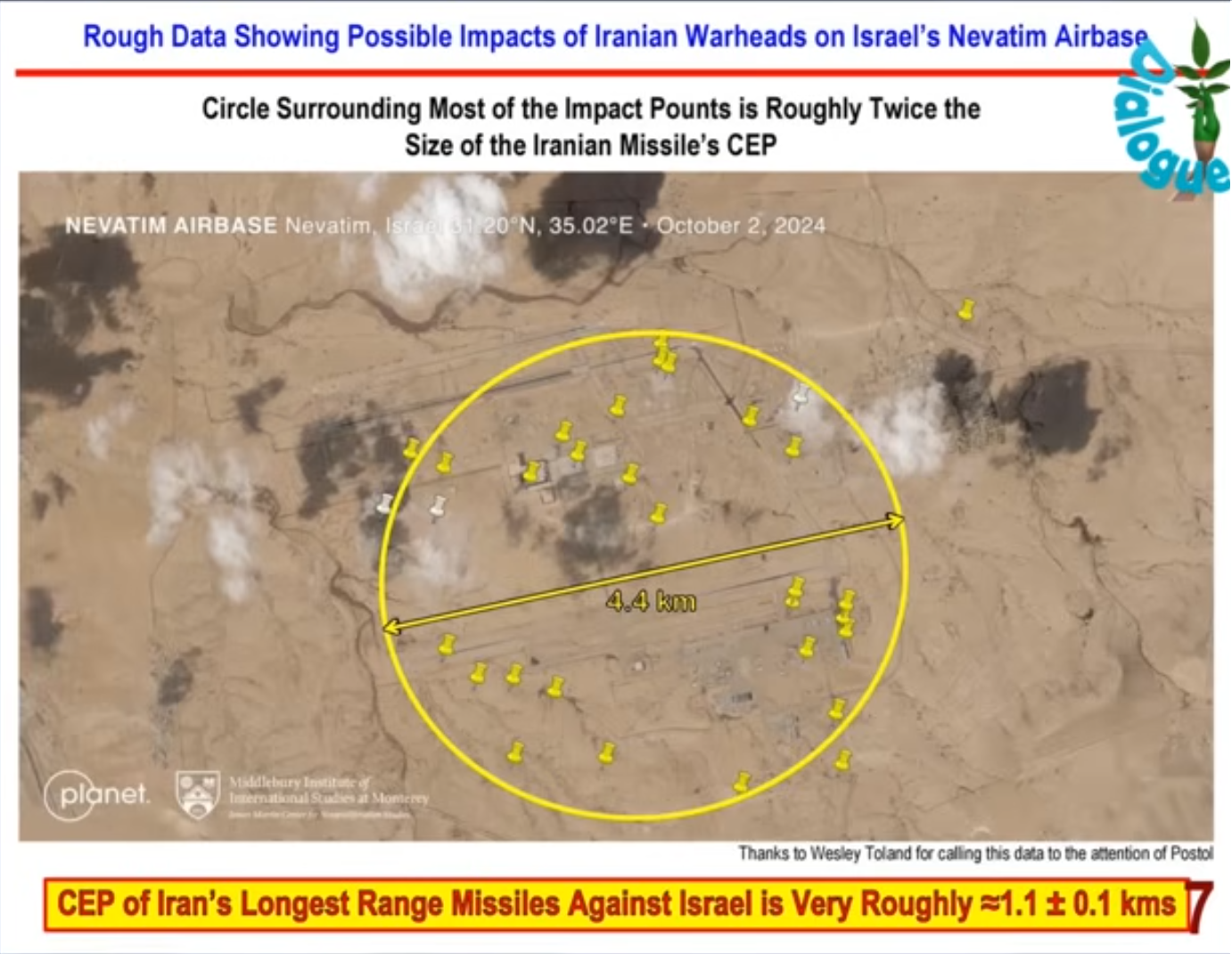
If we look at the situation, what we know —we go to slide seven— is that we have an estimate of the accuracy of these ballistic missiles from the attack on the Nevatim Air Base during the October war in 2024. They obviously wanted to damage the base. The distribution of warheads shows what their accuracy capabilities were at that time. One of the warheads actually hit a building and probably destroyed an F-35 inside. There is a lot of discussion about that. These are probabilistic events.
The distribution shown is how you estimate the accuracy of Iran’s ballistic missiles at that time. That does not mean it cannot improve. It will improve, and that has meaning in a different situation from the one people tend to focus on.
The possibility that the accuracy of Iran’s ballistic missiles will become so high that they can selectively target aircraft and shelters and things like that is very low in the near future. The technologies involved are extremely advanced and will be very difficult to implement, even for an advanced country like Iran. These technologies are very difficult to master for ballistic missiles.
Iran’s cruise missiles, however—I’m not talking about their drones—have demonstrated tremendous accuracy. In the attack on the Saudi Arabian oil fields, we saw evidence that Iranian cruise missiles have the ability to lock on to an object of a certain shape and home toward the center of that object. I could show that evidence in another discussion. So cruise missiles are extremely accurate, but ballistic missiles are a long way from there.
To understand what kind of damage ballistic missiles could do to an urban area, we need to understand what damage an explosion might cause.
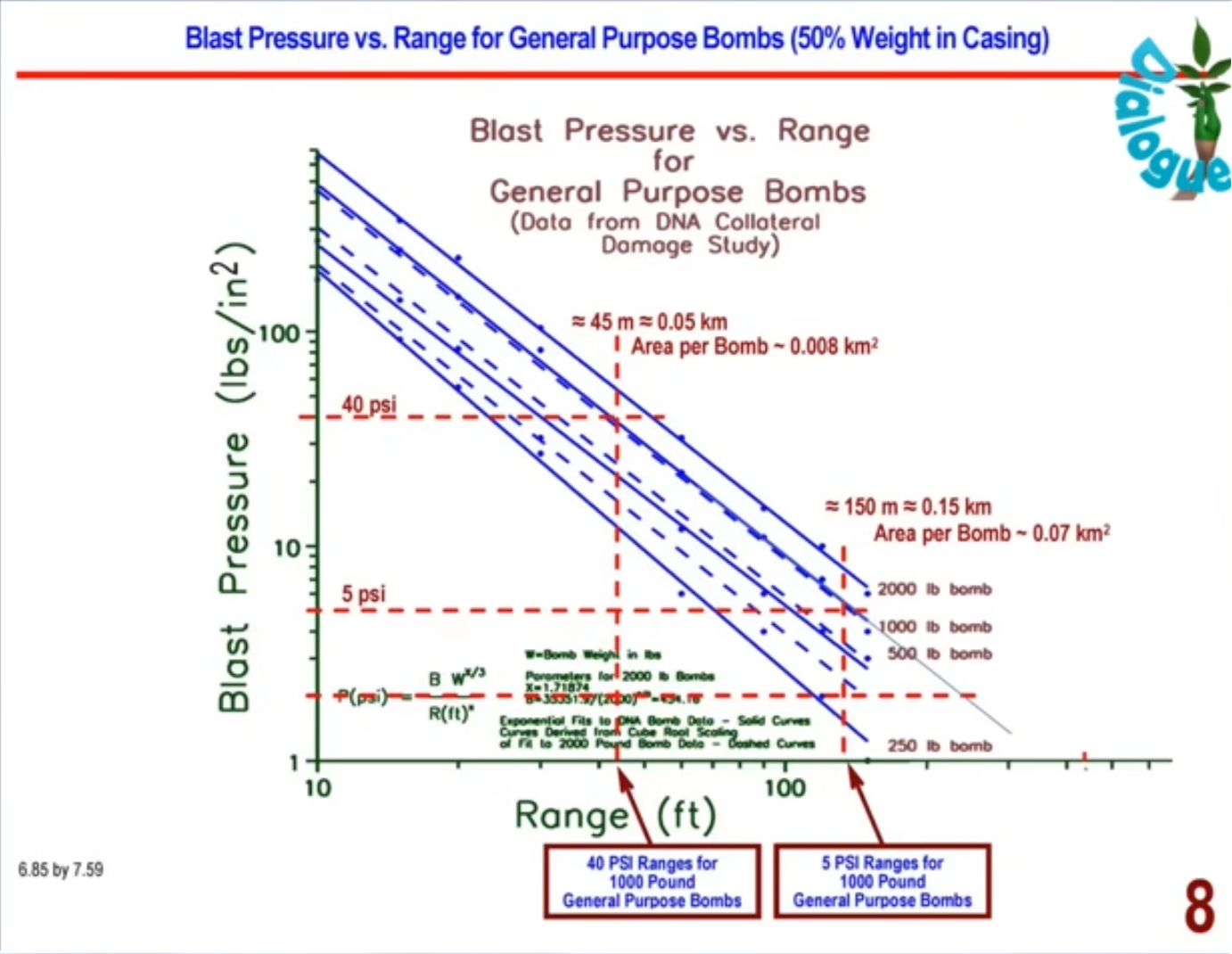
Slide eight shows the ranges at which certain levels of blast overpressure from a general-purpose bomb would occur. These are very general qualitative curves. For example, a 1,000-kilogram warhead, at about 100 meters you might get around two pounds per square inch. It could be 120 meters or 130, but approximately 100 meters. At 50 meters, you might get about five pounds per square inch. At around 15 meters, you might get over 40 pounds per square inch, which is enough to knock down a concrete and steel wall.
Let us look at slide nine to get a sense of what damage might look like.
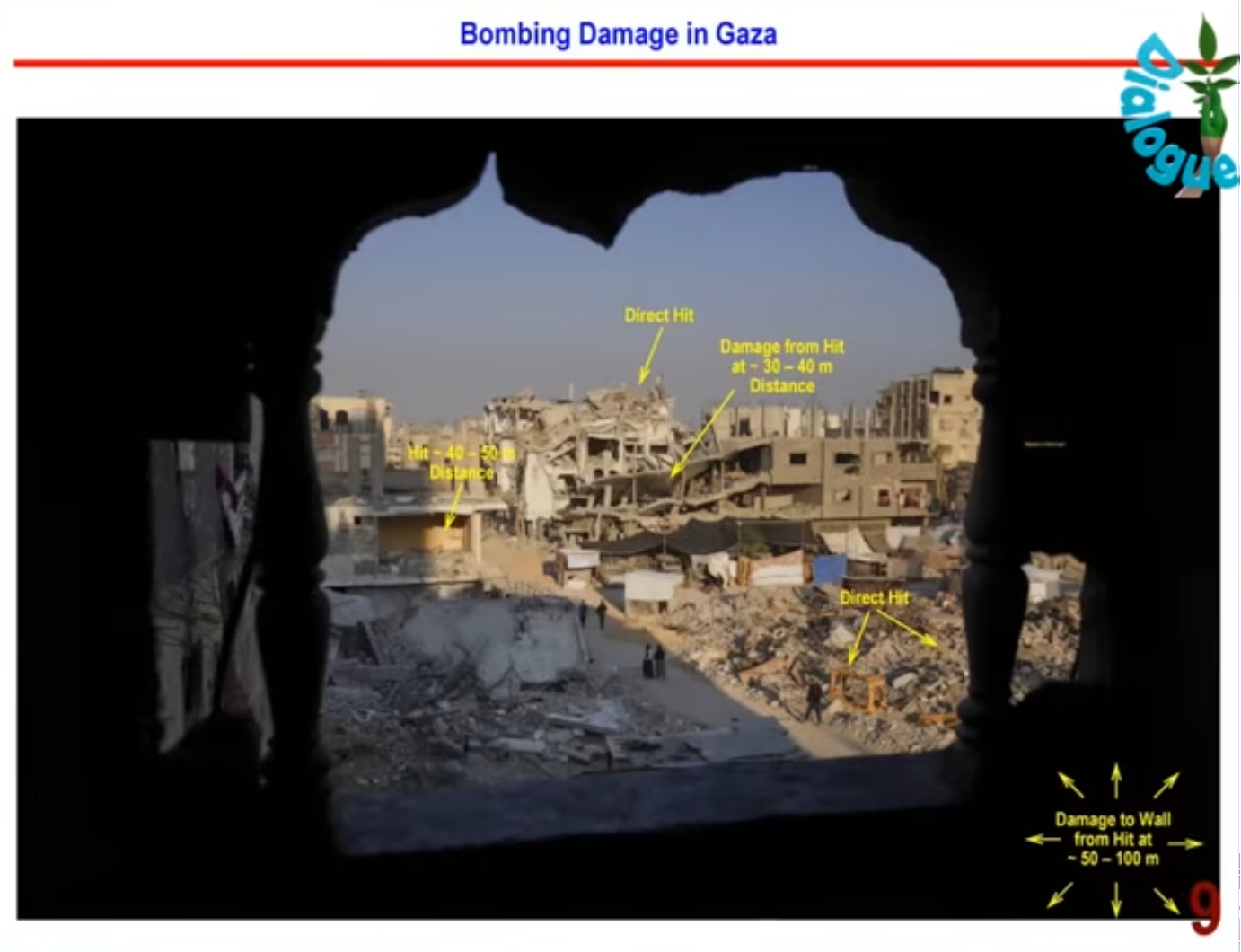
This is an image from Gaza. We are looking through a hole in the wall of a building. That hole was probably produced by the blast wave from a roughly 500- or 1,000-kilogram bomb that landed 50 to 100 meters away. It depends on the strength of the wall, but this is the kind of damage you can expect at that distance.
At the far end of the image, you can see what a direct hit looks like on a significant structure, concrete and steel, reinforced structure. The structure slightly forward of it was damaged not by a direct hit, but by secondary shock waves, perhaps from a bomb or bombs that landed 30 or 40 meters away.
The point is that there is a lot of damage beyond the point where a bomb hits.
On the left side, we see a building where the exterior walls have largely been knocked out, while the roof and floors appear intact. That was probably done by a blast 40 or 50 meters away, and the walls just collapsed or were blown inward. That is significant damage from bombs that did not directly hit the target.
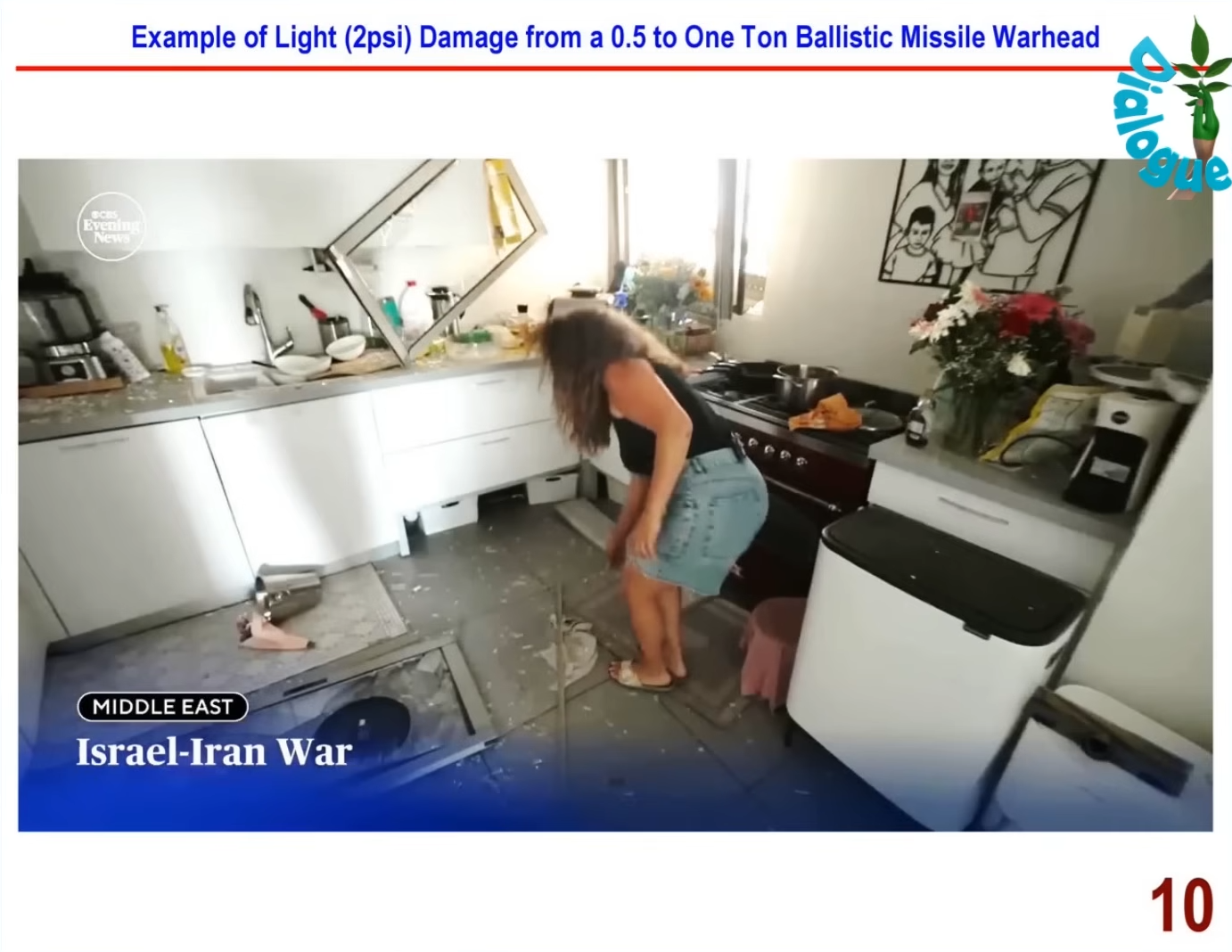
On the next slide, we see the interior of an apartment in Israel. This apartment was probably 100 to 150 meters away from a 500- to 1,000-kilogram ballistic missile explosion. At that distance—perhaps 50 to 100 meters—there is substantial general damage. The exterior window is blown out, and there is general disruption inside. If the blast had been at half that distance, the exterior wall could have been blown out.
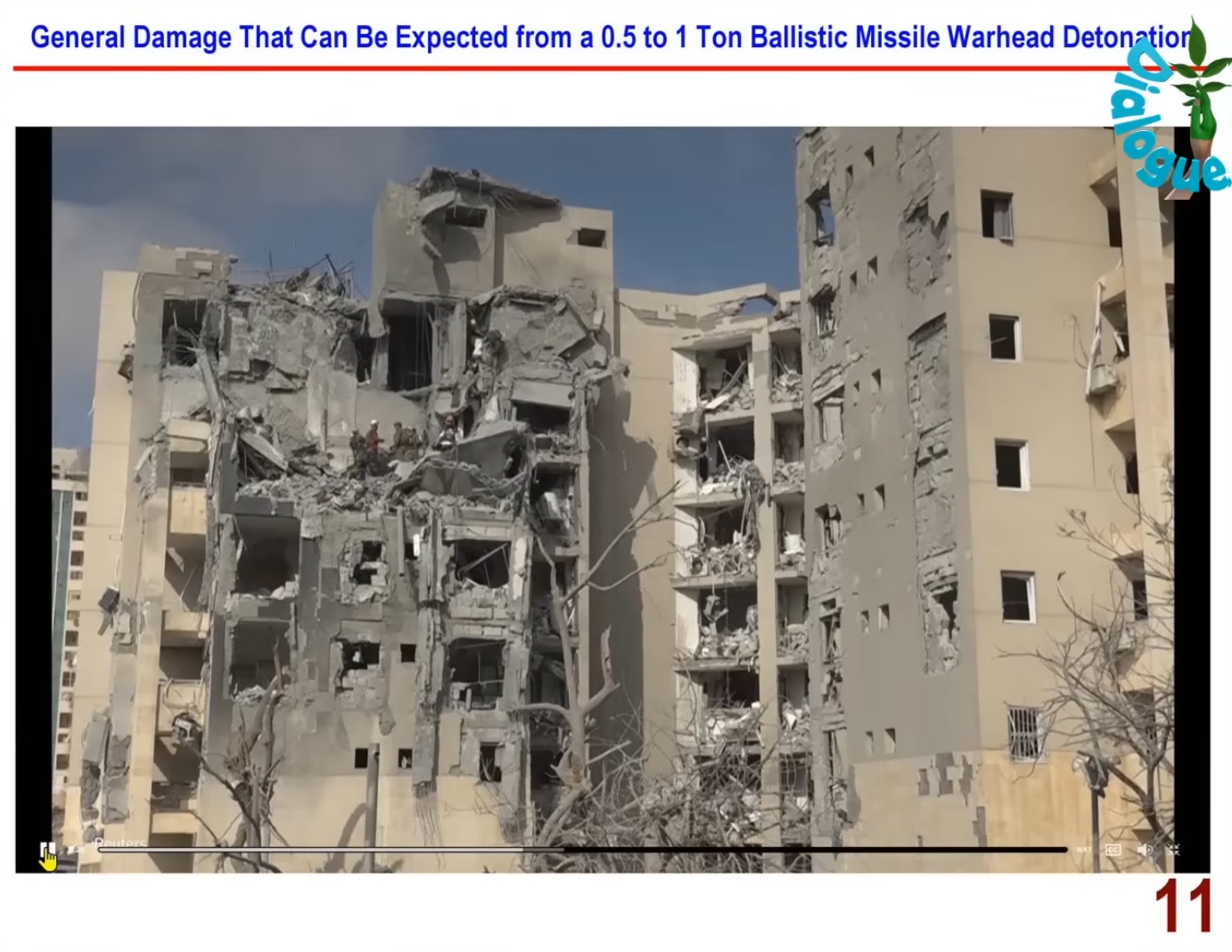
Slide 11 shows damage from a bomb that probably landed 50 or 60 meters away. The walls were shattered, and the interiors were badly damaged. There is evidence of fires in the building, which often occur in such events. There is usually no one around to fight the fires because people are injured or evacuating, and tremendous damage results.
Now that we have a sense of what the damage looks like, let us go to slide 12.
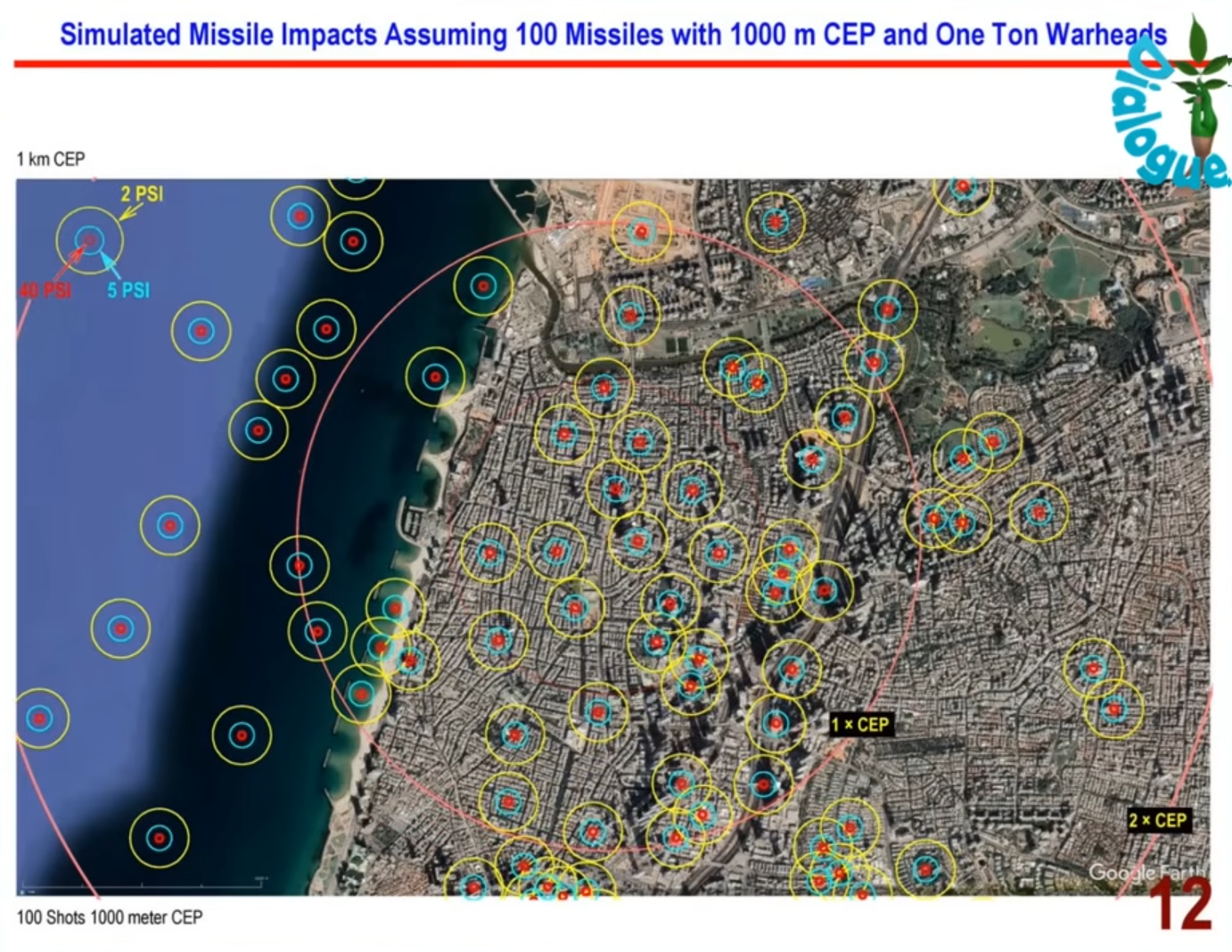
This is a simulated missile impact diagram. In the upper left corner, there is a key explaining the circles. The outer yellow circle represents about two pounds per square inch—damage similar to the apartment we saw earlier, where there was general internal damage without the walls being knocked down.
The five-psi contour shows the range at which a bomb landing nearby would severely damage the exterior walls of a building. It might not knock them down completely, but it would cause serious structural damage.
The 40-psi contour, shown in red, represents the range at which the structure itself would likely collapse or suffer severe structural damage.
This simulation shows 100 missiles with 1,000-meter accuracy, assuming a one-ton warhead. A 500-kilogram warhead would produce similar general conclusions.
If you were firing at Tel Aviv—and we know the Iranians were—a significant number of warheads would land in the downtown area, which we know occurred. There was considerable damage in downtown Tel Aviv, although the Israelis tried to mask it all. But if you went and talked to somebody who was in downtown Tel Aviv, they’d tell you there was bomb damage all over the place, you know. Very very damaging. Real problem. The Israelis tried to downplay it, but there was certainly a lot of reaction from the Israeli population.
And in fact I believe — I conjecture, I don’t know — that a lot of the discussion about running out of missile interceptors, or interceptors not working perfectly, is just a smokescreen. The defense interceptors were not working very well to begin with. These missiles basically came in unopposed, to a first approximation. There may have been some intercepts, but the number was very low—perhaps around five percent. I would be very surprised if it is as much as one in ten. I would be very surprised if it is that high.
There is a mythology that the Israelis have been trying to promulgate, which they cannot hide from their population because the Iranians showed their population what could happen. There is a big set of lies being promulgated to the Israeli people and to other organizations—that the defenses are simply running out of interceptors, that there are minor problems with intercept rates, and similar claims. In fact, these systems have never been effective at all.
Most of what the Iranians fired came through. When you have 1,000-meter precision, many warheads will simply fall into the Mediterranean, for example. That is what happens when you have a weapon that is not very accurate. Now what happens when 100 missiles have 500-meter accuracy rather than 1,000-meter accuracy, as shown in the next slide.
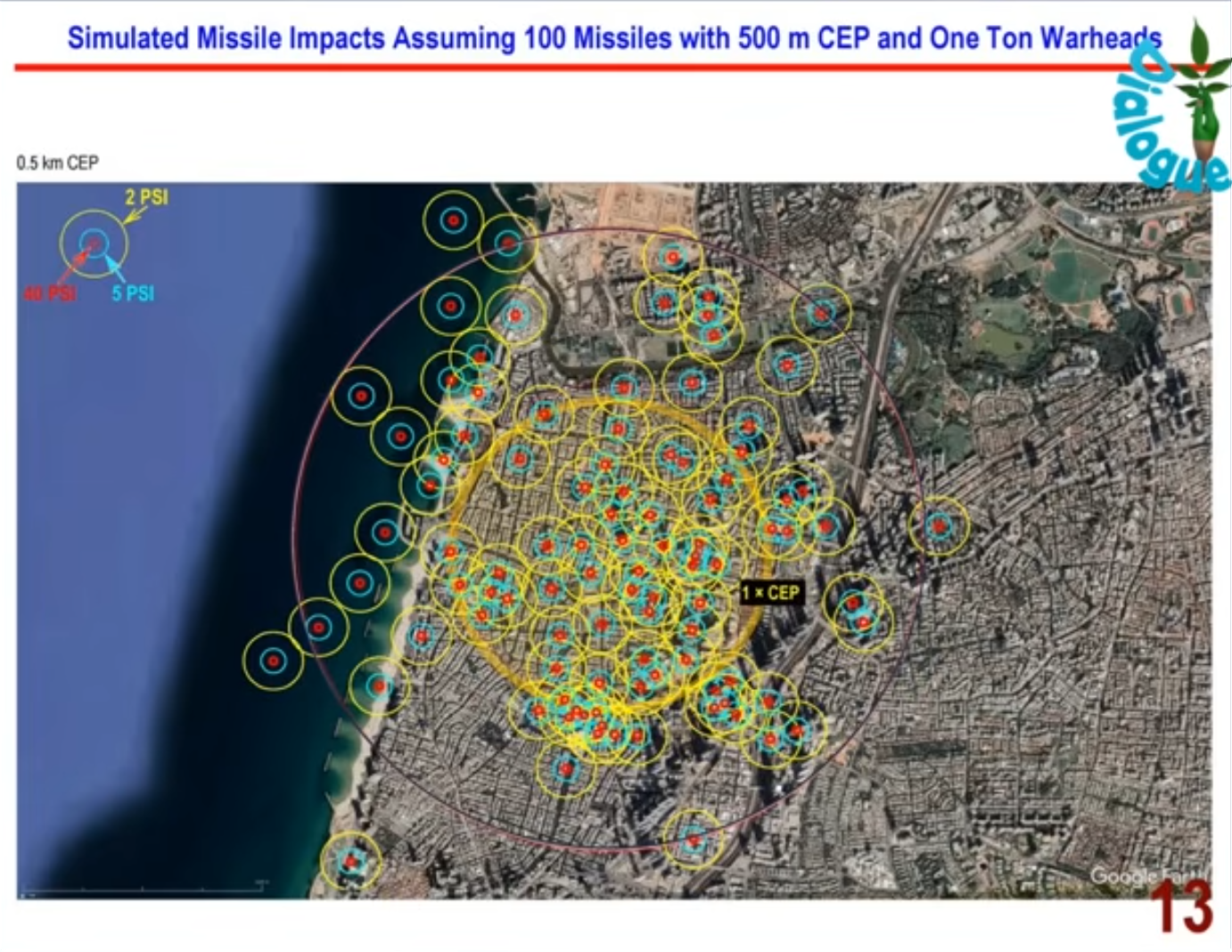
Things look a lot worse. A lot worse. You can see that the downtown Tel Aviv area gets at least twice the density of impacts. That is not a good sign if you are Israeli.
This simulation is for 100 missiles. Iran does not have to restrict itself to that number. Over time, Iran will not only improve its accuracy but also increase the number of missiles it can launch.
Let us look, in the next few slides, at what a 500-missile attack with 500-meter accuracy could look like.
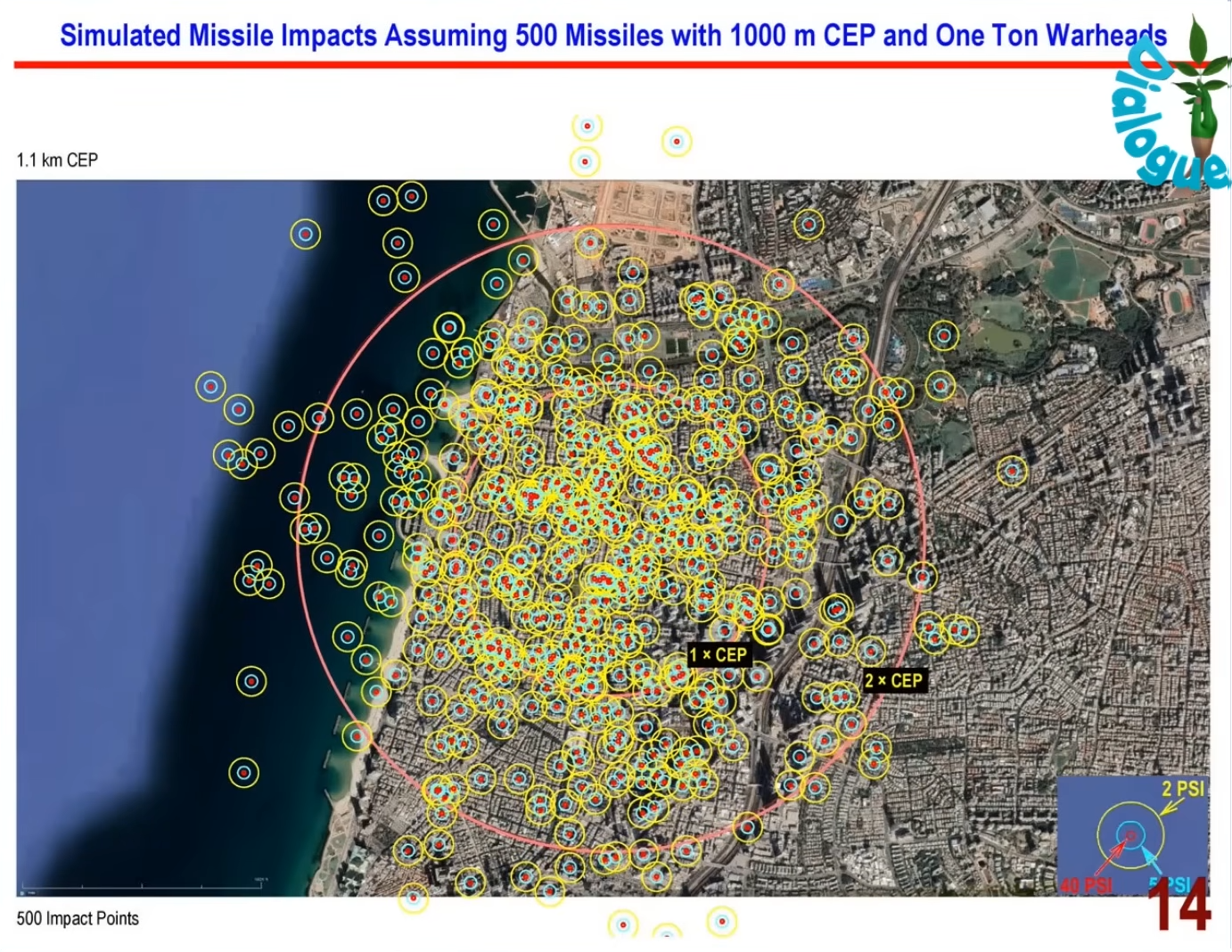
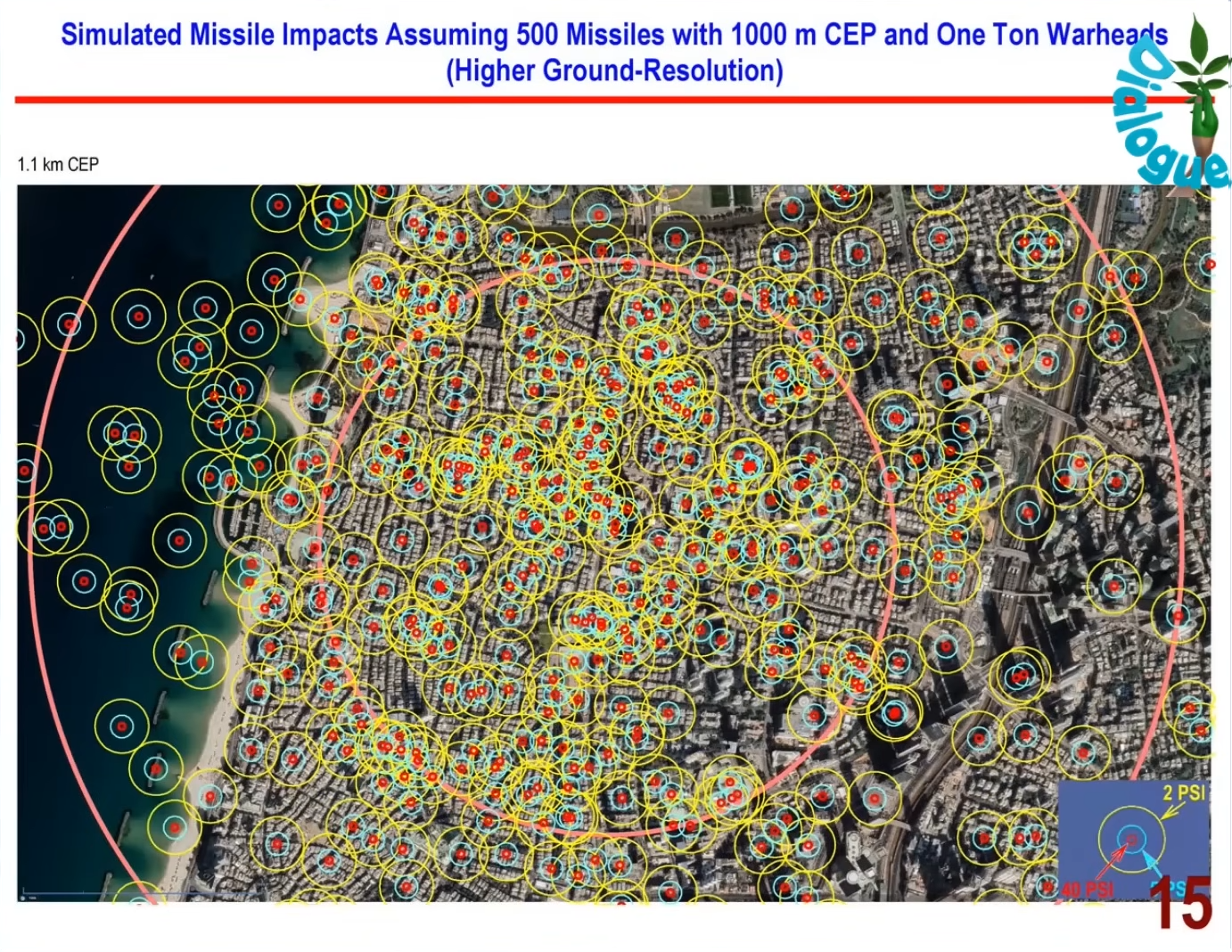
You see two roughly orange circles. One marks 1,000 meters of distance; the other marks 2,000 meters. A very large percentage of the warheads land within the urban built-up area of Tel Aviv.
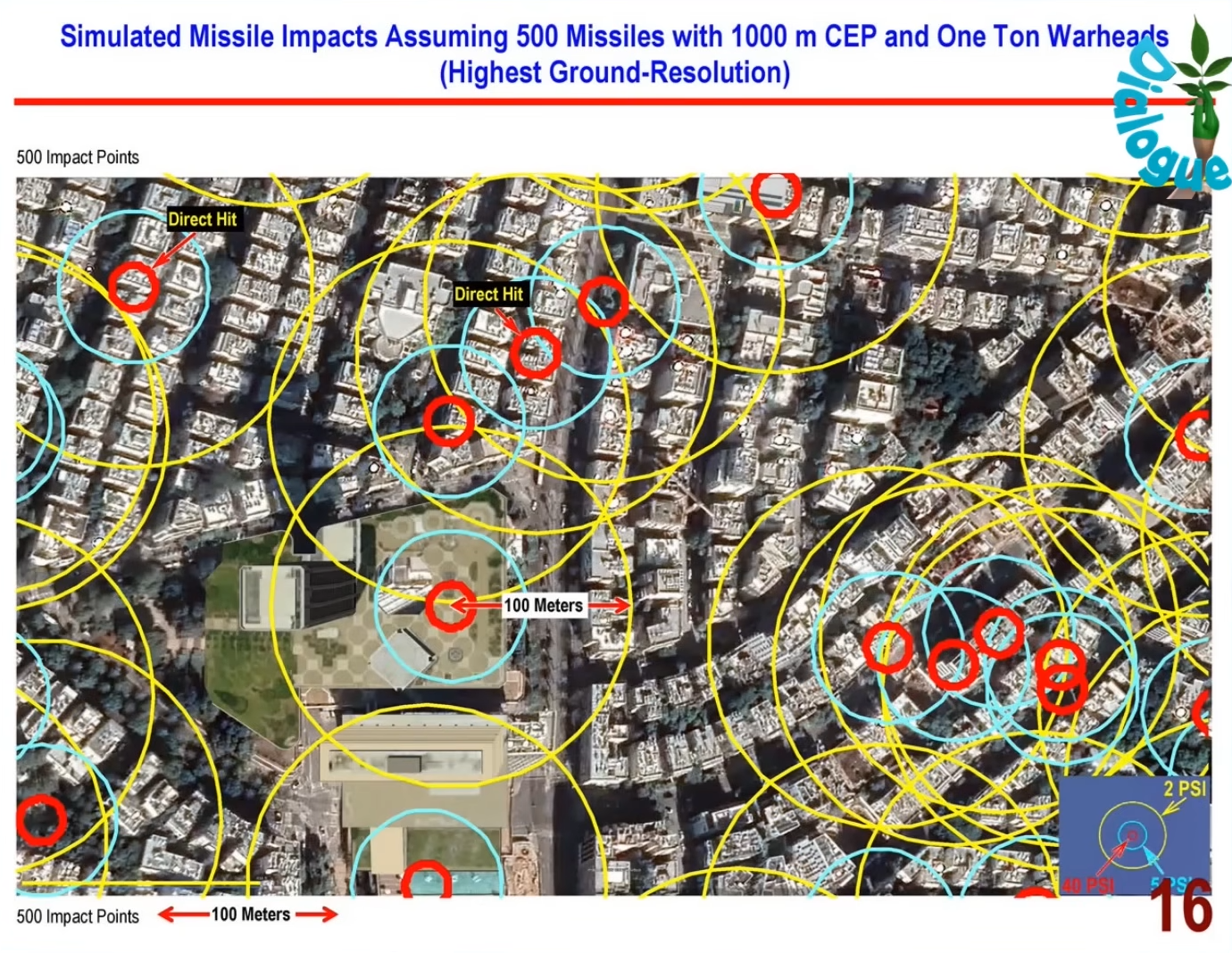
Slide 16 is a close-up. You can see the buildings and the density of impacts, to try and understand what it means. The red circles show areas where the blast intensity would be enough to knock down the buildings or large parts of them. That would be severe damage.
The blue lines show areas where extensive general damage would occur: interior apartment walls knocked out, fires initiated in many buildings, people injured by flying debris, evacuation under chaotic conditions, and widespread fires.
The yellow lines indicate areas of more general damage—broken windows and more in streets and buildings.
This entire area is covered with general damage and severe damage. It is just one arbitrarily selected area.
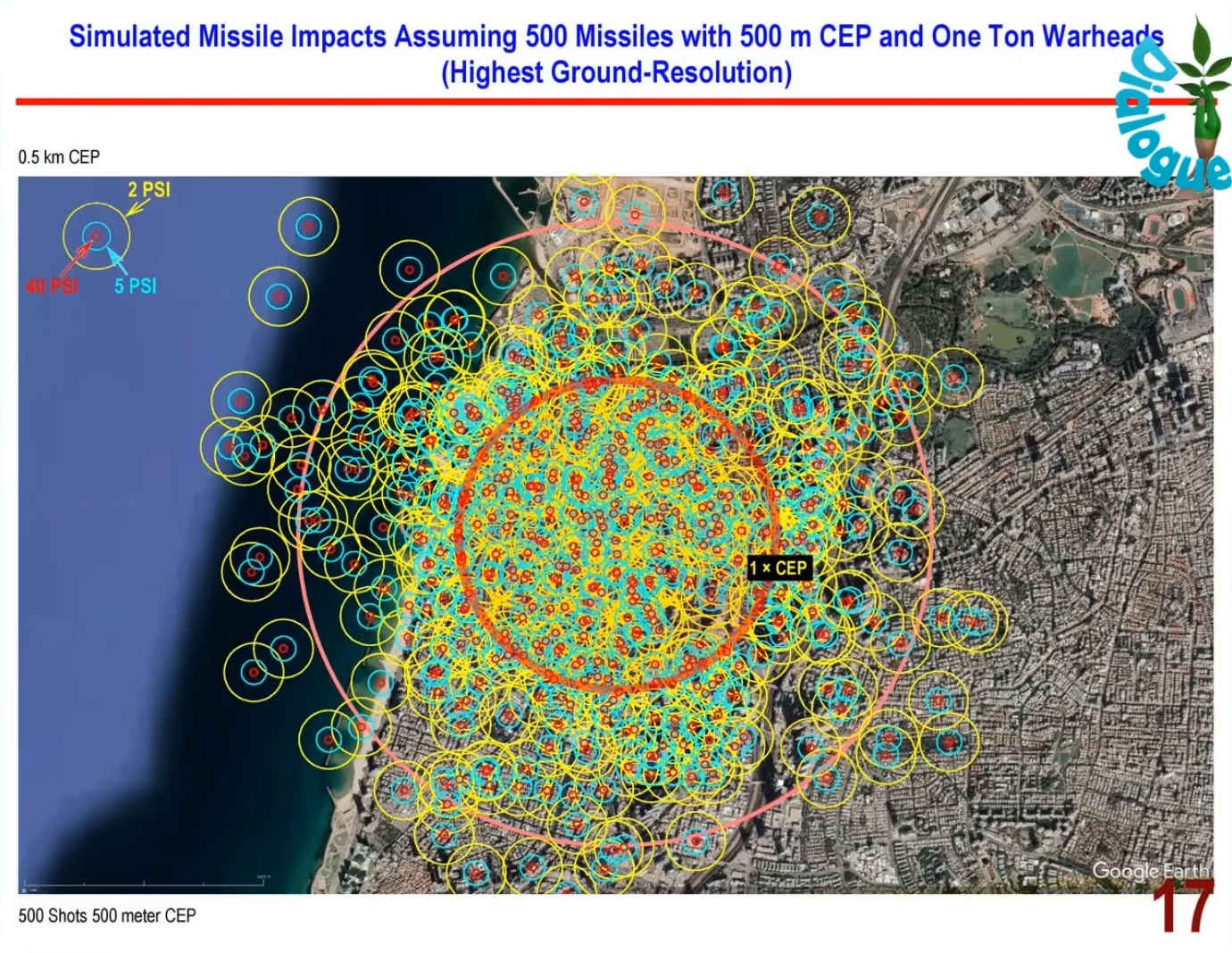
Slide 17 shows what the whole city looks like, in this case with 500-meter accuracy missiles: the density of impacts is so great that it blocks out the city. Each red dot represents severe damage to concrete and steel buildings—big, strongly built structures—along with widespread secondary damage to surrounding buildings and interiors.
After an attack like this, Tel Aviv is no longer a functioning city. Haifa is no longer a functioning city. Beersheba is no longer a functioning city. These cities could be shut down completely by a few thousand ballistic missiles with 500-meter accuracy, which you can be sure that in the next let’s say five years, Iran will have. Because Israel cannot stop them from building ballistic missiles. They will have, I think, the outreach from Russia and China, you know, they’ll be plenty of materials available, made available to Iran to continue manufacturing these ballistic missiles. And the technology for improving their accuracy is well in hand, as Iran is a sophisticated country with advanced engineering capabilities. All it needs is a little help from Russia or China or both to refine these missiles to 500-meter accuracy.
So we’re talking about a very big strategic problem that the Israelis have brought upon themselves by this aggressive behavior.
So let me go to slide 21, because I made a point about lying to the Israeli people. This is a slide from 1991. I think this may have occurred in Saudi Arabia, where Patriots were used to defend Saudi Arabia.
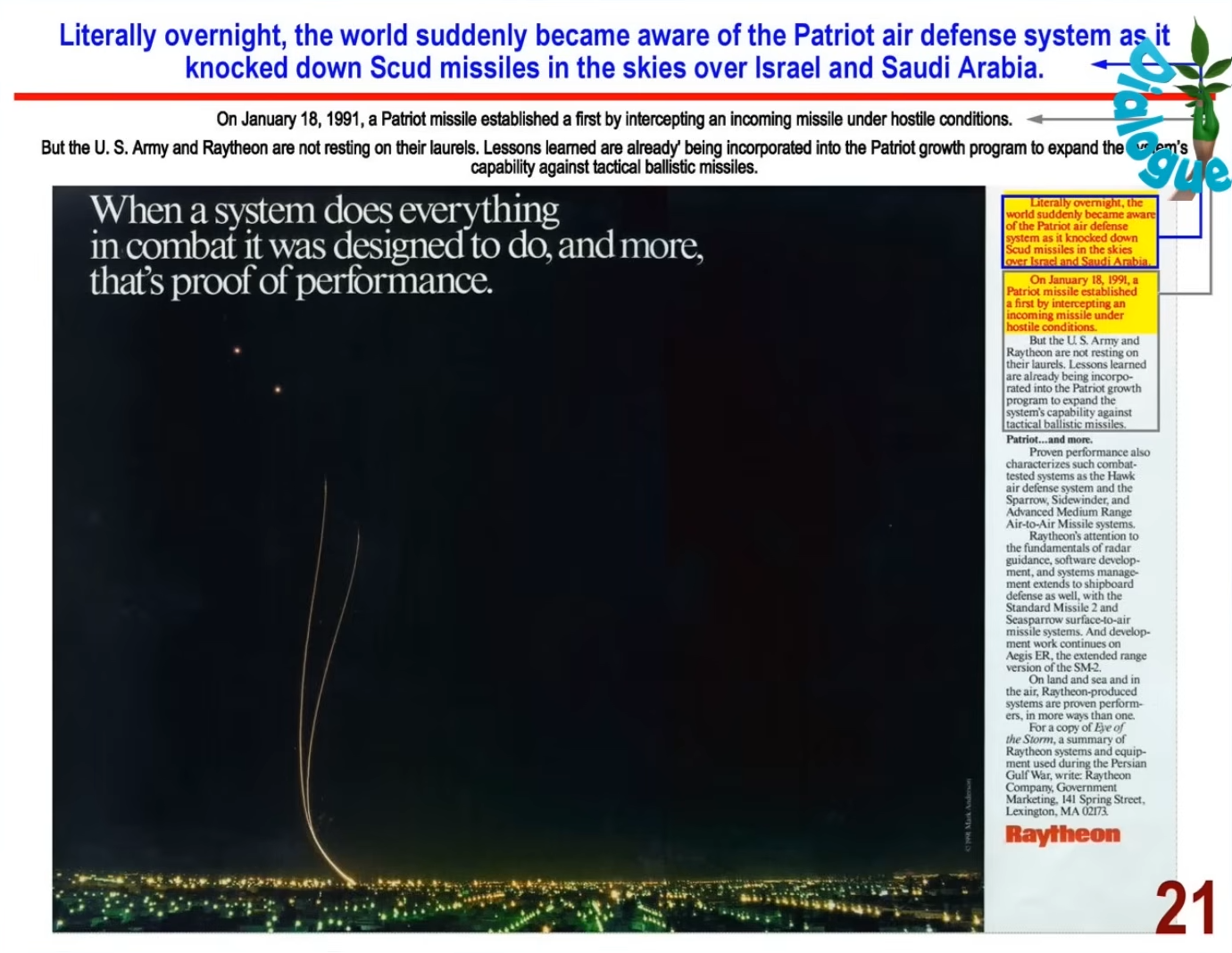
A spectacular photograph. Most people misunderstood it. And in fact, the Raytheon Corporation took a great… Let’s just look at what it says: “When a system does everything in combat it was designed to do and more, that’s proof of performance.” This was in Aviation Week & Space Technology, and it ran two pages. Two pages. A total lie by Raytheon, the company that is still building Patriots and claiming they work when they don’t.
This time-lapse photo—let’s stop for a second and understand how it works. The camera is focused on the skyline, and the aperture is open. It does not open and close like a regular photograph; it is just open. When a Patriot interceptor is launched, it has a rocket motor that burns. The rocket motor looks like a point of light, and that point of light traces a line on the film because this is a time exposure.
You see the line in both cases disappears because the Patriot burns out. It finishes its powered flight, then flies like a bullet and maneuvers by changing its orientation in the atmosphere.
Now you see those two dots in the sky. Those two dots are the explosions of the Patriot warheads. They have nothing to do with intercepting a Scud.
We found this engagement on a video camera and analyzed it frame by frame. One Scud came in. They missed it with both explosions. If they had hit the Scud, it should have appeared as a track on the black photo. The Scud was bright enough that you should have seen it as a track. Somebody took that track and blacked it out. So this was consciously a fraudulent photo.
This is what the Israelis tell their own people. This is what American contractors tell the Saudis, the Poles, the Ukrainians, and whoever else is foolish enough to spend money on their system for anti-missile.
It is a very effective system against aircraft, I want to be clear. You do not want to fly against Patriots if you are in an airplane. But as a ballistic missile defense, it is worthless, as we know from Ukraine as well.
What we have here is an example of layers upon layers upon layers of fraud that have been foisted off on the populations of different countries, and on the American taxpayer, who has bought most of these Patriots for other countries, including Israel and Ukraine.
What we have is nothing but a fraud against the American taxpayer, the Israeli public, and the Ukrainian population.
Ukraine is a horrific situation because we, the Americans have put the Ukrainians in a position where their country has been destroyed and will continue to be destroyed if it does not negotiate with what is left of it and with the Russians.
You can still find articles in The New York Times, the paper that is supposed to be the paper of record. Just the other day there was an article —I shouldn’t laugh, because it’s so serious— about how Prosk in Donbass had just fallen. Prosk fell two or three months ago. The New York Times is now reporting it? This is a crime.
You have unbelievably courageous Ukrainian soldiers fighting for their country, for what they believe is the survival of their country, and they are dying at a tremendous rate for nothing. This can all be stopped by carrying out a realistic negotiation.
But the political administration in Ukraine—my best analogy is Hitler letting all these Germans die as the Russians closed in on Berlin when the best thing to do would have been to surrender. The war was over. Why cause all these people to die? They were even executing their own people in the streets for not fighting.
It is this kind of fascism, and it is fascism, that is contributing to the complete destruction of Ukraine. I mean complete, because all of these dying soldiers are altering the demography of Ukraine for the next 20 years. There will be an incredible dip in the birth rate. There already is. Ukraine could potentially even disappear as a culture. I do not think it will, but it could.
All these extremists—banderites, white supremacists—who think they are saving Ukrainian ethnicity are destroying it.
We have all this complexity going on in the world in front of us, and the cynical political leadership of NATO and the United States as well is resulting in extraordinary loss of life. I am beside myself when I think about the loss of life in Ukraine for no reason.
Just negotiate. Stop trying to make yourself an existential enemy of the Russians. Just live beside them and stop this unbelievable slaughter, because the Russians are going to stop it anyway. They can stop it by reaching an understanding, or they can stop it by basically completely destroying Ukraine as a viable state, which I think is what will occur, unfortunately.
Sorry to jump around, but from the point of view of a technologist like myself, who is most deeply concerned with violence in the world and its negative consequences, I look at this with despair.
This talk is simple in some sense. The diagrams took a long time to put together. I did not just make them up. I wanted to make them understandable so you could visualize what 500-meter CEP means. When you see it laid out on a map, you begin to understand what the consequences are. We are visual animals. Our ability to learn is based on visual capabilities, and abstractions come after that.
That is what I have to share on this issue.
UK prosecutors drop aggravated burglary charges against 24 Palestine Action activists
The Cradle | February 18, 2026
The UK’s Crown Prosecution Service (CPS) dropped aggravated burglary charges against 18 of the Filton 24 activists on 18 February, citing a “reconsideration of the sufficiency of the evidence” after earlier acquittals in the same case at Woolwich Crown Court.
At a case management hearing in south London, prosecutor Deanna Heer KC told the court, “The prosecution has reconsidered the sufficiency of the evidence … In light of those verdicts and in respect of all the remaining defendants the prosecution offers no evidence on count one, aggravated burglary.”
The aggravated burglary charge linked to the Elbit factory raid carries a maximum sentence of life imprisonment.
The decision came two weeks after six co-defendants – Charlotte Head, Samuel Corner, Leona Kamio, Fatema Rajwani, Zoe Rogers, and Jordan Devlin — were acquitted of aggravated burglary on 4 February 2026. Jurors had deliberated for more than 36 hours before returning not guilty verdicts on that count.
Heer confirmed the CPS will seek a retrial on other allegations where no verdict was reached.
She told Mr Justice Johnson, “We now confirm the prosecution intention to seek a retrial in respect of all those allegations which no verdict was returned by the jury.”
Those include criminal damage against all defendants, violent disorder against three, and, in Corner’s case, causing grievous bodily harm with intent.
Rajwani, Rogers, and Devlin were cleared of violent disorder, while the jury failed to reach verdicts on that charge for Head, Corner, and Kamio.
None of the six were convicted of any offence, with all except Corner being released on conditional bail after about 18 months in custody.
Corner remains on remand over the unresolved Section 18 grievous bodily harm charge.
The remaining 18 continue to face criminal damage charges, with some also facing violent disorder allegations.
Thirteen defendants have applied for bail, while one, Sean Middlebrough, failed to return to custody while on conditional release in October last year.
Israel ‘dictating terms’ to US – Turkish professor
Washington is following the Jewish State’s demands on Iran and the Middle East as a whole, Hasan Unal has told RT
RT | February 18, 2026
Israel is effectively dictating US foreign policy, particularly on Iran and the wider Middle East, in a way that is historically unprecedented for a global superpower, a Turkish international relations professor has told RT.
Hasan Unal, who teaches at Baskent University in Ankara, spoke to RT’s Rick Sanchez this week about what he described as a highly unusual power imbalance between Israel and the US.
”We are living in a world now where a small country like Israel is dictating terms to a superpower like the United States on anything and everything, particularly anything pertaining to Israel and to the Middle East,” he said, calling the situation “totally unacceptable.”
Unal added that some analysts have even described it as an “occupation” of US policymaking by Israel, a characterization he said was “almost true.”
He went on to say that pro-Israel lobby influence and the personal involvement of Israeli Prime Minister Benjamin Netanyahu were shaping American positions, recalling episodes when Netanyahu “gets on his plane immediately” and flies to Washington “to simply dictate what [US President Donald] Trump should say and should negotiate in the negotiations with the Iranians.”
Unal claimed such a pattern has left Washington “dogging behind the Israeli demands all the time” and cautioned that it risks further destabilizing the Middle East.
Netanyahu has made multiple high profile visits to Washington to engage directly with senior US officials on regional policy. In the past year alone, he has met Trump at the White House at least six times to discuss issues ranging from Gaza and Iran’s nuclear program to military cooperation. His latest trip took place last week, ahead of the second round of indirect US Iran talks in Geneva. Netanyahu later said he had pressed Trump to ensure that Tehran is barred from enriching uranium. The renewed diplomatic push followed joint Israeli-US strikes on Iranian nuclear facilities last year, officially justified as an attempt to stop Iran from acquiring nuclear weapons – an ambition the Islamic Republic denies.
Trump has since sent an ‘armada’ to the Middle East and threatened further attacks unless Iran agrees to a deal on both its nuclear and missile programs. Last week, he raised the prospect of regime change and announced a second carrier strike group deployment, with media reports claiming the US military was ordered to prepare for a sustained multi-week operation if talks fail.
Asked whether Iran poses a direct threat to the US, Unal replied that Tehran does not seek to attack American assets as such and that many of the tensions are tied to Israel’s security calculations.
Unal also suggested what he called the gradual collapse of a “big empire,” referring to the Western-led order, and the emergence of a more multipolar system in which countries such as Russia, China, and Türkiye have greater room to maneuver. – video
Erdogan wants nukes: What a Turkish bomb would mean for the Middle East
Ankara is telling the world that a selective and force-driven approach to the Iranian nuclear issue could ignite a chain reaction
By Murad Sadygzade | RT | February 18, 2026
In Ankara, the idea of Türkiye one day seeking a nuclear weapons option has never been entirely absent from strategic conversation. Yet in recent days it has acquired a sharper edge, as the region around Türkiye is sliding toward a logic in which raw deterrence begins to look like the only dependable language left.
Türkiye’s foreign policy has expanded far beyond the cautious, status-quo posture that once defined it. It has positioned itself as a mediator on Ukraine and Gaza, pursued hard security aims through sustained operations and influence in Syria, Iraq, and Libya, and inserted itself into competitive theaters from the Eastern Mediterranean to the Horn of Africa. President Recep Tayyip Erdogan has long framed this activism as a corrective to an international order he portrays as structurally unfair. His slogan that the world is bigger than five – referring to the UN Security Council – is a statement of grievance against a system in which a narrow group of powers retains permanent privileges, including an exclusive claim to ultimate military capability.
Within that narrative, nuclear inequality occupies a special place. Erdogan has repeatedly pointed to the double standards of the global nuclear order, arguing that some states are punished for ambiguity while others are insulated from scrutiny. His references to Israel are central here, because Israel’s assumed but undeclared nuclear status is widely treated as an open secret that does not trigger the same enforcement instincts as suspected proliferation elsewhere. That asymmetry has long irritated Ankara, but it became more politically potent after the war in Gaza that began in 2023, when Erdogan openly highlighted Israel’s arsenal and questioned why international inspection mechanisms do not apply in practice to all regional actors.
Still, for years this was mostly an argument about fairness and legitimacy rather than a declaration of intent. What has changed is the sense that the regional security architecture itself is cracking, and that the cracks are widening at the very moment the US and Israel are escalating pressure on Iran. Türkiye’s leadership has warned that if Iran crosses the nuclear threshold, others in the region will rush to follow, and Türkiye may be forced into the race as well, even if it does not want dramatic shifts in the balance.
This is the key to understanding the new intensity of the debate. Ankara’s signaling is not primarily an emotional reaction to Tehran. Türkiye and Iran remain competitors, but their frictions have also been managed through pragmatic diplomacy, and Türkiye has consistently argued against a military solution to the Iranian nuclear issue. Erdogan has again presented Türkiye as a mediator, insisting on de-escalation and rejecting military steps that could drag the region into wider chaos.
The driver is the fear that the rules are no longer the rules. When enforcement becomes selective, and when coercion is applied in ways that appear to disregard broader stability, the incentives change for every middle power caught in the blast radius. The signal from Ankara is that if the Middle East moves into a world where nuclear capability is treated as the only ironclad guarantee against regime-threatening force, then Türkiye cannot afford to remain the exception.
That logic is dangerous precisely because it is contagious. It turns proliferation into an insurance policy. In an unstable region where trust is thin and the memory of war is always fresh, the idea of nuclear weapons as a shield against interference can sound brutally rational. If possessing the bomb raises the cost of intervention to unacceptable levels, it can be perceived as the ultimate deterrent, a guarantee that outsiders will think twice. But the same logic that appears to promise safety for one actor produces insecurity for everyone else. In practice it fuels an arms race whose end state is not stability, but a crowded deterrence environment in which miscalculation becomes more likely, crisis management becomes harder, and conventional conflicts become more combustible because nuclear shadows hover over every escalation ladder.
The renewed urgency also reflects a broader global drift. Arms competition is intensifying well beyond the Middle East. The erosion of arms control habits, the normalization of sanctions as a tool of strategic coercion, and the return of bloc-like thinking in many theaters all contribute to a sense that restraint is no longer rewarded. For Türkiye, a state that sees itself as too large to be merely a client and too exposed to be fully autonomous, the temptation is to seek leverage that cannot be negotiated away. Nuclear latency, even without an actual bomb, can function as a strategic bargaining chip.
Yet the jump from ambition to capability is not straightforward. Türkiye does have important ingredients for a serious civil nuclear profile, and those capabilities matter because they shape perceptions. The country has been building human capital in nuclear engineering and developing an ecosystem of research institutions, reactors for training and experimentation, accelerator facilities, and nuclear medicine applications. Most visibly, the Akkuyu nuclear power plant project with Russia has served as an engine for training and institutional learning, even if technology transfer is limited and the project remains embedded in external dependence.
Türkiye also highlights domestic resource potential, including uranium and especially thorium, which is often discussed as a long-term strategic asset. Resource endowments do not automatically translate into weapons capability, but they reduce one barrier, the need for sustained and vulnerable supply chains. As a result, Türkiye can credibly present itself as a state that could, if it chose, move from peaceful nuclear competence toward a latent weapons posture.
The real bottleneck is not simply material. It is political and legal. Türkiye is a party to the Nuclear Non-Proliferation Treaty, and it operates inside a web of international commitments that would make an overt weapons program extremely costly. Withdrawal from the treaty or large-scale violations would almost certainly trigger sweeping sanctions, diplomatic isolation, and a rupture with major economic partners. Unlike states that have adapted their economies to long-term siege conditions, Türkiye is deeply integrated into global trade, finance, and logistics. The short-term shock of a proliferation crisis would be severe, and Ankara knows it.
This is why the most plausible path, if Türkiye ever moved in this direction, would not be a dramatic public sprint. It would be a careful, ambiguous strategy that expands latency while preserving diplomatic maneuvering room. Latency can mean investing in expertise, dual-use infrastructure, missile and space capabilities that could be adapted, and fuel cycle options that remain justifiable on civilian grounds. It can also mean cultivating external relationships that shorten timelines without leaving fingerprints.
Here the debate becomes even more sensitive, because proliferation risk is not only about what a country can build, but also about what it can receive. The Middle East has long been haunted by the possibility of clandestine technology transfer, whether through black markets, covert state support, or unofficial security arrangements. In recent months, discussions around Pakistan have become particularly salient, not least because Islamabad is one of the few Muslim majority nuclear powers and has historically maintained close security ties with Gulf monarchies.
Saudi Arabia has repeatedly signaled that it will not accept a regional balance in which Iran alone holds a nuclear weapon. Saudi leaders have at times implied that if Iran acquires the bomb, Riyadh would feel compelled to match it for reasons of security and balance. Those statements are not proof of an active weapons program, but they are political preparation, shaping expectations and normalizing the idea that proliferation could be framed as defensive rather than destabilizing.
There have also been unusually explicit hints in regional discourse about nuclear protection arrangements, including arguments that Pakistan could, in some scenario, extend a form of deterrence cover to Saudi Arabia. Even when such claims are partly performative, they underscore how the region’s strategic conversation is shifting from taboo to contingency planning.
Once that door is open, Türkiye inevitably enters the picture in regional imagination. Türkiye, Pakistan, and Saudi Arabia are linked through overlapping defense cooperation and political coordination, and analysts increasingly discuss the emergence of flexible security groupings that sit alongside or partially outside formal Western frameworks. The idea that technology, know-how, or deterrence guarantees could circulate within such networks is precisely the nightmare scenario for nonproliferation regimes, because it compresses timelines and reduces the visibility that international monitors depend on.
For Ankara, this creates both opportunity and risk. The opportunity is that Türkiye could enhance its deterrent posture without bearing the full cost of overt development. The risk is that Türkiye could become entangled in a proliferation cascade that it cannot control, while simultaneously inviting a Western backlash that would reshape its economy and alliances.
This is where the question becomes deeply geopolitical. A nuclear-armed Türkiye would not simply change the Middle East. It would alter Europe’s security landscape and challenge the logic that has governed Türkiye’s relationship with the West for decades. Western capitals have tolerated, managed, and constrained Türkiye through a mixture of incentives, institutional ties, defense cooperation, and pressure. Türkiye’s NATO membership, its economic links to Europe, and the presence of US nuclear weapons stored at Incirlik as part of alliance arrangements have all been elements of a broader strategic framework in which Türkiye was seen as anchored, even when politically difficult.
If Türkiye acquired its own nuclear weapons, that anchoring would weaken dramatically. Ankara would gain a form of autonomy that no sanction threat could fully erase. It would also gain the capacity to take risks under a nuclear umbrella, a dynamic that worries Western capitals because it could embolden more confrontational regional behavior. Türkiye’s disputes with Western partners are already intense on issues ranging from Eastern Mediterranean energy politics to Syria, defense procurement, and the boundaries of alliance solidarity. A nuclear deterrent could make those disputes harder to manage because the ultimate escalation dominance would no longer sit exclusively with the traditional nuclear powers.
At the same time, a Turkish bomb could accelerate Türkiye’s drift away from the West, not only because the West would react with pressure, but because the very act of building such a capability would be an ideological statement that Türkiye rejects a Western-defined hierarchy. It would be Ankara’s most dramatic way of saying that it will not accept a subordinate place in a system it considers hypocritical.
None of this means Türkiye is on the verge of producing a weapon. Political obstacles remain huge, and technical challenges would be substantial if Ankara had to do everything indigenously while under scrutiny. A credible weapons program requires enrichment or plutonium pathways, specialized engineering, reliable warhead design, rigorous testing regimes or sophisticated simulation capabilities, secure command and control, and delivery systems that can survive and penetrate. Türkiye has missile programs that could in theory be adapted, but turning a regional missile force into a robust nuclear delivery architecture is not trivial.
The more immediate danger is not that Türkiye will suddenly unveil a bomb, but that the region is moving toward a threshold era, in which multiple states cultivate the ability to become nuclear on short notice. In such an environment, crises become more perilous because leaders assume worst-case intentions, and because external powers may feel pressure to strike early rather than wait. The irony is that a weapon meant to prevent intervention can increase the likelihood of intervention if adversaries fear they are running out of time.
The escalation by the US and Israel against Iran, combined with the broader arms race logic spreading across the Middle East and globally, is making this spiral more plausible. Uncertainty is the fuel of proliferation, because it convinces states that the future will be more dangerous than the present, and that waiting is a strategic mistake.
Türkiye’s rhetoric should therefore be read as a warning as much as a threat. Ankara is telling the world that a selective and force-driven approach to the Iranian nuclear issue could ignite a chain reaction. It is also telling regional rivals that Türkiye will not accept a future in which it is strategically exposed in a neighborhood where others have ultimate insurance.
The tragedy is that this is exactly how nuclear orders unravel. They do not collapse when one state wakes up and decides to gamble. They collapse when multiple states simultaneously conclude that the existing rules no longer protect them, and that deterrence, however dangerous, is the only available substitute. In a stable region, that conclusion might be resisted. In the Middle East, where wars overlap, alliances shift, and trust is scarce, it can quickly become conventional wisdom.
If the goal is to prevent a regional nuclear cascade, the first requirement is to restore credibility to the idea that rules apply to everyone and that security can be achieved without crossing the nuclear threshold. That means lowering the temperature around Iran while also addressing the deeper asymmetries that make the system look illegitimate in the eyes of ambitious middle powers. Without that, Türkiye’s nuclear debate will not remain an abstract exercise. It will become part of a wider regional recalculation, one that risks turning an already unstable region into a nuclearized arena where every crisis carries the possibility of catastrophe.
Murad Sadygzade, President of the Middle East Studies Center, Visiting Lecturer, HSE University (Moscow).
Epstein Files Expose Israeli Occupation of America
MSM grudgingly admits Pizzagaters were on to something
By Kevin Barrett | February 18, 2026
On January 30, the US Department of Justice released what it called “3.5 million responsive pages” in compliance with the Epstein Files Transparency Act spearheaded by Rep. Thomas Massie. Though more than a month late, redacted in bizarrely non-compliant ways, and representing only about half of the Epstein files (the other half are still being illegally withheld) the DOJ document dump provided abundant, irrefutable evidence that the “antisemitic conspiracy theorists” have been right all along: The United States of America is occupied by a Jewish supremacist crime ring based in Israel.
The documents show that when then-United States Attorney for the Southern District of Florida Alex Acosta gave convicted sex criminal Jeffrey Epstein a sweetheart plea deal in 2008 because Epstein “belonged to intelligence,” he was referring to Israeli intelligence. According to FBI files, Acosta’s source was Alan Dershowitz, Epstein’s lawyer, who himself represented Israeli intelligence.
Epstein should have gone to prison for years or decades, as would any other criminal convicted of the same charges. But the notorious sex trafficker got a work-release wrist slap. Since when can a foreign intelligence agency tell a US Attorney not to do his job?
The latest document dump confirms that Epstein, who was groomed as a sexual blackmailer by Les Wexner’s MEGA group of billionaire Mossad spies, was “trained as a spy by (Israel’s former military intelligence chief and Prime Minister) Ehud Barak,” who visited Epstein’s New York mansion on dozens of occasions. Barak and Epstein teamed up not only to blackmail American political, economic, and cultural leaders, but also to funnel huge sums of money to politicians in various nations—bribes in return for those politicians following Israel’s orders.
The new document dump reveals that Epstein worked with Israel to support their Ukrainian asset Zelensky, and to try to overthrow Russia’s Vladimir Putin and replace him with an Israeli stooge named Ilya Ponomatov. Epstein, we also learn, was involved in the overthrow of Libya’s Gaddafi. The Mossad blackmailer helped cultivate Israel’s relations with separatists in the imaginary nation of “Somaliland” (which only Israel recognizes). He brokered Israel’s ties with India’s Prime Minister Modi, and maintained close relationships with top UK leaders including Tony Blair and Peter “love the torture video” Mandelson.
These and other revelations prove that Epstein was not just a sexual blackmailer. Since his job was to establish compromising personal relationships with the world’s most powerful people, Epstein was also used by Israel as a high-level international power broker. “I represent the Rothschilds,” Epstein wrote to Peter Thiel, referring to the banking dynasty that created Israel.
The DOJ files show how Israeli/Rothschild agent Epstein lured his blackmail targets into a cesspool of depravity. The files contain many references to torturing, raping, and murdering children. FBI files cite testimony that Epstein’s crime ring would “birth babies for black market use.” Those who thought Pizzagate was an unproven conspiracy theory may be surprised to learn that the Epstein emails include more than 900 references to “pizza” as a likely code for child sex slaves. There are also 673 suspicious references to “ice cream” and countless uses of “grape soda” presumably referring to black prostitutes or sex slaves. Mainstream media are twisting themselves into contortions trying to insist that even though most of these food code words are obviously what they seem–code words for child sex slaves–though possibly a few could be interpreted as references to actual food! New York Magazine opines:
Admittedly, some of the pizza-related material seems pretty weird. An April 2018 message from a redacted sender says, “lets go for pizza and grape soda again. No one else can understand. Go kno.” Cryptic! Some of it is scrutable: “Go kno” appears to be a rendering of go know, an English derivative of the Yiddish expression geh vays, which is roughly equivalent to “go figure.” The claim that “no one else can understand,” on the other hand, is a creepy element that echoes Donald Trump’s allusion to “wonderful secrets” in his infamous letter on the occasion of Epstein’s 50th birthday…
“Pizza and grape soda” belongs to the latter category, and it appears frequently in Epstein’s emails and texts. In a 2018 exchange with his urologist, Harry Fisch (who erroneously appears in Epstein’s contacts as “Harry Fish”), the two seem to discuss refilling Epstein’s prescription for erectile-dysfunction medication. Fisch later texts, “After you use them, wash your hands and lets [sic] go get pizza and grape soda.” This proposal seems odd. There are many things you can do after your Viagra kicks in, and getting a slice with your doctor is not near the top of the list…
… Remember when only unreasonable people thought like this? The idea that pizza could be a code word for illicit sexual activities was laughable in 2016, when the so-called Pizzagate conspiracy captured the imaginations of what might charitably be called the internet’s most enthusiastic users…At the time, the assumption that pizza was code for sex with children seemed obviously arbitrary and extravagant, a violation of the principle that the simplest explanation is usually the right one. This heuristic, Occam’s razor, is often a handy way to differentiate ideas and people we should take seriously from ones we can safely dismiss — people who are frustrated that they’ve misplaced their keys tend to be more credible than those who think their keys have been stolen. Except with this Epstein pizza thing, the somebody-stole-my-keys contingent seems to have been suddenly, disastrously vindicated…
…Occam’s razor has comparatively little to tell us about grape soda. Fisch and Epstein refer to “pizza and grape soda” so often, and so often together — seemingly never just grape soda and rarely just pizza — that the whole thing starts to look like a shibboleth… The mystery deepens when you notice that Fisch often follows references to pizza and grape soda with an emoji depicting an African American…
The sender’s name has been redacted, and the identity of “Brice” is unclear, but a former New Zealand Army chef named Brice Gordon co-managed Epstein’s New Mexico ranch and was interviewed by the FBI in 2007. Red Hook is an unincorporated town in the U.S. Virgin Islands — the least-populated such place, according to the 2020 census, consisting mostly of marinas. There is, as it turns out, a pizza restaurant there. But why would someone need Epstein’s permission to have a “quick pizza meal” to which the financier was not invited? It’s enough to drive a sensible person to speculation.
From the mainstream media’s perspective, the problem is not that we are ruled by genocidal Israeli-Mossad-empowered Jewish supremacist psychopathic billionaire perverts. It is that someone might notice that we are ruled by genocidal Israeli-Mossad-empowered Jewish supremacist psychopathic billionaire perverts. That would mean that the “antisemitic conspiracy theorists” were right all along. Oy vey! Double-plus ungood!
Though the mainstream media professes to hate racism, they are covering up Epstein’s virulent racism against non-Jews. The emails are full of disparaging references to “goys,” a term for non-Jews that roughly parallels other racial slurs including the N-word. Epstein and his supremacist cronies loved to degrade non-Jewish children and teens, but never targeted their fellow “chosen people.”
For many Americans, the most disturbing revelations in Epstein files involve President Donald J. Trump. Prior to the files’ release, we already knew that Trump flew on Epstein’s jet at least eight times, was referred to by Epstein as his “best friend,” sent a birthday drawing to Epstein depicting a barely pubescent naked girl alluding to their “secret,” and has been accused of raping 13-year-old “Katie Johnson” in 1994 at an Epstein party and then threatening to kill the girl and her family. The first Epstein dump also contained FBI witness reports that Trump was present when a baby was drowned in Lake Michigan, and was implicated in the rape and murder of a certain Dusty Rhea Duke in 2000.
The new Epstein files release includes FBI witness reports that Trump was involved in murdering three girls who were buried at Mar-a-Lago and threatening the witness with a similar fate. Witnesses also told the FBI that Trump auctioned underage girls from his swimsuit contests, measuring their vulvas and rating them for tightness. Trump is also accused of forcing oral sex and other abuses against 13 and 14 year old girls.
Meanwhile the mainstream media chant in unison: “President Trump has not been accused of wrongdoing.” Will they change their tune, and suddenly discover the FBI files, if and when Trump stops following Israel’s orders?
A shorter version of this article was published in last week’s American Free Press. -KB
Stripe is Substack’s only processor and they debanked me, so you can no longer pay me through Substack. Now I am posting everything on Substack free and asking people to sign up for recurring donations at my Paypal donation page… or better yet, the free speech platform SPdonate. Alternately you can Paypal or Zelle to truthjihad[at]gmail(dot)com. Note that Zelle, unlike other methods, doesn’t charge any fees.
The Mandelson Molecule: Exposing the Architecture of Cross-Border Political Suppression
By Freddie Ponton | 21st Century Wire | February 18, 2026
The resignation of Peter Mandelson as UK ambassador to Washington in February 2026 revealed more than a scandal—it exposed the architecture of a parallel governance system operating through deniable channels. The Epstein files, the Center for Countering Digital Hate (CCDH) censorship apparatus, and the Mandelson intelligence pipeline are not separate stories. They are component parts of a transatlantic mechanism that converts private access into public control, with enforcement mechanisms that now reach across sovereign borders to silence American citizens.
Jeffrey Epstein was a convicted sex offender with deep ties to political and financial elites on both sides of the Atlantic. Peter Mandelson is a former UK power‑broker and ambassador to Washington, now under investigation for secretly sharing government information with Epstein. This article shows how their relationship connects to a wider system of online censorship and private global‑health finance.
The Intelligence Pipeline: Real-Time Treasury Briefings to a Convicted Sex Offender
The Mandelson-Epstein correspondence reveals something far more systematic than indiscreet friendship. It documents a private intelligence channel operating at the highest levels of UK and US financial policy.
In December 2009, while serving as Business Secretary, Mandelson forwarded Treasury positions on the bankers’ bonus tax to Epstein within hours of receiving them, with Epstein requesting advance notice “before Jes” and Mandelson replying simply: “Treasury”. By March 2010, the pattern had escalated—Mandelson forwarded notes from a meeting between UK Chancellor Alistair Darling and US Treasury Secretary Larry Summers to Epstein within five minutes, followed by his own meeting with Summers the next day. Those notes were forwarded within two minutes.
The content was market-moving intelligence: Dodd-Frank implementation, hedge fund taxation, derivatives regulation, and Bank of England quantitative easing strategy during the credit crunch. Mandelson advised Epstein that JPMorgan’s CEO should “mildly threaten” Chancellor Darling over policy. This systematic extraction of live government intelligence for private financial advantage can hardly be construed as incidental corruption.
DOCUMENT: Peter Mandelson leaked No 10 documents to Epstein, who then helped him pursue multi-million dollar jobs (Source: Tax Policy Associates)
The Censorship Architecture: From Anti-Corbyn Operations to American Deplatforming
The same censorship machine that produced the Biden White House’s authoritarian campaign against the so-called “Disinformation Dozen” in 2021 had emerged from the notorious Room 216, Brixton, where Israeli loyalist and architect of Keir Starmer’s rise to power, Morgan McSweeney, along with Imran Ahmed, built the “Labour Together” operation to dismantle Jeremy Corbyn. It was a CCDH list of 12 named individuals, which the White House then pushed Facebook to censor. The March 2021 “Disinformation Dozen” report was not independent research—it was unequivocally the identical playbook redeployed. The Biden White House directly cited CCDH’s report to pressure Facebook into censoring American health publishers, with internal documents showing the platform’s “secretly demoted” users, including alleged “anti-vaxxers”, and Twitter accounts of targeted individuals. When Facebook pushed back that the “majority of the accounts in question were not spreading misinformation,” the White House persisted.
Among those branded the “Disinformation Dozen” by the CCDH in March 2021: Robert F. Kennedy Jr. (Children’s Health Defense), physician Joseph Mercola, and Sayer Ji—whose investigative work exposing the Mandelson intelligence pipeline appears later in this report.
The method was documented in internal strategy papers: cultivate “seemingly independent voices to generate and share content to build up a political narrative,” infiltrate opposition spaces to extract decontextualised content, and feed narratives to sympathetic media. The “antisemitism crisis” that destroyed UK Labour Party leader Jeremy Corbyn was, as Labour Party files confirm, instrumentalised by this same faction.
Morgan McSweeney was CCDH’s founding director and subscriber for 18 months, operating from the same Brixton office that produced Labour’s anti-Corbyn operation. When he resigned in April 2020 to become Starmer’s chief of staff, Ahmed inherited an apparatus already proven effective at demonetising political opposition.

Morgan McSweeney, founding director of the CCDH, and former British Prime Minister Keir Starmer’s Chief of Staff. (Source: The Edge | Business news)
The March 2021 “Disinformation Dozen” report was not independent research—it was unequivocally the identical playbook redeployed. The Biden White House directly cited CCDH’s report to pressure Facebook into censoring American health publishers, with internal documents showing the platform “secretly demoted” affiliated accounts and Twitter accounts of targeted individuals. When Facebook pushed back that the “majority of the accounts in question were not spreading misinformation,” the White House persisted.
Project Molecule: The Financial Infrastructure of Private Governance
The August 2011 JPMorgan “Project Molecule” blueprint reveals the financial architecture that made this system durable. The $150 million fund Epstein pitched to JPMorgan CEO Mary Erdoes was designed to operate “across sovereign borders, into specific countries, for specific biological interventions”—with no elected officials, no treaty obligations, and no public accountability beyond its own audit committee.
DOCUMENT: JPMorgan “Project Molecule” blueprint (Source: DOJ Epstein File Library | EFTA01301114)
Epstein operated as Bill Gates’s representative under a written agreement, with the explicit purpose of securing “additional money for vaccines” while creating a “permanently governed, privately controlled, transnational system”. The budget allocated $40M for polio vaccines in Afghanistan, $40M in Pakistan, $20M specifically for “financing the surveillance network in Pakistan,” and $30M for rotavirus vaccines in Latin America.
This is the governance model: private intelligence (Mandelson-Epstein), private finance (Project Molecule’s offshore vaccination funds), and private enforcement (CCDH’s deplatforming operations) operating in substitutional parallel to democratic institutions.
The Enforcement Layer: Cross-Border Suppression of American Speech
What transforms influence operations into censorship is enforcement. The original investigation documents the apparatus reaching into foreign legal proceedings against American journalists—cross-border enforcement without due process, extradition treaties, or congressional oversight.
The pattern is now confirmed by US government action. In December 2025, Secretary of State Marco Rubio barred Imran Ahmed from entering the United States, citing his role in “leading organised efforts to coerce American platforms to punish American viewpoints they oppose”. Ahmed was one of five Europeans sanctioned under a visa policy targeting foreigners responsible for censoring protected speech in America.
The CCDH is now reportedly under DOJ investigation for potential violations of foreign agent registration laws, given its coordination with UK Labour operatives while targeting US political speech. Labour’s deployment of approximately 100 operatives to US swing states during the 2024 election—conducted by McSweeney’s network—has generated formal FEC complaints alleging direct electoral interference.
After days of parliamentary theatre about “transparency,” Westminster has craftily moved to bury the Mandelson-Epstein papers—not in open sunlight, but inside the Intelligence and Security Committee, a body three of whose members have already stuffed with cash from pro-Israel lobbyists.
In Britain, Downing Street originally wanted veto power over anything “prejudicial to national security”, but the documents will now be reviewed by the Parliament’s Intelligence and Security Committee (ISC). Critics argue that this allegedly independent oversight body could be compromised. In effect, three sitting members—Deputy Chair Sir Jeremy Wright, Sir John Hayes, and Labour’s Derek Twigg—have all taken money from the pro-Israel lobby, which by some estimates bankrolls roughly a quarter of British MPs. This can be verified in the excellent Declassified UK report published in June 2024.
The bottom line is that the Epstein file, which details how Mandelson piped classified Treasury intelligence to a convicted sex offender, and how British power brokers and Wall Street criminals traded backroom briefings, will now be “vetted” by politicians on the take from foreign influence networks. Forget transparency—it was never on the table.
The Architecture of Manufactured Consensus
The critical insight is structural: these networks exploit the gap between formal democratic institutions and actual governance. Mandelson’s Treasury briefings to Epstein occurred through informal channels. Project Molecule’s sovereign surveillance programs were designed to operate offshore. CCDH’s censorship operations, though effective at capturing White House policy, occurred through a nonprofit rather than state agencies. According to reports, George Soros is said to have donated $250,000 to the CCDH, which is working to censor conservative news outlets and to undermine Musk’s Twitter.
When the same personnel (McSweeney as CCDH founder, then Starmer’s chief of staff), the same infrastructure (Brixton operations), and the same methods (crisis amplification, media laundering, financial pressure) appear across Corbyn’s destruction, COVID censorship, and US electoral operations, we are not observing a coincidence. We are witnessing a system.
The switchboard is not the scandal. The switchboard is the system, and it is now being dismantled by the very government it sought to influence.
The Original Investigation
This synthesis builds upon the groundbreaking investigative work of Sayer Ji, founder of GreenMedInfo and author of the Switchboard series—including the first publication to connect the Mandelson-Epstein intelligence pipeline to the CCDH censorship apparatus. Ji’s research, conducted under direct legal and professional pressure from the very networks he was exposing, documented how British political operatives built a cross-border enforcement mechanism capable of weaponising foreign courts against American journalists.
His original reporting on Room 216, the Brixton operations, and the emergence of “disinformation” as a tool for political suppression predates mainstream coverage by years, and has now been validated by the Epstein disclosures, the Rubio sanctions against Ahmed, and the DOJ’s investigation into CCDH’s foreign agent activities.
Read the complete investigation series and supporting documentation at Sayer Ji Substack…
Sayer Ji reports on Substack…
The Switchboard: From Epstein to Mandelson to McSweeney to Ahmed — How a British Machine Became America’s Censorship Engine
How the Epstein Files Reveal the Architecture Behind Censorship, Crisis Finance, and What Happened When I Investigated It – Part 3 in a Series
Peter Mandelson, “the Prince of Darkness,” Keir Starmer’s hand-picked ambassador to Washington, the most powerful unelected figure in British politics, resigned from Parliament this week, one step ahead of legislation to eject him. The Metropolitan Police opened a criminal investigation. The Prime Minister apologised to Jeffrey Epstein’s victims for believing Mandelson’s lies.
The press is treating this as a story about a politician’s downfall. It is not. It is a story about what he was connected to — and what was built to make sure you never found out.
Key Findings:
- The censorship machine that targeted American speech during COVID was built inside a Labour Party factional operation. Morgan McSweeney and Imran Ahmed created the Center for Countering Digital Hate (CCDH) from the same office, using the same staff, and the same dark-money infrastructure they used to destroy Jeremy Corbyn — then redeployed the identical playbook against U.S.-based health publishers and independent media.
- CCDH’s founder and political patron is a protégé of Peter Mandelson, who was simultaneously routing confidential UK and U.S. government intelligence to Jeffrey Epstein. Mandelson forwarded Treasury readouts on the Volcker Rule, Dodd-Frank, and derivatives regulation to Epstein within minutes of receiving them — intelligence worth billions to Epstein’s Wall Street clients. The same political culture of deniable backroom operations that made the Epstein network functional also produced CCDH.
- Epstein’s network was not just criminal — it was architectural. Project Molecule, a $150M JPMorgan blueprint produced the same month Epstein sketched a private global health fund, reveals the institutional machinery: offshore vaccination funds, sovereign biological surveillance programs, and governance structures designed to bypass elected oversight entirely.
- The enforcement layer is not theoretical — it has already been deployed against named individuals. CCDH’s “Disinformation Dozen” list led directly to platform deplatforming. In at least one documented case, CCDH-originated material was entered into foreign legal proceedings to seek an ex parte arrest warrant against a U.S.-based journalist for lawful American speech — cross-border enforcement with no due process, no extradition treaty, and no congressional oversight.
- The same network is now the subject of a formal FEC complaint alleging direct electoral interference. McSweeney — Mandelson’s protégé, CCDH’s political architect, and now Starmer’s chief of staff — was named in a formal FEC complaint for dispatching approximately 100 Labour operatives to U.S. swing states during the 2024 presidential election. The censorship pipeline and the electoral interference pipeline share the same personnel, the same infrastructure, and the same assumption: that British political operatives can shape American outcomes without accountability.
Featured Video
Racist Seinfeld Dances for Joy as Bibi Unveils His New Map
or go to
Aletho News Archives – Video-Images
TV Drama Review
Japanese drama projects Japan’s wartime atrocities onto Chinese characters

Global Times | October 25, 2026
By portraying Chinese characters as perpetrators of ruthless violence while casting Japanese Self-Defense Forces (SDF) intelligence operatives as defenders, the season 2 of the Japanese drama Vivant has recently drawn criticism from Chinese netizens, who argue that its depiction turns historical reality on its head while ignoring Japan’s wartime atrocities.
The TBS drama series – a spy suspense story in which an alleged unofficial intelligence unit of the SDF operates across the globe — has attracted a passionate fanbase. Its currently airing season 2 opened with a household rating of 18.8 percent, the highest for a TV drama this year, according toa commentary article by Japanese media Toyo Keizai.
What draws attention is the portrayal of the enemies in the series, the article noted. Scenes in which the Chinese organization subjects kidnapped members of the SDF unit to brutal torture are repeated with unrelenting intensity.
It is rare for Japanese TV dramas to explicitly portray a real-life country as the enemy, the article noted.
Japanese Prime Minister Sanae Takaichi also made a reference to the drama, saying that she has been recording Vivant and hopes to binge-watch it over the year-end and New Year holidays, according to Japanese media outlets.
China’s CCTV News report on Sunday revealed that the drama features scenes in which Chinese personnel cut off the fingers of and stab Japanese intelligence operatives in the abdomen. Such acts bear striking similarities to the torture inflicted on Chinese nationals by invading Japanese troops during the World War II.
The drama distorts the truth by attributing these atrocities to modern Chinese characters. Beneath the surface, it subtly glorifies Japan’s cross-border overseas operations, blurs the functional boundaries of the SDF and implicitly promotes an expansionist narrative, per CCTV News. … continue
Blog Roll
 Aletho News
- EU facing trillion-euro debt hole while seeking more cash for Kiev
- How US, Europe, Persian Gulf states exhausted missile stockpiles, splurged billions to defend Israel
- Up in arms… Koreans reject U.S. empire’s plan to make South Korea the next Ukraine
- Iran, Turkey, Pakistan, Saudi Arabia could advance region-led security framework in Tehran: FM spox
- Netizens condemn Japanese drama for projecting Japan’s wartime atrocities onto Chinese characters
- Racist Seinfeld Dances for Joy as Bibi Unveils His New Map
- A West Bank War for Netanyahu’s Election Campaign, Could It Backfire?
- Yemen denounces European Parliament’s ‘hypocritical’ push to blacklist Ansarullah
- Qalibaf: UAE’s UN bid aims to ‘clear the runway’ for ‘Greater Israel’, whitewash genocide
- Pakistan reopens Iran border after boosting security: Report
- If Americans Knew
- An error has occurred; the feed is probably down. Try again later.
- No Tricks Zone
- Sudden Stratospheric Warming, Powerful El Niño Combination May Lead To Extreme Europe Cold, Energy Crisis!
- Two New Studies Find Thwaites Glacier Melt Cannot Be Driven By Human Activity Or A Warming Ocean
- E-Cars Reduce CO2 Emissions By Only 41% Compared To Internal Combustion Engine Vehicles
- Predictions Made By Renowned Climate Professor Over Past Decades Have Been Proven To Be Poor
- New Study Suggests Large Regions Of The Pacific Ocean Have Been Cooling For The Last 80 Years
- Germany’s Green Energy Debacle: High Energy Costs Force Kahla Porzellan to Close After 182 Years!
- New Study: 50 Years Of The Most Aggressive ‘Net Zero’ Policies Can Only Affect The Global Climate By 0.03°C
- US September “Heat” Was No Record…Many Records Set Decades Ago
- Latest European Green Energy Debacle; Portugal’s Largest Flagship Solar Park Insolvent!
- Green Energy Debacle: German Expert Professor Fritz Vahrenholt Warns Of Severe Economic And Social Consequences

