Nablus police chief, 3-year-old daughter injured by Israeli fire
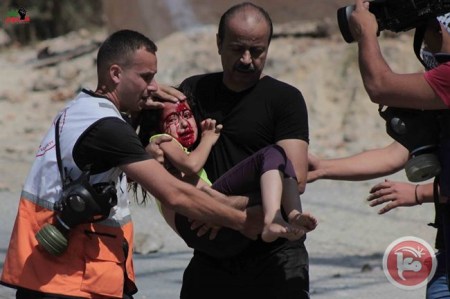
Three-year-old Maram Abed al-Latif al-Qaddumi was shot in the head by Israeli forces with a rubber bullet in the occupied West Bank town of Kafr Qaddum.
(MaanImages/Murad Ishteiwi)
Ma’an – September 25, 2015
NABLUS – The chief of police in the Nablus district and his three-year-old daughter were injured after being shot by Israeli forces with rubber-coated bullets on Friday during a raid in the village of Kafr Qaddum in Qalqiliya.
A Fatah leader in Kafr Qaddum, Murad Ishteiwi, told Ma’an that Israeli forces directly shot at three-year-old Maram Abed al-Latif al-Qaddumi, injuring her with a rubber-coated steel bullet in the head while she was standing on a balcony in her home.
Isheiwi added that when her father, Colonel Abd al-Latif al-Qaddumi, attempted to aid her and take her to the hospital in his car, Israeli forces opened fire, injuring him in the head.
They were both taken to the Rafidia Governmental Hospital in Nablus where their injuries were reported as moderate. Both are currently in a stable condition.
Ishteiwi said that Israeli forces had raided the area and set up several ambushes inside of the town in an attempt to prevent the weekly Kafr Qaddum march.
An Israeli army spokesperson didn’t have any immediate information but told Ma’an they were looking into the incident.
On Sept. 11, Israeli military forces raided the house of al-Qaddumi, and turned his home into a military outpost after evicting his wife and children.
Days earlier, Israeli forces held al-Qaddumi for more than an hour near the entrance of Hijja village west of Nablus.
Last week Israeli forces shot and injured a 14-year-old with live fire in Kafr Qaddum during a demonstration.
An Israeli army spokesperson told Ma’an that there was a “riot” in Kafr Qaddum, where protesters threw rocks and rolled burning tires at Israeli forces, who opened fire “using .22 caliber rounds towards the extremities of the main instigator and a hit was confirmed.”
A weekly average of 39 Palestinians have been injured by Israeli forces since the start of 2015. The majority of injuries sustained by Palestinians occur during unarmed demonstrations.
Rights organizations have argued that methods of crowd control used by Israeli forces often result in excessive, and sometimes fatal, use of force.
Residents of Kafr Qaddum carry out weekly demonstrations in protest of the now 13-year closure of the main street out of the village, which leads to nearby Nablus — the area’s economic hub.
Kafr Qaddum has also lost large swathes of its land to Israeli settlements, outposts and the separation wall, all illegal under international law.
Garifuna Communities of Honduras Resist Corporate Land Grabs

By Samira Jubis | Council on Hemispheric Affairs | September 23, 2015
The fate of the Garifuna people of Honduras hangs in the balance as they face a Honduran state that is all too eager to accommodate the neoliberal agenda of U.S. and Canadian investors. The current economic development strategy of the Honduran government, in the aftermath of the 2009 coup against the democratically-elected President Manuel Zelaya, has not only benefited the political and economic elite in Honduras, but it has also encouraged the usurpation of some of the territories of indigenous peoples of this Central American nation. The often-violent expropriation of indigenous land threatens the Garifuna’s subsistence.
The Garifuna people are descendants of African slaves and two indigenous groups originally from South America—the Arawaks and the Carib Indians. In 1797, the British deported 5,000 Garifuna, also known as Black Caribs, from St. Vincent to Roatán. Since then, the Garifuna people have immigrated throughout North and Central America.[i]
Triunfo de la Cruz and Punta Piedra are home to two of the forty-eight Honduran Garifuna communities along the Honduran Atlantic coast corridor. Due to an ecologically rich geopolitical position, these regions have attracted foreign-backed investments, including tourist and recreational centers, natural resource extraction industries, and self-governing corporate zones. The concept of “self-governing” does not apply to democratic procedures of native citizens, but to the domination of foreign elites who view the Garifuna land as a mere means to the private accumulation of wealth.
Mega development projects have been advertised as a stimulus to economic growth and employment within the country. However, in practice, they have aggravated discrimination and harassment against indigenous and ethnic groups, whom developers generally perceive as obstacles to the expansion of such economic projects. Hence, the Honduran political system, in thrall to ambitious tycoons and foreign interventionism, has infringed on the Garifuna community’s relationship to and management of their ancestral lands. The displacement of these Honduran Afro-descendant communities from their ancestral lands for the development of economic projects accelerated after the coup d’état of June 28, 2009 against the democratically elected President, Manuel Zelaya, and the installment of a U.S. backed golpista regime.
The United States and Canada perceived the center-left policies of former Honduran president Manuel Zelaya as an intolerable restraint on American and Canadian investment objectives in Honduras. The alignment of Honduras with the left-leaning Bolivarian Alliance for the Americas (ALBA) and PetroCaribe along with stricter domestic reforms to rein in the damage caused by neoliberal policies, emboldened the U.S.-Canadian intervention in the Honduran political system. The coup brought the golpista regime of Roberto Micheletti (June 28, 2009 to January 27, 2010) to power and was followed by the subsequent election of two right wing presidents. Tegucigalpa has pursued policies that are more obedient to the economic consensus of Washington and Ottawa, reversing its march towards progressive land and labor reforms and opening the doors wide to foreign investors. As a result, Honduras has been the bloody stage for human rights violations against those who have resisted some of the more intrusive features of the neoliberal economic model.
The Garifuna community of Triunfo de la Cruz, for example, possessed title deeds of full ownership to their ancestral territories. However, the U.S. and World Bank-backed 1992 Agrarian Modernization Law not only led to the expansion of Tela’s city boundaries, but also stimulated future transactions of ancestral lands without consent of the Garifuna community members.[ii] Grahame Russell is the director of Rights Action and has devoted his life to protecting human rights in Guatemala, El Salvador, and Honduras. Russell points out: “All along the north coast, most particularly in the Tela Bay and Trujillo Bay areas, Garifuna villages are being pressured—with false legal documents, with forced sales and with repression—to sell their lands and territories to international tourism operators that are supported by the illegitimate and repressive Honduran regime.”[iii]
The municipality of Tela sold ancestral territories to a corporation called Inversiones y Desarrollos del Triunfo S.A de C.V. The municipality later issued construction permits for the development of tourist projects, such as the Indura Beach and Golf Resort.[iv] Government officials and foreign investors have overlooked the Garifuna people’s opposition to these projects. In turn, there have been frequent territorial disputes between the investors and members of the Garifuna community. In 2014, the Honduran national police and military officials attempted to violently dislodge the Garifuna population from their lands. Despite the United Nations Educational Scientific and Cultural Organization (UNESCO) declaring that the Garifuna culture is one of the nineteen Masterpieces of the Oral and Intangible Heritage of Humanity (2001), violence and physical force have been constantly used to threaten the livelihood of the Honduran Garifuna communities. Oscar Bregal and Jesus Alvarez, two committed Garifuna leaders, were murdered in 1997 while protesting against the violation of the human and civil rights of the Garifuna communities. Oppression and harsh conditions been the principal causes of displacement and emigration of the Honduran Garifuna inhabitants
According to the Indura Beach investors, the first phase of this US $120 million tourist-complex development has created 400 direct jobs and 800 indirect jobs.[v] The Honduran Tourism Institute insists that these jobs have primarily benefited the communities around the complex, especially the Garifuna communities. These benefits, however, have not reached the hands of the Garifuna population. As a matter of fact, unsustainable tourist projects have threatened the Garifuna people’s food sovereignty. As stated by Miriam Miranda, leader of The Honduran Black Fraternal Organization (OFRANEH), the Garifuna people cannot continue to exist without the land required to grow their subsistence crops. Foods like rice, beans, and yucca not only make up the Garifuna daily diet, but also represent critical components of the Garifuna culture. The women of the communities sow and harvest the land for household consumption and income. The Honduran state’s failure to protect the interests of these Honduran citizens has led Garifuna indigenous communities to request the intervention of international organizations.
From August 24 to August 29, the Inter-American Court of Human Rights held its 53rd period of extraordinary sessions in Honduras. During the sessions, the court visited the Garifuna Communities of Triunfo de la Cruz and Punta Piedra to commence proceedings against the Honduran state. OFRANEH— speaking on behalf of the Garifuna inhabitants of Triunfo de la Cruz, Punta Piedra, and Cayos Cochinos—claimed that Honduras has failed to ensure these communities’ right of land ownership as well as their right to free, prior, and informed consent. Although Honduras has ratified the International Labour Organization Convention no. 169, and the Honduran constitution recognizes the rights of indigenous and ethnic peoples, the Honduran Garifuna communities continue to face discrimination and harassment within the Honduran economic and political systems. The petition of the Honduran Garifuna communities was presented to the Inter-American Commission on Human rights on October 29, 2003. [vi] Following the commission’s hearings, the Honduran state agreed to put in place measures to protect the property rights of the Garifuna people. The state, however, has failed to uphold this agreement.
In February 2013, the commission submitted the case Garifuna Community of “Triunfo de la Cruz” and its Members v. Honduras to the Inter-American court after the Honduran government failed to inform the Commission of the measures it had taken to enforce the property rights of the Triunfo de la Cruz inhabitants.[vii] This case not only confirms state collaboration with the violation of Garifuna people’s rights in Honduras, but it also challenges the effectiveness of the international community—in this case the court’s jurisdiction, in protecting those rights.
It has been 12 years since the petition was presented to the commission and the Honduran Garifuna communities are still living in despair and fear. Do we hear their call for justice in the North? Russell remarks that “while OFRANEH and the Garifuna communities are waiting for the Inter-American Court to render its final decision, which—if justice is to prevail—will find in favor of the Garifuna people, against the actions and omissions of the Honduran State, they are not depending on it.” Furthermore, Russell adds that the Honduran Garifuna communities, “resist peacefully, resolutely, on and on, from one community to the next.”
The usurpation of ancestral territories by multinational corporations backed by the political and security structure of the Honduran state has evoked justified skepticism among the Honduran Garifuna communities in regards to neoliberal economic policies that put profits before human needs and respect for participatory democratic procedures. While the Garifuna communities are still waiting for the court’s final decision on their case against the State of Honduras, they have been committed to voicing their grievances. The leadership and determination of the Honduran Garifuna has encouraged other indigenous and ethnic groups in the western hemisphere to fight against hegemonic neoliberal policies that threaten their ability to live and develop in community.
Featured Photo: Chachahuate, a small Honduran island inhabited by Garifuna communities. From: Dennis Garcia
[i] Escure, Geneviève, and Armin Schwegler. “Garifuna in Belize and Honduras.” In Creoles, Contact, and Language Change Linguistics and Social Implications, 37. Amsterdam: John Benjamins, 2004. http://public.eblib.com/choice/publicfullrecord.aspx?p=622399.
[ii] Brondo, Keri V. “La pérdida de la tierra y el activismo de las mujeres garífunas en la costa norte de Honduras.” Journal of International Women’s Studies, 9, no. 3 (May 2008): 374.
[iii] Grahame Russell, e-mail message to author, September 20, 2015
[iv] IACHR, Merits Report No. 76/12. Case No.12.548, Garífuna Community of “Triunfo de la Cruz” and its Members (Honduras), November 7, 2012, paragraph 159, 160.
[v] Diario El Heraldo Honduras. “Lista Primera Etapa De Indura Beach and Golf Resort.” Accessed September 20, 2015. http://www.elheraldo.hn/alfrente/566419-209/lista-primera-etapa-de-indura-beach-and-golf-resort.
[vi] IACHR, Merits Report No. 76/12. Case No.12.548, Garífuna Community of “Triunfo de la Cruz” and its Members (Honduras), November 7, 2012, paragraph 1.
[vii] The Inter-American Commission on Human Rights, (2013). IACHR Takes Case involving Honduras to the Inter-American Court. Available at: http://www.oas.org/en/iachr/media_center/PReleases/2013/076.asp [Accessed 22 Sep. 2015].
Two-thirds of Palestinians support Abbas departure
MEMO | September 23, 2015
An opinion poll has suggested that two-thirds of Palestinians believe that Palestinian Authority President Mahmoud Abbas should resign. They also think that his resignation from the PLO Executive Committee is not “real”.
The Palestinian Centre for Policy and Survey Research released the results of a poll on Monday that it conducted in the occupied West Bank and Gaza Strip between 17 and 19 September. The results show that the popularity of President Abbas has declined “significantly” in the occupied West Bank and has improved “slightly” in the Gaza Strip. Fatah’s popularity has declined in both the West Bank and the Gaza Strip.
The results revealed an increase in Hamas popularity in the occupied West Bank and a significant decrease in the Gaza Strip. The popularity of the deputy leader of the Islamic movement, Ismail Haniyeh, has improved in the West Bank but fallen slightly in Gaza.
“If Abbas does not participate in the next presidential elections,” said the research NGO, “the only viable candidates from Fatah to replace him are Marwan Barghouti followed, but with much less support, by Mohammad Dahlan and Saeb Erekat.” Among Hamas candidates, it added, Ismail Haniyeh and Khaled Meshaal are the most popular to replace Abbas, while among the independents the most popular is Rami Al-Hamdallah followed by Salam Fayyad.
“Two-thirds of the public support Hamas-Israel indirect negotiations about a long term Hudna, or truce, in return for ending the siege of the Gaza Strip. But a majority believes that these negotiations will not succeed. A majority rejects the belief that such negotiations, even if they succeed, would harm the chances for reconciliation.”
The results also reveal that the Palestinian public does not view the PLO or its Executive Committee positively and declines to give it a mandate to make important decisions on behalf of all Palestinians. Instead, the public prefers to give such a mandate to the PA, even if the decisions in question relate to the permanent agreement with Israel. “This, though, does not mean that the public has considerable trust in the PA,” said the centre. “On the contrary, a majority believes that it has become a burden on the Palestinian people and, for the first time since we started asking, a majority now demands the PA’s dissolution.”
Results also show that two-thirds of the public believe that the protection of Palestinians against settler terrorism is the responsibility of the PA, not the Israeli army. “Furthermore, two-thirds believe that the PA is not doing enough to protect Palestinian citizens. To protect Palestinian towns and villages targeted by settlers, the largest percentage has selected, from among several options, the deployment of the Palestinian security forces in those areas. The public believes that if the PA formally establishes civil guard units made up of volunteers in such areas, it would also help to provide protection. Indeed, half of West Bankers say that if such unarmed units were established, they would volunteer to join them.”
The survey was conducted on a random sample of 1,270 people in 127 locations in the West Bank and Gaza Strip.
Around 200 masked men storm Kharkov city hall in Eastern Ukraine
© slava.mavrichev / Facebook
RT – September 23, 2015
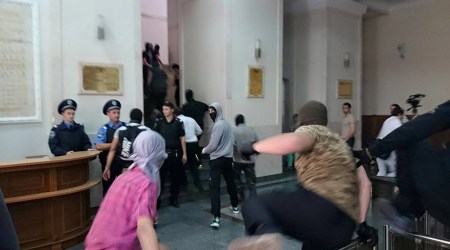
At least 200 people wearing camouflage and masks stormed the local administration building in the city of Kharkov, eastern Ukraine, local media said. The perpetrators are alleged to be members of the radical Azov battalion.
The masked men reportedly clashed with police and security forces at the city’s administration building. Those who have entered the building have also reportedly used tear gas, the Ukrainian 112 channel is saying.
The masked activists were seen holding flags with the insignia of the radical Azov Battalion, which is accused of committing numerous human rights violations in Eastern Ukraine, according to international watchdogs.
“There have been several small clashes between police and people in balaclavas. A few minutes ago somebody let off tear gas. The entrance to the city council is surrounded by a tight police cordon,” a journalist at the scene, from the 112 channel reported.
Earlier, at least 50 people wearing camouflage and balaclavas had taken part in a protest in front of the residence of the local politician, Mikhail Dobkin, who represents the ‘Opposition Bloc’ political party, which wants to find a peaceful solution to the current crisis in Ukraine. The masked men had not set out any demands. However, they were reported to have stated their aim was to “to throw Dobkin out of the city and not to let Kernes become Kharkov’s mayor,” according to the 112 channel.
Gennady Kernes has been the mayor of Kharkov since March 2010. Before the coup in Ukraine, he had been a strong supporter of President Viktor Yanokovich. However, he subsequently switched sides and has backed the new Ukrainian government in order to keep his position.
‘West crying for refugees with one eye, aiming gun with the other’ – Assad (FULL INTERVIEW)
RT | September 16, 2015
In a rare interview with Russian media outlets, RT among them, Syrian leader Bashar Assad spoke about global and domestic terrorism threats, the need for a united front against jihadism, Western propaganda about the refugee crisis and ways to bring peace to his war-torn nation.
Question 1:Mr. President, thank you from the Russian media, from RT, from Rossiyskaya Gazeta, Channel 1, Russia 24, RIA Novosti, and NTV channel, for giving us all the opportunity to talk to you during this very critical phase of the crisis in Syria, where there are many questions that need to be addressed on where exactly the political process to achieve peace in Syria is heading, what’s the latest developments on the fight against ISIL, and the status of the Russian and Syrian partnership, and of course the enormous exodus of Syrian refugees that has been dominating headlines in Europe.
Now, the crisis in Syria is entering its fifth year. You have defied all predictions by Western leaders that you would be ousted imminently, and continue to serve today as the President of the Syrian Arab Republic. Now, there has been a lot of speculation recently caused by reports that officials from your government met with officials from your adversary Saudi Arabia that caused speculation that the political process in Syria has entered a new phase, but then statements from Saudi Arabia that continue to insist on your departure suggest that in fact very little has changed despite the grave threat that groups like ISIL pose far beyond Syria’s borders.
So, what is your position on the political process? How do you feel about power sharing and working with those groups in the opposition that continue to say publically that there can be no political solution in Syria unless that includes your immediate departure? Have they sent you any signal that they are willing to team up with you and your government? In addition to that, since the beginning of the crisis in Syria, many of those groups were calling to you to carry out reforms and political change. But is such change even possible now under the current circumstances with the war and the ongoing spread of terror in Syria?
President Assad: Let me first divide this question. It’s a multi question in one question. The first part regarding the political process, since the beginning of the crisis we adopted the dialogue approach, and there were many rounds of dialogue between Syrians in Syria, in Moscow, and in Geneva. Actually, the only step that has been made or achieved was in Moscow 2, not in Geneva, not in Moscow 1, and actually it’s a partial step, it’s not a full step, and that’s natural because it’s a big crisis. You cannot achieve solutions in a few hours or a few days. It’s a step forward, and we are waiting for Moscow 3. I think we need to continue the dialogue between the Syrian entities, political entities or political currents, in parallel with fighting terrorism in order to achieve or reach a consensus about the future of Syria. So, that’s what we have to continue.
If I jump to the last part, because it’s related to this one, is it possible to achieve anything taking into consideration the prevalence of terrorism in Syria and in Iraq and in the region in general? We have to continue dialogue in order to reach the consensus as I said, but if you want to implement anything real, it’s impossible to do anything while you have people being killed, bloodletting hasn’t stopped, people feel insecure. Let’s say we sit together as Syrian political parties or powers and achieve a consensus regarding something in politics, in economy, in education, in health, in everything. How can we implement it if the priority of every single Syrian citizen is to be secure? So, we can achieve consensus, but we cannot implement unless we defeat the terrorism in Syria. We have to defeat terrorism, not only ISIS.
I’m talking about terrorism, because you have many organizations, mainly ISIS and al-Nusra that were announced as terrorist groups by the Security Council. So, this is regarding the political process. Sharing power, of course we already shared it with some part of the opposition that accepted to share it with us. A few years ago they joined the government. Although sharing power is related to the constitution, to the elections, mainly parliamentary elections, and of course representation of the Syrian people by those powers. But in spite of that, because of the crisis, we said let’s share it now, let’s do something, a step forward, no matter how effective.
Regarding the refugee crisis, I will say now that Western dealing in the Western propaganda recently, mainly during the last week, regardless of the accusation that those refugees are fleeing the Syrian government, but they call it regime, of course. Actually, it’s like the West now is crying for the refugees with one eye and aiming at them with a machinegun with the second one, because actually those refugees left Syria because of the terrorism, mainly because of the terrorists and because of the killing, and second because of the results of terrorism. When you have terrorism, and you have the destruction of the infrastructure, you won’t have the basic needs of living, so many people leave because of the terrorism and because they want to earn their living somewhere in this world.
So, the West is crying for them, and the West is supporting terrorists since the beginning of the crisis when it said that this was a peaceful uprising, when they said later it’s moderate opposition, and now they say there is terrorism like al-Nusra and ISIS, but because of the Syrian state or the Syrian regime or the Syrian president. So, as long as they follow this propaganda, they will have more refugees. So, it’s not about that Europe didn’t accept them or embrace them as refugees, it’s about not dealing with the cause. If you are worried about them, stop supporting terrorists. That’s what we think regarding the crisis. This is the core of the whole issue of refugees.
President Assad: As you know, we are at war with terrorism, and this terrorism is supported by foreign powers. It means that we are in a state of complete war. I believe that any society and any patriotic individuals, and any parties which truly belong to the people should unite when there is a war against an enemy; whether that enemy is in the form of domestic terrorism or foreign terrorism. If we ask any Syrian today about what they want, the first thing they would say is: we want security and safety for every person and every family.
So we, as political forces, whether inside or outside the government, should unite around what the Syrian people want. That means we should first unite against terrorism. That is logical and self-evident. That’s why I say that we have to unite now as political forces, or government, or as armed groups which fought against the government, in order to fight terrorism. This has actually happened.
There are forces fighting terrorism now alongside the Syrian state, which had previously fought against the Syrian state. We have made progress in this regard, but I would like to take this opportunity to call on all forces to unite against terrorism, because it is the way to achieve the political objectives which we, as Syrians, want through dialogue and political action.
Intervention: Concerning the Moscow-3 and Geneva-3 conferences; in your opinion, are there good prospects for them?
President Assad: The importance of Moscow-3 lies in the fact that it paves the way to Geneva-3, because the international sponsorship in Geneva was not neutral, while the Russian sponsorship is. It is not biased, and is based on international law and Security Council resolutions. Second, there are substantial differences around the ‘transitional body’ item in Geneva. Moscow-3 is required to solve these problems between the different Syrian parties; and when we reach Geneva-3, it is ensured that there is a Syrian consensus which would enable it to succeed. We believe that it is difficult for Geneva-3 to succeed unless Moscow-3 does. That’s why we support holding this round of negotiations in Moscow after preparations for the success of this round have been completed, particularly by the Russian officials.
Question 3: I would like to continue with the issue of international cooperation in order to solve the Syrian crisis. It’s clear that Iran, since solving the nuclear issue, will play a more active role in regional affairs. How would you evaluate recent Iranian initiatives on reaching a settlement for the situation in Syria? And, in general, what is the importance of Tehran’s support for you? Is there military support? And, if so, what form does it take?
President Assad: At present, there is no Iranian initiative. There are ideas or principles for an Iranian initiative based primarily on Syria’s sovereignty, the decisions of the Syrian people and on fighting terrorism. The relationship between Syria and Iran is an old one. It is over three-and-a-half decades old. There is an alliance based on a great degree of trust. That’s why we believe that the Iranian role is important. Iran supports Syria and the Syrian people. It stands with the Syrian state politically, economically and militarily. When we say militarily, it doesn’t mean – as claimed by some in the Western media – that Iran has sent an army or armed forces to Syria. That is not true. It sends us military equipment, and of course there is an exchange of military experts between Syria and Iran. This has always been the case, and it is natural for this cooperation to grow between the two countries in a state of war. Yes, Iranian support has been essential to support Syria in its steadfastness in this difficult and ferocious war.
Question 4: Concerning regional factors and proponents, you recently talked about security coordination with Cairo in fighting terrorism, and that you are in the same battle line in this regard. How is your relationship with Cairo today given that it hosts some opposition groups? Do you have a direct relationship, or perhaps through the Russian mediator, particularly in light of the strategic relations between Russia and Egypt. President Sisi has become a welcome guest in Moscow today.
President Assad: Relations between Syria and Egypt have not ceased to exist even over the past few years, and even when the president was Mohammed Morsi, who is a member of the terrorist Muslim Brotherhood organisation. Egyptian institutions insisted on maintaining a certain element of this relationship. First, because the Egyptian people are fully aware of what is happening in Syria, and second because the battle we are fighting is practically against the same enemy. This has now become clearer to everyone. Terrorism has spread in Libya, Egypt, Yemen, Syria, Iraq, in other Arab countries, and in some Muslim countries like Afghanistan, Pakistan and others. That’s why I can say that there is joint vision between us and the Egyptians; but our relationship exists now on a security level. There are no political relations. I mean, there are no contacts between the Syrian Foreign Ministry and the Egyptian Foreign Ministry, for instance. Contacts are done on a security level only. We understand the pressures that might be applied on Egypt or on both Syria and Egypt so that they don’t have a strong relationship. This relationship does not go, of course, through Moscow. As I said, this relationship has never ceased to exist, but we feel comfortable about improving relations between Russia and Egypt. At the same time, there is a good, strong and historical relation between Moscow and Damascus, so it is natural for Russia to feel comfortable for any positive development in relations between Syria and Egypt.
Question 5: Mr. President, allow me to go back to the question of fighting terrorism. How do you look at the idea of creating a region free of ISIS terrorists in the north of the country on the border with Turkey? In that context, what do you say about the indirect cooperation between the West and terrorist organizations like the al-Nusra Front and other extremist groups? And with whom are you willing to cooperate and fight against ISIS terrorists?
President Assad: To say that the border with Turkey should be free of terrorism means that terrorism is allowed in other regions. That is unacceptable. Terrorism should be eradicated everywhere; and we have been calling for three decades for an international coalition to fight terrorism. But as for Western cooperation with the al-Nusra Front, this is reality, because we know that Turkey supports al-Nusra and ISIS by providing them with arms, money and terrorist volunteers. And it is well-known that Turkey has close relations with the West. Erdogan and Davutoglu cannot make a single move without coordinating first with the United States and other Western countries. Al-Nusra and ISIS operate with such a force in the region under Western cover, because Western states have always believed that terrorism is a card they can pull from their pocket and use from time to time. Now, they want to use al-Nusra just against ISIS, maybe because ISIS is out of control one way or another. But that doesn’t mean they want to eradicate ISIS. Had they wanted to do so, they would have been able to do that. For us, ISIS, al-Nusra, and all similar organizations which carry weapons and kill civilians are extremist organizations.
But who we conduct dialogue with is a very important question. From the start we said that we engage in dialogue with any party, if that dialogue leads to degrading terrorism and consequently achieve stability. This naturally includes the political powers, but there are also armed groups with whom we conducted dialogue and reached agreement in troubled areas which have become quiet now. In other areas, these armed groups joined the Syrian Army and are fighting by its side, and some of their members became martyrs. So we talk to everyone except organizations I mentioned like ISIS, al-Nusra, and other similar ones for the simple reason that these organizations base their doctrine on terrorism. They are ideological organizations and are not simply opposed to the state, as is the case with a number of armed groups. Their doctrine is based on terrorism, and consequently dialogue with such organizations cannot lead to any real result. We should fight and eradicate them completely and talking to them is absolutely futile.
Intervention: When talking about regional partners, with whom are you prepared to cooperate in fighting terrorism?
President Assad: Certainly with friendly countries, particularly Russia and Iran. Also we are cooperating with Iraq because it faces the same type of terrorism. As for other countries, we have no veto on any country provided that it has the will to fight terrorism and not as they are doing in what is called “the international coalition” led by the United States. In fact, since this coalition started to operate, ISIS has been expanding. In other words, the coalition has failed and has no real impact on the ground. At the same time, countries like Turkey, Qatar, Saudi Arabia, and Western countries which provide cover for terrorism like France, the United States, or others, cannot fight terrorism. You cannot be with and against terrorism at the same time. But if these countries decide to change their policies and realize that terrorism is like a scorpion, if you put it in your pocket, it will sting you. If that happens, we have no objection to cooperating with all these countries, provided it is a real and not a fake coalition to fight terrorism.
Question 6: What is the Syrian army’s current condition? They’ve been fighting for over four years. Are they exhausted by the war, or become stronger as a result of engagement in military operations? And are there reserve forces to support them? I also have another important question: you said a large number of former adversaries have moved to your side and are fighting within the ranks of government forces. How many? And what is the extent of their help in the fight against extremist groups?
President Assad: Of course, war is bad. And any war is destructive, any war weakens any society and any army, no matter how strong or rich a country is. But things cannot be assessed this way. War is supposed to unite society against the enemy. The army becomes the most-important symbol for any society when there is aggression against the country. Society embraces the army, and provides it with all the necessary support, including human resources, volunteers, conscripts, in order to defend the homeland. At the same time, war provides a great deal of expertise to any armed forces practically and militarily. So, there are always positive and negative aspects. We cannot say that the army becomes weaker or stronger. But in return, this social embrace and support for the army provides it with volunteers. So, in answer to your question ‘are there reserves?’… yes, certainly, for without such reserves, the army wouldn’t have been able to stand for four-and-a-half years in a very tough war, particularly since the enemy we fight today has an unlimited supply of people. We have terrorist fighters from over 80 or 90 countries today, so our enemy is enjoying enormous support in various countries, from where people come here to fight alongside the terrorists. As for the army, it’s almost exclusively made of Syrians. So, we have reserve forces, and this is what enables us to carry on. There is also determination. We have reserves not only in terms of human power, but in will as well. We are more determined than ever before to fight and defend our country against terrorists. This is what led some fighters who used to fight against the state at the beginning for varying reasons, discovered they were wrong and decided to join the state. Now they are fighting battles along with the army, and some have actually joined as regular soldiers. Some have kept their weapons, but they are fighting in groups alongside the armed forces in different parts of Syria.
Question 7: Mr. President, Russia has been fighting terrorism for 20 years, and we have seen its different manifestations. It now seems you are fighting it head on. In general, the world is witnessing a new form of terrorism. In the regions occupied by ISIS, they are setting up courts and administrations, and there are reports that it intends to mint its own currency. They are constructing what looks like a state. This in itself might attract new supporters from different countries. Can you explain to us whom are you fighting? Is it a large group of terrorists or is it a new state which intends to radically redraw regional and global borders? What is ISIS today?
President Assad: Of course, the terrorist ISIS groups tried to give the semblance of a state, as you said, in order to attract more volunteers who live on the dreams of the past: that there was an Islamic state acting for the sake of religion. That ideal is unreal. It is deceptive. But no state can suddenly bring a new form to any society. The state should be the product of its society. It should be the natural evolution of that society, to express it. In the end, a state should be a projection of its society. You cannot bring about a state which has a different form and implant it in a society. Here we ask the question: does ISIS, or what they call ‘Islamic State’, have any semblance to Syrian society? Certainly not.
Of course we have terrorist groups, but they are not an expression of society. In Russia, you have terrorist groups today, but they do not project Russian society, nor do they have any semblance to the open and diverse Russian society. That’s why if they tried to mint a currency or have stamps or passports, or have all these forms which indicate the existence of a state, it doesn’t mean they actually exist as a state; first because they are different from the people and, second, because people in those regions flee towards the real state, the Syrian state, the national state. Sometimes they fight them too. A very small minority believes these lies. They are certainly not a state, they are a terrorist group. But if we want to ask about who they are, let’s speak frankly: They are the third phase of the political or ideological poisons produced by the West, aimed at achieving political objectives. The first phase was the Muslim Brotherhood at the turn of the last century. The second phase was al-Qaeda in Afghanistan in order to fight the Soviet Union. And the third phase is ISIS, the al-Nusra Front and these groups. Who are ISIS? And who are these groups? They are simply extremist products of the West.
Question 8: Mr. President, at the beginning of the Syrian crisis, the Kurdish issue started to be discussed more often. Previously, Damascus was severely criticized because of its position towards the Kurdish minority. But now, practically, in some areas, Kurdish formations are your allies in the fight against ISIS. Do you have a specific position towards who the Kurds are to you and who you are to them?
President Assad: First, you cannot say there was a certain state policy concerning the Kurds. A state cannot discriminate between members of its population; otherwise, it creates division in the country. If we had been discriminating between different components of society, the majority of these components wouldn’t have supported the state now, and the country would have disintegrated from the very beginning. For us, the Kurds are part of the Syrian fabric. They are not foreigners – they live in this region like the Arabs, Circassians, Armenians and many other ethnicities and sects who’ve been living in Syria for many centuries. It’s not known when some of them came to this region. Without these groups, there wouldn’t have been a homogenous Syria. So, are they our allies today? No, they are patriotic people. But on the other hand, you cannot put all the Kurds in one category. Like any other Syrian component, there are different currents among them. They belong to different parties. There are those on the left and those on the right. There are tribes, and there are different groups. So, it is not objective to talk about the Kurds as one mass.
There are certain Kurdish demands expressed by some parties, but there are no Kurdish demands for the Kurds. There are Kurds who are integrated fully into society; and I would like to stress that they are not allies at this stage, as some people would like to show. I would like to stress that they are not just allies at this stage, as some suggest. There are many fallen Kurdish soldiers who fought with the army, which means they are an integral part of society. But there are parties which had certain demands, and we addressed some at the beginning of the crisis. There are other demands which have nothing to do with the state, and which the state cannot address. There are things which would relate to the entire population, to the constitution, and the people should endorse these demands before a decision can be taken by the state. In any case, anything proposed should be in the national framework. That’s why I say that we are with the Kurds, and with other components, all of us in alliance to fight terrorism.
This is what I talked about a while ago: that we should unite in order to fight ISIS. After we defeat ISIS, al-Nusra and the terrorists, the Kurdish demands expressed by certain parties can be discussed nationally. There’s no problem with that, we do not have a veto on any demand as long as it is within the framework of Syria’s unity and the unity of the Syrian people and territory, fighting terrorism, Syrian diversity, and the freedom of this diversity in its ethnic, national, sectarian, and religious sense.
Question 9: Mr. President, you partially answered this question, but I would like a more-precise answer, because some Kurdish forces in Syria call for amending the constitution. For instance, setting up a local administration and moving towards autonomy in the north. These statements are becoming more frequent now that the Kurds are fighting ISIS with a certain degree of success. Do you agree with such statements that the Kurds can bet on some kind of gratitude? Is it up for discussion?
President Assad: When we defend our country, we do not ask people to thank us. It is our natural duty to defend our country. If they deserve thanks, then every Syrian citizen defending their country deserves as much. But I believe that defending one’s country is a duty, and when you carry out your duty, you don’t need thanks. But what you have said is related to the Syrian constitution. Today, if you want to change the existing structure in your country, in Russia for instance, let’s say to redraw the borders of the republics, or give one republic powers different to those given to other republics – this has nothing to do with the president or the government. This has to do with the constitution.
The president does not own the constitution and the government does not own the constitution. Only the people own the constitution, and consequently changing the constitution means national dialogue. For us, we don’t have a problem with any demand. As a state, we do not have any objection to these issues as long as they do not infringe upon Syria’s unity and diversity and the freedom of its citizens.
But if there are certain groups or sections in Syria which have certain demands, these demands should be in the national framework, and in dialogue with the Syrian political forces. When the Syrian people agree on taking steps of this kind, which have to do with federalism, autonomy, decentralization or changing the whole political system, this needs to be agreed upon by the Syrian people, and consequently amending the constitution. This is why these groups need to convince the Syrian people of their proposals. In that respect, they are not in dialogue with the state, but rather with the people. When the Syrian people decide to move in a certain direction, and to approve a certain step, we will naturally approve it.
Question 10: Now, the U.S.-led coalition has been carrying out airstrikes on Syrian territory for about one year on the same areas that the Syrian Air Force is also striking ISIL targets, yet there hasn’t been a single incident of the U.S.-led coalition and the Syrian Air Force activity clashing with one another. Is there any direct or indirect coordination between your government and the U.S. coalition in the fight against ISIL?
President Assad: You’d be surprised if I say no. I can tell you that my answer will be not realistic, to say now, while we are fighting the same, let’s say enemy, while we’re attacking the same target in the same area without any coordination and at the same time without any conflict. And actually this is strange, but this is reality. There’s not a single coordination or contact between the Syrian government and the United States government or between the Syrian army and the U.S. army. This is because they cannot confess, they cannot accept the reality that we are the only power fighting ISIS on the ground. For them, maybe, if they deal or cooperate with the Syrian Army, this is like a recognition of our effectiveness in fighting ISIS. This is part of the willful blindness of the U.S. administration, unfortunately.
Question 11: So not event indirectly though, for example the Kurds? Because we know the U.S. is working with the Kurds, and the Kurds have some contacts with the Syrian government. So, not even any indirect coordination?
President Assad: Not even any third party, including the Iraqis, because before they started the attacks, they let us know through the Iraqis. Since then, not a single message or contact through any other party.
Question 12: OK, so just a little bit further than that. You’ve lived in the West, and you, at one time, moved in some of those circles with some Western leaders that since the beginning of the crisis have been backing armed groups who are fighting to see you overthrown. How do you feel about one day working again with those very same Western leaders, perhaps shaking hands with them? Would you ever be able to trust them again?
President Assad: First, it’s not a personal relation; it’s a relation between states, and when you talk about relation between states, you don’t talk about trust; you talk about mechanism. So, trust is a very personal thing you cannot depend on in political relations between, let’s say, people. I mean, you are responsible for, for example in Syria, for 23 million, and let’s say in another country for tens of millions. You cannot put the fate of those tens of millions or maybe hundreds of millions on the trust of a single person, or two persons in two countries. So, there must be a mechanism. When you have a mechanism, you can talk about trust in a different way, not a personal way. This is first.
Second, the main mission of any politician, or any government, president, prime minister, it doesn’t matter, is to work for the interest of his people and the interest of his country. If any meeting or any handshaking with anyone in the world will bring benefit to the Syrian people, I have to do it, whether I like it or not. So, it’s not about me, I accept it or I like it or whatever; it’s about what the added value of this step that you’re going to take. So yes, we are ready whenever there’s the interest of the Syrians. I will do it, whatever it is.
Question 13: Regarding alliances in the fight against terrorism and ISIS, President Putin called for a regional alliance to fight the so-called ‘Islamic State’; and the recent visits of Arab officials to Moscow fall into that context, but Syrian Foreign Minister Walid al-Moallem said that would need a miracle. We are talking here about security coordination, as described by Damascus, with the governments of Jordan, Turkey and Saudi Arabia. How do you envisage that alliance? Will it achieve any results, in your opinion? You said that any relationship is based on interests, so are you willing to coordinate with these countries, and what is the truth behind the meetings held between Syrian, and maybe Saudi, officials as reported by the media?
President Assad: As for fighting terrorism, this is a big and comprehensive issue which includes cultural and economic aspects. It obviously has security and military aspects as well. In terms of prevention, all the other aspects are more important than the security and military ones, but today, in the reality we now live in terms of fighting terrorism, we are not facing terrorist groups, we are facing terrorist armies equipped with light, medium and heavy weaponry. They have billions of dollars to recruit volunteers. The military and security aspects should be given priority at this stage. So, we think this alliance should act in different areas, but to fight on the ground first. Naturally, this alliance should consist of states which believe in fighting terrorism and believe that their natural position should be against terrorism.
In the current state of affairs, the person supporting terrorism cannot be the same person fighting terrorism. This is what these states are doing now. Saudi Arabia, Turkey and Jordan, who pretend to be part of a coalition against terrorism in northern Syria, actually support terrorism in the south, the north and the north-west, virtually in the same regions in which they are supposed to be fighting terrorism. Once again I say that, within the framework of public interest, if these states decide to go back to the right position, to return to their senses and fight terrorism, naturally we will accept and cooperate with them and with others. We do not have a veto and we do not stick to the past. Politics change all the time. It might change from bad to good, and the ally might become an adversary, and the adversary an ally. This is normal. When they fight against terrorism, we will cooperate with them.
Question 14: Mr. President, there is a huge wave of refugees, largely from Syria, going to Europe. Some say these people are practically lost to Syria. They are deeply unhappy with the Syrian authorities because they haven’t been able to protect them and they’ve had to leave their homes. How do you view those people? Do you see them as part of the Syrian electorate in the future? Do you expect them to return? And the second question has to do with the European sense of guilt about the displacement happening now. Do you think that Europe should feel guilty?
President Assad: Any person who leaves Syria constitutes a loss to the homeland, to be sure, regardless of the position or capabilities of that person. This, of course, does not include terrorists. It includes all citizens in general with the exception of terrorists. So, yes, there is a great loss as a result of emigration. You raised a question on elections. Last year, we had a presidential election in Syria, and there were many refugees in different countries, particularly in Lebanon. According to Western propaganda, they had fled the state, the oppression of the state and the killing of the state, and they are supposed to be enemies of the state. But the surprise for Westerners was that most of them voted for the president who is supposed to be killing them. That was a great blow to Western propaganda. Of course, voting has certain conditions. There should be an embassy, and to have the custodianship of the Syrian state in the voting process. That depends on relations between the states. Many countries have severed relations with Syria and closed Syrian embassies, and consequently Syrian citizens cannot vote in those countries. They have to go to other countries where ballot boxes are installed, and that did happen last year.
As for Europe, of course it’s guilty. Today, Europe is trying to say that Europe feels guilty because it hasn’t given money or hasn’t allowed these people to immigrate legally, and that’s why they came across the sea and drowned. We are sad for every innocent victim, but is the victim who drowns in the sea dearer to us than the victim killed in Syria? Are they dearer than innocent people whose heads are cut off by terrorists? Can you feel sad for a child’s death in the sea and not for thousands of children who have been killed by the terrorists in Syria? And also for men, women, and the elderly? These European double standards are no longer acceptable. They have been flagrantly exposed. It doesn’t make sense to feel sad for the death of certain people and not for deaths of others. The principles are the same. So Europe is responsible because it supported terrorism, as I said a short while ago, and is still supporting terrorism and providing cover for them. It still calls them ‘moderate’ and categorizes them into groups, even though all these groups in Syria are extremists.
Question 15: If you don’t mind, I would like to go back to the question about Syria’s political future. Mr. President, your opponents, whether fighting against the authorities with weapons or your political opponents, still insist that one of the most-important conditions for peace is your departure from political life and as president. What do you think about that – as president and as a Syrian citizen? Are you theoretically prepared for that if you feel it’s necessary?
President Assad: In addition to what you say, Western propaganda has, from the very beginning, been about the cause of the problem being the president. Why? Because they want to portray the whole problem in Syria lies in one individual; and consequently the natural reaction for many people is that, if the problem lies in one individual, that individual should not be more important than the entire homeland. So let that individual go and things will be alright. That’s how they oversimplify things in the West. What’s happening in Syria, in this regard, is similar to what happened in your case. Notice what happened in the Western media since the coup in Ukraine. What happened? President Putin was transformed from a friend of the West to a foe and, yet again, he was characterized as a tsar. He is portrayed as a dictator suppressing opposition in Russia, and that he came to power through undemocratic means, despite the fact that he was elected in democratic elections, and the West itself acknowledged that the elections were democratic. Now, it is no longer democratic. This is Western propaganda. They say that if the president went things will get better. What does that mean, practically? For the West, it means that as long as you are there, we will continue to support terrorism, because the Western principle followed now in Syria and Russia and other countries is changing presidents, changing states, or what they call bringing regimes down. Why? Because they do not accept partners and do not accept independent states. What is their problem with Russia? What is their problem with Syria? What is their problem with Iran? They are all independent countries. They want a certain individual to go and be replaced by someone who acts in their interests and not in the interest of his country. For us, the president comes through the people and through elections and, if he goes, he goes through the people. He doesn’t go as a result of an American decision, a Security Council decision, the Geneva conference or the Geneva communiqué. If the people want him to stay, he should stay; and if the people reject him, he should leave immediately. This is the principle according to which I look at this issue.
Question 16: Military operations have been ongoing for more than four years. It’s likely that you analyze things and review matters often. In your opinion, was there a crucial juncture when you realized war was unavoidable? And who initiated that war machinery? The influence of Washington or your Middle East neighbours? Or were there mistakes on your part? Are there things you regret? And if you had the opportunity to go back, would you change them?
President Assad: In every state, there are mistakes, and mistakes might be made every day, but these mistakes do not constitute a crucial juncture because they are always there. So what is it that makes these mistakes suddenly lead to the situation we are living in Syria today? It doesn’t make sense. You might be surprised if I tell that the crucial juncture in what happened in Syria is something that many people wouldn’t even think of. It was the Iraq war in 2003, when the United States invaded Iraq. We were strongly opposed to that invasion, because we knew that things were moving in the direction of dividing societies and creating unrest. And we are Iraq’s neighbours. At that time, we saw that the war would turn Iraq into a sectarian country; into a society divided against itself. To the west of Syria there is another sectarian country – Lebanon. We are in the middle. We knew well that we would be affected. Consequently, the beginning of the Syrian crisis, or what happened in the beginning, was the natural result of that war and the sectarian situation in Iraq, part of which moved to Syria, and it was easy for them to incite some Syrian groups on sectarian grounds.
The second point, which might be less crucial, is that when the West adopted terrorism officially in Afghanistan in the early 1980s and called terrorists at that time ‘freedom fighters’, and then in 2006 when Islamic State appeared in Iraq under American sponsorship and they didn’t fight it. All these things together created the conditions for the unrest with Western support and Gulf money, particularly form Qatar and Saudi Arabia, and with Turkish logistic support, particularly since President Erdogan belongs intellectually to the Muslim Brotherhood. Consequently, he believes that, if the situation changed in Syria, Egypt, and Iraq, it means the creation of a new sultanate; not an Ottoman sultanate this time, but a sultanate for the Brotherhood extending from the Atlantic to the Mediterranean and ruled by Erdogan. All these factors together brought things to what we have today. Once again, I say that there were mistakes, and mistakes always create gaps and weak points, but they are not sufficient to cause that alone, and they do not justify what happened. And if these gaps and weak points are the cause, why didn’t they lead to revolutions in the Gulf states – particularly in Saudi Arabia which doesn’t know anything about democracy? The answer is self-evident, I believe.
Mr. President, thank you for giving us the time and for your detailed answers to our questions.
Where Will It End? More Israeli Murders
By Stephen Lendman | September 22, 2015
Israel intends imprisoning Palestinian youths and children up to 20 years for stone-throwing. Nonviolent protesters are brutally attacked. Soldiers routinely murder Palestinians unaccountably.
Police now may use live fire indiscriminately, justifying it by inventing pretexts. Settlers commit near-daily violence and/or vandalism with impunity. Investigations when conducted are whitewashed.
Zionist zealots responsible for immolating Dawabsha family members are free to kill again – even though Israeli authorities identified them. Arrests didn’t follow.
On Tuesday, a Palestinian youth named Dia’ Abdul-Halim died – or was he killed? Israeli government officials notoriously lie. So do police and military sources.
The IDF claims the youth was killed trying to throw a grenade, claiming it detonated first. Judge for yourself if true or false. How often do civilians die from grenade explosions? Rare lightning strikes are more common. Palestinian medical sources said he was shot to death.
Soldiers prevented Palestinian Red Crescent medical workers from reaching the scene to help. What did they have to hide?
 On September 22, Israeli forces murdered Palestinian teenager Hadeel al-Hashlamon – shooting her three times in the chest, abdomen and lower body, claiming they foiled a stabbing attack.
Photos released proved otherwise. Soldiers confronted the unarmed woman belligerently, aiming their weapons at her. She turned to walk away and was murdered in cold blood.
An Israeli army spokeswoman lied, claiming “(t)he attacker attempted to stab a soldier.” Live fire aimed at her “lower extremists.” Soldiers shot to kill. None were harmed. No knife was found.
Palestinian PalMedia news agency video showed her left bleeding to death for around 30 minutes before help arrived. Soldiers and heavily armed settlers did nothing to save her.
She’s the 28th Palestinian murdered by Israeli security forces or settlers this year – unaccountably. No prosecutions followed.
Hadeel was taken to Shaare Zedek medical center too late to save her. These incidents happened after Israel mobilized hundreds of police reservists and extra numbers of soldiers in flashpoint areas.
A 2014 Amnesty International report called Israeli forces “trigger happy.” Excessive force is standard practice. Children are abused as violently as adults.
So are international solidarity activists and journalists. Anyone supporting long-suffering Palestinians is vulnerable.
In June through August 2014, over 1,000 West Bank Palestinians were arrested, nearly 600 injured, around two-thirds from live fire. During the same period, Israeli forces murdered 10 others.
Heavy security was deployed ahead of the Yom Kippur atonement period – beginning sundown on September 22, ending 24 hours later.
Vicious Israeli authorities have much to atone for – decades of brutality against defenseless Palestinians, accountability nowhere in sight, nor an end to occupation harshness.
Stephen Lendman can be reached at lendmanstephen@sbcglobal.net.
His new book as editor and contributor is titled “Flashpoint in Ukraine: US Drive for Hegemony Risks WW III.”
How The NY Times Hides the Scandal of US-Israeli War Crimes
By Barbara Erickson | TimesWarp | September 21, 2015
The United States sends at least $3.1 billion in military aid grants to Israel every year, more than the amount given to all the rest of the world combined, and although Americans oppose this excess, their opinion has had no effect: Officials are now in talks to raise the yearly amount by as much as 50 percent.
If you missed that news in The New York Times, there is no reason for surprise. The issue has essentially remained out of sight, glossed over in a smattering of news stories, where readers find murky references to US aid and no enlightening details.
Thus we have a story by Jodi Rudoren this month, a look at how Israeli Prime Minister Benjamin Netanyahu has made a “pivot” after losing his battle against the nuclear agreement with Iran. Several paragraphs into this piece she writes, “Washington is expected to deliver a huge new military aid package to Israel… to appease Mr. Netanyahu and Democratic supporters of Israel who reluctantly backed the nuclear deal.”
This begs for explanation. How much is “huge”? Why is this “expected”? But nothing more is forthcoming.
Times readers have to look elsewhere for a fuller story. Other sources tell us that Israel has been asking for up to $4.5 billion a year in military aid and that talks have been going on “away from the spotlight.” Observers expect announcement of an aid agreement in November, when Israeli Prime Minister Benjamin Netanyahu visits Washington.
The Times did manage to work in the $4.5 billion price tag, in the last paragraph of a story that ran in July. The US has guaranteed Israel $31 billion in military aid grants over 10 years ending in 2017, and Israel now wants a new deal guaranteeing up to $45 billion over another 10 years. The article states that officials will frame the deal that finally emerges as an effort to bolster Israel’s defenses in the face of a resurgent Iran. Thus they will try to defuse the charge that the new deal is a way of “appeasing” Israel.
Since this story appeared, the Times has avoided the subject, except for Rudoren’s reference to a “huge” new package, and brief comments elsewhere about “compensation” for defying Israel on the Iran nuclear deal.
US aid to Israel is a subject that the Times would like to avoid. On many fronts it is difficult to defend and shines a harsh light on the actions of both the US and Israeli governments. For instance:
- Congress has been willing to maintain and even increase military aid to Israel even as it cuts programs for education, food assistance and tax relief for working families in the United States.
- Israel receives US aid even though it is one of the most economically advanced countries in the world.
- US military aid makes up a full 20 percent of the Israeli military budget.
- Israel, a small country, is so well supplied with arms that it is the tenth largest purveyor of weaponry in the world. In other words, Israel receives military aid from the US, and then makes money by selling arms to other nations.
- US aid to Israel amounts to $10.2 million per day or $450 per year for each Israeli citizen.
- Israel receives special perks that other aid recipients are denied, such as the right to use some of the funds to buy weapons from Israeli manufacturers instead of being required to purchase American products.
- Israel spends more on military expenditures than any other country in the world, based on percentage of gross domestic product.
- The annual U.S. military aid package for Palestine is $0.00.
- In addition to the $3.1 billion in direct military aid guaranteed each year, Israel receives other gifts, such as economic grants and immigration assistance, raising the total aid well beyond the stated amount. (Vice President Joe Biden recently cited $7.18 billion for a one-year package.)
- Sixty percent of Americans polled in a survey said the United States “gives too much aid to Israel.”
In addition, human rights organizations and other observers have raised ethical concerns over supplying arms to Israel in view of its deadly attacks on civilians in the occupied Palestinian territories.
Last year, during the assaults on Gaza that left some 2,200 Palestinians dead, Amnesty International called on the United States to stop transferring arms to Israel, citing “growing evidence of war crimes.” In June of this year, Rep. Betty McCollum (D-MN) asked the State Department to review the legality of military aid to Israel in light of evidence that security forces abuse child prisoners and have killed nonviolent demonstrators.
This past week a coalition of 10 organizations—American Muslims for Palestine, Jewish Voice for Peace, Code Pink, Defense for Children International and others—sent out a petition asking President Obama to stop supplying Israel with arms. In particular the petition targets the 50 percent increase in direct aid from $3.1 to $4.5 billion now under consideration.
Within days, by Sept. 21, the petition had reached its goal of 50,000 signatures and reset its sights on 60,000.
The Times, however, has had nothing to say about these protests, although they have been reported elsewhere. Rep. McCollum’s letter, which garnered the signatures of 18 additional members of Congress, was featured in US and Israeli media but found no mention in the Times.
The subject of military aid to Israel demands a fuller treatment in the Times. Readers should know the actual cost to U.S. taxpayers; they should be told of ethical concerns raised by organizations and officials; they are entitled to know more about the lethal effects of Israel’s weaponry; they should find Times analysts willing to discuss the contrast between congressional largess for Israel and the efforts to cut domestic programs.
It is not too much to say that US military aid to Israel is scandalous in light of the devastating effects it has had on innocent Palestinians and also on Americans deprived of basic needs. The failure of the Times to address the issue also amounts to scandal, making it fully complicit in this sordid affair.
Brazil president rejects settler leader as Israel envoy
Press TV – September 21, 2015
Brazilian President Dilma Rousseff has reportedly rejected the appointment of a hardliner as Israel’s envoy to her country, saying it could be understood as support for the illegal Israeli settlements.
According to an article published on Israeli website Ynetnews, Rousseff has sent a message to the Tel Aviv regime, expressing her discomfort with the appointment of Dani Dayan, an extremist in charge of running the affairs of Israeli settlements in the occupied West Bank.
The rejection has been part of some covert communications between Brazil and Israel with Rio de Janeiro warning the Tel Aviv regime that it should not go ahead with Dayan’s nomination to the job or mutual relations could seriously be endangered.
Various organizations and individuals have been pressuring Rousseff to reject Dayan due to his background in opposing the rights of Palestinians and his contribution to the illegal settlements in the Occupied West Bank. A petition in August called the appointment “a violation of the international legitimacy and sovereignty of Brazil.”
From 2007 to 2013, Dayan was the chairman of the Yesha Council, the umbrella organization of settlement councils in the Occupied West Bank. He is also a renowned opponent of the so-called two-state solution.
A group of activists submitted a request to the Brazilian government on Monday, demanding the rejection of Dayan as Israel’s ambassador. According to Israeli daily Haaretz, the activists met with Brazilian envoys to the occupied territories as well as Brazil’s envoy to the Occupied West Bank and reiterated that accepting the appointee would help legitimize the settlement enterprise.
Israeli Prime Minister Benjamin Netanyahu announced Dayan’s appointment three weeks ago. Based on diplomatic protocols, once Dayan’s appointment is officially confirmed by Israel, the Brazilian government will be sent a request to endorse the decision.
It is rare for a host country to reject a foreign envoy but if Netanyahu decides to insist on his choice, he could face a formal rejection. Israel has always sought better relations with Brazil as one of the most prosperous economic countries in the world and a major power in South America.
Palestinian teen shot in Hebron by Israeli forces dies from injuries

A photo of the incident shows an Israeli soldier aiming at the woman. (Youth Against Settlements)
Ma’an – September 22, 2015
BETHLEHEM – A Palestinian teenager shot by Israeli forces at a checkpoint in Hebron died from her injuries on Tuesday, Israeli medical sources said.
The teenager, identified as 18-year-old Hadeel al-Hashlamon, was shot three times by Israeli soldiers after allegedly attempting to carry out a stabbing attack, Israel’s army said.
A spokesperson for the Shaare Zedek Medical Center where she was taken for treatment said the teenager was “terribly injured, and underwent surgery upon her arrival.”
She later died from her injuries, the spokesperson confirmed.
No Israeli soldiers were injured during the incident, and the Israeli army did not release photographs of a knife, as they have done on several other recent occasions.
The army spokeswoman said that the attack had been “thwarted.”
A local activist group Youth Against Settlements later released what it said were photos of the incident, appearing to show Israeli soldiers aiming their weapons at the woman, as first she faced them and afterward turned away from them.
Another photo appeared to show the woman slumped on the street, after she was shot and wounded.
Video footage from Palestinian news agency PalMedia showed al-Hashlamon left bleeding on the pavement, reportedly for up to 30 minutes before she received treatment.
The footage shows the woman being dragged out of camera frame, while soldiers and heavily armed settlers look on.
Al-Hashlamon’s death marks at least 25 Palestinians killed by Israeli forces since the start of 2015, according to UN documentation, not including Palestinian deaths caused by Israeli settlers.
Al-Hashlamon’s father, the head of the Anesthesia Department of the Al-Ahli Hospital in Hebron, and its former General Director, Dr. Salaheddin Hashlamoun, said his daughter is a first-year student at the Hebron University.
Aid for Syria crisis victims still not enough: UN
Press TV – September 20, 2015
The United Nations says despite a surge in the international community’s humanitarian aid to help those affected by the conflict in Syria, the sum hardly keeps up with the rising needs of the afflicted people.
UN Under-Secretary-General for Humanitarian Affairs and Emergency Relief Coordinator Stephen O’Brien made the remark on Saturday while on a tour of the Zaatari camp, which is Jordan’s largest facility for Syrian refugees.
When asked about the aid shortage, O’Brien said that “need has risen so much that even though we are securing record amounts of funding, record amounts of political will and support, nonetheless the (funding) gap has widened,” because of protracted conflicts in the region, such as those in Syria, South Sudan and Yemen.
Meanwhile, Hovig Etyemezian, the director of the UN-run Zaatari refugee camp, said the international community “hasn’t woken up yet to the need to assist Jordan” to address the refugee crisis.
For 2015, aid agencies requested over USD 7.4 billion, both for refugees and those internally displaced by the crisis in Syria. However, the agencies have received only USD 2.8 billion so far, according the UN refugee agency.
Refugee aid programs in host countries such as Jordan, Lebanon, Turkey, Egypt and Iraq were reportedly just 41 percent funded as of September.
Germany’s donation
In a separate development on Sunday, German Minister of Economic Cooperation and Development Gerd Muller announced that Berlin would donate USD 22.6 million to the World Food Program (WFP) to supply Syrian refugees with food.
“This means that around 500,000 Syrian refugees in the region can be supplied with food for three months,” Muller told the German Welt am Sonntag newspaper.
In late July, the WFP slashed by half its food assistance for Syrian refugees in Jordan and Lebanon due to a funding crisis.
The foreign-sponsored conflict in Syria, which flared in March 2011, has reportedly claimed more than 240,000 lives up until now.
Featured Video

Genocide-linked firm handles Britons’ NHS data
or go to
Aletho News Archives – Video-Images
Book Review
Book review: Boiling Point, How America Brought War to Ukraine
By Tim Kirby | Strategic Culture Foundation | November 14, 2026
Did Vladimir Putin just wake up one day on the wrong side of the bed and decide to invade Ukraine in February of 2022 or is there a lot more to this single decision that has been reshaping the 21st century geopolitical landscape?
Obviously, from the way that I just posed the question you can see that I am on the side that views the causes for the war in Ukraine to be very deep, long-term, historical and consciously nefarious, and most importantly, not from within the halls of the Kremlin. So it was a pleasure to take a look at the book “Boiling Point, How America Brought War to Ukraine” by author Stephen Kinzer, who like myself, also believes that the real reasons behind military conflicts around the world are not what CNN and the BBC have been telling you. The main thesis of this book was stated clearly by its creator; the war “may have been illegal, but it was definitely not unprovoked.” … continue
Blog Roll
 Aletho News
- The 10 Disease Renamings That Rescued the Vaccine
- NATO cancels 2027 leaders’ summit
- IAEA’s politicized use of safeguards undermines its impartiality: Russian envoy
- UK must be ready to strike Russian Arctic – ex-PM
- Fico’s Two Red Lines: Russian Energy and the Next Ukraine Loan
- Thousands rally for banned NATO-skeptic presidential candidate
- Ukraine Settlement and New European Security Architecture Must Go Hand in Hand – Kremlin
- Book review: Boiling Point, How America Brought War to Ukraine
- Israel Revives The ‘Iranian Assassination Threat Against Trump’ Deception In A Desperate Bid To Restart The War
- US rewrites history to dodge blame for illegal war on Iran: Foreign Ministry spokesperson
- If Americans Knew
- An error has occurred; the feed is probably down. Try again later.
- No Tricks Zone
- New Study: Barents Sea Temperatures Were Warmer And Sea Ice Less Extensive In The 1700s Than Today
- German Authorities Start Initiative To Evaluate Public Register For Climate “Disinformation” Spreaders!
- Zonal Asymmetry of Temperature Change in the Antarctic Circumpolar Current
- New Study: The Net Fossil Fuel Contribution To Rising Atmospheric CO2 Has Been Zero For 500 Years
- Germany’s Green Energy Transition Becoming Increasingly Expensive…Another 6 Trillion Euros!
- Sudden Stratospheric Warming, Powerful El Niño Combination May Lead To Extreme Europe Cold, Energy Crisis!
- Two New Studies Find Thwaites Glacier Melt Cannot Be Driven By Human Activity Or A Warming Ocean
- E-Cars Reduce CO2 Emissions By Only 41% Compared To Internal Combustion Engine Vehicles
- Predictions Made By Renowned Climate Professor Over Past Decades Have Been Proven To Be Poor
- New Study Suggests Large Regions Of The Pacific Ocean Have Been Cooling For The Last 80 Years


