Lawmakers in the US Congress reached an agreement on Monday in both the House and the Senate on the proposed federal budget for 2014, which would allocate $520.5 billion for defence spending and $491.8 billion for non-defence.
The defence budget includes an increase in military aid to Israel that will be given as private aid, thus it will be in addition to the $3.1 billion dollars already given annually to Tel Aviv.
The budget is still awaiting formal approval and the exact amount of additional aid to Israel remains unclear.
Israeli newspaper Haaretz reported that the US House of Representatives Armed Services Committee had endorsed an increase of $488 million in military aid to Israel to pay for Israel’s procurement and development of additional rocket and missile interception systems. The newspaper noted that this sum is considerably higher than previously expected.
However, Reuters news agency reported that the additional military aid to Israel would exceed $500 million after a compromise defence bill proposed on Monday agreed to boost US spending on missile defence by $358 million to $9.5 billion, mandating another homeland defence radar and increased funding for US-Israeli cooperative efforts.
Israel’s Channel 7 News reported that US President Barack Obama had originally requested $220 million of additional private military aid to Israel to buy extra Iron Dome short-range interceptor missiles and the batteries they are launched from, which was approved.
According to the Israeli media network, in addition to the above, the supplementary aid will allocate $173 million in funding for US-Israeli cooperative missile defence programs, which includes “nearly $34 million to improve the Arrow weapon system and $22 million for work on developing another, more advanced interceptor,” noting that, “The move signals further cooperation between Boeing and Israel Aerospace Industries (IAI).”
The new budget will also allocate $117.2 million to Israel for the “development of the David’s Sling short-range ballistic missile defence system, which is being developed jointly by Israel’s state-owned Rafael Advanced Defence Systems and the US’s Raytheon.”
Furthermore, “An additional $15 million will be directed for US co-production of Iron Dome components. Raytheon has a joint marketing agreement with Israeli state-owned manufacturer Rafael Advanced Defence Systems for the Iron Dome system.”
Both the US and Israeli media are reporting that the supplemental funds are intended to protect Israel from the increasing threats coming from Iran, Gaza and Hezbollah in Lebanon.
In addition to the supplemental aid, US Secretary of Defence Chuck Hagel has promised Israel that the existing $3.1 billion package of military aid would remain intact, despite US spending cuts.
The final vote on the budget is expected to take place before Congress leaves for the year.
Haaretz noted that, “Despite frequent disputes with Prime Minister Benjamin Netanyahu’s government regarding the peace process with the Palestinians and the Iranian nuclear threat, US President Barack Obama’s administration continues to be extraordinarily generous when it comes to granting military aid. Israeli defence officials see last week’s decision as further evidence of the strength of the relationship between the two countries.”
Note: throughout this review I refer to concepts like “racial oppression”, “Jewish supremacy” and so on. None of this is intended to imply that the concept “race” is meaningful, biologically or otherwise. Racial supremacy does not depend on the reality of race, but merely on the belief in it. Whether race is or is not meaningful is a completely separate question from whether Israel is an instance of racial supremacy. I cover this separate question in another article, Invention, Imagination, Race and Nation.
Max Blumenthal just had a book published, entitled Goliath: Life and Loathing in Greater Israel. He is a left-wing Jewish American journalist. The book assumes that the left/right political dichotomy is meaningful, not only in America, but in the Jewish state. He writes as if Israel can be reformed:
“The Nakba law was only one among a constantly expanding battery of racist and anti-democratic proposals pouring from the legislative offices onto the floor of the Knesset” (page 62).
“Israel’s very existence is threatened by fascism” (Uri Avnery, quoted sympathetically by Max Blumenthal on page 65, complaining about Jewish extremism undermining what is good about Israel).
“…the maintenance of a Jewish demographic majority is Israel’s national priority…” (page 42).
A national priority is something which can be changed. [it changed in south africa] But a Jewish majority is what Israel is.
My point (at least, in this review) is not to criticize reformism as such – normal Western countries can be, and are continually being, reformed. They are critical of their own histories, particularly in regard to racial oppression. Israel stands alone in its self-righteousness.The almost exclusive concern of organizations such as the Southern Poverty Law Center, radical anti-racist groups, and various academic departments, with “white racism”, tends to obscure this. Another article of mine, “The One-Sided View of Hate in Hate Studies,” goes into this question in more detail.
On several occasions in the book, the author criticizes the “settlements” in the “occupied territories” and the “right wing” Israeli politicians who support them. Taken seriously, this argument supports Israel’s fallback position — withdrawal to its 1967 frontiers, before it occupied the “occupied territories”. On page 273, he explains that liberal Zionists mislead us, by claiming that the “source of Israel’s crisis” is in 1967, with the occupation of the West Bank and other areas, rather than with the ethnic cleansing of 1948. But the Nakba was not the “source of Israel’s crisis” – it was the source of Israel!
The book is critical of what it calls Israeli “racism”, for example, on pages 18, 23, 39, 77, 135, 176, 247, 334 and 398. But what would it mean for a state, whose very definition of citizenship is membership of a particular “race”, regardless of geographical origin, leading to the expulsion of non-members of that “race”, who happen to be located within that state’s boundaries, to be “less racist”?
One area where Blumenthal argues there could be improvement, is the mistreatment of Israeli citizens of Palestinian Arab descent.
“…it is hard to find any Arab citizen who travels abroad by air and who has not experienced a discriminatory security check at least once” (page 39).
But, unlike equality for minorities in Western countries like the USA, equality for Israel’s Arab minority would make no difference to the basic fact that Israel, the Jewish state, is an implementation of imagined racial supremacy. They’re a minority because most of them were driven out.
In line with his effort to make Israel look like a Western society, Blumenthal lauds “feisty bands of Israeli radical leftists who had dedicated themselves to direct action against their country’s militaristic policies” (page 67) as if they are analogous to the anti-war movement in the USA. But the war in Vietnam really was a US policy, and that is why it could be changed. Ditto, US aggression in the Middle East. The imposition of Jewish supremacy is not an Israeli policy. It is what Israel is.
On page 116, he contrasts the left-wing shministim with right-wing “Israeli ultra-nationalists”. But what is an “ultra” nationalist in Israel? You either support Jewish power, or you don’t. Uri Avnery confuses the issue further by claiming that the “violence” of the “rightists” is the result of “brainwashing”.
“About fifty Jewish radical leftists brought up the rear of the protest [against a settlement], banging drums and chanting in Hebrew ‘Fascism will not pass!’” (page 50).
One of Blumenthal’s radicals left Israel and landed in London. No, it’s not Gilad Atzmon, whom the author explicitly repudiates. In contrast to Atzmon’s critique of Zionism and Jewish anti-Zionism, Blumenthal’s favorite joined “a radical counterculture” that was “transforming the Western world”, “successfully fusing anti-Zionism into the New Left’s broader struggle against colonialism” (page 265).
He’s right. Subordinating anti-Zionism to anti-racism, etc., has been very successful – in the sense of making it completely ineffective. As a result, the struggle against Zionism has been a complete failure – segregation and apartheid were ended, but Jewish supremacy in Palestine continues.
Blumenthal is, at best, ambiguous; he criticizes Israeli policies and politicians, and sometimes comes close to criticizing the entire project, but never once gets to the point – since the Western countries (the USA, Britain, France, etc.) have repudiated racial supremacy, and enforced compliance with that repudiation, and Israel is, by its very definition, based on racial supremacy, the Western countries should, if they follow their own standards, boycott Israel until it grants citizenship only to those born in Palestine, and those whose recent ancestors were born in Palestine, in other words, ceases to exist.
An example of this ambiguity is the first paragraph on page 74. It starts by saying there is not much to choose between the right and left wing Israeli parties, because they only differ in how to maintain the what he delicately calls the “Jewish demographic majority”. But the same paragraph ends:
In a society where maintaining the tyranny of the ethnic majority formed the underpinnings of national policy, there could be little wonder that an unapologetically supremacist party like Yisrael Beiteinu was able to consolidate a mainstream foothold in such a rapid fashion.
What does claiming the tyranny of the ethnic majority forms the underpinnings of national policy mean? Isn’t it just a roundabout way of saying that racial supremacy is what that nation is? In which case, why does it matter how unapologetic its parties are about their supremacy?
Blumenthal complicates and confuses the issue, but it’s quite simple. There are three major differences between South African apartheid and Israel. One is that, unlike apartheid, Israel exists. The second, is that Israel is Jewish. Finally, South Africa merely had to change its laws, but if Israel abandoned racial supremacy, it would no longer be the Jewish state. The complete contrast between the treatments of these two implementations of racial supremacy means that Jews have special rights in the Western world, and that white gentiles do not. It follows that opposing racial supremacy today therefore means, first and foremost, dismantling Jewish privilege, and that the “anti-racist” industry’s continuing emphasis on the critique of “white privilege” is, to put it charitably, a diversion.
How is Jewish privilege maintained? Blumenthal does briefly mention an example of president Obama having to grovel to the power of the American Jewish lobby on page 275, but only in passing, and with no attempt to help us understand how the organizations of a small ethnic minority can make the most powerful country in the world follow its interests.
~
Jay Knott wrote The Mass Psychology of Anti-Fascism.
It’s kind of one of those pictures that are “worth a thousand words,” don’t you think? What you’re looking at is Obama onstage with media mogul and Israeli dual national Haim Saban, who has stated previously, “I’m a one issue guy, and my issue is Israel.” The photo was taken last weekend at the Saban Forum, held in Washington. During the event Saban and Obama appeared together for what was billed as a “conversation” on the Middle East, but basically it was a one-on-one press conference—with Saban doing the grilling and Obama doing the answering. Do the facial expressions in the photo, the body language, suggest anything to you—like for instance which of the two figures is dominant and which is submissive?
Saban, of course, has lots of money. In 2002 he provided a $13 million grant which established the Saban Center for Middle East Policy, and which is part of the larger Brookings Institution think tank. Today he is a major funder of political candidates, particularly of the Democratic Party. You can go here and watch a 48-minute video of his “conversation” with Obama, which includes a few questions from the audience towards the end (all of the people selected to ask questions in that closing segment, coincidentally, happen to be Israelis). At one point, Saban jokingly remarks upon how “obedient” Obama is. A little later in the video, Obama states the following:
“The one thing I will say to the people of Israel is that you can be assured, whoever is in the office I currently occupy, Democrat or Republican, that your security will be uppermost on our minds. That will not change.”
Does it not strike you as a curious comment? Why would the security of a foreign nation be “uppermost” in the minds of the leaders of a supposedly sovereign country? But then maybe America is no longer a sovereign nation.
Obama indeed proves his “obedience” by never once bringing up Israel’s nuclear weapons. Much of the conversation is dominated by talk about Iran’s domestic nuclear energy program. The president at one point repeats the standard, stock-in-trade “options-on-the-table” remark—which in essence is nothing more than a threat to attack Iran—yet nowhere, in the entire 48-minute video, does the subject of Israel’s nuclear weapons come up.
A report on the Saban Forum was posted recently at the Mondoweiss blog. While the article mentions the “conversation” between Obama and Saban, much of the piece is devoted to the remarks of John Kerry, who delivered the keynote address for the event. Allison Deger, the author of the report, notes that Kerry expressed the view that Palestinians in the West Bank are deserving of “state institutions” (as opposed to an actual state) of their own, a comment which seems to have prompted Deger to draw the conclusion that “Palestinian statehood is not on the table in the current round of peace talks.” It is a not unreasonable conclusion to draw.
Kerry also referred to Palestinians as a “demographic time bomb” threatening to jeopardize Israel’s “future as a democratic, Jewish state”—apparently the secretary of state’s first public expression of concern over the so-called “demographic threat.” But perhaps most interesting is what Deger reports on comments by Israeli Foreign Minister Avigdor Lieberman, who also attended the event:
Even though Lieberman was amongst a crowd of Washington and Israeli officials familiar with his anti-Arab diatribes, audible gasps could be heard throughout the room when he called to expel Palestinian citizens of Israel. A diplomat from the Russian embassy seated next to me even choked. Another moment of discontent between the plated-dinner audience and Lieberman passed when the foreign minister made a forlorn pun at Sen. Joe Lieberman. Otherwise the foreign minister was amongst allies.
Much has been made of the recent bone of contention between Obama and Netanyahu over the negotiations with Iran, with some suggesting that the US president is beginning to assert himself and to defy the Israeli lobby on some key, important issues. Is it simply wishful thinking on the part of some commentators? I don’t pretend to know the answer to that, but if there was any note of defiance struck at last weekend’s Saban Forum, all I can say is it is extremely difficult to detect.
*
Update-12/11/13: The following information on Saban comes from Wikipedia:
In March 2008, Saban was among a group of major Jewish donors to sign a letter to Democratic Party house leader Nancy Pelosi warning her to “keep out of the Democratic presidential primaries.” The donors, who “were strong supporters of Sen. Hillary Rodham Clinton presidential campaign”, “were incensed by a March 16 interview in which Pelosi said that party ‘superdelegates’ should heed the will of the majority in selecting a candidate.” The letter to Pelosi stated the donors “have been strong supporters of the DCCC” [Democratic Congressional Campaign Committee] and implied, according to The Jewish Telegraphic Agency, that Pelosi could lose their financial support in important upcoming congressional elections.
And also this:
Regarding Jane Harman AIPAC Controversy, in April 2009, New York Times, quoting anonymous sources, said a caller promised her that Saban would withhold campaign contributions to Representative Nancy Pelosi if she did not select Ms. Harman for the intelligence post.”
And additionally this:
Saban says his greatest concern is to protect Israel. At a conference in Israel, Saban described his formula. His three ways to influence American politics were: make donations to political parties, establish think tanks, and control media outlets.
South Africa’s young people today are known as the Born Free generation. They enjoy the dignity of being born into a democratic society with the right to vote and choose who will govern. But modern South Africa is not a perfect society. Full equality – social and economic – does not exist, and control of the country’s wealth remains in the hands of a few, so new challenges and frustrations arise. Veterans of the anti-apartheid struggle like myself are frequently asked whether, in the light of such disappointment, the sacrifice was worth it. While my answer is yes, I must confess to grave misgivings: I believe we should be doing far better.
There have been impressive achievements since the attainment of freedom in 1994: in building houses, crèches, schools, roads and infrastructure; the provision of water and electricity to millions; free education and healthcare; increases in pensions and social grants; financial and banking stability; and slow but steady economic growth (until the 2008 crisis at any rate). These gains, however, have been offset by a breakdown in service delivery, resulting in violent protests by poor and marginalised communities; gross inadequacies and inequities in the education and health sectors; a ferocious rise in unemployment; endemic police brutality and torture; unseemly power struggles within the ruling party that have grown far worse since the ousting of Mbeki in 2008; an alarming tendency to secrecy and authoritarianism in government; the meddling with the judiciary; and threats to the media and freedom of expression. Even Nelson Mandela’s privacy and dignity are violated for the sake of a cheap photo opportunity by the ANC’s top echelon.
Most shameful and shocking of all, the events of Bloody Thursday – 16 August 2012 – when police massacred 34 striking miners at Marikana mine, owned by the London-based Lonmin company. The Sharpeville massacre in 1960 prompted me to join the ANC. I found Marikana even more distressing: a democratic South Africa was meant to bring an end to such barbarity. And yet the president and his ministers, locked into a culture of cover-up. Incredibly, the South African Communist party, my party of over 50 years, did not condemn the police either.
South Africa’s liberation struggle reached a high point but not its zenith when we overcame apartheid rule. Back then, our hopes were high for our country given its modern industrial economy, strategic mineral resources (not only gold and diamonds), and a working class and organised trade union movement with a rich tradition of struggle. But that optimism overlooked the tenacity of the international capitalist system. From 1991 to 1996 the battle for the ANC’s soul got under way, and was eventually lost to corporate power: we were entrapped by the neoliberal economy – or, as some today cry out, we “sold our people down the river”.
What I call our Faustian moment came when we took an IMF loan on the eve of our first democratic election. That loan, with strings attached that precluded a radical economic agenda, was considered a necessary evil, as were concessions to keep negotiations on track and take delivery of the promised land for our people. Doubt had come to reign supreme: we believed, wrongly, there was no other option; that we had to be cautious, since by 1991 our once powerful ally, the Soviet union, bankrupted by the arms race, had collapsed. Inexcusably, we had lost faith in the ability of our own revolutionary masses to overcome all obstacles. Whatever the threats to isolate a radicalising South Africa, the world could not have done without our vast reserves of minerals. To lose our nerve was not necessary or inevitable. The ANC leadership needed to remain determined, united and free of corruption – and, above all, to hold on to its revolutionary will. Instead, we chickened out. The ANC leadership needed to remain true to its commitment of serving the people. This would have given it the hegemony it required not only over the entrenched capitalist class but over emergent elitists, many of whom would seek wealth through black economic empowerment, corrupt practices and selling political influence.
To break apartheid rule through negotiation, rather than a bloody civil war, seemed then an option too good to be ignored. However, at that time, the balance of power was with the ANC, and conditions were favourable for more radical change at the negotiating table than we ultimately accepted. It is by no means certain that the old order, apart from isolated rightist extremists, had the will or capability to resort to the bloody repression envisaged by Mandela’s leadership. If we had held our nerve, we could have pressed forward without making the concessions we did.
It was a dire error on my part to focus on my own responsibilities and leave the economic issues to the ANC’s experts. However, at the time, most of us never quite knew what was happening with the top-level economic discussions. As Sampie Terreblanche has revealed in his critique, Lost in Transformation, by late 1993 big business strategies – hatched in 1991 at the mining mogul Harry Oppenheimer‘s Johannesburg residence – were crystallising in secret late-night discussions at the Development Bank of South Africa. Present were South Africa’s mineral and energy leaders, the bosses of US and British companies with a presence in South Africa – and young ANC economists schooled in western economics. They were reporting to Mandela, and were either outwitted or frightened into submission by hints of the dire consequences for South Africa should an ANC government prevail with what were considered ruinous economic policies.
All means to eradicate poverty, which was Mandela’s and the ANC’s sworn promise to the “poorest of the poor”, were lost in the process. Nationalisation of the mines and heights of the economy as envisaged by the Freedom charter was abandoned. The ANC accepted responsibility for a vast apartheid-era debt, which should have been cancelled. A wealth tax on the super-rich to fund developmental projects was set aside, and domestic and international corporations, enriched by apartheid, were excused from any financial reparations. Extremely tight budgetary obligations were instituted that would tie the hands of any future governments; obligations to implement a free-trade policy and abolish all forms of tariff protection in keeping with neo-liberal free trade fundamentals were accepted. Big corporations were allowed to shift their main listings abroad. In Terreblanche’s opinion, these ANC concessions constituted “treacherous decisions that [will] haunt South Africa for generations to come”.
An ANC-Communist party leadership eager to assume political office (myself no less than others) readily accepted this devil’s pact, only to be damned in the process. It has bequeathed an economy so tied in to the neoliberal global formula and market fundamentalism that there is very little room to alleviate the plight of most of our people.
Little wonder that their patience is running out; that their anguished protests increase as they wrestle with deteriorating conditions of life; that those in power have no solutions. The scraps that are left go to the emergent black elite; corruption has taken root as the greedy and ambitious fight like dogs over a bone.
In South Africa in 2008 the poorest 50% received only 7.8% of total income. While 83% of white South Africans were among the top 20% of income receivers in 2008, only 11% of our black population were. These statistics conceal unmitigated human suffering. Little wonder that the country has seen such an enormous rise in civil protest.
A descent into darkness must be curtailed. I do not believe the ANC alliance is beyond hope. There are countless good people in the ranks. But a revitalisation and renewal from top to bottom is urgently required. The ANC’s soul needs to be restored; its traditional values and culture of service reinstated. The pact with the devil needs to be broken.
At present the impoverished majority do not see any hope other than the ruling party, although the ANC’s ability to hold those allegiances is deteriorating. The effective parliamentary opposition reflects big business interests of various stripes, and while a strong parliamentary opposition is vital to keep the ANC on its toes, most voters want socialist policies, not measures inclined to serve big business interests, more privatisation and neoliberal economics.
This does not mean it is only up to the ANC, SACP and Cosatu to rescue the country from crises. There are countless patriots and comrades in existing and emerging organised formations who are vital to the process. Then there are the legal avenues and institutions such as the public protector’s office and human rights commission that – including the ultimate appeal to the constitutional court – can test, expose and challenge injustice and the infringement of rights. The strategies and tactics of the grassroots – trade unions, civic and community organisations, women’s and youth groups – signpost the way ahead with their non-violent and dignified but militant action.
The space and freedom to express one’s views, won through decades of struggle, are available and need to be developed. We look to the Born Frees as the future torchbearers.
Ronnie Kasrils was a member of the national executive committee of the African National Congress from 1987 to 2007, and a member of the central committee of the South African Communist party from December 1986 to 2007. He was the country’s minister for intelligence services from 2004 to 2008. This is an extract from the new introduction to his autobiography, Armed and Dangerous.
Dutch water supplier Vitens has ended a partnership with Israeli water company Mekorot due to the “political context,” the Dutch company said on Wednesday.
The abrupt decision comes days after a visit to the Mekorot offices in Occupied Palestine by the Netherland’s trade minister Lilianne Ploumen was abruptly cancelled.
In a statement, Vitens said it had come to the conclusion that it was “extremely hard” to work with Mekorot on future projects “because they cannot be taken out of the political context.”
The company visit was part of a larger tour of Occupied Palestine by Prime Minister Mark Rutte that was marred by a dispute over a Dutch-made security scanner on the Gaza border.
Rutte was to have inaugurated the scanner on the frontier with the Gaza Strip, but the ceremony was broken off.
The focus of the dispute is trade between Gaza and the West Bank, which is controlled by the Palestinian Authority under president Mahmoud Abbas.
Israel’s defense ministry wants to isolate the two Palestinian regions, while Dutch officials had hoped the scanner might boost commerce between them.
Mekorot, which provides water to Israeli towns and to Jewish settlements in the occupied Palestinian territories, has been accused by Dutch media of denying water access to Palestinians.
According to the World Bank, a third of Palestinian territories are cut off from the Israeli water system and Israelis draw out a far bigger share of the water supply than agreed in the 1995 Oslo II accord.
Israeli deputy Foreign minister Zeev Elkin said he was “blindsided” by the pullout “and a few more European companies have made similar decisions in the past months, which have blindsided us exactly in parallel with the peace process.”
In talks last week, Israel, Jordan and the Palestinian Authority signed a historic water-sharing initiative at the World Bank that could protect water resources in the region amid rising demand.
The deal will see Israel, working through Mekorot, boosting its annual sales of water to the Palestinian Authority by 20-30 million cubic meters a year, up from the current level of 52 million cubic meters.
Zeev, speaking to Israeli military radio, said that peace initiatives should mean “that people don’t breathe down our neck,” but “unfortunately this doesn’t work.”
Vitens said the decision to end the Mekorot tie-up was made after conferring with the Dutch foreign ministry and other “concerned parties.”
The news comes a day after Romania reportedly refused to allow Romanian construction workers to be employed in Israel’s illegal West Bank settlements.
The row comes in the wake of tensions between Israel and the European Union over new guidelines that bar EU funding for any Israeli entity operating in the internationally recognized occupied Palestinian territories.
There is no remission to Washington’s belligerence towards Iran and no deal seems to be an antidote to this venom of spite secreted out on the part of the US officials on a daily basis.
In a tone not unfamiliar to Iranian ears, US Defense Secretary Chuck Hagel on board the USS Ponce, just 120 miles off the coast of Iran once again reminded the military men that the “threat of US military force still exists even though the Obama administration is pursuing a six-month long diplomatic process with Iran to freeze its nuclear program.”
There was some hope that the nuclear deal between Iran and the six world powers would considerably alleviate the tensions on Iran, relieve the inhumane sanctions against the Iranian population and offset future internal and external attempts directed at imposing more illegal sanctions against the Islamic Republic.
However, the sanctions are not only still in place but there is also a perceptibly powerful force at work in Washington to intensify the sanctions that have already taken human toll in Iran.
According to reports, the Democratic chairman of the Senate Foreign Relations Committee, Robert Menendez, and Republican Senator Mark Kirk are on the verge of “agreeing on legislation that would target Iran’s remaining oil exports, foreign exchange reserves and strategic industries.”
Widely considered the major engineers of the anti-Iran sanctions, these two senators are at the beck and call of the Zionists and their efforts are certainly aimed at gratifying their Iranophobic desires.
Quite naturally, Iran’s Foreign Minister Javad Zarif has warned Washington of imposing new sanctions as they would definitely kill the nuclear deal.
A top Republican Senate aide has told Reuters that the legislation is “an insurance policy to protect against Iranian deception.”
Time and again, Sen. Robert Menendez has proved to be cravenly submissive to Tel Aviv and has frequently warned Washington of the impending danger Iran poses towards the entity. For instance, in September, he recklessly said that Iran and Hezbollah “could possibly” strike Israel.
“The Iranians and Hezbollah… ultimately could possibly strike against neighbors in the region, including our ally, the state of Israel.”
Apart from playing an extremely effective role in imposing sanctions on Iran, he has resorted to any brute means to instill a sense of threat and phobia about Iran.
Also, in his AIPAC address, he clearly said that he would make every endeavor to safeguard the interests of Israel.
“The committee has helped every American president, from Harry Truman to Barack Obama, protect and defend our fundamental promise to stand with Israel and the Israeli people in a strong and lasting and enduring alliance. And as chairman, I can say without hesitation I will keep that promise as I always have. There will never be any daylight between the United States and Israel on my watch. Never. Not on my watch.”
Prominent among his numerous political hunger games are designing anti-Iran sanctions after sanctions under the aegis of Tel Aviv, authorizing the US President the use of military force in Afghanistan and his refusal to vote against the Iraq Resolution, which terminated in an invasion of Iraq.
In this diabolical league comes in Sen. Mark Kirk, who tries in a similar way to disseminate fear of Iran in the world. During an invitation-only phone briefing for supporters, Kirk said, “It’s the reason why I ran for the Senate, [it] is all wrapped up in this battle. I am totally dedicated to the survival of the state of Israel in the 21st century. This has been very much a one-senator show, unfortunately.”
After all, Sen. Mark Kirk is a darling of the Zionists. In 2002, when he was still home recovering from a stroke that incapacitated him from making an appearance at AIPAC, Israeli Prime Minister Benjamin Netanyahu voiced his “sincere request” during his keynote and said, “I want to send a special message to a great friend of Israel who is not here tonight: Senator Mark Kirk, the co-author of the Kirk-Menendez Iran Sanctions Act. Senator Kirk, I know you’re watching this tonight. Please get well soon. America needs you; Israel needs you. I send you wishes for a speedy recovery. So get well and get back to work.”
Indeed it is not hard to imagine that these well-financed marionette-handlers in Washington are playing in the hands of Tel Aviv to advance their ultimate goals regarding Iran, which is clearly regime change. As time passes and realities come to surface, one acquires conviction that the rift that keeps deepening more and more between Iran and the West has nothing to do with a West concerned about Iran’s intention in trying to build a nuclear bomb; rather, it is an ulterior motive long cherished and shaped by the West and the Zionists: uprooting a tree of truth.
The confrontational attitude of these senators against Iran and the unfortunate and powerful sway they exercise on the powers-that-be in America leave no room for optimism in restructuring a politically correct attitude on the part of Washington towards Iran.
Be that as it may, global awakening is on the horizon. Manipulation of public opinion has run its course. Distorting the realities on the ground is a threadbare ploy. It is now generally acknowledged that the West’s narrative on Iran’s intention to produce nuclear weapons is but a thumping big lie and a fairy tale forcefully woven into the warps and wefts of public opinion. Indeed, it is, in Shakespeare’s words, “a tale told by an idiot full of sound and fury signifying nothing.”
BEIRUT — The Hamas movement has expressed its total rejection of the agreement linking the Red Sea with the Dead Sea, considering it a normalization and legalization to the Israeli occupation.
Hamas warned of the agreement’s serious impacts on the Palestinian cause in light of the open Israeli war on the Palestinian people and holy sites.
In a controversial step, Israel, Jordan and PA signed in Washington an agreement linking between the Red Sea and Dead Sea.
Israeli officials have described the agreement as an historic development that could achieve Herzl’s dream, while environmental groups warned of its serious impacts.
The movement stressed that the PA is not entitled to give up or compromise on any inch of the Palestinian land or water resources, calling on Palestinian factions to refuse such agreements that strengthen the Israeli occupation.
The Islamic movement called on the Palestinian Authority not to take unilateral decisions in violation of the national consensus under the illusion of peace negotiations.
The undersigned Palestinian NGOs call on the Palestine Liberation Organization (PLO) and the Palestinian National Authority (PNA) to halt all forms of cooperation with the World Bank-sponsored Red Sea – Dead Sea Conveyance Project (RSDSCP) and to take an unequivocal public stance of rejection to the project.
It has become clear beyond doubt that the project is an unacceptable attempt to force the Palestinian population to consent to their own dispossession and to compromise on their own rights.
Any lack of a clear position by the Palestinian leadership on this outrageous project, any stand of ambiguity or positive criticism towards it, contributes to the impunity that for far too long has allowed Israel to appropriate Palestinian water and deny Palestinians their rights.
Five reasons why the RSDSCP must be rejected:
1. The project undermines Palestinian water rights and legitimizes Palestinian dispossession from the Jordan River. Israel unilaterally controls the flow from the upper Jordan River and prevents Palestinians from making use of their rightful share of the lower river’s water. This is the sole cause for the gradual disappearance of the Dead Sea. Instead of addressing Israel’s water theft, the project aims to maintain the unjust status-quo of the river and allegedly “save” the Dead Sea through large scale Red Sea water transfer.
2. The project attempts to replace the river’s natural fresh water appropriated by Israel from the upper Jordan River with desalinated Red Sea water sold at high costs to severely water-dispossessed Palestinians and at pitiful quantities. Even these sales remain merely an “option” and the World Bank studies plan to ‘supply’ only Jericho, which is currently the only water-rich place in the occupied West Bank. With every drop of water that Palestinians purchase, they capitulate to their own deprivation.
3. Neither the World Bank’s Feasibility Study (FS) nor its Environmental & Social Assessment study (ESA) address the grave damage to the West Bank Eastern Aquifer, currently the only source Palestinians have for water supply and development. The Eastern aquifer is rapidly depleting, and its water table is dropping at an alarming rate – both as a direct result of the shrinking Dead Sea. Consenting to the project entails closing an eye to the rapid destruction of the only other water resource in the Eastern West Bank. Instead, Israel should be held accountable for the damage it caused to this vital resource on which over 1 million Palestinians currently depend.
4. Far from “saving the Dead Sea”, the RSDSCP will actually destroy the unique features of the Dead Sea and its ecosystem. Under the project, the Dead Sea is slated to turn into a dead, engineered pool of Red Sea water and desal brines, destroying this Palestinian and world heritage site.
5. Both Red-Dead studies (FS & ESA) and the entire conduct of the World Bank lack credibility and transparency, and make a mockery of the alleged consultation and participation process. Throughout the process, the Bank has systematically turned a blind eye to Israeli violations of Palestinian water rights.
The Bank repeatedly and deliberately ignored key concerns expressed by Palestinians since the project’s inception and during the “consultation” meetings in severe breach of its very own Code of Conduct, as well as the project’s Terms of Reference.
In addition, the Bank management has so far refused to make public the results of the Feasibility and ESA studies. The World Bank’s actions are tantamount to a cover-up.
Palestinian civil society organizations reiterate their rejection of the Red Sea – Dead Sea Conveyance Project and invite Palestinians of all walks to demand that the PLO and the PNA honor their aspirations for self-determination and justice by voicing a clear, loud and unequivocal “No!” to the Red-Dead Sea scam.
This project can only result in further damaging and undermining Palestinian water rights and all cooperation with it should cease immediately. Reparation and compensation for past damages and respect for Palestinian water rights are long overdue and the only way forward.
Endorsing organizations and individuals:
1. Palestinian Environment NGO Network (PENGON)
2. MAAN Development Center
3. Palestinian Wastewater Engineers Group (PalWEG)
4. Stop the Wall
5. Palestinian Farmers Union
6. Applied Research Institute Jerusalem (ARIJ)
7. Land Research Center
8. Media Environmental Center
9. Palestine Hydrology Group (PHG)
10. Palestinian Agricultural Relief Committees (PARC)
11. Union of Agricultural Work Committees (UWAC)
12. Environmental Education Center (EEC)
13. Institute of Environmental and Water Studies – Birziet University
14. Palestinian Center for Human Rights (PCHR)
15. Palestinian Environment Friends (PEF)
16. Arab Center for Agricultural Development (ACAD)
17. Earth and Human Center for Research and Studies (EHCRS)
18. Palestinian Farmers Association
19. The Arab Agronomists Association (AAA)
20. Prof. Dr. Hilmi S. Salem, Palestine Technical University – Kadoorie (PTUK)
21. Clemens Messerschmid, Hydrologist
22. Prof. Dr. Samir Afifi, Environmental & Earth Sciences Department, Islamic University of Gaza
That was the response of Munir, a Palestinian who is faced with Israeli soldiers at the checkpoint opposite his shop in Hebron every day, when I asked him how he thought being in Hebron must affect the soldiers.
I have had so many encounters with Israeli soldiers during my time in Hebron – it is impossible not to, due to the intensity of the military occupation.
I have passed the time of day and talked with some of them about what we are each doing here. Some have told me of their boredom, that they would much rather be on the beach. One helped keep a stray dog away from Palestinian school children who were frightened and I thanked him. Another told the police to leave me alone when they were harassing me about where in the street I was standing during the school run, and I thanked him too.
They have also spat at me, shouted at me, threatened to arrest me and called me stupid in Hebrew and a “sharmoota” (“whore” in Arabic). I have refused to follow their orders to move or stop taking photos. I have watched heavily armed soldiers throw stun grenades, and tasted the tear gas they shoot at Palestinian children on their way to school in response to small stones being thrown at their checkpoint. I have seen them harass and detain Palestinians trying to go about their lives, push kids for “facing the wrong direction” as Israeli settlers walk past, and arrest children. I have watched them laughing and joking many times in situations that are far from funny – most recently in the aftermath of an extremely serious attack by Israeli settlers against a Palestinian family.
An Israeli soldier fires tear gas at Palestinian children on their way to school after small stones were thrown at a fence near checkpoint 29 in Hebron
I have come to know some of the Givati Brigade of the Israeli army, currently serving in Hebron, by sight and a few by name. You can often tell how many schoolbags will be searched or Palestinians detained for ID checks by who is on duty. Almost without fail, the local Palestinians say that their treatment on a given day depends on the mood of the soldiers. I have often wondered what must be going through their minds and wished that I could talk to them properly about what they think. Amidst the tension and violence of Hebron, this is normally impossible.
One Friday night settlers blockaded a Palestinian family’s gateway and stopped them from leaving their home at Tel Rumeida in Hebron. I asked the nine watching Israeli soldiers to please help. They wouldn’t. One of them, whose name is Kawalski*, said “everything is fine.” 34 Israeli settlers were stopping a Palestinian family from walking down the street and thus from entering or leaving their home. Many of the settler children were shouting abuse, hitting our cameras and spitting at us.
An Israeli settler child hits my camera during the incident when settlers blockaded Palestinians in their home, and went on to attack us. Soldiers stand stand by in the background
They went on to throw two buckets of water at us, followed by a bucket of bleach. It was an awful scene and I cannot see how he could have thought it was fine.
Most of the soldiers in Hebron are young, ranging from 19-22 years old, and are conscripted into military service for three years. This is compulsory with a few exceptions, so most of them have not made a positive choice to be in the army. Yet in Israeli society there is real kudos attached to being a combat soldier like those in Hebron – just take a look at the Israel Defense Forces Facebook page. Only a tiny minority ever refuse to serve and spend time in prison as a result. Kawalski, the soldier on that Friday night, must be no more than 22 years old. After the incident, I wondered a lot about his “everything is fine” comment and thought maybe it was actually his internal reasoning – him trying to persuade himself it was all OK and he was in control (he most definitely was not).
An Israeli soldier gives first aid to our journalist colleague after refusing to intervene in a situation which culminated in the settlers throwing bleach in her eyes
Later, when he called an ambulance for my colleague after the attack on us that he had failed to prevent, he must have been forced to acknowledge that everything had not been fine.
Israeli soldiers tell a young Palestinian boy he is not allowed to ride his bike in H2 in Hebron. Israelis can drive on this street but Palestinian are not allowed to
Thousands of settlers and their supporters came to Hebron recently for Shabbat Chayei Sarah, which commemorates Sarah of biblical times, who is buried in Hebron. It was a difficult weekend, with heightened tensions and violence. Movement restrictions were even tighter than usual – the Ibrahimi Mosque and nearby Palestinian shops were forcibly closed. Most of Shuhada Street, which Palestinians are never allowed to walk down, was closed to my colleagues and I as well – “Jews only” as the enforcing soldier told me. Extra soldiers drafted into H2 checked the ID of Palestinian men every 50 metres.
Me intervening to stop Israeli soldiers harassing young Palestinians who were sitting on a wall chatting as Israeli settlers walked past on Shabbat Chayei Sarah
I was patrolling with a colleague and we went to an area with a few Palestinian homes and many settlers nearby. I felt nervous because large groups of settlers, some armed and some drunk, are not normally a great thing to encounter. A Palestinian family was harvesting olives on a hill where many settlers were hanging around. We checked if the family was OK and sat down under a tree, hoping to deter the settlers from coming to bother them, throw things at them etc (there was a fence between us and the Palestinians so we couldn’t help with the olives). A couple of Israeli soldiers were standing nearby.
After a bit, a group of male settlers tried to make their way towards us and I stood up, worried about what would happen next. But rather than standing back and letting them come over, the soldier stepped in the way and asked the settlers to leave. They did. I had never seen such a thing before and, when the settlers had moved away, I thanked the soldier. “Don’t worry” he said. Shortly after, a second group of settlers tried to come and the soldier and his colleague again turned them away. After this the soldiers came to ask if we were OK. I was slightly stunned that they were looking out for us and for the Palestinians. I thanked them both and said that we would move on soon. They told us there was no need for us to leave and not to worry, they would make sure everything was OK with the Palestinians. This was the opposite of what I am used to in Hebron, where the soldiers will often do whatever they can to get rid of us, and simply stand by as settlers harass and attack Palestinians. The first soldier told me that his name was Yossi* and he was not normally based in Hebron.
Later, when there were no settlers watching, I bumped into Yossi again. I asked him if he understood what I was doing there. “You want peace” he said, and told me that he wanted peace too. He told me that after my colleague and I had gone, the settlers had pushed him and thrown stones at him. He was astonished by this and couldn’t understand it. I asked what he knew about Hebron – not much. His orders that day had been to keep the Jewish and the Palestinians apart. I told him what it is like in Hebron – the settler violence, the soldiers refusing to help, the clashes, and showed him pictures. It was all news to him. “It’s good that you are telling me this, I will tell my commander”, he said. I really appreciated this but told him I didn’t think it would help – his commander was 24 years old and decisions about what happens in Hebron are made high up in military and political circles. None of those in charge will be unaware of what actually goes on in Hebron.
Yossi told me that he loved being in the army. He told me that he loved his gun. “Why do you love your gun?!” I asked him, “It’s for killing people.” “No!” he said, “I love target practice, I don’t want to kill anyone.” “But why do you think they give you a gun?!” I asked. I learned that Yossi was 19 years old. He seemed like a good, decent young man and I believed him when he said he wanted peace and didn’t want to kill anyone. But, as I have previously written about other discussions I’ve had with Israelis, I was surprised by his lack of understanding about the facts of the conflict he is part of. I asked him to keep being nice to the Palestinians and he told me to take care in Hebron.
My encounter with Yossi really made me think. That I was so surprised at his fair conduct says a lot about the norm for soldiers in Hebron.
An Israeli soldier detains Palestinian boys aged 8 and 10 years. Photo by Maria Schaffluetzel
I wonder how it comes to be that so many of the young soldiers behave in the morally unacceptable ways I have so often observed or seen evidence of: arresting children and beating them up; demolishing Palestinian houses with bulldozers and then preventing tents and emergency aid from being delivered; even deliberately shooting innocent people, as veterans’ organisation Breaking the Silence has documented. Sometimes they will be following their orders in doing these things, and sometimes not. Mohaned, a 13 year old from the town of Beit Ummar, told me how soldiers raided his house at 3am, blindfolded and arrested him wearing only his underwear. He was held for 10 days, in which he was slapped, hit with the butt of a rifle, beaten and then released.
An 11 year old Palestinian boy arrested by Israeli soldiers in Hebron
Surely it is important to ask how young men, most of whom start off as normal, decent guys like Yossi, end up doing these things?
On a day off I visited the Golan Heights and got talking to some soldiers about their jobs. One of them said that they themselves had been discussing these issues, “Some of us were talking – we are children and they give us guns.” I met another soldier in Haifa, Israel. He was 23 years old and had previously served in the Golani Brigade in Hebron. He recalled an army education week when there had been a discussion about putting the heads of dead Palestinians on poles. He had been in the minority 20:1 to say that such things were wrong. Another former Golani soldier simply refused to speak about what he had done when he served in the army.
A Palestinian looks out of his window to find armed Israeli soldiers using the roof of his home in Al Arrub refugee camp near Hebron
My friend Sam is Jewish, an Israeli of British origin who I got to know in our student days. After my blog about my some of my experiences in Israel, he emailed me saying, “I think another big reason why it’s hard to convince Israelis about what’s going on in the territories is that almost every Israeli knows somebody who serves in the territories… it’s hard for us to believe that they are monsters.”
His use of the word “monster” really stuck with me. I don’t believe the soldiers are monsters – perhaps with a few exceptions, as with all people. But sometimes they end up doing monstrous things on a regular basis. They are born into a system which takes apparently normal teenagers and seemingly trains them to behave in these ways.
One soldier who served in Hebron told Breaking the Silence, “In Hebron, I was disturbed and frightened most of all by the unregulated and uncontrolled power, and the things it made people do.” Another said, “Another thing that has stayed with me from Hebron? I think of myself as a little injured maybe, I don’t know. Not physically injured. More emotionally injured.”
Rather than monsters, I think it makes the young soldiers part of the tragedy of the conflict. I am pretty sure that it will damage them too, that they will suffer in the long run. Aside from the terrible harm that the military occupation does to the Palestinians, I am sure that Israel also hurts itself and its own young people in what it does. What kind of society, what kind of country, will Israel end up as?
Avraham Shalom is in a position to know. He led the Shin Bet, the Israeli intelligence service, between 1980-86 and in the film The Gatekeepers he says,
“We have become cruel. To ourselves as well, but mainly to the occupied population.” The Israeli army has become “a brutal occupation force.”
I have heard it for the entirety of my 61 years of life, Israel’s ‘Right To Exist’. In fact, in recent memory I have heard this phrase more than I’ve heard ‘Happy Thanksgiving’ or ‘Merry Christmas’ or even ‘Have a Good 4th.
Israel seems to exist quite well. Her people have a very high living standard compared to the rest of the world. Israel has the most sophisticated armed forces in the Middle East, if indeed not the world. According to one of our former presidents, Israel is said to possess several hundred nuclear weapons and if we are to believe some of the things said by Israel’s leaders in recent years she is ready to destroy mankind if her leaders choose to do so.
Israeli’s live a very good life style, second to none. A swimming pool in every back yard on stolen land, plenty of food, jobs, stocks, cash, you name it. Their quality of life continues to grow and prosper every month of every year.
Now what I have a problem with is this–doesn’t the United States of America also have a ‘Right to Exist’?
Yes we do, but unfortunately that right is being taken away from us every second, every minute, every hour, every month and every year and all for the sake of Israel’s ‘Right To Exist’. What’s wrong with this story? Well, I’ll explain what’s wrong with it and believe me, its not that hard to figure out.
Israel’s ‘Right To Exist’ has virtually bankrupted the United States, and all of it off the backs of hard-working Americans for the last sixty years. We’ve given Israel untold billions of dollars NEVER TO BE REPAID, to say nothing of the military hardware in the billions we (I should say the United States) just flat-out gives them, including free training for their fighter pilots.
The United States continues to supply Israel with cash payments every day in the millions of dollars, and remember–THIS IS BORROWED MONEY. Do you understand this my fellow Americans? We borrow money for the sake of Israel but yet we do not barrow it for the sake and safety of our own citizens. This money must be paid back by us our children, their children and their children and this cycle will never be broken until the Untied States gives up its passionate attachment to the Jewish state.
Our sons and daughters are paying a very heavy price in Iraq. 4000+dead, tens of thousands wounded so badly that their lives will never be the same and who knows when it will end.
The United States is fighting this war in Iraq all for the sake of Israel. Americans getting killed, wounded and us spending billions of tax dollars we don’t have, and for what? Let me remind you, in case you have forgotten–FOR ISRAEL’S RIGHT TO EXIST.
The ugly truth is that the United States can’t take much more. It is bending to the very breaking point of no return, and now the war drums beat once again in Israel that we must attack Iran or they will. When Israel spouts this aggression the gas prices go up and up, along with the price of food and just about everything else we need so that America can exist. It is a heavy burden on the American people, Israel’s benefactors. Many in this country are losing their homes, their jobs and can’t even afford food and all because they gave everything they had for Israel’s ‘Right to Exist’.
This year the United States has gone through so many natural disasters it boggles the mind. One after the other–fire, floods, tornadoes, you name it and we’ve had it and up to our collective eyeballs. And through all of this, where has America’s greatest ally been? I haven’t seen Israel hand over a red cent to this country when it was in need. Israel could care less about us, their benefactors the USA. If we were broke and down to our last cent, you can bet the ranch that Israel would demand it go into her coffers and God help any politician who would vote against it.
But then, why do we even bother discussing such business as politicians voting in America’s best interest? It goes without saying that when Israel wants something she gets it, no strings attached from a subservient President and congress.
It’s time we cut this step child Israel loose and let her make it on their own. No more wars for Israel. No more money, no more nothing. If Israel wants money let her people earn it. If they want a war LET THEM FIGHT IT ON THEIR OWN. NO MORE AMERICAN BLOOD OR TREASURE SPENT ON ISRAEL’S ‘RIGHT TO EXIST’.
For those who think I am wet behind the ears on this one, think twice–I know all too well what Israel thinks about Americans, because 41 years ago I saw them murder my shipmates in cold blood with no remorse in their black hearts or in their vacant souls. Their entire war machine was bought and paid for– you guessed it–by you, the people of the United States and they used that to murder America’s sons.
History will repeat itself if the Government doesn’t wise up soon, and they won’t unless they hear from you, me and the rest of the American public as we demand no more free rides for any country, and especially not Israel. America has its own ‘Right to Exist’ and no one, not even the Jewish state, should come before our own family and friends.
It’s enough to make one who knows even a little history gag.
The death of Nelson Mandela has led to an outpouring of vapid commentary about Canada’s supposed role in defeating South African Apartheid. “Canada helped lead international fight against Apartheid”, noted a Toronto Star headline while a National Post piece declared, “Canada’s stance against apartheid helped bring freedom to South Africa.”
Notwithstanding this self-congratulatory revisionism, Canada mostly supported apartheid in South Africa. First, by providing it with a model. South Africa patterned its policy towards Blacks after Canadian policy towards First Nations. Ambiguous Champion explains, “South African officials regularly came to Canada to examine reserves set aside for First Nations, following colleagues who had studied residential schools in earlier parts of the century.”
Canada also supported South African apartheid through a duplicitous policy of publicly opposing the country’s racist system yet continuing to do business as usual with this former British Dominion. It’s true that in 1961 John Diefenbaker’s Conservative government called for South Africa to be expelled from the British Commonwealth. But this position was not a moral rebuke of apartheid. “Nothing has been more constant in Diefenbaker’s approach than his search for a tolerable way of averting South Africa’s withdrawal,” commented an External Affairs official at the 1961 Commonwealth meeting where South Africa left the organization. Diefenbaker pushed for South Africa’s exclusion in an attempt to save the Commonwealth. The former British colonies — notably in South Asia and Africa — threatened to leave the Commonwealth if South Africa stayed. This would have been the death of the British Empire’s Commonwealth. Diefenbaker’s lack of principled opposition to apartheid helps explain his refusal to cancel the 1932 Canada-South Africa trade agreement.
Sentenced to life in prison in 1964, Mandela joined 1,500 black political activists languishing in South African jails. In June 1964 NDP leader Tommy Douglas told the House of Commons: “Nelson Mandela and seven of his associates have been found guilty of contravening the apartheid laws … [I] ask the Prime Minister if he will make vigorous representation to the government of South Africa urging that they exercise clemency in this case”? Lester Pearson responded that the “eight defendants … have been found guilty on charges of sabotage and conspiracy … While the matter is still sub judice [before the courts] it would, I believe, be improper for the government to make any public statement on the verdict or on the possible sentences.” This author found no follow up comment by Pearson regarding Mandela.
Widely viewed as a progressive internationalist, Pierre Trudeau’s government (1968-1984) sympathized with the apartheid regime not the black liberation movement or nascent Canadian solidarity groups. Throughout Trudeau’s time in office, Canadian companies were heavily invested in South Africa, enjoying the benefits of cheap black labour. In October 1982 the Trudeau government delivered 4.91 percent of the votes that enabled Western powers to gain a slim 51.9 percent majority in support of South Africa’s application for a billion-dollar IMF credit. Sixty-eight IMF members opposed the loan as did 121 countries in a nonbinding vote at the U.N. General Assembly. Five IMF executive directors said South Africa did not meet the standards of conditionality imposed on other borrowers. The Canadian minister of finance justified support for the IMF loan claiming that “the IMF must be careful … not to be accused of meddling in the internal affairs of sovereign states.” A few months later, Ottawa opposed IMF funding for Vietnam because of its occupation of Cambodia (largely to stop the Khmer Rouge’s killing).
Officially, the Trudeau government supported the international arms embargo against South Africa. But his government mostly failed to enforce it. As late as 1978 Canadian-government financed weapons continued to make their way to South Africa. Canadair (at the time a Crown company) sold the apartheid regime amphibious water bombers, which according to the manufacturer, were useful “particularly in internal troop-lift operations.” (The official buyer was the South African forestry department.) In the early 1970s the Montréal Gazette discovered that the RCMP trained South African police in “some sort of liaison or intelligence gathering” instruction.
Supporters of apartheid would say anything to slow opposition to this cruel system. At a 1977 Commonwealth meeting, Trudeau dodged press questions on post-Soweto South Africa suggesting that Idi Amin’s brutal regime in Uganda should be discussed along with southern Africa. For its part, the Globe and Mail argued in 1982 that “disinvestment would be unwittingly an ally of apartheid” since foreign investment brought progressive ideas.
After decades of protest by Canadian unions, churches, students and others, Brian Mulroney’s Conservative government finally implemented economic sanctions on South Africa in 1986. The Conservatives only moved after numerous other countries had already done so. “The record clearly shows”, notes Ambiguous Champion, “that the Canadian government followed rather than led the sanctions campaign.” Unlike Canada, countries such as Norway, Denmark New Zealand, Brazil and Argentina also cut off diplomatic ties to South Africa. Even U.S. sanctions, due to an activist Congress, were tougher than those implemented by Ottawa.
From October 1986 to September 1993, the period in which economic sanctions were in effect, Canada’s two-way trade with South Africa totaled $1.6 billion — 44 percent of the comparable period before sanctions (1979-1985). Canadian imports from South Africa averaged $122 million a year during the sanctions period.
Canada did business with the apartheid regime and opposed the liberation movements. Ottawa’s relationship with the African National Congress (ANC) was initially one of hostility and then ambivalence.
Canada failed to recognize the ANC until July 1984 and then worked to moderate their direction. In an August 1987 letter to the Toronto Star, Foreign Affairs Minister Joe Clark explained the government’s thinking: “Canada has been able to develop a relationship of trust with the … African National Congress that it is hoped has helped to strengthen the hand of black moderates.”
With apartheid’s end on the horizon, Ottawa wanted to guarantee that an ANC government would follow pro-capitalist policy, contrary to the wishes of many of its supporters. The man in charge of External Affairs’ South African Taskforce said that Ottawa wanted an early IMF planning mission to the country to ensure that the post-apartheid government would “get things right” from the start. One author noted: “The Canadian state has entered fully in the drive to open South Africa to global forces and to promote the interests of the private sector.”
Ottawa’s policy towards apartheid South Africa was controversial among Canadians. There was an active solidarity movement that opposed Canadian support for the racist regime and to the extent that Canadian politicians played a role in challenging South African apartheid it was largely due to their efforts.
Palestinian medical sources have reported that twin girls have been wounded after being rammed by an Israeli settler’s vehicle in the Al-Walaja road, west of Beit Jala, in the West Bank city of Bethlehem on Tuesday.
Mohammad Awad, head of the Emergency Unit in Bethlehem, said that one of the girls suffered a fracture in one of her legs, while her sister suffered various cuts and bruises to different parts of her body.
The 17-year-old sisters were moved to the Arab Society Hospital in Beit Jala, Awad added.
On Monday, December 9, a young Palestinian man was injured after being rammed by an Israeli military jeep in Nahhalin village, west of Bethlehem.
On November 19, 2013, a young woman identified as Zeina Omar Awad, 21, was injured after being rammed by a settler’s vehicle at the main entrance of Beit Ummar. She suffered cuts and bruises, while the settler fled the scene.
On the same day, a Palestinian woman was wounded after being rammed by the speeding vehicle of an Israeli settler, near the northern West Bank city of Nablus.
On October 22, resident Abdul-Hafith Tayyem, 76, died of serious injuries suffered after being hit by a settler’s vehicle in Al-Fondoq town, near the northern West Bank city of Qalqilia. The incident took place on October 16, 2013.
On September 29, a Palestinian worker was injured after being rammed by a settler’s vehicle, near Husan town, west of the West Bank city of Bethlehem.
On September 20, a Palestinian man was injured in a similar accident with an Israeli settler who fled the scene.
A week before the incident took place, Palestinian child was seriously injured after being hit by a settler’s vehicle as she was walking home from school in Teqoua’ village, near the West Bank city of Bethlehem.
The child, Hayat Mohammad Suleiman, 8 years of age, was walking back home from school on the main road that is also used by Israeli settlers living in illegal settlements in the area.
On December 10, the world celebrates the Human Rights Day, which was proclaimed by the United Nations General Assembly in 1950 to review the international achievements in the field of universal respect, promotion and protection of human rights and fundamental liberties that are the core principles of International Bill of Human Rights, which States have repeatedly emphasized their legal and moral commitment, in cooperation with the United Nations (UN), to promote and respect for all human beings.
This anniversary coincides with the 20th anniversary of signing the Oslo Accords, under which human rights were sacrificed under the pretext of achieving peace and security that have not been achieved yet.
As a result, the Palestinian people have been paying the price of those policies as their fundamental liberties and rights are abused, especially the ongoing denial of their right to self determination and all their civil and political rights as well as their economic, social and cultural rights.
This year is one of the worst in regards to the human rights situation in the occupied Palestinian territory (oPt) and there is not yet an end in sight. Rather, day- by-day the situation continues to worsen with civilians paying the price.
The summary report for 2013 outlines the human rights violations committed by Israel as well as by the Palestinian security services and the two governments in Gaza and Ramallah. The report also includes information about ongoing settlement expansion and related violence and the ongoing closure of the Gaza Strip.
Regrettably, the international focus has been reduced to issues related to basic needs and means of subsistence, including electricity and water supplies, and allowing the entry of some basic goods, such as construction materials rather than addressing the underlying causes of the ongoing humanitarian crisis.
This report aims to shed light on the numerous human rights violations and the institutionalization of policies and laws that continue to undermine the rights of the Palestinian people.
Traditional food was food. Not organic food. Not slow food. Not wellness food. Food. Bone broth was food. Raw milk was food. Fermented vegetables were food. Butter was food. Eggs were food. Honey was food. Liver was food.
Weston Price travelled from 1931 to 1936 across fourteen populations — Swiss villagers in the Lötschental valley, Gaelic communities in the Outer Hebrides, Inuit in Alaska, Native Americans in northern Canada, Māori in New Zealand, Masai in Kenya, Melanesians in the South Pacific, Peruvian Indians in the Andes. He photographed their faces. He measured their dental arches. He weighed their vitamin and mineral intake. He published the results in 1939 in Nutrition and Physical Degeneration. The pattern was consistent across every population. The generation raised on ancestral foods had broad faces, straight teeth, strong bone structure, and virtually no chronic disease. The generation raised on refined flour, refined sugar, and canned goods did not.
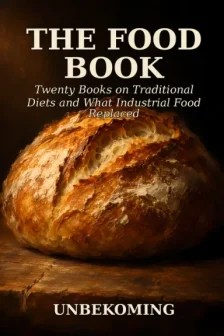
What has not been treated at book length, until now, is the whole shelf — the twenty works that, taken together, describe what the traditional kitchen was, what industrial food replaced it with, and what the body does when the replacement runs for a century.
The Food Book reads twenty of those works as a single library: Weston Price and Sally Fallon on the tradition that was lost; Francis Pottenger on what cooking does to a species over four generations; Sandor Katz on fermentation as an ecology; William Dufty on the two-and-a-half-century history of refined sugar; William Campbell Douglass on raw milk; James DiNicolantonio on the inversion of the salt argument; Max Gerson on cancer; Ulric Williams on medicine as a cartel; William Engdahl on seed sovereignty; Stephen Harrod Buhner on what plants do, chemically, that pharmaceuticals disrupt. … continue
This site is provided as a research and reference tool. Although we make every reasonable effort to ensure that the information and data provided at this site are useful, accurate, and current, we cannot guarantee that the information and data provided here will be error-free. By using this site, you assume all responsibility for and risk arising from your use of and reliance upon the contents of this site.
This site and the information available through it do not, and are not intended to constitute legal advice. Should you require legal advice, you should consult your own attorney.
Nothing within this site or linked to by this site constitutes investment advice or medical advice.
Materials accessible from or added to this site by third parties, such as comments posted, are strictly the responsibility of the third party who added such materials or made them accessible and we neither endorse nor undertake to control, monitor, edit or assume responsibility for any such third-party material.
The posting of stories, commentaries, reports, documents and links (embedded or otherwise) on this site does not in any way, shape or form, implied or otherwise, necessarily express or suggest endorsement or support of any of such posted material or parts therein.
The word “alleged” is deemed to occur before the word “fraud.” Since the rule of law still applies. To peasants, at least.
Fair Use
This site contains copyrighted material the use of which has not always been specifically authorized by the copyright owner. We are making such material available in our efforts to advance understanding of environmental, political, human rights, economic, democracy, scientific, and social justice issues, etc. We believe this constitutes a ‘fair use’ of any such copyrighted material as provided for in section 107 of the US Copyright Law. In accordance with Title 17 U.S.C. Section 107, the material on this site is distributed without profit to those who have expressed a prior interest in receiving the included information for research and educational purposes. For more info go to: http://www.law.cornell.edu/uscode/17/107.shtml. If you wish to use copyrighted material from this site for purposes of your own that go beyond ‘fair use’, you must obtain permission from the copyright owner.
DMCA Contact
This is information for anyone that wishes to challenge our “fair use” of copyrighted material.
If you are a legal copyright holder or a designated agent for such and you believe that content residing on or accessible through our website infringes a copyright and falls outside the boundaries of “Fair Use”, please send a notice of infringement by contacting atheonews@gmail.com.
We will respond and take necessary action immediately.
If notice is given of an alleged copyright violation we will act expeditiously to remove or disable access to the material(s) in question.
All 3rd party material posted on this website is copyright the respective owners / authors. Aletho News makes no claim of copyright on such material.


 Traditional food was food. Not organic food. Not slow food. Not wellness food. Food. Bone broth was food. Raw milk was food. Fermented vegetables were food. Butter was food. Eggs were food. Honey was food. Liver was food.
 Aletho News

