Lavrov: Last-Minute Changes Ruined Nuclear Deal
Al-Manar | November 15, 2013
Russian Foreign Minister Sergei Lavrov said amendments made by a member of the six world powers to a US-proposed draft proposal during the recent Iran nuclear talks in the Swiss city of Geneva spoiled efforts to reach a deal.
Lavrov, who is on a visit to Egypt, said on Thursday that Iran and six world powers were close to reaching an agreement on a deal during their talks in Geneva, but last-minute amendments to the draft document blocked a deal, AP reported.
He expressed hope that representatives of the six countries will not abandon “agreements that already have been shaped” and strike a pact with Iran during next week’s talks.
A member of the Iranian delegation in nuclear talks with six world powers says Tehran did not block an agreement in last week’s negotiations in Geneva.
“The Islamic Republic of Iran did not prevent a final deal in Geneva,” Iran’s Deputy Foreign Minister for European and American Affairs Majid Takht-e Ravanchi said Friday. “We do not want to go into the details of the issues…, but it is clear who ultimately blocked a final agreement,” he added.
On November 7, Iran and the six world powers – the US, France, Britain, Russia, China and Germany – kicked off intense discussions in Geneva which stretched into a third day. The two sides did not reach an agreement, but stressed that significant progress had been made and expressed optimism about the prospect of a possible deal in the future.
French Foreign Minister Laurent Fabius said in a November 9 interview that “Israel’s concerns” must be taken into consideration in the course of the negotiations, adding that there is “no certainty” whether Iran and six powers will reach an agreement at the current stage.
Canada Signs Free Trade Deal with Honduras amid Pre-electoral Repression
By Sandra Cuffe | Upside Down World | November 14, 2013
Canada and Honduras inked a bilateral free trade agreement on November 5, amid political repression, increasing militarization, and controversial Canadian investment in the Central American nation.
 Ed Fast, Canada’s Minister of International Trade, and Honduran Minister of Industry and Commerce Adonis Lavaire signed the deal in Ottawa, less than three weeks before general elections are expected to change the political landscape in Honduras.
“It’s really uncertain what’s going to happen with the elections,” said Karen Spring, a Canadian human rights activist living in Honduras. “It’s a lot less likely for [Canada] to have a government – and the political conditions and the economic conditions – in [Honduras] that would approve the free trade agreement or would allow it to be approved.”
Recent polls show two leading presidential candidates: LIBRE candidate Xiomara Castro, the wife of Manuel Zelaya, who was ousted as President in a coup d’état in June 2009 and the ruling National Party’s Juan Orlando Hernández, former President of the National Congress who resigned in order to run for office.
The November 24 general elections are expected to mark the end of a longstanding two-party system. Nine political parties are participating, and it is unlikely that any one party will hold a majority of seats in Congress.
“Because of the strong political force of the LIBRE party and its bases, the National Front of Popular Resistance, there’s a really good chance they can either gain a lot of seats in Congress or they can win the presidency,” Spring told Upside Down World. Whether or not LIBRE congressional representatives would pass the free trade agreement or not is uncertain, but the political landscape will undoubtedly change. “I think the Canadian government knows very well that after the elections on November 24, it’s going to be a lot more difficult to pass any free trade agreements,” she added.
Negotiations leading to the Canada-Honduras Free Trade Agreement (FTA) began back in 2001, though they were initially for a deal between Canada and the C4 countries: Guatemala, Honduras, El Salvador, and Nicaragua. After nearly a decade of multilateral talks and a number of impasses, Canada and Honduras decided to pursue a bilateral agreement in 2010, the year following the coup d’état.
Before it comes into effect, the Canada-Honduras FTA must be approved by both Canadian Parliament and Honduran Congress. Current representatives of the latter will sit until a few days before the new administration assumes power on January 27, 2014.
Canada exported $38 million in goods to Honduras in 2012, and imported $218 million. Top Honduran exports to Canada are agricultural products and apparel, and the leading product Canadian exports to Honduras is fertilizers. Recent government figures on Canadian direct foreign investment are unavailable.
In its official press release announcing the signing of the FTA, the Canadian government focused on the elimination of tariffs and improved access for the export of Canadian pork and beef. However, controversial Canadian mining, sweatshop, and tourism sectors also stand to benefit from investment protection measures contained in Chapter 10 of the bilateral free trade agreement.
“In a country like Honduras, using free trade agreements to open the domestic economy to competition with countries with asymmetrical economies has only attracted transnational companies which operate and implement work systems that exploit Honduran women workers,” wrote the Honduran Women’s Collective (CODEMUH), in a statement in response to the signing of the Canada-Honduras FTA.
The organization is currently dealing with more than 100 textile factory workers who are suffering from work-related injuries and health conditions related to their employment by Gildan Activewear, a Montreal-based clothing manufacturer. The company operates several sewing and manufacturing facilities in northwestern Honduras, as well as others in Nicaragua, Haiti, the Dominican Republic, and Bangladesh. Gildan’s gross profits in 2012 were just shy of $400 million, while net earnings reached $148.5 million.
“Exploitative and enslaving working conditions – such as those which exist in Gildan Activewear headquartered in Canada and promoted by nation states and trade agreements – involve normal work days of an illegal 11 and a half hours, with obligatory overtime, bringing the work week to up to 69 hours,” according to the statement by CODEMUH.
Canadian companies and investors in Honduras have not only come under fire for their treatment of workers, but also for their impacts on communities.
“We have come to see that Canadian tourism has been the most aggressive in Garifuna communities in recent years,” said Miriam Miranda, General Coordinator of OFRANEH, an indigenous Garifuna federation. The lands and traditional territories of the 46 Garifuna communities spread up and down the Caribbean coast of Honduras are prime targets for tourism and real estate development projects. “There’s no respect whatsoever for the rights of Indigenous peoples,” said Miranda.
Canadian investor Randy Jorgensen’s Banana Coast project near the coastal city of Trujillo took off after the 2009 coup. Dubbed the “Porn King” for amassing a fortune from his Canadian porn chain, Jorgenson pressured Rio Negro residents to sell parcels of land they inhabited in order to secure coastal property in Trujillo for the construction of a Panamax cruise ship pier and massive commercial center.
“They used the Law of Forced Expropriation in the case of Trujillo, but it was used to impact Garifuna communities. They never use it to return land to Garifuna communities,” Miranda told Upside Down World. “The last people who refused to sell [their land] were told ‘if you don’t sell, we’ll take your land away.’”
The first phase of the Banana Coast pier was inaugurated in June 2013. Jorgensen has also invested in a mountainside gated community of villas in the traditional territories of the Garifuna communities of Santa Fe, Barrio Cristales and Rio Negro. They’re not the only Canadian projects in the area, said Miranda. There have been incursions by Canadian investors into Garifuna territory in and between the Garifuna communities of Rio Esteban, Guadalupe, San Antonio, Santa Fe, Rio Negro and Barrio Cristales, linking a stretch of coast from Rio Esteban to Trujillo. And it’s a phenomenon that’s not limited to the coast.
“All of the territories are kind of on the table right now to see how they can be exploited – not just mining, not just tourism, but anything where public goods, resources can be exploited,” said Miranda. There’s currently an unparalleled exploitation of resources by transnational foreign capital in Honduras, she said, and the post-coup government has gone out of its way to protect foreign investment.
“These days, Canadians – together with the Taiwanese and Chinese – are the ones with the most aggression towards the territories,” said Miranda.
As with many FTAs, the Canada-Honduras agreement is accompanied by parallel agreements on labor and the environment, but Common Frontiers Program Director Raul Burbano and Americas Policy Group Coordinator Stacey Gomez maintain they’re just for show. “The labor and environmental side agreements are mere window dressing given that they are not accompanied by any real enforcement mechanism to ensure they are adhered to,” they wrote in a November 5 Open Letter.
Chapter 10 of FTA itself includes a brief mention of labour, environmental and human rights, but – unlike the investment protection measures – there are no enforcement measures. “Each Party should encourage enterprises operating within its territory, or entreprises [sic] subject to its jurisdiction, to voluntarily incorporate internationally recognized standards of corporate social responsibility in their internal policies,” according to Article 10:16. The full text of the agreement was only made public after it was signed.
While the FTA was signed in Ottawa, the reality on the ground in Honduras remained one of increasing militarization and ongoing repression.
Murders of journalists, lawyers, and Indigenous and campesino people involved in land and resource struggles continue in the country, which has one of the highest per capita murder rates in the world. People involved with the LIBRE party have also become targets. Rights Action’s Spring has been researching pre-electoral political violence and compiled a list of murders and armed attacks on political party-affiliated candidates, campaigners, and activists between May 2012 and October 19, 2013.
“The list shows that the LIBRE party has suffered more armed attacks and killings in the last year and a half than all other eight political parties combined,” said Spring. “Those are just armed attacks and killings. That doesn’t include political persecution, death threats, disappearances, and then killings and armed attacks of people that aren’t part of the political campaigning process but that are really important in the social movement.”
Militarization has increased hand-in-hand with repression since the 2009 coup. Not only are soldiers patrolling the streets alongside the national police force, but a new military police force hit the streets in October 2013. Legal challenges to the constitutionality of the new security force, operating directly under military command, are currently underway. In response, on November 6 the National Party’s presidential candidate Hernández introduced a proposal to Congress to reform Article 274 of the Constitution in order to grant constitutional standing to the military police force. This has become a cornerstone of his electoral campaign.
The controversy surrounding the military police has been subject to recent media coverage in Honduras, but the involvement of mining companies and other private sector corporations in financing public security forces no longer makes headlines. The General Mining and Hydrocarbons Law ratified in January 2013, after a review by advisors paid by the Canadian government, includes as part of its royalty regime a two percent payment to the Security Tax (Tasa de Seguridad) fund. The fund is helping to finance the increasing militarization of Honduran streets.
Who will win the November 24 elections is uncertain at this point. But no matter which political party comes out on top, if the Honduran Congress passes the Canada-Honduras Free Trade Agreement into law, it will be a win for Canadian companies.
Sandra Cuffe is a vagabond freelance journalist currently based in Honduras.
Israeli navy captures two Gaza fishermen, including one injured by gunfire
By Rosa Schiano | International Solidarity Movement | November 13, 2013
Gaza, Occupied Palestine – On the morning of Sunday, 10th November, brothers Saddam Abu Warda (age 23) and Mahmoud Abu Warda (age 18) were captured by the Israeli navy in Palestinian waters off the Gaza Strip. They were released later in the evening and their boat was confiscated. Mahmoud was injured by a bullet in the right side of his abdomen.
We went to visit the two young fishermen in their home in the town of Jabaliya, in the northern Gaza Strip.
In the absence of electricity, the house was dark like most homes in Gaza Strip, which is stifled by the siege and a severe fuel crisis. Without electricity, water could not reach the house’s plumbing system.
“We cast our nets into the sea at a distance of about 500 meters from the forbidden fishing area,” Saddam told us. “We were far away from the Israeli gunboats.” The two fishermen were on a small boat, or hasaka, without an engine.
Saddam told us that an Israeli gunboat approached their boat. The soldiers shouted for them to leave in less than five minutes. “We had to cut our nets in order to flee,” Saddam said. “The soldiers came closer to us and started shooting at our boat.”
Without a motor, the two fishermen could not escape. The Israeli soldiers ordered the two fishermen to undress and jump into the water. Meanwhile, they continued to open the fire. “I was shocked,” Saddam said. “I could not move. They were shooting, and I thought I would be killed.”
As we listened to Saddam, F-16 fighter jets rumbled overhead at low altitudes, a constant threat in the darkness.
“I shouted, asking the soldiers to stop shooting and save our lives,” Saddam said. According to him, another Israeli gunboat reached them and attacked the fishermen using water cannons. The two fishermen jumped into the water. “Three Israeli gunboats surrounded us, our boat was now far away, and the water was cold,” he added. The soldiers told them to swim to the forbidden maritime area. “I was scared. My brother was away from me, and the soldiers kept firing. He was wounded. He could not swim. I reached him to save him. His blood was everywhere in the sea. Two Israeli dinghies reached us. The soldiers took my brother Mahmoud and closed his wound to stop the bleeding. They didn’t take me, too. They left me in the water. They told me to swim to the marker that delimits the maritime area allowed by Israel, then took me. They covered my head. I could not see anything. They pointed a gun at my head and cuffed my hands and feet. They hit me, kicking me on the back. Then I fainted for about an hour. I don’t remember anything more.”

Mahmoud (left) and Saddam Abu Warda. (Photo by Rosa Schiano)
The two fishermen were transported to a medical center in the port of Ashdod. “When I woke up, I saw my brother beside me,” Saddam said. “Two soldiers then took me to a special room and interrogated me. They asked me why we were fishing in the forbidden area. I told them that we were 500 meters away from the limit, and that the soldiers forced us to swim until we reached it. An investigator asked me how my brother was wounded, since it was not by the Israeli soldiers. I told him my brother was wounded by Israeli gunfire. The investigator tried to convince me that Mahmoud was not wounded by the soldiers. Then I told him that three Israeli gunboats were shooting over our heads and my brother’s blood was everywhere in the sea”.
The investigators then showed Saddam a map on a laptop, placing their boat in the forbidden maritime area. Investigators interrogated the two fishermen individually. Afterwards, the two brothers were detained in another room, and at the end of the day, were transferred to Erez, where they received another interrogation. “They asked me about my family, my neighbors, fishermen, and every detail of my life,” said Saddam. “Then they showed me a map and asked me about every house around my home. They also asked me how many boats I had.”
The Israeli port of Ashdod now holds three boats belonging to Saddam’s family. In the past, in fact, other members of the Abu Warda family had been arrested and seen their boats confiscated. Now they have none left.
After interrogation, the fishermen were detained in a cell for two hours before being released through the Erez checkpoint later in the evening.
Saddam’s family has 15 members. Fishing is their only source of livelihood. The other eight brothers are also fishermen. They don’t have any other source of income, and they don’t believe they will get their boats back.
Mahmoud showed us the wound on the right side of his abdomen. The bullet did not enter his body, but brushed it. Doctors in the Ashdod medical center closed his wound with two stitches. Mahmoud also told us of the physical and verbal abuse he received from Israeli soldiers. We asked him if he will return to fishing. “Of course,” he said. “We have no choice. We have to face the danger.”
What its fishermen earn only allows the Abu Warda family to survive. Sometimes, they return home without anything. Other times, what they earn only covers the cost of fuel.
The fishermen told us that they would like more support from international associations, especially when they are in the north of the Gaza strip. There, attacks are more frequent and the majority of confiscated boats have been lost.
We continue to hope that one day the international community will break its silence and force Israel to stop attacking Gaza fishermen, and to release all their boats it has confiscated.
Background
Israel has progressively imposed restrictions on Palestinian fishermen’s access to the sea. The 20 nautical miles established under the Jericho agreements, between Israel and the Palestine Liberation Organization (PLO) in 1994, were reduced to 12 miles in the Bertini Agreement of 2002. In 2006, the area Israel allowed for fishing was reduced to six nautical miles from the coast. After its military offensive “Operation Cast Lead” (December 2008 – January 2009) Israel imposed a limit of three nautical miles from the coast, preventing Palestinians from accessing 85% of the water to which they are entitled under the Jericho agreements of 1994.
Under the ceasefire agreement reached by Israel and the Palestinian resistance after the Israeli military offensive “Operation Pillar of Defense” (November 2012), Israel agreed that Palestinian fishermen could again sail six nautical miles from the coast. Despite these agreements, the Israeli navy has not stopped its attacks on fishermen, even within this limit. In March 2013, Israel once again imposed a limit of three nautical miles from the coast. On 22 May, Israeli military authorities announced a decision to extend the limit to six nautical miles again.
Related article
- Army Invades Southern Gaza (imemc.org)
Soldier killed in Occupied Palestine as Israel calls for “intelligent” settlements
Al-Akhbar | November 13, 2013
A 16-year-old Palestinian stabbed an Israeli soldier to death on a bus on Wednesday in an attack apparently motivated by the jailing of his relatives in Israel, police said.
The death came as Israel backtracked on an announced plan to expand illegal settlements in the West Bank, calling for “intelligent and coordinated” construction despite international condemnation.
The killing, in the town of Afula in Occupied Palestine, follows a surge in violence in the West Bank, where 10 Palestinians have been shot dead by Israeli troops and three Israelis killed since peace talks resumed in July.
Israel’s northern police commander, Ronny Attia, said the attacker was from the West Bank town of Jenin, and that he was in custody.
According to police, the Palestinian youth did not have a permit to be inside Israel.
“By his account, his uncles are in prison in Israel and this is the reason he decided to carry out the terrorist attack,” Attia said.
Israel refers to many acts of protest against the decades-long occupation – whether violent or non-violent – as terrorism.
Police spokesman Micky Rosenfeld said the soldier, aged 18, was pronounced dead in hospital.
The attack occurred a day before the one-year anniversary of the Israeli Pillar of Cloud offensive on Gaza, in which six Israelis and more than 100 Palestinian civilians were killed in eight days.
Peace talks orchestrated by US Secretary of State John Kerry have faced serious obstacles, including the high rate of Palestinians incarcerated in Israeli prisons, many in indefinite administrative detention, as well as extensive plans to expand Israeli settlements in the West Bank.
A report by British newspaper The Guardian on Tuesday revealed that Israeli troops conducted mock arrests and raids in the West Bank without informing the local population that their actions were drills, causing extreme distress to many Palestinians.
The attack came as Israel’s Intelligence Minister Yuval Steinitz urged “coordinated” settlement building, a day after a new plan for settler homes in the West Bank drew international condemnation.
Settlements in Israeli-annexed east Jerusalem and the West Bank “must be done in an intelligent and coordinated way,” Steinitz told Israeli public radio on Wednesday.
The settlements are deemed illegal under international law.
Israeli Prime Minister Benjamin Netanyahu late Tuesday cancelled plans to build 20,000 new settler homes in the West Bank, hours after their announcement sparked US and Palestinian criticism.
State Department spokeswoman Jennifer Psaki had said Washington was not only concerned by the initial announcement, but also “surprised” and sought an explanation from Israel.
She repeated the longstanding US position on settlements that “we do not accept the legitimacy of continued settlement activity.”
Netanyahu then ordered Israeli Housing Minister Uri Ariel “to reconsider all of the steps for evaluating planning potential (for the settler homes) that he distributed without any advance coordination,” the premier’s office said.
(Reuters, AFP, Al-Akhbar)
Related video
French starting to see Zionist lobby pull: Analysis
By Tahmineh Bakhtiari | Press TV | November 11, 2013
Since the formation of Israel and even before that, Tel Aviv has always resorted to lobbying to pursue its illegitimate objectives, including efforts to earn recognition for its so-called government.
Israel’s most active lobby is in the US, but it is also highly active in European countries such as Britain, Germany, France and even Italy and Spain.
This article seeks to discuss the influence of the Zionist lobby and France-Israel ties.
After a book by John Mearsheimer and Stephen Walt about the influence of the Israeli lobby on US foreign policy was published in 2007, French daily Le Monde published an article in October that year describing the Zionist lobby in France as a non-transparent and deceitful group. From that point, the issue of the Zionist lobby in France and its influence on the country’s foreign and domestic policy has been taken into consideration.
The Zionist lobby in France has extensive influence in three areas: A: Media and their affiliate companies, including Eutelsat; B: Political parties who receive campaign funding and media sponsorship from the Zionist lobby; C: Oil and arms companies.
The history of Zionist lobby in France
The Zionist movement led by Joseph Fisher started its activities in France between the first and second World Wars. Later in 1949, Fisher became Israel’s ambassador to Belgium. France had incurred heavy losses during World War II and that laid the groundwork for the presence of affluent Jews in different economic, social, judicial, cultural, religious and political arenas of the country.
At present, there are over 100 Jewish organizations and societies in France and all of the active Israeli parties have offices in Paris. In 1977, different Jewish groups in France merged and formed the Representative Council of French Jewish Institutions (Le Conseil Representatif des Institutions Juives de France (CRIF)).
The group is tasked with pursuing the interests of Israel inside France and its foreign policy. The group which owns a myriad of newspapers, magazines, TV networks and satellite service providers, has extensive influence in France’s political and legal bodies. Moreover, the Zionist lobby has a lot of lucrative businesses and financial institutions under its control.
The Zionist lobby in Israel has also formed certain groups for defaming, suing and even bringing to trial the individuals and groups which do not assert Israel’s interests. The French Union of Jewish students, the union of Jewish merchants in France, the SOS Racisme (established by the French Socialist Party to curry favor with Israel), the Organization of Lawyers without Borders France and the Anti-Defamation League are some examples.
French parties and the Zionist lobby
In domestic politics, some of the political parties are in competition with each other to forge friendly ties with Israel due to their need of pro-Israeli funds for victory in elections.
One of the examples of the Zionist Lobby’s sway in France is the naming of one the key roundabouts in Paris as David Ben-Gurion by the council of the city, which is comprised of rightist and socialist parties. Interestingly, the socialist mayor of Paris performed the ceremony with Shimon Peres.
Moreover, there are other Parisian squares named after the Zionist leaders such as Theodor Herzl and Yitzhak Rabin.
In 2012, around 112 French lawmakers, both rightists and leftists, held a festival in support of Israel. The move was aimed at opposing Palestine’s UN membership. The French parliamentarians stood up singing Israel’s national anthem.
The influence of the Zionist lobby in France reaches its peak during the election campaign in the country where each candidate competes with the others to ingratiate itself with Israel.
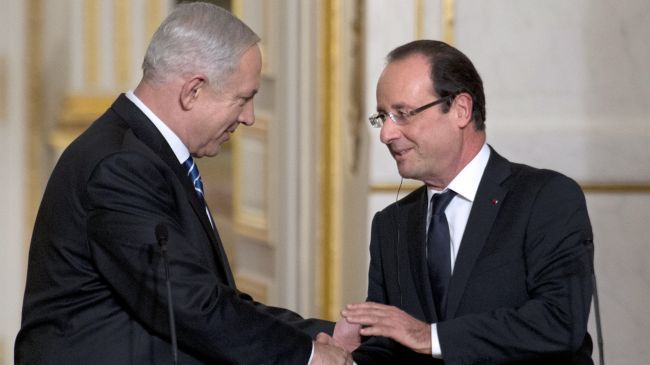
Among the French parties, the Socialist party has the closest ties with Israel and it adjusts most of its work plans, particularly vis-à-vis foreign policy, with the officials in Tel Aviv. The recent stance of Socialist French Foreign Minister Laurent Fabius regarding the nuclear talks with Iran was aligned with his illogical compliance with Tel Aviv’s policies towards Tehran.
Israel-France intelligence and security cooperation
Apart from the poisoning of Yaser Arafat, the former president of the Palestinian National Authority, and his hospitalization at a military hospital in Paris — which was a sort of French-Israeli intelligence and security coordination – the history of Paris-Tel Aviv ties is fraught with such cooperation.
From the outset of the fake Israeli regime, the French government authorized its intelligence apparatus to cooperate with the Mossad elements in assassinations of Arab and Palestinian fighters.
In 1965, under the presidency of Charles De Gaulle, Mossad abducted Mehdi Ben Barka, an opponent to King Hassan II, in cooperation with the French intelligence service. In 1972, Mossad killed Palestine Liberation Organization’s Representative to Paris, Mahmoud Al-Hamshri in cooperation with French intelligence elements.
Moreover, in the judiciary section, the French government has always acted in accordance with the interests of the Zionist lobby, the trial of Roger Garaudy, the writer of The Founding Myths of Israeli Politics, being an example.
Most of the world media are under the Zionist lobby’s sway and, using this powerful tool, they have managed to control world public opinion. That’s why when a media outlet moves in the path of actually informing the public, they spare no effort to prevent its activities.
The Zionist lobby in France puts pressure on the companies which provide services to the anti-Zionist satellite networks. The pressures by the Zionist lobby on the French Satellite service provider Eutelsat to stop the broadcasting of al-Manar, al-Alam, Press TV, Sahar and other networks is another example of such media sway.
Generally speaking, the Zionist lobby in France is enormously powerful in different spheres, despite its unpopularity among the French public. It has tried hard to portray Israelis as oppressed people. However, given the growth in public awareness, the information revolution and expansion of information dissemination tools, Zionism can no longer dominate public opinion.
The domineering and greedy nature of the Zionist regime and the futility of its claims about its opponents are being unmasked on a daily basis. This will lead to mounting pressure of public opinion’s pressure on the politicians. Nonetheless, for the time being, the majority of French politicians need the money and economic leverage of the Zionist lobby for the achievement of their objectives and the French media have to keep silent in order to survive and avoid the anti-Semitism tag.
In other words, at present France is under the domination of Zionists and their supporters, but the French public is gradually becoming aware of the fact.
~
Tahmineh Bakhtiari is an Iranian journalist and an expert on the Middle East and Latin America. Her writings have appeared in many print and online journals and newspapers including The Khorassan Daily, Jam-e Jam, Jomhuri Islami and Aftrab-e Yazd. Her book ‘The Genealogy of Zionism’ was published in 2001. Bakhtiari has a master’s degree in international relations.
Related article
Two Broken Cameras
By Yossi Gurvitz | November 11, 2013

Israeli soldiers try to arrest Activestills photographer Yotam Ronen, as Palestinian and international activists block 443 highway, which connects Tel Aviv and Jerusalem through the West Bank, during a protest against the violence of the Israeli settlers, October 16, 2012.
One morning last September, Nadel Shafiq Taher Shatiya heard the loudspeakers of the mosque in his village, in the Nablus region, announce that settlers were approaching the village’s land. Shatiya, a photojournalist by trade, grabbed two cameras and raced to the scene.
Based on his account, it turns out that when he arrived, several tractors and settlers – who, according to the reports received by Shatiya, came from thenearby Elon Moreh settlement – were trying to plough the village’s lands while several dozen Palestinian farmers tried to expel them. A settlement security vehicle showed up, and two settlers stepped out of it (Shatiya believes he can identify them), and started shooting live ammo at the farmers. Some of them took cover; Shatiya kept taking photos. That’s his job.
About ten minutes later, a large IDF force arrived at the scene, and did what it usually does: joined the settlers. The soldiers fired tear gas canisters and stun grenades at the farmers, and as the area is full of dry thorns, a fire broke out. The Palestinian farmers tried to put it out, and the two armed settlers demanded that the troops stop them (Yours truly was present for another incident, in which IDF soldiers fired at Palestinians who tried to put out a fire which had erupted after a demonstration due to canister fire.) The soldiers confronted the Palestinians, and Shatiya saw – and documented – one of the soldiers pull out a knife and threaten one of the farmers.
Our brave troops don’t know how to deal with nonviolent resistance. Major General (res.) ‘Amon Gilad became famous abroad when he told the American embassy “we don’t do Ghandi very well.” In such cases, the IDF’s instinct is to use excessive force. It makes for bad publicity, and the soldiers know that – so they try to suppress the evidence.
Shortly after Shatiya photographed the knife-wielding soldier, other soldiers assaulted him and took his cameras and camera bag from him. He witnessed another soldier tearing a phone out of the hands of a farmer, who was using it to document the incident; the farmer was beaten and detained.
So far, no surprises. Anyone who has either served in the West Bank or demonstrated there is familiar with the loving care the soldiers lavish on photographers. But in Shatiya’s case, the story underwent an unusual twist: the soldiers took his cameras to an officer, who turned them over, along with his camera bag, to a settler. Shatiya protested to the officer, saying “you’re in charge of security, and if, as part of your duty, you want to confiscate the cameras, keep them; why do you give them to the settler?” In return, the officer blamed Shatiya for the fire. Later on, Shatiya saw a settler moving among the detained Palestinians, telling the soldiers who should be kept in detention.
Turning the cameras over to the settler caused some fuss, with Israeli DCO officers telling the army it had no authority to detain journalists or confiscate their cameras, that only policemen may do so. This is inaccurate, by the way: in the West Bank soldiers have the same authority as cops, until the latter reach the scene. The Military Commander is the sovereign in the West Bank, as it is legally considered to be held under belligerent occupation; the police only act in the West Bank because they have been delegated that authority by the Military Commander. In the end, several officials promised Shatiya he’d get his cameras back, but afterwards they simply ignored and then began avoiding him.
Some 12 days after the incident, the Israeli DCO contacted the Palestinian DCO, and informed the latter Shatiya could come and retrieve his cameras. He found them broken and rubbed with sand. The damage to the cameras is estimated at 21,000 NIS (about 6,000 USD). That’s what happens when you try to document the most moral army between the Jordan and the Mediterranean while it fails to move into Ghandi mode.
So, to sum it up, we’ve had settler violence, immediately backed up by the army; the destruction of evidence by soldiers, using a settler for this purpose; yet another example of problematic cooperation between soldiers and settlers, where a settler tells soldiers who to detain and they obey, and, finally, another example of the security forces in the West bank misunderstanding their role. There’s a strain of thinking in Israel, particularly among the center and on the left, which says that the problem in the West Bank is the settlers, and that the soldiers are not at fault.
But the soldiers know full well that they are at fault – Had they felt no guilt, they wouldn’t have felt the need to destroy evidence, and they would neither have broken the farmer’s cell phone nor given Shatiya’s cameras to a settler, in order to rid themselves of responsibility for taking the cameras away from him. In the West Bank, the soldiers and the settlers are part of the same pattern, the pattern of an occupation whose inner logic is annexation by a quiet population transfer of the Palestinians.
Yizhak Shamir, an Israeli prime minister, once said that one is allowed to lie for Eretz Israel (the ‘Land of Israel”). The IDF soldiers take this one step further: in the name of Eretz Israel, they destroy evidence and intimidate journalists and innocent civilians.
Related video

Featured Video
Strike Iran Again, Open Pandora’s Box | Brian McGlinchey
or go to
Aletho News Archives – Video-Images
New Book
The Food Book — First Edition, 2026, Paperback
Lies are Unbekoming | November 18, 2026
 Traditional food was food. Not organic food. Not slow food. Not wellness food. Food. Bone broth was food. Raw milk was food. Fermented vegetables were food. Butter was food. Eggs were food. Honey was food. Liver was food.
Weston Price travelled from 1931 to 1936 across fourteen populations — Swiss villagers in the Lötschental valley, Gaelic communities in the Outer Hebrides, Inuit in Alaska, Native Americans in northern Canada, Māori in New Zealand, Masai in Kenya, Melanesians in the South Pacific, Peruvian Indians in the Andes. He photographed their faces. He measured their dental arches. He weighed their vitamin and mineral intake. He published the results in 1939 in Nutrition and Physical Degeneration. The pattern was consistent across every population. The generation raised on ancestral foods had broad faces, straight teeth, strong bone structure, and virtually no chronic disease. The generation raised on refined flour, refined sugar, and canned goods did not.
What has not been treated at book length, until now, is the whole shelf — the twenty works that, taken together, describe what the traditional kitchen was, what industrial food replaced it with, and what the body does when the replacement runs for a century.
The Food Book reads twenty of those works as a single library: Weston Price and Sally Fallon on the tradition that was lost; Francis Pottenger on what cooking does to a species over four generations; Sandor Katz on fermentation as an ecology; William Dufty on the two-and-a-half-century history of refined sugar; William Campbell Douglass on raw milk; James DiNicolantonio on the inversion of the salt argument; Max Gerson on cancer; Ulric Williams on medicine as a cartel; William Engdahl on seed sovereignty; Stephen Harrod Buhner on what plants do, chemically, that pharmaceuticals disrupt. … continue
Blog Roll
 Aletho News
- Study of 14,000 Children Links Vaccination to Higher Rates of Chronic Illness
- Strike Iran Again, Open Pandora’s Box | Brian McGlinchey
- ‘Revenge of Big Pharma’: 12 States Could Lose Religious Exemptions to Vaccination in 2027
- Brazil targeted by Western biopower
- B’nai B’rith UK’s bid to brand anti-Zionism as extremism
- ‘Same fraudulent script’: Iran slams US biological and chemical weapons claims as recycled Iraq-style deception
- Tom Friedman’s Deceptive Attempt to Lure Democrats to Escalate the Iran war
- Russia Warns of Response if Nuclear Deployment Limits Near Its Borders Are Lifted
- Putin is Partly Right on NATO
- The trillion-dollar question: Why can’t machines replace soldiers?
- If Americans Knew
- An error has occurred; the feed is probably down. Try again later.
- No Tricks Zone
- Argentina’s Perito Moreno Glacier Joins Antarctica and Arctic In Defying Doomsday Melt Claims
- New Study: Barents Sea Temperatures Were Warmer And Sea Ice Less Extensive In The 1700s Than Today
- German Authorities Start Initiative To Evaluate Public Register For Climate “Disinformation” Spreaders!
- Zonal Asymmetry of Temperature Change in the Antarctic Circumpolar Current
- New Study: The Net Fossil Fuel Contribution To Rising Atmospheric CO2 Has Been Zero For 500 Years
- Germany’s Green Energy Transition Becoming Increasingly Expensive…Another 6 Trillion Euros!
- Sudden Stratospheric Warming, Powerful El Niño Combination May Lead To Extreme Europe Cold, Energy Crisis!
- Two New Studies Find Thwaites Glacier Melt Cannot Be Driven By Human Activity Or A Warming Ocean
- E-Cars Reduce CO2 Emissions By Only 41% Compared To Internal Combustion Engine Vehicles
- Predictions Made By Renowned Climate Professor Over Past Decades Have Been Proven To Be Poor

