Gaza fighters fired retaliatory strikes on Tuesday, hours after the death in custody of a Palestinian who was denied appropriate cancer treatment, witnesses and the Israeli military said.
Witnesses told AFP that militants in Gaza City had fired three mortar rounds, but the army said only one projectile had landed, without causing any casualties.
Meanwhile, over 40 Palestinians angered by the death of Maisara Abu Hamdiyeh, 64, were injured in clashes with Israeli police and prison guards. Riots are believed to have swept through Israeli prisons, while guards used live fire and tear gas against the protesters.
Hamas spokesman Sami Abu Zuhri told AFP that the faction was watching the developments with “the greatest concern” and that Israel would “regret its continuing crimes”.
The last time Gaza fighters launched rocket fire was on March 21 during a visit by US President Barack Obama, when two rockets landed causing some damage but no injuries.
Maysara Abu Hamdiyeh’s death threatened to raise tensions in the Israeli-occupied West Bank and Gaza, after reports surfaced that Israeli authorities had denied care to the prisoner. Palestinian Prisoner Affairs Minister Issa Qaraqe likened Israel’s handling of Abu Hamdiyeh’s condition to a “slow death penalty.”
Israeli authorities claim they informed Abu Hamdiyeh, 64, of his illness in February, however, prisoner’s rights groups say the diagnosis occurred in August 2012. His lawyers and relatives report that Israeli doctors ran biopsies on him after he repeatedly complained of throat pains.
Palestinians have held several protests in recent weeks in support of more than 7,000 prisoners in Israeli jails, including over 300 children.
Palestinian Authority President Mahmoud Abbas said Israel had ignored long-standing pleas to free Abu Hamdiyeh, 64, sentenced to life in prison in 2002 for recruiting a bomber who planted explosives in a Jerusalem cafe. The bomb did not detonate.
“The Israeli government in its intransigence and arrogance refused to respond to Palestinian efforts to save the life of the prisoner,” Abbas told members of his Fatah party in the West Bank city of Ramallah.
Abu Hamdiyeh is the second Palestinian to die in Israeli custody this year. Arafat Jaradat, 30, died after an interrogation session in February. Palestinian officials said he had been tortured, an allegation Israel denied.
News of Abu Hamdiyeh’s death touched off protests by Palestinian inmates in several Israeli prisons. At Ramon jail, in southern Israel, inmates threw objects at guards, who fired tear gas at them, the Prisons Service spokeswoman said.
Three prisoners and six guards were treated at the jail for tear gas inhalation, she said.
In Abu Hamdiyeh’s West Bank home city of Hebron, masked stone-throwers confronted Israeli soldiers. No serious injuries were reported.
Israel holds 178 Palestinians in administrative detention, who have been jailed without trial as suspected militants for renewable three- to six-month terms based on classified evidence.
Hundreds of sick Palestinians are perishing in Israeli jails, according to the Palestinian Prisoner Affairs Minister and activists. The Palestinian Prisoners Club says some 25 Palestinian prisoners held by Israel are suffering from cancer.
Palestinians are expected to hold strikes across the West Bank and Gaza, and Palestinian members of the Israeli Knesset have issued strongly worded condemnations of the Israeli government over Abu Hamdiyeh’s deah.
Rights groups, as well as Qaraqe, described Abu Hamdiyeh’s eight-hour trips to and from the hospital as hellish. He was transported in a corrugated metal van with no windows or seats.
The Palestinian Authority said they expected him to be released on Monday. Israel’s refusal to free Abu Hamdiyeh had sparked protests in several Israeli prisons, where 17 detainees have begun a hunger strike.
In recent weeks, Abbas and Prime Minister Salam Fayyad made intense efforts to secure Abu Hamdiyeh’s release in the light of his deteriorating health.
An Iranian envoy to the UN has reiterated Tehran’s proposal for a Middle East free of nuclear arms, blaming the Israeli regime for hampering efforts to cleanse the entire region of all nuclear weapons.
Pointing to Israeli bids to oppose and obstruct an Iranian initiative to rid the Middle East of all atomic warheads, Iran’s Deputy Permanent Representative to the UN Gholam-Hossein Dehqani said in a Monday address to the UN Disarmament Commission (UNDC) meeting that the Islamic Republic and all Arab nations have declared their willingness to partake in a conference on eliminating all nuclear arms in the region without preconditions.
Dehqani further pointed to Iran’s insistence that all UN amendments for freeing the Middle East and the world from nuclear arms must be implemented, emphasizing that the eradication of all atomic weapons across the globe is the only ultimate guarantee for removing this threat.
The Iranian official also stressed that since the US atomic bombing of the Japanese cities of Hiroshima and Nagasaki in 1945, nuclear disarmament has remained one of the greatest global priorities and the UN General Assembly called for the abolishment of atomic bombs in a resolution at its first meeting on January 24, 1946.
Dehqani expressed regret, however, that “the maintenance of thousands of nuclear arms in the weapon depots of nuclear powers” on their own soil as well as in the territories of their allies “threatens international peace and security and the existence of human civilization.”
He further pointed to major concerns about the continued allocation of billions of dollars by countries that possess nuclear weapons for the testing and development of a new generation of atomic arms, as well as constructing new facilities to manufacture such weapons of mass destruction.
The Iranian envoy also pointed to the massive annual expenditures for the production and development of nuclear arms by some of the countries that possess atomic warheads and said there are major concerns regarding the expansion of nuclear military programs by these countries.
Calling for the total eradication of such nuclear arms, Dehqani further expressed regret about the “slow progress” on the issue of nuclear disarmament at the United Nations, reiterating the Islamic Republic’s insistence on eliminating all atomic arms based on the nation’s core opposition to all weapons of mass destruction.
The Israeli regime is widely believed to be the only possessor of nuclear weapons in the Middle East. The regime reportedly maintains between 200 and 400 atomic warheads, but under its policy of so-called nuclear ambiguity, it has never denied nor confirmed its possession of the weapons of mass destruction.
Furthermore, the Israeli regime has never allowed any international inspection of its nuclear facilities and has refused to sign the nuclear Non-Proliferation Treaty (NPT). It has also refused to join the International Atomic Energy Agency (IAEA), which limits members to civilian uses of the nuclear technology.
The UNDC meets annually in geographical working groups for three weeks in the spring, but over the years it has failed to agree on any substantial outcome. The commission, like most other UN bodies, is heavily influenced and manipulated by the US and its allies to ensure their global interests are served through the world body.
Israeli police arrested Palestinian worshipers on Saturday at the al-Aqsa mosque compound in Jerusalem, after an alleged scuffle erupted during a visit by a group of Jews and Christians to the mosque.
Israeli police spokesman Micky Rosenfeld told Ma’an that six Palestinians were arrested for throwing stones at groups of Jews and Christians visiting the compound.
Witnesses told Ma’an that police detained ten Palestinians and attacked Muslim worshipers with electric shock batons.
Dozens of Israeli settlers raided the mosque from al-Magharbeh gate, witnesses said. One settler drank wine and another allowed her daughter to urinate near an olive tree in the compound, they said, adding that a guard at al-Aqsa Mosque intervened, leading to scuffles.
Sheikh Azzam al-Khatib, the director of Islamic endowments in Jerusalem, said 200 Israeli settlers had entered the mosque in a provocative way, adding that religious officials had forced Israeli police to close al-Magharbeh gate for the day.
Israel’s police spokesman said further visits of Jewish and Christian groups were scheduled on Sunday afternoon and would continue as planned.
The al-Aqsa Mosque compound is one of the holiest sites in Islam. Jews also consider the area, which they refer to as Temple Mount, as imbued with important religious meaning.
Obama’s visit to Israel and Jordan has brought joy to no one but the Israelis. The US president practically swore an oath of fealty to Israel, speaking not just as a friend and faithful ally, not as a head of state, but as a humble subordinate.
He waxed lyrical on Israel as a land of dreams, then advised the Palestinians to ignore the settlements being built on their land and issued stern warnings to Syria, Iran and Hizbullah.
So eager was Obama to court the Israelis that he suddenly started calling Netanyahu — the very man who supported his rival, Mitt Romney, in the elections — “Bibi”. Tensions between the US president and the Israeli prime minister seemed to evaporate as Obama wandered from one Biblical reference to another while praising Israel for its “shining future”.
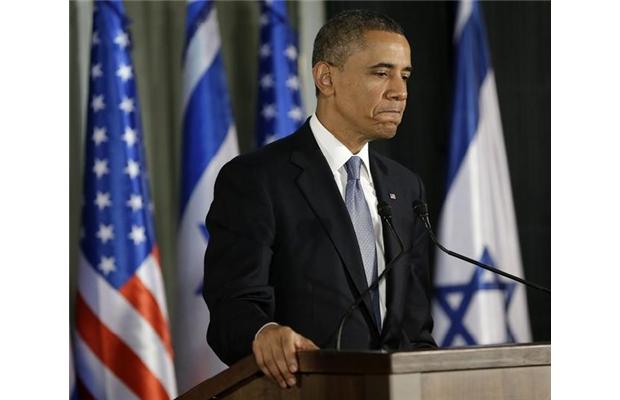
Dressed in the colours of the Israeli flag, a blue tie over a white shirt, Obama spared the Israelis no compliment, saying that it was his honour to visit them on Israel’s 65th “independence day”.
“It is good to be in this land,” Obama said in Hebrew, before applauding Israel for being the land of kibbutz that made the desert bloom. His rhetoric was reminiscent of that of a century ago, when the promise of a “land without a people for a people without a land,” launched decades of Palestinian suffering.
Obama didn’t neglect to remind his listeners that he had introduced Passover as a White House celebration.
“After enjoying Seders [Passover] with family and friends in Chicago and on the campaign trail, I’m proud that I’ve now brought this tradition into the White House. I did so because I wanted my daughters to experience the Haggadah and the story at the centre of Passover that makes this time of year so powerful.”
After mentioning the long history of the Jewish people and their years in exile, the sad memories of the Jewish holocaust, Obama showered the Israelis with praise for their many successes.
Then, he lashed out at Iran. Iran’s nuclear programme, he said, is “not simply a challenge for Israel. It is a danger to the entire world, including the United States. A nuclear-armed Iran would raise the risk of nuclear terrorism. It would undermine the non-proliferation regime,” he stated.
Reiterating US commitment to Israeli security, Obama made a pledge: “The security of the Jewish people in Israel is so important. It cannot be taken for granted. But make no mistake. Those who adhere to the ideology of rejecting Israel’s right to exist, they might as well reject the earth beneath them and the sky above, because Israel is not going anywhere.”
The Israeli website Walla! pointed out that in his speech, the US president mentioned the word “Israel” 82 times and the word “Palestinian” only 21 times.
Obama also visited the tombs of Herzl and Rabin, then the Yad Vashaem Holocaust Memorial. But he declined to visit the tomb of Yasser Arafat. And he refused to meet the daughter of one of the political prisoners held in Israel’s detention camps.
The whole thing seemed as if the US president was telling the Palestinians and Arabs, “This is the land of the Jews; so go look for your land elsewhere!”
Now the writing is on the wall. Those who had taken the US president for a moderate should take note.
The right-wing seemingly never misses a chance to go after Barack Obama for his collectivism and alleged dislike of America. Yet when Obama embraced blood-and-soil tribalism openly and implied that America was not the “land of the free” for everyone, the right-wing apparently had nothing to say.
Why? The subject was Israel, and the right-wing shares Obama’s tribalist premises on that subject.
For the Jewish people, the journey to the promise of the State of Israel wound through countless generations. It involved centuries of suffering and exile, prejudice and pogroms and even genocide. Through it all, the Jewish people sustained their unique identity and traditions, as well as a longing to return home. And while Jews achieved extraordinary success in many parts of the world, the dream of true freedom finally found its full expression in the Zionist idea — to be a free people in your homeland. That’s why I believe that Israel is rooted not just in history and tradition, but also in a simple and profound idea — the idea that people deserve to be free in a land of their own.
The first half of the paragraph is full of fable and fabrication, though he’s right about suffering, prejudice, pogroms, and genocide. To understand what’s wrong with those sentences, consult Shlomo Sand’s two excellent books The Invention of the Jewish Peopleand The Invention of the Land of Israel(both available for Kindle). Invention is not unique to the “Jewish people.” Many peoples and nations are the product of what Sand calls “mythistory.”
What I want to focus on in Obama’s statement is this:
And while Jews achieved extraordinary success in many parts of the world, the dream of true freedom finally found its full expression in the Zionist idea–to be a free people in your homeland.
Obama is saying that Jews need to live apart in Israel or they can’t be truly free. Think about the implications. Something about Jews makes it impossible for them to be really at home anywhere—including in what the right-wing (and presumably Obama) tout as the freest nation in the history of the world. So Jews need an ethno-religiously exclusivist state. That view amounts to a wholesale rejection of the western liberal tradition, which was inclusive and universalist and in which all people have the same rights without being seen as members of a tribe. Isn’t it the official line that this is what made America great? So why is Obama rejecting it? And why is the right-wing conspicuously silent?
Of course the right-wing can’t raise any objection because it is staunchly in Israel’s corner, which means endorsing its medieval notions. (Forgive me for writing as though the right-wing is monolithic. It is not. Suffice it to say there are honorable exceptions.) So the right-wing is stuck (like Obama) with a contraction: Jews aren’t fully free and at home in what they claim is the greatest and freest country on earth. This seems to be an insult both to Jews and the United States, but no one will say it. (And people wonder why Chuck Hagel once called the Israel Lobby “intimidating”—before being intimidated into withdrawing the charge.)
Obama and the right-wing would find their position untenable if they had a few facts. Throughout Jewish history, few Jews have had any desire or perceived obligation to move to Israel. (Most of those who went wished to die there in order to be near Jerusalem when the messiah comes and raises the dead.) When the Zionist movement was launched in the late 19th century, most American Jews rejected it firmly; for one thing, they couldn’t imagine a freer place than America. They also realized that there is no Jewish People—no race, no ethnic group, no tribe—but only many culturally diverse people worldwide who (in different ways) embrace Judaism. They were explicitly—vehemently—anti-Zionist and would have been even if Palestine were a “land without a people” (which it certainly was not).
Worldwide, Zionism was a minority position among Jews until World War II, at which point for most Jews it became a humanitarian cause on behalf of the survivors of the Nazi Judeocide. Besides the books linked to above, see Jack Ross’s Rabbi Outcast: Elmer Berger and American Jewish Anti-Zionism.)
Understand that Zionism did not begin as a humanitarian cause. The Zionist pioneers (many of whom were secular intellectuals) aspired to remake (invent) the “Jewish People” by getting them away from cities and towns and turning them into tillers of the soil in their own exclusivist nation. (Theodor Herzl might well have been the first self-hating Jew.) The early Zionists wanted—indeed, expected—all Jews everywhere to take up permanent residence in Palestine. (That’s why the Palestinian Arabs had to be removed, violently if necessary, from the land they inhabited and worked for at least a thousand years.) By the in-gathering standard, Zionism has been a colossal failure. Few Jews want to move to Israel, and many in Israel are emigrating. When the Soviet Union let Jews leave, they overwhelmingly wanted to move to the United States, but the Israeli government conspired with the U.S. government to push them to Israel against their will. (See my “Let the Soviet Jews Come to America” [1991].)
Hence the old joke that Zionism amounts to one Jew raising money from a second Jew to send a third (poor) Jew to Israel.
When we say “Next year in Jerusalem’” [during the Passover Seder] we mean that all Jews should actually be in Israel and in Jerusalem (not just as tourists!). We mean Jerusalem as it is ideally meant to be – with the Temple, the Sanhedrin and a Jewish Monarch. We’re still waiting. Even we here in Jerusalem say “Next year in Jerusalem!” [Emphasis added.]
On the basis of Jews’ demonstrated preference, the rabbi will have a long wait.
Obama’s words are a reminder of the shameful double standard favorable to Israel that many people hold when it comes to the “Jewish state’s” crimes and offenses. As David Bromwich asks, can you imagine Obama’s saying: “Shiite Islam found extraordinary success in many parts of the world but its dream of national realization has attained its full expression in Iran.”
Israeli forces fired tear gas and rubber coated bullets at Palestinians marking the annual Land Day in towns across the West Bank and Gaza on Saturday, local media reported.
Eyewitnesses told Ma’an News Agency that hundreds of Palestinians gathered in agricultural lands near the West Bank village of Jayyus to plant trees in commemoration of Land Day before Israeli troops stormed the area.
The soldiers fired tear gas canisters at the Palestinians, injuring dozens who inhaled the thick fumes.
In Ramallah in the central West Bank, Israeli forces fired tear gas and rubber bullets near the Qalandiya checkpoint which separates Ramallah and Jerusalem, a Ma’an reporter said.
In southern Gaza, east of Rafah, Israeli troops fired tear gas at Palestinian demonstrators, injuring several of them.
Palestinians also marked Land Day near Erez crossing and in the town of Beit Hanoun, both in northern Gaza.
Israeli forces had deployed heavily across the occupied West Bank and East Jerusalem, and on the northern border with Lebanon, since Friday in preparation for the yearly demonstrations.
Palestinians worldwide have marked every March 30 Land Day since Israeli police killed six Palestinians from inside the Green Line in 1976 who were protesting the theft of thousands of dunums of Arab land.
In Bethlehem, activists marked Land Day near Rachel’s Tomb where they raised Palestinian flags. Lawmaker Mustafa Barghouti, secretary-general of the Palestinian National Initiative, joined the commemoration.
“Each day for our people is a land day during our battle with the occupation who steals our land and our future,” Barghouti said. “The only way to respond to the plots against our land is by escalating popular resistance across homeland.”
The tears shed by assorted media at the news of David Miliband’s departure from British politics for a new life in New York had me reaching once again for the sick-bag.
“British politics will be a poorer place without David,” said brother Ed, leader of the Labour Party.
Will it? I’m pleased to see Peter Oborne’s straight-talking piece in The Telegraph putting Miliband D in his place.
“We are, after all, talking about someone who was at best a minor politician, no towering colossus,” writes Oborne. “After Labour’s 1997 election victory he was the poster boy of a new ruling elite which seized control of the commanding heights of British politics. Anti-democratic, financially greedy and morally corrupt, this new political class has done the most enormous damage. Since David Miliband was its standard-bearer, his political career explains a great deal about what has gone wrong with British public life, about why politicians are no longer liked or trusted, and about how political parties have come to be viewed with contempt.”
Oborne makes the point that Miliband set the pattern so many others, including his brother Ed, have followed. “Obsessed by politics at university, he has never had even the faintest connection with the real world. From life in think tanks he became a Labour Party researcher and special adviser, before being parachuted into the north-eastern constituency of South Shields as an MP.”
Miliband wrote Labour’s vacuous 1997 and 2001 election manifestos and was at the heart of the Labour machine when it generated the now notorious falsehoods over Iraq. Oborne also notes the irony of Miliband’s new job heading a humanitarian organisation “when the government of which he was such a loyal member created so many of the world’s disasters”.
We are reminded that Miliband was inexperienced and had no idea how the world worked, so was out of his depth when promoted to the Foreign Office. “During his short, undistinguished career, Mr Miliband has done grave damage to British politics. He is part of the new governing élite which is sucking the heart out of our representative democracy while enriching itself in the process… David Miliband has belittled our politics and he will not be missed.”
And having gone, many will be praying the Miliband brat won’t be back.
He will be forever remembered as the British foreign secretary who shamelessly apologized to Israel’s gangsters for the risk they ran of being arrested if they set foot in London. Back in 2009 Ehud Barak, Tzipi Livni and retired general Doron Almog, cancelled engagements in London for fear of ‘having their collar felt’. Israel complained bitterly and Miliband promised Lieberman that UK laws relating to ‘universal jurisdiction’ would be changed. He asked Prime Minister Gordon Brown and Justice Minister Jack Straw for urgent action.
When the general election ousted him from the Foreign Office, Miliband’s groveling promise was eagerly taken up by his replacement, William Hague, another fanatical ‘friend of Israel’, who declared that a situation where politicians like Mrs Livni could be threatened with arrest in the UK was “completely unacceptable… We have agreed in the coalition about putting it right, we will put it right through legislation… and I phoned Mrs Livni amongst others to tell her about that and received a very warm welcome for our proposals.”
Never mind that the arrest warrants were issued to answer well-founded criminal charges. Never mind that under ‘universal jurisdiction’ all states that are party to the Geneva Conventions are under a binding obligation to seek out those suspected of having committed grave breaches of the Conventions and bring them, regardless of nationality, to justice. And never mind that there should be no hiding place for those suspected of crimes against humanity and war crimes.
Human rights activists resorted to private arrest warrants because the government was in the habit of shirking its duty under the Fourth 1949 Geneva Convention and dragged its feet until the birds had flown.
Bringing a private prosecution for a criminal offence is an ancient right in common law and, in the words of Lord Wilberforce, “a valuable constitutional safeguard against inertia or partiality on the part of the authority.” Lord Diplock, another respected Lord of Appeal, called it “a useful safeguard against capricious, corrupt or biased failure or refusal of those authorities to prosecute offenders against the criminal law”.
And the beauty of the private warrant was that it could be issued speedily.
The servile Miliband’s action disgusted those who will never forget that Tzipi Livni, Israel’s former foreign minister, was largely responsible for the terror that brought death and destruction to Gaza’s civilians during the blitzkrieg known as Operation Cast Lead. Showing no remorse, and with the blood of 1,400 dead Gazans (including 320 children and 109 women) on her hands and thousands more horribly maimed, Livni’s office issued a statement saying she was proud of it. Speaking later at a conference at Tel Aviv’s Institute for Security Studies, she said: “I would today take the same decisions.”
Any British government minister who brings this degree of obsequiousness to his job and is prepared to undermine our justice system in order to make the UK a safe haven for the likes of her, deserves to be judged harshly.
Miliband is also remembered for not having the guts to visit Gaza, or even Iran, while in office. Yet he managed to reach Gaza in 2011 with Save the Children. “I had not been able to visit while in government for security reasons,” he said in an article in The Guardian. What nonsense. The only danger would have been from an air-strike by his psychopathic friends in Tel Aviv or a Mossad assassin. Those risks go with the job. You can’t be an effective foreign secretary wrapped in cotton wool.
He said the purpose of his eventual trip to Gaza was “to get a sense of life… to get a glimpse, albeit brief, of life for the people”. A pity he didn’t do that earlier instead of wielding his ministerial power in ignorance
While David Miliband headed up foreign policy it was frankly embarrassing to be British. What magical transformation has this pipsqueak recently undergone to make him the ideal candidate to run an organization like the International Rescue Committee? With the likes of Madeleine Albright, Condoleeza Rice, Colin Powell, and Henry Kissinger on board, you might wonder about the IRC’s presence in vulnerable countries like Syria, Iraq and Afghanistan.
No-one is about to forget Albright’s infamous remark about the human misery caused by the intervention and mayhem in Iraq, that “the price is worth it”.
– Stuart Littlewood’s book Radio Free Palestine, with Foreword by Jeff Halper, can now be read on the internet by visiting http://www.radiofreepalestine.org.uk.
Official U.S. support for bands of killers dates back to the nation’s inception, likely one reason H. Rap Brown called violence “as American as cherry pie.” The country’s founding father helped start the trend when he sent General John Sullivan to Iroquois territory in 1779, giving him explicit instructions “that the country may not be merely overrun, but destroyed.” “It will be essential to ruin their crops,” the Town Destroyer—as Washington became known—emphasized. Sullivan and his men brought their adventure to a close when they “skinned the bodies of Indians from the hips downward, to make boot tops or leggings,” historian Ernest Cruikshank wrote in the late 1800s, prompting a contemporary, John Watts de Peyster, to wonder “which were the savages, the Continental troops or the Indians,” in the situation just described.
Scholars today tend to remark only that Washington seems “more a monument than a man,” as Gordon Wood never tires of pointing out; Wood spoke a month ago at an event celebrating Washington’s birthday, beginning with the premise that the first U.S. president was great, and proceeding from there. Bertrand Russell once criticized medieval philosophy for assuming in advance it knew the truth, thereby avoiding genuine inquiry—still apparently a prerequisite for academic success, given Wood’s reputation.
The belief that indigenous groups wasted the opportunities the land provided drove policies of dispossession and extermination, the latter being the term Jefferson, Jackson, and other luminaries favored. Little wonder Hitler admired this facet of U.S. history. During the California Gold Rush, whites murdered and raped the region’s native inhabitants, some of whom had known there was gold in the area, without valuing it as an exploitable resource. What could the land’s rightful owners do with such people? “Why not annihilation?” Wizard of Oz author L. Frank Baum asked in an 1890 editorial, capturing the zeitgeist.
These assumptions about the right to control territories, and the obstacles blocking enlightened developers from achieving their aims, grew more expansive after the Native American genocide. As WWII drew to a close, U.S. planners outlined a system of “foreign missions throughout the world” in conformity with corporate aims. “We are colonizing to some extent,” Representative Eugene Worley (D-TX) affirmed, not quite doing justice to Washington’s plans to copy the British imperial model—“a good goal to shoot at, because they are the masters,” the American Maritime Council’s John E. Otterson argued, voicing views his audience, a House subcommittee, received well. After listening to Assistant Secretary of State Adolf Berle’s 1943 discussion of U.S. intentions to govern the planet’s skies, Representative Charles A. Eaton (R-NJ) asked him to “define for us the difference in principle between Mr. Hitler’s program to obtain control of all land and all peoples and all oceans and seas, and the proposed program now for America to obtain control of all the air on earth[.]”
One of Eaton’s colleagues clarified the distinction: the U.S. sought “world power as trustee for civilization,” while Hitler wanted it merely “for the benefit of a bunch of Nazi gangsters.” Any student of U.S. history should have been able to recognize the country’s pure intentions—and if, for some reason, the examples of Town Destroyer and the Gold Rush proved unpersuasive, the coming decades would further testify to its benevolence. In 1976, we see that Secretary of State Kissinger encouraged the Argentine government to carry on with its dirty war, in which the military “disappeared” as many as 30,000 people. “The quicker you succeed the better,” the Nobel Peace Laureate stressed, and by the late ’70s the CIA was bringing Argentine officers into Honduras, so they could teach their Central American counterparts what they had mastered.
Doris Rosibel Benavides Tarrius, a young psychologist, experienced first-hand the Honduran students’ aptitude. Security forces abducted her in March 1987, taking her to a facility where they raped her, and strung her up on a metal bar to shock her feet and breasts, in what was called an “airplane position.” A decade earlier, an Argentine mechanic named Marcos Queipo watched as military planes passed over the Paraná Delta, dropping mysterious packages that plummeted to the riverbanks far below. Horacio Verbitsky, an investigative journalist, learned about these flights years later, when a stranger approached him in the Buenos Aires subway. “I want to talk to you,” the man said, explaining he had helped prosecute the dirty war. “You’ll see that we did things worse than the Nazis,” Adolfo Scilingo continued, subsequently telling of how he pushed several thousand suspected subversives, each drugged into a stupor but still alive, out of airplanes. Queipo saw some of their bodies in the packages he opened, though most of the murdered have never been found.
The killings continue in Honduras, where violence targeting lawyers, human rights defenders, LGBT people, women and others has intensified since the June 2009 coup. Two School of the Americas graduates helped topple the democratically-elected leader that month, and Obama supported the ensuing presidential election, a farce the mainstream media would have ridiculed had it taken place in, say, Venezuela. Last fall, the Honduran Commission of Truth identified several patterns of repression endangering the public, which the World Bank never mentions in the summary of its “Safe Municipalities Project,” ostensibly aimed at promoting “citizen security.” One of the Bank’s real goals seems to be expanding the Honduran police’s reach into areas like Choloma—“a dustbin industrial mecca for maquiladoras,” as scholar-activist Adrienne Pine described it. Juan Carlos Bonilla, accused of extrajudicial killings, oversees the entire Honduran National Police, even though the State Department tried to claim otherwise, saying it directed U.S. funds only to vetted units outside his purview.
Allegations of death squad-style murders have been leveled at Bonilla’s men in recent years, indicating the Bank’s “security” aims apply less to human beings then they do to the current economic model, in which agribusinesses thrive, while displaced peasants are forced into manufacturing work. The situation brings to mind the Bank’s steady lending to Guatemala in the late ’70s and early ’80s, when the genocidal government was slaughtering Mayans to free up the areas designated for the Chixoy Hydroelectric Dam.
As in the past, only an enlightened few seem to grasp the land’s enormous potential as a profit source. The rest pay for their ignorance, often with their lives. It’s an old story, but no less infuriating for that—and the trend’s deep roots in the past indicate a combination of radical thinking and enormous effort is required to end the system enabling it.
In documents released on Thursday to the High Court of Justice, the Israeli government has admitted what Palestinians have been saying for decades: that the Israeli government has taken over 99.3% of the West Bank, allocating most of the land to illegal Israeli ‘Jewish only’ settlements.
The Israeli designation of 1.3 million acres of Palestinian land in the West Bank as ‘Israeli state land’ flies in the face of past Israeli claims that they are willing to negotiate in good faith with the Palestinians on the status of land in the West Bank.
The documents were released as part of a lawsuit filed by Israeli human rights group Yesh Din that challenged the construction of the illegal settlement of Hayovel on stolen Palestinian land. The Israeli government argues that the settlement and the road leading to it are on ‘uncultivated land’, and have declared that such lands are subject to takeover by the Israeli government.
After 1979, the Israeli government began wide scale takeovers of Palestinian land using a law that passed in the Israeli Knesset authorizing the Israeli government to take over any Palestinian land that had not been cultivated in ten years.
A study by Israeli researcher Dror Etkes found that the Israeli government has used land surveys that are meant to determine which land is cultivated and which is not as a political tool to take over nearly all of the land in the West Bank.
His report stated that his findings “prove the claims that Palestinian landowners have been consistently presenting over the past few decades: Under the aegis of the broad declaration of lands as state lands, which includes almost a million dunams, Israel has taken over extensive cultivated areas, which were stolen from their owners through administrative decisions over which public and legal oversight is minimal, because they were supposedly not cultivated.”
In the recent case of the outpost of Derech Ha’avot, the largest Israeli outpost colony in the West Bank, the Israeli High Court ruled that the takeover of private Palestinian land by the Israeli settlers was acceptable, leading the lawyers for Yesh Din (the Israeli human rights group representing the Palestinian landowners) to declare;
“Not only is the state reconciling itself to the breaking of the law, but it is also ultimately granting the usurped land to the lawbreakers. It is particularly outrageous that all the state authorities joined forces to accept the breaking of the law and are now attempting to provide an umbrella of state support, rather than combating organized ideological crime that violates human rights on a daily and hourly basis.”
(Unfree in Palestine. Registration, Documentation and Movement Restriction by Nadia Abu-Zahra and Adah Kay, Pluto Press, London 2013, pp. 232, L 17.99.)
The latest visit by U.S. President Barack Hussein Obama to Israel has demonstrated to the world on which side the Empire stands. Obama promised an occupying power absolute support and eternal loyalty. Behind this background, the reader of “Unfree in Palestine” is befallen from a kind of bitterness when hearing Obama’s unrestricted support for a heinous form of total control of a whole population under occupation. A slap in the face for the Palestinians and for some critical Israeli intellectuals was Obama’s sentence that he admires Israel’s “core values”! Perhaps he did not know what he was talking about. Israel betrays all the “core values” the U. S. American civil rights movement was fighting for, not to speak of many laws that discriminate against non-Jews in Israel.
The authors, Nadia Abu-Zahra, Assistant Professor of Globalization and Development at the University of Ottawa, and Adah Kay, Honorary Visiting Professor at Cass Business School, City University of London, describe the role played by identity documents in Israel’s policies towards the Palestinians, from the red passes of the 1950s to the orange, green and blue passes of today. They show how millions of Palestinians have been denationalized through the bureaucratic tools of census, population registration and a highly discriminatory pseudo-legal framework. They show how identity documents are used by Israel as a means of coercion, extortion, humiliation and informant recruitment.
In the book the authors provide a review of identity documentation and movement restrictions in Palestine from the 1800s till today. They focus on population and how it is divided and affected using bureaucratic instruments. In the introduction chapter terms such as “population registration”, “identity documentation”, and “movement restriction” are defined and explained by examples from other countries in order to demonstrate the power that such tools can have on denationalization, discrimination, displacement, dispossession, coercion, collaboration, and death.
The main part of the book deals with the history of the census, the population registry, denationalization, blacklists, coercion, collaboration and how movement restrictions of millions of Palestinians became possible. The authors exemplify on the health and education sectors, how the above mentioned policies affect the social life of the people. Both sectors are undermined through restricted access for patients, students and teachers. Despite all odds, the Palestinians resist inducements to leave their homeland.
Although international law declared denationalization illegal, the international community did not care about the forced displacement of Palestinians. Their “right of return” has been ignored by Israel, despite the fact that the United Nations has called for it since 1948, and it was a requirement for Israel’s entry into the UN. On the basis of denationalization, the Israeli occupier has striped the Palestinians of any personal security. Israel has been issuing over one hundred permits so far that curb the movement of the people in the occupied territories and abroad. Permits and identity cards can be revoked arbitrarily. Acquiring an ID card or granting permits became a bargaining chip for the Israeli authorities to recruit informants and collaborators among the Palestinians.
The book gives an excellent overview of a military and bureaucratic Kafkaesque system of control used by Israel to deprive the Palestinians of their rights and freedoms. Perhaps Obama meant, inter alia, these “core values” the U. S. shares with the Israeli occupying regime. The Palestinian people want their rights and not charity from the international community. Despite having made the lives of the Palestinians unbearable, the people resisted and stayed to the chagrin of the Israeli colonizers. The great value of this book is that the authors have brought light into the fate of 1.4 million denationalized Palestinians.
Ankara – In the ugly panorama that is the contemporary Middle East a light hardly flickers on the horizon. Iraq has been destroyed as a unitary Arab state and jihadis unleashed in Syria are burning out another room in the Arab house. Lebanon has again been brought to the brink of implosion through the intrigues of outside governments and local proxies incapable of putting the interests of their country ahead of their sectarian and power intrigues. The Palestinians are divided between those who live under the authority of one man who has bound himself to Israel and the US and two others who have bound themselves to Egypt and Qatar. Fitna – the spreading of division and sowing of hatred amongst Muslims – is being fanned across the region by governments brazen enough to call themselves Muslim. Whether in Iraq, Lebanon, Syria and Iran, Shiism is the enemy. Ceaselessly stirring this pot from the outside are governments that feast on division in the Arab world.
There are those who loathe Bashar so much that they are willing to commit or tolerate any crime in the name of getting rid of him, including the deliberate bombings of civilians, one taking the lives of a leading Sunni Muslim scholar and 48 other worshippers in a Damascus mosque only recently and another killing 100 people, amongst them children waiting for their school bus. A country Gamal abd al Nasir once described as the ‘beating heart of Arabism’ is being destroyed. Its enemies have their hands inside the body and they intend to rip the heart out. The cooperative at work on this venture includes the US, Britain, France, Saudi Arabia, Qatar, Turkey and the local and foreign-born jihadis who are their tools whether they realize it or not.
That the Syrian system needs changing goes without saying. In Syria possibly no-one understands this better than the much reviled Bashar al Assad. He could go tomorrow but that would solve nothing because the system would stay the same; for those who hate him, someone worse might take his place. Bashar has made serious mistakes, including the adoption of free market policies which have enriched the merchant class while further impoverishing the peasantry, who are now said to be many of the foot soldiers of the armed groups, but Syria is an easier place than it was under his father. The abolition of the Baath as the central pillar of state and society and the multi-party elections held last year were a start to political reforms. The elections were not perfect but if anyone is looking for perfection in the Middle East, they should look somewhere else. These are threads that could have been teased out if the collective calling itself ‘The Friends of the Syrian People’ had any serious interest in the best interests of the Syrian people. A process of national dialogue has begun in Damascus but this has been ignored, too, because these ‘friends’ want nothing less than the destruction of a government which is a strategic ally of Iran and Hezbollah and forms with them the ‘resistance axis’ to US-Israeli hegemony.
The achievements of this axis need to be set against the record of collaboration of those Arab governments who are now bent on destroying it. Iran and Syria have been solid in their support for the Palestinians, hosting resistance movements and working together to provide Hamas with the weapons it needed to defend Gaza. No weapons came from the direction of Saudi Arabia or Qatar. It was Hezbollah, the non-state partner in this alliance, that finally drove Israel from occupied southern Lebanon after nearly two decades of struggle involving not just the bravery of part-time soldiers but the mastery of electronic warfare, enabling Hezbollah to penetrate Israeli communications, including drone surveillance, as was made clear when Hasan Nasrallah produced intercepted film showing that an Israeli drone had been shadowing Rafiq Hariri for three months and was overhead when he was assassinated in February, 2005. When Israel tried to take revenge in 2006 it was humiliated. Hezbollah stood firm, destroyed its supposedly invincible Merkava tanks, disabled one of its warships in a missile attack and prevented its ground forces from advancing north of the Litani river. At the time, it might be remembered, both Egypt and Saudi Arabia vilified Hasan Nasrallah for bringing on this war, as they saw it.
It was Hezbollah which scored another triumph by breaking Israel’s spy network in Lebanon, now in the public eye because of the revelations that an Australian-born Mossad agent, Ben Zygier, had provided it with the names of two of its agents. The official Israeli version of the Zygier affair is that he handed over this information with the ultimate intention of setting up the assassination of Hasan Nasrallah. However, as the case is regarded as one of the most serious threats to national security in Israel’s history, much more might be involved than the collapse of a spy network. It is hard to imagine any agent who was not in fact a double agent doing what Zygier is reported to have done. What other information he might have passed on is a matter of conjecture but Israel’s nervousness about this affair could be a sign that far darker secrets are involved than the exposure of two spies.
Both Iran and Syria have been targeted with economic sanctions because of their disobedience. Iran has been threatened with military attack ever since the invasion of Iraq in 2003 and now that the attempt to destroy the government in Damascus through armed proxies has clearly failed, if more than two years of trying qualifies as failure, the US is sending out signals that it is prepared to intervene directly despite the regional and global risks. The collapse of the Syrian National Council last year has now been followed by the disintegration of the Syrian National Coalition, with ‘president’ Mu’adh al Khatib resigning and the chief of its military wing refusing to recognize the authority of new ‘prime minister’ Ghassan al Hitto. Riad al Assad, the displaced former commander of the self-styled Free Syrian Army, has just been carried back across the border into Turkey with only one leg, the other having been blown off by a roadside car bomb. Some sources say it was only a foot but either way he is out of action for a long time to come. As the leading armed groups do not recognize the authority of Mr Assad or the squabbling coalition of which the FSA is supposed to be the military arm, his absence from the scene is not going to make a great deal of difference.
For Muadh al Khatib to be given the Syria seat at the recent summit of the Arab League in Doha is farcical in more than one respect. Al Khatib is no longer even a member of the group Qatar is trying to set up as an alternative government. The group itself is in a state of complete collapse, with al Khatib walking out and other members rejecting the appointment of Hitto, a Syrian-born American who has not visited the country of his birth for decades. That Al Khatib should demand that his ragged, motley crew be given Syria’s seat at the UN goes beyond preposterous. The government of Syria sits in Damascus, not Doha, and Bashar al Assad is still its president, not the former imam of the Umayyad mosque. Compounding this theatre of the absurd, it was the ruler of Qatar who directed that Al Khatib be given the Syrian seat at the Doha summit, underlining the degree to which the Arab League has become no more than an instrument of this gentleman’s drive for regional dominance. That King Abdullah should have stayed away from Doha is a sign of the deepening rivalry between Qatar and Saudi Arabia, especially over how to manage Syria. The determination of the ruler of Qatar to persevere with this chaotic bunch of exiles is the measure of his determination to destroy the government in Damascus.
On the ground the armed groups are taking a beating at the hands of the Syrian army but like an irresponsible trainer sending a punched-out boxer out from his corner for the next round, their outside sponsors are pouring arms into Syria to keep them on their feet. The tactics of these groups include bombings aimed at civilians that in other circumstances their backers would not hesitate to call terrorism but steadfastly refused to call terrorism when Syrians are the victims and their proxies are the perpetrators. Al Khatib’s dissatisfaction with his ramshackle coalition was possibly brought to a head by the assassination in Damascus of Sheikh Muhammad Said Ramadan al Bouti, a former colleague and a man he greatly admired. Al Bouti and close to 50 other worshippers were murdered in the Iman mosque by a suicide bomber. Two days earlier an armed group had loaded CL 17 chlorine – an ingredient normally used in swimming pool cleaner – into the warhead of a small missile and fired it at a Syrian army checkpoint, killing 26 people. Soldiers were among the dead and the army was there to look after the survivors, so the claims of activists that ‘the regime’ was responsible had even less traction than usual. Having warned of direct intervention in Syria should chemical weapons be used, the US had little to say now that such a weapon had been used, not by the Syrian army, but by the ‘rebels’ it has been supporting.
Hezbollah, Syria and Iran’s record of resistance has to be compared with the long Saudi and Qatari record of collaboration with the US and Israel. Having deserted Damascus in its hour of need, what does Khalid Mishaal think he is going to get from the ruler of Qatar besides money and somewhere to stay? What is Ismail Haniyeh expecting from Muhammad Morsi, who began his presidency by blocking off the tunnels into Gaza and confirmed where he intends to take Egypt with his letter calling Shimon Peres ‘my dear friend’? Is it forgotten already, apart from his record in violence and destruction going back to 1948, that it was Peres who authorized the attack on southern Lebanon in 1996 which took the lives of more than 100 people sheltering inside the UN compound in Qana? If the friend of my enemy is my enemy, where does that leave Haniyeh, Misha’al and Abbas?
The beneficiaries of intervention in Iraq, Libya and Syria are outside and regional governments who have combined forces to reshape the Middle East in their own interests. As Ibrahim al Amin has remarked (‘Partitioning Syria at the Doha summit’, Al Akhbar English, March 25, 2013), they are fighting a global war against Syria in the name of bringing the people freedom and justice. In truth, western governments only intervene in their own interests and the people always end up being sliced and diced on the chopping board of their grand designs. There has been no exception to this rule. Civilization, liberation, freedom, democracy, the rights of the people and the responsibility to protect are the unctuous phrases that have rolled off the lips of western prime ministers, foreign ministers and presidents for two centuries. This is the rhetorical buildup to a self-assigned ‘duty’ to intervene: the only real difference between intervention in the 19th century and intervention in the 21st lies in the vastly increased killing power of western governments and the development of weapons that would have been regarded as science fiction until only recently.
As they always get away with it, there is no reason for them to stop. Iraq was a terrible crime but while the UN Security Council or the International Criminal Court points the finger at Robert Mugabe, Umar al Bashir or Saif al Islam al Gaddafi it never points the finger at western politicians whose crimes are infinitely greater. Slobodan Milosevic was a rare exception but even his crimes do not measure up to what George Bush and Tony Blair authorized in Iraq in and after 2003 – not to speak of the horrors that Bush senior, Clinton and Blair authorized through the decade of sanctions which followed the attack of 1991. Because they are protected by a world system which is highly selective about who it punishes, the politicians who follow them feel free to repeat the experience. They know that whoever suffers, whoever is bombed, whoever has to look at the faces of dead parents, children, aunts, grandfathers and neighbors being dug out of the rubble of bombed cities and towns, it is not going to be them. William Hague is perfectly comfortable in his desire to give more weapons to the ‘rebels’ because he knows that the calamitous consequences of decisions he takes are never going to bounce back on his own doorstep.
It is obvious but needs to be said anyway that the first priority of people across the Middle East should be solidarity rising above ethnic and religious divisions. No problem can be solved without it and certainly not the core issue of Palestine. In his recent Edward Said memorial lecture, Noam Chomsky drew attention to what is going on while the world’s attention is diverted by the ‘Arab spring.’ In 1967 the Jordan Valley had a Palestinian population of 300, 000. The policy of ‘purification’ pursued by the Israeli government has now reduced that population to 60,000. On a smaller scale the same policy has had the same results in Hebron and elsewhere in the occupied territories. There is nothing accidental or incidental about this. Netanyahu is no more than faithful to the racist policies set in motion by Theodor Herzl and David Ben-Gurion. Continuing without letup for 65 years these policies are neither forgettable nor forgivable.
It is not surprising that Israel’s strongest supporters always have been similar colonial settler states. There are no exact parallels but the Zionist settlers in Palestine and the American colonists both turned on the mother state while setting out to crush the native people. Thomas Paine had much to say about the American ‘war of independence’ that is relevant to Palestine. First of all, it was an ‘independence war’ being fought on land long since inhabited by another people. The colonists wanted to be independent of the mother country, which planted them in this foreign soil in the expectation that they would maintain it as part of the king’s domains. A loyal colony was what the British also sought in Palestine but the American settlers and later the Zionists had other ideas. The war between Britain and the American colonists was brutal, generating deep hatreds on both sides, just as the Zionist war against the British did in Palestine.
Paine was writing of settler feelings towards the savagery of the mother country but the words equally apply to the people who were the victims of double colonialism in North America or, nearly two centuries later, in Palestine:
‘Men of passive tempers look somewhat lightly over the offences of Great Britain and still hoping for the best are still apt to call out come, come, we shall be friends against for all this. But examine the passions and feelings of mankind; bring the doctrine of reconciliation to the touchstone of nature and then tell me whether you can hereafter love, honor and faithfully serve the power that hath carried fire and sword into your land. If you cannot do all these then you are only deceiving yourself, and by your delay bringing ruin upon posterity. Your future connections with Britain, whom you can neither love nor honor, will be forced and unnatural and being formed only on the plan of present convenience, will in a little time fall into a relapse more wretched than the first. But if you say you can still pass the violations over, then I ask hath your house been burnt? Hath your property been destroyed before your face? Are your wife and children destitute of a bed to lie on or bread to live on? Have you lost a parent or child by their hands and yourself the ruined and wretched survivor? If you have not, then you are not a judge of those who have. But if you have and can still shake hands with the murderers, then are you unworthy the name of husband, father, friend or lover; and whatever may be your rank or title in life you have the heart of a coward and the spirit of a sycophant.’
Paine was a democrat within the limitations of his time. He was writing for the settlers and had no thought of admitting the indigenous people of North America to representation in the colonies. Except for the passage of almost 250 years Paine might be a Zionist today, but the two and a half centuries make all the difference. Israel was an anomaly from the beginning, a colonial state arising at the tail end of colonialism. It would be no more possible to imagine Thomas Paine supporting an America in which native and Afro-Americans did not have the vote now than it would be to imagine him supporting a situation where a people not only did not have the right to vote but had been denied the right to live on the land where they or their forebears had been born.
In today’s world Paine could not support an Israel built on blatantly racist and discriminatory lines. Everything he says in the passage quoted above applies to Israel. The wounds it has inflicted have gone deep and far from making any attempt to heal them Israel has endlessly inflicted new wounds. The state of Israel – to be differentiated from those pockets of its citizens who oppose its brutal mindset – is not interested in any kind of genuine settlement with the Palestinians. It is not interested in them as a people. It is not interested in their stories of suffering. It is not interested in its own guilt because it is blind to its own guilt. It has no humility and would scoff at the idea of penance for crimes it refuses to admit it has committed, like the worst recidivist offender hauled before a court. It is interested in the Palestinians only as a problem to be solved and the solution is for them somehow to disappear or to be made to disappear. Hence the ‘purification’ in the Jordan Valley and the daylight oppression of the Palestinians in Hebron and the racist demographic war being waged in East Jerusalem. These are crimes against humanity.
If we substitute Israel and the Oslo process for the reconciliation proffered by the British monarch the result is the same: the policy, wrote Thomas Paine, is there ‘in order that he may accomplish by craft and subtlety in the long run what he cannot do by force and violence in the short one’. His conclusion that ‘reconciliation and ruin are nearly related’ sums up the consequences for the Palestinians of the Venus fly trap known as the ‘peace process.’ Violence works but ‘peace’ has a deadly potency of its own: whatever the means employed, the Zionist aim of reducing the Palestinians to dust that will eventually be whirled away by history has not changed in 100 years.
By themselves, however bravely they have resisted, the Palestinians have never had the power to fend off the forces arrayed against them. This has been true from the time Britain implanted the Zionist project in Palestine until the present day. Britain and the US were not just any countries but the two most powerful states of their time and with their support both Zionist success and Palestinian failure were assured. Never have the Palestinians been able to draw on anything like such sources of strength despite the immense potential in their own backyard. Israel’s dominance as a regional power is still sustained by the US while being continually replenished by Arab weakness: Arab weakness is built on chronic Arab disunity, now being promoted in sectarian form by Saudi Arabia and Qatar. As long as there is no way out of this trap the Palestinians will remain stuck in their trap.
Sectarianism is a powerful weapon but would be useless if people were not susceptible to it. A people divided are doomed to be dominated. George Antonius prefaced The Arab Awakening with a quote from Ibrahim Yaziji: ‘Arise Arabs and awake!’ That was in 1938. An Arab awakening did follow and while it would be tempting to say the Arab world has gone back to sleep, in reality what is happening is far worse than sleep. A fire is raging and it is hard to see how and when it will be put out.
– Jeremy Salt is an associate professor of Middle Eastern history and politics at Bilkent University in Ankara, Turkey.
There are certain assumptions that are applied to anyone labelled a “conspiracy theorist”—and all of them are fallacies. Indeed, the term “conspiracy theory” is nothing more than a propaganda construct designed to silence debate and censor opinion on a range of subjects. Most particularly, it is used as a pejorative to marginalise and discredit whoever challenge the pronouncements and edicts of the State and of the Establishment—that is, the public and private entities that control the State and that profit from the State.
Those of us who have legitimate criticisms of government and its institutions and representatives, who are therefore labelled “conspiracy theorists,” face a dilemma. We can embrace the term and attempt to redefine it or we can reject it outright. Either way, it is evident that the people who weaponise the “conspiracy theory” label will continue to use it as long as it serves their propaganda purposes.
One of the most insidious aspects of the “conspiracy theory” fabrication is that the falsehoods associated with the term have been successfully seeded into the public’s consciousness. Often, propagandists need do no more than slap this label on the targeted opinion and the audience will immediately dismiss that viewpoint as a “lunatic conspiracy theory.” Sadly, this knee-jerk reaction is usually made absent any consideration or even familiarity with the evidence presented by that so-called “lunatic conspiracy theorist.”
This was the reason why “conspiracy theorist” label was created. The State and its propagandists do not want the public to even be aware of inconvenient evidence, let alone to examine it. The challenging evidence is buried under the “wild conspiracy theory” label, thereby signalling to the unsuspecting public that they should automatically reject all of the offered facts and evidence.
There are a number of components that collectively form the conspiracy theory canard. Let’s break them down. … continue
This site is provided as a research and reference tool. Although we make every reasonable effort to ensure that the information and data provided at this site are useful, accurate, and current, we cannot guarantee that the information and data provided here will be error-free. By using this site, you assume all responsibility for and risk arising from your use of and reliance upon the contents of this site.
This site and the information available through it do not, and are not intended to constitute legal advice. Should you require legal advice, you should consult your own attorney.
Nothing within this site or linked to by this site constitutes investment advice or medical advice.
Materials accessible from or added to this site by third parties, such as comments posted, are strictly the responsibility of the third party who added such materials or made them accessible and we neither endorse nor undertake to control, monitor, edit or assume responsibility for any such third-party material.
The posting of stories, commentaries, reports, documents and links (embedded or otherwise) on this site does not in any way, shape or form, implied or otherwise, necessarily express or suggest endorsement or support of any of such posted material or parts therein.
The word “alleged” is deemed to occur before the word “fraud.” Since the rule of law still applies. To peasants, at least.
Fair Use
This site contains copyrighted material the use of which has not always been specifically authorized by the copyright owner. We are making such material available in our efforts to advance understanding of environmental, political, human rights, economic, democracy, scientific, and social justice issues, etc. We believe this constitutes a ‘fair use’ of any such copyrighted material as provided for in section 107 of the US Copyright Law. In accordance with Title 17 U.S.C. Section 107, the material on this site is distributed without profit to those who have expressed a prior interest in receiving the included information for research and educational purposes. For more info go to: http://www.law.cornell.edu/uscode/17/107.shtml. If you wish to use copyrighted material from this site for purposes of your own that go beyond ‘fair use’, you must obtain permission from the copyright owner.
DMCA Contact
This is information for anyone that wishes to challenge our “fair use” of copyrighted material.
If you are a legal copyright holder or a designated agent for such and you believe that content residing on or accessible through our website infringes a copyright and falls outside the boundaries of “Fair Use”, please send a notice of infringement by contacting atheonews@gmail.com.
We will respond and take necessary action immediately.
If notice is given of an alleged copyright violation we will act expeditiously to remove or disable access to the material(s) in question.
All 3rd party material posted on this website is copyright the respective owners / authors. Aletho News makes no claim of copyright on such material.
 Olive trees are planted to commemorate Land Day (Photo credit – ISM)

 The authors, Nadia Abu-Zahra, Assistant Professor of Globalization and Development at the University of Ottawa, and Adah Kay, Honorary Visiting Professor at Cass Business School, City University of London, describe the role played by identity documents in Israel’s policies towards the Palestinians, from the red passes of the 1950s to the orange, green and blue passes of today. They show how millions of Palestinians have been denationalized through the bureaucratic tools of census, population registration and a highly discriminatory pseudo-legal framework. They show how identity documents are used by Israel as a means of coercion, extortion, humiliation and informant recruitment.

 Aletho News

