Displaced indigenous Guatemalans, undaunted by war crimes, re-establish communities
Written by Emma Volonté, Translation by Alex Cachinero-Gorman | Upside Down World | 11 April 2011

“The CPRs [Communities of Popular Resistance] exist because the army has forced us to resist. We carry with us the scraps of bombs and bullets that you tried to kill us with. (…)You know very well that we are not guerrillas, but rather peasants, civilians; you know well how you have fired on our huts, which you’ve burned many times before (…) You have bombarded our communities, kidnapped thousands of our brothers; you have also ordered civilian patrols to stop us from setting up businesses (…). The Constitution gives us the right to resist when you place yourself above the reproach of civil society, when you persecute us, when you kidnap us illegally, when you have poisoned our rivers and tried to kill us by starvation.” ~ Message to the Guatemalan Army from the CPRs.
At first sight, CPR-Salvador Farjado (Petén) seems like any other community in Guatemala. A few small shops, a school, and houses made of wooden boards, out of which one can catch always smell that wafting, warm perfume—firewood being burnt in preparation for dinner.
About 400 families—hailing from Cobán, Santa Rosa, Alta Verapaz, Huehuetenango and Chimaltenango—now live in Salvador Fajardo, a meager human community carved out of a small portion of the Petén jungle. There, I got to know Ms. Elvira, who told me of her past and of the community’s history, which reflect the extreme extent of violence that Guatemala had seen until 1996.
The Guatemalan state has always been characterized as authoritarian, militarized, and managed by the ruling classes to serve their own interests. In the ’60s, various guerilla groups began to form as state violence and repression increased. These groups joined together as the URNG (Guatemalan National Revolutionary Unity) in 1982.
The tension between guerrillas and the army intensified between ’78 and ’83: but the atrocious “scorched earth politics” advanced by the ‘Kaibiles‘ special operations unit, the PACs (Civilian Self Defense Patrols), and various paramilitary groups, showed clearly that the growing counter-insurgency effort was, without a doubt, disproportionately brutal.
According to the Historical Clarification Commission of Guatemala, the total sum of both dead and ‘disappeared’ during the conflict in Guatemala is over 200,000, 83% of which are indigenous Mayans. In their report, the Commission writes: “The great majority of these human rights violations were carried out viciously and in public. […] Assassinating defenseless boys and girls, on many occasions by throwing them against walls or tossing them into ditches alive, only later to be buried by the corpses of adults; the traumatic amputation or removing of limbs; assassination by being burned alive; disembowelment of still-living victims with others looking on; the internment of victims who had already been fatally tortured, and keeping them alive deliberately in a state of constant agony; the cutting open of pregnant womens’ stomachs. Extreme cruelty was consciously utilized as a technique to create a climate of terror in the population. The vast majority of victims of the State’s actions were not guerrilla combatants, but rather civilians.”
It is estimated that in the early ’80s, between 500,000 and 1 and a half million people were forced to flee from Guatemala because of the violence: of these, around 150,000 took refuge in Mexico, while the rest were condemned to continual, internal displacement within the country. Some of these internally displaced persons [IDPs] formed the CPRs: in Ixcán, in the high plateaus of Quiché (CPR Sierra), and in the Petén jungle. These then became the preferred target of military operations.
The CPR-Petén hid in the impenetrable snare that is the Lacandon Jungle, in a strip of Guatemalan land that borders the Eastern frontier of Chiapas. Ms. Elvira, who was originally displaced from the Santa Rosa District, lived there for 12 years. She gladly recounted her experience there, in what has come to be known as “the mountain” in Salvador Fajardo.
Back then, military incursions were so frequent that every morning the families of the CPR-Petén packed up the few things that they had so that they would be ready to flee at any moment. “We always had lookouts at four different points”, Ms. Elvira told me. “When the army arrived, a shot fired into the air was the signal that it was time to grab your suitcase and go. And the army would make incursions continually: sometimes every four days, at the very least every month. When they came, we had to escape, to go to some other part of the mountains—if we didn’t have enough time to take our things, they would just destroy everything. So we would set up camp somewhere else, because the army already knew where we’d settled and would check to see if we came back—that’s why you would never return to the same encampment.”
Ms. Elvira told me about the difficulties she faced in those years, of the constant fear, of a solidarity of both the community and hunger. One ate what the jungle gave you: roots, plants, and fruits. Some managed to get into Mexico to get food—“a bit limited”, Ms. Elvira emphasizes. “Sometimes when community members walked around they would come across milpas [small crop fields] and they would steal a little bit of corn to feed their children…there were a lot of children in the mountain. We cooked what little bit of corn they took: we would walk around with a mill and a pot, and wherever you came across corn you would grind it right there. We would make little balls of dough out of it and then wrap it in leaves. Then we would go look for a place to eat safely, each person with their own portion tucked away in their bag, but you couldn’t light a fire in the daytime, because there was always a plane hovering over the mountain—if it detected the smoke from a campfire, it would drop bombs on the whole encampment. So we would cook at night.”
After the final offensive in 1992, the displaced families of CPR-Petén realised that the army would no longer be as vigilant of their presence, and that they had the possibility to settle down in the Lacandon Jungle. There they founded four communities: Fajardo, Esmeralda, Virgilio, and Albeño, where they sowed milpa fields and vegetable gardens. They also decided to begin pressuring the government to award them a finca [agricultural plot of land] so that they could leave the jungle and begin life anew.
It was in 1998 that the CPR-Petén founded a community in memory of Salvador Fajardo in Santa Rita, after the “Firm and Lasting Peace Agreement” (1996) was signed. Fajardo was a community member who, in the ’80s, after the umpteenth flight to the jungle, offered to return to the encampment to retrieve their pots and pans. When he arrived, he found that the army had already taken all except one pot, which was sitting in the middle of a campfire. When he lifted it up, it exploded—a mine had been planted beneath the firewood.
“When we came here we didn’t bring anything with us, because we had nothing to bring, but after being here for awhile many organizations supported us”, Ms. Elvira told me. “The only governmental institution that gave us a little bit of support was FONAPAZ [National Peace Fund]: they helped by giving us food, but it wasn’t much. Everything we have was possible because of support from international organizations: the preschool and elementary school, the clinic, the radio station, the store. But the government did not fulfill its promises—the only thing it followed up on was building a mechanical well to secure a water supply. And sure, they bore the well; they even bought a bomb to clear it out but in the end it didn’t serve us well: after three months it was completely dry and we were left without water. The municipality didn’t help us either, instead claiming we were guerrillas—they discriminated against us.”
Many have accused members of the CPRs of being part of the UNRG, but they have always responded that they have only ever served as bases of support for the guerrillas, whom they guaranteed a place to eat and rest. In exchange, the UNRG offered an indispensable service to the CPRs: “the guerrillas defended us, because in reality, if the guerrillas were not around, the army would have annihilated us already. They were with us; they knew that there were people, women and children, elders, defenseless people here. It was when they neglected us, when they retreated from the surrounding area, that the army would come in. But as long as they were with us, nothing would happen to us”, said Ms. Elvira—a very special woman indeed.
Forget Deir Yassin; Its Victims Were “Unworthy”
By Daniel McGowan / Dissident Voice / April 11th, 2011
Sixty three years ago today Palestinian civilians were massacred at Deir Yassin on the west side of Jerusalem. The terrorists were Jews from The Irgun and the Stern Gang. The village buildings still stand within clear sight of Yad Vashem, the most famous Holocaust memorial.
There is no marker, historical plaque, or even a sign post to commemorate the Deir Yassin massacre, which was the most pivotal event in the Naqba or the 1948-49 dispossession of Palestinians and the beginning of the brutal ethnic cleansing that continues today, largely with American support.
The Holocaust Industry ensures that Jewish victims are worthy of remembering. In countless films, memoirs, novels, articles, museums, memorials, and educational programs Jewish victimhood is recounted over and over again. Professional victims like Elie Wiesel cast and recast the Holocaust narrative so that the world will “never forget” and consequently will ignore the apartheid conditions imposed on over half of the population living within the borders Israel now controls. The irony that Wiesel worked for the terrorist Irgun and steadfastly refuses to apologize for the massacres his employer perpetrated is never exposed in our Israel-centric media.
No comparable organization or dedication exists on the Palestinian side partly because the power of “worthy” victimhood is not recognized and partly out of fear of charges of anti-Semitism and Holocaust denial.
When Sarah Palin put on her Star of David necklace and toured Yad Vashem three weeks ago she pandered to Jewish power and to the memory of “worthy” victims. Had she visited Deir Yassin or even mentioned its name, she would have ended her career in American politics. The same has been true of all obligatory visits by American politicians including Clinton, Giulani, Huckabee, and Romney.
~
Daniel McGowan is a Professor Emeritus at Hobart and William Smith Colleges. Because of admonishment by the administration, it is hereby stated that the above remarks are solely those of the author. Hobart and William Smith Colleges neither condone nor condemn these opinions. Furthermore, the author has been instructed to use his personal email address of mcgowandaniel@yahoo.com and not his college email at mcgowan@hws.edu for those wishing to contact him with comments or criticisms.
Israel demolishes homes in the village of Bir al-Hamam
Palestine Information Center – 11/04/2011
NAZARETH — Israeli bulldozers demolished several homes and other structures in the village of Bir al-Hamam on the road to Dimona city Monday morning, as well as some structures in a village near Araara in the Negev desert, said Ibrahim al-Waqili, who heads the council of unrecognized villages.
He added that Israel claimed the structures were built without permit and has declared the region a closed military zone.
Separately, the Israel occupation force has arrested three Palestinian men and set up random checkpoints at the entrances of the West Bank city of Al-Khalil.
The men were arrested after a large force infiltrated several neighborhoods and searched homes.
Checkpoints were set up in the northern and southern entrances of the city, and soldiers searched cars and inspected identifications without report of arrest.
The same day, Jewish settlers from Tel Rumeida, Al-Khalil vandalized and assaulted several shops in the Old City as Israeli soldiers stood by and did nothing. They also set fire to one of the shops.
Commemorating 63rd Anniversary of Zionist Massacre in Palestinian Village Deir Yassin
Tania Kepler for the Alternative Information Center – 10 April 2011
The Palestinian village of Deir Yassin was one of five Palestinian villages to the west of Jerusalem that were completely cleansed and destroyed during the ethnic cleansing of 1948 (the other four are Qalunia, Sarris, Beit Surek and Biddou), during the creation of the state of Israel.

Original buildings from the Palestinian village of Deir Yassin are now used by the Kfar Shaul Mental Health Centre, constructed on remains of the village
The village is now best known for the massacre that was committed by the Zionist underground paramilitary groups Irgun and Lehi on 9 April1948, during which around 200 Palestinians were assassinated in cold blood by shooting or hand grenades thrown at their homes.
Deir Yassin was located on the western outskirts of Jerusalem. Most of the village remains have since been destroyed. The area is currently known as Givat Shaoul, and is a largely orthodox Jewish neighborhood. It is also home to Kfar Shaul Mental Health Center, Jerusalem’s largest psychiatric facility, which uses some of the remaining village homes in the hospital compound.
At present, the Venezuelan Jewish community is building a luxury apartment complex on the site of the village. The Jerusalem Municipality, upon approving the Venezuelan development, said that it hopes the surrounding neighbourhood will absorb the Venezuelan immigrants into Jerusalem.
The complex has been named Pninat Har Nof. In addition to the luxury apartments, the Pninat Har Nof complex will have a park for children and a common space building that will house a gym, spa, sauna, squash, and a party room, according to the website.
Armed Settlers supported by Israeli army attack Palestinian village
International Solidarity Movement | April 10, 2011
At 8.30am yesterday morning around fifty settlers, some masked and armed with guns, descended from Yitzhar settlement onto the Palestinian village of Assira Al Qibliya. International observers from the UK and Ireland witnessed the settlers throwing rocks at homes and people on the outskirts of the village injuring one local, who is being treated in hospital.
Within thirty minutes an army jeep carrying Israeli soldiers arrived. They stood in front of the settlers on the hillside approximately one hundred metres from the Palestinian homes yet did nothing to prevent their attacks. The soldiers could be seen firing guns into the air and directly towards the Palestinians who had come out of their homes to witness and document this attack on their village.
During the attack four settlers broke away from the main group and made their way to a Palestinian quarry. Two armed with machine guns stood on a ledge while two descended onto the side of the road and set fire to a car used by the Palestinian workers.
The settlement of Yitzhar was originally established as a military outpost in 1983 but demilitarised and turned over to residential purposes a year later. Yitzhar is home to a Jewish orthodox community of over 100 who have in the past decade attacked the residents and properties of Assira Al Qibliya and neighbouring villages on numerous occasions using rocks, knives, guns and arson. These attacks often happen on Saturdays, the religious holiday of Shabbat.
Yitzhar is home to Rabbi Elitzur who published a book last November entitled “The Handbook for the Killing of Gentiles”, condoning the murder of non-Jewish babies, lest they grow to “be dangerous like their parents”. Rabbi Elitzur is vocal in his encouragement of “operations of reciprocal responsibility” such as the arson attack made on Yasuf mosque in December 2009
Despite the West Bank settlement’s status as illegal under international law, Yitzhar was included in the Israeli governments’ 2009 “national priority map” as one of the settlements earmarked for financial support. Yitzhar also receives significant funding from American donations, tax-deductible under U.S. government tax breaks for ‘charitable’ institutions.
Homes, roads taken down near Tubas
Ma’an – 07/04/2011
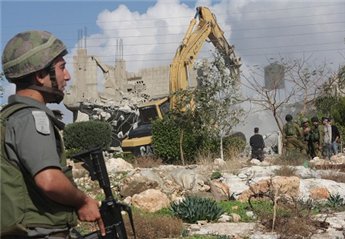
TUBAS — Witnesses said six bulldozers and hundreds of soldiers were deployed throughout the Jordan Valley village of Aqrava on Thursday morning, when two homes and road entrances were taken down by Israeli forces.
Sami Sadeq, head of the village council, said two streets leading out of the village were torn up, effectively rendering them useless for travel, forcing residents to take long detours and exit via the main entrance of the village.
Sadeq said some 95 percent of the structures in the village have demolition orders issued on them, including the village’s grand mosque, kindergarten and homes.
The bulldozing destroyed electricity poles at the entrance of the village, and the homes of Mohammad Hassen Subieh and Abed An-Naser Ahmad Subieh, the official said.
Israeli daily news site Ynet said the military and Civil Administration “destroyed 3 illegal Palestinian structures and two pathways in Jordan Valley,” saying all were in an areas designated as a firing field.
The demolitions come as UN figures show a continued increase in home demolitions hit a record high during the first three months of 2011.
Ffigures from the UN agency for Palestinian refugees recorded 76 demolitions of Palestinian buildings in March, forcibly displacing 158 Palestinians including 64 children.
So far this year, Israel has demolished the homes of 333 Palestinians, including 175 children, UNRWA reported.
Omar Barghouti on ‘Why BDS?’
By Omar Barghouti | Mondoweiss | April 6, 2011
Omar Barghouti has finally been issued a visa to travel to the US for his speaking tour in support of his new book. We’ve included the tour dates and locations after the post below. Haymarket Books has been generous enough to allow us to post a chapter from the book, here’s “Why BDS?”:
 The BDS (Boycott, Divestment and Sanctions) Call, launched in July 2005, was endorsed by an overwhelming majority of Palestinian civil society unions, political parties, and organizations everywhere. Rooted in a long tradition of nonviolent popular resistance in Palestine against Zionist settler-colonialism1and largely inspired by the anti-apartheid struggle in South Africa, it adopts a rights-based approach that is anchored in universal human rights, just as the US civil rights movement did. It resolutely rejects all forms of racism, including anti-Semitism and Islamophobia.
BDS unambiguously defines the three basic Palestinian rights that constitute the minimal requirements of a just peace and calls for ending Israel’s corresponding injustices against all three main segments of the Palestinian people. Specifically, BDS calls for ending Israel’s 1967 military occupation of Gaza, the West Bank (including East Jerusalem), and other Arab territories in Lebanon and Syria; ending its system of racial discrimination against its Palestinian citizens; and ending its persistent denial of the UN-sanctioned rights of Palestine refugees, particularly their right to return to their homes and to receive reparations.
Calling Israel an apartheid state does not imply that its system of discrimination is identical to apartheid South Africa’s. It simply states that Israel’s laws and policies against the Palestinians largely fit the UN definition of apartheid, which was adopted in 1973 and went into effect in 1976.
For decades efforts to promote peace between Israel and the Palestinian people have categorically failed, further entrenching Israeli colonial hegemony and Palestinian dispossession. The main culprit is the insistence of Israel and successive US governments on exploiting the current massive power imbalance to impose a peace devoid of justice and human rights on the Palestinians, an unjust “solution” that fails to address our basic rights under international law and undermines our inalienable right to self-determination.
In parallel, official Western collusion manifested in unconditional diplomatic, economic, academic, and political support of Israel has further fed Israel’s already incomparable impunity in violating human rights and spurred civil society worldwide to support boycotts against Israel as an effective, nonviolent form of struggle in the pursuit of peace based on justice and precepts of international law.
For too long, while nonviolence has been the mainstay of Palestinian resistance to settler-colonial conquest for decades, the term nonviolence has been associated among Palestinians with appeasement of Israel or submission to some of its unjust demands. There are two main reasons for this negative connotation. First, many of those who advocated “nonviolence” in the past, and who received lavish Western media attention as a result, categorically vilified and denounced armed resistance, presented nonviolence as a substitute for it, and advocated only a minimal set of Palestinian rights, usually excluding or diluting the internationally recognized right of Palestinian refugees to repatriation and compensation, as well as ignoring the rights of Palestinian citizens of Israel. They therefore stood isolated from the Palestinian grass roots and virtually all respected civil society organizations. Second, Palestinian nonviolent campaigns were often funded, if not directed, by Western organizations, governmental or otherwise, with their own political agendas that conflicted with the publicly espoused Palestinian national agenda as expressed by the Palestine Liberation Organization (PLO). This entrenched association between nonviolence and a minimalist and seemingly “imported” political program made the term nonviolence subject to suspicion and antipathy among most Palestinians, particularly since armed resistance has been largely linked to a maximalist political program.
I beg to differ with this general characterization. While I firmly advocate nonviolent forms of struggle such as boycott, divestment, and sanctions to attain Palestinian goals, I just as decisively, though on a separate track, support a unitary state based on freedom, justice, and comprehensive equality as the solution to the Palestinian-Israeli colonial conflict. To my mind, in a struggle for equal humanity and emancipation from oppression, a correlation between means and ends, and the
decisive effect of the former on the outcome and durability of the latter, is indisputable. If Israel is an exclusivist, ethnocentric, settler-colonial state, then its ethical, just, and sustainable alternative must be a secular, democratic state, ending injustice and offering unequivocal equality in citizenship and individual and communal rights both to Palestinians (refugees included) and to Israeli Jews. Only such a state can ethically reconcile the ostensibly irreconcilable: the inalienable, UN-sanctioned rights of the indigenous people of Palestine to self-determination, repatriation, and equality in accordance with international law and the acquired and internationally recognized rights of Israeli Jews to coexist—as equals, not colonial masters—in the land of Palestine.
While individual BDS activists and advocates may support diverse political solutions, the BDS movement as such does not adopt any specific political formula and steers away from the one-state-versus-two-states debate, focusing instead on universal rights and international law, which constitute the solid foundation of the Palestinian consensus around the campaign. Incidentally, most networks, unions, and political parties in the BNC still advocate a two-state solution outside the realm of the BDS movement.
Starting with the collapse of the Soviet Union and the premature end of the first Palestinian intifada (1987–1991), through the launching of the Madrid-Oslo“peace process” and until a decade ago, the question of Palestine had been progressively marginalized, if not relegated to a mere nuisance factor, by the powers that be in the new unipolar world. Edward Said reflected on the “peace process” thus:
What of this vaunted peace process? What has it achieved and why, if indeed it was a peace process, has the miserable condition of the Palestinians and the loss of life become so much worse than before the Oslo Accords were signed in September 1993? And why is it, as the New York Times noted on 5 November, that “the Palestinian landscape is now decorated with the ruins of projects that were predicated on peaceful integration”? And what does it mean to speak of peace if Israeli troops and settlements are still present in such large numbers? Again, according to RISOT, 110,000 Jews lived in illegal settlements in Gaza and the West Bank before Oslo; the number has since increased to 195,000, a figure that doesn’t include those Jews—more than 150,000—who have taken up residence in Arab East Jerusalem. Has the world been deluded or has the rhetoric of “peace” been in essence a gigantic fraud?
In quite a revealing turn of history, among the very first substantial consequences of this “new world order” was the UN General Assembly’s 1991 repeal, under intense US pressure, of its 1975 “Zionism Is Racism” resolution,6thus removing a major obstacle on the course of Zionist and Israeli rehabilitation in the international community. This was followed by the PLO’s formal recognition of Israel under the Oslo accords, which furthered the transformation of Israel’s image from that of a colonial and inherently exclusivist state into a normal member of the international community of nations, one that is merely engaged in a territorial dispute. After the establishment of the Palestinian Authority(PA), primarily, from Israel’s perspective, to relieve Israel’s colonial burdens in the West Bank and Gaza and to cover up its ongoing theft of Palestinian land to build Jewish-only settlements, Israel embarked on an ambitious public relations campaign in Africa, Asia, Latin America, and the Arab world, establishing diplomatic ties and opening new markets for its growing industries. Former sworn enemies suddenly warmed up to Israel, importing from it billions of dollars’ worth of military hardware and other goods, and, convinced that the road to the US Congress passed through Tel Aviv, wooing it politically. As a result, Israel multiplied the number of states with which it holds diplomatic relations from a few dozen before Oslo to more than 160 at present.
Meanwhile, the election of George W. Bush in 2000 as the president of the United States and the rise of his neoconservative associates (erstwhile advisers to the far-right Israeli leader Benjamin Netanyahu) brought Zionist influence in the White House to unprecedented heights, finally matching its decades-old, almost unparalleled influence on Capitol Hill.
But shortly before the US presidential elections, in September 2000, after years of a sham “peace process” that served to disguise Israel’s ongoing occupation and the enormous growth of its colonies in the occupied territories, the second Palestinian intifada broke out. As the uprising intensified, Israel’s brutal attempts to crush it, through means described by Amnesty International and other human rights organizations as amounting to war crimes,8 reopened—at least in intellectual circles—long-forgotten questions about whether a just peace can indeed be achieved with a colonial, ethnocentric, and expansionist Zionist state. It was against this background that the UN World Conference against Racism in Durbanin 2001 revived the 1975 debate on Zionism. Although, as expected, the official assembly failed to adopt a specific resolution on Israel’s multitiered oppression of the Palestinian people due to direct threats from the United States and, to a lesser extent, powerful European states, the NGO Forum condemned Zionism as a form of racism and apartheid. This was an expression of the views of thousands of civil society representatives from across the globe whose struggle against all forms of racism, including anti-Semitism, is mostly informed by humanist and democratic principles. Despite the official West’s unwillingness to hold Israel to account, Durban confirmed that grassroots support, even in the West, for the justness of the Palestinian cause was still robust, if not yet channeled into effective forms of solidarity.
With the new intifada, boycott and sanctions were in the air. Campaigns calling for divestment from companies supporting Israel’s occupation, for instance, spread to many US campuses, initially causing panic among the ranks of the Israel lobby and its student arm. Archbishop Desmond Tutu of South Africa was among the earliest internationally renowned figures to support divestment from Israel. The impromptu nature of these early, largely abortive efforts soon gave way to a higher degree of coordination and sharing of experience at a national level in the United States, culminating in the establishment of the Palestine Solidarity Movement and later the US Campaign to End the Israeli Occupation, a broad coalition of over three hundred groups working to change US foreign policy in favor of a just peace. Across the Atlantic, particularly in the United Kingdom, calls for various forms of boycott against Israel started to be heard among intellectuals, academics, and trade unionists. These efforts intensified with the massive Israeli military reoccupation of Palestinian cities in spring 2002, with all the destruction and civilian casualties it left behind.
By 2004, academic associations, trade unions, and solidarity organizations in the United States and Europe calling for boycott had been joined by mainstream churches, which began to study divestment and other forms of boycott against Israel, similar in nature to those applied to South Africa during apartheid rule. The most significant development at that stage was the precedent-setting decision of the Presbyterian Church USA (PCUSA) in July 2004, in a resolution that was adopted by a resounding majority of 431 to 62, to start “a process of phased selective divestment in multinational corporations doing business in Israel.” Unlike similar declarations adopted by student and faculty groups, the Presbyterian move could not be dismissed as “symbolic” or economically ineffective. Although PCUSA in 2006 dropped the term divestment, opting for “investment in peace” due to threats and intimidation by Israel lobby groups,13its initiative managed to inspire many faith-based organizations, especially, in the West to consider halting their investments in Israel as well.
A development of signal importance for these efforts was the historic advisory opinion issued by the International Court of Justice(ICJ) at The Hague on July 9, 2004, condemning as illegal both Israel’s wall and the colonies built on occupied Palestinian land. Ironically, the PLO scored this momentous political, legal, and diplomatic victory at a time when it was least prepared to build on it. A similar advisory opinion by the ICJ in 1971, denouncing South Africa’s occupation of Namibia, had triggered what became the world’s largest and most concerted campaign of boycotts and sanctions directed against the apartheid regime, eventually contributing to its demise. Though the ICJ ruling on the wall did not prompt similar reaction, chiefly due to Palestinian structural and political powerlessness, it did fuel a revival of principled opposition to Israeli oppression around the world.
Days before the ICJ ruling, the Palestinian Campaign for the Academic and Cultural Boycott of Israel (PACBI), formed in April 2004, issued a call for the academic and cultural boycott of Israel endorsed by some sixty unions, organizations, and associations in the Palestinian occupied territories urging the international community to boycott all Israeli academic and cultural institutions as a “contribution to the struggle to end Israel’s occupation, colonization, and system of apartheid.”This call was greatly and qualitatively amplified on the first anniversary of the ICJ ruling, when more than 170 Palestinian civil society organizations and unions, including the main political parties, issued the Call for Boycott, Divestment and Sanctions (BDS) against Israel “until it fully complies with international law.” After fifteen years of the so-called peace process, Palestinian civil society reclaimed the agenda, articulating Palestinian demands as part of the international struggle for justice long obscured by deceptive “negotiations.” In a noteworthy precedent, the BDS Callwas issued by representatives of the three segments of the Palestinian people—the refugees, the indigenous Palestinian citizens of Israel, and those under the 1967 occupation. It also directly “invited” conscientious Israelis to support its demands. The Palestinian boycott movement succeeded in setting new parameters and clearer goals for the
growing international support network, sparking, or giving credence to, boycott and divestment campaigns in several countries.
A genuine concern raised by solidarity groups in the West regarding the calls for boycott has been the conspicuous absence of an official Palestinian body behind them. “Where is your ANC?” is a difficult and sometimes sincere question that faced Palestinian boycott activists everywhere. The PLO, in total disarray for years, has remained largely silent. The PA, with its circumscribed mandate and the constraints imposed upon it by the Oslo accords, is inherently incapable of supporting any effective resistance strategy, especially one that evokes injustices beyond the 1967 occupation. Indeed, with rare exceptions, the PA’s role has actually been detrimental to civil society efforts to isolate Israel. This started to change in 2009, when the Sixth
Conference of Fatah, the leading secular political party, adopted a political platform highlighting popular nonviolent struggle as the main form of resistance to the occupation. Much criticism has been leveled at Fatah for holding its conference under occupation, accommodating Israeli demands, and, more substantively, transforming the Palestinian cause from a struggle for self-determination and comprehensive rights to what is seen by many pundits as a hollowed-out process of coexisting with Israeli injustices and denial of some of those basic rights.Still, the enthusiasm for a strong commitment to nonviolent means of countering Israel’s occupation and sprawling colonization eventually led the Fatah-dominated PA to adopt a—belated—policy of boycotting and calling on other states to boycott products of Israeli colonial settlements. While many Palestinians saw this PAcall for a partial boycott of Israel as “too little, too late,” coming five full years after the
great majority of Palestinian civil society had called for comprehensive BDS measures, there was a sense of vindication nonetheless. “Even” the PA, BDS leaders can now argue, eventually understood the immense power of boycott and popular resistance. It also has helped underline the consensus among Palestinians in support of boycott as a form of struggle against Israel’s violations of international law.
As for “unofficial” Palestinian bodies, a tiny minority of them did not support the July 2005 BDS call. These were mostly smaller NGOs, ever attentive to donor sensitivities, that declined to endorse, some citing as “too radical” the clause on the right of refugee return (despite the fact that it is “stipulated in UN Resolution 194”). Some, bowing to pressure from their European “partners,” feared that the term boycott would invite charges of anti-Semitism. Also, initially the largest Palestinian
political factions, with their predominant decades-old focus on armed struggle, seemed unable to recognize the indispensable role of civil resistance, particularly in the unique—and certainly very different from South Africa’s—colonial conditions of siege that the Palestinians had to resist.18By either inertia or reluctance to critically evaluate their programs in light of a changed international situation, these forces became addicted to the armed model of resisting the occupation, ignoring the troubling moral and legal questions raised by certain indiscriminate forms of that resistance and its failure to date to achieve concrete and sustainable results in an international environment dominated by Israel’s main sponsor and enabler, the United States. Despite this initial reluctance, all major Palestinian political parties signed on to the BDS Call, widening the circle of consensus around it.
In order to realize Palestinian aspirations for self-determination, freedom, and equality and to pose a real challenge to Israel’s dual strategy of on the one hand fragmenting, ghettoizing, and dispossessing Palestinians and on the other hand projecting a reduced image of the colonial conflict as a symmetrical dispute over rival claims and a diminished set of Palestinian rights, the PLO must be resuscitated and remodeled to embody the aspirations, creative energies, and national frameworks of the three main segments of the Palestinian people. The PLO’s grassroots organizations need to be rebuilt from the bottom up with mass participation, inclusive of all political forces, and must be ruled by unfettered democracy through proportional representation.
In parallel, the entire Palestinian conceptual framework and strategy of resistance must be thoroughly and critically reassessed and transformed into a progressive action program capable of connecting the Palestinian struggle for self-determination and justice with the international social movement. The most effective and morally sound strategy for achieving these objectives is one based on gradual, diverse, context-sensitive, and sustainable campaigns of BDS—political, economic, professional, academic, cultural, athletic, and so on—and other forms of popular resistance, all aimed at bringing about Israel’s comprehensive and unequivocal compliance with international law and universal human rights.
BDS will unavoidably contribute to the global social movement’s challenge to neoliberal Western hegemony and the tyrannical rule of multi/transnational corporations. In that sense, the Palestinian boycott against Israel and its partners in crime becomes a small but critical part in an international struggle to counter injustice, racism, poverty, environmental devastation, and gender oppression, among other social and economic ills. Reflecting on this aspect of the BDS movement, and connecting it with the 2009 environmental international summit held in Denmark, John Pilger, the widely acclaimed journalist and writer, states:
The farce of the climate summit in Copenhagen affirmed a world war waged by the rich against most of humanity. It also illuminated a resistance growing perhaps as never before: an internationalism linking justice for the planet with universal human rights, and criminal justice for those who invade and dispossess with impunity. And the best news comes from Palestine.
. . . To Nelson Mandela, justice for the Palestinians is “the greatest moral issue of the age.” The Palestinian civil society call for boycott, disinvestment and sanctions (BDS) was issued on 9 July 2005, in effect reconvening the great, non-violent movement that swept the world and brought the scaffolding of [South] African apartheid crashing down.”
In this context, it is important to emphasize that it is not just Israel’s military occupation and denial of refugee rights that must be challenged but the wider Zionist-Israeli system of racist exclusivism. Jewish groups that historically stood in the front lines of the struggle for civil rights, democracy, equality before the law, and separation between church and state in many countries should find Israel’s unabashedly ethnocentric and racist laws and its reduction of Palestinians to relative
humans, whether in the occupied territories, in exile, or within Israel itself, to be politically indefensible and ethically untenable. Ultimately, then, successful nonviolent resistance requires transcending the fatally ill-conceived focus on the occupation alone to a struggle for justice, equality, and comprehensive Palestinian rights.
I am aware that reducing Palestinian demands to ending the occupation alone seems like the easiest and most pragmatic path to take, but I firmly believe that it is ethically and politically unwise to succumb to the temptation. The indisputable Palestinian claim to equal humanity should be the primary slogan raised, because it lays the proper moral and political foundation for effectively addressing the myriad injustices against all three segments of the Palestinian people. It is also based on
universalist values that resonate with people the world over. While coalescing with diverse political forces is necessary to make this direction prevail, caution should be exercised in alliances with “soft” Zionists lest they assume the leadership of the BDS movement in the West, lowering the ceiling of its demands beyond recognition. On the other hand, principled Jewish voices—whether organizations or intellectuals consistently supporting a just and comprehensive peace—in the United States,
Europe, and Israel have courageously supported various forms of boycott, and this helps shield the nascent boycott movement from charges of anti-Semitism and the intellectual terror associated with them.
Supporting the UN-sanctioned rights of all segments of the Palestinian people does not, however, entail adopting BDS tactics that necessarily target all Israeli institutions. Tactics and the choice of BDS targets at the local level must be governed by the context particularities, political conditions, and the readiness (in will and capacity) of the BDS activists. In the United States, for instance, two of the most active and creative BDS groups, Adalah-NY and Code Pink, endorse the 2005 BDS Call with its comprehensive rights-based approach and run effective campaigns that are very targeted and nuanced, focusing only on companies indisputably implicated in Israeli violations of international law in the occupied Palestinian territory. The same can be said of the largest BDS- related coalition in France, Coalition against Agrexco-Carmel.
Besides the need to extend the struggle beyond ending the occupation, two other pertinent points in connection with BDS initiatives bear emphasizing. First, they should be guided by the principles of inclusion, diversity, gradualness, and sustainability. They must be flexibly designed to reflect realities in various contexts. Second, although the West, owing to its overwhelming political and economic power as well as its decisive role in perpetuating Israel’s colonial domination, remains the main battleground for this nonviolent resistance, the rest of the world should not be ignored. Aside from South Africa and some beginnings elsewhere, the BDS movement has yet to take root in China, India, Malaysia, Brazil, and Russia, among other states that seek to challenge the West’s monopoly on power. It is worth noting that Zionist influence in those states remains significantly weaker than in the West.
With the formation of the Palestinian BDS National Committee, BNC, in 2008,25it became the reference and guiding force for the global BDS movement, which was all along based on the Palestinian-initiated and -anchored BDS Call. The BNCis the coordinating body for the BDS campaign based on the Palestinian civil society BDS Call of 2005. Upholding civil and popular resistance to Israel’s occupation, colonization, and apartheid, the BNCis a broad coalition of the leading Palestinian political parties, unions, coalitions, and networks representing the three integral parts of the people of Palestine: Palestinian refugees; Palestinians in the occupied West Bank (including Jerusalem) and Gaza Strip; and Palestinian citizens of Israel.
The BNC adopts a rights-based approach and calls for the international BDS campaign to be sustained until the entire Palestinian people can exercise its inalienable right to freedom and self-determination and Israel fully complies with its obligations under international law.
BDS is not only an idea. It is not merely a concept. It is not just a vision. It is not all about strategy. It is all those, for sure, but also much more. The Palestinian Civil Society Campaign for Boycott, Divestment and Sanctions against Israel is above everything else a deeply rooted yet qualitatively new stage in the century-old Palestinian resistance to the Zionist settler-colonial conquest and, later, Israel’s regime of occupation, dispossession, and apartheid against the indigenous people
of Palestine.
The global BDS campaign’s rights-based discourse and approach decisively, almost irrefutably, exposes the double standard and exceptionalism with which the United States and most of the other Western states have to varying degrees treated Israel ever since its establishment through the carefully planned and brutally executed forcible displacement and dispossession of the majority of the Palestinian people in the 1948 Nakba. More crucially, the BDS movement has dragged Israel and its well-financed, bullying lobby groups into a confrontation on a battlefield where the moral superiority of the Palestinian quest for self-determination, justice, freedom, and equality neutralizes and outweighs Israel’s military power and financial prowess. It is the classic right-over-might paradigm, with the right being recognized by an international public that is increasingly fed up with Israel’s criminality and impunity and is realizing that Israel’s slow, gradual genocide places a heavy moral burden on all people of conscience to act, to act fast, and to act with unquestionable effectiveness, political suaveness, and nuance, and above all else with consistent, untarnished moral clarity. Thus BDS.
Omar Barghouti Speaking Tour (for more information see here)
-
New York City, NYAuthor Event featuring Omar Barghouti
-
Panel Discussion featuring Omar Barghouti
New York City, NY -
Author Event featuring Omar Barghouti
Princeton, NJ -
Author Event featuring Omar Barghouti
Waltham, MA -
Author Event featuring Omar Barghouti
Cambridge, MA -
Author Event featuring Omar Barghouti
Providence, RI -
Author Event featuring Omar Barghouti
Amherst, MA -
Author Event featuring Omar Barghouti
Washington, DC -
Author Event featuring Omar Barghouti
Washington, DC
On Peace and Critics

Ilan Pappé: I am willing to respond to any concrete question.
By Emanuel Stoakes | Palestine Chronicle | April 3, 2011
(Emanuel Stoakes talks to the Israeli historian Ilan Pappé about the prospect of a peace settlement in the Middle East, the plight of the Palestinian refugees, and his response to his numerous critics.)
After attending the Inaugural Lecture for the European Centre for Palestine Studies at Exeter University (the first institution of its kind in our country), I met the controversial Professor Ilan Pappé, who – with some gentle persuasion on my part – agreed to do an online interview on the Israel-Palestine conflict.
In brief, Pappé’s association with “controversy” stems from, amongst other things, his much-debated claim that Palestine was “ethnically cleansed” (in part at least) in the war of 1948; his claim, unpopular in Israel, that “Zionism is far more dangerous to the Middle East than Islam”; and because he has been accused of being, simply, a politically-motivated distorter of the historical “truth” by rival scholars.
Benny Morris, one of the prominent “New Historians” of Israeli history (a category that includes Pappé as well as the venerable Avi Shlaim) described a book by Pappé on Palestine as “appalling… [containing] errors of a quantity and a quality that are not found in serious historiography”; be that as it may, it is worth reviewing Morris’ own justification for Palestinian dispossession.*
King’s College’s Efraim Karsh and the inimitable Melanie Phillips in the Spectator are also voluble detractors; by contrast, John Pilger famously called him Israel’s “bravest” and “most principled” historian, whilst supporters in the academic world, including Noam Chomsky and Nur Masalha, continue to collaborate and concur with him.
Whatever one may think of his opinions, Pappé has borne a heavy cost for his heterodoxy: members of his family have shunned him due to his views, and he faced calls to resign from his former lecturing post at the University of Haifa, prompted by his political activities, and issued by none other than the university’s President.
I began by asking Professor Pappé if he believed that peace between Israel and the Palestinian Authority could be achieved through their (apparently moribund) peace talks, and if not, why?
Pappé: I have very little faith in the current phase of the negotiations. As in the past, it seems that the Israeli government is exploiting the ‘peace process’ to receive immunity for its continued dispossession of the Palestinians in the West Bank and the barbaric siege on the Gaza Strip. The current phase has already been exploited by Israel to expand its settlement in the Greater Jerusalem Area – which has been accompanied by demolition of houses and eviction of people – and to tighten its grip over the Palestinian villages and towns which are in the vicinity of the ever-growing Jewish colonies of the West Bank. Similarly, it felt free to tighten the siege over Gaza, despite its promise to the international community to ease it.
At the recent inaugural lecture of the European Centre for Palestine Studies at Exeter University, you introduced Filipo Grandi from United Nations Relief and Works Agency for Palestine Refugees in the Near East (UNRWA), who talked about the fate of the Palestinian refugees. Could you briefly outline the current human rights situation of the refugees and comment on their prospects for achieving some sort of improvement in their lives?
These are refugees who have lived in camps for more than sixty years – an unprecedented existence in modern times. Their situation varies between being denied access to meaningful jobs and benefits in Lebanon to a very limited access to the local economy and state benefits in Jordan. And we should not forget the refugee camps in the West Bank and the Gaza Strip, where people suffer from the double oppression of being both occupied and refugees.
There are also internal refugees in Israel itself and refugee communities in the world at large. Those in Israel live in better conditions than those in the occupied territories or the Arab world; but psychologically they had to undergo unbearable experiences for the past sixty years, such as watching their houses, businesses, factories, shops, fields and villages being pillaged and taken over by Jews.
There are two elements to this predicament. One is the dismal conditions in which people live, caged in camps that even when they become neighborhoods are on the margins of local society and in a limbo existence. Secondly, there have been more and more refugees as result of Israeli policy since 1948. There is no end to the dispossession, while at the same time the international community had already declared on 11 December 1948 through the UNGA resolution 194 that all these refugees have the unconditional right to return. As long as this continues, there is very little hope for peace and reconciliation in Israel and Palestine.
In the publication “Gaza in Crisis” you mention that you are working on a book with a ‘particular focus on the Israeli decisions taken in the early years’, that you claim ‘have not been deviated from’ up to the present. What were those decisions and how has the political class in Israel consented to their continued application?
The gist of these decisions was that there could be no overall strategy for Gaza after the Israeli ‘disengagement’ from it in 2005. Therefore, there were two options for the Israeli policy makers. Either they would succeed in subjecting the Strip to Israel’s will – and putting it under a joint Israeli and PA control – encircled by barbered and electric wire. In such a case life would have depended on Israel’s goodwill, and the people would have to resign to a life in Ghetto-like conditions. Should the people of Gaza resist the first option they would be subjected to collective punishment until they surrender – this is the second option. There is no real bottom line to collective punishment, but given the circumstances on the ground, by inertia it turns into a slow genocide. The Israeli public did not only endorse this policy, in the main it demands more punitive and more drastic actions against the people of Gaza.
Changing topic slightly, how do you view the Israeli claims that Hamas hides amongst civilian infrastructure and uses human shields, as a justification for civilian deaths as “collateral damage” to IDF offences? What evidence is there for this, and is it a fair point?
This always strikes me as a curious allegation. Gaza is the most densely inhabited urban space upon earth, where can Hamas operate from within a territory that is no bigger than the largest metropolises in the world? When you cage a million and half people in a tiny squeezed space like this, and they resist, and you retaliate, you know in advance what kind of collateral damage you are going to inflict.
Do you see the Palestinian Authority as being possibly “corrupt and complicit” in the oppression of those in the West bank, as has been suggested by some commentators?
I do not think the PA is more corrupt than any government in the world, or let alone in the Middle East. It is complicit but so is anyone who in a way does not actively resist the occupation. And yet, resisting today is almost like signing your own death certificate so that one should be very careful to make moral judgments from the outside.
One can make political judgments and the one I offer is that the PA helps the occupation and the illusion of a peace process and it seems that its dismantlement could be more beneficial for the attempt to expose the rouge nature of the Israeli regime and the criminal character of its policies.
One of your most controversial claims is that Palestine (as it was) was “ethnically cleansed” – at least in part – as a part of a systematic attempt to create a Jewish state at the cost of its Arab inhabitants. In the book “The Ethnic Cleansing of Palestine” you write that the Hagana’s Plan Dalet documents such intentions. Could you clarify and explain your position on this subject? Furthermore, how do you respond to the fierce criticism of your views? For example, David Pryce-Jones, described you in the Literary Review as “an Israeli academic who has made his name by hating Israel and everything it stands for.” Others have simply called you a falsifier. What is your response?
I am not going to respond to name calling – “Nazi”, “Falsifier”, “Communist”, “self-hating Jew” or whatever. I am willing to respond to any concrete question. Plan Dalet is a cluster of orders sent by the Hagana High Command from the beginning of March 1948. Each command instructed a specific unit to occupy villages or urban neighbourhoods, destroy them and expel the people living in them. The famous document Plan D, published on March 10, 1948 referred only to the areas the new state would occupy from the UN Arab states, but it included the same graphic description of how to deal with the native population of Palestine. The plan as published and the systematic cluster of orders, together with other evidence I cite in my book, show a clear intention to ethnically cleanse Palestine from its indigenous population, as indeed happened. Moreover, as shown by Nur Masalha, there is already supporting evidence that this intention existed from early on in Zionist thought and strategy.
Finally, could you comment on the under-discussed issue of resources and their allocation in both the West Bank and Gaza, particularly water. Do you think that there is any hope for parity between Palestinians and Israelis in the future in this area, without a separate Palestinian state?
No hope whatsoever. The Israelis are intent of robbing the Palestinians of land, water and any other natural resources – this is what dispossession is all about.
(*Note: In an infamous interview with Haaretz, Morris controversially justified the “tragedy” of the uprooting of Palestinians thus: “there was no other choice… Even the great [sic] American democracy [sic] could not have been created without the annihilation of the Indians. There are cases in which the overall, final good [sic] justifies harsh and cruel acts that are committed in the course of history…”)
Featured Video

They Double Down on BLOOD PRESSURE Guidelines!
or go to
Aletho News Archives – Video-Images
From the Archives
Chocolate Gives Statins a $29 Billion Run For Their Money
By Sayer Ji · GreenMedInfo · April 17, 2012
With the blockbuster cholesterol-lowering class of drugs known as statins being widely promoted for the primary prevention of cardiovascular disease, despite their having over 300 documented adverse health effects (including heart failure!), how does chocolate sound as a viable, heart-friendly alternative?
We already connect amorously with chocolate (to the tune of 6 billion lbs of cocoa consumed annually worldwide), revealing in heart-felt expressions like “I love it,” and “this is to die for!” how comfortable we are with publicly declaring our affection. But did you know that while it makes our emotional hearts sing, it may actually keep our physical hearts happy, alive and ticking longer, as well?
Indeed, back in 2006, researchers found that for elderly men, eating cocoa was inversely associated with blood pressure and 15-year cardiovascular and all-cause mortality. … continue
Blog Roll
 Aletho News
- I’M SO BLOODY FURIOUS: They Double Down on BLOOD PRESSURE Guidelines!
- The Israeli Nuclear Doctrine and the Turning Point of the Kennedy Assassination
- Striking Matches Near the Powder Keg
- Prominent Russia hawk: European leaders privately talk about war with Russia, first need ‘mass casualty event’
- China warned Trump not to touch Iran’s oil tankers: Larry Johnson
- EU Central Banker Plans To Plant Barren AI Crops Across The Continent
- Macron’s Strategic Autonomy Paradox: France Rearms on Debt and Depends on Foreign Fuel
- Nigel Farage vs Tucker Carlson: Who is right about Hitler and Britain?
- Chocolate Gives Statins a $29 Billion Run For Their Money
- Hypotheses on the collapse of U.S. computer systems
- If Americans Knew
- An error has occurred; the feed is probably down. Try again later.
- No Tricks Zone
- New Study: Modern Temps Are Among The Coldest Of The Last 10,000 Years In East Central Europe
- Germany’s Renewable Energies Lead to 1.4 Billion Euro Electric Power Trade Deficit
- Argentina’s Perito Moreno Glacier Joins Antarctica and Arctic In Defying Doomsday Melt Claims
- New Study: Barents Sea Temperatures Were Warmer And Sea Ice Less Extensive In The 1700s Than Today
- German Authorities Start Initiative To Evaluate Public Register For Climate “Disinformation” Spreaders!
- Zonal Asymmetry of Temperature Change in the Antarctic Circumpolar Current
- New Study: The Net Fossil Fuel Contribution To Rising Atmospheric CO2 Has Been Zero For 500 Years
- Germany’s Green Energy Transition Becoming Increasingly Expensive…Another 6 Trillion Euros!
- Sudden Stratospheric Warming, Powerful El Niño Combination May Lead To Extreme Europe Cold, Energy Crisis!
- Two New Studies Find Thwaites Glacier Melt Cannot Be Driven By Human Activity Or A Warming Ocean

