HEBRON: Settlers attack Palestinian home in Beqa’a Valley
CPTnet | 1 April 2011
On Monday 14 March, fifteen settlers from Harsina Settlement attacked the Jaber home in the Beqa’a Valley, adjacent to Hebron. At the initial attack during the day, the Israeli military stopped the settlers, but they returned at 6:30 p.m. and stoned the house for one hour with no interference by the military.
The Jaber home sits below the settlement of Givat Ha Harsina and houses several families—seventeen people in all, with twelve children. This family has lost most of its land to the Harsina settlement over the years, land for which it has deeds dating back to the time of the Ottoman Empire.
Surrounding homes in the Beqa’a Valley have likewise suffered tremendous pressure from the settlers and Israeli military. Within the last year alone, the Israeli military destroyed thirteen water cisterns in the valley, cut irrigation pipes to the grape vineyards, occupied a home during increased settler activity, allowed the building of at least four more houses in Harsina Settlement during the so called “Settlement Freeze,” and permitted visiting settlers to plant 1000 trees on Palestinian land in this valley.
One of the Jaber brothers who lives across the road from Givat Ha Harsina—now living in his third home after the military destroyed his first two homes—said he was so worried that he wondered whether he should move his family to one of his cousins’ homes for safety. He told CPTers he cannot fall asleep until 1:30 or 2:30 a.m. at night.
For photo coverage of previous acts of destruction in the Beqa’a see http://cpt.org/index.php?q=gallery&g2_itemId=20652
Supermarket fires 21 Arab employees at once
By Saar Yachin | +972 Blog | April 2, 2011
Last week, one of Israel’s major retail chains, Kimat Hinam (“Almost Free”), dismissed 21 of its employees. It did so by handing all 21 notices to just one employee, requesting that he distribute them among his coworkers on Saturday, when the shop is of course closed. Although unconventional, this was apparently convenient, as they all know each other, all work at the same branch in Modi’in, and are all Arab.
A few days later, the Equal Opportunities Commissioner at the Ministry of Industry, Trade and Labor filed a petition against the termination, citing suspicion of “nationalist motives.” In reply, the retail chain issued a statement, saying that the company was forced to dismiss those employees in light of their “violent behavior,” so severe that other workers expressed “significant concern for their lives.” The statement also clarified that as 23% of Kimat Hinam’s employees are Arabs, it is impossible for the Company to be one “in which discrimination prevails.” Globes further reported (Hebrew) that the dismissal occurred after “15 – 20 Arab workers of the branch behaved wildly, especially following the Fogel family massacre in Itamar.”
The last accusation is hard to take seriously, as it is unspecific in numbers, conforms too well to the fantasy of the hostile “other,” and describes a single event which somehow escalated following the terror attack. It could simply be poorly worded, or it may be a manipulative libel – but in any case it was not included in the company’s official statement. The claims that were included in it, however, do not make much sense either: Twenty-one employees suddenly and jointly posing a threat to the lives of their fellow workers, intimidating those belonging to the ‘vulnerable’ majority – that is hard to believe. Nevertheless, Kimat Hinam’s arguments could have some truth in them, as outlandish as they are, but even if they were to be proven, the company’s conduct would be harder to defend.
What struck me at first about this story was how blunt, unprofessional and irresponsible, businesswise, this action was. How could a company be so incompetent, when its actions are sure to be perceived as blatantly racist, all the more so when it chooses to deliver the notices in such a suspicious and ugly manner? But the sad truth is, that in Israel today, this is not even considered foolish business conduct. In Israel, it is perfectly normal for nationalist (read: racist) considerations to dictate business ventures.
In a more tolerant society, such a move would be considered wrong, because it is not ‘politically correct’, and as discredited as this term may have become, it does point to some healthy social norms. Even if Kimat Hinam’s almost-free-of-plausibility narrative is true, had it happened in a comparable American retail chain, all efforts would be made to avoid giving the impression that workers are being fired on a racial/nationalist basis. At the very least, the workers would be notified personally and individually, and they would probably be entitled to a warning first. Giving consideration to the company’s public image would not be a sign of hypocrisy, but rather an acknowledgement of the healthy values of a society in which racism is frowned upon, and in which it is unprofitable for a corporation to be associated with it.
In Israel, however, companies have no reason to fear any public reaction for being perceived as discriminatory against Arabs. In fact, the opposite is true, as can be seen in the disgusting attempts at boycotting Rami Levy, another retail chain, for its employment of Arabs, which jeopardizes the racial purity of its Jewish employees; proposed ‘kosher’ certificates for businesses which refuse to employ Arabs; and other moves for boycotts, which are now blossoming in abundance in this springtime of bigotry. In such an atmosphere, the owners and managers of this and other businesses can rest assured, that there will be no public outcry, no consumer backlash, or in fact, any outrage at all at such discrimination.
Dominci in Israel: Dispossession by Law
By Seraj Assi | Palestine Chronicle | March 31, 2011
Imagine you are an Israeli Arab. You receive a graduate fellowship in an American university. You set there in the campus cafeteria, meet with a Syrian or Lebanese colleague or friend, a fellow Arab who happens to share with you the same religion, nationality and language. You then return home for the summer vacation. You are arrested, stripped of your citizenship and expelled out of your homeland.
This episode is not taken from a satirical novel. It is what the new Knesset law all about. The law already passed in its second and third reading. “Knesset passes law to strip terrorists of Israeli citizenship” was the Haaretz headline. That is, not only does the law make dispossession and transfer of Palestinians legal, but it also labels the entire people terrorists.
On March 28, 2011, the Knesset plenum in Israel gave its final seal of approval to “citizenship loyalty” law that enables Israel’s Supreme Court to revoke the citizenship and the status of any permanent resident convicted of espionage, treason or aiding the enemy during war. We must remember here that Israel considers itself to be in a permanent state of war with Arabs and Palestinians.
“Anyone who betrays the state and carries out acts of terror must know that citizenship and loyalty go together,” said Yisrael Beiteinu MK David Rotem, who initiated the bill. Israel’s Foreign Minister Avigdor Lieberman lauded the Knesset’s decision as a step toward “contending with the phenomenon of exploiting democracy in order to subvert it.”
This is no doubt a modern Israeli version of dispossession and ethnic cleansing. “No citizenship without loyalty” simply means that two million Palestinian Arabs living in Israel today can be immediately expelled or put in prison, by law of course. The absurd irony is that since every Arab Palestinian in Israel is considered a permanent enemy of the state and potential threat of its national security, any discussion involving two Arab citizens can be literally seen as subversive to the state.
One might wonder how could an Arab Palestinian be loyal to a state that continues to define itself as a Jewish state that belongs to the Jewish people, in which native Arab Palestinians are seen as potential enemies? Isn’t the “Jewish democratic” state of Israel after all a state in which democracy and law are goaded into the service of an ethnic hegemony and the suppression of the native community?
One might also wonder what about solidarity with fellow Palestinians under occupation and blockage in the West Bank and Gaza? What about national solidarity with fellow Arab victims of Israeli attacks and massacres? Is that considered treason too? The law is ambiguous enough to include all expressions of national and humanist solidarity under the category of terrorism.
The new law does not tell us whether the category of terrorism includes Israeli Jewish terrorists, such as Kahana’s supporters or Jewish settlers who terrorize Palestinians on a daily basis. Nor does it really explain who the terrorist is. One thing is for sure here; Israel can right now begin a systematic persecution of all Arab Palestinian citizens under the banner of legal and democratic ideals.
There is a famous passage by the French philosopher Roland Barthes named “Dominci, or the Triumph of Literature.” Barthes examines a case in which an inarticulate rural laborer is condemned in terms of legal discourse. The judges describe Dominci’s motives in terms borrowed from literary clichés, jargon and abstract lexicon.
Dominci’s trail is a classic account of how hegemony is produced through interactions between formal institutions and discourses. These notably include language, literature, law and journalism. It is a classic example of how colonial hegemony is exercised over the body of those who can hardly speak back.
So if your Palestinian grandmother would say in her next prayer “May God grant victory to Arabs and Muslims,” she too can be arrested, trailed, condemned and expelled for providing a divine aid to the state’s “enemies.” Perhaps it is time for young Palestinians in Israel to remove all those Gazan, Lebanese and Syrian “enemies” from their Twitter Friends list.
The timing of the law is by no means coincidence. This week marks the 35th anniversary of the Land Day, the annual commemoration of the massacre of six Palestinian citizens by the Israeli police. The approval of the Loyalty Law comes in this historical moment to mark the transition from ethnic cleansing by direct force to one exercise by law and legal manipulations. Not only does it come to remind Palestinian citizens that Israel is never ready to admit its massacres, but never ready to admit Palestinian right to exist in their homeland.
– Seraj Assi is a PhD Student in Arabic and Islamic Studies at Georgetown University, Washington DC.
Tractors confiscated in Al Jiftlik, Jordan Valley
By Lydia, International Solidarity Movement | 29 March 2011

At approximately 7 am this morning the Israeli army entered the village of Al Jiftlik. Soldiers went door to door ordering all tractor owners to bring their farming vehicles to the closed military zone between Miswa settlement and a nearby Israeli army base, where they had set up a temporary base.
The Palestinian farmers and their tractors were forcibly escorted to the temporary military base in the closed military zone. There they were kept under the surveillance of Israeli soldiers, police, and a private military company. Approximately forty tractor owners were questioned, and their ID’s and vehicle ownership were checked. They were made to stand next to their tractors, after which soldiers photographed and filmed the men with their vehicles. All people were informed that their tractors would be confiscated if they proved unable to provide proof of ownership.
The forty farmers had to wait in the sun for up to 7 hours to find out the army’s decision on what would happen to their farming vehicles. At 3 pm four owners were ordered to drive their tractors into the military camp (next to Al Jiftlik), escorted by military police and police vehicles. When one of the farmers refused to do so he was arrested, but released several minutes later on the condition that he would drive his tractor to the camp anyway, which he did. The four tractors were confiscated and kept inside the military camp after the farmers brought them there.
Faris, one of the farmers who had to bring his tractor into the military camp, said his tractor cost him 40.000NIS; “all the money I collected from farming, I put into the tractor.” He also indicated that he will be unable to continue farming his land without having a tractor.
Homes destroyed by Israeli Army in Amnyir, South Hebron Hills
29 March 2011 | Christian Peacemaker Teams
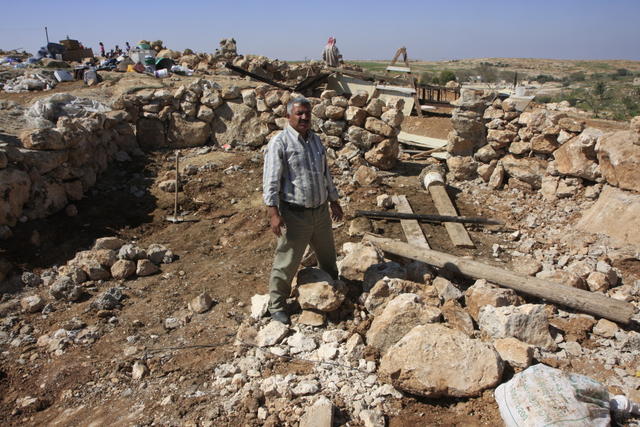
At 7:00 am on the morning of March 29th 2011 the Israeli military demolished the village of Amniyr , destroying seven tent dwellings and confiscating the remains. This is the second time in just over a month that the Israeli army has demolished the village. After the last demolition, villagers built new tent dwellings a few days later with the help of the Israeli human rights group Ta’ayush and the International Red Cross.
Five residents were transported to the hospital with injuries incurred when soldiers forcibly removed residents from their homes. One resident was injured by a blow to his had by the butt of a gun, and four required treatment for inhalation of teargas used by the soldiers.
Israel does not deny that the demolished homes are on private land owned by the village’s Palestinian residents. Israel simply prohibits the residents from constructing any dwellings, cisterns, or structures of any kind, essentially making it “illegal” for these villagers to live on their land.
Immediately after the demolitions were finished, villagers began to reconstruct what they could of the rubble. As residents started gathering stones from a demolished sheep pen, the sounds of an Israeli bulldozer could be heard across the valley as it continued to excavate new construction for the illegal Israeli settlement of Susiya.
Additional photos are available here.
Palestinians jailed because lawyer can’t communicate with them
Yossi Gurvitz | March 26 2011
The text is simple and quite short, and it merits being quoted in full: “The Netanya Magistrate’s Court has decided to extend by 24 hours the detention of three Palestinians, without holding a hearing about their alleged crimes. The reason for the absence of such a hearing is that the suspects speak only Arabic, and could not communicate with the public defender appointed for them.”
The abstract form of this masterpiece of news briefs deserves a few words of attention. Reporter Ra’anan Ben Zur successfully conveys the fully Kafkaesque nature of the situation in two little sentences. We have three defendants, about whom we know nothing except for their nationality; the fact that a public defender has been appointed for them; that they cannot communicate with said defender; and that they are consigned to detention due to this lack of communication. We do not know their names, and most importantly, the crime of which they are suspected is missing from the report. Is this a serious crime, where the suspect must be detained? Or maybe it is a minor, negligible crime, and the suspects were only arrested for their ethnicity? The truth is — and the newsflash expressed it well — that it does not really matter. What matters is that three people were denied their liberty, without having the opportunity to defend themselves from this arbitrary decision.
In defense of the court, it is very likely that it would have come to the same decision even if it had to hear the case of three migrant laborers from China, who also would not have been able to converse with their public defender because he did not happen to speak Chinese and their Hebrew was not sufficient. It is, of course, significantly easier to find a speaker of Arabic than of Chinese, so you could accuse the court of having taken the easy way out here, but the principle stands.
Denial of liberty is the most severe sanction that we permit our courts. We do not permit corporal punishment and we do not have a death penalty (it exists, and rears its head occasionally, when it becomes necessary to make a ritual human sacrifice — of the three cases of death penalty, two involved Nazi criminals and the third was suspected of treason — but it generally lies dormant), and after financial penalties, only the denial of liberty remains.
The Supreme Court has written exhaustively about the fact that denial of liberty should not be used without appropriate cause, but in practice detentions are extended at Magistrates’ Courts by overloaded judges, and the Israeli courts tend to work in favor of the prosecution in any case. Frequently the police motion to extend detention is granted automatically. Once a person has been detained, the police has plenty of time to apply pressure and extract a confession, and once a confession has been produced, the case is pretty much closed.
And here comes the court and denies the liberty of people without the police even taking the trouble to make a case for such action. The three men have not even been accused, no evidence against them has been put forth: this is a classic case of the principle of “innocent until proven guilty”. Even the argument that their release could be risky is irrelevant here, because no one made that argument. The court has simply punished the three men for the lack of competence by the judiciary authorities themselves, who did not discharge their basic obligation, which is to provide the defendants with an attorney. And no, sending an attorney who is incapable of conversing with his clients does not count as “providing counsel”.
The court could have delayed the hearing and called in an interpreter. It could have — in fact, it should have — released the three defendants, because they were not able to put up a defense against whatever it was that the police argued against them. But the decision taken was to arrest them. Next time the judges ask themselves why people have been losing faith in the system of justice, they should look at this sort of decision and the lower steps of the hall of justices – the ones that trip up most citizens who are unfortunate enough to run into the system.
(The original is here, translation courtesy of Dena Bugel-Shunra.)
Israel destroys ancient wells near Bethlehem
Ma’an – 27/03/2011
BETHLEHEM — Israeli authorities destroyed ancient water wells and natural reservoirs used by Bedouins southeast of Bethlehem, Palestinian officials said.
A 3,000-cubic-meter well owned by Ali Madghan Rashayida and a 225-cubic meter reservoir belonging to Majid Rashayida were demolished last week, in a move Palestinian Authority officials said was illegal and “an obvious assault by the Israeli occupation.”
International and local human rights groups had been working with PA officials to help the Rashayida Bedouins rehabilitate the area, and use natural caves to collect water for domestic use and for their sheep.
Bringing water tankers to the area had been very costly, and beyond the means of the community.
By demolishing the structures, Israeli authorities deprived the community of the right to file a legal appeal, officials added, noting that the time limit given in the demolition warrants had not yet passed.
Residents of Arab Ar-Rashayida were handed demolition orders for the tents and wells in their enclave of the village during the week of 13 March.
Ali Auda, the head of the family, said if the orders were carried out in full, the family — 50 members in all — would have nowhere else to go.
“It is the farce of the twenty-first century, imagine, an occupying state telling Palestinians they are violating their own land.”
The partial demolition of the community will have an equally devastating effect, officials said, explaining that the Bedouin would not have sufficient water for themselves or their livestock, and would be at high risk during summer months in the desert area.
The UN has noted a sharp increase in Israel’s demolitions of Palestinian structures in the West Bank in 2011.
“Although the Israeli authorities maintain that these demolitions are carried out due to the lack of Israeli-issued permits, the highly restrictive and often discriminatory nature of the planning regime implemented by the same authorities rarely grants Palestinians such permits in Area C, leaving them with no choice but to build ‘illegally,’ or to leave the area,” the agency said February in its monthly report.
“It is difficult to understand the reasoning behind the destruction of basic rain water collection systems, some of them very old, which serve marginalised rural and herder Palestinian communities where water is already scarce and where drought is an ever-present threat,” said Maxwell Gaylard, who heads OCHA in the Palestinian territories.
Gaylard noted that the demolitions were illegal under international law, which prohibits an occupying power from destroying property belonging to individuals or communities except when absolutely required by military operations.
Following Israel’s confiscation of nine water tankers from a community in Khirbet Tana, in Nablus, on March 7, Gaylard said, “if the authorities ultimately responsible for these demolitions could see the devastating impact on vulnerable Palestinian communities, they might reflect upon the inhumanity of their actions.”
Israeli army destroys home in Jordan Valley
26 March 2011 | International Solidarity Movement

Settlers erect tent 10 metres from family
Yesterday afternoon the Israeli army destroyed the home of the Nabel Daraghmeh family who have been living in the Ein Al Hilwe region of the Jordan Valley for over 15 years. Three days previously, a group of armed illegal settlers descended in the middle of the night on the area where the family had their tent, setting up their own tent only metres away. In the following days the settlers intimidated and threatened the family of six, ordering them to move their home and leave the area. According to Jordan Valley Solidarity, the settlers threw rocks towards the family’s cattle pen, urinated outside their tent and water-tank, and made as much noise as possible, preventing the family from sleeping. They also put up a fence around the family’s tent and cattle pen preventing them from being able to bring their cattle in at night. The Daraghmeh family legally rent the land from the Lutheran Church, however the Israeli army ordered the family to dimantle and remove their home from the land, eventually destroying it themselves by force.

Settlers erect fence around family’s home
Ein Al Hilwe is located just below the illegal settlement of Maskiot which houses 28 familes. In the past years the villagers of Ein Al Hilwe have suffered from ongoing attacks from the settlers. Five days ago settlers tied a rope around the neck of a young horse belonging to villagers and attached the rope to the back of their truck, lynching the horse in front of a group of children. Two weeks previously a woman from the village was also attacked whist attempting to take water from the well.
Biofuel terrorism in Guatemala
By Annie Bird | Upside Down World | 23 March 2011
Internationally-funded Guatemalan bio-fuel interests evict Mayan Qeqchi families from their historic lands, destroying homes and crops, killing one, injuring more, while thousands are without food or shelter. On March 15, 16 and 17, hundreds of security officers from the Guatemalan National Civil Police, Army and Anti-riot Squads entered 14 small Maya Qeqchi villages in the municipality of Panzos, Alta Verapaz, shooting live ammunition and dispersing tear gas.
Reports from the region indicate that police and soldiers were followed by masked and armed employees of the Chabil Utzaj sugar cane company, who destroyed homes and crops. Families pleaded, to no avail, with plantation ‘owners’ and State authorities to spare the crops because they were close to harvest and families would face starvation without their harvest.
In the first community, Aguas Calientes, 72 families awoke at 5 a.m. surrounded by troops. They were given an hour to gather possessions and food. They begged for more time to gather what crops they could, but were not allowed. The day before, on March 14, a delegation from the community had attended a government sponsored negotiation meeting with farm ‘owners’ in Guatemala City, and were given no notice of the pending eviction. Those too slow in the scramble to leave were attacked with violence, resulting in five injured and four hospitalized. Families with registered land titles in a neighboring farm were also attacked.
The next community, of 32 families, was Miralvalle. The eviction began at approximately 10 a.m., and proceeded in a similar manner. Witnesses report that Antonio Beb Ac, a 35-year-old father of three, was shot in the head by anti-riot troops, though justice system authorities, notoriously corrupt in this region of the country, claim he was killed by a rock.
Evictions continued the evening of March 16 in the community of Quinich. On March 17 reports indicate that evictions occured in Semau, Finca Parana, Tinajas, San Miguelito, Los Recuerdos, Bella Flor, La Isla, Santa Rosa, San Paolo, Rio Frio, El Rodeo and 8 de Agosto. Thousands of people, including thousands of children, are camped out many on the side of the roads with no shelter or food, in the rain.
BIOFUEL-RELATED REPRESSION BUILDS ON 1978 “PANZOS” MASSACRE
This is not the first time the landholders who claim to own the land from which these communities are being evicted have called out the armed forces against the communities.
During the military governments ushered in by the 1954 CIA-sponsored coup, a handful of non-Qeqchi families gained access to land and land titles in the fertile Polochic Valley where Panzos is located, in large part through a combination of violence and fraud. The communities did not accept the validity of these claims, and made every effort they could, under military governments, to have their land and labor rights recognized.
One man, Flavio Monzon, who was named as mayor in 1954 by the military government and remained in office for 20 years, is reported by community leaders to have amassed approximately 200,000 acres of land while acting as mayor, including much of the area being evicted today.
The historical tension between the large landholders and the Qeqchi communities culminated in 1978 when, according to testimonies, the mayor and landholders convoked communities to a meeting in the town square on May 29. On approximately May 24, a contingent of 30 soldiers, invited by the mayor and landholders, occupied the municipal hall. Early in the morning on May 29, workers hired by plantation owner Flavio Monzon used a tractor to dig a large hole in the Municipal cemetery.
By 9:00 a.m., hundreds of people from the summoned communities had arrived in the town square of Panzos, to find it surrounded by soldiers and police. The army was stationed around the square and on the roofs of the buildings surrounding it. They had blocked all the exits. At the mayor’s signal, they opened fire on the unarmed crowd. Soldiers went after those who tried to escape one-by-one to kill them. Monzon’s hired workers then used the municipal truck to carry at least three loads of bodies to the cemetery and dump them in the hole they had prepared beforehand. The United Nations-sponsored Commission for Historical Clarification registered 53 people killed that day. Local people say there were actually many more killed and injured.
Extreme repression continued, with constant kidnappings, torture and extrajudicial executions of community leaders throughout the late 1970s and 1980s. Mass graves are reported in the area where the forced evictions are today occurring, and a torture center used by the military was located that was evicted, Las Tinajas.
Following the Panzos massacre and the ensuing extreme repression, communities abandoned their homes and fled into the mountains, the Sierra de las Minas, surviving unimaginable hardship.

BIOFUELS & MULTILATERAL “DEVELOPMENT” BANKS IN THE POLOCHIC VALLEY: THE NEXT CHAPTER IN THE VIOLENCE
Between 1985 and 2005 the situation slowly improved as the nation transitioned into ostensible “civilian” rule, as the international community accompanied the peace process, ending the 36-year armed conflict in 1996. Communities returned to farming lands some had fled from during “the violence.”
Under the framework of the peace accords, a national fund for land was created to provide access to credit to allow rural communities to buy land. Based on a model being implemented throughout Latin America with the goal of facilitating stable land markets, the fund was highly problematic. Nonetheless it was the only apparent alternative for thousands of communities seeking secure tenure of their land.
Throughout the Polochic Valley dozens of communities sent in their paperwork, requesting to buy lands from the land “owners.” By the mid 2000’s dozens of communities believed they were on the brink of gaining security over their lands, when the possibility of massive agri-business profits appeared in the form of biofuels.
Though sugar cane and palm oil producers may argue that their production is for human consumption, the current investment in these sectors is geared toward generating sufficient production to supply the biofuel markets expected to skyrocket as climate change mitigation strategies mandate consumption and subsidize production of biofuels.
WEALTHY FAMILY CONNECTIONS
In 2006, Carlos Widmann, brother-in-law of then recently-elected president Oscar Berger and owner of the sugar cane refinery Ingenio Guadalupe, secured loans totaling $31 million from the Central American Bank for Economic Integration (CABEI) (a smaller version of the World Bank and the Inter-American Development Bank), with which he moved his refinery operation across the country from the traditional sugar lands of the south-west Coast to the Polochic Valley, where the refinery was renamed Chabil Utzaj.
BIOFUEL INTERESTS PROVOKE ENVIRONMENTAL DESTRUCTION
The Widmann family was not a traditional landholder in the Polochic, but Widmann brokered deals with the landholders to rent and then allegedly buy the farms. Mass evictions of communities began, in what the Qeqchi farmers describe as being just like the 1980s, when communities were forced to flee to the mountains. Many again were displaced into terrible conditions in the Sierra de las Minas, like in the 1980s.
Between 1998 and 2006, a large landholding family in Polochic of German descent, the Maegli’s, experimented with African Palm oil production, and by 2006 had 5,000 hectares under palm fruit production in Alta Verapaz, and then began rapidly expanding plantations, and therefore also illegally, forcibly displacing small farmers.
Though studies should be undertaken, it was obvious to observers that forests were significantly impacted by this displacement as hungry families were forced to cultivate forest lands either bordering or within the Sierra de las Minas biosphere.
The new palm and sugar cane plantations needed large scale irrigation. Carlos Widmann and his Chabil Utzaj company literally re-routed the Polochic river while the palm oil producers reportedly changed existing irrigation systems connected to tributaries of the Polochic, wreaking massive havoc throughout the region, particularly due to the re-routing of the river.
Each year since 2006 immense extensions of land have been flooded as the river seeks to return to its natural course, flooding out crops and even flooding portions of the large town of Teleman. The river often deposits 60cm or more of sand on top of large expanses of formerly agricultural lands outside of the cane and palm plantations, strangling all crops and trees. Small farmers throughout the region have been devastated, and ecosystems in the Polochic River and Izabal Lake have been devastated. People have been killed crossing the river.
In late 2009, the Widmann sugar cane operation apparently collapsed, and the lands were abandoned. The reasons are not clear. Mayan Qeqchi communities, most having lived and worked (as almost slave-labour) for generations on these lands, then returned to farm the lands, building huts and sowing subsistence, survival crops. In August 2010 newspapers reported that lands and equipment belonging to Chabil Utzaj were to be auctioned by a Guatemalan bank, Banco Industrial, which managed a trust fund set up to facilitate CABEI funds for Chabil Utzaj.
However, a solution was negotiated between Chabil Utzaj and CABEI, in which at the urging of the bank Chabil Utzaj brought on new investors to recapitalize the company. In the region rumors are circulating that cane plantations would be converted to African palm.
In February 2011, local radio stations ran advertisements apparently from Chabil Utzaj calling on former cane workers to illegally evict the families farming the former cane plantations.
GREENWASHING STARVATION AND ENVIROMENTAL DESTRUCTION
Small farmers in the Polochic live from harvest to harvest. When the harvest is not good, families know they must pass a few weeks when food will be scarce because they must buy or forage for it. When a harvest is lost completely, like when the company destroys their crops by provoking flooding, chopping down crops or kicking families off lands, they face starvation conditions, now rampant in one of Guatemala’s most fertile river valleys.
Recent studies have demonstrated that virtually all the families in the villages affected by the introduction of biofuel production spend significant periods of time feeding five to seven people with only five pounds of corn a week, and nothing else.
Claims that the production of biofuel crops (African palm, sugar) generates jobs are false and misleading. While a large number of jobs are generated for labor during harvest, the cane company brought in outside seasonal labors. One reliable source reported that workers had been brought in from Nicaragua.
Most significantly, the only study of production patterns in the region found that other cash crops produced, such as chili and okra, as well as corn and beans, all require much more intense labor than cane or palm, often double or triple work input per land unit, and in this way maintain much higher and more constant employment levels. These crops also contribute to food security and are cultivated by small producers, while the economic benefits are distributed more equitably. This clearly demonstrates that palm and cane plantations reduce employment, income and food security, even though they may raise the national Gross Domestic Product.
WELFARE FOR THE WEALTHY: SUBSIDIZING ENVIRONMENTAL DESTRUCTION & RIGHTS VIOLATIONS
Biofuels, however, are apparently more profitable for large plantation ‘owners,’ in part because they are being subsidized by Clean Development Mechanism and favorable loans from multilateral development banks.
Between 2006 and today, a handful of cane and palm oil producers have received funding from the CABEI, and the IDB’s (Inter-American Development Bank) private sector lending agency, the Inter-American Investment Corporation. In May 2007, the IDB held its Annual General Meeting in Guatemala City, promising financing for biofuel production through funding projects that had been in the planning for several years.
The Ingenio Magdelena, like the Ingenio Guadelupe, received CABEI funds. The Pantaleon sugar operation, of which the Widmann family is a large shareholder, benefitted from an IDB loan.
Given that both the CABIE and the IDB are government-sponsored and -controlled funding agencies, the fact that close relatives of the then president benefit from these resources raises red flags of corruption and nepotisim. Carlos Widmann’s sister was the First Lady, and Widmann’s nephew, son of then President Berger, was on the board of the Guatemalan bank that facilitated the more than $30 million in CABEI funds.
INTERNATIONAL INVESTORS PROFITEERING FROM RIGHTS VIOLATIONS AND PUBLIC FUNDS
But the wealthy and powerful in Guatemala are not the only beneficiaries of the enormous windfalls from the massive public spending on market incentives for initiatives purportedly aimed at curbing climate change or from funding from multinational, public development banks.
Central American corporations are taking on business partners from throughout the region, and stock and bond holders in the US, Europe, the Middle East and Asia are profiting from this new ’emerging market.’
In 2006, the CABEI, for just the second time in its existence, issued publicly traded bonds, placing $200 million worth on the New York market. Since 2006, CABEI has embarked on an aggressive strategy of capitalizing the bank with series of bond releases sold in the US, Europe and Asia, while prioritizing so called “renewable” energy investments like biofuels.
Multilateral banks have participated in creating a burgeoning new array of “mezzanine” investment funds, in which public funds from the WB and the IDB provide seed capital for investment funds deposited with private investment corporations used to levy private sector investment in the funds, which in turn finances a range of private sector investments in infrastructure and “renewable” energy.
For example, the Central America Mezzanine Infrastructure Fund, created in 2005 with WB and IDB investments, was deposited with the Bahrain based “EMP” investments which was later purchased by a Brunai based investment firm.
In January 2009, the WB and IDB collaborated to create the Latin American Capital Management LLC (LACAM), managed by Reservoir Capital Group, described as managers of university endowments and individual investors.
LACAM is dedicated to sugar cane financing!
The “Clean Development Mechanism”, managed by the United Nations Framework Convention for Climate Change, has certified carbon emissions reduction credits for projects undertaken by cane and palm oil companies to reduce their emissions or generate electricity.
The Extractora del Atlantico palm oil refinery received CDM certification in April 2008; the Agroamerica palm oil plant in April 2009; the Ingenio Magdalena cane mill in July 2009; the INDESA palm oil plant in July 2009; and the Olmeca palm oil plant in November 2009.
Agroamerica and INDESA produce palm oil from the Polochic Valley. In August 2010, INDESA received certification from the Round Table on Sustainable Palm Oil (RSPO), certifying it as being an ecologically sustainable product.
RSPO certification is being strongly promoted by the World Wildlife Fund (WWF) and the WB.
In recognition that biofuel production is devastating environments and communities around the world, the WB and the IDB put a freeze on biofuel loans while they prepared sector strategies. RSPO is seen as a “safeguard” which can separate out the environmentally friendly palm oil; experience in the Polochic Valley shows RSPO is nothing more than greenwashing.
The WB plans to present its palm oil strategy in this month. In May 2010 they held “stakeholder consultations” in Costa Rica with palm oil producers and NGOs. Agroamerica, a Polochic Valley palm oil producer, among other Guatemalan palm oil producers such as Palmas del Ixcan and Agroindustrias Hame, participated. It seems that Polochic Valley palm oil producers are poised to benefit from the WB’s private sector funding agency, the International Finance Corporation.
Defensores de la Naturaleza, a highly criticized environmental NGO that “administers” the Sierra de las Minas biosphere, receives funding from WWF and Conservation International. As part of the “payment for environmental services” scheme they also receive funding from palm oil producers.
USAID sponsored a project to promote “Ecotourism” involving the Defensores de la Naturaleza and INDESA.
Under the new REDD+ initiative, advanced in the Copenhagen COP16 summit, palm oil plantations may be eligible to earn carbon capture credits. In Copenhagen, agreements were advanced to define mandatory national percentages of fossil fuel replacement by biofuels, and for the creation of multinational public funding for technology conversion, which could generate trillions of dollars of potential markets for northern corporations.
These measures will stimulate the expansion of biofuel production on unprecedented levels and strengthen already politically powerful financial and corporate interests in biofuels, some of which appear to have little concern for the real environmental, or human, impacts of biofuel production.
The environmental damages by cane and palm production are already being reported around the world. In the Polochic valley the damages from the destruction of wetlands, the rerouting of the Polochic River and the displacement of families has not been quantified, but observers and communities alike know it is enormous. The corporations earning money through the Clean Development Mechanism and enjoying access to public funds are generating environmental destruction and climate change, not curbing it. It also appears that climate change funds attract investors to initiate these environmentally destructive activities.
WHY DO MAYAN QEQCHI COMMUNITIES THINK THEY HAVE RIGHTS TO THIS LAND?
How communities, who have lived for generations on their lands, are today called ‘land invaders’ and are being charged with trumped up crimes of land usurpation and then brutally evicted by the military, police and private security forces, is the result of a historical process enabled by violence and racism, international investment and by US political and military intervention, and it is ongoing.
In the late 1880s, the Guatemalan government created the National Land Registry. It is not a coincidence that this occurred as the government was promoting international investment to try to boost exports. Around the same time the Guatemalan national army was formed, and from the beginning its focus was controlling the population of Guatemala, enforcing land grants, not defending borders.
The Land Registry allowed people, or communities with existing land titles, most of which had been granted by the Spanish crown prior to Guatemalan independence in 1821, to register them with a centralized national authority. It was established that any lands not registered with the Land Registry were considered to be ‘baldios,’ essentially property of the nation. Anyone could stake a claim on the land by having it measured, and paying a fee to the government. However, laws stipulated that if someone was already using the land, they had prior rights. Over the ensuing years these rights were often ignored, especially in the fertile Polochic valley.
The creation of the Land Registry ushered in a land rush in which outsiders came into the Polochic valley, and by 1915 had claimed over 300,000 acres of land. The Mayan Qeqchi communities, which had been farming the area, became the plantation laborers, following the colonial pattern that tied indigenous laborers to land grants in slave-like conditions.
Large tracts were given to German settlers to begin large scale cultivation of coffee and to US owned banana plantations. The coffee and banana planters had a strong presence, which was followed by an influx of mixed Spanish descent immigrants who also took control of land, usually by a combination of force and fraud.
The 1940s and 1950s were a turning point in the Polochic valley. Many of the descendants of the German planters were expelled during World War II, due to a perceived allegiance to Nazi Germany. The land reform program initiated during Guatemala’s ten year reformist government (1944-1954), and a banana blight, impelled United Fruit Company to leave the area.
From the 1950s to the 1980s, Mayan Qeqchi communities and landholders of mixed Spanish and German descent struggled for control of the fertile flatlands in the valley. During most of that time a man named Flavio Monzon served as mayor of Panzos, first named in 1954 by the bloody regime ushered in by the CIA sponsored invasion. During the 20 years he acted as mayor, he and other non Qeqchi families amassed massive landholdings using a combination of fraud and violence.
Elders today describe how, while Mayor, Flavio Monzon offered to help communities obtain registered land titles, they brought him the documentation they had to back up their land rights, and the lands then appeared registered in his name. Sources claim Monzon left office with title to approximately 200,000 acres of land.
During the 1970s, land rights and agricultural worker rights movements grew in Panzos and across Guatemala. By the end of the 1970s, Monzon had turned over the Mayors’ office to Walter Overdick. According to investigations and testimonies from community members, Monzon then took the lead in organizing landholders (of which he was now a major landowner), in close coordination with the Mayor, to put an end to the demands for land titles and better working conditions on plantations.
“Nakba Law Incites against Arab Population”
Israel’s Knesset approved the Nakba Law, mandating fines for state funded bodies that commemorate the Nakba, the 1948 Palestinian catastrophe of death, displacement and dispossession. Palestinian public in Israel will continue to commemorate its national days and history, despite this legal threat.

The Israeli Knesset approved on Tuesday night (22 March) the second and third readings of the controversial “Nakba Law.”
37 Knesset members voted in favor of the bill, which would require the state to fine local authorities and other state-funded bodies for holding events marking Israeli Independence Day as the “Nakba” (“catastrophe” in Arabic) or for supporting “racism” against Israel. 25 others opposed the law.
The bill, initiated by Knesset Member Alex Miller of the ultra right-wing Zionist party Yisrael Beiteinu, will now become law, unless the decision is overturned by the Israeli High Court.
The Nakba is the term for the events of 1948 that left hundreds of thousands of Palestinians as refugees, dead, and homeless.
The final version of the law will require the state to fine local authorities and other state-funded bodies for holding events commemorating the Nakba, supporting armed resistance or racism against Israel, or desecrating the state flag or nation symbols.
A statement released by the Follow-Up Committee on Arab Education- Israel, following the vote, says, “The Palestinian Arab public in Israel has every right to observe national days and preserve the national collective memory, including content in school curriculum.”
“The Follow-up Committee on Arab Education will continue to target Arab schools, specifically on Nakba Day, Land Day, the massacre in Kafr Qasem and other important historical events, to enhance the national and cultural affiliation of Arab students and present the denied Palestinian narrative, and will continue to fight for inclusion in the curriculum.”
The AIC spoke with Raja Za’atra the spokesperson for the Committee on Arab Education Issues, which said it will continue to commemorate the Nakba Day in schools.
“This law has no practical effect on the committee itself because it receives no funding from the state, but it is meant to intimidate schools, local councils and other bodies that are giving services to the public and dealing with Palestinian nationalism in general,” Za’atra said.
“This law is an attempt to incite against the Arab population,” he added.
The Abraham Fund responded to the Nakba Law, warning that “Knesset members are mistaken to think that one can force the Arab minority to celebrate Israel’s Independence Day. It is important to allow Arab citizens to learn about and acknowledge their painful past. It is also important that mutual understanding of the other’s historical narrative exists between the Jews and Arabs in Israel.”
Prior to the final vote, Attorney Dan Yakir, ACRI’s Chief Legal Counsel, sent a letter to Members of Knesset, urging them to oppose the Nakba Law. In his letter, Attorney Yakir states that the law will limit specific forms of expression, while attempting to dictate one ideological and historical truth: “This bill severely damages freedom of political expression, freedom of artistic expression, and freedom of protest, which are all basic rights and are essential to the very existence of a democracy.”
Featured Video

They Double Down on BLOOD PRESSURE Guidelines!
or go to
Aletho News Archives – Video-Images
From the Archives
Chocolate Gives Statins a $29 Billion Run For Their Money
By Sayer Ji · GreenMedInfo · April 17, 2012
With the blockbuster cholesterol-lowering class of drugs known as statins being widely promoted for the primary prevention of cardiovascular disease, despite their having over 300 documented adverse health effects (including heart failure!), how does chocolate sound as a viable, heart-friendly alternative?
We already connect amorously with chocolate (to the tune of 6 billion lbs of cocoa consumed annually worldwide), revealing in heart-felt expressions like “I love it,” and “this is to die for!” how comfortable we are with publicly declaring our affection. But did you know that while it makes our emotional hearts sing, it may actually keep our physical hearts happy, alive and ticking longer, as well?
Indeed, back in 2006, researchers found that for elderly men, eating cocoa was inversely associated with blood pressure and 15-year cardiovascular and all-cause mortality. … continue
Blog Roll
 Aletho News
- I’M SO BLOODY FURIOUS: They Double Down on BLOOD PRESSURE Guidelines!
- The Israeli Nuclear Doctrine and the Turning Point of the Kennedy Assassination
- Striking Matches Near the Powder Keg
- Prominent Russia hawk: European leaders privately talk about war with Russia, first need ‘mass casualty event’
- China warned Trump not to touch Iran’s oil tankers: Larry Johnson
- EU Central Banker Plans To Plant Barren AI Crops Across The Continent
- Macron’s Strategic Autonomy Paradox: France Rearms on Debt and Depends on Foreign Fuel
- Nigel Farage vs Tucker Carlson: Who is right about Hitler and Britain?
- Chocolate Gives Statins a $29 Billion Run For Their Money
- Hypotheses on the collapse of U.S. computer systems
- If Americans Knew
- An error has occurred; the feed is probably down. Try again later.
- No Tricks Zone
- New Study: Modern Temps Are Among The Coldest Of The Last 10,000 Years In East Central Europe
- Germany’s Renewable Energies Lead to 1.4 Billion Euro Electric Power Trade Deficit
- Argentina’s Perito Moreno Glacier Joins Antarctica and Arctic In Defying Doomsday Melt Claims
- New Study: Barents Sea Temperatures Were Warmer And Sea Ice Less Extensive In The 1700s Than Today
- German Authorities Start Initiative To Evaluate Public Register For Climate “Disinformation” Spreaders!
- Zonal Asymmetry of Temperature Change in the Antarctic Circumpolar Current
- New Study: The Net Fossil Fuel Contribution To Rising Atmospheric CO2 Has Been Zero For 500 Years
- Germany’s Green Energy Transition Becoming Increasingly Expensive…Another 6 Trillion Euros!
- Sudden Stratospheric Warming, Powerful El Niño Combination May Lead To Extreme Europe Cold, Energy Crisis!
- Two New Studies Find Thwaites Glacier Melt Cannot Be Driven By Human Activity Or A Warming Ocean

