Beijing ‘will retaliate’ as no Chinese journalist in US has been granted visa extension since May 8
RT | August 17, 2020
Washington should immediately correct its mistake and stop persisting with escalation against Chinese journalists working in the United States, Beijing has warned.
No Chinese journalist in the US has been granted a visa extension since Washington limited their stay to 90 days, with an option to extend, on May 8, Chinese Foreign Ministry spokesman Zhao Lijian told reporters on Monday.
China will take a necessary and legitimate response to safeguard its rights, Zhao said, commenting on Washington’s “wrong actions.” It was not immediately clear what retaliation China might consider.
The spokesman cited “the Cold War mentality and ideological biases” while saying that Washington’s actions have seriously interrupted Chinese journalists reporting in the US, harmed the Chinese media’s reputation and normal people-to-people exchange.
The Trump administration announced in February that it would begin treating five major Chinese state-run media entities with US operations the same as foreign embassies. The next month, the number of Chinese journalists allowed to work at the US offices of Chinese media was slashed from 160 to 100.
In June, the US State Department added four more Chinese media outlets to those it treats as foreign embassies.
In response, China has revoked the press credentials for American journalists from three newspapers.
Some Chinese analysts have urged Beijing to impose visa restrictions on American journalists in the Hong Kong Special Administrative Region as part of countermeasures.
New York: Lebanese Government Defends Intellectual Freedom of Diplomat Against Zionist Intimidation Campaign
By Eric Striker – National Justice – August 14, 2020
 The Lebanese consul in New York City refused to cower to a Jewish-led mob demanding the firing of Abir Taha, a Lebanese intellectual and career diplomat who serves as the consul general.
Taha, whose books have been published by Arktos, has written academic books about Nationalsocialism, geopolitics and Nietzschean philosophy, as well as novels influenced by Eastern spirituality. Jewish groups are calling her Nazi and anti-Semite.
A group called Outlive Them NYC, who describe themselves as “antifascist Jews in occupied NYC organizing to defend all our communities,” led a mob that blocked the entrance of the Lebanese consul demanding Taha’s resignation just two days after the tragic August 4th explosion in Beirut that killed 178 people and leveled a large portion of the city.
According to the consulate’s website, the Jews and leftists flooded their system with emails and almost collapsed their network as retaliation for their decision to defend Taha’s intellectual freedom. The result of this action is that thousands of Lebanese citizens who required both conventional services as well as information on the status of loved ones potentially impacted by the explosion were significantly delayed by the callous haters.
The Lebanese have doubled down on defending Taha’s free speech and professionalism. In a public statement, they declared that “[Abir Taha] is a career diplomat (من الملاك) who has joined the diplomatic corps and who will remain in this corps until she retires, because she is part of the administration, not a political class or group. Indeed, she is politically independent, with no political affiliation or loyalty to any party or politician. She only strives to serve Lebanon and its people, her only pride, loyalty and duty.”
In a shocking display of arrogance, the foreign emissaries were subjected to an ultimatum by the mob of New York Jews and “antifa” members demanding that Taha be fired by August 10th “or else.” The release concludes that, “What is currently happening to the Consul General : harassment, threats, insults, blaming her for all of our country’s woes, insulting the Consulate staff members, and lastly, giving her an “ultimatum” to resign until August 10, 2020 “or else” (…) … all of this is really sad and unfair since she and the entire staff of the Consulate General of Lebanon have been tirelessly serving our community, even during these difficult times, without any interruption or delay. She certainly doesn’t deserve this. The entire staff of the Consulate certainly doesn’t deserve this.”
By taking a principled stance, the Lebanese state breaths a breath of fresh air into the American police state, where citizens live in fear of their opinions being known and are arbitrarily blacklisted from employment for questioning the narratives of the elite.
The disgusting act of trying to leverage access to embassy services right after a tragedy to enforce US-style political correctness was celebrated by Al Arabiya, a media company owned by Saudis, which reported that the consul had to close its doors on August 12th in response to the protests.
There is no evidence of this being true. The consul appears to be open during its usual hours and Taha is still listed as its head.
Facebook’s latest ‘hate speech’ update proves no censorship will ever be enough for social media thought police
By Helen Buyniski | RT | August 12, 2020
Facebook has expanded its already-prodigious list of banned content to include insults, blackface, and the notion that Jews control major industries. But even these new rules aren’t enough – and nothing ever will be.
The social media behemoth has bent the knee in spectacularly groveling fashion following a pro-censorship campaign disguised as an advertiser protest against Facebook’s supposed leniency toward “hate speech.” In a blog post on Tuesday, the platform announced a dramatic expansion of its Hate Speech policy along with the formation of a “Diversity Advisory Council” and a handful of “inclusivity” task forces.
Facebook has even volunteered to submit to an “independent, third-party audit in 2021,” issuing a call for proposals for would-be auditors to “grade its homework” – i.e. verify it’s not manipulating statistics to make itself look tougher on “hate speech” than it really is. In sum, Facebook has completely dropped its pretense of defiance and acquiesced to the demands of Stop Hate for Profit, the boycott campaign led by notorious censorship advocates the Anti-Defamation League.
Just as the ADL maintains its dominance by hyping up hate crimes to give the impression that Nazis and KKK members are lurking around every corner, triggering worried liberals to throw money at them to make the bad people go away, Stop Hate for Profit convinced large corporations that buying ads on Facebook was akin to endorsing the local chapter of the Hitler Youth – or Trump’s re-election campaign. Companies already walking on eggshells amid the racial reckoning triggered by the police killing of George Floyd in Minneapolis were in no position to oppose the ADL, especially when it had deputized social justice powerhouses like the NAACP and Color of Change to give its cause a patina of authenticity.
Never particularly well-defined, the concept of “hate speech” on Facebook already included not only “generalizations that state inferiority” (of the hygienic, mental, or moral variety), “expressions of contempt,” and “expressions of disgust,” but even “expressions of dismissal.” Yes, stating one does not care about [protected group] counts as hate speech on the world’s largest social media platform. “Mocking the concept, events or victims of hate crimes” is also outlawed, an interesting policy wrinkle given the ADL’s known propensity for flat-out inventing its own hate crime stats.
To the laundry list of oddly-specific no-nos (which includes both comparisons between “black people and apes or ape-like creatures” and “black people and farm equipment”), Tuesday’s update added blackface and comments about “Jewish people running the world or controlling major institutions such as media networks, the economy or the government.”
The latter is a touchy subject, given that Jewish Facebook CEO Mark Zuckerberg and Jewish Facebook COO Sheryl Sandberg once paid for propaganda images depicting Jewish currency speculator and infamous liberal megadonor George Soros as an octopus with his tentacles engulfing the earth. Presumably, the new policy prevents users from commenting that Jewish nonprofit the ADL underwrote the campaign to censor such talk in the first place, or that Soros has been publicly trying to unseat Zuckerberg from the CEO’s chair for months. Wouldn’t it be ironic if in knuckling under to the ADL, Zuckerberg walked right into a trap that would secure his own departure from the company? But that would be an antisemitic conspiracy theory that doesn’t bear thinking about. Perish the thought!
Even the blackface ban seems designed for overreach. Facebook acknowledged the measure would rule out portraying Black Pete, a traditional character seen at Christmas celebrations in the Netherlands who sports blackface, or morris dancers who happen to have painted their faces black, but might permit critical discussion of – for example – a politician discovered to have worn blackface at some point.
The amount of “collateral damage” done to organic human conversations on Facebook by algorithms removing content whose real meaning they’re unable to determine – given artificial intelligence’s inability to recognize sarcasm, nuance, or indeed anything less subtle than a blow to the head – is massive. By continuing to expand the “hate speech” category long past what anyone would consider “hate,” Zuckerberg’s platform has placed a fatwa on edgy humor. And if their “blackface enforcement” is anything like their “hate speech” enforcement, spray-tan users are likely to find their posts flagged as offensive.
In its quarterly Community Standards Enforcement Report, Facebook hyped a massive increase in hate speech enforcement for the last quarter, noting it had deleted 22.5 million “items” as opposed to 9.6 million during the previous period. While Zuckerberg revealed during last month’s Big Tech antitrust hearings that Facebook censors nearly 90 percent of so-called “hate speech” before it’s seen by anyone at all, the quarterly report proclaimed that percentage had actually risen to 95 percent – raising the question of who, if anyone, is complaining about much of this material, and who was offended enough to push for an advertiser boycott in the first place.
Mainstream media coverage of the new rules almost always includes a few malcontents opining that Facebook either hasn’t gone far enough, didn’t act soon enough, or isn’t really sincere in its desire to shield anyone possessing “protected characteristics” from mean comments (seriously, “profane terms or phrases with the intent to insult” are classed as hate speech, too).
Zuckerberg surely knows he’s going to be apologizing for the rest of his life – or the rest of his time as CEO, at least – and adding more and more types of naughty conversation to Facebook’s “hate speech” compendium. How soon will it be before they decide it makes sense to just release a list of approved opinions and allow users to select from these family-safe, pre-digested ideas?
Helen Buyniski is an American journalist and political commentator at RT. Follow her on Twitter @velocirapture23
Beijing Blasts ‘Double Standards’ as Twitter Labels Only Russian, Chinese Media ‘State-Affiliated’
By Tim Korso – Sputnik – 13.08.2020
Twitter’s decision to target Russian and Chinese media by limiting their ability to deliver content to the platform’s users comes as part of an apparent broader effort by Western social media to censor points of views that are different from the mainstream agenda.
Media outlets should be treated in an equal manner and not on a case-by-case basis if they comply with the laws and regulations of the countries they operate in, a spokesperson for the Chinese Embassy in Russia said regarding the recent actions of Twitter. On 6 August, the social media platform flagged numerous Russian and Chinese media outlets, including Sputnik, as “state-affiliated”, limiting their ability to promote and amplify tweets.
The Chinese Embassy stressed the importance of the media as a crucial link uniting countries around the world and condemned the actions preventing them from properly functioning. It pointed out that Twitter had pledged to mark all media outlets in one way or another controlled by the governments of the five permanent members of the UN Security Council, but has in fact so far only targeted those based in Russia and China.
“We hope that the said social networks [sic] will abandon prejudices and ‘double standards’, and will, in a spirit of transparency and tolerance, consider the role of media from various countries in boosting international exchanges and cooperation; [that they] will not selectively create obstacles, and politicize issues”, the embassy said.
Double Standards in Twitter’s ‘Affiliation’ Marks
Twitter claims to have introduced the “state-affiliated” label for the sake of “transparency and practicality”, but has shown little transparency itself in explaining why media outlets from only two of the aforementioned five countries have been slapped with the new status, hindering these outlets’ capabilities compared to others and essentially censoring them.
The social media platform said that some media outlets, such as the UK’s BBC or the US’ National Public Radio (NPR), would be exempt from the rule despite being funded and sometimes even established by these countries’ respective governments. Twitter claimed that only outlets whose agendas are not influenced by their governments would be eligible for the waiver, but somehow all major Western mainstream media were spared from the platform’s censorship, despite often falling in line with their governments’ political stances. The social media platform failed to respond to Sputnik’s inquiry into why only media outlets from two countries have been affected by the feature.
Former Israeli soldier sues pro-Palestinian Toronto restaurant
By Yves Engler · August 11, 2020
As part of a well-organized, multilayered, Israel nationalist lobby bid to bankrupt a small left-wing restaurant a prominent Toronto interior designer sued Kimberly Hawkins for $800,000. Shai DeLuca is claiming the Foodbendersowner libeled him.
The suit was filed by RE-LAW LLP and the US-based Lawfare Project which harasses pro-Palestinian activists. The Lawfare Project, reports Nora Barrows-Friedman, is “a pro-Israel group that works to silence activists by filing lawsuits against them and smearing supporters of Palestinian rights as anti-Semites.”
In a statement of claim DeLuca said two posts on Foodbenders’ Instagram account on July 6 defamed him. One of the posts was apparently a screenshot of DeLuca’s Instagram account with the comment, “he’s literally gathering his other whining Zionist friends to attack Palestinians and others in support of @foodbenders.” A second post, reported Toronto.com, featured the statement, “this guy is one of the people who was attacking @foodbenders. He’s an IDF [Israel Defense Forces] SOLDIER (aka terrorist) yet he’s using the BLM [Black Lives Matter] movement for likes. How can you sit there and post about BLM when you have your sniper rifle aimed at Palestinian Children.”
DeLuca’s statement of claim suggests Foodbenders’ statements were libelous. But, on Twitter DeLuca describes himself as an “IDF sergeant (ret)” and a quick Google search demonstrates that he is an aggressive proponent of Israeli military violence. DeLuca publicly defended Israel’s 2014 onslaught on Gaza that left more than 2,000 Palestinians dead and has spoken at a number of international events promoting the Israeli military. DeLuca even claims IDF experience helps with interior design!
(In recent years the Israeli military has bombed Syria on a weekly basis and has multiple boots on Palestinian necks. In his 2008 book Defending The Holy Land: A Critical Analysis of Israel’s Security & Foreign Policy Zeev Maoz notes: “There was only one year out of 56 years of history in which Israel did not engage in acts involving the threat, display, or limited use of force with its neighbors. The only year in which Israel did not engage in a militarized conflict was 1988, when Israel was deeply immersed in fighting the Palestinian uprising, the intifada. So it is fair to say that during each and every year of its history Israel was engaged in violent military actions of some magnitude.” Maoz concludes: “None of the wars — with a possible exception of the 1948 war of Independence — was what Israel refers to as Milhemet Ein Brerah (‘war of necessity’). They were all wars of choice or wars of folly.”)
DeLuca works with the rabidly pro-Israel Committee for Accuracy in Middle East Reporting in America (CAMERA). Funded by Donald Trump mega-donor Sheldon Adelson, Seth Klarman and other anti-Palestinian billionaires, CAMERA regularly promotes the IDF and is “aligned with right-wing and hawkish political views”, reports the Jewish Forward.
In his statement of claim to the Ontario Court of appeal DeLuca presents his military service as simply a requirement that every Israeli must fulfill. “He grew up in the State of Israel where he served his compulsory term of military service as a sergeant in the Israel Defense Forces”, it notes. But, elsewhere DeLuca offers a more politicized depiction of his time in the IDF. Asked in 2018 by the Canadian Jewish News “What shaped your strong connection with Israel?” DeLuca responded: “I grew up in an extremely Zionist family. The matriarch of my family, my grandma, and I had a very special relationship. She always said that if she’d had the opportunity, she would’ve gone to Israel. She talked a lot about the importance of defending our homeland. This was really strongly instilled in me. From the age of 15, I knew that, at 18, I’d go do my army service in Israel. I finished high school in Toronto and in November 1995, I went into the Israeli army.”
When speaking to a pro-Israel Canadian audience DeLuca promotes fighting in the IDF but when a social justice activist reframes his actions as a moral outrage against Palestinians he claims to have been duty bound and the victim of malice. DeLuca’s position is not unique. After pro-Palestinian activists protested a presentation by Israeli military reservists at York in November, those who brought the ‘terrorists’ to the university and in some cases assaulted the protesters claimed they were the victims. In 2018 a private Toronto school that flew an Israeli flag and promoted its military also claimed “anti-Semitism” when pro-Palestinian graffiti was scrawled on its walls.
To get a sense of DeLuca’s extreme anti-Palestinian ideology, last week he retweeted ethnic cleansing denial, claiming Israel merely occupied mosquito infested lands. “The only ones that Zionism displaced were mosquitos,” he messaged. “The lands Zionists acquired to establish themselves were malaria ridden, and they reclaimed those lands.” This, of course, is complete nonsense.
It requires chutzpah to join a brutal occupation force halfway across the world, spend years promoting it and when called on it claim you are the victim. DeLuca should either stop promoting a violent foreign military or accept that people are going to criticize him for doing so.
…
For those interested in supporting Foodbenders please email: PALILEGALFUND@GMAIL.COM
Please email Cityline TV (info@cityline.tv) to say Shai DeLuca, who is a contributor, promotes a violent foreign army and denies the ethnic cleansing of Palestinians.
Twitter censoring tweets containing links to BitChute video service, flags posts as ‘potentially harmful’
RT | August 7, 2020
Video hosting service BitChute has accused Twitter of censoring tweets including links to their platform, and numerous users have experienced the apparent ban, though the social media app has yet to officially respond.
“It appears as if Twitter has started blocking all tweets that contain Bitchute videos,” BitChute’s account tweeted on Friday morning. They encouraged users to share their own examples of censorship too.
Numerous users then posted screenshots of them trying to post links to videos on the website, only to be blocked by Twitter and told the material they were about to post was “potentially harmful.”
When you try and post a link to BitChute, Twitter will preview the tweet to the user, and send two messages. One in red says, “something went wrong, but don’t fret — let’s give it another shot.”
This message is essentially useless because the “potentially harmful” statement will pop up when the user tries to hit “tweet.”
The Twitter and Twitter Support pages have not officially responded to the seeming censorship, and BitChute has said they received no warning about the content blockage.
The ban appears to go beyond posting new content too. If a user tries to follow an old link to a BitChute video through Twitter, they are brought to a warning page that tells users the link “may be unsafe.” The various reasons it could be “unsafe” include “spammy links that mislead people or disrupt the experience” or even “violent or misleading content that could lead to real-world harm.”
A user needs to “ignore this warning and continue” in order to make it to the BitChute link originally requested.
Since launching in 2017, BitChute has been accused by liberal activists and mainstream media outlets of being a conspiracy theorist-driven and right-wing hosting site. The platform has found success through giving creators far more freedom than other platforms like YouTube, Facebook, and Twitter, which have become more aggressive in their moderation and banning of content. Many content creators who have found themselves banned or demonetized on sites like YouTube have found their way over to BitChute.
BitChute was banned by PayPal along with right-wing figures like Alex Jones in 2018. The Southern Poverty Law Center has accused them of hosting “hate-fueled material.”
Despite the accusations of hosting hate videos, much of the content on BitChute is related to technology and not-politically motivated. Even that content, however, seems to have been blocked by Twitter in what appears to be a blanket ban on anything related to the site.
The Pharmaceutical Narrative is Failing
By Bretigne Shaffer – LewRockwell.com – August 7, 2020
So now we don’t have to listen to what those doctors said in front of the US Supreme Court, because it turns out that one of them has some whacky beliefs about sex with demons causing reproductive disorders. What a relief.
I’m not going to pretend that the things Dr. Stella Immanuel has said don’t sound just a little crazy to me. They do. But I’ve been observing this game long enough to have a pretty good idea of how this works:
Someone says something that contradicts the dominant narrative (in this case, the narrative about medical science), and the machine that supports that narrative goes into overdrive to discredit them, with whatever information they can dig up–as long as it doesn’t involve discussing the actual substance of what the person has said.
I understand that for some people, maybe even for a great many, that is the end of the conversation. So for everyone who is satisfied with the “fringe doctors promoting hydroxychloroquine also believe demon sex causes fybroids” narrative–please, stop here. Your ride is over, and you may go on believing that this group of doctors and other professionals has been thoroughly discredited by these statements.
For everyone else, if you are at all interested in why such a coordinated effort has been launched to silence and discredit this group, why–even before the sex demon stuff was uncovered–videos of the group’s press conference were quickly yanked from YouTube, and why their own website was taken down without warning by its host, SquareSpace, (their new website can now be found here) then please keep reading.
WHAT THE AMERICA’S FRONTLINE DOCTORS GROUP SAID:
What follows is a brief summary of the key points made by the group America’s Frontline Doctors at their press conference last week. I will not comment on the validity of their claims, however founder Dr. Simone Gold has provided support for much of what the group said, in a white paper that can be found here.
1. They believe that hydroxychloroquine is an effective treatment for Covid-19.
This is the claim made by several of the speakers, including Dr. Immanuel, based on their own clinical experience, as well as on multiple published studies. Many of those studies are listed here, and here.
2. State licensing boards are using their power to forcibly prevent people from having access to this drug.
According to Dr. Gold, many states have empowered their pharmacists to not honor prescriptions for hydroxychloroquine to be used in treating Covid-19. This, she says, is unprecedented: “It has never happened that a state has threatened a doctor for prescribing a universally accepted safe generic cheap drug off-label.”
Meanwhile, says Gold, the drug is available over the counter in many other countries, including Iran and Indonesia, where it can be found “in the vitamin section”.
3. There is a coordinated campaign to discredit and suppress information about the drug hydroxychloroquine as a possible treatment for Covid-19:
“If it seems like there is an orchestrated attack going on against hydroxychloroquine,” said Dr. James Todaro, “it’s because there is.”
Dr. Todaro is speaking from experience. He was the co-author of a March 13 white paper arguing for the use of hydroxychloroquine against Covid-19. The paper was made public on Google Docs, received a lot of attention, and was then removed–without warning–by Google. (It has since been put back up.)
4. The World Health Organization (the authority upon which YouTube CEO Susan Wojcicki has said she bases her company’s policy on “misinformation”) halted its trials of hydroxychloroquine based on a blatantly fraudulent study that relied on data that it appears never even existed. The WHO later resumed trials after independent investigators discovered the problems and the study’s authors retracted it.
5. We should be able to have a free and open discussion about this.
Dr. Dr. Joseph Lapado from UCLA, sums it up:
We’ve been using (hydroxychloroquine) for a long time. But all of a sudden it’s been escalated to this area of looking like some poisonous drug. That just doesn’t make sense… At the very least, we can live in a world where there are differences of opinion about the effectiveness of hydroxychloroquine, but still allow more data to come, still allow physicians who feel they have expertise with it to use that medication, and still, you know, talk and learn and get better at helping people with Covid-19.
WHY THE ALL-OUT MEDIA ASSAULT ON THE FRONTLINE DOCTORS?:
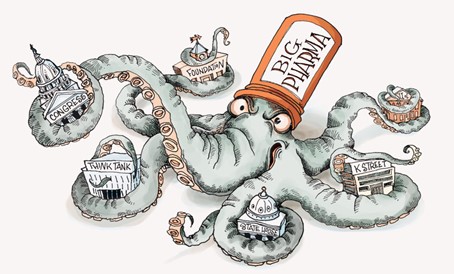
The influence that the pharmaceutical industry wields over media outlets is no secret. As of 2018, an estimated 70% of all news advertising in the US came from pharmaceutical companies. I have written elsewhere about how “reporting” on medical issues can be difficult to distinguish from outright marketing for drug companies.
Social-media platforms are not immune to this influence, whether it comes via advertising dollars; “partnerships” such as that between the CDC Foundation and MailChimp (which like many other platforms, has an explicit policy of censoring content about vaccines that does not align with the positions of the CDC and the WHO); direct investment, such as that of Google’s parent company Alphabet; or indeed at the behest of politicians such as Congressman Adam Schiff, who last year wrote to the CEOs of Amazon, Facebook and Google, requesting that those companies censor information and products that did not conform to the officially sanctioned position on vaccines. All three complied.
So it should come as small surprise that both Google and YouTube have now taken to removing content supportive of hydroxychloroquine, a drug that is no longer covered by patent, and can be made and sold by any generic producer, for a fraction of the price that Gilead, for example, might charge for its still-patented Remdesivir. Twitter and Facebook have likewise removed posts about the drug, most notably–and with no visible sense of irony–removing posts of the video in which the Frontline Doctors speak out about widespread media censorship of the topic. (You can now see those videos on Bitchute.)
One need not have an opinion on the merits of the drug hydroxychloroquine in order to recognize that something very odd is happening here. Something that doesn’t seem to have anything to do with free and open inquiry or honest scientific discourse.
Many argue that the politicization of this drug is founded in a desire to unseat President Trump, that the opposition to it is primarily because it was endorsed by Trump, and if it is deemed to be a failure (or even better, dangerous to patients) it will be a powerful strike against the president. That may well be part of what has motivated this. But there is another motivation, having to do with the desire to push a more expensive medication onto the market, and to push a new vaccine on the world’s population.
More broadly, it has to do with the narrative that those in the business of selling drugs demand we believe: that we are all in desperate need of their products (but only the ones still under patent) if we are to be healthy–or indeed, if we are to survive at all.
If it turns out that this “new” virus is easily treatable, with hydroxychloroquine or anything else, then the industry’s dreams go up in smoke. If hydroxychloroquine turns out to be a safe and effective way of treating Covid-19 (as multiple studies and the experience in many other countries outside of the US indicate it may be) then there is much less reason for anyone to receive a vaccine for it, let alone the entire world’s population. Likewise, there is no pressing need to develop a new, more expensive treatment.
But even more than that: If it turns out that hydroxychloroquine is after all a safe and effective treatment for Covid-19, then this whole episode – the silencing of dissenting voices, the “fact-checking” on social media, the campaigns against “misinformation” – will be revealed in plain sight, for what it has always been: Nothing more than a well-funded marketing campaign and damage-control effort on behalf of the industry that wants you to believe that you need to use its expensive products in order to go on living.
So when a group of doctors took to the steps of the US Supreme Court and told the world how they were having success using a cheap anti-malarial that had been in use for 65 years to treat the most deadly contagion of our generation, it was a massive blow to the narrative upon which the pharmaceutical purveyors’ success depends. And over the next few days, as viewers engaged in a race with the censors, quickly downloading videos before they were removed, to post them on other platforms… it became clear that the censors and the gatekeepers had lost control of the conversation.
This is not only about hydroxychloroquine. Every time media outlets or social-media platforms engage in outright censorship of content, in a way that happens to benefit pharmaceutical companies, both parties lose just a little more credibility. The actions we are witnessing now are not the actions of an industry confident in the value of what it provides to the world. They are the actions of a desperate, threatened creature. They are the actions of an entity that is not strengthened by the truth, but weakened by it. That is what these (increasingly obvious) acts of censorship tell us. What we are witnessing are the pangs of a lumbering, wounded, behemoth.
Newspapers: Fusion Centers Have Secretly Created A National Citizen Spying Program
MassPrivateI | August 6, 2020
 What has the public learned about Fusion Centers since the recent BlueLeaks hack was released over a month ago? Not a lot.
The Feds have done a great job of keeping the public from finding out what DHS Fusion/Intelligence Centers are really doing. In a country founded on freedom, we find federal and local law enforcement scrambling to keep the true function of Fusion Centers hidden from the public.
By piecing together news articles from Maine and Texas papers, a disturbing picture begins to unfold of warrantless surveillance of Americans.
The first proof that Fusion Centers were being used to spy on everyday citizens and activists can be found in a Maine Press Herald article from mid-July.
“A cache of internal police documents stolen from a secretive Maine State Police intelligence unit has provided the first substantial glimpse into how it collects and shares information about crime suspects and political activists and, in rare cases, keep tabs on domestic extremists, gang members and anti-government groups.”
The article goes into greater detail describing how local police use Fusion Centers to track down low-level offenders and ID people from social media or video footage.
“Police agencies commonly contact the Maine center with requests for help identifying a person depicted in a photo, sometimes captured from a surveillance camera. Other pictures are taken directly by law enforcement, or appear to be pulled from Facebook or other social media sites.”
Maine police even went so far as to ask the Fusion Center to identify a passenger in a car who refused to identify himself, and did not consent to having his photograph taken or his fingerprints scanned.
Another article in the Maine Press Herald which predated BlueLeaks, revealed that Fusion Centers refuse to acknowledge that they are secretly scanning everyone’s faces and spying on their cellphones.
“Despite evidence that the Maine State Police has worked for years with federal agencies to develop its use of digital surveillance technology, the agency now uses that law to refuse to answer any questions about such efforts, or even acknowledge that they exist.”
A third Maine Press Herald article revealed that Fusion Centers are secretly collecting a massive database of license plate numbers, the names and addresses of legal gun owners, and monitoring political activist groups and collecting members names and addresses.
The Austin Chronicle revealed that Fusion Centers have used secret informants to create a national “Suspicious Activity” network.
“In early June, an intelligence center operated by the Austin Police Department was hacked, along with many others like it across the country. Known as BlueLeaks, the collection of leaked documents from the hack contains over 10 gigs of material taken from the Austin center. They reveal a secret citizen spying program that’s active in the Austin area and across the country.”
The article reveals how Fusion Centers have created a vast network of secret “Threat Liaison Officers” (TLOs).
“Documents examined by the Chronicle show that each TLO must sign a nondisclosure agreement with ARIC, including those not working in law enforcement, essentially creating secret citizen officers.”
Secret citizen spies or TLOs could be someone you least expect. TLOs could be anyone: “private security officers with local hotels, malls, large venues, and local semiconductor companies. Government employees in “education,” “code enforcement,” and “public works” also contribute to ARIC as FOUO TLOs.
According to the article, TLOs could be teachers, trash collectors, ministers, priests, rabbi’s or even counselors.
Basically DHS has succeeded in creating a network of secret government spies masquerading as everyday people.
A TLOs job is to report people for doing mundane things like asking questions, taking pictures or being observant of one’s surroundings. TLOs are also reporting people for “suspicious” social media posts, whatever that means.
“According to one FOUO TLO’s report, an individual was seen taking photos of Zach Scott’s Topfer Theatre on Sept. 22, 2016. The report includes five different pictures of a young person using a camera on a tripod to photograph the theatre from across the street.”
To make it easier to report Americans for doing mundane things, Fusion Centers have provided TLOs with a checklist.
“The leaked documents include submission forms TLOs use to make their reports. At the top of the forms are boxes to check indicating the type of activity being reported. These include the aforementioned “School Threat,” but also Eliciting Information, Observation/Surveillance, and Suspicious/Odd Facebook Post. The TLO report spreadsheet contains 128 reports of school threats. But the category most reported by far was Expressed or Implied Threat, with more than a thousand entries.”
To say that this is reminiscent of China, the USSR or East Germany is an understatement. As the Chronicle warned, ‘worrisome examples of suspicious activity have led to increased scrutiny’ which means the Feds and local police could be secretly monitoring innocent Americans without out any public scrutiny.
If you thought DHS’s “If You See Something, Say Something” was a failure guess again. DHS has managed to justify creating 78 Fusion Centers whose sole purpose, it seems, is to spy on innocent Americans and track their daily movements.
US State Department ‘Russian disinformation’ report aims to stop normalisation of relations, discredit alternative media – embassy
RT | August 6, 2020
Russia’s embassy in Washington believes apparatchiks at the State Department have put together a hysterical report on “Russian propaganda” to prevent politicians improving relations.
The Russian diplomats say the dispatch on the “Pillars of Russia’s Disinformation and Propaganda Ecosystem.” is an attempt to obstruct Moscow’s proposals to resume cooperation in key areas. They also claim the communique is obviously geared to discredit alternatives to the mainstream press, which generally toes the US establishment line. It’s also notable that the publication coincides with a request for $138 million in 2021 to spend on “countering” Russian media.
“(The) report is an attempt to silence Russian official proposals to resume cooperation in key areas on which the security of the entire world depends,” the embassy wrote on its Facebook account. “The US State Department is not very fond of the existence of alternative sources of information. Serious resources are employed to discredit them. Any voice that contradicts Washington is dubbed ‘disinformation’ in the service of the ‘Kremlin’ and Russian intelligence.”
Parts of the document are absurd, the Russian diplomats noted. For example, the authors classified far-right opposition LDPR leader Vladimir Zhirinovsky and the private radio station Govorit Moskva as “Official Government Communications.” The officials also cite Russian media with state funding, with headlines from Sputnik, RIA Novosti, RT and others presented as examples of ‘disinformation.’
“If this serves as the pinnacle of the entire structure, so carefully built by our American colleagues, then it seemingly looks like a house of cards,” the commentary reads. “Russian and foreign media outlets that dare to criticize the United States should bear in mind that they can and almost certainly will become the subject of thorough scrutiny. Their accounts in American social media are at risk of being suspended with no explanation.”
In its Special Report Pillars of Russia’s Disinformation and Propaganda Ecosystem, the GEC claims that Russia is a key threat in terms of disinformation and propaganda. According to the document, this “ecosystem” involves official government channels, state-run mass media, proxy-resources, and social network. The Russian authorities, as follows from the report, are responsible for the development of such tactics and platforms as part of their approach to the use of information as a weapon.
Russia repeatedly denied Western media allegations that it indulges in misinformation. Deputy Foreign Minister Sergei Ryabkov said that the recent allegations that Russia and China were propagating misinformation about the coronavirus infection were yet another manifestation of the West’s Russophobia and Sinophobia. The US State Department has requested $138 million in 2021 to “counter disinformation and propaganda from Russia.”
The US already has a government-controlled foreign broadcasting arm, the United States Agency for Global Media (USAGM), which operates the Voice of America and Radio Liberty/Free Europe, and their various branches. The operation is entirely funded from the US budget, with its current expenses amounting to around $800 million annually, according to Voice of America. This is more than two and a half times what Russia spends on RT.
Ten Years After Lieberman’s “Internet Kill Switch,” the War on Freedom Rages On

By Thomas L. Knapp | The Garrison Center | August 2, 2020
In 2010, US Senators Joe Lieberman (D-CT), Susan Collins (R-ME), and Thomas Carper (D-DE) introduced their Protecting Cyberspace as a National Asset Act. Better known as the “Internet Kill Switch” proposal for the emergency powers it would have conferred on the president, the bill died without receiving a vote in either house of Congress.
A decade later, the same fake issues and the same authoritarian “solutions” continue to dominate discussions on the relationship between technology and state. The real issue remains the same as well. As I wrote in a column on the “Kill Switch” bill nearly 10 years ago:
“If the price of keeping Joe Lieberman in power is you staring over a plow at the ass end of a mule all day and lighting your home with candles or kerosene at night before collapsing on a bed of filthy straw, that’s a price Joe Lieberman is more than willing to have you pay.”
A single thread connects the “Internet Kill Switch” to the passage of Internet censorship provisions in the name of fighting sex trafficking (FOSTA/SESTA), the whining of federal law enforcement and intelligence officials for “back doors” to cripple strong encryption, and President Trump’s threats to ban video-sharing app TikTok, supposedly because the Chinese government’s surveillance programs just might be as lawless and intrusive as those of the US government.
That thread is the burning, pathological compulsion which drives politicians and bureaucrats to control every aspect of our lives, on the flimsiest of excuses and no matter the cost to us.
The compulsion hardly limits itself to technology issues (the war on drugs is a great example of its scope), nor is it limited to the federal level of government (see, for example, the mostly state and local diktats placing millions of Americans under house arrest without charge or trial “because COVID-19”).
That thread and that compulsion are more obvious vis a vis the Internet than “public health”-based authoritarianism because we’ve been propagandized and indoctrinated into the latter ideology for centuries, while the public-facing Internet is younger than most Americans.
Few of us can remember the days before quarantine-empowered “health departments” in every county, let alone a time when a five-year-old could walk into a store and buy morphine without so much as a doctor’s note.
But most of us can remember a relatively censorship-free Internet and the false promises of politicians and bureaucrats to respect the dramatically expanded power it gave to free speech.
That makes “kill switches” and “back doors” and TikTok bans a tougher sell. But the political class is still coming after the Internet. If we want to continue living in the 21st century instead of the 11th, we’re going to have to keep fighting them.
Thomas L. Knapp (Twitter: @thomaslknapp) is director and senior news analyst at the William Lloyd Garrison Center for Libertarian Advocacy Journalism (thegarrisoncenter.org).
Poll shows minimal support for Labour Party’s call to ‘urgently review’ RT’s media license
‘Prefer to use my own judgement’
RT | July 30, 2020
A letter from Labour’s Shadow Culture Secretary Jo Stevens to communications regulator Ofcom demands that RT’s media license be reviewed, but a poll shows the party itself doesn’t want censorship, but to make their own decisions.
The poll, conducted by Labour Grassroots, finds only 26 percent of Labour supporters feel the party should pursue having the media outlet’s license reviewed by a third party.
While another 19 percent did not answer either way, 55 percent of the 620 respondents said no.
And though those 55 percent believe RT is biased, many commented that the bias makes them no different from other media outlets and there is still value in the coverage.
“I watch for the interviews. They are very balanced and fair. The interviewers ask a question, allow a full answer and then ask follow up questions. Very good and far better than the equivalent on the BBC,” one respondent said.
“I am sure that RT is careful not to cause too many ripples with the Russian government. But that also applies to the BBC and the British government,” added another.
Yet another said as a “big boy,” he preferred to make the decision about where he gets his news, rather than the government.
“I know RT is effectively state run. However, as a big boy I prefer to use my own judgement rather than having a media outlet censored.”
Of those polled, 68 percent also believe RT provides useful media coverage.
In Stevens’ letter to Ofcom, it was claimed that RT has dangerous “political influence.” The charge was based on a report by the Intelligence and Security Committee, which called out social media companies in the UK for “failing to play their part” in suppressing “disinformation” from RT.
The report claimed RT helped influence UK politics in favor of Russia, like interfering with the Brexit vote, but failed to give any examples.
“Charity” Accused of Sex Abuse Coordinating ID2020’s Pilot Program For Refugee Newborns
By Whitney Webb |
UNLIMITED HANGOUT| July 29, 2020
A biometric identification program backed by the ID2020 alliance will see its new “digital id” program rolled out for refugee newborns in close coordination with a charity tied to Wall Street and prominent Western politicians whose workers have been accused of sexually exploiting refugee children.
iRespond, an international non-profit organization that is “dedicated to using biometrics to improve lives through digital identity,” has begun piloting a new biometric program for newborns among the predominately Karen refugee population along the Myanmar-Thailand border, a program it soon hopes to “quickly deploy” at a greater scale and make available to the general global population. The pilot program is being conducted as part of the controversial ID2020 alliance, backed by Microsoft, the GAVI vaccine alliance and the Rockefeller Foundation, and with the International Rescue Committee (IRC), a non-profit organization deeply tied to the Western political elite and Wall Street with a controversial track record of silencing numerous sex abuse and fraud allegations.
The new program, an extension of iRespond’s “voluntary” biometric identification program in the Mae La refugee camp, “will create a record of a birth, attested by a trusted clinic, with a goal of changing the life trajectory for the participants.” Through the program, “a guardianship relationship between the newborn and the mother is established and linked to digital and high security physical identity documents.”
However, iRespond’s CEO, Scott Reid, told Biometric Update that these credentials do “not carry the same weight as a true birth certificate,” but asserts that the organization’s biometric “birth attestation” program “could leapfrog the traditional barriers to establishing identity.” Despite the fact that iRespond’s quasi-birth certificates would seemingly serve little purpose in areas where actual birth certificates are readily available, the organization notes that “once the pilot is completed, iRespond is ready to quickly deploy the solution at scale” for mass use around the globe. “Product development” on adapting their platform for newborns began earlier this year and Reid notes that having an iRespond-provided biometric “birth attestation” will enable “access to vital services such as healthcare, social protection, education and banking.”
The pilot program is being conducted at the Mae Tao clinic, which is largely funded by the CIA cut-out USAID as well as the governments of Germany and Taiwan, the Open Society Foundations and the International Rescue Committee (IRC). The IRC is very active in the day-to-day functions of the clinic (financed by a USAID-funded project) and it is also intimately involved in iRespond’s digital identity program, including its new pilot program for newborns and its earlier efforts to supply Mae La’s residents with biometric identity.
Food or Sovereignty
iRespond’s work in Mae La in conjunction with IRC was first announced by the ID2020 alliance in September 2018. The ID2020-funded pilot program, the announcement states, was to be “led by Alliance partner iRespond and will be conducted in close partnership with the International Rescue Committee (IRC).” It aims to provide biometric identities to the approximately 35,000 individuals inhabiting the area, with the newer program aiming to ensure that babies born in the community are also made participants by default upon birth. It notes specifically that “the pilot will offer blockchain-based digital identification, linked to individual users through iris recognition, for refugees accessing the IRC’s services in the Mae La Camp in Thailand.” Having a “digital identity” would allow refugees “to access improved, consistent healthcare within the camp” with plans for the same system to eventually “electronically document both educational attainment and professional skills to aid with employment opportunities.”
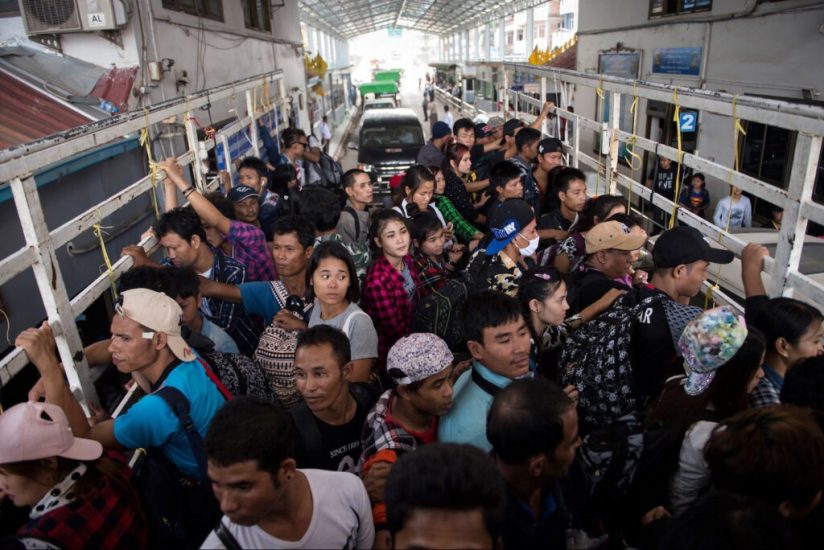
Migrant workers pass the Thai-Myanmar border in an official service truck as they leave Thailand from Mae Sot in Tak province in northern Thailand. Photo: AFP/Ye Aung Thu
A year later, the program, featured in a lengthy profile in Newsweek, was revealed to be “just the first step in an effort that aims to equip the camp’s entire refugee population with secure and portable “digital wallets” that will hold not just their medical records but also educational and vocational credentials, camp work histories and myriad other records,” ostensibly including financial activity. This is particularly likely given that iRespond is partnered with Mastercard, another ID2020 partner that is closely allied with the company, Trust Stamp, a biometric identity platform that also doubles as a vaccine record and payment system. In addition, IRC’s strategic plans for Mae La through 2020 include “expand[ing] micro-enterprise development and village savings and loans associations,” such as those offered by ID2020 partner Kiva, among others, who link biometric identity to the receipt of loans.
iRespond’s system, not unlike Trust Stamp’s, is also slated to serve as a vaccine record. Larry Dohr, iRespond’s head of Southeast Asia operations, told Reuters in April that “a biometric ID system can keep a record of such people [who have previously tested positive for Covid-19] and those getting the vaccine.” Dohr added that “we can biometrically identify the individual and tie them to the test results, as well as to a high security document. The person then has ‘non-refutable’ proof that they have immunity due to antibodies in their system.” Dohr then refers to such “proof” as a “very valuable credential.”
Notably, in press releases and news reports, iRespond executives emphasize how their biometric identity system, based on iris scans and powered by Microsoft, will “protect privacy” and allow “control and ownership of identity data belong to the holder.” However, the Mae La project does not offer this degree of control and ownership, with Newsweek noting that“Eventually, [iRespond and their collaborators] aim to offer the refugees a level of fine-grained control over what pieces of personal information are shared with others.” In other words, such control over their personal information has not yet been made available to them, despite the public portrayal that this functionality is a base component of iRespond’s system.
What is particularly noteworthy about iRespond’s and IRC’s digital identity efforts is that, while it is a “voluntary” program, destitute refugees wishing to access healthcare and other services IRC provides in the area, including access to clean water, must have their irises scanned in order to reap those benefits. It is highly unlikely that such individuals are not only uninformed about any potential risks of providing their biometrics for use in a pilot program, but are not in a stable enough state to make an informed decision on the matter, as their precarious position would see them choose urgent healthcare needs, etc. over privacy. It increasingly seems that Mae La was chosen as the pilot project because its residents were highly unlikely to decline participation, especially when healthcare access and other basic needs provided by IRC are dangled as carrots on a stick and only accessible upon participation in iRespond’s biometric identity program.
This program is remarkably similar to the World Food Programme’s recently implemented “Building Blocks” initiative, which is funded by the US, German, Dutch and Luxembourgian governments. Building Blocks uses a blockchain-based biometric identity system “to expand refugees’ choices in how they access and spend their cash assistance” in Syrian refugee camps within Jordan. Now, “over 100,000 people living in the camps can purchase groceries by scanning an iris at checkout” as part of the checkout. Those who do not participate are unable to access their WFP “cash benefits” since they are available exclusively through this biometric system, leaving refugees the choice between surrendering their biometric data and food.
Equally noteworthy is the fact that those financially supporting the Mae La project and similar projects, particularly the ID2020 alliance, are “hopeful” that iRespond’s efforts in Mae La will some day be rolled out on a global scale. Indeed, Newsweek noted that “many of the funders [of the Mae La project]—part of what’s known as the ID2020 alliance, which includes Accenture, Microsoft and the Rockefeller Foundation—hope the Mae La project could eventually serve as a blueprint for the world’s millions of stateless people, as well as citizens of developed nations and everyone else.”
Biometric Enclosure
According to iRespond’s rather spartan website, their biometric identity platform “primarily relies on iris biometrics, the best modality after DNA for accuracy and reliability.” It further describes its platform as follows:
“When a new participant is enrolled, an encrypted biometric template is created from their iris scan and a randomly assigned 12-digit number is drawn from a pool of 90 billion numbers. On subsequent visits, the identity of the participant is verified when their template is matched and the system returns the original 12-digit unique identifier.”
iRespond’s platform also “easily integrates into healthcare, humanitarian aid, research, and human-rights applications,” and it has been used to grant refugees and other vulnerable populations access to food, healthcare, and other forms of aid provided by foreign NGOs operating in these areas. It has also been used to keep track of participants in clinical drug trials. iRespond’s platform in the latter case was used by the U.S. Center for Disease Control and Prevention (CDC) in conjunction with Johns Hopkins School of Public Health (both are iRespond partners), to track participants in clinical HIV treatment trials in Senegal as well as an additional Johns Hopkins study in South Africa. It has also been used to track recipients of the controversial HPV vaccine in Sierra Leone, where it was used “to track patients who have not completed their vaccination series.”
It is also being used among “vulnerable groups” in Myanmar by the NGO Population Services International (PSI) to “track demographics and the timing of positive HIV tests.” By analyzing these details, “we uncover which groups are most vulnerable to becoming infected,” according to PSI’s country representative for Myanmar.
The non-profit’s platform is powered by its main tech partner and another ID2020 member, Microsoft. iRespond’s platform “couldn’t exist without the cloud,” according to its CEO Scott Reid, and Microsoft supplies iRespond with a $60,000 grant to its Azure cloud system, allowing the organization to use it free of charge. In addition, Microsoft donated 39 tablets to iRespond that are used by the organization in the various places it operates “to enable flexibility in the field.” “The number of people we have helped has rapidly gone from the tens of thousands to the hundreds of thousands, and we look forward to soon working on behalf of many millions of people. These Microsoft tools are helping to make it possible,” iRespond’s Larry Dohr stated in a Microsoft profile.
Eric Rasmussen, iRespond’s president and chairman of the board, is a particularly interesting character who has been quite frank about the rationale behind the creation of iRespond. “When you understand who someone is, you understand what they’re entitled to, whether that’s national citizenship, international refugee support, or simply food distributions,” Rasmussen told Microsoft last year.
In addition to his key role at iRespond, Rasmussen is a professor at the Google-backed “Singularity University” as well as chairman of the board at InSTEDD, a “global NGO specializing humanitarian informatics, particularly around health in resource-poor economies” that is partnered with the Bill and Melinda Gates Foundation, the Rockefeller Foundation, the CDC, Google and UNICEF. In addition, Rasmussen is also the CEO of a “profit-for-purpose” company called Infinitum Humanitarian Systems (IHS). IHS works closely with USAID and the State Department as well as U.S. military intelligence agencies and intelligence/defense contractor Booz Allen Hamilton. Prior to his roles at iRespond, IHS and InSTEDD, Rasmussen was the Principal Investigator in humanitarian informatics for the Pentagon’s Defense Advanced Research Projects Agency (DARPA) and made multiple war time deployments to Bosnia, Iraq and Afghanistan.
“Charity” of the Predator Class
More troubling than the background and associations of iRespond are those of their partner in the recently announced newborn biometric identification initiative, the International Rescue Committee (IRC). The IRC describes themselves as responding “to the world’s worst humanitarian crises and help[ing] people whose lives and livelihoods are shattered by conflict and disaster to survive, recover and gain control of their future.”
Despite the IRC framing itself as a “humanitarian” venture, its board is stuffed with a sordid mix of Wall Street criminals and war criminals. For example, its board is co-chaired by Timothy Geithner, former Treasury Secretary during the 2008 financial crisis bail-outs and current President of Wall Street titan Warburg-Pincus, and Susan Susman, an Executive Vice President at Pfizer. Its board of advisers includes war criminals Henry Kissinger and Madeleine Albright as well as Condoleezza Rice and Colin Powell. Also present are current and former leaders and top executives at McKinsey, Morgan Stanley, Goldman Sachs, Kroll Associates (“the CIA of Wall Street”), PepsiCo, Bank of America, Lehman Brothers, Citigroup and the World Bank. Another advisor is former chairman and CEO of AIG Maurice “Hank” Greenberg, a name that will likely be familiar to those who have researched the September 11th attacks and Wall Street financial crimes in general.
Since 2013, the IRC has been led by David Miliband, the Tony Blair “protégé” who Bill Clinton once called “one of the ablest, most creative public servants of our time” and who worked closely with then-U.S. Secretary of State Hillary Clinton while serving as the U.K.’s Foreign Secretary. So close was Miliband to the Clintons, that he was being considered for a “top U.S. government job” if Hillary Clinton had won the 2016 election.
In the years since joining the IRC, Miliband’s salary as the group’s president has ballooned to nearly a million dollars annually (up from approximately $240,000 when he arrived at the organization in 2013). In addition, the group has been mired in scandal since Miliband became its president. For instance, it was revealed in 2018 that IRC was one of several U.K.-based charities where “workers [were] alleged to be in sexually exploitative relationships with refugee children” including through “sex-for-food scandals” where “sexual abuse was so endemic that the only way for many refugee families to survive was to allow a teenage girl to be exploited.” Reports further alleged that IRC and other charities named in the report, including Save the Children, had known of the egregious abuse for years prior to the allegations being made public and chose not to act.
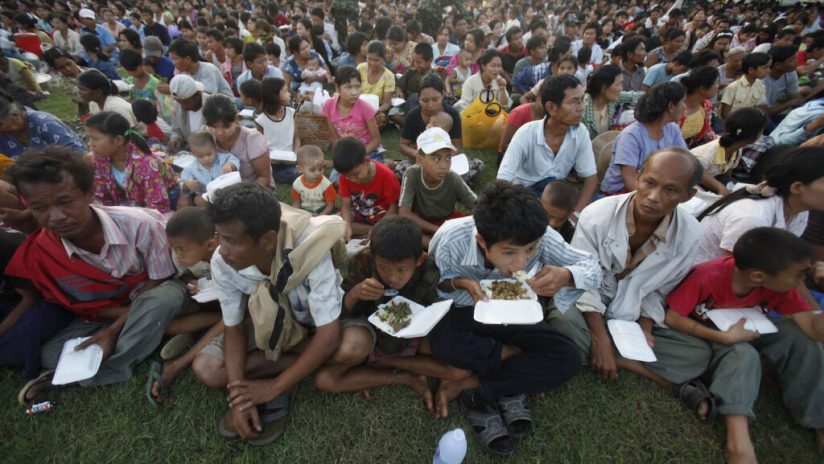
Myanmar refugees, who crossed over from Myanmar to Thailand when a battle erupted between Myanmar’s soldiers and rebels, eat at the Thai-Myanmar border town of Mae Sot November 8, 2010. A clash erupted between ethnic minority Karen rebels and government soldiers in Myanmar’s Myawaddy town opposite the Thai border town of Mae Sot, Reuters witnesses on the Thai side of the border said. REUTERS/Chaiwat Subprasom (THAILAND – Tags: POLITICS CIVIL UNREST) – RTXUDI7
That year, it was also found that the IRC had “silenced 37 sex abuse, fraud and bribery allegations,” resulting in the U.K. government, which had previously funneled millions to the organization, cutting off its funding entirely. Despite the troubling revelations, no IRC workers accused of wrong-doing were ever prosecuted.
Given the fact that the IRC’s board and presidency is stuffed with professional exploiters, from Wall Street to the public sector, it is hardly surprising that this “charity” would be caught doing the same under the guise of providing “aid” to the world’s most vulnerable populations, who they apparently view as easy prey.
Foxes in the Hen House
In the several media profiles of the iRespond-IRC biometric identity effort, the initiative is described as helping to prevent the exploitation of the world’s most vulnerable, particularly forced labor and sex trafficking. However, if that really were the case, why is this program being executed by iRespond, whose president and chairman has close ties to the U.S. military and intelligence communities, and the IRC, backed by a legion of war criminals and financial predators?
The U.S. military, a close partner of iRespond’s Eric Rasmussen, is notorious for its role in the trafficking of persons for forced labor, while many of its key contractors – like DynCorp — have been the subject of numerous scandals regarding the sexual abuse or sex trafficking of war-torn or otherwise vulnerable populations. On the other hand, the IRC’s mix of backers like Madeleine Albright, infamous for her comment on the murder by sanctions of half a million Iraqi children being “worth it,” and Henry Kissinger, notorious for his words about using food as a weapon to force populations into subservience and to reduce third-world populations, is equally anathema to the publicly professed purpose of the iRespond-IRC biometric identification program.
Not unlike the “sex-for-food” scandal in which IRC was once embroiled, this new initiative is placing refugees in the position of taking part in a massive technocratic experiment if they wish to eat or access other basic services. Though certainly not as egregious as a sex crime, it is nonetheless another means of exploiting the world’s most vulnerable populations under the guise of “helping” them, when those really being aided are the technocratic elite who aim to take this biometric identification program global in short order.
Featured Video

The American Retreat from Vietnam
or go to
Aletho News Archives – Video-Images
From the Archives
Secret document reveals plans for civil war in Lebanon, Israeli false flags, and invasion
By Randi Nord | Geopolitics Alert | April 5, 2019
Beirut – During his visit with US Secretary of State, Mike Pompeo, Lebanese President Michael Aoun reportedly received a US-Israeli document detailing plans for creating a civil war in Lebanon with covert false flag operations and possible Israeli invasion.
Although the source of the document is Israeli and created in partnership with Washington, no one knows who presented it to Aoun. The Lebanese TV station, Al-Jadeed, initially reported the document on Lebanese TV and a video on its website. Geopolitics Alert translated the report for this article. … continue
Blog Roll
 Aletho News
- Department of War Awards $20.7 Billion Contract to Raytheon for Air-to-Air Missiles
- ‘Distance yourselves from Israel’: IRGC urges US population to question govt policies
- America’s Greenland deal has a radioactive backstory
- The RAF Fairford ‘terror plot’: Unpacking escalation in the UK echo-chamber
- EU Council Advances Chat Control 2.0 Scanning Proposal
- Ex-Greek MEP files complaint against Israeli spyware firm over alleged Pegasus surveillance
- Troubling ideas throughout the Torah, Talmud, Mishneh Torah and Tanya
- ‘Grave, alarming’: Iran mission on Trump’s UNGA ‘annihilation’ threats
- Najaf airport to reopen to Iranian flights within 24 hours: Ambassador
- From ‘How Will This End For Iran’ to ‘When America Walks Away’: A tale of two Economist covers
- If Americans Knew
- New Report: “Scholasticide and Genocide in Gaza: Assessment, Testimonies and Legal Analysis”
- Ex-Biden officials are desperate for a Gaza scapegoat
- Israeli “settlers” Invade Al-Aqsa; Pour Boiling Water on 75-Year-Old
- Israel Has Kidnapped Another American Teenager
- US arms sales to Israel worth $21.6 billion in 20 months
- Three Palestinians Killed in Israeli Attacks on Gaza
- Revealed: German “Anti-Semitism Expert” Driving Crackdown on Palestine Solidarity is Former Israeli Spy
- Egypt’s Warning to Israel Before Oct 7
- Israel’s siege signals another cruel winter for 1.8 million Gazans – Daily Update
- Netanyahu Asked UAE Leader to Deny Report on Oct. 7 Warning in Secret Visit, Sources Say
- No Tricks Zone
- New Study: Earth And Venus Surface Warmth Largely Explained By Convection And Lapse Rate, Not CO2 Or Radiation
- 2025 Nature Paper Claiming Worsening Global Drought Gets RETRACTED …Heavily Flawed
- New Study: ‘Global Drought Shows No Detectable Recent Acceleration Under Climate Warming’
- Economic Masterminds: German Socialists Suggest Taxing Productivity Gains Stemming From Using AI
- The South China Sea Has Not Been Cooperating With The Climate Change Narrative
- Energy Crisis: Germany Enters Heating Season With Historically Low Gas Reserve Fill Levels
- New Study: The Antarctic Ice Sheet Gained Mass From 2020-2024 Due To Staggering Snow And Ice Accumulation
- Study: Ocean Heating Rates From Thousands Of Years Ago ‘Dwarf’ Modern Ocean Heating Rates
- Climate Extremists Target, Attack Large-Scale Power Grid Infrastructure In Germany!
- New Study: Antarctic Ice Melt Has Contributed Less Than 1 Centimeter To Sea Level Rise In The Last 30 Years

