Twitter’s ‘ban’ on political ads has a gaping, legacy media-shaped loophole
RT | November 16, 2019
Trying to stay ahead of spurious allegations of enabling ‘Russian meddling’ into US elections, Twitter has outlawed all political advertising – but left an exemption most US legacy media, though partisan, will easily sail through.
“Twitter globally prohibits the promotion of political content. We have made this decision based on our belief that political message reach should be earned, not bought,” the company announced Friday, sharing the details of its ad ban.
Elaborating on the decision in a thread, Twitter’s head of legal, policy and Trust & Safety Vijaya Gadde effectively admitted that the ban was driven by concerns over digital advertising “driving political outcomes” – even though the effects of micro-targeted ads “are not yet fully understood.”
The ban is scheduled to go into effect on November 22. In addition to banning candidates, parties, and affiliated groups like political action committees (PACs) from advertising, Twitter is also ruling out ads that are about influencing votes, parties, ballot initiatives or elections. “Cause-based ads” will be allowed with certain restrictions, but again not when coming from candidates, parties or politicians.
If this sounds convoluted, banning both people and content, that’s because it is. However, the policy has a sizeable exemption for “news publishers” who can run ads referencing “political content and/or prohibited advertisers,” so long as there is no advocacy for or against.
To qualify, a publication’s website must have “a minimum of 200,000 monthly unique visitors in the US,” the ability to contact its editors and reporters online, have a searchable archive, and not be a user-generated platform or aggregator. Nor can the publication be dedicated to advocating on a single issue.
These parameters clearly skew the playing field in favor of US legacy media – despite its open partisanship over the past several years. Not only have the legacy media and Democrats blamed the social media for enabling the election of President Donald Trump, they have also led the charge in pressuring Twitter, Facebook and others to “deplatform” any alternative voices they might find unsavory.
Most recently, Sen. Kamala Harris (D-California) actually demanded Twitter suspend Trump’s account as part of her pitch for the 2020 presidential nomination – so far, without effect.
In August, Twitter rolled out a ban on ads from “state-controlled news media entities,” using a convoluted definition that also carves out exemptions for well-established legacy outlets in the West.
(Full disclosure: Twitter banned RT ads long before that, without explanation or process, following the initial 2017 congressional hearings into social media platforms, and the revelation that it proposed a multi-million dollar deal to RT during the 2016 election, which was declined.)
The vast majority – about 86 percent – of Twitter’s revenue comes from advertising, with data licensing and other sources accounting for the rest. The company turned an annual profit for the first time in 2018, five years after going public.
Social Media Censorship Reaches New Heights as Twitter Permanently Bans Dissent
Mnar Muhawesh speaks with journalist Daniel McAdams about being permanently banned from Twitter, social media censorship and more.
By Mnar Muhawesh – MintPress News – November 14, 2019
It’s an open secret. The deep state is working hand in hand with Silicon Valley social media giants like Twitter, Facebook and Google to control the flow of information. That includes suppressing, censoring and sometimes outright purging dissenting voices – all under the guise of fighting fake news and Russian propaganda.
Most recently, it was revealed that Twitter’s senior editorial executive for Europe, the Middle East and Africa is an active officer in the British Army’s 77th Brigade, a unit dedicated to online warfare and psychological operations.
In other words: he specializes in disseminating propaganda.
The news left many wondering how a member of the British Armed Forces secured such an influential job in the media.
The bombshell that one of the world’s most influential social networks is controlled in part by an active psychological warfare officer was not covered at all in the New York Times, CNN, CNBC, MSNBC or Fox News, who appear to have found the news unremarkable.
But for those paying attention and for those who have been following MintPress News extensive coverage of social media censorship, this revelation was merely another example of the increasing closeness between the deep state and the fourth estate.
Amazon owner, and world’s richest man, Jeff Bezos was paid $600 million by the CIA to develop software and media for the agency, that’s more than twice as much as Bezos bought the Washington Post for, and a move media critics warn spells the end of journalistic independence for the Post.
Meanwhile, Google has a very close relationship with the State Department, its former CEO Eric Schmidt’s book on technological imperialism was heartily endorsed by deep state warmongers like Henry Kissinger, Hillary Clinton and Tony Blair.
In their book titled, The New Digital Age: Reshaping the Future of People, Nations and Business, Eric Schmidt and fellow Google executive Jared Cohen wrote:
What Lockheed Martin was to the twentieth century…technology and cyber-security companies [like Google] will be to the twenty-first.
Another social media giant partnering with the military-industrial complex is Facebook. The California-based company announced last year it was working closely with the neoconservative think tank, The Atlantic Council, which is largely funded by Saudi Arabia, Israel and weapons manufacturers to supposedly fight foreign “fake news.”
The Atlantic Council is a NATO offshoot and its board of directors reads like a rogue’s gallery of warmongers, including the notorious Henry Kissinger, Bush-era hawks like Condoleezza Rice, Colin Powell, James Baker, the former head of the Department of Homeland Security and author of the PATRIOT Act, Michael Chertoff, a number of former Army Generals including David Petraeus and Wesley Clark and former heads of the CIA Michael Hayden, Leon Panetta and Michael Morell.
39 percent of Americans, and similar numbers of people in other countries, get their news from Facebook, so when an organization like the Atlantic Council is controlling what the world sees in their Facebook news feeds, it can only be described as state censorship on a global level.
After working with the council, Facebook immediately began banning and removing accounts linked to media in official enemy states like Iran, Russia and Venezuela, ensuring the world would not be exposed to competing ideas and purging dissident voices under the guise of fighting “fake news” and “Russian bots.”
Meanwhile, the social media platform has been partnering with the US and Israeli governments to silence Palestinian voices that show the reality of life under Israeli apartheid and occupation. The Israeli Justice Minister proudly revealed that Facebook complied with 95 percent of Israeli government requests to delete Palestinian pages. At the same time, Google deleted dozens of YouTube and blog accounts supposedly connected to the government of Iran.
In the last week alone, Twitter has purged several Palestinian news pages, including Quds News Network — without warning or explanation.
Electronic Intifada co-founder Ali Abunimah wrote,
This alarming act of censorship is another indication of the complicity of major social media firms in Israel’s efforts to suppress news and information about its abuses of Palestinian rights.
Alternative voices not welcome
The vast online purge of alternative voices has also been directed at internal “enemies.”
Publishers like Julian Assange and whistleblowers like Chelsea Manning are still being held in solitary confinement in conditions that international bodies and human rights groups call torture, for their crime of revealing the extent of the global surveillance network and the control over the media that Western governments have built.
As attempts to re-tighten the state and corporate grip over our means of communication increases, high-quality alternative media are being hit the hardest, as algorithm changes from the media monoliths have deranked, demoted, deleted and disincentivized outlets that question official narratives, leading to huge falls in traffic and revenue.
The message from social media giants is clear: independent and alternative voices are not welcome.
One causality in this propaganda war is Daniel McAdams, Executive Director of the Ron Paul Institute for Peace and Prosperity, a public advocacy group that argues that a non-interventionist foreign policy is crucial to securing a prosperous society at home. McAdams served as Senator Paul’s foreign affairs advisor between 2001 and 2012. Before that, he was a journalist and editor for the Budapest Sun and a human rights monitor across Eastern Europe.
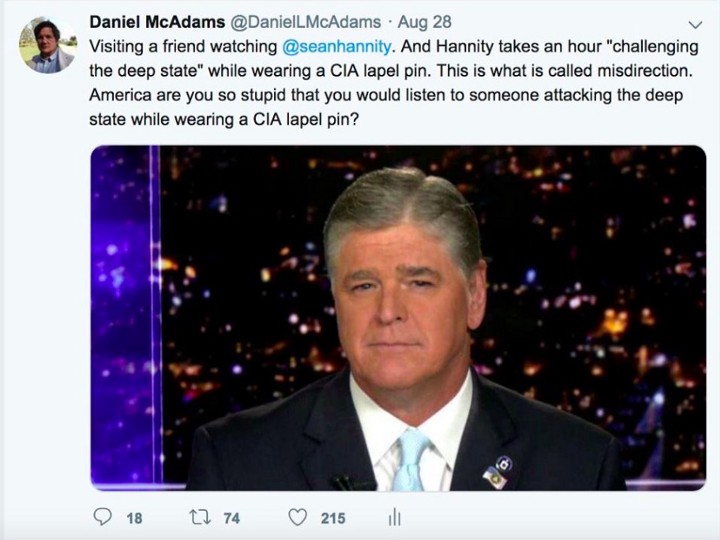
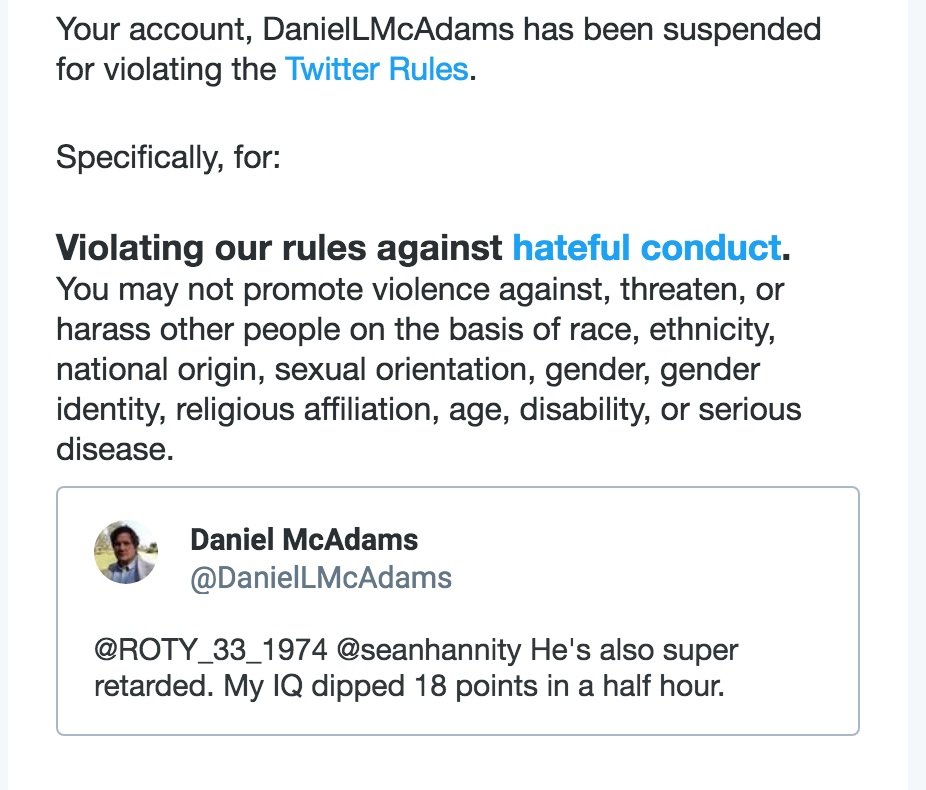
McAdams, who spent much of his time on Twitter calling out the war machine supported by both parties, was recently permanently banned from the platform for so-called “hateful conduct.” His crime? Challenging Fox News anchor Sean Hannity over his hour-long segment claiming to be against the “deep state,” while simultaneously wearing a CIA lapel pin. In the exchange, McAdams called Hannity “retarded,” claiming he was becoming stupider every time he watched him.
Yes, despite that word and its derivatives having been used on Twitter over ten times in the previous minute, and often much more aggressively than McAdams used it – only McAdams fell victim to Twitter’s ban hammer. Something didn’t make sense about this ban. One only needs to read the replies under any of President Trump’s tweets to see far more hateful speech than what McAdams displayed to suspect foul play.
I spoke with McAdams about the ban and began by asking him if he accepts the premise of the ban, or if he believes something else was afoot.
Israel has cracked down on Palestinian education, criminalising hundreds of students
By Megan Giovannetti | MEMO | November 15, 2019
Khaleel Shaheen is a senior at Birzeit University in Ramallah. When he heard that four close friends and fellow students were arrested by the Israeli authorities, he didn’t go to the campus for five days.
As a volunteer with Birzeit’s Right to Education Campaign — a student-led group which monitors Israeli violations against students — Shaheen is finding it difficult to continue his work as normally as possible while this latest crackdown against students unfolds.
“I feel so angry,” he told me. “I feel so helpless. “I cannot just go to school. I cannot focus. I cannot function to go to class.”
According to the Right to Education Campaign, 20 students have been detained by the Israeli authorities since the beginning of the current academic year. This is nothing new. Since 2004, more than 1,000 students enrolled at Birzeit have been arrested, 80 of whom are still in Israeli prisons. Seventeen of these are currently held under administrative detention, a process which Israel uses systematically to hold Palestinians indefinitely with neither charge nor trial.
Students are often denied access to a lawyer for up to 60 days and subjected to harsh interrogation and treatment in Israeli custody. Most are taken from their homes in the middle of the night or even kidnapped directly from campus.
Addameer, a Palestinian prisoner support and human rights association, told me that a total of 250 students across various Palestinian universities are currently in Israeli prisons. “There are also around 190 Palestinian children detained and imprisoned in Israeli jails, of whom 20 are under 16 years old,” Addameer’s advocacy officer pointed out. “Those children are all students in primary or secondary schools.”
In an exclusive statement to MEMO, Birzeit University described this escalation of arrests as an ongoing Israeli policy targeting students who have political affiliations and activism. “They are targeting students who are very active in the student movement in the university,” Shaheen explained. “They are not just going after people at random.”
Birzeit University is the only West Bank higher education institution which holds student body elections, with representation from all Palestinian political parties. In a society that has not held a General Election since 2007 — hence the deadlocked political system and a president whose own term ended 10 years ago — Birzeit University’s elections are one of the only ways to gauge public opinion.
“These elections are very, very important for both the [Palestinian] government and the [Israeli] occupation [because] it depicts the streets… and what the new generations are voting for,” said Shaheen. He confirmed that no particular political party’s members appear to be targeted; arrests occur across the spectrum of political affiliation.
Birzeit seems to be targeted because of its reputation for producing politically active students. “The students care so much about politics,” added Shaheen. “They care about what is happening on the streets.” He told me about the weekly demonstrations that students arrange in support of prisoners, refugees and martyrs; or simply demanding their right to education.
The student body council has the power to gather students together and give them a voice. “For the Israelis, this is dangerous. It’s dangerous for them [to have] active students who have a voice and opinions, and influence the opinions of others.”
Last year, a video went viral of undercover Israeli forces kidnapping the president of the student body council, Omar Kiswani, directly from Birzeit’s campus. The video and various reports show six plain-clothed officers beating Kiswani and firing their guns in broad daylight.
Birzeit University faculty member and Professor of Media Dr Widad Bargouthi was swept up in the latest round of Israeli arrests based on a military law of “incitement”. According to Addameer, the indictment was based on social media posts made by Dr Bargouthi, despite them being a part of a class regarding the basic journalistic principles of freedom of expression.
“I believe that most of those arrests [are carried out] to create an atmosphere of fear inside the university,” Shaheen said. This has drawn students away from making social media posts or even simply attending classes. “They want to make students fearful of everything.”
When asked for a comment, the office of the Israel Defence Forces spokesperson indicated that the cases are under investigation by Shin Bet, the internal security agency, and no information could be shared. “The students that are in custody have been suspected of terrorist attacks in which Israeli citizens were killed,” is all that the spokesperson would say. No details of the specific “terrorist attacks” in question were provided.
A public gag order on all student cases was issued on 10 September and has been renewed twice. The current order will expire on 7 December. This limits Addameer’s ability for advocacy. The order — requested by Shin Bet — was not issued by a military court, but a civil court in Jerusalem. “The session was one-sided, without the prisoners or their lawyers [present],” said Addameer’s advocacy officer.
Birzeit University told MEMO that Israel’s policy of arresting students and teachers is a “grave violation” of basic rights to education and academic freedom. “The reality now is turning higher education in Palestine from safe spaces where students can grow, excel and express themselves freely, into zones where students are in grave danger both on and off campus.”
Israel’s crackdown on Palestinian education is criminalising hundreds of young people. This is not the act of a genuine democracy.
READ ALSO:
Jewish Nation-State Law added to Israel high school curriculum
Israel students forced to pass government propaganda course before overseas school trips
Le Mesurier Gets Cross
By Craig Murray | November 14, 2019
Perhaps the only fact on James Le Mesurier about which I would agree with the MSM war cheerleaders is that he was a very busy man. It is remarkable therefore that he found the time and inclination to follow “Philip Cross” on twitter. Given that “Philip Cross” has virtually never posted an original tweet, and his timeline consists almost entirely of retweets of Nick Cohen, David Aaronovitch and openly pro-Israel propaganda accounts, why would Le Mesurier bother to follow him?
“Philip Cross” has never posted any news other than to retweet columnists. He has never given an insight into a story. In addition to James Le Mesurier, why then were all these MSM journailsts following “Philip Cross” from before “he” gained notoriety for his Wikipedia exploits?
Oliver Kamm, Leader Writer The Times
Nick Cohen, Columnist The Guardian/Observer
Joan Smith, Columnist The Independent
Leslie Felperin, Film Columnist The Guardian
Kate Connolly, Foreign Correspondent The Guardian/Observer
Lisa O’Carroll, Brexit Correspondent The Guardian
James Bloodworth, Columnist The Independent
Cristina Criddle, BBC Radio 4 Today Programme
Sarah Baxter, Deputy Editor, The Sunday Times
Iain Watson, Political Correspondent, The BBC
Caroline Wheeler, Deputy Political Editor, the Sunday Times
Jennifer Chevalier, CBC ex-BBC
Dani Garavelli, Scotland on Sunday
Prominent Freelancers
Bonnie Greer (frequently in The Guardian )
Mason Boycott-Owen (The Guardian, New Statesman )
Marko Attilla Hoare (The Guardian )
Kirsty Hughes
Guy Walters (BBC)
Paul Canning
What attracted all of these senior MSM figures to follow an obscure account with almost no original content? No reasonable explanation of this phenomenon has ever been offered by any of the above. What a considerable number of them have done is to use the megaphone their plutocrat or state overlords have given them, to label those asking this perfectly reasonable question as crazed conspiracy theorists.
This week, on the day of Le Mesurier’s death, “Philip Cross” made 48 edits to Le Mesurier’s Wikipedia page, each one designed to expunge any criticism of the role of the White Helmets in Syria or reference to their close relationship with the jihadists.
“Philip Cross” has been an operation on a massive scale to alter the balance of Wikipedia by hundreds of thousands of edits to the entries, primarily of politically engaged figures, always to the detriment of anti-war figures and to the credit of neo-con figures. An otherwise entirely obscure but real individual named Philip Cross has been identified who fronts the operation, and reputedly suffers from Aspergers. I however do not believe that any individual can truly have edited Wikpedia articles from a right wing perspective, full time every single day for five years without one day off, not even a Christmas, for 2,987 consecutive days.
I should declare here the personal interest that “Philip Cross” has made over 120 edits to my own Wikipedia entry, including among other things calling my wife a stripper, and deleting the facts that I turned down three honours from the Crown and was eventually cleared on all disciplinary charges by the FCO.
I hazard the guess that at least several of the above journalists follow “Philip Cross” on twitter because they are a part of the massive Wikipedia skewing operation operating behind the name of “Philip Cross”. If anybody has any better explanation of why they all follow “Philip Cross” on twitter I am more than willing to hear it.
The “White Helmets” operation managed for MI6 by Le Mesurier was both a channel for logistic support to Western backed jihadists and a propaganda operation to shill for war in Syria, as in Iraq or Libya. Wars which were of course very profitable for arms manufacturers, energy interests and the security establishment. It should surprise nobody that Le Mesurier intersects with the Philip Cross propaganda operation which, with the active support of arch Blairite Jimmy Wales, has for years been slanting Wikipedia in support of the same pro-war goals as pushed by the “White Helmets”.
Federal Court Rules Suspicionless Searches of Travelers’ Phones and Laptops Unconstitutional
Activist Post | November 12, 2019
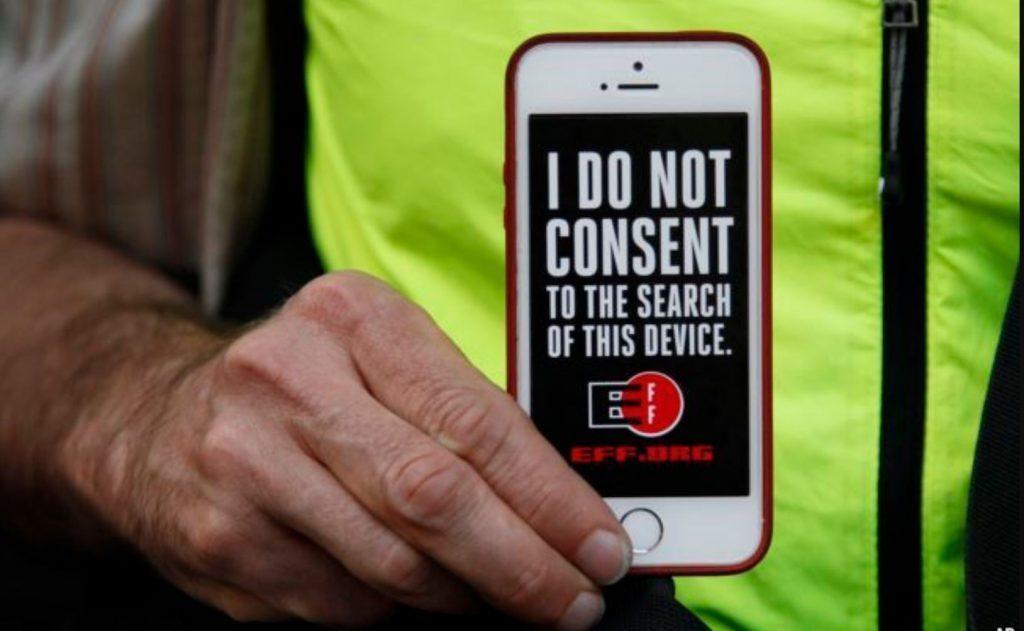
In a major victory for privacy rights at the border, a federal court in Boston ruled today that suspicionless searches of travelers’ electronic devices by federal agents at airports and other U.S. ports of entry are unconstitutional.
The ruling came in a lawsuit, Alasaad v. McAleenan, filed by the American Civil Liberties Union (ACLU), Electronic Frontier Foundation (EFF), and ACLU of Massachusetts, on behalf of 11 travelers whose smartphones and laptops were searched without individualized suspicion at U.S. ports of entry.
“This ruling significantly advances Fourth Amendment protections for millions of international travelers who enter the United States every year,” said Esha Bhandari, staff attorney with the ACLU’s Speech, Privacy, and Technology Project. “By putting an end to the government’s ability to conduct suspicionless fishing expeditions, the court reaffirms that the border is not a lawless place and that we don’t lose our privacy rights when we travel.”
“This is a great day for travelers who now can cross the international border without fear that the government will, in the absence of any suspicion, ransack the extraordinarily sensitive information we all carry in our electronic devices,” said Sophia Cope, EFF Senior Staff Attorney.
The district court order puts an end to Customs and Border Control (CBP) and Immigration and Customs Enforcement (ICE) asserted authority to search and seize travelers’ devices for purposes far afield from the enforcement of immigration and customs laws. Border officers must now demonstrate individualized suspicion of illegal contraband before they can search a traveler’s device.
The number of electronic device searches at U.S. ports of entry has increased significantly. Last year, CBP conducted more than 33,000 searches, almost four times the number from just three years prior.
International travelers returning to the United States have reported numerous cases of abusive searches in recent months. While searching through the phone of Zainab Merchant, a plaintiff in the Alasaad case, a border agent knowingly rifled through privileged attorney-client communications. An immigration officer at Boston Logan Airport reportedly searched an incoming Harvard freshman’s cell phone and laptop, reprimanded the student for friends’ social media postings expressing views critical of the U.S. government, and denied the student entry into the country following the search.
For the order:
https://www.eff.org/document/alasaad-v-nielsen-summary-judgment-order
For more on this case:
https://www.eff.org/cases/alasaad-v-duke
For more about border searches:
https://www.eff.org/issues/border-searches
‘Thousands’ of newly-created generic Twitter accounts defend ‘right-wing coup’ in Bolivia
RT | November 11, 2019
Evo Morales’ resignation has apparently sparked an information battle on social media, with one journalist alleging that countless Twitter bots are spreading right-wing talking points about Bolivia’s recent political upheaval.
“There are thousands of what are obviously bot accounts trolling anyone who tweets about the right-wing coup in Bolivia… There’s a big operation going on here,” tweeted Ben Norton, a journalist and assistant editor of the Grayzone Project. He noted that the accounts have formulaic handles consisting of a common name followed by a series of numbers. Screenshots show anti-Morales messages being posted by new accounts with only a handful of tweets.
Incredibly, his observation was bombarded by denials… from generic Twitter accounts created in November.
One user flagged by Norton had only four tweets – all of them attacking the journalist for sounding the alarm over the suspicious Twitter activity. The account was only three hours old.
Morales announced his resignation on Sunday, following protests and violence in the capital, La Paz. The Bolivian leader had called for new elections in hopes of appeasing protesters, but he stepped down hours later after being urged to do so by the country’s military chief. The political turmoil has been labeled as a military coup by Morales’ supporters, including UK Labour leader Jeremy Corbyn.
Only thing clear about the new Transparency Act is that US senators are about to let Google keep manipulating your search results
By Michael Rectenwald | RT | November 10, 2019
In June, whistleblower Zach Vorhies dumped internal Google documents exposing the company’s shady practices and political agenda. Rather than investigate, US lawmakers are offering Big Tech political cover and a legislative decoy.
Internal documents and secret recordings continue to make abundantly clear what many already knew and others strongly suspected about Google and other digital goliaths; that Google, Facebook, Instagram, Twitter, YouTube and others manipulate their content and their users.
Stepping into the fray, Senator John Thune (R-S.D.) has boasted that his new bill – the Filter Bubble Transparency Act – is the silver bullet for bursting user information filter bubbles, the predictable information dead ends that reinforce users’ pre-existing perspectives. He would have us believe that the use of personal user data by search engine algorithms is the real problem with the internet.
But this issue is the least of the problems that users face online. The bill’s co-sponsors hope we’ve forgotten – or never knew – that Google and the rest are not the unbiased, politically neutral information sources or social media platforms that they (so poorly) pretend to be. Far from it.
Google blacklists sources and prevents them from appearing in news results or featured links. Google’s blacklist is a manually curated file including over 500 websites that are excluded from news results.
Google applies fringe ranking to sites, downgrading those sites – but not The New York Times and The Washington Post – that promote “conspiracy theories” and “fake news.” Fringe ranking involves the manual grading of sites, although only those whose conspiracy theories or fake news stories fail to meet Google’s criteria for credible, plausible narratives are downgraded.
Google and YouTube use “hate speech” labeling, downgrading sites and videos they believe contain “hate speech.” YouTube scoring is apparently based solely on whether videos express “supremacism.”
Google and YouTube use “authoritativeness” scoring to rank sites and videos. The authoritativeness score is necessarily based on whether a news site or video conforms to Google or YouTube’s notions of credible and respectable views.
Last is the little-known fact that Google ranks websites against Wikipedia pages, treating Wikipedia as an unbiased and authoritative source. As Zach Vorhies told me in a private chat, “the core issue is that sites are not being ranked according to user data, they are being ranked against Wikipedia.” Websites are downgraded if Wikipedia pages contain negative information about them. Yet, as information age philosopher Jaron Lanier has noted, Wikipedia is notorious for its left-leaning political bias and its overwriting of known facts to suit its agenda. The issue has been addressed on Wikipedia itself.
Together, Google’s site-ranking methods favor liberal and left-leaning sites – but Google goes even further by steering voters toward preferred candidates and, in an insider video, the company made clear that it intends to intervene in the 2020 presidential election.
The Big Tech giants manipulate data and users and under questionable pretences and using highly subjective criteria. And they’ve done most of these things, or so they hoped, without our knowledge or permission.
The proposed legislation doesn’t even mention –let alone address– these practices. Instead, it pretends to talk tough. Google, Facebook, and other major search and social media platforms would be required to give users an option to use “input-transparent algorithms” that don’t incorporate user data in search results. Platform providers would have to disclose when they use “opaque algorithms” that use such user-connected data. Whoopee.
While it may be true that, as Sen. Thune suggests, the new internet bill was written to give users “more control over what they see online,” it leaves that control by and large in the hands of Google and other digital giants. The proposed bill deflects attention from the basis of this control – the manipulation of search results and use of other data-meddling and scoring tactics by big digital players. Whether intentionally or not, the Filter Bubble Transparency Act serves as a diversionary device, allowing Big Tech to hide in plain sight.
Michael Rectenwald is the author of nine books, including the most recent, Google Archipelago.
Assange Only Did What a Good Journalist Is Supposed to Do
U.S. Using ‘Lawfare’ to Silence the Truth
By Philip Giraldi | American Free Press | November 8, 2019
The United States prides itself on its rule of law, a legacy from British colonial times, but there is increasing evidence that equal justice under law has been replaced by something that is sometimes called “lawfare,” an Israeli invention which consists of using the legal system to punish dissent and silence critics. Three examples, all quite different, illustrate exactly how a quasi-legal process has been used against individuals that are perceived to be, rightly or wrongly, critics of America’s so-called “global war on terror,” which is still being conducted worldwide even though no one uses the expression anymore.
The global war on terror is being fought based on legislation that is unique to the United States, which, under the various editions of the Authorization for the Use of Military Force (AUMF), authorizes the United States to go after any group anywhere that has been identified by the Department of State as “terrorist.” This authority has meant in practice that even American citizens can be killed or captured by U.S. special forces in any country, which of course includes nations with which the United States is not at war—not surprisingly, as Washington is not technically at war with anyone. The AUMF has also been interpreted to permit going after entire countries or political groups designated state sponsors of terrorism.
Once presumed terrorists are captured they can be held indefinitely in special prisons, Guantanamo being the one that is best known. That is precisely the case of Pakistani citizen Khalid Sheikh Mohammed (KSM), the alleged mastermind of 9/11, who was captured in March 2002 in Rawalpindi, Pakistan. But are the claims about his involvement really true? KSM has been tortured and eventually confessed to many crimes, but he has never been tried even though rumors frequently surface in Washington that his day in court will be coming up soon. Recently, military judges asserted that he would finally be tried in January 2021 but warned that a number of conditions would have to be met first.
That KSM has never appeared in court is generally believed to be because the actual evidence against him is so thin and was obtained under torture. So he has been held in prison under orders from presidents Bush, Obama, and Trump with no end in sight, and without providing his testimony regarding events on the September day, one more piece of the 9/11 puzzle will never be revealed to the public.
As the federal government is wedded to its standard account of 9/11, it is likely that KSM will remain in prison until the day he dies, setting an example for all those who choose to question the sanctity of the 9/11 Commission Report.
Julian Assange is another notable example of how revenge against those who question standard narratives is meted out through the legal system. Assange, to be sure, has been guilty of publishing material that the United States government would prefer not to have been made public. His website, WikiLeaks, was conceived as a whistleblower site, with information provided to it by individuals who had uncovered illegal activity on the part of various governments. WikiLeaks exposed, for example, Chelsea Manning’s Iraq war crimes material and the Hillary Clinton and Democratic National Committee (DNC) emails.
In Assange’s defense, he has stated repeatedly that he is a journalist who exposes government wrongdoing, which used to be referred to as a “muckraker.” He never engaged in personally stealing government secrets and only published material that was given to him by others. In some cases, he refused to publish material that would hurt or endanger individuals.
Assange became a target of U.S. and British law enforcement in 2010. Living in London at the time, he was accused by several Swedish women of sexual assault, leading to a request from Stockholm for extradition. At the time, many believed that the accusations were without merit, and, indeed, they were eventually dropped, but Assange was about to be arrested by the British authorities after he failed to make a bail hearing set to contest the Swedish extradition request. To avoid arrest, he fled to the Ecuadorean embassy in 2012 and was granted asylum, where he eventually spent seven years, eventually confined to a small room. His health suffered.
Forced to leave by the Ecuadorean withdrawal of his asylum under U.S. pressure, he was arrested in 2019 by the British and is currently in prison, where his health continues to deteriorate. He will eventually be sent to the United States upon release in early 2020, where he will undoubtedly be convicted under the Espionage Act of 1918, a rarely invoked law that can be brought out whenever the federal government is desperate to convict someone. It was recently used in May 2015 to imprison ex-CIA officer Jeffrey Sterling even though there was no evidence that he had actually revealed classified information. The prosecution claimed that he “must have done it,” which was apparently enough for the judge and jury.
There is also a back story to Assange. He has always insisted that the information he received on the DNC emails did not come from a Russian source, one of the basic claims made that launched the years-long investigation of what became known as Russiagate. Many suspect that a DNC staffer named Seth Rich might have been the actual source, but the government and the Democratic Party have resisted any serious investigation into that possibility. If Assange is ever actually tried he might reveal the truth, but one must consider that folks who have secrets damaging to the government are either somehow silenced or even wind up dead. So Assange, who only did what a good journalist is supposed to do, will, like KSM, likely die in prison after the U.S. gets its hands on him.
And finally, there is the case of Edward Snowden, a government contractor who discovered that the NSA was spying illegally on literally millions of Americans. He went through channels to complain about what was being done, was ignored, and eventually sent his information over to several journalists, who published his claims.
Snowden knew that even though he was a whistleblower and was allegedly protected by special whistleblower legislation there was no chance that he would ever receive a fair trial in the U.S., so he fled first to China and then wound up in Russia, where he is today. He has stated that he would return to the United States to tell his story if he is guaranteed a fair trial that will enable him to use a “public interest” whistleblower defense, but no one is taking the bait. Many in Congress and even some in the media have called for his execution as a traitor. Some of us, however, regard him as a hero.
Truly the land of the free and the home of the brave has become something like a prison camp for those who fall outside the limits of acceptable behavior as defined by the government. Law is the weapon and it is wielded equally by Democrats and Republicans. Do KSM, Assange, and Snowden all have interesting tales to tell? Indeed, they do, but we the public will likely never hear them.
Who Will Guard the Guards? Facebook Launches Programme to Stop Misinformation and Election Meddling
Sputnik – November 8, 2019
The company was repeatedly accused of not investing enough time and effort to stop the flow of fake news and prevent meddling during the 2016 presidential elections. At the same time, numerous media and politicians have raised concerns that new policies, meant to fight against misinformation could be used to suppress “unwanted” opinions.
Facebook has activated its project aimed at shielding the next presidential elections in the United States from meddling via the internet, the tech giant announced late Thursday.
“Today, we’re launching Facebook Protect to further secure the accounts of elected officials, candidates, their staff and others who may be particularly vulnerable to targeting by hackers and foreign adversaries. As we’ve seen in past elections, they can be targets of malicious activity”, the official statement read.
The corporation attempted to stop the spread of misinformation, noting that beginning next month, Instagram will make “accounts that repeatedly post misinformation harder to find”, while Facebook will filter them to exclude fakes from the news feed.
The system will also label “content across Facebook and Instagram that has been rated false or partly false by a third-party fact-checker”, Facebook added, without providing details on the said organisation or how the process will work.
According to the company, the new system will also let Facebook and Instagram users protect themselves from hacking and cyberattacks by using two-factor authentication.
“Participants will be required to turn on two-factor authentication, and their accounts will be monitored for hacking, such as login attempts from unusual locations or unverified devices. And, if we discover an attack against one account, we can review and protect other accounts affiliated with that same organisation that are enrolled in our programme”, Facebook stated.
The statement also echoes the opinion of Facebook founder Mark Zuckerberg, who claimed in October that Russia and Iran attempted to hack the 2016 elections – which Moscow and Tehran have repeatedly denied over the past three years, stressing there is no evidence to support the allegations.
Washington has even imposed sanctions against Russia over its alleged meddling in American elections in 2016 and 2018, while investigators were searching for possible connections between the Kremlin and US President Donald Trump or his campaign. However, after a two-year probe, Special Counsel Robert Mueller stated there was no evidence of such collusion.
The Ministry of Wiki-Truth
By CJ Hopkins | Consent Factory | November 5, 2019
OK, here’s a silly one for you.
Have you ever wondered how all those Wikipedia articles get produced … you know, the ones you pull up on your phone to look up an actor, an author, or a recipe, or a historical or scientific fact? Unfortunately, one of the Consent Factory staff had an opportunity to find out recently.
Apparently, what happened was, someone (presumably one of my readers) tried to add a reference to one of my essays to Wikipedia’s Identity Politics page. The Ministry of Wiki-Truth objected, adamantly. A low-level edit war ensued. Once the Ministers had quashed the rebellion, one of them, “Grayfell,” immediately went to the CJ Hopkins Wikipedia article and started punitively “editing” its contents for “neutrality.”
Other Ministers soon joined in the fun. The list of my awards was summarily deleted. My debut novel, Zone 23, which I published under the Consent Factory’s literary imprint, Snoggsworthy, Swaine & Cormorant Paperbacks, was “edited” into a vanity publication that I “self-published,” probably in my mother’s basement. The “Snoggsworthy, Swaine & Cormorant” imprint (which every bookseller, library, and professional catalog recognizes) was disappeared so that my potential readers will be warned that I’m trying to trick them into buying a book that wasn’t published by a “real” (i.e., corporate) publisher, like the Penguin Group, or one of its … uh, imprints. References to my “political satire and commentary,” and to many of the alternative outlets that regularly repost my essays (like the outlet you’re probably reading this in) were also zapped, because they’re all “fake news” sites operated by Putin-Nazi agents.
Also, given my attempted book fraud, the Wikipedia Ministers immediately launched an investigation into whether I had possibly made up my entire career. Perhaps I had invented all the productions of my plays, and my awards, and even my existence itself. I assume they have contacted my “legitimate” publishers, Bloomsbury Publishing and Broadway Play Publishing, to verify that I haven’t somehow hacked their websites and faked my other books. If they haven’t … well, they should probably get on that.
This “editing” and pursuant investigation was overseen and approved by a senior member of the Ministry’s Arbitration Committee, Doug Weller, who is apparently a “Grandmaster Editor” or a “Lord High Togneme Vicarus” in Wiki-speak. (I kid you not … click the link.) Given Lord Weller’s supervision of the process, I think it’s probably safe to say that this was not just the work of a bunch of kids attempting to negatively impact my book sales because someone on the Internet pissed them off.
This brouhaha was brought to my attention by the Consent Factory’s in-house Wikipedia Liaison, King Ubu (or König Ubu in German). As his job title suggests, King Ubu’s duty is to periodically check my Wikipedia article and make sure that no one has posted anything false, defamatory, or just plain weird. Naturally, when he saw how the Ministers of Wiki-Truth were punitively “editing” my page for “neutrality,” he attempted to engage them. This did not go well. I won’t go through all the gory details, but, if you’re curious, they’re here on the CJ Hopkins “talk” page (which King Ubu reports that he has copied and archived, which I find a bit paranoid, but then, I’m not an IT guy).
Look, normally, I wouldn’t bore you with my personal affairs, but my case is just another example of how “reality” is manufactured these days. In the anti-establishment circles I move in, Wikipedia is notorious for this kind of stuff, which is unsurprising when you think about it. It’s a perfect platform for manufacturing reality, disseminating pro-establishment propaganda, and damaging people’s reputations, which is a rather popular tactic these days. The simple fact is, when you google anything, Wikipedia is usually the first link that comes up. Most people assume that what they read on the platform is basically factual and at least trying to be “objective” … which a lot of it is, but a lot of it isn’t.
If the name Philip Cross doesn’t ring any bells, you might want to have a look into his story before you go back to uncritically surfing Wikipedia. As of May 14, 2018 (when Five Filters published this article about him and his service at the Ministry of Wiki-Truth), he had been editing Wikipedia for five years straight, every day of the week, including Christmas. He (if Cross is an actual person, and not an intelligence agency PSYOP) specializes in maliciously “editing” articles regarding anti-war activists and other anti-establishment persons. The story is too long to recount here, but have a look at this other Five Filters article. If you’re interested, that’s a good place to start.
Or, if you don’t have time to do that, go ahead and use my case as an example. See, according to Ubu, the Ministry’s punitive “editing” of my article to make it more “neutral” began when this specific Minister (“Grayfell”) discovered (a) that I existed, and (b) that I am a leftist heretic. “Grayfell,” as it turns out, is extremely invested in maintaining a positive image of Antifa, whose Wikipedia article he actively edits, and whose honor and integrity he valiantly defends, not only from conservatives and neo-fascist bozos, but apparently also from nefarious leftist authors and political satirists like myself.
Which … OK, I probably deserve it, right? I have satirized identity politics. I have satirized Antifa. I have satirized liberals. I don’t forbid controversial outlets (or any other outlets for that matter) from republishing my political satire and commentary, even after I was instructed to do so by the Leftism Police at CounterPunch. Jesus, I even included a link to a Breitbart article in the preceding paragraph … don’t read it, of course, it’s all a bunch of lies, notwithstanding all the supporting evidence.
Chief among my leftist heresies, I haven’t insulted Trump nearly enough. I don’t believe he’s a “Russian asset” or the resurrection of Adolf Hitler. I believe he is the same narcissistic ass clown and self-absorbed con man he has always been. Much as I dislike the man, I’m not on board with the deep-state coup the Intelligence Community, the Democrats, and the rest of the neoliberal Resistance have been trying to stage since he won the election.
I’m not a big fan of Intelligence agencies, generally. I don’t care much for imperialism, not even when it’s global capitalist imperialism. I do not support the global capitalist ruling classes’ War on Populism, or believe in the official Putin-Nazi narrative that they and their servants in the corporate media have been disseminating for the last three years. I do not sing hymns to former FBI directors. I don’t believe that all conservatives are fascists, or that the working classes are all a bunch of racists, or that “America is under attack.“
Let’s face it, I’m a terrible leftist.
So it’s probably good that “Grayfell” and his pals discovered me and are feverishly “correcting” my article, and God knows how many other articles that don’t conform to Wikipedia “policy,” or Philip Cross’ political preferences, or Antifa’s theory of “preemptive self-defense,” or whatever other non-ideological, totally objective editorial standards the “volunteer editors” at the Ministry of Wiki-Truth (who have nothing to do with the Intelligence Community, or Antifa, or any other entities like that) consensually decide to robotically adhere to.
How else are they going to keep their content “neutral,” “unbiased,” and “reliably sourced,” so that people can pull up Wikipedia on their phones and verify historical events (which really happened, exactly as they say they did), or scientific “facts” (which are indisputable) … or whether Oceania is at War with EastAsia, or Eurasia, or the Terrorists, or Russia?
Oh, and please don’t worry about my Wikipedia article. König Ubu assures me he has done all he could to restore it some semblance of accuracy, and that the Ministers have moved on to bigger fish. Of course, who knows what additional “edits” might suddenly become a top priority once “Grayfell” or Antifa gets wind of this piece.
#
Sentence First, Crime Later?
By Ron Paul | November 4, 2019
Attorney General William Barr recently sent a memo to law enforcement officials announcing a new federal initiative that would use techniques and tools developed in the war on terror, such as mass surveillance, to identify potential mass shooters. Those so identified would be targets of early interventions, which would include the disregarding of Second Amendment rights, as well as the imposing of mandatory counseling and involuntary commitment.
The program would likely match data collected via mass surveillance with algorithms designed to identify those with mental problems that would lead them to commit violent crimes. So, this program would deprive Americans of respect for their rights not because they committed, or even threaten to commit, a violent act but because their tweets, texts, or Facebook posts trigger a government algorithm.
In order to enhance the government’s ability to conduct mass surveillance, Barr has been trying to force tech companies to allow the government to have a “backdoor” for accessing electronic information. This would allow the government to read all messages — even those that are encrypted, making it all but impossible to escape the government’s watchful eye.
Many mental health professionals admit that diagnosing mental health issues involves a degree of subjectivity. So how can we trust a government-designed computer algorithm to accurately identify those with mental health problems? The answer is we can’t. Barr’s program will no doubt result in many individuals who are not a threat to anyone being deprived of respect for their rights. The program will also fail in detecting future mass shooters.
Some mental health professionals argue that holding certain political beliefs is a sign of mental illness. Not surprisingly, federal agencies like the FBI agree that those expressing “anti-government extremism”— like supporting a constitutional republic instead of a welfare-warfare state — are potential threats.
A recent internal FBI memo warned that a belief in “conspiracy theories” is a sign that someone could be a domestic terrorist. “Conspiracy theorist” is an all-purpose smear used against anyone who questions the government’s official narrative on an event or issue. Tying a belief in “conspiracy theory” to terrorism is an effort to not just stigmatize but actually criminalize dissenting thoughts on matters such as foreign policy, climate change, gun control, and the Federal Reserve.
Some people support using political beliefs as a basis for labeling someone as “mentally disturbed” because they think it will mainly affect “right-wing extremists.” These people are ignoring the FBI’s history of harassing civil rights and antiwar activists, as well as the recent controversy over the FBI labeling “black identity extremists” as a threat.
A government program to monitor electronic communications to identify potential mass shooters puts all Americans at risk of losing their liberty due to their political views or a few social media posts. All those who value liberty must oppose this dangerous program.
Copyright © 2019 by RonPaul Institute.
Featured Video

Dan Dicks with James Corbett on Solutions Watch
or go to
Aletho News Archives – Video-Images
From the Archives
Secret document reveals plans for civil war in Lebanon, Israeli false flags, and invasion
By Randi Nord | Geopolitics Alert | April 5, 2019
Beirut – During his visit with US Secretary of State, Mike Pompeo, Lebanese President Michael Aoun reportedly received a US-Israeli document detailing plans for creating a civil war in Lebanon with covert false flag operations and possible Israeli invasion.
Although the source of the document is Israeli and created in partnership with Washington, no one knows who presented it to Aoun. The Lebanese TV station, Al-Jadeed, initially reported the document on Lebanese TV and a video on its website. Geopolitics Alert translated the report for this article. … continue
Blog Roll
 Aletho News
- Sheikh al-Asadi warns of Iraqi government compliance with US demands
- How to MAKE THE CONSPIRATORS PAY for their crimes! Dan Dicks with James Corbett on Solutions Watch
- There’s a drought in academia: A drought in honest research on the subject of drought and other weather extremes
- Department of War Awards $20.7 Billion Contract to Raytheon for Air-to-Air Missiles
- ‘Distance yourselves from Israel’: IRGC urges US population to question govt policies
- America’s Greenland deal has a radioactive backstory
- The RAF Fairford ‘terror plot’: Unpacking escalation in the UK echo-chamber
- EU Council Advances Chat Control 2.0 Scanning Proposal
- Ex-Greek MEP files complaint against Israeli spyware firm over alleged Pegasus surveillance
- Troubling ideas throughout the Torah, Talmud, Mishneh Torah and Tanya
- If Americans Knew
- New Report: “Scholasticide and Genocide in Gaza: Assessment, Testimonies and Legal Analysis”
- Ex-Biden officials are desperate for a Gaza scapegoat
- Israeli “settlers” Invade Al-Aqsa; Pour Boiling Water on 75-Year-Old
- Israel Has Kidnapped Another American Teenager
- US arms sales to Israel worth $21.6 billion in 20 months
- Three Palestinians Killed in Israeli Attacks on Gaza
- Revealed: German “Anti-Semitism Expert” Driving Crackdown on Palestine Solidarity is Former Israeli Spy
- Egypt’s Warning to Israel Before Oct 7
- Israel’s siege signals another cruel winter for 1.8 million Gazans – Daily Update
- Netanyahu Asked UAE Leader to Deny Report on Oct. 7 Warning in Secret Visit, Sources Say
- No Tricks Zone
- Two More Paleo Reconstructions Affirm Meters-Higher Sea Levels Across Ireland, Brazil 7000-6000 Years Ago
- New Study: Earth And Venus Surface Warmth Largely Explained By Convection And Lapse Rate, Not CO2 Or Radiation
- 2025 Nature Paper Claiming Worsening Global Drought Gets RETRACTED …Heavily Flawed
- New Study: ‘Global Drought Shows No Detectable Recent Acceleration Under Climate Warming’
- Economic Masterminds: German Socialists Suggest Taxing Productivity Gains Stemming From Using AI
- The South China Sea Has Not Been Cooperating With The Climate Change Narrative
- Energy Crisis: Germany Enters Heating Season With Historically Low Gas Reserve Fill Levels
- New Study: The Antarctic Ice Sheet Gained Mass From 2020-2024 Due To Staggering Snow And Ice Accumulation
- Study: Ocean Heating Rates From Thousands Of Years Ago ‘Dwarf’ Modern Ocean Heating Rates
- Climate Extremists Target, Attack Large-Scale Power Grid Infrastructure In Germany!