Sheikh Nimr’s Brother: Execution is Riyadh’s Losing Message to Region
Al-Manar | January 2, 2016
The brother of Sheikh Nimr al-Nimr who was executed by Saudi Arabia on Saturday, stressed that the move is a losing message to the region that Riyadh is still “powerful”.
Commenting on the execution of the prominent religious figure, Mohammad al-Nimr stressed that the pro-democracy movement in the Kingdom’s east will persist.
“Wrong, misled, and mistaken those who think that the killing will keep us from our rightful demands,” Mohammad al-Nimr tweeted shortly after the media reported the execution of Sheikh Nimr along with other 46 people.
“It’s a losing message to regional foes that Riyadh is still powerful,” Mohammad al-Nimr said on the execution of his brother.
The execution is also seen as a message to Saudis that if you call for your rights, “you will be met by the wanton sword of Jahiliyya (ignorance),” Sheikh Nimr’s brother said.
“Someday, the sectarianism will be dispelled and we will be in a better condition,” Mohammad al-Nimr tweeted.
Saudi authorities announced on Saturday it had executed Sheikh Nimr along with 46 others.
Sheikh Nimr was a vocal supporter of the mass pro-democracy protests against Riyadh, which erupted in Eastern Province in 2011, where a Shia majority has long complained of marginalization.
At least 4 protesters killed in Saudi mass executions
Reprieve | January 2, 2016
At least four people convicted of offences related to political protest are among the 47 reportedly executed by Saudi Arabia earlier today.
Sheikh Nimr, Ali al-Ribh, Mohammad Shioukh and Mohammad Suweimal were all arrested in 2012 following their involvement in anti-Government protests, and subsequently sentenced to death. Ali was 18 when he was arrested, and sentenced to death for organizing and participating in demonstrations; vandalism; helping to organize demonstrations through the use of his BlackBerry; attending an address of Sheikh Nimr al-Nimr. Mohammad Shioukh, 19 at the time of his arrest, was sentenced to death for a number of offences, including writing anti-Government graffiti and filming demonstrations for the purpose of documenting and publishing their content. Both were tortured while in custody.
Their names were included on a list of executions carried out today by the Saudi Government and published on the website of the Kingdom’s official press agency. In total, 47 people were executed at various locations across the country.
The list did not include the names of a number of people sentenced to death as children who are still facing execution. Ali al Nimr (Sheikh Nimr’s nephew), Dawoud al Marhoon, and Abdullah al Zaher were also sentenced to death over their alleged involvement in the 2012 anti-Government protests, despite having been aged 17, 17, and 15 respectively at the time. All three were also badly mistreated in custody, and tortured into signing ‘confessions’ to the offences alleged against them.
Commenting, Maya Foa, Director of the death penalty team at international human rights organisation Reprieve said: “2015 saw Saudi Arabia execute over 150 people, many of them for non-violent offences. Today’s appalling news, with nearly 50 executed in a single day, suggests 2016 could be even worse. Alarmingly, the Saudi Government is continuing to target those who have called for domestic reform in the kingdom, executing at least four of them today. There are now real concerns that those protesters sentenced to death as children could be next in line to face the swordsman’s blade.”
Hidden Browsing Histories: Theresa May and the Snooper’s Charter
By Binoy Kampmark | CounterPunch | December 30, 2015
“‘Trust Me’ might be just the most manipulative thing a politician can say. It means leave me alone in secret to operate without proper challenge.” – Tom Watson, UK Deputy Labour Leader, Dec 18, 2015
Many government policies are advertised as useful for broader safety – till they are reversed to apply to the very officials who create them. The UK Home Secretary is very much of that school. Readers will be aware what Theresa May has done her invaluably bit to undermine privacy on the broader pretext of protecting security.
Central to this is the Home Office’s insistence on the Investigatory Powers Bill that seemingly insists on more intrusion than investigation. The bill, in rather futile fashion, will compel phone and web companies to retain records of every citizen for at least a year, providing a data pool which police and security services could access when required. The legislation goes further, enrolling the relevant service providers in a pseudo-police role that will override encryption if needed.
May has found herself having to sugar coat the bill with some decent premise, and has decided to go the cyberbullying card, a view she outlined to South Suffolk MP James Cartlidge.
The tactic is standard: if people are misbehaving on the internet, those on facilitating its use should be made responsible for moral behaviour. Accordingly, “Internet connection records would update the capability of law enforcement in a criminal investigation to determine the sender and recipient of a communication, for example, a malicious message such as those exchanged in cyberbullying.”
The response by The Independent has been an attempt to pull the history of Theresa May’s browsing history for the last week of October, a freedom of information request that purposely excludes any information directly concerned with security matters.
What is good for the goose of inquiry is also grand for the gander placed under the scrutinising eye of the state. In short, if you are going to be equal before the law, then by golly even ministers should have their browsing history on the internet made available for the public gaze.
Not so, according to the Home Office. The FOI request has been dismissed as vexatious. In other words, the request was dismissed on grounds of an action “brought without sufficient grounds for winning, purely to cause annoyance to the defendant.”
The Home Office’s response, drawing upon section 14(1) of the Act, insisted that the department had “decided that your request is vexatious because it places an unreasonable border on the department, because it has adopted a scattergun approach and seems solely designed for the purpose of fishing for information without any idea of what might be revealed.”
The response provides a suitable template for critics of the surveillance state, if only because it demonstrates the hopeless rationale for the entire metadata retention regime. If the request by The Independent was, by its nature, scattergun, one could hardly assume that the security state’s behaviour in this regard is anything but scattergun.
This legal excuse remains one of the least convincing in the area of information law. It is, however, used repeatedly by states who have freedom of information regimes, providing slivers when asked, but generally withholding the bulk of what is deemed too sensitive for release.
The point is often the same: we will have a regime to allow information for the public precisely because we are intent on disallowing much of it. Regulation, in other words, is constriction, measured in the name of protecting that great, inscrutable fiction known as the public interest. You are kept in the dark because ignorance is necessary bliss.
In the case of the Home Office, there could be few things more fundamentally vexatious than a metadata retention regime premised on the nonsense of combating trolls and bullies on the world wide web.
The efforts on the part of The Independent have at least demonstrated to British citizens that this regime has other purposes, managing to get some egg onto the faces of Home Office officials. It is by no means the only quarter targeting the potential consequences of the bill. Labour’s Deputy Leader Tom Watson has argued that the bill’s supposed self-guarding mechanisms and oversight simply do not go far enough in protecting privacy.
In Watson’s mind, there was merely a “very limited review of the Home Secretary’s warrants by a judge appointed by a Commissioner who is appointed by the prime minister.” It was a “false choice to say that these massive extensions of state power must be introduced without checks and balances.”
Apple’s CEO Tim Cook finds its provisions similarly repellent for privacy. “We believe it would be wrong,” went a company statement, “to weaken security for hundreds of millions of law-abiding customers so that it will also be weaker for the very few who pose a threat.” Given this government’s supposed love of the corporate sector, big business and all, David Cameron and his Home Secretary have their work sharply cut out for them.
Binoy Kampmark was a Commonwealth Scholar at Selwyn College, Cambridge. He lectures at RMIT University, Melbourne. Email: bkampmark@gmail.com
Turkey blocks Carlos Latuff website: ‘This means I’m doing the right things’
RT | December 29, 2015
For over a decade Brazilian political cartoonist Carlos Latuff has championed what he calls “artistic activism” by animating world leaders and pressing global topics. No issue is considered too controversial by the artist, who has put his own spin on topics including the Gaza war, the rise of ISIS, Ebola, and the Scottish referendum. He’s also known for his bold cartoons depicting Turkey’s alleged links with ISIS.
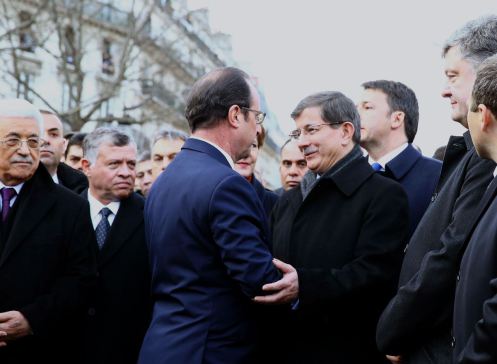
Turkish Foreign Minister Ahmet Davutoglu (center R) talks to French President Francois Hollande (center L) during the Unity March ‘Marche Republicaine’ in Paris, France on January 11, 2014.
(Photo by Hakan Goktepe/Anadolu Agency/Getty Images)
The Obsessive Putin-Bashing
By Gilbert Doctorow | Consortium News | December 26, 2015
The U.S. establishment writers on Russia are one and all “presstitutes” and when you put their writings together, back to back, in 40 pages or so as Johnson’s Russia List has so kindly done in its Christmas Eve issue, the result is an astounding propaganda barrage.
For those of you in the general public who are, likely as not, unfamiliar with this Internet resource, Johnson’s Russia List is an Internet digest published roughly six days a week year round and focused on Russia, now with a separate section on Ukraine.
The JRL is a project domiciled at the Elliott School of International Affairs, George Washington University and operated by Richard Johnson who founded it something like 20 years ago. Its banner tells us that it receives partial funding from George Soros’s Open Society Foundation, partly from the Carnegie Corporation, New York, neither of which may be considered neutral in matters concerning Russia, quite the contrary.
But further funding comes from the voluntary contributions of subscribers, of whom there are perhaps 600, mostly American academics and university centers having an interest in Russian affairs. Appearing in JRL is an ambition of a great many wannabe experts and authorities in the field, mostly but not exclusively political scientists and journalists.
As an institution seeking to be fair-handed in purveying news and opinion about Russia, the JRL has been in the cross-hairs of activists on both sides of the highly divisive pro- and anti-Putin camps. About a year ago one of the most outspoken Russia-bashers, liberal economist Anders Aslund, publicly broke with JRL for what he saw as going easy on Putin in its selection of material. Alternative media commentators like Michael Averko have hit out at JRL for the opposite alleged abuse. In Johnson’s defense, one might argue he chooses selon le marché, i.e., from what is being published.
Undeniably, U.S. and U.K. scholars and pundits are lopsided in their bias against Putin and Russia. Nevertheless, even within the scope of this allowance for what there is to choose from and the presumed desire to run his shop straight down the middle, the Dec. 24 issue of the Johnson’s Russia List was a doozy. The count was 14 articles or transcripts of video events slamming Russia and Putin to zero articles holding any other view.
And among the publishers or hosts of the 14 entries being republished in JRL are not just heavy guns in the media wars but also would-be temples of learning: Radio Free Europe/Radio Liberty, the European Council on Foreign Relations, Foreign Policy magazine, the Center for European Policy Analysis, the American Council on Foreign Relations, The Moscow Times, the Kennan Institute, The National Review, Forbes.com and Home Box Office.
Putin’s personality figures large in nearly all of these essays and discussions as the sole explanation for all the turns in Russian foreign and domestic policy. This is entirely in keeping with the ad hominem argumentation that has become the norm in political discussions generally in the U.S.
Joseph Stalin, with his no man, no issue philosophy of governance must be chuckling, wherever he is, over how this view has caught on in what passes today for polite society.
The phenomenon is something I felt acutely this past spring in its McCarthy-ite form when I appeared as one of three participants in the Euronews hosted talk show The Network. The subject of the day was the assassination of Kremlin critic and opposition politician Boris Nemtsov, who was shot down within proximity of the Kremlin walls a few days earlier.
We were discussing media coverage of that event and who was to blame for politically motivated crimes in Russia, when a fellow panelist, Elmar Brok, the chairman of the European Parliament’s committee on foreign relations, who was irritated by my insistence that Russian media gave a great many different takes on the news and was anything but monolithic, said in an aside to me that was picked up by the microphones and later went on air: “How much is the Kremlin paying you?”
Not being a hardened politician like Brok, stunned by the way a senior official of the E.U. could stoop to such low-life viciousness, and naively believing that Europe’s most watched news station would not broadcast crude libel, I said nothing in response and the talk moved on.
Having just come back a week ago from Moscow, where my stay was picked up by a Kremlin-funded institution, I now can give a fairly precise answer to MEP Brok’s impertinent and malicious question: for three years of occasional guest appearances as interviewee and panelist on the Cross Talk program of Russia Today, I have been paid three nights in a five-star hotel in downtown Moscow, lavish buffet breakfasts, a tour of the Kremlin and a seat at the banquet dinner celebration of Russia Today’s 10 years on air where Vladimir Putin was the keynote speaker.
For this token of respect by my hosts at RT, I am duly grateful. Yet, I know full well that it is not to be compared with the lavish hospitality bestowed on attendees at the annual Kremlin-organized gatherings of the Valdai Discussion Club to which many senior U.S. academics, Angela Stent, of Georgetown University, to name one, Robert Legvold of Columbia and Tufts, to name another, have been invited regularly notwithstanding the fact that most are hostile, at best agnostic to the “Putin regime” in their public writings and appearances.
Now that I have “come clean” about Kremlin blandishments that have come my way, I turn to my political opponents who have a monopoly on Thursday’s JRL and ask how much they are benefiting in terms of grants, professional promotions and access to the high and mighty in Washington for publicly supporting the propaganda lines of State Department handouts. I wouldn’t dream of accusing them of being on the CIA payroll…
Put another way and avoiding rhetorical questions, I assert plainly that the Establishment writers on Russia are one and all “presstitutes” and when you put their writings together, back to back, in 40 pages or so as JRL has so kindly done in the Christmas Eve issue, the result is an astounding propaganda barrage.
From these collected rants by some very well known “authorities,” I have chosen the one piece which presents itself as sort of scholarly. In this it stands apart from the slapstick humor of Richard Haass and Kimberley Marten in the transcript of an HBO airing and from the rehash of analyses of the fatal weaknesses in the Putin regime that constitute the bulk of the writings of other essayists.
Unlike the others, Kirk Bennett’s article would appear to break new ground. In “Russia and the West. The Myth of Russia’s Containment: Has the West always had it in for Russia? Hardly,” we are treated to an historical analysis intended to debunk what the author identifies as a key Kremlin propaganda line. It tries to refute Vladimir Putin’s assertions in several speeches that the West has always been an opponent of Russia, whether out of envy or fear.
This victimization narrative of the Kremlin, in the view of the author, and of the great majority of U.S. international relations experts, is used to whip up patriotic fervor in the broad Russian population and underpin a regime that is undergoing great strain from economic hardships and stagnation, as well as from the international isolation that followed its annexation of Crimea.
The author starts out in paragraph two citing the Russian poet Fyodor Tyutchev to show us he is no carpetbagging political scientist, that Russian studies are in his blood. Indeed, as we see through his text to the end, he has read his Russian and European history.
That is his strong point, compared to many of the other loudmouths in the articles republished by Johnson’s Russia List. It is also his weak point: he has read Russian history but he has not researched or written it. This is not an accusation, but a mere statement of the facts.
Bennett is introduced to us as a “former U.S. Foreign Service officer who spent most of his career working on post-Soviet issues.” For an historical overview like the article in question that goes back almost 300 years, he is clearly something of a lightweight.
Bennett’s article appeared originally in The American Interest, the publication founded and run by the key popularizer of neoconservative philosophy, Francis Fukuyama. Bennett otherwise has recently published in the online platform of The American Center for a European Ukraine, which should explain where he is coming from politically and to whom he is reaching out.
In effect, Bennett is just one more American thinker who presumes that he understands Russian history and Russian national interest vastly better than the Russians themselves do. In this regard, my best advice to him and to his followers is to sit down with a couple of books written by Dominic Lieven, a scion of one of the great families in the Russian Baltics who is presently a visiting professor at Yale University and who spent more than 25 years as professor of Russian history at the London School of Economics.
The two books in question are Russia Against Napoleon (2012) and The End of Tsarist Russia (2015). Both present the history of momentous periods from a novel perspective, Russia’s own, based on extensive work in the Russian historical archives. Together they sweep into the dust bin most of the simplistic remarks of Bennett about the nature of Russian-European relations since the Eighteenth Century up to 1917.
For example, Lieven explains at length the competing imperialisms, European and Russian of the Nineteenth Century, which were underpinned not only by Russia’s Panslavism, but by Pan-Germanism and by myths to justify Anglo-Saxon world hegemony, which put the powers at odds and which spread widely the denigration of Russia that survives to our day in the West.
From Lieven’s archival research and detailed attention to the advice the Russian rulers received from their senior advisers, both in 1812-1815 and in 1906-1917, both from generals and civilians, it is clear that the Putin narrative on Russian history which Bennett tries to shoot down had far wider acceptance among serious, well-educated Russians and far more subtlety to it than Bennett can imagine.
But Bennett’s problem is not just his average-level consumer’s as opposed to scholar’s knowledge of Russian history. It extends to current events. Bennett distorts present realities. Yes, he is right that Vladimir Putin from time to time plays the “victimization” card, just as from time to time, more generally, the Russian President invokes nationalism.
The simple fact is that in Russia, just as in most Western countries including the United States, nationalism has broad resonance and popular understanding, playing as it does to the heartstrings, whereas Realpolitik, which is the dominant approach to policy behind Putin’s thinking, is seen as cold and unfeeling by the public, too cerebral, so is held back from the addresses to the nation that Bennett cites.
It would be more appropriate to describe Vladimir Putin’s characterization of Russia’s talking partners on the international stage as “Frenemies.” Anyone paying close attention to his major speeches knows that he is never excited, least of all does he engage in “tirades” over the conduct of this or that country in its relations to Russia because the underlying expectation of Putin is that all countries are in permanent competition for their own advantage and only alignment of interests can ensure genuine meeting of minds and common action. Personalities as such count for almost nothing.
Contrary to the facile generalization of Bennett, Vladimir Putin has always followed a foreign policy that had a plan A, of joining NATO or otherwise entering into a shared security platform with the West, and a default position plan B of going it alone, as we now see today after the sharp confrontation over Ukraine.
It will be interesting to see in the days ahead if David Johnson has the courage of his convictions and publishes my indictment of his latest harvest of anti-Russian invective.
Gilbert Doctorow is the European Coordinator of the American Committee for East West Accord. His most recent book, Does Russia Have a Future? was published in August 2015. It is available in paperback and e-book from Amazon.com and affiliated websites.
9/11 Generation Needing ‘Safe Space’ for Sacrosanct Myths
By Jonathan Taylor | CounterPunch | December 25, 2015

Does Generation Safe Space need the military to protect them from hurt feelings? Recent polls indicate increasing support among young people for military rule. Given the constant assault on their fragile identities posed by such atrocities as ethnic Halloween costumes, culturally insensitive Banh Mi sandwiches and the like, who can blame them for craving a new authoritarianism?
Critics on the right have increasingly bemoaned the oversensitivity of the not-so-greatest generation but this critique is starting to show up all over the place. Liberal professors are, somewhat hyperbolically, terrified. Eminent sociologists are deeply concerned. Radical environmentalists allege a new liberal McCarthyism. When some of the saner voices on both the right and left start to agree so broadly, it’s past time to pay attention.
Who is to blame? Helicopter parents? Nanny-state bureaucrats? Rule-obsessed educrats? A rhetorical coup in academic discourse in which disagreement becomes disrespect or insult? Widespread mental illness with a lack of corresponding cognitive therapy? Economic insecurity and the increasing impoverishment of the middle class? Increasing job instability for the young? Accusations fly all over the place as we try to understand why the insufficiently trigger-warned would throw out free speech because of the existence of hate speech, or move to reject democracy itself in favor of authoritarian rule. Few though examine the broader political atmosphere of fear and intolerance since 9-11 that our young people have grown up in, and the role of mass surveillance and the militarization and securitization of political discourse. Could broader notions of vulnerability be leading to an increased sense of personal vulnerability? Or perhaps, a little bit of all of the above?
Whatever the cause, there is no doubt a backlash is brewing, and trending in an unfortunate direction. While the Ivy Leaguers purge a few token administrators (while simultaneously creating new administrative positions that students demand), hate crimes outside of universities are on the rise. While in the classroom each utterance is more and more carefully subjected to scrutiny for microaggressions, populist pundits and politicians are increasingly open about their racism and xenophobia. What do the students expect? With some campus activism devolving into 50% group therapy and 50% primal screaming at hapless administrators, does anyone think this is actually helping create safe spaces for the sort of nuanced, open-minded public debate necessary for real learning and growth? Why create a movement that allows yourself to be viewed as a mass of coddled, over-sensitive elitists, unless of course the problem is that this is what you are?
Watching authoritarianism on the right grow simultaneously with authoritarianism from the campus liberal-left produces anxiety, but anxiety itself fuels these attacks on free speech. Is it time for another Free Speech movement ala Berkeley 1964-6? Or would that potentially hurt somebody’s feelings?
Jonathan Taylor is a Professor in the Geography Department at California State University, Fullerton.
Israel has ‘deprived 23,000 orphans of monthly sponsorship’

MEMO | December 22, 2015
The Deputy Head of the Islamic Movement in Israel, Shaikh Kamal Al-Khatib, said on Monday that Israel’s banning of the group has deprived 23,000 orphans from their monthly sponsorship payments, Anadolu has reported.
“The Islamic Relief charity run by the movement,” explained Al-Khatib, “used to pay a minimum of $40 monthly sponsorship for each orphan spread around the West Bank, Jerusalem and Gaza Strip.”
The Israeli government banned the Islamic Movement on 16 November. Any person or group which associates with it officially is now subject to criminal penalties, including arrest. The authorities confiscated property belonging to the organisation and its bank accounts were frozen. Seventeen affiliated organisations, including charities, were closed down.
The sponsorships, explained Al-Khatib, were donated by Palestinians. He suggested that a solution for the problem is for wealthy Muslims to take over the orphan sponsorships and pointed out that efforts are being made in this regard, although, understandably, he gave no details.
The Palestinian Islamic Relief charity was established by the movement in 1988 and its main activity was sponsoring orphans; it has no connection to the UK-based Islamic Relief or Islamic Relief Worldwide. The charity has been closed by the Israeli authorities several times. “Israel seeks to crack down on all projects which lie behind the persistence of the Palestinians,” added Al-Khatib. He stressed that the charity’s accounts have always been subject to Israeli monitoring.
Sayyed Nasrallah Speech 21/12/2015
Regarding the assassination of the martyr Samir el-Kuntar
– After a few days, there will be the anniversary of the birth of Jesus Christ – and on this anniversary, we extend our greetings to all the Christians and Muslims. A few days later, is the anniversary of the birth of Prophet Mohammed, and we extend our greetings to all the Muslims on this occasion and we ask God for the blessings of both these two prophets to extend mercy and security and happiness to all the region and to open the hearts and minds of all to love and mercy that these two great leaders brought to the world.
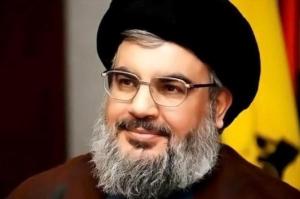 – Yesterday, we lost one of our brothers who shared in the birth of Hezbollah from its first hours and carried heavy responsibility for 33 years – el Sheikh Mohammed Khatoun. I shall speak more about him at the date of his funeral tomorrow. I extend condolences to his family and loved ones.
– Before I speak about the main event – I want to speak about what happened in Nigeria a few days ago – a massacre in Zariah. Hundreds were killed. Hundreds were injured. Hundreds were detained. We include our voice among the voices of all who condemned this massacre, and we condemn the silence of all those who chose to be silent – a horrific silence. There is talk of up to 1,000 killed. And we call on the Nigerian government and its political parties – to act with strength to hold those responsible and to have a national and humanitarian response. I worry that there are American or Israeli hands or Takfiri hands that are behind this horrific massacre – designed to create more bloodshed in Nigeria.
– Back to our main point of discussion
– The assassination of the General of the Political Prisoners in the Israeli Jails – the brother, the martyr, Samir el Quntar
– (1) The facts. We have no doubt that the Israeli enemy is the one behind the assassination. It was not a covert operation – but an open attack. The assassination was by Israeli jets – against a residential home, that specifically targeted Samir el Quntar and other fighters and civilians. Did the Israeli jets enter Syrian air space or the did the Israeli jets fly over occupied Golan Heights – that is a detail, one that does not change anything, unless the discussion is about Syria and Russia and today that is not our focus. What is clear is that it was an Israeli attack against a residential home in Geramana in the outskirts of Damascus. I extend condolences to all those martyred. Anyone who kills a man like Samir el Quntar does a service to Israel.
– (2) We know and Samir knew and the Israelis themselves did not hide – that Israel would not leave Samir el Quntar alive, from the first day of his release. The threat was alive throughout all the years, months, days. Israel was very open that it would not forgive him for his past nor on his strength and resilience in jail nor on his dedication to the resistance. Israel does not forgive – it is our governments that forgive the murderers of Deir Yassin to Qana. This talk by Israel was before the plan for building resistance in the occupied Golan Heights. We in Hezbollah hold the enemy Israel responsible for the assassination of Samir el Quntar
– (3) In this night I do not want to talk about the characteristics of this great martyr. I shall simply say tonight that Samir el Quntar was a lover of Palestine. Palestine was all his love and filled his heart and mind. Palestine’s destiny and the destiny of Palestine’s people and the future of the resistance was always his first and main focus. In our first visit upon liberation, he and I spoke – and we always leave options open – I told him that he has numerous options – politics, media, and military. He said then what he told others publicly: I left Palestine to return to Palestine. He told me that from this very moment I am ready to participate in any military operation, whether on the border with occupied Palestine or within occupied Palestine. I await my martyrdom, he said. It would be an honor to me to be a fighter, he said. That is Samir, that is his truth that we must say today. Does the enemy Israel imagine that by killing Samir and those like him that they can kill such love and passion and commitment and the vast sacrifice of the people of this nation? Many great leaders have been killed and tens of thousands of people have been martyred – in Palestine and Lebanon and Syria and Egypt and Jordan. And what was the result? Has this nation and these people and these generations given up on Palestine? NO. A generation grew up to inherit resistance and to give it to the next generation. The blood of Samir el Kuntar and those who passed before him – is that the resistance against Israel for liberation is a call that will not be broken, regardless of who will be killed and detained and tortured; this is a call that will not be broken. Look now at the people of occupied Palestine – this is a generation that is as old as Samir el Kuntar was when he went to occupied Palestine (i.e. 17). The youth of Palestine fight death with death. Tens of them have been martyred as they fight with knives – because that is their only option. They have entered terror in the hearts of the enemy. When we see a youth in her prime – such as (martyr) Ashraqat Tamami – and when I speak of her, I speak of all the youth of Palestine, I discovered that this youth (female) had a great deal of awareness and clarity and dedication and deep understanding to the cause that she wants to sacrifice for and to the understanding of the enemy and the friend, and for the calmness of her decision. Ashraqat is today a model for many of Palestine’s youth – who love with a passion the land and freedom. They carry the same passion that Samir el Quntar carried and it remained in his heart until a traitorous Israeli rocket killed him.
– (4) Our position. When Israel attacks, anywhere it chooses and how it chooses and in any time it does, it is the right of the resistance – anywhere, and any way, and in any place, and at any time. Today, I repeat: from now, any member of Hezbollah that is killed, we shall hold the responsibility to the Israelis and we shall consider it is our right to respond at any time, at any location, and in the manner we choose. We said this on the 30th of January 2015. Today, we say, to the enemy and to the friend, Samir el Quntar is one of us, and he is a leader in our resistance, and Israelis killed him, and it is our right to respond to his assassination in the time, place, and in the manner that we choose. That is our right. And I add – we, in Hezbollah, we shall fulfill this right.
– (5) In the same vein, the killing against Hezbollah and this resistance, comes the US actions that seek to target Hezbollah on a number of levels. Since the early 90s, we as a party have been on the terrorism list – as a political party and as individuals. And for decades, the Americans have tried to force this description on other countries; they were not successful. Such a description is not accepted by the UN, and the EU, only lately, considers the military wing on the terrorism list, and China and Russia do not consider us as such. What the Americans decided to do now – even though they support terrorism worldwide — is that they consider us a criminal organization and not terrorism, claiming that we are drug dealers and that we are money launderers and that the US Congress now seeks to investigate the accusation that we are human traffickers. These accusations are false and have no basis in truth. It is our duty to deny them. We are not due to show evidence of our innocence. It is their responsibility to show evidence – if they have any, although they have long made accusations without evidence. Clearly, these accusations are political – and it’s first objective is to show Hezbollah in a bad light. They are the ones who spent millions of dollars, as per their own Ambassador, to create propaganda against Hezbollah for the Arab youth. We have a strong example here: the international organization of nuclear energy presented a report about the Iranian nuclear energy – and they said that the Iranian nuclear energy is peaceful and at the very least, since 2009 until today, there is no evidence of anything military in the Iranian nuclear energy. They presented the evidence, and one of the panel of the international organization is an American and there was a consensus on the report! A full consensus. Let us remember that it was the Americans that accused Iran for years. Also the Europeans. And let’s not forget Netanyahu in many occasions, including his speech at the UN. Netanyahu should be a joke internationally and even for Israel – let’s remember his chart at UN when he said that Iran would have a nuclear bomb in a few months. And now we have this report – with consensus – that there is no evidence of military usage of Iran’s nuclear energy. Let’s remember that they were planning a war against Iran, and they enforced sanctions against more than 80 million people, and they threatened, unfortunately with some of their Arab collaborators. That is just one example of a political accusation. The accusations against us are small in comparison. With the battle against us, they won’t accuse us of getting nuclear weapons. This is what they have to say against – either terrorist or criminal. That is the end of their line. The line of their lie is short. The truth will eventually be exposed. We know, in front of God, in front of our people, in front of many people, this is not who we are. If they think their accusations are a propaganda war, it will fail. From a financial perspective, they have now forced upon international banks to freeze Hezbollah funds – well, this was closed a long time ago. We do not have funds in international banks. Now, they are also putting pressure on Lebanese banks and the Lebanese central bank – to put pressure on any organization that is claimed to be tied to Hezbollah. We also state today, and state it again, we have no funds in Lebanese banks, not in the past nor in the present, nor do we have funds that we put in any banks. Nor do we transfer our funds via Lebanese banks – so there is no need for either the Lebanese central bank or any Lebanese banks to feel fear of being chased by the Americans. Furthermore, as I have stated before and shall say again, we are not a business nor an investment. We do not have companies nor are we partners with any Lebanese merchants. Whatever funds we have, we give to our resistance and to the families of the injured and the martyrs. We do not have an extra penny that we invest or put in any fund.
– Based on this, we have to speak seriously about this – it is the responsibility of the Lebanese Central Bank and the Lebanese banks to protect the Lebanese consumers and merchants! It is enough that one sign come from the Americans for there to be an accusation against an individual, and these banks immediately follow. Does this country not have sovereignty? Not have its own courts? Its own state? There are Lebanese merchants and investors that are hurt. We are not hurt. But now if Americans want to target a particular political current or a particular community, all they do is give the names to the Lebanese banks! These are Lebanese who should be protected by the Lebanese State. I do not ask the Lebanese State to protect any member of Hezbollah – but at the very least, it is the responsibility of the State to protect the men and women of this country. No one is asking the State to declare war on the US, only to ask for evidence for these accusations and to take the evidence to the Lebanese courts. This has already begun — this subservience to the US!
– Furthermore, with regards to the media, whether it is part of our network (Manar and Nour) or accused of supporting us or even empathizing with us – they are being threatened! The US is accusing you and judging you in absentia and charging you and killing you and you are not allowed to speak and if you speak, your voice cannot reach anywhere in the world. That is the freedom and democracy of the United States. Your media is not allowed – and maybe it will reach the stage that any media that shows the truth will be accused of being pro-terrorism, while knowing of course that anyone with a Dish can see hundreds of channels that call for takfiri [intolerance] and for killing and raping and committing terrorism and destruction and occupation and violence; those channels are accepted. But you and your type of the resistance are targeted, and the real reason is Israel, and not our position in Yemen or otherwise, but the real reason is that you are a resistance! The intention is Resistance itself – the discourse, the culture, the knowledge base of Resistance!
– Media is part of the struggle. We will not surrender. We will look for all options and opportunities so that the voice of Resistance and the voice of all who reject the project of Israel and the US in the region – those voices will be heard. This is an ongoing struggle.
– What is more important about all these actions against us, is how we look upon all these actions. You can see the negative, but there is also the positive. The fact that Congress sits and meets and has consensus and continues to think about new ways to fight us – means that we are in the right place. They have given us more faith and strength. It shows that we are in the right struggle, the right battle, the right discourse. Who ever finds himself – knowingly or not – a partner with the US and Zionism, let him re-examine his nationalism and religion and ethics! These actions by the US are also a recognition of us, that we are not a small group with small consequences. It is a recognition that Hezbollah plays a large role in Lebanon and in the region in fighting the Israeli project and the hegemonic project. As part of the Resistance – and we don’t claim to fight alone, just as we didn’t fight alone in 1982 and since – there were many US projects of hegemony, we are part of this battle and not alone. That is why the US Congress needs to take these declarations with clear time lines — they take us seriously. We also say that we understand these actions, see how loving we are. We understand these actions. When we are enemies to each other, and this is a compliment to us – to be enemies to the US and to Israel and enemies to all who want to steal the riches of our people and to all who want to destroy our civilization, we understand that they would want to do all these things, and we also will not surrender in this battle. I say to the US and to Israel and to their allies in the region: all these actions against us, from sanctions and murders, you will not be able to erase us. All the actions against us and are planned against us – will only increase our commitment.
– May God have mercy on our great martyr Samir el Kuntar…
Translation by Rania Masri [not word for word]
Stop unacceptable harassment of human rights defenders in Occupied Palestinian Territory – UN experts
UN Human Rights Council | December 18, 2015
GENEVA – United Nations independent experts today expressed grave concerns at continued reports that human rights defenders are being subjected to physical attacks, harassment, arrest and detention, and death threats, particularly in Hebron in the Occupied Palestinian Territory (OPT), in an apparent bid by Israeli authorities and settler elements to stop their peaceful and important work.
“Amidst a charged and violent atmosphere over past months in the OPT, Palestinian and international defenders are providing a ‘protective presence’ for Palestinians at risk of violence, and documenting human rights violations,” said the UN Special Rapporteur the situation of human rights defenders, Michel Forst.
“The continued harassment of human rights defenders in the OPT, who are exercising their rights to freedoms of expression and association, is simply unacceptable. It should cease immediately,” Mr. Forst stressed.
Earlier this month, a group of UN human rights experts urged the Israeli Government to ensure a protective environment where human rights defenders in the Occupied Palestinian Territory can work without unlawful restriction and without fear of retaliatory acts.
“We recently addressed concerns to the Israeli Government regarding retaliatory acts by Israeli authorities against members of one organisation based in Hebron, Youth Against Settlements, after its Centre was subjected to raids and settlers allegedly called for it to be closed,” noted the UN Special Rapporteur the situation of human rights in the OPT, Makarim Wibisono.
“The Centre has now effectively been shut down as a result of the Israeli military declaring the surrounding area a military zone,” Mr. Wibisono said. “We urge Israeli authorities to lift this military order.”
The experts’ statement has been endorsed by the Special Rapporteur on torture and other cruel, inhuman or degrading treatment or punishment, Mr. Juan E. Méndez, and by the Special Rapporteur on the rights to freedom of peaceful assembly and of association, Mr. Maina Kiai.
Featured Video
Dan Dicks with James Corbett on Solutions Watch
or go to
Aletho News Archives – Video-Images
From the Archives
$1.5bn up in smoke: US THAAD missile stockpile dries up defending Israel against Iran
By Ivan Kesic | Press TV | July 2, 2025
According to American media, defense news outlets, and independent analysts, the 12-day Israeli military aggression against Iran significantly depleted the US stockpile of THAAD (Terminal High Altitude Area Defense) interceptor missiles.
Citing official sources, American magazine Newsweek reported on Friday that the US transferred a substantial portion of its advanced missile defense capabilities to support the Israeli regime, an effort with questionable results and a critical impact on US strategic reserves.
THAAD, developed by Lockheed Martin arms manufacturing company, is a key component of Israel’s multi-layered air defense architecture. It is designed to intercept medium-range ballistic missiles, including those launched from Iran and Yemen.
The US-made system is capable of targeting short-, medium-, and intermediate-range ballistic missiles during their terminal phase, whether inside or outside Earth’s atmosphere.
THAAD uses a “hit-to-kill” method, relying on kinetic energy rather than explosive warheads to destroy incoming threats, intercepting at altitudes of up to 150 km and ranges between 150-200 km.
Operated exclusively by American personnel, the US military maintains eight THAAD batteries with an estimated 350–400 interceptors in total. The eighth battery was activated during the June 20 Israeli aggression against Iran and is capable of intercepting hypersonic missiles. … continue
Blog Roll
 Aletho News
- Zionist Bought Senate Blocks Information About American Citizens Killed By Israel
- While Gaza dominates the UN, these are the people keeping it alive
- New Report: “Scholasticide and Genocide in Gaza: Assessment, Testimonies and Legal Analysis”
- ‘THAAD Delusion’: Iran war exposes US missile shield limits – The Atlantic
- Moscow issues warning to NATO over Russian exclave
- Yes, the Iran war has destroyed Trump’s presidency
- The fallacy of US delusions about Iran’s economic collapse
- Hezbollah denies Syria cell link, warns of Israeli plan to sow discord
- The legacy of US sanctions, war, and occupation in Iraq
- Iraqi resistance group rejects disarmament, vows to maintain support for Lebanon
- If Americans Knew
- Mamdani releases plan to combat antisemitism and hate crimes in New York City
- Iran’s Revolutionary Guards Publish Letter to the American People
- DMFI launches $1 million ad campaign supporting Virginia’s Elaine Luria
- US Senate blocks resolution seeking report on Americans killed by Israel
- Israeli Attacks Kill Ten Palestinians in Gaza
- Massacre at Minab: The School That Became a Grave
- Israeli media: The IDF Shows It Doesn’t Turn a Blind Eye; It Actively Emboldens Settler Havoc
- As settlers ravage West Bank, Israeli forces kill 10 in Gaza – Daily Update
- New Report: “Scholasticide and Genocide in Gaza: Assessment, Testimonies and Legal Analysis”
- Ex-Biden officials are desperate for a Gaza scapegoat
- No Tricks Zone
- Green Energy Debacle: German Expert Professor Fritz Vahrenholt Warns Of Severe Economic And Social Consequences
- Two More Paleo Reconstructions Affirm Meters-Higher Sea Levels Across Ireland, Brazil 7000-6000 Years Ago
- New Study: Earth And Venus Surface Warmth Largely Explained By Convection And Lapse Rate, Not CO2 Or Radiation
- 2025 Nature Paper Claiming Worsening Global Drought Gets RETRACTED …Heavily Flawed
- New Study: ‘Global Drought Shows No Detectable Recent Acceleration Under Climate Warming’
- Economic Masterminds: German Socialists Suggest Taxing Productivity Gains Stemming From Using AI
- The South China Sea Has Not Been Cooperating With The Climate Change Narrative
- Energy Crisis: Germany Enters Heating Season With Historically Low Gas Reserve Fill Levels
- New Study: The Antarctic Ice Sheet Gained Mass From 2020-2024 Due To Staggering Snow And Ice Accumulation
- Study: Ocean Heating Rates From Thousands Of Years Ago ‘Dwarf’ Modern Ocean Heating Rates

