Home of the brave? Law professor says freedom to read is too dangerous!
PrivacySOS | December 16, 2015
Live from slate.com : ISIS is so scary that we should think really hard about gutting the First Amendment.
In true Slate pitch form, the website has posted an anti-First Amendment screed by law professor Eric Posner, in which he argues that we should “[c]onsider a law that makes it a crime to access websites that glorify, express support for, or provide encouragement for ISIS or support recruitment by ISIS; to distribute links to those websites or videos, images, or text taken from those websites; or to encourage people to access such websites by supplying them with links or instructions.”
Such a law could exempt “journalists, academics, private security agencies, and the like,” Posner reassures us. The punishments for unlawfully accessing public information the government does not like would range from “a warning letter from the government” to fines and “prison sentences,” to escalate in severity with each commission of an ISIS-related thought crime.
Woefully, Posner writes, the pesky First Amendment interferes with such a plan. Courts have repeatedly held that the First protects our right to access “[s]peech that blasts the American constitutional system and praises America’s enemies.”
Ughhhhhhhhh.
So what to do about this obnoxious history of judicial rigidity when it comes to free speech and the freedom to read? Posner suggests we turn back the clock, to a time before the 1960s, when “people could be punished for engaging in dangerous speech.” Ah, the good old days.
Reminiscing, he cites the prosecution of World War One draft resisters, Nazi sympathizers during World War Two, and even Confederate sympathizers during the Civil War. But he forgot to mention that before the Supreme Court’s revolution on expanding speech rights, anti-speech laws were mostly used to crack down on domestic dissent that had nothing to do with support for any foreign “enemy.”
The ACLU was founded in response to such attacks, primarily on union and worker speech:
In 1912, feminist Margaret Sanger was arrested for giving a lecture on birth control. Trade union meetings were banned and courts routinely granted injunctions prohibiting strikes and other labor protests. Violators were sentenced to prison. Peaceful protesters opposing US entry into World War I were jailed for expressing their opinions. In the early 1920s, many states outlawed the display of red or black flags, symbols of communism and anarchism. In 1923, author Upton Sinclair was arrested for trying to read the text of the First Amendment at a union rally. Many people were arrested merely for membership in groups regarded as “radical” by the government. It was in response to the excesses of this period that the ACLU was founded in 1920.
Imagine that. Laws passed to deal with a wartime enemy were used to crush domestic dissent and corral American popular opinion.
How could we make sure a law banning certain kinds of reading wouldn’t bleed out into criminalizing dissent, as similar anti-speech and censorship laws always have in US history? Posner suggests it’s easy: “A simple balancing test would permit laws to target dangerous speech that does not advance public debate.”
Right. Because determining what “does not advance public debate” is simple as pie, and not at all subject to wild fluctuation depending on who makes the determination. That’s totally not the kind of insane “balancing test” the First Amendment was designed to foreclose. … Full article
Privacy advocates blast ‘surveillance bill in disguise’ after CISA tucked into spending deal
RT | December 17, 2015
Under the cover of a late-night session of Congress, House Speaker Paul Ryan announced a new version of the “omnibus” federal government funding bill that includes a version of the Cybersecurity Information Sharing Act, outraging privacy advocates.
The new version combines three bills, two passed by the House, and one – the Cybersecurity Information Sharing Act (CISA) – that had already passed the Senate by a vote of 74 to 21.
A long-standing critic of government overreach in surveillance, Senator Ron Wyden (D-Oregon), who voted against the Senate bill, issued a statement on Wednesday stating that it was a “bad bill when it passed” and “worse bill today.”
“Americans deserve policies that protect both their security and their liberty. This bill fails on both counts,” said Wyden, adding that “cybersecurity experts say CISA will do little to prevent major hacks and privacy advocates know that this bill lacks real, meaningful privacy protections.”
Under the latest version, the bill creates the ability for the president to set up “portals” for agencies like the FBI and the Office of the Director of National Intelligence so that companies can hand information about potential threats directly to law enforcement and intelligence agencies instead of the Department of Homeland Security. It allows for more data sharing between the public and private sector while shielding companies from liability.
It also changes the criteria for when information shared for cybersecurity reasons can be used in law enforcement investigations. Previously, the backchannel use of data could only occur in cases of “imminent threats,” while the new bill requires just a “specific threat.”
The Electronic Frontier Foundation has strongly opposed cybersecurity bills over the past five years. In a statement, it said they did nothing to address the real problems the government faces, “like computer data breaches that are caused by unencrypted files, poor computer architecture, un-updated servers, and employees (or contractors) clicking malware links.”
Other advocacy groups, such as Fight for the Future, have previously referred to the bill as “a surveillance bill in disguise.”
The group’s campaign director, Evan Greer, called it “a disingenuous attempt to quietly expand the U.S. government’s surveillance programs.”
“Congress has failed the Internet once again,” she added, “now it’s up to President Obama to prove that his administration actually cares about the Internet. If he does he has no choice but to veto this blatant attack on Internet security, corporate accountability, and free speech.”
The bills were opposed not just by privacy advocates, but also civil society organizations, computer security experts, and many Silicon Valley companies. In April, a coalition of 55 civil groups and security experts signed an open letter opposing an earlier version of CISA.
The Department of Homeland Security itself warned in July that the bill could overwhelm the agency with data of “dubious value,” while at the same time “sweep[ing] away privacy protections.”
The EFF also said the CISA bill has no place in the federal budget package, a point shared by the Open Technology Institute (OTI).
“They’re kind of pulling a Patriot Act,” Robyn Greene, police counsel of OTI, told Wired. “They’ve got this bill that’s kicked around for years and had been too controversial to pass, so they’ve seen an opportunity to push it through without debate. And they’re taking that opportunity.”
US House Passes Bill to Block Hezbollah from International Financial System
Bill also targets Al-Manar TV
Press TV December 16, 2015
The US House of Representatives has approved sanctions against banks that do business with the Lebanese resistance movement Hezbollah.
Lawmakers unanimously voted for the imposition of the sanctions in a bill that will be sent to the White House for US President Barack Obama’s signature.
Following a unanimous one in the US Senate on November 17, the House voted for the measure 422 to 0 .
The bill also targets the resistance movement’s television channel Al-Manar through attempts to cut the broadcast of satellite operators that air the channel’s programs.
Meanwhile, a senior administration official told AFP that the president will sign the legislation, adding the White House and the US Congress have been working together for long “to intensify the pressure” on the organization, which the official described as a “terrorist.”
This is while Hezbollah fighters have been engaged in battles against the Daesh Takfiri terrorists in Syria.
Apart from pressuring banks that knowingly do business with the group, the bill also requires the White House to present reports to the Congress in regard to Hezbollah’s operations.
The organization has been accused by the US of committing “terrorism” while its fighters keep advancing against the ISIL militants, originally trained and funded by the CIA in Jordan in 2012 to destabilize the government of Syrian President Basher al-Assad.
Turkish MP faces treason charges after telling RT ISIS used Turkey for transiting sarin
RT | December 16, 2015
An investigation on treason charges has been opened against a Turkish MP who alleged in an exclusive interview with RT that Islamic State jihadists used Turkish territory as a transit route to deliver deadly sarin gas to Syria.
Ankara’s Chief Prosecutor’s Office opened the case against Istanbul MP Eren Erdem of Republican People’s Party (CHP) after his interview about sarin was aired on RT on Monday.
“Chemical weapon materials were brought to Turkey and put together in ISIS camps in Syria, which was known as the Iraqi Al-Qaeda at that time.”
Erdem noted that the chemicals used for the production of weapons did not originate from Turkey. “All basic materials are purchased from Europe. Western institutions should question themselves about these relations. Western sources know very well who carried out the sarin gas attack in Syria,” Erdem told RT.
As Turkish media reported Wednesday, the prosecutor’s office is planning to send a summary of proceedings to the Ministry of Justice on Thursday. Following that, the summary could be forwarded to the Turkish parliament, which could vote to strip Erdem of his parliamentary immunity.
Once Turkish mass-media reported the criminal investigation had been opened against Erdem, the hashtags #ErenErdemYalnızDeğildir – #ErenErdemYouAreNotAlone began to circulate in Turkish social networks.
On Tuesday, MP Erdem issued a written statement in his defense, saying he had become the target of a smear campaign because of his statements made in parliament.
As for his accusations about Turkish businessmen being involved in supplying Islamic State (IS, formerly ISIS/ISIL) with the poisonous gas sarin and other reactants needed for chemical warfare, Erdem maintained this statement was made based on the results of a Turkish court investigation in 2013.
Erdem revealed that five Turkish citizens had been arrested by the Adana Chief Prosecutor’s Office as a result of an investigation coded 2013/139. A Syrian national was prosecuted in Turkey for procuring chemical agents for Islamist groups in Syria. At the same time, Erdem noted all the persons arrested within the framework of the 2013/139 investigation were released a week later.
In his statement Eren Erdem claimed he had received death threats over social media following the publication of his interview to RT.
Eren Erdem said that the Turkish paramilitary organization Ottoman Hearths has published his home address on Twitter in an effort to enable at an attack on his house.
“I am being targeted with death threats because I am patriotically opposed to something that tramples on my country’s prestige,” MP Erdem said.
In an interview to Turkey’s Kanal 24 on Tuesday, Cem Küçük, a columnist at the pro-government Star daily, said that Erdem’s claims about sarin gas should be regarded as treason. Erdem should be stripped of his parliamentary immunity to “pay for his deeds,” Today’s Zaman cited Küçük as saying.
The Turkish public is “very much polarized” and those supporting the government and followers of the ruling Justice and Development Party (AKP) make up “about half of the country,” Hisyar Ozsoy, Turkish MP for leftist HDP party, told RT.
“They really do not care about what is happening in terms of freedom of expression,” Ozsoy said, adding that “anybody who is critical of the government is facing incredible pressure: indictments, court cases, even imprisonments.”
The Turkish government – and the president in particular – use polarization of the Turkish community as a mode of carrying out politics that very much worries the other half of the citizenry.
The most widely-reported chemical attack in Syria took place in the early hours of August 21, 2013, in Ghouta, on the outer fringes of Damascus. Rockets containing sarin gas were reportedly fired, killing more than 1,400 people, including no fewer than 426 children. It was on the very day a UN team of inspectors arrived in the city to investigate the alleged March 19 chemical attack in Khan al-Assal, northern Syria.
Attack on Freedom: Activists to Take Spain to ECHR Over ‘Gag Law’
Sputnik – 14.12.2015
A group of lawyers and journalists are taking Spain to the European Court of Human Rights (ECHR) over the country’s controversial “gag law,” which activists say is an attack on freedom of speech and information rights.
The coalition of activists, known as ‘Defender a quien defiende’ (DqD) launched a triple lawsuit with the ECHR, calling for the immediate repeal of the law.
The highly controversial Citizen Security Law, dubbed the ‘gag law’ by critics, was passed by the governing Popular Party (PP) earlier this year and came into action in July, despite widespread protests and demonstrations.
DqD has labeled the law “authoritarian,” with critics arguing that it restricts the right to legitimate protest and allows authorities to harshly crack down on any form of anti-government demonstration.
Under the law, the vague description of “disrespecting a police officer” can attract a fine of US$662 (€600), while those guilty of staging an “unauthorized protest” can be hit with financial penalties as high as US$662,000 (€600,000).
Many photojournalists have taken aim at the law, which also makes it illegal to photograph a police officer, with many arguing that it severely affects their ability to do their job.
DqD argues that such provisions “violate” basic freedoms, expressions and the right to protest, in turn restricting journalists and photojournalists from subsequently sharing certain pieces of information with the public.
“They are particularly affected since the law jeopardizes their main function: to report on events of public relevance,” the lawsuit states.
Photojournalists are “obliged by police to stop filming or photographing police actions for fear of being penalized,” the lawsuit says, amid fears that it may allow instances of police misconduct to go undocumented and unreported.
The law has already attracted controversy since it came into effect in July after a man was fined US$662 (€600) for calling police “slackers” on social media.
In another controversial instance a woman was fined US$883 (€800) for taking a photo of a police car parked illegally in a disabled zone, however the fine was later scrapped.
The timing of the ECHR lawsuit, which is to be officially launched with a press conference on Tuesday, comes at a critical time for the ruling controversial Popular Party (PP) ahead of the country’s December 20 election.
All three major opposition parties have vowed to scrap the highly unpopular law if they win power, with some analysts saying the controversy around the matter could influence swing voters who remain undecided on who to vote for in the national election.
We’re all terrorists now
By Sam Gerrans | RT | December 12, 2015
The concept of terrorism has been extended from carrying out physical acts in which innocent people are killed, to wrong opinions, sweaty palms and disagreement with government. If you want to find a terrorist, soon all you will have to do is look in the mirror.
Words are political. They change shape to suite agendas.
In the 1970s, ‘terrorist’ meant a paid-up member of the IRA, the Irgun, ETA and the like. These were bad people perpetrating evil and indiscriminate deeds upon a defenceless public. They used bombs, worked in cells, and killed people without warning before fading into the shadows.
Although the UK had legislation specifically geared to deal with what is called terrorism on the books, people deemed terrorists, when they were caught, were prosecuted under existing laws – i.e. for actual crimes they had committed.
Bobby Sands, for example, who fought and died for the IRA cause, was incarcerated for nothing more sinister than owning illegal firearms.
Since 9/11 and the implementation of the so-called Patriot Act (and equivalent legislation in other countries), the definition of terrorism is itself becoming a source of terror.
As part of this process, we are being taught to live with the new nomenclature of ‘terror suspect’; that is you haven’t done anything wrong, but you might.
The Independent reports that: “315 terror suspects were arrested between September 2014 and September 2015, according to new figures from the Home Office.”
The same article continues: “[…] it seems what we are seeing is an increase in terrorism-related fear rather than terrorism itself – totally understandable of course in itself, but not when it leads to the kind of heavy-handed policing that can actually radicalize more people.”
Read another way: the British Government is harassing increasing numbers of innocent people and generating both fear and the chance of more ‘radicalization’ thereby.
The no-fly list
The Huffington Post reports that one can be identified and placed on a ‘no-fly list’ for any number of reasons.
It tells us: “government officials have secretly characterized an unknown number of individuals as threats or potential threats to national security. In 2013 alone, 468,749 watch-list nominations were submitted to the National Counterterrorism Center. It rejected only one percent of the recommendations.”
This is nearly half-a-million US citizens in one year; this means they are finding almost 1,400 new American enemies a day.
The article goes on to list seven criteria government agencies use to put a person on a list. These criteria are vague and admit to the broadest and most subjective interpretation; in short they break down to: we don’t like the cut of your jib.
Yes, some life-failed bureaucrat you will never meet can decide – extra judicially – that you may not travel on an aeroplane.
The no-gun list
If there is to be no due process, why stop there?
Obama certainly agrees. The Guardian tells us: “Closing the No-Fly List loophole is a no-brainer,” Barack Obama tweeted on Tuesday, arguing that Congress should pass laws to prevent anyone on the government’s terrorist watch list from buying a gun.”
I see: the president calmly tweets that revoking the Constitution he swore to uphold is a “no brainer,” and we can all go about our business.
Terrorist events
Since Obama is so concerned with guns, he might want to do something about all the smoking guns that feature so prominently in the so-called terrorist attacks on US soil.
RT’s Marina Portnaya did a piece on the release of a report, which identifies the FBI as the mastermind of 95 percent of all domestic terrorism in the US.
Judge Andrew Napolitano, senior judicial analyst for Fox News, concurs. He tells us that of the 20 terrorist attacks the FBI claims to have foiled on US soil, three were thwarted by members of the public and the remaining 17 were masterminded and carried out by the FBI itself.
Who is a terrorist?
The so-called War on Terror is worldwide.
For its part, the French government is educating its population to spot a terrorist.
The Independent gives us these bonmots: “The French government has launched a campaign which appears to warn parents that their children may have been recruited by terrorists if they stop eating baguettes.”
Other tell-tale signs of nascent radicalism include deciding not to watch television.
US airport security staff operate on a much more scientific basis. The Telegraph reports on a leaked document revealing: “Excessive yawning, strong body odour and arrogance are among the suspicious signs that US airport staff are trained to associate with potential terrorists.”
Excessive yawning? Remember that if find yourself on a stopover in a US airport on a long-haul flight.
Other warning signs include: “protruding or throbbing neck arteries, whistling, excessive laughter, and verbally expressing contempt for the screening process.”
The full list of 17 ‘fear factors’ staff are trained to spot include: arriving late for a flight, sweaty palms, and a pale face indicating the recent shaving of a beard.
More government
Naturally, the only rational response to this exploding bomb of suspicion is more government. Was there ever any doubt?
The UK government’s website tells you exactly what to do in the event of a terrorist attack: Step 1: run. Step 2: Hide. Step 3: Tell the authorities. Step 4: Wait for armed police to arrive (and keep your hands where they can see them). Step 5: Be ready for those authorities to point guns at you and treat you ‘firmly’ (i.e. brutalize you).
No mention of repealing UK gun laws so that British adults can defend themselves, of course.
Imagine what would happen to any real terrorist threat in Britain if one in three Britons carried a handgun.
No. What we need is more government; more intrusion by the very agencies that not only benefit from the events they pretend to protect us from (and use said events to take away our rights), but which – according to all objective analysis – are also central in bringing those events to pass.
So terrorism has morphed from real actions which killed people – the destruction of the King David Hotel by the Irgun or the Iranian Embassy siege – to intuitions about people, sweaty palms and the non-eating of French bread.
The simple definition for such a subjective and arbitrary application of power is this: tyranny.
Why stop there?
Since there is no place for principle or due process in this new tyranny, insanity must follow.
Under such a regime things just are because someone – in this case an opinion-leader – says they are.
For his part, supposed science guy Bill Nye makes a strong connection between what he calls ‘climate change’ and what he terms ‘terrorism’.
The Huffington Post reports: “Nye’s reasoning hinges on a water shortage in Syria, which researchers have blamed on climate change. As Nye explained, the shortage has stunted farming and pushed young people to look for work in more densely populated areas.
“Young people have gone to big cities looking for work. There’s not enough work for everybody, so the disaffected youths, as we say – the young people who don’t believe in the system, believe the system has failed, don’t believe in the economy – are more easily engaged and more easily recruited by terrorist organizations, and then they end up part way around the world in Paris shooting people,” Nye asserts.
The Independent breathlessly informs us that one of the country’s most senior advisers on health has warned: “Obesity is such a threat to women it should be treated as a “national risk” – like terrorism, natural disasters and cyber attacks.”
And Obama claims that the ‘climate change’ conference in Paris (the only outcome of which will doubtless be more government control for them and more taxes for us), offered the chance to show the ‘terrorists’ that the world was standing together against them.
Sound insane? That’s because it is; until we realise that none of this has anything to do with genuine science or actual terrorists – or if there is any correspondence it is purely coincidental.
We are living through a revolution, a play for total power; or in modern parlance: full-spectrum dominance.
And we have been here before. Last time round it was called Communism. It accused its critics of being counter-revolutionaries or reactionaries. And it murdered those people – and many besides – in their tens of millions.
This time round it is called Freedom.
And if you disagree with it, or don’t smile fast enough or wide enough – or suffer from body odour or weigh too much – today it can stop you from getting on a plane. Tomorrow it may deny you the right to defend yourself.
After that, it may decide on some new arbitrary method of protecting everyone else from you.
Still think your government is there to protect you?
I hope so.
Or you may be a terrorist.
Sam Gerrans is an English writer, translator, support counselor and activist. He also has professional backgrounds in media, strategic communications and technology. He is driven by commitment to ultimate meaning, and focused on authentic approaches to revelation and realpolitik. He is the founder of Quranite.com – where the Qur’an is explored on the basis of reason rather than tradition – and offers both individual language training and personal support and counseling online at SkypeTalking.com.
Is my iPhone listening to me?
PrivacySOS – 12/11/2015
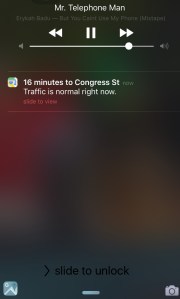 The other night I was getting ready to leave my partner’s house to go home. I know how to get from their place to mine without any assistance, so I didn’t look up directions on my phone. I didn’t text anyone to say I was about to go home. Some nights I stay over at my partner’s place and some nights I don’t. In other words, it seemed like there was no way my phone could have known that I was about to get into my car and drive back to my place. And yet, as I walked out the door, I looked at my iPhone and found a push notification alerting me that traffic to my home address was looking normal.
I did not like that. How the hell did my phone know I was about to drive home? Did it listen to me?
Even though I work full time as a privacy advocate, there are lots of things on my mind, so I sort of forgot about this incident—that is, until this morning, when it happened again.
I normally take public transit or bike to work. This morning I was running a little late and my roommate suggested we drive to get coffee together. I said aloud, “If the bus is on time, I can take it. Otherwise could you drop me off downtown?” She agreed.
As I walked toward the door to leave I looked down at my phone. Again, there was a push notification from Apple Maps (an app I have never once used). It read: “16 minutes to Congress St.; Traffic is normal right now.” This time I took a screenshot, posted at right.
How on earth could my iPhone have known that I wasn’t going to take the bus this morning, and that I was going to drive downtown instead?
Apple’s website includes a page on location tracking and privacy. On that page, it says:
Frequent Locations: To learn places that are significant to you, your iOS device will keep track of places you have recently been, as well as how often and when you visited them. This data is kept solely on your device and won’t be sent to Apple without your consent. It will be used to provide you with personalized services, such as predictive traffic routing.
But in both cases, these alerts appeared only after I had verbally announced my intention to drive somewhere, either home or to work. In neither case was this a routine event; I often sleep over at my partner’s place, and I usually take public transit or ride my bike to work. Therefore the only possibility that makes any sense to me is that my phone is listening, heard me tell my partner I was going home and ask if my roommate could drop me off at work, and then provided me with up to date traffic reports to those two destinations.
In neither case was it desirable. I don’t appreciate it; if I want to know what traffic looks like, I’ll check it out myself. I don’t want my phone listening to me. I’ve never once used Siri in part because of that preference.
Of course, it could be a (two-time) fluke, so I’m curious to hear from others with iPhones. If you’ve had a similar experience, let me know. Also please get in touch if you know how my phone might be deducing these intensely personal things about me, if it’s not actually listening.
Location information is extremely sensitive. That’s made chillingly clear when your phone, practically an extra limb for many of us, starts giving you information about not just where you are or in response to commands you’ve given it, but about where you’re about to go, without having been asked.
Update: CNET explains how you can turn off predictive traffic alerts. That’s great, but the predictive traffic alert feature doesn’t fully explain these two incidents. After all, there’s nothing routine about the trips I was making. And I gave the phone no indication that I was about to drive somewhere, besides talking about driving in the vicinity of the phone.
Slaying of Chicago Teen Casts Doubt on Body Cams Holding Police Accountable
Sputnik – 12.12.2015
Although President Barack Obama has pledged $263 million in federal grants to fund body cameras for police departments throughout the country, some still feel the effort will do little to hold officers accountable if they engage in suspicious or unlawful activity.
Lisa Schreibersdorf, executive director of Brooklyn Defender Services, points to the recent case of Laquan McDonald, a 17-year-old who was fatally shot last year by a police officer after he responded to a call about a man with a knife.
An officer’s dashboard camera captured footage of that incident. However, Chicago’s mayor and police commissioner struggled to keep those recordings away from the eyes of the public arguing the footage could interfere with the court case.
Following the efforts of journalists and lawyers, however, a judge finally forced city officials to release the video in November leading to the prosecution of Officer Jason Van Dyke for murder more than a year after the shooting.
“Many have suggested that the prosecution would never have come if the City had succeeded in keeping the video under wraps — an allegation that Cook County State’s Attorney Anita Alverez denies, but nevertheless casts doubt on the ability or willingness of the police, prosecutors or even the City administration to hold individual officers accountable unless forced to do so,” Schreibersdorf explained to the Huffington Post.
In many instances, city officials can fight to keep police body-camera footage from being seen by the public and defense attorneys.
In New York City, for example, body-camera recordings legally are categorized as an officer’s file making it difficult for defense attorneys to access it. Police Commissioner Bill Bratton has said that body camera footage would not be released to the public under any circumstances.
“That leaves us in the potential situation of receiving body camera footage only when it serves the NYPD and the prosecution, not when it exonerates our clients or incriminates an officer,” said Schreibersdorf. “Such a scheme favors neither justice nor accountability and is one that we, as public defenders, often the last line of defense against executive power, could never support.”
US university says sorry for Palestinian flag ultimatum
RT | December 11, 2015
George Washington University president Steven Knapp has issued an apology to a student who was told to take down his Palestinian flag.
A university campus police officer entered Ramie Abounaja’s room on October 26 and told him to take down the Palestinian flag that he had hanging from his window.
The officer said he had received multiple complaints and that the flag was in violation of the housing code.
Visitors to the university confirmed many other national flags hanging from dorm rooms without being taken down.
A week later, Ramie Abounaja received a warning letter from the university, threatening future disciplinary action, despite the fact he had removed the flag.
“As a member of the larger residential community we hope that you will be respectful of your peers and be aware of your behavior. The act of an individual has a profound impact on the community,” it read.
Unsure of what he was in violation of, Ramie wrote a letter back. In it, he explained his reason for hanging the Palestinian flag: “I was motivated to do this after I had seen dozens of different banners and flags hung outside other residential campus living spaces throughout my three years here at GW. I felt like I was being singled-out, because of my heritage and the viewpoint of my speech, for something I’ve seen dozens of students, fraternities and other student groups do in my three years at GW.”
Civil rights groups called the order a violation of free speech and said the actions pointed to anti-Palestinian sentiment.
Students for Justice in Palestine at GW said: “Flags of other countries hang out of dorm windows with no disciplinary consequence. Selective reinforcement of these rules is discrimination.”
Universities in the US stand accused of cracking down on pro-Palestinian speech, with a high profile example in the state of Illinois where professor Steven Salaita was dismissed after tweeting about Israel’s assault on Gaza in 2014.
The recent Palestinian Exception to Free Speech report revealed intensifying suppression Israeli criticism on campuses: “Israel’s fiercest defenders in the United States — a network of advocacy organizations, public relations firms, and think tanks — have intensified their efforts to stifle criticism of Israeli government policies. Rather than engage such criticism on its merits, these groups leverage their significant resources and lobbying power to pressure universities, government actors, and other institutions to censor or punish advocacy in support of Palestinian rights.”
Palestine Legal responded to 140 incidents and 33 requests for assistance in anticipation of potential suppression in the first 6 months of 2015. 80% of those were aimed at students and scholars.
The report highlights a number of tactics used to quash pro-Palestinian feeling in universities, including academic sanctions.
Northeastern University in Boston suspended a student group the spring of 2014 after members distributed flyers describing Israel’s policy of demolishing Palestinian homes.
Around the same time, San Francisco State University investigated Professor Rabab Abdulhadi for going on a research trip to Palestine after an Israel advocacy group accused her of meeting with terrorists.
Palestinian Legal wrote to George Washington University, demanding they withdraw its warning letter and threat to sanction the student.
University President Steven Knapp said he has apologized to Abounaja and that the student had been subjected to a flawed process: “I have instructed the relevant offices to end the practice of sending warning letters to students solely because of a reported violation of a university policy. I have also instructed them to ensure consistent enforcement of all university policies.”
Turkey fines Twitter $51,000 for ‘terrorist propaganda’ – reports
RT | December 11, 2015
Twitter has been fined 150,000 Turkish lira (US$51,000) for not removing content allegedly containing “terrorist propaganda, encouraging public acts of violence and hatred,” sources in Turkey’s communication technology watchdog told media outlets.
The Turkish Information and Communications Technologies Authority (BTK) has forwarded its decision to the Twitter Company’s headquarters in San Francisco, California, as well as informed the office of the company’s lawyer in Turkey, according to information Anadolu News Agency received from the body.
The decision was based on a 2007 law on “fighting against crimes committed through internet broadcasting,” Anadolu reported.
A BTK official who spoke to Reuters confirmed the report on the fine, but revealed no details concerning the content except claiming that it includes terrorist propaganda and calls for acts of violence.
Before a decision on the fine was made, Turkish courts had allegedly ordered Twitter to remove content they deemed illegal, but the company reportedly did not comply. This is the first time Turkey fined the popular social media website.
Turkish authorities previously have temporarily blocked Twitter, YouTube and Facebook for failing to remove content deemed to be illegal or banned.
On April 6, Turkey blocked access to Twitter, YouTube and Facebook over the publication of photos of a prosecutor taken hostage and killed by militants in Istanbul on March 31. The ban was lifted shortly after the sites removed the images.
In July, Twitter was once again blocked by Turkish authorities for a short period of time over publishing the images of a suicide bomb attack in Turkey’s Southeast on July 20. The ban was again lifted after the site removed the content in question.
Turkey has been accused of growing censorship and a media crackdown.
In December 2014, the Organization for Security and Cooperation in Europe (OSCE) accused Turkey of adopting restrictive internet laws and implementing broad measures aimed at censoring online content.
At the same time, the Civic Solidarity Platform, a network of more than 60 human rights NGOs from throughout the OSCE region released its own report claiming that Turkey had repeatedly blocked thousands of news and social media sites, including YouTube and Twitter, in recent years.
On November 27, thousands of people joined the rallies in Istanbul and Ankara showing their support for two prominent journalists of the Cumhuriyet newspaper accused of treason over publishing photos of weapons allegedly brought to Syria by Turkish intelligence.
Police in Ankara used pepper spray against peaceful protesters staging a demonstration near the Cumhuriyet office in the Turkish capital.
Washington DC Student Forced to Remove Palestinian Flag
Sputnik – 10.12.2015
A student at George Washington University has been forced by police to remove a Palestinian flag they had hanging from their dorm room — despite countless flags hanging from other windows in the dormitories.
Ramie Abounaja, a 20-year-old pre-med student has also been threatened with future disciplinary action despite complying with the police, the Intercept reported.
On October 26, a police officer arrived at Abounaja’s Washington, DC, dorm room to order the removal of flag. The officer cited receiving multiple complaints and explained that he would not be leaving until it was removed, which the student complied with.
The following week, the student received a letter from the school’s Office of Student Rights and Responsibilities, which oversees disciplinary issues. “This letter serves as a warning that this behavior is a violation of the ‘Code of Student Conduct’ and/or the Resident Community Conduct Guidelines,” it began.
“As a member of the larger residential community we hope that you will be respectful of your peers and be aware of your behavior. The act of an individual has a profound impact on the community. … Subsequent reports naming you as a subject may result in disciplinary action taken by the university.”
The student noted that other students have been allowed to continue hanging their national flags from their windows, and that he is being selectively targeted.
“I felt like I was being singled out, because of my heritage and the viewpoint of my speech, for something I’ve seen dozens of students, fraternities and other student groups do in my three years at GW,” Abounaja wrote in a letter to the school.
Nationwide, there appears to be a crackdown taking place on pro-Palestinian speech and particularly against the BDS movement which aims to boycott Israel over their treatment of the Palestinian people.
Palestine Legal, a US civil rights advocacy organization, has reported 140 instances of suppression of Palestine advocacy in the first six months of 2015, 80 percent of which were on college campuses, the Intercept reported.
After Palestine Legal published an open letter to the George Washington University regarding their treatment of Abounaja and demanding an apology, explanation, and for them to retract their future disciplinary notice, the university’s media relations released a statement claiming that it wasn’t discrimination and that no students may have flags hanging from the school’s housing.
“The George Washington University is committed to fostering a welcoming and safe environment for every member of the GW community, and we encourage students to share their rich diversity of backgrounds, experiences and views with their peers. GW has not banned any flags from its campus; however, the university’s Residential Community Conduct Guidelines prohibit the hanging of any object outside of a residence hall window (Section III. 7). These guidelines apply to all on-campus housing residents.”
Following the school’s statement, Students for Justice in Palestine at GW released a statement of their own, calling the university on their hypocrisy.
The student group alleged that the selective enforcement points to an anti-Palestine sentiment and that “flags of other countries hang out of dorm windows with no disciplinary consequence.”
They continued on to state that “selective reinforcement of these rules is discrimination. In this moment of rising Islamophobia in the United States, it is contradictory that a university that advertises inclusivity and diversity would act like this.”
Featured Video
Dan Dicks with James Corbett on Solutions Watch
or go to
Aletho News Archives – Video-Images
From the Archives
$1.5bn up in smoke: US THAAD missile stockpile dries up defending Israel against Iran
By Ivan Kesic | Press TV | July 2, 2025
According to American media, defense news outlets, and independent analysts, the 12-day Israeli military aggression against Iran significantly depleted the US stockpile of THAAD (Terminal High Altitude Area Defense) interceptor missiles.
Citing official sources, American magazine Newsweek reported on Friday that the US transferred a substantial portion of its advanced missile defense capabilities to support the Israeli regime, an effort with questionable results and a critical impact on US strategic reserves.
THAAD, developed by Lockheed Martin arms manufacturing company, is a key component of Israel’s multi-layered air defense architecture. It is designed to intercept medium-range ballistic missiles, including those launched from Iran and Yemen.
The US-made system is capable of targeting short-, medium-, and intermediate-range ballistic missiles during their terminal phase, whether inside or outside Earth’s atmosphere.
THAAD uses a “hit-to-kill” method, relying on kinetic energy rather than explosive warheads to destroy incoming threats, intercepting at altitudes of up to 150 km and ranges between 150-200 km.
Operated exclusively by American personnel, the US military maintains eight THAAD batteries with an estimated 350–400 interceptors in total. The eighth battery was activated during the June 20 Israeli aggression against Iran and is capable of intercepting hypersonic missiles. … continue
Blog Roll
 Aletho News
- Zionist Bought Senate Blocks Information About American Citizens Killed By Israel
- While Gaza dominates the UN, these are the people keeping it alive
- New Report: “Scholasticide and Genocide in Gaza: Assessment, Testimonies and Legal Analysis”
- ‘THAAD Delusion’: Iran war exposes US missile shield limits – The Atlantic
- Moscow issues warning to NATO over Russian exclave
- Yes, the Iran war has destroyed Trump’s presidency
- The fallacy of US delusions about Iran’s economic collapse
- Hezbollah denies Syria cell link, warns of Israeli plan to sow discord
- The legacy of US sanctions, war, and occupation in Iraq
- Iraqi resistance group rejects disarmament, vows to maintain support for Lebanon
- If Americans Knew
- Mamdani releases plan to combat antisemitism and hate crimes in New York City
- Iran’s Revolutionary Guards Publish Letter to the American People
- DMFI launches $1 million ad campaign supporting Virginia’s Elaine Luria
- US Senate blocks resolution seeking report on Americans killed by Israel
- Israeli Attacks Kill Ten Palestinians in Gaza
- Massacre at Minab: The School That Became a Grave
- Israeli media: The IDF Shows It Doesn’t Turn a Blind Eye; It Actively Emboldens Settler Havoc
- As settlers ravage West Bank, Israeli forces kill 10 in Gaza – Daily Update
- New Report: “Scholasticide and Genocide in Gaza: Assessment, Testimonies and Legal Analysis”
- Ex-Biden officials are desperate for a Gaza scapegoat
- No Tricks Zone
- Green Energy Debacle: German Expert Professor Fritz Vahrenholt Warns Of Severe Economic And Social Consequences
- Two More Paleo Reconstructions Affirm Meters-Higher Sea Levels Across Ireland, Brazil 7000-6000 Years Ago
- New Study: Earth And Venus Surface Warmth Largely Explained By Convection And Lapse Rate, Not CO2 Or Radiation
- 2025 Nature Paper Claiming Worsening Global Drought Gets RETRACTED …Heavily Flawed
- New Study: ‘Global Drought Shows No Detectable Recent Acceleration Under Climate Warming’
- Economic Masterminds: German Socialists Suggest Taxing Productivity Gains Stemming From Using AI
- The South China Sea Has Not Been Cooperating With The Climate Change Narrative
- Energy Crisis: Germany Enters Heating Season With Historically Low Gas Reserve Fill Levels
- New Study: The Antarctic Ice Sheet Gained Mass From 2020-2024 Due To Staggering Snow And Ice Accumulation
- Study: Ocean Heating Rates From Thousands Of Years Ago ‘Dwarf’ Modern Ocean Heating Rates

