Israel celebrates 40 years of illegal settlement

MEMO | August 10, 2018
Two thousand Israelis yesterday gathered to celebrate the 40th anniversary of the illegal West Bank settlement of Shiloh, south of Nablus.
The celebration was attended by Israel’s Agriculture Minister, Uri Ariel, who is a member of the Religious-Zionist Jewish Home party. According to Arutz Sheva, the head of Israel’s “Binyamin Regional Council”, the group which oversees 42 of Israel’s illegal settlements and outposts in the occupied West Bank, also attended. Israeli Prime Minister, Benjamin Netanyahu, sent a letter of congratulations to the illegal settlers, claiming historic links between the Bible and the modern-day occupied Palestinian territory.
Uri Ariel has a long history of pro-settlement activity, previously serving as head of Beit El council, an illegal Israeli settlement situated north east of Ramallah. Ariel was also previously secretary general of the Yesha council.
In July it emerged that Uri Ariel had previously approved plans to demolish Khan Al-Ahmar, the Palestinian Bedouin village that has been slated for demolition. The plans, which were made in the late 1970s, proposed a “Jewish corridor” of illegal settlements be built on some 100,000 to 120,000 dunams (25,000 to 30,000 acres) of Palestinian land, including the villages of Hizme, Anata, Al-Azariya and Abu Dis on the outskirts of Jerusalem. Demolishing these villages would make way for expanding two illegal settlements – Ma’ale Adumim and Kfar Adumim – situated on the Jerusalem-Jericho road.
Shiloh was one of the first locations targeted for illegal Israeli settlement as early as 1974 by Gush Emunim, the orthodox right-wing settlement movement that rose to prominence in the wake of the 1973 War. Gush Emunim was later succeeded by the Yesha council that Uri Ariel previously affiliated with. During the Oslo Accords of the early 1990s, Shiloh was identified as an example of an area that should be returned to Palestinian control given the high density of Palestinians living in the area.
Illegal settlement in the West Bank has been pursued as a policy by the State of Israel since it occupied the territory in the 1967 Six Day War, along with the Gaza Strip, Jerusalem, the Golan Heights and the Sinai Peninsula. Israeli human rights organisation B’Tselem states that, as of the end of 2015, there were 127 Israeli government-sanctioned settlements in the West Bank (not including occupied East Jerusalem and Hebron). When combined with 100 non-recognised outposts and 15 Israeli neighbourhoods inside the Jerusalem Municipality, these settlements are inhabited by approximately half a million illegal settlers.
The Israeli Buffer Zone On The Syrian Territory Will Have To Wait
By Khaled AL-KASSIMI | ORIENTAL REVIEW | August 4, 2018
On May 18th 2017, 27 Syrian army vehicles drove within 18 miles of al-Tanf, which breached the U.S.-declared 34-mile radius of the army convoy’s operations resulting in the U.S. forces striking the Syrian Army. It should be noted that al-Tanf (an American military base) operated by U.S. special forces trains a number of rebel groups referred to by the U.S. as Vetted Syrian Opposition (VSO) also known as the Southern front which includes over 50 militant groups such as the Revolutionary Commando Army (RCA). When the U.S struck the Syrian army, the Wall Street Journal’s Yaroslav Trofimov reported that “The U.S. attack at al Tanf is significant not because the U.S. has once again struck Assad’s forces, but because it did so in defense of Syrian rebels”. It is important to remember these past events because on June 24th 2018, the U.S. announced that it will not be backing its proxies on the ground with air force – in contrast to last year. This event highlights that the Syrian Arab Army (SAA) and its allies have made substantial geostrategic gains in the past year.
While the Battle of Daraa is symbolically important – since it is the province where the Syrian (foreign) intervention by proxy first took place in 2011 with the help of Former U.S. ambassador to Syria Robert S. Ford – the Battle for southern Syria should not be analyzed as the “final” battle simply because the U.S. announced “that it will not back up its anti-government proxies in the south”. The SAA and its allies still have a long way to go in liberating areas located in Northern and Eastern Syria which remain under the control of the SDF (Syrian Democratic Forces) and extremist rebel factions – funded and trained by American officers. This is by no means an overstatement considering Major General Igor Konashenkov saying that Russia has intelligence that the Free Syrian Army is going to stage a “chemical attack” in the village of Haql al-Jafara and accuse the Syrian government of conducting it.

According to Syrian government military sources, almost a year ago in July 2017 a group of Israeli military and intelligence personnel travelled to Syria’s West Daraa countryside with the objective of meeting rebel commanders from the Southern Front such as Liwa Jaydour, Jaysh al-Ababil, and the Revolutionary Commando Army (RAC) to discuss future cooperation and collaboration in battles. Another meeting also took place on September 2017 in the Quneitra border town of Rafid between Israeli intelligence personnel and militia commanders concerning the establishment of a 50km buffer zone stretching east of Golan Heights into Syrian (Southern) territory – absorbing Quneitara, As Suwayda and Daraa. The Times of Israel on July 6th 2017 notes “Prime Minister Benjamin Netanyahu called Russian President Vladimir Putin on Thursday as part of ongoing Israeli efforts to convince Russia and the United States to establish a demilitarized buffer zone in southern Syria…Israel is pushing for an agreement that would prevent “Hezbollah or other Iranian-backed militias” from operating in the area, which would extend some 30 miles (48 kilometers) beyond the Israeli-Syrian border [sic] on the Golan Heights”.
On June 26th 2018 Russia declared the ceasefire it brokered on July 2017 between Jordan, Israel, and U.S in Southern Syria (de-confliction/de-escalation zone i.e No Fly Zone) as null since Israel targeted an Iranian weapon depot around Damascus Airport, and mercenaries also targeted a Syrian military command post in Suwayda (southernmost province in Syria). The Russian defense ministry took both of these events as clear action in violation of the agreement. With the ceasefire no longer in place, a Syrian-Russo offensive has begun regaining the southern geographical space of Syria. Recent reports reveal that some rebels are surrendering and that the SAA is making substantive gains in Izraa, Nahitah, Sama Al Hadeidat in Daraa and ongoing advances are underway to take Busra al sham in East Daraa. Questions that remain unanswered concern how long will the IDF “turn a blind eye” to the SAA regaining southern provinces such as Quneitara bordered with Israel and the Golan Heights?; and will the U.S. withdraw from its base in Al Tanf base which Al Muallem and Al Assad have vehemently opposed and categorized as colonialism?.
It should be highlighted that with the U.S. abandoning its proxies in Southern Syria, we can deduce that Israel will have to “pause” its “Greater Israel” ambitions in wanting to absorb Southern Syrian territory, and la pièce de résistance – claim the Golan Heights as Sovereign Israeli territory. During a visit to Israel’s northern border according to the Jerusalem Post (JP) on July 4th 2018, General Eisenkot discussed the readiness of the Northern Command with its commander Maj. Gen. Yoel Strick and the 366th Division’s commander Brig. Gen. Amit Fisher. “The IDF is monitoring the situation in Syria and is prepared for a variety of scenarios to preserve the security on Israel’s border,” read a statement given by the IDF’s Spokesperson’s Unit. On July 1st 2018 the Israeli government reinforced its border with the Golan Heights by positioning armored and artillery forces near the border with Syria in light of a situational assessment by the Northern Command.
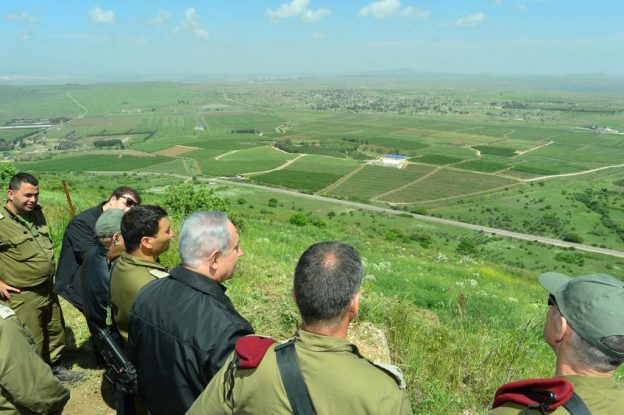
Benjamin Netanyahu is seen during a security tour in the Golan Heights, near Israel’s northern border with Syria
The SAA territorial advancements in the past year highlight that the SAA has the upper hand on the battle field. However, we should also remember that the southern battle is not the final battle, even though it is a vital battle since it includes an offensive that will be combating over 15,000 mercenaries. Contrary to Mr. Robert Fisk’s article in the Independent on June 26th 2018, I think it is too early to state that the battle for southern Syria will go down in history as a moment where “the US has given up on the overthrow of Assad in Syria” because it “abandoned its proxies in southern Syria”. Another battle that should be increasing in intensity in the next few weeks and/or after the southern battle is concluded is the battle to reclaim Northern (East) Syria – a territory under the Syrian Democratic Forces (SDF) and U.S. rebel factions.
The Syrian government including Liwa al-Baqir convened a major meeting of tribal notables from across Syria on June 2 in order to build support for operations against the U.S. in Eastern Syria. Syrian state media claimed the meeting included representatives from seventy clans from Aleppo, Ar-Raqqa, Hasakah, Daraa, and Deir ez-Zor Provinces. According to the Institute for the Study of War unconfirmed reports suggest that the SDF arrested dozens of additional tribal representatives traveling to the meeting from SDF-held Hasaka Province in Northern Syria. Tribal representatives at the meeting denounced the presence of the U.S., France, and Turkey in Syria and called for tribal mobilization to fight them on behalf of Assad. Multiple new pro-regime militia units of unclear size and capability reportedly formed subsequent to the meeting. These units may have joined Liwa al-Baqir with support from Russia and Iran. Not to mention reports released the week of July 15th 2018 highlighting that rebels in Southern Syria are being transported to the Northern part of Syria.
More recent news on July 29th 2018 highlights that the Syrian Democratic Council [the SDF political arm] held a two day meeting with the Syrian government headed by President Bashar Al Assad. Officials belonging to the SDF, which hold large swathes of land in northern Syria discussed the future of the autonomous regions it set up in northern and northeastern Syria. The SDF has made a series of deals with Damascus in recent years, notably in Aleppo when the SAA decimated Syrian Arab rebel groups making a final stand to hold the city. The SDF also came to an agreement with the Syrian government during the Turkish incursion into the then-Kurdish-held Afrin canton in Syria’s north-west corner, allowing Kurdish fighters to cross regime-held territory in a doomed bid to repel Turkish troops and their allies. The SDF, whose military is largely funded by the US as a counter-IS initiative, holds more than 27 percent of the country’s territory, according to the Syrian Observatory for Human Rights. It is still not clear whether rebel troops in northern Syria will be in accord with the SDF and SAA in relinquishing land they have usurped in the past 7 years and have it under the control of Damascus headed by President Bashar Al Assad. Also, according to a statement by SDF spokesperson Leilwa al-Abdullah, SDF forces pushed IS fighters into retreat from an area of 3,100 square-kilometers to a small slither of territory close to the strategic border town of Abu Kamal. A local SDF commander, speaking to Syria Direct said that the “crackdown on the border area” had gone ahead in coordination with Iraqi forces and international coalition airpower.
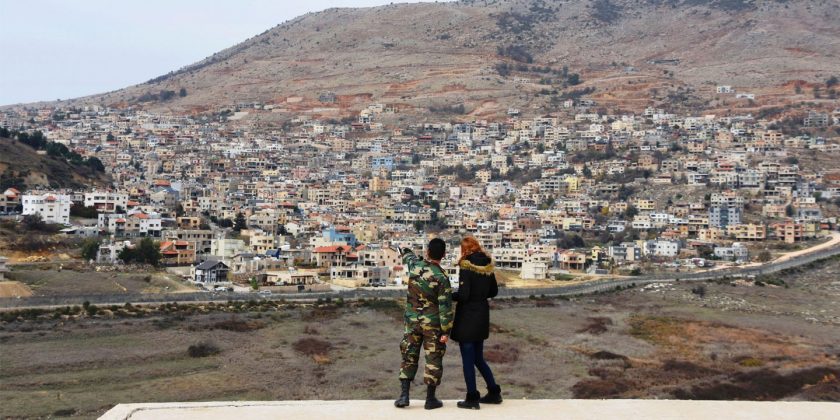
The Golan Heights
Still, recent territorial gains by the SDF may have little bearing on talks with the Syrian government, which could be unwilling to actually cede territorial control or administrative authority to Kurdish-majority forces. Sihanouk Dibo, from the majority-Kurdish leftist Democratic Union Party (PYD), acknowledged that any future talks could be “long and arduous because the Damascus regime is very centralized.” Whether centralized or not, the Syrian Government has historically been committed to the modality of Greater Syria with Damascus being the locus in decision making and autonomous regions conducting provincial policies relating to their provincial preferences. As stated by President Al Assad “Despite the ethnic diversity within each nation, the social fabric of the region by and large is one”. In other words, a region of the historical Bilad Al Sham/Greater Syria space will not be relinquished since the Levant possesses a unified social fabric and most importantly because the Barzani Clan in Iraq is a dangerous example of how U.S. imperialism with its allies can defend decentralization for the sake of geostrategic interest.
Therefore, in regards to the Syrian peace process, peace cannot be implemented when the UNSC resolution 2254 adopted in 2015 – including the P5 – continues to be violated. The delegates meeting at the June 13th U.N-led peace process in Geneva reiterated the importance of the clauses in the resolution which included that a nationwide ceasefire can only occur when member states are serious in halting the funding and training of mercenary entities. The members also reiterated the basis for a Syrian-led and Syrian-owned political transition in order to end the conflict in Syria. The meeting in Geneva did not highlight anything novel that the meetings in Astana or Sochi didn’t already outline. The meeting laid out the so-called four “baskets of reform” for a political settlement of the crisis. They include the drafting of a new constitution, parliamentary elections, the creation of a non-sectarian transitional government and the fight against mercenaries and terrorists. But the talks have made little progress so far as opposition members have failed to find an agreement over the fate of President Bashar al-Assad – a condition that the opposition has long wanted to include in the draft.
It is quite ironic that the Syrian Opposition is adamant in wanting to include a clause that stipulates that the current Syrian president is not allowed to run for president after 2020 and/or practice politics in Syria… it is ironic because while some opposition members discuss the importance of democracy being the foundation for peace in Syria, it is precisely democracy which re-elected President Bashar Al Assad in 2014.
Khaled AL-KASSIMI is a Doctoral candidate in the Department of Political Science at McMaster University in Canada. His research interest relates to the fields and approaches contoured by Critical Security Studies, Development Studies, International Relations, and Decolonial Studies.
Marching for Peace: From Helmand to Hiroshima
By Maya Evans | Dissident Voice | August 5, 2018
I have just arrived in Hiroshima with a group of Japanese “Okinawa to Hiroshima peace walkers” who had spent nearly two months walking Japanese roads protesting U.S. militarism. While we were walking, an Afghan peace march that had set off in May was enduring 700km of Afghan roadsides, poorly shod, from Helmand province to Afghanistan’s capital of Kabul. Our march watched the progress of theirs with interest and awe. The unusual Afghan group had started off as 6 individuals, emerging out of a sit-in protest and hunger strike in the Helmand provincial capital Lashkar Gah, after a suicide attack there created dozens of casualties. As they started walking their numbers soon swelled to 50 plus as the group braved roadside bombs, fighting between warring parties and exhaustion from desert walking during the strict fast month of Ramadan.
The Afghan march, which is believed to be the first of its kind, is asking for a long-term ceasefire between warring parties and the withdrawal of foreign troops. One peace walker, named Abdullah Malik Hamdard, felt that he had nothing to lose by joining the march. He said: “Everybody thinks they will be killed soon, the situation for those alive is miserable. If you don’t die in the war, the poverty caused by the war may kill you, which is why I think the only option left for me is to join the peace convoy.”
The Japanese peace walkers marched to specifically halt the construction of a U.S. airfield and port with an ammunition depot in Henoko, Okinawa, which will be accomplished by landfilling Oura Bay, a habitat for the dugong and unique coral hundreds of years old, but many more lives are endangered. Kamoshita Shonin, a peace walk organizer who lives in Okinawa, says:
People in mainland Japan do not hear about the extensive bombings by the U.S. in the Middle East and Afghanistan, they are told that the bases are a deterrent against North Korea and China, but the bases are not about protecting us, they are about invading other countries. This is why I organised the walk.
Sadly, the two unconnected marches shared one tragic cause as motivation.
Recent U.S. war crimes in Afghanistan include the deliberate targeting of civilian wedding parties and funerals, incarceration without trial and torture in Bagram prison camp, the bombing of an MSF hospital in Kunduz, the dropping of the ‘Mother of all bombs’ in Nangarhar, illegal transportation of Afghans to secret black site prisons, Guantanamo Bay prison camp, and the extensive use of armed drones. Elsewhere the U.S. has completely destabilised the Middle East and Central Asia, according to The Physicians for Social Responsibility, in a report released in 2015, stated that the U.S. interventions in Iraq, Afghanistan and Pakistan alone killed close to 2 million, and that the figure was closer to 4 million when tallying up the deaths of civilians caused by the U.S. in other countries, such as Syria and Yemen.
The Japanese group intend to offer prayers of peace this Monday at Hiroshima ground zero, 73 years to the day after the U.S. dropped an atomic bomb on the city, instantly evaporating 140,000 lives, arguably one of the worst ‘single event’ war crimes committed in human history. Three days later the U.S. hit Nagasaki instantly killing 70,000. Four months after the bombing the total death toll had reached 280,000 as injuries and the impact of radiation doubled the number of fatalities.
Today Okinawa, long a target for discrimination by Japanese authorities, accommodates 33 U.S. military bases, occupying 20% of the land, housing some 30,000 plus U.S. Marines who carry out dangerous training exercises ranging from rope hangs suspended out of Osprey helicopters (often over built-up residential areas), to jungle trainings which run straight through villages, arrogantly using people’s gardens and farms as mock conflict zones. Of the 14,000 U.S. troops currently stationed in Afghanistan, many to most would have trained on Okinawa, and even flown out directly from the Japanese Island to U.S. bases such as Bagram.
Meanwhile in Afghanistan the walkers, who call themselves the ‘People’s Peace Movement’, are following up their heroic ordeal with protests outside various foreign embassies in Kabul. This week they are outside the Iranian Embassy demanding an end to Iranian interference in Afghan matters and their equipping armed militant groups in the country. It is lost on no-one in the region that the U.S., which cites such Iranian interference as its pretext for building up towards a U.S.-Iran war, is an incomparably more serious supplier of deadly arms and destabilizing force to the region. They have staged sit-in protests outside the U.S., Russian, Pakistani and U.K. embassies, as well as the U.N. offices in Kabul.
The head of their impromptu movement, Mohammad Iqbal Khyber, says the group have formed a committee comprised of elders and religious scholars. The assignment of the committee is to travel from Kabul to Taliban-controlled areas to negotiate peace.
The U.S. have yet to describe its long term or exit strategy for Afghanistan. Last December Vice President Mike Pence addressed U.S. troops in Bagram: “I say with confidence, because of all of you and all those that have gone before and our allies and partners, I believe victory is closer than ever before.”
But time spent walking doesn’t bring your destination closer when you don’t have a map. More recently U.K. ambassador for Afghanistan Sir Nicholas Kay, while speaking on how to resolve conflict in Afghanistan said: “I don’t have the answer.” There never was a military answer for Afghanistan. Seventeen years of ‘coming closer to victory’ in eliminating a developing nation’s domestic resistance is what is called “defeat,” but the longer the war goes on, the greater the defeat for Afghanistan’s people.
Historically the U.K. has been closely wedded to the U.S. in their ‘special relationship’, sinking British lives and money into every conflict the U.S. has initiated. This means the U.K. was complicit in dropping 2,911 weapons on Afghanistan in the first 6 months of 2018, and in President Trump’s greater-than-fourfold average increase on the number of bombs dropped daily by his warlike predecessors. Last month Prime Minister Theresa May increased the number of British troops serving in Afghanistan to more than 1,000, the biggest U.K. military commitment to Afghanistan since David Cameron withdrew all combat troops four years ago.
Unbelievably, current headlines read that after 17 years of fighting, the U.S. and Afghan Government are considering collaboration with the extremist Taliban in order to defeat ISKP, the local ‘franchise’ of Daesh.
Meanwhile UNAMA has released its mid-year assessment of the harm done to civilians. It found that more civilians were killed in the first six months of 2018 than in any year since 2009, when UNAMA started systematic monitoring. This was despite the Eid ul-Fitr ceasefire, which all parties to the conflict, apart from ISKP, honoured.
Every day in the first six months of 2018, an average of nine Afghan civilians, including two children, were killed in the conflict. An average of nineteen civilians, including five children, were injured every day.
This October Afghanistan will enter its 18th year of war with the U.S. and supporting NATO countries. Those young people now signing up to fight on all sides were in nappies when 9/11 took place. As the ‘war on terror’ generation comes of age, their status quo is perpetual war, a complete brainwashing that war is inevitable, which was the exact intention of warring decision makers who have become exceedingly rich of the spoils of war.
Optimistically there is also a generation who are saying “no more war, we want our lives back”, perhaps the silver lining of the Trump cloud is that people are finally starting to wake up and see the complete lack of wisdom behind the U.S. and its hostile foreign and domestic policies, while the people follow in the steps of non-violent peace makers such as Abdul Ghafoor Khan, the change is marching from the bottom up.

Okinawa to Hiroshima Peace Walk (Photo by Maya Evans)
Maya Evans coordinates Voices for Creative Nonviolence UK and has visited Afghanistan 9 times since 2011. She is a writer and a Councillor for her town in Hastings, England.
Turkey in panic as Assad seeks to reclaim occupied territory
By M K Bhadrakumar | Indian Punchline | August 1, 2018
The meeting of the senior diplomats from Russia, Iran and Turkey in Sochi on Tuesday was prima facie meant to hasten the Astana process on a Syrian settlement. But in reality, it took place in the backdrop of reports that Syrian forces, which have liberated the southwestern provinces of Quneitra (facing Golan Heights) and Daraa (on the Jordanian border) will now proceed to assault the northwestern province of Idlib on the Turkish border.
Ankara has warned that any such move by Damascus will prompt Turkey to pull out of the Astana process altogether in protest. Turkey’s fear is that unlike in the southern provinces, the terrorist groups that control Idlib may fight it out, which would lead to large-scale violence and an exodus of refugees and militants across the border into Turkey. Idlib is estimated to have a population close to 2.5 million. Importantly, though, Turkey seeks to maintain its presence in Idlib, thanks to its enduring links with many of the extremist groups ensconced there. Turkey is equally adamant that the Kurds should not spread their influence into Idlib close to eastern Mediterranean coast.
Turkish President Recep Erdogan personally took up the matter with Russian President Vladimir Putin twice during the past fortnight, demanding that Moscow should restrain Damascus from launching any operations in Idlib. After the meeting in Sochi today, Russian presidential envoy on Syria Alexander Lavrentyev was quoted as saying, “I’d rather refrain from speaking about the city’s (Idlib’s) storming or a pending operation. There are too many rumors and they are ungrounded. Any large-scale operation in Idlib is out of the question.”
He seemed to hint that Russia and Turkey are trying to find a way to influence the terrorist groups to surrender (which was how Daraa and Quneitra were liberated without fighting.) To quote Lavrentyev, “We still hope that the moderate opposition and our Turkish partners, who took responsibility for stabilising this region, will manage it.” But he added, “The threat coming from this zone is still significant.” (In the past 10 days, Russia had shot down as many as four drones launched by the militants from Idlib targeting the Russian military near the Hmeymim airbase.)
On the other hand, Damascus has insisted that it intended to liberate Idlib. All indications are that preparations have begun for a big military operation. The militant groups in Idlib are estimated to be over 50,000 strong and are drawn from Turkish, Uzbek, Chechen, Turkistani and Arab fighters from the Persian Gulf.
Overshadowing the Idlib issue, there is another development that worries Turkey – the direct talks between the Syrian Kurds (previously aligned with the US) and Damascus for reaching a modus vivendi regarding northern Syria up to the Euphrates in the east. The Kurds hope to reconcile with the Assad government in pursuit of their common interest to force Turkey to vacate the large chunks of Syrian territories occupied by it in military operations in the recent years.
Contradictions are galore. For one thing, Russia encourages the newfound proximity between Syrian Kurds and Assad regime. Russia is also keen to vanquish the jihadi fighters who migrated to Syria from North Caucasus and Central Asia. Again, Moscow is one with Damascus on preserving Syria’s unity and territorial integrity at any cost.
On the other hand, it is of supreme importance for Moscow that Turkey is somehow assuaged so that the Astana process as such doesn’t get derailed. At the same time, Russia also places store on its working relationship with Turkey at the bilateral level that is steadily deepening and assuming a strategic character, especially with the downswing in Turkish-American relations lately. The business ties between Russia and Turkey are also flourishing with Russia winning multi-billion dollar contracts in energy projects.
Realpolitik aside, however, morally or legally Turkey has no business to stop the Assad regime from regaining control of the entire Syrian territory. Turkey has blood on its hands by fostering al-Qaeda groups and Islamic State. Equally, Turkish occupation of Syrian territory is untenable on any ground. In reality, Turkey overreached, hoping that it could exploit the US-Russia tensions to bargain with both superpowers and maximize its returns in a Syrian settlement. But President Trump has instead begun tightening the screws on Erdogan lately. Equally, Ankara didn’t expect the stunning victory of the Syrian-Russian operations in southwestern Syria.
There will be growing pressure on Turkey to pull out from Syrian territory in the coming months. Evidently, an American withdrawal from Syria in a near future is on the cards. The Syrian Kurds’ move to reconcile with Damascus is the sure indicator that their American mentors are exiting the war. In short, the US’ capacity to create new facts on the ground in favor of Turkey is virtually zero. This puts Turkey under immense pressure to negotiate a deal with Russia on the best terms available.
To be sure, Assad’s tenacity to reclaim all lost territories is not to be doubted. Make no mistake, he will liberate Idlib, no matter what it takes, and he will thereafter head east towards Jarablus, Azaz, al-Bab and Afrin — territories that are under Turkish control — as well as areas near the Euphrates front line that have been under the control of the Kurdish groups backed by the US. It seems some skirmishes have already begun in the region adjacent to Idlib between Syrian government forces and terrorist groups. Read a report by FARS news agency, here.
Israel deports Freedom Flotilla activists
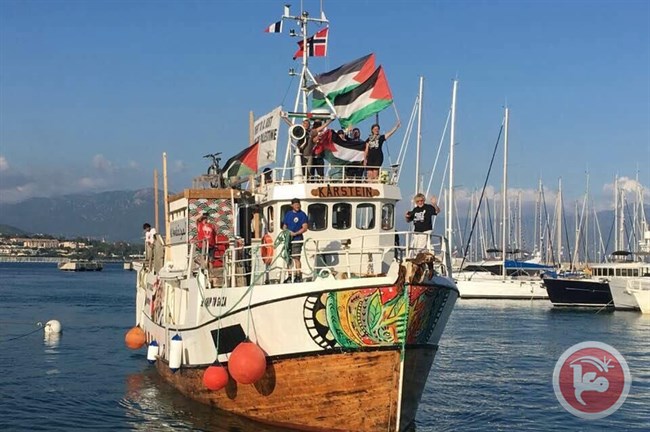
Ma’an – August 1, 2018
BETHLEHEM – Gaza’s National Committee for Breaking the Siege announced on Wednesday that the Israeli authorities began deporting several of the international solidarity activists, who were aboard the Al Awda ship of the Freedom Flotilla.
Gaza’s National Committee confirmed that the activists deportation back to their countries, comes two days after being detained following an attack by Israeli naval forces on the ship in international waters.
Zaher Birawi, head of the committee, said in a statement that a number of international activists have already been deported on Tuesday, including a Malaysian professor, Dr. Mohd Afandi Salleh, and on Wednesday the rest would also be deported.
Birawi stressed that many of the activists rejected to be voluntarily deported, preferring to delay it for more than 72 hours, the legal deadline for accepting voluntary deportation from the country.
Birawi continued that the activists are attempting to delay their deportation, in order to appear before an Israeli court to expose the unjust practices of Israeli naval forces who attacked the humanitarian ship in international waters, and to later prosecute Israel for its actions.
The committee quoted the testimonies of some of the activists as being exposed to “beatings and violence” including the ship’s captain, his assistant, and other solidarity activists.
Swedish human rights activist, Divina Levrini, who was among international detainees, said in a statement that she declares a hunger strike, as a form of protest against the treatment she received by Israeli forces and against the harsh conditions she is going through while being detained in the Israeli Givon prison.
Levrini had conducted an interview with Ma’an in July, while aboard the Freedom Flotilla ship, in which she discussed the Flotilla’s intention on raising awareness about the Israel-Gaza conflict and on breaking the illegal and inhumane Israeli blockade of Gaza.
In addition, two days prior, Israeli authorities already released two Israeli activists on bail. One of the released activists, Zuhr Chamberlain Regev, confirmed that several activists were beaten by Israeli forces before being dragged out of the ship to be detained. She continued by saying that “people on board were tasered and hit by masked Israeli soldiers. We did not get our passports or belongings before we got off the boat. Do not believe reports of peaceful interception.
Taliban claims victory over ISIS fighters in NW Afghanistan
RT | August 1, 2018
More than 150 Islamic State (IS, formerly ISIS) fighters surrendered to Afghan security forces in the northwestern province of Jawzjan after they were defeated and driven out by the Taliban, government officials and Taliban said on Wednesday.
The defeat represents a major setback for the group. IS first appeared in eastern Afghanistan around four years ago and gained a foothold in southern Jawzjan, where it fought for control of smuggling routes into neighboring Turkmenistan, Reuters reports.
“The evil phenomenon of [IS] has completely been eliminated and people have been freed from its tortures in Jawzjan province of Afghanistan,” Taliban spokesman Zabihullah Mujahid said.
The Taliban launched an offensive several weeks ago in Jawzjan against the group, which they oppose as much as they do the Western-backed government in Kabul.
20 Freedom Flotilla sailors still held in Israeli jail; Italian artists deported from Palestine
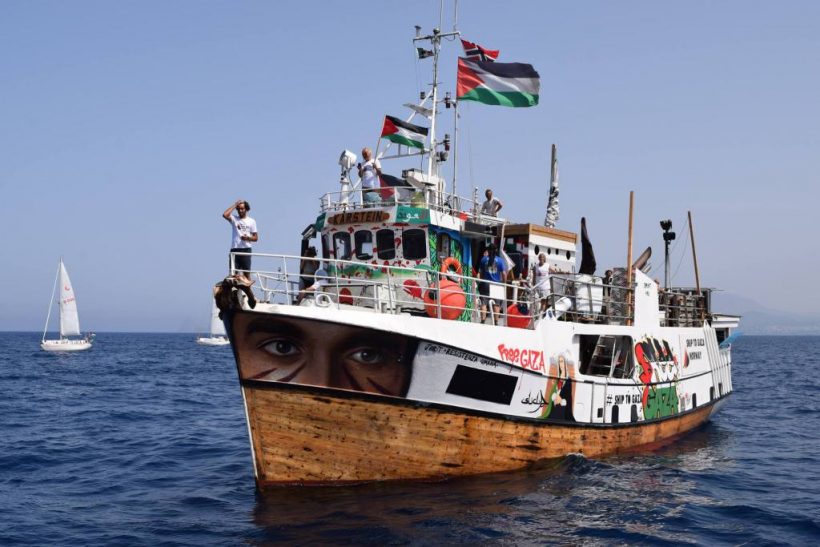
Samidoun Palestinian Prisoner Solidarity Network – July 30, 2018
Twenty international solidarity activists on board the Freedom Flotilla to Gaza are being held in Israeli prisons, report the Freedom Flotilla Coalition. The first boat in the flotilla, “Al-Awda,” was hijacked by Israeli occupation forces in international waters on Sunday, 29 July. The next boat in the flotilla, the “Freedom,” is still on the approach to Gaza. The Flotilla aims to break the Israeli naval siege on Gaza, Palestine.
Two activists with Israeli citizenship on the boats, Zohar Chamberlain Regev and Yonatan Shapira, were released on bail and charged with attempting to enter Gaza and conspiracy to commit a crime. The 20 international solidarity activists remain detained in Givon prison and were scheduled to begin meeting with their lawyer on Monday.
The Freedom Flotilla Coalition noted that:
“Although the Israeli Occupation Forces (IOF) claim that the capture of our vessel happened ‘without exceptional incident’, eye-witness Zohar Chamberlain Regev reports that at the time of boarding: ‘People on board were tasered and hit by masked IOF soldiers. We did not get our passports or belongings before we got off the boat. Do not believe reports of peaceful interception.’ We urgently need to know the details of who was injured and how seriously, and what treatment they are receiving, if any. A military attack on a civilian vessel is a violent act and a violation of international law. Taking 22 people from international waters to a country which is not their destination constitutes an act of kidnapping, which is also unlawful under the international Convention of the Law of Sea.”

Mural on Apartheid Wall by artist Jorit Agoch.
In addition, two Italian artists, including well-known muralist Jorit Agoch, were ordered deported from Palestine on Monday, 30 July after they were seized by Israeli occupation forces for painting a large mural of Ahed Tamimi, 17, on the Apartheid Wall. The 13-foot-high painting was part of the celebration of Ahed’s release from over seven months in Israeli prison on Sunday, 29 July, along with her mother, Nariman.
The portrait was the focus of global media attention before the artists and the Palestinian driver who accompanied them were seized by occupation forces as they completed work on the portrait. The Palestinian man was reportedly released, as were the two artists, after their tourist visas were cancelled and they were ordered to leave the country within 72 hours. They were also banned from entering occupied Palestine for 10 years, much like other activists who have been denied entry to Palestine at Ben-Gurion airport or the Karameh/Allenby crossing.
Russia: Israel’s ‘nation state law’ fuels tension in the region
MEMO | July 25, 2018
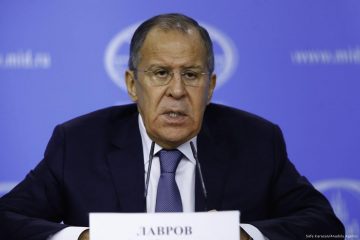 The Russian foreign ministry said a recent law passed by Israel which declares the country a state for all Jews “complicates the peace process” and “increases regional tension”.
Russian foreign ministry official, Artyom Kozhin, said unilateral steps do not serve peace, raise tension and greatly hamper efforts to launch the peace process.
“A just and guaranteed settlement of the Palestinian-Israeli conflict must be based on the principles of international law, relevant Security Council resolutions and the UN General Assembly, which provide to settle all final issues through negotiations,” he added.
Last Thursday, the Israeli Knesset passed the “nation state bill” into law which limits self-determination right to Jews only.
Read:
Israel is challenging the world – I am an Apartheid state, what are you going to do about it?
The Myth of US ‘Inaction’ in Syria
By William Van Wagenen – The Libertarian Institute – July 8, 2018
Introduction
When the Russian military intervened in the Syrian war in October 2015, many in the Western press complained bitterly, demanding that US planners intervene directly in Syria on behalf of the anti-government rebels in response. Reuters alleged that “The Middle East is angry and bewildered by US inaction in Syria,” arguing that “The question on everyone’s mind is: will the United States and its European and regional Sunni allies intervene to stop President Vladimir Putin from reversing the gains made by mainstream Syrian rebels after more than four years of war? Few are holding their breath.” The Washington Post similarly argued that Russian president Vladimir Putin was “exploiting America’s inaction,” while the Guardian lamented the “western inability to care enough about the plight of Syrians.” As Russian and Syrian forces battled rebels one year later in Aleppo, more dramatic accusations of US inaction emerged, with Foreign Policy describing US policy in Syria under Obama as “inaction in the face of genocide.”
 The idea that the United States has not intervened in Syria and is guilty of “inaction,” is a myth however. The United States and its Western and Gulf Allies have intervened in the Syrian conflict from early on. US planners have been fighting what the New York Times described as a “$1 Billion Secret C.I.A. War in Syria” while providing weapons to rebels through a program considered “one of the costliest covert action programs in the history of the C.I.A.” Starting in the fall of 2012, the US and its Gulf partners, under the direction of then CIA director David Petraeus, were openly sending “a cataract of weaponry” into Syria. It is likely that such shipments began much earlier without public acknowledgment, via the “rat line” from Libya, as reported by journalist Seymour Hersh. US Special Envoy to Syria Michael Ratner, in a meeting with members of the Syrian opposition, explained that “The armed groups in Syria get a lot of support, not just from the United States but from other partners,” while Secretary of State John Kerry added in the same meeting, “I think we’ve been putting an extraordinary amount of arms in,” and “Qatar, Turkey, Saudi Arabia, a huge amount of weapons [are] coming in. A huge amount of money.”
Also a myth is the idea that any US intervention in Syria would seek to protect civilians. While allegations that Syrian and Russian forces were committing genocide in Aleppo proved baseless, US planners have themselves supported rebels intent on committing genocide and sectarian mass murder. This was clearly evident in the Syrian city of Latakia, which by the time of the Russian intervention in October 2015 was on the verge of falling to a coalition of Syrian rebel groups including al-Qaeda (known in Syria as the Nusra Front) and the US-armed and funded Free Syrian Army (FSA).
Robert Worth of the New York Times writes that “In Latakia, some people told me that their city might have been destroyed if not for the Russians. The city has long been one of Syria’s safe zones, well defended by the army and its militias; there are tent cities full of people who have fled other parts of the country, including thousands from Aleppo. But in the summer of 2015, the rebels were closing in on the Latakia city limits, and mortars were falling downtown. If the rebels had captured the area — where Alawites are the majority — a result would almost certainly have been sectarian mass murder. Many people in the region would have blamed the United States, which armed some of the rebels operating in the area. . . Andrew Exum, who worked in the Pentagon at the time, told me that the military drew up contingency plans for a rapid collapse of the regime. The planning sessions were talked about as ‘catastrophic success [emphasis mine].’”
Alawite civilians in Latakia faced the prospect of being massacred if rebels had been able to capture the city, due to the virulently anti-Alawite views of Nusra Front members. Nusra religious clerics draw on the writings of the fringe 14th century Islamic scholar Ibn Taymiyya to argue that Alawites are “infidels” deserving of death. Syria analyst Sam Heller described Nusra clerics as promoting “toxic — even genocidal — sectarianism.” Rebels from the FSA, which have fought alongside and “in the ranks” of the Nusra Front throughout the conflict, also posed a threat to Alawite civilians in Latakia. While typically considered moderate in the Western press, many FSA battalions have been armed and funded by the Syrian Muslim Brotherhood (MB). Thanks to the influence of Brotherhood ideologue Said Hawwa, the Syrian Brotherhood strongly promoted the anti-Alawite sectarian views of Ibn Taymiyya from the 1960’s until the 1980’s. This anti-Alawite sectarianism re-emerged in segments of the Syrian opposition, including in elements of the FSA, when peaceful protests and armed insurrection against the Syrian government simultaneously erupted in Syria in the spring of 2011.
While the Syrian and Russian militaries managed to protect Latakia and prevent a massacre of the city’s Alawite civilians, the broader effort to prevent the fall of the country to al-Qaeda and its FSA allies exacted a huge toll on Syria’s Alawites. The Telegraph noted that already by April 2015, “The scale of the sect’s losses is staggering” and that of some 250,000 Alawite men of fighting age “as many as one third are dead” and that “Alawite villages nestled in the hills of their ancestral Latakia province are all but devoid of young men. The women dress only in mourning black.”
While arming rebels threatening the massacre of Alawite civilians in Latakia, US planners were at the same time welcoming the potential massacre of Syrian civilians in Damascus. The Syrian capital was on the verge of falling to the Islamic State (ISIS) in the summer of 2015 after ISIS, with the help of Nusra, captured all of the Yarmouk Palestinian refugee camp in the southern Damascus suburbs. The New York Times acknowledged the ISIS threat to Damascus at this time, observing that “By seizing much of the camp” ISIS had “made its greatest inroads yet into Damascus,” while the Washington Post noted that “Their new push puts [ISIS] within five miles of the heart of the capital . . . even as they are on the retreat in Iraq.”
In a private meeting with members of the Syrian opposition, Secretary of State John Kerry acknowledged that US planners had actually welcomed the ISIS advance on Damascus, in an effort to use it as leverage to force Assad to give up power. Kerry explained that, “the reason Russia came in is because ISIL [ISIS] was getting stronger. Daesh [ISIS] was threatening the possibility of going to Damascus. And that is why Russia came in. They didn’t want a Daesh [ISIS] government and they supported Assad. And we know this was growing. We were watching. We saw that Daesh [ISIS]was growing in strength. And we thought Assad was threatened. We thought we could manage that Assad might then negotiate. Instead of negotiating, he got Putin to support him [emphasis mine].”
Because the US was bombing ISIS in defense of its Kurdish allies in Northeastern Syria and its Iraqi government allies in Northwestern Iraq, the fact that US planners at the same time welcomed the ISIS push on Damascus against the Syrian government was largely obscured.
Had Damascus fallen to ISIS, it is clear that many civilians in the city, including Christians, Alawites, Shiites, members of the LGBTQ community, and pro-government Sunnis, would have been killed. While commenting on the Russian intervention, Michael Kofman of the Wilson Center acknowledged that “Assad may be irredeemable in the eyes of the United States, but it is equally clear that a high human price would be paid when the Islamic State [ISIS] or al-Nusra seizes the major population centers in Syria that he still controls.”
It is also clear that US planners were deliberately supporting al-Qaeda (Nusra), despite its genocidal intentions towards Syria’s Alawites, by flooding Syria with weapons. Because FSA brigades that received funding and weapons from the US and its Gulf Allies were fighting side by side with militants from Nusra throughout the country, in practice much of the money and weapons sent to the FSA ultimately benefited al-Qaeda.
For example, US-made TOW anti-tank missiles sent by US planners to FSA groups in Idlib played a crucial role in helping Nusra conquer the entire province in the spring of 2015. Syria analyst Hassan Hassan observed in Foreign Policy during this period that “The Syrian rebels are on a roll” and that “The recent offensives in Idlib have been strikingly swift — thanks in large part to suicide bombers and American anti-tank TOW missiles,” which the FSA and Nusra deployed in tandem. Syria analyst Charles Lister, also writing in Foreign Policy, described how US planners explicitly encouraged the FSA groups they were arming to fight alongside Nusra in Idlib. Rebel victories in Idlib, in particular the town of Jisr al-Shughour, allowed Nusra and the FSA to then threaten the massacre of Alawites in Latakia.
When Russia intervened militarily in Syria in October 2015, US planners responded by immediately increasing shipments of TOW anti-tank missiles to FSA groups, some of which then helped Nusra capture the strategic town of Murek in central Syria one month later in November 2015.
This prompted Daveed Gartenstein-Ross of the Foundation for Defense of Democracies (FDD) to observe that “it is impossible to argue that U.S. officials involved in the CIA’s program cannot discern that Nusra and other extremists have benefited” from CIA weapons shipments to Syrian rebels, “And despite this, the CIA decided to drastically increase lethal support to vetted rebel factions following the Russian intervention into Syria in late September.”
Nusra did not only benefit from fighting alongside FSA rebels armed with US-supplied weapons, but acquired many of these weapons themselves. That Nusra regularly purchased weapons from the Western-backed military councils supplying the FSA was confirmed in October 2014, when the New York Times reported that Shafi al-Ajmi, a Nusra fundraiser, told a Saudi news channel that “When the military councils sell the weapons they receive, guess who buys them? It’s me.”
That al-Qaeda was purchasing US supplied weapons seemed of little concern to US planners. When journalist Sharmine Narwani asked why US-supplied weapons allegedly meant for FSA groups were showing up in Nusra hands, CENTCOM spokesman Lieutenant Commander Kyle Raines responded: “We don’t ‘command and control’ these forces—we only ‘train and enable’ them. Who they say they’re allying with, that’s their business.”
Obama administration officials themselves acknowledged tacit US support for al-Qaeda, admitting in November 2016 to the Washington Post that they had struck “a deal with the devil,” years before, “whereby the United States largely held its fire against al-Nusra because the group was popular with Syrians in rebel-controlled areas and furthered the U.S. goal of putting military pressure on Assad,” thereby confirming long standing Russian accusations that the US had been “sheltering al-Nusra.”
More recently, Ben Rhodes, deputy national security advisor under the Obama administration, acknowledged providing military support to Syrian rebels, even though it was clear that Nusra comprised a good portion of the Syrian opposition as a whole. Rhodes explained that “there was a slight absurdity in the fact that we were debating options to provide military support to the opposition at the same time that we were deciding to designate al-Nusra, a big chunk of that opposition, as a terrorist organization.”
Despite designating Nusra as a terror group already in 2012, US planners nevertheless provided weapons to the Syrian rebels, of which Nusra comprised a “big chunk,” for the next 7 years. As Sharmine Narwani observes, “U.S. arms have been seen in Nusra’s possession for many years now, including highly valued TOW missiles, which were game-changing weapons in the Syrian military theater. When American weapons end up in al-Qaeda hands during the first or second year of a conflict, one assumes simple errors in judgment. When the problem persists after seven years, however, it starts to look like there’s a policy in place to look the other way.”
US planners welcomed rebel gains in Syria, including by rebel groups advocating genocide against Syria’s Alawite population, such as ISIS and Nusra, because these gains bolstered the broader US goal of toppling the Syrian government, in an effort to weaken its close allies, Iran and Hezbollah. US planners wished to see rebel gains in Syria, in spite of the obviously catastrophic consequences for Syrian civilians, including for Syria’s Sunnis, which rebel success would bring. US support for the rebels belies the myth of US “inaction” in Syria, and the myth that any US intervention would be for the sake of preventing massacres and even genocide, rather than in support of it.
In the remainder of this essay, I will review the US support for rebel advances in the spring and summer of 2015 in Idlib, Latakia, Palmyra, Yarmouk, and Homs. I will describe how these rebel advances nearly led to the massacre of Syrian civilians in two of the country’s main population centers, Latakia and Damascus, if not for the Russian intervention which halted the rebel advance.
Idlib
In March of 2015, rebels from the Jaish al-Fatah coalition, which included Nusra and the jihadist rebel group Ahrar al-Sham, launched a coordinated assault along with brigades from the FSA on Idlib province, leading to the capture of the province as a whole from Syrian government forces two months later.
Rebels captured Idlib city itself on March 29. Al-Jazeera quoted the pro-opposition Syrian Observatory for Human Rights (SOHR) as declaring “Al-Nusra Front and its allies have captured all of Idlib,” in a battle that led to some 130 deaths. Al-Jazeera also quoted representatives of the Western-backed Syrian National Council (SNC) as declaring the capture of Idlib city as “an important victory on the road to the full liberation of Syrian soil from the Assad regime and its allies,” showing the close relationship between the US-supported Syrian political opposition in exile and al-Qaeda affiliated militants on the ground in Syria. Rebels captured the last major Syrian army base in the province on March 19 near the town of Mastouma. Rebel control of Idlib was completed with the ouster of the Syrian army from the town of Ariha at the end of May, causing government forces to retreat to bases on the coast in Latakia.
The rebel offensive in Idlib succeeded largely due to the lethal combination of Nusra suicide bombers and US-provided TOW anti-tank missiles. FSA commander Fares Bayoush from the Fursan al-Haq brigade explained to the LA Times “that his group’s TOW missiles played an important role in repelling government tanks during a March offensive in Idlib province spearheaded by an Islamist coalition called the Army of Conquest, which includes Al Nusra Front.” It was during this period that Syria analyst Hassan Hassan observed in Foreign Policy that, “The Syrian rebels are on a roll,” and that “the recent offensives in Idlib have been strikingly swift — thanks in large part to suicide bombers and American anti-tank TOW missiles,” as well as that,“For the first time since the conflict began, Assad’s heartlands in the Western region [Latakia] seemed exposed.”
The close cooperation between FSA brigades and rebels from the al-Qaeda affiliated Nusra Front in Idlib was encouraged by US planners. Syria analyst Charles Lister, also writing in Foreign Policy, observed that “The involvement of FSA groups, in fact, reveals how the factions’ backers have changed their tune regarding coordination with Islamists. Several commanders involved in leading recent Idlib operations confirmed to this author that the U.S.-led operations room in southern Turkey, which coordinates the provision of lethal and non-lethal support to vetted opposition groups, was instrumental in facilitating their involvement in the operation from early April onwards. That operations room — along with another in Jordan, which covers Syria’s south — also appears to have dramatically increased its level of assistance and provision of intelligence to vetted groups in recent weeks [emphasis mine].”
Lister, who has testified several times before the US House Foreign Affairs Committee to make policy proscriptions for US planners in Syria, argued at that time that US cooperation with al-Qaeda (Nusra) is the best option: “[T]here still remains no better alternative to cooperating with al Qaeda, and thus facilitating its prominence. If the West wants a better solution, it must broaden and intensify its engagement with Syria’s insurgent groups and considerably expand its provision of assistance to a wider set of acceptable groups” echoing a popular view among Western and Gulf think tank analysts that al-Qaeda was worthy of US support.
Predictably, US efforts to help al-Qaeda conquer Idlib had grim consequences for many of its residents, large numbers of whom fled after rebels took control of the city and province. The Guardian reported that while under Syrian government control, Idlib city, with a population of some 165,000 before the war, “had been swollen by hundreds of thousands of displaced people, who had fled there to escape fighting elsewhere.” In contrast, when the rebels came, many civilians fled. The New York Times reported that although “some Idlib residents celebrated Saturday, cheering as fighters ripped down posters of Mr. Assad or embracing insurgent relatives who returned to the city for the first time in years, others streamed out of the city, with convoys of loaded cars and trucks blocking roads.” Citing the United Nations, the NYT reported that already by April 1, just two days after the rebel arrival, at least 30,000 residents had fled the city. One Idlib resident who fled when the rebels arrived explained that “The rebels that attacked Idlib at the end of March 2015 came from all sorts of countries. I even saw children carrying weapons. The rebels had a list of names of people who were to be killed, in the majority of cases because they held pro government views. One of my friends, a teacher, was on the list and was shot. . . . I left Idlib with my cousin who had a car. Afterwards, my house was occupied and looted by the rebels. I had planned to sell my house to enable my daughter to study medicine. Now it’s too late. I also worry about our old Christian neighbors. I am a Muslim but the religion of these rebels is not my Islam. I detest Salafism, and do not want to live under it.”
On April 25, rebels from the Jaish al-Fatah coalition, which included the jihadist rebel groups Nusra, Ahrar al-Sham, and Jund al-Aqsa, captured the strategic town of Jisr al-Shughour, which lies on the highway connecting Latakia to Aleppo. The rebel capture of the town came one month after the capture of Idlib city. The Guardian quoted one senior opposition member who had supplied weapons to the rebels taking Jisr al-Shughour as noting, “I would put the advances down to one word . . .Tow,” referring to missiles made in the US and purchased by Saudi Arabia for supply to the rebels. The opposition member noted as well that “Saudi is not as concerned as it was by who among the rebel groups is winning, as long as it’s not [Isis]. They’ve convinced everyone involved in Syria that the real enemy is Iran,” suggesting Saudi comfort in militarily supplying jihadist rebels from al-Qaeda. Rebel media posted video of civilians fleeing Jisr al-Shughour after its capture, claiming they wished to escape in anticipation of a pending regime bombardment now that the city had fallen. The Guardian also quoted one resident as noting that FSA groups participated alongside the Nusra-led Jaish al-Fatah coalition in taking the city, in accordance with the familiar pattern: “There were people from the normal opposition there. They were strong too, but the jihadists were stronger.”
Though the city fell on April 25, hundreds of Syrian army soldiers and some women and children fled to the National Hospital complex, which remained under siege by rebels for the next month. The soldiers managed to repel multiple suicide car bombs, targeting them with rocket propelled grenades. Rebels then began preparing to detonate a large tunnel bomb below the hospital to destroy it and kill the soldiers inside. The soldiers then attempted to flee the hospital under air cover from the Syrian air force. Of this incident, the Telegraph reports, “Syrian rebel leaders have described massacres of hundreds of Assad troops and fighters in grim detail as the regime’s defenses begin to crumble in the face of revived attacks on several fronts. President Bashar al-Assad had promised to rescue hundreds of his men who were surrounded in a last stand at a hospital in the key north-western town of Jisr al-Shughour. Eventually, the men tried to run for it under the cover of a regime aerial attack, pre-empting a final assault by rebels including Jabhat al-Nusra, the Syrian branch of al-Qaeda, and other Islamist groups. Instead, many of the soldiers were shot down as they were cornered in orchards on the edge of town, a rebel spokesman said.” Rebels claimed to have killed 208 Syrian soldiers, including several high ranking officers, while pro-government sources claimed up to 80 soldiers managed to escape. One soldier who managed to escape alive described the ordeal to Chinese state media, adding that a number of civilians escaped with the soldiers.
Jisr al-Shughour fell four years after rebels initially attempted to take the city in June 2011, just three months after the beginning of anti-government protests. Several hundred rebels attacked the local police station with dynamite, killing a number of soldiers inside, and then ambushed and killed as many as 120 Syrian army soldiers sent as reinforcements. This event was known as the “massacre” of Jisr al-Shughour. The killings were widely attributed to the Syrian army itself at the time, as activists implausibly blamed the Syrian army for the killing of its own soldiers. The story of government responsibility for the killings was widely believed, and reported as such in the Western press, as the rebel attacks took place at a time before armed rebel activity in Syria was widely acknowledged. This was despite correct reporting on the killings at the time by Syria expert and University of Oklahoma professor Joshua Landis. Rebel responsibility for the killings was later confirmed by journalist Rania Abouzeid, who was able to return to Jisr al-Shughour years later and interview witnesses who confirmed rebels had killed the soldiers, as recounted in her book, “No Turning Back: Life, Loss, and Hope in Wartime Syria (pages 55-60).”
Latakia
The defeat of government forces in Idlib, in particular in Jisr al-Shughour, allowed rebels to then push on toward Latakia province on the Western coast of Syria, and to threaten the massacre of the large Alawite population there, as discussed above. A representative from the rebel group Ahrar al-Sham explained to Reuters that “Jisr al-Shughour is more important than Idlib itself, it is very close to the coastal area which is a regime area [Latakia], the coast now is within our fire reach.”
Alawites, which comprised some 50% of the population in Latakia, faced the prospect of being massacred if rebels from Nusra had been able to capture the city, due to the virulently anti-Alawite views of Nusra members, who draw on the writings of the fringe 14th century Islamic scholar Ibn Taymiyya in order to deem Alawites “infidels” deserving of death.
Syrian analyst Sam Heller cites the views of the supreme Nusra religious official Sami al-Oreidi to show that Nusra promotes “toxic — even genocidal – sectarianism” against Syria’s Alawite population. Heller writes that “[T]he verdict on Syria’s Alawites, Oreidi makes clear, is death. Oreidi cites medieval Islamic jurist Imam al-Ghazali, who wrote, ‘Proceed with [the Alawites] as you would with apostates…. The land must be purged of them.’ He also quotes Islamic scholar Ibn Taymiyyah, himself Syrian and among the formative influences on modern Salafism: This people called the ‘Nuseiriyyah [Alawites] . . . are more infidels than the Jews and the Nasara [Christians]; more infidels, in fact, than many polytheists. Their harm to the nation of Muhammad, peace be upon him, is greater than the infidels waging war on it.’”
But it was not only jihadist fighters from the Nusra Front that held strongly sectarian, anti-Alawite views, but also many fighters from the FSA as well, due to the Syrian Muslim Brotherhood (MB) roots of many FSA battalions. Thanks to the influence of Brotherhood ideologue Said Hawwa, the Syrian MB promoted the anti-Alawite sectarian views of Ibn Taymiyya from the 1960’s until the 1980’s.
Islam scholar Itzchak Weismann of the University of Haifa writes that “In defining his attitude toward the ‘Alawis, Hawwa alludes to a fatwa of Ibn Taymiya, which although it concerns a particular Ismal’ili sect can be applied, in his opinion, to any analogous sect in the Muslim world. According to this fatwa jihad against this sect precedes jihad against polytheists (musbrikun) or against ahl al-kitab, as it belongs to the category of jihad against murtaddun [apostates]. Thus, in Hawwa’s view, Syria is a unique case of a Muslim state that is ruled by a heretical batini government, and in such a case he sees no escape from a violent confrontation. The Sunni majority, led by the Islamic movement, must wage an uncompromising war against Assad’s regime and against ‘Alawi dominance in Syria.”
This view helped inspire some Brotherhood members, such as Marwan Hadid, to split from the broader Syrian MB organization and initiate an armed insurrection against the Syrian government in Hama in 1964. Upon Hadid’s death in government custody in 1976, his followers, known as the Fighting Vanguard, initiated an assassination campaign targeting Alawite members of the Syrian government bureaucracy and security forces. As part of this campaign, Fighting Vanguard militants massacred 83 Alawite army cadets in Aleppo in June 1979, while attempting to assassinate President Hafez al-Assad himself in June 1980. In response, Assad ordered the massacre of some 500 MB members then being held in Tadmur prison. The Syrian MB joined the Fighting Vanguard in launching an armed insurrection (which they called a jihad) against the Syrian government in Hama in 1982. Islamist militants attacked police stations, Ba’ath party offices and Syrian army units, forcing the army to withdraw from the city. The army regrouped however, and (in)famously suppressed the insurrection, with the use of considerable violence, leaving thousands dead and much of the city in ruins (for a review of this period, see “Ashes of Hama” by Rafael Lefevre and “The Struggle for Power in Syria” by Nikolaos van Dam).
While the Syrian MB has espoused more moderate positions after the group was defeated in Hama, anti-Alawite sectarianism which colored its conflict with the Syrian government in the 1980’s re-emerged in some segments of the Syrian opposition at the outset of anti-government protests in 2011, and was taken up by some FSA rebel groups.
In some anti-government protests in the spring of 2011, protestors chanted the slogan “Christians to Beirut, Alawites to the grave,” while in June 2011, Syrian opposition cleric and FSA supporter Adnan Arour threatened to put Alawites supporting the government in “meat grinders” and “feed their flesh to the dogs.”
In the summer of 2011, Lebanese Sunnis from the city of Tripoli were entering Syria to fight for the FSA-affiliated Farouq Brigade in Homs, with encouragement from Lebanese cleric Masen al-Mohammed, who insisted that “Assad is an infidel,” because he is a member of the Alawite faith and that “It is the duty of every Muslim, every Arab to fight the infidels.”
FSA groups inquired of Islamic scholars in March 2012 whether it was allowed to raid Alawite villages and kill their women and children in response to alleged crimes committed by the Syrian army.
On April 10, 2011, just weeks after the first anti-government protests in Syria, anti-government activists loyal to local Salafi cleric and protest leader Anas Ayrout murdered an Alawite farmer in Banias named Nidal Janoud. Video emerged of the activists stabbing Nidal to death in the street. In July 2013, Ayrout, by then a rebel commander and member of the Western-backed Syrian National Council (SNC) told Reuters that “We have to drive them [Alawites] out of their homes like they drove us out. They have to feel pain like we feel pain,” and that “(Alawites) are relaxed while areas that have slipped out of regime control are always under shelling (by government forces), always in pain. . . If you do not create a balance of terror, the battle will not be decided.”
Similarly, in September 2013, Zahran Alloush, a Salafi preacher and founder of the Saudi-supported opposition rebel group Jaish al-Islam, called for “cleansing Damascus” of all Alawites, while calling Shiite Muslims, of which Alawites are considered an offshoot, “unclean” and threating to “destroy your skulls” and “make you taste the worst torture in life before Allah makes you taste the worst torture on judgment day.” Proof that Jaish al-Islam was welcomed by the mainstream and Western-backed political opposition became clear when Zahran’s cousin and co-founder of Jaish al-Islam, Mohammad Alloush, was appointed as the lead negotiator for the Syrian opposition at the Geneva peace negotiations in January 2016.
The anti-Alawite incitement promoted by opposition clerics such as Alloush, al-Mohammed, Arour, and Ayrout was at times translated into action. In December 2012, FSA battalions carried out a mass kidnapping of Alawite civilians in the town of Aqrab. Alex Thomsen of Channel 4 News reported that according to residents of the town who had escaped, “rebels wanted to take the women and children to al-Houla to use them as human shields against bombardment from government forces, and they believed they would kill the remaining men.”
In August 2013, one month after Ayrout’s threats against Alawites, fighters under the command of FSA head Salim Idriss participated alongside Nusra and ISIS in the massacre and kidnapping of Alawite civilians in 10 villages in Latakia, according to the BBC. Human Rights Watch (HRC) investigated the massacre further, and reported that on August 4, rebels overran a Syrian army position, killing some 30 Syrian soldiers. Rebels then massacred 190 civilians, including 57 women and 18 children and 14 elderly men. Rebels also kidnapped and held hostage some 200 additional civilians, the majority women and children. Many of the hostages were released 9 months later as part of a ceasefire deal to end fighting between the Syrian army and rebels in Homs, and victims were able to recount horrific details of their captivity to the pro-Syrian government Lebanese newspaper, al-Akhbar.
The massacre came as part of a rebel offensive, led by ISIS, to capture Tartous, a port town crucial for the Syrian army receiving weapons shipments by sea from its Iranian allies. The Telegraph reported that Western-backed Syrian National Council (SNC) denied that rebels were targeting civilians based on their religious identity, but that the SNC nevertheless “praised” the ISIS led-offensive “stating that the villages had been used as launching posts from which pro-government militias had shelled rebel held villages in the north of the province.” At the same time, the Telegraph reported that “Video footage posted showed rebel groups indiscriminately launching rockets in the direction of Qardaha, the Assad village, and many of the comments made in the footage were clearly sectarian.”
In November 2015, Jaish al-Islam placed Alawite prisoners, both kidnapped civilians and captured Syrian soldiers, in metal cages in public squares. The Telegraph cited SOHR reporting that “Jaish al-Islam is using these captives and kidnapped people – including whole families – as human shields,” allegedly in an effort to prevent Syrian government bombing.
Christians in Latakia also feared the rebels. In March 2014, the Armenian Christian village of Kassab in northern Latakia province was overrun by rebels crossing the Syrian border from Turkey. Saudi owned al-Arabia reports that “Kassab’s residents fled after rebels seized their village on March 23, as part of a rebel offensive in the coastal Syrian province of Latakia, Assad’s ancestral heartland.” One resident who fled when the rebels came told al-Jazeera that “There was no obvious reason to invade, no heavy Syrian military presence. . . But that morning, shelling was pouring down like hail.” Once the residents fled, rebels looted their homes and farm equipment. “They have taken the televisions, radios and microwaves to Kassab Square, and they’ve gathered all the tractors at the Kassab Tourist Resort,” a media representative for the Armenians in the town told al-Jazeera. The Washington Post reported that a “mother of three said that after she arrived in Latakia with her children, she called home, and a man who identified himself as a member of Jabhat al-Nusra answered” and told her “Come back, why did you leave your home? We have come here to protect you,” before also telling her “she should convert to Islam before returning.” The mother described how “I pleaded with him, ‘Eat and drink whatever you like, but please don’t destroy the house.’” American celebrity personality Kim Kardashian, herself Armenian, attempted to bring attention to the plight of Kassab’s residents and the danger they faced from al-Qaeda rebels. In response, the Daily Beast published an article making light of her concerns, suggesting Kardashian was simply an apologist for dictators.
Despite rebel attacks on various villages in Latakia province as described above, Latakia city and its some 400,000 residents had largely been spared the violence engulfing much of the country, with some 200,000 displaced persons finding refuge in Latakia, many of whom were housed in tents and pre-fabricated homes in the city’s sports stadium complex.
By the spring of 2015, however, rebels were encroaching closer and closer on Latakia city. In March 2015, Saudi-owned al-Arabiya reported that rebels had detonated a car bomb in Qardaha, President Assad’s hometown, located just 30 kilometers Latakia city, and that the Syrian army was conducting operations in an effort to “put to an end the frequent shelling of loyalist villages and towns on the coasts. Morale is reportedly cracking in the regime strongholds due to repeated artillery shelling.”
When Jisr al-Shughour in Idlib province fell to the rebels in April 2015, pro-opposition Orient News reported that the coming rebel advance on Latakia would be considerably more difficult and complicated, not just for military reasons, but due to demographic ones as well, as Latakia is primarily populated by supporters of the government. Orient News also acknowledged that many towns and cities in Latakia taken by the rebels would be depopulated, explaining that the “entry of the opposition to these regions will cause a large wave of displaced persons, as occurred when the opposition took control of the villages of Ishtabrak and al-Rasmania and Ghania, which are villages surrounding Jisr al-Shughour and whose residents support the government,” noting as well that the capture of these towns by the opposition “led to residents of these towns fleeing to areas under government control in the Sahel [Latakia].”
In June 2015, one Latakia resident told Syria Deeply that, the “opposition’s proximity to Latakia is what everyone talks about these days. People expect that Latakia is next, after Idlib and Jisr al-Shughour. When the opposition took over Idlib, people in Latakia were disappointed, but when they took over Jisr al-Shughour, people were scared.” The resident noted that many young men from Latakia had already died fighting with the Syrian army against rebels elsewhere in Syria: “Many Latakians were killed fighting with the army and serving their country. More than 150 people from my neighborhood were killed in service. Their pictures are hung along the main street. All streets in Latakia are like this.” Despite the fear of a rebel takeover of Latakia, the resident suggested many were encouraged by the fact that prominent Syrian general Suhail al-Hassan, who had had considerable success in defeating rebels elsewhere, had been appointed to re-take Jisr al-Shughour. The resident concluded his comments by stating that “The army is our only hope that Syria would become peaceful again.”
While the threat of the massacre of Alawite civilians in Latakia city loomed in the summer of 2015, Syria’s Alawite community had already suffered terrible losses at the hands of the rebels elsewhere. In April 2015 the Telegraph had noted that “The scale of the sect’s losses is staggering: with a population of around two million, a tenth of Syria’s population, the Alawites boast perhaps 250,000 men of fighting age. Today as many as one third are dead, local residents and Western diplomats say. Many Alawite villages nestled in the hills of their ancestral Latakia province are all but devoid of young men. The women dress only in mourning black [emphasis mine].” The Telegraph quotes a Latakia resident as explaining that “Every day there at least 30 men returned from the front lines in coffins. In the beginning of the war their deaths were celebrated with big funerals. Now they are quietly dumped in the back of pick-up trucks,” which caused some Alawite mothers to “set up ‘road blocks’ at the entrances to some of the mountain villages to prevent the army from forcibly taking their sons to the military draft” and to tell military commanders to “Go and bring the sons of the big shots to war and after that we will give you our children.” Resentment due to the high casualties among Alawite army conscripts had begun years before. The Telegraph reported in October 2012 that “as families see their young soldiers coming home in body bags ‘everyday’ that support [for Bashar al-Assad] is cracking” in his hometown of Qardaha, where “The walls are covered in posters showing the faces of the young men that have been killed.”
On September 2, 2015 rebels detonated a car bomb outside a school in Latakia city, killing 12. In providing context for the bombing, the BBC noted that “Latakia has largely escaped the conflict that has devastated most of Syria and left 250,000 people dead. But a rebel alliance that includes al-Qaeda’s local affiliate, al-Nusra Front, has been advancing on the city and within its surrounding province after driving government forces out of much of neighboring Idlib province earlier this year.” The BBC chose not acknowledge the threat to civilians of the rebel advance, characterizing it instead as simply “the latest in a series of setbacks for the president.” Al-Jazeera cited SOHR as reporting this was “the biggest car bomb attack in Latakia since the war began” and that “This is rare for Latakia city, which is usually hit by rockets.” Al-Jazeera added that “Rebel fighters entrenched in the hilly terrain around Latakia regularly fire rockets and other missiles into the city.”
Robert Worth of the New York Times writes of this period that “the rebels were closing in on the Latakia city limits, and mortars were falling downtown. If the rebels had captured the area — where Alawites are the majority — a result would almost certainly have been sectarian mass murder. Many people in the region would have blamed the United States, which armed some of the rebels operating in the area. . . Andrew Exum, who worked in the Pentagon at the time, told me that the military drew up contingency plans for a rapid collapse of the regime. The planning sessions were talked about as ‘catastrophic success [emphasis mine].’”
The phrase “catastrophic success” is an odd one. Presumably, the rebel takeover of Latakia and possible collapse of the Syrian government would be catastrophic, given the large numbers of people that would have been massacred. Such an outcome would have nevertheless constituted a success, from the perspective of US planners, as the fall of the Syrian government was long a strategic US goal, due to the desire to weaken Syria’s close allies, Iran and Hezbollah.
For example, Flynt Leverett, the former Middle East specialist for the State Department, CIA and National Security Council during the Bush Administration described how, “The unrest in Syria started in March 2011. . . . and by April of 2011, just one month into this the Obama administration was backgrounding David Sanger from the New York Times and other sympathetic reporters that they were looking at the situation in Syria as a way of pushing back and undermining Iran. That if you could bring about regime change in [Syria] the argument was that this would really weaken Iran’s regional position and reignite the Green Movement and produce regime change in Iran. . . This has been very much the real strategic driver for American policy toward the situation.”
Central Syria (Homs and Hama)
In late March 2015, ISIS fighters moved south and west from their stronghold in Raqqa to initiate an offensive to take control of territory in central Syria, in Homs and Hama provinces. Both provinces are strategically important as the M5 highway, which connects Damascus to the major population centers in the north, in particular Aleppo, runs directly through both Homs and Hama and constitutes Syria’s economic and military lifeline. ISIS gains in Homs and Hama, in particular in the ancient city of Palmyra, also helped open the road toward Damascus.
On March 23, 2015 ISIS fighters assaulted the town of Sheikh Hilal, in an effort to control the larger Salamiya area in Hama. Reuters cited the SOHR as reporting that ISIS had killed 74 Syrian government soldiers during the assault, which according to Syrian government officials were either off-duty soldiers or members of the locally formed defense groups. ISIS released photos of five Syrian soldiers its militants had beheaded. On June 27, ISIS raided Sheikh Hilal once again. Al-Arabiya quotes SOHR as reporting that ISIS fighters killed “40 government loyalists, including soldiers and members of the National Defense Forces,’ a local pro-regime militia.” Sheikh Hilal was an important target for ISIS because according to SOHR, “If they seize control of this road, they’ll cut off the regime forces in Aleppo, since the government won’t be able to send reinforcements or supplies there.”
On March 30, 2015 ISIS fighters assaulted the town of Mabouja, 30 km west of Sheikh Hilal. Al-Jazeera cites the SOHR as reporting that “ISIL [ISIS] had killed entire families and that the dead included people who were burned alive. The population of Mabouja includes Alawites and Ismailis — sects deemed heretical by the radical brand of Sunni Islam espoused by ISIL [ISIS], said Rami Abdulrahman, who runs the Observatory. But he said that Sunni residents were among the dead, too [emphasis mine].” Al-Jazeera also observed that, “ISIL [ISIS] fighters have mounted numerous attacks in government-held areas in the provinces of Hama and Homs in recent weeks, even as it has lost ground in the north and northeast under pressure from a Kurdish militia backed by U.S.-led airstrikes.” The New York Times reports that according to a journalist from the area near Mabouja, “48 bodies had been buried on Wednesday, and that residents were angry that the government had not sent ‘real army, tanks and heavy weapons’ to back up lightly armed pro-government militias” from the National Defense Forces (NDF) which had been tasked with protecting the town. According to pro-Syrian government al-Masdar News, fighters from the NDF were able to finally repel the ISIS assault with help from the “Syrian Arab Air Force’s (SAAF) Hind Helicopters,” while the “NDF was successful in retaking all lost territory in Al-Maba’ouji, while also killing over 40 enemy combatants from ISIS, including a number of foreigners from Tunisia, Chechnya, Saudi Arabia, Kuwait, and Bosnia,” while the NDF suffered 31 dead and 23 injured.
On May 20, 2015 ISIS conquered the city of Tadmur at the site of ancient Palmyra, famous for its Roman ruins, and which lies in Homs province on the road between Deir Ezzour and Damascus. CNN reported of the ISIS assault to take Palmyra that “After at least 100 Syrian soldiers died in fighting overnight, Syrian warplanes carried out airstrikes Thursday in and around Palmyra.”
Shortly after capturing the city, ISIS released video of its fighters throwing two allegedly gay men from the top of a building, and then stoning them. CBS News cites an eyewitness as claiming that “ISIS militants blared on loudspeakers for men to gather. Then a black van pulled up outside the Wael Hotel, and Mallah and Salamah were brought out. The first to be thrown off was Mallah. He was tied to a chair so he couldn’t resist, then pushed over the side. He landed on his back, broken but still moving. A fighter shot him in the head. Next was Salameh. He landed on his head and died immediately. Still, fighters stoned his body, Omar said. The bodies were then hung up in Palmyra’s Freedom Square for two days, each with a placard on his chest: ‘He received the punishment for practicing the crime of Lot’s people.’” ISIS also released video of teenage boys carrying out the mass execution of 25 captured Syrian soldiers in the city’s ancient amphitheater. Agence France Presse (AFP) reported that ISIS executed as many as 200 people after taking the city. ISIS militants also murdered Khalid al-Asaad, the 83 year old retired director of antiquities for Palmyra. The New York Times reports that “After detaining him for weeks, the jihadists dragged him on Tuesday to a public square where a masked swordsman cut off his head in front of a crowd, Mr. Asaad’s relatives said. His blood-soaked body was then suspended with red twine by its wrists from a traffic light, his head resting on the ground between his feet, his glasses still on, according to a photo distributed on social media by Islamic State supporters.”
CNN commented that despite these atrocities, “there’s no indication that Syrian ground forces will try to take back the city, 150 miles northeast of Damascus, the capital. Nor that any other countries such as the United States will come to the rescue. ‘The world does not care about us,’ the Palmyra resident said. ‘All they are interested in is the stones of ancient Palmyra.’”
US planners could have indeed bombed convoys of ISIS fighters moving across the open desert from Raqqa to assault Palmyra, but chose not to. The LA Times reported of this period that “as Islamic State [ISIS] closed in on Palmyra, the U.S.-led aerial coalition that has been pummeling Islamic State in Syria for the past 18 months took no action to prevent the extremists’ advance toward the historic town — which, until then, had remained in the hands of the sorely overstretched Syrian security forces. The U.S. approach in Palmyra contrasted dramatically with the very proactive U.S. bombardment of Kobani during 2014-15 on behalf of U.S.-allied Kurdish militias fending off a furious Islamic State offensive [Emphasis mine].” US planners were willing to come to the aid of their Kurdish allies in northeastern Syria against ISIS, but refused to do the same for residents in Palmyra, as the city had been under Syrian government control.
One year later, in March 2016, Russian and Syrian forces were able to retake Palmyra and liberate it from ISIS, to the displeasure of US planners. The LA Times noted that White House officials have “difficulty publicly lauding advances against Islamic State by Assad and his allies, including the Russians and Iranians, after years of calling for Assad’s fall” and that the Russian success in combating ISIS created a “dilemma” for US planners, because “Washington has endeavored to portray the battle against Islamic State as a project of the United States and its allies, while accusing Moscow of attacking ‘moderate’ rebels instead of the extremists. Palmyra seems to embody an alternative narrative.” US dissatisfaction at the defeat of ISIS in Palmyra was also expressed by State Department spokesperson Mark Toner at a press briefing in March 2016, when Toner refused “to laud” the Syrian and Russian effort to liberate the city.
The fall of Palmyra in May 2015 resulted in ISIS control of some 50% of Syrian territory, and constituted “another strategic defeat that could expose Homs and Damascus to the terror group’s advances,” according to the Guardian. Al-Jazeera acknowledged the same, explaining that the “fall of the city potentially opens the way for ISIL [ISIS] to advance towards key government-held areas, including the capital and Homs.”
After capturing Palmyra, ISIS militants attempted multiple times to assault the nearby T4 airbase, located 40 km west to the west of the ancient city in Homs province. Crowd-sourced journalism site Bellingcat reported that “The Islamic State’s [ISIS] offensive in Central Syria has not only allowed the fighters of the Islamic State [ISIS] to expand their operations into areas previously out of reach, but it now also threatens the regime’s gas supplies, its presence on numerous fronts, its control over the only road leading to the vitally important T4 airbase and the airbase itself, the largest of its kind in Syria.”
On August 6, 2015 ISIS advanced further toward the Damascus by capturing the town of al-Qaryatain, which lays roughly half way between Palmyra and the Syrian capital. United Press International (UPI) reports that “37 pro-government forces were killed, as were 23 IS militants. The battle began with suicide bombings at checkpoints of the town of about 40,000; the population of the community, a mix of Sunni Muslims and Christians, has been reduced by the flight of refugees. The capture of al-Qaryatain indicates IS [ISIS] can move troops and supplies across central Syria without interference, from Palmyra in the east and southwestward to al-Qaryatain.” CNN cited SOHR as reporting that “The Islamic extremists [ISIS] have abducted more than 200 people, said Rami Abdurrahman, the observatory’s executive director. Up to 500 people are unaccounted for, but Abdurrahman said the observatory has confirmed that at least 230 people have been taken hostage. He said that ISIS militants targeted Christians, some of whom were abducted from the town’s Dar Alyan monastery, as well as people believed to have alliances with the Syrian regime.” To be considered a collaborator or as having “alliances with the regime” by ISIS, it was often enough to simply have a picture of Bashar al-Assad on one’s phone, despite the fact that “lots of people have a picture of Bashar on the phone because it helps them get through checkpoints,” according to one former ISIS captive. ISIS militants then bulldozed the 1,500 year old monastery and its church, while the senior priest, Father Jacques Mouraud, was among the kidnapped.
The capture of Qaraytain also allowed ISIS forces to threaten to take control of the strategic M5 highway on month later. Patrick Cockburn of the Independent reported in September 2015 that “Islamic State (Isis) forces in Syria are threatening to capture a crucial road, the loss of which could touch off a panic and the exodus of several million refugees from government areas, in addition to the four million who have already fled. Isis fighters have advanced recently to within 22 miles of the M5 highway, the only major route connecting government-held territory in Damascus to the north and west of the country. . . The four million Syrians who are already refugees mostly came from opposition or contested areas that have been systematically bombarded by government aircraft and artillery, making them uninhabitable. But the majority of the 17 million Syrians still in the country live in government-controlled areas now threatened by Isis. These people are terrified of Isis occupying their cities, towns and villages because of its reputation for mass executions, ritual mutilation and rape against those not obedient to its extreme variant of Sunni Islam. Half the Syrian population has already been displaced inside or outside the country, so accurate figures are hard to estimate, but among those particularly at risk are the Alawites (2.6 million), the Shia heterodox sect that has provided the ruling elite of Syria since the 1960s, the Christians (two million), the Syrian Kurds (2.2 million), and Druze (650,000) in addition to millions of Sunni Arabs associated with the Syrian government and its army [emphasis mine].”
Yarmouk
By April 2015, ISIS and Nusra had also captured the Yarmouk Palestinian refugee camp, known as the capital of the Palestinian diaspora, in the southern suburbs of Damascus, and just kilometers from the presidential palace. This allowed ISIS and Nusra to control territory that could be used as a base to assault the heart of the Syrian capital itself.
Flush with newly delivered weapons supplied by the CIA and its Saudi partners, rebels from the FSA and Nusra had invaded and occupied Yarmouk camp two and a half years previously, on December 15, 2012. Rebels entered the camp against the will of Yarmouk’s resident’s, despite explicit requests from the PLO that the rebels not invade, as Palestinians wished to remain neutral in the conflict.
Some 800,000 Yarmouk residents, both Palestinian and Syrian, fled the camp to escape the dangers of the subsequent fighting. Residents, fearing both the rebel mortars and Syrian government MiG airstrikes, sought refuge in other Damascus neighborhoods, in the Palestinian camps in Lebanon, in Turkey, and even in Europe, with the scale of the displacement numerically rivaling that of the 1948 Nakba.
Rebels soon began looting homes, taking over hospitals and stealing medicine. The Syrian government imposed a siege on Yarmouk, which prevented the rebels from advancing further toward Damascus, but which made food, water, and basic necessities scarce, forcing residents to depend heavily on intermittent UNRWA humanitarian aid deliveries. Government and rebel use of heavy artillery and mortars while fighting one another led to significant destruction in the camp, and scores of civilian deaths.
The few remaining civilians, roughly 20,000, became trapped in the camp because, as one Yarmouk resident told the Guardian, “rebel groups were eager to keep people in the camp, she said, particularly men and boys. Their departure was seen as defection from the opposition cause as well as potentially making it easier for government troops to enter the camp by force and regain control.” While the Syrian government encouraged civilians to leave, many nonetheless feared being detained by the Syrian security forces which were screening exiting civilians for fighters. The rebel occupation and government siege continued for years, causing hundreds of deaths due to starvation and lack of medical care.
In April 2015, Nusra fighters facilitated the entry of ISIS fighters into Yarmouk. The BBC reported that “Monitors say IS [ISIS] and the al-Qaeda-affiliated al-Nusra Front, who have fought each other in other parts of Syria, are working together in Yarmouk.”
Several thousand residents who managed to escape the camp and take shelter in a school in an area under Syrian army control told of ISIS atrocities, including one boy who saw ISIS fighters using a severed head as a soccer ball, and a woman who described how “’Daesh’s [ISIS] arrival meant destruction and massacre. Their behavior’s not human and their religion is not ours.”
Clashes between ISIS and local Palestinian rebels (who were loyal to Hamas and had previously supported Nusra’s initial invasion of the camp) exacerbated the humanitarian situation, forcing UNRWA to cease the already limited aid deliveries to Yarmouk. The Guardian quoted one Yarmouk resident as stating, “There is no food or electricity or water, Daesh [ISIS] is killing and looting the camp, there are clashes, there is shelling. Everyone is shelling the camp. . . As soon as Daesh entered the camp they burned the Palestinian flag and beheaded civilians.”
The Syrian government tightened the siege, reaffirming their concern that ISIS fighters controlled territory so near the heart of the Syrian capital. Al-Jazeera reporter Stefanie Dekker explained that “It is a complex situation. The government forces control the northern part [of the camp] towards Damascus. It is their priority to keep the capital safe. . . The fact that ISIL [ISIS] fighters are less than 10km away is of a huge concern. If they allow a humanitarian corridor, who will be coming out?” Despite these concerns, al-Jazeera reported that the Syrian government did indeed allow residents to leave, as some 2,000 were able to be evacuated at this time, with many finding shelter in government schools in neighboring areas.
Fighters from the pro-government Popular Front for the Liberation of Palestine-General Command (PFLP-GC) confronted ISIS fighters at the northern edge of the camp to stop their advance, while the Syrian military bombed ISIS positions. Foreign Policy quoted one PFLP-GC fighter originally from Yarmouk as saying “I will not stop until they [ISIS] leave the camp. . . I have no problem staying here in this position, not sleeping, digging out tunnels, and fighting. We need to do this,” while quoting another PFLP-GC fighter who felt that “If we weren’t here fighting, [the militants] would be able to access Damascus. . . We’re here to protect the camp and Damascus.”
The New York Times acknowledged the ISIS threat to Syrian capital at this time, observing that “By seizing much of the camp” ISIS had “made its greatest inroads yet into Damascus,” while the Washington Post noted that “Their new push puts [ISIS] within five miles of the heart of the capital . . . even as they are on the retreat in Iraq.”
As a result of this threat, 14 Palestinian factions agreed to form a joint operations room with the Syrian army to try defeat ISIS militarily and purge its militants from the camp. PLO Executive Committee member Ahmed Majdalani told a press conference that “The decision will be jointly made by the two sides to retake the camp from the obscurantist terrorists who seize it now.” However, the PLO soon reversed course, claiming the Palestinians should not be dragged into any conflict, allegedly as a result of pressure on Palestinian President Mahmoud Abbas from Saudi Arabia and Qatar.
The US preference for the advance of ISIS toward Damascus, even as US warplanes were bombing the terror group in Eastern Syria and Iraq, was explained by Secretary of State John Kerry. Kerry shockingly admitted that US planners actually welcomed the ISIS push toward Damascus, which they felt they could leverage to put pressure on Assad to give up power to the US-backed opposition. As discussed above, Kerry explained that, “We were watching. We saw that Daesh [ISIS]was growing in strength. And we thought Assad was threatened. We thought we could manage that Assad might then negotiate. Instead of negotiating, he got Putin to support him.” The New York Times reported in detail on the meeting, an audio recording of which was leaked, as did the Guardian and CNN. Despite Kerry’s shocking comments, none of these three news outlets mentioned his admission that US planners welcomed the ISIS advance on Damascus, presumably due to requests by US intelligence officials. CNN initially posted the full audio of the leaked tape, but later took it down, claiming in an editor’s note to have done so for the safety of participants in the meeting.
Russia Intervenes
The Nusra/FSA advance on Latakia and ISIS advance on Damascus and the M5 highway provides the context in which Russian forces intervened in Syria in September 2015. Writing in the New York Review of Books, Charles Glass confirmed Secretary of State Kerry’s view that Russia intervened in the conflict to prevent the fall of the Syrian government to jihadists from Nusra and ISIS. Glass quoted “one analyst familiar with Russian decision making” as noting that by autumn 2015, “it was clear Damascus could fall,” which was a “red line” that “Russia could not abide.” As a result, Russia “increased air support and sent ground forces to guarantee the survival of Syria’s government, army, and institutions. Its action saved Damascus from an insurgent onslaught and gave the Syrian army the upper hand in the long seesaw war.”
US planners responded to Russian efforts to save Damascus and Latakia from Nusra and ISIS respectively by immediately increasing shipments of TOW anti-tank missiles to the FSA, despite their knowledge these weapons had helped Nusra conquer Idlib and threaten Latakia.
The New York Times reported on October 12, 2015, just two weeks after the start of the Russian intervention, that rebels were now receiving as many TOW missiles as they asked for. One FSA commander explained, “We get what we ask for in a very short time,” while another rebel official in Hama called the supply “carte blanche,” suggesting, “We can get as much as we need and whenever we need them.” The NYT also acknowledged that FSA cooperation with Nusra constituted a “tactical alliance that Free Syrian Army commanders describe as an uncomfortable marriage of necessity, because they cannot operate without the consent of the larger and stronger Nusra Front.”
Daveed Gartenstein-Ross of the Foundation for Defense of Democracies (FDD) observed that “at this point it is impossible to argue that U.S. officials involved in the CIA’s program cannot discern that Nusra and other extremists have benefited” from CIA weapons shipments to Syrian rebels, “And despite this, the CIA decided to drastically increase lethal support to vetted rebel factions following the Russian intervention into Syria in late September.”
TOW Missiles Just “Rhetoric”
Understanding that TOW shipments were benefitting al-Qaeda, US planners stopped short of also providing anti-aircraft missiles to FSA groups. US planners have strongly supported Syrian rebel groups, but not at any cost. The New York Times noted that the Russians “appear to be using techniques honed in Afghanistan, where the occupying Soviet Army fought insurgents who were eventually supplied with antiaircraft missiles by the United States. Some of those insurgents later began Al Qaeda. That specter hangs over American policy, and has kept Syrian insurgents from receiving what they most want: antiaircraft missiles . . .”
Opposition supporters, including many oddly identifying as socialists, complained bitterly that US planners were not willing to take the step of providing anti-aircraft missiles to the FSA, for the ultimate benefit of al-Qaeda. Author and opposition supporter Leila al-Shami bizarrely suggested the US refusal to provide anti-aircraft missiles to the rebels proves that “The United States support for Free Syrian Army militias on the ground has never really been any more than rhetoric. It’s never really given any serious support to them.” Al-Shami ignores the over $1 billion of weaponry and assistance provided by the CIA to the rebels directly, not to mention the much larger amounts of aid provided by America’s Gulf partners to both the FSA and Salafi rebel groups Ahrar al-Sham and Jaish al-Islam since the start of the Syrian conflict, with US approval. Some opposition supporters expressed to Secretary of State Kerry that they would not be satisfied unless the US military intervened directly on behalf of the rebels to depose Assad, despite the illegality of doing so under international law, and potential that such an intervention could trigger a direct conflict between the US and Russia. Rebel-affiliated media activists tweeting under the guise of the young girl, Bana al-Abed, suggested the US should come to the aid of the al-Qaeda-dominated rebels in Aleppo even at the risk of starting World War III with Russia.
Conclusion
US planners welcomed rebel gains in Syria, including by jihadist groups advocating genocide against Syria’s Alawite population such as ISIS and Nusra, because these gains bolstered the broader US goal of toppling the Syrian government, in an effort to weaken its close allies, Iran and Hezbollah. US planners wished to see rebel gains in Syria, in spite of the obviously catastrophic consequences for Syrian civilians that rebel success would bring. US support for the rebels belies the myth of US “inaction” in Syria, and the myth that any US intervention would be for the sake of preventing massacres and even genocide, rather than in support of it.
The Syrian government is an authoritarian police state that has long been in need of drastic reform. Like all governments fighting a war, the Syrian government has killed civilians and committed crimes against innocent people during the course of the Syrian conflict (though the extent of these crimes has been massively inflated and often even fabricated in the Western press). Similarly, the Russian military deserves harsh criticism, as it has undoubtedly killed civilians unnecessarily during air strikes against the rebels. The deaths of these civilians are tragic, as are the deaths of civilians in Raqqa and Mosul killed by US bombs in the effort to defeat ISIS in those cities.
It is unclear however, how Syrian civilians generally would have benefited if US planners had succeeded in accomplishing their goal of helping the predominantly jihadist Syrian rebels, including al-Qaeda and ISIS, topple the Syrian government. One Syrian fighting for a pro-government militia articulated why he and many Syrians in general oppose the rebels and the Syrian political opposition which supports them: “At first, my family sympathized with the protesters. But then it became obvious that the hardliners among the secular opposition work in the interests of Turkey and the Arab monarchies. Plus the course for Islamization was visible early on, and that was a concern. Like pretty much all normal people, my family, my friends and everyone I know in Syria are strongly against Wahhabis and religious extremism in general [emphasis mine],” with Wahhabism referring to the state ideology of Saudi Arabia, from which al-Qaeda and ISIS draw much of their inspiration.
In Syria’s major population centers, civilians are terrified that the rebels will come, and look to the Syrian army to protect them. Large numbers of civilians leave any city where rebels gain a foothold and seek refuge primarily in government controlled areas of the country or outside of Syria itself. The threat of Syrian and Russian bombing certainly plays a role in this, but it is clear that rebel looting, the murder of minorities and those sympathetic to the government, and the imposition of extremist religious rule do not endear the rebels to Syria’s civilian population.
Contrary to most reporting on Syria, which suggests the civil war has pitted Syria’s entire Sunni population against its Alawite, Christian, Druze, Shia and other minorities, in fact many Syrian Sunnis support the government and oppose Salafi-Jihadism, the extremist religious ideology undergirding most rebel groups in Syria. The Syrian government would have fallen long ago, if not for Sunni support. For example, the rebels were hated even in the majority Sunni city of Aleppo and many Sunnis continue to fight in the Syrian army against the rebels, while many Syrian Sunnis have been killed by the rebels for this support of the government. For this reason, describing the rebels as “Sunni” is misleading. A more accurate description of Syria’s rebels would be “Salafi-Jihadi” or “Wahhabi,” or “Takfiri,” or “religious fundamentalist” rather than “Sunni.”
Had Damascus and Latakia fallen to the rebels, not only Alawites and Christians, but also pro-government Sunnis and Sunnis opposed to Salafi-Jihadi ideology would have been massacred, not to mention members of Syria’s LGBTQ community. The Russian intervention in Syria then, by all indications, prevented this horrific outcome for Syrians of all ethnic and religious identities, despite the best efforts of US planners to achieve the “catastrophic success” in Syria they had hoped for.
Regional states muscle in to seek a bigger ‘say’ in Afghan conflict
By M.K. Bhadrakumar | Asia Times | July 19, 2018
A new strategic fault line appeared in the Afghan conflict last week when Islamabad hosted an unusual meeting of the heads of the intelligence agencies of Russia, China and Iran on July 11.
Moscow thoughtfully publicized the event both for its optics as well as to pre-empt misperceptions that some sort of zero-sum game might be afoot.
The focus was on joint measures to stop the terrorist group Islamic State Khorasan Province (IS-K) from threatening the territorial boundaries of the four regional states. In the Russian estimation, there could be up to 10,000 fighters in IS-K’s ranks already and the group is already active in nine of the 34 provinces in Afghanistan.
The four participating countries “reached understanding of the importance of coordinated steps to prevent the trickling of IS terrorists from Syria and Iraq to Afghanistan, where from they would pose risks for neighboring countries.” But they also “stressed the need for a more active inclusion of regional powers in the efforts” to end the war in Afghanistan.
Clearly, the leitmotif is in the latter claim by the regional states seeking a greater say in Afghan peace-making. Three related developments over the weekend also signal the new churning. One, the Chief of Staff of the Iranian Armed Forces, General Mohammad Baqeri, started a three-day visit to Islamabad on July 15 at the invitation of Pakistani army chief General Qamar Bajwa.
This is the first time since the Islamic Revolution of 1979 that a chief of staff of Iran’s armed forces visited Pakistan. No doubt, the visit signals Tehran’s appreciation that Pakistan is no longer in the US orbit. General Bajwa visited Tehran in November.
According to the Pakistani readout, General Bajwa noted that Pakistan’s military cooperation with Iran would have a “positive impact on peace and security in the region.” Later, General Baqeri told the Iranian media that the US and its allies seek to weaken security in the region and Iran and Pakistan are “duty-bound to take actions” to safeguard regional peace and security.
There is a history of cross-border terrorism from across the porous Pakistani border in which Tehran suspected the hidden hand of hostile powers. Therefore, today, the Iranian calculus prioritizes the “return” of Saudi Arabia and the United Arab Emirates to the Afghan chessboard recently, after a prolonged absence, given the geopolitical rivalries playing out in a diverse theatre across the Greater Middle East.
Curiously, although the newfound Saudi-Emirati pro-activism in Afghanistan is coinciding with the steady expansion of IS-K, the two Gulf states today are preoccupied with weakening the Taliban, whom they had mentored in an earlier era in the 1990s. The Kabul government approved on June 6 the deployment of UAE Special Forces to Afghanistan.
On July 11-12, Saudi Arabia hosted an Ulema conference in Jeddah and Mecca, which issued a ‘fatwa’ against the ‘jihad’ waged by the Afghan Taliban. Washington encouraged these parallel Saudi-Emirati moves, which implies a concerted attempt to weaken the Taliban whom the US military failed to defeat, with a view to force it to compromise.
However, on the contrary, a paradigm shift is under way in the regional perceptions regarding the Taliban. The special envoy of the Russian president on Afghanistan, Zamir Kabulov, disclosed on the weekend that Moscow proposes to invite the Taliban to the second round of the Russian regional initiative on Afghanistan, which is expected to be held sometime late in the summer.
Kabulov characterized the Taliban as a force that has “integrated” with the Afghan nation, and therefore, having a legitimacy, which in some respects even exceeds the Kabul government’s, and controlling more than half the territory of Afghanistan. Kabulov implicitly doubted the representative character of the present Afghan government.
Suffice to say that the Russian policy is incrementally redefining the battle lines in Afghanistan from ‘Taliban versus the Rest’ to ‘Afghanistan versus the IS-K.’ Conceivably, Iran, China and Pakistan are in harmony with the Russian thinking.
The heart of the matter is that while these regional states regard the Taliban as an Afghan movement indigenously rooted in traditional Islam and with a political agenda confined to their homeland, they abhor the IS-K as a brutal terrorist group weaned on Salafi-Wahhabist teaching which casts a seductive appeal to misguided Muslim youth worldwide.
However, in the final analysis, the above interplay needs to be juxtaposed with recent reports that President Trump may order a policy review of his one-year old Afghan strategy. In fact, the sudden visit of the US Secretary of State Mike Pompeo to Kabul on July 9 only reinforced that impression in the region. Unsurprisingly, Pompeo maintained while in Kabul that the Trump administration’s “strategy is working.”
But then, instead of heaping praise on the US military, he instead stressed the urgency of a peace process with the Taliban. Pompeo offered that the US will “support, facilitate and participate in these peace discussions.” He then added meaningfully: “We expect that these peace talks will include a discussion of the role of international actors and forces.”
Henningsen: ‘US Can Help Refugee Crisis By Lifting Sanctions and Getting Out of Syria’
21st Century Wire | July 18, 2018
One potentially positive outcome from Monday’s Trump-Putin Summit in Helsinki, Finland was a clear signal that both leaders have talked about cooperating in Syria, rather than treating each other as geopolitical adversaries at the expense of Syria’s own welfare.
While this has been received with fury by the US mainstream corporate media, pro-war Democrats and Neocon Republicans – it has been seen by the rest of the world as a much-needed diplomatic overture which could help to stabilize the situation, rather than exacerbate existing problems across the country and the Middle East in general. Russia’s Defense Ministry announced it is already prepared to ‘boost cooperation’ with the U.S. military in Syria, saying in a statement Tuesday that it’s ready for “practical implementation” of any memorandums of understanding reached between Trump and Putin, including the extension of the START arms control treaty.
21WIRE editor Patrick Henningsen spoke to RT International yesterday about what the US and its EU counterparts need to do to mitigate Europe’s Migrant Crisis as well as Syria and the Middle East’s refugee crisis – namely, lifting punitive joint US-EU economic sanctions on Syria, and also seeing the US end its illegal occupation with its Kurdish SDF proxy militias in northeastern Syria: Watch:
Featured Video

“Historic Russia”: The Land Putin Will Not Give Back
or go to
Aletho News Archives – Video-Images
From the Archive
How Ukraine Tortured and Slaughtered Donbass
By Kit Klarenberg | Al Mayadeen | July 11, 2024
Almost immediately after the proxy war erupted, ISIS-tier footage of the torture and murder of Russians in Ukrainian custody emerged.
On July 6th, the New York Times published an astonishing investigation: In Ukraine, Killings of Surrendering Russians Divide an American-Led Unit. The article documents in grim detail how Chosen Company, an international volunteer battalion for Kiev, routinely executes Russian prisoners of war. It is the very first mainstream admission that this practice – a brazen breach of the Geneva Conventions, and a grave war crime – is widespread among Ukraine’s fighters, both foreign and homegrown. … continue
Blog Roll
 Aletho News
- Burnham tackles Britain’s poverty with aggression in Yemen
- Peace in Ukraine: the easy way – or the hard way
- Trump & the Rrrrussians
- US taxpayer money laundered back through Ukraine – Musk
- Before COVID, an NIH lab chief proposed making a SARS-like bat virus more infectious
- Gates, Bourla on Trial in Netherlands Accused of ‘Great Reset’ Scheme at Vaccine Injury Hearing
- BRITAIN’S WARNING: PREPARE FOR WAR
- “Historic Russia”: The Land Putin Will Not Give Back
- How the Cambridge Analytica scandal still haunts Mark Zuckerberg
- The Ongoing Cancellation Campaign Against a Dissenting Academic in Norway
- If Americans Knew
- DAILY UPDATE: Latest essential news on Palestine, Israel, & region
- Damning report shows the media must confront its failures on Gaza
- BBC senior broadcaster speaks out on Gaza coverage
- Netanyahu vows vast West Bank invasion in response to 20-minute skirmish that left 2 Israeli soldiers and 2 Palestinian fighters dead
- Tied up and tortured: Israel using US-made electroshock weapons on Palestinian detainees
- The outsourced risk: how newsrooms rely on Gaza’s freelancers without protecting them
- Gaza bakeries forced to shut as Israel blocks flour shipments
- Gaza’s breast cancer patients face a deadly wait for treatment amid Israel’s genocide
- DAILY UPDATE: Latest essential news on Palestine, Israel, & region
- The Israel Lobby’s Changing Fortunes
- No Tricks Zone
- Two New Studies Find Thwaites Glacier Melt Cannot Be Driven By Human Activity Or A Warming Ocean
- E-Cars Reduce CO2 Emissions By Only 41% Compared To Internal Combustion Engine Vehicles
- Predictions Made By Renowned Climate Professor Over Past Decades Have Been Proven To Be Poor
- New Study Suggests Large Regions Of The Pacific Ocean Have Been Cooling For The Last 80 Years
- Germany’s Green Energy Debacle: High Energy Costs Force Kahla Porzellan to Close After 182 Years!
- New Study: 50 Years Of The Most Aggressive ‘Net Zero’ Policies Can Only Affect The Global Climate By 0.03°C
- US September “Heat” Was No Record…Many Records Set Decades Ago
- Latest European Green Energy Debacle; Portugal’s Largest Flagship Solar Park Insolvent!
- Green Energy Debacle: German Expert Professor Fritz Vahrenholt Warns Of Severe Economic And Social Consequences
- Two More Paleo Reconstructions Affirm Meters-Higher Sea Levels Across Ireland, Brazil 7000-6000 Years Ago

