US authorities break into closed Russian consulate residence in Seattle

RT | April 25, 2018
US authorities broke into the locked residence of the Russian consul-general in Seattle, Washington. The building was evacuated on US orders as part of the mass expulsion of Russian diplomats.
Video from the scene shows State Department personnel in plainclothes entering the yard and attempting to break the lock on the door of the residence. A later attempt appears to have been successful, as a locksmith could be seen opening the door and entering the premises. The Russian flag is still flying over the building.
“US authorities breaking into the consul-general’s residence in Seattle is a gross violation of diplomatic conventions,” the Russian Embassy in the US told RIA Novosti. Russia did not agree to remove diplomatic immunity from the property, and the attempted break-in is an “unfriendly step,” the embassy added.
By breaking into the consulate, the US is “violating international law,” the embassy said.
Consular personnel left the residence on Wednesday evening, in compliance with the deadline given last month by the Trump administration.
The Seattle consulate was ordered to close “due to its proximity to one of our submarine bases and Boeing,” the Trump administration said on March 26, announcing the expulsion of 60 Russian diplomats from the US.
The US acted on the urging of its British ally, with London blaming Moscow for the alleged chemical attack on former double agent Sergei Skripal and his daughter Yulia in Salisbury last month. Canada, Australia and most NATO countries followed suit, resulting in the expulsion of over 150 Russian diplomats altogether. Moscow has retaliated in kind.
Locksmiths hired by the State Department followed the same steps last October, when they broke into the Russian consulate in San Francisco, ordered shut by Trump in an escalating row with Moscow.
Expulsions began in December 2016, when the outgoing President Barack Obama ordered the seizure of two Russian properties in the US and expelled a number of diplomats, claiming Russia had meddled in the US presidential election. Moscow initially declined to retaliate, hoping to mend relations that soured under the Obama administration. However, when the US Congress overwhelmingly voted in favor of new sanctions against Russia in August 2017, Moscow responded by ordering the US diplomatic mission to downsize.
Democrats and much of the US mainstream media continue to insist that Trump “colluded” with Russia during the 2016 campaign, and no amount of “tough on Russia” behavior from the White House has sufficed to change their mind.

Illegal foreign presence in Syria serves to revive terrorism front: Iranian official
Press TV – April 25, 2018
Iran’s top security official says the illegitimate military presence of certain countries in Syria is meant to put the Takfiri terrorists, who have suffered defeat in the region, back on their feet.
Secretary of Iran’s Supreme National Security Council Ali Shamkhani made the remarks on Tuesday during a meeting with his Russian counterpart, Nikolay Patrushev, in Sochi, where he is to attend a security conference of senior officials from more than 100 countries.
“Through their illegitimate military presence in Syria, some countries have only further complicated the circumstances on the ground there, and are practically taking steps towards the reinforcement of the defeated front of Takfiri terrorism,” he said.
The two officials discussed a wide range of issues, including bilateral anti-terror cooperation, insecurity in Afghanistan, and the threat facing the region from the relocation of terrorists to the Central Asian country following their defeat in Syria and Iraq.
Shamkhani also spoke in condemnation of an April 9 Israeli strike against the T-4 airbase in central Syria, which killed more than a dozen people, including seven Iranian military advisors.
He said the attack on the people, who are in Syria for anti-terrorism military advisory assistance at the request of the legal government, “exposed the identity of the real supporters of terrorists.”
The official also condemned a recent coordinated attack by the US, the UK, and France against Syria, saying the strikes showed the West is seeking out excuses to damage the standing mechanisms for finding a political solution to the crisis in the Arab country.
The Russian official, for his part, said the conference in Sochi is meant to explore ways to replace militarism and violence with dialog and understanding.
Some countries, he added, resent successful Iran-Russia cooperation, and have launched “full-scale and suspicious” efforts at hurting their ties.
Patrushev said the US is continuously trying to deliver economic and political blows to Iran and Russia to restrict their joint efforts to restore stability to the region, adding, however, that Washington will fail to achieve its goal.
Iran and Russia have been both assisting Syria in its counter-terrorism offensive and mediating, together with Turkey, a diplomatic process to help restore calm to the Arab country.
On the contrary, the United States and its allies have been launching attacks on Syria since 2014, claiming they seek to root out Daesh without getting the Syrian government’s approval or a UN mandate.
The US and its allies have defied the Damascus government’s call to leave Syrian soil despite the collapse of the Takfiri terror group late last year.
In recent months, Russia has on various occasions reported that the US military is allowing Daesh members to leave its former strongholds in the Middle East to Afghanistan, where the terrorists have carried out bloody acts of violence.
Iran has also censured the US for supporting Daesh, with Leader of the Islamic Revolution Ayatollah Seyyed Ali Khamenei saying in January that Washington has been transferring Daesh to Afghanistan to rationalize its military presence in the region.
Russia backs Iran deal
Elsewhere in his remarks, the Russian official condemned Washington for failing to stay committed to its obligations under the 2015 nuclear deal.
The Russian Federation decisively backs the preservation and implementation of the deal and believes that Iran should be able to enjoy the benefits of the accord, officially called the Joint Comprehensive Plan of Action (JCPOA).
Certain states play into hands of terrorists by using military force: Russia president
Press TV – April 25, 2018
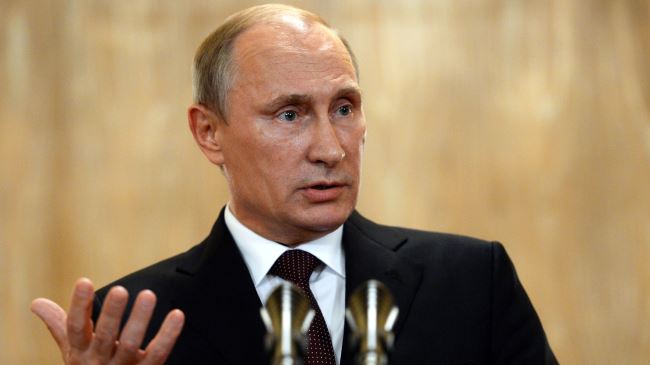
Russian President Vladimir Putin says certain countries play into the hands of terrorists and endanger regional security by bypassing international law and resorting to military force.
Putin made the remarks in a greeting message to the participants in a security conference in the Black Sea resort city of Sochi on Wednesday.
He stressed that the policy of unilateralism practiced by certain states is hindering efforts to ensure regional and global security.
“Some members of the international community have been increasingly trying to ignore the generally recognized norms and principles of the international law and resort to the use of military force bypassing the UN Security Council and refuse to hold talks as a key tool of resolving international disputes,” he said.
“This, in its turn, generates political and social instability and plays into the hands of terrorism, extremism and transnational crime, leading to the escalation of local conflicts and crises,” he added.
Earlier this month, the US, Britain and France launched a coordinated missile attack against sites and research facilities near Damascus and Homs with the purported goal of paralyzing the Syrian government’s “capability” to produce chemical arms.
The trio blamed the government of Syrian President Bashar al-Assad for a suspected gas attack in the Damascus suburb town of Douma on April 7.
Moscow said it has “irrefutable” evidence that the Douma incident was a “false flag” operation orchestrated by British spy services.
Elsewhere in his message, Putin expressed Russia’s readiness to engage in close security cooperation with foreign partners in both multilateral and bilateral formats.
The Russian president further noted that the Sochi conference will provide a good opportunity to discuss the options for countering various threats and challenges to international security.
The two-day event has gathered senior officials from more than 100 countries. Secretary of Iran’s Supreme National Security Council Ali Shamkhani is among the participants and is set to address the conference.
‘Incitement to crime’: Russian senator blasts Saudi advice to send Qatari troops to Syria
RT | April 25, 2018
A member of the Russian upper house security committee has described a recent Saudi statement urging Qatar to send troops to Syria as blackmail, and warned that any such step would bring only chaos and casualties to the region.
“The statement made by the head of Saudi Arabia’s Foreign Ministry is a very real blackmail. Saudi Arabia is inciting Yemen into knowingly unlawful action,” Senator Frants Klintsevich told reporters on Wednesday.
Klintsevich referred to comments by Saudi Foreign Minister Adel Jubeir, who earlier in the day stated that Qatar must “send its military forces (to Syria), before the US president cancels US protection of Qatar, which consists of the presence of a US military base on its territory.” The minister also hinted that Qatari forces could replace US servicemen in case the latter are ordered to withdraw from the region.
The Russian senator told the press that he personally had great doubts about the US’ intention to leave Syria, despite all contrary statements made by President Donald Trump. “Saudi Arabia must be talking about Qatar’s participation in the Syrian campaign alongside the US forces, not instead of them. This is even stranger as Riyadh cannot fail to understand that this would bring nothing but additional chaos and new senseless casualties,” he said, adding that he suspected Saudi authorities had their own goals in the conflict, which they preferred to keep quiet.
The Al-Udeid airbase located near the Qatari capital Doha is currently the largest US military base in the Middle East, with around 11,000 servicemen stationed there. Qatar’s own army is one of the smallest in the region, with some 12,000 active military personnel.
In January, the Qatari defense minister outlined a far-reaching expansion of US military presence in the country and a potential US Navy deployment after it completes renovations of its naval ports. He also expressed hope that the base will one day become permanent.
Palestinians file complaint to UN over Israel violation of anti-racism convention
MEMO | April 23, 2018
Palestinians have filed a complaint to the UN against Israel for numerous violations including breaches of its obligations under international anti-racism treaty.
The move, which is likely to trigger a lengthy and high-profile investigation by world bodies monitoring racism and discrimination, was handed to the UN by the Palestinian ambassador to the international organisation, Ibrahim Khraishi, to the body that monitors the implementation of the UN convention against racism.
In the 350 page document seen by the Guardian, which accuses Israel of establishing an apartheid regime, Palestinians say that Israel is implementing policies that have “the common aim of displacing and replacing the Palestinian people for the purpose of maintaining a colonial occupation”.
Palestinians list a number of Israeli violations in the occupied territories and accuse Israel of seeking to maintain “a Jewish demographic majority in the entirety of historic Palestine”.
“Not only is the purpose of the settlement regime discriminatory in itself, it is further maintained by a system of discriminatory measures, severely depriving Palestinians of their fundamental rights,” the report says.
The complaint sent to the UN is over violations of the 1979 UN Convention on the Elimination of All Forms of Racial Discrimination. Israel has ratified the convention and Palestinians, who were granted UN observer status in 2014, filed the complaint which is believed to be the first interstate complaint filed under the treaty.
The convention is monitored by the Committee on the Elimination of Racial Discrimination, a body of 18 independent experts that is now tasked with assessing the complaint. Israel will now be required to submit written explanations within three months, including any remedies it has taken. The committee could then move to investigate the claims.
According to Ammar Hijazi, from the Palestinian ministry of foreign affairs, the complaint “does not reach the level of a court order.” Hijazi added that the finding that Israel had breached the treaty would oblige other signatories to the convention, which include the US, to “ensure that such practices are not continued”, reported the Guardian.
In their list of complaints Palestinians say that they are severely limited in their freedom of movement compared to Israeli settlers and are subject to “confiscation and seizure” of their land, including home demolitions.
In addition to the violations relating to the right to equal treatment under the law, Palestinians claim that Israel is in breach of article 3 of the convention, which prohibits racial segregation and apartheid. “It is clear that Israel’s acts are part of a widespread and oppressive regime that is institutionalised and systematic; that accords separate and unequal treatment to Palestinians,” the summary says, calling for the dismantling of all existing Israeli settlements.
US to Build World’s Largest Consulate Facility in Iraqi Kurdistan – Reports
Sputnik – 23.04.2018
US Ambassador to Iraq Douglas Silliman and Kurdish Prime Minister Nechirvan Barzani led the groundbreaking ceremony for the world’s largest US consulate in Erbil, the capital of Iraqi Kurdistan, local media reported Monday.
As of now, the United States rents buildings from local residents and business owners in Erbil’s district of Ainkawa to house its consulate, which opened in February 2007 and was upgraded to a consulate general in 2011, the Rudaw news agency reported.
“The new consulate building demonstrates that the United States will stand with the people of the Iraqi Kurdistan Region, as they build a future that will be brighter than the past,” Silliman said at the ceremony, as quoted by the media outlet.
The ambassador also called for strengthening US-Kurdish business relations.
Barzani, in turn, thanked Silliman and congratulated him on the decision to start construction.
“We see it as a significant and valuable step, and hope that it will be finished successfully at its schedule time,” he said.
Barzani also stressed that the development of relations between the United States and the Kurdistan Region lay “in the framework of the diplomatic relations it has with Iraqi federal government.”
The estimated cost of the new US consulate building is $600 million. It will be built on 200,000 square meters (2,152,782 square feet) of land on Erbil-Shaqlawa highway.
Iran rejects ‘baseless’ UK, US accusations on Yemen missiles
Press TV – April 18, 2018
Iran has firmly rejected fresh US and British allegations of Tehran sending missiles to Yemen, saying the two are seeking to whitewash their “shameful” complicity in the crisis gripping the war-torn country by leveling “false” charges against others.
“The US and UK complicity in Yemen crisis is shameful,” Iran’s Permanent Mission to the United Nations said in a press release on Tuesday.
The Iranian mission was reacting to remarks by the American and British ambassadors to the UN, Nikki Haley and Karen Pierce during a Security Council meeting on Yemen earlier in the day.
Haley claimed that Iran was interfering in the Yemeni affairs and violating the arms embargo on the impoverished state. Pierce also accused Tehran of “non-compliance with Security Council Resolution 2216.”
The Iranian mission, however, said the American and British officials had “repeated their derogatory allegations about Iran to cover up their own role in the disastrous situation created in Yemen. Iran categorically rejects those allegations as baseless propaganda.”
“The fact is that the war of aggression of Saudi Arabia in Yemen is the main underlying reason for the escalation of the crisis. It is regrettable that Saudi Arabia and its warmonger supporters, as the main party responsible for such a catastrophic humanitarian situation, are trying to cover up their shameful crimes by introducing false charges against others or trying to spread the crisis beyond Yemen’s borders,” it added.
“The US and UK are enjoying a blood business in Yemen now” by providing bombs to the Saudi warplanes that are targeting Yemeni civilians, the Iranian mission added.
Saudi Arabia and its allies launched the war in March 2015 in support of Yemen’s former Riyadh-friendly government and against the Houthi Ansarullah movement, which is currently running state affairs.
The military campaign has killed and injured over 600,000 civilians, according to the latest figures released by the Yemeni Ministry of Human Rights.
Several Western countries, the US and the UK in particular, are accused of being complicit in the aggression as they supply the Riyadh regime with advanced weapons and military equipment.
Canada should support peace in Syria, not US missiles
By Yves Engler · April 14, 2018
The US has once again flagrantly violated international law. Without UN approval, they launched dozens of airstrikes on Syria.
Ottawa immediately supported the US bombing. In a statement Prime Minister Justin Trudeau said, “Canada supports the decision by the United States, the United Kingdom, and France to take action to degrade the Assad regime’s ability to launch chemical weapons attacks against its own people.”
Over the past week the Trudeau government has helped lay the foundation for the US-led attack. Twenty-four hours after the alleged April 7 attack foreign minister Chrystia Freeland put out a statement claiming, “the repeated and morally reprehensible use of chemical weapons by the Assad regime in the past has been confirmed by independent international investigators…. Canada condemns the Assad regime—and its backers, Russia and Iran—for its repeated, gross violations of human rights and continued, deliberate targeting of civilians.” Without presenting any evidence of the alleged chemical weapons use in Douma, Freeland said on Friday “when it comes to this use of chemical weapons, it is clear to Canada that chemical weapons were used and that they were used by the Assad regime.”
In her initial statement Freeland expressed Canada’s “admiration for … the White Helmets.” Also known as the Syrian Civil Defence, the White Helmets produced the video purporting to show chemical weapons use in Douma.
On Friday Russian foreign minister Sergei Lavrov claimed the White Helmets staged the video with help from the UK. Former British ambassador to Syria Peter Ford largely endorsed Moscow’s position.
Credited with rescuing people from bombed out buildings, the White Helmets have long fostered opposition to Assad and promoted western intervention. The White Helmets operated almost entirely in areas of Syria occupied by the Saudi Arabia–Washington backed Al Nusra/Al Qaeda rebels and other jihadist groups. They criticized the Syrian government and disseminated images of its violence while largely ignoring those targeted by the opposition. Their members were repeatedly photographed with Al Qaeda-linked Jihadists and reportedly enabled their executions.
Canada has provided significant support to the White Helmets. Two weeks ago Global Affairs Canada announced they “provided $12 million for groups in Syria, such as the White Helmets, that are saving lives by providing communities with emergency response services and removing explosives.” At that time White Helmet representatives were in Ottawa to meet with government officials and in late 2016 Global Affairs Canada sponsored a five-city White Helmets tour of Canada.
The White Helmets received at least $23 million US from USAID. The British, Dutch, German and French governments have also provided the group with tens of millions of dollars. The White Helmets are closely associated with the Syria Campaign, which was set up by a British billionaire of Syrian descent, Ayman Asfari, actively opposed to the Bashar al-Assad regime.
The conflict in Syria is multilayered and messy. Thousands of US and Turkish troops are in the country in contravention of the UN charter. Similarly, Israel has bombed Syria more than 100 times since the outbreak of the conflict and continues to illegally occupy part of its territory. Saudi Arabia and Qatar have plowed billions of dollars worth of weaponry and other forms of support to opposition rebels while the CIA spent a billion dollars backing anti-Assad groups.
On a number of occasions Ottawa has denounced Iran, Hezbollah and Russia’s substantial support of Assad, but they’ve ignored the significant role the US, Saudi Arabia, Turkey, Qatar and Israel have played in the conflict. In fact, Ottawa has ramped up arms sales to Saudi Arabia and deepened its ties to Israel and the US in recent years.
Syrians needs an end to fighting. Hundreds of thousands have been killed and millions more displaced over the past seven years of conflict. The US, which unleashed sectarian war in Iraq, bears significant responsibility for the horrors in that country. Syria requires political negotiation, the withdrawal of foreign troops and a real arms embargo, not more bombing and violations of international law.
Canadians should oppose the Trudeau government’s support for the recent US air strikes.
Pentagon Does Not Have Evidence of Chlorine, Sarin Use in Syria’s Douma – Mattis
Sputnik – 12.04.2018
US Defense Secretary Jim Mattis has told lawmakers that the US military is still “assessing the intelligence” on the alleged chemical attack in the Syrian town of Douma, and that President Trump has yet to decide whether to launch strikes against the Middle Eastern country.
“There have been a number of these attacks. In many cases, you know we don’t have troops, we’re not engaged on the ground there, so I cannot tell you that we had evidence, even though we had a lot of media and social media indicators that either chlorine or sarin were used,” Mattis said, speaking to members of the House Armed Services Committee on Thursday.
The defense secretary said he did believe that a chemical attack took place, but that the US was still “looking for the actual evidence.”
“We’re still assessing the intelligence, ourselves and our allies. We’re still working on this,” he reiterated.
Warning that he was concerned that a US strike might lead to an “out of control” escalation in the Syrian war, Mattis said that Washington was “committed to ending that war through the Geneva process through the UN-orchestrated effort.”
“On a strategic level, [the issue is] how do we keep this from escalating out of control, if you get my drift on that,” he said, alluding to the prospects of a confrontation between Russian and US forces deployed in the Middle Eastern country.
No Decision Yet
According to Secretary Mattis, President Trump has yet to decide whether or not to launch an attack. “We’ve not yet made any decision to launch military attacks into Syria,” he said.
“I don’t want to talk about a specific attack that is not yet in the offing, knowing that this would be pre-decisional. Again, the president has not made that decision,” he added.
No Congressional Approval Needed
Mattis said he would discuss Syria options at a National Security Council meeting later Thursday, and promised to keep lawmakers informed if the Pentagon did decide to attack. He added, however, that the White House has the authority to conduct strikes without seeking Congressional approval.
Asked if the US was ready to mount an attack, Mattis replied that “We stand ready to provide military options if they’re appropriate, as the president determined.” … Full article
Featured Video
BRITAIN’S WARNING: PREPARE FOR WAR
or go to
Aletho News Archives – Video-Images
From the Archive
How Ukraine Tortured and Slaughtered Donbass
By Kit Klarenberg | Al Mayadeen | July 11, 2024
Almost immediately after the proxy war erupted, ISIS-tier footage of the torture and murder of Russians in Ukrainian custody emerged.
On July 6th, the New York Times published an astonishing investigation: In Ukraine, Killings of Surrendering Russians Divide an American-Led Unit. The article documents in grim detail how Chosen Company, an international volunteer battalion for Kiev, routinely executes Russian prisoners of war. It is the very first mainstream admission that this practice – a brazen breach of the Geneva Conventions, and a grave war crime – is widespread among Ukraine’s fighters, both foreign and homegrown. … continue
Blog Roll
 Aletho News
- Israel Demolishes Home Of Lebanese Journalist Whose Viral Film Exposed Pager Attack
- Record Oil, Empty Tanks: The UAE’s Miracle Recovery
- Burnham tackles Britain’s poverty with aggression in Yemen
- Peace in Ukraine: the easy way – or the hard way
- Trump & the Rrrrussians
- US taxpayer money laundered back through Ukraine – Musk
- Before COVID, an NIH lab chief proposed making a SARS-like bat virus more infectious
- Gates, Bourla on Trial in Netherlands Accused of ‘Great Reset’ Scheme at Vaccine Injury Hearing
- BRITAIN’S WARNING: PREPARE FOR WAR
- “Historic Russia”: The Land Putin Will Not Give Back
- If Americans Knew
- An error has occurred; the feed is probably down. Try again later.
- No Tricks Zone
- Two New Studies Find Thwaites Glacier Melt Cannot Be Driven By Human Activity Or A Warming Ocean
- E-Cars Reduce CO2 Emissions By Only 41% Compared To Internal Combustion Engine Vehicles
- Predictions Made By Renowned Climate Professor Over Past Decades Have Been Proven To Be Poor
- New Study Suggests Large Regions Of The Pacific Ocean Have Been Cooling For The Last 80 Years
- Germany’s Green Energy Debacle: High Energy Costs Force Kahla Porzellan to Close After 182 Years!
- New Study: 50 Years Of The Most Aggressive ‘Net Zero’ Policies Can Only Affect The Global Climate By 0.03°C
- US September “Heat” Was No Record…Many Records Set Decades Ago
- Latest European Green Energy Debacle; Portugal’s Largest Flagship Solar Park Insolvent!
- Green Energy Debacle: German Expert Professor Fritz Vahrenholt Warns Of Severe Economic And Social Consequences
- Two More Paleo Reconstructions Affirm Meters-Higher Sea Levels Across Ireland, Brazil 7000-6000 Years Ago

