Douma Chemical Attack: Another Link in the Chain of Staged Provocations
By Peter KORZUN | Strategic Culture Foundation | 09.04.2018
What happened in Syria on April 7 had been expected. While raising hue and cry over the alleged chemical attack in Douma, a rebel-held suburb of the capital, Western officials and media wasted no time to put the blame on the Assad government.
The US State Department issued a statement saying that by shielding Damascus Moscow has breached its international commitments. The administration immediately called on Russia to cease its support of Syria’s government. President Trump wants an international action. As usual, few people in the West raised their voices to emphasize the need to investigate first and make conclusions afterwards.
It strikes the eye that Moscow’s warnings about a CW provocation being prepared to dash the rising hopes for peaceful settlement in Syria appear to be forgotten! The Defense Ministry shared the information that the ringleaders of Jabhat al-Nusra and the Free Syrian Army were plotting false flag chemical attacks in areas under their control. Moscow warned but the West did not listen.
It’s the same old song and dance. Last year, the Syrian government was blamed for a sarin gas attack on Khan Sheikhun that prompted a US cruise missile strike on a Syrian air base. The American president’s approval ratings went up as a result. This time, the alleged attack occurred right after the Russia-Turkey-Iran summit that took place in Ankara on April 4 to promote the Syria conflict settlement.
As before, all “evidence” boils down to White Helmets’ report and a video going viral that does not look or sound very convincing. There was no independent verification. The White Helmets have iffy reputation, to put it mildly. The organization is known to pursue political interests of outside actors.
No explanation was given to a simple question: what does Syria’s government need this attack for? It is victorious everywhere and the operation in Eastern Ghouta has been a success. Douma is the last remaining stronghold still controlled by rebels in the area and will be liberated soon. It’s a matter of a few days. The army’s combat actions are supported by Russian aviation. What does Syria’s government stand to gain by using CW? Nothing.
Syria army units are operating in Douma. By launching an attack, the Syrian government would hit its own troops, This argument appears to be largely missing in Western media reports. President Trump has recently promised to withdraw American forces from Syria. Why would President Assad give him a pretext to renege on his word?
But the world “indignation” against Russia-supported President Assad benefits the extremists a lot. They are cornered and need time to take a breath and receive support. Actually, the ballyhoo raised in the West is their only chance to at least slow down the offensive. A government forces’ victory in Douma would deal a heavy blow to terrorist groups, sounding the death knell for the rebellion. Sounds simple but that’s what it is. There is each and every reason to believe the incident was staged by terrorists.
Right after the alleged attack, they asked for talks. The ringleaders believe that this is their chance for a negotiated truce. The militants keep their fingers crossed hoping that NATO member states which clandestinely support them will get involved one way or another. Just last February, Secretary of Defense James Mattis warned Syria of “dire consequences” if it executed chemical strikes. French President Macron said he would order strikes if CW were used. It’s worth noting that today the US president’s National Security Team is led by a person known as a trigger happy hawk advocating the use of force as a foreign policy tool.
The US and France have been harboring plans to launch a joint operation in Syria for some time. Only a few days ago, a contingent of French forces arrived in Manbij to join American allies there. Actually, a NATO operation has been launched leaving Turkey, a bloc’s member, out in the cold. It’s an open secret that the US-led coalition pursues the goal of partitioning Syria to “contain” Russia, roll back Iran, win the support of rich Persian Gulf Arab states to boost lucrative arms trade and bolster the US and France’s clout in the Middle East.
It would be naïve to think that the chemical attack in Syria and the Skripal scandal are two separate events. They are links in the same chain. With the spy poisoning case leading nowhere, the anti-Russia campaign needs a new impetus. The alleged CW attack is a good pretext to spur the efforts. But any strike in Syria would pose a risk to the lives of Russian servicemen. It could make Moscow respond. The US-led coalition is playing with fire. And as in the Skripal case, the reaction is the same – blame first, wait for the results of investigation second. It just shows that the West is not interested in the truth. It’s looking for new pretexts to damage Russia’s reputation and thus reduce its global clout.
Douma Chemical Attack: Timeline of facts so far
By Kit | OffGuardian | April 8, 2018
A brief post, collating all the known events surrounding the build up to the alleged chemical weapons attack in Douma, Syria on the 7/8th of April 2018.
- February-April 2018: The Syrian Arab Army has been making quick, decisive gains on the ground in recent weeks. Eastern Ghouta has all but fallen. Barring foreign intervention, the Syrian government’s victory is now all but assured.
- March 13th 2018 Russian military command claims US is aiming to strike Damascus on an “invented pretext”. Advises them against it.
- March 13th 2018 Syrian forces reported finding caches of chemical weapons in labs around liberated areas of Ghouta.
- March 19th 2018 Russian and Syrian military figures reported they feared the rebels would stage a “false flag” chemical attack in order to drag US/NATO into action in Syria.
- March 30th 2018 Donald Trump told a crowd at a speech in Ohio – and later repeated in a tweet – that the USA would be pulling out of Syria “very soon.” This is met with consternation in the capital and across the media.
- April 6th 2018 UNSC meeting convened – at Russian request – to discuss the alleged attack in Salisbury, UK. Every member of the UNSC who spoke was categorical in their condemnation of any use of chemical weapons.
- Night of April 7th/morning of April 8th… a chemical attack is reported by the US/UK funded “White Helmets”. The US blames Syrian govt. and holds Russia “responsible”.
With these facts as they are, we should ask a few questions:
1. Why, with the current international focus on chemical weapons, why would Assad hurt his cause by attacking a non-military target with chemical weapons?
2. With global political discussion focusing more on Saudi Arabian war on Yemen, the Skripal attack, and Israeli violence against Palestinians, why would Assad choose this moment to conduct a chemical attack and potentially distract from these issues?
3. The Syrian Arab Army is currently operating in Douma, why would Assad risk dropping chemical weapons that could hit his own troops?
4. The POTUS has publicly stated he intends to pull out of Syria “very soon”. Why would the Syrian Government endanger this development?
5. Cui bono? Who has the most to gain from this chemical attack? The SAA, who are already winning the war, or the cornered jihadist forces in desperate need of aid and air support?
Turkey: France’s buildup in Syria will amount to ‘invasion’
Press TV – April 8, 2018
Turkey which has deployed troops to northern Syria says if France steps up its military presence in the Arab country, it will amount to an “invasion.”
“If France takes any steps regarding its military presence in northern Syria, this would be an illegitimate step that would go against international law and in fact, it would be an invasion,” Turkish Defense Minister Nurettin Canikli said Saturday.
Turkey sent troops to the northern Syrian region of Afrin on January 20 to force out Kurdish militants, known as the People’s Protection Units (YPG), which it suspects of having ties with anti-Ankara separatists.
France, which has criticized Ankara over the offensive, operates in Syria as part of the so-called US coalition.
French President Emmanuel Macron hosted a delegation of the so-called Syrian Democratic Forces (SDF), which has the YPG as its backbone, at the Elysee Palace on March 29.
On Saturday, Turkish President Recep Tayyip Erdogan railed against Paris. “France, you are abetting terrorism, supporting it by then hosting them at the Elysee Palace,” he said.
“Especially, if they intend to support terror group elements or give direct or indirect protection with armed forces, this would be a really calamitous step,” Canikli said during a visit to the northeastern province of Giresun.
After the Paris meeting, Kurdish officials said France was planning to send new troops to the city of Manbij, also in northern Syria.
Paris has also threatened to attack Syria if it was established that Damascus had deployed chemical weapons in its military operation, an accusation strongly rejected by the Syrian government.
Turkey, which has pushed the YPG out of Afrin, has also threatened to extend its operation to Manbij, which hosts American forces.
Ankara has further locked horns with Washington on several occasions over the latter’s providing arms, training, and logistical support to the Kurds.
France Joins Syria Fight: Goals and Consequences
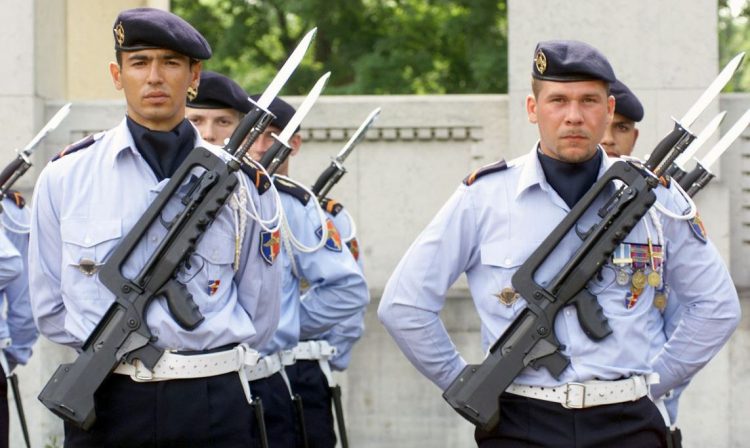
French Armed Forces, armed with FAMAS F1 assault rifles, participate in the Memorial Day ceremony at the LaFayette Escadrille Monument in Paris, France.
By Peter KORZUN | Strategic Culture Foundation | 05.04.2018
French President Emmanuel Macron kept his word. On April 1-2, French troops moved into northern Syria. This is the first time France deployed substantial forces there to turn Paris into a new actor actively involved in the war. The troops advanced toward Manbij and Remelin to join American allies and did it hastily.
The move was made at the time Ankara warned about the plans to control this territory with Russia, Turkey and Iran working together to define Syria’s future. It significantly changes the situation and makes one ask questions about the goals pursued by the US and France and the prospects for war and peace in the conflict-torn country. Summing up the recent events leads to the conclusion that the US and France have a hidden agenda to expand the conflict, wreak havoc and stymie the Russia-led peace efforts.
The news about French deployment came just before the April 4 Russia-Turkey-Iran summit in Ankara stated the goal to “speed up their efforts to ensure calm on the ground” in Syria. On April 3, US President Donald Trump said he would “decide very quickly” to remove forces from that country. The statement was made right after about 300 US Marines accompanied by armored vehicles and engineering equipment were moving toward Manbij as reinforcements to repel possible Turkish inroads. The construction of two bases in Syria’s northern Manbij region is underway.
The Marines have already launched daily patrols along the Sajur River, a tributary that feeds the Euphrates River from sources in Turkey, with observation posts built to monitor the area. This is unheard of – two leading states of the North Atlantic Alliance blocked the other NATO member’s land access to Manbij! On April 3, CNN reported that plans to send reinforcements have been discussed for several days before Trump’s remarks on leaving Syria soon.
The US also wasted no time to press Iraq into sending its 5th Army Division to Sinjar province and line the forces on the Iraqi-Syrian border to obstruct the possible advance of Turkish army from Syria into Iraq.
Obviously, the US is trying to partition Syria while creating a quasi-state on the eastern bank of the Euphrates and up to the Iraqi border. In Deir-ez-Zor, the US-led coalition resists the restoration of Syrian government institutions. It makes one think that the words about “leaving soon” may be nothing more than wishful thinking or an attempt to baffle those who are trying to predict further steps America will take.
The list of goals includes controlling the oil fields and chunks of the territory. Donald Trump wants Saudi Arabia to pay for US operations in Syria and it probably will. If the decision to leave were taken, he wouldn’t raise the question. According to the president, Saudi Arabia is interested in America staying in Syria.
That’s what the US “rocking from side to side” foreign policy is like. Rex Tillerson is fired to make the world know about it from tweets. The US wants to leave Syria but will stay if Saudi Arabia pays. Donald Trump invited the Russian leader to visit him in Washington against the background of Russia diplomats expelled and the consulate office in Seattle closed. Is it being short-sighted or far-sighted? Is this swinging back and forth a well-thought over policy or no policy at all? Is it done on purpose to keep everyone guessing with no predictions possible? You never know. Donald Trump once denounced Saudi Arabia as extremist and then sold a huge package of weapons while calling the kingdom a great friend and close ally against Iran.
The Syrian forces are preparing an offensive in the Daraa – Quneira – Suweida area in the south while denuding other fronts. The territory is huge and the terrain is hard to cross. There are at least 25 heights to fire at advancing forces from. The Free Syrian Army and other rebel groups are much more numerous than the ones being defeated in Eastern Ghuta. Their defenses are strong. Unlike in other places, the rebel forces can easily get logistical support from Jordan. That’s where the US and Saudi Arabia can contribute greatly. Israel has been involved in such activities since 2015. It took roughly six months to liberate Eastern Ghuta, with an active phase to dislodge rebel fighters launched in mid-March. It’s easy to surmise that it will take at least a year, may be much more, to liberate the area in question.
A conflict is easy to provoke. The operations of Syria’s government forces aimed at cutting off supplies coming from Jordan could be presented as an act of aggression against the Hashemite Kingdom. Chemical substances could be transported from Jordan to stage another provocation used as a pretext to attack Syria.
The operation could become a war of attrition to make Syria concentrate more and more of its forces in one place at the expense of other battlefields. They will be stuck there for a considerable period of time. That’s when the US-coalition will be in good position to attack anywhere it wants using the base of Al-Tanf as a springboard. Manbij as well as the Al-Tabka air base located to the south of Raqqa are perfect places for launching an offensive to drive Syria out from Aleppo. Then the country will plunge again into an “all-against-all” fight.
The efforts applied so far by Russia, Turkey and Syria will go down the drain. This time the US will not be alone to have substantial presence on the ground. It’s hard to imagine that the French forces arrived in Syria could be anything but the start of broader NATO presence with other members of the bloc to follow the French example. Russian military personnel and NATO soldiers will be looking at each other through the sights of guns. This scenario will be fraught with a great risk of international military conflict and a real tragedy for Syrian people but those who are provoking it don’t care.
Newly Revealed Docs Shed Light on UK’s Intervention in Russia During WWI
Sputnik | April 4, 2018
British military intervention in Russia in 1918-1919 was unlawful and indefensible, British government papers held by the National Archives reveal. It turned Russian public attitudes towards Britain from friendly to hostile.
In March 1918 the Bolshevik government signed a peace treaty with Germany, as they had promised to the nation exhausted by four years of the devastating and senseless WWI. The Russian Revolution was triggered by the overwhelming public desire for peace. The war-weary Russian army simply could not carry on fighting. Britain and France immediately accused Russia of betraying the Allied cause and sent in their troops. In a show of “solidarity” reminiscent of today, a dozen Anglo-French allies took part in the armed intervention in Russia. The official excuse was to keep the Eastern front against Germany and protect the Russian war materiel from falling into German hands.
The map of foreign military intervention in Russia in 1918-1919.
In reality, the British, the French, the Americans, the Japanese and many others fought the locals, engaging in “frolics” and “high handed behaviour,” according to British government papers.
The legality of their action under international law was not considered until 1972 when the British government, locked in a dispute with Moscow over mutual debts, sought advice from a Foreign Office legal counselor, Eileen Denza. The advice was damning of London’s actions and was kept under wraps for a long time.
“In my own view there is no legal justification for any of the major incidents of intervention by British forces,” Ms. Denza wrote in her paper. “Nor have I formed an impression from … research from such original sources as Foreign Office archives and Cabinet documents that any consideration whatsoever was given at the time to the legal aspects of the matter by those in London, or by the army commanders while they were actually in Russia.”
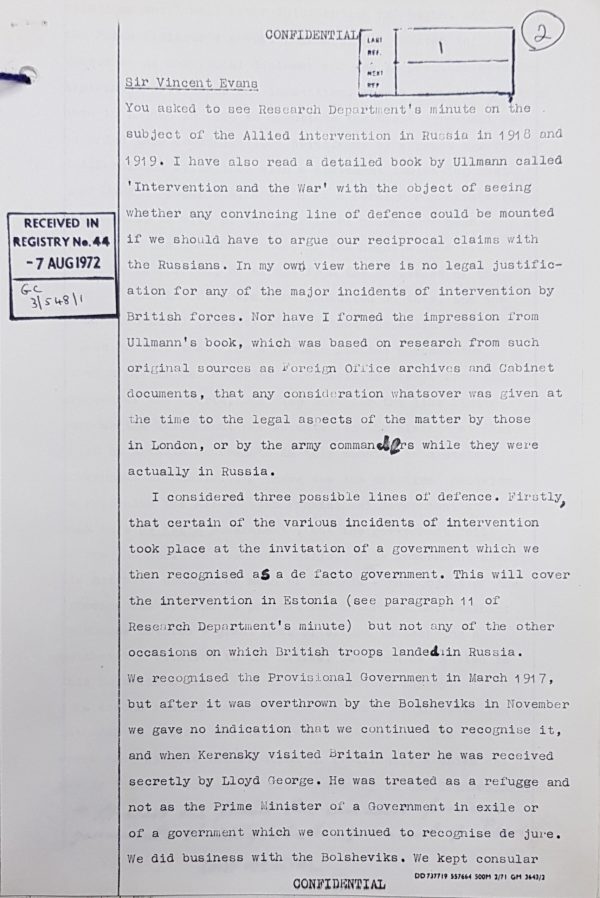
© Photo: Crown copyright National Archives, UK
FCO Legal Councellor paper on legality of British intervention in Russia
Ms. Denza had explored possible avenues for defending the British intervention but failed to find any convincing arguments.
Argument 1. Certain incidents of intervention took place at the invitation of a Russian government which Britain then recognized as a de facto government.
This, Ms. Denza said, would cover the intervention in Estonia [which Britain helped break away from Russia — NG] but not any of the other occasions on which British troops landed in Russia. Britain did recognize the Russian Provisional government after the overthrow of the Tsar in March 1917, but after it was overthrown by the Bolsheviks in November Britain gave no indication that she continued to recognize it. Indeed, when its premier Kerensky visited Britain later he was treated as a refugee, and not as a prime minister of a government in exile or of a government which London continued to recognize de jure.
“We did business with the Bolsheviks,” Ms. Denza reminded the British government. “We kept consular relations until well after intervention had begun, and the Prime Minister’s envoy, Bruce Lockhart, was … accorded diplomatic privileges and immunities [which he abused — NG]”.
Initially Lockhart devoted a great deal of effort to securing a Bolshevik invitation to the Allies to intervene, but when he failed in this he advised the British government to intervene anyway. He started plotting for the overthrow of the Bolsheviks, and channeled his energy into persuading the reluctant US President Woodrow Wilson to support the British and Japanese intervention in the North and Far East of Russia.
Argument 2. The intervention was intended to protect British lives and property.
There was no British community in Russia to speak of.
“The question of defence of British property was never raised or put forward at any stage,” wrote the FCO legal counselor, “and it had always been clearly understood that it was intervention which led the Bolsheviks (who began by being friendly to Britain) to take much more extremist measures against property generally and to adopt the position that no compensation would ever be paid to the Allies in respect of their expropriated property, since it was the necessity caused by external pressures and Allied intervention which had made it necessary to seize foreign property on such a scale.”
Argument 3. The intervention was justifiable as an act of military necessity, or self-defense, in order to protect the Allied military position in the east after Russia’s withdrawal from the war following the peace treaty of Brest-Litovsk signed with Germany in March 1918.
Britain at the time made a great deal in public that the motive for intervention was related entirely to the conduct of the war, and that there was no intention to intervene in the domestic affairs of Russia. However, once they arrived in Russia, the British and other Allied forces “did not limit their actions to cutting off supplies to the Germans,” wrote Ms. Denza. “They did not confine themselves to supporting factions which had clearly stated that once in power they would bring Russia back into the war.”
“In the main the commanders in the field seem to have gone off on frolics of their own with very little clear political coordination.” [Those “frolics” included bayoneting the locals to death, and forcing captured Russian gunners to turn their cannons on their compatriots, according to British commanders’ combat logs held by the National Archives — NG]


© Photo: Crown copyright National Archives UK
Excerpt from a British Dvina (North Russia) Force battle instructions issued on 5 August 1919
When large-scale intervention began in the summer of 1918 Britain withdrew its embryonic diplomatic and consular mission from Russia [thereby implying it was an invasion rather than intervention — NG].
Most important of all, Ms. Denza wrote, the intervention did not cease with the surrender of Germany in November 1918. Indeed the military justification for intervention, which could have existed during the many months when plans for intervention were being made and discussed “virtually ceased to exist very soon after our troops first went in [Russia — NG] in substantial numbers [shortly before Armistice — NG].”
Overall, the FCO legal counselor said, the British and Allied intervention in Russia painted “such a damning picture.”
“The immediate effect of the intervention was to prolong a bloody civil war,” wrote American historian James W Loewen, “thereby costing thousands of additional lives and wreaking enormous destruction on an already battered society.”
During the Anglo-Soviet debt negotiations in 1972-1973 this destruction was estimated to be between two and four billion pounds.
British government papers of the time record a flurry of Whitehall discussions on how to avoid admitting any liability for the damages caused by the unlawful intervention. As one note put it:
“I think it inevitable the Russians will raise the intervention claim in reaction to whatever HMG decides to do” [e.g., expropriate Russian gold held by Britain in payment for Russian debt — NG].
In this eventuality our aims should be:
(a) To avoid admitting the unlawfulness of the intervention (this would be unacceptable)
(b) To avoid discussing the lawfulness and morality of our part in the intervention (Mrs. Denza in her minute of 28 July has shown we could not win on this score); and hence
(c) To minimize unfavourable press coverage.
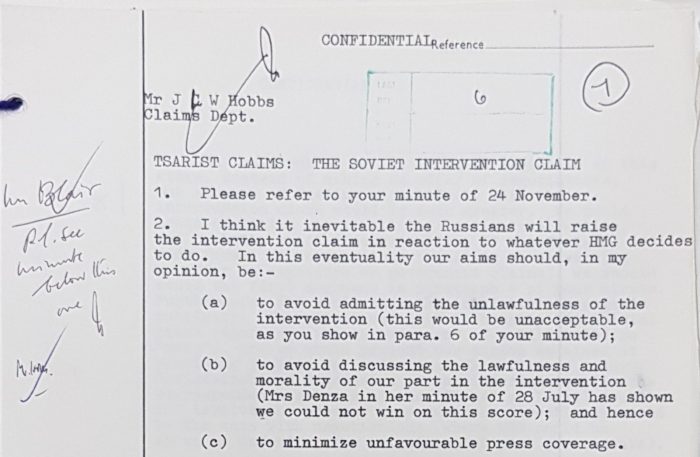
© Photo: Crown copyright National Archives UK
FCO claims department note on avoiding liability for military intervention in Russia
Whatever the press coverage, the intervention did create very unfavorable attitudes towards Britain in Soviet Russia.
In 1921 a British Parliamentary Committee produced a report which included the following perceptive passage:
“There is evidence to show that, up to the time of military intervention the majority of the Russian intellectuals were well disposed towards the Allies, and more especially to Great Britain, but that later the attitude of the Russian people towards the Allies became characterised by indifference, distrust and antipathy.” [Report (Political and Economic) of the Committee to Collect Information on Russia; (Russia (No.1), 1921, Cmd. 1240]
American Historian William Henry Chamberlin, who was the Moscow correspondent of The Christian Science Monitor in the 1920-30s, wrote that the consequences of the intervention “were to poison East-West relations forever after, to contribute significantly to the origins of World War II and the later Cold War, and to fix patterns of suspicion and hatred on both sides which even today threaten worse catastrophes in time to come.”
God forbid his prophecy comes true…
America Faces a Vietcong Style Genuine Arab Rebellion in Syria
By Adam Garrie | Eurasia Future | 2018-04-02
While the Syrian Arab Army has liberated all of Eastern Ghouta from pro-western Takfiri terrorists and Turkey continues to be unable to get the US to agree on a disarmament agreement regarding YPG/PKK terrorists in Manbij, in Raqqa, a genuine Arab rebellion is taking place against the United States and their YPG proxies.
While the word “rebel” has been used throughout the duration of the Syrian conflict to describe heavily armed and handsomely paid terrorists whose loyalty is to foreign powers and whose citizenship is often not Syrian, in Raqqa, one is witnessing an organic uprising of indigenous Arabs against the American military and the SDF flagged YPG terrorists who have worked with the US to occupy Arab majority lands in the Syrian Arab Republic.
Real moderate rebels finally emerge
As geopolitical expert Andrew Korbyko recently wrote in Eurasia Future,
The American President made global headlines once again after he seemingly veered off script at a political rally in Ohio by declaring that the US will be ‘coming out’ of Syria ‘very, very soon’ in order to ’let the other people take care of it now’. Trump didn’t elaborate, but his surprise announcement came on the heels of Turkish President Erdogan threatening to expand his country’s anti-terrorist campaign into the part of northeastern Syria that the Russian Security Council previously said hosts as many as 20 American bases, which could potentially lead to a ‘war by miscalculation’ between the two nominal NATO ‘allies’ if the American forces remain there during this time and are caught in the Turkish-Kurdish crossfire.
Within a day after Trump’s statement, the Chief of the Main Operational Directorate of the Russian General Staff informed the world that Raqqa’s native majority-Arab population had begun to rise up against the US-backed Kurds that are in control of the city, thus heralding in the beginning of the “Rojava Civil War” that the author first predicted more than a year ago and which was undoubtedly further provoked by the anti-Arab ethnic cleansing campaign that the Kurds commenced over the summer. It can’t be known for certain, but Russia and Turkey likely have a favorable attitude towards the Arab revolt against the pro-American Kurds because it dovetails with their interest in seeing this disruptive power removed from the agriculturally and energy-rich corner of northeastern Syria.
The key elements of Korybko’s observations are as follows:
1. In spite of some disagreements regarding a post-war settlement, Russia, Syria, Iran and Turkey are all opposed to the illegal US presence in Syria, although none seek a direct confrontation with US forces.
2. It is not clear if the indigenous Arabs of Raqqa are loyal to Damascus, Ankara or some other power, but what is clear is that they are united in a common objective of exorcising the US and its proxies from their homeland.
An Arab Vietcong
While the issue of the Arab rebels of Raqqa’s loyalty to one state or another is a key mystery, ultimately the most immediate threat to the always flimsy US narrative regarding the region, is that the US and their allies may face a Vietnam war style combat situation against the Arab rebels, assuming the US doesn’t “pull out” of Syria as Donald Trump recently indicated.
In the American war in Vietnam, the US found itself facing not only regular troops from Northern Vietnam but indigenous Vietcong rebels in the South whose fight was first and foremost against a foreign occupier. The Arab rebels in and around Raqqa likely feel the same way, as for example did the Algerian fighters who rebelled against French rule between 1954 and 1962. While the US did have Southern Vietnamese allies on its side, such troops were in the minority and ultimately faced ostracism after the US loss. Just as some South Vietnamese and other minorities who sided with the US during war, typically out of opportunism, attempted to run away from Vietnam when the war was lost by the US, so too might many YPG militants attempt to flee along with their US masters when defeat is imminent as it could be in short order.
A French connection
Prior to the US entering Vietnam, indigenous Vietnamese (referred to as Indochinese at the time) rebels fought a colonial French occupation between 1946 and 1954. After the French were vanquished in 1954, the US began gradually sending so-called “military advisers” to Vietnam before the situation spiraled into a full-scale US invasion after the Gulf of Tonkin false flag incident in 1964.
Today, there is discussion that US troops in north-eastern Syria will be replaced by French and/or Saudi troops. The irony here is that while the US went into Vietnam only to repeat the loss of their French predecessors, now it appears as though France may enter north eastern Syria only to inherent a rebellion against the US and its Kurdish proxies that neither foreign army is likely to win.
As French President Macron has publicly come out in support of Kurdish radicals in Syria, it is unlikely that a French strategy in Raqqa would look significantly different than the US strategy. Moreover, the presence of Saudi troops in the region would only have the effect of making apolitical rebels likely to side increasingly with either Turkey or Damascus, were a fellow Arab army to fight along side infamously anti-Arab Kurds against indigenous Sunni Arabs.
Syria remains an Arab Republic
With the defeat of Daesh in Syria, many Arabs have attempted to return to their homes in places like Raqqa, only to find that they are being abusively occupied by US backed Kurdish militants. This is a classic recipe for rebellion and while the world is focused on Eastern Ghouta and Manbij, the Arab rebellion against the USA and YPG is already underway, as has been confirmed by the Russian military.
Now a spokesman for the Arab rebels has issued the following statement,
“Following the intelligence activities, the militia of Raqqa waged a special operation targeting the US Staff located at the former base of the 93rd Brigade in the district of Ayn Issa, 43 miles north of Raqqa. Several mortar shells were fired on individual targets without any casualties on our side”.
While the authors of this statement claimed they were opposed to both the US and Turkish presence in Syria, seeing as they are operating in an area far from any Turkish troops, the likelihood is that this group of rebels is centred around a pro-Damascus and anti-US political/military agenda. Indeed, as the government in Damascus remains the only legitimate Arab representative of the Syrian people, the rebellion in Raqqa may prove to help reconcile formerly anti-government forces with the government, as indigenous Arabs displaced by American troops and their proxies look to restore Syrian Arab rule over the Syrian Arab Republic.
While Turkey has said countless times that it does not intend to stay in Syria beyond a reasonable timeline for orderly withdrawal, the US has stated that it plans to stay in Syria for an extended period of time. Recent statements from the so-called SDF saying that they are unaware of Donald Trump’s proposed “pull out”, indicate that the veracity of the US President’s statements are far from certain. Thus, whatever faction the Arabs of north eastern Syria are ultimately loyal to, the fact remains that the US and its allies will be the primary targets and in the context of Syria, this excludes Turkey.
Conclusion
Thus the likelihood is that the Arab rebellion against the US and its proxies will only grow, perhaps especially if the US troops in the region are replaced by generally less capable French or Saudi troops. In this sense, whoever seeks to occupy Arab land in north eastern Syria whether Kurdish terrorists, the US military, French military or Saudi military – they will ultimately be doomed to failure for the same reason the US failed in Vietnam and Iraq and likewise, for the same reasons that the French failed in Indochina and Algeria.
The difference between a fake rebellion against a legitimate government funded by outsiders, as was seen in Eastern Ghouta, Aleppo, Hama, Homs and Deir ez-Zor, versus a genuine indigenous rebellion against an occupying foreign army and a minority of non-local militants whose loyalty (in terms of cooperation) is to the invader, is clear enough. The fake foreign funded “rebellions” historically lose battles while organic rebellions against an imperial occupier tend to eventually win, often with very decisive results.
Raqqa’s Militia Attacks US Coalition Base in Northern Syria
Sputnik | April 2, 2018
DAMASCUS – The militia of the Syrian city of Raqqa fired mortars on the US-led coalition base in the town of Ayn Issa, the press service of the movement said on Monday.
“Following the intelligence activities, the militia of Raqqa waged a special operation targeting the US Staff located at the former base of the 93rd Brigade in the district of Ayn Issa, 43 miles north of Raqqa. Several mortar shells were fired on individual targets without any casualties on our side,” the statement said.
The militia noted that they do not tolerate “the occupational forces” of the United States, Turkey, and their allies in northern Syria.
The statement read: “Do not relax night and day, wherever you are.”
On March 25, the indigenous Arab population launched an uprising against armed groups supported by the United States in the town of Al-Mansura in the suburbs of Syria’s Raqqa, opposing a forced mobilization conducted by the Syrian Democratic Forces and local self-governing bodies appointed by the United States. The uprising came as result of a 4-year-long military campaign, carried out by the United States and its allies against Daesh in Syria, without the approval of either the Syrian official government, nor the United Nations.
Last October, the coalition drove Daesh out of Raqqa that had been previously served as the de facto capital of the terrorist group’s self-declared caliphate. According to the United Nations, the humanitarian situation in the city is disastrous and the infrastructure is completely destroyed.
READ MORE:
Violent Clashes Between US-Backed Kurds and Locals Reported in Raqqa
‘NATO Member is at War With Another One’ – Analyst on Turkey-France Relations
Sputnik – March 31, 2018
According to the French media, French president Emmanuel Macron is planning to deploy troops to Syria’s Manbij to help local Kurds in resisting Turkish forces. The move has reportedly been coordinated with Washington. Sputnik discussed relations between France and Turkey with Gearóid Ó Colmáin, Paris-based geopolitical analyst and journalist.
Sputnik: What can you say about the conversation between the Turkish and the French presidents? It seems that there is quite a bit of disagreement. Do you think that there are issues other than cooperation with the SDF that they are in disagreement about when it comes to Syria?
Gearóid Ó Colmáin: If you look at the history of French-Turkish relations even going back to the sixteenth century, France generally used the Ottoman Empire as a stick with which to beat the central European powers, the Habsburgs in the sixteenth century and later — Austria. I think French policy towards Turkey in the current context is similar with important differences in sense that France sees Turkey as an emerging imperial power and as a rival. It is probably one of the reasons for France’s hostility towards Turkey’s entry into European Union, because the Turkish military is extremely powerful, it’s reputed to be even more powerful than the French military and the French want military dominance in the European Union context.
That’s one tension between France and Turkey, and with respect to the Kurdish problem, the US is supporting the YPG forces, which are linked to the PKK [Kurdistan Workers’ Party] in Turkey, so, from the Turkish perspective, it is a national security threat to have a buffer state, develop in northern Syria, which will have access to the eastern Mediterranean. But the western side of the NATO coalition clearly wants that to happen. That has been the case throughout the war. The have supported the Kurds and that has been to the chagrin of the Turks. We now have a situation whereby Turkey is at war with France, effectively over the Kurdish issue. It is a proxy war. The French recently, in the mold of Francois Hollande, the former French president, accused Russia of allowing Turkey to enter Northern Syria in order to weaken and divide NATO. The French and the Americans are clearly concerned about Turkey’s rapprochement with Russia, its recent agreement to cooperate with Russia.
So Turkey is kind of in a difficult position right now — on the one hand it’s cooperating with Russia, on the other hand it’s NATO member who is effectively at war with another NATO member, i.e. France and possibly the US. We don’t know what the United States really means, what Trump really means, when he says the US is going to pull out of Syria. They reportedly have 20 military bases in the country right now. […] It looks like the French are taking over, or at least offering to take over, where the Americans are leaving off.
Sputnik: So that was the gist perhaps of Trump’s statement saying that “We’re going to be leaving Syria very very soon and let the other people take care of it.” Do you think France was intended as “the other people”?
Gearóid Ó Colmáin: It looks to me to be the case. The French are clearly pursuing US policy in Syria and have been from the very start of the war. They don’t have an independent policy in the Middle East and haven’t had an independent policy since Chirac. France is clearly working on behalf of the United States and I think that will be my reading of it right now.
Sputnik: Does France have any of its own interests in the Syrian conflict? Other than what is dictated by American policy.
Gearóid Ó Colmáin: France was traditionally the protector of Christians in the Middle East. That was the case in Lebanon, but it hasn’t been the case for a long time. France hasn’t protected anyone in this war. They have been supporting terrorism from the very start. Now not only have they been supporting terrorism against the Syrian state. […] But now they are being accused by their cohorts in terrorism, i.e. Turkey of supporting terrorism against them. France has really been in a mess since this war began. […]
Sputnik: The proposal was already declined by Ankara. They said that those who cooperate with terror groups against Turkey will become a target for Turkey. How is that going to impact Turkey’s relations with France and the EU in general?
Gearóid Ó Colmáin: Turkey has already threatened the EU on several occasions — last year, year before Turkey threatened to unleash an avalanche of migrants on Europe, to intensify the migrant crisis in Europe, if the EU would not concede to their demands, regarding funding and accession conditions [to the EU]. Turkey has already basically threatened Europe with coercive engineered migration, as a form of warfare, if the European Union doesn’t fully cooperate with Turkey’s demands. That is something that you could see escalating.
READ MORE:
France Deploys Military Forces to Assist Kurdish Militants in Manbij — Reports
Erdogan ‘Saddened’ by Macron’s ‘Wrong Stance’ as France Deploys Forces to Manbij
Syria: Is Trump Finally Putting America First?
By Thomas L. Knapp | William Lloyd Garrison Center | March 29, 2018
During a visit to Ohio to promote his infrastructure plan on March 29, US president Donald Trump dropped one of the bombshells that Americans have become accustomed to over the last year and a half: “We’ll be coming out of Syria, like, very soon …. Let the other people take care of it now.”
If he’s serious, if the more hawkish members of his administration don’t dissuade him, and if he follows through, Trump will be taking a giant step in the right direction on foreign policy. The US never had any legitimate business in Syria. Its military adventurism there has been both dumb and illegal from the beginning.
Yes, illegal. Congress has never declared war on, or against any force in, Syria. For that matter, it hasn’t even offered the fig leaf of an extraconstitutional “Authorization for the Use of Military Force.” Former president Barack Obama just decided to go to war there, did so … and got away with it.
And yes, dumb. The rise of the Islamic State in Syria was a direct consequence of the US invasion and occupation of Iraq. American military intervention in Syria using the Islamic State as an excuse simply doubled down on that previous mistake.
While I carry no brief for the Ba’athist regime headed by Bashar al-Assad, that regime has never offered the US or its allies anything resembling a legitimate casus belli. US calls for “regime change” and backing for anti-Assad rebels (many of whom seem to be foreign jihadists rather than domestic dissidents) remind one, as they should, of similar calls regarding the Taliban in Afghanistan and Saddam Hussein’s regime in Iraq. After nearly two decades of “war on terror,” following through on those calls would just add a third quagmire to the set.
Then, of course, there are the Russians. Russia and Syria have been allied since the days of Assad’s late father. Syria provides Russia with its only naval base on the Mediterranean (at Tartus), and the two states have been linked by a “Treaty of Friendship and Cooperation” since 1980. Among areas where the new Cold War could turn hot in a hot minute, Syria stands out.
Trump’s first year and change as president has been marked by a bellicosity at odds with his sometimes non-interventionist statements on the campaign trail. Around the globe he has continued and sometimes escalated the war policies of his predecessors. But between a prospective summit with North Korea’s Kim Jong Un and now talk of withdrawal from Syria, perhaps those of us who have considered him “business as usual” on foreign policy, and his remaining non-interventionist supporters naive, will get a big plate of crow to eat. If so, I’ll gladly have seconds.
Thomas L. Knapp (Twitter: @thomaslknapp) is director and senior news analyst at the William Lloyd Garrison Center for Libertarian Advocacy Journalism (thegarrisoncenter.org).
“Why 55 U.S. Senators Voted for Genocide in Yemen”
By Michael S. Rozeff | LewRockwell.com | March 24, 2108
That’s the headline of a blog. It’s a good question. There are six factors involved: Iran, sales of arms, Israel, the CIA, indifferent cruelty, and the system of empire. These are all bad reasons that shouldn’t persuade right-thinking and honorable U.S. senators, but votes for genocide do not come from right-thinking and honorable senators.
Iran. The idea is that Saudi Arabia is thwarting Iran in Yemen. The evidence for this is very, very thin, but even if the Saudis want to thwart Iran somehow in Yemen, that doesn’t justify either a war initiated by Saudi Arabia, a war of the type and scale being waged by the U.S. and Saudi Arabia, and a U.S. presence in that war.
Sales of arms. Huge sales to the Saudis are being made by U.S. companies who influence senators.
Israel. Israel is anti-Iran and in league with Saudi Arabia. Senators are influenced by the Israel lobby.
Notice that in none of these factors or those to follow does the American public play a part. The Senate is only remotely under the control of Americans on this issue, and why would it be? Americans are little affected by what their government does in Yemen, and the U.S. role is kept quite hidden. The visible and well-heeled Israel lobby is more influential than the invisible “pro-American public” lobby.
The CIA. The CIA operates an anti-al Qaeda operation inside Yemen. The war has allowed al-Qaeda to expand. This justifies an expanded CIA presence there. This benefits the CIA.
Indifferent cruelty. The lives of Yemenis count for little to those who vote for genocide. This is a characteristic of fallen man that is sometimes ameliorated by moral teachings and the threat of punishments or worse blowback, but only now and then. The institutional customs and mechanisms to control this trait are not strong enough to stop genocides.
The system of empire. Habitual cruelty is a feature of the U.S. empire. Empires enforce “order”, actually control and dominance, over broad domains that they seek to extend. They use killing to accomplish their expansion in most cases. Their victims are not counted as costs.
Featured Video
BRITAIN’S WARNING: PREPARE FOR WAR
or go to
Aletho News Archives – Video-Images
From the Archive
How Ukraine Tortured and Slaughtered Donbass
By Kit Klarenberg | Al Mayadeen | July 11, 2024
Almost immediately after the proxy war erupted, ISIS-tier footage of the torture and murder of Russians in Ukrainian custody emerged.
On July 6th, the New York Times published an astonishing investigation: In Ukraine, Killings of Surrendering Russians Divide an American-Led Unit. The article documents in grim detail how Chosen Company, an international volunteer battalion for Kiev, routinely executes Russian prisoners of war. It is the very first mainstream admission that this practice – a brazen breach of the Geneva Conventions, and a grave war crime – is widespread among Ukraine’s fighters, both foreign and homegrown. … continue
Blog Roll
 Aletho News
- Israel Demolishes Home Of Lebanese Journalist Whose Viral Film Exposed Pager Attack
- Record Oil, Empty Tanks: The UAE’s Miracle Recovery
- Burnham tackles Britain’s poverty with aggression in Yemen
- Peace in Ukraine: the easy way – or the hard way
- Trump & the Rrrrussians
- US taxpayer money laundered back through Ukraine – Musk
- Before COVID, an NIH lab chief proposed making a SARS-like bat virus more infectious
- Gates, Bourla on Trial in Netherlands Accused of ‘Great Reset’ Scheme at Vaccine Injury Hearing
- BRITAIN’S WARNING: PREPARE FOR WAR
- “Historic Russia”: The Land Putin Will Not Give Back
- If Americans Knew
- DAILY UPDATE: Latest essential news on Palestine, Israel, & region
- Damning report shows the media must confront its failures on Gaza
- BBC senior broadcaster speaks out on Gaza coverage
- Netanyahu vows vast West Bank invasion in response to 20-minute skirmish that left 2 Israeli soldiers and 2 Palestinian fighters dead
- Tied up and tortured: Israel using US-made electroshock weapons on Palestinian detainees
- The outsourced risk: how newsrooms rely on Gaza’s freelancers without protecting them
- Gaza bakeries forced to shut as Israel blocks flour shipments
- Gaza’s breast cancer patients face a deadly wait for treatment amid Israel’s genocide
- DAILY UPDATE: Latest essential news on Palestine, Israel, & region
- The Israel Lobby’s Changing Fortunes
- No Tricks Zone
- Two New Studies Find Thwaites Glacier Melt Cannot Be Driven By Human Activity Or A Warming Ocean
- E-Cars Reduce CO2 Emissions By Only 41% Compared To Internal Combustion Engine Vehicles
- Predictions Made By Renowned Climate Professor Over Past Decades Have Been Proven To Be Poor
- New Study Suggests Large Regions Of The Pacific Ocean Have Been Cooling For The Last 80 Years
- Germany’s Green Energy Debacle: High Energy Costs Force Kahla Porzellan to Close After 182 Years!
- New Study: 50 Years Of The Most Aggressive ‘Net Zero’ Policies Can Only Affect The Global Climate By 0.03°C
- US September “Heat” Was No Record…Many Records Set Decades Ago
- Latest European Green Energy Debacle; Portugal’s Largest Flagship Solar Park Insolvent!
- Green Energy Debacle: German Expert Professor Fritz Vahrenholt Warns Of Severe Economic And Social Consequences
- Two More Paleo Reconstructions Affirm Meters-Higher Sea Levels Across Ireland, Brazil 7000-6000 Years Ago

