Asian Century bypasses Modi’s India
By M. K. BHADRAKUMAR | Indian Punchline | September 1, 2019
The stunning news that India’s GDP growth rate is hitting a six-year low figure of 5 percent in the past six-year period comes as reality check. Many economists even hold the view that in actuality, take away the statistical jugglery, India’s actual GDP growth figure could be somewhere around 3 percent.
Either way, it is a dismal scenario. As mostly the case, it is the poor people who will suffer from the decline in the GDP growth rate than the rich. There is going to be a significant decline in the employment rate and the number of people below poverty line could rise. Clearly, the 5-trillion dollar economy that Prime Minister Narendra Modi boasted about as his second term began 100 days ago, seems a pipe dream. Even to recall PM’s quote becomes a painful embarrassment.
In a Reuters poll of economists, analysts believe the slowdown could persist for two or three years while much needed structural reforms are put in place. The Reserve Bank of India (RBI) said on Thursday a big push on infrastructure spending would be needed to revive consumer demand and private investment. Structural reforms were also required to ease the path for businesses in India, it said.
What causes such profound disquiet is that all this appears to go way beyond a cyclical slowdown. The economy has lost momentum.
To be sure, the government policy approach will need to be multi-pronged. But this is also fundamentally a crisis of India’s political economy. Watch former PM Manmohan Singh’s stern warning that the looming crisis should not be underestimated, as it is a combustible mix of many elements that aren’t easy to separate — deficiency in statecraft, populist politics, political vendetta, flawed economic measures, bad economic management, lack of accountability, authoritarianism, etc.
There is a crucial foreign-policy dimension to it — India is in critical need of a peaceful external environment so that it can prioritise the economy. Plainly put, the government needs to apply itself diligently to keep down tensions in relations with Pakistan.
All that talk by senior cabinet ministers about “nuclear first use” and of “taking back” POK and Northern Areas from Pakistan is hogwash. Standing on such emaciated legs, no country can wage a war. Just throw into the dustbin all that jingoism.
Misplaced national priorities have brought the economy to a cul-de-sac. Glance through the statistics of the top ten fastest growing Asian economies today: Bangladesh (8.13%) ; Nepal (7.9%); Bhutan (7.4%); China (6.9%); Myanmar (6.8%); Philippines (6.7%); Malaysia (5.9%) Pakistan (5.4%); Indonesia (5.1%); India – 5%
Modi becomes the first prime minister of independent India to take the country’s GDP growth rate below Pakistan’s. This should be rude awakening and should prompt honest soul-searching.
What a wasteful foreign policy our country has been saddled with, focusing on vainglorious projects that have no relevance to the “real India”! How does it help India if PM worships at the Krishna temple in Bahrain or receives the highest national award of the Emirati nation?
Alas, the diplomatic calendar of the present government since it took over in May shows that we are still focused on dream projects to boost the image of the Leader in the domestic audience and to pursue a US-centric foreign policy.
The foreign-policy priority today is to somehow “lock in” the Trump administration by buying more oil and LNG from the US even if at a much higher cost than what Iran is able to supply. By succumbing to the US diktat, India is compelled to import phosphates — a vital input for farming sector — via enterprising Emirati middlemen rather than directly from Iran, at an increased cost of 30 percent! Who cares?
The government prioritises a mega energy conference in Houston, Texas, later this month so that we can buy more energy from the US — and also, explore proposals for massive Indian investments in the American energy sector. The idea is to substantially contribute to “America First” so that Trump is somehow kept happy and the long-term “Indo-Pacific strategy” aimed at containing China can be pursued without hiccups.
Of late, the thrust of Indian diplomacy lies in warding off the Pakistani challenge on the Kashmir issue. But the more we go on that track, the more work it generates for our diplomats to “counter” the Pakistani backlash. It is all turning out to be a Catch-22 situation.
Not all the waters in the Ganges can clean the accumulating filth of the comparisons being bandied about in the world media between Modi’s India and Nazi Germany. We are going to get even more of all that when the European Parliament meets tomorrow to exchange views on the situation in J&K.
Delhi got the tip-off that the POK Prime Minister Raja Farooq Haider will be present at the European Parliament when it will discuss the Kashmir issue on September 2. So, External Affairs Minister S. Jaishankar gets through to Brussels post-haste in the weekend with tons of detergent powder to sanitise the lobby. Raja Farooq Haider versus Subrahmanyam Jaishankar: nothing could more graphically highlight the tragedy of Indian diplomacy today.
Forget about India attracting western businessmen as an investment destination in the prevailing setting. And, make no mistake, no one is yet accounting for the massive haemorrhage of resources in the deployment of a million troops in J&K till eternity. How many world economies can sustain such a futile enterprise?
Not even the US, the lone superpower. Trump has programmed his diplomats to delver on his stern demand that the American troop level in Afghanistan should be drastically reduced in immediate terms — from 14,000 troops to 8,600 troops. He thinks it is “ridiculous” and stupid that a great army trained to fight wars is deployed for police duties. Trump is pressing hard for a political solution.
Doesn’t some of all this rub on Modi when he converses with the leaders of Bangladesh, Nepal and Bhutan, the three top “Asian tigers”? Don’t they talk serious stuff when they get quality time with Modi — how well their countries are growing but how much better they still could if only India ceases to be a laggard in the neighbourhood?
Australia Furthers Its Cooperation With NATO
By Ramona Wadi | Strategic Culture Foundation | August 29, 2019
In 2001, Australia became involved in the US “war on terror”, coined by former US President George W Bush as the pretext for invading Afghanistan. The rationale behind Australia’s decision was the ANZUS Treaty – a non-binding security between Australia, New Zealand and the US purportedly in line with the principles of the UN Charter.
Despite the treaty relating to possible attacks on either party in the Pacific, former Australian Prime Minister John Howard invoked Article VI to justify Australia’s involvement in Afghanistan, which states, “This treaty does not affect and shall not be interpreted as affecting in any way the rights and obligations of the Parties under the Charter of the United Nations or the responsibility of the United Nations for the maintenance of international peace and security.”
Since 2001, Australia has maintained a presence in Afghanistan and Iraq. Adopting US rhetoric on security and terrorism, the Australian Defence Ministry described its presence in Afghanistan thus: “Our fundamental objective in Afghanistan is to combat a clear threat from international terrorism to both international security and our own national security. Australia cannot afford, and Australians cannot afford, to let Afghanistan once again become a safe haven and training ground for terrorist organisations.”
Needless to say, the war on terror accomplished a continuation of the terrorism fomented by the US in its plans to permanently destabilise the region. Following its involvement in Afghanistan and Iraq, Australia has also cooperated with the North Atlantic Treaty Organisation (NATO) since 2005, thus prioritising security discourse at a national level.
In 2012, the Australia-NATO Joint Political Declaration established the foundations for cooperation and strategy – in other words, the prolongation of intervention abroad upon pretexts of security. The document recognises Australia as “one of the leading contributors to the NATO-led ISA mission in Afghanistan, which works under a UN Security Council mandate.”
Additionally, the declaration whitewashes foreign intervention through security concerns: “We understand the need to manage effectively risks and threats to our mutual interest, such as political instability from failed states, terrorism, the proliferation of weapons of mass destruction and their means of delivery, and cyber-attacks.” This statement has been reflected in the recent partnership agreement signed by NATO and Australia earlier this month.
NATO Secretary General Jens Stoltenberg described Australia’s role as “helping us to prevent Afghanistan from becoming a safe haven for international terrorists.” Days later, US President Donald Trump spoke about US presence in Afghanistan as a purported deterrent to prevent the country from becoming “a laboratory for terror.”
Far from deterring terrorism, international involvement in Afghanistan has created networks of terror which cannot be dissociated from foreign intervention. Dismantling terrorism in a failed state created by foreign intervention is the pretext for prolonged international presence.
Australia’s involvement in Iraq and Afghanistan as a non-NATO member has been one of the most prominent and reportedly in relation to training missions, although it was also involved in capturing and detaining alleged terror suspects.
As early as 2003 while working in close cooperation with the US, Australia not only was knowledgeable about the torture and abuse meted out at Abu Ghraib in Iraq – it was also a participant. Documents reveal that Australia’s representative at Abu Ghraib, officer and military lawyer George O’Kane, blocked the International Committee of the Red Cross access to detainees undergoing torture sessions. The Australian Government’s response to the revelations refuted responsibility, stating that the techniques applied against detainees were in concordance with the Geneva Conventions.
Australia was also one of the countries, among them NATO members and allies, participating in the Central Intelligence Agency’s (CIA) extraordinary rendition program, which involved the transfer of individuals suspected of terrorism to secret US detention and torture centres.
Speaking about the recently agreed framework, Stoltenberg highlighted Australia’s cooperation with NATO as focusing on preventing terrorism. “Training local forces is the best thing we can do in fighting terrorism; helping countries to stabilise their own countries.”
False premises instigated the war on terror. Maintaining it requires the regurgitation of past, dangerous lies. The West’s appropriation of what constitutes “individual liberty, democracy, human rights and the rule of law” has fomented perpetual war and subjugation to imperialist powers.
In the words of Australian Defence Minister as to the level of involvement of Australia in the region, “what we’re doing at the moment is assessing the ask from the United States, assessing what other allies are doing and how they’re considering this.” A simple statement that shows the Australian government has no consideration for the countries invaded by NATO, the mutating violence, dispossession of people and permanent instability. Neither, for that matter, will Australia assess its own involvement in terms of the human rights violations it helped to propagate. Dropping bombs in Iraq? Australia seems to have no problem with furthering an oppressive legacy.
Turkey’s Syria Convoy Stopped in Its Tracks
By Jeremy Salt | American Herald Tribune | August 23, 2019
On August 19 Turkey sent a military convoy across the border in the direction of Khan Shaikhun, in southern Idlib province. It informed Russia beforehand of what it intended to do. From what followed, it can be assumed that Russia warned Turkey not to go ahead, but it did and suffered the consequences.
South of the town of Ma’arrat al Nu’man, 20 kilometres north of Khan Shaikhun, the lead vehicle in the convoy was destroyed from the air in a Syrian missile strike. The action had the clear support of the Russian government. The destruction of the lead vehicle was a warning that if the convoy went any further it also would be bombed. It was brought to a halt and remains parked somewhere north of Khan Shaikhun.
The convoy included tanks being carried on transporters, ammunition and personnel carriers as well as an unknown number of soldiers. Turkey claimed that three civilians were killed in the attack. In fact, from reports, the ‘civilians’ in the destroyed vehicle included the commander of Faylaq al Sham, a faction integrated into the Turkish-backed ‘National Liberation Front.’
Syrian military units were already infiltrating Khan Shaikhun, held since 2014 by Hayat Tahrir al Sham (HTS), formerly Jabhat al Nusra, formerly Al Qaida in Syria, and by August 21 they had fully liberated the city. Turkey said the convoy was bound for its military observation post near the town of Murek. Syria claims the weaponry was being sent to the beleaguered takfiris in Khan Shaikhun.
As the M5 highway runs through Murek all the way from Aleppo to Damascus, Turkey’s access to its observation post is now cut off and can only be restored through Russian mediation. The M5 runs north to Saraqib before branching off to Idlib city, which has been occupied by HTS since 2015.
Turkey has another observation post near Ma’arrat al Nu’man, which it claims has come under harassing fire from the Syrian army. It insists, however, that all its 12 observation posts in Idlib will remain open.
Further Syrian advances south of Khan Shaikhun have scattered takfiris from northern Hama, which borders southern Idlib. Others remain trapped. The Syrian military has opened a humanitarian corridor around the village of Suran for civilians to leave the region. Many are already pouring out of Idlib and northern Hama.
Turkey claims the attack on the convoy breached the understanding it had reached with Russia and Iran on the ‘de-escalation’ of conflict in Idlib, which it was supposed to manage. However, as Vladimir Putin pointed out after the aerial attack, when Turkey signed the ‘de-escalation’ agreement in August, 2018, HTS controlled 50 per cent of Idlib but within months it had taken control of 90 per cent.
Even by the US and Turkey HTS is designated as a terrorist group. Nevertheless, in the fighting for Khan Shaikhun, units from the ‘National Liberation Front’ and the ‘National Army’, founded in January, 2018, and also backed by Turkey, formed a common front with HTS against the Syrian army’s advance.
The liberation of Khan Shaikhun has been a major victory for the Syrian army, which is now positioned for an offensive north towards Ma’arrat al Nu’man, held by the ‘Syrian Liberation Army’ (SLF), originally an amalgam of two terrorist groups, Ahrar al Sham and Nur al Din Zinki, but eventually expanded to include numerous other takfiri factions.
Early in 2018 heavy fighting between the SLF and HTS took the lives of hundreds of takfiris, but the SLF captured Ma’arrat al Nu’man and has held it ever since. In August, 2018, the SLF joined the ‘National Front for Liberation,’ which is also backed by the Turkish government.
While the Syrian army is now positioned to move rapidly northwards from Khan Shaikhun, its advances in the past have been frequently stymied by ceasefires called as part of the chess game played under the heading of ‘diplomacy.’
Russia has yet to respond to Turkey’s request for a ceasefire in Idlib but this time, with its air base at Khmeimim coming under frequent attack and with Putin remarking that the takfiris in Idlib are spreading out globally, it may prefer to see the province cleared without any further delay.
The compartmentalization of interests on both sides suggest that neither Russia nor Turkey will allow developments in Idlib, including the attack on the military convoy, to jeopardize the overall relationship. Apart from diplomatic and trade considerations, Turkey is now purchasing Russian weaponry, with the delivery of the second batch of S400 missiles expected in September. On September 18 Putin, Rouhani and Erdogan will discuss Syria at a conference in Ankara.
Nevertheless, however many twists and turns ‘diplomacy’ takes, Russia stands firmly behind the Syrian government in its drive to liberate Idlib and restore its authority over all territory held by the takfiris and foreign forces, Turkish in the northwest and American in the northeast.
At odds over the status of the Syrian Kurds, Turkey and the US have now agreed to cooperate in the establishment of a ‘safe zone’ along the Syrian side of the Syrian-Turkish border. Erdogan wanted to establish a ‘safe’ or ‘buffer’ zone inside Syria from the moment he decided to intervene in 2011 by supporting the so-called Syrian National Council and the so-called Free Syrian Army against the Syrian government.
The decision to intervene in Syria is unprecedented in the history of the Turkish republic. While a Turkish government intervened in Cyprus in 1974 to forestall the annexation of the island by the Greek military junta, and while the Turkish military has frequently campaigned against the PKK (Kurdistan Workers’ Party) in northern Iraq, no Turkish government has ever actively intervened to bring about the downfall of another government, let alone one in a neighboring country, let alone one with which it had good ‘brotherly’ relations at the very moment it decided to intervene.
Apart from other dire consequences, the destruction of the Syrian government’s authority in the north created the very problem which Erdogan is now determined to solve, the perceived ‘national security’ threat from the YPG (People’s Protection Units), the Kurdish militia.
Before 2011 the Syrian government had supported Turkish military action against the Kurds in northern Iraq. It had also cracked down on the YPG’s parent political organization, the PYD (Democratic Union Party), breaking up demonstrations and sending leading activists for trial before security courts. Syria was just as strongly opposed to Kurdish separatism as the government of Turkey.
It was the US, Turkey’s partner in the collective calling itself ‘The Friends of the Syrian People,’ which enhanced opportunities for the Syrian Kurds, irrespective of Turkey’s interests. It established military bases in the predominantly Kurdish northeast and created a largely Kurdish militia, the Syrian Democratic Forces. It refused to accept Turkey’s designation of the YPG as a ‘terrorist’ group and by all of its actions, it fostered Kurdish attempts to set up autonomous enclaves along the Turkish border. Had the Syrian government not come under such a ferocious attack from 2011, none of this would have happened.
Apart from the widespread destruction in Syria caused by foreign intervention, the consequences for Turkey have included an influx of 3.6 million refugees. According to opinion polls, the Turkish public now regards their presence as a problem second only to the faltering state of the economy.
The ‘safe zone’ or ‘peace corridor’ as it is now being called allows Turkey to aim at two targets simultaneously. One is the YPG, whose presence Turkey is determined to remove from the border area. The second is rising public disquiet inside Turkey at the visible presence of so many Syrians, the cost of maintaining them and their impact on daily life. According to press reports, large numbers of the refugees will now be resettled in this ‘safe zone’, easing domestic pressure on the Turkish government. Whether Syrians who come from other parts of their country will want to stay, if conditions in their home towns and villages are safe, is doubtful. The influx of so many Syrian Arabs into this strip of territory would water down the Kurdish population and inevitably lead to accusations of demographic engineering.
How Turkey and the US will ‘police’ this safe zone is far from clear. They have been wrangling over it for months. The ‘safe zone’ would run from Jarabulus in the west to the Iraqi border. Turkey wants (or wanted) a zone 32 kms deep, while the US argued for 14 kms, the first five kilometres a DMZ, patrolled jointly by Turkish and US forces, the remaining nine kilometres only to be cleared of heavy weaponry and not necessarily the YPG. The two sides say they have now agreed and have launched the first phase of this operation but no details apart from air coordination are known.
Joint patrols would take Turkish troops deep into the Syrian Kurdish heartland, just across the border from the Kurdish heartland in Turkey’s southeast and not far from Kurdish northern Iraq. This latest initiative is fraught with many dangers, including the likelihood of Kurdish resistance to the Turkish presence. How the US intends to balance out its strategic support for the Kurds against its strategic relationship with Turkey is only one of many unknowns.
In the domestic Turkish background the ruling Justice and Development Party (AKP) suffered a major blow in the March local elections when it lost control of Istanbul and Ankara as well as other major cities. Its situation since then has only deteriorated. Senior figures in the party, including former Foreign Minister and Prime Minister Ahmet Davutoglu and Ali Babacan, a co-founder of the AKP and former Economy Minister and Deputy Prime Minister, have broken away and are forming their own political parties. These are certain to make inroads into the AKP inside and outside parliament. In short, Tayyip Erdogan’s domestic base, for the first time in 18 years, is beginning to fracture.
The recent dismissal of Kurdish mayors in the southeast – the latest in a long line of such dismissals – and their replacement by government trustees has attracted widespread public criticism, well beyond the ranks of the predominantly Kurdish People’s Democracy Party (HDP). The domestic political climate is changing rapidly and the arrests are being openly criticized as further blows to an already severely weakened democratic base. The opposition Republican People’s Party (CHP) is totally opposed to Turkey’s intervention in Syria, where the Syrian army is now encircling Turkey’s observation posts in Idlib, heightening the danger of direct clashes.
Were the CHP to take government, it could be counted on to withdraw from Syria without delay. However, elections are not due until 2023 and while there have been unfavourable shifts on the domestic landscape, Erdogan is wily and resilient and perfectly capable of reversing these setbacks. Syria is a different picture. It is full of dangerous variables which he can neither avert nor necessarily control but it is not his style to back off. Rather, he is more likely to double down and seek victory in his public’s eyes, whatever the risks this will involve.
Jeremy Salt has taught at the University of Melbourne, Bosporus University (Istanbul) and Bilkent University (Ankara), specialising in the modern history of the Middle East. His most recent book is “The Unmaking of the Middle East. A History of Western Disorder in Arab Lands” (Berkeley: University of California Press, 2008.)
Turkey, US agree to launch 1st phase of so-called safe zone plan in northern Syria
Press TV – August 22, 2019
Turkey and the United States have reached an agreement to immediately launch the first phase of a so-called safe zone plan in northern Syria, irrespective of the Damascus government’s strong opposition that the scheme amounts to “blatant aggression” against Syria’s territorial integrity.
Turkish Defense Minister Hulusi Akar and his US counterpart Mark Esper discussed the plan during a telephone conversation late on Wednesday, and decided to implement the measure from Thursday.
The two defense chiefs also agreed that military delegations from the two countries will meet in Ankara soon to discuss next stages of the plan.
Akar said the safe zone east of the Euphrates River in Syria should be established within the framework of the principles set out in the calendar without losing time, according to a Turkish Defense Ministry statement.
On August 7, Turkey and the US reached an agreement on the establishment of a joint operation center in the northern part of Syria, in the wake of Ankara’s threats to launch an operation against Kurdish militants from the People’s Protection Units (YPG) to push them away from the Turkish border.
Turkey views the YPG as the Syria branch of the homegrown Kurdistan Workers’ Party (PKK) militant group, which has been seeking an autonomous Kurdish region in Turkey since 1984.
Turkey expects the creation of a 32-kilometer (20-mile) safe zone in northern Syria, and has stressed that it wants the YPG cleared from the region.
An unnamed source at the Syrian Ministry of Foreign Affairs and Expatriates told the official SANA news agency on August 8 that the US-Turkey agreement over the establishment of a so-called safe zone in Syria amounted to “blatant aggression” against the Arab country’s territorial integrity and was a “flagrant violation” of international law and the UN Charter.
“This agreement has very clearly exposed the US-Turkish partnership in the aggression against Syria, which serves the interest of the Israeli occupation entity and the Turkish expansionist ambitions,” the source said.
He also urged Kurdish militants to reconsider their position and stand by the Syrians in defending their country.
“Syria calls on the international community and the UN to condemn the US-Turkish flagrant aggression which constitutes a dangerous escalation and poses a threat to peace and security in the region and the world and hinders all positive efforts for finding a solution to the crisis in Syria,” he said.
Michael Lane, founder of the American Institute for Foreign Policy, told Press TV on August 13 that the US plan to set up a joint command center with Turkey to coordinate a so-called safe zone in Syria is aimed at blocking the Syrian army’s advances on the battlefield against foreign-backed militants.
“The United States is trying to disrupt the consolidation of the Syrian government over its country so that it keeps it distracted by that particular task,” and prevent it from working with its allies, namely Iran and Russia, in the battle against terrorism, he said.
“The United States purpose or vision is to keep Syria from becoming part of a triangle of Iran, Russia and Syria,” Lane commented.
Turkey faces quagmire in Syria
By M. K. BHADRAKUMAR | Indian Punchline | August 20, 2019
The three-year old Russian-Turkish tango in Syria has been incisive, exciting and provocative, but the inability of the two partners to trust each other or surrender to the care and needs of the other has deprived the relationship of the energies to work symbiotically.
If tango serves as a metaphor of relationship, an overall imbalance of energy on both sides is apparent in the Russian-Turkish moves on the Syrian turf.
There was always the suspicion that the endgame being played out in Idlib province in northwest Syria on the Turkish border would ultimately put to test the mettle of the Russian-Turkish axis in Syria. That is happening.
The major Russian-backed offensive by the Syrian government forces last week to recover the strategic town of Khan Sheikhoun that has been in rebel hands since 2014 and is the opposition’s last major stronghold has prompted Turkey to come to the aid of the rebel forces supported by it.
A Turkish military convoy sent to keep open supply routes for the opposition fighters was halted by an air attack on Monday by Syrian and Russian war planes. According to Iranian reports, the Turkish convoy comprised 28 military vehicles, including tanks and trucks carrying weapons and military equipment destined for Tahrir al-Sham al-Hay’at (read the Al-Nusra Front affiliated with al-Qaeda) terrorists holed up in Khan Sheikhoun.
A war of words has erupted. The Defence Ministry in Ankara squarely blamed Russia in a statement on Monday. Foreign Minister Mevlut Cavusoglu warned today at a press conference in Ankara that Damascus is “playing with fire.”
Turkey argues that the convoy was only ferrying supplies for its military observation post in Idlib, which was established in terms of an agreement with Russia last September.
The crux of the matter is that the September agreement obliged Turkey to neutralise the extremist groups ensconced in Idlib but in reality the terrorists since expanded their presence in the province and began attacking the Russian base nearby and the Syrian forces in the vicinity.
Russia put up with Turkey’s doublespeak for a year but patience has run out, especially as its Hmeymim air base is facing constant threat from terrorist attacks.
As for Damascus, capturing Khan Sheikhoun is an important gain in military terms not only for President Assad’s bid to recover “every inch” of Syria, but also since a highway running through that town connects Aleppo city.
Moscow has snubbed the Turks. While on a visit to France on Monday, President Putin said at a press conference that Russia supports the Syrian government forces’ on-going campaign against terrorists in Idlib.
Putin repeated that before the establishment of a demilitarised zone in Idlib by Turkey, the terrorists had controlled fifty percent of the province’s territory, but now 90% of Idlib’s territory is under the terrorist groups’ control.
Turkey has overreached in Syria. But then, there is more to it. To be sure, Turkey is paying a high price for its wrong policies. It should never have got involved with the US-led project to overthrow the regime in Syria; its dalliance with terrorist groups was (and continues to be) incomprehensible; its projection of power into Syria is violative of international law; and worst of all, it is still unwilling to reconcile with the established government in Damascus although it is clear that the Assad regime will remain in power for the foreseeable future.
Meanwhile, the deterioration of relations with the US is hitting Turkey hard. Washington is not in a mood to accommodate Turkey’s concerns and vital interests vis-a-vis the Kurdish issue.
Things have come to a point where, paradoxically, a US-Russia tacit understanding seems to exist in regard of northeast Syria.
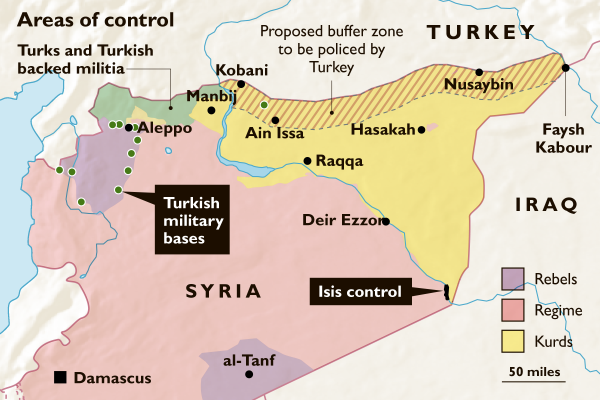
There is a growing perception that the US and Russia are acting on an overall consensus in Syria, with Moscow having the say largely over the area on the western part of the Euphrates River, while the eastern side of the river where the Kurdish forces are present remains under US control. That is to say, the US retains its presence to the east of Euphrates, while the territories to the west of Euphrates come under Russian ‘sphere of influence.’
Conceivably, there could be a Russian-American congruence to keep Turkey out of northeastern Syria. The Iranian media reported on Monday that for the first time, Russian infantry units are being deployed in Bukamal region in Eastern Deir Ezzur province near the Iraqi border where Russia plans “to build military centres”.
On the other hand, Turkey’s partnership with Russia has become increasingly one-sided. Turkey cannot afford to antagonise Russia anymore, whereas, Russia no longer has to wear kid gloves while dealing with Ankara, although Turkey still is a NATO power.
In November 2015, when Turkey shot down a Russian Sukhoi Su-24M attack aircraft, Moscow was ultra-sensitive while reacting. But there is no apology for Monday’s air attack on the Turkish military convoy in Idlib.
The Russian Foreign Minister Sergey Lavrov asserted today that any attacks carried out by Islamist militant groups (which Turkey harbours) in the de-escalation zone in Idlib will be “forcefully suppressed”.
All in all, Russia has concluded that this is an opportune moment to clean up Idlib. Turkey’s proposal to establish a safe zone in northern Syria isn’t getting anywhere. The Turkish demand — a 30 to 40 kilometre deep safe zone stretching 430 kilometres all along the border up to Iraq — is not going to be acceptable to the US. But the US keeps Turkey engaged in talks to buy time while the US-backed Kurdish militia will retain their control of northeast Syria bordering Turkey.
In essence, Turkey risks a quagmire with two fronts — Idlib, where the Syrian offensive backed by Russia will trigger a massive refugee flow into Turkey, and a border with Syria that is dominated by well-armed, battle-hardened Kurdish groups.
US, Turkey must end illegal military presence on Syria soil: Damascus envoy to UN
Press TV – August 21, 2019
Syria’s UN Ambassador Bashar al-Ja’afari has called on the United States and Turkey to end their “illegal military presence” in the Arab country and crimes against civilians.
Speaking at a United Nations Security Council (UNSC) session on Middle East peace and security challenges in New York on Tuesday, Ja’afari urged Washington and Ankara to respect the UN Charter’s principle of non-interference in the internal affairs of other countries and refrain from using force against them.
“The United States and its allies, including the Turkish occupation forces, must be obliged to end their illegal military presence on Syrian territory and to stop their aggressive practices in support of terrorism and their crimes against Syrians, civilian installations and infrastructure,” he said.
He also criticized Turkey for sending a military convoy carrying ammunition into Syria’s Idlib Province in support of the militants holed up in the embattled region.
The Syrian envoy further highlighted the need for the world body to stay focused on the real root causes of the Middle East conflict, including occupation, acts of aggression and destructive interventions in countries’ domestic affairs — such as those aimed at overthrowing governments by force, investing in terrorism and fabricating crises.
“Success in dealing with the challenges facing the region requires upholding the principles of international law and the provisions of the UN Charter and stopping attempts to distort and manipulate its provisions,” he said.
Ja’afari also described Israel’s occupation of Arab territories as the main reason for the crisis in the region.
“The main cause of the conflicts in the Middle East and the inability to achieve peace and stability has been and continues to be the Israeli occupation of Arab territories, including the occupied Syrian Golan,” he said.
Ja’afari further expressed concerns about Israel’s accumulation of weapons of mass destruction, saying the regime should join the Non-Proliferation Treaty (NPT) without delay and subject its facilities to the International Atomic Energy Agency (IAEA)’s safeguards regime.
Jammu and Kashmir: the Legitimacy of Article 370

Photograph Source: Motohiro Sunouchi – CC BY 2.0
By Nyla Ali Khan | CounterPunch | August 20, 2019
Introduction
The recent unilateral decision of Prime Minister Modi’s government to revoke Article 370, which guaranteed the special status of Jammu and Kashmir; dismemberment of the State, and its diminishment are flagrant violations of the sovereign Constitution of India. These maneuvers jeopardize the federal structure of India. The erosion of the rights and privileges of a State is an unhealthy precedent to set in a diverse and federal country. The current curbing of political and civil rights in Jammu and Kashmir is deplorable.
Historical Perspective
On 26 October 1947, Maharaja Hari Singh signed the “Instrument of Accession” to India, officially ceding to the government of India jurisdiction over defense, foreign affairs and communications. The accession of J & K to India was accepted by Lord Mountbatten with the proviso that once political stability was established in the region, a referendum would be held in which the people of the State would either validate or veto the accession. After signing the Instrument of Accession, the maharaja appointed his political adversary, Sheikh Mohammad Abdullah, as the head of an interim government.
On 2 November 1947, Pandit Jawaharlal Nehru, the first Prime Minister of independent India, reiterated his government’s pledge to not only the people of Kashmir, but also to the international community, to hold a referendum in Indian and Pakistani-administered Jammu and Kashmir under the auspices of a world body like the United Nations, in order to determine whether the populace preferred to be affiliated with India or Pakistan. Nehru emphasized this commitment several times at public forums over the next few years.
In January 1948 India referred the Kashmir dispute to the United Nations. Prime Minister Nehru took the dispute with Pakistan over Kashmir beyond local and national boundaries by bringing it before the UN Security Council, and seeking a ratification of India’s “legal” claims over Kashmir. The UN reinforced Nehru’s pledge of holding a plebiscite in Kashmir, and in 1948 the Security Council established the United Nations Commission for India and Pakistan (UNCIP) to play the role of mediator in the Kashmir issue. The UNCIP adopted a resolution urging the government of Pakistan to cease the infiltration of tribal mercenaries and raiders into J & K. It also urged the government of India to demilitarize the State by “withdrawing their own forces from Jammu and Kashmir and reducing them progressively to the minimum strength required for the support of civil power in the maintenance of law and order.” The resolution proclaimed that once these conditions were fulfilled, the government of India would be obligated to hold a plebiscite in the State in order to either ratify or veto the accession of J & K to India.
In the meantime, the Government of Jammu and Kashmir negotiated with the central government to ensure that it would be allowed to function as a fully autonomous unit within the federation. Article 370 of the Constitution of India ensured that apart from defense, foreign affairs, and communications, decisions with regard to other matters would be determined with the consent of the Government of Jammu and Kashmir. There was a reason that special status was guaranteed to Jammu and Kashmir under Article 370 of the Indian Constitution. On 13 July 1950, the new government of J & K, headed by Sheikh Mohammad Abdullah, made a landmark decision.
“Between 1950 and 1952, 700,000 landless peasants, mostly Muslims in the Valley but including 250,000 lower-caste Hindus in the Jammu region, became peasant-proprietors as over a million acres were directly transferred to them, while another sizeable chunk of land passed to government-run collective farms. By the early 1960s, 2.8 million acres of farmland (rice being the principal crop in the Valley) and fruit orchards were under cultivation, worked by 2.8 million smallholding peasant-proprietor households.” (Bose 2003: 27–28)
This metamorphosis of the agrarian economy had groundbreaking political consequences. This revolutionary measure, which greatly improved the human development index in the State, would not have been possible without Article 370. The political logic of autonomy and Article 370 of the Indian Constitution was necessitated by the need to bring about socioeconomic transformations.
The legislative bill, which had orchestrated this transformation, won the unstinting support of thousands of erstwhile disenfranchised peasants. But displaced landlords and officials in the Dogra regime made no bones about their hatred of the political supremacy of the new class of Kashmiri Muslims. This hatred unleashed a reign of terror and brutality against the Valley’s new political class.
The “defining moment in Jammu and Kashmir’s post-Indian independence history” came in 1950 when disenfranchised peasants “were freed from the shackles of landlords through a law that gave them ownership rights on the land they tilled. . . . The sweeping land reforms under the Big Landed Estates Abolition Act passed on July 13, 1950, changed the complexion of Kashmiri society. The historical image of the emaciated local farmer in tatters, with sunken faces and listless eyes, toiling to fill the granaries of landlords changed overnight into one of a landowner who expected to benefit from the labor he had put in for generations” (Ahmed, F.). This program emphasized the necessity of abolishing exploitative landlordism without compensation and enfranchising tillers by granting them the lands they worked on. Many policy makers in the Indian subcontinent, political scientists, and economists have acknowledged the effectiveness and rigor of land reforms in Jammu and Kashmir, which benefited underprivileged farmers in all three parts of the State—Jammu, Kashmir, and Ladakh.
In August 1952, the government of J & K reiterated the commitment of to the principles of secularism and democracy which enabled the forging of ties with the Indian nation-state: “The supreme guarantee of our relationship with India is the identity of secular and democratic aspirations, which have guided the people of India as well as those of Jammu and Kashmir in their struggle for emancipation, and before which all constitutional safeguards will take a secondary position.” For the layperson, the “new Kashmir” in which the hitherto peripheralized Muslim population of the Valley and marginalized women would reinsert themselves into the language of belonging a welcome development.
But the nationalist project of the Praja Parishad had sought the subsumption of religious minorities into a centralized and authoritarian state since the 1940s. These integrative and centralist measures were met with massive opposition, which the government of India suppressed with bloody maneuvers. The volcanic nature of the protests in the Valley gave a veneer of legitimacy to its action of large-scale repression of leaders of the Plebiscite Front. Sheikh Mohammad Abdullah was also arrested, for the umpteenth time, under the Defense of India Rules, to further hush the voices of dissent.
Sheikh Mohammad Abdullah underlined in his letter to Shyama Prasad Mukherjee, founder of the Bharatiya Jan Sangh, in February 1953,
When talking about the constitutional aspect, it is sometimes conveniently forgotten that the Praja Parishad wants that Article 370 should be expunged from the Constitution. So far as we are concerned, we have maintained that the special position accorded to the State can alone be the source of a growing unity and closer association between the State and India. The Constituent Assembly of India took note of the special circumstances obtaining in the State and made provisions accordingly.
To entertain the doubt that the Muslims of Kashmir would now give up their secular ideals would be uncharitable, although the statements and the pronouncements made by the leaders of communal parties in India from time to time and the inspiration and guidance they are providing at the moment to the Praja Parishad leadership in Jammu is, no doubt, giving them a rude shock. But let me assure you and the people of India that the Muslims in Kashmir will not falter from their ideals even if they are left alone in this great battle for secularism and human brotherhood.
As I’ve said on other forums, the Constitution of India seeks to guarantee respect for the rule of law, the independence of the judiciary, and the integrity of the electoral process. But time and again, provisions of the Constitution of India have been breached in Kashmir, and the ideals that it enshrines have been forgotten. In Kashmir, rights relating to life, liberty, dignity of the people, and freedom of expression guaranteed by the Constitution, embodied in the fundamental covenants and enforceable by courts of law, have been flouted. The revocation of Article 370, without consultation, makes it clear that the much lauded parliamentary democracy in India has been unable to protect a genuine democratic set-up in Kashmir.
Heads of Governments cannot avoid their ethical and moral responsibilities toward the peoples of the States in a federal country. The lives of those people cannot be torn asunder by paramilitary forces and other “upholders” of the law.
Blow to Kashmiriyat
“Kashmiriyat” was not handed down to me as an unachievable and abstract construct. On the contrary, it was crystallized for me as the eradication of a feudal structure and its insidious ramifications. It was the right of the tiller to the land he worked on. It was the unacceptability of any political solution that did not take the aspirations and demands of the Kashmiri people into consideration. It was the right of Kashmiris to high offices in education, the bureaucracy and government; the availability of medical and educational facilities in Jammu, Kashmir and Ladakh. It was the preservation of literatures and and historical artifacts that defined an important aspect of “Kashmiriyat.” It was the formation of the Constituent Assembly of J & K to institutionalize the Constitution of the State in 1951, which was an enormous leap toward the process of democratization. It was the fundamental right of both women and men to free education up to the university level. It was, constitutionally, equal opportunities afforded to both sexes in the workplace. It was the nurturing of a contact zone in social, political and intellectual ideologies and institutions. It was pride in a cultural identity that was generated in a space created by multiple perspectives.
Trust cannot be won and unity cannot be maintained by the display of national chauvinism and erosion of Kashmiriyat.
Nyla Ali Khan is the author of Fiction of Nationality in an Era of Transnationalism, Islam, Women, and Violence in Kashmir, The Life of a Kashmiri Woman, and the editor of The Parchment of Kashmir. Nyla Ali Khan has also served as an guest editor working on articles from the Jammu and Kashmir region for Oxford University Press (New York), helping to identify, commission, and review articles. She can be reached at nylakhan@aol.com.
The Deeper Meaning in a Lost War
By Alastair Crooke | Strategic Culture Foundation | August 19, 2019
It’s pretty clear. Saudi Arabia has lost, and, notes Bruce Riedel, “the Houthis and Iran are the strategic winners”. Saudi proxies in Aden – the seat of Riyadh’s Yemeni proto-‘government’ – have been turfed out by secular, former Marxist, southern secessionists. What can Saudi Arabia do? It cannot go forward. Even tougher would be retreat. Saudi will have to contend with an Houthi war being waged inside the kingdom’s south; and a second – quite different – war in Yemen’s south. MbS is stuck. The Houthi military leadership are on a roll, and disinterested – for now – in a political settlement. They wish to accumulate more ‘cards’. The UAE, which armed and trained the southern secessionists has opted out. MbS is alone, ‘carrying the can’. It will be messy.
So, what is the meaning in this? It is that MbS cannot ‘deliver’ what Trump and Kushner needed, and demanded from him: He cannot any more deliver the Gulf ‘world’ for their grand projects – let alone garner together the collective Sunni ‘world’ to enlist in a confrontation with Iran, or for hustling the Palestinians into abject subordination, posing as ‘solution’.
What happened? It seems that MbZ must have bought into the Mossad ‘line’ that Iran was a ‘doddle’. Under pressure of global sanctions, Iran would quickly crumble, and would beg for negotiations with Trump. And that the resultant, punishing treaty would see the dismantling of all of Iran’s troublesome allies around the region. The Gulf thus would be free to continue shaping a Middle East free from democracy, reformers and (those detested) Islamists.
What made the UAE – eulogised in the US as tough ‘little Sparta’ – back off? It was not just that the Emirs saw that the Yemen war was unwinnable. That was so; but more significantly, it dawned on them that Iran was going to be no ‘doddle’. But rather, the US attempt to strangulate the Iranian economy risked escalating beyond sanctions war, into military confrontation. And in that eventuality, the UAE would be devastated. Iran warned explicitly that a drone or two landed into the ‘glass houses’ of their financial districts, or onto oil and gas facilities, would set them back twenty years. They believed it.
But there was another factor in the mix. “As the world teeters on the edge of another financial crisis”, Esfandyar Batmanghelidj has noted, “few places are being gripped by anxiety like Dubai. Every week a new headline portends the coming crisis in the city of skyscrapers. Dubai villa prices are at their lowest level in a decade, down 24 percent in just one year. A slump in tourism has seen Dubai hotels hit their lowest occupancy rate since the 2008 financial crisis – even as the country gears up to host Expo 2020 next year. As Bloomberg’s Zainab Fattah reported in November of last year, Dubai has begun to “lose its shine,” its role as a center for global commerce “undermined by a global tariff war—and in particular by the US drive to shut down commerce with nearby Iran””.
An extraneous Houthi drone landing in Dubai’s financial zone would be the ‘final nail in the coffin’ (the expatriates would be out in a flash) – a prospect far more serious than the crisis of 2009, when Dubai’s real estate market collapsed, threatening insolvency for several banks and major development companies, some of them state-linked – and necessitating a $20 billion bailout.
In short, the Gulf realised MbS’ confrontation project with Iran was far too risky, especially with the global financial mood darkening so rapidly. Emirati leaders faced off with MbZ, the confrontation ideologue – and the UAE came out of Yemen formally (though leaving in situ its proxies), and initiated outreach to Iran, to take it out of that war, too.
It is now no longer conceivable that MbS can deliver what Trump and Netanyahu desired. Does this then mean that the US confrontation with Iran, and Jared Kushner’s Deal of the Century, are over? No. Trump has two key US constituencies: AIPAC and the Christian Evangelical ‘Zionists’ to ‘stroke’ electorally in the lead up to the 2020 elections. More ‘gifts’ to Netanyahu in the lead into the latter’s own election campaign are very likely also, as a part of that massaging of domestic constituencies (and donors).
In terms of the US confrontation with Iran, it seems that Trump is turning-down the volume on belligerence toward Iran, hoping that economic sanctions will work their ‘magic’ of bringing the Islamic Republic to its knees. There is no sign of that however – and no sign of any realistic US plan ‘B’. (The Lindsay Graham initiative is not one).
Where does that leave MbS in terms of US and Israeli interests? Well, to be brutal, and despite the family friendships … ’expendable’, perhaps? The scent of an eventual US disengagement from the region is again hanging in the air.
The deeper meaning in the ‘lost Yemen war’, ultimately, is an end to Gulf hopes that ‘magician’ Trump would undo the earlier Gulf panic that the West would normalise with Iran (through the JCPOA), thus leaving Iran as the paramount regional power. The advent of Trump, with all his affinity towards Saudi Arabia, seemed to Gulf States to promise the opportunity again to ‘lock in’ the US security umbrella over Gulf monarchies, protecting these states from significant change, as well as leaving Iran ‘shackled’, and unable to assume regional primacy.
A secondary meaning to Yemen is that Trump and Netanyahu’s heavy investment in MbS and MbZ has proved to be chimeric. These two, it turned out were ‘naked’ all along. And now the world knows it. They can’t deliver. They have been bested by a ragtag army of tough Houthi tribesmen.
The region now observes that ‘war’ isn’t happening (although only by the merest hair’s breadth): Trump is not – of his own volition – going to bomb Iran back to the 1980s. And Gulf States now see that if he did, it is they – the Gulf States – who would pay the highest price. Paradoxically, it has fallen to the UAE, the prime agitator in Washington against Iran, to lead the outreach toward Iran. It represents a salutary lesson in realpolitik for certain Gulf States (and Israel). And now that it has been learned, it is hard to see it being reversed quite so easily.
The strategic shift toward a different security architecture is already underway, with Russia and China proposing an international conference on security in the Persian Gulf: Russia and Iran already have agreed joint naval exercises in in the Indian Ocean and Hormuz, and China is mulling sending its warships there too, to protect its tankers and commercial shipping. Plainly, there will be some competition here, but Iran has the upper hand still in Hormuz. It is a powerful deterrent (though one best threatened, but not used).
Of course, nothing is assured in these changing times. The US President is fickle, and prone to flip-flop. And there are yet powerful interests in the US who do want see Iran comprehensively bombed. But others in DC – more significantly, on the (nationalist) Right – are much more outspoken in challenging the Iran ‘hawks’. Maybe the latter have missed their moment? The fact is, Trump drew back (but not for the stated reasons) from military action. America is now entering election season – and it is fixated on its navel. Foreign policy is already a forgotten, non-issue in the fraught partisan atmospherics of today’s America.
Trump likely will still ‘throw Israel a few bones’, but will that change anything? Probably, not much. That is cold comfort – but it might have been a lot worse for the Palestinians. And Greater Israel? A distant, Promethean hope.
Police raid Aqsa Mosque’s Bab al-Rahma, seize furniture

Days of Palestine – August 18, 2019
Israeli occupation police, on Saturday evening, stormed Al-Aqsa Mosque’s Bab al-Rahma prayer area and confiscated some furniture items.
Local sources said that Israeli police officers desecrated the Bab al-Rahma prayer area and embarked on carrying away shoe cabinets and patterned wood panels.
The sources added that the officers threatened Aqsa guards with arrest if they tried to prevent them from carrying out the confiscations.
The Israeli police had already removed furniture from the same prayer area recently, raising fears among the Jerusalemites about Israeli intents to reclose the place and turn it into a synagogue.
FCO Speeds Up Planning to Move UK Embassy to Jerusalem
By Craig Murray | August 18, 2019
Following US National Security Adviser John Bolton’s talks with Boris Johnson and his ministers in London last week, FCO officials have been asked to speed up contingency planning for the UK to move its Embassy in Israel from Tel Aviv to Jerusalem, with an eye to an “early announcement” post Brexit.
The UK is currently bound by an EU common foreign policy position not to follow the United States in moving its Embassy to Jerusalem. As things stand, that prohibition will fall on 1 November. FCO officials had previously been asked to produce a contingency plan, but this involved the construction of a £14 million new Embassy and a four year timescale. They have now been asked to go back and look at a quick fix involving moving the Ambassador and immediate staff to Jerusalem and renaming the Consulate already there as the Embassy. This could be speedily announced, and then implemented in about a year.
Johnson heads the most radically pro-Israel cabinet in UK history and the symbolic gesture of rejection of Palestinian rights is naturally appealing to his major ministers Patel, Javid and Raab. They also see three other political benefits. Firstly, they anticipate that Labour opposition to the move can be used to yet again raise accusations of “anti-semitism” against Jeremy Corbyn. Secondly, it provides good “red meat” to Brexiteer support in marking a clear and, they believe, popular break from EU foreign policy, at no economic cost. Thirdly, it seals the special link between the Trump and Johnson administrations and sets the UK apart from other NATO allies.
Bolton also discussed the possibility of UK support for Israeli annexation of areas of the West Bank to “solve” the illegality of Israeli settlements on occupied territory. My FCO sources believe this is going to be much more difficult politically for the Cabinet to agree than simply moving the Embassy, due to lack of support on their own backbenches.
This is an insight into the future of British foreign policy if the Johnson government, and the UK, both survive. In the massive defeat of the UK at the UN General Assembly two months ago over the illegal occupation of the Chagos Islands, the UK was in a voting block with only the USA, Israel, Australia, Hungary and the Maldives, against the rest of the world. The Maldives had a particular maritime interest there, but the leadership of the others – Donald Trump, Viktor Orban, Scott Morrison, Benjamin Netanyahu and now Boris Johnson – constitute a distinct and extreme right wing bloc. These are very worrying times indeed.
US Nuclear Weapons Should Be Out of Germany Along With Its Troops, German Lawmaker Says
By Polina Strelnikova – Sputnik – 12.08.2019
US Ambassador Richard Grenell’s renewed criticism of Berlin’s failure to spend more on defence and praising an idea to withdraw American troops from Germany has prompted a backlash in one of Washington’s key allies in Europe. The head of the left-wing party Die Linke’s parliamentary group has welcomed this idea.
Member of the German Parliament Bundestag Dietmar Bartsch has told the German editorial network RND that the German government should “absolutely accept” US Ambassador Richard Grenell’s offer and not only discuss a plan to pull out US troops from Germany but also try to get rid of Washington’s nuclear weapons in the country.
“The US ambassador is right: US taxpayers should not have to pay for US troops in Germany. The US taxpayers also do not have to pay for deploying nuclear weapons in Germany. If the Americans pull their soldiers out, they should take their nuclear weapons with them”, he demanded.
He insisted that they should take them back home and not to Poland, noting that the latter scenario “would be another dramatic escalation in relations with Russia, which does not coincide with European and German interests”.
However, not everyone on the left wing of the German political spectrum seemed to like the idea. German MP Carsten Schneider, who represents the Social Democrats, called Grenell’s statements, which echoed an earlier remark by US Ambassador to Poland Georgette Mosbacher, “completely inappropriate for allies”. He stated that Germany cannot be blackmailed, and that the “general’s pose wears off”.
The criticism was prompted by Grenell’s recent interview with the German news agency DPA, in which he stated that it was “insulting to expect that the US taxpayer pays for more than 50,000 Americans in Germany, but the Germans use their trade surplus for domestic purposes” and backed Donald Trump’s idea to relocate troops from Germany to Poland.
Mosbacher earlier noted that Poland meets its payment obligation of 2% of GDP, as agreed upon within NATO, while Germany does not do that, so it would be better if American troops go to Poland.
Although Germany announced plans to increase military spending up to 1.35% in 2019 and hopes to boost the number up to 1.5% by 2023, it still falls short of planning to reach the 2% goal, set by NATO members in 2014.
Trump has persistently criticised Germany’s reluctance to comply with this voluntary goal since having taken office. He also previously suggested that a 2,000-strong increase to American forces stationed in Poland should be achieved at the expense of those based in Germany.
Meanwhile, US warheads deployed in Germany have been a point of heated debates within the country with many, including politicians from coalition junior partner, the SPD, demanding that US nuclear weapons be removed from its territory.
Gentle and Loving but Still a Settler
By Jeremy Salt | American Herald Tribune | August 11, 2019
Last week a car drew up alongside Dvir Sorek outside the West Bank settlement of Migdal Oz. Dvir was on his way back from Jerusalem where he had bought a book, a novel by David Grossman, as a gift for his teacher. He was almost home when a man jumped out of the car and stabbed him to death.
David Grossman did not know him but did not hesitate to add to the eulogies: the young man was clearly “a kind, sensitive youth who loved others and loved peace with the soul of an artist.” Netanyahu declared that the murderers would soon be found. Soldiers swooped on the nearby Palestinian village of Beit Fajjar, raiding houses and confiscating security camera footage. Later four Palestinians were arrested in another village.
Grossman’s son was killed during the invasion of Lebanon in 2006, and Sorek’s grandfather on his mother’s side, a rabbi, also a settler of occupied land, killed in an attack near Nablus in 2000. These other deaths made the killing of Dvir Sorek seem even more poignant. “Death as a way of life,” declared the Times of Israel, blaming Hamas for the attack, even though the identity and possible ideological affiliations of the attacker/s were not known, as if the death of others was not a way of life for the state of Israel.
The media described Sorek as a student at a yeshiva, or religious school, in his case the hesder (‘arrangement’) yeshiva at Migdal Oz. The programs in the hesder schools blend advanced religious instruction with military service. Government funding makes an application to be listed as a hesder yeshiva an attractive option. Not all courses are of the same duration. They may last for three, four or even five years, with the active military service component varying from about 17 months to two years. Almost all hesder yeshiva students join combat units.
Officially, the peace-loving Dvir Sorek was an IDF soldier even though he had not yet begun the military component of his course. No doubt this is the reason he was not armed when he was attacked.
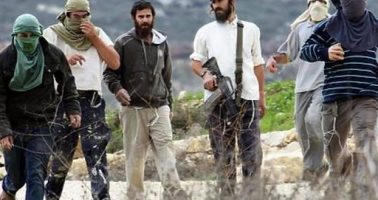
In the West Bank yeshiva students, or former yeshiva students, especially those who fall under the heading of the ‘hilltop youth,’ are in the forefront of anti-Palestinian violence, from beating and occasionally killing to attacks on mosques, the destruction of olive trees and crops and the harassment, intimidation and abuse of the general population in general, women and children included. Their hatreds extend to all non-Jews and even ‘Hellenized’ or secular Jews, including those representing the state, including the soldiers who protect them. One has to wonder where this comes from if not religious instruction at the hands of their rabbis.
The history of the hesder schools go back to the 1960s. More recently, the lack of enthusiasm for war among Israel’s secularized youth, especially wars fought on the other side of what they regarded as Israel’s borders, has increased the appeal of religiously indoctrinated hesder zealots to the military command.
For secular Israeli Jews the enemies are Hamas, Hizbullah, Syria and behind them, Iran, but for orthodox religious Jews, the enemy is Amalek, existential, taking different shapes and different forms at different stages of history but always there.
The injunction to destroy the tribe of Amalek is laid down in several passages of the Bible. According to Deuteronomy: “The Lord said to Moses ‘Write this down in a book to be remembered and tell it to Joshua: (God) will completely blot out any memory of Amalek … Remember what Amalek did to you on the road as you were coming out of Egypt, how he met you on the road, attacked those in the rear, those who were exhausted and straggling behind when you were tired and weary. He did not fear God. Therefore, when the Lord your God has given you rest from all your surrounding enemies in the land the Lord your God is giving you as your inheritance to possess you (Israelites) are to blot out all memory of Amalek from under heaven. Don’t forget!’ (Deuteronomy 25/17-19).
The message to the first king of Israel and Judah, Saul, from the prophet Samuel is even more forceful: “Now go, attack the Amalekites and totally destroy all that belongs to them. Do not spare them: put to death men and women, children and infants, cattle and sheep, camels and donkeys.’ (Samuel 1:15.3). Saul went to war against the Amalekites but did not kill them all, allowing their king to live and preserving the best of the livestock.
Learning of this, Samuel tells him he has been rejected by God and will lose his kingdom. He then kills the Amalekite himself. Saul lives until defeated by the Philistines in the battle of Gilboa, after which he either commits suicide or is killed by an Amalekite, according to differing Bible accounts but his death is seen as the consequence of having disobeyed God’s injunction to kill all the Amalekites.
All of this might have happened thousands of years ago – or did not happen as described – but it remains as fresh as yesterday in the thinking of orthodox religious scholars. In the modern age these injunctions are subject to numerous interpretations, partly based on what ‘blotting out’ could mean. Maimonides (12th-13th century) explains the commandment as meaning that if the Amalekites accepted Jewish law and agreed to pay a tax there would no need to kill them. There are numerous variations on the theme that ‘blotting out’ did not mean physical annihilation.
Steven Leonard Jacobs points out that the overwhelming majority of the world’s Jewish population does not draw such deadly conclusions, “much less the implication that they [the Palestinians] must be genocidally destroyed.” While those who do take the Biblical injunctions literally “are in the minority … they do exist and [they] present an ongoing challenge to how one reads history and sacred texts.” They keep the door open to violence: however wrongly understood, “there is an understanding that the enemies of the Jewish people are the literal and lineal descendants of the past.”
These genocidal invocations – as they would be regarded now – are read in synagogues at certain times of the year (during the ‘reading cycle’) and are emphasized again during the festival of Purim, celebrating the delivery of the Jews from Haman, the high Persian court official who planned to kill them all.
For the most extreme Jewish settlers, Amalek is still out there, waiting. According to Benzi Lieberman, former head of the Yesha settler council, “The Palestinians are Amalek … we will destroy them. We won’t kill them but we will destroy their ability to think as a nation. We will destroy Palestinian nationalism.”
However, Amalek is frequently invoked in the political mainstream, which has steadily shifted further to the right since the election of Menahim Begin in 1977 and now includes those once regarded as extremists if not outright fanatics. In the 1950s David Ben-Gurion referred to “the hosts of Amalek from north, east and south.” Begin opposed reparations from Germany, which he regarded as Amalek. During the siege of Beirut in 1982 he described PLO leader Yasser Arafat as Hitler hiding in his bunker, thus another manifestation of Amalek. Speaking in Cracow in 2010, without naming names but clearly thinking of Iran, Netanyahu said “A new Amalek is appearing and once again threatens to annihilate the Jews.” According to the ‘libertarian’ Israeli politician Moshe Feiglin “the Arabs engage in typical Amalek behaviour … I can’t prove this genetically but this is the behaviour of Amalek.”
Throughout history, while identifying Amalek as the existential enemy, Jews never had the power to destroy Amalek but now they do, in a state of their own that has an arsenal of nuclear weapons. According to Steven Jacobs “the propensity of rightwing settlers to identify the Palestinians with the Amalekites has sometimes had deadly consequences” The commandment to exterminate the Amalekites has been preserved by the rabbis “and for that reason, it remains a potential source of conflict.” Needless to say, Mr Jacobs does not regard the Palestinians as Amalekites.
Dvir Sorek was 18 and only a few days short of his 19th birthday when he was killed. He had not begun the military component of his course but in his religious studies he would have had to consider the injunctions to ‘blot out’ the Amalekites. What impact this would have had on his development as a soldier no-one can say.
In the eulogies Dvir was described as a gentle soul, as innocent and full of love for family and friends, all of which he probably was, but he was also living in occupied territory. Ofra, the settlement in which he lived, is illegal even under Israeli law because it was largely built on privately owned Palestinian land.
While a Palestinian drove in the knife, who must take ultimate responsibility for his death, if not the state which seized the land and the settler-colonists who have moved there, including Dvir’s parents? They may have shared the belief that the land was God’s selective gift to the Jewish people; they may have decided to live there because of subsidised housing and tax breaks but whatever their motives, they were living on the West Bank in breach of international law and they would have known it.
The UN General Assembly has passed numerous resolutions affirming the right to resist colonial domination and occupation by all means. It is only putting into print what has been human practice since the beginning of time. An occupied people will resist with all the means at their disposal. In the 1950s the white settlers of Kenya no doubt included loving gentle souls, but they were killed just as ruthlessly as anyone else by the Mau Mau. In the last stages of the Algerian war of independence (1964-62), the FLN (National Liberation Front) slaughtered many French settlers, including women and children innocent of any crime but part of a white settler community which had established itself through violence, collective punishment, the expropriation of land and the ‘purchase’ of land on the basis of forged or spurious documents. Needless, these are the precise tactics used by the Zionists in their occupation of Palestine.
For those whose land is being occupied, it is immaterial whether the colonial settler is a gentle soul or a ranting religious bigot or a family looking for subsidised housing and tax breaks. The settler is always the settler, the usurper of someone else’s lands and rights, to be resisted as long as possible.
It was the Zionists who began the cycle of violence in Palestine and logic demands that they must take the first steps to end it but for the Israeli government, logic is the logic of force and not the logic of justice, law, ethics and morality. The wrong, fateful, irreversible decisions Israel has made will mark its history forever: occupation instead of withdrawal, injustice instead of justice, war instead of peace, including more war, inevitably, beyond the borders of Palestine.
Israel has never had such a degree of military, economic and political support from its great benefactor, the US. Drugged with the sense of its own power it builds even more settlements as it moves steadily towards annexation, thereby guaranteeing that there will be more Dvir Soreks, and far more Palestinian men, women and children killed in the struggle against occupation. Israel is dragging itself and the region into a future even darker than the past.
Jeremy Salt has taught at the University of Melbourne, Bosporus University (Istanbul) and Bilkent University (Ankara), specialising in the modern history of the Middle East. His most recent book is “The Unmaking of the Middle East. A History of Western Disorder in Arab Lands” (Berkeley: University of California Press, 2008.)
Featured Video

Trita Parsi: Israel Set a Trap for Total War in the Region
or go to
Aletho News Archives – Video-Images
Book Review
Why the War on Conspiracy Theories Is Bad Public Policy
By Kevin Barrett • Unz Review • February 1, 2019
 A Review of Conspiracy Theories and Other Dangerous Ideas by Cass Sunstein (based on an earlier paper co-authored with Adrian Vermeule); In Defense of Troublemakers: The Power of Dissent in Life and Business by Charlan Nemeth; and Conspiracy Theories and the People Who Believe Them, edited by Joseph E. Uscinski
On January 25 2018 YouTube unleashed the latest salvo in the war on conspiracy theories, saying “we’ll begin reducing recommendations of borderline content and content that could misinform users in harmful ways—such as videos promoting a phony miracle cure for a serious illness, claiming the earth is flat, or making blatantly false claims about historic events like 9/11.”
At first glance that sounds reasonable. Nobody wants YouTube or anyone else to recommend bad information. And almost everyone agrees that phony miracle cures, flat earthism, and blatantly false claims about 9/11 and other historical events are undesirable.
But if we stop and seriously consider those words, we notice a couple of problems. First, the word “recommend” is not just misleading but mendacious. YouTube obviously doesn’t really recommend anything. When it says it does, it is lying. … continue
Blog Roll
 Aletho News
- Trita Parsi: Israel Set a Trap for Total War in the Region
- Trump’s Iran war is on an Israeli leash
- Saudi oil boss issues global supply warning
- Riyadh Says Its Oil System Is Intact. The Numbers Say Otherwise.
- Trump and Netanyahu Want to “Finish the Job” on Iran
- US ‘one-sided dictation’ not Iran’s beliefs makes rational talks impossible: Baghaei
- Iran’s Next Strike May Not Explode. It Could Shut You Down /Col Doug Macgregor
- Iran: US political targets legitimate if assassinations return
- Iraq shuts key border crossing with Iran under US pressure: Report
- Undersea Internet cables could be targeted in retaliation for attacks on Iran: IRGC deputy chief
- If Americans Knew
- The Israel Lobby’s Changing Fortunes
- AIPAC has become such a political liability that it’s shifting to a more “nimble” approach to buying politicians
- At least 160 Israeli settler attacks in 2 weeks
- Will Gaza’s Ancient Christian Community Disappear Forever?
- Israel’s vision of regional security rests on keeping Arab states weak
- Heidi Levine recounts how Palestinian youths helped save her in settler attack
- DAILY UPDATE: Latest essential news on Palestine, Israel, & region
- Trump’s Intensifying Sabotage of the ICC, for Israel’s Sake
- Israeli military detain US and UK volunteers in West Bank including Democratic NY politician Brad Lander
- Americans at National Conservatism Conference held in Israel this year criticize Israel
- No Tricks Zone
- E-Cars Reduce CO2 Emissions By Only 41% Compared To Internal Combustion Engine Vehicles
- Predictions Made By Renowned Climate Professor Over Past Decades Have Been Proven To Be Poor
- New Study Suggests Large Regions Of The Pacific Ocean Have Been Cooling For The Last 80 Years
- Germany’s Green Energy Debacle: High Energy Costs Force Kahla Porzellan to Close After 182 Years!
- New Study: 50 Years Of The Most Aggressive ‘Net Zero’ Policies Can Only Affect The Global Climate By 0.03°C
- US September “Heat” Was No Record…Many Records Set Decades Ago
- Latest European Green Energy Debacle; Portugal’s Largest Flagship Solar Park Insolvent!
- Green Energy Debacle: German Expert Professor Fritz Vahrenholt Warns Of Severe Economic And Social Consequences
- Two More Paleo Reconstructions Affirm Meters-Higher Sea Levels Across Ireland, Brazil 7000-6000 Years Ago
- New Study: Earth And Venus Surface Warmth Largely Explained By Convection And Lapse Rate, Not CO2 Or Radiation

