Riyadh doesn’t yet know who carried oil strikes or why: Saudi energy minister
Press TV – September 17, 2019
Saudi Energy Minister Prince Abdulaziz bin Salman says Riyadh does not yet know who were behind the highly disruptive drone attacks on Saudi Aramco petroleum and gas processing plants at Abqaiq and Khurais in the kingdom’s Eastern Province, which sent crude prices skyrocketing.
“We don’t know who is behind the attack,” he told reporters in the western Red Sea city of Jeddah on Tuesday, adding that Riyadh wants “proof based on professionalism and internationally recognized standards.”
Prince Abdulaziz, who was only appointed to the role earlier this month, went on to say that Saudi Arabia had dipped into its strategic reserves to maintain supply to clients.
He said stricter measures were needed to be taken to prevent further attacks, but did not provide any elaboration.
The Saudi energy minister then alleged that the kingdom would achieve 11 million barrels per day (bpd) capacity by the end of September, and 12 million bpd by the end of November.
“Restoring sustainable production capacity to 11 million bpd by the end of the month is an ambitious target, given the amount of repairs required” at the sites, Alex Schindelar, president of the Energy Intelligence group, told AFP though.
The remarks come as the United States has tried to build its case that Iran was behind the attacks. Iran has denied being behind the assaults, which knocked out half of Saudi Arabia’s oil production.
Yemen’s Houthi Ansarullah movement has claimed responsibility for the attacks, warning Saudi Arabia that their targets “will keep expanding.”
On Tuesday, Ansarullah censured support for the Saudi-led coalition of aggressors in the wake of Yemeni retaliatory drone attacks on Aramco oil facilities in eastern Saudi Arabia, stressing that those who have no reservations at all about the bloodletting in the war-ravaged country must bear the consequences of their actions.
“Peace in the region can be restored only through dialogue and understanding, and away from the clatter of weapons. Yemeni people hope to see security and peace prevail across the Arabian Peninsula. They will never surrender to oppression and others’ domination,” Mohammed Abdul-Salam, spokesman for the movement, said in a string of tweets.
He added, “Those condemning the September 14 operation have indeed denounced themselves as they have exposed their blatant bias in favor of the aggressor. In fact, their condemnation would embolden the criminal regime to continue its criminal acts against our people.”
The senior Houthi official noted that “Saudi oil is not more precious than Yemeni blood,” emphasizing that those who have no respect whatsoever for the Yemeni people’s lives must embrace all consequences of their actions.
Saudi Arabia and a number of its regional allies launched a devastating campaign against Yemen in March 2015, with the goal of bringing the government of former president Abd Rabbuh Mansur Hadi back to power and crushing Ansarullah movement.
The US-based Armed Conflict Location and Event Data Project (ACLED), a nonprofit conflict-research organization, estimates that the war has claimed more than 91,000 lives over the past four and a half years.
The war has also taken a heavy toll on the country’s infrastructure, destroying hospitals, schools, and factories. The UN says over 24 million Yemenis are in dire need of humanitarian aid, including 10 million suffering from extreme levels of hunger.
Pompeo blames Iran for drone attack on Saudi oil facilities, Senator Graham urges US to strike it
RT | September 14, 2019
A drone attack on Saudi oil facilities claimed by Yemen’s Houthi rebels prompted Washington to blame Tehran, with US warhawk, Senator Lindsey Graham, calling for a strike against Iran.
The smoke from the huge fires at the world’s largest oil processing plant caused by the strike had barely dissipated when officials in Washington jumped at the opportunity to use the occasion to push an anti-Iranian agenda.
US Secretary of State Mike Pompeo blamed Tehran for what he called “an unprecedented attack on the world’s energy supply” but stopped short of suggesting any retaliatory measures.
Meanwhile Graham was quick to turn to Twitter to call for swift retaliation.
The senator linked the need to stop Iran’s alleged “provocations” to the seemingly ultimate goal of Washington’s policy toward Tehran – regime change – as he said that the Islamic Republic would not stop until the consequences of its “misbehavior” would be “more real, like attacking their refineries, which will break the regime’s back.”
Riyadh denounced the drone strike as a “terrorist attack” but did not immediately name a perpetrator. Houthis claimed responsibility for the Saturday morning assault, which resulted in massive blazes at the refinery in the city of Abqaiq in the kingdom’s oil-rich Eastern Province and another facility at the vast Khurais oil field, around 150km (93 miles) from Riyadh.
US President Donald Trump has already phoned Saudi Crown Prince Mohammed bin Salman and offered help to the Kingdom in ensuring its security. He also said that the attack on the Saudi oil facilities could be detrimental to the American and the global economy.
The International Energy Agency (IEA) said, though, that the attack is unlikely to affect the global oil markets as they are “well supplied with ample commercial stocks.” Yet, it also said it is closely monitoring the situation and is in contact with the Saudis and “major producer and consumer nations.”
The IEA statement came amid media reports that the attack forced Riyadh to cut oil production by as much as 5 million barrels a day, which is equivalent to roughly half of its total oil output and about five percent of the global oil supply.
The Saturday attack has become the most successful strike the Houthis have launched against the Saudis, who have been leading a bombing campaign in Yemen since it intervened in the nation’s civil war in 2015. In May, armed drones caused minor damage to two Saudi Aramco state oil companies’ pumping stations in the Eastern Province.At that time, Riyadh blamed Iran for the attack, which was claimed by the Yemeni rebels as well. Tehran denied the allegations.
The Saudi-led coalition’s military campaign in Yemen has itself been repeatedly criticized by the UN and various international human rights groups, which repeatedly pointed to the mass civilian casualties resulting from the coalition’s airstrikes
War is imposed on us by US, we can fight it for 100 years, Taliban tells RT after talks cut off
RT | September 13, 2019
Talks with the Taliban to put an end to the longest of America’s forever wars were killed off by the US last week. The Afghan militant movement is prepared to fight a hundred more years, its chief negotiator told RT.
The peace negotiations between the US and the Taliban were called off by President Donald Trump days ahead of a planned signing of a formal agreement. The draft has even been initialed by both parties and Qatar, which mediated in the talks, Sher Mohammad Abbas Stanikzai, who headed the Taliban’s delegation, told RT. As far as the Taliban is concerned, the US decision can be easily reversed and the agreement put into force as agreed, he said.
“We are still committed to the negotiations. Our stance is that there is no solution to the conflict except negotiations and except peace on the table. We hope that Mr. Trump rethinks his announcement and comes back to where we were,” the official said.
Trump cited an attack by the Taliban, which killed a US soldier stationed in Afghanistan, as the reason for the surprise cancellation of the talks. The militants say their attacks were well justified by attacks against them by the US and the Afghan security forces. They see the Americans as a foreign occupying force and themselves as freedom fighters and protectors of the Afghan civilians, who are injured and killed when the US attacks the Taliban, which regularly conducts terrorist attacks.
“The war was imposed on us. It is American soldiers who are in Afghanistan. It’s not our mujahedeen in Washington,” he said. He added that Trump’s justification for stopping talks clashed with statements by Secretary of State Mike Pompeo, who appeared on TV the following day and said the US killed “over 1,000 Taliban” over ten prior days, as negotiations were under way.
“Mr. Pompeo admitted that they have killed a thousand Taliban,” Stanikzai pointed out. “If they can kill a thousand of us, why can we not kill one or two of them? This is our right. We have to defend ourselves and defend our people.”
The Taliban representative said the Trump administration proved to be no different to that of Barack Obama, which also held peace talks with the Afghan militants before ending them at the last moment. He questioned Washington’s commitment to resolving the situation and ending what is now a 19-year-long anti-insurgency war that the US apparently cannot win through military force.
“If the American side is not willing to negotiate and they do not want peace on the table, we will be compelled to defend ourselves,” he said.
“We can do it for a hundred years.”
Stanikzai reiterated that only after a formal agreement is signed and US troops are pulled out of Afghanistan would the Taliban be able to settle its differences with other political forces in Afghanistan, including the US-backed government in Kabul.
“We need a practical thing. When it is signed, there will be [a] ceasefire between us and the American forces. We will give safe passage to the American forces,” he said. “When they go out, inter-Afghan talks can start and a comprehensive ceasefire and other domestic issues can be discussed.”
Moscow condemns Netanyahu’s annexation bid on eve of his visit to Russia
Press TV – September 11, 2019
Russia has strongly condemned Israeli Prime Minister Benjamin Netanyahu’s election pledge to annex north of the Dead Sea and Jordan Valley in the occupied West Bank on the eve of his visit to the Russian city of Sochi.
In a statement on Wednesday, the Russian Foreign Ministry warned that the implementation of Netanyahu’s plan may result in a “sharp escalation of tension in the region”.
It may also “undermine hopes for a long-awaited peace” in the region, the statement added, urging Tel Aviv to return to direct negotiations based on “relevant UN Security Council resolutions, the Madrid Principle and the Arab Peace Initiative.”
The condemnation came on the eve of Netanyahu’s visit to the Black Sea resort city of Sochi, where he is scheduled to hold talks with Russian President Vladimir Putin on Thursday.
The visit, announced on Tuesday, will be held just five days before the Israeli snap legislative elections. The last time Putin and Netanyahu met was in Moscow on April 4, again five days before the last Israeli election.
Netanyahu has promised to go ahead with the annexation plan in case he emerges victorious in the forthcoming votes.
“Today I announce my intention to apply with the formation of the next government Israeli sovereignty over the Jordan Valley and northern Dead Sea,” Netanyahu said in a speech broadcast live on Israeli TV channels on Tuesday evening.
The 69-year-old Chairman of the Likud-National Liberal Movement also reiterated his intention to annex Israeli settlements throughout the occupied West Bank if re-elected, and in coordination with US President Donald Trump.
The plan has drawn sharp criticism from countries in the Middle East, including Jordan and Turkey, and international bodies like the UN and the Arab League.
Iran on Wednesday said the Israeli prime minister seeks to stay in power through annexations and anti-Iran accusations.
“Netanyahu is after votes to stay in power and continue with expansionist policies and aggression one day through making accusations against the Islamic Republic of Iran and one day by announcing his malicious intention to annex certain parts of Palestine,” Iranian Foreign Ministry Spokesman Abbas Mousavi said.
Ironically enough, Saudi Arabia that has been seeking to normalize ties with Israel also criticized Netanyahu for this “dangerous escalation against the Palestinian people” and called for an emergency meeting of the Organization of Islamic Cooperation (OIC).
The OIC later announced on Wednesday it will call an emergency meeting soon at the level of foreign ministers to review the Israeli premier’s plan.
The OIC Secretary General Yousef bin Al-Othaimeen strongly condemned Netanyahu’s intention, emphasizing that the “dangerous announcement is another aggression against the Palestinian people’s rights.”
He said the OIC meeting will discuss the possible political and legal measures that could be taken to confront Israel’s new aggression.
Condoleeza Rice wants the US to stay in Afghanistan, and this time it’s for ‘the women’
RT | September 11, 2019
Former National Security Advisor and State Secretary Condoleeza Rice appeared on a late-night comedy show, calling for a continued US presence in Afghanistan, this time for apparently feminist reasons. She was swiftly called out.
After some de-rigeur Trump-bashing, host Stephen Colbert and Rice got down to the topic at hand: President Donald Trump’s decision to host, and then cancel, a meeting with the Afghan Taliban at Camp David last week.
Speculating that Trump might cut a deal with the Islamic militants to wrap up the war in Afghanistan –which turns 18 next month– by any means necessary, Rice made the case for continued American involvement in the country. “I hope we’re not going to abandon the women of Afghanistan,” she proclaimed, to cheers from the audience.
“We’ve gone a long way toward helping to create a decent place for the Afghan people to live,” she continued, without mentioning that an estimated 38,000 civilians have been killed in Afghanistan since 2001, along with more than 2,400 US troops, 4,000 US contractors and 58,500 Afghan military and police personnel.
While she trumpeted the fact that women may now join Afghanistan’s military and police force, Rice did not mention the near-weekly attacks on these forces, like the Taliban bombings that killed at least 179 security personnel in one week at the beginning of this month.
Commenters were quick to call out the former Bush administration official. “‘Women of Afghanistan’ is a strange euphemism for defense contractors,” one wrote. “[I] Love late night comedy,” another sarcastically quipped.
And while life for these women under the Taliban was certainly repressive and cruel, life with American boots on the ground and drones in the sky can be nasty, brutish and short, too. A joint American/Afghan airstrike killed seven civilians on Monday, obliterating a crowd reportedly on their way to a wedding party in the Sayed Abad district. Furthermore, a UN report revealed in July that Afghan government forces and their US and international partners had killed more civilians in the first half of 2019 than the Taliban, Islamic State, and other anti-government fighters.
Colbert, however, did not press Rice on any of this. Instead he took a moment to plug Rice’s new book, unironically entitled ‘To Build a Better World.’ Colbert’s show was just one stop on a recent media blitz for Rice, who told CBS on Tuesday that “No one but the US” can guarantee stability in Afghanistan.
Damascus strongly condemns US-Turkish joint military patrols in northeastern Syria
By Sarah Abed | September 10, 2019
On Sunday, six military vehicles from Akcakale district in southeast Sanliurfa in Turkey, crossed the border into Syria and joined a US military convoy in carrying out joint military ground patrols from Tel Abyad, Al Raqqa governorate to Ras Al Ain, Al Hassaka governorate. Two helicopters flew overhead, and unmanned aerial vehicles were also used according to Turkey’s Defense Ministry.
The Kurdish People’s Protection Units (YPG) are leaving areas on Turkey’s border and uprooting fortifications as part of the US-Turkey “safe zone” agreement, which was the result of relentless pressure from Turkish President Recep Tayyip Erdogan, who had threatened to unilaterally proceed with his plans if the US dragged its feet. Turkey also threatened to carry out a military operation last month, against Kurdish militias east of the Euphrates, but US officials stopped the operation.
Under the “safe zone” initiative Erdogan wants to establish a “peace corridor” through which he can send back a million of the four to five million Syrian refugees currently in Turkey. Refugees would be forced to resettle in northern Syria on Turkey’s borders to create a buffer zone thereby changing the demographics of the area. It’s worth noting that many of these displaced refugees are not from the northern Syria.
Erdogan has threatened to “open the gates” and allow millions of refugees currently residing in Turkey to flood Europe and specifically Greece, if his requests are not met in Syria. Some have noted that these refugees are not even Syrian and came from dozens of other countries to fight alongside foreign-funded extremist groups in Syria.
Ankara has also been looking into Russian military equipment and threatened to build nuclear weapons.
In a statement made to the Syrian national news agency SANA an official source at the Foreign and Expatriates Ministry stated, “The Syrian Arab Republic condemns in the strongest terms launching joint patrols by the US administration and the Turkish regime in the Syrian al-Jazeera region in a flagrant violation of international law and the sovereignty and territorial integrity of the Syrian Arab Republic.”
Syria sees this as a form of aggression which is aimed at complicating and prolonging the crisis in Syria and to hinder significant progress made by the Syrian Arab Army against the remaining terrorist groups. Syria absolutely rejects the creation of a “safe zone” and affirms its determination to counter any attempts that put its safety and territorial integrity at risk.
The Syrian government has highlighted previously that Erdogan’s true intentions include “expansionist ambitions” and reviving the Ottoman empire, under the façade of protecting his borders from Kurdish terrorist groups.
In January 2018, Erdogan carried out Operation Olive Branch by invading Afrin and effortlessly defeating the YPG. In a matter of months more than 150,000 Kurds were displaced when they fled to neighboring areas and were replaced with refugees that had fled to Turkey. The demographics were changed and many of the residents who did stay complained about living under harsh extremist conditions enforced by the Turkish-aligned resettled refugees.
At that time, the Kurdish population in Afrin realized that the US will not defend them against an onslaught by NATO ally Turkey and had left them to fend for themselves. The mistake that separatist Kurds have made for the past four years during this war is relying on the United States to save and protect them. Thinking that Washington cares about their independence or political ambitions has put them in several embarrassing situations, including the one they are in now, east of the Euphrates river.
Ultimately, separatist Kurds are responsible for the illegal presence of foreign armed forces from the United States, France, Britain, and coming in at the eleventh hour, Denmark in northern Syria. Had they not turned against the Syrian government and sold their dignity for weaponry, training, and funds from the US led coalition, Turkey would not have had an excuse to invade. This does not take away from the blame that should be placed on all other parties that are impeding the Syrian military progress.
Before the war, Kurdish minorities lived peacefully alongside their fellow Syrian brothers and sisters and many were enlisted in the Syrian army fighting against terrorists. It was only when the United States started backing and providing them with funds, supplies, training, etc. did they turn to treason and treachery. This sort of behavior is not uncommon, Kurds with separatist ambitions have previously been used to create division and instability in the region, including during the Iraq/Iran war. They are closely allied with Israel and have worked with several terrorist groups during the eight-year war in Syria.
The SDF/YPG are seen by Turkey as the Syrian offshoot of the Kurdistan Workers Party (PKK) with whom they have been in conflict for over three decades.
The hostile environment created by the self-declared autonomous Kurdish administration has been rejected by not only the Syrian government and the non-Kurdish Syrian majority in Al Hassaka governorate but by Russia, Iran, and Turkey who’ve issued joint statements declaring their opposition to the autonomous regions set by the Kurdish-led SDF and the Kurdish People’s Protection Units in northern Syria saying they “reject… all attempts to create new realities on the ground under the pretext of combating terrorism.” On Sunday, Syrians held a massive rally in Deir Ezzor against the US-backed Kurdish militias calling for their expulsion from the area.
Last December, when U.S. President Donald Trump announced the withdrawal of US troops from Syria, separatist Kurds turned to Damascus for talks, but when Washington didn’t follow through with the withdrawal, the talks turned stale. There has been mention that talks are now resuming but as long as the Kurdish militias and their political mouthpieces continue receiving handouts from Western nations and direction from the US/Israel, negotiations will be futile.
Sarah Abed is an independent journalist and analyst.
Yemen: Socotra suspends Emirates Airline flights to stop UAE mercenaries

MEMO | September 9, 2019
Amid allegations of UAE-backed foreign mercenaries arriving on the Yemeni island of Socotra, it was reported yesterday that the island’s main airport has temporarily suspended flights from UAE’s Emirates Airline for three days.
According to the Socotra Post, local intelligence suggests the UAE intends to deploy additional mercenaries from the Eritrean port city of Asseb in addition to militia stationed in the southern mainland.
It has been speculated that the UAE hopes to expand its trading routes by occupying the strategically located archipelago where a military base has already been established. The UAE has previously set up similar bases in the Horn of Africa, of which Eritrea is part.
Soqotri residents have held regular demonstrations against a perceived occupation by the Emiratis.
The Socotra Post reported other sources saying that the UAE previously smuggled arms onto the island by using sites used to store humanitarian aid and commercial goods belonging to the UAE branch of the Red Crescent and the Khalifah Foundation.
The Socotra islands are a UNESCO World Heritage Centre protected and recognised by the UN body for their unique flora and fauna.
We refuse to be a ‘normal country’ if it means US-style bombings & invasions, Moscow tells Pentagon
RT | September 9, 2019
It’s better not to be a “more normal country” if that means being as prone to invasions and coups as the United States, top Russian ministers have said, firing back at bizarre remarks by a new Pentagon chief.
It would be “great” if the West “could get Russia to behave like a more normal country,” Mark Esper, the newly appointed defense secretary, was reported to have claimed while visiting Paris this week.
That remark did not go down well with Moscow, however.
“If he said so, he called upon us to act as a normal country [as such] and not like the United States,” Foreign Minister Sergey Lavrov told a press briefing in the Russian capital, where he and Defense Minister Sergey Shoigu had a face-to-face meeting with French counterparts.
“Otherwise, we should have been acting like the US, bombing Iraq and Libya in blatant violation of international law… We should have supported coups, violent and anti-constitutional, like the US and its closest allies did in February 2014 [in Ukraine].”
What’s more, if Russia followed Washington’s instructions, then “we would have spent millions on intervening in the affairs of other countries as Congress has done by authorizing $20 million for supporting democracy in Russia,” Lavrov stated.
On his part, Shoigu also said that normalcy has a different meaning for Moscow then.
“We will probably remain [an] abnormal [country].”
Meanwhile, the visiting French officials advocated coming to terms with Russia.
“The time has come, the time is right, to work towards reducing distrust,” Foreign Minister Jean-Yves Le Drian said.
Defense Minister Florence Parly added that “it is important to talk to each other, to avoid misunderstanding and friction.”
Also on rt.com ‘Russia will never be our friend, we’ll slap them when needed’ – US envoy to UN
The meeting comes weeks after Russian President Vladimir Putin met with his French counterpart Emmanuel Macron in late August at Bregancon, in an attempt to defuse tension and break the ice in Russia-West relations.
On that occasion, Macron vowed to create a “new architecture of security and confidence” between the EU and Russia. He pointed out that Moscow’s contribution is “essential” in helping to solve the crises in and around Iran, Ukraine, and Syria, and to work on nuclear non-proliferation.
Denmark announces increased military contributions and NATO support in Syria and beyond
By Sarah Abed | September 9, 2019
Denmark is recognized as one of the most socially and economically developed countries in the world, which enjoys a high standard of living as well as high metrics in national performance, protection of civil liberties, and the lowest perceived level of corruption in the world, has announced that it will be boosting military contributions to missions around the world, including joining the United States in its illegal and unauthorized deployment in northeastern Syria.
The sovereign and proud nation of Syria has neither invited nor does it accept any foreign invaders on its land and has repeatedly demanded that all foreign forces leave on their own before they are forced out. Syria is highly committed to liberating every inch of its land from terrorist control whether that be domestic or foreign, and protecting its territorial integrity.
On Friday, U.S. Department of Defense Chief Pentagon Spokesperson, Jonathan R. Hoffman provided the following statement on Denmark’s deployment to Syria:
“The United States welcomes the announcement by the Danish Government to make a military deployment to Syria in support of Operation Inherent Resolve and to continue to share the burden and responsibilities of this important mission. As a founding member of the Global Coalition to Defeat ISIS, this deployment demonstrates Denmark’s continued commitment to working with our partners, to include the SDF, to ensure ISIS cannot re-emerge. Our Danish partners will work with the residual U.S. military force in northeast Syria to support stability and security. We look forward to working with our Danish ally to continue our shared mission of achieving ISIS’s enduring defeat-in Syria and wherever else the group may operate.”
The Nordic nation, along with its NATO allies; the United States, France, Britain, Turkey etc. do not have authorization by the Syrian government nor the UN Security Council to even be in Syria, let alone carry out any military operations.
With the exception of Turkey, these foreign troops are seen as illegal invaders supporting a Kurdish-led separatist movement in northeastern Syria which is closely aligned with and supported by Israel and has even employed Daesh-like tactics during the war. The so called Syrian Democratic Forces (SDF) is simply a rebranding by the US of the People’s Protection Units (YPG), a Syrian offshoot of the Turkish based Kurdistan Workers Party (PKK) which is recognized as a terrorist organization by the United States and other NATO members, and has been in conflict with the Turkish government since 1984.
The US-led coalition has killed at least 1,319 civilians during its unauthorized operations in Syria and Iraq since 2014, by its own admission, although the actual number is most likely higher.
On Friday, Denmark’s Foreign Minister Jeppe Kofod stated that Denmark must lift its share of the burden as a member of NATO. Danish Minister of Defense Trine Bramsen said that she was proud that the country will be contributing to peace and stability in one of the world’s hotspots.
Ironically, Syria would not have become a “hotspot” if the US and their allies didn’t support terrorist factions and weren’t committed to “regime-change” for the past eight years.
In addition to sending support to the “Global Coalition against Islamic State” in northeast Syria, the Danish military will also be sending support to the United Nations peacekeeping mission in Mali, France’s mission in the Sahel, and a U.S. aircraft carrier group in the north Atlantic and Mediterranean seas, as well as increasing its contributions to NATO and as if that wasn’t enough there’s also talks of a possible deployment to an international maritime effort in the Strait of Hormuz. In response to calls from the U.K. and France for a “European-led maritime mission” in the Persian Gulf region which would probably be in addition to an increased U.S. presence.
“When we make new military contributions in the Sahel region and in Syria to the fight against ISIL, it is about more than immediate firefighting,” Danish Foreign Minister Kofod said Friday. Kofod also said, “We are working across several fronts to create security, stability, and – in the long term – a positive development in the immediate neighborhoods of Europe.”
The aforementioned “military contributions” including sending a “helicopter contribution of up to 70 people and one-to-two staff officers” to France’s Operation Barkhane in sub-Saharan Africa’s Sahel region, for the first time. As well as, sending a medical team consisting of fourteen members including doctors, nurses, therapists, and support staff to provide trauma care at a coalition base in northeastern Syria.
Denmark will also be sending a C-130J transport aircraft along with approximately 65 personnel as well as a staff contribution of up to 10 to MINUSMA, the United Nations stabilization mission in Mali.
Also, to strengthen NATO’s deterrence and defense profile Denmark will be sending around 700 personnel to NATO missions, including a combat battalion, a “larger warship” and four fighter aircraft.
A frigate will be sent by Denmark to accompany a U.S. Navy carrier group for three months on an upcoming deployment in the Mediterranean and North America as well. It appears that building a closer and stronger cooperation with the U.S. is a priority for Denmark, maybe even more so than their supposed mission to strengthen maritime security.
Last December, U.S. President Trump announced the withdrawal of American troops from Syria, stating we had won against ISIS and called on other nations to step in. His plans were derailed and currently there exists a fair amount of British and French troops in addition to U.S. Special Operations Forces who have trained and advised the SDF in the northeastern region. France and the U.K have stated during the past few months, that they will increase their presence.
Some are questioning whether Denmark’s surprise announcement to deploy troops to Syria is an attempt to make amends with President Donald Trump. After refusing to sell him Greenland, Trump canceled his trip to Denmark.
Sarah Abed is an independent journalist and analyst.
Erdogan: Turkey, US at odds over Syria safe zone
Press TV – September 8, 2019
Turkish President Tayyip Erdogan says Ankara and Washington do not see eye to eye regarding a planned “safe zone” in northern Syria, where an alliance of Kurdish and Arab militants opposed by Turkey enjoy the United States’ support in their alleged fight against terrorism.
Speaking hours after joint US-Turkey patrols began in Syria’s north on Sunday, the Turkish president strongly criticized the US for protecting a “terrorist group” operating in the region.
“We are negotiating with the US for the safe zone, but we see at every step that what we want and what they have in mind is not the same thing,” Erdogan said. “It seems that our ally is looking for a safe zone for the terrorist organization, not for us. We reject such understanding.”
Earlier, media reports said six Turkish armored vehicles had crossed into Syria to join US troops. Two helicopters overflew the area as the Turkish vehicles drove through an opening in the concrete wall erected between the countries.
“If we don’t actually begin establishing a safe zone in the east of Euphrates with our own soldiers by the end of September, we will have no other option left but to follow our path. This is not something to be done with three or five helicopter flights, five or ten rounds of ground patrols, and ostensible presence of a few hundreds of soldiers in the region,” the Turkish president said.
Last month, the US and Turkey agreed to set up the buffer zone to the east of the Euphrates River between the Turkish border and Syrian areas controlled by US-backed Kurdish militias, which Ankara views as terrorists affiliated with the homegrown Kurdistan Workers Party (PKK) militant group.
Washington’s support for the Kurdish militants in Syria has long been a source of tension between the two NATO allies. Turkey has launched two military operations in Syria against those militants and threatened a third if Washington fails to keep them away from the Turkish border.
The Syrian government — which has authorized neither the Turkish nor the US military activities on its soil — has slammed the US-Turkish agreement, labeling it as a violation of Syria’s sovereignty and territorial integrity as well as international law.
How to confront Israel’s annexation of the occupied West Bank
By Dr Youssef Rizqa | MEMO | September 4, 2019
While Israeli Prime Minister Benjamin Netanyahu is doing everything possible to annex parts of the occupied West Bank, the Palestinian Authority is still doing everything possible to coordinate with Israel’s security agencies, suppressing every new resistance cell, most recently the one in Nablus.
If the PA can preserve the Arab nature and character of the West Bank by suppressing resistance and security coordination, then there is no reason for it to complain about Netanyahu’s annexation call. How can the PA complain about Israel to the world, while it helps Israel, facilitates its security measures and prevents its own citizens from resisting illegal settlements and the Judaisation of their land? If the PA is resorting to the outside world and complaining about Israel, why doesn’t it let its people in the West Bank help it to thwart Israel’s plans?
The PA’s policy is strange, as Abbas is fighting Israel abroad in Western countries and international forums, but not at home; nor does he allow the Palestinian factions and citizens to exercise any kind of legitimate resistance to the Israeli occupation. Does he hope to liberate the West Bank of the Israeli settlements by complaining to Western countries? If that was even remotely possible, why couldn’t he prevent Israel from annexing Jerusalem or stop the US from moving its embassy to Jerusalem, even though the entire world, including Britain and France, do not recognise Israel’s annexation of the Holy City?
The correct response to the Jerusalem issue is to activate national resistance, while the appropriate response to Netanyahu’s call to annex parts of the West Bank is to activate the resistance and withdraw from security coordination. There is no other solution that can preserve the Arab nature of the West Bank and prevent illegal settlement expansion.
Abbas cannot walk down the right path — which must surely be the path of his own people — while taking the crooked path, travelling between Western and Eastern capitals and begging them to put pressure on Israel. He has forgotten that countries with specific ideologies and which believe Zionism’s Biblical myths are not influenced at all by external pressure.
Israel and its supporters have the power to exert pressure and influence over others in, for example, the US, where support for the occupation state is strong, as well as among the governing classes in France, Germany and Britain. Ideology must be tackled with ideology; myths must be disproved by established historical facts; and resistance must be used to prevent settlement expansion and Israel’s annexation of the West Bank.
This article first appeared in Arabic in Felesteen on 2 September 2019
What if the Palestinians Won a Battle and No One Knew?
By Eve Mykytyn | September 2, 2019
There is a lawsuit, Al-Tammimi v. Adelson, that is making its way through the federal courts. The lawsuit was brought by a group of Palestinians and Palestinian/Americans asking for damages of 34.5 billion dollars resulting from Israeli settlements in the West Bank including East Jerusalem and the Gaza Strip. The Palestinians claim that the defendants, pro-Israel donors and organizations, banks, contractors working for Israel and deputy National Security Advisor Abrams conspired to expel Non Jews from their land and otherwise harm them. Defendants include Americans Sheldon Adelson, Lawrence Ellison, Haim Saban, Irving Moskowitz, John Hagee and Israeli Lev Leviev. The appeals court decision is here.
The suit was first brought in a US Federal district court (the “trial court”) alleging that the defendants “funneled millions of dollars through the defendant tax-exempt entities and banks to Israeli villages called “settlements.” Armed with this financial assistance, the settlement leaders hired full-time security coordinators who trained a militia of Israeli settlers to kill Palestinians and confiscate their property. The defendant construction and support firms destroyed property belonging to the Palestinians and built settlements in its place” and deputy national security advisor of the United States publicly endorsed the settlements.
The plaintiffs pressed four claims: “(1) civil conspiracy, (2) genocide and other war crimes, (3) aiding and abetting genocide and other war crimes and (4) trespass.”
The trial court dismissed the suit, relying on the doctrine that it is inappropriate for a court to determine matters that are inherently political and more properly decided by Congress and/or the President. The trial court found that the case required it to “adjudicate and resolve the lawfulness of the development of Israeli settlements…” Such a ruling, the trial court said, was “simply inappropriate for this court to resolve. Instead, these issues must be decided by the political branches.”
According to Haaretz, Israeli legal organization, Shurat Hadin, that claims to represent victims of terror, praised the trial court decision, and incorrectly stated that “cases such as this are brought solely to furnish a foundation of legal legitimacy for the BDS movement, and undermine the legitimacy of Israel.” And then, perhaps for vengeance, added the hope that “the judge will see clear to impose the large costs of these proceedings on the plaintiffs.” Imposition of costs is routine in some countries but unusual in the US.
On February 19, 2019 a panel of the Washington, DC Federal Circuit Court of Appeals (the “appeals court”) unanimously reversed the trial court and ruled that a trial court could find the defendants liable without deciding who owns the land. Although the appeals court did not decide liability, it sent the case back to the trial court for trial.
The appeals court agreed with the trial court that the issue of sovereignty over the land is political, but found that the case could be dismissed only if none of its claims could be resolved without deciding the political issue. In other words, they ruled that the Plaintiff’s claims can be separated from the issue of sovereignty over the land.
The lawsuit was brought primarily under a federal law entitled, the Alien Tort Statute (“ATS”). The ATS provides, in part, that federal courts can hear a civil action by a nonresident non- US citizen for a wrong “that is committed in violation of the law of nations.” The appeals court noted that “it is well settled that genocide violates the law of nations.” The court found that there is a definition of genocide within international law, that is: “[k]illing members of [a national, ethnic, racial or religious group] with intent to destroy [the group], in whole or in part.”
“Thus, the ATS—by incorporating the law of nations … —provides a judicially manageable standard to determine whether Israeli settlers are committing genocide.” In so stating, the appeals court is telling the trial court that this is the proper standard for its decision, and that this is not a “political” issue. (by political, they mean in the narrow sense of sovereignty involved in this case).
This decision can be appealed to a larger panel of the appeals court or to the Supreme Court, absent a successful appeal by the defendants, the Palestinians will be able to proceed. The district court has not yet reheard the case.
It seems to me like a big deal that three federal appeals judges ruled unanimously that the plaintiffs may proceed to argue that Israeli settlers and their benefactors have committed or aided in genocide.
However, the mainstream media has declined to cover this crucial case. A search of The New York Times, the Wall Street Journal and Bloomberg yielded no results. The case was covered by a few smaller outlets and by Bloomberg, Reuters (which included a summary that was at least partially correct) and by the Jerusalem Post (that complained the Palestinian plaintiffs failed to present the Israeli narrative). The Electronic Intifada covered the initial filing but does not seem to have followed the case. And Haaretz and the Times of Israel wrote about the dismissal by the district court but not that it was overturned on appeal. This strikes me as scant coverage of an important case.
Finally, a part of the United States government is treating Palestinians as people who have at least potential rights even against billionaires, and most of our media has not bothered to tell us the story.
Featured Video
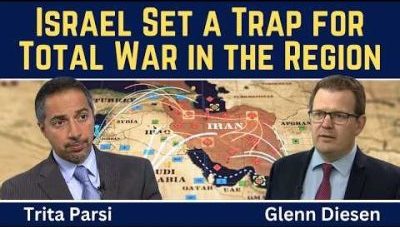
Trita Parsi: Israel Set a Trap for Total War in the Region
or go to
Aletho News Archives – Video-Images
From the Archive
Zionism’s Violent Legacy
By Donald Neff | Washington Report On Middle East Affairs | January 1996
On January 4, 1948, Jewish terrorists drove a truck loaded with explosives into the center of the all Arab city of Jaffa and detonated it, killing 26 and wounding around 100 Palestinian men, women and children.[1] The attack was the work of the Irgun Zvai Leumi – the “National Military Organization,” also known by the Hebrew letters Etzel – the largest Jewish terrorist group in Palestine. The Irgun was headed by Revisionist Zionist Menachem Begin and had been killing and maiming Arabs, Britons and even Jews for the previous ten years in its efforts to establish a Jewish state.
This terror campaign meant that at the core of Revisionist Zionism there existed a philosophical embrace of violence. … continue
Blog Roll
 Aletho News
- Trita Parsi: Israel Set a Trap for Total War in the Region
- Trump’s Iran war is on an Israeli leash
- Saudi oil boss issues global supply warning
- Riyadh Says Its Oil System Is Intact. The Numbers Say Otherwise.
- Trump and Netanyahu Want to “Finish the Job” on Iran
- US ‘one-sided dictation’ not Iran’s beliefs makes rational talks impossible: Baghaei
- Iran’s Next Strike May Not Explode. It Could Shut You Down /Col Doug Macgregor
- Iran: US political targets legitimate if assassinations return
- Iraq shuts key border crossing with Iran under US pressure: Report
- Undersea Internet cables could be targeted in retaliation for attacks on Iran: IRGC deputy chief
- If Americans Knew
- The Israel Lobby’s Changing Fortunes
- AIPAC has become such a political liability that it’s shifting to a more “nimble” approach to buying politicians
- At least 160 Israeli settler attacks in 2 weeks
- Will Gaza’s Ancient Christian Community Disappear Forever?
- Israel’s vision of regional security rests on keeping Arab states weak
- Heidi Levine recounts how Palestinian youths helped save her in settler attack
- DAILY UPDATE: Latest essential news on Palestine, Israel, & region
- Trump’s Intensifying Sabotage of the ICC, for Israel’s Sake
- Israeli military detain US and UK volunteers in West Bank including Democratic NY politician Brad Lander
- Americans at National Conservatism Conference held in Israel this year criticize Israel
- No Tricks Zone
- E-Cars Reduce CO2 Emissions By Only 41% Compared To Internal Combustion Engine Vehicles
- Predictions Made By Renowned Climate Professor Over Past Decades Have Been Proven To Be Poor
- New Study Suggests Large Regions Of The Pacific Ocean Have Been Cooling For The Last 80 Years
- Germany’s Green Energy Debacle: High Energy Costs Force Kahla Porzellan to Close After 182 Years!
- New Study: 50 Years Of The Most Aggressive ‘Net Zero’ Policies Can Only Affect The Global Climate By 0.03°C
- US September “Heat” Was No Record…Many Records Set Decades Ago
- Latest European Green Energy Debacle; Portugal’s Largest Flagship Solar Park Insolvent!
- Green Energy Debacle: German Expert Professor Fritz Vahrenholt Warns Of Severe Economic And Social Consequences
- Two More Paleo Reconstructions Affirm Meters-Higher Sea Levels Across Ireland, Brazil 7000-6000 Years Ago
- New Study: Earth And Venus Surface Warmth Largely Explained By Convection And Lapse Rate, Not CO2 Or Radiation

