Pakistan’s PM Slams India’s Modi and Israel’s Netanyahu as “Morally Bankrupt”
Sputnik – 09.04.2019
New Delhi – Pakistan Prime Minister Imran Khan on Tuesday launched a scathing attack on Indian Prime Minister Narendra Modi and Israeli Prime Minister Benjamin Netanyahu on the day when Israel is voting to elect its next government; India will begin the voting process for its general elections shortly.
“When leaders in Israel and India show a moral bankruptcy in their readiness to annex the occupied West Bank and India-Occupied Kashmir in defiance of international law, UN Security Council resolutions & their own Constitution for votes, don’t their people feel a sense of outrage and wonder how far they will go simply to win an election?” Imran Khan tweeted on Tuesday.
Israelis are voting on Tuesday, with Prime Minister Benjamin Netanyahu, leader of the right-wing Likud Party, seeking a fifth term in office.
Around 900 million will begin casting their votes starting on 11 April in a seven-phase polling process in India that will end with the announcement of its results on 23 May. The ruling Bharatiya Janata Party (BJP) hopes to retain control of the 543-seat Lok Sabha (Indian Lower House of Parliament).
“Our duty is to protect our nation, while Congress (the country’s main opposition party) and its supporters are anti-national. They are in favour of Article 370 (pertaining to unfair privileges to the strife-ridden state of Jammu and Kashmir). What Congress’s sham document (manifesto) is stating is exactly what Pakistan is saying,” PM Modi thundered at an election rally on Tuesday.
The BJP, in its 48-page manifesto, has made a new pledge to scrap Article 370 and Article 35A that gives special privileges to residents of India in the Kashmir region, such as laws preventing outsiders from buying property.
Earlier, Imran Khan took to Twitter to criticise the Indian government for fuelling war hysteria with Pakistan after the mid-February incident, when more than 40 Indian soldiers were killed in a terrorist attack in the Pulwama district of Kashmir.
Pakistan-based Jaish-e-Mohammed had claimed responsibility for the attack but the Indian government had squarely pegged blame on the Imran Khan government for allegedly sponsoring terror activities in India. In retaliation, the Indian Air Force had conducted an aerial strike on 26 February, describing it as a non-military strike against terrorist facilities in Balakot, inside Pakistan. The following day, the two nuclear-armed nations embroiled themselves in their first aerial clash in decades, which resulted in the loss of air assets.
Trump’s Golan Declaration Another Own Goal
Strategic Culture Foundation | 29.03.2019
Hardly a week goes by and the United States falls deeper into global disrepute. This week was a bonanza of own goals for the self-declared “leader of the free world”.
The debacle over the ridiculous “Russiagate” scandal finally imploding was spectacular.
Then there were more horrific reports of US air strikes killing civilians simultaneously in four countries – Afghanistan, Somalia, Syria and Yemen.
That was followed by Washington’s ludicrous lecturing to Russia about the US-imposed humanitarian crisis in Venezuela.
And then, to top all those own goals, we saw President Donald Trump declaring that Israel’s illegal annexation of the Golan Heights is not, in the warped US view, illegal after all. Can you possibly keep score of the mind-boggling inanities and insanities?
Switching metaphors for a moment – because you can hardly just use one when it comes to grappling with American asinine policy – Russia’s foreign ministry spokeswoman Maria Zakharova got it right when she likened the US to a “cowboy shooting up the Louvre museum” in its free-wheeling, double-dealing foreign conduct.
Where to begin in dissecting the US and its descent into madness and mafia-style foreign policy? It truly is a brain-wrecking, train-wrecking challenge. Is there a wicked genius to its Mephistophelean madness? Perhaps it is simply down to Washington becoming an absurd circus of incompetence, accelerated under the administration of a former real-estate magnate and reality TV star, President Donald J (for Joker) Trump.
On the Golan issue, Trump’s proclamation this week of recognizing the Israeli-occupied Golan Heights as under Israeli sovereignty is a flagrant subversion of international law and the United Nations Charter. Israel has been forcibly occupying Syrian southern territory since the 1967 Six Day War. It formally annexed the strategic plateau in 1981, which was ruled as illegal by the UN Security Council – including a vote from the US at that time.
Trump’s declaration is thus a brazen repudiation of international law and a glaring green light to aggression. Can anything this president says or does be taken seriously? What’s that about Venezuela, or Ukraine?
His declaration this week undermines gravely the foundation of international law in a shocking, reckless affront. It completely demolishes any pretense the US claims to have as a world leader and upholder of international law.
Washington has been slamming Russia for the past five years over alleged “annexation” of Crimea – and then Trump this week turns around and endorses Israeli theft of Syrian territory.
At a UN Security Council meeting called this week by Syria in protest to Trump’s proclamation, the US was seen as a pariah state. All 14 other members of the council (including non-permanent members) slammed the US policy on Golan. They included US allies Britain and France.
Outside the UNSC, other US allies also condemned Washington’s declaration of complicity in Israeli annexation of Golan.
Egypt, Saudi Arabia, Kuwait, the United Arab Emirates, among others, all slammed the US for daring to legalize the theft of Syrian territory by Israel.
Russia’s deputy envoy to the UN, Vladimir Safronkov, put it aptly. He said that the US move was not only an audacious violation of international and the UN Charter. “This only exacerbates the situation in Syria and complicates the establishment of a political process, but it also creates serious obstacles to normalizing the relations between Israel and the Arab states.”
We will come back to that profound point in a moment. But first, let’s throw out a few other motives for Trump’s outrageous violation of international law regarding Golan and Israel’s annexation.
Trump is no doubt giving his family friend Prime Minister Benjamin Netanyahu a timely electoral boost ahead of Israeli state elections scheduled for April 9.
There is also the issue of American oil interests being pursued by designating the Golan as Israeli territory. The mountainous region overlooking the Jordan Valley is reputed to hold untapped reserves on par with those of Saudi Arabia, which US-based Genie oil company has been exploring for years.
But still a more strategic motive is the objective of keeping the Middle East and Syria in particular in perpetual turmoil. By annexing Syrian territory, the US-Israeli move furthers the objective of controlling the wider Arab region.
Syria’s envoy to the UN, Bashar al Jaafari, made that very point at the UN Security Council meeting this week. He said the US-backed annexation of Golan was a part of the US-sponsored covert war against his country. The move is a way to keep Syria and the region in turmoil, said al Jaafari.
This gets back to what the Russian envoy, Vladimir Safronkov, said. The whole point is for Washington to prevent any political settlement to the eight-year war in Syria and to impede any normalization of relations in the region. The US and its client Israeli regime only stand to benefit from perpetual chaos and conflict in the region.
So far so good, as Washington may calculate – albeit fiendishly. But in the final analysis, the US is ending up looking like a complete rogue state without any respect, even among its supposed allies.
The presumed global leader, Washington, is losing foes and allies alike through its disgraceful duplicity and disregard for any pretense of probity. The Golan Heights is another nail in the coffin for Washington’s over-rated self-regard.
In a week of other American absurdities and own-goals, the Golan debacle may turn out to be the moment when Washington is finally seen in the eyes of the world as the utter laughing stock that it surely has become. It’s a laughing stock, but in the creepiest, macabre sense.
Israel official reveals plan to change Golan Heights’ demographic balance
MEMO | March 28, 2019
An Israeli official revealed a plan to triple the number of Jewish settlers in the Golan Heights in the coming years in order to create a Jewish majority in the occupied Syrian territory.
The Mayor of Katzrin settlement in the occupied Golan, Dmitry Apartzev, said the plateau’s total population will increase to 150,000 people which means the number of Jews will reach 100,000 people while the number of Druze will be 50,000.
Apartzev expected the population of Katzrin settlement alone to increase from 8,500 to 50,000.
According to the Israeli official, the recognition of Israel’s sovereignty over the Golan will open new horizons for foreign investment in the area, hoping that the recognition would also contribute to counter the international boycott campaigns urging investors not to invest in the occupied territories.
Apartzev claimed that the Golan economy is growing despite the campaigns.
Today, some 40,000 people live in the occupied Golan, 50 per cent of them are Arab Druze who consider themselves Syrian citizens.
On Monday, US President Donald Trump signed an executive resolution recognising Israel’s sovereignty over the Golan Heights, internationally recognised as Syrian territory occupied in 1967.
Lebanon Decides to Confront Israel And The US in Shebaa, Kfarshouba And Syria
By Elijah J. Magnier | American Herald Tribune | March 28, 2019
Lebanese Judge Ahmad Mezher has given orders that a survey be conducted of Lebanese occupied territories in the Shebaa Farms, Kfarshouba, Huneen, Ideise and Bleeda. These villages are bordering Hasbaiya, Rashaya al-Fukhar and Kiyam and have been under Israeli occupation since 1981, as Syria’s Golan Heights have been since 1967. This step coincides with the illegal “gift” of the Syrian Golan Heights offered by US President Donald Trump to his closest ally Prime Minister Benyamin Netanyahu. Although Trump’s move was verbally condemned by the international community, no other state or international body seems likely to openly oppose Trump’s move at the moment.
However, Lebanon has decided to confront this move on the ground, showing its readiness to defend its territory if US “gifts” were ever seen to include Lebanese occupied territories. The Lebanese presidency, the Parliament and the government agreed that it is the right of Lebanon to regain its occupied territory and that the equation “the army, the people, the resistance” is united under one umbrella. Thus, the possibility of confrontation between the Resistance – i.e. Hezbollah in this case – and Israel is now on the table.
The level of tension and chances of confrontation increased during Lebanese President Michel Aoun’s visit to Moscow. During meetings with his homologue Russian President Vladimir Putin, the Christian President Aoun rejected US pressure on his country. The US establishment, including Secretary of State Mike Pompeo and his envoys to Lebanon, wants to prevent the over one and a half million Syrian refugees in Lebanon from returning home. President Aoun also rejected Trump’s gift to Netanyahu, stating clearly that the Golan Heights is Syrian territory illegally occupied by Israel, and not the property of the US to dispose of as it will.
It remains unclear whether the Shebaa Farms, Kfarshouba and neighbouring villages are part of Trump’s gift to Israel. This is why Lebanese authorities have requested the judiciary authority officially survey the southern Lebanese territories occupied by Israel. If, in response to the survey, any attempt is made to assert that these areas are part of Israel, then the Lebanese triad (the army, the people and the resistance) will be bound to recover its occupied territory. The timing of the decision is important because it shows the readiness of the Lebanese government to raise the subject and to confront Israel in the wake of the US decision on the Golan Heights, a territory closely linked to the Lebanese farms and villages. As recently as 2009 some of these lands were contested between Syria and Lebanon, but now that Lebanon is in a better position than Syria to vindicate its claims against Israel, the Syrian government will be happy for it to do so.
President Aoun raised these issues with President Putin in the context of Trump’s previous gift of Jerusalem, by virtue of his recognition of an undivided Jerusalem as the capital of Israel. Lebanon fully supports the right of return of Palestinians to their land, particularly since there are over 800,000 Palestinians living in Lebanon. Just as the US would prefer these Palestinians to remain in Lebanon, the US now seems to want Lebanon to accept an ongoing presence of Syrian refugees on Lebanese soil. The US policy of keeping Syrian refugees in Lebanon has several goals.
The first is to shift the religious balance of power in Lebanon. Most Syrian refugees are Sunni (mainly hostile to Assad and to his allies) and the US would like to see a Sunni plurality in Lebanon to confront Shia Hezbollah and the society behind it. All Israeli wars have failed to curb Hezbollah and could not reduce its strength. On the contrary, Hezbollah military power is increased to an unprecedented level domestically and regionally. Moreover, in the last Lebanese Parliamentary polls, Hezbollah won more votes than any religious party, surprising everyone. Support for Hezbollah goes beyond any one religious confession; it has proved itself as a force defending Christians and Shia against Wahhabi takfiri extremists. Confronting Hezbollah face to face would lead to certain failure, hence the US need to strategically build another society to stand against it.
President Aoun insists on the return of Syrian refugees to Syria, notwithstanding the financial incentives being offered by the US and Europe to keep them in Lebanon. The presence of the refugees upsets the religious equilibrium in Lebanon, and accelerates the process by which Christians are becoming a minority on Lebanese soil. The religious terrorism that hit the Middle East over the last decade targeted regional minorities, notably the Christians. The same NATO leaders whose governments sponsored takfiri terrorism against Christians in the Levant proposed to Lebanese Christian leaders that they leave the land of their ancestors and settle in the west. Christians who were raped, murdered and terrorized by ISIS and al-Qaeda in Iraq and Syria would have suffered the same fate in Lebanon had Hezbollah decided to entrench themselves in the south of Lebanon, in the Beirut suburbs, or in selected villages of the Bekaa Valley.
Moreover, the Lebanese President considers the Syrian refugees a security and a financial burden that is placing a heavy burden on the fragile and chaotic Lebanese infrastructure. These refugees currently represent a third of the total Lebanese population.
Another objective of US refugee policy in Lebanon is to recover from Syrian President Bashar al-Assad what it failed to achieve by arming militants to overthrow his government over the last 8 years. The US establishment would like to keep over 5 million Syrian refugees outside Syria, mainly in Lebanon, Jordan, Turkey and Europe. This, in US thinking, could impede forthcoming presidential elections in Syria, and prevent both the rebuilding of the Syrian Army and the reconstruction of the country. Syrians are skilful craftsmen; keeping them away from home impedes rebuilding. All these US objectives do not help Lebanon in any way. On the contrary, they weaken Lebanon, which needs a healthy relationship with neighbouring Syria for its security and commercial development.
Trump has made the Middle East less secure. He has offered Israel an illegal and unnecessary gift. Israel was already controlling the Syrian Golan Heights; Syria posed no threat to it. Syria had not fired a bullet against Israeli occupation of the Golan for 30 years and will be busy for the next ten years rebuilding its destroyed infrastructure. Moreover, the late President Hafez Assad had engaged with Israel, through US mediation, to negotiate a peace deal in exchange for the Golan Heights. It was Israel who rejected the deal at the last minute. Assad then said he would leave liberation of the territory to the generation to come.
The US establishment is undermining Lebanon’s security and peace by imposing one and a half million refugees on the country, destabilizing the local society, and threatening to impose sanctions if Lebanon does not submit to US bullying.
Trump gave Jerusalem to Israel and can no longer be considered a partner in any peace process. This realization has given new urgency to the Palestinian cause. He is not willing to give a state to the Palestinians, but he is disposing of their rights.
US forces are unwelcome in Syria, occupying a third of the country and a bordering passage, while ISIS no longer controls any Syrian territory in the north-east. At the same time the US is keeping tens of thousands of Syrian refugees at the al-Rukban camps from returning home.
In Iraq, the parliament is divided between those willing to see the last US soldier depart and those who want to maintain some training and intelligence collaboration. Iraqi politicians are afraid of asking the US to stay or to leave permanently for fear of seeing ISIS return with US support in either case (if US forces stay there is fear of seeing the US support for ISIS, an eventuality Iraqis also fear if the US were to leave).
Finally, the US is now seen as a superpower ruled by a thug sucking wealth from the oil-rich Arab countries, forcing them to buy US weapons so that Middle Easterners can continue killing each other at their own expense. Arab countries, once very rich, are imposing local taxes they have never imposed before on their own nationals and are going through a financial crisis unheard of for decades. Syria, Iraq, Yemen, Palestine and Lebanon are on the floor financially and even Saudi Arabia, the Emirates, Qatar and Bahrain are not in their best financial shape. Iran’s nuclear deal was revoked and since Trump took power the country is facing the harshest sanctions ever.
It is unclear when the next war may erupt to challenge US hegemony in this part of the world. It is clear that Russia and China are already present in the Middle East, ready to take the place of a US establishment which is no longer regarded as a friendly nation by any state but Israel.
Elijah J. Magnier is a veteran war correspondent Senior Political Risk Analyst with over 35 years’ experience covering Europe, Africa & the Middle East.
Syria’s Rukban Now Little More Than a US-Controlled Concentration Camp – and the Pentagon Won’t Let Refugees Leave
By Whitney Webb | MintPress News | March 28, 2019
DAMASCUS, SYRIA — The United States military has rejected offers to resolve the growing humanitarian crisis in the Rukban refugee camp in Syria, which sits inside a 55 km zone occupied by the U.S. along the Syria-Jordan border. The U.S. has also refused to let any of the estimated 40,000 refugees — the majority of which are women and children — leave the camp voluntarily, even though children are dying in droves from lack of food, adequate shelter and medical care. The U.S. has also not provided humanitarian aid to the camp even though a U.S. military base is located just 20 km (12.4 miles) away.
The growing desperation inside the Rukban camp has received sparse media coverage, likely because of the U.S.’ control over the area in which the camp is located. The U.S. has been accused of refusing to let civilians leave the area — even though nearly all have expressed a desire to either return to Syrian government-held territory or seek refuge in neighboring countries such as Turkey — because the camp’s presence helps to justify the U.S.’ illegal occupation of the area.
Though the U.S. has long justified its presence in al-Tanf as necessary to defeat Daesh (ISIS), the U.S. government has also acknowledged that al-Tanf’s true strategic importance lies in U.S. efforts to “contain” Iran by blocking a connection from Iran to Syria through Iraq. Al-Tanf lies near the area where the borders of Syria, Iraq and Jordan meet. Thus, in the U.S.’ game of brinkmanship with Iran, Rukban’s estimated 40,000 inhabitants have become pawns whose basic needs are ignored by their occupiers.
U.S. shows no interest in meeting
On Tuesday, delegations from Russia, Syria, the UN, and the Rukban refugee camp met to discuss the fate of the camp’s inhabitants after a UN survey found that 95 percent of the camp’s inhabitants wanted to leave the camp, while 83 percent wanted to return to their hometowns in areas of Syria now under Syrian government control.
However, the U.S. military and State Department officials in nearby Jordan rejected an invitation to Tuesday’s meeting. The U.S. military also prohibited a Syrian-Russian delegation from entering the Rukban camp on Tuesday. The delegation had sought to assess conditions in the camp, which have become increasingly desperate according to reports from a variety of outlets, including U.S. government-funded outlets like Voice of America.
The U.S.’ refusal to attend the meeting or allow the delegation passage comes less than a month after the U.S. military blocked the entry of evacuation buses overseen by Russian and Syrian forces that would have allowed refugees to leave the camp.
The buses would have entered through the “humanitarian corridors” that were recently opened on the Syrian-controlled side of the U.S.-occupied enclave. While camp inhabitants can, in theory, leave the camp through the corridors on foot, the barren area’s remoteness makes such evacuations unfeasible without vehicle transport. Although some families have left this way, the lack of record keeping within the camp has made it impossible to know how many have tried leaving this way since the corridors were opened last month.
An often overlooked problem that has prevented them from leaving is that U.S.-backed and U.S.-trained “moderate rebel” groups have been known to block camp inhabitants from leaving, demanding large payments in U.S. dollars to leave the area. The U.S. military took control of Al-Tanf alongside “moderate” rebel forces in 2014 after wresting the area from Daesh. Many of those opposition groups have since been revealed to have ties and sympathies to terrorist groups, including Daesh.
The U.S. has not given a reason for its rejection of Tuesday’s meeting and had previously said that its rejection of the evacuation buses was based on its view that the buses did not meet the U.S.’ “protection standards.”
Horrific conditions and a U.S. shrug
While the U.S. has blocked refugees from leaving on Russian-Syrian buses under U.S. “protection,” it has done little to abet the suffering of the tens of thousands of civilians in Rukban, even though the area is under complete U.S. military control and a U.S. military base is just a few miles away. Indeed, the extent of U.S. “aid” to the Rukban camp has been medical training of the handful of nurses in the camp, who work in conditions they describe as being like “the Stone Age” owing to the chronic lack of basic medications and doctors.
While medical care is decidedly lacking, the most pressing problem is the access to food, as starvation has become a real threat for those living in Rukban. Last October the opposition-aligned news service, the Syrian Observatory for Human Rights (SOHR), reported that the Rukban camp had been without food or essential supplies for months. Only two aid deliveries, managed jointly by the Syrian Arab Red Crescent (SARC) and the UN, were able to enter the camp.
One of those shipments, however, almost didn’t happen after the UN delayed the aid “for logistical and security reasons.” While the UN did not specify which “security reasons” had prompted the delay, it was apparently not the Syrian government, as the UN also said in the same statement that the convoy had received approval from Damascus. This suggests that the “security” concerns were related to U.S.-backed militants in the U.S.-controlled area surrounding al-Tanf. Notably, Russian and Syrian sources have claimed that these same militants often “plunder” the aid intended for the camp’s inhabitants for themselves.
Since then, the situation inside the camp has continued to deteriorate. Indeed, things have gotten so desperate that, in January, a mother attempted to set herself and her three children on fire after she couldn’t find food for three straight days and preferred to give her children a quick death rather than watch them starve. Others in the camp rescued the family, though the mother and her infant were seriously injured. Recently aid from the UN and SARC arrived in early February, the first aid shipment in over three months.
The lack of food combined with the lack of medical care has been responsible for scores of deaths in the camp — the majority of which are of children under the age of two, who often die from malnutrition and preventable diseases. Others have died from freezing weather owing to a lack of adequate shelter, with eight children dying in January for that very reason. Satellite images taken of the camp in early March showed the recent creation of a mass grave containing an estimated 300 bodies adjacent to the camp.
Despite the desperate conditions less than 13 miles from its military base, the U.S. has declined to send food, doctors, medical supplies or other forms of aid to Rukban’s inhabitants, while also preventing them from leaving. However, the U.S. has been providing militant groups in the same area with military and logistical support.
Rukban provides a pretext
In addition to presiding over the squalid and starvation conditions in the Rukban camp, the U.S. has also given militant groups present in the area it controls — including Daesh terrorists who have “embedded” themselves in the camp on the U.S.’ watch — free rein to terrorize the camp’s refugees. These militant groups not only control the flow of food and aid in the camp but terrorize its most vulnerable inhabitants, forcing women and children into sex slavery and engaging in human trafficking. All of this is taking place in a “deconfliction zone” controlled by the U.S. military.
These extremist groups, including Daesh, are well-armed, according to Jordanian Brigadier General Sami Kafawin, who told NBC News in 2017 that these groups “have whole weapons systems … small arms, RPGs, anti-aircraft.”
The official reason for the U.S. base in al-Tanf has long been counterterrorism operations that ostensibly target Daesh. However, very few attacks against the terror group have been launched from this base and a UN report released last August found that Daesh had been given “breathing space” in U.S.-occupied areas of Syria, including al-Tanf. The U.S. has stated that it uses the al-Tanf base to train Syrian opposition fighters who then control the area around the base, including Rukban.
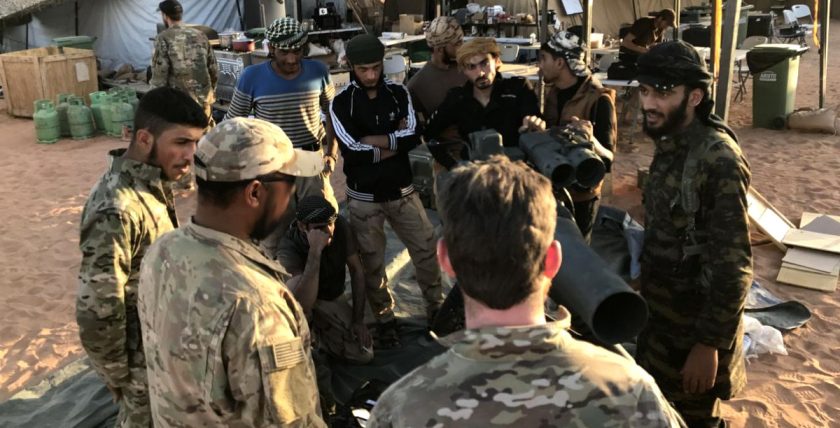
Unidentified Syrian rebels surround a piece of US weaponry during training by an American special forces member in Tanf. Photo | Hammurabi’s Justice News
With the U.S. now having claimed that Daesh has been completely defeated in Syria, the official justification for its illegal occupation of Syrian territory is wearing thin. With that justification now on shaky ground, the U.S. is increasingly having to acknowledge its main motive for its presence in al-Tanf — containing Iran and keeping Syria divided.
Indeed, a recent Reuters article notes that the U.S.-controlled area around al-Tanf that includes the Rukban camp “is designed to shield U.S. troops at the Tanf garrison and maintain for Washington a strategic foothold in an area close to a crucial supply route for Iranian weapons entering Syria from Iraq.” This was confirmed by General Joseph Votel late last year when he told NBC News that the U.S. base in al-Tanf was key in countering “the sway of Iran” in Syria.
This followed statements made last July by National Security Advisor John Bolton that U.S. troops would remain in Syria “as long as the Iranian menace continues throughout the Middle East.” This policy of Iran containment has clearly guided U.S. policy in Syria of late, with at least 1,000 U.S. troops set to stay in Syria illegally despite Daesh’s defeat and President Donald Trump’s recent calls for a troop withdrawal.
The U.S. has been accused of using the civilians trapped in Rukban as a “shield” for its continued operations in Syria aimed at containing Iran’s regional influence. Russian Foreign Minister Sergei Lavrov said earlier this month that “the fact that people are not allowed to leave [the camp] and are held hostage makes one suggest that the U.S. needs this camp to continue justifying its illegitimate presence there.” There appear to be few other explanations for the U.S.’ refusal to let camp inhabitants leave the area.
The hypocrisy of U.S. “humanitarian concerns”
The situation in the Rukban camp reveals the dark reality behind the U.S.’ occupation of Syrian territory in Al-Tanf and elsewhere. In order to pursue its policy of Iran “containment” and a divided and partitioned Syria, the U.S. is willing to imprison some 40,000 people — many of them children — in a concentration camp where international aid is blocked and where food is so scarce that mothers are setting themselves and their children on fire so they can avoid slowly starving to death.
According to the Cambridge Dictionary, a concentration camp is defined as “a place where large numbers of people are kept as prisoners in extremely bad conditions, especially for political reasons.” It is undeniable that the Rukban camp fits this definition to the letter.
That the U.S. justifies its aggressive policies around the world — from Syria to Venezuela and elsewhere — as being motivated by “humanitarian concerns” — when a refugee camp under the U.S.’ complete control in Syria is facing starvation conditions and its inhabitants are being forcefully kept confined in the camp by the U.S. military despite their expressed desire to leave — is an obscene Orwellian twist. All this to “contain” Iranian influence in the Middle East.
Whitney Webb is a MintPress News journalist based in Chile. She has contributed to several independent media outlets including Global Research, EcoWatch, the Ron Paul Institute and 21st Century Wire, among others. She has made several radio and television appearances and is the 2019 winner of the Serena Shim Award for Uncompromised Integrity in Journalism.
Deal of the Century, minus one: Is Trump’s peace plan for the Middle East the deletion of Palestine?
By Helen Buyniski | RT | March 27, 2019
It has become clear that US President Donald Trump, despite his vaunted prowess as the Dealmaker-in-Chief, isn’t interested in brokering peace between Israel and Palestine. His Middle East peace has no room for Palestine at all.
Trump promised to bridge the impossible gap between the incredible shrinking Palestinian territories and the Israeli government that long ago left behind such niceties as international law. Along with his son-in-law, Jared Kushner, Trump declared he would build a peace where none before him had succeeded. Unfettered by the rules of international sovereignty, as he displayed by handing Israel a Golan Heights that wasn’t his to give, Trump’s peace-making abilities are – in theory at least – limited only by his imagination.
Instead, his “Deal of the Century” – which Kushner has hyped across the Middle East for months – remains unseen by Palestinian eyes, and even Trump’s own diplomats have expressed concern over the viability of an Israeli-Palestinian peace that lacks any input from the Palestinian side. To make matters worse, February’s Warsaw conference that was supposed to tease a peaceful way forward for the region instead exposed the US and Israel’s real agenda when Israeli PM Netanyahu mistweeted its goal was “to advance the common interest of war with Iran.”
The “Deal of the Century” is rumored to throw Palestine a few economic crumbs in exchange for Jerusalem, most of the West Bank, and relinquishing the right of return. Is it any wonder that no countries appear to be taking it seriously?
Trump claims the deal will be revealed in all its glory after the Israeli election in two weeks, when Netanyahu is presumably reelected, though with even staunch allies like Saudi Arabia condemning Trump’s gift-wrapping of the Golan as a dire threat to regional peace, it’s difficult to believe such a peace could be revived.
Lucky for him, then, that it doesn’t have to be. The big plan – and the reason it’s kept such a big secret from Ramallah – doesn’t include Palestine at all. When Trump’s through, there will be no Palestine left worth negotiating with.
Like his Golan Heights move, Trump’s out-of-left-field decision to move the US embassy to Jerusalem last year provoked international condemnation. The UN censured the move; the Palestinians took to the streets, where a few more were gunned down by IDF soldiers than on a typical Tuesday. But this week’s AIPAC conference has seen several US allies quietly sign on with their own embassy moves. Recent US coup-beneficiary Honduras joined its neighbor Guatemala in moving its embassy to Jerusalem, while Romania broke with the EU to do the same.
Bezalel Smotrich, deputy speaker of the Knesset, knows a giving mood when he sees one and has matter-of-factly asked Trump to recognize over half a century of illegal West Bank settlements by handing over the whole territory. It wouldn’t be any more of a stretch than the Golan was, after all – the same UN resolutions and international law have condemned the Israeli land-grab, the same US vetoes in the Security Council have negated the condemnation, and the same Manifest Destiny has spurred the theft of other people’s land. Trump’s primary financial backer, casino magnate and IDF fan-boy Sheldon Adelson, is one of the main funders of West Bank settlements, so the business connections are already in place. The ostensibly Palestinian territory is already so honeycombed with illegal dwellings, walls, and apartheid roads it’s practically a done deal.
Perhaps most tellingly, Secretary of State Mike Pompeo posted a highlight reel of his pre-AIPAC Israeli jaunt, complete with the al-Aqsa mosque – a Muslim holy site sitting on real estate revered by both Jews and Christians – surgically excised, replaced by a rendering of the Third Temple. Pompeo spent his CIA years buttonholing colleagues in the hallway to chat about the coming Rapture – the Third Temple means a lot to him, eschatologically speaking. Palestinians, Muslims, international law? Not so much.
Earlier this month, the new and improved US embassy in Jerusalem absorbed the consulate that had served as de facto Palestinian Authority liaison. So goes the last diplomatic link with the would-be Palestinian state. Most US lawmakers espouse support for a two-state solution, even as Israeli settlements have engulfed the West Bank over the last decade and Netanyahu has legally declared non-Jews second-class citizens; Trump has refused to commit to either model. It’s clear what state he prefers.
Lest anyone think the move to efface all traces of Palestine is accidental, a parallel linguistic campaign is underway. No longer do US government reports refer to the “occupied” West Bank or Golan Heights, both territories illegally seized by Israel in 1967 and held to this day. Israeli groups have even rewritten history textbooks to frame Israel’s conquests in a more flattering light – why not remove Palestine altogether.
The US has curtailed its financial support of the United Nations Relief and Works Agency, leaving a $125 million hole in the group that sustains much of what’s left of Palestine’s civilian infrastructure after decades of ruinous blockades, bombardments, and apartheid policies so egregious South Africa has recoiled with déjà vu. The decision followed the discontinuation of $200 million in economic aid for the West Bank and Gaza. Netanyahu applauded the financial coups de grace, calling the millions of Palestinians descended from those who were evicted from their land during the 1948 Nakba “fictitious refugees.” Kushner himself has called for two million Palestinian refugees living in Jordan to be delisted as “refugees.”
And what of Gaza, which international observers have called an “open air concentration camp” and “Israel’s weapons-testing laboratory”? They have a few more weapons to test before taking it over completely, and Uncle Sam has already got his checkbook out. It’s no wonder Trump is more popular in Israel than he is in his own country. If there were truth-in-advertising laws governing elections, MAGA would be MIGA: Make Israel Great Again.
Trump’s Stance on the Golan will allow Israel to Operate with Impunity Elsewhere
By Jonathan Cook – The National – March 25, 2019
When President Donald Trump moved the US embassy to occupied Jerusalem last year, effectively sabotaging any hope of establishing a viable Palestinian state, he tore up the international rulebook.
Last week, he trampled all over its remaining tattered pages. He did so, of course, via Twitter.
Referring to a large piece of territory Israel seized from Syria in 1967, Mr Trump wrote: “After 52 years it is time for the United States to fully recognize Israel’s Sovereignty over the Golan Heights, which is of critical strategic and security importance to the State of Israel and Regional Stability.”
Israel expelled 130,000 Syrians from the Golan Heights in 1967, under cover of the Six Day War, and then annexed the territory 14 years later – in violation of international law. A small population of Syrian Druze are the only survivors of that ethnic cleansing operation.
Replicating its illegal acts in the occupied Palestinian territories, Israel immediately moved Jewish settlers and businesses into the Golan.
Until now, no country had recognised Israel’s act of plunder. In 1981, UN member states, including the US, declared Israeli efforts to change the Golan’s status “null and void”.
But in recent months, Israeli prime minister Benjamin Netanyahu began stepping up efforts to smash that long-standing consensus and win over the world’s only superpower to his side.
He was spurred into action when Bashar Al Assad – aided by Russia – began to decisively reverse the territorial losses the Syrian government had suffered during the nation’s eight-year war.
The fighting dragged in a host of other actors. Israel itself used the Golan as a base from which to launch covert operations to help Mr Assad’s opponents in southern Syria, including Islamic State fighters. Iran and the Lebanese militia Hezbollah, meanwhile, tried to limit Israel’s room for manoeuvre on the Syrian leader’s behalf.
Iran’s presence close by was how Mr Netanyahu publicly justified the need for Israel to take permanent possession of the Golan, calling it a vital buffer against Iranian efforts to “use Syria as a platform to destroy Israel”.
Before that, when Mr Assad was losing ground to his enemies, the Israeli leader made a different case. Then, he argued that Syria was breaking apart and its president would never be in a position to reclaim the Golan.
Mr Netanyahu’s current rationalisation is no more persuasive than the earlier one. Russia and the United Nations are already well advanced on re-establishing a demilitarised zone on the Syrian side of the separation-of-forces line. That would ensure Iran could not deploy close to the Golan Heights.
Mr Netanyahu is set to meet Mr Trump in Washington on Monday, when the president’s tweet will reportedly be converted into an executive order.
The timing is significant. This is another crude attempt by Mr Trump to meddle in Israel’s election, due on April 9. It will provide Mr Netanyahu with a massive fillip as he struggles against corruption indictments and a credible threat from a rival party, Blue and White, headed by former army generals.
Mr Netanyahu could barely contain his glee, reportedly calling Mr Trump to tell him: “You made history!”
But, in truth, this was no caprice. Israel and Washington have been heading in this direction for a while.
In Israel, there is cross-party support for keeping the Golan.
Michael Oren, a former Israeli ambassador to the US and a confidant of Mr Netanyahu’s, formally launched a plan last year to quadruple the size of the Golan’s settler population, to 100,000, within a decade.
The US State Department offered its apparent seal of approval last month when it included the Golan Heights for the first time in the “Israel” section of its annual human rights report.
This month, senior Republican senator Lindsey Graham made a very public tour of the Golan in an Israeli military helicopter, alongside Mr Netanyahu and David Friedman, Mr Trump’s ambassador to Israel. Mr Graham said he and fellow senator Ted Cruz would lobby the US president to change the territory’s status.
Mr Trump, meanwhile, has made no secret of his disdain for international law. This month, his officials barred entry to the US to staff from the International Criminal Court, based in The Hague, who are investigating US war crimes in Afghanistan.
The ICC has made enemies of both Washington and Israel in its initial, and meagre, attempts to hold the two to account.
Whatever Mr Netanyahu’s spin about the need to avert an Iranian threat, Israel has other, more concrete reasons for holding on to the Golan.
The territory is rich in water sources and provides Israel with decisive control over the Sea of Galilee, a large freshwater lake that is crucially important in a region facing ever greater water shortages.
The 1,200 square kilometres of stolen land is being aggressively exploited, from burgeoning vineyards and apple orchards to a tourism industry that, in winter, includes the snow-covered slopes of Mount Hermon.
As noted by Who Profits, an Israeli human rights organisation, in a report this month, Israeli and US companies are also setting up commercial wind farms to sell electricity.
And Israel has been quietly co-operating with US energy giant Genie to explore potentially large oil reserves under the Golan. Mr Trump’s adviser and son-in-law, Jared Kushner, has family investments in Genie. But extracting the oil will be difficult, unless Israel can plausibly argue that it has sovereignty over the territory.
For decades the US had regularly arm-twisted Israel to enter a mix of public and back-channel peace talks with Syria. Just three years ago, Barack Obama supported a UN Security Council rebuke to Mr Netanyahu for stating that Israel would never relinquish the Golan.
Now Mr Trump has given a green light for Israel to hold on to it permanently.
But, whatever he says, the decision will not bring security for Israel, or regional stability. In fact, it makes a nonsense of Mr Trump’s “deal of the century” – a regional peace plan to end the Israeli-Palestinian conflict that, according to rumour, may be unveiled soon after the Israeli election.
Instead, US recognition will prove a boon for the Israeli right, which has been clamouring to annex vast areas of the West Bank and thereby drive a final nail into the coffin of the two-state solution.
Israel’s right can now plausibly argue: “If Mr Trump has consented to our illegal seizure of the Golan, why not also our theft of the West Bank?”
Romania breaks with EU to relocate its Israeli embassy to Jerusalem
RT | March 24, 2019
Romania will move its embassy in Israel to Jerusalem, Prime Minister Viorica Dancila announced at the AIPAC summit in Washington on Sunday, in a controversial move that goes against the rest of the European Union.
Speaking at the Israel lobby group American Israel Public Affairs Committee’s (AIPAC) conference, Dancila said Romania intends to relocate its embassy from Tel Aviv to Jerusalem, which she referred to as Israel’s capital, in a move that follows the US’ controversial decision to do so last year.
Most nations with diplomatic relations with Israel have their embassies in Tel Aviv, as, although Israel claims Jerusalem as its capital, it is not recognized as such by the international community. Palestinians want East Jerusalem as their future capital, and Israel has occupied East Jerusalem since the 1967 war, when it annexed the area from the rest of the West Bank.
Dancila is currently president of the Council of the European Union and the move is a marked departure from the position held by the rest of the EU. Romania, along with Hungary and the Czech Republic, reportedly blocked an EU resolution objecting to the US embassy move, which said Jerusalem should be capital of both Israel and Palestine.
Israeli Prime Minister Benjamin Netanyahu asked Dancila to move Romania’s embassy when she visited Israel in January. “I hope you will act to stop the bad resolutions against Israel in the European Union,” he said. “And also, of course, to move your embassy and other embassies to Jerusalem.”
Romanian President Klaus Iohannis called for Dancila to resign last April after she pushed a secret memorandum to move the embassy without consulting him, and after she went on a state visit to Israel without consulting him. As president, Iohannis is in charge of foreign policy and has the final decision on such moves.
Speaking before another meeting between Romania and Israel in November, Netanyahu explained some of the reasons they enjoy good relations: “We cooperate in matters of security, anti-terror. Romania stands often with Israel in difficult diplomatic arenas and we appreciate this. We recognize our friends and we consider Romania a great friend.” Netanyahu also referred to their shared concerns about “radical Islam.”
The president of Honduras also told AIPAC it would open diplomatic representation in Jerusalem, and hinted that if AIPAC would lobby on behalf of his country, he would consider opening an embassy too, Haaretz reports. Brazil has also said it will consider moving its embassy. Guatemala is the only country apart from the US to have moved its embassy to Jerusalem so far.
Trump Koshers the Seizure of the Golan Heights
By Eve Mykytyn – March 23, 2019
On Thursday President Trump announced that the United States should recognize Israel’s sovereignty over the Golan Heights. Israel seized the Golan Heights from Syria in 1967 and effectively annexed it in 1981. The New York Times and The Wall Street Journal characterized Trump’s move as a favor to Netanyahu who is facing a challenge for reelection and Netanyahu called it a “Purim miracle.”
Despite any boost this may give to Netanyahu’s reelection, the effort to persuade Trump to endorse Israel’s claim to Golan began well before Netanyahu’s campaign and was described by Israeli Intelligence Minister Israel Katz as “topping the agenda” in US/Israeli diplomatic talks in May 2018.
Trump’s announcement contravenes the 1981 UN resolution passed in reaction to the annexation and co-written by the United States, that: “The Israeli decision to impose its laws, jurisdiction and administration in the occupied Syrian Golan Heights is null and void and without international legal effect.”
At least at the moment, action by the US is unlikely to change the European Union or Russia ’s support for the UN resolution and both announced that they would not change their positions on the Golan Heights without a UN declaration. Iranian Foreign Minister Javad Zarif, tweeting from a meeting with the Organization of Islamic Cooperation, said all the ministers were shocked by Mr. Trump “continuing to try to give what is not his to racist Israel: first al-Quds [Jerusalem] & now Golan.”
It is unclear how Trump’s twitter declaration on its own can change the U.S.’s official position on Golan. But his avowal may soon be law, Senators Cruz and Cotton along with Representative Mike Gallagher who each applauded the president’s move, introduced legislation in the House and Senate to formally “recognize Israel’s sovereignty over the Golan Heights.” Importantly, the proposed bill includes the Golan Heights as part of Israel in any spending and trade bills and approves joint scientific, industrial and agricultural projects in the occupied territory.
Since 1981, Israel has treated the Golan as a resource rich part of its country. The Golan provides over a third of Israel’s fresh water. And the Golan has provided Israel’s first major oil find. Afek Oil and Gas, a division of Genie Oil has obtained oil rights for the huge oil fields in the Golan Heights. In October 2015, October 2015 Afek Oil and Gas confirmed the discovery of vast oil reserve oil in the Golan Heights. Genie Oil has powerful political connections. Keith Murdock, Vice President Cheney, Michael Steinhardt Jacob Rothschild and Larry Summers are among its Board Members.
Despite Genie’s influence, under current conditions, Genie’s Israeli subsidiary can not sell any oil it extracts from the Golan on the international oil market because that would violate UN resolutions. However, if Washington declares Golan to be part of Israel, then oil could be legally traded with the US. Russia Today speculates that “Genie Energy’s investments in the Golan are likely the strongest factor pushing the U.S. towards the recognition of Israeli sovereignty over the occupied territory.”
Berri to Pompeo: Hezbollah Lebanese Party Represented at Parliament & Government, Resistance Results from Israeli Occupation
Al-Manar | March 22, 2019
Lebanon’s Speaker of the House, Nabih Berri, welcomed this Friday at Ain Tineh the US Secretary of State Mike Pompeo and an accompanying delegation.
The one-hour meeting touched on “the importance of maintaining stability in Lebanon and the need to deal with the maritime borders issue, including Lebanon’s Special Economic Zone.”
Pompeo expressed the United States’ desire to “assist with the efforts of the United Nations so as to address this issue.”
Speaker Berri, in turn, stressed that “the solution begins with the maritime borders.”
Talks also focused on the US sanctions imposed on Hezbollah, and their negative repercussions on Lebanon and the Lebanese.
In this regard, Berri maintained that “the laws passed by the Lebanese parliament conform to international laws and ensure transparency in financial trading at all levels.”
He stressed that Hezbollah is a “Lebanese party represented at the parliament and the government. Its resistance and that of the Lebanese are the result of the continued Israeli occupation of Lebanese territory.”
Pompeo later met with the PM Saad Hariri and then President Michel Aoun.
Featured Video

Trita Parsi: Israel Set a Trap for Total War in the Region
or go to
Aletho News Archives – Video-Images
Book Review
Why the War on Conspiracy Theories Is Bad Public Policy
By Kevin Barrett • Unz Review • February 1, 2019
 A Review of Conspiracy Theories and Other Dangerous Ideas by Cass Sunstein (based on an earlier paper co-authored with Adrian Vermeule); In Defense of Troublemakers: The Power of Dissent in Life and Business by Charlan Nemeth; and Conspiracy Theories and the People Who Believe Them, edited by Joseph E. Uscinski
On January 25 2018 YouTube unleashed the latest salvo in the war on conspiracy theories, saying “we’ll begin reducing recommendations of borderline content and content that could misinform users in harmful ways—such as videos promoting a phony miracle cure for a serious illness, claiming the earth is flat, or making blatantly false claims about historic events like 9/11.”
At first glance that sounds reasonable. Nobody wants YouTube or anyone else to recommend bad information. And almost everyone agrees that phony miracle cures, flat earthism, and blatantly false claims about 9/11 and other historical events are undesirable.
But if we stop and seriously consider those words, we notice a couple of problems. First, the word “recommend” is not just misleading but mendacious. YouTube obviously doesn’t really recommend anything. When it says it does, it is lying. … continue
Blog Roll
 Aletho News
- Trita Parsi: Israel Set a Trap for Total War in the Region
- Trump’s Iran war is on an Israeli leash
- Saudi oil boss issues global supply warning
- Riyadh Says Its Oil System Is Intact. The Numbers Say Otherwise.
- Trump and Netanyahu Want to “Finish the Job” on Iran
- US ‘one-sided dictation’ not Iran’s beliefs makes rational talks impossible: Baghaei
- Iran’s Next Strike May Not Explode. It Could Shut You Down /Col Doug Macgregor
- Iran: US political targets legitimate if assassinations return
- Iraq shuts key border crossing with Iran under US pressure: Report
- Undersea Internet cables could be targeted in retaliation for attacks on Iran: IRGC deputy chief
- If Americans Knew
- The Israel Lobby’s Changing Fortunes
- AIPAC has become such a political liability that it’s shifting to a more “nimble” approach to buying politicians
- At least 160 Israeli settler attacks in 2 weeks
- Will Gaza’s Ancient Christian Community Disappear Forever?
- Israel’s vision of regional security rests on keeping Arab states weak
- Heidi Levine recounts how Palestinian youths helped save her in settler attack
- DAILY UPDATE: Latest essential news on Palestine, Israel, & region
- Trump’s Intensifying Sabotage of the ICC, for Israel’s Sake
- Israeli military detain US and UK volunteers in West Bank including Democratic NY politician Brad Lander
- Americans at National Conservatism Conference held in Israel this year criticize Israel
- No Tricks Zone
- E-Cars Reduce CO2 Emissions By Only 41% Compared To Internal Combustion Engine Vehicles
- Predictions Made By Renowned Climate Professor Over Past Decades Have Been Proven To Be Poor
- New Study Suggests Large Regions Of The Pacific Ocean Have Been Cooling For The Last 80 Years
- Germany’s Green Energy Debacle: High Energy Costs Force Kahla Porzellan to Close After 182 Years!
- New Study: 50 Years Of The Most Aggressive ‘Net Zero’ Policies Can Only Affect The Global Climate By 0.03°C
- US September “Heat” Was No Record…Many Records Set Decades Ago
- Latest European Green Energy Debacle; Portugal’s Largest Flagship Solar Park Insolvent!
- Green Energy Debacle: German Expert Professor Fritz Vahrenholt Warns Of Severe Economic And Social Consequences
- Two More Paleo Reconstructions Affirm Meters-Higher Sea Levels Across Ireland, Brazil 7000-6000 Years Ago
- New Study: Earth And Venus Surface Warmth Largely Explained By Convection And Lapse Rate, Not CO2 Or Radiation

