Trump’s Golan move shows US contempt for international law and rules-based order
By M. K. BHADRAKUMAR | Indian Punchline | March 22, 2019
US President Donald Trump’s tweet on Thursday that the United States should back Israeli sovereignty over the Golan Heights, seized from Syria in 1967, didn’t quite come like a bolt from the blue. There has been talk about such a thing for sometime. Last December, the US Congress had begun pioneering a resolution expressing the sense of the Senate that the US should recognise Israel’s sovereignty over the Golan Heights.
Last month, new legislation was proposed in both houses of the Congress which called for recognising Israel’s sovereignty over the Golan Heights as part of the strategy to counter Iran and Syria. A copy of the Senate version of the bill stated, “It shall be the policy of the United States… to recognise Israel’s sovereignty over the Golan Heights.” The resolution stated that such a move is critical in the light of new realities on the ground including Iran’s presence in Syria. The resolution argued that Israel’s security from attacks from Syria and Lebanon cannot be assured without control over Golan Heights.
In addition, the bill said it is in US interest that Israel retains control over this territory to ensure that the Syrian government faces “diplomatic and geopolitical consequences” for killing civilians and allegedly using chemical weapons.
The sophistry aside, the fact of the matter is that the influential Jewish lobby began canvassing for such legislation once it became clear that Israel had lost the war in Syria. The primary purpose of the Israeli intervention in the Syrian Conflict by way of equipping and supporting extremist groups to overthrow the government led by President Bashar al-Assad was that a weakened and preferably dismembered Syria would never be in a position to demand the vacation of the Israeli occupation of Golan Heights.
Simply put, Tel Aviv is pulling strings in Washington to get US recognition of the Golan Heights as Israeli territory with the hope that the lone superpower’s opinion would somehow help legitimise the illegal occupation of Syrian territory since the 1967 war. Prime Minister Benjamin Netanyahu had pinned hopes that any Syrian political settlement would also include provisions legitimising the Israeli occupation of Golan.
A sub-plot here is about the timing of the tweet by Uncle Trump. Quite obviously, he is boosting the profile of nephew Netanyahu who is in dire straits at the moment fighting an election where he is trailing and staring at the prospect of a prison term for corruption. What are uncles for, after all, if they don’t help when nephew is in trouble — and big trouble at that?
But then, there is still more to it than meets the eye. The fact of the matter is that Golan Heights is believed to have vast oil reserves that could supply all of Israel’s needs. In fact, Israel began drilling for oil already by 2015 in anticipation of the ouster of President Assad.
US foreign policy is reaching an historic low point in this episode by helping to legitimise the illegal occupation of territories belonging to another sovereign country. Trump is plainly ignoring international law and the UN Charter. Yet, the US pontificates about a rules-based world order. In 2006, the United Nations General Assembly actually had passed a resolution affirming the “inalienable rights” of the Arab population in the Golan over its natural resources. The 1907 Hague Regulations, which is a cornerstone of international law, unambiguously states that an occupying power must “safeguard the capital of these properties.” Stealing resources from an occupied territory constitutes the crime of pillage.
Where such an act of pillage will ultimately lead to, time only can tell. Make no mistake, Syria will never accept the occupation of a part of the country. The US-Israeli conspiracy will meet with Syrian resistance. In fact, Trump is virtually pushing Syria into the resistance camp in the Muslim Middle East. A weakened Syria cannot challenge Israel militarily. But in the fullness of time, Israel is getting surrounded by a circle of hostile nations.
There are strong indications already that a resistance front against the US and Israel is forming in the northern tier of the Middle East stretching from Iran westward to the Mediterranean coast. Assad’s visit to Tehran, Iran’s Supreme Leader Al Khamenei conferring the highest military honour on the commander of Iran’s Quds Force Gen. Qassem Soleimani, Iranian president Hassan Rouhani’s high-profile visit to Iraq, the meeting of the commanders of the armed forces of Iran, Iraq and Syria in Damascus — all these developments in the most recent weeks underscore the emergence of a new strategic alliance that will work toward the purge of US influence in the region.
This trend is also reflected in a pronounced shift in the Iranian foreign policies, which no longer prioritise Iran’s integration into the Western world and would instead attribute centrality to resistance. Ironically, Trump’s cynical move on Golan — as per the wishes of his deep-pocketed Jewish donors such as casino magnate Sheldon Adelson and wife Miriam, influential lobby groups, and far-right Christian fringe — will end up providing strategic depth to Iran in its region to push back at the US’ containment policy.
Iran: Zionist Regime Doesn’t Have Sovereignty over any Arab, Islamic Land
Al-Manar | March 22, 2019
Iranian Foreign Ministry Spokesman Bahram Qassemi strongly condemned US President Donald Trump’s statement on recognizing the so-called “Israeli sovereignty” over the occupied Golan Heights, considering the US decision as “arbitrary” that will plunge the region into new crises.
“The Zionist regime, as an occupying regime, does not have sovereignty over any Arab or Islamic lands and its aggression and occupation should be immediately stopped,” Qassemi said in a statement on Friday, Tasnim news agency reported.
“The Golan is also considered as the occupied territory of the Syrian land according to UN Security Council resolutions,” he said.
There is no solution to the issue other than the end of the occupation, the spokesman went on to say.
He further deplored Trump’s acts as violations of the UN resolutions and the international law and said that his “personal and arbitrary decisions” have only revealed the real policies of the US, which are dangerous for the whole world and will plunge the region into new consecutive crises.
In a tweet on Thursday evening, Trump stated that it was time the United States recognized “Israeli sovereignty” over the Golan Heights, territory it occupied in the 1967 war.
With eye on US, Iran revs up ‘resistance front’
By M. K. BHADRAKUMAR | Indian Punchline | March 19, 2019
A new phase is beginning in Iran’s approach to the situation since last May when the US withdrew from the 2015 nuclear deal. Tehran had thus far prioritised the consolidation of Western opinion against President Trump’s decision with a view to effectively counter the US sanctions. But with hindsight, it appears that Europeans might posture against the US sanctions, but business interests ultimately prevail and the hard reality is that European companies that have exposure to the American market will not risk US sanctions.
Certainly, the drop in oil income following the US sanctions has hurt the Iranian economy and Tehran admits it openly. The Trump administration now plans to unveil an even harsher sanctions regime in May. According to reports, Washington aims to bring down Iran’s oil exports further.
Meanwhile, the US-Israel-Saudi-UAE nexus against Iran is actively working to create instability within Iran, weaken the regime and incapacitate it from playing a regional role. Saudi money is challenging Iran’s towering multi-dimensional presence in Iraq.
Although the US is notionally withdrawing troops from Syria, the efforts continue to roll back Iran’s presence in Iraq and Syria. Iran mentors the battle-hardened Shi’ite militia forces numbering tens of thousands in Iraq and Syria, which fought against the ISIS. Iran’s continuing presence in Syria poses an insurmountable obstacle to Israel’s designs to weaken and dominate Syria and to legitimise its illegal occupation of the Golan Heights.
Suffice to say, Tehran finds itself besieged. Of course, Iran’s regime has lived through dangerous periods through the past 4 decades and there is no question of capitulation. But an inflection point has been reached and a new trajectory has become necessary in terms of Iran’s political economy as well as to overcome the geo-strategic challenges.
There have been incipient signs change in the most recent months — in various statements by the Supreme Leader Ali Khamenei, in particular — indicative of a new pathway that would jettison the earlier obsession with the Western countries and abandon the strategy to put eggs in the EU basket. Khamenei repeatedly stressed Iran’s inner strength and the resilience of ‘resistance’.
Without doubt, the unannounced visit by Syrian President Bashar al-Assad to Tehran on February 27 augured that a Syrian-Iranian alliance with far-reaching geopolitical significance is taking shape. Khamenei stated during his meeting with Assad: “The Islamic Republic of Iran regards helping the Syrian government and nation as assisting the Resistance movement, and genuinely takes pride in it… Syria, with its people’s persistence and unity, managed to stand strong against a big coalition of the US, Europe and their allies in the region and victoriously come out of it… Iran and Syria are strategic allies and the identity and power of Resistance depend on their continuous and strategic alliance, because of which, the enemies will not be able to put their plans into action.”
Khamenei repeatedly used the metaphor of the resistance to characterise the Iran-Syria alliance. The charismatic commander of the Quds Force Gen. Qassem Soleimani neatly summed up that Assad’s visit was a “celebration of victory” for the resistance front.
Indeed, Khamenei has since decorated Soleimani with Iran’s most prestigious medal of honor, the Order of Zulfiqar. There is much symbolism here, since Soleimani happens to be the first Iranian commander to receive the Order of Zulfiqar after the 1979 Islamic revolution. Iran is applauding Soleimani’s profound contribution to the resistance. To be sure, Iran is returning to its revolutionary moorings.
Thus, the meeting between the top commanders of the armed forces of Iran, Iraq and Syria which took place in Damascus on Sunday was geared to flesh out a coordinated plan to meet the challenges in regional security. Some reports mentioned that Soleimani too was in Damascus on Sunday.
While receiving the three army commanders in Damascus, Assad reportedly said that the blood of Syrians, Iranians, and Iraqis “have mixed in the battle against terrorism and its mercenaries, who are considered as a mere façade for the countries that support them.”
Equally, Iranian president Rouhani’s recent visit to Iraq can be put in perspective. As a senior Chinese expert on West Asia has noted, Rouhani’s visit has “long-term geopolitical implications” in terms of expansion of Iran’s regional influence, apart from giving traction to the “resistance” politics (against US and Israel.)
The Chinese expert wrote that Iraq is refusing to be part of US’ containment strategy against Iran and Rouhani’s visit consolidates Iran’s influence in Iraq, which in turn also enhances its capacity to offer a “stark counterbalance” to US influence over Iraq. Again, Iran sees Iraq as a gateway to bust the US sanctions. Geopolitically, the expert underscored, the new dynamic strengthens Tehran’s strategy to create a regional axis between Iran, Iraq, Syria and Lebanon, which would have an edge over Saudi Arabia. Incidentally, Rouhani is likely to visit Syria as well in the near future.
Clearly, resistance politics creates strategic depth for Iran to push back at the US. But there is also a bigger dimension to it. Tehran plans to step up its participation in Syrian infrastructure construction. Ultimately, Iran’s economic relations with Iraq and Syria will be further strengthened in addition to its political and strategic relations with the two countries.
Very few details of yesterday’s meeting of army commanders in Damascus have emerged but one concrete outcome is the reopening of the Syrian-Iraqi border in the “coming days”, which of course, will facilitate a road link connecting Iran with Syria and Lebanon via Iraq. This is a major development insofar as a direct road link becomes possible connecting Iran with Syria and Lebanon. One main objective of the US military presence in Syria was to thwart such a transportation route that would significantly boost Iran’s influence and presence in the Levant. There have been reports that Iran may use Latakia port in Syria to access the world market.
India shouldn’t undermine Afghan peace talks
By M. K. BHADRAKUMAR | Indian Punchline | March 17, 2019
The Press Trust of India has reported on the discussions regarding Afghanistan in Washington last week between the visiting Foreign Secretary Vijay Gokhale and the US special representative Zalmay Khalilzad. The report carries a New Delhi dateline and is attributed to ‘official sources’.
According to the report, FS made a demarche with Khalilzad that any US troop withdrawal from Afghanistan should take place only after a new elected government takes over in Kabul and not on the basis of any interim arrangement. Separately, Hindustan Times amplified on the PTI report, citing ‘people familiar with developments’ to the effect that India is opposed to any interim government that is not ‘constitutionally mandated’ and might have members of the Taliban.
Both reports say that Khalilizad held out an assurance to FS that the security guarantee that Washington seeks from the Taliban about Afghan soil not being used for international terrorism, will also include groups that target India.
Quite obviously, Delhi considers it advantageous to disseminate the above confidential exchange in Washington at the present juncture when US-Taliban talks regarding ‘intra-Afghan dialogue’ and ceasefire is about to commence in Doha later this month.
Curiously, the Indian security establishment leaked the above information just the day after Pakistan PM Imran Khan claimed last Friday that peace in Afghanistan is ‘round the corner’ and can be expected in ‘coming days’. Imran Khan reportedly said, ‘A good government will be established in Afghanistan, a government where all Afghans will be represented. The war will end and peace will be established there.’
Kabul has reacted strongly against Imran Khan’s prognosis of a ceasefire and a new representative government forming in Kabul. Of course, the present ruling elite in Kabul fear that they may become expandable in an Afghan settlement. However, they are becoming a small minority. Whereas, a large section of Afghan opinion seems to favour the idea of ‘intra-Afghan dialogue’ and a broad-based government getting established in Kabul.
Why should India take a partisan stance in such circumstances? See an interview, here, by former Afghan president Hamid Karzai, who used to be a close friend and trusted interlocutor of India.
Delhi is demanding elections in Afghanistan ignoring that security conditions need to be created first on the ground for that purpose. Clearly, the reconciliation with the Taliban who control at least half of Afghan territory is an essential pre-requisite of the situation.
Suffice to say, without the participation of the Taliban, election makes no sense — that is, for electing a government that enjoys legitimacy. On the other hand, the withdrawal of the US troops is a pre-condition that the Taliban has unwaveringly laid down for participating in any intra-Afghan dialogue — and latest reports are that the US is agreeable to meeting that pre-condition.
Clearly, Delhi’s stance that US withdrawal be postponed until a settlement is in place is neither realistic nor logical. It casts India in a spoiler’s role.
The really surprising part is that Delhi waded into the Afghan peace talks just when Kabul and Washington publicly clashed over Khalilzad’s role. The Afghan national security advisor Hamdullah Mohib has derisively called Khalilzad a ‘viceroy’ who manipulates the peace talks with a view to usurping power for himself in Kabul. Delhi should not take sides in the rift between Khalilzad and President Ashraf Ghani. It’s a dangerous gambit.
If Delhi so desperately wants to give a lifeline to Ghani’s circle who are its allies in Kabul, the thing to do is to depute army chief Gen. Vipin Rawat to make a quick trip to Afghanistan and evaluate how an Indian intervention, replacing the US and NATO forces, can be urgently worked out before a settlement with the Taliban takes shape so that the erstwhile puppet regime of the US in Afghanistan can be transformed into an Indian surrogate.
If that is too weird a thing to be tried out, then the reasonable thing to do is to give the US-Taliban peace talks a fair chance. This may not be the ideal way of conflict resolution, but this is the only show in town and may serve the purpose of ending the senseless 17-year old war.
Delhi should have understood a long time ago that the Taliban insurgency cannot be defeated militarily and the US has been pursuing the West’s interests in Afghanistan. It should have worked with like-minded regional capitals to stabilise the Afghan situation in the interest of regional security and stability. But instead, it opted to be the US’ poodle.
Inevitably, Delhi feels let down. But that doesn’t warrant the petulance that is appearing here. When India has neither the geo-strategic clout influence nor the capacity to be prescriptive, the rational thing is to exercise strategic patience and try to come to terms with the regime that emerges out of a settlement in Afghanistan.
It is still not too late to calibrate India’s policy in a manner that stops viewing Afghanistan as the turf to wage proxy war against Pakistan. Pakistan has legitimate interests in Afghanistan — no less than what India would have in Nepal or Bhutan.
Arguably, a new thinking on our part reversing the policy trajectory adopted two decades ago in the late nineties will not only stop the enormous financial haemorrhage running into billions of dollars, but may even have the salutary effect of Pakistan reciprocating elsewhere on issues where India has core interests.
Israel embassy to UK erases West Bank, Gaza in election video
![Screenshot of a video released by the Israeli embassy to the UK has erased the occupied Palestinian territories (oPt), showing the whole of historic Palestine as Israel [Twitter]](https://i2.wp.com/www.middleeastmonitor.com/wp-content/uploads/2019/03/tW.png?resize=1200%2C800&quality=75&strip=all&ssl=1)
Screenshot of a video released by the Israeli embassy to the UK has erased the occupied Palestinian territories (oPt), showing the whole of historic Palestine as Israel [Twitter]
MEMO | March 15, 2019
A video released by the Israeli embassy to the UK has erased the occupied Palestinian territories (oPt), showing the whole of historic Palestine as Israel.
The video – created by the Israeli embassy in London and shared on its official Twitter account on Wednesday – sets out to explain the upcoming Israeli general election on 9 April. The video addresses “frequently asked questions” about the Israeli electoral system, such as “what is the Knesset” and “who do people vote for”.
Answering the question “do they [Israelis] vote for representatives of their city or district,” the video explains: “Israel is very small, so the whole country is a single constituency,” while a graphic draws the outline of historic Palestine and shades in the whole space, erasing the occupied West Bank and besieged Gaza Strip.
Though the outline of the West Bank can be seen beneath the shading, the video still shows the territory as part of the “single constituency” of Israel. The Gaza Strip, on the other hand, is not demarcated at all.
Though MEMO contacted the Israeli embassy for comment, at the time of publication no answer had been received.
The video will be seen as further evidence of Israel’s attempt to normalise its narrative of “sovereignty”, which ignores Palestinians living under occupation and increasingly seeks to annex the Palestinian territories.
This narrative has taken centre stage in election campaigning in recent weeks, with a number of parties promising to annex all or parts of the West Bank and increase Israel’s illegal settlement there. The New Right (Hayemin Hehadash) party – which was formed by Education Minister Naftali Bennett and Justice Minister Ayelet Shaked after they broke away from the Jewish Home party – has vowed to annex “Area C”, which makes up 61 per cent of the occupied West Bank.
The New Right explained that, under this plan, it would give Israeli citizenship to the “80,000 Arabs” it estimates live there. However, according to the UN Office for the Coordination of Humanitarian Affairs (OCHAoPt), some 297,000 Palestinians are known to live in Area C, raising questions as to their fate should the New Right join the ruling coalition after 9 April.
Even centrist political parties have made partial annexation of the West Bank a key campaign promise. The Blue and White alliance – comprised of Benny Gantz’s Israel Resilience (Hosen L’Yisrael) party and Yair Lapid’s Yesh Atid party and now polling as the main challenger to incumbent Prime Minister Benjamin Netanyahu’s Likud party – has vowed that the Jordan Valley, which lies deep in the West Bank, will be Israel’s border.
Blue and White has also promised to maintain Israel’s illegal settlements in the occupied West Bank, with the alliance’s number three Moshe Ya’alon criticising the “land for peace” model. This model would see Israel dismantle its occupation in return for peace agreements, following the precedent set by the 1979 Camp David Accords under which Israel withdrew from the Sinai Peninsula in return for a peace treaty with Egypt.
The Israeli embassy’s video also came on the same day the US State Department dropped its usual description of the Golan Heights as “Israeli-occupied”, changing the designation to “Israeli-controlled”. The State Department’s annual global human rights report also failed to mention the words “occupied” or “occupation” in a separate section about the West Bank and Gaza.
Though a State Department official said “[US] policy on the status of the territories has not changed,” the move has been interpreted as indication of US support for Israel’s efforts to gain international recognition of the territories it controls. Palestinian officials slammed the move, with the spokesman for Palestinian President Mahmoud Abbas, Nabil Abu Rudeineh, saying: “These American titles will not change the fact that the Palestinian territory occupied since 1967 and the occupied Arab Golan are territories under Israeli occupation in accordance with UN resolutions and international law.”
During the Six Day War of 1967, Israel occupied the West Bank, the Gaza Strip, Golan Heights and Sinai Peninsula. With the exception of the Sinai, it has thus far refused to hand back these territories and has transferred its civilian population into the areas, in contravention of international law.
Spectre of Afghan quagmire haunts US
By M. K. BHADRAKUMAR | Indian Punchline | March 15, 2019
The Afghan national security advisor Hamdullah Mohib, while on a visit to Washington, tore into the US’ peace talks with Taliban in remarks to the American media on Thursday. Mohib alleged that US special representative Zalmay Khalilzad is keeping the Afghan govt in Kabul in the dark about the negotiations with the Taliban and that he’s plotting to replace President Ashraf Ghani.
Mohib alleged that Pakistan is dictating the trajectory of the US-Taliban negotiations and warned that there can be no peace until Islamabad ended its support for ‘non-state actors’.
The charges are indeed very serious and it is unlikely that Mohib spoke without Ghani’s approval. Mohib is Ghani’s hand-picked security aide, the fountainhead of Afghan intelligence and is wired into the Washington Beltway, where he previously served as ambassador. The US state department called in Mohib and apparently gave him a dressing down.
That there is friction between Khalilzad and Ghani has been known for sometime. Basically, there is much resistance among the Afghan elite to the US strategy to take Pakistan’s help to engage Taliban in direct negotiations and chalk out a settlement that mainstreams the insurgents.
Things have lately reached a point of no return, now that the crucial next phase of negotiations at Doha is due where the agenda includes intra-Afghan dialogue and ceasefire leading to an interim power-sharing arrangement in Kabul replacing the Ghani government.
Meanwhile, there are interest groups within the Afghan elite who either fear retrenchment or simply do not accept reconciliation with the Taliban. There is indeed widespread resentment among Afghans toward Pakistan’s blatant projection of power into their country through decades. In sum, a coalescing of anti-Taliban, anti-Pakistan sentiments is taking place.
Ghani himself has never hidden his antipathy toward Islamabad for its interference in Afghan affairs and of late has been reaching out to these anti-Taliban, anti-Pakistan groups within the Afghan elite. He feels annoyed that Washington is not insisting on the Taliban holding talks with the Afghan govt, but has instead harmonised with the Pakistani-Russian idea of an ‘intra-Afghan dialogue’ where the Afghan govt can only be a participant like myriad other Afghan groups — and not as the Taliban’s principal interlocutor.
Having said that, Ghani would also know that Khalilzad who enjoys the backing of the US foreign and security establishment, is by no means a pushover. In principle, the US can withdraw support from Ghani and make a horrible example of him but in the current fluidity, that will open a Pandora’s box and may trigger events over which Washington will have no control. With such a big US and NATO military deployment in Afghanistan, it is out of the question that the Trump administration would make any precipitate moves which might create a power vacuum in Kabul.
On the other hand, President Trump wants the troop withdrawal to begin, which was also his campaign pledge in the 2016 election. Fundamentally, the Americans may have underestimated the strong undercurrents of Afghan nationalism. Ghani suspects that the Pakistani game plan is to ultimately create conditions for an outright Taliban takeover in Kabul. There have been ample signals that he is digging in.
Suffice to say, the spectre of an Afghan quagmire is haunting the Americans. An orderly American / NATO withdrawal is possible only on the basis of a settlement with the Taliban. But Ghani and his camp insist on an ‘Afghan-led’ , ‘Afghan-controlled’ peace process — that is, direct talks between the government and the Taliban. The US’ capacity to leverage Ghani is steadily diminishing.
There are hardline militia factions who stoutly oppose any power-sharing arrangement with the Taliban and are horrified at the prospect of Pakistani hegemony over Afghanistan. They may opt for a trial of strength through force. In the circumstances, there is always the danger of a coup and usurpation of power, which of course no one wants to talk about.
The role of regional powers will be crucial in the coming period. Pakistan and Russia have a special role to play here. Both countries harbour an adversarial mindset vis-a-vis Ghani. Clearly, Pakistan and Russia are increasingly moving in tandem to create conditions for a transition in Kabul that maximises their influence. Russia has pockets of influence among the anti-Pakistani Afghan factions — for instance, former president Hamid Karzai or former NSC Hanif Atmar and erstwhile Northern Alliance leaders and so on — which can work favourably for the advancement of Pakistani interests.
Equally, Russia hopes to gain out of its links to the Taliban, which Pakistan has helped to promote, in a future regime in Kabul. Of course, both Russia and Pakistan have troubled relations with the US and will be beneficiaries of any diminution of American prestige and influence in the region. It will be an understatement to say that in the New Cold War conditions, Moscow wouldn’t mind if the US and NATO are forced to exit from the Hindu Kush in disgrace and defeat.
CIA May Be Behind February Attack on North Korean Embassy in Madrid – Reports
Sputnik – 13.03.2019
Spanish police and intelligence officers, who are investigating the attack on the North Korean embassy in Madrid in February, believe that US Central Intelligence Agency (CIA) may be behind the incident, El Pais newspaper reported on Wednesday.
According to El Pais, at least two out of 10 attackers were identified to have connections with US intelligence services. Spanish investigators have already requested the CIA about their involvement in the incident.
According to the publication, the CIA denied their guilt, but the response to the request was “unconvincing.”
This incident may eventually lead to diplomatic friction between Madrid and Washington, the newspaper said. Sources in the Spanish government believe that if the CIA’s involvement in the attack is confirmed, it will be regarded as “unacceptable” actions by the ally. According to the publication, this would mean that US intelligence services acted in Spain without permission and violated international agreements protecting diplomatic missions.
The reports come after in February, El Confidencial newspaper reported, citing sources in the Spanish Interior Ministry, that a group of unidentified men broke into the North Korean embassy in Madrid, restrained the diplomatic staff for several hours and stole computers. According to the newspaper, the incident occurred on February 22. One of the employees managed to escape and report to the police.
The Dark Secret Behind a British Billionaire’s “Parallel State” In Argentina’s Patagonia
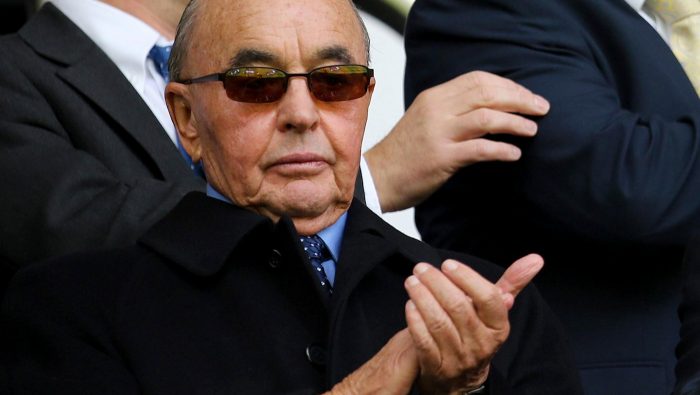
By Whitney Webb | Mint Press News | March 11, 2019
EL BOLSÓN, ARGENTINA – At the “end of the world,” spanning the southernmost regions of Argentina and Chile, lies the land of Patagonia, much of which remains a pristine wilderness that has inspired countless naturalists and would-be adventurers with its dramatic landscapes and natural beauty. For many, it is a place that still feels remarkably untouched and removed from the chaos of the modern world.
Yet, it is these very qualities, as well as the region’s great oil and gas potential and its abundance of glacier-fed freshwater reserves, that have placed it in the crosshairs of predators — predators armed with billions of dollars, powerful influence over Argentine politics and the country’s press, as well as alliances with controversial international financial organizations and key elements of the global Zionist lobby.
Coveted for its still largely unplundered resources, Patagonia has become the target of a close-knit network of notorious billionaires and global elites, who have spent much of the last two and a half decades seeking to transform this area into their own independent state.
Indeed, though several of these billionaires have already created de facto private states where they enjoy near-total impunity within Argentine Patagonia, others have been behind major efforts that have pushed for the territory’s secession. Still others have pushed Argentina’s government to exchange its claim to Patagonia for “debt relief” as a way of easing Argentina’s economic plight that, incidentally, was largely created by this very same group of billionaires. The International Monetary Fund (IMF), whose connections to this billionaire network are considerable, has had an outsized role in this effort.
Yet this appears to be more than just a venture on the behalf of notable oligarchs and the global elite, as prominent elements of the international Zionist lobby are intimately involved, as is the state of Israel, though the extent of the involvement of the latter is subject to debate. Their interest revolves around claims that date back to the founding of Zionism in the 19th century, when revered Zionist figures like Theodore Herzl discussed Argentina as a potential homeland for a Jewish ethno-state.
Since then, other notable Zionists, including past Israeli ambassadors to Argentina, have argued that Israel is for “European Jews” while “American Jews” must take Argentina for themselves. Notably, the method suggested by Herzl as a means of creating a Zionist state in his seminal work “The Jewish State” involves the exchange of debt for territory.
In the first part of this investigative series, MintPress explores the de facto independent state that has been created by British billionaire and Zionist Joe Lewis, a long-time associate of controversial Hungarian-American financier George Soros. Lewis has essentially bought out the local, regional and even national government of Argentina, allowing him to operate with impunity while he acquires more and more territory through land purchases of dubious (if any) legality, intimidates and threatens locals, usurps crucial water and energy resources from local towns, and operates his own international private airport that no one but he controls.
Subsequent reports in this series will examine the other key players in this effort to create a Patagonian state, namely Argentine oligarchs Marcelo Mindlin and Eduardo Elsztain, who are both deeply connected to the global Zionist lobby and the Rockefeller-founded Americas Society, and are also both close Soros associates. Finally, the role of these individuals and their associates in efforts to use IMF debt slavery to pressure the Argentine government to swap debt for territory will be revealed, as will the role of the Zionist lobby and prominent figures in the global elite.
The town that fought back
The quaint mountain town of El Bolsón, nestled among the picturesque rocky peaks of Argentina’s Patagonia and famed for its local legends of gnomes and elves, may seem an unlikely epicenter in a nationwide battle that has pitted locals against powerful foreign billionaires — billionaires who are not only plundering the country’s rich resources but eroding its national sovereignty through backdoor deals with Argentina’s most powerful, and most corrupt, political leaders.
Yet, however unlikely the role of this sleepy town in Argentina’s Río Negro province may seem, for over a decade many locals have used every tool at their disposal to oppose one billionaire’s effort to turn the town and much of Río Negro into his own personal fiefdom. This struggle has seen massive demonstrations in El Bolsón against British billionaire Joe Lewis, with some attracting as many as 15,000 participants – nearly 80 percent of the town’s entire population.
Lewis, worth an estimated $5.2 billion according Forbes, is best known in the West for owning the British Tottenham Hotspur football club, his sprawling luxury estates and golf resorts in the Bahamas and Florida, and owning well-known brands including Puma sportswear and Vans shoes. He is often described as a “self-made” billionaire, having been born to a poor Jewish family in London, who worked his way up to become one of England’s richest men.
Since the mid-1990s, Lewis has been building an empire in Patagonia, having become the owner of extensive properties north of El Bolsón — which, among other things, contain almost all of the town’s water reserves, as well as those of the nearby farming community, Mallín Ahogado — and the de facto power behind Pampa Energía, the company controlling most of Argentina’s electricity production. Part Two of this series will focus on Lewis’ role at Pampa Energía, as well as that of his associate, Marcelo Mindlin.
The “self made” man made by Soros
Long before his venture into Argentina, Lewis was a controversial figure owing to his close association with controversial Hungarian-American financier George Soros. Indeed, the bulk of Lewis’ massive fortune derives from his decision to “team up” with Soros to bet against the British pound in 1992, a day popularly known as Black Wednesday.
Soros’ and Lewis’ bet against the pound actually led to the pound crashing, after Soros ordered his hedge fund to “go for the jugular” and aggressively trade against the currency, thereby prompting its sharp devaluation. Though Soros is often called “the man who broke the Bank of England” as a result of the $1 billion in profits he made on that fateful day, Lewis is said to have made an even larger profit than Soros, according to several reports.
While Soros became a financial celebrity after Black Wednesday, Lewis opted to stay out of the limelight even though, just three years later, he would repeat what he helped do to the British pound with the Mexican peso, reaping yet another massive profit. While the Mexican peso crisis made Lewis even wealthier, it led to a massive jump in poverty, unemployment and inequality in Mexico and left its government beholden to the International Monetary Fund (IMF) through a loan package arranged by then-U.S. President Bill Clinton.
Between 1995 and 1996, the severe economic recession that followed the Mexican peso crisis spread throughout the Americas and “severely affected” the economies of other Latin American countries like Argentina. As fresh economic havoc arrived and took hold in Argentina, Lewis decided to take advantage of the troubled regional economic climate that he himself had helped create and began developing his interests in Patagonia.
As will be explored later in this investigative series, Soros and two of his Argentine associates who are also connected to Lewis — Eduardo Elsztain and Marcelo Mindlin — took advantage of this economic crisis and subsequent crises to buy major stakes in several banks as well as massive tracts of Argentine real estate, particularly in Patagonia.
How to build an empire
In 1996, Joe Lewis returned to Argentina after initially visiting the country in 1992 at the invitation of Australian media tycoon Kerry Packer. Lewis, apparently inspired by his first visit, had decided to buy property in the area. According to regional media outlet El Patagónico, Lewis’ dream was not just owning his piece of paradise, but creating “his own state in Patagonia.”
Lewis soon came into contact with Nicolás Van Ditmar, who would not only facilitate Lewis’ initial and subsequent land purchases in Argentina’s Patagonia but would also do so for several other foreign oligarchs. Van Ditmar had previously arranged massive land sales farther south to the Benetton Group, the family company run by the Italian oligarchs of the same name, best known as the owners of the United Colors of Benetton clothing company.
Van Ditmar, after learning of what Lewis hoped to acquire, spoke to him of the property of the Montero family, which encircled a pristine mountain lake known as Lago Escondido (Hidden Lake). Most of the members of the Montero family agreed to sell their collective property of around 14,000 hectares (~34,549 acres) to Lewis for $7 million. However, one of the Montero brothers, Irineo Montero, had refused and he, along with his wife María Ortiz and their employee José Matamala, were all found dead under mysterious circumstances.
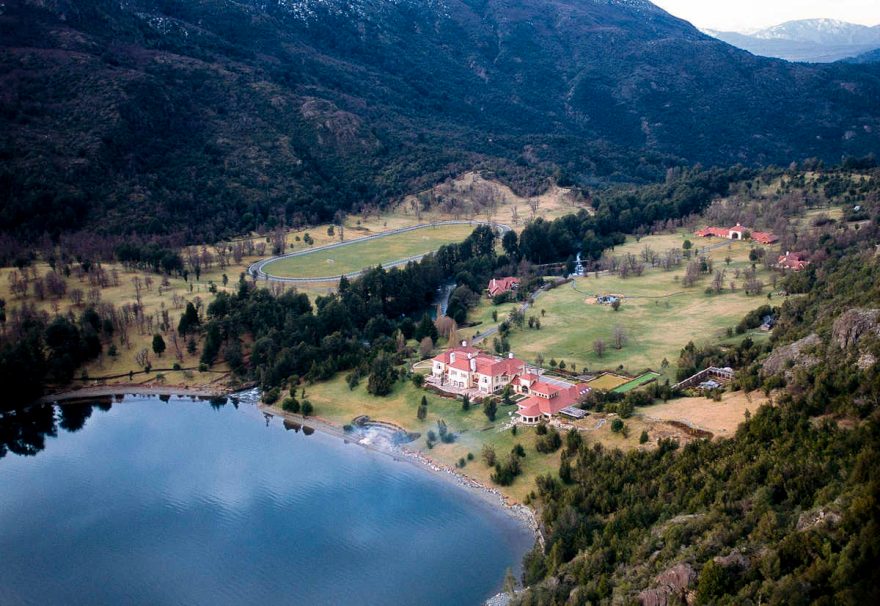
An aerial photograph Joe Lewis’ ranch on Hidden Lake, March 1, 2010 in southern Patagonia, Argentina. Francisco Bedeschi | dpa
Whether or not Lewis or his “right hand man” Van Ditmar were somehow involved in Irineo’s death and those of his wife and employee, there is no denying that their mysterious yet grisly endings cleared the way for Lewis’ purchase of Lago Escondido and the surrounding area. However, Lewis’ acquisition of this property, irrespective of the remaining Montero siblings’ willingness to sell, should never have been allowed for several reasons.
First, as per Argentine law, the sale of the property that Lewis has owned since 1996 is prohibited to a foreign citizen on national security grounds, given that the property is just 20 km from the Chilean border and thus, in foreign hands, could represent a grave national security risk. Second, it violates a local law dating back to 1969 that caps the maximum amount of land that any individual – Argentine citizen or foreigner – may own at around 70 hectares (~172 acres).
Third, it violates a provincial law passed in 1994 that created a protected natural area called the Río Azul Lago Escondido Natural Protected Area (ANPRALE), which included a significant portion of the land that Lewis would later buy from the Monteros. However, that law was amended in 1998, a few years after Lewis’ purchase, to remove the portion of his land that had previously been named a protected area under the control of the state. Federico Soria noted that the way in which the 1994 law was amended was blatantly unconstitutional.
One would think that the law would have prevented Lewis’ acquisition of the land long before Van Ditmar had first approached the Monteros about Lewis’ interest in the land. However, he was explicitly allowed to do so, despite the illegal nature of the purchase, owing to the general laxity of the local, regional and federal authorities towards wealthy foreigners looking to acquire Argentine land. As Lewis himself said in an interview with Gonzalo Sanchez in 2004, “I bought what they let me buy and here we are.”
The two-term presidency of Carlos Menem in the 1990s marked the reversal of more than 50 years of keeping and protecting areas of national importance and deemed strategic to natural security by permitting foreigners to buy a larger percentage of land than had been allowed since the passage of a 1944 law intended to preserve the territorial integrity of Argentina. Notably, when that law was created, the government of Edelmiro Farrell and Juan Perón expropriated several strategic properties owned by foreigners.
Yet, Menem’s presidency — which was thoroughly aligned with the “Washington consensus” — began, according to critics, violating the spirit of this 1944 law by issuing approvals of several million hectares to foreigners. Menem’s policies favoring foreign land purchases in rural areas have since been expanded by the presidency of Cristina Fernandez de Kirchner as well as that of the current president of Argentina, Mauricio Macri. Both of them have “friendly” relationships with Lewis and his associates, with the Macri a regular visitor of Lewis’ lakeside property in Patagonia.
Locals in El Bolsón have claimed that Lewis’ purchase of the Lago Escondido property – despite the legal obstacles – was the direct result of Menem’s policies. A member of El Bolsón’s community radio station FM Alas, who chose to remain anonymous owing to his father’s personal involvement in Lewis’ regional businesses, told MintPress that Lewis “had negotiated the purchase of the [Lago Escondido] property in meetings at the Casa Rosada [Pink House],” the Argentine equivalent of the White House, during Menem’s presidency.
MintPress was unable to confirm whether Lewis or his associates had visited the Casa Rosada while negotiating the property’s purchase. Yet Lewis has stated in interviews that “Menem sent us greetings and his best wishes when we opened [Lewis’ Lago Escondido mansion]” (Sanchez interview, pg. 61). Furthermore, Lewis has a notable habit of building close relationships with powerful Argentine politicians, including Macri. Macri has called Lewis “a friend,” defended him repeatedly, and even personally vacationed at Lewis’ Lago Escondido property.
The battle for Lago Escondido
Ever since his arrival to the area caused concern among some locals, Lewis has sought to win the good graces of the people of El Bolsón by acting as their benefactor — donating hospitals, building soccer fields and hosting annual activities and sporting competitions for locals at his property. This altruism is either embraced or rejected by locals, depending on whom you talk to. In keeping with the image that he has sought to cultivate among the townspeople, Lewis is often referred to as “Uncle Joe,” though it is spoken with either respect and admiration or derision and disgust.
Felicitas Libano, a member of the Assembly for the Defense of Water and Land (ADAT), told MintPress that Lewis has “integrated himself into nearly all the function of the city,” including its firefighters, police and other areas of the municipal government, and has “always tried to position himself as a benefactor.” According to Guido Augello, a member of local community radio station FM Alas, the townspeople are divided somewhat evenly into “people that like ‘Uncle Joe,’ people who hate him and people who don’t care.”
Lewis has also won over a portion of the townspeople and local businessmen through his patronage of select local services and his occasional hosting of small groups of locals for invitation-only sporting events and holiday celebrations. However, some have contended that Lewis receives many foreign guests, particularly from Israel.
According to the research of former French intelligence officer turned journalist Thierry Meyssan, Lewis has been inviting thousands of Israel Defense Forces (IDF) soldiers to his territory annually. In late 2017, Meyssan alleged:
Since the Falklands War, the Israeli army has been organizing ‘holiday camps’ in Patagonia for its soldiers. Between 8,000 and 10,000 of them now come every year to spend two weeks on Joe Lewis’ land.”
It is unclear if Meyssan’s information was the result of his time in France’s exterior intelligence service DGSE or independent research he conducted since becoming a journalist, as MintPress’ efforts to contact Meyssan were unsuccessful. Locals, journalists and researchers interviewed by MintPress could not confirm Meyssan’s claims. Yet, many of these locals and researchers said they had heard of those claims from other sources within Argentina, but also noted that they were speculative, given that no one but Lewis or his employees knows who visits the property beyond the aforementioned events where select locals are invited to attend.
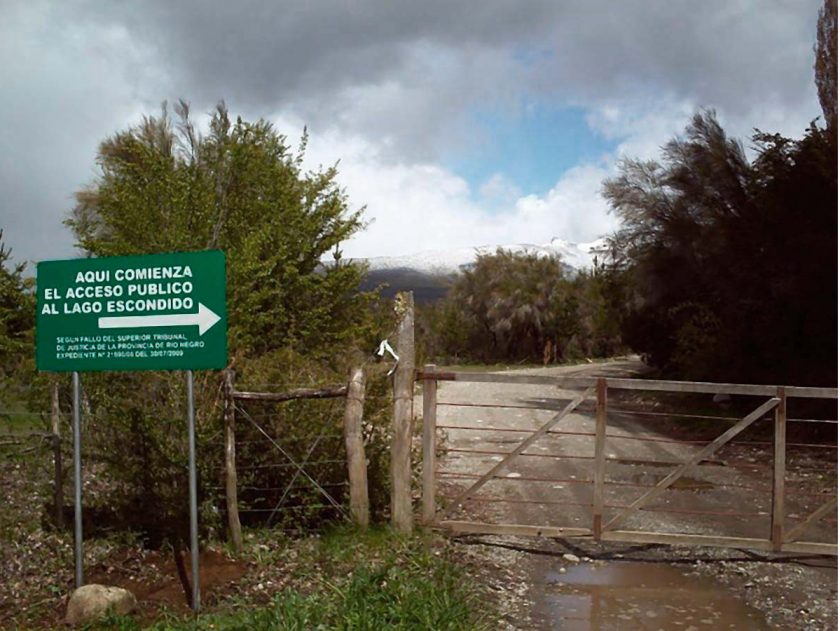
Tacuifi road leading to Lago Escondido, now blocked to public access, lies off of Argentina’s Route 40. The sign notes the 2009 Supreme Court ruling demanding the still-closed road be opened to the public. Photo | Revista Anfibia
Beyond the alleged IDF “vacations” on Lewis’ land, his presence in the area has been controversial for other reasons, namely for concerns that he sought to usurp key regional resources. Indeed, journalist Gonzalo Sanchez noted in his 2004 book Patagonia Sold: The New Owners of the Land :
In El Bolsón, there are more than a few locals and city council members that believe that, behind his [Lewis’] generosity, there are other hidden objectives, like the possible control of the water reserves of this part of Patagonia (pg. 50).”
Inklings of the truth in relation to these concerns were evident as soon as Lewis acquired the property surrounding Lago Escondido. This large mountain lake, which Lewis’ property surrounds, is the water basin for two important regional rivers, the Manso and Puelo, which later unite in Chile and drain into the Pacific. It is also the lake which feeds other nearby lakes including the Soberanía Lakes and Montes Lake, among others. Lago Escondido itself is estimated to contain as many as 400 billion liters (~105 billion gallons) of freshwater.
In Argentina, as is also the case in neighboring Chile, water – whether in lakes, rivers or seas – is a public right and public access to all bodies of water is guaranteed by law. This legal concept — likely foreign to Lewis and other Westerners, whose home countries often enshrine private property rights over the public’s right to vital resources — has been the most visible way in which tensions between Lewis and locals have manifested. It was also the first real test of Lewis’ resolve to carve out his “independent state” in Patagonia and keep locals out.
Lewis closed off the public road from the highway to the lake and also closed the private road he built at a separate point from public access. According to several locals interviewed by MintPress who had tried to enter the area, private security in civilian clothing prevent people from using the roads either by vehicle or on foot. Federico Soria, who has himself tried to enter the area on several occasions, described the guards to MintPress as “intimidating” and “aggressive” and also said that the Montero family, the old owners of the land, block one of the roads before it enters Lewis’ property and are “heavily armed.”
The only remaining path is a steep – and in places, dangerous – mountain path that takes at least two days in each direction to traverse. The path is poorly marked and maintained and is only usable in summer, as it is blocked by snowfall in other seasons. Every person interviewed by MintPress who had seen or traversed the path described it as being suitable only for “experienced mountaineers.”
In 2009, Lewis suffered his first major defeat in his efforts to keep locals out of his “parallel state” when the regional court ruled that the Tacuifi road — which connects the lake to the main highway, Route 40, and crosses Lewis’ property — be opened. The ruling stated that this must be done in order to “ensure access to Lago Escondido with appropriate signaling and ensuring transability.” The court gave Lewis 120 days to comply.
However, he didn’t comply and instead his regional associates began openly threatening any who tried to visit “his” lake. The clearest threat came from Van Dittmar himself in 2011, when he publicly stated that he and other Hidden Lake S.A. employees would defend Lewis’ private property by “fighting with blood, if we have to.” Van Ditmar also said that he would keep locals from accessing the lake “with a Winchester [rifle] in hand, with blood if necessary.”
In 2012, the region’s Supreme Court upheld the 2009 ruling, as did Argentina’s national Supreme Court a year later. However, Lewis and Van Ditmar refused to open the Tacuifi road, Van Ditmar saying that the treacherous but “very pretty” mountain path should instead be used to access the lake. Argentine President Macri also stepped in and echoed Van Ditmar, stating that the lake is even more accessible than before Lewis bought the property.
The court battle continues to today, after the Supreme Court of Río Negro in 2016 withdrew its previous ruling and ordered that a new hearing with different judges issue a new ruling. Critics accused Lewis of using extreme “political pressure” at the regional and local level in order achieve this very surprising ruling.
Despite that, locals continue to fight for public access to Lago Escondido and defend Argentina’s sovereignty over Lewis’ private empire. The main manifestation of this effort is an annual “March for Sovereignty,” the most recent of which took place in early February of this year. The march is organized by the Foundation for the Cultural Integration and Promotion of Water (FIPCA), which is run by former Argentine marine Julio Cesár Urien. Like the prior marches of the same name, its participants walked for nearly three days on foot over the mountain trail to arrive on the shore of the lake, which – as mentioned above – they were within their legal rights to do.
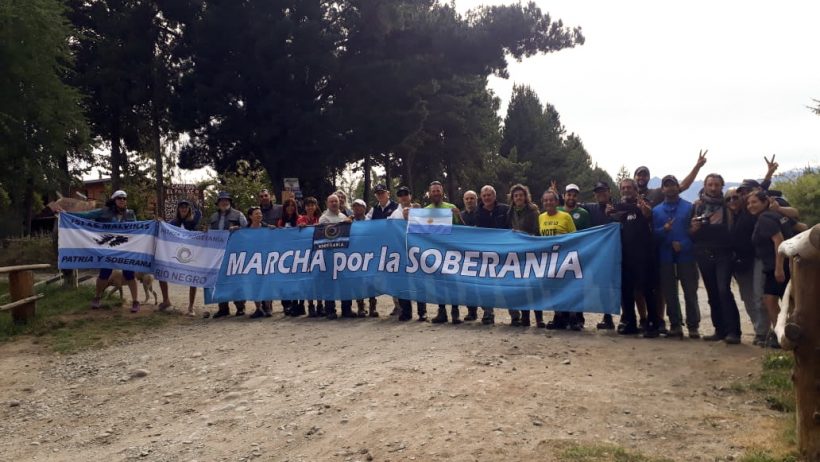
Participants in the 2019 “March for Sovereignty” pose for a picture at the beginning of their several-day journey to reach Lago Escondido by foot. Photo | FIPCA PRENSA
Upon arriving, they were met by Lewis’ private security as well as members of the Río Negro police, who cornered them and told them that they couldn’t even go to the bathroom without fear of arrest for trespassing, even though lakeshores are also legally considered public spaces. Guillermo Martín Caviasc — a journalist for Barricada TV, who was present at the demonstration — called the combination of local police and private security Lewis’ “private army” and remarked that the police officers present were “in a situation of subordination like if they were visiting a foreign state controlled by Lewis.”
Two participants in the march, Andrea Gatabria and David Ramallo, mounted inflatable kayaks with the intention of placing an Argentine flag in a small island in the middle of the lake, itself technically a public space. Before they made it to the island, two speedboats belonging to Hidden Lake S.A. circled the kayaks in an effort to capsize them while taunting them, asking “Do you know what it’s like to die from hypothermia?”
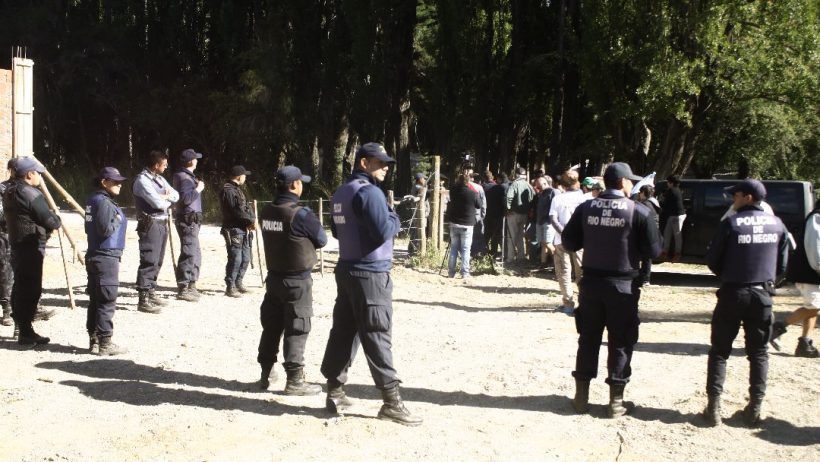
Participants in the 2019 “March for Sovereignty” pose for a picture at the beginning of their several-day journey to reach Lago Escondido by foot. Photo | FIPCA PRENSA
After half an hour of taunts that seemed more like death threats, Lewis’ private security knocked over the kayaks, leaving Gatabria and Ramallo floating in the freezing water. After several minutes, several witnesses stated that one of the security guards told the two kayakers “Well, now do you see what it’s like to die of hypothermia?” Gatabria and Ramallo were, after some time, lifted into the guard boats, but had spent so much time in the frigid water that both had to be hospitalized.
National Senator for Río Negro, Magdalena Odarda, demanded accountability for the actions of Lewis’ private security and local police and FIPCA has begun legal action against Hidden Lake S.A. for threatening the lives of march participants. Neither Hidden Lake S.A. nor Lewis’ Tavistock Group, which oversees his business interests in Argentina and elsewhere, responded to MintPress inquiries regarding the incidents against march participants.
While Argentines have routinely experienced intimidation and aggression when attempting to access the lake, some foreigners have had very different experiences. Take, for instance, Scott Leahy*, an American now living in Chile, who, during a past trip to El Bolsón, was able to waltz right through onto Lewis’ Lago Escondido property when he was in the company of two ex-IDF soldiers who had been there before.
Leahy told MintPress that when he was backpacking through Argentine Patagonia in 2010 with a Chilean friend, he had met and become friends with two young Israelis who had recently finished their service in the IDF and were staying at the same youth hostel. One day, these two Israelis offered to take Leahy and his friend to what they called a “secret beach” nearby.
They all piled into a car and, upon taking a gravel road off of Route 40, arrived at a gate that Leahy confirmed to MintPress was the Tacuifi road entrance to Lewis’ Lago Escondido property (seen in an image earlier in this report). Leahy was unsure about continuing, given that the gate was closed and, as a foreigner, he was unfamiliar with the area. However, the Israelis urged him on, saying that they had been there before and knew where they were going.
When the group of backpackers encountered Hidden Lake S.A. employees and guards, the Israelis explained that they were from Israel and wanted to bring their friends to the beach. The Lago Escondido employees told the pair that the group was not officially allowed to enter the property, but they could pass. Leahy didn’t think anything of it at the time, and told MintPress that he had assumed the pair knew the owner, though the Israelis never mentioned Lewis at all and they showed no interest in meeting with him either. This suggests that they were not personal friends of Lewis, but also shows that they knew that they could access the lake without problem, even in the absence of a formal invitation.
While this anecdote suggests that the claims of Lewis hosting thousands of IDF soldiers annually may indeed have something to them, it also serves as a very troubling comparison to the way Argentines have been treated when trying to access the very same lake. Indeed, if foreigners, Israelis in this case, were amicably waved through despite no invitation from Lewis or Hidden Lake S.A., why are Argentines who try to do the same met with such violence and aggression, particularly when they have a legal right to do so?
Stealing El Bolsón’s resources for his own use
Though public access to Lago Escondido has been a major issue of contention between Lewis and the people of El Bolsón since the late 1990s, concerns that the British billionaire was intent on controlling the region’s water supply multiplied when firms connected to Lewis began to move forward with what is often referred to as simply the “Laderas project.”
As early as 2004, a man named Cipriano Soria started telling his neighbors that he had “sold” his land in an area known as Pampa de Ludden (Ludden’s Plain) to Lewis. However, Soria did not technically own the land, which was a publicly-owned nature reserve, but was granted an easement by the provincial government of Río Negro to use its meadows to graze his livestock as long as he paid a “grazing license.” Despite the fact that it was neither legally nor properly sold to Lewis, Lewis began to make plans for the land — plans that ignored the fact that the area was and technically remains under several legal protections due to its ecological and strategic importance to the region.
Lewis intended to use this land to build a private airport in the area but was met by strong local resistance in 2005, including from the local group Assembly for the Defense of Water and Land (ADAT). Several members of ADAT live in Mallín Ahogado next to Pampa de Ludden, which provides the adjacent farming community of 2,000 with nearly all of its water. Felicitas Libano, who lives in Mallín Ahogado, told MintPress that the importance of this area as a critical water resource — as well as its ecological importance as an old-growth native forest — led it to be named a nature reserve that was supposed to be prevented from falling into private hands.
ADAT’s eforts were successful and Lewis’ plan for the area seemed to have been defeated or, at least, put on hold. Then, in 2009, the town voted on Lewis’ private airport, with more than 79 percent of voters opposing it. However, unluckily for the people of El Bolsón, Lewis had much bigger plans than just an airport and he wasn’t planning on letting local democracy get in his way.
From 2006 to 2009, legal arrangements were made between the ski center’s owner, the Club Andino Piltriquitrón, and the provincial government that opened up the local ski center at the Perito Moreno mountain to “third party” management.
Then, in 2009, Mirta Soria, Cipriano’s daughter, “inherited” the land from her father — land that he technically did not own yet was somehow granted permission to purchase from the state, along with another protected territory between Pampa de Ludden and the ski center, even though the state was forbidden from doing so by regional and local laws. Just six months after she bought this territory and sold more than half of it to Van Ditmar’s brother-in-law Samy Mazza. This new and very large area under Van Ditmar/Lewis control is where El Bolsón’s, in addition Mallin Ahogado’s, water reserves are located.
Soon after the land purchase occurred, two businesses appeared — Laderas of Perito Moreno Association S.A. and Laderas of Parallel 42, both of which are directly connected to Lewis and were given ownership of the lands in Pampa de Ludden and the other area recently purchased by Van Ditmar’s relative. That same year, both of these linked businesses proposed a “lottery” whereby the provincial government would select a private company to manage the local ski center. Laderas of Parallel 42 won the lottery.
Subsequently, the other Laderas company, Laderas of Perito Moreno, began plans to transform the land illegally acquired by Van Ditmar’s brother-in-law, Samy Mazza, as well as the portion still owned by Mirta Soria into a luxury subdivision of more than 1,000 luxury homes for wealthy Argentines and foreigners, along with a golf course, shopping centers, an artificial lake, and a private airport. This planned venture was subsequently promoted by pro-Lewis businessmen and media outlets as necessary for the successful development and improvement of the ski center.
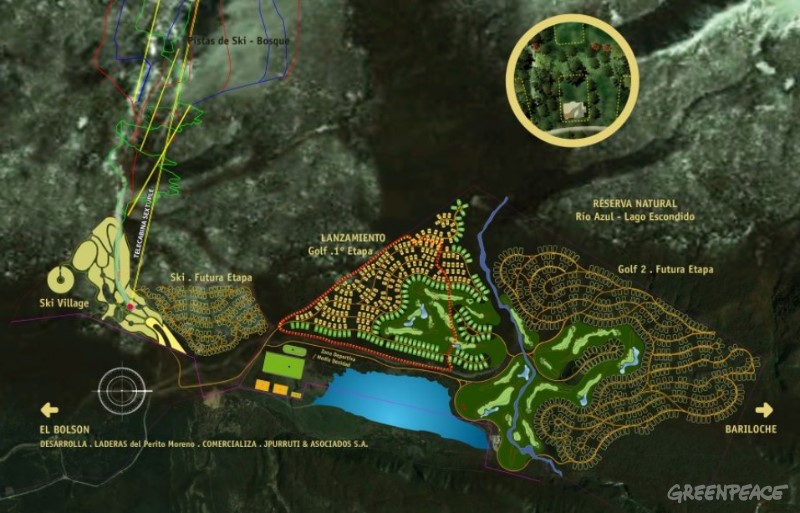
Proposed plan for the Laderas project, a 1,000-home luxury subdivision complete with an artificial lake and a golf course. Lewis’ firm plans to place the private airport (not shown in this image) south of the lake. The project, located right in the center of a nature reserve, is connected to Lewis’ Lago Escondido property and sits atop El Bolsón’s water reserves.
With the court battle underway and the project still lacking approval from El Bolsón’s city council, the regional governor, Alberto Weretilneck – a well-known Lewis ally – teamed up with Lewis-associated local businessmen in an effort to strongly pressure El Bolsón’s mayor at the time, Ricardo García, to sign a pledge that, once legal issues were resolved, the project would be fast-tracked for approval. García refused and Weretilneck along with other Lewis associates in the area began to push for his resignation. However, local protests kept García in power and, before leaving his post as mayor, García issued a decree that temporarily prohibited the Laderas project from advancing.
Clearly unhappy with this turn of events, the Laderas firms challenged the suspension of the project in court. Around this same time, members of local groups that had opposed the Laderas project reported several incidents of violence and intimidating acts, including threatening phone calls, their cars being set on fire, and the burning of a radio station as well as a community center in Mallín Ahogado.
In the case of architect and local politician Luis Martin, he was threatened with “lynching” by two Lewis associates – local businessmen Juan Carlos Martínez and Fabián Tornero – and his home was later broken into by armed thugs, one of whom accidentally cut himself with his machete and later fled the scene. Before escaping, the man had told Martin, “They have you targeted, they are going to kill you.”
In a 2011 article in Tiempo Argentina, Martínez referred to Lewis as “my friend” and was noted as a regular participant in meetings with Van Ditmar. The same article goes on to note that, in those meetings with Van Ditmar, Tornero is “influential” and further notes that Tornero is a known associate of Lewis.
In 2015, after García’s decree was challenged in court by Lewis’ firms, a judge ruled that the decree was legal but had not been written properly and therefore cancelled it. Soon after, a new pro-Lewis mayor and city council took charge and quickly signed a legal agreement with the Laderas companies, allowing them to build a “smaller project,” while claiming that any attempt to block the project – as García had done – could lead to another costly, lengthy legal battle that the municipal government just couldn’t afford. However, as Guido Augello told MintPress, this was hardly accurate, given that the local government could have appealed the decision regarding the decree, suggesting that this was just a convenient excuse to fast-track the project.
A few months after signing this agreement with the Laderas firms, the city council held a public hearing at which the vast majority of attendees from the community overwhelmingly rejected and criticized the project. Not getting the response it had hoped for, the council held a “secret” extraordinary meeting — secret because they declined to give the public the required notice needed to register to attend and participate in the meeting. With no one having registered, Pogliano decided to keep the meeting “closed” and placed police officers at the entrances to keep the townspeople out by force. The council subsequently decided to approve the Laderas project. Angry locals moved to occupy local government buildings in response, where they were targeted by riot police with tear gas.
The move generated several large-scale protests in El Bolsón, which started in 2016 and continued into 2017. Local resistance to the actions taken by the city council and mayor in relation to the Laderas project included a citizen occupation of the main plaza for three months, which was subject to police intimidation and violence, as well as three major protests, including the largest in El Bolsón’s history. That march against the Laderas project attracted an estimated 10,000 to 15,000 participants — quite a feat considering that the town’s urban and rural population boasts little more than 25,000 total inhabitants.
The reason for this mass mobilization, according to Augello, was that “even many of the people that like Lewis or believe his ‘Uncle Joe’ image oppose the Laderas project” and its associated airport. It’s not hard to understand why, considering that electricity and water intended for the townspeople of El Bolsón could soon be diverted to the wealthy outsiders who buy homes in “Lewislandia,” a derogatory term used to describe the Laderas project by some locals.
Yet, not only does Lewis intend to privatize El Bolsón’s water reserves, he and those developing his Laderas project also plan to divert the tourism that keeps its economy alive by instead diverting traffic from the main highway (Route 40) into his newly planned “city,” according to Federico Soria, a member of the Union of Patagonian Assemblies who has extensively researched Lewis’ local businesses. In an extensive 2016 article on the Laderas project and other Lewis-linked ventures, Soria wrote:
It is the intention of the developers of Laderas to unite the complex to Route 40 through two paved roads that they plan to build north and south of El Bolsón…. The Laderas variant road would be an advantageous shortcut [around El Bolsón].… [This] would benefit Lewis but economically endanger the community of El Bolsón…”
Furthermore, in 2016, Lewis completed a hydroelectric plant on the Escondido River — in the name of another of his local firms, Patagonia Energía — which passes through his property and feeds into the lake of the same name. However, he was granted permission to do so only if he connected the plant to El Bolsón in order to help the town resolve its ongoing and highly problematic electricity shortages. Once the plant was connected to El Bolsón, Lewis would become the main electricity provider to El Bolsón, as its current, aging diesel generators would be shut down.
Yet, instead of following the planned route for the power line that would give power to El Bolsón, it was diverted to the planned zone for the Laderas project, where it has remained “stopped” for years, even though his license to use the river for electricity production expired in 2015 owing to his company’s failure to connect the plant to El Bolsón in the time allotted by the license. As in so many other cases, Lewis and his companies have suffered no repercussions and continue to use the river for private power production. This situation has led some locals to speculate that Lewis has no intention of ever providing hydroelectric power to El Bolsón and it is instead a resource being guarded especially for his planned Laderas villa.
In effect, Lewis and his local representatives are working the resources they have acquired — water, electricity and tourism traffic — away from the town of El Bolsón and to the new “luxury” town of Laderas they hope to build to its north, a town that is an extension of Lewis’ own “independent” state. If this project is allowed to be completed, the people of El Bolsón will face a new troubling reality of resource insecurity and see its economy falter, as a crucial stream of revenue is diverted to the personal pet project of a foreign and predatory billionaire.
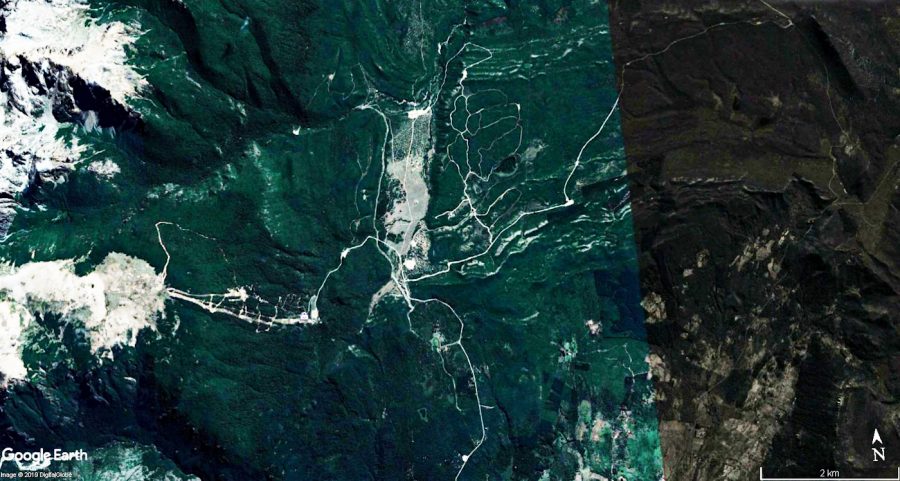
A satellite image taken last August shows land owned by the Laderas companies (center of photo) Roads for the planned “mini-city” are already being built, despite the fact that the companies are still not legally authorized to begin construction due to ongoing litigation. The already present ski center is seen on the left. Photo | Radio FM Alas, El Bolsón, Argentina via Google Earth
Yet, though Lewis won that particular battle in 2017, he is far from winning the war. Soon after the scandalous way in which the project was approved, the project again found itself challenged in court — placing it in legal limbo, unable to advance. Though the project is supposed to be blocked from moving forward until the conclusion of this latest legal battle, satellite images taken last August and shared with MintPress by local radio station FM Alas (shown above) reveal that Lewis’ businesses have already begun construction on the Laderas project, a clear indication that Lewis and his associates expect their impunity to continue.
Lewis’ Tavistock Group did not respond to MintPress inquiries about the Laderas project or the satellite images shown above.
The Joe Lewis “International Airport” — off-the-radar (literally)
Lewis’ “irregular” acquisition of Lago Escondido, the Laderas property, and his use of private security to block civilian access to the lake that is — by law — public property have long been decried as flagrant affronts to Argentina’s national sovereignty. Yet, while Lewis’ activities in and around Lago Escondido certainly do undermine existing Argentine laws, it is another Lewis-linked property in the Río Negro province that has done far more to erode Argentina’s national sovereignty.
Though Lewis’ plan to build an airport in Lago Escondido was technically approved but has not been able to move forward, Lewis – through his foreman Van Ditmar – purchased a sizeable property at the same latitude as Lago Escondido, but hours away on the Atlantic Coast. The property would soon become the site of Lewis’ private airport as well as a beachfront mansion. That airport, located south of Playas Doradas, was completed in February of 2008 and local media noted that its construction was “systemically hidden” from the public and was not subject to environmental impact assessments as normally required by law.
Most notably, however, there has never been any presence of Argentine customs or any other form of Argentine government control over what or who flies into or out of that airport, even though the airport is capable of receiving international flights. This point is particularly concerning in light of allegations that Lewis receives thousands of IDF soldiers annually on his property.
Joe Lewis’ private airport as seen on Google Maps
Furthermore, the Defense Ministry of Argentina has confirmed that not only is there no formal state control over what lands or takes off from this private airport, but that there are no radars in the area that even allow Argentine authorities to track nearby flight movements, including those of international flights. This means that no one but Lewis and his associates knows for sure how many flights land or take off from this area or where these flights originate or their intended destinations.
More shocking still, in 2010 then-Defense Minister Nilda Garré, in responding to a complaint from local politicians over the flagrant illegality of the airport, defended the airport’s presence by stating that it “could be used to facilitate rapid assistance of the state to locals in the event of disasters or emergencies.” To date, in the more than 10 years of its operation, it has never been used for any such purpose, according to those interviewed for this report.
The airport in Playas Doradas is roughly the same size as the airport in San Carlos de Bariloche (though some say it is larger), and is capable of receiving at least two large commercial-size passenger planes at a time. Much as with Lago Escondido, public access to the airport is denied, owing to the fact that the sprawling 15,000 hectare (~37,065 acres) property surrounding the airport is privately owned by a front company called Bahía Dorada S.A., which itself is legally owned by Lewis’ “foreman” Van Ditmar. However, the airport itself is owned by Westwind Aviation S.A. (formerly owned by Tavistock Aviation Argentina S.A., a subsidiary of Lewis’ Tavistock Group. Westwind Aviation S.A. is based at Lewis’ Lago Escondido property, as is Bahía Dorada S.A.. Neither Westwind Aviation S.A. nor the Tavistock Group responded to inquiries from MintPress regarding the lack of Argentine government oversight over the airport.
In order to realize the project, Van Ditmar – an Argentine citizen – had to be the owner of the property, as the area where the airport is built falls within a “National Security Zone” that prohibits land in that zone from being owned by foreigners on the basis of national security interests. In addition, the airport and the surrounding property, much like Lago Escondido, has a large and sophisticated private security presence.
The airport is estimated to have cost $20 million and Van Ditmar has publicly justified the airport’s existence by stating that Lewis not only “had the money” to build the complex but that it also made his ability to travel to his Lago Escondido property “easier.” This latter point is hard to believe given that the existing airport in San Carlos de Bariloche, which receives both private and commercial planes, is several hours closer to Lewis’ property than is his private airport in Playas Doradas. The notable difference between the two is that the private airport has no Argentine government oversight while the Bariloche airport does.
Few knew of the existence of the airport or the fact that access to the beach in that area had been effectively cut off by the Lewis/Van Ditmar project until a local woman, Elvira Linares, went on the television program “Documentos América,” hosted by Argentine journalist Facundo Pastor. On that program, Linares shared her experience of trying to pass through the now-private territory, noting that access to the ocean had been illegally blocked off. She also shared video footage she had taken of the massive, yet largely unknown to the public, private airport.
Mere hours after the program aired, Linares’ home was filled with bullet holes by still unknown assailants in what local media described as a blatant act of intimidation that led National Senator for Río Negro, Magdalena Odarda, to request that the government extend its protection to Linares, whose life was in danger. Efforts to contact Linares for comment for this report were unsuccessful.
Senator Odarda has arguably been the most well-known figure to demand accountability regarding the numerous irregularities surrounding the private airport. Odarda has, with limited success, repeatedly denounced the airport, on the basis of the fact that there is “no state control” over what or who passes through the airport.
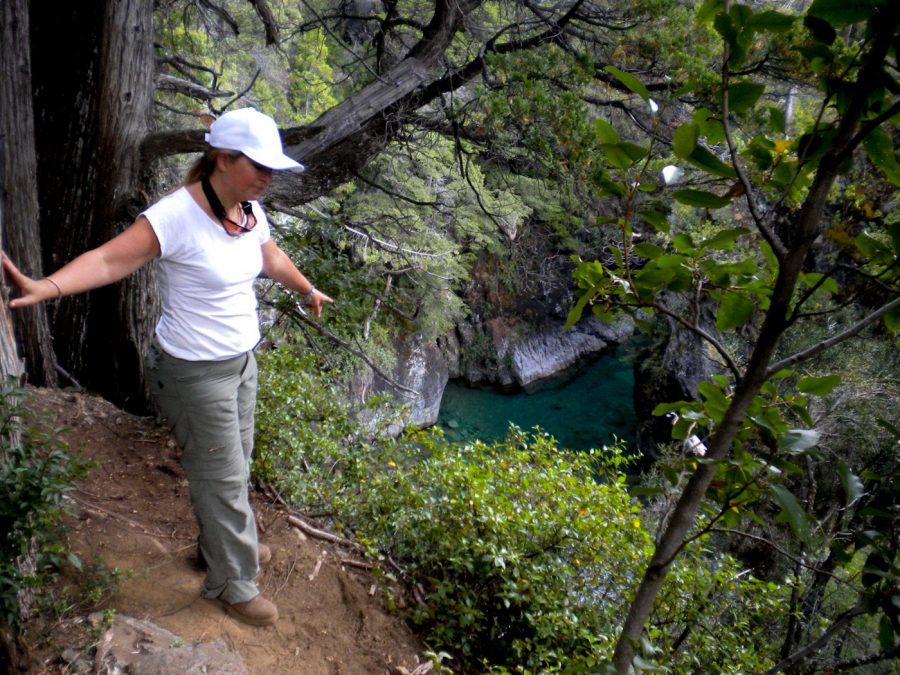
Senator Magdalena Odarda tours the publicly accessible road to Lago Escondido. Photo | Facebook
Odarda has also noted that the area where the airport is constructed is highly “strategic,” which poses a danger given that it is exclusively controlled by a foreigner, an Englishman. Odardo has pointed out that the airport is located on the important 42° parallel, which divides the regions of Río Negro and Chubut, and is only two hours away by plane from the disputed Falkland Islands, which are controlled by the United Kingdom but also claimed by Argentina. This dispute dates back to the 19th century and was the principal factor behind the Falklands War between Argentina and the U.K. in the 1980s, which many Argentines remember quite bitterly for the peace treaty Argentina signed after its defeat by England. Many Argentines have compared the document to the Treaty of Versailles that ended World War I.
Notably, there has been considerable evidence that Lewis’ airport has received planes from the Falkland Islands, which was the subject of a formal complaint made in 2010 to Argentina’s defense minister by then-governor of Argentina’s Tierra del Fuego province, Fabiana Ríos.
A well-oiled machine
Given the numerous laws that Lewis’ activities in Río Negro have broken at both the local and federal level, one would expect that somebody in the government – at least the local government – would hold him accountable. While some politicians like Magdalena Odarda and others have tried, the lack of impunity surrounding Lewis’ activities largely owes to his “friendships” with local and regional politicians as well as the country’s president.
One of the innumerable examples is Sergio Plunket. Plunket, who is in charge of Vial Rionegrina Sociedad del Estado (VIARSE), the regional body in charge of controlling public roads including the road leading to Lago Escondido, also works as a private “ecological consultant” for Lewis’ Hidden Lake S.A. Plunket also authorized the construction of Lewis’ Playas Doradas airport. Another clear example is Bruco Pogliano, El Bolsón’s current mayor, who is also Lewis’ long-time accountant in Argentina.
Another example that Gonzalo Sanchez noted (pp. 50-51) in his book, Patagonia Sold , is how Pablo Verani, ex-governor of Río Negro, started a long tradition of politicians making regular visits to Lago Escondido for Lewis-financed barbeque feasts, when he celebrated his win as the 1997 regional governor on the shores of the magnate’s privatized lake.
In addition to his undeniable influence among key local, regional and even national politicians, Lewis also enjoys considerable influence in the regional press and several former employees of his have become important figures in local and regional media. For example in 2016, according to local media, Dalila Pinacho, who long served as a lawyer and spokeswoman for Lewis’ Lago Escondido firm Hidden Lake S.A., became the director of the Nequén branch of Argentina’s National Radio, apparently through her “close” connections to local politicians.
Another journalist, Julio Álvarez — who described himself, to Gonzalo Sanchez in 2004 at an event in Lago Escondido, as Lewis’ “spokesman” — now works at a radio station in Viedma, Argentina, and was previously the El Bolsón correspondent for the regional newspaper Río Negro. Lewis also funds the local newspaper Ruta 40 and has stakes in other local newspapers such as El Cordillerano, Bolsón Web Patagonia, and El Ciudadano in Bariloche. Eliana Almonacid, who used to work for Ruta 40, told the national outlet Tiempo Argentina in 2014 that the Ruta 40’s director Nancy Aleuy, who also works for Hidden Lake S.A., told her that “Lewis had bought all the media outlets” in the region.
Lewis’ “Parallel State” is just the beginning
Lewis’ control over the local authorities and local press in Río Negro, and the complete impunity of his actions and those of his associates, have made it clear that in Argentina there is a de facto different legal system for oligarchs like Lewis and for the vast majority of Argentina’s citizens. This fact — in combination with the control Lewis and his associates exercise over the region’s key resources, including its water and energy production — has led to the creation of what some like Federico Soria have called a “parallel state” within Patagonia. However, this “parallel state” is, in reality, a microcosm of a much larger project currently underway that is aimed at the domination of the entirety of Argentine Patagonia by predatory oligarchical interests, the majority of which are directly connected to Lewis and his associates.
As will be explored in Part Two of this series, the Soros-led oligarch network, of which Lewis is a part in Argentina, has expanded its efforts to control Patagonia’s vast and strategic resources, including the region’s oil and gas wealth in addition to the domination of its freshwater resources and hydroelectricity production. Subsequent articles will then show that this effort is just the beginning, as this network and its close ties to the International Monetary Fund are being used to transfer ownership of vast state lands to their control in exchange for “debt relief.” The ultimate endgame appears to be the expansion of this “parallel state” — which Lewis has already helped to create in Río Negro and beyond, and which is controlled by small number of mostly foreign oligarchs — into a full-scale operation for extracting the region’s riches and exploiting its people.
Note: An sterisk (*) after a name indicates that a person’s real name was not used after they requested that MintPress not use their real name in this report.
Top Photo | This undated photo shows British billionaire, Joseph C. Lewis, at a Tottenham Hotspurs football game in the United Kingdom. Photo | Reuters
Whitney Webb is a MintPress News journalist based in Chile. She has contributed to several independent media outlets including Global Research, EcoWatch, the Ron Paul Institute and 21st Century Wire, among others. She has made several radio and television appearances and is the 2019 winner of the Serena Shim Award for Uncompromised Integrity in Journalism.
A Stumble at Hanoi, but Negotiations Remain on the Agenda
By Gregory Elich | Zoom in Korea | March 4, 2019
President Trump’s hasty decision to pull the plug on the Hanoi Summit ahead of schedule came as a stunning surprise. The feeling of disappointment in those who were hoping for success contrasted with the sense of relief in the U.S. foreign policy establishment, which remains steadfastly opposed to any improvement in relations.
The widespread assumption going into the summit was that the Trump administration would be able to buy off North Korea with diplomatic trinkets. It was thought that among these would be limited sanctions exemptions, such as allowing humanitarian organizations greater latitude to operate in North Korea. It was also anticipated that a document would be signed which would recognize that the Korean War had ended in 1953. While a peace declaration would have a symbolic “feel good” value, it would change no facts on the ground, and leave the North Koreans essentially empty-handed.
By all accounts, the North Koreans have been more clear-eyed about what they need in talks with U.S. negotiators than they had been given credit. Symbolic measures will not suffice. The North Koreans have serious and well-founded security concerns, given the various wars and military interventions the United States has launched around the world and its decades-long hostility to North Korea.
The Trump administration’s current campaign to destabilize Venezuela and substitute its handpicked lackey as that country’s president can only have further clarified thinking on security matters for the North Koreans.
A more immediate concern for North Korea is the impact of economic sanctions, which have as their aim the collective punishment of the entire population. According to a senior U.S. State Department official, during discussions on sanctions relief with their North Korean counterparts, U.S. negotiators “did our own calculations, and [the damage] tallies up to the tune of many, many billions of dollars.” North Korea’s GDP may be difficult to assess with precision, but it is estimated at around $30 billion. That places it below Vermont, which ranks dead last among U.S. states in terms of GDP. Given the economic damage/GDP ratio, it is obvious that the sanctions war is inflicting enormous hardship on the North Korean people.
According to North Korean Foreign Minister Ri Yong-ho, “Our proposal was that, if the U.S. lifts some of the UN sanctions, or in other words those aspects of the sanctions that impede the civilian economy and the people’s livelihood, we will completely and permanently dismantle the production facilities of all nuclear materials, including plutonium and uranium, in the Yongbyon complex, through a joint project by technicians from our two countries, in the presence of American experts”
“They were willing to give everything, including all the facilities at Yongbyon,” revealed an unnamed source. “Not just one physical reactor, but the whole complex. They were also willing to present their willingness to fully dismantle in the form of an official document. They were getting down to business pretty seriously. And then Mr. Trump and the American side turned down the proposal and left,” to the dismay of the North Koreans.
U.S. Secretary of State Mike Pompeo urged the president to reject the North Koreans’ proposal, as facilities outside of Yongbyon were not included, and nuclear weapons and missiles would remain untouched. National Security Advisor John Bolton may have added objections as well, given his well-known aversion to anything other than unilateral disarmament by North Korea.
“The President in his discussions challenged the North Koreans to go bigger,” a State Department official announced. “The President encouraged Kim to go all in, and we were… prepared to go all in as well.” Trump wanted the North Koreans to put their entire program on the table in exchange for relief on economic sanctions.
From the North Korean standpoint, complete dismantlement of its nuclear program cannot come without a security guarantee. According to Foreign Minister Ri, that guarantee is “even more important” than lifting sanctions. After all, it was for security reasons that North Korea developed its nuclear program, and its security will need to be assured through other means if it denuclearizes. “Given the current level of trust between our two countries,” Ri explained, the dismantlement of the Yongbyon facility is “the biggest step toward denuclearization that we can take at the present moment.” Trump’s proposed grand bargain failed to provide a secure basis for the North Koreans to abandon their nuclear program. Also unaddressed is the concept of denuclearization of the Korean Peninsula, which is habitually interpreted in a one-sided manner in the West as applying solely to North Korea. The meaning of that term needs to be clarified through further negotiations.
The U.S. side, however, remains wedded to the idea of maximum punishment as a negotiating tool and is unwilling to grant relief on economic sanctions without North Korea’s complete denuclearization. That is the essence of the current impasse between the two sides. In an interview broadcast on Fox News, Trump said, “The sanctions are there, and I didn’t want to give up the sanctions unless we had a real program.”
It seems clear that if both parties can agree on timing and sequencing, the possibilities for progress are there, starting with a partial lifting of economic sanctions in exchange for partial denuclearization.
Although the Hanoi Summit failed to produce a concrete result, it would be incorrect to say that it failed. Diplomacy is a process, not a single event. The summit did not end in rancor, and both sides have pledged to continue negotiations. KCNA, the North Korean news agency, reported that the summit “offered an important occasion for deepening mutual respect and trust,” and it noted that President Trump and Chairman Kim Jong Un “agreed to keep in close touch” and “continue productive dialogues for settling the issues discussed at the Hanoi Summit.”
“They were constructive discussions,” points out a State Department official. “There’s room to continue talking.” In Mike Pompeo’s assessment, “There have been lots of things that we’ve moved forward on, and I think we have a set of shared common understandings. I’ve seen enough congruence between what the two sides are trying to accomplish. I saw the goodwill between the two leaders.”
Despite the lack of agreement, Kim reiterated his commitment to maintain a freeze on nuclear and ballistic missile testing, while the U.S. is renaming and reducing the scope of its annual Foal Eagle and Key Resolve military exercises.
The main impediment to progress is U.S. bi-partisan opposition to dialogue and any reduction of tensions in East Asia. An often-repeated charge is that last year’s Singapore Summit produced no tangible result. However, the Singapore Summit was a short meeting meant to establish an agreement on intent, in which not only did North Korea promise to work toward denuclearization, but both sides committed to improve relations and build a peace regime on the Korean Peninsula. After decades of hostility and confrontation, the summit redirected the relationship to one of dialogue. That is no small thing. Critics who argue that detailed steps should have been drawn up in that initial meeting are, of course, intentionally distorting the nature of the meeting in an attempt to discredit the concept of U.S.-North Korea negotiations.
Similarly, those who wish to block progress can be expected to argue that the lack of an agreement at Hanoi proves that it is a mistake to meet with the North Koreans and talks must come to a halt. Nevertheless, U.S. and North Korean leaders remain invested in the process, and the less influence opponents have on U.S. negotiating strategy, the more chance of success. Moreover, although there is internal opposition from conservative forces in South Korea, the detente process between the two Koreas has developed its own momentum, which can be expected to exert a positive influence on the U.S. position. For now, there is certainly more reason for hope than despair.
Gregory Elich is a Korea Policy Institute associate and on the Board of Directors of the Jasenovac Research Institute. He is a member of the Solidarity Committee for Democracy and Peace in Korea, a columnist for Voice of the People, and one of the co-authors of Killing Democracy: CIA and Pentagon Operations in the Post-Soviet Period, published in the Russian language. He is also a member of the Task Force to Stop THAAD in Korea and Militarism in Asia and the Pacific.
His website is https://gregoryelich.org
Follow him on Twitter at @GregoryElich
US-Led Coalition Used White Phosphorus in Attacks on Syria’s Baghouz – Reports
© Photo: 1st Lt. Daniel Johnson/U.S. Army
Sputnik – 02.03.2019
DAMASCUS – The US-led coalition has used shells with white phosphorus in its bombing attacks on the southwestern Syrian town of Baghouz, which remains the last stronghold of the Daesh terror group in the country, local media reported on Saturday, citing sources.
This came soon after the US-backed Syrian Democratic Forces (SDF) announced that it had resumed operations against Daesh militants in Baghouz, following a break for citizens evacuation. According to SDF claims, only Daesh militants currently remain in the town.
However, the battle for Baghuz is currently going slowly in order to protect hostages held by the Daesh terrorists, according to co-chair of the US mission of the Syrian Democratic Council (SDC), Bassam Ishak.
Over the recent months, the Kurdish-led SDF has been carrying out operations against Daesh militants in Syria, with support from the US-led coalition.
Numerous reports have been emerging in Syrian media about civilian casualties and use of white phosphorus, which is prohibited under international conventions.
The Syrian authorities, in particular, have repeatedly urged the United Nations to take measures targeting the perpetrators of the attacks and put an end to the coalition’s unauthorized presence in Syria.
The United States, in the meantime, denies using white phosphorus in its airstrikes.
The US-led coalition, which consists of over 70 countries, is conducting military operations against the Daesh in Syria and Iraq. The coalition’s operations in Syria are not authorized by the Syrian government or the UN Security Council.
Lavrov to Pompeo: We can talk Venezuela, but US must stop threatening its legitimate government
RT | March 2, 2019
The US attempts to threaten Venezuela and meddle in the country’s affairs under the guise of supplying humanitarian aid have nothing to do with democracy, Russian FM Sergey Lavrov told his American counterpart, Mike Pompeo.
The top diplomats talked on the phone on Saturday on the initiative of Washington, the Russia Foreign Ministry said.
During the conversation, Lavrov blasted the American threats against the government of Nicolas Maduro, calling them “blatant interference in the internal affairs of a sovereign state and a flagrant violation of international law.”
He also grilled the US Secretary of State over Washington’s attempts to influence the situation in Venezuela under the “hypocritical guise” of providing humanitarian aid to the crisis-hit country. Such actions “have nothing to do with democratic process,” Lavrov said.
Earlier this week, Venezuelan Foreign Minister, Jorge Arreaza, has labeled the US aid to the country “a Trojan horse.” He said that nails and barbed wire to build barricades were seized from the supply trucks on the border with Colombia and provided photos to back his words.
As for Washington’s proposal to hold consultations on Venezuela, Lavrov said that Moscow was ready for such talks. However, he reminded Pompeo that “the principles of the UN Charter must be followed strictly as only the people of Venezuela have the right to decide the future of their country.”
The situation in Venezuela escalated after opposition leader, Juan Guaido, declared himself interim president of the country in late January. He was swiftly backed by the US, which never made a secret out of its desire to see socialist president Maduro removed from power.
However, all the American backing and increased sanction pressure on Caracas have so far been insufficient to cement Guaido’s claim to power as the man fled to neighboring Colombia to lead the coup from there, while promising to return.
Featured Video
Trita Parsi: Israel Set a Trap for Total War in the Region
or go to
Aletho News Archives – Video-Images
Book Review
Why the War on Conspiracy Theories Is Bad Public Policy
By Kevin Barrett • Unz Review • February 1, 2019
 A Review of Conspiracy Theories and Other Dangerous Ideas by Cass Sunstein (based on an earlier paper co-authored with Adrian Vermeule); In Defense of Troublemakers: The Power of Dissent in Life and Business by Charlan Nemeth; and Conspiracy Theories and the People Who Believe Them, edited by Joseph E. Uscinski
On January 25 2018 YouTube unleashed the latest salvo in the war on conspiracy theories, saying “we’ll begin reducing recommendations of borderline content and content that could misinform users in harmful ways—such as videos promoting a phony miracle cure for a serious illness, claiming the earth is flat, or making blatantly false claims about historic events like 9/11.”
At first glance that sounds reasonable. Nobody wants YouTube or anyone else to recommend bad information. And almost everyone agrees that phony miracle cures, flat earthism, and blatantly false claims about 9/11 and other historical events are undesirable.
But if we stop and seriously consider those words, we notice a couple of problems. First, the word “recommend” is not just misleading but mendacious. YouTube obviously doesn’t really recommend anything. When it says it does, it is lying. … continue
Blog Roll
 Aletho News
- Trita Parsi: Israel Set a Trap for Total War in the Region
- Trump’s Iran war is on an Israeli leash
- Saudi oil boss issues global supply warning
- Riyadh Says Its Oil System Is Intact. The Numbers Say Otherwise.
- Trump and Netanyahu Want to “Finish the Job” on Iran
- US ‘one-sided dictation’ not Iran’s beliefs makes rational talks impossible: Baghaei
- Iran’s Next Strike May Not Explode. It Could Shut You Down /Col Doug Macgregor
- Iran: US political targets legitimate if assassinations return
- Iraq shuts key border crossing with Iran under US pressure: Report
- Undersea Internet cables could be targeted in retaliation for attacks on Iran: IRGC deputy chief
- If Americans Knew
- The Israel Lobby’s Changing Fortunes
- AIPAC has become such a political liability that it’s shifting to a more “nimble” approach to buying politicians
- At least 160 Israeli settler attacks in 2 weeks
- Will Gaza’s Ancient Christian Community Disappear Forever?
- Israel’s vision of regional security rests on keeping Arab states weak
- Heidi Levine recounts how Palestinian youths helped save her in settler attack
- DAILY UPDATE: Latest essential news on Palestine, Israel, & region
- Trump’s Intensifying Sabotage of the ICC, for Israel’s Sake
- Israeli military detain US and UK volunteers in West Bank including Democratic NY politician Brad Lander
- Americans at National Conservatism Conference held in Israel this year criticize Israel
- No Tricks Zone
- E-Cars Reduce CO2 Emissions By Only 41% Compared To Internal Combustion Engine Vehicles
- Predictions Made By Renowned Climate Professor Over Past Decades Have Been Proven To Be Poor
- New Study Suggests Large Regions Of The Pacific Ocean Have Been Cooling For The Last 80 Years
- Germany’s Green Energy Debacle: High Energy Costs Force Kahla Porzellan to Close After 182 Years!
- New Study: 50 Years Of The Most Aggressive ‘Net Zero’ Policies Can Only Affect The Global Climate By 0.03°C
- US September “Heat” Was No Record…Many Records Set Decades Ago
- Latest European Green Energy Debacle; Portugal’s Largest Flagship Solar Park Insolvent!
- Green Energy Debacle: German Expert Professor Fritz Vahrenholt Warns Of Severe Economic And Social Consequences
- Two More Paleo Reconstructions Affirm Meters-Higher Sea Levels Across Ireland, Brazil 7000-6000 Years Ago
- New Study: Earth And Venus Surface Warmth Largely Explained By Convection And Lapse Rate, Not CO2 Or Radiation

