“Real” Assassin Arrested In Staged Kiev Hit Linked To Ukrainian Intelligence As Official Story Unravels
By Tyler Durden – Zero Hedge – 06/02/2018
The Ukrainian government’s staged assassination of anti-Putin journalist Arkady Babachenko has taken an even stranger turn, as evidence has emerged that his would-be “Russia-ordered” assassin and the man who supposedly hired him, both say they worked for Ukrainian counterintelligence, casting serious doubt on the official story.
To review, Ukrainian authorities announced last Tuesday that Babachenko had been assassinated after returning home from the store. On Wednesday, Babachenko appeared at a press conference with Ukrainian authorities who said that the faked assassination was an elaborate sting to bust an actual hit planned by Russia.
Only now we find that the hitman, Oleksiy Tsimbalyuk, is an outspoken critic of Russia who says he worked for Ukrainian counterintelligence – a claim Ukraine initially denied but later admitted to be true. Meanwhile the guy who supposedly hired Tsimbalyuk, Boris L. German, 50, also says he worked for Ukrainian counter-intelligence, a claim Ukraine denies as its immediately destroys the carefully scripted, if rapidly imploding, Ukrainian narrative meant to scapegoat Russia for what has been a “fake news” story of epic proportions, emerging from the one nation that not only was the biggest foreign donor to the Clinton foundation, but has made fake news propaganda into an art form.
The New York Times reports that Tsimbalyuk – a former Russia-hating priest was featured in a 10-minute documentary in January 2017 in which “he called killing members of the Russian-backed militias in eastern Ukraine “an act of mercy”, further calling into question why Russia would hire him for the supposed assassination in the first place.
Facebook pictures also reveal Tsimbalyuk wearing a Ukrainian ultranationalist uniform from “Right Sector,” a group deemed to be neo-Nazis.
As even the Russophobic NY Times puts it:
Given such strong and publicly avowed enmity toward Russia, it is odd to say the least that Mr. Tsimbalyuk would be selected to carry out the contract killing of a prominent Kremlin critic.
German claims he took orders from Moscow businessman Vyacheslav Pivovarnik – who he says works for one of Putin’s personal foundations.
Ukrainian officials also claim that German has a list of another 30 targets which Moscow wants to wipe out – something he claims he has since passed onto Kyiv.
Prosecutors claimed German had been given a down payment of $15,000, half what he was promised for carrying out the hit.
German said: ‘I got a call from a longtime acquaintance who lives in Moscow, and in the process of communicating with him it turned out that he works for a Putin foundation precisely to orchestrate destabilization in Ukraine.’ –Daily Mail
“Six months ago, my old acquaintance contacted me, an ex-citizen of Ukraine, now living in Moscow,” German told a Ukrainian court, adding “He works in a personal foundation of Putin’s – and is in charge of organizing riots in Ukraine and planned acts of terror at the next presidential elections. He is called Vyacheslav Pivovarnik. This is not a fairy tale, there’s nothing mystical here, everything has been proved.”
German’s lawyer Eugene Solodko wrote on Facebook that his client was an executive director of Ukrainian-German firm Schmeisser – the only non-state owned arms producer in the country.
Russia has denied German’s claim, with a Putin spokesman saying “No such foundation exists in Russia. Any allegations about Russia’s possible complicity in this staging is just mudslinging. They do not correspond to reality.”
Meanwhile, senior Ukraine officials have been on the defensive since Wednesday, when the head of security services announced they had staged the death of Babchenko so they could track his would-be killers to Russian intelligence, a story the International Federation of Journalists slammed as idiotic, nonsensical and completely undermining Ukraine’s credibility.
Did Israel Kill the Kennedys?
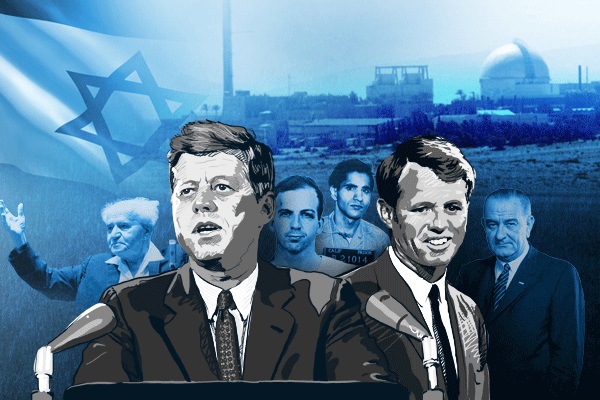
By Laurent Guyénot • Unz Review • June 3, 2018
Introduction
Just after midnight of June 6, 1968, Senator Robert Kennedy was assassinated in a backroom of the Ambassador Hotel in Los Angeles. He had just been celebrating his victory at the California primaries, which made him the most likely Democratic nominee for the presidential election. His popularity was so great that Richard Nixon, on the Republican side, stood little chance. At the age of 43, Robert would have become the youngest American president ever, after being the youngest Attorney General in his brother’s government. His death opened the way for Nixon, who could finally become president eight years after having been defeated by John F. Kennedy in 1960.
John had been assassinated four and a half years before Robert. Had he survived, he would certainly have been president until 1968. Instead, his vice-president Lyndon Johnson took over the White House in 1963, and became so unpopular that he retired in 1968. Interestingly, Johnson became president the very day of John’s death, and ended his term a few months after Robert’s death. He was in power at the time of both investigations.
And both investigations are widely regarded as cover-ups. In both cases, the official conclusion is rife with contradictions. We are going to sum them up here. But we will do more: we will show that the key to solving both cases resides in the link between them. And we will solve them beyond a reasonable doubt.
As Lance deHaven-Smith has remarked in Conspiracy Theory in America:
“It is seldom considered that the Kennedy assassinations might have been serial murders. In fact, in speaking about the murders, Americans rarely use the plural, ‘Kennedy assassinations’. […] Clearly, this quirk in the Kennedy assassination(s) lexicon reflects an unconscious effort by journalists, politicians, and millions of ordinary Americans to avoid thinking about the two assassinations together, despite the fact that the victims are connected in countless ways.”[1]
John and Robert were bound by an unshakable loyalty. Kennedy biographers have stressed the absolute dedication of Robert to his elder brother. Robert had successfully managed John’s campaign for the Senate in 1952, then his presidential campaign in 1960. John made him not only his Attorney General, but also his most trusted adviser, even on matters of Foreign or Military affairs. What John appreciated most in Robert was his sense of justice and the rectitude of his moral judgment. It is Robert, for example, who encouraged John to fully endorse the cause of the Blacks’ civil rights movement.[2]
Given this exceptional bond between the Kennedy brothers, what is the probability that the two Kennedy assassinations were unrelated? Rather, we should start with the assumption that they are related. Basic common sense suggests that the Kennedy brothers have been killed by the same force, and for the same motives. It is, at least, a logical working hypothesis that Robert was eliminated from the presidential race because he had to be prevented from reaching a position where he could reopen the case of his brother’s death. Both his loyalty to his brother’s memory, and his obsession with justice, made it predictable that, if he reached the White House, he would do just that. But was there, in 1968, any clear indication that he would?
Did Bobby plan to reopen the investigation on his brother’s assassination?
The question has been positively answered by David Talbot in his book Brothers: The Hidden History of the Kennedy Years, published in 2007 by Simon & Schuster. Robert had never believed in the Warren Report’s conclusion that Lee Harvey Oswald was the sole assassin of his brother. Knowing too well what to expect from Johnson, he had refused to testify before the Warren Commission. When its report came out, he had no choice but to publicly endorse it, but “privately he was dismissive of it,” as his son Robert Kennedy, Jr. remembers.[3] To close friends who wondered why he wouldn’t voice his doubt, he said: “there’s nothing I can do about it. Not now.” [4]
From 22 November 1963, Robert was alienated and monitored by Johnson and Hoover. Although still Attorney General, he knew he was powerless against the forces that had killed his brother. Yet he lost no time beginning his own investigation; he first asked CIA director John McCone, a Kennedy friend, to find out if the Agency had anything to do with the plot, and came out convinced that it hadn’t. In March 1964, he had a face-to-face conversation with mobster Jimmy Hoffa, his sworn enemy, whom he had battled for ten years, and whom he suspected of having taken revenge on his brother. Robert also asked his friend Daniel Moynihan to search for any complicity in the Secret Service, responsible for the President’s security[5]. And of course, Robert suspected Johnson, whom he had always mistrusted, as Jeff Shesol documents in Mutual Contempt: Lyndon Johnson, Robert Kennedy, and the Feud that Defined a Decade (1997).
In fact, a mere week after JFK’s death, November 29, 1963, Bill Walton, a friend of the Kennedys, travelled to Moscow and passed to Nikita Khrushchev, via a trusted agent who had already carried secret communications between Khrushchev and John Kennedy, a message from Robert and Jacqueline Kennedy; according to the memo found in the Soviet archives in the 90s by Alexandr Fursenko and Timothy Naftali (One Hell of a Gamble, 1998), Robert and Jackie wanted to inform the Soviet Premier that they believed John Kennedy had been “the victim of a right-wing conspiracy,” and that “the cooling that might occur in U.S.-Soviet relations because of Johnson would not last forever.” [6]
Robert also contacted a former MI6 officer who had been a friend of his family when his father was Ambassador in London. This British retired officer in turn contacted some trusted friends in France, and arrangments were made for two French Intelligence operatives to conduct, over a three-year period, a quiet investigation that involved hundreds of interviews in the United States. Their report, replete with innuendo about Lyndon Johnson and right-wing Texas oil barons, was delivered to Bobby Kennedy only months before his own assassination in June of 1968. After Bobby’s death, the last surviving brother, Senator Ted Kennedy, showed no interest in the material. The investigators then hired a French writer by the name of Hervé Lamarr to fashion the material into a book, under the pseudonym of James Hepburn. The book was first published in French under the title L’Amérique brûle, and was translated under the title Farewell America: The Plot to Kill JFK. Its conclusion is worth quoting:
“President Kennedy’s assassination was the work of magicians. It was a stage trick, complete with accessories and fake mirrors, and when the curtain fell, the actors, and even the scenery disappeared. […] the plotters were correct when they guessed that their crime would be concealed by shadows and silences, that it would be blamed on a ‘madman’ and negligence.”[7]
Robert had planned to run for the American Presidency in 1972, but the escalation of the Vietnam War precipitated his decision to run in 1968. Another factor may have been the opening of the investigation by New Orleans District Attorney Jim Garrison in 1967. Garrison was allowed to view Abraham Zapruder’s amateur film, confiscated by the FBI on the day of the assassination. This film, despite evident tampering, shows that the fatal shot came from the “grassy knoll” well in front of the President, not from the School Book Depository located behind him, where Oswald was supposed to be shooting from.
When talk of the investigation began, Kennedy asked one of his closest advisors, Frank Mankievitch, to follow its developments, “so if it gets to a point where I can do something about this, you can tell me what I need to know.” He confided to his friend William Attwood, then editor of Look magazine, that he, like Garrison, suspected a conspiracy, “but I can’t do anything until we get control of the White House.” [8] He refrained from openly supporting Garrison, believing that since the outcome of the investigation was uncertain, it could jeopardize his plans to reopen the case later, and even weaken his chances of election by construing his motivation as a family feud.
In conclusion, there can be little doubt that, had he been elected president, Robert Kennedy would have done everything possible to reopen the case of his brother’s assassination, in one way or another. This fact certainly did not escape John’s murderers. They had no other option but to stop him. This first conclusion is a sufficient reason to conduct a comparative analysis of both Kennedy assassinations, in search of some converging clues that might lead us to the trail of a common mastermind.We begin with Robert’s assassination.
Sirhan Sirhan, a Palestinian motivated by hatred of Israel?
Just hours after Robert’s assassination, the press was able to inform the American people, not only of the identity of the assassin, but also of his motive, and even of his detailed biography.[9] Twenty-four-year-old Sirhan Bishara Sirhan was born in Jordania, and had moved to the United States when his family was expelled from West Jerusalem in 1948. After the shooting, a newspaper clipping was found in Sirhan’s pocket, quoting favorable comments made by Robert regarding Israel and, in particular, what sounded like an electoral commitment: “The United States should without delay sell Israel the 50 Phantom jets she has so long been promised.” Handwritten notes by Sirhan found in a notebook at his home confirmed that his act had been premeditated and motivated by his hatred of Israel.
That became the story line of the mainstream media from day one. Jerry Cohen of the Los Angeles Times wrote a front page article, saying that Sirhan is “described by acquaintances as a ‘virulent’ anti-Israeli,” (Cohen changed that into “virulent anti-semite” in an article for the The Salt Lake Tribune), and that: “Investigation and disclosures from persons who knew him best revealed [him] as a young man with a supreme hatred for the state of Israel.” Cohen infers that “Senator Kennedy […] became a personification of that hatred because of his recent pro-Israeli statements.” Cohen further revealed that:
“About three weeks ago the young Jordanian refugee accused of shooting Sen. Robert Kennedy wrote a memo to himself, […] The memo said: ‘Kennedy must be assassinated before June 5, 1968’—the first anniversary of the six-day war in which Israel humiliated three Arab neighbors, Egypt, Syria and Jordan.”[10]
After September 11, 2001, the tragedy of Robert’s assassination was installed into the Neocon mythology of the Clash of Civilizations and the War on Terror the story. Sirhan became a precursor of Islamic terrorism on the American soil. In a book entitled The Forgotten Terrorist, Mel Ayton, who specializes in debunking conspiracy theories, claims to present “a wealth of evidence about [Sirhan’s] fanatical Palestinian nationalism,” and to demonstrate that “Sirhan was the lone assassin whose politically motivated act was a forerunner of present-day terrorism” (as written on the back cover).
In 2008, on the 40th anniversary of Robert’s death, Sasha Issenberg of the Boston Globe recalled that the death of Robert Kennedy was “a first taste of Mideast terror.” He quotes Harvard professor Alan Dershowitz (best known as Jonathan Pollard’s lawyer), as saying:
“I thought of it as an act of violence motivated by hatred of Israel and of anybody who supported Israel. […] It was in some ways the beginning of Islamic terrorism in America. It was the first shot. A lot of us didn’t recognize it at the time.”[11]
The fact that Sirhan was from a Christian family was lost on Dershowitz. The Jewish Forward took care to mention it on the same occasion, only to add that Islamic fanaticism ran in his veins anyway:
“But what he shared with his Muslim cousins — the perpetrators of September 11 — was a visceral, irrational hatred of Israel. It drove him to murder a man whom some still believe might have been the greatest hope of an earlier generation.”
“Robert Kennedy was the first American victim of modern Arab terrorism,” the Forward journalist hammered; “Sirhan hated Kennedy because he had supported Israel.” [12]
This leitmotiv of the public discourse begs the question: Was Bobby really a supporter of Israel? But before we answer that question, there is on more pressing one: Did Sirhan really kill Bobby?
Did Sirhan Bishara Sirhan really kill Robert Kennedy?
If we trust official statements and mainstream news, the assassination of Robert Kennedy is an open-and-shut case. The identity of the killer suffers no discussion, since he was arrested on the spot, with the smoking gun in his hand. In reality, ballistic and forensic evidence show that none of Sirhan’s bullets hit Kennedy.
According to the autopsy report of Chief Medical Examiner-Coroner Thomas Noguchi, Robert Kennedy died of a gunshot wound to the brain, fired from behind the right ear at point blank range, following an upward angle. Nogushi restated his conclusion in his 1983 memoirs, Coroner. Yet the sworn testimony of twelve shooting witnesses established that Robert had never turned his back on Sirhan and that Sirhan was five to six feet away from his target when he fired.
Tallying all the bullet impacts in the pantry, and those that wounded five people around Kennedy, it has been estimated that at least twelve bullets were fired, while Sirhan’s gun carried only eight. On April 23, 2011, attorneys William Pepper and his associate, Laurie Dusek, gathered all this evidence and more in a 58-page file submitted to the Court of California, asking that Sirhan’s case be reopened. They documented major irregularities in the 1968 trial, including the fact that the bullet tested in laboratory to be compared to the the one extracted from Robert’s brain had not been shot by Sirhan’s revolver, but by another gun, with a different serial number; thus, instead of incriminating Sirhan, the ballistic test in fact proved him innocent. Pepper has also provided a computer analysis of audio recordings during the shooting, made by engineer Philip Van Praag in 2008, which confirms that two guns are heard.[13]
The presence of a second shooter was signaled by several witnesses and reported on the same day by a few news media. There are strong suspicions that the second shooter was Thane Eugene Cesar, a security guard hired for the evening, who was stuck behind Kennedy at the moment of the shooting, and seen with his pistol drawn by several witnesses. One of them, Don Schulman, positively saw him fire. Cesar was never investigated, even though he did not conceal his hatred for the Kennedys, who according to his recorded statement, had “sold the country down the road to the commies.” [14]
Even if we assume that Sirhan did kill Robert Kennedy, a second aspect of the case raises question: according to several witnesses, Sirhan seemed to be in a state of trance during the shooting. More importantly, Sirhan has always claimed, and continues to claim, that he has never had any recollection of his act:
“I was told by my attorney that I shot and killed Senator Robert F. Kennedy and that to deny this would be completely futile, [but] I had and continue to have no memory of the shooting of Senator Kennedy.”
He also claims to have no memory of “many things and incidents which took place in the weeks leading up to the shooting.” [15] Some repetitive lines written of a notebook found in Sirhan’s bedroom, which Sirhan recognizes as his own handwriting but does not remember writing, are reminiscent of automatic writing.[16]
Psychiatric expertise, including lie-detector tests, have confirmed that Sirhan’s amnesia is not faked. In 2008, Harvard University professor Daniel Brown, a noted expert in hypnosis and trauma memory loss, interviewed Sirhan for a total of 60 hours, and concluded that Sirhan, whom he classifies in the category of “high hypnotizables,” acted unvoluntarily under the effect of hypnotic suggestion: “His firing of the gun was neither under his voluntary control, nor done with conscious knowledge, but is likely a product of automatic hypnotic behavior and coercive control.” [17]
We know that in the 1960s, American military agencies were experimenting on mental control. Dr Sidney Gottlieb, son of Hungarian Jews, directed the infamous CIA MKUltra project, which, among other things, were to answer questions such as: “Can a person under hypnosis be forced to commit murder?” according to a declassified document dated May 1951.[18] According to Israeli journalist Ronen Bergman, author of Rise and Kill First: The Secret History of Israel’s Targeted Assassinations (Random House, 2018), in 1968, an Israeli military psychologist by the name of Benjamin Shalit had concocted a plan to take a Palestinian prisoner and “brainwash and hypnotize him into becoming a programmed killer” aimed at Yasser Arafat.[19]
If Sirhan was hypnotically programmed, the question is: Who had some interest in having a visceral anti-Zionist Palestinian blamed for the killing of Robert Kennedy? Israel, of course. But then, we are faced with a dilemma, for why would Israel want to kill Robert Kennedy if Robert Kennedy was supportive of Israel, as the mainstream narrative goes?
Was Robert Kennedy really a friend of Israel?
The dilemma rests on a misleading assumption, which is part of the deception. In fact, Robert Kennedy was definitely not pro-Israel. He was simply campaigning in 1968. As everyone knows, a few good wishes and empty promises to Israel are an inescapable ritual in such circumstances. And Robert’s statement in an Oregon synagogue, mentioned in the May 27 Pasadena Independent Star-News article found in Sirhan’s pocket, didn’t exceed the minimal requirements. Its author David Lawrence had, in an earlier article entitled “Paradoxical Bob,” underlined how little credit should be given to such electoral promises: “Presidential candidates are out to get votes and some of them do not realize their own inconsistencies.”
All things considered, there is no ground for believing that Robert Kennedy would have been, as president of the US, particularly Israel-friendly. The Kennedy family, proudly Irish and Catholic, was known for its hostility to Jewish influence in politics, a classic theme of anti-Kennedy literature, best represented by the 1996 book by Ronald Kessler with the highly suggestive title, The Sins of the Father: Joseph P. Kennedy and the Dynasty He Founded.[20]
Robert had not been, in his brother’s government, a particularly pro-Israel Attorney General: He had infuriated Zionist leaders by supporting an investigation led by Senator William Fulbright of the Senate Committee on Foreign Relations aimed at registering the American Zionist Council as a “foreign agent” subject to the obligations defined by the Foreign Agents Registration Act of 1938, which would had considerably hindered its efficiency (after 1963, the AZD escaped this procedure by changing its status and renaming itself AIPAC)[21].
In conclusion, it is only with outstanding hypocrisy that The Jewish Daily Forward could write, on the 40th anniversary of Bobby’s death:
“In remembering Bobby Kennedy, let us remember not just what he lived for, but also what he died for—namely, the precious nature of the American-Israeli relationship.”[22]
Robert Kennedy’s death had not been a bad thing for the precious “American-Israeli relationship.” Rather, it was a great loss for the Arab world, where Bobby was mourned just as had his brother John before him.
Of course, the fact that the Zionist media lied when granting Robert Kennedy some posthumous certificate of good will toward Israel, and thereby provided Israel with a fake alibi, is not a sufficient reason for concluding that Israel murdered Robert. Even the fact that the masterminds of the plot chose as their programmed instrument an anti-Zionist Palestinian, and thereby stirred a strong anti-Palestinian feeling among Americans at the same time as getting rid of Robert, does not prove that Israel was involved. What is still lacking for a serious presumption is a plausible motive.
The motive of Robert’s assassination must be found, not in what Robert publicly declared in an Oregon synagogue during his presidential campaign, but rather in what he confided only to his most close friends: his intention to reopen the investigation on his brother’s death. Our next question, therefore, is: What would an unbiased investigation, conducted under the supervision of Robert in the White House, have revealed?
Did the CIA assassinate Kennedy?
It is obvious to anybody just vaguely informed that a genuine investigation would first establish that Oswald was a mere “patsy”, as he said himself, a scapegoat prepared in advance to be blamed for the crime and then be slaughtered without a trial. We will not here review the evidence that contradicts the official thesis of the lone gunman. It can be found in numerous books and documentary films.
Just as notorious is the theory that the plot to kill Kennedy originated from a secret network within the CIA, in collusion with extremist elements in the Pentagon. That conspiracy theory looms the largest in books, articles and films that have been produced since John Kennedy died.
That CIA-Pentagon theory, as I will call it (add the military-industrial complex if you wish) has a major flaw in the motive ascribed to the killers: besides getting rid of Kennedy, the theory goes, the aim was to create a pretext for invading Cuba, something the CIA had always pushed for and Kennedy had refused to do (the Bay of Pigs fiasco). With Oswald groomed as a pro-Castro communist, the Dallas shooting was staged as a false flag attack to be blamed on Cuba. But then, why did no invasion of Cuba follow Kennedy’s assassination? Why was the pro-Castro Oswald abandoned by the Warren Commission in favor of the lone nut Oswald? Those who address the question, like James Douglass in his JFK and the Unspeakable, credit Johnson with preventing the invasion. Johnson, we are led to understand, had nothing to do with the assassination plot, and thwarted the plotters’ ultimate aim to start World War III. This is to ignore the tremendous amount of evidence accumulated against Johnson for fifty years, and documented in such groundbreaking books as Phillip Nelson’s LBJ: The Mastermind of JFK’s Assassination (2010) or Roger Stone’s The Man Who Killed Kennedy: The Case Against LBJ (2013).
Another weakness in the CIA-Pentagon theory is the lack of agreement about the mastermind of the plot. In fact, one of the names that comes up most often is James Jesus Angleton, the head of Counter-Intelligence within the CIA, about whom Professor John Newman writes in Oswald and the CIA :
“In my view, whoever Oswald’s direct handler or handlers were, we must now seriously consider the possibility that Angleton was probably their general manager. No one else in the Agency had the access, the authority, and the diabolically ingenious mind to manage this sophisticated plot.”[23]
But there is plenty of evidence that Angleton, who was also the head of the CIA “Israel Office,” was a Mossad mole. According to his biographer Tom Mangold, “Angleton’s closest professional friends overseas […] came from the Mossad and […] he was held in immense esteem by his Israeli colleagues and by the state of Israel, which was to award him profound honors after his death.” [24] No less that two monuments were dedicated to him at memorial services in Israel during ceremonies attended by chiefs of Israeli Intelligence and even a future Prime Minister.[25]
Another aspect must be taken into account: if the trail of the CIA is such a well-trodden path among Kennedy researchers, it is because it has been cut and marked by the mainstream media themselves, as well as by Hollywood. And that began even before the assassination, on October 3, 1963, with an article by the New York Times’ chief Washington correspondent Arthur Krock. The article denounced the CIA’s “unrestrained thirst for power” and quotidian unnamed “very high official” who claimed that the White House could not control the CIA, and that:
“If the United States ever experiences an attempt at a coup to overthrow the Government, it will come from the CIA and not the Pentagon. The agency represents a tremendous power and total unaccountability to anyone.”[26]
In such a way, The New York Times was planting a sign, a month and a half before the Dallas killing, pointing to the CIA as the most likely instigator of the upcoming coup. The sign said: “The President is going to fall victim of a coup, and it will come from the CIA.”
One month after Kennedy’s assassination, it was the turn of the Washington Post to use a very similar trick, by publishing an op-ed signed by Harry Truman, in which the former president said he was “disturbed by the way CIA has been diverted from its original assignment.” “I never had any thought when I set up the CIA that it would be injected into peacetime cloak and dagger operations,” at the point of becoming across the globe “a symbol of sinister and mysterious foreign intrigue […] there are now some searching questions that need to be answered.” [27] Truman was hinting at the CIA’s role in toppling foreign governments and assassinating elected leaders abroad. But given the timing of his article, one month to the day after Dallas, it could only be understood by anyone with ears to hear, and at least subliminally by the rest, as an indictment of the CIA in the Kennedy assassination. This article, widely reprinted in the 1970s after the creation of the Church Committee and the House Select Committee on Assassinations, is regarded as Truman’s whistleblowing. Yet its mea culpa style is quite unlike Truman; that is because it was not written by Truman, but by his longtime assistant and ghostwriter, a Russian born Jew named David Noyes, whom Sidney Krasnoff calls “Truman’s alter ego” in his book, Truman and Noyes: Story of a President’s Alter Ego (1997). Truman probably never saw the article prior to its publication in the Washington Post morning edition, but he may be responsible for its deletion from the afternoon print runs.[28]
So the two most influential American newspapers, while ostensibly defending the official theory of the lone gunman, have planted directional signs pointing to the CIA. Most Kennedy truthers have followed the signs with enthusiasm.
In the 70s, the mainstream media and publishing industry played again a major role in steering conspiracy theorists toward the CIA, while avoiding any hint of Israeli involvement. One major contributor to that effort was A. J. Weberman, with his 1975 book Coup d’État in America: The CIA and the Assassination of John F. Kennedy, co-authored by Michael Canfield. According to the New York Jewish Daily Forward (December 28, 2012), Weberman had “immigrated to Israel in 1959 and has dual American-Israeli citizenship,” and is “a close associate of Jewish Defense Organization founder Mordechai Levy, whose fringe group is a spin-off of the late Rabbi Meir Kahane’s militant right-wing Jewish Defense League.” Weberman acknowledged Neocon Richard Perle’s assistance in his investigation.[29] The Weberman-Canfield book contributed to the momentum that led the House Select Committee on Assassinations (HSCA) to reinvestigate in 1976 the murders of JFK and Dr. Martin Luther King.
It is also in this context that Newsweek journalist Edward Jay Epstein published an interview of George De Mohrenschildt, a Russian geologist and consultant for Texan oilmen who had befriended Oswald and his Russian wife in Dallas in 1962. In this interview, De Mohrenschildt admitted that Oswald had been introduced to him at the instigation of Dallas CIA agent J. Walton Moore.[30] That piece of information is dubious for several reasons: First, Moore was officially FBI rather than CIA. Second, De Mohrenschildt was in no position to confirm or deny the words that Epstein ascribed to him: he was found dead a few hours after giving the interview. In fact, De Mohrenschildt’s interview published by Epstein contradicts De Mohrenschildt’s own manuscript account of his relationship to Oswald, revealed after his death.[31] De Mohrenschildt’s death was ruled a suicide. The Sheriff’s report mentions that in his last months he complained that “the Jews” and “the Jewish mafia” were out to get him.[32] Needless to say, Epstein didn’t mention anything about this. More suspicions arise from the fact that Epstein’s main source for his 1978 book, Legend: the Secret World of Lee Harvey Oswald, was James Jesus Angleton, who was actively spreading disinformation at the time of the HSCA, defending the theory that Oswald was a KGB agent with CIA connections.
That Israeli agents have been instrumental in spreading conspiracy theories targeting the CIA is also evidenced by Oliver Stone’s film JFK released in 1991, starring Kevin Costner in the role of New Orleans District Attorney Jim Garrison. This film, which shook public opinion to the point of motivating the President John F. Kennedy Assassination Records Collection Act of 1992, was produced by Arnon Milchan, described in a 2011 biography as being from his youth “one of the most important covert agents that Israeli intelligence has ever fielded,” involved in arms smuggling from the US to Israel.[33] In 2013 Milchan publicly revealed his extended activity as a secret agent of Israel, working in particular to boost Israel’s nuclear program.[34] It is therefore no wonder that Stone’s film gives no hint of the Mossad connection that Garrison stumbled upon.
Who killed JFK?
By a strange paradox, the authors who stand for the consensual conspiracy theory of a CIA plot against Kennedy build their case on the biography of Oswald, while at the same time claiming that Oswald had almost nothing to do with the killing. If Oswald was “just a patsy,” as he publicly claimed, the quest for the real culprits must logically begin by investigating the man who silenced Oswald.
Oswald’s assassin is known as Jack Ruby, but few people know that his real name was Jacob Leon Rubenstein, and that he was the son of Jewish Polish immigrants. Ruby was a member of the Jewish underworld. He was a friend of Los Angeles gangster Mickey Cohen, whom he had known and admired since 1946. Cohen was the successor of the famed Benjamin Siegelbaum, aka Bugsy Siegel, one of the bosses of Murder Incorporated. Cohen was infatuated with the Zionist cause, as he explained in his memoirs: “Now I got so engrossed with Israel that I actually pushed aside a lot of my activities and done nothing but what was involved with this Irgun war”.[35] Mickey Cohen was in contact with Menachem Begin, the former Irgun chief, with whom he even “spent a lot of time,” according to Gary Wean, former detective sergeant for the Los Angeles Police Department. So there is a direct line connecting Jack Ruby, via Mickey Cohen, to the Israeli terrorist ring, and in particular to Menachem Begin, a specialist in false flag terror. We also know that Ruby phoned Al Gruber, a Mickey Cohen associate, just after Oswald’s arrest; no doubt he received then “an offer he couldn’t refuse,” as they say in the underworld.[36] Ruby’s defense lawyer William Kunstler wrote in his memoirs that Ruby told him he had killed Oswald “for the Jews,” and Ruby’s rabbi Hillel Silverman received the same confession when visiting Ruby in jail.[37]
That is not all. At every level of the conspiracy to kill Kennedy, we also find the fingerprints of the Israeli deep state. JFK’s trip to Dallas, being officially “non political,” was sponsored by a powerful business group known as the Dallas Citizens Council, dominated by Julius Schepps, “a wholesale liquor distributor, member of every synagogue in town, and de facto leader of the Jewish community,” as described by Bryan Edward Stone in The Chosen Folks: Jews on the Frontiers of Texas.[38] Kennedy was on his way to the reception organized in his honor when he was shot.
The “host committee” inviting Kennedy was chaired by another influential figure of the wealthy Jewish community in Dallas: advertising executive and PR man Sam Bloom. According to former British Intelligence Officer Colonel John Hughes-Wilson, it was Bloom who suggested to the Police “that they move the alleged assassin [Oswald] from the Dallas police station to the Dallas County Jail in order to give the newsmen a good story and pictures. ”Oswald was shot by Ruby during this transfert. Hughes-Wilson adds that,“when the police later searched Ruby’s home, they found a slip of paper with Bloom’s name, address and telephone number on it.” [39]
After the Dallas tragedy, Israel’s sayanim were also busy fabricating the official lie. Apart from its chairman Earl Warren, chosen for his figurative role as Chief Justice, all key people in the investigative Commission were either personal enemies of Kennedy—like Allen Dulles, the CIA director fired by Kennedy in 1961—or ardent Zionists. The man who played the key role in fabricating the government lie purveyed by the Warren Commission was Arlen Specter, the inventor of what came to be called the “magic bullet” theory: a single bullet supposed to have caused seven wounds to Kennedy and John Connally sitting before him in the limousine, and later found in pristine condition on a gurney in Parkland Memorial Hospital in Dallas. Specter, who with an ironic touch of chutzpah titled his autobiography Passion for Truth, was the son of Russian Jewish immigrants, and, at his death in 2012, was mourned by the Israeli government as “an unswerving defender of the Jewish State,” and by AIPAC, as “a leading architect of the congressional bond between our country and Israel.” [40]
So, at all stages of the plot, we find a Zionist cabal including business men, politicians and Irgun-connected gangsters, not forgetting media executives, all devoted to Israel.
The most plausible motive for Israel to kill Kennedy has been revealed by two books: Seymour Hersh’s The Samson Option in 1991, then Avner Cohen’s Israel and the Bomb in 1998, and the lead has been followed up in 2007 by Michael Karpin in The Bomb in the Basement. What these investigators reveal is that Kennedy, informed by the CIA in 1960 of the military aim pursued at the Dimona complex in the Negev desert, was firmly determined to force Israel to renounce it. With that purpose in mind, he replaced CIA Director Allen Dulles by John McCone, who had, as Eisenhower’s chairman of the Atomic Energy Commission (AEC), leaked to The New York Times the truth about Israel’s Dimona project; the story was printed on December 19, 1960, weeks before Kennedy was to take office. As Alan Hart writes, “there can be no doubt that Kennedy’s determination to stop Israel developing its own nuclear bomb was the prime factor in his decision to appoint McCone.”[41] Then Kennedy urged Ben-Gurion to allow regular inspections of Dimona, first verbally in New York in 1961, and later through more and more insistent letters. In the last one, cabled June 15, 1963 to the Israeli ambassador with instruction to hand it personally to Ben-Gurion, Kennedy demanded Ben-Gurion’s agreement for an immediate visit followed by regular visits every six months, otherwise “this Government’s commitment to and support of Israel could be seriously jeopardized.” [42] The result was unexpected: Ben-Gurion avoided official reception of the letter by announcing his resignation on June 16. As soon as the new Prime Minister Levi Eshkol took office, Kennedy sent him a similar letter, dated July 5, 1963, to no avail. Did Ben-Gurion resign in order to deal with Kennedy from another level?
Five months later, Kennedy’s death relieved Israel of all pressure (diplomatic or otherwise) to stop its nuclear program. Faced with Johnson’s complete lack of interest in that issue, John McCone resigned from the CIA in 1965, declaring: “When I cannot get the President to read my reports, then it’s time to go.”
Kennedy’s determination to stop Israel’s Dimona project was only part of the “Kennedy problem”. During his first months in the White House, Kennedy committed himself by letters to Nasser and other Arab heads of State to support UN Resolution 194 for the right of return of Palestinian refugees. Ben-Gurion reacted with a letter to the Israeli ambassador in Washington, intended to be circulated among Jewish American leaders, in which he stated:
“Israel will regard this plan as a more serious danger to her existence than all the threats of the Arab dictators and Kings, than all the Arab armies, than all of Nasser’s missiles and his Soviet MIGs. […] Israel will fight against this implementation down to the last man.’”[43]
Kennedy behaved warmly toward Nasser, Israel’s worst enemy. Historian Philip Muehlenbeck writes:
“While the Eisenhower administration had sought to isolate Nasser and reduce his influence through building up Saudi Arabia’s King Saud as a conservative rival to the Egyptian president, the Kennedy administration pursued the exact opposite strategy.”[44]
After Kennedy’s death, American foreign policy was reversed again, without the American public being aware of it. Johnson cut the economic aid to Egypt, and increased the military aid to Israel, which reached 92 million dollars in 1966, more than the total of all previous years combined.
For 50 years, the Israeli trail in the Kennedy assassination has been smothered, and anyone who mentioned it was immediately ostracized. American congressman Paul Findley nevertheless dared write in March 1992 in the Washington Report on Middle East Affairs: “It is interesting to note that in all the words written and uttered about the Kennedy assassination, Israel’s intelligence agency, the Mossad, has never been mentioned.” One single author has seriously investigated that trail: Michael Collins Piper, in his 1995 book Final Judgment: The Missing Link in the JFK Assassination Conspiracy. Piper was largely ignored by the mainstream of the Kennedy truth movement. But his work has made its way nevertheless. In 2013, Martin Sandler wrote about Piper’s work in his edition of letters by Kennedy, which included those addressed to Ben-Gurion about Dimona: “Of all the conspiracy theories, it remains one of the most intriguing.” It is, in fact, a theory widespread in Arab countries.[45]
The case against Lyndon Johnson
Several investigators have identified Lyndon Johnson, Kennedy’s vice-president, as the mastermind of the Kennedy assassination. It is, at least, beyond doubt that the plotters acted with the foreknowledge that Johnson, who automatically stepped in as head of State after Kennedy’s death, would cover them. The context of national crisis enabled him to bully both Justice and the press while achieving his life’s ambition. Johnson not only benefitted from the plot; he participated in its elaboration. As a former senator from Texas, he could mobilize high-ranked accomplices in Dallas to prepare the ambush. Johnson also had his men in the Navy. In 1961, Texan senator John Connally had been appointed as Navy Secretary at the request of Johnson. When Connally resigned eleven months later to run for governor of Texas, Johnson convinced Kennedy to name another of his Texan friends, Fred Korth.
Johnson’s privileged control over the Navy is an important aspect of the case because the Navy was critical in the setting up and in the cover-up of the plot. First, contrary to a widespread but erroneous belief, Lee Harvey Oswald had been recruited by the Navy and not by the CIA. He was a Marine, and as a Marine he had worked for the Office of Naval Intelligence (ONI). Secondly, it is at the Naval Hospital in Washington, under the control of Navy officers, that Kennedy’s autopsy was performed, after his body had been literally stolen at gunpoint from Parkland Hospital in Dallas. The report of this autopsy stated that the fatal bullet had entered the back of Kennedy’s skull, which contradicted the testimonies of twenty-one members of the Dallas hospital staff who saw two entry bullet-wounds on the front of Kennedy’s body. This was critical because Oswald was presumably shooting from behind Kennedy, and could not possibly have caused these bullet wounds.
It is noteworthy that Johnson had actually taken advantage of his connections in the Navy to participate in the greatest corruption case ever recorded at that time. His accomplice Fred Korth was forced to resign as Navy Secretary in November 1963, only weeks before the Dallas coup, after the Justice Department headed by Robert Kennedy had implicated him in a fraud involving a $7 billion contract for the construction of 1,700 TFX military aircraft by General Dynamics, a Texas company. Johnson’s personal secretary, Bobby Baker, was charged in the same case.
Because of this mounting scandal and other suspicions of corruption, Kennedy was determined to change Vice-President for his upcoming reelection campaign.[46] While in Dallas the day before the President’s visit, Nixon publicized the rumor of Johnson’s removal, and the Dallas Morning News was reporting on November 22nd: “Nixon Predicts JFK May Drop Johnson.” Instead, Johnson became president that very day.
Many Americans immediately suspected Johnson’s involvement in the Dallas coup, especially after the publication in 1964 of a book by James Evetts Haley, A Texan Looks at Lyndon, which portrayed Johnson as deeply corrupt. According to his biographer Robert Caro, Johnson was a man thirsting “for power in its most naked form, for power not to improve the lives of others, but to manipulate and dominate them, to bend them to his will.” [47]
The evidence incriminating Johnson does not conflict with the evidence against Israel, quite the contrary. First, both trails converge in the person of Jack Ruby, whom Nixon identified a one of “Johnson’s boys,” according to former Nixon operative Roger Stone.[48] The hypothesis that Ruby acted on Johnson’s orders is a likely explanation for some of his odd statements to the Warren Commission:
“If you don’t take me back to Washington tonight to give me a chance to prove to the President that I am not guilty, then you will see the most tragic thing that will ever happen.” “There will be a certain tragic occurrence happening if you don’t take my testimony and somehow vindicate me so my people don’t suffer because of what I have done.”
He said that he feared that his act would be used “to create some falsehood about some of the Jewish faith,” but added that “maybe something can be saved […], if our President, Lyndon Johnson, knew the truth from me.” [49] With such words, Ruby seems to be trying to send a message to Johnson through the Commission, or rather a warning that he might spill the beans about Israel’s involvement if Johnson did not intervene in his favor. We get the impression that Ruby expected Johnson to pardon him.
Yet Johnson did nothing to get Ruby out of jail. Ruby’s sense of betrayal would explain why in 1965, after having been sentenced to life imprisonment, Ruby implicitly accused Johnson of Kennedy’s murder in a press conference: “If [Adlai Stevenson] was Vice-President there would never have been an assassination of our beloved President Kennedy.” [50]
Ruby died from a mysterious disease in his prison in 1967.
A Crypto-Zionist president?
Ruby is not the only link between Johnson and Israel, far from it. In truth, Johnson had always been Israel’s man. His electoral campaigns had been funded since 1948 by Zionist financier Abraham Feinberg, who happened to be president of the Americans for Haganah Incorporated, which raised money for the Jewish militia. It is the same Feinberg who, after the Democratic primaries in 1960, made the following proposal to Kennedy, as Kennedy himself later reported to his friend Charles Bartlett: “We know your campaign is in trouble. We’re willing to pay your bills if you’ll let us have control of your Middle East policy.” Bartlett recalls that Kennedy was deeply upset and swore that, “if he ever did get to be President, he was going to do something about it.” [51]
It is on record, thanks to Kennedy insider Arthur Schlesinger (A Thousand Days: John Kennedy in the White House, 1965), that the two men who convinced Kennedy to take Johnson as his running mate, were Philip Graham and Joseph Alsop, respectively publisher and columnist of the Washington Post, and strong supporters of Israel.[52] Schlesinger doesn’t reveal Graham and Alsop’s arguments, and states that Kennedy’s final decision “defies historical reconstruction”—a curious statement for a historian so well informed on the topic. But Evelyn Lincoln, Kennedy’s personal secretary for twelve years, had her own idea about it. She believed that Kennedy was blackmailed with proofs of his many infidelities to his wife: “Jack knew that Hoover and LBJ would just fill the air with womanizing.” Whatever the details of the blackmail, Kennedy once confided to his assistant Hyman Raskin, as an apology for taking Johnson, “I was left with no choice […] those bastards were trying to frame me. They threatened me with problems and I don’t need more problems.” [53]
In 2013, Associated Press reported about newly released tapes from Johnson’s White House office showing LBJ’s “personal and often emotional connection to Israel,” and pointed out that under Johnson, “the United States became Israel’s chief diplomatic ally and primary arms supplier.” An article from the 5 Towns Jewish Times “Our First Jewish President Lyndon Johnson?” recalls Johnson’s continuous support of Jews and Israel in the 1940s and 50s, and concludes: “President Johnson firmly pointed American policy in a pro-Israel direction.” The article also mentions that, “research into Johnson’s personal history indicates that he inherited his concern for the Jewish people from his family. His aunt Jessie Johnson Hatcher, a major influence on LBJ, was a member of the Zionist Organization of America.” And, in an additional note: “The line of Jewish mothers can be traced back three generations in Lyndon Johnson’s family tree. There is little doubt that he was Jewish.” [54]
Whatever was the reason of Johnson’s loyalty to Israel, it is a fact that, thanks to Johnson, Israel could continue its military nuclear program undisturbed, and acquire its first atomic bomb around 1965. Historian Stephen Green writes: “Lyndon Johnson’s White House saw no Dimona, heard no Dimona, and spoke no Dimona when the reactor went critical in early 1964.” [55]
Thanks to JFK’s death, Israel was also able to carry out its plan to annex Palestinian territories beyond the boundaries imposed by the United Nations Partition plan. By leaning on Pentagon and CIA hawks, Johnson intensified the Cold War and created the climate of tension which Israel needed in order to demonize Egyptian president Nasser and reinforce its own stature as indispensable ally in the Middle East.
During the Six Day War of 1967, Israel managed to triple its territory, while creating the illusion of acting in legitimate defense. The lie could not deceive American Intelligence agencies, but Johnson had given a green light to Israel’s attack, and even authorized James Angleton of the CIA to give Israel the precise positions of the Egyptian air bases, which enabled Israel to destroy them in just a few hours.
Four days after the start of the Israeli attack, Nasser accepted the ceasefire request from the UN Security Council. It was too soon for Israel, which had not yet achieved all its territorial objectives. On June 8, 1967, the USS Liberty, a NSA spy ship stationed in international waters off Sinai, was bombed, strafed and torpedoed during 75 minutes by Israeli Mirage jets and three torpedo boats, with the obvious intention of sinking it without leaving any survivors. (Even the rescue channels were machine-gunned.) Meanwhile, Johnson, from the White House, intervened personally to prohibit the nearby Sixth Fleet from rescuing the USS Liberty after the crew, despite the initial destruction of its transmitters, had managed to send off an SOS.
The attack would have been blamed on Egypt if it had succeeded, that is, if the ship had sunk and its crew had all died. The operation would then have given Johnson a pretext for intervening on the side of Israel against Egypt.
But it failed. The USS Liberty affair was suppressed by a commission of inquiry headed by Admiral John Sidney McCain II, Commander-in-Chief of US Naval Forces in Europe (and Father of Arizona Senator John McCain III). Johnson accepted Israel’s spurious “targeting error” explanation. In January 1968 he invited the Israeli Prime Minister, Levi Eshkol, to Washington, and warmly welcomed him to his Texas ranch. What’s more, Johnson rewarded Israel by lifting the embargo on offensive military equipment: US-made tanks and aircraft immediately flowed to Tel Aviv.
This failed false flag attack is evidence of the secret complicity of Johnson and Israel, implying high treason on the part of Johnson.
Conclusion
Let’s now conclude our overview of the evidence: beside the fact that John and Robert were brothers, their assassinations have at least two things in common: Lyndon Johnson and Israel.
First, their deaths are precisely framed by Johnson’s presidency, which was also the context for other political assassinations, such as Martin-Luther King’s. Johnson was in control of the State during the two investigations on John and Robert’s murders.
Secondly, in both cases, we find the fingerprints of Israel’s deep state. In the case of Robert, it is the choice of the manipulated patsy, which was obviously meant to disguise Robert’s assassination as an act of hatred against Israel. In the case of John, it it is the identity of the man asked to kill the patsy, a Jewish gangster linked to the Irgun.
Johnson and Israel, the two common elements in the Kennedy assassinations, are themselves closely linked, since Johnson can be considered as a high-level sayan, a man secretly devoted to Israel, or owned by Israel, to the point of committing high treason against the nation he had been elected to lead and protect.
The causal link between the two assassinations then becomes clear: even if Robert had been pro-Israel, which he was not, Israel and Johnson would still have had a compelling reason to eliminate him before he got to the White House, where he could—and would—reopen the investigation on his brother’s death.
What should have been obvious from the start now appears brightly clear: in order to solve the mystery of the assassination of John Kennedy, one has simply to look into the two other assassinations which are connected to it: the assassination of Lee Harvey Oswald, the man whose trial could have exposed the hoax and possibly put the plotters into the light, and the assassination of Robert Kennedy, the man who would have reopened the case if he had lived. And both these assassinations bear the signature of Israel.
At his death in 1968, Robert Kennedy left eleven orphans, not counting John’s two children, whom he had somewhat adopted. John’s son, John F. Kennedy Jr., aka John John, who had turned three the day of his father’s funeral, embodied the Kennedy myth in the heart of all Americans. The route seemed traced for him to become president one day. He died on July 16, 1999, with his pregnant wife and his sister-in-law, when his private plane suddenly and mysteriously nose-dived into the ocean a few seconds after he had announced his landing on the Kennedy property in Massachusetts.
John John had long been portrayed as a superficial, spoiled and harmless young man. But that image was as misleading as young Hamlet’s in Shakespeare’s play. John had serious interests in mind, and, at age 39, he was just entering politics. In 1995 he founded George magazine, which seemed harmless until it began to take an interest in political assassinations. In March 1997, George published a 13-page article by the mother of Yigal Amir, the convicted assassin of Israeli Prime Minister Yitzhak Rabin. The article was supporting the thesis of a conspiracy by the Israeli far-right. So JFK Jr. was eliminated while following in the footsteps of his father, entering politics through the door of journalism and taking an interest in the crimes of the Israeli deep state. Canadian-Israeli journalist Barry Chamish believes John Kennedy Jr. was assassinated precisely for that.[56]
The nonsensical notion of a mysterious curse on the Kennedy family is an obvious smoke screen. The unsolved murders of JFK and his two legitimate heirs—his younger brother and his only son—require a more rational explanation. The sense that the official stories about their deaths amount to a huge cover-up is obsessing the American psyche, a bit like a repressed family secret affecting the whole personality from a subconscious level.
President John Kennedy and his brother are heroic, almost Christ-like figures, in the heart of a growing community of citizens who have become aware of the disastrous longtime effect of their assassinations. Only when the American public at large come to grips with the truth of their deaths and honor their legacy and sacrifice will America have a chance to be redeemed and be great again.

Laurent Guyénot is the author of JFK-9/11: 50 years of Deep State, Progressive Press, 2014, and From Yahweh to Zion: Jealous God, Chosen People, Promised Land … Clash of Civilizations, 2018. ($30 shipping included from Sifting and Winnowing, POB 221, Lone Rock, WI 53556).
Footnotes
[1] Lance deHaven-Smith, Conspiracy Theory in America, University of Texas Press, 2013,kindle 284-292.
[2] John Lewis’ testimony is in the PBS documentary American Experience Robert F. Kennedy.
[3] Associated Press, “RFK children speak about JFK assassination,” January 12, 2013, on http://www.usatoday.com
[4] David Talbot, Brothers: The Hidden History of the Kennedy Years, Simon & Schuster, 2007, p. 278-280, 305.
[5] David Talbot, Brothers, op. cit., 2007, p. 21-22.
[6] David Talbot, Brothers, op. cit., p. 25-7.
[7] James Hepburn, Farewell America: The Plot to Kill JFK, Penmarin Books, 2002, p. 269.
[8] David Talbot, Brothers, op. cit., p. 312-314.
[9] Extract of TV news in the documentary film Evidence of Revision: Part 4: The RFK assassination as never seen before, 01:11:42
[10] Jerry Cohen, “Yorty Reveals That Suspect’s Memo Set Deadline for Death,” Los Angeles Times, June 6, 1968, pages 1 and 12, on latimesblogs.latimes.com/thedailymirror/2008/06/june-6-1968.html. Jerry Cohen, “Jerusalem-Born Suspect Called An Anti-Semite,” The Salt Lake Tribune, June 6, 1968, on http://www.newspapers.com. See also Harry Rosenthal, “Senator Kennedy’s support for Israel promoted decision declares Sirhan,” The Telegraph, March 5, 1969, on news.google.com
[11] Sasha Issenberg, “Slaying gave US a first taste of Mideast terror,”Boston Globe, June 5, 2008, on http://www.boston.com
[12] Jeffrey Salkin, “Remember What Bobby Kennedy Died For,” Forward.com, June 5, 2008. Also Michael Fischbach, “First Shot in Terror War Killed RFK,” Los Angeles Times, June 02, 2003, on articles.latimes.com
[13] Frank Morales, “The Assassination of RFK: A Time for Justice!” June 16, 2012, on http://www.globalresearch.ca; watch on YouTube, “RFK Assassination 40th Anniversary (2008) Paul Schrade on CNN.”
[14] Philip Melanson, The Robert F. Kennedy Assassination: New Revelations On the Conspiracy And Cover-Up, S.P.I. Books, 1994, p. 25. For a full overview, watch Shane O’Sullivan’s 2007 investigative documentary RFK Must Die: The Assassination of Bobby Kennedy. For more detail, read his book Who Killed Bobby? The Unsolved Murder of Robert F. Kennedy, Union Square Press, 2008. See also Don Schulman’s testimony in The Second Gun (1973), from 42 min 40.
[15] In a parole hearing in 2011, failing to convince the judges for the fourteenth time. Watch on YouTube, “Sirhan Sirhan Denied Parole”: http://www.youtube.com/watch?v=nsm1hKPI9EU
[16] Shane O’Sullivan, Who Killed Bobby? The Unsolved Murder of Robert F. Kennedy, Union Square Press, 2008, p. 5, 44, 103.
[17] Jacqui Goddard, “Sirhan Sirhan, assassin of Robert F.Kennedy, launches new campaign for freedom 42 years later,” The Telegraph, December 3, 2011, on http://www.telegraph.co.uk/search/
[18] Colin Ross, Bluebird: Deliberate Creation of Multiple Personality by Psychiatrists, Manitou Communications, 2000,summary on http://www.wanttoknow.info/bluebird10pg
[19] David B. Green, “Brainwashing and Cross-dressing: Israel’s Assassination Program Laid Bare in Shocking Detail,” Haaretz, February 5, 2018.
[20] Ronald Kessler, The Sins of the Father: Joseph P. Kennedy and the Dynasty He Founded, Hodder & Stoughton, 1996.
[21] The Israel Lobby Archive, http://www.irmep.org/ila/forrel/
[22] Jeffrey Salkin, “Remember What Bobby Kennedy Died For,” op. cit..
[23] Michael Collins Piper, False Flag, op. cit., p. 78.
[24] Tom Mangold, Cold Warrior: James Jesus Angleton: the CIA’s Master Spy Hunter, Simon & Schuster, 1991, p. 318.
[25] Michael Howard Holzman, James Jesus Angleton, the CIA, and the Craft of COunterintelligence, University of Massachusetts Press, 2008, p. 153.
[26] “Assassination studies Kennedy knew a coup was coming,” on Youtube. Image of Arthur Krock’s article is shown on http://www.youtube.com/watch?v=snE161QnL1U at 1:36.
[27] “Harry Truman Writes: Limit CIA Role to Intelligence,” Washington Post, December 22, 1963, quoted in Mark Lane, Last Word: My Indictment of the CIA in the Murder of JFK, Skyhorse Publishing, 2011, p. 246.
[28] Thomas Troy, “Truman on CIA,” September 22, 1993, on http://www.cia.gov ; Sidney Krasnoff, Truman and Noyes: Story of a President’s Alter Ego, Jonathan Stuart Press, 1997.
[29] Michael Collins Piper, False Flags: Template for Terror, American Free Press, 2013, p. 67.
[30] James Douglass, JFK and the Unspeakable: Why He Died and Why It Matters, Touchstone, 2008, p. 46.
[31] George de Mohrenschilldt, I am a Patsy! on jfkassassination.net/russ/jfkinfo4/jfk12/hscapatsy.htm
[32] Read the Sheriff’s Office report on mcadams.posc.mu.edu/death2.txt
[33] Meir Doron, Confidential: The Life of Secret Agent Turned Hollywood Tycoon – Arnon Milchan, Gefen Books, 2011, p. xi.
[34] Stuart Winer, “Hollywood producer Arnon Milchan reveals past as secret agent,” The Times of Israel, November 25, 2013, on http://www.timesofisrael.com ; Meir Doron, Confidential: The Life of Secret Agent Turned Hollywood Tycoon – Arnon Milchan, Gefen Books, 2011, p. xi
[35] Mickey Cohen, In My Own Words, Prentice-Hall, 1975, p. 91-92.
[36] Michael Collins Piper, Final Judgment: The Missing Link in the JFK Assassination Conspiracy, American Free Press, 6th ed., ebook 2005, p. 133-155, 226.
[37] William Kunstler, My Life as a Radical Lawyer, Carol Publishing, 1994, p. 158; Steve North, “Lee Harvey Oswald’s Killer ‘Jack Ruby’ Came From Strong Jewish Background,” The Forward, November 17, 2013, on forward.com
[38] Bryan Edward Stone, The Chosen Folks: Jews on the Frontiers of Texas, University of Texas Press, 2010, p. 200.
[39] John Hughes-Wilson, JFK-An American Coup d’État: The Truth Behind the Kennedy Assassination, John Blake, 2014.
[40] Natasha Mozgovaya, “Prominent Jewish-American politician Arlan Specter dies at 82,” Haaretz, October 14, 2012, on http://www.haaretz.com.
[41] Alan Hart,Zionism: The Real Enemy of the Jews, vol. 2: David Becomes Goliath, Clarity Press, 2009, p. 273.
[42] Warren Bass, Support any Friend: Kennedy’s Middle East and the Making of the U.S.-Israel Alliance, 2003, p. 219.
[43] Quoted in George and Douglas Ball, The Passionate Attachment: America’s Involvement With Israel, 1947 to the Present, W.W. Norton & Co., 1992, p. 51.
[44] Philip Muehlenbeck, Betting on the Africans: John F. Kennedy’s Courting of African Nationalist Leaders, Oxford UP, 2012.
[45] Listen to Libyan leader Muammar Gaddafi on the topic on http://www.youtube.com/watch?v=PV4kvhs8I8E
[46] Phillip Nelson, LBJ: The Mastermind of JFK’s Assassination, XLibris, 2010, p. 372.
[47] Quoted in Phillip Nelson, LBJ: The Mastermind, op. cit., p. 17.
[48] Patrick Howley, “Why Jack Ruby was probably part of the Kennedy conspiracy,” The Daily Caller, March 14, 2014, on dailycaller.com
[49] Read Ruby’s deposition on jfkmurdersolved.com/ruby.htm
[50] See on YouTube, “Jack Ruby Talks.”
[51] Seymour Hersh, The Samson Option: Israel’s Nuclear Arsenal and American Foreign Policy, Random House, 1991, p. 94-97.
[52] Arthur Schlesinger, A Thousand Days: John Kennedy in the White House (1965), Mariner Books, 2002, p. 56; Alan Hart, Zionism, vol. 2, op. cit., p. 257.
[53] Phillip Nelson, LBJ: The Mastermind, op; cit., p. 320.
[54] Morris Smith, “Our First Jewish President Lyndon Johnson? – an update!!,” 5 Towns Jewish Times, April 11, 2013, on 5tjt.com.
[55] Stephen Green, Taking Sides: America’s Secret Relations With a Militant Israel, William Morrow & Co., 1984, p. 166.
[56] Barry Chamish, “The Murder of JFK Jr – Ten Years Later,” www.barrychamish.com (also on: www.rense.com/general87/tenyrs.htm).
Sacrificing Gaza: The Great March of Zionist Hypocrisy
By Jim Kavanagh | The Polemicist | June 2, 2018
The Great March of Return is a startling, powerful expression of Palestinian identity and resistance. Thousands of Palestinians have come out, bravely and unapologetically, to say: “We refuse to remain invisible. We reject any attempt to assign us to the discard pile of history. We will exercise our fundamental right to go home.” They have done this unarmed, in the face of Israel’s use of deadly armed force against targets (children, press, medics) deliberately chosen to demonstrate the Jewish state’s unapologetic determination to force them back into submissive exile by any means necessary. By doing this repeatedly over the last few weeks, these incredibly brave men, women, and children have done more than decades of essays and books to strip the aura of virtue from Zionism that’s befogged Western liberals’ eyes for 70 years.
What the Israelis have done over the past few weeks—killing at least 112 and wounding over 13,000 people (332 with life-threatening injuries and 27 requiring amputation)—is a historical crime that stands alongside the Sharpeville Massacre (69 killed), Bloody Sunday (14 killed), and the Birmingham Fire Hoses and Police Dog Repression as a defining moment in an ongoing struggle for justice and freedom. Like those events, this month’s slaughter may become a turning point for what John Pilger correctly calls “the longest occupation and resistance in modern times”—the continuing, unfinished subjugation of the Palestinian people, which, like apartheid and Jim Crow, requires constant armed repression and at least occasional episodes of extermination.
The American government, political parties, and media, which support and make possible this crime are disgraceful, criminal accomplices. American politicians, media, and people, who feel all aglow about professing their back-in-the-day support (actual, for some; retrospectively-imagined, for most) of the Civil-Rights movement in the American South and the anti-apartheid struggle in South Africa but continue to ignore the Palestinian struggle for justice against Zionism, because saying peep one about it might cost them some discomfort, are disgraceful, cowardly hypocrites.
You know, the millions of anti-racist #Resistors who are waiting for a quorum of Natalie Portmans and cool elite, preferably Jewish, personalities to make criticism of Israel acceptable before finding the courage to express the solidarity with the Palestinian people they’ve always had in their hearts. Back in the day, they’d be waiting for Elvis to denounce Jim Crow before deciding that it’s the right time to side with MLK, Malcolm, and Fred Hampton against Bull Connor, George Wallace, and William F. Buckley.
Dis/Ingenuity
The bankruptcy of purportedly anti-racist and humanitarian liberal-Zionist ideology and ideological institutions reached an apogee with the eruption of various apologia for Israel in the wake of this crime, not-so-subtly embedded in mealy-mouthed “regret the tragic loss of life” bleats across the mediascape. All the usual rhetorical subjects were rounded up and thrown into ideological battle: “Israel has every right to defend its borders” (NYT Editorial Board); the “misogynists and homophobes of Hamas” orchestrated the whole thing (Bret Stephens); the protestors are either Hamas “terrorists” or Hamas-manipulated robots, to be considered “nominal civilians” (WaPo ). And, of course, the recurring pièce de résistance: Human Shields!
Somewhere in his or her discourse, virtually every American pundit is dutifully echoing the Israeli talking point laid down by Benjamin Netanyahu during the Israeli attack on Gaza in 2014: that Hamas uses the “telegenically dead” to further “their cause.” The whole March of Return action is “reckless endangerment, bottomlessly cynical” (Stephens). Women and children were “dispatched” to “lead the charges” although they had been “amply forewarned…of the mortal risk.” It’s a “politics of human sacrifice” (Jonathan S. Tobin and Tom Friedman), staged by Hamas, “the terrorist group that controls [Gazans’] lives,” to “get people killed on camera.” (Matt Friedman, NYT Op-Ed). The White House, via spokesman, Raj Shah, adopts this line as its official response “The responsibility for these tragic deaths rests squarely with Hamas,” which “intentionally and cynically provoke[ed] this response” in “a gruesome… propaganda attempt.”
Shmuel Rosner takes this “human shields” trope to its ultimate “no apologies” conclusion in his notorious op-ed in the NYT, “Israel Needs to Protect Its Borders. By Whatever Means Necessary.” Feeling “no need to engage in ingénue mourning,” Rosner forthrightly asserts that “Guarding the border [or whatever it is] was more important than avoiding killing.” They want human sacrifice, we’ll give ‘em human sacrifice!
He acknowledges that Gazans “marched because they are desperate and frustrated. Because living in Gaza is not much better than living in hell,” and that “the people of Gaza … deserve sympathy and pity.” But the Palestinians were seeking “to violate [Israel’s] territorial integrity,” so “Israel had no choice” but to “draw a line that cannot be crossed,” and kill people trying to leave that hell. It was “the only way to ultimately persuade the Palestinians to abandon the futile battle for things they cannot get (“return,” control of Jerusalem, the elimination of Israel).” The alternative is “more demonstrations — and therefore more bloodshed, mostly Palestinian.”
Though he acknowledges that “the interests of Palestinians are [not] at the top of the list of my priorities,” Shmuel nonetheless feels comfortable speaking on their behalf. He sincerely “believe[s] Israel’s current policy toward Gaza ultimately benefits not only Israel but also the Palestinians.” Following the wisdom of “the Jewish sages” (featuring Nick Lowe?) he opines: “Those who are kind to the cruel end up being cruel to the kind.”
Fear not, Shmuel, for the pitiable people of Gaza: Knesset member Avi Dichter reassures us that the Israeli army “has enough bullets for everyone. If every man, woman and child in Gaza gathers at the gate, in other words, there is a bullet for every one of them. They can all be killed, no problem.” For their ultimate benefit. Zionist tough love.
There is nothing new here. Israel has always understood the ghetto it created in Gaza. In 2004, Arnon Soffer, a Haifa University demographer and advisor to Ariel Sharon, said: “when 2.5 million people live in a closed-off Gaza, it’s going to be a human catastrophe. … The pressure at the border will be awful. … So, if we want to remain alive, we will have to kill and kill and kill. All day, every day…. If we don’t kill, we will cease to exist.” And when challenged again in 2007 about “Israel’s willingness to do what he prescribes… — i.e., put a bullet in the head of anyone who tries to climb over the security fence,” Soffer replied with a shrug: “If we don’t, we’ll cease to exist.”
Soffer’s only plaint: “The only thing that concerns me is how to ensure that the boys and men who are going to have to do the killing will be able to return home to their families and be normal human beings.” A reprise of Golda Meir’s “shooting and crying” lament; “We can never forgive [the Arabs] for forcing us to kill their children.” Ingénue mourning, anyone?
We can point out the factual errors and concrete cruelties that all these apologias rely on.
We can point out that Hamas did not “orchestrate” these demonstrations, and that the thousands of Gazans who are risking their lives are not instruments. “You people always looked down at us,” one Gazan told Amira Hass, “so it’s hard for you to understand that no one demonstrates in anyone else’s name.”
We can point out that the fence the Israelis are defending is not a “border” (What country are the Gazans in?), but the boundary of a ghetto, what Conservative British PM David Cameron called a giant “prison camp” and Israeli scholar Baruch Kimmerling called “the largest concentration camp ever to exist.” It’s a camp that tens of thousands of Palestinians were forced into by the Zionist army. The right of those families (80% of Gaza’s population) to leave that confinement and go home is a basic human right and black-letter international law.
We can point out that Gazans aren’t just trying to cross a line in the sand, they are trying to break a siege, and that: “The blockade is by definition an act of war, imposed and enforced through armed violence. Never in history have blockade and peace existed side by side. …There is no difference in civil law between murdering a man by slow strangulation or killing him by a shot in the head.” Those were, after all, the words of Israeli Foreign Minister Abba Eban, when he was justifying Israel’s attack on Egypt in 1967. And they are confirmed today by New York judge Mary McGowan Davis, who says: “The blockade of Gaza has to be lifted immediately and unconditionally.”
We can point out that there can be no excuse in terms of modern international law or human rights principles for Israel’s weeks-long “calculated, unlawful” (HRW) mass killing and crippling or unarmed protestors who were standing quietly, kneeling and praying, walking away, and tending to the wounded hundreds of meters from any “fence”—shootings carried out not in any “fog of war” confusion, but with precise, targeted sniper fire (which, per standard military practice, would be from two-man teams).
As the IDF bragged, in a quickly deleted tweet: “Nothing was carried out uncontrolled; everything was accurate and measured, and we know where every bullet landed.” Indeed, as Human Rights Watch reports, senior Israeli officials ordered snipers to shoot demonstrators who posed no imminent threat to life, and many demonstrators were shot hundreds of meters, and walking away, from the fence.
We can point out that the IDF’s quick deletion of that tweet indicates its consciousness of guilt awareness, in the face of proliferating images of gruesome, unsupportable casualties, of how bad a Rosner-like “no apology, no regrets” discourse sounds. After all, it’s hard, since they “know where every bullet landed,” not to conclude the Israelis deliberately targeted journalists and medical personnel, who were never threatening to “violate [Israel’s] territorial integrity.” There have been at least 66 journalists wounded and 2 killed wearing clearly marked blue “PRESS” flak jackets. And everyone should see the powerful interview with Canadian doctor, Tarek Loubani, who was shot in the leg, describing how, after six weeks with no paramedic casualties, suddenly:
in one day, 19 paramedics—18 wounded plus one killed—and myself were all injured, so—or were all shot with live ammunition. We were all… away during a lull, without smoke, without any chaos at all, and we were targeted…So, it’s very, very hard to believe that the Israelis who shot me and the Israelis who shot my other colleagues… It’s very hard to believe that they didn’t know who we were, they didn’t know what we were doing, and that they were aiming at anything else.
It was on another day that this 21-year-old “nominal civilian” nurse, Razan al-Najjar, was killed by an Israeli sniper while tending to the wounded:

Of course, pointing all this out won’t mean anything to these apologists or to those who give them a platform. Everybody knows the ethico-political double standard at work here. No other country in the world would get away with such blatant crimes against humanity without suffering a torrent of criticism from Western politicians and media pundits, including every liberal and conservative Zionist apologist cited above. Razan’s face would be shining from every page and screen of every Western media outlet, day after day, for weeks. Even an “allied” nation would get at least a public statement or diplomatic protest; any disfavored countries would face calls for punishment ranging from economic sanctions to “humanitarian intervention.” Israel gets unconditional praise from America’s UN Ambassador.
Indeed, if the American government “defended” its own actual international border in this way, liberal Zionists would be on the highest of moral saddles excoriating the Trump administration for its crime against humanity. And—forgetting, as is obligatory, the thousands of heavily-armed Jewish Zionists who regularly force their way across actual international borders with impunity—if some Arab country’s snipers killed hundreds and wounded tens of thousands of similarly unarmed Jewish Zionist men, women, children, and paraplegics who were demonstrating at an actual international border for the right to return to their biblical homeland, we all know the howling and gnashing of morally outraged teeth that would ensue from every corner of the Western political and media universe. No “Guarding the border was more important than avoiding killing” would be published in the NYT, or tolerated in polite company, for that scenario.
Nathan J. Robinson got to the bottom line in his wonderful shredding of Rosner’s argument, it comes down to: “Any amount of Palestinian death, however large, was justified to prevent any amount of risk to Israelis, however small.” Western governments and media have fashioned, and are doing their utmost to sustain, an ethico-political universe where Israel can “lay siege to a million people, ‘bomb them occasionally,’ and then kill them when they show up at the wall to throw rocks.”
Is there a way anymore of not seeing the racism of Zionism? Can we just say, once and for all, that the interests of Palestinians—not as pitiable creatures but as active, fully, enfranchised human beings—are not anywhere on the list of Soffer’s or Dichter’s or Rosner’s (or the Western media’s or governments’) priorities, and refuse any of their pitifully disingenuous expressions of concern for the Palestinians’ benefit? Nobody gets to put “For your own benefit,” in front of “Surrender or I’ll put a bullet in your head.” The only concern any of these commentators have for the people of Gaza is that they submissively accept their forced displacement and imprisonment in “the largest concentration camp ever to exist.”
Does the vulgarity of it shock you?
The “human shields, human sacrifice” trope, which all these apologias hang on, is particularly mendacious and hypocritical as used by Zionists. It’s also a classic example of projection.
This is a “human shield”:
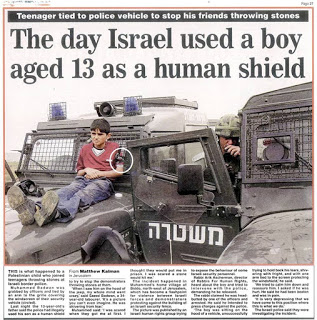
It is Israel which has repeatedly used the specific, prohibited tactic of using children as “human shields” to protect its military forces. According to the U.N. Committee on the Rights of the Child, Israel is guilty of the “continuous use of Palestinian children as human shields and informants.” Besides this namby-pamby UN Committee that no red-blooded American/Zionist would pay any attention to, the High Court of Justice in Israel identified and denounced the “human shield” procedures the IDF acknowledged and defended using 1,200 times. These include “the ‘neighbor procedure,’ whereby neighbors of wanted Palestinians are forced to go into the wanted man’s house ahead of troops, in case it is booby-trapped,” and Israeli “soldiers forcibly position[ing] members of [a] family, including the children, at the windows of [a] home and proceed[ing] to fire from behind them.”
So, when Zionists use a “human shields” argument as a moral cudgel against unarmed civilian protestors, and a moral justification for a powerful army, which brazenly uses children to shield its own soldiers, killing scores of those protestors by the day—well, it’s not a stretch to see this charge is a projection of Zionists’ own pattern of thought and behavior.
Besides being an ongoing tactic of today’s Israeli army, “human shields” and the “human sacrifice” they imply were an integral element of the Zionist narrative—expressly articulated and embraced, with no apology, as a necessity for the establishment of a Jewish State.
Take a look at what Edward Said in 2001 called: “the main narrative model that [still] dominates American thinking” about Israel, and David Ben-Gurion called “as a piece of propaganda, the best thing ever written about Israel.” It’s the “’Zionist epic’…identified by many commentators as having been enormously influential in stimulating Zionism and support for Israel in the United States.” In this piece of iconic American culture, an American cultural icon—more sympathetically liberal than whom there is not—explains why he, as a Zionist, is not bluffing in his threat to blow up his ship and its 600 Jewish refugees if they are not allowed to enter the territory they want:
–You mean you’d still set it [200 lbs. of dynamite] off, knowing you’ve lost?… Without any regard for the lives you’d be destroying?…
Every person on this ship is a soldier. The only weapon we have to fight with is our willingness to die.
–But for what purpose?”
Call it publicity.
–Publicity?
Yes, publicity. A stunt to attract attention… Does the vulgarity of it shock you?
More Zionist tough love.
In the face of the scurrilous “human shield” accusation against Palestinians now being used to denigrate the killed, maimed, and still-fighting protestors in Gaza, we would do well to recall Paul Newman’s Zionist-warrior, “no apology,” argument for 600 telegenically dead Jewish men, women, and children as a publicity stunt to gain the sympathy of the world.
Lest we dismiss this as a fiction, remember that Paul Newman’s fictional boat, Exodus, is based on a real ship, the SS Patria. In 1940, the Patria was carrying 1800 Jewish refugees from Nazi-occupied Europe whom the British authorities refused entry into Palestine. While the Patria was in the port of Haifa, it was blown up and sunk by Munya Mardor on the orders of the Haganah, which did not want Jewish refugees going anywhere but Palestine. At least 267 people were killed. The Haganah put out the story that the passengers had blown up the ship themselves – a story that lasted 17 years, nourishing the imagination of Leon Uris, author of the Exodus fiction. This wasn’t a commander or leading organization urging people to knowingly take a deadly risk in confronting a powerful enemy; it was “their” self-proclaimed army blowing its people up with no warning—and then falsely claiming they did it to themselves! Nobody who wouldn’t use “bottomlessly cynical” to denigrate the Haganah should be using it to denigrate Gazans.
At a crucial moment in history, it was Zionists who practiced a foundational “human shield” strategy, holding the victims of Nazism “hostage” to the Zionist “statehood” project – as none other than the publisher of the New York Times, Arthur Hays Sulzberger, recognized and criticized:
I cannot rid myself of the feeling that the unfortunate Jews of Europe’s D. P. [Displaced Persons] camps are helpless hostages for whom statehood has been made the only ransom. …[W]hy in God’s name should the fate of all these unhappy people be subordinated to the single cry of Statehood?
The Exodus/Patria/Paul Newman/Haganah willingness to blow up hundreds of Jewish refugees in order to force their way into a desired territory was an attitude endemic to the Zionist movement, and enunciated quite clearly by its leader, David Ben-Gurion, as early as 1938: “If I knew it was possible to save all [Jewish] children of Germany by their transfer to England and only half of them by transferring them to Eretz-Yisrael, I would choose the latter.” You want human sacrifice?…
(Sulzberger, by the way, “opposed political Zionism not solely because of the fate of Jewish refugees because he disliked the ‘coercive methods’ of Zionists in this country who use economic means to silence those with differing views.” Yes, the NYT ! So change is possible.)
What’s Right Is Wrong
And here’s the thing: You want to call what the Gazans did—coming out unarmed by the thousands, knowing many of them would be killed by a heavily-armed adversary determined to put them down by whatever means necessary—a “politics of human sacrifice”? You are right.
Just as you’d be right to say that of the Zionist movement, when it was weak and faced with much stronger adversaries. And just as you’d be right to say it of the unarmed, non-violent Civil Rights Movement, when it faced the rageful determination of the immensely more powerful American South, to preserve the century-old Jim Crow apartheid that was its identity, by whatever means necessary.
Princeton Professor Eddie Glaude, Jr. nailed it when, to the visible discomfort of his MSNBC co-panelists, he responded to the invocation of the White House line that it’s “all Hamas’ fault and that they’re using them as tools for propaganda,” with: “That’s like saying to the children in the Children’s March of Birmingham it was their fault that Bull Connor attacked them.”
Civil-rights activists did put children on the front lines, and put their own and those children’s lives in danger to fight and defeat Jim Crow. They knew there were a lot of people armed and willing to kill them. And children, as well as activists, were killed. And those actions were supported (but by no means “orchestrated”) by “extremist” organizations—i.e., the Communist Party. At the time, conservatives attacked Freedom Riders with the same arguments that Zionists are now using to attack Gaza Return Marchers.
All unarmed, non-violent but disruptive, Gandhian strategies to eliminate entrenched systems of colonial-apartheid rule will knowingly sacrifice many lives to attain their victory. Call it a politics of human sacrifice if you want. I won’t make any ingénue objections. But it’s not a sign of the subjugated people’s cynicism; it’s a result of their predicament.
“Human sacrifice” defines the kind of choices a desperate and subjugated people are forced to make in the face of armed power they cannot yet overcome. A militarily-weak insurgent/liberation movement must use an effectively self-sacrificing strategy of moral suasion. That is now a standard and powerful weapon in political struggle. (Though moral suasion alone will not win their rights. Never has. Never will.)
For Gazans, it’s the choice between living in a hell of frustration, misery, insult, confinement, and slow death, or resisting and taking the high risk of instant death. It’s the choice faced by people whose “dreams are killed” by Israel’s siege and forced expulsion, and who are willing to risk their lives “for the world’s attention.” Young men like Saber al-Gerim, for whom, “It doesn’t matter to me if they shoot me or not. Death or life — it’s the same thing.” Or the one who told Amira Hass: “We die anyway, so let it be in front of the cameras.” Or 21-year-old Fathi Harb, who burned himself to death last Sunday. Or Jihadi al-Najjar, who had to make the choice between continuing to care for his blind father (“He was my sight. He helped me in everything, from going to the bathroom to taking a shower to providing for me… I saw life through Jihadi’s eyes.”) or being killed by an Israeli sniper while, as his mother Tahani says “defending the rights of his family and his people.”
Tough choices, to get the world’s attention. This is the kind of choice imposed on the untermenschen of colonial-apartheid regimes. The only weapon they have is their willingness to die. But Gazans won’t get the sympathetically-anguished Paul Newman treatment. Just “bottomlessly cynical.”
Paul’s choice, Sophie’s choice, is now Saber’s and Jihad’s and Fathi’s, and it’s all bad. Maybe some people—comrades and allies in their struggle—have a right to say something about how to deal with that choice. But the one who doesn’t, the one who has no place to say or judge anything about that choice, is the one who is forcing it. Those who are trying to fight their way out of a living hell are not to be lectured to by the devil and his minions.
So, yes, in a very real sense, for the Palestinians, it is a politics of human sacrifice—to American liberals, the gods who control their fate.
By choosing unarmed, death-defying resistance, Palestinians are sacrificing their lives to assuage the faux-pacifist conscience of Americans and Europeans (particularly, I think, liberals), who have decreed from their Olympian moral heights that any other kind of resistance by these people will be struck down with devastating lightning and thunder.
Funny, that these are the same gods the Zionists appealed to to seize their desired homeland, and the same gods the civil-rights activists appealed to to wrest their freedom from local demons of lesser strength. Because, in their need to feel “sympathy and pity,” the sacrifice of human lives seems the only offering to which these gods might respond.
The Nakba Is Now
The Israelis and their defenders are right about something else: They cannot allow a single Gazan to cross the boundary. They know it would be a fatal blow to their colonial-supremacist hubris, and the beginning of the end of Zionism—just as Southern segregationists knew that allowing a single black child into the school was going to be the beginning of the end of Jim Crow. Palestinians gaining their basic human rights means Israeli Jews losing their special colonial privileges.
As Ali Abunimah points out, Arnon Soffer was right, when he said: “If we don’t kill, we will cease to exist,” and Rosner, when he said the Gazans threatened the “elimination of Israel.” To continue to exist as the colonial-apartheid polity it is, Israel must maintain strict exclusionist, “no right of return,” policies. Per Abunimah: “the price of a ‘Jewish state’ is the permanent and irrevocable violation of Palestinians’ rights… If you support Israel’s “right to exist as a Jewish state” in a country whose indigenous Palestinian people today form half the population, then you… must come to terms with the inevitability of massacres.”
What’s happening in Gaza is not only, as Abunimah says, a “reminder… of the original sin of the ethnic cleansing of Palestine and the creation of a so-called Jewish state,” it is a continuation of that unfinished work of the devil. The Nakba is now.
I’m all for everybody on both sides of the issue to be aware of the stakes and risks in this struggle, without any disingenuous denials.
Whether you sympathize with, or denigrate, the choices of people who put their own, their comrades’, and even their children’s, lives at risk is not determined by whether some tactical choices can be characterized as “human shields, human sacrifice”; it’s determined by what they’re fighting for, and what and whom they are fighting against, and where your solidarity lies.
Stage Left
Here’s the core of the disagreement about Gaza (and Palestine in general): There are those—they call themselves Zionists—who think the Palestinians deserve to have been put in that concentration camp, and who stand in solidarity with the soldiers who, by whatever means necessary, are forcing them to stay there. And there are those—the growing numbers who reject Zionism—who stand in solidarity with every human being trying to get out of that camp by whatever means necessary.
There’s a fight—between those breaking out of the prison and those keeping them in; between those seeking equality and those enforcing ethno-religious supremacism; between the colonized and the colonizer. Pick a side. Bret Stephens, Shmuel Rosner, and Tom Friedman have. The New York Times, The Washington Post, and Breitbart have. ABC, CBS, (MS)NBC, and Fox have. The Democrats and Republicans and the Congress and the White House have. And they are not shy about it.
It’s past time for American progressives to clearly and unequivocally decide and declare which side they are on. It’s time for professedly humanitarian, egalitarian, pro-human rights, anti-racist, and free-speech progressives to express their support of the Palestinian struggle—on social media, in real-life conversation, and on the street.
It’s time to firmly reject the hypocritical discourse of those who would have been belittling any expression of sorrow and outrage over Emmet Till, Chaney, Schwerner and Goodman, and the four black schoolgirls killed in Birmingham, while “ingénue mourning” the terrible moral quandary in which those disrupters had put Bull Connor’s boys. Don’t shrink from it, talk back to it—every time. Make them ashamed to be defending colonialism and apartheid with such patently phony arguments.
Politically? At a minimum, demand of any politician who seeks your vote: End the blockade of Gaza, immediately and unconditionally. Support BDS. Refuse any attempt to criminalize BDS and anti-Zionism. Stop blocking UN and ICC actions against Israeli crimes. Restrict arms sales to Israel. Reject the hypocritical Zionist apologetics. Refuse any attempt to censor or restrict the internet. (This last is very important. Nothing has threatened Zionist impunity more than the information available on the internet, and nothing is driving the demand to censor the internet more than the Zionists’ need to shut that off.)
This is a real, concrete, important resistance. What’ll it cost? Some social discomfort? It’s not sniper fire. Not human sacrifice. Not Saber’s choice.
Are we at a turning point? Some people think this year’s massacre in Gaza will finally attract a sympathetic gaze from the gods and goddesses of the Imperial City. Deliberately and methodically killing, maiming, and wounding thousands of unarmed people over weeks—well, the cruelty, the injustice, the colonialism is just too obvious to ignore any longer. And I hope that turns out to be so. And I know, Natalie Portman and Roger Waters and Shakira, and—the most serious and hopeful—the young American Jews in groups like Students for Justice in Palestine and IfNotNow. There are harbingers of change, and we must try.
I also know there is nothing new here. Thirty years ago, a doctor in Gaza said: “We will sacrifice one or two kids to the struggle — every family. What can we do? This is a generation of struggle.” It was obvious thirty years ago, and forty years before that. The Nakba was then. The Nakba is now. Was it ever not too obvious to ignore?
My mother was an actress on Broadway, who once came to Princeton University to share the stage, and her professional skills, with Jimmy Stewart and other amateur thespians. She played the ingénue. Me, I’m not so good at that.
By all means, regarding Palestine-Israel and the sacrifices and solidarity demanded: No more ingénue politics.
Mainstream media gets it wrong on Gaza AGAIN

The New York Times, the Washington Post, and CNN are 3 examples of the selective amnesia from which nearly every mainstream media news source seems to suffer when it comes to the subject of Israel. It doesn’t take much digging to discover the actual truth – the context that completely changes the story.
By Kathryn Shihadah | If Americans Knew | June 1, 2018
Palestinians of Gaza have been peacefully protesting for 2 months, unarmed, demanding only their human rights. They have been met with Israeli sniper fire week after week, killing at least 118.
And the United States hasn’t done anything.
Grant Smith points out on antiwar.com that “a stunning 81.5% of Americans say they never heard about the massacre through any channel,” which perhaps explains our apparent apathy.

Source: IRmep poll of 1,506 US adults through Google Surveys May 25-27, RMSE 4.1%. Raw data and demographic filters at Google
Mainstream media reports on incidents in Palestine-Israel, but its effectiveness as a source of accurate information is questionable. For example, most Americans don’t even know who is occupying whom.
On May 29, 2 weeks after the bloodiest day of protesting – in which at least 60 Palestinians were killed and thousands were injured – several factions in Gaza had enough and began shooting rockets toward Israel. Israel naturally responded with airstrikes from warplanes.
Mainstream media, with its short-term memory loss in all matters Israeli, forgot about the context of unarmed Palestinian protest and sniper fire, describing the Gazan rockets almost as though they represented an unprovoked attack on a peaceful state.
It is not hard to see that, when there is coverage, MSM tends to come down firmly on the side of Israel. In the interest of accurate education of American readers, we provide the following corrections of recent articles.
The New York Times published on May 29:
Gaza Militants Barrage Israel With Mortars and Rockets
NYT: Islamic militants in Gaza attacked southern Israel with rockets and mortars on Tuesday and Israel responded instantly with a wave of airstrikes across the Palestinian territory, a sharp escalation of violence after weeks of deadly protests, arson attacks and armed clashes along the border.
Everything about this paragraph is problematic.
Let’s talk chronology first: since March 30th there have been 9 weekends of nonviolent protests by Gazans, which were met by Israeli sniper fire, killing at least 118 and injuring 13,000. The number of Israeli casualties: three. The “deadly protests” were only deadly for Palestinians, who were unarmed. During this time, no rockets or mortars were fired out of Gaza. When “militants” responded after 2 months of Israeli violence, the NYT called it “an attack,” and Israel’s action “a response.”
NYT: The exchanges were the most intense cross-border hostilities in Gaza since the two sides fought a 50-day war in the summer of 2014.
“Cross-border hostilities” refers again to an unarmed population, protesting for their rights, vs. snipers. Palestinians never crossed any borders, but Israelis did. Likewise, Palestinians were not hostile, but Israelis were.
Similarly, the “two sides” that fought in 2014 included 34,000 unguided shells shot into Gaza by Israel (including 19,000 high-explosive artillery shells, which form a crater 50 feet wide and 36 feet deep, penetrate up to 15 inches of metal or 11 feet of concrete), and 4,500 rockets shot into Israel by Gaza. No wonder 72 Israelis (mostly military) vs. 2,200 Palestinians (mostly civilians, including 500 children), died in that “war.”
The “cross border hostilities” in 2014 and this week were similarly lopsided.

Israeli Air Force MK-84 crater from 2014 incursion on Gaza, “Operation Protective Edge.”
NYT: By 10 p.m. on Tuesday, Israel said there had been 70 rockets or mortars fired from Gaza throughout the day.
This may sound frightening, and it would indeed be unnerving to endure. But context matters: in 14 years of rockets from Gaza, only 17 Israelis have been killed during peacetime, and 44 total.
NYT: Tensions have been spiraling along the border in recent weeks during a series of Palestinian protests against the 11-year blockade of the Gaza Strip and to press Palestinian claims to lands in what is now Israel. Israel insisted that it was not seeking to escalate, and that it was up to Hamas to decide whether to ratchet things up or stand down.
We applaud NYT for mentioning the 11-year blockade and Palestinian claims to land in what is now Israel. Don’t be in such a rush, though, NYT. Linger over the blockade for a moment – at least long enough to help your readers understand the truth. The blockade is against international humanitarian law.The blockade is keeping food and medicine out of Gaza, and has done so for over a decade.
NYT: Early Wednesday, Israel announced a new wave of airstrikes against 25 more Hamas targets in Gaza, saying it was holding Hamas responsible for conducting and allowing a “wide-scale attack against Israeli citizens.”

U.S. Ambassador to the United Nations Nikki Haley (Drew Angerer/Getty Images)
The United States called for an emergency meeting of the United Nations Security Council to discuss the latest attacks on Israel from Gaza and said it expected the session to be held on Wednesday afternoon… [US ambassador to the UN Nikki Haley said], “The Security Council should be outraged and respond to this latest bout of violence directed at innocent Israeli civilians.”
It’s puzzling that the US sees Gaza’s nonlethal rockets as worthy of outrage, but Israel’s snipers killing over 100 as unworthy of comment.
NYT: As many as 120 Palestinians have been killed by Israeli fire since March 30, according to the Gaza Health Ministry, mostly by snipers during the protests and half of them in a single day, May 14, the peak of the campaign.
Israel said it was defending its border and the nearby communities against a mass breach by the protesters, adding that Gaza militants intended to use unarmed civilian protesters as cover to infiltrate Israeli territory and attack Israeli soldiers and civilians.
Oh, NYT, you started strong there, acknowledging the Palestinian deaths and the snipers. But then you gave your readers only Israel’s explanation (“Gaza militants intended to use unarmed civilian protesters as cover”) as though this was an indisputable fact instead of an opinion. A comment from a Palestinian spokesperson would have been in order at this juncture.
The Washington Post was similarly one-sided in its May 29 coverage:
Tensions rise as Gaza militants fire more than 70 mortars, rockets into Israel
WaPo: “This is something we cannot tolerate,” said [Israeli army spokesman Lt. Col. Jonathan] Conricus. “Hamas is turning the fence into an active combat zone, and we cannot tolerate attacks on Israeli civilians and military targets.”
Interestingly, even Ha’aretz has conceded that the Great March of Return is not a “Hamas project,” but a grassroots movement by people who are deeply invested in resistance and return. But WaPo prefers the official Israeli spin, that “Hamas is turning the fence into an active combat zone,” in spite of the obvious fact that one side of the fence has no combat weapons. There is also, apparently, nothing noteworthy in the statement, “we can not tolerate attacks on Israeli civilians and military targets” (as if Palestinians do not have the same right to be intolerant of violence being perpetrated on their people).
WaPo: Tensions have been soaring between Israel and Gaza for the past few months. Residents of the coastal enclave, which has been under land and sea blockade by Israel and Egypt since Hamas wrested power over the strip more than a decade ago, have been holding weekly demonstrations at the Israeli border fence. They are demanding a right to return to land that now sits inside Israel and expressing frustration over a growing humanitarian crisis in what they describe as an open-air prison.
WaPo came so close to getting the paragraph right. Fact is, Hamas did not “wrest power over the strip.” Rather, Hamas won a free and open election – which the US encouraged.
CNN likewise managed, on May 29, to miss the point:
Gaza militants launch mortars, rockets at Israel, which responds with airstrikes
CNN: In a statement, the IDF said the [launching of mortars and rockets by Gazans] was a “severe, dangerous, and orchestrated act of terror, aimed at Israeli civilians and children.”
The degree of self-deception required for the IDF to make such a statement is staggering. The “severity” and “danger” of Gaza rockets is minor in comparison to Israel’s snipers; the label “act of terror” belongs with the side that has been killing unarmed protesters; likewise, the targeted “civilians and children” were the ones killed (at least 12 children out of 118 dead) and injured (about 1,000 children out of over 13,000 injured).
CNN: UN chief Middle East envoy Nickolay Mladenov expressed his deep concern at what he called “indiscriminate firing” by Gaza militants toward communities in southern Israel.
“Such attacks are unacceptable and undermine the serious efforts by the international community to improve the situation in Gaza.”
Of course, “indiscriminate firing” is problematic (especially if it actually hits something, as Gazan rockets rarely do); how about “discriminate firing that hits people who are praying, or running from the border, or helping injured protesters, or children, or journalists, or medical personnel? Does discriminate firing help the “serious efforts by the international community”? And where in the international community is work actually being done to “improve the situation in Gaza”?

Israeli soldiers take aim as they lie prone over an earth barrier along the border with Gaza
Bottom line, these mainstream media articles were not aberrations, but business as usual. Every day in Gaza has yielded either similarly inaccurate news, or radio silence – the one exception perhaps being May 14, 2018. On that day there was opportunity for a dazzling visual display on every news channel: a split-screen exhibition contrasting the high-class, clueless crowd at the opening ceremony of the US embassy in Jerusalem, with the Israeli violence and Palestinian carnage at the Gaza border. For that brief moment, many commentators pointed out Israeli aggression against a besieged people group.
Shortly after that day, reporters’ memories were erased, and Gazans are once again aggressors and followers of Hamas. Avigdor Lieberman is correct again: there are “no innocent civilians in Gaza.”
Life is back to normal.
What if Babchenko had decided to stay “dead”?
By Catte | OffGuardian | May 31, 2018
There’s a good deal of discussion, both in mainstream and in alt media, of how/why the Arkady Babchenko event unfolded in the ludicrous way it has.
The Ukrainian government narrative is (currently) claiming the SBU faked AB’s death in order to entrap some real (Russian) assassins who really wanted him dead, and it was all part of a cunning plan. They’re light on detail about exactly how taking pics of Bab pretending to be dead helped with the general effort, but maybe they’ll fill in all those blanks soon.
Others, including RFE, are telling us the very bad fake death pic was released on a Facebook page with ties to Washington.
But beyond the Byzantine imbroglio, I think there’s another question no one is asking. –
What if Arkady hadn’t turned up, looking sheepish at that presser?
What if he hadn’t turned up ever? What if he’d decided he couldn’t face the humiliation, or what if his SBU handlers decided it might be better if he just continued to be dead and skipped off the map somewhere with a few hundred grand and nice new ID.
What then?
We need to never forget that while Arkady was busy hiding in his closet (or whatever he did for the hours he was supposed to be dead), his demise was the reality for all of us. Sold to us, not just with narrative consistency, but with apparent hard evidence and circumstantial confirmation.
There was the blood-soaked “corpse” photo:

There was the sketch of the perp:

There was the Twitter parade of blue-tick public mourners.


A very very familiar roll-out we have all seen many times was taking shape. There were predictable articles, by predictable people, saying predictable things. By next month Luke Harding would have had a new book out called something like “Death in Broad Daylight: how the Kremlin silenced Arkady Babchenko.” Its cover would feature Babchenko’s completely fake murder pic with a target superimposed and a semi-opaque red halftone background of Putin’s face. It would be on the NYT bestseller list for the next two years and make Luke another little fortune.
There would soon be an “Arkady Babchenko” street in Washington. A “posthumous” Pulitzer would have been his within a year or two. Arkady Babchenko memorial plaques would spawn like tribbles. Navalny and his twenty-seven supporters would carry those tragically misty and sepia pics of our boy (which miraculously appeared within hours of his “death”) on all their “rallies”. By 2019 Katherine Bigelow would have made the movie (based on Luke’s book), and it would be a dead cert at the 2020 Oscars.
But it would have been no more true that it is now, would it? It would simply be an undiscovered lie. A mesh of words, woven thick by repetition, giving shape to an absence – of evidence, of investigation, of everything.
If he hadn’t turned up alive, Arkady dead would have become the thing most people called “truth.” Like “United 93”, and similar collective myths, the legend of his martyrdom would have taken on all the trappings of solid reality. No one – none of us – would think to question it. And anyone who did would be dismissed as a lunatic.
The most important and abiding point about the non-death of Arkady Babchenko, beyond all the spin and damage control and narrative-boosting we are inevitably going to see over the next days and weeks, is that, at its deepest level, consensual reality is a fragile thing that can very easily have nothing to do with truth or fact or actual reality. The point is that the people who are paid to fact check official narratives didn’t do it, and would never have done it. They were simply sold a line and bought it, uninterrogated, uninvestigated, unwrapped.
And this is what they do every day. With every item of “news” they lay before us.
Look at the illusion of depth and veracity they gave this lie, simply by reporting it. See how easily they were fooled and went on to fool us. See how little it occurred to any of us, even those who make a habit of interrogating narratives, to ask whether or not it really happened.
Think about how easily that basic question was trampled and crushed into oblivion. How effortlessly a few public statements and a very very questionable pic became the collective “truth” for all of us. Look at how the debate was already being positioned. How the issue was going to be “who did it?” not “was it even done?”
The real problem this highlights is not just that the derogation of journalistic duty to fact-check and second-source is now the norm. We already know this. It’s been too apparent for too long.
The real problem is that this derogation helps to create the reality we all live in. Even those of us who deplore it. If for whatever reason Arkady had sloped off to Hawaii in a bad wig, today we would all be debating who may have killed him. Unwittingly hostage to a flimsy lie.
This is an uncomfortable truth we need to recognise. Because it’s often the questions that seem most unnecessary, absurd, offensive, even insane that actually most need to be asked.
We are already being dissuaded from learning this most valuable lesson. The journos who were so recently burned are already backstopping against it. They aren’t focusing on why the lie happened, they are focusing on how “the enemy” (the Russians, the alt-media, the whole evil circus of “other”) are “exploiting” it. How they will now have an “excuse” to suggest any future such deaths might also be fake.
The drive is to make it ridiculous to learn from experience or to cite precedence. We are already being persuaded only idiots would think future deaths might be fake based on the fact past deaths were fake.
No matter how much data there might be for fakery we must never accept it as a legitimate possibility. No matter how many Doumas may happen, no matter how many Babchenkos come back from the dead, no matter how many incidents of fakery are outed, or “explained” in unsatisfactory terms, we must never learn from experience. We can discuss why the victims of the latest atrocity died, but not the possibility they might not have died at all?
Is this really good enough? I don’t think so.
Next time we are flooded with the apparently shocking narrative of violent death, how many of us will be brave or crazy enough to dare to ask – “did this death even happen?”?
Iran rejects US report on religious freedom as ‘politically motivated’
Press TV – May 31, 2018
Tehran has dismissed the allegations put forth in a recent US report on religious freedom in Iran as “baseless” and “politically motivated,” saying the document offers a “distorted picture” of the realities in Iran and other countries.
Iranian Foreign Ministry spokesman, Bahram Qassemi, was reacting to the US State Department’s International Religious Freedom Report for 2017, which was released on May 29.
The Iran section of the report claimed that “non-Shia Muslims and those affiliated with a religion other than Islam” residing in the Islamic Republic faced “societal discrimination and harassment.”
Besides Iran, the report also targets Washington’s other foes, including Russia, China and North Korea.
Qassemi said, “The Islamic Republic of Iran views this report as unrealistic, baseless and biased, which has been compiled merely with the aim of serving certain political goals.”
The US, he added, has “no accurate and realistic evaluation” of the situation inside other countries, stressing that this report, which presents yet another distorted picture of religious freedoms in Iran and levels untrue allegations against the Islamic Republic, is “undoubtedly unacceptable and rejected.”
The official said history shows that the great people of Iran, from all faiths and ethnicities, have peacefully coexisted for millennia.
Since the 1979 Islamic Revolution, “followers of all religions have performed their religious traditions in various religious centers across Iran based on the articles of the Constitution and within the framework of law,” Qassemi said, adding that Iranian law “protects all such freedoms.”
Iran’s Foreign Ministry spokesman also called on the United States to avoid politicizing the issue of religion, warning that offering “delusional, self-made and unfounded readings of different religions” could only lead to more interfaith clashes in the world.
The official religion of Iran is Shia Islam under the Constitution. The Islamic Republic recognizes Zoroastrian, Jewish, and Christian religious minorities, among others.
The Constitution states that “the investigation of individuals’ beliefs is forbidden,” and that “no one may be molested or taken to task simply for holding a certain belief.”
Sinister Choreography of the MH17 Probe to Smear Russia
By Finian CUNNINGHAM | Strategic Culture Foundation | 31.05.2018
The Dutch-led probe into the 2014 Malaysian airliner disaster has the hallmarks of a psychological operation to frame-up Russia and to justify further sanctions and aggression from the NATO powers.
The so-called Joint Investigation Team (JIT) released an update last Thursday on its ongoing probe into the MH17 air disaster over Eastern Ukraine, in which all 298 people onboard were killed. The JIT’s latest release moves the accusation of culpability closer to Russia, with the team claiming that an anti-aircraft Buk missile, which allegedly shot down the plane, was brought into Ukraine by Russia’s 53rd Brigade based in Kursk, southwest Russia.
Then on Friday, the day after the high-profile JIT presentation, a news report compiled by US-based McClatchy News and UK-based self-styled online investigative website Bellingcat was published claiming to have identified a senior Russian military intelligence (GRU) officer as being involved in the transport of the missile system.
The Russian GRU officer is named as Oleg Vladimirovich Ivannikov. The report includes a photograph of the named man, who is said to have at least one residential address in Moscow and who used the call sign “Orion”. Tellingly, the McClatchy report claims that news of identifying the Russian military officer was not known by the JIT when it made its presentation the day before. But McClatchy reported that the Dutch-led investigators now want to arraign “Orion”.
Over the weekend, the Dutch, Australian and British governments upped the ante by formally accusing Russia, and demanding that Moscow pay financial compensation to families of the crash victims. Most of those onboard the doomed MH17 were Dutch, Malaysian and Australian nationals.
What we are seeing here is a choreographed sequence trying to give the public impression that developments in the probe are taking a natural course based on “evidence” imputing blame to Russia. The same technique of media psychological operation can be seen in the Skripal poisoning affair in which Moscow is blamed for trying to assassinate a former spy in England. Allegations, purported evidence, and then sanctions (expulsion of Russian diplomats) all follow a choreographed sequence.
On the MH17 incident, Russia has vehemently denied any involvement in the passenger plane’s downing. Moscow says its own investigation into the incident points to the Kiev regime’s armed forces as being responsible, possibly using their stock of Soviet-era Buk anti-aircraft missiles. Significantly, Russia’s investigative results have been spurned by the JIT, while Moscow’s offers of contributing to the probe have been rebuffed. As in the Skripal affair, where the British authorities have also refused Russia’s offers of joint investigation, or Russia’s ability to independently verify the supposedly incriminating data.
In a dramatic twist, Russia’s Ministry of Defense said that the missile casing displayed by the Dutch investigators bore features dating the weapon to 1986 when Ukraine was a Soviet Republic. The Russian military said that all such Buk models were replaced by its forces in 2011. Therefore, the alleged offensive weapon presented by the JIT last week could not have come from Russian forces. Besides, Moscow denies that any of its brigades crossed into Ukrainian territory.
The JIT, which includes investigators from Holland, Belgium, Australia, Malaysia and – invidiously – Ukrainian secret services, openly acknowledged in its presentation last week that it is cooperating with the Britain-based Bellingcat website. The latter is cited for its analysis of videos purporting to show the transport of a Russian military Buk convoy through Eastern Ukraine at around the time of the airliner being shot down. Those videos have already been exposed as fabrications.
Now it seems rather strange that the JIT was reported by McClatchy as not knowing of Bellingcat’s next “scoop” published the following day in which it claims to identify a Russian military officer, named as Oleg Ivannikov or Orion, for being involved in coordinating the transport of the Buk convoy, which the JIT says came from the 53rd Brigade in Russia’s Kursk.
The JIT and Bellingcat have collaborated in a previous update to its MH17 probe, in 2016, when the dubious videos were presented as purportedly showing the Buk convoy traversing Eastern Ukraine back to Russia. Bellingcat was cited again in the JIT’s update last Thursday.
That raises the question of why the information claiming to identify the Russian military officer was not available to JIT, even though the latter has worked closely with Bellingcat before? It was the next day when the McClatchy-Bellingcat news report came out, seemingly separate to the JIT presentation.
The sequence suggests a concerted effort to “build” a public perception that “clues” into the cause of the air crash and the incrimination of Russia are being assembled in an independent manner. When, in reality, the sequence is actually a deliberately orchestrated media campaign, to more effectively smear Russia.
Bellingcat’s media activities indicate that it is not the supposed “independent online investigative website” it claims to be. During the Syrian war, it has helped to peddle claims that videos sourced from the White Helmets are “authentic” when in fact there is strong evidence that the White Helmets have been fabricating videos of atrocities on behalf of NATO-sponsored terrorists in order to smear the Syrian government and its Russian ally.
For the Dutch-led JIT to associate with Bellingcat as a source of “evidence” is a matter of grave concern as to the probe’s professional credibility.
Moreover, what is also fatally damaging to the MH17 probe is that the Ukrainian secret services (SBU) under the control of the Western-backed Kiev regime, which came to power in the NATO-backed February 2014 coup d’état, is the source for much of the so-called evidence implicating Russia or the pro-Russian separatists in Eastern Ukraine for shooting down the MH17 airliner.
The dubious videos cited by the JIT and Bellingcat were sourced from the SBU. Those videos were purportedly posted on social media at the time of the plane crash by anonymous members of the public. The Russian government has dismissed those videos as fake.
The latest claims by McClatchy and Bellingcat of identifying a Russian military officer are based on allegations that mobile phone intercepts are attributable to the man named as Orion. Bellingcat appears to have expended a lot of effort trawling through digital phone books to identify the individual. The report also relies on embellishment of Orion’s alleged secret military career in Ukraine and South Ossetia by way of lending a sense of credibility and sinister innuendo.
However, the bottom line is that McClatchy and Bellingcat both admit that they are relying on the Ukrainian secret services for their phone intercepts, as they had previously for the videos of the alleged Russian Buk convoy.
The SBU and its Kiev masters have an obvious axe to grind against Moscow. Their partisan position, not to say potential liability for the air crash, thus makes the JIT and subsequent Western media reporting highly suspect.
Such close involvement of a Western media outlet (McClatchy ) with a fake news engine (Bellingcat ) and Ukrainian state intelligence is indicative of coordinated public psychological operation to smear Russia.
The prompt responses from Western governments calling for criminal proceedings against Moscow are further indication that the whole effort is an orchestrated campaign to frame-up Russia.
‘Assassinated’ journalist Babchenko alive, Kiev accuses Russian intelligence of murder plot
RT | May 30, 2018
The reported killing of Russian journalist Arkady Babchenko on Tuesday in Kiev was actually a ruse played by the Ukrainian law enforcement to prevent a planned hit, the Ukrainian authorities said.
Reporting on the high profile case on Wednesday, the head of the SBU, Ukraine’s national security service, Sergey Gritsak said Babchenko was alive and unhurt.
He claimed that the SBU had information about a planned assassination attempt on the journalist and acted to derail the plot.
“I want to congratulate his family, all of us and the entire world, which is watching it, and congratulate Babchenko with a third birthday,” Gritsak wrote on his Facebook page.
‘Third birthday’ was a reference to the journalist’s supposedly last post, in which he described narrowly avoiding death on May 29th a couple of years ago.
After reports of Babchenko’s killing, some Ukrainian officials rushed to accuse Russian intelligence services of masterminding the assassination. It was not immediately clear whether those officials did so as part of the spectacle or simply followed their usual habit of pinning every high-profile crime in Ukraine on Moscow.
The change of Babchenko’s status from murder victim to SBU agent didn’t stop Kiev from making accusations against Moscow. Gritsak insists that there was a hit on Babchenko ordered by the Russian intelligence. He claimed the contract to kill was worth $30,000 and that the organizer of the crime was arrested.
Babchenko himself said the staging of his death was executed as part of a wider SBU operation to prevent “massive terrorist attacks” in Ukraine.
“As far as I know, this operation was in the pipeline for two months. I was let in the loop a month ago. Over this month I say the guys worked really hard. They were constantly in contact with me. We deliberated, thought things out, acted. And this covert action was the result,” he told journalists.
Commenting on the development to Interfax, Konstantin Kosachev, the chair of the Foreign Relations Committee in the Russian Senate, called the apparent ruse “a stage in a series of delusional actions of the Ukrainian authorities directed at Russia”. He said he regretted that Babchenko agreed to be part of it.
Time for UK to Apologize to Moscow for Accusations Over Skripal Case – Embassy
Sputnik – 25.05.2018
The Russian Embassy in the United Kingdom said on Friday it was time for the UK side to apologize to Russia for accusations over the poisoning of Sergei and Yulia Skripal, as no evidence was provided by London to substantiate its claims of Moscow’s involvement during the three months which passed since the incident.
“Time has come for British authorities to apologize to Russia for the hollow accusations accompanied by an unprecedented anti-Russian campaign, to give answers to all the questions and requests officially sent to the British side on this matter, to engage with Russian law enforcement agencies that have opened the criminal case regarding the attempted murder of Yulia Skripal, and to stop isolating the two Russian citizens,” the embassy’s press release read.
Meanwhile, Russian President Vladimir Putin urged to stop speculations on the so-called Skripal case and conduct a joint objective investigation instead.
“We need to either carry out a joint objective and thorough investigation, or simply stop talking on this topic, because it does not lead to anything but a deterioration of relations,” he said.
Putin also questioned the alleged fact of poisoning of ex-spy Sergei Skripal and his daughter by a military-grade nerve agent.
“I’m not a specialist in chemical warfare agents, but as far as I can imagine, if a warfare agent is used, the victims of this attack die on the spot, almost immediately. But nothing happened in this case. Skripal himself and his daughter are alive, and have been discharged from the hospital. His daughter looks quite alright, everyone is alive and well,” the president stressed.
On May 1, UK National Security Adviser Mark Sedwill told the UK lower house defense committee that no suspects had been identified in the March’s attack on the former Russian intelligence officer Sergei Skripal and his daughter in Salisbury.
Analysis by the Organization for the Prohibition of Chemical Weapons (OPCW) of the Salisbury incident confirmed the UK findings related to the nature of the chemical used in the poisoning, but did not include any information that would help the UK government substantiate claims about Russian involvement in the incident.
The United Kingdom and its allies have blamed Russia for an alleged role in the poisoning despite presenting no proof. Over a hundred Russian diplomats have since been expelled from these countries in solidarity with London and to put pressure on Moscow, which denies any involvement.
“Skirmishes” – Israel’s Syria Blitz
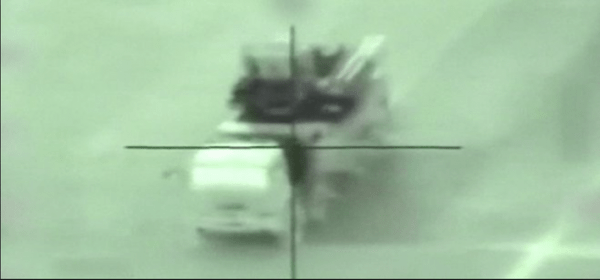
Media Lens | May 23, 2018
A key ‘mainstream’ media theme in covering the Israeli army’s repeated massacres of unarmed, non-violent Palestinian civilians protesting Israel’s military occupation in Gaza – killing journalists, a paramedic, the elderly and children – has been the description of these crimes as ‘clashes’.
This has been a clear attempt to obfuscate the fact that while two groups of people are involved, only one group is being killed and wounded.
To the casual reader – and many readers do not venture beyond the headlines – a ‘clash’ suggests that both sides are armed, with both suffering casualties. One would not, for example, describe a firing squad as a ‘clash’. There was no ‘clash’ in New York on September 11, 2001, and so on.
Following Israel’s massive blitz on more than 100 targets in Syria on May 10, ‘mainstream’ coverage offered similarly questionable frameworks of understanding.
A Guardian headline read:
Israel retaliates after Iran “fires 20 rockets” at army in occupied Golan Heights (Our emphasis)
For moral, legal and public relations reasons, the issue of which side started a conflict is obviously crucial. If the public recognises that the case for war is unjustified, immoral or illegal – that a country has chosen to launch a war of aggression – they will likely oppose it, sometimes in the millions, as happened in 2002 and 2003 in relation to the Iraq war. It is thus highly significant that the Guardian described Israel as retaliating.
The BBC reported of Israel’s attacks:
They came after 20 rockets were fired at Israeli military positions in the occupied Golan Heights. (Our emphasis)
Reuters took the same line as the Guardian and BBC:
Iran targets Israeli bases across Syrian frontier, Israel pounds Syria
Iranian forces in Syria launched a rocket attack on Israeli forces in the Golan Heights early on Thursday, Israel said, prompting one of the heaviest Israeli barrages in Syria since the conflict there began in 2011. (Our emphasis)
The New York Times also reported:
It was a furious response to what Israel called an Iranian rocket attack launched from Syrian territory just hours earlier. (Our emphasis)
And yet, the report buried a challenge to its own claim that Israel had retaliated in the second half of the piece:
Iran’s rocket attack against Israel came after what appeared to have been an Israeli missile strike against a village in the Syrian Golan Heights late on Wednesday. (Our emphasis)
According to the BBC (see below), the Israeli missile strike had targeted an Iranian drone facility killing several Iranians.
So, actually, it might be said that Iran was retaliating to Israeli attacks – a more reasonable interpretation, given recent history also described by the New York Times:
Israel has conducted scores of strikes on Iran and its allies inside Syria, rarely acknowledging them publicly.
Nevertheless, the corporate media theme has been that Israel retaliated, part of a long-term trend in media coverage. In a 2002 report, Bad News From Israel, The Glasgow University Media Group commented:
On the news, Israeli actions tended to be explained and contextualised – they were often shown as merely “responding” to what had been done to them by Palestinians (in the 2001 samples they were six times as likely to be presented as “retaliating” or in some way responding than were the Palestinians).
Was Iran Skirmishing?
But was Iran even involved at all? The opening, highlighted sentence in a front-page BBC piece by diplomatic editor Jonathan Marcus left the reader in no doubt:
These are the first skirmishes in a potential war between Israel and Iran that promises a fearful level of destruction – even by the standards of the modern Middle East.
So this was a ‘skirmish’, a clash involving Israel and Iran – they were both involved in the combat. And yet, in the second half of the article, Marcus wrote:
The alleged Iranian attack last night – I say alleged because at this stage there is no confirmation from Iranian sources as to the precise authors of the attack – involved a single and relatively short-range system, what appears to have been a multiple-barrelled rocket launcher.
How can the Iranian attack be merely ‘alleged’ half-way down the article but a bald fact in the highlighted opening sentence?
In fact, not only has there been ‘no confirmation’, there has been outright Iranian rejection of the claims. Abolfazl Hassan-Baygi, deputy head of the Iranian parliament’s national security committee, commented:
Iran has nothing to do with the missiles that struck the enemy entity yesterday.
Associated Press (AP ) reported Iranian Foreign Ministry spokesman Bahram Ghasemi commenting that Israel’s attacks were based on ‘fabricated and baseless excuses’, and were a breach of the national sovereignty and territorial integrity of Syria.
AP quoted a senior Lebanese politician and close ally of Syria and Iran, Parliament Speaker Nabih Berri, as saying: ‘this time the Syrian retaliation was in the Israeli-occupied Golan Heights but next time it will be in Israel proper. (Our emphasis)
Later in his BBC piece, Marcus wrote:
The immediate tensions stem from an Israeli air strike on what they claimed was an Iranian drone facility at the so-called T-4 air base, near Palmyra, on 9 April, which reportedly killed several Iranian military advisers.
This again challenged the idea that Israel had ‘retaliated’, but again it was not given the kind of prominence that could challenge Israel’s version of events.
So the ‘skirmishes’ may actually have consisted of Israel first attacking an Iranian drone facility killing Iranian personnel, and then launching a massive attack against Iranian positions across Syria, without Iran responding at all. And yet Marcus wrote:
It is a conflict that needs to be averted and the time to do it is now. However Israel and Iran remain on a collision course.
Despite the uncertainty on whether Iran had attacked, Marcus concluded:
Iran’s strategic intent is clear… it is unlikely to be dissuaded from its efforts.
He added:
Israel has drawn its red lines and it is clearly not going to back down either.
Obama also famously drew his ‘red line’ in Syria in 2012, threatening a massive attack in the event of Syrian government use of chemical weapons. But for Marcus, Israel’s actual launch of a massive attack merely constituted the drawing of ‘red lines’.
And again, ignoring his own doubts about what had happened, the required warmongering ‘balance’ was favoured:
For the immediate future, the pattern of strike, attempted riposte, and counter-strike is likely to continue.
If it had started at all! Marcus concluded his article with three ominous lines identifying another threat alongside the danger of Israel drawing more ‘red lines’ with more massive attacks:
One clear danger is that Iran may seek to exact its revenge outside the Middle East.
Pro-Iranian factions have in the past attacked Israeli tourists abroad or Jewish organisations, notably in Latin America.
A successful terrorist attack of this kind would inevitably alter the picture, pushing Israel and Iran to the brink of a full-scale war.
The word ‘terrorist’ thus made its first appearance in the last line of Marcus’s piece, in reference to a hypothetical Iranian atrocity.
The idea that Israel might already have committed terrorist atrocities in Syria by launching unprovoked attacks, by illegal bombings committed completely outside of international law, is unthinkable.
Iran: Morocco’s false claims aim to please third parties
Press TV – May 24, 2018
Iran has hit out at Morocco for accusing Tehran of interference in the African country’s affairs, saying the “false claims” are aimed at pleasing certain third parties.
Morocco has close ties with Saudi Arabia which has accused Iran of meddling in Arab affairs, with Moroccan Foreign Minister Nasser Bourita repeating those claims in a recent interview with Fox News.
“The Moroccan foreign minister knows himself well that the unjust charges he is making are utterly wrong, false and based on delusions and fictions written by those who resort to such provocations only in line with their illegitimate interests,” Iran’s Foreign Ministry spokesman Bahram Qassemi said on Thursday.
Bourita first made the accusations against Iran early this month as he announced Morocco’s decision to sever diplomatic ties with the Islamic Republic over what he called Tehran’s support for the Polisario Front.
The Polisario is a guerrilla movement fighting for independence for the Sahrawi people in Western Sahara which is claimed by Morocco after colonial Spain left the territory.
In his interview with Fox News aired on Wednesday, Bourita claimed that Hezbollah members had met with senior Polisario military leaders recently and that the Iranian embassy in Algeria was used to fund the Polisario.
“The Moroccan authorities’ insistence on repeating their false claims for cutting diplomatic ties with Iran and repeatedly raising baseless allegations against our country is merely a bid to please certain third parties,” Qassemi said.
Bourita also claimed that Iran was in part trying to destabilize the area due to Morocco’s good relations with the US and Europe.
Earlier this month, he had said that Iran and Hezbollah were supporting Polisario by training and arming its fighters, via the Iranian embassy in Algeria.
Algeria, Iran and Hezbollah were all quick to reject the claims as baseless back then.
Iranian Foreign Ministry said there was no cooperation between Tehran’s diplomatic mission in Algiers and the Algeria-backed movement.
Hezbollah also blamed the US, Israel and Saudi Arabia for the diplomatic tensions, saying Rabat had cut ties with Tehran under pressure from the trio.
In turn, Algeria summoned Morocco’s ambassador to protest the “unfounded” claims.
Rabat annexed Western Sahara, a former Spanish colony, in 1975, and has since been in conflict with Polisario, which demands a referendum on self-determination and independence.
The movement, which aims to end Morocco’s presence in the Saharan region, recently said they sought to set up a “capital” in the region, prompting Rabat to caution it would respond with force.
Former UK Ambassador Craig Murray unconvinced by Yulia Skripal interview: ‘Duress cannot be ruled out’
By Craig Murray | May 24, 2018
I was happy to see Yulia alive and looking reasonably well yesterday, if understandably stressed. Notably, and in sharp contrast to Litvinenko, she leveled no accusations at Russia or anybody else for her poisoning. In Russian she spoke quite naturally. Of the Russian Embassy she said very simply “I am not ready, I do not want their help”. Strangely this is again translated in the Reuters subtitles by the strangulated officialese of “I do not wish to avail myself of their services”, as originally stated in the unnatural Metropolitan Police statement issued on her behalf weeks ago.
“I do not wish to avail myself of their services” is simply not a translation of what she says in Russian and totally misses the “I am not ready” opening phrase of that sentence. My conclusion is that Yulia’s statement was written by a British official and then translated to Russian for her to speak, rather than the other way round. Also that rather than translate what she said in Russian themselves for the subtitles, Reuters have subtitled using a British government script they have been given.
It would of course have been much more convincing had Sergei also been present. Duress cannot be ruled out when he is held by the British authorities. I remain extremely suspicious that, at the very first chance she got in hospital, Yulia managed to get hold of a telephone (we don’t know how, it was not her own and she has not had access to one since) and phone her cousin Viktoria, yet since then the Skripals have made no attempt to contact their family in Russia. That includes no contact to Sergei’s aged mum, Yulia’s grandmother, who Viktoria cares for. Sergei normally calles his mother – who is 89 – regularly. This lack of contact is a worrying sign that the Skripals may be prevented from free communication to the outside world. Yulia’s controlled and scripted performance makes that more rather than less likely.
It is to me particularly concerning that Yulia does not seem to have social media access. The security services have the ability to give her internet risk free through impenetrable VPN. But they appear not to have done that.
We know a little more about the Salisbury attack now:
Nobody – not Porton Down, not the OPCW – has been able to state that the nerve agent found was of Russian manufacture, a fact which the MSM continues to disgracefully fudge with “developed in Russia” phrasing. As is now well known and was reported by Iran in scientific literature, Iran synthesised five novichoks recently. More importantly, the German spying agency BND obtained novichok in the 1990s and it was studied and synthesised in several NATO countries, almost certainly including the UK and USA.
In 1998, chemical formulae for novichok were introduced into the United States NIST National Institute of Standards and Technologies Mass Spectrometry Library database by U.S. Army Edgewood Chemical and Biological Defense Command, but the entry was later deleted. In 2009 Hillary Clinton instructed US diplomats to feign ignorance of novichoks, as revealed by the last paragraph of this Wikileaks released diplomatic cable.
Most telling was the Sky News interview with the head of Porton Down. Interviewer Paul Kelso repeatedly pressed Aitkenhead directly on whether the novichok could have come from Porton Down. Aitkenhead replies “There is no way, anything like that could… leave these four walls. We deal with a number of toxic substances in the work that we do, we’ve got the highest levels of security and controls”. Asked again twice, he each time says the security is so tight “the substance” could not have come from Porton Down. What Aitkenhead does NOT say is “of course it could not have come from here, we have never made it”. Indeed Aitkenhead’s repeated assertion that the security would never have let it out, is tantamount to an admission Porton Down does produce novichok.
If somebody asked you whether the lion that savaged somebody came from your garden, would you reply “Don’t be stupid, I don’t have a lion in my garden” or would you say, repeatedly, “Of course not, I have a very strong lion cage?”. Here you can see Mr Aitkenhead explain repeatedly he has a big lion cage, from 2’25” in.
So the question of where the nerve agent was made remains unresolved. The MSM has continually attempted to lie about this and affirm that all novichok is Russian made. The worst of corporate and state journalism in the UK was exposed when they took the OPCW’s report that it confirmed the findings of Porton Down and presented that as confirming the Johnson/May assertion that it was Russia, whereas the findings of Porton Down were actually – as the Aitkenhead interview stated categorically – that they could not say where it was made.
The other relatively new development is the knowledge that Skripal had not retired but was active for MI6 on gigs briefing overseas intelligence agencies about Russia. This did not increase his threat to Russia, as he told everything he knows a decade ago. But it could provide an element of annoyance that would indeed increase Russian official desire to punish him further.
But the fact he was still very much active has a far greater significance. The government slapped a D(SMA) notice on the identity of Pablo Miller, Skripal’s former MI6 handler who lives close by in Salisbury and who worked for Christopher Steele’s Orbis Intelligence at the time that Orbis produced the extremely unreliable dossier on Trump/Russia. The fact that Skripal had not retired but was still briefing on Russia, to me raises to a near certainty the likelihood that Skripal worked with Miller on the Trump dossier.
I have to say that, as a former Ambassador in the former Soviet Union trained in intelligence analysis and familiar with MI6 intelligence out of Moscow, I agree with every word of this professional dissection of the Orbis Trump dossier by Paul Roderick Gregory, irrespective of Gregory’s politics. In particular this paragraph, which Gregory wrote more than a year before the Salisbury attack, certainly applies to much of the dossier.
I have picked out just a few excerpts from the Orbis report. It was written, in my opinion, not by an ex British intelligence officer but by a Russian trained in the KGB tradition. It is full of names, dates, meetings, quarrels, and events that are hearsay (one an overheard conversation). It is a collection of “this important person” said this to “another important person.” There is no record; no informant is identified by name or by more than a generic title. The report appears to fail the veracity test in the one instance of a purported meeting in which names, dates, and location are provided. Some of the stories are so bizarre (the Rosneft bribe) that they fail the laugh test. Yet, there appears to be a desire on the part of some media and Trump opponents on both sides of the aisle to picture the Orbis report as genuine but unverifiable.
The Russian ex-intelligence officer who we know was in extremely close contact with Orbis at the time the report was written, was Sergei Skripal.
The Orbis report is mince. Skripal knew it was mince and how it was written. Skripal has a history of selling secrets to the highest bidder. The Trump camp has a lot of money. My opinion is that as the Mueller investigation stutters towards ignominious failure, Skripal became a loose end that Orbis/MI6/CIA/Clinton (take your pick) wanted tied off. That seems to me at least as likely as a Russian state assassination. To say Russia is the only possible suspect is nonsense.
The Incompetence Factor
The contradiction between the claim that the nerve agent was so pure it could only be manufactured by a state agent, and yet that it failed because it was administered in an amateur and incompetent fashion, does not bother the mainstream media. Boris Johnson claimed that the UK had evidence that Russia had a ten year programme of stockpiling secret novichok and he had a copy of a Russian assassination manual specifying administration by doorknob. Yet we are asked to believe that the Russians failed to notice that administration by doorknob does not actually work, especially in the rain. How two people both touched the doorknob in closing the door is also unexplained, as is how one policeman became poisoned by the doorknob but numerous others did not.
The explanations by establishment stooges of how this “ten times more powerful than VX” nerve agent only works very slowly, but then very quickly, if it touches the skin, and still does not actually kill you, have struck me as simply desperate. They make May’s ringing claims of a weapon of mass destruction being used on British soil appear somewhat unjustified. Weapon of Upset Tummy does not sound quite so exciting.
To paint a doorknob with something that, if it touches you, can kill you requires great care and much protective gear. That no strangely dressed individual has been identified by the investigation – which seems to be getting nowhere in identifying the culprit – is the key fact here. None of us know who did this. The finger-pointing at Russia by corporate and state interests seeking to stoke the Cold War is disgusting.
Featured Video
Trita Parsi: Israel Set a Trap for Total War in the Region
or go to
Aletho News Archives – Video-Images
Book Review
Why the War on Conspiracy Theories Is Bad Public Policy
By Kevin Barrett • Unz Review • February 1, 2019
 A Review of Conspiracy Theories and Other Dangerous Ideas by Cass Sunstein (based on an earlier paper co-authored with Adrian Vermeule); In Defense of Troublemakers: The Power of Dissent in Life and Business by Charlan Nemeth; and Conspiracy Theories and the People Who Believe Them, edited by Joseph E. Uscinski
On January 25 2018 YouTube unleashed the latest salvo in the war on conspiracy theories, saying “we’ll begin reducing recommendations of borderline content and content that could misinform users in harmful ways—such as videos promoting a phony miracle cure for a serious illness, claiming the earth is flat, or making blatantly false claims about historic events like 9/11.”
At first glance that sounds reasonable. Nobody wants YouTube or anyone else to recommend bad information. And almost everyone agrees that phony miracle cures, flat earthism, and blatantly false claims about 9/11 and other historical events are undesirable.
But if we stop and seriously consider those words, we notice a couple of problems. First, the word “recommend” is not just misleading but mendacious. YouTube obviously doesn’t really recommend anything. When it says it does, it is lying. … continue
Blog Roll
 Aletho News
- Araghchi blasts ‘parasitic’ alliance as US taxpayers pay for Israel’s war on Iran
- Easy fix for Europe’s chaos? Stop fueling war against Russia
- Putin’s key remarks on peace talks and Europe’s ‘schizophrenia’
- Trita Parsi: Israel Set a Trap for Total War in the Region
- Trump’s Iran war is on an Israeli leash
- Saudi oil boss issues global supply warning
- Riyadh Says Its Oil System Is Intact. The Numbers Say Otherwise.
- Trump and Netanyahu Want to “Finish the Job” on Iran
- US ‘one-sided dictation’ not Iran’s beliefs makes rational talks impossible: Baghaei
- Iran’s Next Strike May Not Explode. It Could Shut You Down /Col Doug Macgregor
- If Americans Knew
- The outsourced risk: how newsrooms rely on Gaza’s freelancers without protecting them
- Gaza bakeries forced to shut as Israel blocks flour shipments
- Gaza’s breast cancer patients face a deadly wait for treatment amid Israel’s genocide
- DAILY UPDATE: Latest essential news on Palestine, Israel, & region
- The Israel Lobby’s Changing Fortunes
- AIPAC has become such a political liability that it’s shifting to a more “nimble” approach to buying politicians
- At least 160 Israeli settler attacks in 2 weeks
- Will Gaza’s Ancient Christian Community Disappear Forever?
- Israel’s vision of regional security rests on keeping Arab states weak
- Heidi Levine recounts how Palestinian youths helped save her in settler attack
- No Tricks Zone
- E-Cars Reduce CO2 Emissions By Only 41% Compared To Internal Combustion Engine Vehicles
- Predictions Made By Renowned Climate Professor Over Past Decades Have Been Proven To Be Poor
- New Study Suggests Large Regions Of The Pacific Ocean Have Been Cooling For The Last 80 Years
- Germany’s Green Energy Debacle: High Energy Costs Force Kahla Porzellan to Close After 182 Years!
- New Study: 50 Years Of The Most Aggressive ‘Net Zero’ Policies Can Only Affect The Global Climate By 0.03°C
- US September “Heat” Was No Record…Many Records Set Decades Ago
- Latest European Green Energy Debacle; Portugal’s Largest Flagship Solar Park Insolvent!
- Green Energy Debacle: German Expert Professor Fritz Vahrenholt Warns Of Severe Economic And Social Consequences
- Two More Paleo Reconstructions Affirm Meters-Higher Sea Levels Across Ireland, Brazil 7000-6000 Years Ago
- New Study: Earth And Venus Surface Warmth Largely Explained By Convection And Lapse Rate, Not CO2 Or Radiation

