Blaming the Victims of Israel’s Gaza Massacre
By Gregory Shupak | FAIR | May 17, 2018
Israel massacred 60 Palestinians on Monday, including seven children, bringing to 101 the total number of Palestinians Israel has killed since Palestinians began the Great March on March 30. In that period, Israel has killed 11 Palestinian children, two journalists, one person on crutches and three persons with disabilities.
Monday’s casualties included 1,861 wounded, bringing total injuries inflicted by Israel to 6,938 people, including 3,615 with live fire. Israel is using bullets designed to expand inside the body, causing maximum, often permanent damage: “The injuries sustained by patients will leave most with serious, long-term physical disabilities,” says Médecins Sans Frontières (Ha’aretz, 4/22/18).
On the 70th anniversary of Israel’s so-called “declaration of independence,” the United States opened its new embassy in Jerusalem—a city Israel claims as its own, despite what international law says on the matter—and Palestinians undertook unarmed protests in reaction to the move and as part of the Great Return March. Although to this point, the only Israeli casualty during the entire cycle of demonstrations has been one “lightly wounded” soldier, considerable space in coverage of the massacres is devoted to blaming Palestinians for their own slaughter.

NBC (5/14/18) mentions “what Palestinians refer to as their ‘right of return’”; actually, it’s what international law calls it, based on the Universal Declaration of Human Rights
Two of the first three paragraphs in an NBC report (5/14/18) provided Israel’s rationalizations for its killing spree. The second sentence in the article says that the Israeli military
accused Hamas of “leading a terrorist operation under the cover of masses of people,” adding that “firebombs and explosive devices” as well as rocks were being thrown towards the barrier.
A Washington Post article (5/14/18) devoted two of its first four sentences to telling readers that Palestinians are responsible for being murdered by Israel. Palestinian “organizers urged demonstrators to burst through the fence, telling them Israeli soldiers were fleeing their positions, even as they were reinforcing them,” read one sentence. “At the barrier, young men threw stones and tried to launch kites carrying flames in hopes of burning crops on the other side,” stated the next one, as though stones and burning kites released by a besieged people is violence remotely equivalent to subjecting people to a military siege and mowing them down.
The New York Times (5/14/18) said that “a mass attempt by Palestinians to cross the border fence separating Israel from Gaza turned violent, as Israeli soldiers responded with rifle fire,” painting Israel’s rampage as a reaction to a Palestinian provocation. Like FAIR (2/21/18) has previously said of the word “retaliation,” “response” functions as a justification of Israeli butchery: To characterize Israeli violence as a “response” is to wrongly imply that Palestinian actions warranted Israel unleashing its firing squads.
A Yahoo headline (5/14/18) described “Violent Protests in Gaza Ahead of US Embassy Inauguration in Jerusalem,” a flatly incorrect description in that it attributes the violence to Palestinian demonstrators rather than to Israel. The BBC (5/15/18) did the same with a segment called “Gaza Braced for Further Violent Protests.”

In Bloomberg‘s account (5/14/18), the fence seemed to be the real victim.
One Bloomberg article (5/14/18) by Saud Abu Ramadan and Amy Teibel had the same problem, referring to “a protest marred by violence,” while another one (5/14/18) attributed only to Ramadan is headlined “Hamas Targets Fence as Gaza Bloodshed Clouds Embassy Move,” as though the fence were Monday’s most tragic casualty. Ascribing this phantom violence to Palestinians provides Israel an alibi: Many readers will likely conclude that Israel’s lethal violence is reasonable if it is cast as a way of coping with “violent protests.”
The second paragraph of the Bloomberg article solely written by Ramadan says that
Gaza protesters, egged on by loudspeakers and transported in buses, streamed to the border, where some threw rocks, burned tires, and flew kites and balloons outfitted with firebombs into Israeli territory.
This author—like the rest in the “Palestinians were asking for it” chorus—failed to note that Israel’s fence runs deep into Palestinian territory and creates a 300-meter “buffer zone” between Palestinians and Israeli forces, which makes it highly unlikely that the kites and balloons of the colonized will have an effect on their drone-operating, rifle-wielding colonizers, let alone on people further afield in Israeli-held territory.
The New York Times editorial board (5/14/18) wrote as though Palestinians are barbarians against whom Israel has no choice but to unleash terror:
Led too long by men who were corrupt or violent or both, the Palestinians have failed and failed again to make their own best efforts toward peace. Even now, Gazans are undermining their own cause by resorting to violence, rather than keeping their protests strictly peaceful.
The board claimed that “Israel has every right to defend its borders, including the boundary with Gaza,” incorrectly suggesting that Palestinians were aggressors rather than on the receiving end of 100 years of settler-colonialism.
Moreover, like the Times and Bloomberg articles discussed above, the editorial attempts to legitimize Israel’s deadly violence by saying that it is defending a border that Palestinians are attempting to breach, but there is no border between Gaza and Israel. There is, as Maureen Murphy of Electronic Intifada (4/6/18) pointed out, “an armistice line between an occupying power and the population living under its military rule” that Palestinians are trying to cross in order to exercise their right to return to their land.

The Washington Post (5/15/18) condemned the “cruel, cynical tactic” of trying to exercise the internationally guaranteed right of return.
A Washington Post editorial (5/15/18) called the Palestinians hunted by Israel “nominal civilians.” Apart from being a logical impossibility (one either is or isn’t a civilian), the phrase illuminates how too much of media think about Palestinians: They are inherently threatening, intrinsically killable, always suspect, never innocent, permanently guilty of existing.
A Business Insider piece (5/14/18) by columnist Daniella Greenbaum described “Palestinian protesters who ramped up their activities along the Gaza strip and, as a result, were targeted by the Israeli army with increasing intensity.” Greenbaum’s use of the phrase “as a result” implies that it was inevitable and perhaps just that Palestinians’ “ramped up activities” led to Israel mowing down a population it occupies, 70 percent of whom are refugees Israel refuses to allow to return to their homes.
Greenbaum then climbs into the intellectual and moral gutter, claiming that
absent from the commentary that children have unfortunately been among the injured and dead are questions about how they ended up at the border. On that question, it is important to recognize and acknowledge the extent to which Palestinians have glorified violence and martyrdom — and the extent to which the terrorist organization Hamas has organized the “protests.”
In her view, dozens of Palestinians died because they are primitive savages who take pleasure in sacrificing their own children, not because Israel maintains the right to gun down refugees in the name of maintaining an ethnostate.
In a rare instance of a resident of Gaza allowed to participate directly in the media conversation, Fadi Abu Shammalah wrote an op-ed for the New York Times (4/27/18) that offered an explanation of why Palestinians are putting their lives on the line to march. Life for the people of Gaza, including for his three young sons, has been “one tragedy after another: waves of mass displacement, life in squalid refugee camps, a captured economy, restricted access to fishing waters, a strangling siege and three wars in the past nine years. ” Recalling the concern for his safety expressed by his seven-year-old child, Shammalah concludes:
If Ali asks me why I’m returning to the Great Return March despite the danger, I will tell him this: I love my life. But more than that, I love you, Karam and Adam. If risking my life means you and your brothers will have a chance to thrive, to have a future with dignity, to live in peace with all your neighbors, in your free country, then this is a risk I must take.
Palestinians have a right to liberate themselves that extends to the right to the use of armed struggle, yet as Shammalah wrote, the Great Return March signifies a “nearly unanimous acceptance of peaceful methods to call for our rights and insist on our humanity.” Nevertheless, based on media coverage, readers could be forgiven for concluding that it was Palestinians, not Israel, who carried out what Doctors Without Borders called “unacceptable and inhuman” violence.
Pompeo Claims Iran Conducts Assassinations in Europe, Bewilders Experts
Sputnik – 23.05.2018
Speaking on May 21 at the Heritage Foundation in Washington, DC, Pompeo said some pretty strange things in his speech, “A New Iran Strategy.”
“Today, the Iranian Quds Force conducts covert assassination operations in the heart of Europe,” he said nonchalantly, between calling out Iran’s Taliban support in Afghanistan, support for Yemen’s Houthis and the holding of US citizens hostage.
He never elaborated on that passage.
These are some strange accusations, considering that for the last two decades, there have been no assassinations in Europe linked to Tehran in any way. As the Guardian points out, the last people whose violent death was in any way connected to Iran were Shapour Bakhtiar, the former Persian prime minister under the Shah, who was assassinated in France in 1991, and four Iranian Kurdish dissidents who were shot in Berlin the next year.
There was also a bombing of a bus with Israeli tourists in Bulgaria in 2012, but it was Hezbollah, the Lebanese militia, that was blamed for the incident. The former president of Argentina, Cristina Kirchner, was ordered late last year to stand trial for allegedly helping cover up Iran’s alleged role in the 1994 Jewish center bombing that killed 85 people in the country. That connection has never been proven.
What were you talking about, Mr. Pompeo?
As per the Guardian, other journalists were also pretty puzzled by the statements and turned to Heather Nauert, the department’s spokesperson, for comments. That didn’t help.
“He has information and access to information that I do not,” she said during a press briefing on May 22. “I am not able to comment on that in particular but I can tell the secretary has assured me that there is a basis for that point in his speech and he stands firmly behind that.”
US diplomats specializing in Iran were equally surprised by Pompeo’s allegations.
The claim was also questioned by Iraj Mesdaghi, a Sweden-based Iranian political activist who was jailed in Iran for a decade between 1981 and 1991.
“There is no evidence to back the claim that currently they are carrying out such operations in Europe,” he said pointing out that the shooting of Kurdish dissidents in Berlin was never blamed on Quds Force or the Iranian Revolutionary Guards Corps (IRGC) in general.
There was one case worth pointing out, though: last year, Ahmad Mola Nissi, an Iranian dissident, was killed in the Hague. He was a leader of an Iranian separatist group, whose armed wing was responsible for several attacks in Iran.
But, according to the Guardian, the Dutch investigation has not publicly blamed the IRGC. If that is what Pompeo was talking about, then he just disclosed previously classified information.
“There is no public evidence to weigh these claims and European officials have been silent,” says Shashank Joshi, a senior research fellow at the Royal United Services Institute in London.
According to Mesdaghi, Tehran gave up on the idea of assassinating people after a 1997 court case on the Berlin shooting made it clear the EU would not tolerate the practice.
“It would be very unusual for Iran to have carried out his killing, given the relationship they have with Europe now and the fact that Nissi was not influential, nor important enough,” he said.
Making Excuses for Russiagate
By Daniel Lazare | Consortium News | May 18, 2018
The best evidence that Russia-gate is sinking beneath the waves is the way those pushing the pseudo-scandal are now busily covering their tracks. The Guardian complains that “as the inquiry has expanded and dominated the news agenda over the last year, the real issues of people’s lives are in danger of being drowned out by obsessive cable television coverage of the Russia investigation” – as if the Guardian’s own coverage hasn’t been every bit as obsessive as anything CNN has come up with.
The Washington Post, second to none when it comes to painting Putin as a real-life Lord Voldemort, now says that Special counsel Robert Mueller “faces a particular challenge maintaining the confidence of the citizenry” as his investigation enters its second year – although it’s sticking to its guns that the problem is not the inquiry itself, but “the regular attacks he faces from President Trump, who has decried the probe as a ‘witch hunt.’”
And then there’s the New York Times, which this week devoted a 3,600-word front-page article to explain why the FBI had no choice but to launch an investigation into Trump’s alleged Russian links and how, if anything, the inquiry wasn’t aggressive enough. As the article puts it, “Interviews with a dozen current and former government officials and a review of documents show that the FBI was even more circumspect in that case than has been previously known.”
It’s Nobody’s Fault
The result is a late-breaking media chorus to the effect that it’s not the fault of the FBI that the investigation has dragged on with so little to show for it; it’s not the fault of Mueller either, and, most of all, it’s not the fault of the corporate press, even though it’s done little over the last two years than scream about Russia. It’s not anyone’s fault, evidently, but simply how the system works.
This is nonsense, and the gaping holes in the Times article show why.
The piece, written by Matt Apuzzo, Adam Goldman, and Nicholas Fandos and entitled “Code Name Crossfire Hurricane: The Secret Origins of the Trump Investigation,” is pretty much like everything else the Times has written on the subject, i.e. biased, misleading, and incomplete. Its main argument is that the FBI had no option but to step in because four Trump campaign aides had “obvious or suspected Russian ties.”
‘At Putin’s Arm’
One was Michael Flynn, who would briefly serve as Donald Trump’s national security adviser and who, according to the Times, “was paid $45,000 by the Russian government’s media arm for a 2015 speech and dined at the arm of the Russian president, Vladimir V. Putin.” Another was Paul Manafort, who briefly served as Trump’s campaign chairman and was a source of concern because he had “lobbied for pro-Russia interests in Ukraine and worked with an associate who has been identified as having connections to Russian intelligence.” A third was Carter Page, a Trump foreign-policy adviser who “was well known to the FBI” because “[h]e had previously been recruited by Russian spies and was suspected of meeting one in Moscow during the campaign.” The fourth was George Papadopoulos, a “young and inexperienced campaign aide whose wine-fueled conversation with the Australian ambassador set off the investigation. Before hacked Democratic emails appeared online, he had seemed to know that Russia had political dirt on Mrs. Clinton.”
Seems incriminating, eh? But in each case the connection was more tenuous than the Times lets on. Flynn, for example, didn’t dine “at the arm of the Russian president” at a now-famous December 2015 Moscow banquet honoring the Russian media outlet RT. He was merely at a table at which Putin happened to sit down for “maybe five minutes, maybe twenty, tops,” according to Green Party presidential candidate Jill Stein who was just a few chairs away. No words were exchanged, Stein says, and “[n]obody introduced anybody to anybody. There was no translator. The Russians spoke Russian. The four people who spoke English spoke English.”
The Manafort associate with the supposed Russian intelligence links turns out to be a Russian-Ukrainian translator named Konstantin Kilimnik who studied English at a Soviet military school and who vehemently denies any such connection. It seems that the Ukrainian authorities did investigate the allegations at one point but declined to press charges. So the connection is unproven.
Page Was No Spy
The same goes for Carter Page, who was not “recruited” by Russian intelligence, but, rather, approached by what he thought were Russian trade representatives at a January 2013 energy symposium in New York. When the FBI informed him five or six months later that it believed the men were intelligence agents, Page appears to have cooperated fully based on a federal indictment filed with the Southern District of New York. Thus, Page was not a spy but a government informant as ex-federal prosecutor Andrew C. McCarthy has pointed out – in other words, a good guy, as the Times would undoubtedly see it, helping the catch a couple of baddies.
As for Papadopoulos, who the Times suggests somehow got advance word that WikiLeaks was about to dump a treasure trove of Hillary Clinton emails, the article fails to mention that at the time the conversation with the Australian ambassador took place, the Clinton communications in the news were the 30,000 State Department emails that she had improperly stored on her private computer. These were the emails that “the American people are sick and tired of hearing about,” as Bernie Sanders put it. Instead of spilling the beans about a data breach yet to come, it’s more likely that Papadopoulos was referring to emails that were already in the news – a possibility the Times fails to discuss.
FBI ‘Perplexed’
One could go on. But not only does the Times article get the details wrong, it paints the big picture in misleading tones as well. It says that the FBI was “perplexed” by such Trump antics as calling on Russia to release still more Clinton emails after WikiLeaks went public with its disclosure. The word suggests a disinterested observer who can’t figure out what’s going on. But it ignores how poisonous the atmosphere had become by that point and how everyone’s mind was seemingly made up.
By July 2016, Clinton was striking out at Trump at every opportunity about his Russian ties – not because they were true, but because a candidate who had struggled to come up with a winning slogan had at last come across an issue that seemed to resonate with her fan base. Consequently, an intelligence report that Russia was responsible for hacking the Democratic National Committee “was a godsend,” wrote Jonathan Allen and Amie Parnes in Shattered, their best-selling account of the Clinton campaign, because it was “hard evidence upon which Hillary could start to really build the case that Trump was actually in league with Moscow.”
Not only did Clinton believe this, but her followers did as well, as did the corporate media and, evidently, the FBI. This is the takeaway from text messages that FBI counterintelligence chief Peter Strzok exchanged with FBI staff attorney Lisa Page.
Andrew McCarthy, who has done a masterful job of reconstructing the sequence, notes that in late July 2016, Page mentioned an article she had come across on a liberal web site discussing Trump’s alleged Russia ties. Strzok texted back that he’s “partial to any women sending articles about nasty the Russians are.” Page replied that the Russians “are probably the worst. Very little I finding redeeming about this. Even in history. Couple of good writers and artists I guess.” Strzok heartily agreed: “f***ing conniving cheating savages. At statecraft, athletics, you name it. I’m glad I’m on Team USA.”
The F’ing Russian ‘Savages’
This is the institutional bias that the Times doesn’t dare mention. An agency whose top officials believe that “f***ing conniving cheating savages” are breaking down the door is one that is fairly guaranteed to construe evidence in the most negative, anti-Russian way possible while ignoring anything to the contrary. So what if Carter Page had cooperated with the FBI? What’s important is that he had had contact with Russian intelligence at all, which was enough to render him suspicious in the bureau’s eyes. Ditto Konstantin Kilimnik. So what if the Ukrainian authorities had declined to press charges? The fact that they had even looked was damning enough.
The FBI thus made the classic methodological error of allowing its investigation to be contaminated by its preconceived beliefs. Objectivity fell by the wayside. The Times says that Christopher Steele, the ex-MI6 agent whose infamous, DNC and Clinton camp paid-for opposition research dossier turned “golden showers” into a household term, struck the FBI as “highly credible” because he had “helped agents unravel complicated cases” in the past. Perhaps. But the real reason is that he told agents what they wanted to hear, which is that the “Russian regime has been cultivating, supporting and assisting TRUMP for at least 5 years” with the “[a]im, endorsed by PUTIN, … [of] encourage[ing] splits and divisions in [the] western alliance.” (which can be construed as a shrewd defensive move against a Western alliance massing troops on Russian borders.)
What else would one expect of people as “nasty” as these? In fact, the Steele dossier should have caused alarm bells to go off. How could Putin have possibly known five years before that Trump would be a viable presidential candidate? Why would high-level Kremlin officials share inside information with an ex-intelligence official thousands of miles away? Why would the dossier declare on one page that the Kremlin has offered Trump “various lucrative real estate development business deals” but then say on another that Trump’s efforts to drum up business had gone nowhere and that he therefore “had had to settle for the use of extensive sexual services there from local prostitutes rather than business success”? Given that the dossier was little more than “oppo research” commissioned and funded by the Democratic National Committee and the Clinton campaign, why was it worthy of consideration at all?
The Rush to Believe
But all such questions disappeared amid the general rush to believe. The Times is right that the FBI slow-walked the investigation until Election Day. This is because agents assumed that Trump would lose and that therefore there was no need to rush. But when he didn’t, the mood turned to one of panic and fury.
Without offering a shred of evidence, the FBI, CIA, NSA, and Director of National Intelligence James Clapper issued a formal assessment on Jan. 6, 2017, that “Putin ordered an influence campaign in 2016 aimed at the US presidential election … [in order] to undermine public faith in the US democratic process, denigrate Secretary Clinton, and harm her electability and potential presidency.”
The New Yorker reports that an ex-aide to John McCain hoped to persuade the senator to use the Steele dossier to force Trump to resign even before taking office. (The ex-aide denies that this was the case.)
When FBI Director James Comey personally confronted Trump with news of the dossier two weeks prior to inauguration, the Times says he “feared making this conversation a ‘J. Edgar Hoover-type situation,’ with the FBI presenting embarrassing information “to lord over a president-elect.”
But that is precisely what happened. When someone – most likely CIA Director John Brennan, now a commentator with NBC News – leaked word of the meeting and Buzzfeed published the dossier four days later, the corporate media went wild. Trump was gravely wounded, while Adam Schiff, Democratic point man on the House Intelligence Committee, would subsequently trumpet the Steele dossier as the unvarnished truth. According to the Times account, Trump was unpersuaded by Comey’s assurances that he was there to help. “Hours earlier,” the paper says, “… he debuted what would quickly become a favorite phrase: ‘This is a political witch hunt.’”
The Times clearly regards the idea as preposterous on its face. But while Trump is wrong about many things, on this one subject he happens to be right. The press, the intelligence community, and the Democrats have all gone off the deep end in search of a Russia connection that doesn’t exist. They misled their readers, they made fools of themselves, and they committed a crime against journalism. And now they’re trying to dodge the blame.
Daniel Lazare is the author of The Frozen Republic: How the Constitution Is Paralyzing Democracy (Harcourt Brace, 1996) and other books about American politics.
‘Independent’ Syrian Observatory for Human Rights receives nearly £200k from UK – Peter Hitchens
By Omar Baggili | RT | May 14, 2018
The British government has given the self-described ‘impartial’ Syrian Observatory for Human Rights (SOHR) £194,769.60 for a project to help fund “communications equipment and cameras,” according to journalist Peter Hitchens.
The Sunday Mail’s Hitchens, a regular critic of British foreign policy, tweeted on Sunday: “Boris Johnson’s Foreign Office admits it gave £194,769.60 to the supposedly ‘independent’ Syrian Human Rights Observatory. How many other ‘independent’ bodies in the Syrian controversy aren’t as ‘independent’ as they look?”
The SOHR declares on its website that it’s “not associated or linked to any political body.” Hitchens in his Sunday Mail blog asks: “Is Boris Johnson’s Foreign Office not a political body?” Hitchens appears to question the legitimacy of the relationship, in relation to the Syrian conflict “in which the British government clearly takes sides.”
Fellow Mail journalist and author of ‘Not the Chilcot Report,’ Peter Oborne has added that the “Syrian Observatory has been treated as a gold standard for information on Syria. Quoted by BBC all the time. Always described as independent.”
The group has come under criticism, being accused by some as a tool of Western propaganda due to its location and lack of staff. Its operation is managed by one man in Coventry in the UK, Rami Abdurrahman, who fled Syria in 2000. He relies on a handful of Syrians to assist him in collating information from “more than 230 activists on the ground”, a network of people from his youth, reports New York Times.
Abdurrahman’s neutrality on the Syrian conflict came under fire when he told Reuters in 2011 he would return to Syria only “when Bashar al-Assad goes,” and according to CNN, was part of a delegation of Syrian opposition officials that met with the then-Foreign Secretary William Hague, that same year.
It’s not the only Syrian-focused human rights group to come under the spotlight with accusations of questionable neutrality because of UK government links. The White Helmets, officially known as the ‘Syria Civil Defence’ has also come under fire. Since 2011, the UK has provided the organization with £38.4m of funding, a freedom of information request has revealed, as reported in The Guardian.
The group operates in areas under the control of the Syrian opposition forces, including Islamist rebels such as Jaysh al-Islam, who controlled the city of Douma until recently, and the location of the latest alleged chemical weapons attack.
According to reports, Theresa May is preparing to increase funding to the White Helmets in response to media claims that President Donald Trump is to withdraw US support for the organization. In March, Trump froze a $200m (£148m) package of US aid to Syria, including money for the White Helmets.
The US President has said he would like to see his country relieve itself of military and humanitarian duties in Syria, calling on other countries to help fill the financial void to fund stabilizing and rebuilding projects in the country after the fight against Islamic State (IS, formerly ISIS), claims ABC news.
Addressing parliament on Wednesday, the UK PM said: “We do support them [the White Helmets], we will continue to support them and … the international development secretary will be looking at the level of support in the future.”
Two Syrian groups claim to be impartial, yet are happy to receive funding from the UK government who, as Hitchens says, are clearly taking sides on the Syrian conflict.
Hilarious fake Yulia Skripal twitter account (now deleted)
Niqnaq | May 6, 2018
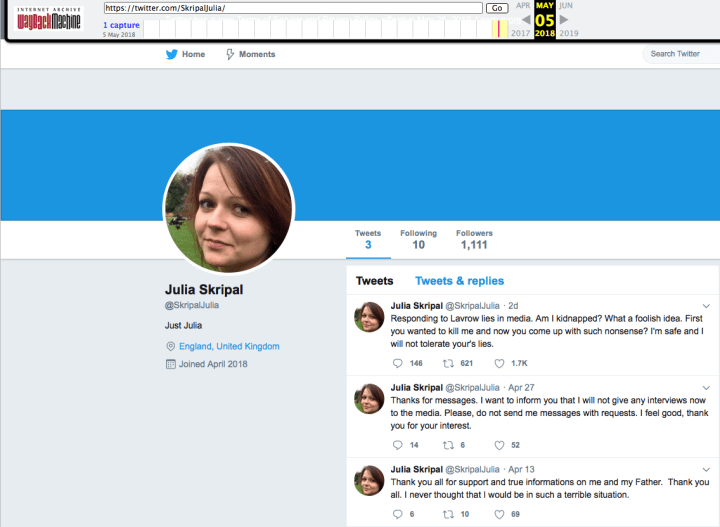
Would you believe that a twitter account purporting to be Yulia Skripal appeared 2 days ago & her first follower was The Washington Post ? The lies continue unabated. I challenged her to show her face & give us the grand interview the whole world wants to see. I got no reply.
— Maria (@mariabirchwood) May 6, 2018
Alexander Yakovenko (diplomat) slams British journalists over the Skripal case as he asks “what’s happening in the UK?”:
A Bucketful of Novichok
By Rob Slane | The Blog Mire | May 5, 2018
In my last piece, I wrote that one of the downsides of the probable D-Notice slapped on the Skripal Case was that we may well be deprived of our daily dose of farcical nonsense, such as whether the poison was administered in the restaurant, the car, the cemetery, the flowers, the luggage, the bench, the porridge, the door handle or – and I’m surprised nobody has thought of it yet – perhaps the cat. There is no doubt an FSB manual waiting to be found which explains how cats can be safely used as conduits for “Novichok”, and it has almost certainly been put together by the dashingly handsome, astonishingly intelligent, but inexplicably bitmapped ruthless ex-KGB assassin, “Gordon”, who was apparently a suspect a couple of weeks ago, but is no longer deemed a person of interest.
But despite the D-Notice, on the morning of 5th May it seemed that the torrent of patent absurdities was actually not about to cease anytime soon. In an interview with the New York Times, the Director General of the Organisation for the Prohibition of Chemical Weapons (OPCW), Ahmet Uzumcu, said the following:
“For research activities or protection you would need, for instance, five to 10 grams or so, but even in Salisbury it looks like they may have used more than that, without knowing the exact quantity, I am told it may be 50, 100 grams or so, which goes beyond research activities for protection.”
My immediate reaction was to ask why only 50-100 grams (which the New York Times helpfully tells its readers is between about a quarter-cup to a half-cup of liquid)? Why not a whole bucketful of Novichok, splashed indiscriminately over the front door of Mr Skripal’s house?
It is testimony to the truly uninquisitive minds of the dutiful stenographers at the New York Times and the rest of the media which ran with the same story, that none of them appear to have wondered to themselves something along these lines:
“Huh? 100 grams of military-grade nerve agent? Of a type said to be 5-8 times more lethal than VX, which itself has a median lethal dose of 10 milligrams. And we’re now apparently talking about 100,000 milligrams! And yet not only are the Skripals alive (well at least they were when last Yulia got hold of a phone) but the population of Salisbury seems to be doing okay as well. In fact no-one died (apart from the cat and the guinea pigs). Does Mr Uzumcu know what he’s talking about?”
My next reaction was to wonder whether actually he knows exactly what he’s talking about. But I’ll come back to that in a moment.
Anyway, later in the day, the OPCW issued a Statement on Amount of Nerve Agent Used in Salisbury, which read as follows:
“In response to questions from the media, the OPCW Spokesperson stated that the OPCW would not be able to estimate or determine the amount of the nerve agent that was used in Salisbury on 4 March 2018. The quantity should probably be characterised in milligrams. However, the analysis of samples collected by the OPCW Technical Assistance Visit team concluded that the chemical substance found was of high purity, persistent and resistant to weather conditions.”
As an aside, I’d love to know which media asked the questions. My guess is that it wasn’t any of those organisations who had repeated the claims made in the New York Times.
But what of the statement itself? Taken at face value, along with Mr Uzumcu’s original statement, it is very odd for a number of reasons:
1. Firstly, it says that the OPCW would not be able to estimate or determine the amount of the substance used. But of course this is exactly what Mr Uzumcu did appear to say, when he mentioned the quantities 50 and 100 grams.
2. Secondly, the statement says that the quantity should probably be characterised in milligrams. Not bucketfuls then? But of course the problem with this is that it does appear to leave Mr Uzumcu looking rather stupid, as if he:
a) Doesn’t know his grams from his milligrams and
b) Doesn’t realise that a cupful of military grade nerve agent 5-8 times more toxic than VX would kill people – like, lots and lots and lots of people
3. And thirdly, the milligrams for grams exchange completely undercuts the whole point Mr Uzumcu was making. He was saying that it appeared from the amount used that it could not have been produced in any old laboratory, as he had admitted a week before when he had said it could be produced “in any country where there would be some chemical expertise.” Rather, the point he was making was that quantities like 50-100 grams could only point to military production of the agent, rather than simply for research purposes.
This is all very bizarre. That’s hardly surprising, though, since there is almost nothing about this case that has not been extremely odd. From what I can tell, there are only really two possible explanations for this latest bout of strangeness.
One possible explanation is that Mr Uzumcu is simply incompetent, and so lacking in knowledge that he doesn’t know his grams from his milligrams, nor that half a cup of deadly nerve agent would wipe out hundreds, if not thousands, of people (not to mention being impossible to put on a door handle in the first place, at least not without the kind of protection that might just draw attention). However, this seems to me fairly unlikely. I assume that you don’t become Director General of the OPCW and remain in the position for eight years if you really are that inept.
But is there another more revealing explanation?
If you go back and read Mr Uzumcu’s statement, it is very noticeable that he does not actually state that he personally believes the quantity of the poison used in Salisbury was 50 or 100 grams. What he actually said is:
“For research activities or protection you would need, for instance, five to 10 grams or so, but even in Salisbury it looks like they may have used more than that, without knowing the exact quantity, I am told it may be 50, 100 grams or so, which goes beyond research activities for protection” [my emphasis].
It looks like they may have used more than that? From what does it look like that? From the months long, multi-million pound clean up job being undertaken, by any chance?
And of the quantity, he says he was told this. But the question is, who told him?
I can’t be sure, but my hunch is that he does know his grams from his milligrams; that he is well aware that 50-100 grams of the stuff would be enough to have killed the Skripals outright, along with hundreds or possibly thousands of others in the surrounding area; and also that he understands full well that the current multi-million pound clean up operation in Salisbury, which is precisely intended to give the impression that there was so much of the stuff that it might make up half a cupful, or perhaps even a whole bucketful, is something of a farce.
And so even though his original statement at first seems absurd, I’m fairly convinced that it was not a display of incompetence on his part. Rather, together with the subsequent clarification, it was very likely a signal that he believes his source for the claim to be either incompetent or – shall we say – economical with the actualité. And it may be that his real aim was – as diplomatically as possible – to let certain folks in Britain know that he’s not as convinced by some of their claims as they might like him to be.
Featured Video
Trita Parsi: Israel Set a Trap for Total War in the Region
or go to
Aletho News Archives – Video-Images
Book Review
Why the War on Conspiracy Theories Is Bad Public Policy
By Kevin Barrett • Unz Review • February 1, 2019
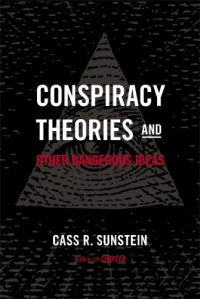 A Review of Conspiracy Theories and Other Dangerous Ideas by Cass Sunstein (based on an earlier paper co-authored with Adrian Vermeule); In Defense of Troublemakers: The Power of Dissent in Life and Business by Charlan Nemeth; and Conspiracy Theories and the People Who Believe Them, edited by Joseph E. Uscinski
On January 25 2018 YouTube unleashed the latest salvo in the war on conspiracy theories, saying “we’ll begin reducing recommendations of borderline content and content that could misinform users in harmful ways—such as videos promoting a phony miracle cure for a serious illness, claiming the earth is flat, or making blatantly false claims about historic events like 9/11.”
At first glance that sounds reasonable. Nobody wants YouTube or anyone else to recommend bad information. And almost everyone agrees that phony miracle cures, flat earthism, and blatantly false claims about 9/11 and other historical events are undesirable.
But if we stop and seriously consider those words, we notice a couple of problems. First, the word “recommend” is not just misleading but mendacious. YouTube obviously doesn’t really recommend anything. When it says it does, it is lying. … continue
Blog Roll
 Aletho News
- Araghchi blasts ‘parasitic’ alliance as US taxpayers pay for Israel’s war on Iran
- Easy fix for Europe’s chaos? Stop fueling war against Russia
- Putin’s key remarks on peace talks and Europe’s ‘schizophrenia’
- Trita Parsi: Israel Set a Trap for Total War in the Region
- Trump’s Iran war is on an Israeli leash
- Saudi oil boss issues global supply warning
- Riyadh Says Its Oil System Is Intact. The Numbers Say Otherwise.
- Trump and Netanyahu Want to “Finish the Job” on Iran
- US ‘one-sided dictation’ not Iran’s beliefs makes rational talks impossible: Baghaei
- Iran’s Next Strike May Not Explode. It Could Shut You Down /Col Doug Macgregor
- If Americans Knew
- The outsourced risk: how newsrooms rely on Gaza’s freelancers without protecting them
- Gaza bakeries forced to shut as Israel blocks flour shipments
- Gaza’s breast cancer patients face a deadly wait for treatment amid Israel’s genocide
- DAILY UPDATE: Latest essential news on Palestine, Israel, & region
- The Israel Lobby’s Changing Fortunes
- AIPAC has become such a political liability that it’s shifting to a more “nimble” approach to buying politicians
- At least 160 Israeli settler attacks in 2 weeks
- Will Gaza’s Ancient Christian Community Disappear Forever?
- Israel’s vision of regional security rests on keeping Arab states weak
- Heidi Levine recounts how Palestinian youths helped save her in settler attack
- No Tricks Zone
- E-Cars Reduce CO2 Emissions By Only 41% Compared To Internal Combustion Engine Vehicles
- Predictions Made By Renowned Climate Professor Over Past Decades Have Been Proven To Be Poor
- New Study Suggests Large Regions Of The Pacific Ocean Have Been Cooling For The Last 80 Years
- Germany’s Green Energy Debacle: High Energy Costs Force Kahla Porzellan to Close After 182 Years!
- New Study: 50 Years Of The Most Aggressive ‘Net Zero’ Policies Can Only Affect The Global Climate By 0.03°C
- US September “Heat” Was No Record…Many Records Set Decades Ago
- Latest European Green Energy Debacle; Portugal’s Largest Flagship Solar Park Insolvent!
- Green Energy Debacle: German Expert Professor Fritz Vahrenholt Warns Of Severe Economic And Social Consequences
- Two More Paleo Reconstructions Affirm Meters-Higher Sea Levels Across Ireland, Brazil 7000-6000 Years Ago
- New Study: Earth And Venus Surface Warmth Largely Explained By Convection And Lapse Rate, Not CO2 Or Radiation

