The Two Superpowers: Who Really Controls the Two Countries?
By Paul Craig Roberts | Institute For Political Economy | June 30, 2018
Among the ruling interests in the US, one interest even more powerful than the Israel Lobby—the Deep State of the military/security complex— there is enormous fear that an uncontrollable President Trump at the upcoming Putin/Trump summit will make an agreement that will bring to an end the demonizing of Russia that serves to protect the enormous budget and power of the military-security complex.
You can see the Deep State’s fear in the editorials that the Deep State handed to the Washington Post (June 29) and New York Times (June 29), two of the Deep State’s megaphones, but no longer believed by the vast majority of the American people. The two editorials share the same points and phrases. They repeat the disproved lies about Russia as if blatant, obvious lies are hard facts.
Both accuse President Trump of “kowtowing to the Kremlin.” Kowtowing, of course, is not a Donald Trump characteristic. But once again fact doesn’t get in the way of the propaganda spewed by the WaPo and NYT, two megaphones of Deep State lies.
The Deep State editorial handed to the WaPo reads: “THE REASONS for the tension between the United States and Russia are well-established. Russia seized Crimea from Ukraine, instigated a war in eastern Ukraine, intervened to save the dictatorship of Syrian President Bashar al-Assad, interfered in the U.S. presidential election campaign to harm Hillary Clinton and help Donald Trump, poisoned a former intelligence officer on British soil and continues to meddle in the elections of other democracies.”
The WaPo’s opening paragraph is a collection of all the blatant lies assembled by the Deep State for its Propaganda Ministry. There have been many books written about the CIA’s infiltration of the US media. There is no doubt about it. I remember my orientation as Staff Associate, House Defense Appropriation Subcommittee, when I was informed that the Washington Post is a CIA asset. This was in 1975. Today the Post is owned by a person with government contracts that many believe sustain his front business.
And don’t forget Udo Ulfkotte, an editor of the Frankfurter Allgemeine Zeitung, who wrote in his best seller, Bought Journalism, that there was not a significant journalist in Europe who was not on the CIA’s payroll. The English language edition of Ulfkotte’s book has been suppressed and prevented from publication.
The New York Times, which last told the truth in the 1970s when it published the leaked Pentagon Papers and had the fortitude to stand up for its First Amendment rights, repeats the lies about Putin’s “seizure of Crimea and attack on Ukraine” along with all the totally unsubstantiated BS about Russia interfering in the US president election and electing Trump, who now kowtows to Putin in order to serve Russia instead of the US. The editorial handed to the NYT insinuates that Trump is a threat to the national security of America and its allies (vassals). The problem, the NYT declares, is that Trump is not listening to his advisors.
Shades of President John F. Kennedy, who did not listen to the CIA and Joint Chiefs of Staff about invading Cuba, nuking the Soviet Union, and using the false flag attack on America of the Joint Chiefs’ Northwoods Project (look it up online). Is the New York Times setting up Trump for assassination on the grounds that he is lovey-dovey with Russia and sacrificing US national interests?
I would bet on it.
While the Washington Post and New York Times are telling us that if Trump meets with Putin, Trump will sell out US national security, The Saker says that Putin finds himself in a similar box, only it doesn’t come from the national security interest, but from the Russian Fifth Column, the Atlanticist Integrationists whose front man is the Russian Prime Minister Medvedev, who represents the rich Russian elite whose wealth is based on assets stolen during the Yeltsin years enabled by Washington. These elites, The Saker concludes, impose constraints on Putin that put Russian sovereignty at risk. Economically, it is more important to these elites for financial reasons to be part of Washington’s empire than to be a sovereign country.
I find The Saker’s explanation the best I have read of the constraints on Putin that limit his ability to represent Russian national interests.
I have often wondered why Putin didn’t have the security force round up these Russian traitors and execute them. The answer is that Putin believes in the rule of law, and he knows that Russia’s US financed and supported Fifth Column cannot be eliminated without bloodshed that is inconsistent with the rule of law. For Putin, the rule of law is as important as Russia. So, Russia hangs in the balance. It is my view that the Russian Fifth Column couldn’t care less about the rule of law. They only care about money.
As challenged as Putin might be, Chris Hedges, one of the surviving great American journalists, who is not always right but when he is he is incisive, explains the situation faced by the American people. It is beyond correction. American civil liberties and prosperity appear to be lost.
In my opinion, Hedges’ leftwing leanings caused him to focus on Reagan’s rhetoric rather that on Reagan’s achievements—the two greatest of our time—the end of stagflation, which benefited the American people, and the end of the Cold War, which removed the threat of nuclear war. I think Hedges also does not appreciate Trump’s sincerity about normalizing relations with Russia, relations destroyed by the Clinton, George W. Bush, and Obama regimes, and Trump’s sincerity about bringing offshored jobs home to American workers. Trump’s agenda puts him up against the two most powerful interest groups in the United States. A president willing to take on these powerful groups should be appreciated and supported, as Hedges acknowledges the dispossessed majority do. If I might point out to Chris, whom I admire, it is not like Chris Hedges to align against the choice of the people. How can democracy work if people don’t rule?
Hedges writes, correctly, “The problem is not Trump. It is a political system, dominated by corporate power and the mandarins of the two major political parties, in which we [the American people] don’t count.”
Hedges is absolutely correct.
It is impossible not to admire a journalist like Hedges who can describe our plight with such succinctness:
“We now live in a nation where doctors destroy health, lawyers destroy justice, universities destroy knowlege, the press destroys information, religion destroys morals, and banks destroy the economy.”
Read The Saker’s explanation of Russian politics. Possibly Putin will collapse under pressure from the powerful Fifth Column in his government. Read Chris Hedges analysis of American collapse. There is much truth in it. What happens if the Russian people rise up against the Russian Fifth Column and if the oppressed American people rise up against the extractions of the military/security complex? What happens if neither population rises up?
Who sets off the first nuclear weapon?
Our time on earth is not just limited by our threescore and ten years, but also humanity’s time on earth, and that of every other species, is limited by the use of nuclear weapons.
It is long past the time when governments, and if not them, humanity, should ask why nuclear weapons exist when they cannot be used without destroying life on earth.
Why isn’t this the question of our time, instead of, for example, transgender toilet facilities, and the large variety of fake issues on which the presstitute media focuses?
The articles by The Saker and Chris Hedges, two astute people, report that neither superpower is capable of making good decisions, decisions that are determined by democracy instead of by oligarchs, against whom neither elected government can stand.
If this is the case, humanity is finished.
Here are the Washington Post and New York Times editorials:
Washington Post
June 29, 2018
Editorial
Trump is kowtowing to the Kremlin again. Why?
Ahead of a summit with Putin, Trump is siding with the Russian leader, with dangerous results.THE REASONS for the tension between the United States and Russia are well-established. Russia seized Crimea from Ukraine, instigated a war in eastern Ukraine, intervened to save the dictatorship of Syrian President Bashar al-Assad, interfered in the U.S. presidential election campaign to harm Hillary Clinton and help Donald Trump, poisoned a former intelligence officer on British soil and continues to meddle in the elections of other democracies. Yet on Wednesday in the Kremlin, President Vladimir Putin brushed it all aside and delivered the Russian “maskirovka,” or camouflage, answer that it is all America’s fault.
Meeting with John Bolton, the president’s national security adviser, Mr. Putin declared that the tensions are “in large part the result of an intense domestic political battle inside the U.S.” Then Mr. Putin’s aide Yuri Ushakov insisted that Russia “most certainly did not interfere in the 2016 election” in the United States. On Thursday morning, Mr. Trump echoed them both on Twitter: “Russia continues to say they had nothing to do with Meddling in our Election!”
Why is Mr. Trump kowtowing again? The U.S. intelligence community has concluded that Russia did attempt to tilt the election using multiple campaigns, including cyberintrusions and insidious social media fakery. Would it be so difficult to challenge Mr. Putin about this offensive behavior? A full accounting has yet to be made of the impact on the election, but Mr. Bolton did not mince words last year when he described Russian interference as “a true act of war” and said, “We negotiate with Russia at our peril.” And now?
Summits can be productive, even – maybe especially – when nations are at odds. In theory, a meeting between Mr. Trump and Mr. Putin, now scheduled for next month in Helsinki, could be useful. But a meeting aimed at pleasing Mr. Putin is naive and foolhardy. A meeting aimed at pleasing Mr. Putin at the expense of traditional, democratic U.S. allies would be dangerous and damaging.
Just as Mr. Bolton was flattering Mr. Putin, Russia was engaging in subterfuge on the ground in Syria. The United States, Russia and Jordan last year negotiated cease-fire agreements in southwestern Syria, along the border with Jordan and the Golan Heights. In recent days, the United States has warned Russia and its Syrian allies not to launch an offensive in the area, where the rebel forces hold parts of the city of Daraa and areas along the border. The State Department vowed there would be “serious repercussions” and demanded that Russia restrain its client Syrian forces. Secretary of State Mike Pompeo called the Russian foreign minister, Sergei Lavrov, saying an offensive would be unacceptable. All to no avail; Syria is bombing the area.
This is what happens when Mr. Trump signals, repeatedly, that he is unwilling or unable to stand up to Russian misbehavior. We are on dangerous ground. Either Mr. Trump has lost touch with essential U.S. interests or there is some other explanation for his kowtowing that is yet unknown.
New York Times
June 29, 2018
Editorial
Trump and Putin’s Too-Friendly Summit
It’s good to meet with adversaries. But when Mr. Trump sits down with Mr. Putin, it will be a meeting of kindred spirits. That’s a problem.It’s good for American presidents to meet with adversaries, to clarify differences and resolve disputes. But when President Trump sits down with President Vladimir Putin of Russia in Finland next month, it will be a meeting of kindred spirits, and that’s a problem.
One would think that at a tête-à-tête with the Russian autocrat, the president of the United States would take on some of the major concerns of America and its closest allies. Say, for instance, Mr. Putin’s seizure of Crimea and attack on Ukraine, which led to punishing international sanctions. But at the Group of 7 meeting in Quebec this month, Mr. Trump reportedly told his fellow heads of state that Crimea is Russian because everyone there speaks that language. And, of course, Trump aides talked to Russian officials about lifting some sanctions even before he took office.
One would hope that the president of the United States would let Mr. Putin know that he faces a united front of Mr. Trump and his fellow NATO leaders, with whom he would have met days before the summit in Helsinki. But Axios reported that during the meeting in Quebec, Mr. Trump said, “NATO is as bad as NAFTA,” the North American Free Trade Agreement, which is one of Mr. Trump’s favorite boogeymen.
Certainly the president would mention that even the people he appointed to run America’s intelligence services believe unequivocally that Mr. Putin interfered in the 2016 election to put him in office and is continuing to undermine American democracy. Right? But on Thursday morning, Mr. Trump tweeted, “Russia continues to say they had nothing to do with Meddling in our Election!”
More likely, Mr. Trump will congratulate Mr. Putin, once again, for winning another term in a sham election, as he did in March, even though his aides explicitly warned him not to. And he has already proposed readmitting Russia to the Group of 7, from which it was ousted after the Ukraine invasion.
Summits once tended to be carefully scripted, and presidents were attended by senior advisers and American interpreters. At dinner during a Group of 20 meeting last July, Mr. Trump walked over to Mr. Putin and had a casual conversation with no other American representative present. He later said they discussed adoptions – the same issue that he falsely claimed was the subject of a meeting at Trump Tower in 2016 between his representatives and Russian operatives who said they had dirt on Hillary Clinton.
It’s clear that Mr. Trump isn’t a conventional president, but instead one intent on eroding institutions that undergird democracy and peace. Mr. Trump “doesn’t believe that the U.S. should be part of any alliance at all” and believes that “permanent destabilization creates American advantage,” according to unnamed administration officials quoted by Jeffrey Goldberg in The Atlantic.
Such thinking goes further than most Americans have been led to believe were Mr. Trump’s views on issues central to allied security. He has often given grudging lip service to supporting NATO, even while complaining frequently about allies’ military spending and unfair trade policies.
The tensions Mr. Trump has sharpened with our allies should please Mr. Putin, whose goal is to fracture the West and assert Russian influence in places where the Americans and Europeans have played big roles, like the Middle East, the Balkans and the Baltic States.
Yet despite growing anxieties among European allies, Mr. Trump is relying on his advisers less than ever because, “He now thinks he’s mastered this,” one senior member of Congress said in an interview. That’s a chilling thought given his inability, so far, to show serious progress on any major security issue. Despite Mr. Trump’s talk of quick denuclearization after his headline-grabbing meeting with the North Korean leader, Kim Jong-un, experts say satellite imagery shows the North is actually improving its nuclear capability.
While the White House hasn’t disclosed an agenda for the Putin meeting, there’s a lot the two leaders should be discussing, starting with Russian cyberintrusions. Mr. Trump, though, has implied that Mr. Putin could help the United States guard against election hacking. And although Congress last year mandated sweeping sanctions against Russia to deter such behavior, Mr. Trump has failed to implement many of them.
In a similar vein, should Mr. Trump agree to unilaterally lift sanctions imposed after Moscow invaded Ukraine and started a war, it would further upset alliance members, which joined the United States in imposing sanctions at some cost to themselves. Moreover, what would deter Mr. Putin from pursuing future land grabs?
Mr. Trump could compound that by canceling military exercises, as he did with South Korea after the meeting with Mr. Kim, and by withdrawing American troops that are intended to keep Russia from aggressive action in the Baltics.
Another fraught topic is Syria. Mr. Trump has signaled his desire to withdraw American troops from Syria, a move that would leave the country more firmly in the hands of President Bashar al-Assad and his two allies, Russia and Iran. Russia, in particular, is calling the shots on the battlefield and in drafting a political settlement that could end the fighting, presumably after opposition forces are routed.
What progress could be made at this summit, then? Mr. Trump and Mr. Putin may find it easier to cooperate in preventing a new nuclear arms race by extending New Start, a treaty limiting strategic nuclear weapons that expires in 2021.
Another priority: bringing Russia back into compliance with the I.N.F. treaty, which eliminated all U.S. and Soviet ground-launched ballistic and cruise missiles with ranges between 500 and 5,500 kilometers, until Russia tested and deployed a prohibited cruise missile.
Mr. Trump’s top national security advisers are more cleareyed about the Russian threat than he is. So are the Republicans who control the Senate. They have more responsibility than ever to try to persuade Mr. Trump that the country’s security is at stake when he meets Mr. Putin, and that he should prepare carefully for the encounter.
Russia’s Nuclear Doctrine Is Being Distorted Once Again
By Vladimir KOZIN | Oriental Review | June 26, 2018
On June 13, 2018, the Washington Post published an original piece by Paul Sonne that describes America’s potential use of the low-yield nuclear warheads that are to be installed on the future US B-61-12 nuclear bombs, as well as on the ballistic missiles carried by the Trident II submarines in the form of W76-2 warheads, in accordance with Washington’s 2018 nuclear doctrine. The article claims that the introduction of low-yield warheads and the idea of their potential use is being justified by the Pentagon as necessary due to the fact that Russia is allegedly prepared to use similar warheads against NATO countries, based on that nation’s current nuclear doctrine and because a purported strategy of “escalate to de-escalate” has apparently been “approved” by Moscow.
It should be kept in mind that the Military Doctrine of the Russian Federation, which has sections covering the potential use of nuclear weapons, says nothing about the power of the nuclear weapons that might be utilized, nor is there any mention of warheads with either high or “low” yields in TNT equivalents. Those sections of the official doctrine do not even categorize Russian nuclear weapons into strategic vs. tactical varieties.
Only one term is specified in Russia’s military and strategic posture: “nuclear weapons.” And only two circumstances are listed as a basis for their potential use: the first — only in response to the use of nuclear or other weapons of mass destruction against the Russian Federation and/or its allies; and the second — in the event of aggression against Russia that employs conventional weapons to the point that “the very existence of the state is threatened.” In other words, only reciprocal actions are permitted in either case.
Nor does the Russian nuclear doctrine list the countries or alliances against which nuclear weapons can be used.
It seems odd that the US still does not understand the basic tenets of Russia’s nuclear posture. And it must be said that this is not the first time that Western analysts have taken such an unprofessional approach. This has become especially glaring in the run-up to the next NATO summit, which will take place July 11-12 in Brussels.
On the other hand, the newest US nuclear doctrine, which was approved last February, specifies 14 justifications for the use of nuclear weapons, including “low-yield” warheads, which is how US arms experts classify nuclear warheads of 5.0-6.5 kilotons and below. These are precisely the sea- and air-launched warheads the Pentagon intends to utilize in accordance with its new concept of “escalating to de-escalate.” Under that theory, low-yield nuclear warheads can be employed by US nuclear forces on an increasing scale in a variety of regional conflicts, with the aim of “de-escalating” them, which might be accomplished with the help of a nuclear first strike.
This practice could cause a chain reaction in the use of nuclear weapons, involving not only “low-yield” warheads, but also more powerful nuclear explosives.
The practice being described — the potential use of low-yield nuclear weapons, which is a real fixation for the current US administration and is being discussed with increasing frequency in the US — suggests that America’s military and political leaders are committed to dramatically lowering the minimum threshold for their use and expanding the list of acceptable reasons to utilize them under real-world conditions. The adage from the past that everyone could relate to — “A nuclear war cannot be unleashed, because there will be no winners” — is now absent from the political statements that are being heard. It is clear that forces have taken the upper hand on Capitol Hill that are still incapable of imagining the consequences of a nuclear Armageddon. Such a path, even if this scenario proves unlikely, will inevitably lead to a potential undermining of the already fragile non-proliferation regime and a breakdown in the negotiations on establishing control over nuclear facilities, which — and this is not news — very few countries are taking part in at the present time.
For all these reasons, a dangerous future practice like this needs to be reexamined by Washington, in the interests of preserving global stability. In order to achieve this goal, the strategic guidelines for inflicting a first “preemptive and preventive” nuclear strike, as well as the continuing premise of “unconditional offensive nuclear deterrence,” which have remained unchanged since 1945, must be completely eliminated from American nuclear strategies.
These are not ultimatums, as someone defending US nuclear policy has already tried to portray them. This is a completely natural, logical, and sensible step, which would no doubt be positively received all over the world.
Atrocity Porn and Hitler Memes Target Trump for Regime Change
By James George JATRAS | Strategic Culture Foundation | 23.06.2018
American and global audiences have been bombarded with media images of wailing children in holding facilities, having been separated from adults (maybe their parents, maybe not) detained for illegal entry into the United States. The images have been accompanied by “gut-wrenching” audio of distraught toddlers screaming the Spanish equivalents of “Mommy!” and “Daddy!” – since, as any parent knows, small children never cry or call for their parents except in the most horrifying, life-threatening circumstances.
American and world media have provided helpful color commentary, condemning the caging of children as openly racist atrocities and state terrorism comparable to Nazi concentration camps and worse than FDR’s internment of Japanese and Japanese-Americans. Indeed, just having voted for Trump is now reason enough for Americans to be labeled as Nazis.
Finally, the presumptive Hitler himself, also known as President Donald Trump, citing the pleas of First Lady Melania and First Daughter Ivanka, signed an Executive Order to provide for adults and (their?) children to be detained together. However, the order is unlikely to hold up in court, with sanctuary-minded states aiming to obstruct border enforcement the way Trump’s earlier order on vetting arrivals from terrorism-prone countries has been crippled by the federal judiciary. His media and bipartisan political opposition will be happy only when all border violation detentions cease and America has gone full Merkel, starting with ending Trump’s declared zero tolerance for illegal crossings and restoration of Barack Obama’s catch-and-release policy.
Even then, Trump will be vilified for taking so long to do it. Whether or how Trump may yield further is not clear, but rather than slaking the hate campaign against him, his attempted effort at appeasement has put the smell of political blood in the water with the November 2018 Congressional midterm elections looming.
Some images of small children have become veritable icons of Trumpian brutality. One photo, reportedly of a two-year-old Honduran girl (who in fact had not been separated from her mother), graced the cover of Time magazine, confronting the black-hearted tyrant himself. Another, of a little boy in a cage, went viral before it was revealed that this kid had nothing to do with the border but rather was briefly inside a staged pen as part of a protest in Dallas.
The reality behind the pictures doesn’t matter, though. More important are the images themselves and their power, along with dishonest media spin, to produce an emotional response that short-circuits critical thinking. Never mind what the facts are! Children are suffering! Trump is guilty! We need to “do something”!
On point of comparison, let’s remember the saturation media distribution given in 2016 to a picture of a little boy, Omran Daqneesh, said to have been pulled from the rubble of Aleppo after what was dubiously reported as a Russian airstrike. Promptly dubbed “Aleppo Boy,” his pathetic dusty image immediately went viral in every prestige outlet in the United States and Europe. The underlying message: we – the “international community,” “the Free World,” the United States, you and I – must “do something” to stop Syrian President Bashar al-Assad and his main backer and fellow Hitler clone Vladimir Putin.
(Not long before, another little boy, also in the area of Aleppo, was beheaded on video by the “moderate” US-supported jihad terror group Harakat Nour al-Din al-Zenki. The images of his grisly demise received far less media attention than those of official Aleppo Boy. This other youngster received no catchy moniker. No one called for anyone in power to “do something.” In fact, western support for the al-Zenki murderers – which the Obama administration refused to disavow even after the beheading and allegations of chlorine gas use by al-Zenki – can itself be seen as part of “doing something” about the evil, evil Assad. (Reportedly Trump’s viewing the beheading video led to a cutoff of CIA aid to some jihad groups.) Another small detail readily available in alternative media but almost invisible in the major outlets: Mahmoud Raslan, the photographer who took the picture of Aleppo Boy and disseminated it to world acclaim, also took a smiling selfie with the beaming al-Zenki beheaders of the other kid. But, hey, says Raslan, I barely know those guys. Now let’s move on . . . )
For those who have been paying attention for the past couple of decades, the Trump border crisis kids, like Aleppo Boy before them, are human props in what is known as “atrocity porn” designed to titillate the viewers through horror and incite them to hatred of the presumed perpetrators. Atrocity propaganda has long been a part of warfare – think World War I claims of Belgian babies impaled on German bayonets – but with modern digital technology and social media the impact is immediate and universal.
It’s irrelevant whether what is identified in images corresponds to reality. What matters is their ability to evoke mindless, maudlin emotionalism, like MSNBC’s Rachel Maddow choking up in tears over the border children or the similar weepy display in 2016 by CNN’s Kate Bolduan over Aleppo Boy.
Now being deployed in an American domestic context over whether or not the US should be allowed to control its borders, for decades atrocity porn has been essential for selling military action in wars of choice unconnected to the actual defense of the US: incubator babies (Kuwait/Iraq); the Racak massacre (Kosovo); the Markale marketplace bombings, Omarska “living skeletons,” and the Srebrenica massacre (Bosnia); rape as calculated instrument of war (Bosnia, Libya); and false flag poison gas attacks in Ghouta and Douma (Syria). Never mind that the facts, to the extent they eventually become known, may later turn out to be very different from the categorical black-and-white accusations on the lips of western officials and given banner exposure within hours if not minutes of the event in question.
Atrocity porn dovetails closely with another key meme, that of Hitler-of-the-month. In painting Trump as der Führer on the border, we see coming home to America a ploy that has been an essential element to justify foreign regime change operation, each of which has been spelled out in terms of black-and-white, good-versus-evil Manichaean imperatives, with the side targeted for destruction or replacement having absolutely no redeeming qualities. This entails first of all absolute demonization of the evil leader in what is called reductio ad Hitlerum, a concept attributed to philosopher Leo Strauss in 1951. Russia’s Vladimir Putin has been characterized by name as another Hitler by Hillary Clinton and others. Among the prominent “Hitlers” since 1991 have been Saddam Hussein (Iraq), Slobodan Milosevic (Yugoslavia/Serbia), Radovan Karadzic (Republika Srpska), Moammar Qaddafi (Libya), and Bashar al-Assad (Syria), with less imposing Führer figures to be found in Mohamed Farrah Aidid (Somalia), Manuel Noriega (Panama), Mahmoud Ahmadinejad (Iran), and Omar al-Bashir (Sudan).
With apologies to Voltaire, if Hitler had not existed it would be necessary for the US-UK Deep State to invent him . . .
Today the atrocity porn and Hitler memes that have been so useful in justifying regime change in other countries are being directed with increasing intensity against America’s own duly elected president. This is at a time when the original conspiracy to discredit and unseat him, the phony “Russian collusion” story, is in the process of unraveling and being turned back on its originators. Horror of horrors, Trump is now feeling free enough to move forward on a meeting with Putin.
Keep in mind that Putin is, according to Hillary Clinton, leader of the worldwide “authoritarian, white-supremacist, and xenophobic movement” who is “emboldening right-wing nationalists, separatists, racists, and even neo-Nazis.” So he and Hitler-Trump should get on famously! The prospect of any warming of ties between Washington and Moscow has elements of the US intelligence agencies, together with their British coconspirators in MI6 and GCHQ, in an absolute panic.
That’s why desperate measures are in order. As noted earlier, when confronted with a reincarnation of the most evil personage in history, even the most extreme actions cannot be ruled out. Demonizing the intended target neutralizes objections to his removal – by any means necessary.
After all, how can any decent person oppose getting rid of Hitler?
The Ups and Downs of Rebuilding Aleppo, Mosul
Veterans Today | June 23, 2018
Aleppo and Mosul, cities that endured some of the worst urban warfare in the 21st century, have quite different liberation stories, but they are alike in the way media treated them with oblivion once the post-war struggle began.
Both the Syrian city of Aleppo and Iraq’s Mosul found themselves gripped in fierce battles in late 2016. Syrian forces were trying to liberate the eastern part of Aleppo from militant groups to end the mortar shelling, which was killing civilians in the western half, and to begin rebuilding the war-ravaged districts of the city. An ambitious Russia-backed effort to evacuate civilians from the warzone set up humanitarian corridors. It was the US-backed Iraqi battle for Mosul, however, that captured the Western media’s favor as a heroic struggle to liberate civilians from Islamic State (IS, ISIS/ISIL), while the war in Aleppo was presented in a markedly different light.
‘Bombing kitten sanctuaries’ in Aleppo
It’s no secret that the mainstream media coverage of eastern Aleppo’s liberation – more often termed as the “siege” or the “fall of Aleppo” in the West – focused exclusively on alleged atrocities of the Syrian Army rather than the full picture. Reports tugged at the emotional strings of the viewers, describing children’s hospitals, schools and blood banks destroyed in the government bombing. However, they failed to mention that the former schools and hospitals often housed militant mortars, while the “last hospital in Aleppo” was destroyed multiple times as MSM readily cited militant-linked sources without verifying them.
But perhaps the most absurd of the stories spun by the media during the battle was the “bombing” of the cat sanctuary in the city. The home for orphaned felines, which was run by Mohammad Alaa Aljaleel, who was referred to as an “ambulance driver” and “the Catman of Aleppo,” was repeatedly brought into the spotlight, highlighting the hardships of the rebel-held parts of the city. In November 2016, the Catman reported that the facility was “bombed,” and several cats and a dog, aptly named Hope, were killed. The incident was squarely pinned on President Bashar Assad’s air forces and Russia. The next alleged attack on the sanctuary came with the MSM’s weapon of choice – chlorine – according to the owner, who was eventually safely evacuated from Aleppo.
home of Ernesto cats, will close !! now also they bombarded with chlorine. We go away with our cats and Dog .😔#HouseOfCatsErnestoinAleppopic.twitter.com/5cZ0pfh3CB
— The Aleppo CatMan (@theAleppoCatman) November 18, 2016
The man eventually settled in the militant-held western countryside of Aleppo, opening a new kitten sanctuary. The feline facility, sadly, has not received much media attention ever since. As the battle for Aleppo ended, the media largely lost its interest in the city, forgetting about the civilians who are now working hard to rebuild a peaceful life.
Hushed strikes on Mosul
The chaotic battle for Mosul, where IS terrorists ruthlessly used civilians as human shields amid relentless US-led coalition bombing, was no less of a tragic story of suffering, but the absence of evacuations for civilians made the city warfare particularly extreme. When it came to coverage, however, the MSM mostly picked military advances while the toll of the fighting was covered in a hushed and infrequent manner.
While footage and photos of the city, taken by a few real reporters on the ground, showed the vast destruction and carnage, no widespread outrage was to be seen in the aftermath of mass civilian casualties reported. Warnings from international human rights groups, including the UN bodies, which highlighted the dire refugee situation and apparent disregard for “collateral damage” by the coalition, were also left largely unaired.
But as the battle ended and the city was pronounced liberated from IS, the story of Mosul’s struggles was seemingly cut short in the media once and for all.
But what happened next?
The battle for Aleppo ended in the very end of 2016, and the city has been vigorously striving to get back to peaceful life ever since. The cafés have reopened, the World Cup is broadcasted, and people are celebrating holidays – of several different religions – in peace.
Latin Parish of St Francis marking the feast day of St Anthony of Padua #Aleppo#Syriapic.twitter.com/npHOKtn9nU
— G (@SyrianLionesss) June 14, 2018
Syrian football fans are watching the 2018 FIFA World Cup. During the match in the sports bars there is no free one. Most support the Russian team.#Syria#Aleppo#Rusia2018#FifaWorldCup18#FifaWorldCup2018#SoccerAid#Syrian#FIFA#SportWithoutPolitics#2018FIFAWorldCuppic.twitter.com/xDWj0Vtk9i
— RealNewsfromAleppo (@RealNewsAleppo) June 20, 2018
The Old City’s Sheraton Hotel, which was turned into a Syrian Army barracks during the battle, was restored to its former glory and is open for guests.
Sheraton #Aleppopic.twitter.com/Tx6VSQhIJ4
— maytham (@maytham956) June 13, 2018
The city is rebuilding, roads have been long cleared of rubble, and they are getting new asphalt.
Restoration work has started on the Old Markets in #Aleppo#Syriapic.twitter.com/xz5zzq82qa
— maytham (@maytham956) June 5, 2018
Now why is it that Syria’s Aleppo is of no mainstream media interest when it is rising again with its citizens cleaning and rebuilding their city after the defeat of ISIS and Al-Qaeda jihadists? 🤔
(Photos via @NamanTarcha) pic.twitter.com/O1csFbe90f— Sarah Abdallah (@sahouraxo) March 28, 2018
Mosul, which was liberated nearly a year ago, presents a more chilling picture. The authorities still haven’t managed to collect the dead – militants, civilians and those who fought against IS.
Last week, Mosul was visited by Hollywood superstar and Special Envoy of the High Commissioner for Refugees (UNHCR) Angelina Jolie, who found the “worst devastation” there that she has seen in her 17 years representing the UN watchdog. The streets of Mosul’s Old City are still laying in ruins, and the stench of decomposing corpses is still in the air.
“There are bodies in this rubble that stay here and you can smell the bodies and some of them have family members that are here and they are unable to move them,” Jolie said, walking the streets where the “liberators” made the last push against IS terrorists.
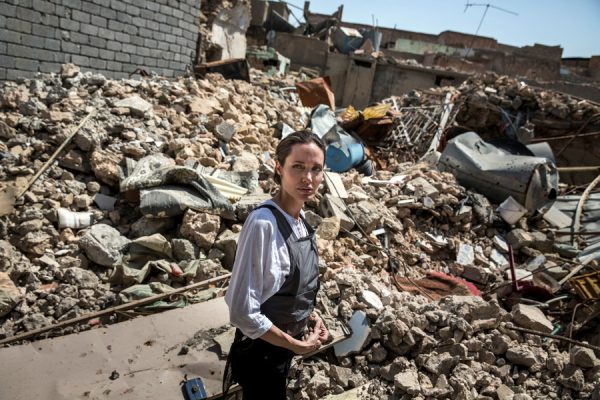
UNHCR Special Envoy Angelina Jolie visits the Old City in West Mosul, Iraq June 16, 2018. © UNHCR / Andrew McConnell
Surely, life is picking up in Mosul, yet at a very slow pace, with destruction seen in the background of every photo.
A photo worth a thousand words ❤#EidAlFitr in #Mosul#Iraq#BackToLifepic.twitter.com/5hZyPgToau
— ICRC Iraq (@ICRC_IQ) June 19, 2018

Iraqi workers repair a building in Mosul on March 15, 2018. © Ahmad Al-Rubaye / AFP
Restoring hope & heritage
Historical sites in both cities sustained massive damage during the fighting. An iconic landmark of Mosul, the Grand al-Nuri Mosque, was blown up by IS militants a month before the city was recaptured by the coalition. The monument was effectively reduced to rubble, and, nearly a year after, it remains in the same state – showing only signs of further deterioration and weathering.
The destroyed Grand al-Nuri Mosque is seen in the Old City of Mosul on January 17, 2018. © Ari Jalal / Reuters
Aleppo Citadel, on the other hand, not only endured the battle for the city, but it actually played one of the key roles in it, serving as a stronghold for Syria’s defenders once again. While the monument was damaged during the fighting, restoration – and demining – works were launched almost immediately after the city’s liberation. Now it’s open for everyone again.
Syrian children from the St. Francis Church summer camp enjoy an exploratory trip to Syria’s historic Citadel in Aleppo, free of terrorism.
You won’t be seeing these smiling faces on any mainstream media outlets because it doesn’t advance their agenda against Syria. pic.twitter.com/X3nrDoH0TH
— Sarah Abdallah (@sahouraxo) June 7, 2018
#Aleppo Citadel is back open for Syrian and Foreign Tourists. Fee to enter in US $ equivalent?
Foreign Tourists = $1.16
Syrian Visitors = $0.17
Syrian Soldiers = $0.12
Families of Martyrs = Free https://t.co/gMyRsQ3Rtupic.twitter.com/gZwLg4CCFG— EHSANI2 (@EHSANI22) June 20, 2018
Another iconic landmark of the city – the Umayyad Great Mosque – was less lucky and sustained way more serious damage, getting pierced with shrapnel and having one of its minarets toppled. While more work needs to be done, it looks way better now – and it actually serves its purpose.
The Parallel Universe of BBC Panorama
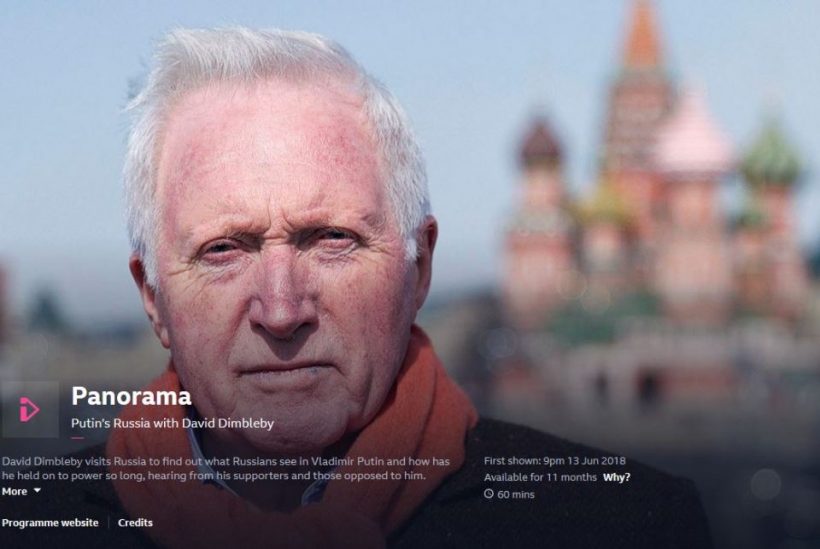
By Kit | OffGuardian | June 21, 2018
The BBC flag-ship documentary series “Panorama” has long been a stalwart of state-funded television propaganda. They can always be relied upon to tell us what we’re supposed to think. In 2013, just days before the Commons vote on military intervention in Syria, BBC aired “Panorama: Saving Syria’s Children”, a shambolic piece of fiction designed to outrage the public into war.
Robert Stuart has done truly exceptional work in deconstructing the fakery and propaganda on which the BBC sees fit to spend taxpayer’s money.
In just the last year they’ve had two documentaries about North Korea being evil (“North Korea’s Secret Slave Camps” and “North Korea’s Nuclear Trump Card”).
And it’s not just foreign “enemies” that end up in Panorama’s crosshairs either – it’s also domestic ones.
In 2015, just a few days before Jeremy Corbyn’s first Labour leadership victory, the BBC aired “Panorama: Jeremy Corbyn – Labour’s Earthquake”, a documentary which prompted Corbyn’s team to file an official complaint, labelling it a “hatchet job”.
Then in 2016, on the eve of Corbyns second (larger) Labour leadership victory, the BBC aired “Panorama: Labour – Is the Party over?”, a documentary full of doom and gloom, featuring anecdotes about abuse, and various (predictable) Blairite MPs bemoaning the “unelectability” of their leader.
In the 2017 General Election, Jeremy Corbyn’s resurgent Labour defied the polls, the pundits and the BBC to knock-off the Tory majority and come within 2% of winning. Could the BBC’s, and Panorama’s, relentlessly negative slanted coverage be responsible for keeping Corbyn out of No.10? It would be foolish to deny the possibility.
And there, neatly demonstrated in those three paragraphs, you see the value and purpose of state-sponsored propaganda. Panorama is the spirit of the BBC, a pretense of faux objectivity, shrouded in cuddly familiarity, employed exclusively and decisively against anything the establishment sees as a threat.
*
Enter Vladimir Putin
The folks at Panorama LOVE Putin, or at least love to hate him. In the last two years there have been no less than five (five!) episodes devoted to the man, and indeed the myth.
January 2016 brought us “Putin’s Secret Riches”, January 2017 “Trump: The Kremlin Candidate”, March of this year brought us two inside a week, “Putin: The New Tsar” and “Taking On Putin!”. As the titles suggest, none of them were especially objective or open-minded. That’s not in the BBC’s remit.
The most recent Putin-hit piece aired just last week – in the run up to the World Cup – its rather more mundane title simply: “Putin’s Russia with David Dimbleby”. The documentary, for want of a better word, opens on David Dimbleby wandering through a Moscow market looking at sigh Russian nesting dolls, and it doesn’t get less predictable from there on in.
A long time ago, I was taught you construct an argument in three steps – “Statement, Evidence, Conclusion”. Instead Panorama opted to go for the unorthodox “Conclusion, Anecdote, Stock Footage of Nesting Dolls” approach.
 The first problem, and perhaps the biggest, is David’s hat… but it never really goes up-hill from there.
The second problem, is the smugness. Forget the factual inaccuracies re: the Russian economy, forget the totally evidence-free assertions, and just focus on the smugness.
The smugness of an English man who went to Charterhouse School, and then on to Oxford, is possibly one of the most toxic things in the world. So much evil has been done by men who are taught their own effortless superiority. Blood has been spilled by such men, oceans of it, evils done beyond imagining, all with a soft chuckle and clear conscience, because they come from a system that tells them their very existence MAKES them RIGHT. They do the “right thing” as a matter of course because of who they are and what they think. They are right, and the vast swamps of Other are wrong, and that’s just the way it is.
These are the people who spread the British Empire over a quarter of the globe, all the time telling themselves that they were doing the savages a favour by giving them civilisation. The same men, the same minds, in suits that change with time and with methods that shift with the ages, have run the country for centuries… and run the BBC since its inception. Men who believe morality is a function of their very existence. A path that rises up to meet their feet.
This is the British version of what the Americans call “exceptionalism”. It’s less brash, and less obvious, but no less poisonous for that.
The worst actions of mankind flow from minds who never question their own moral position, and this documentary can be counted as small, septic, addition to that list.
And so we begin…
I’ve come to see how Putin has managed to hold on to power for so long, and what the Russians see in the Putin that We, in the West, don’t.
Dimbleby’s introduction is immediately partisan and dishonest – referring to “we” in the West as if there is a consensus, when clearly that is not the case, is a variation on the argumentum ad populum, the argument to common knowledge. “Everybody knows that”, or “We all agree on this”. It is deceptive language, being used to paint a false picture.
Likewise, saying Putin “held on” to power for so long, makes it seem like his Presidency was an act of force, when all the evidence is to the contrary. Dimbleby says so himself just a few minutes later.
(SIDEBAR: When Dimbleby says “so long”, he means 18 years. The classic mainstream media trick of ignoring Medvedev’s term as president is employed here. As is every other, long discredited, anti-Putin rhetorical device.)
In a democracy if you failed to deliver on your economic promises, if you surrounded yourself with cronies, and if you used the law to oppress opposition, well you’d be thrown out on your ear… but this is Russia, and they do things differently here.
Dimbleby lays out, in one broad stroke, that Russia is backwards, and silly, and he’s going to come along and point out to us sensible Westerners just how they went wrong.
Leaving aside the hypocrisy (this is, let’s be honest, a pretty accurate summary of what every single British government has done since Margaret Thatcher), it’s also simply insulting. I find it insulting, and I’m British. If I was Russian and heard that? I would vomit blood.
It’s sickening… and we’re only 2 minutes in.
*
David on… the Russian Birthrate
Our first port of call on David’s whistle-stop tour of everything that’s shit about Russia is the birth rate. He tells us that it fell sharply in the years following the collapse of the USSR, and this is true, he doesn’t say WHY this happened. As a matter of policy this programme avoids, at all costs, mentioning what Russia was like in the 1990s.
Anyway, when Putin came to power the birth rate was declining, and what did he do about this? Well, in a masterstroke, decided to encourage people to have babies.

Mrs Cherenkova’s medals
How? Well by increasing state benefits to mothers with more than 2 children, and further increasing them for families with more than 3 children. Families with multiple children are also entitled to free school meals, tax breaks and get discounts on family holidays. Medvedev also introduced a medal in 2008 – “The Order of Glorious Motherhood” – for mothers with 7 or more children, based on the “Mother Heroine” medal from World War 2.
(SIDEBAR: It’s worth noting here that we, in lovely hugs-and-flowers Britain with our nice fluffy democracy, DON’T have free school meals… for anyone. At all. Ever. The government that proposed this bill was not “thrown out on their ear”, but DID have to spend £1.4 BILLION pounds bribing a minority party to vote it through.)
The measures worked, and under Putin/Medvedev the birthrate has increased almost every year since 2000. In 2011 the birthrate moved ahead of the death rate for the first time since 1992, and Russia’s population started growing.
Now, if this is all sounding very sensible and not at all bad to you, then well done for paying attention.
It’s here the film reaches its first hurdle… and goes into it face first. Russia is supposed to be backwards and Putin is supposed to be a brutal corrupt dictator with no concern for the country he runs… but the facts on the ground don’t jive with this at all, at least in the birthrate example. Not only did he try to improve his country, but he did via perfectly reasonable methods, and they worked.
The film makers decide to simply leave an ellipsis on this one, just a long pause that’s obviously designed to make us ruminate on how bad Russia is, but it doesn’t really work. Partly because it doesn’t make any sense, but mostly because – for some reason – David thinks the best way to hammer this point home is show us the Cherenkovas. A very happy family with lots of healthy children. He refers to them as “Putin’s ideal family”, as if the term itself is insulting.
Mrs Cherenkova proudly displays her medals for motherhood in a leather case, explaining she wears them on public holidays. The family sing as they sit down for dinner, talk about the Church and how life has improved under Putin compared to the 1990s. (David, staying true to his brief, doesn’t ask how bad things were in the 1990s. In 58 minutes it’s not mentioned once.)
*
David on… the Russian Orthodox Church
The Cherenkovas praying as they sit down to dinner provides a neat segue for David to discuss something really terrible – the growing influence of the Russian Orthodox Church.
You see, the ROC was suppressed under Communism, which was bad, and now it’s not… which is apparently, also bad. I don’t fully understand the point David is trying to make, but that’s OK since I’m pretty sure he doesn’t either.
We are presented with a Bishop, who tells us that it’s now easier for the Church to interface with the state than it was during the 1990s. We don’t know what he means by that, because he’s cut off and David never asks.
The implication, backed by stock footage of Putin lighting candles in a church and David’s narration about “conservative values”, is that Russia is becoming a kind of quasi-theocracy. It’s never stated out-loud, because the position is so ridiculous as to be indefensible, but it is quite clearly the implication.
*
David on… Russian Opinion Polls
Curious to see “how widely [the Cherenkovas’] views are shared”, David goes in search of a broad opinion, but meets an apparent problem:
It’s all very well to say “I’ve come to Russia to find out what the Russians really think”, but it’s not actually that easy in a country where the press, radio and television are all strictly controlled by an authoritarian government.
1) He hasn’t gone there to find out what Russians think. He knows what Russians “really think”. He’s there to tell US why THEY are wrong. He’s there, at our expense, to make sure we hate who we’re told to hate.
2) The press, radio and television are not all “strictly controlled”, that’s a lie, and he knows it’s a lie because he proves it himself less than 10 minutes later.
But that’s beside the point. How does David get around the problem of finding out what Russian’s “really think” under such an authoritarian regime? Well, he goes to the one of the biggest public opinion polling companies in Russia, the Levada Centre.
The irony of rambling on about Russia’s repressive controlling government as you take a gentle stroll down to the partly-American funded NGO, just minutes from Red Square, is apparently lost on David.
Imagine, if you can, a Russian-funded “polling centre” operating within walking distance of Westminster or Pennsylvania Avenue. That not only calls the government-run polls inaccurate, but claims that the CIA forces people to vote and that the President is corrupt.
It would never be allowed to happen, but in “authoritarian” Russia, with its “strictly controlled” media, this is the current reality.
In the Levada Centre (Russia’s only “independent” polling centre), David finds out that around 80% of Russian’s support Putin as President. Which everyone in the world already knew.
The fact the “independent” Levada’s centre polls almost perfectly align with the apparently unreliable government polls doesn’t cause anyone to question their assertions about corruption or dishonesty. It’s one of the many inconvenient truths the Panorama team feel the need to brush over as quickly as possible.
When the head of the Levada Centre claims a President with an 80% approval rating had to “force” people to vote, David doesn’t ask why, or state that it doesn’t make any sense. No, he just makes concerned faces at the camera.
They discuss the “annexation” of Crimea as Russia “taking back” what is theirs, with no reference to the polls that show huge Crimean support for the move, going all the way back to 1992, including those done by both the American and German governments.
*
David on… Propaganda
From Crimea it’s a steady flow to “propaganda” – theirs, not ours – Dimbleby narrates in solemn tones:
For most Russians, state-run television remains the main source of television news.”
… blithely passing over that this statement is being made on a state-run television station, that is the main source of television news for most people in Britain.
He goes from Russian domestic television to RT, saying they are “accused of spreading conspiracy theories”, he doesn’t say who accuses them, or ask his audience to consider the possible reason behind such accusations. He doesn’t even throw the weight of conviction behind it enough to make a declarative statement. No, just sends out the little accusation, evidence free and with no reply or counter, and hopes the implication does its job.
He interviews a British anchor for RT, who says that they aren’t told what to say, and he’s “answerable to no one but his own conscience”. To which David replies, “And that’s clear is it?” The anchor explains the structure of RT, but David isn’t listening. He’s too busy making a documentary demonising a designated “enemy” for a state-funded broadcaster.
He doesn’t pose the same questions about his own conscience.
It’s always worth remembering that the BBC, formerly the British Broadcasting Corporation, is not “independent”, even though they’ve spent decades pretending otherwise. We’re encouraged to think of the BBC as a friendly presence, our shared “Auntie Beeb”, cosy and reassuring and honest. It’s none of those things, it’s a state backed broadcaster with a history of launching pro-government, pro-war propaganda, for which it never faces censure or punishment. It’s a much a less “friendly auntie”, more a threatening “big brother”.
With truly Orwellian posters intimidating us into paying for it.
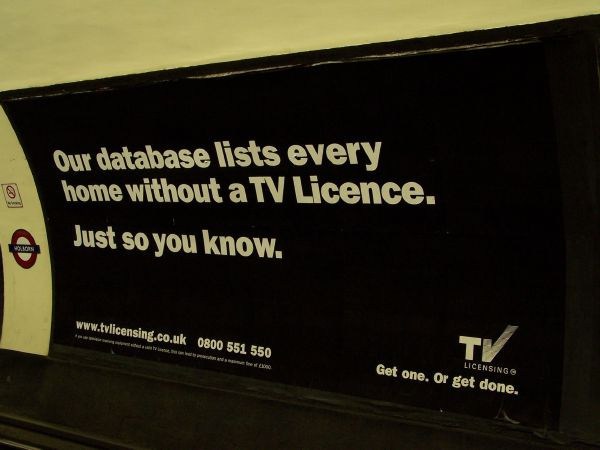
Imagine this poster was in cyrillic and about RT.
That Dimbleby can stand under the banner of one of the biggest state-funded media organizations in the world, and pontificate about “media control” from an “authoritarian government” demands levels of cognitive dissonance few would think possible. It’s marvelously without irony.
*
Next David seeks out a human rights lawyer to discuss Russia’s legal system. David tells us that Russian judges convict in 99% of cases. This is apparently shockingly high. It does sound high, but deliberately left without context to make it seem worse than it is.
Firstly, the 99% refers only to Judge cases. Jury trials are relatively new to Russian law – in fact Putin, in one of his desperate power grabs, introduced them nationwide in 2003 – and they have a conviction rate of roughly 80%, right in line with the UK’s own courts.
A high conviction rate is not unheard of, especially in systems that run “special procedure court hearings”, a slightly complex system of what amounts to plea bargaining.
Japan runs a similar system and has a conviction rate of nearly 100%, as does Israel. The US federal courts had a conviction rate of 93% in 2012. Will we be seeing documentaries about that? No.
I’m not a lawyer, I’m in no position to launch a full defense of the Russian legal system – for all I know it is corrupt and/or unfair. But there’s no evidence in this film that shows it to be the case, outside of some anecdotal evidence from one lawyer.
Then they move on to Putin’s “online crackdown”.
Apparently Russia is starting to try to censor the internet. How? We don’t know, they don’t tell us. They cite no laws and name no Acts. It is just anecdote after anecdote. There’s no body to any part of it. We’re told Putin wants more control of the internet, as if this is shockingly tyrannical and when Dimbleby says there is…
… a crackdown on what the security services call “online extremism”.
He thinks his scare quotes show some desperately dystopian alternative universe, but doesn’t seem to know, or at least acknowledge, that WE call it that too, or that our very own dear Theresa May called for a “crackdown in online extremism” in a speech just last year.
Or that she put having an entirely government controlled internet in her manifesto last year.
Or that she passed an act in 2016 which Edward Snowden described as:
The most extreme surveillance in the history of western democracy.
Is Panorama asking questions about that? Of course not.
Does the BBC call our government authoritarian? Not once.
Instead they offer just a talking-head, making a scary statement that “thousands” of innocent Russians could be in prison, with again no evidence to back it up at all.
When you actually dig into the numbers they tell a completely different story.
The New York Post, not known for its pro-Russia bias, reported that 233 Russians were convicted of “hate speech” in 2015, “most of them for online activity.”
Meanwhile, in happy bunny funland Britain, 2015 saw 857 people arrested for “offensive” tweets or Facebook posts… in London alone.
It sounds like we’re more “authoritarian” than the Russians on the internet front at least. A fact which takes maybe 30 seconds of research to find.
*
David on… Russia’s Controlled Media
Next David goes to Echo of Moscow Radio to talk to one of the completely non-existent members of the independent media in Russia. She claims that the entire country is actually run by the KGB. As per usual, she produces no evidence for this statement, she just says it. But that’s good enough for David who asks her to “explain how the KGB dominates society”, underlining that the KGB and MI6 are not at all similar:
Explain to our UK viewers, who might think of the KGB as just like our MI5 or MI6… how the KGB dominates society?”
Got that everyone? There’s their spies, and our spies, and they are completely different. This attitude was ridiculous enough to be used as satire in Blackadder, but now is being seriously repeated by one the BBC’s most respected personalities.
Her “explanation” involves simply repeating the same sentiment she already expressed, only in slightly different words, and David is too polite to press for more, or too lazy to be bothered, or too smug to notice. It’s really getting hard to say at this point.
(SIDEBAR: Of course one of the most prominent ways that MI6 and the KGB differ is that the KGB doesn’t exist anymore, whereas MI6 are very much still going.)
It’s at this point the documentary seems to realise the rather confusing contradiction of its own existence. They are there to talk about how autocratic and terrible Russia is, and yet they seem to talk to human rights lawyers, anti-government television hosts and the head of anti-Putin radio stations. If Putin has all dissidents and protestors locked up and/or murdered… how do these people exist?
They get around this in one, short sentence:
By allowing a few independent outlets, a few dissident voices, Putin can claim freedom of expression.
Brilliant logic. Unfailing reason. Yes there’s SOME freedom of speech, but only so Putin can say there’s freedom of speech, it’s not REAL freedom of expression.
It just looks like it.
Much like that old expression:
“If it looks like a duck, swims like a duck and quacks like a duck, then it’s not really a duck because Putin doesn’t allow ducks. He’s just letting that duck exist so he can pretend he’s got a duck.”
*
The Russian Orthodox Church seems to be a real bugbear of David’s, because fresh from announcing that “there IS free-speech in Russia, it just doesn’t count”, David goes back to talk to a member of the Church… and asks him if he approves of the lack of free speech in Russia. David narrates:
When it comes to political repression, the one place not to look for support is the Orthodox Church.”
This sentence implies we’re about to hear a Church spokesman defending political repression… which is not the case. Instead we see the same bemused Bishop as before, being asked:
You know there’s a lot of criticism of Putin’s encroachment on human rights: People in prison for speaking out against the state, internet communications closed down, the state spying on people’s communications, do you approve of all that?”
Note he’s asking “do you approve of…”, not “is this the case…”. Leading questions predicated upon unproven assumptions have no place in honest discourse… but if you took them out the documentary there would only be 3 or 4 minutes of stock footage of nesting dolls and onion domes.
The bishop, who seems slightly perturbed by the rudeness of the question, evidently wasn’t provided with a script because he doesn’t launch into a fascistic diatribe about values, or verbal attacks on traitors and dissidents… he simply says:
This is your point of view, and we do not always agree. With all due respect.
You can see his Russian politeness straining, but not breaking. And that’s it.
So much for Russia the conservative theocracy.
*
David on… Russians’ Right to Protest
The documentary just gets less coherent and more confusing from here on in. The facts they present never align with the spin they try to put on them. They point out eminently reasonable realities of Russian life, with a weight of sinister implication that defies all reason. (In the trade, we refer to this maneuver as “The Harding”).
The perfect example is the story of a women’s rights campaigner Alena Popova, protesting about the allegations of sexual harassment made against the Russian MP Leonid Slutsky.
We see her standing outside the State Duma with cardboard cut-out of Slutsky. I don’t read Russian, but I can’t imagine the slogans on the cut-out are especially complimentary. She is briefly detained by the police who ask her who she is and what she’s doing… she explains and is released. Then she returns to the Duma, and does her protest unmolested.
All this seems perfectly fine, despite David’s chuntering narration.
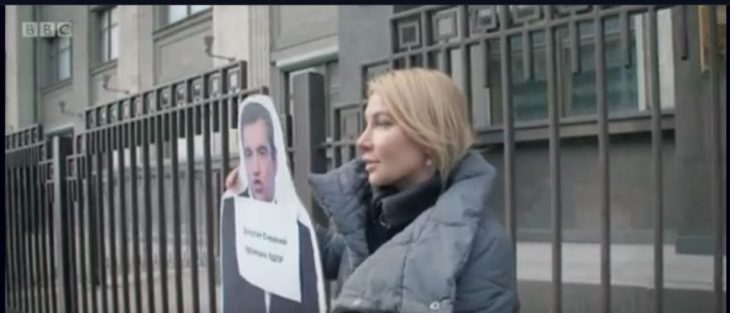
This is just one example of brutal oppression of dissent, ever present in Putin’s Russia.
Alena is standing literally right outside the door of the parliament building, with a cut-out of Slutsky covered in protest slogans. She requires no permit to do this under Russian law, which states that solo protests are allowed anywhere at any time without a permit. You do need permission to hold group protests.
By way of comparison, let’s imagine Alena were British, not Russian: If she attempted the same exact protest in the UK… she would not be allowed to. At all. Ever.
Firstly, you would never get to stand within inches of the doors of Parliament without getting halted by armed police. Secondly, you’re not allowed to protest in Parliament Square – even alone – without getting prior permission. This law was passed by Blair’s government in 2006, in order to shift anti-war protester Brian Haw.
At one point a young man approaches David and Alena and asks what’s going on, David’s voice-over claims the young man works for state security, and intones the words with foreboding. We have no way of knowing if this is true, if it even matters. I’m fairly sure a Russian camera crew standing outside the Houses of Parliament would attract the attention of special branch. He asks them two questions and then leaves.
Later, there’s a counter-protest. Four people appear with signs in support of Slutsky. David claims they’re there to cause trouble for Alena, and even implies they are working for the state. A claim which is rather shot-down when the counter-protest group – who support the government – are escorted away by the police because they don’t have permission for their group protest.
The pro-government protesters are gone, the anti-government protester remains. David doesn’t see this as, in any way, challenging his position on government oppression of dissent. He asks Alena:
If they control protest, if they’re against protest, why do they let it happen at all?”
A fantastic question, the only really cogent thing he’s said for the last half an hour. She replies:
Because we have a constitution.”
(SIDEBAR: Britain, of course, has no written constitution at all.)
*
David on… Russian Paranoia
The next episode in this bizarre saga opens with the director of the Levada Centre claiming the Kremlin is “paranoid” about a revolution, referencing the 2012 protests (the aborted “Snow Revolution”). To which David adds some rather incongruous narration:
Putin prepares to go to almost any lengths to prevent a popular uprising against him.”
He never says what these “lengths” are. In fact, we have no idea what the Russian government has done to prevent a Revolution. If anything. But breaking away from the specific facts, which the documentary forces us to do, maybe we should ask a simple question.
Why would the Russian government be paranoid about revolution?
Maybe we should look at other countries that have had “revolutions” recently for an answer to this question.
Ukraine is a disaster. Libya is possibly the only country in the world worse off than Ukraine and the only reason Syria isn’t just as bad those two is that Russia stepped in to help. David talks about revolutions as if they are organic, almost accidental, occurrences. But we all know that’s not true, we’ve all seen “Colour Revolutions” be fomented by the Western powers to overthrow governments that the USA has deemed to not have “American interests” at heart.
“Revolutions”, in recent years, are Imperial acts of aggression carried out by proxy armies with the aim of removing an “enemy” of the West. And they have left nothing in their wake but blood and destruction. The Kremlin has every right to be concerned about possible Western attempts at a coup against their government. Such a move could destroy everything they have built.
Do you think a Western-backed coup government will keep up free school meals and medals for motherhood? Do they have a constitutional right to protest in Libya right now? How about the birthrate vs death rate in Syria, is that going up?
Shouldn’t all governments fear revolution and hope for stability?
How would David feel about a revolution in Britain? Would it be welcomed? Would Theresa May like seeing violent unrest in the streets of London? Or being replaced by a Russian-backed, unelected leader?
Despite the chaos that has been left in the wake of “revolutions” the world over in recent years, the documentary gives no credence to Russian fears. Russia is never “afraid”, and always “paranoid”.
David talks to an Sergei Markov, a “political consultant who has worked with Putin”. We have no way of knowing if this is true, and this being Panorama taking it in faith is an unearned act of trust, but let’s assume that they’re telling the truth.
Markov highlights that Russia has good reason to fear Western aggression. Pointing out, reasonably enough, that no Russian soldier has ever set foot on British soil in the name of conquest, whereas Britain has invaded Russia every several times since the 19th Century:
Now, you are preparing to invade Russian territory again, to establish your control of Russian political, social and economic constitution, for us it is absolutely clear.”
We are encouraged to see Markov as a crazy-eyed lunatic, and David’s response is to laugh in his face:
You don’t seriously think an invasion of Russia is planned by the West? I mean, you’ll have me laughing in a moment.”
 A rather patronising rebuttal, that would hold more water if Russia weren’t practically encircled by NATO airbases. Or if the US hadn’t unilaterally withdrawn from the Anti-Ballistic Missile Treaty in 2002. Or if they hadn’t positioned their missile defense shield in Eastern Europe under clearly false pretences, granting them theoretical first-strike capability.
David doesn’t mention these facts.
Just as he doesn’t go into any recent history of Western military interventions. How America has, in the last 20 years alone, carried out coups in Venezuela, Ukraine and Honduras. Or how, when covert means did not work, they simply declared all out war in Afghanistan, Iraq and Libya.
Any impartial viewing of world history – especially recent history – would explain every country in the world having a fear of falling into NATO’s crosshairs.
Rather than acknowledging this, the documentary remains resolutely in its own little world. Insisting, in the face of all evidence to the contrary, that Russia has nothing to fear from the West.
*
David on… Russia’s “Orchestrated” Democracy
Fresh from telling us that Putin’s Russia is a “paranoid place”, where the leader with 80% approval is constantly worried about revolution and is prepared to go any lengths to stop it – even so far as having laws regulating protests that are almost identical to our own – David goes to talk to all the young people about their views on Putin.
They all like him, apparently:
One of the most fascinating aspects of today’s Russia, is that the under 25s, who might be expected to rebel, are Putin’s strongest supporters.
He’s talking to a group called Set (Russian for Network), a collection of “young artists, writers and designers” who consider Putin a role-model. David asks them a series of questions.
What do you like about Putin?
One of the young men says that before Putin it was “uncomfortable”, even “shameful”, to be associated with Russia. David doesn’t ask a follow-up question, putting paid to his earlier claims about wanting to know what Russians “really think” and staying true to the programme’s aim of never, ever mentioning the 1990s. Instead he skips back to leading questions based on false assumptions:
You feel happy with one person controlling the whole country?
We don’t know what they say to that, because it cuts off before anyone answers.
Do you agree that he’s quite ruthless when it comes to opposition?
They say they don’t agree. In fact they say quite the opposite. Which cues in a snide narration:
This generation of Russians are internet savvy, globally connected, but they prefer Putin’s authoritarian rule to democracy.
None of the people on camera ever express this opinion. Which makes this one of the most egregious lies in the whole 58 minutes. To appreciate what a statement that is, you really need to watch the film.

None of these young people “prefer authoritarianism to democracy”, they make it quite clear – in their opinion, they live in a democracy. Is there an effort to understand their position? None whatsoever. Instead we get treated to the head of the Levada Centre (again), this time dismissing all the young people who like Putin as being either stupid or brainwashed:
They are very different to Western youth, their minds were formed at the same time Putin’s regime was established, and for them the rhetoric of a great power is a very important part of their collective identity.
This is, as far as we know, another unsupported statement. Not one of the half-dozen young people David talked to said anything about Russia being a great power. Not one thing. They talked about Putin personally being relatable and they talked about improving conditions from the Yeltsin era.
When confronted with Dimbleby asking yet another offensively phrased question…
People in Britain look at Russia and say “this is a powerful autocrat who stops opposition, prevents anyone, if necessary puts them in jail to stop them opposing him” is that not how you see it?
… one young man, far from claiming to “prefer authoritarian rule” or praising the “rhetoric of a great power”, launches into a defense of Russian democracy. Pointing out the sheer number of different political parties (48), and that they had 8 different Presidential candidates running against Putin.
David isn’t listening. He’s nailed his colours to the mast on this one, Russia isn’t a democracy. It doesn’t matter how popular the leader is. It doesn’t matter how many elections they have, how many candidates are on the ballots, or how much public support they have. Russia is NOT a democracy, because David says so.
The film even references Navalny as “Putin’s biggest political opponent”, without mentioning that his party has ZERO seats in the Duma, and that he polls at less than 2% public support. Dimbleby doesn’t know these numbers, because his “researchers” either didn’t look them up, or pretended not to know them. Instead David solemnly declares:
Putin had him convicted of fraud.
Not “he was found guilty”, no, “Putin HAD him convicted”. Is there evidence produced that shows Navalny was framed? Nope. Is there evidence produced that shows any corruption on behalf of the judiciary? None. Is there any mention of Navalny being a right-wing ultra-nationalist who referred to Caucasians as “cockroaches”? Not even a little.
“Russia isn’t a democracy”, and “Putin’s main political opponent” is an unpopular convicted criminal with a history of racism, who was forbidden by the constitution from running in a Presidential election in which he would have come ninth.
Cut to:- Skyline of Moscow. Night. Synthy music plays, and the David lets fly with this beauty:
As many autocrats have shown, just holding an election doesn’t make a democracy.”
Boom. Just as a free press doesn’t mean Russia has freedom of expression, elections don’t mean they are a democracy. The documentary is slowly becoming less an attack on Putin and Russia, than an attack on the English language, and indeed logic itself.
David doesn’t tell us what DOES make a democracy, but it certainly isn’t elections. Following this logic, of course, you could have a democracy without elections. And if that sounds absurd, then remember that Margaret Thatcher praised Pinochet for bringing “democratic order” to Chile.
Elections that return the “wrong” result? They aren’t democratic. Rounding up dissidents in soccer stadiums and gunning them down? That is democratic.
“Democracy” means whatever the establishment wants it to mean.
Putin uses carefully orchestrated elections to legitimise his rule.”
Who “orchestrates” the elections? How do they do it? How does David know this? We’re not told. We’re now 40 minutes in, and we’ve yet to have any single accusation or anecdote backed up with anything even approaching evidence. We’re not even provided basic logical reason.
Perhaps more pressing is: Why would a President with 80% popularity NEED to “orchestrate” elections?
They never explain.
*
David on… Russia’s “small” economy
David’s next port-of-call on his tour of Bizzarro World is the Russian economy. Having been told that the Russian economy is “struggling” we get some more stock footage – this time of factories and oil wells – with David narrating:
Russia is one of the largest countries on Earth, with a population of 144 million, but its economy is much smaller – not even two-thirds the size of Britain, and even smaller than Italy.”
There’s a lot to unpack here.
First, it’s absolutely hilarious that dear little David can’t even bring himself to acknowledge the simple fact that Russia is not “one of the largest countries on Earth”, it is the largest. It’s nearly double the size of China. It’s European portion is the largest country in Europe, its Asian portion is the largest country in Asia and if you cut it evenly in half the two new countries would still be 4th and 5th largest countries in the world.
Russia is very big.
Nobody would ever dispute that, so why not just say it? It goes to show the pettiness of the mindset behind this programme. They simply cannot give Russia any credit, even so far as acknowledging its size.
Second, the language is again very deceptive. When he says “much smaller than Britain” and “EVEN smaller than Italy”, he’s painting a picture of small economy. He doesn’t mention that the UK has the 4th largest economy in the world, and Italy the 7th. Russia is 10th, just behind Canada. He also doesn’t mention that those figures don’t include the economy of Crimea, which the World Bank refuses to count as Russian.
Nobody would seriously claim that the 10th biggest economy in the world is “small”.
David sits down with Russia’s former deputy-Prime Minister Arkady Dvorkovich who says, when asked about the size of Russia’s economy:
If you look at other European economies, they have a long tradition of private entrepreneurship, we started this tradition only in the 1990s and need to accumulate experience.”
It’s a fair point, considering they’ve only been capitalist for 28 years or so, the 10th biggest economy in the world isn’t bad at all. David is unmoved. We don’t see his answer to that point, I would suggest because he couldn’t make one.
Instead he changes the subject, in voice-over, to corruption. Calling it a “tradition” in Russia.
He talks to Vladimir Pozner, a member of the allegedly “strictly controlled” Russian media, who apparently feels free to say corruption is endemic, giving yet more anecdotal evidence. This time about entirely hypothetical traffic policeman being bribed. A (strictly controlled?) anti-corruption campaigner points at a flat and says a politician lives there and shouldn’t be able to afford it. And David mentions an (unnamed) survey which ranks Russia 135th in the world in terms of corruption.
Thus is it established that Russia has a terrible corruption problem.
At this point the documentary devolves into a series of complete lies. Not mistakes, not exaggerations, lies. Lies so simple and so easy to refute with only a few google searches, that we’ll just go ahead and work through them one at a time:
Corruption is widespread, according to one survey it’s one of the worst countries in the world – it ranks 135 out of 180.”
He’s almost certainly referring to the famous “corruption perception index”, which is NOT a measure of corruption, but a measure of how corrupt some (unnamed) people THINK something MIGHT BE. It is a nonsense stat, discussed in more detail here.
“Russia has one of the most unequal economies in the world…. 20 million people live in poverty.”
This is technically true, there are 20 million people living under the poverty line in Russia, or 13.8% of the population. Before the sanctions it was less than 12%.
In the US, there are 45 million people living under the poverty line, or 13.8% of the population.
In the UK, there are 14 million people living under the poverty line, or 20.6% of the population.
Of course, where these numbers differ is that Russia’s number is coming down from 35%, and ours is going up. The makers of this programme know this, because the numbers were published on the BBC’s own website.
Putin’s failure to diversify the economy means that half the Russian budget comes from oil and gas, so when the price of oil fell after the annexation of Crimea, Russia was plunged into crisis.”
The price of oil did not “fall”, it was deliberately sabotaged by the gulf monarchies flooding the market. This was done to try to hurt the Russian economy, we can tell David knows this because he references the “annexation of Crimea” as the cause, he just doesn’t explain the details.
Putin’s aggressive foreign policy, along with the West’s sanctions, made the situation worse.”
Putin’s foreign policy – “aggressive” or otherwise – has no bearing on the Russian economy. This is all about the sanctions. Sanctions imposed by the West are not any reflection on the economic competence of the Russian government, especially when they are put in place over entirely false accusations, such as the Skripal poisoning or “hacking” the US Presidential election.
It is one of the oldest tricks in the US Imperial playbook, create a pretext for action against a country which they see as an “enemy”. Use this pretext to sanction a country with the aim of crippling their economy, and then use the fact the economy is struggling to criticise the government of the target country. The US has been doing it to Cuba and North Korea for decades, to Venezuela for years and Russia since 2014.
The deliberate destruction of their economy by powers beyond their control has no bearing on the competence or corruption of the Russian government.
In fact, by any standards, the Russian government under both Putin and Medvedev has been exceptionally competent.
- Since 2000, Russian national debt has reduced from 92.1% of GDP to 12.5%. But for the sanctions, it would be less than 10%.
- Since 1999, Russian unemployment has fallen from over 15% to less than 5%.
- Since 2000, inflation has dropped from nearly 30% to less than 3%. It’s already recovered from the increases resulting from sanctions.
- Since 2000, Russian GDP has risen from $195bn to $1283bn. Prior to the sanctions, it was over $2230bn.
- Since 1998, Russia’s balance of trade has increased from -$203mn, to +$15.3bn. Prior to the sanctions it was over $20bn.
- Since 2000, Russia’s average wage has increased from ~2000 rubles/month, to over 44,000 RUB/m. It carried on increasing in spite of sanctions.
… this list could go on and on.

Russian GDP under Yeltsin, Putin and Medvedev
Russia’s economy – under both Putin and Medvedev – has gone largely in the right direction.Of course, part of that is that there was only one direction to go.
All of this comes back to the 1990s. When Russia, as a country, was possibly within only months of ceasing to exist, collapsing into Balkanisation and chaos.

Average salary in Russia since 1998
Putin’s government prevented that, and turned things around for ordinary Russians in a quasi-miraculous fashion. That is why 80% of Russians support the man.
It’s the most basic rule of governance, but its one we in the West are encouraged to ignore – the first priority of government is to make the country better. Do that, and the people will support you.
To discuss the Russian economy, or the living standards of Russian people, or popularity of Putin, without acknowledging these facts, is just incredibly dishonest. Sickeningly so.
*
Conclusion
This is a bad documentary. It’s not simply ethically bankrupt, it’s also badly made. It’s badly paced, badly edited and incoherent. It’s so dedicated to its agenda that it sacrifices all else.
There is a relentless war being waged here, not just at the BBC and not just against Russia, but throughout the Western world… and against reality itself.
Consider the implications of this situation: One of the largest media organizations in the world spent license fee-payers money to send a man half-way around the globe, to convince their captive audience of tax-payers that elections don’t equal democracy, that independent media doesn’t equal free speech and that a $15bn trade surplus means your economy is struggling.
It recycles lies that have become terribly dull to refute, so must be simply exhausting to repeat. It routinely accidentally steps on its own argument, realises it has done so, and then performs logical gymnastics to try to prove it knows what it’s talking about. It makes no sense, and you can tell that they know it.
The list of contradictions and unanswered questions goes on and on, creating a world that cannot exist under the laws of reason. We’re told that Putin is popular, but that people are forced to vote for him. We’re told by Russian independent media organizations, critical of the government, that Russia has no independent media organizations critical of the government, and we’re told by a protester standing right outside the Russian parliament, that protests are practically illegal.
All of this irrationality combines to put together a patchwork-Picasso portrait of “Vladimir Putin”, the corrupt communist idealist, KGB hardliner and devout christian ideologue, who forces all the devoted members of his cult of personality to vote for him in elections he rigs anyway. A man who stole all the money he also spent on rebuilding Russia’s military, schools and hospitals, is best-buddies with all the oligarchs he sent to jail for tax evasion, and who – despite the size of the country – has “only” got the 10th biggest economy in the world.
It’s a documentary made by people at war with themselves, unable to understand that their delusions are absurd and incomprehensible to those of us struggling to live a reality-based life.
There’s desperation in this film, a hysterical repetition of proven lies and shrill fake news, screamed out by people who feel they’re losing control of the narrative.
They don’t know what they think except that Russia is bad and Putin is worse, they don’t know why they think it except that they’ve got to because they were told to, and they’re aghast. Unable to understand why no one’s listening when they’re making so much sense!
This documentary, like so much of the MSM’s recent output, is a wail of outrage at a world that refuses to listen to their nonsense. As well-reasoned as a toddler’s tantrum, as well sourced as “Trevor from the pub” and as well researched as toilet stall graffiti. A limping, heaving, slime-ridden pile of self-defeating, self-contradictory garbage that has no place in people’s hearts, minds or homes.
And I watched it five times to write this.
I need a shower.
NYT Carries IDF Attack on Murdered Medic–Reveals It’s a Smear in 20th Paragraph

By Adam Johnson | FAIR | June 11, 2018
A reporter at the most influential paper in English-language media appears to not know the difference between a government “tightly editing” and selectively editing video.
New York Times reporter Herbert Buchsbaum (6/7/18) wrote up a propaganda video posted by the Israeli Defense Force, showing Rouzan al-Najjar–a 21-year-old medic the Israeli Defense Force shot and killed earlier this month—apparently throwing a tear-gas canister, along with a brief clip of her purportedly saying, “I am here on the front line and I act as a human shield.”
The video seems to suggest that throwing a device spewing caustic gas away from people into an empty field is a sort of violence. (“This medic was incited by Hamas,” the video reads as she grabs the canister.) But the primary problem with the IDF video is that it deceptively edits her comments to distort what she said—a fact not noted by the Buchsbaum until paragraph 20, when he threw in this crucial piece of information:
In the longer video, the comment that the military translated as “I act as a human shield” was part of a sentence in which Ms. Najjar said, “I’m acting as a human rescue shield to protect the injured inside the armistice line.”
“Acting as a human shield to protect the injured inside the armistice line” has a radically different meaning than the commonly understood canard about Palestinians using “human shields” to protect “terrorists.” This hugely consequential fact should have led the story; instead, it’s casually tossed out in the third-to-last paragraph. The story here is that the IDF—as it has been doing for decades—casually lies and distorts facts to suit its narrative. Like all militaries, the Israeli military is not presenting a “dueling narrative” in good faith, as a New York Times tweet suggested; it’s manipulating video, hoping credulous journalists help them muddy the waters, as Buchsbaum did.
Indeed, the bizarre IDF press release write-up serves no other purpose than to reframe the gunning down of the unarmed medic from a clear crime committed by Israel to a Fog of War “dueling narratives between Israel and Hamas” tale of “both sidesism.” Buchsbaum vaguely alludes to—but strangely omits—the deceptive editing in the opening with his risible turn of phrase in paragraph two:
The tightly edited video shows a woman identified as the medic, Rouzan al-Najjar, throwing what appears to be a tear-gas canister.
“Tightly edited”? What does this mean, exactly? “Tight” editing is generally considered a compliment in the film and TV world, and says nothing about deliberate omissions for the purposes of misleading the viewer. When videographer Tate B. James confronted Buchsbaum about this fact, Buchsbaum appeared to think he had covered his bases:
hey herbert, any reason why you waited until the 20th paragraph to let folks know the video was selectively edited?
— Tate James (@tatebjames) June 8, 2018
a music video is “tightly edited”, herbert. that video is *deceptively* edited. there’s a difference
— Tate James (@tatebjames) June 8, 2018
Either Buchsbaum doesn’t know he’s being misleading, and is thus severely unqualified to be writing for a major paper, or he knows he’s spinning in Israel’s favor, but was hoping no one would really notice. Either way, the New York Times is once again (FAIR.org, 7/14/17, 5/17/18, 5/15/18) using its pages to confuse readers to the benefit of the Israeli military.
You can send a message to the New York Times at letters@nytimes.com (Twitter:@NYTOpinion). Please remember that respectful communication is the most effective.
Brexit backer Arron Banks’s ‘golden Kremlin connection’ allegation raises laughter
RT | June 10, 2018
The UK media has come up with yet another ‘sensational revelation’ that allegedly sheds light on ties between the Kremlin and major Brexit campaigners. The story only seemed to raise laughter from those mentioned in it, though.
There is no rest for the wicked, it seems, as the British media apparently goes to great lengths to continue the narrative of Russia’s interference in the UK’s vote to leave the EU alive. This time, the Sunday Times dug up a story that was immediately turned into a new ‘reason’ for anti-Russian hysteria and even prompted the Minister for the Cabinet Office in Theresa May’s government, David Lidington, to call for an investigation.
The respected “quality paper” reported that Arron Banks, the millionaire co-founder and major funder of the Brexit campaign known as Leave.EU, made repeated contacts with Russian officials and even took such an incautious and reasonably suspicious step to make a trip to Moscow at the time when the UK was at the height of the Brexit campaign. And by saying “repeated contacts,” the Sunday Times actually means as many as three meetings between Banks and Andy Wigmore, the director of communications for Leave.EU, and Russian Ambassador to the UK Alexander Yakovenko over a period of more than a year.
The Sunday Times also boldly claims right in the first line of its piece that it managed to reveal “the hidden scale of Kremlin links to the biggest donor to the Brexit campaign.” It is all because the two Brexiteers and the Russian official allegedly discussed the roles of Banks and Wigmore in a deal involving six Russian gold mines.
Banks and Wigmore were expected to involve Lord Charles Guthrie, the former chief of the Defense Staff, and Peter Hambro, a UK businessman, who actually co-founded and owned Petropavlovsk PLC, a major Russian mining company, in a deal envisaging the consolidation of six Russian gold mines into one company. However, the deal has actually fallen through, according to the Sunday Times.
‘We are American spies too’
Banks slammed the report as “complete absolute garbage,” which is comparable to “the Salem witch hunt.” “Yeah, we had two lunches with the Russian ambassador and passed on a business contact. So what?” he told Reuters.
He revealed that he did not only meet with the Russian officials during the Brexit campaign, he also met with many representatives of other countries as well. “It wasn’t just the Russians: we met all sorts of nationalities, we also briefed the State Department in Washington, we also met with the top embassy officials in London,” he said.
The Sunday Times itself mentions in its piece that Banks actually admitted to briefing the CIA on his meetings with the Russian officials. “We actually saw the suits from the American embassy who introduced us to the State Department to explain what had happened and then we briefed the Americans on our meetings with the Russians,” he said, as cited by the paper.
“So if we are Russian spies we must be American spies too,” Banks later told Reuters.
New round of hysteria
The Sunday Times story is based on a batch of emails containing correspondence between Banks, Wigmore and some Russian diplomats and businessmen, including Ambassador Yakovenko’s office, which were provided to the paper by a journalist named Isabel Oakeshott.
The emails themselves, which were carefully presented by the Sunday Times in another piece, actually do not contain a single word about Brexit. The paper also hesitates to make any direct conclusions related to the role of the perceived conspiracy in the Brexit campaign, as it only mentions some in a broader context. Oakeshott is actually the only person who does make some direct hints about the alleged links between the two Brexiteers and the Kremlin.
“Banks and Wigmore were shamelessly used by the Russians,” she told the Sunday Times, adding that the two “genuinely sympathized with some of Putin’s political views.” This journalist, who once worked with Banks on his book ‘The Bad Boys of Brexit,’ later suddenly changed the subject of her interest and started working on a book dedicated to Russia’s use of “hybrid warfare” to influence British politics together with the Tory peer Lord Ashcroft.
As if there were not enough conspiracies in this story already, the Sunday Times decided to spice it up a little bit more by adding a hint of Trump-Russia collusion as well. It repeatedly mentioned that the two Brexiteers discussed Trump during their meeting with Yakovenko, also adding that one of their meetings came just days after Banks and Wigmore visited US President Donald Trump after his election victory.
Predictably, these “revelations” provoked a new outbreak of anti-Russian hysteria. “Those who’ve got the evidence, let them take it to the relevant authorities and let it be looked into,” Lidington told the Andrew Marr Show on BBC One.
A bunch of Tory MPs rushed to brand both Brexiteers as “useful idiots” serving the Kremlin’s interests. Meanwhile, Labour frontbencher Liam Byrne, a shadow digital minister, nervously asked if Russian President Vladimir Putin’s “active measures” indeed “did stretch to Leave.EU.”
As for Banks himself, the recent news seemingly only made him laugh. When asked if he ever got money or assistance from Russia for his Brexit campaign, the businessman said: “No, of course not. You know if I have, I’m still waiting for the cheque.”
A Brief History of the “Kremlin Trolls”

By Scott Humor | The Saker | October 15, 2018
Saint Petersburg, Savushkina, 55 is the most famous office building in the world, thanks to the relentless promotion of the United States government, the CIA, FBI, and by the powers of the entire Western media, financed by Western governments. VOA, NPR, and Svoboda, by the government of the US; the BBC by the government of the UK; CNN by the governments of Saudi Arabia; the DW, by the government of Germany; and so on and so forth. You name it, they all punched time to promote this office building.
To be specific, it’s not even a building, but several adjoined buildings that cover an entire city block, an urban development plan common for Saint Pete’s. That’s why every business here has the address of Savushkina, 55 followed by a building number. You can take a virtual tour around it, to see for yourself. The buildings are shared by several dozens of private businesses, by the local Police department, and by the newsrooms of half a dozen Russia Media sources like the FAN (Federal News Agency), the Neva News (Nevskie Novosti), Political Russia, Kharkov News Agency, publishing Ukrainian news, and others. They all are privately owned and operated and generate over 55 million unique visitors per month. Overall, several thousand people come to this building to work every morning. But you wouldn’t know this by account of Western media. For over two years now, these people are being harassed and collectively branded as “THE KREMLIN TROLLS.”
The building is very popular because it’s located in a quiet historical neighborhood and is in walking distance from a suburban train station. It’s newly renovated offices offer open floor plans with Scandinavian fleur so very appreciated by the news people. In addition, the rent for this building is less than in center city. Which is why Evgeny Zubarev, a former top editor for the RIA NEWS, choose it for his media startup. He took several offices allowing him to manage his growing media giant without wasting time to commute. Now, the FAN newsroom alone employs about 300 journalists.
This wasn’t always the case.
At the beginning of 2014, the building was still under construction and renovation, when an anti-Russian government group of hackers called first “The Anonymous International” and latter “Shaltay-B0ltay” fingered it as the “Kremlin trolls’ layer.”
Their wordpress blog is still here. It was last updated on November 2016. Its title states: “Anonymous International. Shaltay Boltay/Press Secretary of the group. Creating reality and giving meaning to words.”
November 7, 2014, Khodorkovsky, who acted as an integral part of the CIA “Kremlin trolls” Project, tweeted the picture of one of the entrances to one of the buildings saying: “Savuchkina 55. New home for bots. ID check system. Not a sign there. I won’t say who took the photo.”
Савушкина 55
Новый домик для ботов. Пропускная система. Ни одной вывески. Чье фото – не скажу. pic.twitter.com/oCVUAvSTW4— Ходорковский Михаил (@mich261213) November 7, 2014
Someone commented by saying
Nov 7 2014. The comment reads: “I live there and pass this building on my way to work. The sign on the building says “For Rent”
@tvjihad @mich261213 Михаил, я каждый день мимо проезжаю на работу. и да, чье фото с вывеской не скажу))) pic.twitter.com/FlTEJJwyTt
— Kirill_V (@Kirill_V1) November 7, 2014
The phone number on the picture 324-56-06 belongs to the commercial real estate company Praktis Consulting & Brokerage that managed the rent of offices.
Midsummer 2014, Evgeny Zubarev with his start up and several hundred journalists moved in, along with the Police department, and a slew of other businesses people. Little did they know what was to come.
***
The best way to get information is to make it up.
Everything what we know now about the so-called “Kremlin trolls from the Internet Research Agency paid by Putin’s favorite chef,” came from one source, a group of CIA spies that used the mascot of Shaltay-Boltay, or Humpty-Dumpty, for their collective online persona.
They were arrested in November 2016 and revealed as the FSB and former FSB officers. One of them even managed a security department for the Kaspersky Lab. They all were people highly skilled and educated in manipulating and creating large online databases, in any online research imagined, and the knowledge of hacking and altering databases, including those that were run by the Russian government. They weren’t poor people. They weren’t there for the money. They were ideologically driven. Their hatred towards Russia and its people was the motive for their actions.
At some point, Gazeta.ru, an online Russophobic publication, suggested that “Shaltai-Boltai was just a distraction meant to confuse everybody.” They themselves were more concise by stating that they were working to change the reality.
Russian authorities, the courts, and the lawyers, refused to call these men hackers. There was a reason for this. They weren’t so much hackers in a classic sense, as in when someone gains access to real information and copies it. This group wasn’t necessarily hacking existing information, but planting information. They were creating files about fake nonexistent companies and employees, files with blurry fake paystubs, memos, emails, phone messages and so on. The fakes looked convincing, but they still were forgeries that could be easy disproved for someone who had access to the real information.
That’s when the hacking took place, when the FSB agents went into government databases and created records of people and companies that didn’t exist.
I think that part of the reasons why some of them got the mild sentences of three years in general security prison, and some were left free, wasn’t just the fact that they agreed to collaborate with the Russian government, but also the fact that they didn’t actually steal information from government officials like Medvedev and his press secretary, Nataliya Timakova, or the owner of the largest in Europe catering business, Evgeny Prigozhin. They made information up and claimed that it was real.
These guys gave a bad name to all hackers, whistleblowers, leakers and spies. Now, journalists presented with some “hacked” and leaked secrets has to think it over, less they end up with an egg on their face like journos from the Fontanka, Vedomosti and Novaya Gazeta in case of the “Kremlin’s trolls.”
If we accept that the Shaltay-Boltay group was working to create and distribute documents they forged, claiming that those files were “hacked,” we would also understand a mysterious statement made by them to BuzzFeed.
“In email correspondence with BuzzFeed, a representative of the group claimed they were “not hackers in the classical sense.”
“We are trying to change reality. Reality has indeed begun to change as a result of the appearance of our information in public,” wrote the representative, whose email account is named Shaltai Boltai, which is the Russian for tragic nursery rhyme hero Humpty Dumpty.”
Bazzfeed also said back in 2014, that “The leak from the Internet Research Agency is the first time specific comments under news articles can be directly traced to a Russian campaign.”
Now, this is a very important grave mark.
Just think about this working scheme: Shaltay-Boltay with a group of anti-government “activists” created the “Internet Research Agency,” they and some “activists” created 470 FaceBook accounts used to post comments that looked unmistakably “trollish.”
After that other, CIA affiliated entities, like the entire Western Media, claimed the “Russian interference in the US election.” Finally, the ODNI published a report lacking any evidence in it.
The link to their report is here, but I don’t recommend you to read it. You will gain as much information by reading this report as you would by chewing on some wet newspaper. Ask my dog for details.
Assessing Russian Activities and Intentions in Recent US Elections
https://www.dni.gov/files/documents/ICA_2017_01.pdf
Only three paragraphs are interesting on the page 4:
“Russia used trolls as well as RT as part of its influence efforts to denigrate Secretary Clinton. This effort amplified stories on scandals about Secretary Clinton and the role of WikiLeaks in the election campaign.
The likely financier of the so-called Internet Research Agency of professional trolls located in Saint Petersburg is a close Putin ally with ties to Russian intelligence.
A journalist who is a leading expert on the Internet Research Agency claimed that some social media accounts that appear to be tied to Russia’s professional trolls—because they previously were devoted to supporting Russian actions in Ukraine—started to advocate for President-elect Trump as early as December 2015.”
In other words, in its report with a subtitle: “Background to “Assessing Russian Activities and Intentions in Recent US Elections”: The Analytic Process and Cyber Incident Attribution” the Office of the Director of National Intelligence ODNI, is quoting the Shaltay-Boltay, a group that had been proved to work for the CIA by “creating reality.”
The only reason why they don’t provide us with evidence, with at least one lousy IP address with the Russian trace roots that would convincingly point at the company named the Internet Research Agency, is because this company never existed, it never had any IP addresses assigned to it that would be verifiable via third parties like RIPE network coordination and via online domain tools.
We understand that having hundreds of people working ten to twelve hours a day, as they claimed, posting hundreds messages hourly, would use huge amount of bandwidth. They would need a very fast internet connection with unlimited bandwidth that only a business can get. Inevitably, this internet connection would come with the assigned IP addresses. No internet provider would let this kind of bandwidth hog to create this kind traffic without being forced to separate them from other customers.
One example, a woman with the last name Malcheva filed a lawsuit in court against the companies “Internet Research, LLC” and “TEKA, LLC,” claiming unpaid wages.
The court asked her to produce evidence of her work, and then denied her claim after she produced a photo of a computer with an IP address on its screen as evidence of her employment.
IP Address 109.167.231.85
inetnum: 109.167.231.0 – 109.167.231.255
netname: WESTCALL-NET
descr: S-Peterburg Hotel Corintia Wi-Fi
An IP address that was assigned to a luxury hotel in Saint-Petersburg. A hotel that was awarded multiple international awards for excellence. An immensely popular hotel among discriminating travelers. A very expensive hotel located in the center of a historic city. The woman claimed that she was an “online troll’ working from this location ten hours a day with hundreds of other virtual trolls. The judge didn’t believe her. Would you?
People from the Shaltay-Boltay group weren’t hackers in the proper terms because they worked with and for the CIA. Middle-of the-road and run-of-the-mill intelligence agencies would collect and analyze information for their governments. The CIA invents information, then goes on to manufacture and forge documents in support of their invented information; they then recruit people inside other countries and other governments to claim that they “obtained” this explosive evidence. Being the dirty cops that they are, the CIA doesn’t obtain and secure evidence, but instead they plant fake evidence on their victims.
By this act alone they change our current and past reality, and they change our future. They change our history by forging never existing “proof” of invented myths. They hire and train groups of military men to act as “protesters” around government buildings, while other military men from other countries shoot at unsuspected bystanders whose death allows Washington to claim the sovereign governments’ wrongdoing.
CIA-operated groups arrest and kill government officials or force them to flee, like in Ukraine. They take over a couple of government buildings and declare their victory over a huge country, just like it happened in Russia in 1991 and 1993 and in Ukraine in 2005 and 2014. For some reason, they claim that governments are those people who take over a couple of buildings in one city. When in fact, our countries’ governments are those people whose names we wrote on ballots, regardless of where these people are located. We don’t run around like chickens with our heads cut off electing a new president every time our current president leaves the country.
Going back to the CIA’s Humpty-Dumpty project that came online sometime in 2013. Why would anyone name their enterprise after such predictable failure, you might ask. Because, in the Russian alliteration, Shalti-Boltai means “shake up and brag about it” and not as in its original Carroll’s version of “humping and dumping.”
I went ballistic after someone retweeted me this CNN clip titled “Russia used Pokemon Go to interfere with the US elections.”
I actually listened to the clip itself, in which they brought up the Internet Research Agency” from SP. Knowing full well that the hackers who “leaked” the information about this “Agency” were arrested and successfully charged for treason because they worked for the CIA should prevent the CIA to run fake news about the entities and people they themselves made up. You would think that the matter of the “Kremlin trolls from Saint Petersburg” should be dead and buried after the arrest. The CIA and other 16 intelligence agencies should know better than to use information that is being known now as “discovered’ with their “help.”
Because it’s all fake and we know it.
We also know everything that the CIA touches is fake. Speaking in layman’s term, it’s as if all those middle aged bald guys would start licking their balls while claiming to be in fulfilling relations. If it’s just you, guys, there is no relations. It’s just you. Deal with it!
The American intelligence community cannot claim an existence of threats against America if all fingers in those “threats” are pointing back at the American intelligence community.
By stating that someone interfered with the US election using the Internet Research Agency in SP, is plainly to state that it’s CIA that interfered in the American elections.
—
Let’s just briefly run over the matter, before I tell you what exactly took place.
—
On September 6, 2017, Alex Stamos, a Chief Security Officer, posted a statement titled “An Update On Information Operations On Facebook”:
“In reviewing the ads buys, we have found approximately $100,000 in ad spending from June of 2015 to May of 2017 — associated with roughly 3,000 ads — that was connected to about 470 inauthentic accounts and Pages in violation of our policies. Our analysis suggests these accounts and Pages were affiliated with one another and likely operated out of Russia.”
To make sure that people including myself won’t find those accounts, the FB deleted them.
“We don’t allow inauthentic accounts on Facebook, and as a result, we have since shut down the accounts and Pages we identified that were still active.”
That’s how it’s done in the US. They destroy all potential evidence while laying heavy blame on Russia. Facebook destroys evidence of “Russians crimes” while public ask them to show those evidences. This means only one thing: the pieces of evidence are pointing at something Facebook wants to protect, which is the CIA.
You see, I am not suggesting that they are lying about those accounts being real or that they “affiliated with Russia,” because, if the Shaltay-Boltay group worked with people from the Soros and Khodorkovky-backed group of human rights lawyers “Team 29,” created in February 2015, then their only task, it seems, was to service the psyop of the “Internet Trolls.” It looks to me like they could also coordinated the work done by those 470 FaceBook accounts while being on the territory of Russia. Considering that, it’s not a complete lie for the FB to say that those accounts were “Russia affiliated” and that they were “likely operated from Russia.”
Facebook also can claim with plausible deniability that they are ignorant of the fact that people behind the Internet Research Agency troll hoax are proved by the Russian court to be affiliated with the CIA, while people who have been acting as the “witnesses” to this Project are lawyers from Team 29, “human rights activists and also journalists from the Norwegian Bonnier AB owned Fontanka, Taiwan-based Novaya Gazeta, and the Latvia-based Meduza; these people are factually proven to be backed by Soros, a CIA financial branch, like a journalist who has received an award from Khodorkovsky.
The entire campaign of blaming Russia in “meddling” is being reported without ANY tangible proof that could be verified by at least two independently existing sources, that’s why we should grab ANY grains of information. That’s why Facebook’s statement that “About one-quarter of these ads were geographically targeted, and of those, more ran in 2015 than 2016″is very important.
Why?
Because, fake business entities known as “the Internet Research Agency,” and “the Internet Research” in the government electronic business registry, they were treated as real companies by the system. Because of their inactivity on all of their bank accounts and because no one ever filed required forms, they were automatically liquidated by the electronic system.
The United Business Registry database in Russia works according to the Federal laws, so after twelve months of inactivity a business is simply liquidated. The Internet Research Agency was liquidated in December 2016 by the government system after it been inactive for twelve month. It’s inactivity implied that the company had no employees, no office, and no bank transactions for at least twelve months! The Internet Research company was liquidated on September 2, 2015 by merging with TEKA company. According to the federal business Registry TEKA was a construction retailer. I wasn’t able to find any indication, like an office, phone number, names of the managers or employees, anything at all that would indicate that this company existed. Just like the Internet Research Agency and the Internet Research, TEKA existed only in the federal registry and nowhere else.
The automatic liquidation in the federal registry for inactivity explains the drop in activity on the accounts run by the Shaltay-Boltay and the others. Oh, yes, they were also hunted and on the run, out of the country. It’s hard to use bank accounts to simulate activities after you have fled the country.
The Team 29, of the human rights lawyers and activists, was created in February 2015. To give to this new company some proof of reality and instant notoriety they immediately filed a lawsuit against the Internet Research company using an activist woman with a Ukrainian last name Ludmila Savchuk (Людмила Савчук) who went and filed a lawsuit against the company, claiming some unpaid wages. Her first lawsuit the judge threw out. Only after the local general prosecutor’s office pressed the judge to take the case, the district court took the case and partially granted the Claimant her claim, but not the “moral damages.” She wanted the money for working for the “troll factory.” In essence, they wanted an official court paper that would say black on white, that there is a “troll factory” that this poor woman worked for. Without reading the file, I don’t know what the judge was thinking, but she might have smelled a rat among those virtual “trolls.”
This took place in August 2015, and by September 2 2015, a fake company named the “Internet Research” was liquidated by merging it, in the Business registry, with another fake entity, TEKA, that was created in spring 2015 as the construction materials retailer.
“Facebook disclosed on Wednesday that it had identified more than $100,000 worth of divisive ads on hot-button issues purchased by a shadowy Russian company linked to the Kremlin.”
“Most of the 3,000 ads did not refer to particular candidates but instead focused on divisive social issues such as race, gay rights, gun control and immigration, according to a post on Facebook by Alex Stamos, the company’s chief security officer. The ads, which ran between June 2015 and May 2017, were linked to some 470 fake accounts and pages the company said it had shut down.”
“Facebook officials said the fake accounts were created by a Russian company called the Internet Research Agency, which is known for using “troll” accounts to post on social media and comment on news websites.”
“The January intelligence report said the “likely financier” of the Internet Research Agency was “a close Putin ally with ties to Russian intelligence.” The company, profiled by The New York Times Magazine in 2015, is in St. Petersburg and uses its small army of trolls to put out messages supportive of Russian government policy.”
“To date, while news reports have uncovered many meetings and contacts between Trump associates and Russians, there has been no evidence proving collusion in the hacking or other Russian activities.”
“While there is no direct link between the Kremlin and any of these projects—both Surkov and Zubarev say their projects are privately funded—the timing, scale, and coordination of these efforts are suspicious. BuzzFeed was not able to find evidence of direct government funding to the “Internet Research Agency ,” the pro-Kremlin troll outlet operating out of 55 Savushkina, but they did reference a number of sources that revealed some level of involvement.”
—-
In my next study, I will provide you with more links, screenshots and translations. I will demonstrate to you how this story connects to the war on the Middle East and the international war on the Russian population of Ukraine.
—
In conclusion I just want to say that everything the United State touches turns into a warzone. The building on Savushkina, 55 in Saint Petersburg is no exception.
Multiple death threats are being directed at people who work there. Popular and excellent in their quality media outlets operating there have to hide their true location and rent a separate office across the city for their visitors, because people are simply afraid to come in.
Journalists and multiple business employees are threatened online with rape.
Threats to hang the journalists during a “protest meeting” on Oct 1, 2017
At least one case of terror attack on the office building that resulted in arson on October 26, 2016.
On Oct 26, 2016, several men threw bottles of Molotov cocktail in the windows of the Nevskie Novosti (Neva News). Luckily, no one was there but the owner of the Media conglomerate, Evgeny Zubarev, who put out the fire.
All of these, every threat, every simple lie is all on the United State government, its intelligence community, on those traitors, who are in prison now, and those who are still at large.
UPDATE:
A couple of Kaspersky staff members (Stoyanov and Dokuchaev), including the head of computer crime investigations (Stoyanov), were arrested by
Russian FSB on treason charges in January this year. An FSB officer (Sergei Mikhailov) was also arrested. The treason charges suggest they
were acting on behalf of a foreign power. SputnikMaybe the US actions against Kaspersky Labs anti-virus software are an attempt to preempt the consequences of the trial of the Kaspersky and
FSB operatives?
——————
Scott Humor
Director of Research and Development
author of The enemy of the State
George Monbiot: selling the 1% agenda in a Green box

George Monbiot NOT shilling for corporate interests
By Catte | OffGuardian | June 8, 2018
The neoliberals of today specialise in using concepts of concern and inclusiveness as a cover for their frankly fascist agenda. Censorship is being repackaged as “anti-hate”. The destruction of the core idea of “innocent until proven guilty” is being repackaged as protecting (mostly female) victims from their persecutors. Reasonable doubt is being repackaged as “denialism.” Minority opinion is being repackaged as treachery or subversion. Facts that contradict a current state-sponsored agenda are repackaged as “fake news.”
Conformity is being encouraged, presented as a cosy and reassuring “consensus blanket”, under which we can all snuggle together, safe from confusion, doubt or the horrendous experience of having our cherished beliefs called into question. Most journos operating in the mainstream have already opted to crawl in and curl up for the long snooze into intellectual and ethical oblivion, while others, the kapos, are actively herding the remaining doubters inside.
George Monbiot is one of the latter. The last few years have outed this one time supposed anti-establishment figure as nothing more than a fully establishment goon, posturing in the sad tatters of his “dissident Green” cosplay. His performance during the Syria crisis made this too obvious. His sub-intelligent smears on those independent journalists daring to question the narrative made his real allegiances, and limitations, more than clear. His preparedness to brazenly lie and his refusal to debate the people he smeared in an open forum cemented this view.
Monbiot is revealed as the guy the establishment uses to try and lure the Left-Greens out in support of the latest agenda roll-out by the likes of Soros, Gates and the Atlantic Council. He’s booked for the same gigs as Avaaz. His brief, as ever, is to sell fascism – but this time in a Green box.
Today George is busy selling us on veganism.
Now, don’t get me wrong. Veganism is fine. It’s a human choice and it has a place. This is not an attack on veganism, or vegans.
But we need to separate what a thing is from what it’s being used for. Everything, even the best things, can be exploited. And we can’t let loyalty to the thing itself stop us from seeing when its being used for less than good ends.
Veganism is being promoted right now by the usual suspects. There has been a rash of articles in the Guardian and elsewhere about the supposed health and environmental benefits of giving up meat and dairy. Even if we happen to be vegan, we’d be insane not to wonder why. Especially when Monbiot is getting involved.
George is a poster child for the New Wave Vegan. Strange, perhaps, given he’s only a “97% vegan” himself. But let’s just ignore the 3% carnivore, since it’s only road kill. The more important point, anyway, is that George wants us all to think he’s a vegan. Because a salesman has to be seen to use the product he’s promoting. His latest article breaks no new ground on this really. He’s said most of it before, as have others. But still, given the mounting evidence for the political mobilisation of veganism, it’s a good idea to look at what he says.
He starts by offering a binary choice – between the current wasteful and insane industrial farming system and a somewhat poorly defined alternative in which everyone eats a plant-based diet, which he implies without really saying, will put an end to this insanity. He tells us not only will this choice fix the problem of worldwide food shortage (because plant-husbandry produces far more calories per hectare than animal husbandry), but it will also remove the problem of all that unused animal waste currently pouring into rivers and creating massive pollution.
George’s ideal future will also be gratifying for the processed food industry. Because vegans need ready meals!
Unless you can cook well – and many people have neither the skills nor the space – a plant-based diet can be either boring or expensive. We need better and cheaper vegan ready meals and quick and easy meat substitutes
And fake meat grown in a lab!
The big shift will come with the mass production of cultured meat.
George recognises the latter will be a tough sell, but he’s up for giving it a try. An objection to this might be that “artificial meat is disgusting”, says George, but:
If you feel this way, I invite you to look at how your sausages, burgers and chicken nuggets are currently raised, slaughtered and processed. Having worked on an intensive pig farm, I’m more aware than most of what disgusting looks like.
Mmmm… Lab-grown pseudo-meat, pink-dyed and not quite as disgusting as something even worse! Lovely Roundup-saturated veggies [silage] processed into some approximation of the kind of protein humans can digest, and piped into microwavable sachets.
Who knew utopia would end up looking quite so much like – now? Who knew the new way would be just like the old way but with more “progressive” slogans?
George uses twisty self-contradictory arguments to claim one minute that eliminating livestock farming would “be a chance to break our complete dependence on artificial nitrogen”, while in his very next para admitting the exact opposite will in fact be the case.
the transition to plant protein is unlikely to eliminate the global system’s need for artificial fertiliser
Though he throws us a bone in the shape of
the pioneering work of vegan organic growers, using only plant-based composts and importing as little fertility as possible from elsewhere
This is blatant bait and switch. Green or green-sounding proclamations being swapped out for their very opposites with a deftness he hopes will fool us. We may, in some misty future time, not need to rely entirely on synthetic chemicals – but yes, OK, for now we will still be sucking up carcinogens with our lovely all veg diet.
Of course we could just use the animal manure to fertilise our veggies, which would entirely eliminate the need for chemical fertilisers… But let’s not think about that too much. Let’s instead soften that focus and just picture fields full of lovely cruelty-free plants waving in the even lovelier breeze…
In case you haven’t noticed, George’s entire article is hand-waving nonsense predicated on a lie, or a system of lies, and his trademark nifty footwork.
His claim that we need to produce more food is used as a blanket rationale for everything he advocates, but it’s a lie. We don’t need to produce more food. We currently produce more than enough food to feed the world. What we need and don’t have is equitable distribution. And that is because of the stranglehold of the minority interests George is carefully eliding.
His initial binary choice is a lie. We don’t need to choose between intensive animal farming and intensive cereal/veg farming. We have the option of non-intensive farming methods that treat the land, the animals and the crops with respect, and use age-old, sustainable methods to produce chemical-free and healthy food.
His dishonesty is nowhere more apparent than when he tries to elide this simple truth. Look at how he acknowledges the illogicality of unused animal waste
Today, the link between livestock and crops has mostly been broken: crops are grown with industrial chemicals while animal slurry stacks up, unused, in stinking lagoons, wipes out rivers and creates dead zones at sea.
but dodges away from the obvious solution – use the “slurry” to fertilise the land in place of synthetic chemicals – with a weak excuse:
When it is applied to the land, it threatens to accelerate antibiotic resistance.
Notice how he avoids mentioning the fact non-intensively reared animals don’t need to be pumped full of antibiotics in the first place. He even links to the source for sustainable husbandry I cite above, but does so only to dismiss it (without data) as “worse” than anything else on offer, by using, once again, the fake claim about the need to produce more food per hectare:
More damaging still is free-range meat: the environmental impacts of converting grass into flesh, the paper remarks, “are immense under any production method practised today”. This is because so much land is required to produce every grass-fed steak or chop
And adding that it’s also bad for the environment
Those who claim that “regenerative” or “holistic” ranching mimics nature deceive themselves. It relies on fencing, while in nature wild herbivores roam freely, often across vast distances. It excludes or eradicates predators, which are crucial to the healthy functioning of all living systems. It tends to eliminate tree seedlings, ensuring that the complex mosaics of woody vegetation found in many natural systems – essential to support a wide range of wildlife – are absent
You thought Monsanto, GM, monocultures and the ripping up of hedgerows was the problem? Nah. It’s fences. And herbivores eating the grass they’re designed to eat. And implicit in this nonsense of course is the greater nonsense that massive veggie monocultures drowned in pesticides and herbicides, are just teaming with wild life, tree seedlings and predators.
Just as he used frank lies to promote the Soros-backed White Helmets as unsung “heroes”, here, in the fake guise of promoting a healthy, organic, back-to-nature solution to the world’s problems, George is promoting the current power system of Big Ag and Big Food monopoly. Just as Avaaz sells us imperial regime change as grass roots activism, George is selling us industrial farming and denatured food as a return to Eden.
Don’t buy what he’s selling. Don’t surrender your sense of the real to this snake oil salesman. Go vegan if you want – that’s a fine personal choice. But not at the expense of the small producers who are already struggling to survive without the subsidies the big guys get. Don’t vote for some future “meat tax” that will drive them out of business, and penalise the poor, just as Big Ag wants. Don’t buy into this soft focus dreamland where our entire livestock herd disappears bloodlessly and completely from our landscape without being killed or culled, and is somehow better for it. Don’t be whispered into campaigning for a new and self-imposed serfdom, in which 7 billion compliant vegans munch their potage or their shrink-wrapped lab-grown Soylent Green, while the 1% quietly eat grass-fed steak and snigger with duping delight.
Featured Video
Trita Parsi: Israel Set a Trap for Total War in the Region
or go to
Aletho News Archives – Video-Images
Book Review
Why the War on Conspiracy Theories Is Bad Public Policy
By Kevin Barrett • Unz Review • February 1, 2019
 A Review of Conspiracy Theories and Other Dangerous Ideas by Cass Sunstein (based on an earlier paper co-authored with Adrian Vermeule); In Defense of Troublemakers: The Power of Dissent in Life and Business by Charlan Nemeth; and Conspiracy Theories and the People Who Believe Them, edited by Joseph E. Uscinski
On January 25 2018 YouTube unleashed the latest salvo in the war on conspiracy theories, saying “we’ll begin reducing recommendations of borderline content and content that could misinform users in harmful ways—such as videos promoting a phony miracle cure for a serious illness, claiming the earth is flat, or making blatantly false claims about historic events like 9/11.”
At first glance that sounds reasonable. Nobody wants YouTube or anyone else to recommend bad information. And almost everyone agrees that phony miracle cures, flat earthism, and blatantly false claims about 9/11 and other historical events are undesirable.
But if we stop and seriously consider those words, we notice a couple of problems. First, the word “recommend” is not just misleading but mendacious. YouTube obviously doesn’t really recommend anything. When it says it does, it is lying. … continue
Blog Roll
 Aletho News
- Araghchi blasts ‘parasitic’ alliance as US taxpayers pay for Israel’s war on Iran
- Easy fix for Europe’s chaos? Stop fueling war against Russia
- Putin’s key remarks on peace talks and Europe’s ‘schizophrenia’
- Trita Parsi: Israel Set a Trap for Total War in the Region
- Trump’s Iran war is on an Israeli leash
- Saudi oil boss issues global supply warning
- Riyadh Says Its Oil System Is Intact. The Numbers Say Otherwise.
- Trump and Netanyahu Want to “Finish the Job” on Iran
- US ‘one-sided dictation’ not Iran’s beliefs makes rational talks impossible: Baghaei
- Iran’s Next Strike May Not Explode. It Could Shut You Down /Col Doug Macgregor
- If Americans Knew
- DAILY UPDATE: Latest essential news on Palestine, Israel, & region
- The Israel Lobby’s Changing Fortunes
- AIPAC has become such a political liability that it’s shifting to a more “nimble” approach to buying politicians
- At least 160 Israeli settler attacks in 2 weeks
- Will Gaza’s Ancient Christian Community Disappear Forever?
- Israel’s vision of regional security rests on keeping Arab states weak
- Heidi Levine recounts how Palestinian youths helped save her in settler attack
- DAILY UPDATE: Latest essential news on Palestine, Israel, & region
- Trump’s Intensifying Sabotage of the ICC, for Israel’s Sake
- Israeli military detain US and UK volunteers in West Bank including Democratic NY politician Brad Lander
- No Tricks Zone
- E-Cars Reduce CO2 Emissions By Only 41% Compared To Internal Combustion Engine Vehicles
- Predictions Made By Renowned Climate Professor Over Past Decades Have Been Proven To Be Poor
- New Study Suggests Large Regions Of The Pacific Ocean Have Been Cooling For The Last 80 Years
- Germany’s Green Energy Debacle: High Energy Costs Force Kahla Porzellan to Close After 182 Years!
- New Study: 50 Years Of The Most Aggressive ‘Net Zero’ Policies Can Only Affect The Global Climate By 0.03°C
- US September “Heat” Was No Record…Many Records Set Decades Ago
- Latest European Green Energy Debacle; Portugal’s Largest Flagship Solar Park Insolvent!
- Green Energy Debacle: German Expert Professor Fritz Vahrenholt Warns Of Severe Economic And Social Consequences
- Two More Paleo Reconstructions Affirm Meters-Higher Sea Levels Across Ireland, Brazil 7000-6000 Years Ago
- New Study: Earth And Venus Surface Warmth Largely Explained By Convection And Lapse Rate, Not CO2 Or Radiation

