Critiquing Nature and the Lancet over their disinformation, but making huge material omissions while doing so. Who is Ian Birrell?
By Meryl Nass, M.D. | June 8, 2021
Below are excerpts from a very interesting Unherd article by Ian Birrell, who previously wrote about the lab leak hypothesis when it was very difficult to get anything published on it. Birrell’s reportage is good, as far as it goes. But he lets Fauci, Farra and Collins off the hook. He ponders whether Chinese money influenced the “debt-ridden” Nature publishing company. It surely could have.
But one should also be asking, why is the (formerly?) world’s top science magazine, Nature, the most important journal in the world in which to publish science, debt-ridden in the first place?
And Birrell deftly avoided the more obvious conclusion that if Farrar, Fauci and Collins initiated the Nature Medicine paper to produce faulty scientific arguments against a lab leak, wouldn’t they have been the ones to place it in Nature Medicine, not China?
Birrell did something else strange. He notes that Farrar directed him to the Nature Medicine paper as the scientific basis for the natural origin claim. But he fails to mention that the Fauci emails now show that Farrar was involved in crafting that paper, and involved his employee Josie Golding, who also signed the Daszac-written March 7 Lancet Correspondence, in its crafting. Though not a coauthor, she was quoted in the press release the Scripps Institute issued about the paper. From the Fauci emails, we now know that Kristian Andersen, the first author, emailed Fauci, Farrar and Collins to thank them for their “advice and leadership” on the paper.
Thus this otherwise interesting article is a limited hangout. While criticizing Nature Medicine and the Lancet, and attempting to grab the high road, Ian Birrell reveals himself to be a purveyor of slanted news.
There are two other interesting things about Ian Birrell. He produced one of the earliest mainstrem articles on the lab hypothesis with Alina Chan, back in February. In hindsight, were they being set up then as trusted sources if the lab hypothesis gained prominence?
But who is Ian Birrell? His earlier claim to fame was as a speechwriter for David Cameron. Everyone knows what that means. He was a professional crafter of lying narratives. This Unherd article is designed to blame China and misdirect away from the role of the US and UK’s top science funders: Fauci, Jeremy Farrar and Francis Collins.
https://unherd.com/2021/06/beijings-useful-idiots/
Nature Medicine, its sister publication, was also home for the second key commentary that set the tone in the scientific community after Daszak’s outing in The Lancet. “The proximal origin of Sars-CoV-2″ bluntly concluded that “we do not believe that any type of laboratory-based scenario is plausible”. Critics pointed out it was questionable to claim there was any “evidence” proving that Sars-CoV-2 is not a purposefully manipulated virus. Others noted that the statement mentions the mysterious furin cleavage site — which Nikolai Petrovksy drew attention to as allowing the spike protein to bind effectively to cells in human tissues yet which is not found in the most closely-related coronaviruses — but downplays its potential significance. The statement suggests “it is likely that Sars-CoV-2-like viruses with partial or full polybasic cleavage sites will be discovered in other species”. This has not happened so far.
This document — whose five signatories include one expert who was handed China’s top award for foreign scientists after nearly 20 years work there, and another who is a “guest professor” for the Chinese Centre for Disease Control and Prevention — has been accessed 5.4 million times and cited almost 1,500 times in other papers. It is so influential that when I emailed Jeremy Farrar, director of the Wellcome Trust and one of The Lancet signatories, to see if his stance remained the same, he pointed me to this paper that he called “the most important research on the genomic epidemiology of the origins of this virus”.
The lead author was Kristian Andersen, an immunologist at Scripps Research Institute in California who has been a very active voice on social media condemning the lab leak theory and confronting its proponents. Yet the recent release of emails to Anthony Fauci exposed that Andersen had previously admitted to the National Institute of Allergy and Infectious Diseases director that the virus had unusual features that “(potentially) look engineered” and which are “inconsistent with expectations from evolutionary theory”. He claimed last week the discussion was “clear example of the scientific process” but as another top scientist said to me: “What a smoking gun!”. Now Anderson’s twitter account has suddenly disappeared…
[According to Rutgers professor Richard Ebright,] “Nature and The Lancet played important roles in enabling, encouraging, and enforcing the false narrative that science evidence indicates Sars-CoV-2 had a natural-spillover origin points and the false narrative that this was the scientific consensus”.
Or as another well-placed observer put it: “The game seems to be for Nature and The Lancet to rush non-peer revised correspondences to set the tone and then delay critical papers and responses.”
But why would they do this? This is where things become even murkier. Allegations swirl that it was not down to editorial misjudgement, but something more sinister: a desire to appease China for commercial reasons…
The Notorious London Spy School Churning Out Many of the World’s Top Journalists
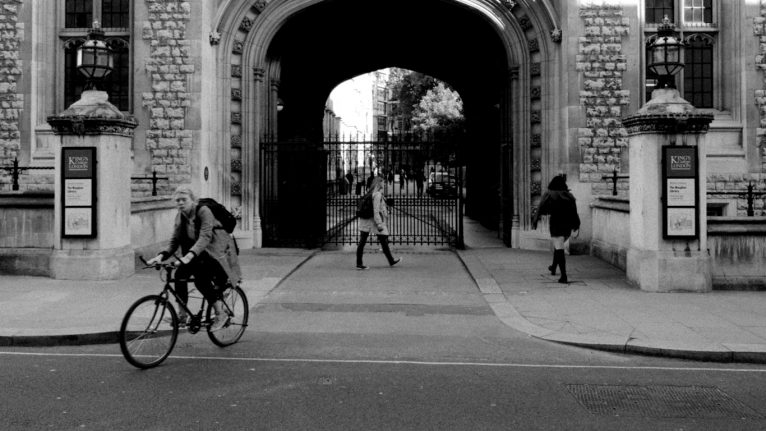
The Maughan Library Gate at Kings College London, UK. David JC | Alamy
By Alan MacLeod | MintPress News | June 4, 2021
LONDON — In a previous investigation, MintPress News explored how one university department, the Department of War Studies at King’s College London, functions as a school for spooks. Its teaching posts are filled with current or former NATO officials, army officers and intelligence operatives to churn out the next generation of spies and intelligence officers. However, we can now reveal an even more troubling product the department produces: journalists. An inordinate number of the world’s most influential reporters, producers and presenters, representing many of the most well-known and respected outlets — including The New York Times, CNN and the BBC — learned their craft in the classrooms of this London department, raising serious questions about the links between the fourth estate and the national security state.
National security school
Increasingly, it appears, intelligence agencies the world over are beginning to appreciate agents with a strong academic background. A 2009 study published by the CIA described how beneficial it is to “use universities as a means of intelligence training,” writing that, “exposure to an academic environment, such as the Department of War Studies at King’s College London, can add several elements that may be harder to provide within the government system.”
The paper, written by two King’s College staffers, boasted that the department’s faculty has “extensive and well-rounded intelligence experience.” This was no exaggeration. Current Department of War Studies educators include the former Secretary General of NATO, former U.K. Minister of Defense, and military officers from the U.K, U.S. and other NATO countries. “I deeply appreciate the work that you do to train and to educate our future national security leaders, many of whom are in this audience,” said then-U.S. Secretary of Defense (and former CIA Director) Leon Panetta in a speech at the department in 2013.
King’s College London also admits to having a number of ongoing contracts with the British state, including with the Ministry of Defence (MoD), but refuses to divulge the details of those agreements.
American connections
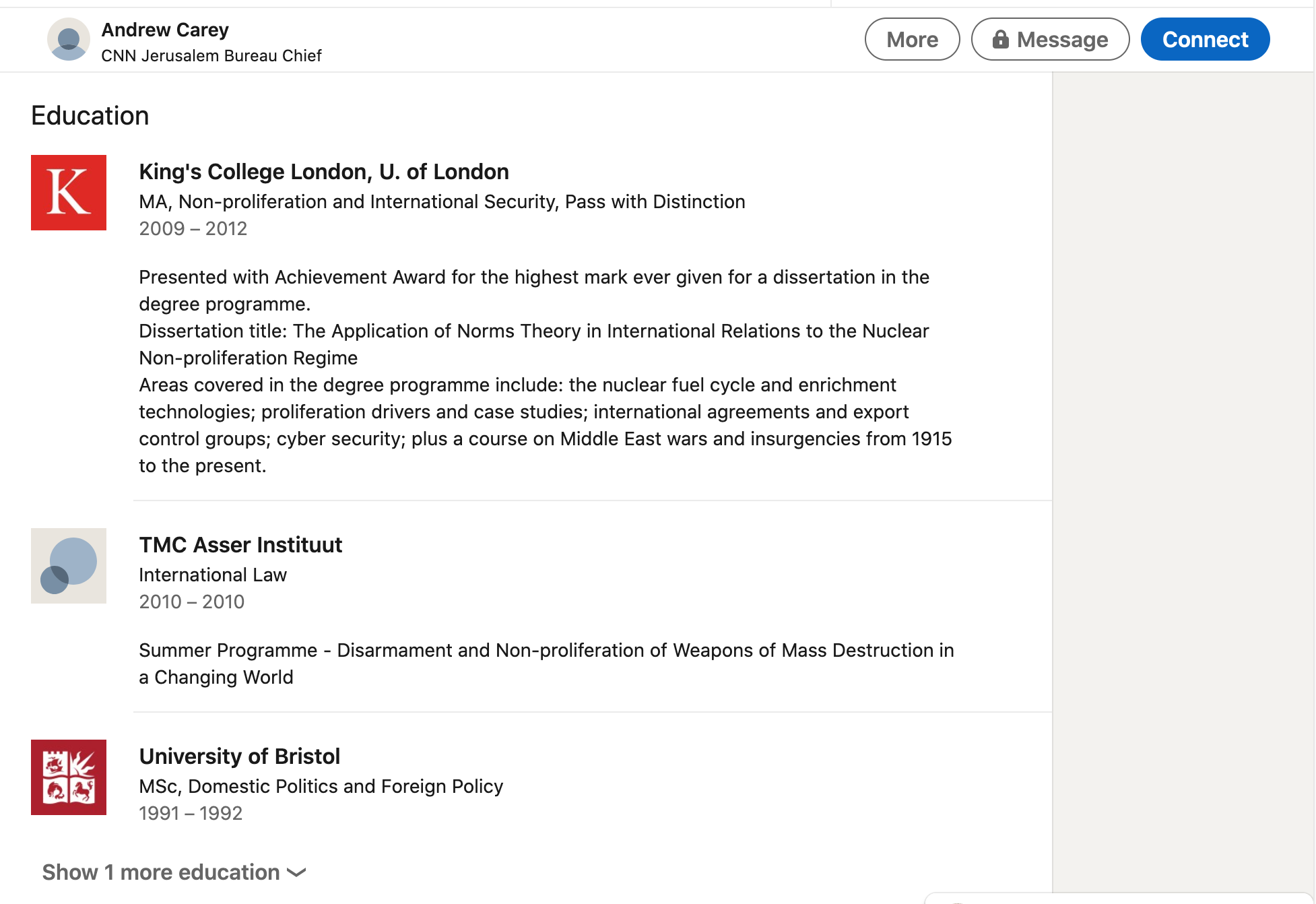
Although a British university, King’s College markets itself heavily to American students. There are currently 1,265 Americans enrolled, making up about 4% of the student body. Many graduates of the Department of War Studies go on to attain powerful positions in major American media outlets. Andrew Carey, CNN’s Bureau Chief in Jerusalem, for example, completed a master’s there in 2012. Carey’s coverage of the latest Israeli attack on Gaza has presented the apartheid state as “responding” to Hamas rocket attacks, rather than being the instigator of violence. A leaked internal memo Carey sent to his staff last month at the height of the bombardment instructed them to always include the fact that the Gazan Ministry of Health is overseen by Hamas, lest readers begin to believe the well-documented Palestinian casualty figures brought on by days of bombing. “We need to be transparent about the fact that the Ministry of Health in Gaza is run by Hamas. Consequently, when we cite latest casualty numbers and attribute to the health ministry in Gaza, we need to include the fact that it is Hamas run,” read his instructions.
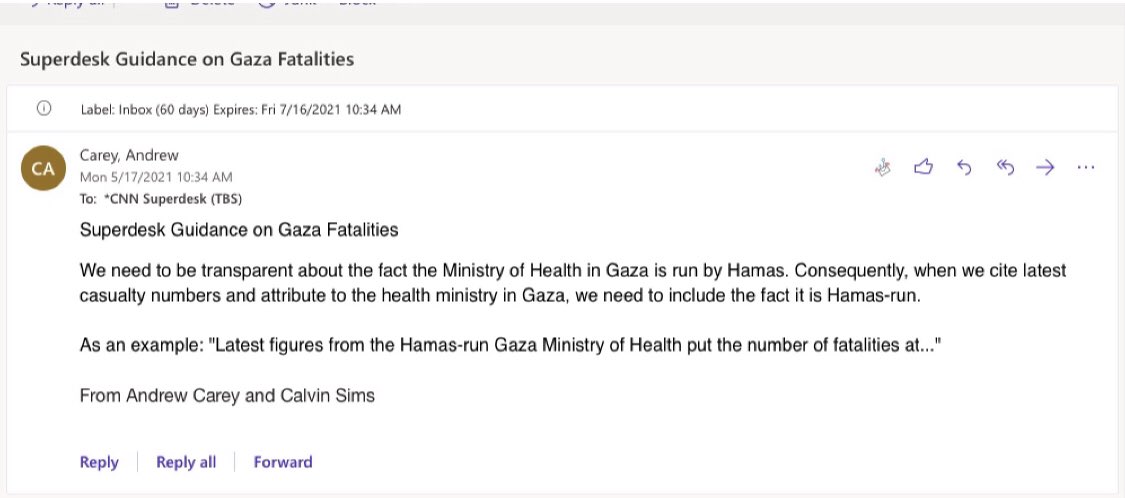
King’s College alumnus turned CNN Jerusalem bureau chief Andrew Carey instructed reporters on how to cover Israel’s latest assault on Gaza
Once publicized, his comments elicited considerable pushback. “This is a page straight out of Israel’s playbook. It serves to justify the attack on civilians and medical facilities,” commented Al-Jazeera Senior Presenter and Producer Dena Takruri.
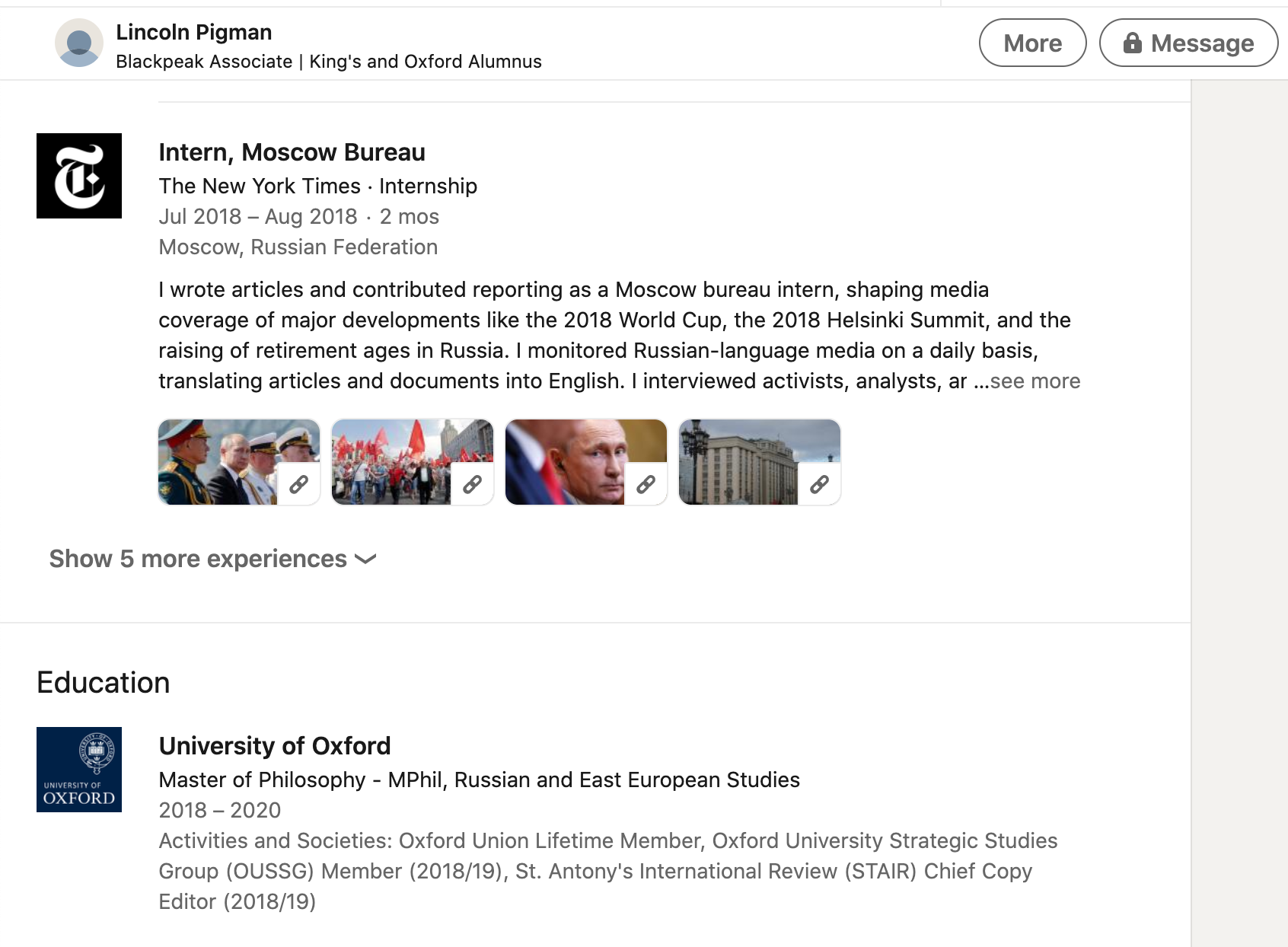
The New York Times, the United States’ most influential newspaper, has also employed Department of War Studies alumni. Christiaan Triebert (M.A., 2016), for example, is a journalist on their visual investigations team. He even won a Pulitzer Prize for “Revelations about Russia and Vladimir Putin’s aggressive actions in countries including Syria and Europe.” Hiring students from the school for spooks to bash Russia appears to be a common Times tactic, as it also employed Lincoln Pigman between 2016 and 2018 at its Moscow bureau.
Josh Smith, senior correspondent for influential news agency Reuters and formerly its correspondent in Afghanistan, also graduated from the department in question, as did The Wall Street Journal’s Daniel Ford.
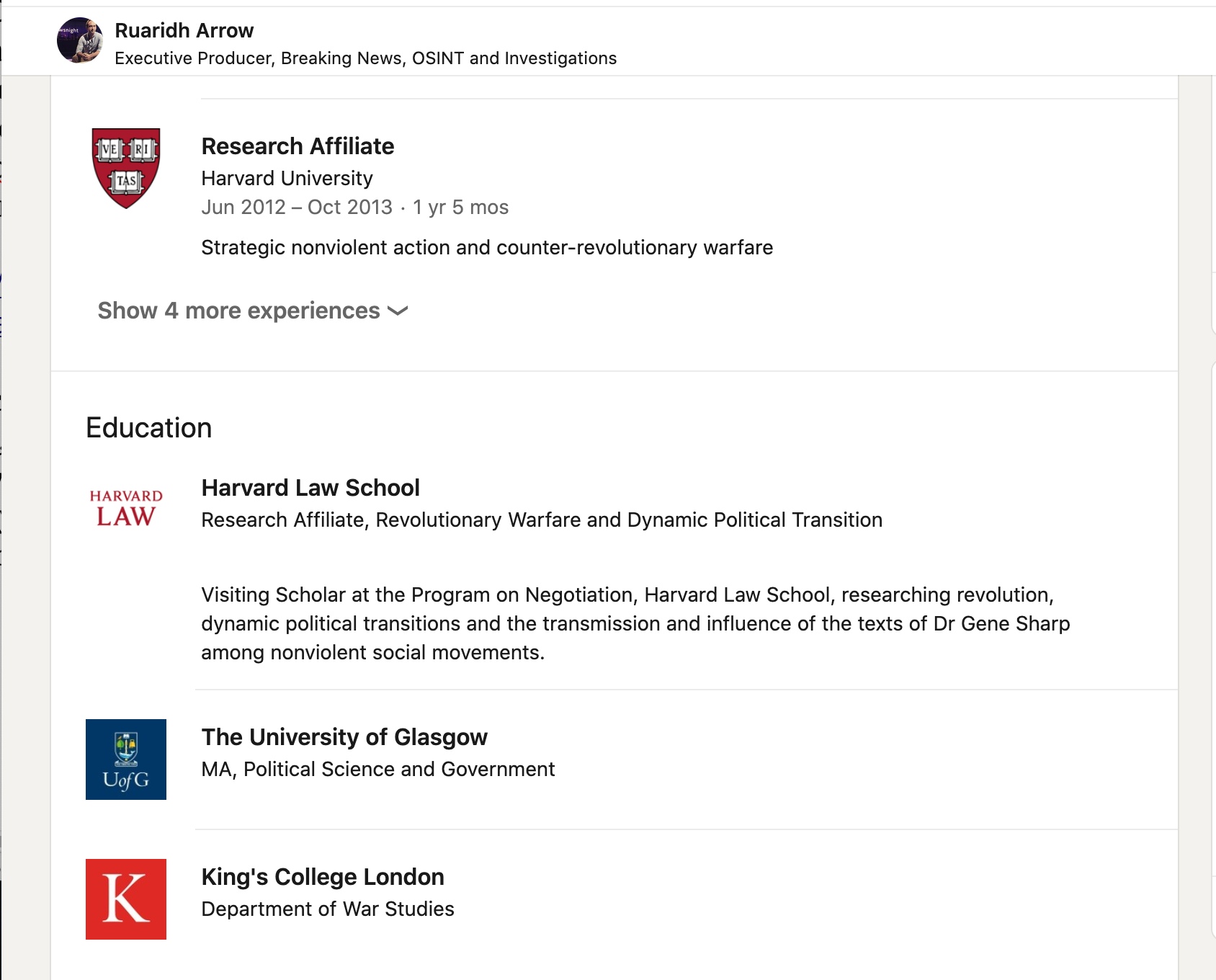
Arguably the most influential media figure from the university, however, is Ruaridh Arrow. Arrow was a producer at many of the U.K.’s largest news channels, including Channel 4, Sky News and the BBC, where he was world duty editor and senior producer on Newsnight, the network’s flagship political show. In 2019, Arrow left the BBC to become an executive producer at NBC News.
The British invasion
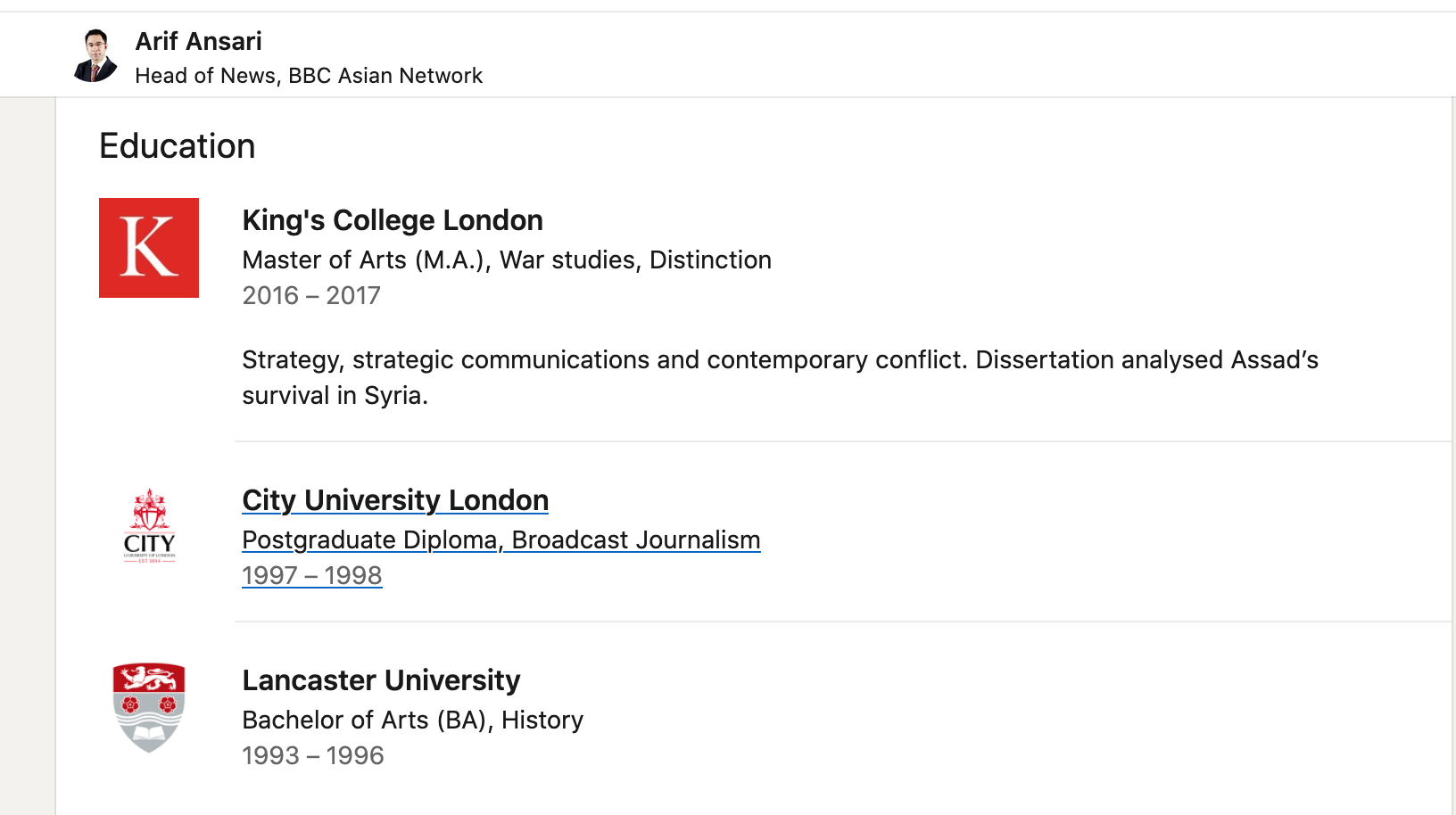
Unsurprisingly for a university based in London, the primary journalistic destination for Department of War Studies graduates is the United Kingdom. Indeed, the BBC, the country’s powerful state broadcaster, is full of War Studies alumni. Arif Ansari, head of news at the BBC Asian Network, completed a masters analyzing the Syrian Civil War in 2017 and was soon selected for a leadership development scheme, placing him in charge of a team of 25 journalists who curate news primarily geared toward the substantial Middle Eastern and South Asian communities in Great Britain.
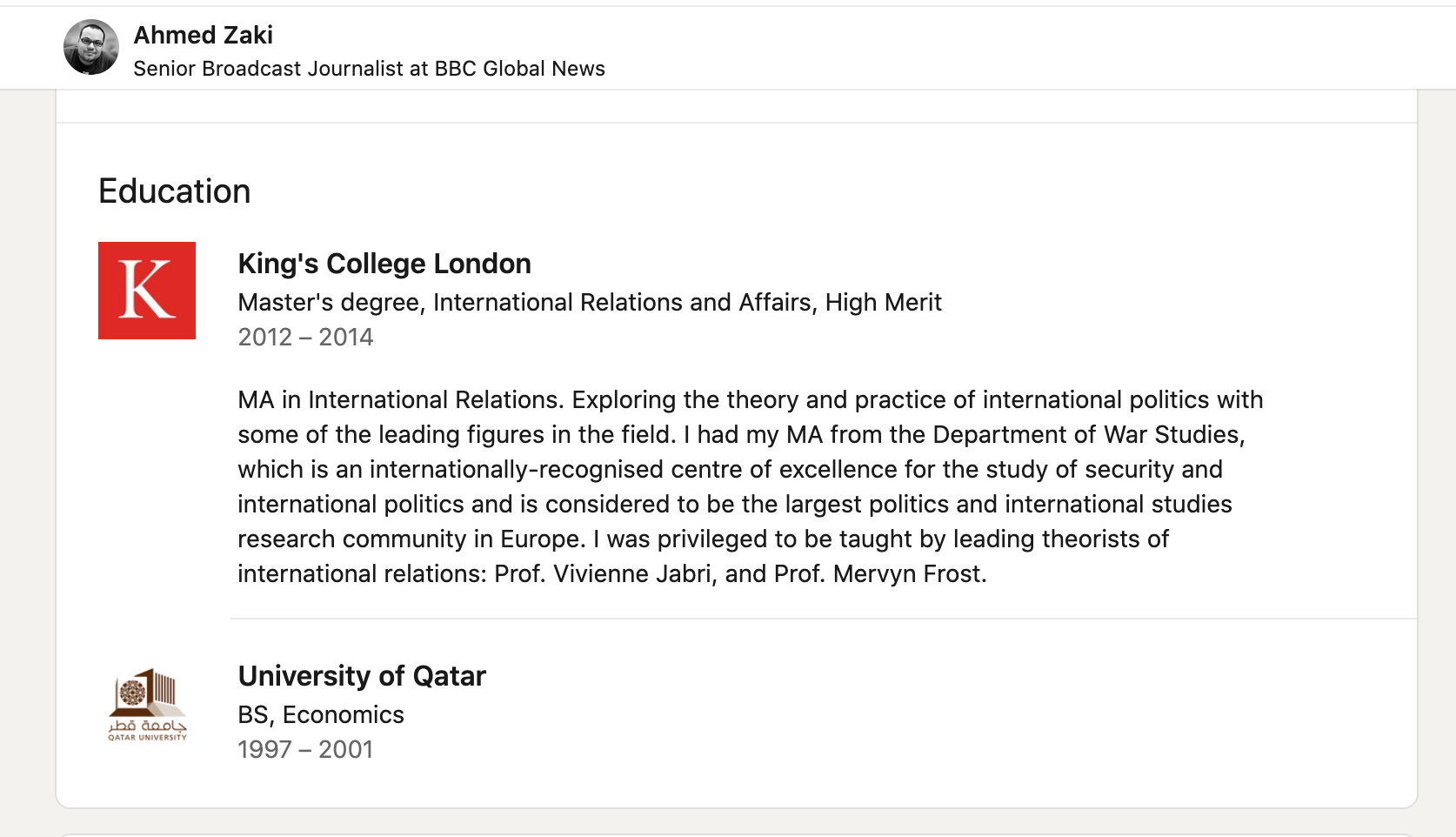
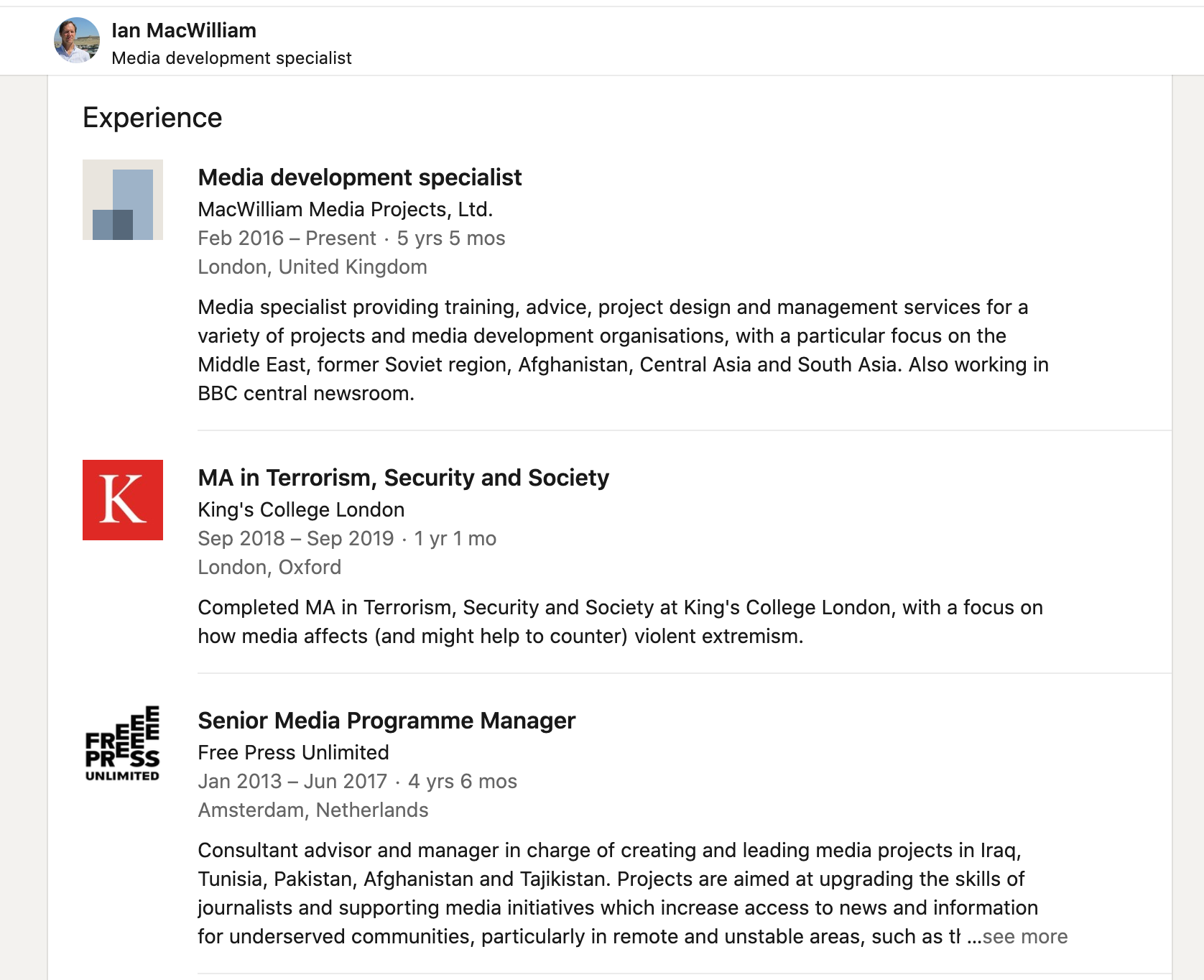
Many BBC employees begin studying at King’s years after their careers have already taken off, and balance their professional lives with pursuing new qualifications. Ahmed Zaki, Senior Broadcast Journalist at BBC Global News, began his master’s six years after he started at the BBC. Meanwhile, Ian MacWilliam — who spent ten years at BBC World Service, the country’s official news broadcast worldwide, specializing in sensitive regions like Russia, Afghanistan and Central Asia — decided to study at King’s more than 30 years after completing his first degree.
Another influential War Studies alumnus at the World Service is Aliaume Leroy, producer for its Africa Eye program. Well-known BBC News presenter Sophie Long also graduated from the department, working for Reuters and ITN before joining the state broadcaster.
“It’s an open secret that King’s College London Department of War Studies operates as the finishing school for Anglo-American securocrats. So it’s maybe not a surprise that graduates of its various military and intelligence courses also enter into a world of corporate journalism that exists to launder the messaging of these same ‘security’ agencies,” Matt Kennard — an investigative journalist for Declassified U.K. who has previously exposed the university’s connections to the British state — told MintPress. “It is, however, a real and present danger to democracy. The university imprimatur gives the department’s research the patina of independence while it works, in reality, as the unofficial research arm of the U.K. Ministry of Defence,” he added.
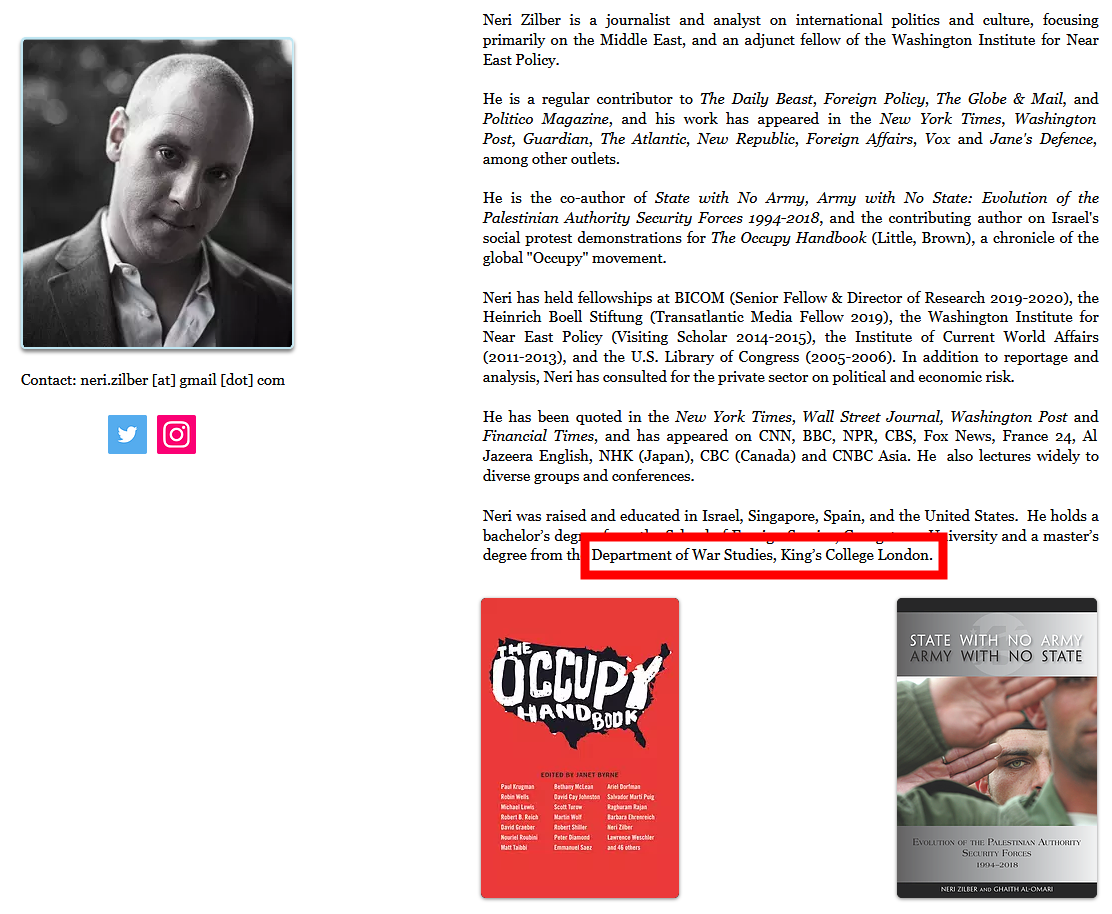
Israeli writer and King’s College alumnus Neri Zilber has bylines in many of the media’s most important outlets
The Department of War Studies also trains many international journalists and commentators, including Nicholas Stuart of the Canberra Times (Australia); Pakistani writer Ayesha Siddiqa, whose work can be found in The New York Times, Al-Jazeera, The Hindu and many other outlets; and Israeli writer Neri Zilber, a contributor to The Daily Beast, The Guardian, Foreign Policy and Politico.
What’s it all about?
Why are so many influential figures in our media being hothoused in a department well known for its connections to state power, for its faculty being active or former military or government officials, and for producing spies and operatives for various three-letter agencies? The point of this is not to allege that these journalists are all secretly card-carrying spooks: they are not. Rather, it is to highlight the alarmingly close links between the national security state and the fourth estate we rely on to be a check on their power and to hold them accountable.
Journalists trained in this sort of environment are far more likely to see the world in the same manner as their professors do. And perhaps they would be less likely to challenge state power when the officials they are scrutinizing were their classmates or teachers.
These sorts of questions abound when such a phenomenon exists: Why are so many journalists choosing to study at this particular department, and why do so many go on to be so influential? Are they being vetted by security agencies, with or without their knowledge? How independent are they? Will they just repeat British and American state talking points, as the Department of War Studies’ publications do?
On the question of vetting, the BBC admitted that, at least until the 1990s, it conspired with domestic spying agency MI5 to make sure that people with left-wing and/or anti-war leanings, or views critical of British foreign policy and empire were secretly blocked from being hired. When pressed on whether this policy is still ongoing, the broadcaster refused to comment, citing “security issues” — a response that is unlikely to reassure skeptics.
“While it strikes me as very interesting that a single academic institution could play such a major role in the recruitment of pro-establishment activist intellectuals and delivery of the same to the media, it is not so surprising,” Oliver Boyd-Barrett, Professor Emeritus at Bowling Green State’s School of Media and Communication and an expert in collusion between government and media, told MintPress, adding:
Elite institutions in the past and doubtless still today have been major playgrounds for intelligence services. The history of the modern nation-state generally, not just the USA, seems to suggest that national unity — and therefore elite safety — is regarded by elites as achievable only through careful management and often suppression or diversion of dissent. Far more resources are typically committed to this than many citizens, drilled in the propaganda of democracy, realize or care to concede.
The Bellingcat Boys
While the journalists cataloged above are not spooks, some other Department of War Studies figures working in journalism could possibly be described as such, particularly those around the influential and increasingly notorious investigative website Bellingcat.
Cameron Colquhoun, for instance, spent almost a decade at GCHQ, Britain’s version of the NSA, where he was a senior analyst running cyber and counter-terrorism operations. He holds qualifications from both King’s College London and the State Department. This background is not disclosed in his Bellingcat profile, which merely describes him as the managing director of a private intelligence company that “conduct[s] ethical investigations” for clients around the world.
Bellingcat’s senior investigator Nick Waters spent four years as an officer in the British Army, including a tour in Afghanistan, where he furthered the British state’s objectives in the region. After that, he joined the Department of War Studies and Bellingcat.
For the longest time, Bellingcat’s founder Eliot Higgings dismissed charges that his organization was funded by the U.S. government’s National Endowment for Democracy (NED) — a CIA cutout organization — as a ridiculous “conspiracy.” Yet by 2017, he was admitting that it was true. A year later, Higgins joined the Department of War Studies as a visiting research associate. Between 2016 and 2019 he was also a senior fellow at the Atlantic Council, the brains behind the North Atlantic Treaty Organization (NATO).
Higgins appears to have used the university department as a recruiting ground, commissioning other War Studies graduates, such as Jacob Beeders and the aforementioned Christiaan Triebert and Aliaume Leroy, to write for his site.
Bellingcat is held in very high regard by the CIA. “I don’t want to be too dramatic, but we love [Bellingcat],” said Marc Polymeropoulos, the agency’s former deputy chief of operations for Europe and Eurasia. Other officers explained that Bellingcat could be used to outsource and legitimize anti-Russia talking points. “The greatest value of Bellingcat is that we can then go to the Russians and say ‘there you go’ [when they ask for evidence],” added former CIA Chief of Station Daniel Hoffman.
Bellingcaught
A recent MintPress investigation explored how Bellingcat acts to launder national security state talking points into the mainstream under the guise of being neutral investigative journalists themselves.
Newly leaked documents show how Bellingcat, Reuters and the BBC were covertly cooperating with the U.K.’s Foreign and Commonwealth Office (FCO) to undermine the Kremlin and promote regime change in Moscow. This included training journalists and promoting explicitly anti-Russian media across Eastern Europe. Unfortunately, the FCO noted, Bellingcat had been “somewhat discredited,” as it constantly spread disinformation and was willing to produce reports for anyone with money.
Nevertheless, a new European Parliament proposal published last month recommends hiring Bellingcat to assist in producing reports that would lay the groundwork for sanctioning Russia, for throwing it out of international bodies, and to “assist Russia’s transformation into a democracy.” In other words, to overthrow the government of Vladimir Putin.
An academic journalistic nexus
The Department of War Studies is also part of this pro-NATO, anti-Russia group. Quite apart from being staffed by soldiers, spooks and government officials, it puts out influential reports advising Western governments on foreign and defense policy. For instance, a study entitled “The future strategic direction of NATO” advises that member states must increase their military budgets and allow American nuclear weapons to be stored in their countries, thereby “shar[ing] the burden.” It also recommended that NATO must redouble its commitment to opposing Russia while warning that it needed urgently to form a “coherent policy” on the Chinese threat.
Other War Studies reports claim that Russia is carrying out “information-psychological warfare” through its state channels RT and Sputnik, and counsel that the West must use its technical means to prevent its citizens from consuming this foreign propaganda.
King’s College London academics have also proven crucial in keeping dissident publisher Julian Assange imprisoned. A psychiatrist who has worked with the War Studies department testified in court that the Australian was suffering only “moderate” depression and that his suicide risk was “manageable,” concluding that extraditing him to the United States “would not be unjust.” As Matt Kennard’s investigation found, the U.K. Ministry of Defence had provided £2.2 million ($3.1 million) in funding to the institute where he worked (although the psychiatrist in question claimed his work was not directly funded by the MoD).
King’s College London markets the War Studies department to both graduates and undergraduates as a stepping stone towards a career in journalism. In its “career prospects” section for its master’s course in war studies, it tells interested students that “graduates go on to work for NGOs, the FCO, the MoD, the Home Office, NATO, the UN or pursue careers in journalism, finance, academia, the diplomatic services, the armed forces and more.”
Likewise, undergraduates are told that:
You will gain an in-depth and sophisticated understanding of war and international relations, both as subjects worthy of study and as intellectual preparation for the widest possible range of career choices, including in government, journalism, research, and humanitarian and international organisations.
Courses such as “New Wars, New Media, New Journalism” fuse together journalism and intelligence and are overseen by War Studies academics.
It is perhaps unsurprising that the department has taught many influential politicians, including foreign heads of state and members of the British parliament. But at least there is considerable overlap between the fields of defense policy and politics. The fact that the very department that trains high state officials and agents of secretive three letter agencies is also the place that produces many of the journalists we rely on to stand up to those officials and keep them in check is seriously problematic.
An unhealthy respect for authority
Unfortunately, rather than challenging power, many modern media outlets amplify its message uncritically. State officials and intelligence officers are among the least trustworthy sources, journalistically speaking. Yet many of the biggest stories in recent years have been based on nothing except the hearsay of officials who would not even put their names to their claims.
The level of credulity modern journalists have for the powerful was summed up by former CNN White House Correspondent Michelle Kosinski, who last month stated that:
As an American journalist, you never expect:
- Your own govt to lie to you, repeatedly
- Your own govt to hide information the public has a right to know
- Your own govt to spy on your communications
Unfortunately, credulity stretches into outright collaboration with intelligence in some cases. Leaked emails show that the Los Angeles Times’ national security reporter Ken Dilanian sent his articles directly to the CIA to be edited before they were published. Far from hurting his career, however, Dilanian is now a correspondent covering national security issues for NBC News.
Boyd-Barrett said that governments are dependent on “the assistance of a penetrated, colluding and docile mainstream media which of late — and in the context of massive confusion over Internet disinformation campaigns, real and alleged — appear ever more problematic guardians of the public right to know.”
In recent years, the national security state has increased its influence over social media giants as well. In 2018, Facebook and the Atlantic Council entered a partnership whereby the Silicon Valley giant partially outsourced curation of its 2.8 billion users’ news feeds to the Council’s Digital Forensics Lab, supposedly to help stop the spread of fake news online. The result, however, has been the promotion of “trustworthy” corporate media outlets like Fox News and CNN and the penalization of independent and alternative sources, which have seen their traffic decrease precipitously. Earlier this year, Facebook also hired former NATO press officer and current Senior Fellow at the Atlantic Council Ben Nimmo to be its chief of intelligence. Reddit’s Director of Policy is also a former Atlantic Council official.
Meanwhile, in 2019, a senior Twitter executive for the Middle East region was unmasked as an active duty officer in the British Army’s 77th Brigade, its unit dedicated to psychological operations and online warfare. The most notable thing about this event was the almost complete lack of attention it received from the mainstream press. Coming at a time when foreign interference online was perhaps the number one story dominating the news cycle, only one major outlet, Newsweek, even mentioned it. Furthermore, the reporter who covered the story left his job just weeks later, citing stifling top-down censorship and a culture of deference to national security interests.
The purpose of this article is not to accuse any of those mentioned of being intelligence agency plants (although at least one person did actually work as an intel officer). The point is rather to highlight that we now have a media landscape where many of the West’s most influential journalists are being trained by exactly the same people in the same department as the next generation of national security operatives.
It is hardly a good look for a healthy, open democracy that so many spies, government officials, and journalists trusted to hold them accountable on our behalf are all being shot out of the very same cannon. Learning side by side has helped to create a situation where the fourth estate has become overwhelmingly deferential to the so-called deep state, where anonymous official’s words are taken as gospel. The Department of War Studies is just one part of this wider phenomenon.T
Alan MacLeod is Senior Staff Writer for MintPress News. After completing his PhD in 2017 he published two books: Bad News From Venezuela: Twenty Years of Fake News and Misreporting and Propaganda in the Information Age: Still Manufacturing Consent, as well as a number of academic articles.
The Myth of “Anti-Semitic Violence”
By Michael Lesher | OffGuardian | June 5, 2021
The claim that the world is awash in an outbreak of Jew-hatred is a myth – a fiction cynically recycled every few years as a cover for Israeli brutality.
That’s easily said. Still, with so many falsehoods parading as news these days, why single out the lie that Jews are “under attack” in what mainstream media monotonously call a “wave of anti-Semitic violence”? Why not just ignore it and move on?
First, because this particular lie is peddled by so powerful an array of propagandists, and swallowed by so many well-meaning people, that a prompt corrective is needed to set the record straight.
Second, and even more importantly, because the lie is part of an organized campaign to turn reality upside down – to convert supporters of Israeli violence into victims, to blame the real victims for their own suffering, and to subordinate the whole issue of Palestinian human rights to the self-serving dictates of an Israeli-driven propaganda machine as to what does and doesn’t offend delicate Jewish “sensibilities.”
If we allow that kind of lie to stand unchallenged, we’re (quite literally) helping Israel get away with murder.
Not that you’d know any of this from mainstream media. At the moment, it’s almost impossible to find a “respectable” outlet that isn’t brimming with warnings about a worldwide threat to the Jews – and the fact that the same claim has been peddled before, and debunked before, doesn’t seem to bother the purveyors in the slightest.
Yet there really ought to be a few raised eyebrows over the gulf dividing the alarmist tone of the “reports” – “violence and harassment targeting American Jews…coast-to-coast” (BBC); “anti-Semitic attacks and slurs in several American cities” (PBS); “a wave of antisemitic attacks… violence and abhorrent rhetoric” (National Public Radio); “Jews have been threatened and attacked” (New York Times) – from the remarkably murky details purportedly proving them.
The May 26 issue of Ami Magazine, a popular Orthodox Jewish weekly, claims to have information about “several scuffles… including in Toronto, Montreal and New York” and insists that “Jews were beaten at several of these events.”
Ah, but which ones? Ami avoids giving specifics – and a closer look suggests that the facts aren’t on offer because they don’t exist.
Consider Toronto. What was originally described as an “anti-Semitic attack” in that city turned out to have been a fracas instigated by the notorious Jewish Defense League – listed by the FBI as a terrorist organization – in which the Jew identified as the “victim” first swung a large club, then brandished a knife, before being “attacked.” (That didn’t stop Ontario Premier Doug Ford from condemning “anti-Semitism” after the event – a statement he refused to withdraw even when presented with video evidence of the behavior of the “victim.”)
And Montreal? The circumstances of that “attack” are scarcely less turbid. The claims of “violence” against Jews were reported entirely by pro-Israel organizations and their supporters; given the heavy police presence in the area at the time, the absence of corroborating testimony renders the story rather hard to credit.
Meanwhile, a similar report of an “anti-Semitic attack” in Los Angeles (also cited in Ami ) was promptly debunked by Richard Silverstein, whose Tikun Olam blog has an excellent track record for accuracy. Here is Silverstein’s report as of May 25:
You may have read about the purported “wave” of anti-Semitic incidents sweeping the world in response to Israel’s attack on Gaza. Don’t you believe it. One of the main incidents supposedly involved a group of Jews eating outdoors at an LA sushi restaurant. The media narrative says that a car full of Palestinians waving the Palestinian fla[g] shouted “fuck you” at the diners and then threw a bottle at them.
My LA Jewish friends who’ve seen video of the incident and spoken to Palestinians involved (who were never interviewed by the media) say that a group of right-wing Iranian Jews saw the car with the flags, shouted “fuck you” at the Palestinians, then threw a bottle from their table at the car.
No wonder Ami doesn’t bother trying to present evidence of that “anti-Semitic attack.”
New York Assemblyman Dov Hikind – a protégé of convicted terrorist Rabbi Meir Kahane – claims to have identified another “victim of anti-Jewish violence” in Las Vegas.
But to eyes less biased than Hikind’s, the facts tell a different story.
By his own account, the “victim” – a Jew from Staten Island – accosted a Palestinian family he encountered at the MGM Casino with the boast that he too is “from Palestine” (he isn’t), and that “Jews have been around for 5,000 years” (they haven’t), adding that he is a “proud Jew” – meaning, evidently, that he supported Israel’s theft of Palestinian land and the massacre Israel was perpetrating in order to secure it. It seems this taunt angered the Palestinian man sufficiently to induce him to push his interlocutor backward, causing him to fall – whereupon the “proud Jew” called the police.
As if being shoved in a casino after bragging about your fondness for racist violence weren’t proof enough of universal Jew-hatred, the “victim” points angrily to the fact that the police are “only” charging his assailant with “battery.” He thinks he suffered a “hate crime” – though from my point of view there’s more “hate” in endorsing mass murder than in getting upset about it.
Anyway, if that’s the horrific “anti-Jewish violence” that’s supposed to be sweeping America, I’m not panicking.
In fact, if the consequences weren’t so sinister, some of the hoopla would be almost funny.
One story making the rounds in mainstream media alleges an “attack” on an empty kosher pizzeria located on Manhattan’s posh Upper East Side. As far as I can tell, all that’s known is that someone damaged the front door during the night – there’s no evidence of a motive, let alone an anti-Semitic motive. But when Israel needs cover stories, a damaged glass door is a Big Deal: the Anti-Defamation League is said to be “working with law-enforcement officials to investigate the incident,” while Ben Kallos, a Jewish member of New York City Council, added: “This is happening everywhere…. People are in fear all over our city.”
By way of contrast, when the owner of the Foodbenders grocery in Toronto was subjected last year to a systematic campaign of harassment, vandalism and threats for posting comments supportive of occupied Palestine in a shop window, the police refused to act – even when video clearly showed an identifiable woman defacing Foodbenders’ front door with spray-painted graffiti. Meanwhile, local politicians attacked the owner, calling her expressions of sympathy for Palestinians “disgusting,” “hateful,” “abhorrent” and “unacceptable.” Double standards, anyone?
If these fictions about “anti-Semitic violence” have a familiar ring, they should: Israel’s mouthpieces have been telling the same tall tales for years. In May 2002, just in time to divert public attention from Israel’s escalating terror campaign in the occupied West Bank (where, in less than a month, Israeli forces killed nearly 500 Palestinians and demolished 878 homes), a Zionist professor at San Francisco State University claimed to have seen an “out of control mob” launch “a raw, physical assault” on “praying [Jewish] students, and the elderly women… who survived the Holocaust.”
The “Palestinians and their supporters,” she wrote, were “literally chanting for our deaths,” while “the police could do nothing more than surround the Jewish students and community members who were now trapped in the corner of a plaza, grouped under the flags of Israel.”
That this story was fabricated – a fact the redoubtable scholar Norman Finkelstein confirmed simply by checking with Jewish eyewitnesses – did not prevent it from being repeatedly broadcast as fact in “worldwide media venues,” as the Jewish Journal boasted within two weeks of the professor’s account.
Media complicity in the propaganda campaign is another persistent component of the problem – a point Finkelstein underscored in his book Beyond Chutzpah. In 2003, as Israel completed its brutal suppression of the Second Intifada, the “progressive” Jewish magazine Tikkun announced that America was experiencing a “virulent new strain” of “anti-Semitism.”
The proof? “A Jewish student wearing a yarmulke at Yale University is attacked by a Palestinian in his dormitory,” shrilled the article’s lead paragraph.
But Finkelstein found that “no one at Yale’s Center for Jewish Life or the university administration had ever heard of such an assault.”
Embarrassing, wouldn’t you think? But if the author of that lie, one Miriam Greenspan, or Tikkun, the publisher, learned a lesson about inventing “anti-Jewish violence” where none exists, you wouldn’t know it from their behavior. Sixteen years later, Greenspan was still complaining in prominent media about “the PC brand of antisemitic anti-Zionism that flourishes today, in which the ancient animosity toward Jews as a ‘race’ has been transposed to Israel as a nation.”
Meanwhile, Tikkun’s Rabbi Michael Lerner was pontificating that “a growing section of progressives are in fact legitimating anti-Semitic tropes,” such as the claim that Israel is a “central ally of global imperialism.” Plus ça change, plus c’est la même chose.
I myself exposed media complicity in another pogrom-that-wasn’t – on the blog site of the Times of Israel, no less. Once again, the context was an Israeli massacre – this time in July 2014, when the assault Israel cynically dubbed “Protective Edge” had already claimed 150 of the more than 2,100 Gazan lives it would obliterate that summer.
Once again, slaughtered Palestinians were upstaged in the press by hysterical reports that a mob of anti-Semites had attacked a Paris synagogue on Bastille Day, while helpless Jews “cowered” inside.
In fact, the synagogue was never attacked at all; the violence was started by Jewish hoodlums who assaulted a group of demonstrators engaged in a noisy but nonviolent protest in the street outside. I haven’t seen any retractions of the original (false) story, though. As far as mainstream media are concerned, stories alleging anti-Semitic attacks don’t require proof – they are true by definition.
Even when not manufactured out of whole cloth, the tales of Jew-hatred are seldom what they seem. In the last two weeks, the New York press has been agog with horrified accounts of a man who started a fire outside a Brooklyn yeshiva and punched a Hasidic man a few hours later. As it happens, there is surveillance video evidence supporting the story.
But the suspect, Ali Alaheri, is also accused of burning an American flag outside a Catholic church and knocking over an image of Jesus in the week prior to the alleged arson at the yeshiva. What is more – though this isn’t mentioned in any of the articles I’ve read – court records show that Alaheri, while in prison on other charges in 2019, was held on a “suicide watch” and was described by a judge as having “significant mental health issues.”
So, while it’s possible that his latest acts reflected anti-Semitism, they’re more likely just the products of a disturbed mind. But don’t expect to learn that from the press.
The editorial bias that makes these bogus stories possible extends to the media’s uncritical reliance on dubious “sources.” When New York City’s Mayor Bill de Blasio promised enhanced police protection for “Jewish communities” on May 23, he was standing alongside Rabbi Bernard Freilich, according to the Jerusalem Post, which also claimed that America is experiencing “the worst anti-Semitic attacks in decades.”
“Antisemitism has to be stopped immediately,” Rabbi Freilich piously added. “It’s just out of control.”
Freilich ought to know something about being “out of control.” In 2011, the rabbi abruptly “submitted his resignation” from a $100,000-a-year job with the New York State Police after he was caught misusing a police badge, a vehicle placard and a set of emergency lights. In any other context, that kind of history might impair his credibility – but you won’t see it mentioned when he’s adding weight to an Israel-inspired propaganda blitz.
Actually, the sheer mendacity of the pro-atrocity campaign is getting so extreme that, apart from shady political fixers like Freilich, Jewish media are having trouble finding mouthpieces unscrupulous enough to fabricate the PR. So we find the latest issue of Ami Magazine relying on a non-Jewish ex-spook named John Loftus for the bizarre claim that Associated Press and Al Jazeera reporters deliberately “looked the other way every single time” Hamas fighters in Gaza aimed mortar rounds at “Israeli school buses full of children” (yes, really), thus rendering the journalists and their employers “complicit” in “war crimes.”
And just who is John Loftus? Well, the most notorious point of his media career occurred when, during an interview on Fox News, he gave out the address of a suburban Los Angeles home with the false claim that it contained a “terrorist,” forcing an innocent family of five to obtain police protection. (Fox called this a “careless error,” but quickly dropped Loftus as a “contributor.”)
Using a guy like that to proclaim Jewish innocence by manufacturing evidence-free conspiracy theories is scraping the bottom of a pretty filthy barrel. But apparently Loftus is kosher as long as he’s whitewashing the right criminals – that is, Jewish ones.
The bottom line? Whenever Israel is dropping bombs on helpless people, and you read in the press that “Jews are under attack,” or that there is a world-wide “wave of anti-Semitic violence,” you can be pretty sure you’re being lied to.
And not just because the “facts” in those stories are generally falsified or embellished.
There’s a deeper problem, too.
The message underlying all the propaganda never varies: Jewish discomfort is somehow the fault of Palestinians and their supporters – “anti-Semitism” is something critics of Israel must either “distance themselves from” or be tarred with. If Jews don’t like the sound of Palestinian activism, the activists need to justify themselves to the satisfaction of the Jews. Otherwise there is no merit in their defense of Palestinian rights, leaving Israel the aggrieved party by default.
Yet the truth is exactly the reverse of this. Jews have never had anything to fear from pro-Palestinian activism. On the contrary: Israel’s propagandists (politicians, pundits, “journalists” included) are not only complicit in Israel’s crimes against Palestinians; they are far and away the most powerful fomenters of anti-Semitism in the world today.
For it is the apologists for Israeli violence, not Palestinians, who scream from every media platform that Jews, by definition, must be criminals: that “Jewish identity” entails the oppression of non-Jews, the theft of their land, the confinement of whole populations in squalid ghettos where they are periodically massacred.
It is Israel’s “supporters,” not Palestinians, who insist that all criticism of Israeli atrocities necessarily offends Jews – who must, ex hypothesi, be defenders of mass murder, torture and apartheid. It is they, not Palestinians, who deny that Jews with ethical principles can really be Jews at all. It is they who equate Judaism with land theft and Jewish identity with ethnic supremacism.
Can there possibly be a more anti-Semitic teaching than this? Anyone who is genuinely concerned about anti-Jewish bigotry is simply wasting time talking about Palestinian activists (whose leading figures, in any case, have scrupulously excluded anti-Semitism from the movement).
The real target should be the pro-Israel crowd that, as I write, is aggressively propagandizing the world with the claim that the word “Jew” and the phrase “lawless, bloody occupier of other people’s territory” mean one and the same thing.
Which brings me to the case of Joseph Borgen. In the midst of all the media fakery about “anti-Semitic violence,” Borgen, a young Long Island accountant, lays claim to being just about the only Jew who has actually experienced a verifiable physical attack in the last few weeks that may have been motivated, in part, by his religious affiliation.
But what actually happened?
According to Borgen’s own account (reported in fawning detail by Ami Magazine), he was on his way to a pro-Israel demonstration in Times Square on May 20 – wearing a yarmulke – when, just “a couple of blocks away from the rally,” he was suddenly surrounded by “a crowd of people” who beat and kicked him, and then “proceed[ed] to mace and pepper spray me” before police arrived. He suffered minor injuries, was treated at Bellevue Hospital, and was released later that same night. At least one arrest has already been made in the case; police are still seeking other suspects.
Ami’s headline for the story is nothing short of hysterical: “ATTACKED by Anti-Semites!” (Yes, the capital letters and exclamation point all appear in the original.)
A bit of historical perspective is in order. The day American hostages, newly released from Iran, reached American soil in January 1981, the New York Times – the same newspaper that is convulsed with indignation if a Jewish supporter of Israeli atrocities gets his hat knocked off – editorialized that there should be “rage and revulsion” in the streets of the US, where Iranian students bold enough to stage pro-Khomeini demonstrations (according to Newsweek) had already been subject to “violent” treatment that included attacks with baseball bats. Khomeini, with all his faults, was guilty of nothing worse than the crimes Israel commits regularly against Palestinians – but the Times considered “rage and revulsion” appropriate ways to deal with people who rallied in his support.
Woody Allen, always an accurate bellwether of orthodox liberal opinion, was even more direct in his 1979 film Manhattan. “Has anybody read that Nazis are gonna march in New Jersey,” he asks in one scene. “We should go there, get some guys together. Get some bricks and baseball bats and explain things to ‘em.” A woman – one of Allen’s stereotypical, myopic bluestockings – mentions a “devastating satirical piece on that in the Times,” to which Allen tartly replies, “Well, a satirical piece in the Times is one thing, but bricks get right to the point.”
For the record, I don’t agree with Allen. Violence breeds violence, and throwing bricks (at whatever target) can only end by elevating the sort of people who prefer brick-throwing to civilization – not the elements we want to strengthen. But I have never sat in a movie audience that didn’t laugh appreciatively at Allen’s suggestion that Nazis deserve a little roughing up.
So where does that leave the Jewish accountant who was so fond of racist brutality that he dropped everything he was doing on May 20 to publicly demonstrate his support for it?
In a 1990 interview, the respected Israeli intellectual Yeshayahu Leibowitz – who was also a religious Jew – warned that Israel was becoming “a Judeo-Nazi state.” Noting that “the Israeli Defense Force, armed to the teeth by American weapons, has assassinated 150 [Palestinian] children in the past two years alone,” Leibowitz insisted that the word “Nazi” was the only appropriate word to describe its conduct:
The minister of Defense [Yitzhak Rabin] who gave the order to break the arms and legs of Palestinian prisoners is a Nazi… And the president of the High Court [Moshe Landau], who judged that torturing prisoners was allowed, is a Nazi.”
I cannot gainsay Leibowitz’s reasoning. So let us use plain language to describe inescapable facts. The Times Square demonstration – the purpose of which was to flaunt Jewish support for crimes against humanity – was a Nazi rally. The Jews who organized it were Nazis. For his eagerness to attend, Joseph Borgen, if not actually a Nazi, was at least a Nazi sympathizer.
And according to the moral standards endorsed by the New York Times, by Woody Allen, and by all of Allen’s liberal admirers, Borgen got off rather lightly under the circumstances: he was kicked and pepper-sprayed, but not clobbered with bricks or baseball bats.
To repeat: I do not endorse that standard. Even Nazis have rights. I think it is entirely proper for Borgen’s assailants to be prosecuted.
But anyone who expects me to be shocked or outraged because one supporter of mass murder got slapped around in Times Square is barking up the wrong tree. What is outrageous is not that someone took a swing at Borgen next door to a Nazi rally he couldn’t wait to join. What is outrageous is that Jews organized a Nazi rally in the first place. That so many Jews enthusiastically attended it makes it doubly outrageous.
“The photos and videos are horrifying,” Ami Magazine declares in the same issue that laments the attack on Borgen. But the “photos and videos” its editors have in mind aren’t of the carnage inflicted by the Holy State on the men, women and children of Gaza. They’re of a handful of Jews who may have paid a small price for the Israeli teaching that Judaism is a violent, racist cult. For Ami and its fellow propagandists, only supporters of violence can be victims; the real victims – Palestinians – are simply nonpersons.
This appalling inversion of moral priorities gives the clue to the real nature of the myth of “anti-Semitic violence.” The myth is not just a distortion of facts. It is a grotesque revaluation of the most basic moral tenets; it makes “victims” of oppressors and converts truth-telling into bigotry.
That’s why we should not dignify the myth with a moment’s pause – let alone respond to it with our own condemnations of “anti-Semitism,” however tempting this may be to decent people who want to stress their freedom from bigotry. To allow phony “anti-Semitism” claims to dominate the public discourse about Palestine – especially under the circumstances we face now, as Israel moves from crime to bloody crime – is only to encourage the propagandists and to betray the Palestinians who await with dread the next Israeli onslaught.
The right approach is perfectly simple.
Denounce the crimes. Resist the criminals. Tell the truth. Support the victims.
And do not stop. Whatever the liars may say.
Michael Lesher is an author, poet and lawyer whose legal work is mostly dedicated to issues connected with domestic abuse and child sexual abuse. His latest nonfiction book is Sexual Abuse, Shonda and Concealment in Orthodox Jewish Communities (McFarland & Co., 2014); his first collection of poetry, Surfaces, was published by The High Window in 2019. A memoir of his discovery of Orthodox Judaism as an adult – Turning Back: The Personal Journey of a “Born-Again” Jew – was published in September 2020 by Lincoln Square Books.
‘Journalist’ Bilal Kareem, one-time Western media darling, emerges from Idlib prison with newfound critical view of jihadist pals
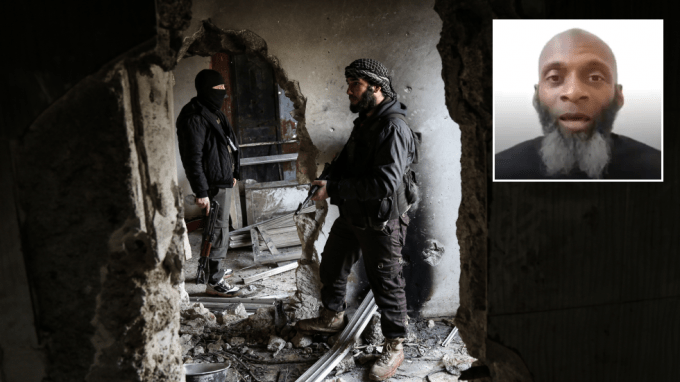
FILE PHOTO. Fighters of Hayat Tahrir al-Sham militant group,Syria, Aleppo. © Getty Images / Anas Alkharboutli; (inset) © Twitter / @BilalKareem
RT | June 5, 2021
A US media personality and a prolific advocate for anti-government Islamist fighters in Syria now says the group he supported is torturing people in the city of Idlib and that he himself was abused while in custody.
Bilal Abdul Kareem is one of the more colorful figures in Syria’s protracted armed conflict. Once treated as a legitimate journalistic source by the mainstream media during the battle for eastern Aleppo, he fell into relative obscurity in the West after his close ties to jihadist forces were exposed.
This week, he gave an interview decrying the abuses of jihadist militants currently controlling Idlib, a city in northern Syria, accusing them of torturing prisoners. Now a fugitive, Kareem says he himself was abused while in their custody.
The interview published on Friday by the London-based Middle East Eye (MEE) depicts a grim picture of life in Idlib under the rule of Hay’at Tahrir al-Sham (HTS), the current predominant military force there. Kareem says the HTS leader, Abu Mohammad al-Julani, is “unfit to rule” and simply gaslighting the West when he claims that the civilian “Syrian Salvation” government is actually in charge. Al-Julani has been listed as a “Specially Designated Global Terrorist” by the US State Department, which has also placed a $10 million bounty on his head.
“I doubt that there’s one in a hundred people who could even tell you who the president of the Salvation Government is, because everyone knows that he wields no power,” Kareem said. The purported government is led by a prime minister, with the office currently held by Ali Keda, a former security official in an Islamist alliance.
Kareem added that torture is rife in prisons controlled by HTS and that he personally was repeatedly threatened with physical violence after being arrested in August 2020. Other inmates were not so lucky, he said.
“Almost every day of every week, I had to listen to the screams of torture just a few meters away from me. Everyone in the prisons can always hear the torture,” he told MEE.
Kareem was released in February and says he is now outside the territory controlled by HTS, fearing retribution. He claims his arrest was prompted by criticism of HTS’ rule in Idlib, and particularly their use of torture, which he believes to be against Sharia law.
“They came to power… and then they start doing things other than that which they said. They promised to bring Islamic rule. They didn’t do it. They promised to bring justice. They didn’t do it.”
He added that HTS was justifying what it does to prisoners by claiming it’s not torture. He said he once told a jihadist official when debating the issue: “You’re starting to sound like the Americans: ‘We’re not calling it torture. We’re calling it enhanced interrogation techniques.’ Torture by any other name is still torture.”
The accusations are quite remarkable, coming from the lips of Kareem. For years, he remained a vocal supporter of some of the most brutal jihadist groups fighting against the Syrian government. One of his first long interviews was with Abu Firas al-Suri, a senior figure in Al-Nusra Front, who was later killed in a US airstrike in April 2016.
HTS was formed in January 2017 through a merger of several jihadist groups, including Al-Nusra, whose founder and leader is the current head of the organization.
While platforming Islamist clerics, jihadist commanders and Islamic foot soldiers, Kareem was treated with respect and adoration by many mainstream media outlets, which either ignored or downplayed the implications of his associations.
In 2016, he was among the people explaining to audiences on CNN and Al Jazeera how the civilian population of eastern Aleppo was facing imminent obliteration at the hands of the Syrian government, which at the time was about to retake it from Islamist fighters. Contrary to predictions that his reporting days were numbered, Kareem left the city with his jihadist friends, releasing a video of a masked fighter wearing what he claimed to be a suicide belt on his way out.
He helped CNN to produce its Peabody-award-winning documentary about the siege of the Iraqi city of Mosul. In 2014, he was invited as a guest speaker on a panel about the “future of jihadism” at the DC-based Brookings Institution, arguing that the country needs “an Islamic solution” to its problems.
Al-Nusra Front, a former Al-Qaeda affiliate, and its HTS partners, which Kareem backed with his coverage, have been implicated in various atrocities since the early years of the Syrian war.
The Finders: CIA Ties to Child Sex Cult Obscured as Coverage Goes from Sensationalism to Silence
By Elizabeth Vos | MintPress News | June 3, 2021
WASHINGTON — In February 1987, an anonymous phone tip was called into the Tallahassee police department reporting that six children were dirty, hungry, and acting like animals in the custody of two well-dressed men in a Tallahassee, Florida park. That phone call would kick off the Finders scandal: a series of events and multiple investigations even more bizarre than the initial report.
The trail would ultimately lead to allegations of a cult involved in ritual abuse, an international child-trafficking ring, evidence of child abuse confirmed and later denied, and ties with the CIA, which was alleged to have interfered in the case. No one was ever prosecuted in the wake of the initial 1987 investigation or a 1993 inquiry into the allegations of CIA involvement: official denials were maintained, and authorities stated that no evidence of criminal activity was ever found. However, documents that have emerged over time beg significant questions as to the validity of the official narrative.
In contrast with other historical human trafficking rings covered in the independent press, including those I have previously discussed, the Finders scandal presents as something of a phantom. This is in consequence of the lack of adult victims who have come forward, an absence of hard evidence viewable to the public, and an absence of extensive trials or convictions. Further impeding the willingness of most journalists to cover such a story were claims of ritualistic abuse that were hyped by corporate media at the time of the incident, as well as allegations of a CIA-led coverup that were less widely recognized by the legacy press.
The story is further complicated by the fact that it takes place in three basic stages: the initial 1987 investigation spread across multiple states and law enforcement agencies; a subsequent 1993 inquiry into allegations of a CIA coverup and interference in the 1987 investigation; and the emergence of Customs Service documents detailing new aspects of initial searches of Finders properties which was followed by the publication of hundreds of documents from both investigations to the FBI vault in 2019.
By initially sensationalizing the issue via the framing of the Finders as a satanic cult, the media profited from immediate shock value while permitting this very sensationalism to become the premise for dismissing other aspects of the story and Finders ties to the CIA to remain unexplored.
The 1987 Investigation
On February 4, 1987, two men dressed in suits and ties in the company of six bug-bitten, dirty, hungry children were arrested in Tallahassee, Florida, on charges of child abuse after a concerned citizen called local police. Initially, Tallahassee police were concerned that the children might have been kidnapped and were being trafficked across state lines. The U.S. Customs Service, the Washington Metropolitan Police Department (MPD), and the FBI became involved in the attempt to identify the two men based on suspicions of interstate criminal activity including the possibility of child pornography.
The story exploded on a national scale after investigators linked the pair, identified as Douglas Ammerman and Michael Houlihan (also referred to as Michael Holwell), with a Washington D.C.-based group known as the Finders, which authorities publicly referred to as a “cult.” Initially, Tallahassee police reported that at least two of the children showed signs of sexual abuse.
Houlihan and Ammerman first told police that they were transporting the children to a school for brilliant children in Mexico. However, this explanation as to the purpose of the children’s trip would change significantly, with Finders members later stating that the group were on an adventure in Florida. The Finders group was found to have multiple properties in Washington, D.C. and a farm in rural Madison County, Virginia. It also became clear that the Finders were highly skilled with early computer technology, which would become a major aspect of the case as it unfolded.

Doug Ammerman and Michael Holwell sit in Leon County Court during a bond hearing related to charges of child abuse. Credit | Tallahassee Democrat
News reports across the country headlined allegations of ritual abuse for approximately six days after the initial arrests, before a tidal shift by both the media and authorities began on February 10. The New York Times reported on that day:
Local police officials announced here today that six children found last week in Florida had apparently not been kidnapped and that there was no evidence to show that the secretive group that has been raising them is a cult involved in child abuse. The statement from the Metropolitan Police Department conflicted with accounts from the police in Tallahassee, Fla., where the children were found, unwashed and hungry, last week. Officials there said this morning that at least two of the children had signs of sexual abuse.
As described by the Times and the Chicago Tribune, the children were placed in police protective custody after threats were received at the shelters where they had originally been housed. Eventually, the mothers of the children were reported to have been Finders members and the children were said to be transported by Houlihan and Ammerman with the full consent of their parents. Hence, suspicions of kidnapping and trafficking rapidly lost credibility, though issues of abuse remained. The original strong allegations of sexual abuse of at least two of the six children were eventually contradicted by Florida authorities.
In March 1987, Houlihan and Ammerman were released with charges dropped for lack of evidence, and all of the children were eventually returned to their mothers. The official and media consensus was that the entire issue was a miscommunication blown out of proportion, and that the Finders were simply a 1960’s-esque “alternative lifestyle community” with unusual education methods.
The 1993 inquiry into an Intelligence Community coverup
U.S. Customs Special Agent Ramon J. Martinez claimed in a memorandum that during his participation in the searches of two of the Finder’s properties in Washington he witnessed evidence of the Finders’ intent to traffic children and other potentially criminal acts. Martinez wrote that he was unable to review the evidence collected at the locations after multiple attempts to do so, and that he was eventually told by a third party at the MPD precinct that the Finders group had come under the protection of the CIA, which had interfered with the investigation by deeming the issue an “internal matter,” and had the case files labeled “Secret,” with no further action to be taken or evidence available for review. Clearly, Martinez’s account detailing what he witnessed presents a strong counter-narrative to the official story.
A man named Skip Clements allegedly communicated the U.S. Customs documents and other records to then-Florida Rep. Tom Lewis (R) and North Carolina Rep. Charlie Rose (D). Stemming in part from their protests, as well as the prospect of CBS’s 48 Hours producing a segment on the Finders story (which never aired), the Department of Justice announced it would investigate allegations of CIA interference in the 1987 investigation in late 1993. The previously mentioned congressmen claimed publicly that the Finders may have benefited from protection of the U.S. government agencies, with U.S.News & World Report writing in December 1993, (as the DOJ investigation was getting underway), that Lewis had asked:
Could our own government have something to do with this Finders organization and [have] turned their backs on these children? That’s what the evidence points to…. I can tell you that we’ve got a lot of people scrambling, and that wouldn’t be happening if there was nothing here.”
The DOJ’s investigation resulted in a verdict of no evidence of CIA interference and no evidence of criminal activity on the part of the Finders, and it represented the official and legal end of the story.
The 2019 publication of FBI Vault documents
Eventually, Customs documents including Ramon Martinez’s memo made their way onto the internet. The exact method by which this occurred remains murky, with the best copy of the documents being hosted by the website of now-deceased Ted Gunderson, who served as an FBI special agent in charge and head of the Los Angeles FBI.
I contacted Martinez in 2017 and confirmed that he authored the document and that it is genuine, but to date, he has otherwise refused to go on record to comment on the matter with me. Martinez has had limited communication with some other independent journalists, including Derrick Broze of the Conscious Resistance, who produced a documentary on the Finders case in 2019. I also described aspects of the Martinez memo and the Finders case as part of a report on alleged intelligence-tied child abuse scandals penned in August 2019 in the wake of Jeffrey Epstein’s death and renewed public interest in the overall subject matter.
Just months after Epstein’s death, in October 2019, the FBI began releasing hundreds of Finders investigation documents to their Vault. The publication sparked a storm of attention, but virtually no corporate press coverage aside from a piece by Vice, which framed any interest in the subject as a conspiracy theory.
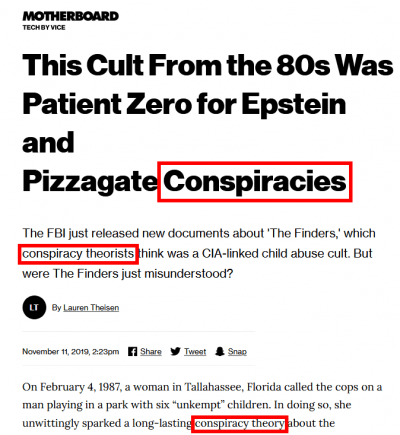
Mainstream media outlets have been quick to dismiss CIA ties to The Finder’s as little more than conspiracy
On their face, the contents of the FBI Vault documents appear to contradict the allegations made by former Special Agent Martinez: they include statements from multiple officers involved in the investigation from various agencies to the effect that they experienced no overt interference in their work from the CIA. Yet, when one looks closely, the documents also corroborate significant aspects of Martinez’s allegations and substantiate questions regarding the Finders’ links with intelligence.
There is the admission that Isabelle Pettie, the wife of Finders leader Marion Pettie, worked for the CIA during the Cold-War era (Pettie also admitted that his son worked for the CIA-linked, Iran Contra-era Air America), and that it was her visas to North Korea, North Vietnam, Russia and elsewhere that had been approved by the State Department. Key documents from the MPD investigation are labeled secret, just as Martinez had claimed, which is bizarre on its face if we are to believe that the Finders were simply an odd “alternative living” commune.
These and other corroborating details add credibility to Martinez’s claims regarding having witnessed other documents that indicated international child trafficking, as well as his assertion that he was told that the case had been deemed a “CIA internal matter.”
The FBI’s Vault publication includes records from the preliminary Tallahassee police department investigation, the MPD investigation, heavily redacted records from the U.S. Customs Service, documents from the Washington Metro Field Office (WMFO) of the FBI, and other agencies, as well as the correspondence and documentation of the 1993 inquiry, mostly from the WMFO to FBI Headquarters. The documents are scattered throughout the three published sections in no coherent order, and are interspersed with news reports from the time ranging from the initial arrests and the child custody issue to the 1993 inquiry into CIA connections with and protection of the group.
Bizarrely, a map relating to the McMartin Preschool scandal is also included in the publication for no known reason, since at this time the cases are completely unrelated aside from both having contained allegations of satanic abuse. Regardless of the intent behind the document’s inclusion, it serves to further associate the Finders with the so-called “moral panic” scandals of the era, which I would argue distracts from the issue of intelligence ties to the case.

A map of the McMartin Preschool inexplicably included in the FBI’s Vault release
A fresh look
Before moving further into analysis of the available evidence, it’s important to recognize a number of problems we face in understanding the information published in the FBI’s Vault. First, a multitude of large, often critically placed redactions plague the documents, the most important of which are not labeled with privacy exemptions but are instead labeled “S,” presumably meaning that the information is classified as secret.
Another problem involves the fact that information requested by some agencies — especially during the 1993 preliminary inquiry into a CIA coverup — was not provided to the relevant investigating agencies. Then there is the phenomenon of information disappearing outright, including vanishing evidence and instances of records never having been kept, resulting in conflicting accounts of the existence of critical pieces of evidence.
This series will challenge both the sensationalism and the silence of establishment media surrounding the Finders narrative by examining the allegations made by the U.S. Customs documents in view of the FBI’s more recent Vault publications, which shed fresh light on the connections between the Finders and the U.S. intelligence apparatus.
Elizabeth Vos is an independent journalist and MintPress News Contributor. Her work has appeared in many media outlets including Consortium News, where she co-hosts the CNLive! webcast.
Babyon Bee’s legal counsel demands retraction of NYT article that paints satire as “misinformation”
By Tom Parker | Reclaim the Net | June 3, 2021
Seth Dillon, CEO of Christian news satire site TheBabylon Bee, has announced that his legal counsel has sent a letter to The New York Times demanding the retraction of an article that insinuates The Babylon Bee is “misinformation.”
“We took this action because their article was—and remains—defamatory,” Dillon tweeted.
The original version of The New York Times’ article branded The Babylon Bee “a far-right misinformation site” that “sometimes trafficked in misinformation under the guise of satire.”
After pushback from Dillon and The Babylon Bee’s founder, Adam Ford, The New York Times replaced these claims with the claim that The Babylon Bee “has feuded with Facebook and the fact-checking site Snopes over whether the site published misinformation or satire.”
But Ford slammed the update, describing it as “awful and malicious and precisely worded to be so.”
In a subsequent interview, Dillon said The Babylon Bee was considering legal action against The New York Times and argued that mainstream media outlets that accuse The Babylon Bee of being misinformation are doing so in an attempt to get the satire site deplatformed by Big Tech.
“They put this stuff out there and if they can get it to stick, then then we have no platform remaining,” Dillon said. “There’s not going to be anybody who wants to host our stuff. … It’s an effort to try and cancel us.”
And Big Tech’s previous treatment of The Babylon Bee highlights how characterizing its content as something other than satire can have a negative impact on its business. Last year, Facebook claimed a Monty Python spoof post from The Babylon Bee was “inciting violence” and demonetized its entire page.
Following the announcement of this legal demand letter, Dillon picked apart The New York Times’ update and noted that Snopes had retracted its insinuations that The Babylon Bee was pushing misinofrmation.
“We have not, in fact, feuded with Snopes as to whether we publish satire or misinformation,” Dillon wrote. “Snopes retracted that insinuation with an editors’ note saying it was never their intent to call our motives into question. It’s therefore misleading and malicious to characterize that incident as a feud, as if Snopes ever openly stood by the claim that we are misinformation and not satire.”
“For better or worse, the NY Times is considered a ‘reliable source,’” Dillon added. “We cannot stand idly by as they act with malice to misrepresent us in ways that jeopardize our business.”
The Babylon Bee’s legal demand letter to The New York Times follows investigative reporting outlet Project Veritas filing a defamation lawsuit against The Times earlier this year after it described Project Veritas reporting as “false,” “deceptive,” and “with no verifiable evidence.”
A judge has ruled that The New York Times used “actual malice” when it accused Project Veritas of being deceptive and the lawsuit is now approaching the discovery phase with The New York Times recently filing a motion for stay of discovery process in an attempt to delay discovery.
Response to Fauci emails proves everything is fake, narrative management trumps reality, and those in power want it so
By Nebojsa Malic | RT | June 3, 2021
Watching the media coverage – or lack thereof – of Dr. Anthony Fauci’s emails and what they mean for the origin of the coronavirus, one is struck by how relentlessly fake everything is, from public health experts to science.
One of the things the emails suggest is that Fauci colluded with Peter Daszak – head of the EcoHealth Alliance, which channeled US research funding to the Wuhan Institute of Virology – to suppress and dismiss any notion that the virus causing Covid-19 may not have evolved naturally.
Thing is, Daszak actually went around giving interviews about his work in China throughout last year, and nobody in the media thought to connect the dots. Simply put, Donald Trump said the virus came from China and might have come from a lab, therefore that had to be wrong and racist, end of story, case closed.
That’s just one, most recent and most acute example of Narrative trumping reality at all cost. Millions of deaths, widespread destruction of the economy, tectonic changes in society itself? Small price to pay for “progress” and ensuring the “correct” outcome of the 2020 election, the fortifiers of Our Democracy might say, without anyone batting an eye. “Build back better!” the press parrots instead.
Trump disagreeing with CNN is a mortal threat to democracy and free speech, but Biden telling a reporter he’d rather run her over with an electric truck than answer a question about the war currently going on in Israel is a funny joke, haha, how hilarious. What flavor of ice cream did you order, sir?
This may seem partisan at first blush, but let’s remember this is the same media that once proudly carried water for the narrative about “Saddam’s WMDs.” So the old Democrat-vs-Republican dichotomy doesn’t really work here, and misses the bigger picture to boot.
A truly free society would have no official narratives, Australian columnist Caitlin Johnstone wrote earlier this week. Thing is, modern societies are not free, and official narratives are all they really have. Where would Joe Biden’s legitimacy be without the January 6 Capitol “insurrection” narrative?
American founders codified the First Amendment because they regarded a free press necessary for a free republic. Yet the corporate media complex and their Big Tech counterparts have become a lapdog, not a watchdog, of power. Even the agencies, once thought neutral and objective, are in on it. AP literally rewrote its stylebook to limit the use of “riot” last summer. Reuters “fact-checked” Biden’s eulogy for Robert Byrd as false because the Democrat senator wasn’t a “grand wizard” of the KKK but merely an “exalted cyclops.”
What this Orwellian replacement of facts with narratives does is condition the public to echo Hillary Clinton’s infamous Benghazi defense: “What difference, at this point, does it make?”
“Facts” mean nothing to this crowd. “Science” isn’t a rigorous process of finding the truth, but a word-totem invoked to grant authority and banish dissent. “Truth” is whatever they declare it is at the moment, and when it stops being convenient they’ll shamelessly go back and rewrite their own words, pretending all along that that’s what they’ve always believed. Yes, it’s literally Orwellian behavior, but they don’t seem to care.
After all, what are you going to do, change the channel? Actually, that’s happening. Month after month, ratings reports show CNN and MSNBC getting their clock cleaned by Fox News – and Tucker Carlson in particular. The response is to triple down on wokeness and Democrat talking points, while waging a veritable jihad against Fox for “misinformation.”
To think that the media will come to their senses when the reality of ratings hits them in the face, therefore, is foolish. They simply don’t give a damn. Could it be that they don’t care for money as much as they care about power? And not just proximity to political power, but the power to shape and control reality itself, to remake society according to their utopian ideas. Even assuming those ideas are good – and that’s debatable at best – having that sort of power corrupts absolutely, to borrow the expression from Lord Acton.
The media were meant to be a means through which the public collectively perceives reality – not the creators of reality itself! Yet they act as if the latter is true and intended. That’s dangerous. They believe themselves in control of reality, to the point where they’re impossible to reason with. Confront them with actual facts, or principles, or laws of physics, and they either censor you – or cackle and carry on.
Biden’s behavior starts making sense when you understand he exists in a fantasy world, entirely conjured by the press and his staff. As do thousands of activists, ‘NGOs’ and cultist consumers of US government grants around the world. How does one reach these people, who have internalized the “logic” of Who/Whom? That might be the most important question facing not just the US, but the world, very soon.
Nebojsa Malic is a Serbian-American journalist, blogger and translator, who wrote a regular column for Antiwar.com from 2000 to 2015, and is now senior writer at RT. Follow him on Telegram @TheNebulator
Australia’s drug regulator considers referring vaccine hesitant Facebook posts to police
The regulator cited potential two-year jail terms in some instances
By Tom Parker | Reclaim the Net | June 1, 2021
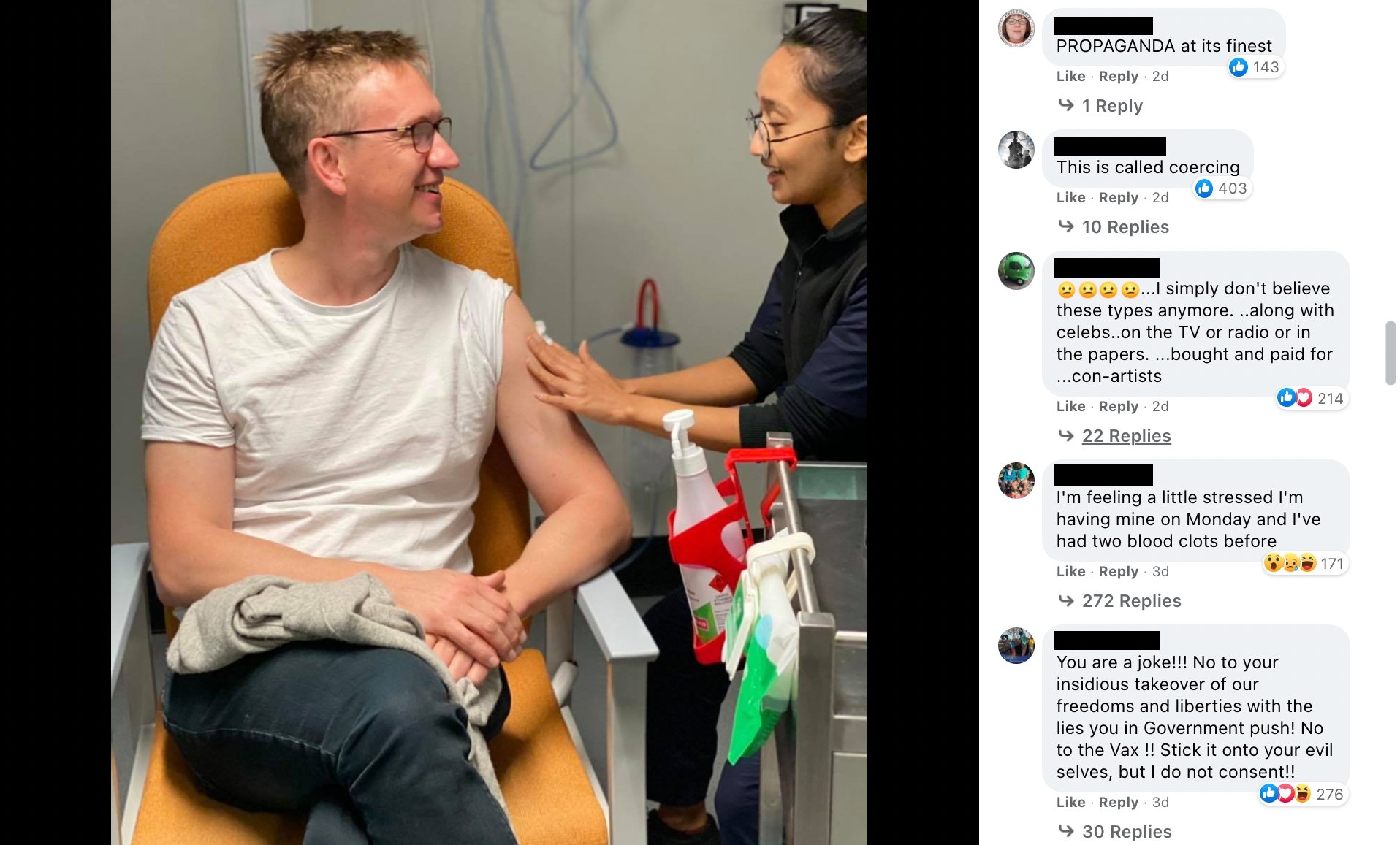
Australia’s drug regulator, the Therapeutic Goods Administration (TGA), is considering referring Facebook posts containing claims about COVID vaccine deaths to the police after a post showing Labor backbencher Julian Hill getting his vaccine was met with mass pushback from vaccine skeptics.
The post was ratioed with almost twice the number of comments to engagements – a common sign that a post is unpopular.
Many of the comments noted that the vaccine is “experimental,” described Hill’s post as “propaganda,” and voiced their objections to the vaccine.
But The Guardian Australia focused on alleged posts from some Facebook users that purportedly contained an image that cited the TGA and claimed that COVID-19 vaccines have caused more than 200 deaths.
The figure is a reference to the TGA’s disclosure in its May 27 COVID-19 vaccine weekly safety report that it has received “210 reports of deaths following immunisation.” However, the TGA insists that only one of these deaths was caused by the vaccines.
After The Guardian Australia contacted the TGA, it said the alleged posting of claims that the vaccine had caused more than 200 deaths were “particularly concerning” and that it would consider referring these posts to the federal police.
Additionally, the TGA noted that it’s a criminal offense, punishable by two years in prison, to represent oneself as a commonwealth body or claim to act on behalf of one.
The Guardian Australia also contacted Facebook which swiftly removed the posts for violating its far-reaching “COVID-19 misinformation” rules.
Despite the threat of police referrals from the TGA and Facebook removing the posts, Hill demanded that Australia’s health minister, Greg Hunt, take further action to “combat vaccine hesitancy, and the bat shit crazy conspiracy theories circulating online.”
He also warned “Australians will continue to be exposed to restrictions and lockdowns… until enough of the population is vaccinated.”
These developments come months after Australian lawmaker Craig Kelly had one of his Facebook posts about masks removed after complaints from the opposition party. Days after this post removal, his account was temporarily suspended and he was then permanently banned a couple of months later.
Facebook also expanded its crackdown on vaccine skeptic content last month by starting to “fact-check” and suppress individual users that repeatedly share misinformation. This followed whistleblowers exposing the tech giant’s secret algorithm that suppresses negative vaccine experiences.
COVID Corruption: Assaulting Human Norms

By Omar Khan | Uncommon Wisdom | May 31, 2021
Well, the seminal errors of the Covidian narrative stockpile so fetidly, you keep thinking one day, the stench will be so overpowering, that even those who have essentially put their critical faculties into suspended animation, will rally, finding that this reeks to high Heaven. Some restoratives surely, we think, will thaw their frozen wits.
I keep meandering back through the history of this ill begotten assault on life and liberty.
Imagine this being designated a “novel” Coronavirus. Well, if it was “massaged” in a Wuhan lab as it now seems all the craze to assert, perhaps there was some novelty to it. Otherwise, as we are advised, there are numerous coronaviruses parading around. Even C-19 is now relegated to only being the fourth most widespread in the US.
And now we find, from antibody tests and more, that some varietal was already doing the circuit in 2019. At any rate, some prior immunity exists. And if this is truly the descendant or even Frankensteinian stepchild of SARS, then as former Chief Medical Officer of Pfizer, Michael Yeadon has reminded us, though it is 80% identical, the immune systems of those exposed to SARS seem to “recognize” SARS-CoV-2, even these 17 years hence. Novelty therefore takes another nosedive.
So, this first assertion, right out of the gate, meant to terrorize us by suggesting an unknown pathogen without parallel, that could hoodwink our immune system completely, was poppycock. And we knew soon enough, it was far more infectious than SARS, but far less lethal. And mortality is where we should have kept our eyes fixed, not the delusions of asserted “cases” from unreliable tests. So, no, not so “novel” at least in impact.
Then, you have to wonder, if even mistaken as “novel,” surely there would be extraordinary curiosity, not fixated dogmatism, about this pathogen. However, it took only a few months, before torrential disdain was showered on any who raised questions as to whether we were over-reacting.
There was censorious outrage lavished on some of the world’s most eminent research experts in meta-analysis like John Ioannidis of Stanford, when he pointed out the lethality seemed less than was being forecasted for example, or when the Diamond Princess Cruise Ship kindly offered itself up as a floating case study, or when Knut Wittowski “sacrilegiously” suggested sunshine and fresh air are lethal to viruses with seasonality as a fairly evident way to corroborate that, and so many others. They were literally chased from the public sphere.
They have been only vindicated since, and why rationally, anyone actually interested in public health as a leader, wouldn’t have wanted a big tent of diverse views, a kind of Manhattan Project to tackle this virus and grapple with providing care, cannot be logically answered, except by accepting they were engaged in a charade of public health only, and other agendas were afoot that could brook no dissent.
In fact, if you consider it, how could they know who to censor? In other words, how with a “novel” coronavirus, could you have so readily stress tested alternatives to arrive at any credible consensus by then? Surely if genuinely interested in leadership and health, immensely experienced and credible experts indicating we may be overzealous, that this may be less deadly, more treatable and more manageable, would be manna from heaven. Such views would surely be welcomed, and would be carefully assessed, with trials done before the world was blown up, and irrevocable harm done to urban centers, small businesses, people needing desperate attention for other health issues, and before children’s lives and educations were turned topsy turvy. Yes, “if.”
By the way, it wasn’t even just Ioannidis and Wittowski. Similar alarms were raised and alternatives suggested by luminaries as diverse as Dr. Sucharit Bhakdi, specialist in microbiology and one of the most cited research scientists in Germany; Dr. Pietro Vernazza, Swiss specialist on Infectious Diseases at the Cantonal Hospital St. Gallen; Professor Hendrik Streek, Professor of virology and director of the Institute of Virology and HIV Research at Bonn University; Dr. David Katz founding director of the Yale University Prevention Research Center; Dr. Peter Goetzsche, Professor of Clinical Research Design and Analysis at the University of Copenhagen; Dr. Sunetra Gupta, Professor of Theoretical Epidemiology at the University of Oxford and later co-author of The Great Barrington Declaration; Dr. Anders Tegnell, that sainted man, Swedish State Epidemiologist who showed the world all of these contrary views were essentially right; Dr. Pablo Goldschmidt, Argentine-French virologist, Professor of Molecular Pharmacology at Universite Pierre et Marie Curie Paris; Dr. Jay Bhattacharya, Professor of Medicine and Public Health at Stanford and later co-author of The Great Barrington Declaration; Dr. Tom Jefferson, British epidemiologist based in Rome; Dr. Michael Levitt, Professor of Biochemistry at Stanford; German Network of Evidence Based Medicine… and so many more (distillations of their points can be found archived on Off-Guardian who collated these remarkable instances of “informed lack of consent.”)
When such a phalanx of experience, talent and credibility speaks at a seemingly desperate time, how could jurisdiction after jurisdiction, pillory them, ostracize them, mischaracterize what they had to say? Why that, rather than be desperately curious, and gratefully keen to explore their insights?
This is particularly so as you cannot possibly imagine that this constellation of talent had any motivation other than wishing to save and serve our global and local cultures, lives and livelihoods. And that they have continued to do so, despite media attacks, smears, economic disincentives, renders every word more plausible. After all, we know there are evident incentives of being proponents of the prevailing mythos. We cannot assert any incentive other than integrity and genuine conviction for refusing to acquiesce to the pervasive gaslighting and whitewashing.
Mass Manipulation
While stifling what should have been real life-lines, and once more we are seeing virtually all of their assessments vindicated today, we were run over by a freak-show of blatant stupidities.
With constant panic porn flashing incessantly, a multi-billion dollar industry of fraudulent tests is pushed through a 2-day peer review, by Dr. Doom (Drosten, who helped create the application of the test, sat on the review board of the publication “validating it” and profits from the tests that were mysteriously ready for production and shipping almost ahead of need). We were to ignore demonstrations of false positives, the need for amplification settings to be below 30 (WHO and others initially set them between 35 and 45, at the latter, a papaya fruit tested positive), as well as clarifications the test is not meant to be diagnostic (as per its inventor and as per the literature found in each test and finally “confessed” to post Trump by WHO as well).
And in one of the greatest bits of medical fraud, in plain sight, known by all, but still glossed over, a “case” was converted from someone who had symptoms to “someone who tested positive.”
The latter could be manipulated by the above settings, further counted on to be magnified via false positives, which ironically get worse in percentage terms as incidence goes down. The whole world held hostage to the vagaries of a non-diagnostic test, whereas had we focused on the symptomatic, no one would even have known we were in more than a really ugly influenza season.
Next, we were invited to ignore the age stratification, as the median age of death was over 80. So, lest people be cut down in the bloom of their 70’s and 80’s (and even there we can improve their odds with early treatment, which has been scrupulously avoided, or again smeared, or else “slow walked” almost catatonically en route to being reviewed), we were ready, for the first time in history, to quarantine the healthy!
We asserted “asymptomatic transmission” of which no credible instance has been found in over 14 months, being confirmed again and again even with the recent UK trials done with 9 large, teeming events that barely scraped together 16 “cases” from 60,000 people applying no COVID protocols, including a football FA Club Final and Brit Awards. You will have noticed, a very appreciable lack of media coverage of this “welcome” news. And the US CDC, now in the “vaccine selling” business has instructed clinics to only count as an instance of post-vaccination reinfection, those who, wait for it, have “symptoms.” The blood curdles at these fork tongued guideposts.
So, when the authors of The Great Barrington Declaration pointed out that when risk profiles are so vastly different, we should address and target care accordingly, there was howling and venting and the attacks were unleashed far and wide. They had pointed out this particular pathogen seems to focus on the elderly and so this pandemic tracks normal mortality and therefore in terms of both population size and adjusting for age, is considerably less lethal than the Hong Kong Flu of 1968 and the Asian Flu of the late 50’s, saying nothing of the epochal Spanish Flu in 1918 which infected one third of the global population of that time of which 10% perished!
By comparison, the current Indian death tally after all the shamefully imbalanced reporting is about 325,000 (despite the most egregious liberties with death certificates there, reported on by 161 doctors from N.I.C.E, National Influenza Care Experts, on May 24th in a letter to Prime Minister Modhi claiming guidelines given to them indicate that if PCR test is positive, even if someone died of accidents or clearly of other causes, the cause of death is to be recorded as C-19). Yet applying conventional death certificates, where only direct causation led to an entry, India lost 20 million in the Spanish Flu.
Painfully but necessarily, life went on. High time to adjust our hackles… and self-imposed shackles.
The Indian instance cited above is simply symptomatic of another fraud we embarked upon early on, taking liberties with how death certificates were filled out. Riddle me this, if truly so lethal, why was this necessary suddenly, after norms of indicating primary cause of death were the mainstay of medical practice for decades?
Why did we have to, in the US, incentivize via insurance, labeling COVID deaths? Why in the UK did we originally say anyone tested positively in the last 6 months, irrespective of comorbidities was a COVID death? This shrieks of outright dark comedy or at least ludicrous parody. But that was “fixed” to only doing that for those who tested positive in the last 28 days! So no one knows. Families have howled outrage, reported of course in secondary media, about their loved one being mis-tagged in this way, when they clearly passed from other causes. Who cares? Can’t interfere with the noxious narrative. In parts of South Asia, with cancer and blood poisoning along with a positive test on the death certificate, you guessed it, COVID wins the prize!
And the booby traps for sanity abounded. And the question to be asked is, why? For example,
why do we “lock down”?
This is a penal remedy, never applied before, disdained in public health literature until 2020, indicated in a 2019 report by WHO to
“not be done in any circumstances.”
One month in Wuhan blows up centuries of experience? Really? Are we welding doors shut next? Or staging collapsed bodies on streets with people in alien suits standing over them (you wondered about all those UFO sightings… voila!)?
As Dr. Risch of Yale has pointed out, with such tonic simplicity, “locking down” is not even coherent once the pathogen has spread! It’s fairly obvious once that’s pointed out. And it’s airborne, and almost all infections are in tight indoor spaces. Anyone not pledging fealty to a cult religion, can work this out. And in the face of non locked down jurisdictions with open societies and economies (US States, Sweden, Bulgaria) flourishing, and 30+ studies confirming no benefit from this illogical imposition, and the Oxford Stringency Index showing an inverse relationship between degree of shutdown and health outcomes, we are truly “stoned” on some narcotic to keep invoking this. Oh, and the belligerence if you question it, as if some canonical certainty was being desecrated.
Masking was not recommended by Fauci or WHO, and suddenly realizing that it could be a signature of totemic compliance, it was asserted, though study after study and simply common sense indicates it is a life leeching absurdity, to have you inhale your own waste, while choking off your oxygen supply. As one eminent, also censored, once tenured professor of Physics, Denis Rancourt says,
“The magical ‘one way mask’, which does not protect the wearer but acts as ‘source control’, is an invention of propaganda. It is contrary to the physics of breathing aerosol particles suspended in the fluid air. It is ridiculous fantasy.”
Frankly, the size of the particles are so small as to make this beyond fantasy. And if we truly believed they captured viral particles, would we blithely be leaving these masks lying around, or even throwing them in the open trash, so their harvest can waft at will? The boxes the cloth masks come in, have disclaimers to confess they don’t protect you against C-19. After all, they have openings so you can breathe and see. And there is no correlation between masking or its absence and COVID results. Again, the open US States have put that to rest. But thou must not question! “They say,” is the holy homily, and it must prevail.
So the round-up is: stifle dissent (which admits we have an agenda), create a “test” that doesn’t test and which can be manipulated, change all the guidance based on one month in Wuhan and Italian nursing home deaths (of which later authorities said 12% only could be directly ascribed to C-19), “order” indefinite mass incarceration, and decide without debate that this one source of harm, this one consideration, trumps everything else in the world: health, wealth, family, work, education, poverty, everything.
Why? Who says? A few models. Hmm. Sounds pretty sane. I’m ready to jettison everything I worked for, lived for, my city, culture, neighborhood, travel, way of life, on “asserted apocalypse” without discussing less destructive mitigation with a slew of the world’s most eminent doctors and scientists who say, based on data, we can do better. No agenda there. And if you don’t want the above poison pill, you’re out to kill everyone!
You’re out to kill me, the holy, carcass preserving, center of all global paranoia, me!
Vaccinating Sense
I don’t want to go over past ground to make the necessary point here. As medical luminaries like Dr. Peter McCullough and Dr. Pierre Kory and many others have pointed out, we know there are clearly effective, preventive treatments, and even some real treatments post hospitalization far more effective than the ‘wait and see’ nihilism that so many of these doctors at the forefront of treatment consider “medical malpractice.”
Of course, these treatments were slandered, fraudulently attacked, even though these are widely in use, no side effects, with multiple studies and numerous countries where they’ve been shown to work magnificently (Mexico, India, Zimbabwe, South Africa, parts of the US and more). But since our so called “vaccines”, perhaps the real “point” of this whole inhuman grotesquerie, are only approved tentatively for “emergency use” (safety trials won’t be complete until 2023), then other treatments if established, would remove “the emergency necessity” and that would jeopardize the whole scabrous scam.
Serial entrepreneur Steve Kirsch has even offered $2 million to anyone who can demonstrate that all the randomized trials and global as well as research evidence is wrong, and that the NIH and WHO concern about Fluvoxamine and Ivermectin is justified. A straight $2 million windfall or grant. No one has taken him up on it. His credibility as a medical entrepreneur and philanthropist is unimpeachable.
A few points. You don’t have to remotely be an “anti-vaxxer” (those who oppose them on principle) to be concerned by any or all of the following:
Safety protocols are incomplete
The mRNA treatments are not “vaccines” they are symptom suppressors. Since the vulnerable were not part of the clinical trials, and those trials had such a small subset of the population anyway (‘nominal’ is a generous term), we really don’t know how well they do for the elderly, the vulnerable, etc. And how in that period could we know anything about “safety” and “efficacy?” Booster shots are already being discussed.
All of them have blood clotting issues, 4,000 deaths plus in the US, 10,000 in Europe, both very likely an undercount, as only a small percentage make it into the adverse effects database, and we have swelling evidence, of doctors extremely reluctant to link “anything” to a vaccine, even if a healthy person, within days, dies. Of course you can say, “healthy people also die.” But since in tabulating COVID lethality the norms were at the other extremity, where a “whiff” of COVID put it on the death certificate, we can clearly see again, wanton inconsistency, and again narrative protection at all costs. These deaths are more than the cumulative recorded death from all other vaccines combined, for an illness you have to be tested for to even know you have!
Re-infection has been rife, and mass surges in cases and deaths after mass vaccination in populations (Israel, UK, Gibraltar, Seychelles, Maldives), and now with the Chinese vaccines, Bahrain, Chile and UAE, either no improvement or serious spikes in cases and deaths.
How can anyone call this normal? And so people are opting out, and mania has set in. To induce you to get vaccinated, free ice cream, drinks, the NYC Mayor offering free burgers, lotteries linked to vaccination, dating apps linked to incentivize sexual license.
Yet, as noted, we hear people are getting re-infected? Doesn’t matter, speed past that, just get a jab in every arm. And children? They have no risk, they don’t transmit the disease, shown over and over, Sweden had no deaths in schools with schools open throughout. But suddenly, a 12-year-old can consent in North Carolina to being “jabbed”? Can they also vote, drive, have sex, smoke and drink while they’re at it?
Can anyone call this remotely normal? Experimental gene therapy asserting “safety” you cannot possibly even know (Salk Institute Study indicates that the spike proteins being injected themselves, without even a virus involved, can cause the virus). Future impact is unknown, people are understandably spooked. How is this anywhere close to “informed consent” by the Nuremberg standards?
And what has happened to the EU? But for a few standouts like Denmark and Sweden, they are ready to require “vaccine passports” thereby ignoring those who have recovered and don’t need experimental substances in their body, or those below 60 and healthy with no statistical risk, or children with a truly non-existent risk profile (symptoms easily treatable for them), and with abundant, far safer, preventive treatments? With plummeting numbers, no “pandemic” in Europe, no excess mortality for 2020, what in God’s name is the panic to just jab everything and everyone in sight, including innocent children we are conducting “human trials” on?
This is horror movie material, but chillingly real.
By the way, despite a nominal surge (large in a relative sense as their numbers are so tame), Japan still has among the lowest numbers of deaths per million in the world. 1% of the population is vaccinated.
None of it makes sense, none of it is plausible, any more than the face diapers, penal lock ups, fake non-diagnostic tests, death certificate manipulation, avoiding treatment that reduces hospitalization risk by over 85%, censoring new insights from the most credible experts. All this while blowing up the economy, magnifying poverty, killing children through hunger and awaiting the reckoning when all the currency printing eventually comes home to roost.
So, we have to stop “asking” for relief and move to “demanding” it. And we have to stop acquiescing and trying to “persuade.” No one is this villainously stupid. Villainous maybe. So you can’t “persuade” someone out of a pathology or a psychosis. We can be respectfully, lawfully, civilly disobedient, and make our voices heard, in concert, and purposefully.
This isn’t Life
C.J. Hopkins, writing from “New Normal” Germany describes this version of “living”:
“Perfectly healthy, medical-masked people are lining up in the streets to be experimentally ‘vaccinated’.”
Lockdown-bankrupted shops and restaurants have been converted into walk-in “PCR test stations.” The government is debating mandatory “vaccination” of children in kindergarten. Goon squads are arresting octogenarians for picnicking on the sidewalk without permission.” Sound appealing?
Should I await docilely to be told when to go out, where to go out, what experimental substance to have shot into my body and that of my family? Should I welcome no stimulus, no abandon, no real laughter or mirth, no experiencing of human aptitudes, or going freely to other lands and immersing in other cultures or relishing the world as a part of my birthright? Is it really all right for us to have these political scavengers pick on the remains of our autonomy?
Poet laureate Seamus Heaney writes so unforgettably:
“History says, don’t hope
On this side of the grave.
But then, once in a lifetime
The longed-for tidal wave
Of justice can rise up,
And hope and history rhyme.”
Time to see if we can’t catch one of those waves.
The prose, the poetry, the rhymes, the chimes, of our lives are at stake. And there we must all decide to take a stand, however, whenever and wherever we can, for the future we seek.
Russia Falsely Accused of Hacking USAID
By Stephen Lendman | May 29, 2021
Virtually all accusations by Washington and its complicit partners against Russia and other nations free from US control lack evidence supporting them because none exists.
Yet they surface time and again, supported by Western press agent media.
On Friday, the Russophobic NYT was at it again, falsely accusing Moscow of hacking USAID.
In response to an earlier phony US accusation of Russian hacking last year, its US embassy said the following:
“We paid attention to another unfounded attempt of the US media to blame Russia for hacker attacks on US governmental bodies.”
“We declare responsibly: malicious activities in the information space contradicts the principles of the Russian foreign policy, national interests and our understanding of interstate relations.”
“Russia does not conduct offensive operations in the cyber domain.”
“What is more, the Russian Federation actively promotes bilateral and multilateral cyber security agreements.”
“In this regard, we would like to remind (the US regime) of the initiative put forward by President Vladimir Putin on September 25 on a comprehensive program of measures to restore Russian-US cooperation in the field of international information security.”
“We have received no reply from Washington.”
“Many our other suggestions to start constructive and equal dialogue with the US remain unanswered.”
Hacking and countless other crimes are how the US-dominated West and Israel operate.
In sharp contrast, Russia fully complies with its international obligations, according to the rule of law.
Yet once again, NYT fake news falsely claimed the following:
“Hackers linked to Russia’s main intelligence agency surreptitiously seized an email system used by (USAID) to burrow into the computer networks of human rights groups and other organizations of the sort that have been critical of President Vladimir V. Putin, Microsoft Corporation disclosed on Thursday (sic).”
When accusations are unsupported by independently verified evidence, they’re baseless.
None exists to support accusations against Russia under Vladimir Putin.
Will the latest phony one be used as a pretext to cancel a scheduled mid-June summit between Putin and Biden’s impersonator — because he can only recite lines scripted for him.
If held, the summit will be farcical — a know-nothing imposter engaging with a world leader of Putin’s stature.
Perhaps the latest phony accusation against Russia will be used to cancel it — to avoid US embarrassment if they meet face-to-face.
No Russian hack of USAID occurred, no evidence suggesting it.
What the Times indicated as the aim of the phony claim fell flat like earlier baseless accusations against Russia.
An invented scenario by the Times reads like a rejected grade B Hollywood script.
Corporate predator Microsoft is complicit with wars by hot and/or other means on invented US enemies.
So are the Times and other establishment media — operating as mouthpieces for US imperial interests on all things geopolitical, notably against Russia, China, and nations victimized by US aggression.
No phony NYT claim of Russian “malicious activity (or) appetite for disruption” against the US or other countries exists, no evidence suggesting it.
An unnamed DHS official falsely claimed that the agency was “aware of the potential compromise” at USAID (sic) and is “working with the FBI and (the State Department’s agency) to better understand the extent of the compromise (sic) and assist potential victims (sic).”
No Russian SolarWinds hack occurred earlier or other hacking it was falsely accused of earlier.
Yet Microsoft and the Times falsely claimed a Nobelium group in Russia hacked SolarWinds and USAID despite no verifiable evidence because there is none.
Time and again, Times reports don’t pass the smell test.
Its daily editions feature managed news misinformation, disinformation and fake news on major domestic and geopolitical issues — far removed from all the news it claims to be fit to print.
A Final Comment
Undemocratic Dem war goddess Samantha Power heads USAID.
Like other interventionist extremists, she never met a nation free from US control she didn’t want smashed.
She once called US foreign policy “a tool box” with a range of options to advance the nation’s hegemonic aims.
Civil rights lawyer Chase Madar earlier called her hellish agenda “a richly instructive example of the weaponization of human rights.”
Like other US hostile to the rule of law officials, she falsely blames others for its high crimes of war and against humanity.
Chances are she was behind the latest false accusation of Russian hacking, enlisting Microsoft to make the phony claim.
Her maliciously destructive worldview is polar opposite values just societies cherish.
Media outlets try to deflect from lab leak theory and censorship
By Didi Rankovic | Reclaim the Net | May 29, 2021
Mainstream media, now embarrassingly forced to follow President Biden’s policy and abruptly reverse course on the Wuhan lab leak theory – after branding and ridiculing it as a conspiracy theory for months – are working to downplay the importance of censorship around the topic that was enforced until just a few days ago.
One would think it would be hard to find a single person who has been through more than a year of lockdowns and myriads of restrictions who would not be interested to learn what the virus is and where it came from – but apparently, such people exist, in media outlets like The Verge.
An article that could easily be described as a distraction in its own right from the topic of why the lab leak theory was suppressed and censored so vigorously, now claims that the origin of coronavirus doesn’t really matter and suggests that it should be swept under the rug as a distraction from truly important topics.
While briefly paying lip service to the importance of discovering the origin of the virus, the article’s real goal is to convince its readers to change the topic. Forced to eat their own words, this class of media are no longer calling the Wuhan theory a fringe conspiracy, but “an extraordinary claim” that is “technically possible.”
But discussing the topic is discouraged as no less than “a distraction from the rest of the urgent work governments and health agencies around the world need to do in order to end this pandemic and prepare for the next one” – while at the same time calling for vaccination efforts to be doubled.
And as scientists who have tried to study the origin of coronavirus, including the possibility that it was artificially created, are finally getting a chance to speak after being censored and ostracized for a long time – mainstream media are scrambling to adjust to the new reality around the topic.
The New York Times has already done its U-turn, reporting on Friday that US intelligence agencies have a large amount of evidence concerning the Wuhan lab – but one of its reporters, Apoorva Mandavilli, didn’t get the memo immediately.
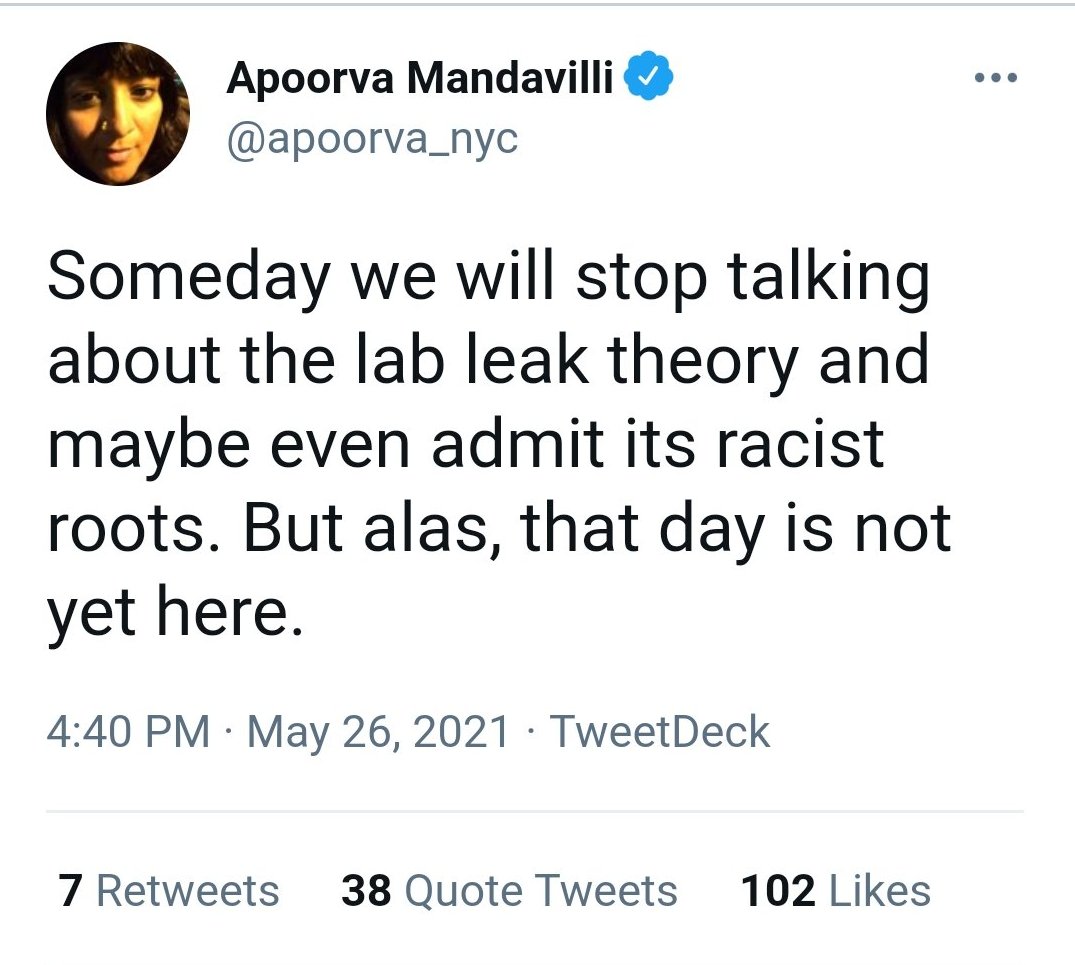
On the same day President Biden announced an investigation, Mandavilli tweeted, “Someday we will stop talking about the lab leak theory and maybe even admit its racist roots. But alas, that day is not yet here” – only to quickly delete the post after receiving backlash for making the claim that it was “racist” to consider the possibility that the virus was engineered by humans.
Featured Video
Houthis Don’t Have to Conquer Saudi Arabia to Make It Pay
or go to
Aletho News Archives – Video-Images
From the Archives
Newly Released FBI Docs Shed Light on Apparent Mossad Foreknowledge of 9/11 Attacks
By Whitney Webb | MintPress News | May 17, 2019
NEW YORK — For nearly two decades, one of the most overlooked and little known arrests made in the aftermath of the September 11 attacks was that of the so-called “High Fivers,” or the “Dancing Israelis.” However, new information released by the FBI on May 7 has brought fresh scrutiny to the possibility that the “Dancing Israelis,” at least two of whom were known Mossad operatives, had prior knowledge of the attacks on the World Trade Center. … continue
Blog Roll
 Aletho News
- MEP blasts ‘Euro-Gestapo’ for lecturing Russia on democracy
- Syria May Send Troops to Saudi Arabia Amid War with Ansar Allah
- UK whines about losing billions to ‘Putin tax’
- Baghaei to Rubio: Distorted narratives cannot erase US record of broken commitments
- Houthis Don’t Have to Conquer Saudi Arabia to Make It Pay
- MOE: Nearly 22,000 Students and Education Workers Killed
- Guterres in Islamabad: Genocide, cowardice, and the cage of Imran Khan
- Johnson, Marandi say Yemen holds upper hand over Saudi Arabia
- False flags won’t save aggressors, Iran FM spokesman says
- The Makkah Pact Enters Into Force: The End of American Dominance or Its New Form?
- If Americans Knew
- Report claimed Mark Levin used by Israeli government to influence Trump
- Over 2,000 Gazans have died awaiting medical evacuation amid Israel’s continued siege
- How a U.S. Diplomat Suppressed and Altered Reports Critical of Israel
- 5 Palestinians Die from Israeli Strikes in Gaza as Relentless Attacks Continue
- Report: Ceasefire Slows Killing but Leaves Devastation Intact
- Country Music Singer Zach Bryan Breaks Attendance Record at Robert Kraft’s Gillette Stadium While Wearing ‘Free Palestine’ Shirt for Second Night in a Row
- Three years of death and devastation: Israel’s war on Gaza in pictures
- Why Hamas believed the status quo was more dangerous than its 7 October gamble
- Debunking Israel’s latest list of ‘terrorist’ journalists in Gaza
- In Gaza, focus is on survival, “every step is a struggle” – Daily Update
- No Tricks Zone
- New Study: 50 Years Of The Most Aggressive ‘Net Zero’ Policies Can Only Affect The Global Climate By 0.03°C
- US September “Heat” Was No Record…Many Records Set Decades Ago
- Latest European Green Energy Debacle; Portugal’s Largest Flagship Solar Park Insolvent!
- Green Energy Debacle: German Expert Professor Fritz Vahrenholt Warns Of Severe Economic And Social Consequences
- Two More Paleo Reconstructions Affirm Meters-Higher Sea Levels Across Ireland, Brazil 7000-6000 Years Ago
- New Study: Earth And Venus Surface Warmth Largely Explained By Convection And Lapse Rate, Not CO2 Or Radiation
- 2025 Nature Paper Claiming Worsening Global Drought Gets RETRACTED …Heavily Flawed
- New Study: ‘Global Drought Shows No Detectable Recent Acceleration Under Climate Warming’
- Economic Masterminds: German Socialists Suggest Taxing Productivity Gains Stemming From Using AI
- The South China Sea Has Not Been Cooperating With The Climate Change Narrative