Justifying the 17-Year War
By Jacob G. Hornberger | FFF | January 25, 2019
When I first learned about the Thirty Years War in a history class in college, I was both fascinated and amazed. How in the world could a war go on for 30 years? That just seemed incomprehensible to me.
Not anymore. The U.S. war on Afghanistan has now been going on for 17 years. And if the American people follow the advice of Michael E. O’Hanlon, a senior fellow at the Brookings Institution, it’s a virtual certainty that the United States will easily surpass the Thirty Years War and, maybe, the Hundred Years War, which needless to say, also amazed and fascinated me when I learned about its existence.
I can just see Americans 83 years from now breaking the 100-year-war record and exclaiming in celebration, “We’re Number One! We’re Number One! KAG! KAG! Keep America Great!”
O’Hanlon’s advice comes in the form of an op-ed in yesterday’s New York Times. It’s entitled “Our Longest War Is Still an Important War.” In his op-ed, O’Hanlon says that it is important that U.S. troops remain occupying Afghanistan, perhaps even in perpetuity.
Why does O’Hanlon feel this way? The thrust of his piece is a variation on the theme that has guided the so-called war on terrorism ever since the 9/11 attacks way back in 2001— that it’s better for U.S. forces to kill the terrorists over there before they come over here to get us.
Not surprisingly, O’Hanlon ignores a very important point about this “war on terrorism” — that it is U.S. interventionism that is the cause of anti-U.S. terrorism.
Why is that important? Because the continued and perhaps perpetual interventionism that he is endorsing produces the very thing that he’s using to justify the continued interventionism.
When U.S. forces kill five “terrorists” over there, they bring into existence ten more terrorists. Those ten new terrorists then become the justification for remaining over there instead of coming home after killing those original five terrorists. Then, once they kill the ten, twenty more come into existence, which is then used to justify staying over there so that they can kill the twenty.
That’s how the “war on terrorism” has become perpetual, which President George W. Bush even suggested would happen way back in 2001.
Interventionists, of course, hate it when we libertarians point out this obvious fact. Recall that famous Republican presidential debate when Ron Paul pointed out that “they” came over here to kill us because the feds were over there killing them. His Republican opponents went ballistic, as did the mainstream press. No one is supposed to say that.
You see, the official position is that the terrorists just spring up and strike a nation, sort of like the flu. Or that they just hate America for its “freedom and values.” I suppose they would say that the Swiss, whose government simply minds its own business, are just plan lucky to have been spared the terrorist flu.
The reality is that the cause of anti-American terrorism is U.S. interventionism. Thus, if you stop the interventionism, the anti-American terrorism stops.
But that’s the last thing interventionists want. Interventionists don’t have any problems with the militarism, the national-security statism, the massive spending, the empire of domestic and foreign military bases, the invasions, the occupations, the CIA, the NSA, the assassinations, coups, partnerships with dictatorial regimes, secret surveillance, and the installing of pro-U.S. regimes around the world.
Interventionists and the national-security establishment always need official enemies. Recall that throughout the Cold War, the official enemy was Russia and the rest of the Soviet Union, along with “godless communism” and the supposed worldwide communist conspiracy to take over the world, which, they said, was based in Moscow.
When they ostensibly lost their official enemy in 1989 with the end of the Cold War, that’s when they began killing people in the Middle East, including during their invasion of Iraq and the subsequent killing of Iraqi children with sanctions. That’s when Iraqi dictator Saddam Hussein because the official enemy. He was coming to get us, they said, with WMDs.
Then after the blowback of the 9/11 attacks, it was the terrorists, who morphed into the Muslims, who, we learned, were engaged in a centuries-long conspiracy to make the United States a part of a worldwide caliphate based on Sharia law.
Most recently, we’ve come full circle with Russia being made once again into an official enemy, along with terrorists and Muslims and, well, also illegal immigrants and drug dealers.
I wish that I could tell you that was all. If you really want to get scared, read O’Hanlon’s article. It turns out that there are so many more bugaboos out there, which have caused him to embrace a continuation of the 17-year war in Afghanistan. Apparently, there’s al-Qaeda, the Islamic State, “related groups,”and, get this — even ISIS-K! According to O’Hanlon, that stands for ISIS-Khorasan. I’ll bet you hadn’t heard of that last one. Scary!
How can any American citizen buy into this nonsense? Bring the troops home, now. All of them. And discharge them. Interventionists have done enough damage to our nation and to the people of Afghanistan (and Iraq, Syria, Libya, and so many other countries). It’s time to return to founding principles, especially America’s founding principle of non-interventionism.
The United States Is at It Again: Compiling an Enemies List
By Philip M. GIRALDI | Strategic Culture Foundation | 24.01.2019
Many American still long for the good old days when men were still manly and President George W. Bush was able to announce that there was a “new sheriff in town” pledged to wipe terrorism from the face of the earth. “You’re either with us or against us,” he growled and he backed up his warning of lethal retribution with an enemies list that he called the “axis of evil.”
The axis of evil identified in those days in the 2002 State of the Union Address consisted of Iraq, Iran and North Korea. Iraq, which had not yet been invaded and conquered by the American war machine, was number one on the list, with Saddam allegedly brandishing weapons of mass destruction deliverable by the feared transatlantic gliders that could easily strike the United States. Bush explained that “Iraq continues to flaunt its hostility toward America and to support terror. The Iraqi regime has plotted to develop anthrax and nerve gas and nuclear weapons for over a decade. This is a regime that has already used poison gas to murder thousands of its own citizens, leaving the bodies of mothers huddled over their dead children. This is a regime that agreed to international inspections, then kicked out the inspectors. This is a regime that has something to hide from the civilized world.”
North Korea meanwhile was described as “A regime arming with missiles and weapons of mass destruction, while starving its citizens” while Iran “aggressively pursues these weapons and exports terror, while an unelected few repress the Iranian people’s hope for freedom.”
The phrase “axis of evil” proved so enticing that Undersecretary of State John Bolton used it two months later in a speech entitled “Beyond the Axis of Evil.” He included three more countries – Cuba, Libya and Syria because they were “state sponsors of terrorism that are pursuing or who have the potential to pursue weapons of mass destruction (WMD) or have the capability to do so in violation of their treaty obligations.” The nice thing about an Axis of Evil List is that you can make up the criteria as you go along so you can always add more evildoers.
Iraq was removed from the playing field in March 2003 while Libya had to wait for President Barack Obama and Secretary of State Hillary Clinton to be dealt with, but North Korea, Cuba, Syria and Iran are still around. Nevertheless, the idea of an enemies list continues to intrigue policy makers since it would be impossible to maintain the crippling burden of the military industrial complex without a simple expression that would convey to the public that there were bad actors out there waiting to pounce but for the magnificent efforts being made by Boeing, Lockheed, Northrop Grumman, General Dynamics and Raytheon to defend freedom.
The Administration of President Donald Trump, not to be outdone by its predecessors, has recently come up with two enemies lists. The first one was coined by the irrepressible John Bolton, who is now National Security Adviser. He has come up with the “troika of tyranny” to describe Cuba, Venezuela and Nicaragua, where he sees “… the dangers of poisonous ideologies without control, and the dangers of domination and suppression… I am here to convey a clear message from the President of the United States about our policy towards these three regimes. Under this administration, we will no longer appease the dictators and despots near our coasts in this hemisphere. The troika of tyranny in this hemisphere — Cuba, Venezuela and Nicaragua — has finally found its rival.”
Bolton also demonstrated that he has a light touch, adding “These tyrants fancy themselves strongmen and revolutionaries, icons and luminaries. In reality, they are clownish, pitiful figures more akin to Larry, Curly, and Moe. The three stooges of socialism are true believers, but they worship a false God.”
Secretary of State Mike Pompeo has apparently also been looking at Venezuela and not liking what he is seeing. On his recent road trip to the Middle East he told reporters that “It is time to begin the orderly transition to a new government [in Caracas].” He declared that “The Maduro regime is illegitimate and the United States will work diligently to restore a real democracy to that country. We are very hopeful we can be a force for good to allow the region to come together to deliver that.” “Force for good” is another key soundbite used by Pompeo. In his Cairo speech on January 10th, he described the United States as a “force for good” in the entire Middle East.
Bolton might have thought “troika of tyranny” was a hands down winner, but he was actually upstaged by the dour Vice President Mike Pence who declared to a gathering of US Ambassadors that “Beyond our global competitors, the United States faces a ‘wolf pack of rogue states.’ No shared ideology or objective unites our competitors and adversaries except this one: They seek to overturn the international order that the United States has upheld for more than half a century.” The states Pence identified were North Korea, Iran, Cuba, Venezuela and Nicaragua. Of the five, only North Korea can even plausibly be considered as a possible threat to the United States.
As wolves are actually very social animals the metaphor provided by Pence does not hold together very well. But Pence, Bolton and Pompeo are all talking about the same thing, which is the continued existence of some governments that are reluctant to fall in line with Washington’s demands. They have to be banished from polite discourse by declaring them “rogue” or “tyrannical” or “evil.” Other nations with far worse human rights records – to include Saudi Arabia, Pakistan, Israel and Egypt – are given a pass as long as they stay aligned with the US on policy.
So useful “lists” are all about what Washington wants the world to believe about itself and its adversaries. Put competitors on a list and condemn them to eternal denigration whenever their names come up. And, as Pence observes, it is all done to prevent the overturning of the “international order.” However, his is a curious conceit as it is the United States and some of its allies, through their repeated and illegal interventions in foreign countries, that have established something like international disorder. Who is really doing what to whom is pretty much dependent on which side of the fence one is standing on.
Second-Round Stakes Higher for Trump and Kim
By Patrick Lawrence | Consortium News | January 24, 2019
President Donald Trump’s announcement late last week that he will meet North Korea’s Kim Jong-un next month promises a significant result whether the encounter succeeds or fails. In the intervening weeks, we have two questions to ponder.
No. 1: what will this second summit accomplish? The first Trump–Kim meeting last June in Singapore was about establishing rapport and can by this measure be counted a success. Something of substance, however modest, needs to get done this time.
No. 2, and just as important, will Trump’s foreign policy minders undermine this encounter before it takes place? The record suggests this is a serious possibility.
A month ago, Trump announced the withdrawal of U.S. special forces from Syria. The howls of protest, Capitol Hill Democrats often the shrillest, have not ceased. And troops have not started to pack their duffel bags.
But the Syria decision may prove a turning point, given that Trump directly confronted the policy clique — segments of the Pentagon and State Department bureaucracies, as well as members of the National Security Council —who have been sabotaging his objectives since his first day in office two years ago.
Steve Bannon, once and briefly Trumps’ strategic adviser, put it this way after the withdrawal announcement: “The apparatus slow-rolled him until he just said enough and did it himself. Not pretty, but at least done.”
Will the second Trump–Kim summit prompt another such showdown with “the apparatus” around Trump?
It could. John Bolton, Trump’s national security adviser, is a hyper-hawk on North Korea. Behind him, the Pentagon finds the prospect of lasting peace on the Korean Peninsula a threat to its immense presence in Northeast Asia. Be wary in coming weeks of vaguely sourced press reports citing newly discovered North Korean treachery, betrayals, and deceits.
More For, Than Against
On balance, however, Trump and Kim appear to have more going for them than against them this time.
Now that the policy cliques and the press have run out of playground epithets for Kim—monster, merciless murderer, and so on—it is generally acknowledged that however autocratic, he is a young but capable statesman. In his new year’s message, he confirmed that national policy has now shifted decisively toward economic development as the North’s top priority.
While Washington and its clerks in the corporate press give Kim no credit, he has already made numerous gestures intended to appease American hawks such as Bolton, build confidence, and signal his desire to be, in effect, a modernizing dictator somewhat in the mold of China’s former leader, the late Deng Xiaoping.
Kim has halted all nuclear and missile testing, destroyed a nuclear-testing site, offered to pull back artillery from the 38th parallel, which now divides North and South Korea, and returned the remains of some American soldiers killed in the 1950–53 war. North and South have also demilitarized a “truce town.”
Kim wants a deal—there are no serious grounds to question this—and is surely smart enough to know he has to bring something impressive to the table next month. Just what this will be is not clear. It is easier to anticipate what he will not concede: the reciprocal diplomatic process that Moon Jae-in, South Korea’s president, calls “action for action.” It is the only rational, workable way to go forward after almost seven decades of mutual distrust and animosity.
Development Planning
Moon has remained remarkably energetic in behalf of a North–South settlement. His country, along with Russia and China, have drawn up development plans to connect the North and its neighbors — rails, roads, airports, seaports, power plants, refineries, and so on — that has something for everybody: The North acquires the foundation for a modern economy, South Korea gains land routes to Chinese, Russian, and European markets, Russia develops its Far East, and China can do more business with both North and South. A map of this plan shows three development belts: Two are to run down the Korean Peninsula’s western and eastern coastlines from the Chinese and Russian borders respectively. The third will run west to east across the 38th parallel. Moon wants these links eventually to connect South Korea to the Trans-Siberian Railway.
The numbers bandied about are extraordinary. While Seoul has allocated a modest $260 million to improve cross-border rail links this year, that is merely the beginning. The Korea Rail Network Authority, a government agency, estimates that upgrading the North’s roads and rails alone will cost roughly $38 billion before it is done. At the time of the first Trump–Kim summit, Citicorp put the cost of rebuilding all of the North’s infrastructure at $63 billion.
These plans have advanced steadily since the first Trump–Kim meeting. But coverage in the mainstream American press is far from abundant.
By all appearances, the U.S. is simply not interested in a constructive settlement in Northeast Asia, even as other nations proceed to develop one. This is a perfect illustration of what happens when a nation is intent only on the projection of its power.
It is anyone’s guess what Trump will bring to his summit with Kim. But it is clear what would produce a breakthrough if Trump truly wants one. First, he can exempt some of Moon’s cross-border development plans from sanctions that now inhibit them. Second, he can relax the ridiculous demand that the North completes its denuclearization before Washington concedes anything. “Give us all we want and then we negotiate” is not a position from which to expect any gains.
Given Kim’s aspirations and the diplomatic efforts of Seoul, Moscow, and Beijing, the opportunity for a settlement of the Korean question has not been this promising since the 1953 armistice. At the same time, Washington has rarely been so uncertain of its power—and hence so eager to display it—and we have a president surrounded by advisors given to neutralizing his better policy objectives.
If Trump and Kim get something done a month from now, we could be on the way to peace in Northeast Asia after 66 years of high tension. If they fail, or if Trump gets the Syria treatment, many years are likely to pass before a moment this propitious comes again.
Patrick Lawrence, a correspondent abroad for many years, chiefly for the International Herald Tribune, is a columnist, essayist, author and lecturer. His most recent book is “Time No Longer: Americans After the American Century” (Yale). Follow him @thefloutist. His web site is www.patricklawrence.us. Support his work via www.patreon.com/thefloutist.
No need to install: Microsoft has controversial fake news filter NewsGuard built into mobile browser

© http://www.microsoft.com
By Igor Ogorodnev | RT | January 23, 2019
Corporate and neocon-backed startup NewsGuard is one step closer to its vision of bringing its “unreliable” news rater to every screen after Microsoft makes it an integral part of its Edge mobile browser.
Rather than having to download an app as before, Edge users on Android and Apple devices can now just click one button to enable its “green-red rating signal if a website is trying to get it right or instead has a hidden agenda or knowingly publishes falsehoods or propaganda.”
Among the green-rated websites: Voice of America, CNN, Buzzfeed, the Guardian, New York Times and the Washington Post, as well as left-leaning upstarts such as Vice News and Refinery 29. Ones that are given the red warning label of “failing to maintain basic standards of accuracy and accountability”: RT and Sputnik (obviously enough) and the right-wing Daily Mail, Breitbart and the Drudge Report, in addition to hundreds of other non-mainstream news websites such as Wikileaks.
Not only does the integration ensure that NewsGuard is present on every browser, and is easier to use than to ignore, but by making it a fundamental Microsoft-provided feature, the company gives it inherent level of trustworthiness, something akin to a bundled anti-virus feature, only this time the virus targets your brain, not your computer or iPod.
‘Totally transparent’
None of this is the slightest bit alarming if you believe that NewsGuard is an absolutely fair arbiter of what constitutes real news or propaganda.
Its pride of place is its “Nutrition Labels” which ape the precision of a list of calories, carbs, and saturated fats to give a supposedly scientific assessment of media reliability on nine different criteria. Among them: doesn’t repeatedly publish false content, avoids deceptive headlines, gathers and presents information responsibly, handles the difference between news and opinion responsibly.
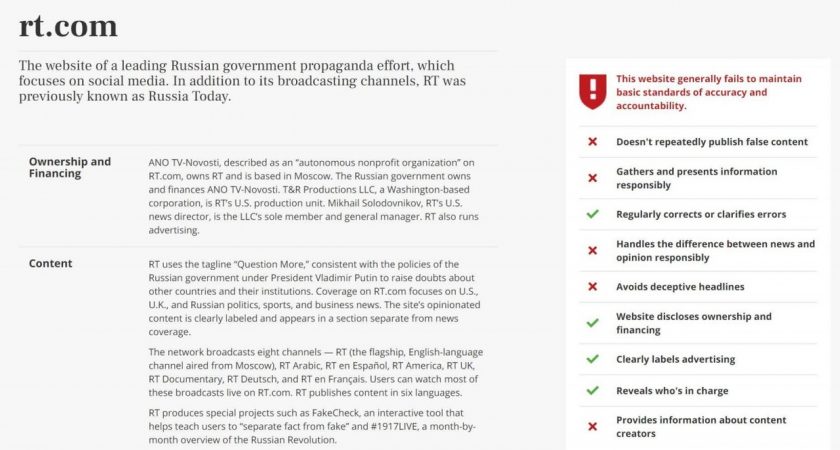
© Newsguardtech.com/Media sample
The green-listed media outlets above apparently do not ever engage in these practices, or at least not knowingly. So CNN never misleads with its headlines, the Guardian never dresses up its agendas as news, and Buzzfeed stories are always accurate. One literally doesn’t have to go back three days to find dozens of examples to the contrary, but this would be too mind-numbingly pedantic a task.
Even regular readers of the green-tick media must be able to see these are judgment calls. What is even “presenting information responsibly”?
Perhaps realizing that their pseudo-scientific fancy diagram is insufficient, NewsGuard has stressed that they are not using shadowy methods like tech companies and are open to two-way communication.
“We want people to game our system. We are totally transparent. We are not an algorithm,” company co-founder Steve Brill told the Guardian.
This is how he explained the Daily Mail red warning.
“We spell out fairly clearly in the label exactly how many times we have attempted to contact them. The analyst that wrote this writeup got someone on the phone who, as soon he heard who she was and where she was calling from, hung up. As of now, we would love to hear if they have a complaint or if they change anything.”
On the other hand, RT did answer NewsGuard’s queries in detail. You can guess how much difference that made.
From anthrax scares to Russia fears
But who are these people that the Daily Mail or RT have to impress and why?
Brill himself is a veteran centrist journalist and author, his co-CEO Gordon Crovitz is a former Wall Street Journal columnist. After Brill, its second-biggest investor, along with his father, is Nick Penniman, the liberal publisher, and the third-biggest is Publicis Group, a multinational advertising agency.
Meanwhile, its advisory board includes Tom Ridge, the first-ever Homeland Security chief, and developer of another famous color-coded system, the terror alert, and Michael Hayden, the CIA director, also under George W. Bush. There are also several Obama and Clinton-era figures.
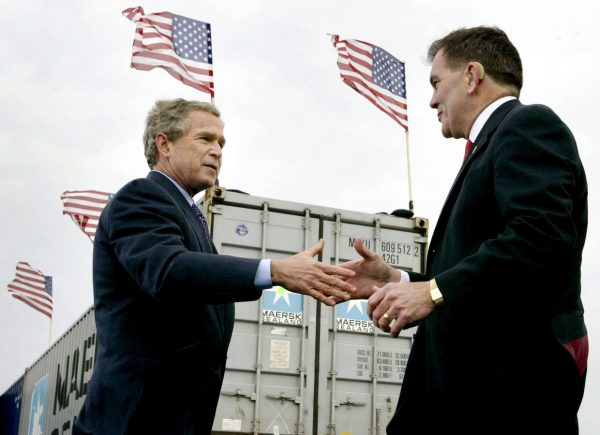
Tom Ridge and George W. Bush in 2004. © Reuters
The overall picture emerges of a mix of establishment journalists, hawkish old-school Washington insiders, and so-called ethical businessmen.
They may all be experts in their fields, but if you believe that these are selfless neutral adjudicators you are probably beyond being helped by color charts. And this is not some one-off initiative either: NewsGuard is part of Microsoft’s Defending Democracy program, which combats purported election meddling, presumably primarily from Russia. The frontline of the information war is not customarily the place for impartial news judgment.
But I wasn’t an Edge user…
However much respectability NewsGuard enjoys through Microsoft, Edge has a laughably small – a fraction of a percent – market share on mobiles. In practical terms, even an increase of popularity of several thousand percent will only mean several thousand new users, and other browsers are available.
This would be that, if not for NewsGuard’s self-proclaimed ambition “to expand to serve the billions of people globally who get news online.” This is just a beginning: there is an overarching plan where all public computers, from the school to the university to the library, are automatically equipped with the same “safe browsing” system.
And rather than as an individual warning, NewsGuard plans to make its designations work as an effective financial tool. The company, which has received $6 million in backing, also plans to soon work with advertisers, “keeping ads off unreliable news websites” to ensure “brand safety.” Fall foul of the green ticks, no money for you. Advertising managers are already demonetizing programs with alternative or controversial viewpoints elsewhere, and soon the process can be automated, and Brill is boasting that he is “happy to be blamed” – doing the dirty work for the platforms. No wonder alternative outlets in the US are openly opposed.
So, just like the use of NewsGuard in all public libraries in the faraway state of Hawaii (no money charged), it is best to look at the Edge integration is more of a test, a pilot project, a dry run. Latching NewsGuard onto a popular browser like Chrome, or a social network like Facebook, would stir tremors of public debate, as it has done in the past when similar initiatives have been tried. Instead, first they came for the Edge users.
Trump-Kim summit to show real progress
By M. K. BHADRAKUMAR | Indian Punchline | January 23, 2019
The White House disclosed in Washington on January 19 that President Trump’s second summit with the North Korean leader Kim Jong-un “will take place near the end of February”. One month is a very long time in politics but the White House disclosure came at the conclusion of three-day working level talks between senior officials of the US, North Korea and South Korea at a secret location near Stockholm, Sweden.
In particular, the visit to Washington last week by North Korea’s chief nuclear negotiator Kim Yong-chul’s and his meeting with Trump, has raised expectations. (Kim’s visit to the US opened the door for the working level negotiations in Sweden.)
The US Secretary of State Mike Pompeo later said in Davos that progress has been made at these talks and he anticipated that they provided a “good marker” for the upcoming summit. As Pompeo put it, “There’s an awful lot of things to be done but some good things have happened already.” He added that there are “many steps along the way to achieve” the goal of North Korea’s denuclearization, while expressing optimism that the next summit will be productive.
The US-North Korea negotiations after the Singapore summit last June had stalled since Pyongyang remained reluctant to “denuclearize” and on its part the US was averse to a step-by-step approach to dismantle the sanctions regime. North Korea has warned that denuclearization could be at risk unless the US eases sanctions, while the US has demanded so far that Pyongyang must first demonstrate its commitment to abandoning the nuclear weapons.
The big question is how this deadlock could be ending. Pompeo’s remarks articulating denuclearization concerns in the same breath as “security and stability and peace on the Peninsula” suggest that the US is gradually shifting its position and is open to embracing the approach of step-by-step concessions. Trump’s upbeat remarks after meeting the North Korean envoy last week lends credence to such a reading.
In the period since the June summit in Singapore between Trump and Kim Jong-un, the latter has consolidated his position. Most importantly, Kim has mended his equations with Chinese President Xi Jinping, whom he visited earlier in January (Kim’s fourth visit to China in the past year), and the relations between the two countries have remarkably improved.
According to Chinese media reports, Kim assured Xi that he is committed to “achieving results” at the second summit with Trump and will “continue sticking to the stance of denuclearization” and “make efforts… to achieve results.” Equally, Xinhua news agency quoted Xi as saying that Pyongyang and Washington would “meet each other half way.”
Equally, the relations between the two Koreas are also proceeding smoothly. It was a measure of Kim’s confidence that in his annual New Year’s speech, the emphasis was heavily placed on his economic programme rather than on threat perceptions.
But the problem lies on the American side. A big campaign is already unfolding with a view to deny Trump the legacy of a successful summit with Kim and a foreign-policy achievement in defusing the North Korea tensions (here and here.) Simply put, North Korea problem has got intertwined with the US domestic politics – like Russia, Syria or Afghanistan. In an editorial comment, Washington Post wrote,
“The North Koreans no doubt hope they can manipulate Mr. Trump into new giveaways at a second summit, such as a relaxation of sanctions, a declaration ending the Korean War, or even the withdrawal of U.S. troops from South Korea… We’d like to hope that Mr. Trump’s advisers, such as Mr. Pompeo, would dissuade him from reckless action; but then, as the president’s recent decision to order U.S. troops out of Syria showed, he’s not inclined to listen. All of which means that a resumption of U.S.-North Korean negotiations should be welcomed — but warily.”
The fact of the matter is that Kim, who has consolidated his position thanks to the backing of Beijing and the prospect of a beneficial economic partnership with South Korea, may well be in a mood to compromise by offering a road map for denuclearization. And if that happens, Trump being highly unpredictable, especially if he is called upon to reciprocate, all bets are off. Indeed, what if Trump reciprocates with the mother of all concessions like withdrawing US troops from South Korea?
Coincidence or not, with just about several weeks left for the Trump-Kim summit, the talks between the US and South Korea regarding the cost-sharing of American military presence in South Korea have reached a deadlock after 10 rounds of intense negotiations since last November. Trump has complained more than once that the US was “subsidizing” the militaries of South Korea. According to Trump, US paid for “about 60 percent” of South Korea’s military costs.
At any rate, through a diplomatic channel, the US demanded in late December that South Korea pay $1.2 billion for costs related to the presence of the 28,500 US soldiers, under a contract valid for one year. The proposal has been framed as an ultimatum from Trump, who stipulated that no offer less than $1 billion would be entertained. Whereas, the South Korean negotiators insist that the amount should not exceed 1 trillion won ($887 million), calling that number “psychologically significant” for the Korean public, and that there should be a five-year contract.
All in all, even if the negotiations over North Korea’s nuclear programme have been exasperatingly slow during the period since the Trump-Kim summit last June in Singapore, it is still better than a hostile standoff or a military confrontation. Without doubt, the Trump-Kim summit created an ambience in which inter-Korean rapprochement could commence, which has since gained traction.
As 2018 ended, the world witnessed the astounding sight of a groundbreaking ceremony for the construction of a new inter-Korean railroad. At the recent talks in Sweden, South Korea actually played a mediatory role between the US and North Korea. If the summit in Singapore was a historic one, real progress can be expected in the upcoming round 2. The South Korean Foreign Minister Kang Kyung-wha said last week that the corresponding measures the US may offer in response to North Korean progress toward denuclearization could include “an end-of-war declaration, humanitarian aid, and a permanent channel for dialogue between the US and North Korea.”
Integrity Initiative wipes website pending probe into ‘theft’ of disturbing leaked data
RT | January 22, 2019
The British state-funded Integrity Initiative, exposed last year for conducting Europe-wide political influence campaigns in leaked files, has removed all of its website content “pending an investigation” into the data “theft.”
A group claiming association with the loose hacktivist collective Anonymous has been dumping private Integrity Initiative documents online in various batches since November. The leaks revealed that the Scotland-based, government-funded organization, which bills itself as a non-partisan disinformation-busting charity, was actually using “clusters” of journalists, politicians, and academics to carry out secret anti-Russia campaigns, interfere in domestic politics across Europe and smear anyone who questioned its narratives.
In a surprise move on Monday, the Integrity Initiative abruptly announced on Twitter that it had “temporarily removed” all content from its site “pending an investigation into the theft of data” from the Institute of Statecraft, the II’s London-based parent operation.
In a statement posted on its now mostly bare website, the II claimed the leaks were “part of a campaign to undermine the work” of the Initiative which it said involved “researching, publicising and countering the threat” Europe faces in the in the form of “disinformation” and “hybrid warfare” – ironically, exactly what the shady organization itself was accused of engaging in with its hefty government paycheck.
It remains an open question if, in an effort to save face, the group would accuse Russia of being behind the leaks and even of doctoring the documents. While the statement admitted that some of the leaks were “genuine,” it claimed others were “falsified” – but did not provide any evidence to back up that claim. It is, however, apparent that Russia has been the Initiative’s main target during the course of its questionable work.
The website will be “relaunched shortly” and “analysis” of the hack and its “significance” will be published soon, the statement said. It doesn’t look as though many will be awaiting that analysis with bated breath, however.
Perhaps discouraging for the Integrity Initiative, few seemed upset to see their content disappear. Most responses to the announcement tweet are of the trolling variety, accusing the organization of simply being caught in the act and trying to clean house.
After the II leaks, Scottish newspaper the Daily Record wrote that the revelations – including that the government-funded organization had also conducted a domestic smear campaign against Jeremy Corbyn – was “one of the biggest political scandals of the year.”
The scandal received scant coverage by mainstream British media, however. Labour MP Chris Williamson told RT earlier this month that the lack of interest could have something to do with the fact that high profile journalists themselves were seemingly involved in the shady operation.
BuzzFeed’s Cohen Lies Just Latest Example of Embarrassing ‘RussiaGate’ Hysteria
By Kit Klarenberg | Sputnik | January 21, 2019
In a bombshell report, on 17 January BuzzFeed claimed Donald Trump had told his lawyer Michael Cohen to lie to Congress about the specifics of the ‘Trump Tower Moscow’ project — a felony, and indeed an impeachable one.
Other news outlets the world over eagerly regurgitated the story, and Democratic lawmakers on social media and indeed on the floor of the US legislature advocated kickstarting impeachment proceedings.
However, in an unprecedented move, the very next day special counsel Robert Mueller broke with his 20-month-long convention of not commenting on news reports relating to his investigation by announcing the story wasn’t true. Moreover, he was critical of BuzzFeed’s failure to contact his representatives and ask for verification on the story before publication.
History of Fabulism
Not long after Mueller’s denial, more critical voices began scrutinizing the report. Many noted Jason Leopold — one of the reporters on the story — had previously been involved in another epic ‘fake news’ fiasco at BuzzFeed relating to Russia. In November 2017, he authored a story which claimed the FBI was investigating records indicating in August 2016 the Russian Foreign Ministry sent US$30,000 to its embassy in Washington for “election financing”.
A shock story evidently written for maximum ‘clickbait’ value, Leopold — almost certainly consciously — opted to bury the fact the payments related to Russia’s own elections in September 2016, in which expatriate Russians were permitted to vote in their adopted home countries. As of January 2019, the article hasn’t been removed from web, although a qualifier has been added to its introductory paragraph.

Jason Leopold
Others expressed shock Leopold was still employed by any media outlet at all, for as Colombia Journalism Review documented back in 2006, his lengthy career has been typified by controversy, ignominy and dishonesty.
For instance, in August 2002 Leopold wrote an article for Salon claiming then-Secretary of the Army and former Enron vice chair Thomas White knew more about the company’s infamously questionable accounting practices than he’d admitted up to that time. The key piece of evidence for the allegation was an internal Enron email that was apparently leaked to Leopold by an anonymous source — but after he was unable to produce a copy when asked by his editor, and it was revealed he’d plagiarised portions of the piece from the Financial Times, it was pulled from the website.
In a perversely ironic twist, in 2005 Leopold’s memoir (Off the Record), in which he pledged to come clean about all the “lying, cheating and backstabbing” he’d engaged in over the course of his journalistic career and set the ‘record’ straight on his various ignominious departures from media organisations (including the Los Angeles Times and Dow Jones ), was dumped by planned publisher Rowman & Littlefield just before it went to press after one of the book’s sources threatened to sue.
Leopold had claimed the source in question, Steven Maviglio — spokesperson for then-California Governor Gray Davis — had told him he “might have broken the law by investing in energy companies using inside information”, which was apparently totally untrue.
The next year, Leopold again landed in hot water when he published a story for Truthout claiming Karl Rove “told President Bush and Chief of Staff Joshua Bolten, as well as a few other high level administration officials,” he was due to be indicted in the Valerie Plame scandal. In the piece, he said multiple anonymous sources had confirmed Rove’s indictment “was imminent” — mere days later prosecutors confirmed Rove would not face charges. Despite this, Truthout chief Marc Ash stood by the story despite a lack of corroboration elsewhere and furious denials from all named in the story for some time.
Standing By
Intriguingly, there were shades of Ash’s response in BuzzFeed’s reaction to Mueller’s denials — namely, the outlet stood by the story, not only refusing to retract it, but “reconfirming” it — and editor-in-chief Ben Smith vehemently defended his decision to publish in a much-ridiculed interview on CNN, claiming the reporting would be “borne out” by future disclosures.
Other outlets have chosen to retract and/or correct their reporting on the story — although, journalist Doug Henwood has noted while New York Times covered the report on the front page of its print edition, its correction was buried on page 11 the next day.
Despite BuzzFeed’s defence of the story, it’s likely to go down as yet another utterly embarrassing mainstream media ‘RussiaGate’ failure in a very long line — stories which have briefly generated borderline-hysteria on social media and cable news, but been proven to be utterly without foundation in short order. Here are some of the most notorious.
Manafort Meeting Never Was
On 27 November 2018, The Guardian published a seismic exclusive report authored by Luke Harding that claimed Paul Manafort, President Donald Trump’s former campaign chair and now-convicted felon, met with WikiLeaks chief Julian Assange in the Ecuadorian Embassy in London on three separate occasions.
The story stretched believability to breaking point — Manafort somehow managed to enter and exit the Embassy without being photographed, filmed or even noticed, and left no record of his presence in the building’s visitor log — and was based entirely on anonymous sources.
WikiLeaks immediately issued a vehement denial, declaring the story to be completely “fabricated” and noting the paper had given them virtually no time to respond prior to publication. Within hours, the organisation had set up a legal fund seeking donations in order to sue The Guardian for libel, and were calling for the resignation of Editor Katherine Viner. The paper responded by softening the report’s wording significantly, making clear it was based entirely on unverifiable allegations from anonymous sources, rather than anything even approaching actual evidence.
In less than a day, what Harding and Viner had evidently hoped would be the journalistic scoop of the year was shaping up to be the biggest disaster in news reporting since Germany’s Stern magazine published ‘The Hitler Diaries’ in 1983, a disaster that could severely — and enduringly — damage the reputation of The Guardian and land the paper in significant legal hot water. Despite this, the story was uncritically regurgitated by news outlets the world over. As of January 21, neither Harding nor Viner has retracted or apologized for the piece.
Dates Mixed Up
On 9 December 2017, CNN claimed Donald Trump Jr. was offered advanced access to the notorious DNC and Podesta email troves by WikiLeaks — a smoking gun proving the Trump campaign had colluded with WikiLeaks to undermine Hillary Clinton. The story was then backed up by MSNBC, with intelligence and national security reporter Ken Dilanian breathlessly claiming to have “independent confirmation” of the story.
It would be mere hours before the incendiary story would be completely shredded by reality. In truth, Trump Jr. had been apprised of the email dumps’ existence by a member of the public 10 days after their release. The assorted anonymous sources who’d confirmed the story to both networks had evidently all got their dates mixed up, or indeed were lying — or didn’t even exist perhaps, as both networks’ refusal to name their sources may imply.
The pair’s determination to cover up their colossal journalistic failure doesn’t end there — both have deleted every trace of the story from their official websites and YouTube channels, and attempts by individual users to upload their own copies invariably result in copyright claims and deletion.
Just Ain’t Crickets
In another major disaster for MSNBC — and its star reporter Dilanian — in September 2018, the network repeatedly claimed Russia was the primary suspect in “mysterious” attacks giving US diplomatic staff in Cuba “brain injuries”.
“Sophisticated microwaves or another type of electromagnetic weapon were likely used on the government workers… [they are] so sophisticated the Americans don’t even fully understand it,” Dilanian said.
Subsequent reports claimed CIA intercepts of Russian communications backed up the conclusion the Kremlin was directing the dastardly brain damaging blasts. Such was the ferocity of the reporting — and the seriousness of the allegations — Republican Senator Cory Gardner appeared on the network to say Russia should now be classified a “terror state”.
MSNBC carried on with their microwave weapon crusade despite academics casting significant doubt on their analysis — it would not be until January 2019 the story would be totally debunked, when two scientists — Alexander Stubbs of Berkeley and Fernando Montealegre-Z of the UK’s University of Lincoln — published a study based on recordings of the sounds embassy personnel complained of hearing, and blamed for their “brain damage”, revealing the ‘microwave weapons’ to in fact be…Caribbean crickets during mating season.
READ MORE:
‘Not Accurate’: Mueller Refutes BuzzFeed Cohen Scoop
Cuban Horror Stories: How US Scares Investors Off From the Island — Pundits
US Questioning Ecuadorian Embassy Staff Over Debunked Assange-Manafort Story
As Guardian’s Manafort-Assange Story Exposed as Fake, Ex-CIA Agent Blames Russia
US Administrations Have Been Intervening in Venezuela Since at Least the Early 2000s
FAIR | January 16, 2019
Janine Jackson interviewed Alexander Main about the Nicolás Maduro re-election for the January 11, 2019, episode of CounterSpin. This is a lightly edited transcript :
Janine Jackson: When it comes to Venezuela, elite US media don’t hide their feelings. And their feelings are all the same. Headlines on last year’s reelection of Venezuelan president Nicolás Maduro differed only in tone, including the disdainful: “As Venezuelans Go Hungry, Their Government Holds a Farcical Election,” from the Economist; the decisive: USA Today‘s “Maduro Is Turning Venezuela Into a Dictatorship,” or Foreign Affairs’ more somber version, “Venezuela’s Suicide; Lessons From a Failed State.” There’s Forbes’ vaguely threatening “Why Nicolas Maduro of Venezuela May Wish He Lost the Presidential Election,” and Foreign Policy’s unashamed “It’s Time for a Coup in Venezuela.”
But they’re all pretty much variations on a theme that’s hard to unhear, given that media bang it out so loudly and repeatedly. Here to help us sort fact from froth is Alexander Main. He’s director of international policy at the Center for Economic and Policy Research. He joins us by phone from Washington, DC. Welcome to CounterSpin, Alex Main.
Alex Main: Thank you, Janine.
JJ: Writing for FAIR on Venezuelan elections last year, Alan MacLeod pinpointed US media’s preferred trope, which was to say that Maduro was reelected “amid”—amid outcry, amid widespread disillusionment, amid charges of irregularities, amid low turnout. The message, I think, to readers was that Maduro’s re-election was not legitimate. What should we know about last May’s elections in Venezuela?
AM: So what isn’t generally mentioned by the media is that a critical factor in the outcome of the election was the approach taken by Venezuela’s opposition. Much of the opposition, many of its parties, decided to boycott these elections, for a variety of reasons.
At any rate, the media did not examine that fact. And we’re still not seeing it very much. I think one of the few exceptions is the Washington Post, in the article that appeared today, that did mention the divisions within the opposition, and their decision not to participate that had, obviously, a huge effect on the election result.
JJ: The media coverage would give you the impression that Venezuela’s election almost happened in a vacuum, but there was in fact involvement from, for example, the Organization of American States.
AM: Well, the Organization of American States, or rather the secretary general of the organization, whose name is Luis Almagro. He represents himself. He was elected, but once secretary general, he has sort of executive power there; but he doesn’t represent the countries within the organization. He has been on a campaign against the Maduro government from very early on. It stems from their initial decision not to allow him to send electoral observers to the elections.
And this is based on a decision taken by Venezuela’s electoral authorities many years ago, when they decided that they had enough transparency, enough safety measures around the elections, that they no longer required any sort of outside tutelage.
A number of countries in Latin America have taken the same decision. It’s a decision that has to do with the respect of their sovereignty. Certainly you don’t see in the US any massive presence of international observers, even though I think a lot of people would like to see that at some point.
But anyway, this was a sovereign decision that was taken by Venezuela’s electoral authority. And following that, Almagro really went on a rampage, and has been very much involved in efforts to try to delegitimize the Maduro government and to support the very hard-line opposition.
In doing this, he went sort of out of bounds in terms of his rhetoric, even for a lot of right-wing governments in Latin America, when late last year he voiced support for a military coup, much as some US officials have done, and US members of Congress have done. And as a response, you had all of the governments of Latin America that signed on to a statement that categorically rejected the possibility of any form of military intervention, whether by coup or an outside military intervention in Venezuela.
But certainly his rhetoric, and the campaign that he has led—along with other figures, such as Sen. Marco Rubio—have certainly given the impression that there is a desire for US intervention in what’s going on in Venezuela, and that’s, I think, resulted in sort of a defensive reaction from the Venezuelan government.
JJ: Well, it sounds very disturbing, but also confusing. You know, when I was looking through headlines, I saw one from something called the Pacific Council on International Policy that said, “Maduro Re-Elected. Can Democracy Ever Prevail in Venezuela?” I mean, just at the level of the sentence, it’s confusing. And then when you start talking about a coup to save democracy—which is the upshot of current coverage, and I guess policy—it just doesn’t even seem to make sense. The call is for the US to intervene, but the US is already intervening, isn’t it?
AM: Well, yeah, absolutely, and they’ve really been intervening in Venezuela, various US administrations, since at least the early 2000s, when we know that the US government—through institutions like the National Endowment for Democracy—has been providing funding and training to opposition groups in Venezuela, and often very hard-line groups that have taken a radical line, not recognizing the government and trying to seek its removal through extra-constitutional means, including a short-lived coup that took place in April of 2002.
The US has been very involved in trying to isolate them, Venezuela, diplomatically throughout the region, putting a lot of pressure on Latin American governments to support US measures condemning the situation in Venezuela.
More recently, the US has been applying sanctions against the government of Venezuela. And this is a very underreported thing in the US media and the international media generally.
When you see the coverage, for instance, of the Maduro inauguration, what you don’t see at all are references to the impact of the economic sanctions that have been applied. In fact, there are few media outlets at this point that even acknowledge that there are economic sanctions, even though they’ve been in place since August of 2017, when Trump announced them through an executive decree, having determined Venezuela to be an “extraordinary threat to US national security.” Those were the actual terms that were used in order to justify these sanctions.
And they’ve had a dire effect in Venezuela, which has been experiencing an economic crisis for quite a while now, since 2014 at least. And the government, of course, has failed to resolve this. It has to do with some of the government’s own economic policies. But at this point, the US also bears responsibility through these sanctions, where they have cut off Venezuela’s access to international financial markets, by which they can borrow money and purchase the necessary imports that the country needs. And we know that there aren’t enough imports of food or of medicine that are taking place at the moment.
And it’s also had a dire effect on the country’s oil production. And, of course, oil is the source of most of Venezuela’s national revenue. Along with falling oil prices, there’s been a tremendous fall in oil production in Venezuela, and it accelerated, actually, after these sanctions were put into place, because the Venezuelan government isn’t able to make the necessary investments to maintain the oil fields.
So that’s not mentioned, really, whatsoever in the major media, even though you have economists, including opposition-aligned economists from Venezuela, like Francisco Rodriguez, who have pointed out the very negative impact that these sanctions are having on the country.
JJ: Alan MacLeod also found a piece in Bloomberg that came close to acknowledging it, but in such a strange way. It was an article in which Bloomberg said that victory in the “widely derided election” gives Maduro “sole ownership of the nation’s crushing economic crisis.” And then in the very next sentence, it gloats that US and regional leaders will punish Venezuela by imposing “further isolation and sanctions on the crisis-stricken nation’s all-important oil industry.”
AM: Exactly. There’s this absurd idea that the sanctions somehow only hurt the Venezuelan government and Venezuelan government officials. It’s always the Venezuelan government’s responsibility, when they discuss the economic situation.
From time to time, you do see some media saying, “Oh, but the Venezuelan government says that the US sanctions are contributing to this dire economic situation.” They fail to ask any independent expert. You know, any economists that are taking a good look at what’s going on in Venezuela today will tell you, “Well, yes, these sanctions quite obviously are having a very negative impact.”
JJ: Finally, one of the things that coverage does is present the Venezuelan people as benighted. A piece from Time from last year includes one of my favorite creations. It first of all says that the crisis, the current crisis, “can be traced to the 1998 election of Hugo Chávez to the presidency,” so Chávez is the reason that things are difficult now. But I love this presentation: “Chávez concocted a political system that used often high oil prices to essentially bribe the masses into supporting him.”
The picture of the Venezuelan people that one gets from US media coverage is really as sort of benighted, not knowing what’s good for themselves and, once again, requiring some sort of intervention to tell them how to do democracy.
AM: Yes. This is quite absurd. Really, what we’re seeing in Venezuela is, one, an extraordinarily well-organized population, and particularly in poor communities that are certainly confronting a very dramatic economic situation, but I think doing so in effective ways that make the situation somewhat sustainable for these communities. So we’re seeing a very, very high level of community organization.
I’d say the vast majority of Venezuelans at this point are probably quite disgruntled with Maduro and his government. However, the Venezuelan opposition really offers no viable alternative to the Maduro government. They have never presented any sort of coherent economic proposal, with the possible exception of the opposition candidate in last year’s election. But, of course, most of the opposition parties boycotted those elections.
And in general, I think a lot of Venezuelans, certainly those that come from lower-income communities, are well aware of the fact that the opposition is linked to the country’s traditional economic elite, and they have a terrible reputation from their involvement in governments before Chávez was in power.
Things may be bad under Maduro, but I think there’s a sense among many Venezuelans that things could actually be quite a bit worse under opposition governments, particularly if they impose the sort of neoliberal policies that hurt the poor people of Venezuela enormously during the decades prior to Hugo Chávez’s election in the late ’90s.
JJ: We’ve been speaking with Alexander Main; he’s director of international policy at the Center for Economic and Policy Research. You can find their work, including Alex’s piece, “The United States’ Hand in Undermining Democracy in Venezuela,” online at CEPR.net. Alexander Main, thank you very much for joining us today on CounterSpin.
AM: Thank you, it was a pleasure.
‘Fake news’ is okay if it’s about #RussiaGate: Top 7 fake ‘collusion’ stories the media pushed
RT | January 21, 2019
BuzzFeed’s ‘bombshell’ claim last week that Donald Trump told ex-lawyer Michael Cohen to lie to congress is just the latest in a long line of ‘Russiagate’ stories that have later turned out to be false.
But BuzzFeed’s rubbished article is part of a phenomenon of what could be termed ‘acceptable fake news’ — fake news that gets a pass from the media because it serves a certain narrative. In this case, it furthers the ‘Russiagate’ narrative, which the mainstream media has been pushing breathlessly for two years. Lacking hard proof that Trump ‘colluded’ with Russia to win the 2016 election, they have clung to any shred of fake evidence they can find.
Last week, one astute Twitter user compiled a list of a whopping 42 Russiagate stories which were billed as bombshells but which ended up needing to be retracted or corrected. Here are seven of the most scandalous instances.
1. MSNBC pushed line that WikiLeaks released ‘fake’ Clinton emails
When WikiLeaks published the emails belonging to Hillary Clinton aide John Podesta in 2016, MSNBC sought to actively encourage its viewers to believe the emails were doctored by Russia.
They based that spurious claim on the fact that a fake transcript of a Clinton speech to Goldman Sachs was drifting around Twitter. The fake transcript had not been published by WikiLeaks, however. Rather, it was the creation of a pro-Clinton troll who had intended to trick Trump supporters into believing it was real so he could later embarrass them for their gullibility. MSNBC reporters who used the fake Twitter transcript to tarnish WikiLeaks’ authentic documents never corrected their false claims.
2. WaPo claims Russia ‘hacked’ the Vermont power grid
In one of the most infamous cases of a botched Russia-related story, the Washington Post claimed that Russia had hacked the Vermont power grid. In its zeal to deliver bombshell proof that Russia was attempting to attack the US, the Post reporters didn’t even bother to contact the utility company which could have told them that there had been no hacking or penetration of the power grid at all. The Post admitted later in an editor’s note that the story was fake.
3. CNN fires three journalists over botched story
It’s not often journalists who publish fake Russia-related ‘bombshells’ face real consequences, but last June, three CNN journalists, including the executive editor of a shiny new ‘investigative’ branch had to resign following the retraction of a false story which claimed Congress was investigating a Russian investment fund “with ties” to Trump’s team. The story quoted a single anonymous source and CNN later admitted that its reporters failed to follow “some standard editorial procedures” before publishing it.
4. Oops? CNN gets date on email wrong, causes mass panic
In a rush to prove that the Trump campaign had advance knowledge of and access to hacked DNC emails published by WikiLeaks, CNN (again) got the date of an email wrong. CNN claimed “multiple” sources had told them the email about the documents had been sent to the Trump campaign on September 4, but in reality, it had been sent on September 14 — a day after the WikiLeaks documents were made public — not, as CNN had claimed, nine days before.
5. ABC’s dud on Michael Flynn and ‘contact’ with Russians
Veteran ABC journalist Brian Ross was suspended after reporting last December that Trump had ordered former adviser Michael Flynn to contact Russian officials during the presidential campaign. It turned out, Trump had made this request of Flynn after he had won the election — not an unusual request for someone about to become the president of the US. Ross left ABC for good a while later after a career littered with embarrassing reporting blunders.
6. Russian supersonic tech or…crickets?
MSNBC reported last year that Russia was likely responsible for a supersonic attack on US diplomats stationed in the Cuba embassy. One ‘expert’ appeared on the channel stating that possible Russian “sophisticated microwaves” targeted the diplomats, while a reporter claimed Russian guilt had been “backed up” by interceptions of Russian communications. Meanwhile, intelligence sources told the New Yorker that no such evidence existed. When the Associated Press later released an audio recording, two US scientists deciphered that the sounds the diplomats had heard were more than likely the sounds of a species of Caribbean crickets during mating season.
7. Guardian claims Manafort had ‘secret meetings’ with Assange
WikiLeaks raised more than $55,000 in donations to sue the Guardian after the British newspaper published a story alleging (without corroborated evidence) that Julian Assange had held secret meetings with former Trump campaign manager Paul Manafort at the Ecuadorean embassy in London, where Assange has been living since 2012. The story which WikiLeaks claims is completely false — and which has also been questioned by other journalists — was written by Luke Harding, a Guardian reporter who has been accused before of fabricating stories and who went AWOL after the report was received with serious skepticism.
Unfortunately, the regularity with which these Russiagate stories have turned out to fake still hasn’t raised any red flags with establishment journalists, who seem more eager to bolster a narrative than to uncover actual facts.
Climate Hysterics Skyrocket Even As Weather Disasters Haven’t
By Paul Driessen | Climate Change Dispatch | January 21, 2019
Call it climate one-upmanship. It seems everyone has to outdo previous climate chaos rhetoric.
The “climate crisis” is the “existential threat of our time,” Speaker Nancy Pelosi told her House colleagues. We must “end the inaction and denial of science that threatens the planet and the future.”
Former California Governor Jerry Brown solemnly intoned that America has “an enemy, though different, but perhaps very much devastating in a similar way” as the Nazis in World War II.
Not to be outdone, two PhDs writing in Psychology Today declared that “the human race faces extinction” if we don’t stop burning fossil fuels.
And yet “even people who experience extreme weather events often still refuse to report the experiences as a manifestation of climate change.” Psychologists, they lament, “have never had to face denial on this scale before.”
Then there’s Oxford University doctoral candidate Samuel Miller-McDonald. He’s convinced the only thing that could save people and planet from cataclysmic climate change is cataclysmic nuclear war that “shuts down the global economy but stops short of human extinction.”
All this headline-grabbing gloom and doom, however, is backed up by little more than computer models, obstinate assertions that the science is settled, and a steady litany of claims that temperatures, tornadoes, hurricanes, droughts et cetera are unprecedented, worse than ever before, and due to fossil fuels.
And on the basis of these hysterics, we are supposed to give up the carbon-based fuels that provide over 80% of the U.S.’ and global energy, gladly reduce our living standards – and put our jobs and economy at the mercy of expensive, unreliable, weather dependent, pseudo-renewable wind, solar and biofuel energy.
As in any civil or criminal trial, the burden of proof is on the accusers and prosecutors who want to sentence fossil fuels to oblivion. They need to provide more than blood-curdling charges, opening statements and summations. They need to provide convincing real-world evidence to prove their case.
They have refused to do so. They ignore the way rising atmospheric carbon-dioxide is spurring plant growth and greening the planet. They blame every extreme weather event on fossil fuel emissions, but cannot explain the Medieval Warm Period, Little Ice Age or extreme weather events decades or centuries ago – or why we have had fewer extreme weather events in recent decades.
They simply resort to trial in media and other forums where they can exclude exculpatory evidence, bar any case for the fossil fuel defense, and prevent any cross-examination of their witnesses, assertions and make-believe evidence.
Climate models are not evidence. At best, they offer scenarios of what might happen if the assumptions on which they are based turn out to be correct.
However, the average prediction by 102 models is now a full degree F (0.55 C) above what satellites are actually measuring.
Models that cannot be confirmed by actual observations are of little value and certainly should not be a basis for vital energy policymaking.
The alarmist mantra seems to be: If models and reality don’t agree, reality must be wrong.
In fact, even as atmospheric carbon dioxide levels climbed to 405 parts per million (0.0405% of Earth’s atmosphere), except for short-term temperature spikes during El Niño ocean warming events, there has been very little planetary warming since 1998; nothing to suggest chaos or runaway temperatures.
Claims that tornadoes have gotten more frequent and intense are obliterated by actual evidence. NOAA records show that from 1954 to 1985 an average of 56 F3 to F5 tornadoes struck the USA each year – but from 1985 to 2017 there was only 34 per year on average.
And in 2018, for the first time in modern history, not a single “violent” twister touched down in the United States.
Harvey was the first major (category 3-5) hurricane to make US landfall in a record twelve years. The previous record was nine years, set in the 1860s. (If rising CO2 levels are to blame for Harvey, Irma and other extreme weather events, shouldn’t they also be credited for this hurricane drought?)
Droughts differ little from historical trends and cycles – and the Dust Bowl, Anasazi, and Mayan droughts, and other ancient dry spells were long and destructive. Moreover, modern agricultural and drip irrigation technologies enable farmers to deal with droughts far better than they ever could in the past.
Forest fires are fewer than in the recent past – and largely due to failure to remove hundreds of millions of dead and diseased trees that provide ready tinder for massive conflagrations.
Arctic and Antarctic ice are largely within “normal” or “cyclical” levels for the past several centuries – and snow surface temperatures in the East Antarctic Plateau regularly reach -90 °C (-130 F) or lower.
Average Antarctic temperatures would have to rise some 20-85 degrees F year-round for all its land ice to melt and cause oceans to rise at faster than their current 7-12 inches per century pace.
In fact, the world’s oceans have risen over 400 feet since the last Pleistocene glaciers melted. (That’s how much water those mile-high Ice Age glaciers took out of the oceans!)
Sea level rise paused during the Little Ice Age but kicked in again the past century or so. Meanwhile, retreating glaciers reveal long-lost forests, coins, corpses, and other artifacts– proving those glaciers have come and gone many times.
Pacific islands will not be covered by rising seas anytime soon, at 7-12 inches per century, and because corals and atolls grow as seas rise. Land subsidence also plays a big role in perceived sea level rise – and US naval bases are safe from sea level rise, though maybe not from local land subsidence.
The Washington Post did report that “the Arctic Ocean is warming up, icebergs are growing scarcer, and in some places, the seals are finding the water too hot.” But that was in 1922.
Moreover, explorers wrote about the cyclical absence of Arctic ice long before that. “We were astonished by the total absence of ice in Barrow Strait,” Sir Francis McClintock wrote in 1860. “I was here at this time in [mid] 1854 – still frozen up – and doubts were entertained as to the possibility of escape.”
Coral bleaching? That too has many causes – few having anything to do with manmade global warming – and the reefs generally return quickly to their former glory as corals adopt new zooxanthellae.
On and on it goes – with more scare stories daily, more attempts to blame humans and fossil fuels for nearly every interesting or as-yet-unexplained natural phenomenon, weather event or climate fluctuation.
And yet countering the man-made climate apocalypse narrative is increasingly difficult – in large part because the $2-trillion-per-year climate “science” and “renewable” energy industry works vigorously to suppress such evidence and discussion … and is aided and abetted by its media and political allies.
Thus we have Chuck Todd, who brought an entire panel of alarmist climate “experts” to a recent episode of Meet the Press. He helped them expound ad nauseam on the alleged “existential threat of our time” – but made it clear that he was not going to give even one minute to experts on the other side.
“We’re not going to debate climate change, the existence of it,” Todd proclaimed. “The Earth is getting hotter. And human activity is a major cause, period. We’re not going to give time to climate deniers. The science is settled, even if political opinion is not.”
The only thing left to discuss, from their perspective was “solutions” – most of which would hugely benefit them and their cohorts, politically and financially.
Regular folks in developed and developing countries alike see this politicized, money-driven kangaroo court process for what it is.
They also know that unproven, exaggerated and fabricated climate scares must be balanced against their having to give up (or never having) reliable, affordable fossil fuel energy. That is why we have “dangerous man-made climate change” denial on this scale.
That is why we must get the facts out by other means. It is why we must confront Congress, media people and the Trump Administration, and demand that they address these realities, hold debates, revisit the CO2 Endangerment Finding – and stop calling for an end to fossil fuels and modern living standards before we actually have an honest, robust assessment of supposedly “settled” climate science.
Paul Driessen is senior policy advisor for the Committee For A Constructive Tomorrow (CFACT) and author of articles and books on energy, environmental and human rights issues.
Lancet EAT Report Promotes Activism Over Science
By Donna Laframboise | Big Picture News | January 21, 2019
Last week, The Lancet, one of the world’s most prestigious medical journals, officially drove off a cliff. With much fanfare, it released a 47-page report titled Food in the Anthropocene: the EAT – Lancet Commission on healthy diets from sustainable food systems.
That title is the first screaming clue we’re being fed propaganda. As I’ve discussed previously, the Anthropocene doesn’t exist.
A scientific body known as the International Commission on Stratigraphy is tasked with defining and naming geological periods. It decides these matters according to an official, established process.
That body’s website contains a chart updated six months ago. It clearly indicates Earth remains in the Holocene. The term Anthropocene is nowhere to be found.
The notion that we’ve entered a new and distinct geological epoch is 100% activist hogwash. It’s an argument. Made by environmentalists. An argument that has been rejected by the scientific authorities who are experts in such matters.
Food in the Anthropocene, indeed. By naming its new report after this figment of activist imagination, The Lancet has been deliberately deceptive.
Medical journals are supposed to be the opposite of fake news. Now they spread misinformation on purpose.
Featured Video

Seyed M. Marandi: US-Iran War Inevitable: Kuwait and Bahrain May Fall
or go to
Aletho News Archives – Video-Images
From the Archives
USS Liberty Massacre: A Pivotal Moment in the Hostile Takeover of America
By Kevin Barrett | Crescent | Dhu al-Qa’dah 24, 1445
In corporate America, hostile takeovers are commonplace. They occur when an aggressor—a larger corporation or rich individuals—seizes control of a smaller corporation without asking permission.
What few recognize is that the United States itself has been subjected to a hostile takeover. Since the aggressor, the illegitimate settler colony known as “Israel,” is much smaller than the US, the takeover has necessarily been surreptitious.
As of June, 2024, Israel’s gradual takeover of the US has become obvious and undeniable—a proverbial “elephant in the living room.” … continue
Blog Roll
 Aletho News
- Seyed M. Marandi: US-Iran War Inevitable: Kuwait and Bahrain May Fall
- Leaders Condemn Ansarallah Attack on Saudi Arabia While Ignoring Illegal War Against Yemen
- Leaked: Britain’s Covert Iraqi Psyops Network
- Yemeni Armed Forces Warn Airlines Against Using Saudi Airports, Exempt Mecca and Medina
- Iran security chief says powers greater than US tried to conquer Iran but ended in ‘dustbin of history’
- Europe’s mounting social chaos… chickens coming home to roost for proxy war against Russia
- US-Russia Diesel Deal Becomes Massive Defeat for Ukraine
- Hormuz and the Looming Economic Catastrophe
- Dhubab offensive, media blitz and the rapid unraveling of Saudi-backed coalition’s new gambit
- Putin Conveys to Trump Iran’s Vision on Possible Conflict Resolution – Kremlin
- If Americans Knew
- Gaza: Ceasefire Anniversary Marks Year of Failed Promises
- The American Conservative: Mike Huckabee Should Resign
- A C-Section in Shackles: A Palestinian Woman’s Harrowing Birth in Israeli Detention
- ‘He’s Desperate’: AIPAC Begins Spending Against Abdul El-Sayed to Boost Mike Rogers:
- Trump, Hormuz, and the Looming Economic Catastrophe
- For three years, Israel has killed a child in Gaza every 71 minutes – Daily Update
- Israeli forces kill another child in Gaza – Daily Update
- Gaza ceasefire exists in name only, say more than 100 organizations
- Nearly 2 Million in Gaza Need Urgent Shelter Assistance as Winter Looms: IOM Chief Warns
- Suppressing Palestinian resistance: US charity under fire for AI monitoring of Gaza classrooms
- No Tricks Zone
- Germany’s Green Energy Debacle: High Energy Costs Force Kahla Porzellan to Close After 182 Years!
- New Study: 50 Years Of The Most Aggressive ‘Net Zero’ Policies Can Only Affect The Global Climate By 0.03°C
- US September “Heat” Was No Record…Many Records Set Decades Ago
- Latest European Green Energy Debacle; Portugal’s Largest Flagship Solar Park Insolvent!
- Green Energy Debacle: German Expert Professor Fritz Vahrenholt Warns Of Severe Economic And Social Consequences
- Two More Paleo Reconstructions Affirm Meters-Higher Sea Levels Across Ireland, Brazil 7000-6000 Years Ago
- New Study: Earth And Venus Surface Warmth Largely Explained By Convection And Lapse Rate, Not CO2 Or Radiation
- 2025 Nature Paper Claiming Worsening Global Drought Gets RETRACTED …Heavily Flawed
- New Study: ‘Global Drought Shows No Detectable Recent Acceleration Under Climate Warming’
- Economic Masterminds: German Socialists Suggest Taxing Productivity Gains Stemming From Using AI

