BILD Newspaper’s Image ‘Shows How German Propaganda Works’
Sputnik – October 25, 2017
Das BILD’s decision to release a controversial image of a suffering Syrian child is a “mean attempt” to manipulate the public opinion, German journalist Karin Leukefeld wrote for Sputnik, commenting on the newspaper’s recent publication that deeply shocked her.
The editor-in-chief of the German newspaper Das Bild, Julian Reichelt, published in his newsletter a photo that depicts a Syrian nurse with a seriously ill or possibly even dead child in her arms.
The picture is accompanied by text: “Assad the Dictator continues to wage war against his own people.”
German political observer Karin Leukefeld reacted to the publication by saying that this is an example of how the German propaganda machine works.

“Bashar al-Assad, the ruler of power, is leading his inexorable war against his own people.” © Photo: BILD
In fact, the image that was taken in the village of Hamuria located 17 kilometers from Damascus has little to do with the Syrian leader himself, but is rather associated with the hostilities of the terrorist groups that have the village under control, the lack of medical care and the passivity of the West, the journalist noted. Since 2012, Hamuria has been occupied by several radical armed groups. The settlement is currently under control of Islamist group Faylaq al-Rahman. The overwhelming majority of the civilian population fled the city and is now living in Damascus or its suburbs, but those who stayed have to live without proper medical care and in constant fear for their lives.
“There is no shortage of weapons, ammunition and insurgents in the besieged territories. But the situation with medicaments and food is the opposite. The fact is that countless children have died and are dying all over Syria…. People were and are starving in all parts of the country. And they can’t get help — not least because of Western sanctions, which become increasingly tough — and Germany is also responsible for this,” Leukefeld wrote.
Moreover, the analyst stressed that, according to international humanitarian law, this photo couldn’t be published at all as “distributing pictures of weak, defenseless, sick or dead people for the purpose of propaganda is forbidden.”In Leukefeld’s opinion, especially “disgusting” is the fact that the German newspaper’s Editor-in-Chief Julian Reichelt used an innocent child to impose his point of view.
“This child can’t prevent all this,” the journalist wrote, adding that readers who see the photo and read the short text won’t ask themselves whether the child is sick and how they might be able to help him, but rather they’ll put the blame for this child’s fate on the Syrian president.
Leukefeld noted that Reichelt’s main goal was to “evoke feelings of hatred and hostility,” adding that his message was a clear example of propaganda that “must be included into the curriculum for beginning journalists.”
The Harmful Effects of Antifa. Crisis of America’s Left

By Diana Johnstone | Global Research | October 24, 2017
An historic opportunity is being missed. The disastrous 2016 presidential election could and should have been a wakeup call. A corrupt political system that gave voters a choice between two terrible candidates is not democracy.
This should have been the signal to face reality. The U.S. political system is totally rotten, contemptuous of the people, serving the corporations and lobbies that pay to keep them in office. The time had come to organize a genuine alternative, an independent movement to liberate the electoral system from the grip of billionaires, to demand a transition from a war economy to an economy dedicated to improving the lives of the people who live here. What is needed is a movement for the pacification of America, at home and abroad.
That is a big order. Yet this approach could meet with wide support, especially if vigorous young people organized to stimulate popular debate, between real live people, from door to door if necessary, creating a mass movement for genuine democracy, equality and peace. This is as revolutionary a program as possible in the present circumstances. A moribund left should be coming back to life to take the lead in building such a movement.
Quite the opposite is happening.
Provoking a new Civil War?
The first step toward preventing such a constructive movement was a false interpretation of the meaning of the Trump victory, massively promoted by mainstream media. This was essentially the Clintonite excuse for Hillary’s loss. Trump’s victory, according to this line, was the product of a convergence between Russian interference and the votes of “misogynists, racists, homophobes, xenophobes, and white supremacists”. The influence of all those bad people indicated the rise of “fascism” in America, with Trump in the role of “fascist” leader.
In this way, criticism of the system that produced Trump vanished in favor of demonization of Trump the individual, making it that much easier for the Clintonites to solidify their control of the Democratic Party, by manipulating their own leftist opposition.
The events of Charlottesville resembled a multiple provocation, with pro- and anti-statue sides provoking each other, providing a stage for Antifa to gain national prominence as saviors. Significantly, Charlottesville riots provoked Trump into making comments which were seized upon by all his enemies to brand him definitively as “racist” and “fascist”. This gave the disoriented “left” a clear cause: fight “fascist Trump” and domestic “fascists”. This is more immediate than organizing to demand that the United States end its threats against Iran and North Korea, its open and covert project to reshape the Middle East to ensure Israel’s regional dominance, or its nuclear buildup targeting Russia. Not to mention its support for genuine Nazis in Ukraine. Yet that trillion dollar policy of global militarization contributes more to violence and injustice even in the United States than the remnants of thoroughly discredited lost causes.
The Left and Antifa
All those who are sincerely on the left, who are in favor of greater social and economic equality for all, who oppose the endless aggressive foreign wars and the resulting militarization of the American police and the American mentality, must realize that, since the Clintonian takeover of the Democratic Party, the ruling oligarchic establishment disguises itself as “the left”, uses “left” arguments to justify itself, and largely succeeds in manipulating genuine leftists for its own purposes. This has caused such confusion that it is quite unclear what “left” means any more.
The Clintonian left substituted Identity Politics for the progressive goal of economic and social equality, by ostentatiously coopting women, blacks and Latinos into the visible elite, the better to ignore the needs of the majority. The Clintonian left introduced the concept of “humanitarian war” to describe its relentless destruction of recalcitrant nations, seducing much of the left into supporting U.S. imperialism as a fight for democracy against “dictators”.
Antifa contributes to this confusion by giving precedence to the suppression of “bad” ideas rather than to the development of good ones through uninhibited debate. Antifa attacks on dissidents tend to enforce the dominant neoliberal doctrine that also raises the specter of fascism as pretext for aggression against countries targeted for regime change.
Antifa’s excuses
Antifa has several favorite arguments to justify itself to those who criticize its use of force and intimidation to silence its adversaries.
1. Its violence is justified by the implicit violence of its enemies who if left alone plan to exterminate whole groups of people.
This is demonstrably untrue, as Antifa is notoriously generous in distributing the fascist label. Most of the people Antifa targets are not fascists and there is no evidence that even “racists” are planning to carry out genocide.
2. Antifa is engaged in other political activity.
That is completely beside the point. Nobody is criticizing that “other political activity”. It is the violence and the censorship which are the hallmarks of the Antifa brand, and the target of criticism. Let them drop the violence and the censorship and get on with their other activities. Then nobody will object.
3. Antifa defends threatened communities.
But that is certainly not all they are doing. Nor is that what its critics are objecting to. Actual defense of a truly threatened community is best done openly by respected members of the community itself, rather than by self-styled Zorros who arrive in disguise. The problem is the definition of the terms. For Antifa, the victim community can be a whole category of people, such as LGBTQI, and the threat may be a controversial speaker at a university who could say something to hurt their feelings. And what community was being defended by Linwood Kaine, younger son of the Democratic Party Vice Presidential candidate, Senator Tim Kaine, when he was arrested in St Paul, Minnesota, last March 4 on suspicion of felony second-degree riot for attempting to break up a pro-Trump rally at the State Capitol? Although Kaine, dressed in black from head to toe, resisted arrest, the matter ended there. What downtrodden community was the young Kaine defending other than the Clintonite Democrats? His own privilege as a family member of the Washington political elite?
4. Antifa claims that it is in favor of free speech in general, but racists and fascists are an exception, because you can’t reason with them, and hate speech is not speech but action.
This amounts to an astounding intellectual surrender to the enemy. It is an admission of being unable to win a free argument. The fact is that speech is indeed speech, and should be countered by speech. You should welcome the chance to debate in public in order to expose the weaknesses of their position. If indeed “you can’t reason with them”, then they will shut down the discussion and you don’t have to. If they resort to physical attack against you, then you have the moral victory. Otherwise, you’re giving it to them.
5. Antifa insists that the Constitutional right to free speech applies only to the State. That is, only the government is banned from depriving citizens of the right to free speech and assembly. Among citizens, anything goes.
This is a remarkable bit of sophistry. Bullying and intimidation are okay if done by an unofficial group. In keeping with neoliberalism, Antifa is out to privatize censorship, by taking over the job itself.
Verbal Violence
 The verbal violence of Antifa is worse than their physical violence insofar as it is more effective. The physical violence is usually of minor consequence, at most temporarily preventing something that will happen later. It is the verbal violence that succeeds most in preventing free discussion of controversial issues.
Alarmed by the proliferation of pro-Antifa articles on CounterPunch, I ventured to write a critique, Antifa in Theory and Practice. My criticism was not personal; I did not mention the authors of those pro-Antifa CounterPunch articles and my mention of author Mark Bray was respectful. The result was a torrent of vituperation on CounterPunch’s FaceBook page, as well as in a hostile email exchange with star Antifa champion Yoav Litvin. This culminated with a hit piece by Amitai Ben-Abba published on CounterPunch itself. Note that both Litvin and Ben-Abba are Israelis, but pro-Palestinian, which provides the two with impeccable left credentials.
These reactions provided a perfect illustration of Antifa discussion techniques. It is a sort of food fight, where you just throw everything you can pick up at the adversary, regardless of logic or relevance. On the FaceBook page, Litvin, on the basis of my past carefully objective articles on French politics, accused me of “shilling for Marine Le Pen”. Irrelevant and inaccurate.
In his hit piece Ben-Abba dragged in this totally off-topic assertion:
“Much in the same way that her early ’00s pseudo-historical denial of the massacre in Srebrenica worked to embolden Serbian nationalists, her present analysis can embolden white supremacists.”
Need I point out that I never denied the “massacre” but refuse to label it “genocide”, nor did Serbian nationalists ever need my humble opinion in order to be “emboldened” – especially since the war was over by then.
I happily grant that there are issues raised in my initial article that deserve debate, such as immigration or whether or not the “fascism” of the early twentieth century still exists today. Indeed my whole point was that such issues deserve debate. That’s not what I got. Ben-Abba came up with this imaginary allusion to the immigration issue:
“‘antifa’ is a broader umbrella term that allows formerly unaffiliated folks (like the sans-papiers migrant baker who makes Johnstone’s croissants) to participate in defense of their communities against neo-fascist intimidation.”
Very funny: I am exploiting some poor undocumented baker and preventing him from being defended. Aside from the fact that I very rarely to eat a croissant, the bakers in my neighborhood are all fully documented, and moreover this largely immigrant neighborhood is the scene of frequent peaceful street demonstrations by African sans-papiers clearly not intimidated by neo-fascists. They obviously do not need Antifa to protect them. This fantasy of omnipresent neo-fascism is as necessary to Antifa as the fantasy of omnipresent anti-Semitism is to Israel.
Antifa rhetoric specializes in non sequitur. If you agree with some conservative or libertarian that it was wrong to destroy Libya, then you are not only guilty of association with a pre-fascist, you are a supporter of dictators and thus probably a fascist yourself. This has been happening in France for years and it’s just getting started in the United States.
The Antifa specialty is labeling anti-war activists and writers as “red-brown”, red for left and brown for fascist. You may pretend to be on the left, but if we can find the slightest association between you and someone on the right, then you are a “red-brown” and deserve to be quarantined.
By claiming to defend helpless minorities from a rising fascist peril, Antifa arrogates to itself the right to decide who is, or might be, “fascist”.
Whatever they think they are doing, whatever they claim to be doing, the one thing they really are doing is to tie the left into such sectarian intolerance that any broad inclusive single-issue anti-war movement becomes impossible. Indeed, it is precisely the imminent danger of nuclear World War III that leads some of us to call for a non-exclusive single issue anti-war movement – thus setting ourselves up as “red-brown”.
That is why Antifa – unwittingly let us say – is running interference for the war party.
It is most unfortunate to see CounterPunch become a platform for Antifa. It didn’t have to. The site is quite able to reject articles, as it has systematically rejected contentions about 9/11 or as it rejected David Cobb’s and Caitlin Johnstone’s (no relative) right to respond. It could have taken a principled stand against calls for violence and censorship. It did not do so. It is one thing to encourage debate and quite another to sponsor mud wrestling.
Diana Johnstone is the author of Fools’ Crusade: Yugoslavia, NATO, and Western Delusions. Her new book is Queen of Chaos: the Misadventures of Hillary Clinton. She can be reached at diana.johnstone@wanadoo.fr
NYT Laments ‘Forever Wars’ Its Editorials Helped Create
By Adam Johnson | FAIR | October 23, 2017

In considering why “the public is quiet” about the United States’ unending wars, the New York Times (10/23/17) fails to examine the failure of leading media outlets to actually oppose these wars.
Corporate media have a long history of lamenting wars they themselves helped sell the American public, but it’s rare so many wars and so much hypocrisy are distilled into one editorial. On Monday, the New York Times (10/22/17) lamented the expansion of America’s “forever wars” overseas, without once noting that every war mentioned is one the editorial board has itself endorsed, while failing to oppose any of the “engagements” touched on in the editorial.
The Times began by noting the sheer scope of US military reach:
The United States has been at war continuously since the attacks of 9/11 and now has just over 240,000 active-duty and reserve troops in at least 172 countries and territories…. American forces are actively engaged not only in the conflicts in Afghanistan, Iraq, Syria and Yemen that have dominated the news, but also in Niger and Somalia, both recently the scene of deadly attacks, as well as Jordan, Thailand and elsewhere. An additional 37,813 troops serve on presumably secret assignment in places listed simply as “unknown.” The Pentagon provided no further explanation.

The New York Times (10/8/01) endorsed the invasion of Afghanistan…
The editorial stops short of actually opposing anything specific, instead insisting, “It’s time to take stock of how broadly American forces are already committed to far-flung regions and to begin thinking hard about how much of that investment is necessary.” They are vaguely concerned; here we have this massive global empire, fighting an ever-changing nebulous enemy of “terrorism,” with no end in sight. What can be done? It’s unclear—but let’s “take stock.”
Left unmentioned in the editorial: from Afghanistan (both the 2001 invasion and Obama’s 2009 surge) to Iraq (the 2003 invasion and Obama re-entering the country in August 2014 to fight ISIS) to Syria (both CIA-backed regime change and bombing ISIS) to Korea to our drone wars in Pakistan, Yemen and Somalia, the New York Times has endorsed and often cheered every of these “forever wars.” And the “engagements” the Times didn’t expressly support (Thailand, Jordan, etc.), because they’re so routine as to not merit mention, there’s no record of them opposing. Indeed, as FAIR (3/27/17) has noted previously, the New York Times editorial board has not opposed a single US war since its equivocal and lukewarm opposition to Reagan’s invasion of Grenada 34 years ago (10/30/83).
When confronted with this fact on Twitter, New York Times foreign and defense policy editorial writer Carol Giacomo responded, “In last decade, NYT editorial board has raised many questions about US military engagements.” Raised many questions? Well, then, never mind; let’s leave the Times’ role in the creation of said global empire unexamined.

…and the invasion of Iraq (New York Times, 2/20/03).
The Times spends a great deal of time trying to market itself as not being the rubber stamp pro-war outlet it manifestly is. To do this, it employs two main genres of nominal anti-war posturing. The first—previously commented on by FAIR (3/27/17)—is to call for congressional approval of a war, without actually opposing it or arguing against its underlying moral or political validity. It’s a process complaint that permits the New York Times to look Very Concerned without the messy work of actually opposing anyone in power. The argument is never “this war is wrong or unjust”; it’s “this war may be great, but we have a legal problem of not getting congressional buy-in—the absence of which is not problematic enough to make us actually oppose the war.”
The second is the morally half-assed “no boots on the ground” argument, like the one the Times employed in support of bombing ISIS in Iraq in 2014 (8/8/14) and the Syrian government in 2013 (8/27/13). They insisted, for example, that Obama “best follow through” on his threat to bomb the Syrian government, while still opposing “deep American involvement,” whatever that meant. This genre supports bombing people—typically brown and poor—from afar, but draws the line at using US troops to augment the long-distance killing.
The “no boots on the ground” pseudo-opposition is an admission that the only lives that matter are American, and that the PR pitfalls of body bags returning home on national TV are the only moral limit to the US invading and occupying other countries. Cruise missiles, drones, special forces raids, and covert funding and arming of dodgy rebel groups are A-OK, so long as there are no “boots on the ground”—a cliche, as FAIR has noted (5/19/15), that itself has an increasingly boutique definition.
Both of these genres permit the New York Times to look like Conflicted Liberals, distressed about war without ever opposing it in any meaningful sense. Both modes typically involve appeals to gather more willing nations, other vague appeals to “international support” or running through legal motions, but, ultimately, after all the tortured language and qualifications, the Times always—always—ends up back at supporting the bombing. The Times acts not as an outside voice holding power to account, but as US empire’s internal compliance officer—there to warn of excesses and problems around the margins, but always with the best interest of their NatSec client at heart.

…along with bombing ISIS (NYT, 10/2/14), and every other major new front in the “War on Terror.”
No such heavy-hearted qualifications, needless to say, exist for US enemies. Russia is “engaging in aggressive and dangerous behavior in the air and on the high seas,” the Times (5/19/16) insisted in an editorial condemning the “duplicity of President Vladimir Putin.” Iran’s “destabilizing role in the Mideast” is simply taken for granted (4/24/17); its actions routinely “deserve condemnation” (4/7/17).
Meanwhile, the US is presented as a good-faith arbiter of human rights and peacekeeping, with no broader military or cynical aims. “At least in recent decades,” the Times editorial board (2/7/17) childishly put it earlier this year, “American presidents who took military action have been driven by the desire to promote freedom and democracy.” Funny how that worked out.
Guardian Sells False Image of an Open Jerusalem

By Jonathan Cook | Dissident Voice | October 23, 2017
A Guardian essay on a new Israeli open-rooftops project in Jerusalem, part of a Season of Culture, sadly falls into a standard trap for feelgood articles of this kind. It fails to provide the main context for Jerusalem: that the native Palestinians live under a belligerent Israeli occupation that is ultimately trying to evict them from the city.
Ignoring that context when reporting on life for Jews and Palestinians in Jerusalem is gravely irresponsible journalism.
Does this misrepresentation simply reflect author Hannah Ellis-Petersen’s ignorance? Or is it a consequence of who is footing the bill: the Rockefeller Foundation sponsored the article.
Note these infuriatingly misleading introductory paragraphs:
For its Season of Culture, the ancient capital has thrown open its rooftops to encourage residents to see beyond their blinkered boundaries. But the reality is a city where the divides are growing deeper.
The standfirst sets the mendacious “balanced” tone, as though Palestinians could ever afford the luxury of choosing to be “blinkered” in a city where the Israeli-run, occupation municipality is openly hostile to them, and where their homes can be demolished for the smallest infraction of opaque, Israeli-imposed planning rules.
The city’s divides are not “growing deeper”. They were always deep in a city where the occupying power has sought for five decades to colonise Palestinian East Jerusalem with Jewish settlers. There are now more than 200,000 of these settlers gradually displacing the native Palestinian population.
Living side by side in Jerusalem are communities who exist with no interaction with one another – kept apart by fear, nationalism and religion.
No, that is not what keeps them apart. Just imagine an article on apartheid South Africa stating that whites and blacks had no interaction because they were “kept apart by fear, nationalism and religion”. In reality, the two populations were kept apart by the colour of their skin. For blacks under apartheid, and today for Palestinians under occupation, their inferior status is dictated to them. They have no say in the matter.
Palestinians and Israelis are kept apart by the structural violence of occupation, which confers on them entirely different rights and life choices. Jews in Jerusalem have Israeli citizenship; Palestinians have a residency that Israel can easily revoke. Potentially, Jews can live almost anywhere in the city; Palestinians are confined to ghettoes, where they are being suffocated of space and services to encourage them to leave.
Israel has even built a wall cutting some Palestinian neighbourhoods off from the rest of East Jerusalem and the services they pay for through their municipal taxes. They do not live apart because of fear, nationalism or religion. They have been cut off from family, friends and services by concrete walls and armed checkpoints.
While Israelis typically live in the west and Palestinians in the east of Jerusalem, mixed neighbourhoods do exist. In the winding alleys of the old city and the streets of downtown, the diverse inhabitants peacefully cross paths every day.
“Mixed neighbourhoods”? Is the author referring to Jewish settlers who have forcibly taken over Palestinian properties in areas of occupied East Jerusalem like the Old City, Silwan and Sheikh Jarrah in violation of international law and have then turned their apartment blocs into armed compounds? Is that her idea of “paths crossing peacefully” – that Palestinians must live submissively, in terror of armed Jewish interlopers?
What’s more, the only rooftops of Palestinians that were made accessible are in the old city; there are none in east Jerusalem. … The project traces a line across a divided city via its rooftops. And the stories of the volunteers who have opened their homes to strangers, regardless of ethnicity or creed, speak to a multi-layered Jerusalem, one rarely seen in a conflict-obsessed news cycle: a colourful, fractious and potent city.
Is it really a failure of the news cycle that it wishes to highlight “conflict” rather than accentuate the supposed rough-and-tumble co-existence proposed by this article, and achieved after Israel illegally annexed East Jerusalem?
Israel professes to have created an “eternal, united capital” of Jerusalem, but nothing could be further from the truth. We don’t need from the media less of an obsession with “conflict”. We need greater honesty from them about Israel’s oppression of Palestinians and the harsh reality of a Jewish settler colonial society slowly disappearing the natives.
Only the gullible or dishonest could believe that opening rooftops in the privileged, Jewish side of the city challenges or mitigates the ugliness of what is going on on the other side of Jerusalem, for Palestinians.
Mutual Assured Destruction
By Philip Giraldi • Unz Review • October 24, 2017
Sometimes it is possible to read or view something that completely changes the way one looks at things. I had that experience last week when I read an article at Lobelog entitled “A Plea for Common Sense on Missile Defense,” written by Joe Cirincione, a former staffer on the House Armed Services Committee who now heads the Ploughshares Fund, which is a Washington DC based global foundation that seeks to stop the spread of nuclear, chemical and biological weapons.
The article debunks much of the narrative being put out by the White House and Pentagon regarding missile defense. To be sure, it is perfectly reasonable to mistrust anything that comes out of the federal government justifying war given its track record going back to the War of 1812. And the belligerent posture of the United States towards Iran and North Korea can well be condemned based on its own merits, threatening war where there are either no real interests at stake or where a diplomatic solution has for various reasons been eschewed.
But the real reason why the White House gets away with saber rattling is historical, that the continental United States has not experienced the consequences of war since Pancho Villa invaded in 1916. This is a reality that administration after administration has exploited to do what they want when dealing with foreign nations: whatever happens “over there” will stay “over there.”
Americans consequently do not know war except as something that happens elsewhere and to foreigners, requiring only that the U.S. step in on occasion and bail things out, or screw things up depending on one’s point of view. This is why hawks like John McCain, while receiving a “Liberty” award from Joe Biden, can, with a straight face, get away with denouncing those Americans who have become tired of playing at being the world’s policeman. He describes them as fearful of “the world we have organized and led for three-quarters of a century, [abandoning] the ideals we have advanced around the globe, [refusing] the obligations of international leadership and our duty to remain ‘the last best hope of earth’ for the sake of some half-baked, spurious nationalism.”
McCain’s completely fatuous account of recent world history befits a Navy pilot who was adept at crashing his planes and almost sank his own aircraft carrier. He also made propaganda radio broadcasts for the North Vietnamese after he was captured. The McCain globalist-American Exceptionalism narrative is also, unfortunately, echoed by the media. The steady ingestion of lies and half-truths is why the public puts up with unending demands for increased defense spending, accepting that the world outside is a dangerous place that must be kept in line by force majeure. Yes, we are the good guys.
But underlying the citizenry’s willingness to accept that the military establishment should encircle the globe with foreign bases to keep the world “safe” is the assumption that the 48 States are invulnerable, isolated by broad oceans and friendly nations to the north and south. And protected from far distant threats by technology, interceptor systems developed and maintained at enormous expense to intercept and shoot down incoming ballistic missiles launched by enemies overseas.
In a recent speech, relating to the North Korean threat, President Donald Trump boasted that the United States anti-missile defenses are 97% effective, meaning that they can intercept and destroy incoming projectiles 97 times out of a 100. Trump was seeking to assure the public that whatever happens over in Korea, it cannot have an undesirable outcome over here in the continental United States nor, apparently, in Hawaii, Alaska and overseas possessions like Guam, all of which are shielded under the anti-missile defense umbrella. Trump was undoubtedly referring to, even if he was ignorant of many of the specifics, the Ground Based Midcourse Defense (GMD) installations in Alaska and Hawaii, which are part of the existing $330 billion missile defense system.
It is certainly comforting to learn that the United States cannot be physically attacked with either nuclear or conventional weapons no matter what our government does overseas, but is it true? What if the countermeasures were somewhat closer to 0% effective? Would that change the thinking about going to war in Korea? Or about confronting Russia in Eastern Europe? And for those who think that a nuclear exchange is unthinkable it would be wise to consider the recent comments by Jack Keane of the aptly named Institute for the Study of War, a leading neoconservative former general who reportedly has the ear of the White House and reflects its thinking on the matter. Keane is not hesitant to employ the military option against Pyongyang and he describes a likely trigger for a U.S. attack to take out its nuclear facilities or remove “leadership targets” as the setting up of a ballistic missile in North Korea with a nuclear warhead mounted on top “aimed at America.” Some observers believe that North Korea is close to having the ability to reduce the size of its nukes to make that possible and, if Keane is to be believed, it would be considered an “act of war” which would trigger an immediate attack by Washington. And a counter attack by Pyongyang.
The claim of 97% reliability for the U.S.’s anti-missile defenses is being challenged by Cirincione and others, who argue that the United States can only “shoot down some…missiles some of the time.” They make a number of arguments that are quite convincing, even to a layman who has no understanding of the physics involved. I will try to keep it simple. First of all, an anti-missile interceptor must hit its target head on or nearly so and it must either actually strike the target or explode its own warhead at a close enough distance to be effective. Both objectives are difficult to achieve. An Intercontinental Ballistic Missile (ICBM) travels at 5,000 meters per second. By way of comparison a bullet fired from a rifle travels at about one fifth that speed. Imagine two men with rifles standing a mile apart and firing their weapons in an attempt to have the bullets meet head on. Multiply the speed by five if one is referring to missiles, not bullets. Even using the finest radars and sensors as well as the most advanced guidance technologies, the variables involved make it much more likely that there will be a miss than a hit. Cirincione observes that “…the only way to hit a bullet is if the bullet cooperates.”
Second, the tests carried out by the Pentagon to determine reliability are essentially fraudulent. Contrary to the Donald Trump comment, the 97% accuracy is an extrapolation based on firing four anti-missile missiles at a target to make up for the fact that in the rigged tests a single interceptor has proven to be closer to only 56% accurate, and that under ideal conditions. This statistic is based on the actual tests performed since 1999 in which interceptors were able to shoot down 10 of 18 targets. The conclusion that four would result in 97% derives from the assumption that multiple interceptors increases the accuracy but most engineers would argue that if one missile cannot hit the target for any number of technical shortcomings it is equally likely that all four will miss for the same reason.
The tests themselves are carefully scripted to guarantee success. They take place in daylight, preferably at dusk to ensure maximum visibility, under good weather conditions, and without any attempt made by the approaching missile to confuse the interceptor through the use of electronic countermeasures or through the ejection of chaff or jammers, which would certainly be deployed. The targets in tests have sometimes been heated to make them easier to find and some have had transponders attached to make them almost impossible to miss. As a result, the missile interceptor system has never been tested under realistic battlefield conditions.
Even the federal government watchdog agencies have concluded that the missile interception system seldom performs. The Government Accountability Office concluded that flaws in the technology, which it describes as “failure modes,” mean that America has an “interceptor fleet that may not work as intended, prompting one Californian congressman John Garamendi to observe that “I think the answer is absolutely clear. It will not work. Nevertheless, the momentum of the fear…of the investments…[of] the momentum of the industry, it carries forward.”
The Operational Test and Evaluation Office of the Department of Defense has also been skeptical, reporting that the GMD in Alaska and Hawaii has only “…a limited capability to defend the U.S. Homeland from small numbers of simple intermediate range or intercontinental ballistic missile threats launched from North Korea…the reliability and availability of the operational [interceptors] are low.”
The dangerous overconfidence being demonstrated by the White House over the ability to intercept a North Korean missile attack might indeed be in some part a bluff, designed to convince Pyongyang that it if initiates a shooting war it will be destroyed while the U.S. remains untouched. But somehow, with a president who doesn’t do subtle very well, I would doubt that to be the case. And the North Koreans, able to build a nuclear weapon and an ICBM, would surely understand the flaws in missile defense as well as anyone.
But the real danger is that it is the American people that is being fooled by the Administration. War is thinkable, even nuclear war, if one cannot be touched by it, a truism that has enabled the sixteen-year- long and counting “global war on terror.” If that is the message being sent by the White House, it would encourage further reckless adventurism on the part of the national security state. Far better to take the North Korean threat seriously and admit that a west coast city like Seattle could well become the target of a successful nuclear weapon attack. That would demonstrate that war has real life consequences and the unfamiliar dose of honesty would perhaps result in a public demand to seriously negotiate with Pyongyang instead of hurling threats in speeches at the United Nations and on Capitol Hill.
Russia-China Tandem Changes the World
By Gilbert Doctorow | Consortium News | October 23, 2017
Much of what Western “experts” assert about Russia – especially its supposed economic and political fragility and its allegedly unsustainable partnership with China – is wrong, resulting not only from the limited knowledge of the real situation on the ground but from a prejudicial mindset that does not want to get at the facts, i.e. from wishful thinking.
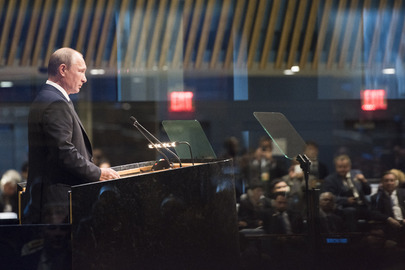
Russian President Vladimir Putin (UN Photo)
Russia may not be experiencing dynamic growth, but over the past two years it has survived a crisis of circumstance in depressed oil prices and economic warfare against it by the West that would have felled less competently managed governments enjoying less robust popularity than is the case in Vladimir Putin’s Russia. Moreover, as stagnant as Russia’s GNP has been, the numbers have been on a par with Western Europe’s very slow growth.
Meanwhile, Russian agriculture is booming, with the 2017 grain harvest the best in 100 years despite very adverse climatic conditions from early spring. In parallel, domestically produced farm machinery has been going from strength to strength. Other major Industrial sectors like civil aircraft production have revived with the launch of new and credible models for both domestic and export markets.
Major infrastructure projects representing phenomenal engineering feats like the bridge across the Kerch straits to Crimea are proceeding on schedule to successful termination in the full glare of regular television broadcasts. So where is this decrepit Russia that our Western commentators describe daily?
The chief reason for the many wrongheaded observations is not so hard to discover. The ongoing rampant conformism in American and Western thinking about Russia has taken control not only of our journalists and commentators but also of our academic specialists who serve up to their students and to the general public what is expected and demanded: proof of the viciousness of the “Putin regime” and celebration of the brave souls in Russia who go up against this regime, such as the blogger-turned-politician Alexander Navalny or Russia’s own Paris Hilton, the socialite-turned-political-activist Ksenia Sochak.
Although vast amounts of information are available about Russia in open sources, meaning the Russian press and commercial as well as state television, these are largely ignored. The sour grapes Russian opposition personalities who have settled in the United States are instead given the microphone to sound off about their former homeland. Meanwhile, anyone taking care to read, hear and analyze the words of Vladimir Putin becomes in these circles a “stooge.” All of this limits greatly the accuracy and usefulness of what passes for expertise about Russia.
In short, the field of Russia studies suffers, as it also did during the heyday of the Cold War, from a narrow ideological perspective and from the failure to put information about Russia in some factually anchored framework of how Russia fits in a comparative international setting.
Just what this means was brought into perspective last week by a rare moment of erudition regarding Russia when professor emeritus of the London School of Economics Dominic Lieven delivered a lecture in Sochi at the latest Valdai Club annual meeting summarizing his take on the Russian Revolution of 1917.
Lieven, arguably the greatest living historian of imperial Russia, is one of the very rare birds who brought to his Russian studies a profound knowledge of the rest of the world and in particular of the other imperial powers of the Nineteenth Century with which Russia was competing. This knowledge takes in both hard and soft power, meaning on the one hand, military and diplomatic prowess and, on the other, the intellectual processes which are used to justify imperial domination and constitute a world view if not a full-fledged ideology.
Self-blinded ‘Experts’
By contrast, today’s international relations “experts” lack the in-depth knowledge of Russia to say something serious and valuable for policy formulation. The whole field of area studies has atrophied in the United States over the past 20 years, with actual knowledge of history, languages, cultures being largely scuttled in favor of numerical skills that will provide sure employment in banks and NGOs upon graduation. The diplomas have been systematically depreciated.
The result of the foregoing is that there are very few academics who can put the emerging Russian-Chinese alliance into a comparative context. And those who do exist are systematically excluded from establishment publications and roundtable public discussions in the United States for not being sufficiently hostile to Russia.
If that were not the case, one could look at the Russian-Chinese partnership as it compares firstly with the American-Chinese partnership created by Richard Nixon and Henry Kissinger, which is now being replaced by the emerging Russian-Chinese relationship. Kissinger was fully capable of doing this when he wrote his book On China in 2011, but Kissinger chose to ignore the Russian-Chinese partnership though its existence was perfectly clear when he was writing his text. Perhaps he did not want to face the reality of how his legacy from the 1970s had been squandered.
What we find in Kissinger’s description of his accomplishments in the 1970s is that the American-Chinese partnership was all done at arm’s length. There was no alliance properly speaking, no treaty, in keeping with China’s firm commitment not to accept entanglement in mutual obligations with other powers. The relationship was two sovereign states conferring regularly on international developments of mutual interest and pursuing policies that in practice proceeded in parallel to influence global affairs in a coherent manner.
This bare minimum of a relationship was overtaken and surpassed by Russia and China some time ago. The relationship has moved on to ever larger joint investments in major infrastructure projects having great importance to both parties, none more so than the gas pipelines that will bring very large volumes of Siberian gas to Chinese markets in a deal valued at $400 billion.
Meanwhile, in parallel, Russia has displaced Saudi Arabia as China’s biggest supplier of crude oil, and trading is now being done in yuan rather than petrodollars. There is also a good deal of joint investment in high technology civilian and military projects. And there are joint military exercises in areas ever farther from the home bases of both countries.
I think it is helpful to look at this partnership as resembling the French-German partnership that steered the creation and development of what is now the European Union. From the very beginning, Germany was the stronger partner economically with France’s economy experiencing relative stagnation. Indeed, one might well have wondered why the two countries remained in this partnership as nominal equals.
The answer was never hard to find: with its historical burden from the Nazi epoch, Germany was, and to this day remains, incapable of taking responsibility in its own name for the European Union. The French served as the smokescreen for German power. Since the 1990s, that role has largely been transferred to the E.U. central bodies in Brussels, where key decision-making positions are in fact appointed by Berlin. Yet, France remains an important junior partner in the German-driven process.
The Russian-Chinese Tandem
One may say much the same about the Russian-Chinese tandem. Russia is essential to China because of Moscow’s long experience managing global relations going back to the period of the Cold War and because of its willingness and ability today to stand up directly to the American hegemon, whereas China, with its heavy dependence on its vast exports to the U.S., cannot do so without endangering vital interests. Moreover, since the Western establishment sees China as the long-term challenge to its supremacy, it is best for Beijing to exercise its influence through another power, which today is Russia.
Of course, in light of the E.U.’s Brexit troubles and Trump’s abandonment of world leadership, it is undeniably possible that China will step out of the shadows and seek to assume direction of global governance. But that would be problematic. China faces major domestic challenges including the transition of its economy from being led by exports to relying more on domestic consumption. That will absorb the attention of its political leadership for some time.
Kissinger, who has been an adviser to Trump, whispers in Trump’s ear about the importance of separating Russia from China, but Kissinger’s limited and outdated knowledge of Russia has caused him to underestimate the powerful motives behind the Russian-Chinese relationship. America’s less gifted and informed pundits are even more clueless.
For one thing, given the sustained hostility directed at Russia from the West in general and from Washington in particular, it is inconceivable that Putin would be wooed away from Beijing by some flirtatious “come hither” gestures from the Trump administration even if that were politically possible for Trump to do. One of Putin’s outstanding features is his loyalty to his friends and his principles as well as to his nation’s interests.
As Putin revealed during his address and Q&A at the Valdai Club gathering this past week, he now bears a deep distrust of the West in light of its having taken crude advantage of Russia’s weakness in the 1990s and by its expansion of NATO to Russian borders and other threatening actions. Whatever hopes Putin once may have held for warmer relations with the West, those hopes have been dashed over the past several years.
Putting personalities aside, Russian foreign policy has a commonality that is rare to see on the world stage: actions first, diplomatic charters later. Russia’s political relations with China come on top of massive mutual investments that have taken many years to agree on and execute.
In the same way, Russia is proceeding with Japan to work towards a formal peace treaty by first putting in place massive trade and investment projects. It is entirely foreseeable that the first step to the treaty will be the start of construction in 2018 of a railway bridge in the Far East linking the Russian island of Sakhalin with the mainland. The general contractor and engineering team is also in place: Arkady Rotenberg and his SGM Group. That bridge is the prerequisite for Japan and Russia signing a $50 billion deal to build a railway bridge linking Sakhalin and Hokkaido. This bridge will draw the attention of the whole region to Russian-Japanese cooperation. It could be the foundation for a durable and not merely paper peace treaty resolving the territorial dispute over the Kurile Islands.
Lost Opportunities
In light of these realities, it is puerile to speak of detaching Russia from China with the promise of normalized relations with the West. The opportunity to do that existed in the 1990s, when President Boris Yeltsin and his “Mr. Yes” Foreign Minister Andrei Kozyrev did everything possible to win U.S. agreement to Russian accession to NATO immediately following accession by Poland. To no avail.
Then again early in Putin’s presidency, the Russians made a determined effort to win admission to the Western alliance. Again to no avail. Russia was excluded, and measures were taken to contain it, to place it in a small box as just another European regional power.
Finally, following the confrontation with the United States and Europe over their backing of the 2014 coup in Ukraine, followed by the Russian annexation/merger with Crimea, and Russian support for the insurgency in Ukraine’s Donbas region, Russia openly was cast as the enemy. It was compelled to mobilize all of its friendships internationally to stay afloat. No state was more helpful in this regard than China. Such moments are not forgotten or betrayed.
The Kremlin understands full well that the West has nothing substantial to offer Russia as long as the U.S. elites insist on maintaining global hegemony at all costs. The only thing that could get the Kremlin’s attention would be consultations to revise the security architecture of Europe with a view to bringing Russia in from the cold. This was the proposal of then President Dmitry Medvedev in 2010, but his initiative was met by stony silence from the West. Bringing in Russia would mean according it influence proportionate to its military weight, and that is something NATO has opposed tooth and nail to this day.
It is for this reason, the failure to seek solutions to the big issue of Russia’s place in overall security, that the re-set initiative under Barack Obama failed. It is for this reason that Henry Kissinger’s advice to Donald Trump at the start of his presidency to offer relief from sanctions in return for progress on disarmament rather than implementation of the Minsk accords regarding the Ukraine crisis also failed, with Vladimir Putin giving a firm “nyet.”
Implicit in the few American “carrots” being extended to Russia these days is its acceptance of the anti-Russian regime in Ukraine and its authority over the heavily ethnic Russian areas of the Donbas and Crimea, concessions that would be politically devastating to Putin inside Russia. Yet, that “normalization” would still leave the much milder but still nasty “human rights” sanctions that the U.S. imposed in 2012 through the Magnitsky Act, driven by what the Kremlin regards as false propaganda surrounding the criminal case and death of accountant Sergei Magnitsky.
The sting of the Magnitsky Act was to discredit Russia and prepare the way for it being designated a pariah state. It came amidst an already longstanding campaign of demonization of the Russian president in the U.S. media. In fact, to begin to find a halfway normal period of bilateral relations, you would have to go back to before George W. Bush’s invasion of Iraq, which Russia denounced along with Germany and France. The latter two powers got a tap on the wrist from Washington. For Russia, it was the start of a period of reckoning for its uncooperativeness with American global domination.
Demonizing Russia
As for Europe and Russia, the question is very similar. To find mention of a strategic relationship, firstly from the German Foreign Ministry, you have to go back to before 2012. And what constituted normality then? At the time, renewal of the E.U.-Russia cooperation agreement was already being held up for years, nominally over a difference of views on the provisions of E.U. law governing gas deliveries through Russian-owned pipelines. Behind this difference was the total opposition of the Baltic States and Poland to anything resembling normal relations with Russia, for which they received full encouragement from the U.S.
The rallying cry was to put a stop to Russia’s status as “monopoly supplier” to Europe as regards gas, but also oil. Of course, no monopoly ever existed, nor does it exist today, but determined geopolitical actors never let such details stand in the way of policy formulation.
This hostility also played out in the contest of wills between the E.U. and Russia over introduction of a visa-free regime for travel by their respective citizens. Here the opposition of Germany’s Angela Merkel, justified by her vicious characterization of Russia as a mafia state, doomed the visa-free regime and by the same token doomed normal relations.
All of this unfinished business has to be addressed and put right for there to be any possibility of the U.S. and the E.U. ending their hostility toward Russia and for the Kremlin to regain any trust toward the West. Even then, however, Russia would not surrender its valued relationship with China.
In my view, the de facto Russian-Chinese alliance matches the de jure US-West European alliance. The net result of both is the partition of the world into two camps. We now have, in effect, a bipolar world that broadly resembles that of the Cold War, though still in a formative stage since many countries have not signed on definitively to one side or another.
Of course, more-or-less neutral states were also a feature of the Cold War, creating what was called the group of Nonaligned Nations, led back then by India and Yugoslavia. Yugoslavia no longer exists, but India has continued its tradition of let both poles court it, trying to eke out the greatest benefit to itself.
To be sure, a great many political scientists in the U.S., in Europe and in Russia as well, insist that we already have a multipolar world, saying that power is too diffuse in the world today, especially considering the rise of non-state actors after 1991. But the reality is that very few states or non-states can project power outside their own region. Only the two big blocs can do that.
The theoreticians defending multipolarity speak of a return to the balance of power of the Nineteenth Century, invoking the Congress of Vienna as a possible model for today’s world governance. This is an approach that Henry Kissinger laid out in 1994 in his book Diplomacy.
Within Russia, this concept has found support in some influential think tanks and is most notably associated with Sergei Karaganov, head of the Council of Foreign and Defense Policy. Nonetheless, I maintain that everyday realities of power will decide this question. And is there anything inherently wrong with this de facto bipolar world, assuming the tensions can be managed and a major war averted?
In my view, two large blocs are more likely to keep global order because the scope of activities by proxies can be reined in – as often happened during the Cold War – by big powers not wanting their various clients to disrupt a functioning world order. The tails are less likely to wag the dog.
Moreover, as regards the Russia-China strategic partnership or alliance, Western observers should take comfort and not take alarm. The rise of China is a given whatever the constellation of great powers may wish. The close embrace of Russia and China also can serve as a moderating influence on China, given Russia’s greater experience in world leadership.
For all of the above positive and negative reasons, the Russia-China relationship should be viewed with equanimity in Western capitals.
Gilbert Doctorow is an independent political analyst based in Brussels. His latest book, Does the United States Have a Future? was just published.
Yet Another ‘Russian Invasion’ Reported, Debunked in Norway
Sputnik | October 20, 2017
A Norwegian defense portal has caused a hullaballoo with its claims that Russia staged a mock invasion of the key Arctic archipelago of Svalbard, despite the Nordic country’s own defense and intelligence bosses vehemently denying such assertions.
Amid the recent cooling between Russia and the West, the Norwegian defense portal Aldri Mer (“Never again”) shocked compatriots with claims that the Russians “trained to invade” Svalbard, a crucial Norwegian archipelago, during the recent exercise Zapad 17. According to Aldri Mer, Russia waged not one but two simulated attacks on Svalbard. Norwegian forces were allegedly taken by surprise, with Norwegian jets reportedly being unable to fend off the intruder.
Aldri Mer based its allegations on information by six anonymous sources from within the Norwegian defense establishment and NATO. According to Alrig Mer, Norway’s inability to provide intelligence irritated NATO officials and set off a series of crisis meetings to discuss what was described as a “complete loss of situational awareness in the north.”
Lieutenant Colonel Ivar Moen of the Norwegian Joint Military Headquarters outside Bodø said that Norwegian authorities did not want to speculate over exercise scenarios employed by Russian forces. Furthermore, Lieutenant General Morten Haga Lunde of Norway’s military intelligence unit (E-tjenesten) repudiated Aldrig Mer’s report as erroneous, while insisting that his intelligence unit had “extremely good oversight and understanding of the situation,” especially before, during and after Russian drills, Norwegian national broadcaster NRK reported. Former Defense Minister Ine Eriksen Søreide, who recently went on to become Norway’s first female Foreign Minister, claimed that no type of simulated attack was either seen or reported, stressing that her country received much praise from NATO for its good surveillance capacity.
Aldig Mer’s editor-in-chief Kjetil Stormark nevertheless held his ground, citing “clarification problems” on E-tjenesten’s part and referring to “entirely different Russian training patterns” established by NATO specialists.
Meanwhile, the wholly unsubstantiated idea of Russian “hostile takeover” is often being pedaled in Nordic media to justify increased military spending or increased cooperation with NATO. In 2014 and 2015, Russian troops were thus claimed to have staged a huge military exercise in the Baltic that simulated an occupation of Denmark’s Bornholm, Sweden’s Gotland, Finland’s Åland and northern Norway.
The Zapad-2017 maneuvers were held on September 14-20 on the territory of Russia and Belarus and were highlighted as a threat amung Norway’s fellow Nordic countries, such as Sweden, which held simultaneous drills featuring US tanks and aircraft.The Svalbard archipelago lies halfway between northernmost Norway and the North Pole and boasts a population of 2,600. According to the Svalbard treaty signed in the 1920s, the archipelago of Svalbard is under Norwegian control. However, the USSR (and by extension Russia) has historically had a physical presence on the archipelago. The community of Barentsburg has been long limited to coal mining operations, but has been recently boosted by investment and renovation for, among other things, scientific purposes.
According to Norway’s military doctrine, Russia is identified as a major threat, which has led to the Nordic country boosting its spying capacity with a reconnaissance ship, the MS Marjata, and surveillance aircraft.
The goal of the Aldri Mer website is to ensure that Norway never gets invaded again, as it was by Nazi German forces in 1940. Ironically, it was the Russians who liberated northern Norway in 1944.
Venezuela Regional Elections: chavismo in triumph, opposition in disarray and media in denial
By Ricardo Vaz | Investig’Action | October 18, 2017
As the President of the Venezuelan Electoral Commission (CNE) read the results from the regional elections that took place on Sunday, October 15, one could feel the agony in the editorial rooms of mainstream media outlets. Chavismo had just won 18 out of 23 (1) governorships, a result that, according to them, could not have happened. International observers praised the electoral process and opposition claims of fraud, while uncritically echoed by the media, do not have a leg to stand on.
The United Socialist Party of Venezuela (PSUV) had a tremendous victory in these elections. Among the three quarters of the governorships secured, some were quite significant. Hector Rodríguez, a young and charismatic chavista leader, won the governorship of Miranda state back from the opposition. Miranda includes part of Caracas and was the main hotspot of opposition violence in recent months. Another example was Chávez’s home state of Barinas which also saw some unrest in recent months. Chávez’s younger brother Argenis was the candidate and the state was successfully held by the PSUV.
The opposition lost all three governorships won in 2012 (Miranda, Amazonas and Lara) and won five others (Anzoátegui, Mérida, Nueva Esparta, Táchira and Zulia), with three of them being on the border with Colombia and raising some fears of increased paramilitary activity. Overall participation was 61%, compared to 54% five years ago, and the PSUV had 54% of the vote, some 5.6M votes. This marked a complete reversal from the legislative elections of 2015. It showed that chavismo’s core support remains very strong, and that, due to its less than coherent actions, it was the opposition that failed to mobilise its supporters.

Electoral map after Sunday’s regional elections. Chavismo took 18 (red) governorships, and the opposition took five (blue).
The media reaction was one for the history books. Having not paid much attention to these elections, the run-up had just the same recycled narrative: “if the elections are free and fair, the opposition will win by a landslide”. Once the results came out, rather than look to understand them and figure out what had gone wrong in their predictions, the media simply went down the rabbit hole. According to their biased narrative and historically inaccurate polls, this simply was not possible!
The evidence to back this impossibility was also less than convincing. There were the usual unsubstantiated, or easily disproved, claims of “fraud” (more on that later). The New York Times added the very scientific claim that “turnout appeared to be lower”, while Reuters, with its ever decreasing credibility, went further and talked about voters being forced to vote at gunpoint! Several analysts were paraded to claim that this result was not possible, some even argued it was “inconceivable”. It seems like these journalists and analysts have violated one of the cardinal rules of (information) trafficking: don’t get high on your own supply. Simply put, they have started believing too much in their own propaganda.
A resounding defeat for the Venezuelan opposition
Let us look at the actions of the US-backed Venezuelan opposition in the recent past. First they kicked off a wave of street violence in April that left more than 100 dead (most of them caused by opposition violence). With the media propaganda in overdrive they claimed they were on the verge of “tumbling the dictatorship”. But barring a few isolated occasions, the violence never spread far beyond the opposition strongholds, mainly in eastern Caracas.
After Maduro proposed the Constituent Assembly, the opposition refused to participate and claimed that they would stop it from taking place. They even staged their own “referendum” to reject the Constituent Assembly and call for intervention of the armed forces. But in what was a massive chavista show of strength, as well as a rejection of opposition violence, more than 8M people voted on July 30th. All the opposition, and the media, could do was claim that the figure was false, based on shoddy exit polls and unsubstantiated claims from Smartmatic (2). These elections and the swearing in of the Constituent Assembly effectively brought peace to the streets.
So after all the talk of tumbling the dictatorship and demanding that Maduro step down tomorrow, the opposition turned to their supporters, and with a straight face asked them to go out and vote in the regional elections. Some of the more hardline factions refused to take part (and are now chiding the leadership for having done so) but most of the opposition parties carried on with the absurd discourse of “voting against the dictatorship”. In the end the absurdity caught up to them and the result was a resounding defeat. And then, like clockwork, the opposition claimed the results were fraudulent. Frankly, what else was left for them to do? They can send the defeated candidates to Washington DC and continue forming their “government in exile”. (3)

Opposition leader Julio Borges’ contradictions with regard to the regional elections (Translated from Misión Verdad)
Fraudulent “fraud” claims
If the media coverage of Venezuela had any vestige of honesty, articles would explain how the voting works, so that these “fraud” allegations can be put into context. In a nutshell, voters mark their vote in a machine, a paper ballot is printed, and if this matches the electronic vote, they deposit the paper ballot in a box. After the voting is completed, a audit is conducted in 54.4% of the voting centres, randomly selected. This consists of tallying up the paper ballots and seeing if they match, up to a very small margin, against the electronic tally. This ensures that statistically the results are pretty much final, and that is what the CNE President Tibisay Lucena means when she says the results are “irreversible”.
Chavista, opposition and international monitors take part in pre-voting checks, are present at voting centres during the day, and they are also present during this audit. At the end of this process they sign an act (acta). So it is very hard to claim there was actual electoral fraud. In fact, defeated opposition candidate in Miranda, Carlos Ocariz, said himself that he had the acts and that was not the problem. Therefore it is ridiculous for France and the US State Dept. to claim there is anything wrong with the tabulation process.
The main “fraud” complaint in the media were that over 200 voting centres (out of 13.500) had been relocated away from areas where the opposition is strongest and into traditionally pro-government areas. What, conveniently, was left unsaid, is that these were centres that could not open for the Constituent Assembly elections because of opposition violence, which makes the CNE’s security concerns more than justified.
There were also protests that opposition candidates that had lost a (contentious) primary vote were left on the ballot, with the CNE arguing that the requests to remove them from the ballot were not filed on time. But looking at the results, all the contests were virtually two-horse races, with hardly any votes for third-placed candidates and with the winner taking over 50% of the vote, so any consequence of this was negligible (with the possible exception of Bolívar).
Another complaint was that some of the voting centres did not open on time. But given that, even after polls close at 6PM, everyone who is standing in line still gets to vote, this complaint does not hold water. All in all, the Venezuelan opposition, their sponsors, and the media, would have the world believe the elections were fraudulent because middle-class voters did not want to wait in line and much less see poor people on their way to vote.

Chavista celebrations after the electoral triumph (photo by AVN)
The road ahead
It is hard to see where the Venezuelan opposition can go from here, with signs of in-fighting already clear. With their “doomsday cult” behaviour they are unlikely to have any success in reactivating the street violence, and thus their fate rests essentially on what the US empire can do. They will be hoping that (more) sanctions can inflict enough pain on the Venezuelan people to give them a chance of winning the presidential election next year. The most fanatical ones might hope that Trump follows through on the threats of military intervention.
One thing they can count on is the unwavering, unconditional support from the mainstream media. While opposition voters and supporters may use their memory and call out the inconsistencies and contradictions, no such thing is to be expected from the media. They will keep echoing claims that there was fraud in these elections, that the turnout on July 30th was inflated, and continue to milk the story of the former prosecutor who goes around saying she has proof of corruption involving high government officials. As with everything that can be used against the Bolivarian government, no evidence is ever needed.
As for chavismo, it is unquestionable that the two most recent electoral showings have been tremendous victories. Western analysts time and again fail to grasp the vitality of the Bolivarian Revolution, and belittle chavistas either as brainwashed zealots or people who simply fear losing their benefits (4). The reality is that, even through a deep economic war/crisis that has hit them hard, and regardless of what the leadership should have done differently, the Venezuelan poor and working-class still see this project as their own, one in which they are actors and not just spectators.
Maduro’s term has arguably seen chavismo playing defence all the time, with an economic war, a steep drop in oil prices, two incarnations of guarimba violence and constant international pressure and sanctions. Fresh off this electoral win and with the Constituent Assembly in place, it is imperative that chavismo seizes the moment to radicalise, to go on the offensive, with a year to go until the presidential elections. The support that it has retained through this storm should not be taken for granted, and there is now a window to fight corruption, increase working-class control in the economy, increase the influence of the communes, etc. This is not just a matter of keeping the grassroots involved, this is how the economic war will be won, this is how socialism will be built.
Notes
(1) The initial results were only final for 22 out of the 23 states. In the southern state of Bolívar the PSUV candidate was later confirmed to be the winner in a tight contest.
(2) Smartmatic, the company responsible for the software in the voting machines, claimed that “without any doubt” the turnout had been inflated by at least 1M votes. The claim was rejected by Venezuelan electoral authorities because the company does not have access to electoral data. Several solidarity organisations delivered a letter to Smartmatic CEO Antonio Mugica on September 8 demanding that the company either present evidence for its claims or issue an apology. There has been no response to this day.
(3) Right on cue, Maria Corina Machado has urged the opposition-controlled National Assembly, which has been in contempt of court since mid-2016, to nominate new electoral authorities. One hopes there is enough office space in OAS headquarters in Washington DC.
(4) If only they had a deep and mature political understanding such as the opposition and their “we do not want to be Cuba” slogans…
Cover photo: President Maduro lauded the election victory as a message against imperialism (photo by AVN)
Featured Video

Why Hamas Really Attacked Israel on Oct. 7
or go to
Aletho News Archives – Video-Images
From the Archives
Confronting the Threat of Ethnic Bioweapons
By Tony Cartalucci – New Eastern Outlook – 29.11.2017
The United States Air Force’s 59th Medical Wing’s molecular biology branch recently was revealed to have been collecting specifically Russian RNA and synovial (connective) tissue samples, prompting fears in Russia of a possible US directed ethnic-specific bioweapons program. … continue
Blog Roll
 Aletho News
- Oct. 7 Forever Marks The Big Reveal: ‘We See You, Israel, We Revile You, We Reject You!’
- Meet the US generals and admirals advancing Israeli policy
- Israel’s Straw Widow Protocol: The Kill Zones Where Civilians Were Labelled ‘Terrorists’
- Leading Israeli Think Tank Publishes Psychotic Israeli ‘National Security’ Doctrine
- Are the United States and Israel in Decline-and-Fall Mode?
- Why Hamas Really Attacked Israel on Oct. 7
- Declassified UK exposes British man who fought for ‘Israel’ in Gaza
- West’s death cult in a theater near you
- How the Yandex ‘Russian bots’ lie fell apart
- Burnham’s ‘Russia did Brexit’ ruse crumbles
- If Americans Knew
- After Ashley Moody Epstein Probe, Donors Linked to Him Poured Money Into her Senate Campaign
- Worried about Russian meddling in UK politics? Wait till you see what Israel is up to
- Israeli settlers attack West Bank center for disabled children, church leader calls for int’l action
- Pulling Out Teeth Just to Live: How Israel Has Devastated Dental Care in Gaza
- Gaza’s “ceasefire” death toll passes 1,500 – Daily Update
- Activists Abused By Israel Return to New Freedom Flotilla Mission
- 60 Minutes won’t tell the full truth about Israeli settler violence
- Nearly 50,000 women, girls killed or severely injured in Gaza since October 2023: UN Women
- ADL is working with AI companies to suppress alleged ‘antisemitism’
- Israeli occupation forces using social media surveillance unit to target hundreds of Palestinians in the West Bank
- No Tricks Zone
- New Study Suggests Large Regions Of The Pacific Ocean Have Been Cooling For The Last 80 Years
- Germany’s Green Energy Debacle: High Energy Costs Force Kahla Porzellan to Close After 182 Years!
- New Study: 50 Years Of The Most Aggressive ‘Net Zero’ Policies Can Only Affect The Global Climate By 0.03°C
- US September “Heat” Was No Record…Many Records Set Decades Ago
- Latest European Green Energy Debacle; Portugal’s Largest Flagship Solar Park Insolvent!
- Green Energy Debacle: German Expert Professor Fritz Vahrenholt Warns Of Severe Economic And Social Consequences
- Two More Paleo Reconstructions Affirm Meters-Higher Sea Levels Across Ireland, Brazil 7000-6000 Years Ago
- New Study: Earth And Venus Surface Warmth Largely Explained By Convection And Lapse Rate, Not CO2 Or Radiation
- 2025 Nature Paper Claiming Worsening Global Drought Gets RETRACTED …Heavily Flawed
- New Study: ‘Global Drought Shows No Detectable Recent Acceleration Under Climate Warming’

