World’s Richest Person Escapes Scrutiny From His Own Paper—and Its Rivals
By Adam Johnson | FAIR | July 28, 2017
The three most prominent US newspapers haven’t run a critical investigative piece on Jeff Bezos’ company Amazon in almost two years, a FAIR survey finds.
A review of 190 articles from the New York Times, Wall Street Journal and the Bezos-owned Washington Post over the past year paints a picture of almost uniformly uncritical–ofttimes boosterish–coverage. None of the articles were investigative exposes, 6 percent leaned negative, 54 percent were straight reporting or neutral in tone, and 40 percent were positive, mostly with a fawning or even press release–like tone.
The last major investigative piece we found in any of these three publications was a 4,500-word critique of Amazon’s labor practices in the New York Times (8/16/15) almost two years ago. Considering that Amazon is the fourth-most-valuable company in the world, with a 43 percent (and growing) share of all US online commerce, it’s a striking absence of journalistic scrutiny.
The line between straight reporting and fawning coverage wasn’t always clear, given the nature of technology journalism, but, in general, a distinction was drawn when reporting on Amazon’s latest moves featured no criticism or contrary third-party input, and the article was mostly indistinguishable from a press release.
Examples of this type of breathless corporate coverage, from a one-week span in 2016, included “Amazon’s Latest Weapon in the E-Commerce Wars: Its Own Air Force” (Washington Post, 8/6/16), “Amazon Reveals ‘Prime Air’ Cargo Jet” (Wall Street Journal, 8/5/16) and “Think Amazon’s Drone Delivery Idea Is a Gimmick? Think Again” (New York Times, 8/10/16). The most embarrassing example of outright PR pablum was this Washington Post “exclusive look,” based primarily on futurist porn speculation (3/2/17):

Amazing how a Bezos-owned paper got an “exclusive” on Jeff Bezos!
One can review the list and determinations here. We included articles about Amazon.com, Inc. (reviews of Amazon TV shows or stories about Amazon bestsellers, for example, were not included) that were significant enough for the outlets’ respective Twitter accounts to post the stories.
One might expect the Washington Post—the personal property of Bezos—to provide more favorable coverage of its owner’s company, but the Post’s level of uncritical praise, though very high, was roughly par for the course. About 95 percent of Post coverage ranged from neutral (43 percent) to positive/fawning (48 percent) in tone.
Ninety-three percent of New York Times coverage of Amazon and 94 percent of the Wall Street Journal’s ranged from straight news to press release. Fifty-seven percent of the Times‘ coverage and 31 percent of the Journal‘s could be characterized as somewhat to extremely flattering. (Note that the Post‘s level of positive coverage fell in between the two other papers’.)
One of the major reasons Amazon gets such glowing coverage is that tech journalism is traditionally not a very critical vertical. Tech company X reveals it’s doing Y or will do Z—that is, by the beat’s definition, newsworthy, and the press release is rewritten, with some added commentary from friendly talking heads and market analysts. Because it’s “tech,” the political or labor implications come in a distant second to the shiny-object quality of the beat.
Occasionally issues such as privacy or anti-trust or union unrest will be touched on, but this is usually in response to legal action taken by the state or by activists, not as a topic raised by reporters themselves. On a case by case basis, this is understandable (clearly not every tech write-up has to be an exposé), but on the whole, tech journalism is a media landscape dominated by corporate stenography.
With Amazon’s stock surging to well over $1,000 a share, and its head recently crowned the richest person in the world, the stakes for putting Amazon and Bezos in a critical light couldn’t be higher. Yet time and again, the pillars of US media provide them all the critical rigor a high school paper typically provides the spring dance committee.
Global Warming Blamed For EU Wildfires
By Paul Homewood | Not A Lot Of People Know That | July 28, 2017
Now why am I not surprised?
Exclusive: The number of forest fires in the EU has trebled so far this year, according to figures obtained by Euronews, affecting an area nearly the size of Luxembourg.
There have been 677 blazes in 2017 – a huge increase on the 215 the bloc saw annually on average over the previous eight years.
Experts have blamed climate change for the rise, saying it has extended the traditional wildfire season and increased the frequency of blazes.
They have warned Europe’s forest fires will rage more often in the future and engulf new areas.
Portugal, Italy and Croatia have battled blazes in recent days amid high temperatures and lower-than-normal rainfall.
It comes less than a month since 64 people died in a forest fire in Portugal, with many victims caught in their cars as they tried to flee.
http://www.euronews.com/2017/07/26/how-europe-s-wildfires-have-more-than-trebled-in-2017
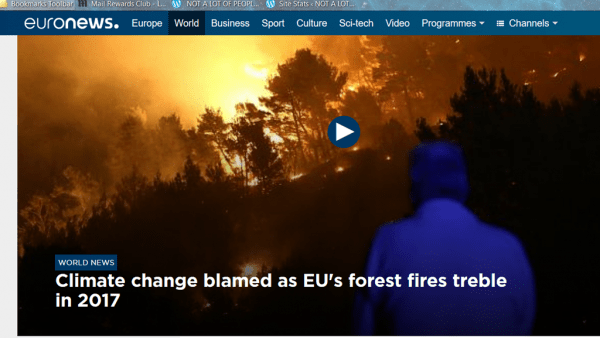
Now you’re no doubt way ahead of me here!
Apparently, the last eight years is the “normal climate”, and 2017 is the new.
Joe, being a suspicious little devil, thought he would check why they used the last eight years as a baseline, and discovered why.
This is the official data from the European Environment Agency, published last November:
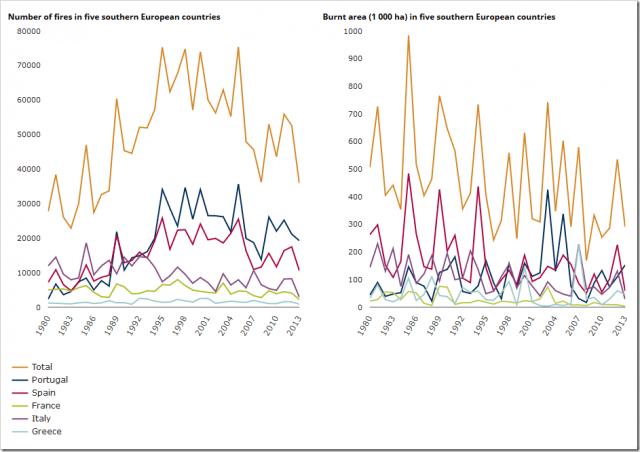
https://www.eea.europa.eu/data-and-maps/daviz/burnt-forest-area-in-five-1#tab-dashboard-01
The number of fires since 1980 peaked in the 1990s, and have been relatively low in the last few years.
The trend on burnt acreage is even more stark, showing consistent decline since the 1980s.
I wonder what they’ll blame on global warming next?
The Dawn of an Orwellian Future
By Robert Parry | Consortium News | July 28, 2017
It seems that The New York Times can’t let a good lie lie. Even after being pushed into running an embarrassing correction retracting its false claim that there was a consensus of all 17 U.S. intelligence agencies that Russia hacked Democratic emails and made them public to help Donald Trump defeat Hillary Clinton, the Times is back suggesting exactly that.
The Times’ current ploy is to say the Russian hacking claims are the “consensus” judgment of the U.S. intelligence community without citing a specific number of agencies. For instance, on Friday, the Times published an article by Matt Flegenheimer about the U.S. Senate vote to prevent President Trump from lifting sanctions on Russia and deployed the misleading phrasing:
“The Trump administration has opposed the sanctions against Russia, arguing that it needs flexibility to pursue a more collaborative diplomacy with a country that, by American intelligence consensus, interfered in last year’s presidential election.”
So, instead of explaining the truth – that the Jan. 6 “Intelligence Community Assessment” was the work of a small group of “hand-picked” analysts from three of the agencies under the watchful eye of then-CIA Director John Brennan and beneath the oversight of then-Director of National Intelligence James Clapper – the Times opts to give its readers the misleading impression that there was a “consensus” within the U.S. intelligence community.
In other words, unless a Times reader knows the truth by having read it at a non-mainstream media outlet such as Consortiumnews.com, that reader would continue to believe that all 17 intelligence agencies were in agreement on this foundational point in the Russia-gate affair.
Marginalizing Dissent
And the continuation of this willful deception comes as the Times and other mainstream media outlets make progress in their plans to deploy Internet algorithms to hunt down and marginalize what they deem “fake news,” including articles that challenge the mainstream media’s power to control the dominant news narrative.
A report by the World Socialist Web Site found that “in the three months since Internet monopoly Google announced plans to keep users from accessing ‘fake news,’ the global traffic rankings of a broad range of left-wing, progressive, anti-war and democratic rights organizations have fallen significantly.”
Google’s strategy is to downgrade search results for targeted Web sites based on a supposed desire to limit reader access to “low-quality” information, but the targets reportedly include some of the highest-quality alternative news sites on the Internet, such as – according to the report – Consortiumnews.com.
Google sponsors the First Draft Coalition, which was created to counter alleged “fake news” and consists of mainstream news outlets, including the Times and The Washington Post, as well as establishment-approved Web sites, such as Bellingcat, which has a close association with the anti-Russia and pro-NATO Atlantic Council.
This creation of a modern-day Ministry of Truth occurred under the cover of a mainstream-driven hysteria about “fake news” and “Russian propaganda” in the wake of Donald Trump’s election.
Last Thanksgiving Day, the Post ran a front-page article citing accusations from an anonymous Web site, PropOrNot, that identified 200 Web sites — including such Internet stalwarts as Truthdig, Counterpunch and Consortiumnews — as purveyors of “Russian propaganda.”
Apparently, PropOrNot’s standard was to smear any news outlet that questioned the State Department’s Official Narrative on the Ukraine crisis or some other global hot spot, but the Post didn’t offer any actual specifics of what these Web sites had done to earn their place on a McCarthyistic blacklist.
An Orwellian Future
In early May 2017, the Times chimed in with a laudatory article about how sophisticated algorithms could purge the Internet of alleged “fake news” or what the mainstream media deems to be “misinformation.”
As I wrote at the time, “you don’t need a huge amount of imagination to see how this combination of mainstream groupthink and artificial intelligence could create an Orwellian future in which only one side of a story gets told and the other side simply disappears from view.”
After my article appeared, I received a call from an NPR reporter who was planning a segment on this new technology and argued with me about my concerns. However, after I offered a detailed explanation about how I saw this as a classic case of the cure being far worse than the disease, I was not invited onto the NPR program.
Also, as for the relatively small number of willfully produced “fake news” stories, none appear to have traced back to Russia despite extensive efforts by the mainstream U.S. media to make the connection. When the U.S. mainstream media has tracked down a source of “fake news,” it has turned out to be some young entrepreneur trying to make some money by getting lots of clicks.
For instance, on Nov. 26, 2016, as the anti-Russia hysteria was heating up in the weeks following Trump’s election, the Times ran a relatively responsible article revealing how a leading “fake news” Web site was not connected to Russia at all but rather was a profit-making effort by an unemployed Georgian student who was using a Web site in Tbilisi to make money by promoting pro-Trump stories.
The owner of the Web site, 22-year-old Beqa Latsabidse, said he had initially tried to push stories favorable to Hillary Clinton but that proved unprofitable so he switched to publishing anti-Clinton and pro-Trump articles whether true or not.
While creators of intentionally “fake news” and baseless “conspiracy theories” deserve wholehearted condemnation, the idea of giving the Times and a collection of Google-approved news outlets the power to prevent public access to information that challenges equally mindless groupthinks is a chilling and dangerous prospect.
Russia-gate Doubts
Even if the Russian government did hack the Democratic emails and slip them to WikiLeaks – a charge that both the Kremlin and WikiLeaks deny – there is no claim that those emails were fake. Indeed, all evidence is that they were actual emails and newsworthy to boot.
Meanwhile, U.S. government accusations against the Russian network, RT, have related more to it covering topics that may make the Establishment look bad – such as the Occupy Wall Street protests, fracking for natural gas, and the opinions of third-party presidential candidates – than publishing false stories.
In some cases, State Department officials have even made their own false allegations in attacking RT.
The current Russia-gate frenzy is a particularly scary example of how dubious government conclusions and mainstream media falsehoods can propel the world toward nuclear destruction. The mainstream media’s certainty about Russia’s guilt in the disclosure of Democratic emails is a case in point even when many well-informed experts have expressed serious doubts — though almost always at alternative media sites.
See, for instance, former WMD inspector Scott Ritter’s warning about lessons unlearned from the Iraq debacle or the opinions of U.S. intelligence veterans who have questioned the accuracy of the Jan. 6 report on Russian hacking.
Perhaps these concerns are misplaced and the Jan. 6 report is correct, but the pursuit of truth should not simply be a case of grabbing onto the opinions of some “hand-picked” analysts working for political appointees, such as Brennan and Clapper. Truth should be subjected to rigorous testing against alternative viewpoints and contradictory arguments.
That has been a core principle since the days of the Enlightenment, that truth best emerges from withstanding challenges in the marketplace of ideas. Overturning that age-old truth – by today unleashing algorithms to enforce the Official Narrative – is a much greater threat to an informed electorate and to the health of democracy than the relatively few times when some kid makes up a bogus story to increase his Web traffic.
And, if this new process of marginalizing dissenting views is successful, who will hold The New York Times accountable when it intentionally misleads its readers with deceptive language about the U.S. intelligence community’s “consensus” regarding Russia and the Democratic emails?
Investigative reporter Robert Parry broke many of the Iran-Contra stories for The Associated Press and Newsweek in the 1980s.
As Harvard academics prove, the truth doesn’t matter when you are bashing Russia
RT | July 27, 2017
Two Harvard University academics have seen dreadfully incorrect Russia-related tweets recently go viral. The fact neither has deleted their falsehoods sums up the low standards when it comes to the Western assessment of all things Russian.
In the information space, a lot of stuff goes out the window when it comes to Russia. Like ethics, decency, fairness, and facts. It’s hard to recall a single incidence of a journalist, official or academic losing a position for being hopelessly wrong about the country.
That’s why you end up with TV networks offering people who’ve never set foot in Moscow as “Russia experts,” magazines presenting opposition figures on two percent in the polls as serious contenders for the presidency and outlets alleging Vladimir Putin is dating Wendy Deng.
It also explains how pundits can claim Russia is about to collapse and then a few months later, insist the Kremlin is about to invade another country. And why analysts who set exact time frames for these incursions, and are proven wrong, fall upwards rather than downwards subsequently. Because anything goes when it comes to Russia and fueling the hysteria is more important than telling the truth.
That said, at least in the “respectable media” you might get the odd correction. Such as when The Washington Post was forced to backtrack on spurious reports Moscow had hacked Vermont’s electrical grid, or when the same paper was compelled to issue a correction after falsely accusing RT of using automated bots to circulate articles.
However, on social media, not only do “experts” not apologize, they rarely even delete their erroneous posts. Probably because of the huge exposure they can receive from the thousands of shares and retweets to be gained from crookedly smearing Russia. And to hell with the consequences of the animosity, enmity, and venom they generate.
Tribal Instinct
A classic case in point emerged this Thursday morning (Moscow Time) when a Harvard University professor named Laurence Tribe, tweeted the following: “DOJ (Department of Justice) is pursuing Dmitri Firtash, Russian mobster linked to . . wait for it: (former Trump campaign aide, Paul) Manafort. But T (Trump) named lawyer for Russian bank to head Crim(inal) Div(ision)!”
DOJ is pursuing Dmitri Firtash, Russian mobster linked to . . wait for it: Manafort. But T named lawyer for Russian bank to head Crim Div!
— Laurence Tribe (@tribelaw) July 27, 2017
And at the time of writing, this brainfart had earned over 4,000 retweets, which have surely multiplied since.
But, you guessed it, the tweet is deceptive, deceitful and specious, whether by accident or design. Because the “Russian mobster” mentioned, Dmitry Firtash is actually a Ukrainian oligarch. A man who amassed much of his fortune during the Presidency of Viktor Yushchenko, the pro-Western leader installed after the 2004 “Orange Revolution.” In addition, Firtash served in a number of government positions during the administration, including as Chair of the National Tripartite Social and Economic Council.
Firtash was born in Ukraine and holds Ukrainian citizenship. And, while he may very well be a “mobster,” he’s not Russian. And, as the Western media never tires of emphasizing, Ukraine and Russia are not the same country and haven’t been joined since 1991.
Dozens of people have pointed out Tribe’s mistake. And the writer has surely noticed because he’s posted since, but this falsehood still sits on his page, proud as a peacock. All the while being shared all around the Twittersphere, as its author betrays no sense of remorse or embarrassment.
Nothing Is Real
Nevertheless, to be fair to Tribe, he’s only a baby faker compared to his Harvard colleague Yascha Mounk. A man who professes to “defend liberal democracy against the illiberal international.” And also makes up the odd bogus online statement about Russia.
A couple of weeks ago Mounk reported on Twitter: “Need a reminder of the human cost of dictatorship? All these are journalists who criticized Putin–and died under mysterious circumstances.” But the problem with his statement was quickly evident to anyone with a basic knowledge of Russia.
Need a reminder of the human cost of dictatorship? All these are journalists who criticized Putin–and died under mysterious circumstances pic.twitter.com/RaOluVumxi
— Yascha Mounk (@Yascha_Mounk) July 15, 2017
Because the image used to illustrate the tweet of ‘journalists killed by Putin’ was actually one of all Russian journalists killed, anywhere, since 1991. And, what’s more, most of them passed away under the West-endorsed presidency of Boris Yeltsin. With many of those featured having been war correspondents, who sadly met their ends in conflict zones. Indeed, while journalism often remains perilous in today’s Russia, the fact is things were far more dangerous during the “liberal democratic” Yeltsin years. The pattern is being repeated right now in Ukraine, where violence against journalists has risen dramatically since the 2014 Maidan installed a US-backed regime.
Again, despite numerous folk informing Mounk of his tweet’s inaccuracy, he hasn’t deleted it. So, It continues to strut across Twitter, with 55,000 retweets and counting. Each one of them spreading the disinformation to a new audience.
Harvard University’s 2016-17 fees amount to “$43,280 for tuition and $63,025 for tuition, room, board, and fees combined,” according to its website. Now, for that kind of cash you’d expect teachers and researchers of the highest caliber, dedicated to rigorous fact-checking and earnestly devoted to accuracy.
But Mounk and Tribe, at least when it comes to Russia, don’t seem to care about such basic standards. Don’t expect either to suffer sanction. Because, after all, anything goes these days once the subject matter is Russian.
Bryan MacDonald is an Irish journalist, who is based in Russia
Read more:
PBS’ Anti-Russia Propaganda Series
By Rick Sterling | Consortium News | July 27, 2017
The U.S.-government-supported Public Broadcasting System (PBS) recently ran a five-part series dubbed “Inside Putin’s Russia”. With a different theme each night, it purports to give a realistic look at Russia today. The image conveyed is of a Russia that is undemocratic with widespread state repression, violence and propaganda. Following are significant distortions and falsehoods in the five-part documentary.
Episode 1: “How Putin Redefined what it means to be Russian”
In this episode, the documentary:
–Claims that Russian identity is based on “projection of power.” In reality, “projection of power” characterizes the U.S. much more than Russia. For the past two centuries the United States has expanded across the continent and globe. The last century is documented in the book Overthrow: American’s Century of Regime Change from Hawaii to Iraq. The U.S. currently has nearly 800 foreign military bases in over 70 countries. In contrast, Russia has military bases in only two countries beyond the former Soviet Union: Syria and Vietnam.
–Ignores crucial information about events in Ukraine. Russian involvement in eastern Ukraine and Crimea are presented as examples of “projection of power.” But basic facts are omitted from the documentary. There is no mention of the violent February 2014 coup in Kiev nor the involvement of neoconservatives such as Sen. John McCain and U.S. Assistant Secretary of State Victoria Nuland in supporting and encouraging the overthrow of Ukraine’s elected government. In a December 2013 speech, Nuland outlined her intense involvement in Ukraine including U.S. insistence that Ukraine choose a “European future” since the U.S. had “invested $5 billion to assist.” Days before the coup in February 2014, Nuland was captured on audio planning the composition of the coup leadership.
–Ignores Crimea’s historic connections with Russia and the Ukrainian violence. The documentary says, “In 2014 in Crimea, Russia helped install separatist leaders who rushed through a referendum that led to Crimea’s annexation.” This gives the misleading impression the decision was Russian, not Crimean.
Even the New York Times report on March 16, 2014, acknowledged that, “The outcome, in a region that shares a language and centuries of history with Russia, was a foregone conclusion even before exit polls showed more than 93 percent of voters favoring secession.”
The documentary fails to mention the fear of violence after Crimean travelers to Kiev were beaten and killed by Ukrainian hyper-nationalists. One of the first decisions of the Kiev coup government was to declare that Russian would no longer be an official language. A good overview including video interviews with Crimeans is in this video, contrasting sharply with the implications of the PBS documentary.
–Trivializes Russian opposition to NATO expansion. The documentary suggests Russians feel “humiliated” by NATO expanding to their borders. This distorts a serious military concern into a subjective, emotional issue. In 2002, the U.S. unilaterally withdrew from the Anti-Ballistic Missile Treaty and started construction of missile defense systems which could be used in tandem with a nuclear first strike. In recent years, NATO troops and missiles have been installed at Russia’s borders. Imagine the response if Russian troops and missiles were placed at the U.S. border in Canada and Mexico.
–Falsely claims that coup violence in Odessa was “exaggerated.”
The documentary says that Russians who went to help defend civilians in eastern Ukraine were convinced by Russian “propaganda” where “dozens of pro-Russian separatists died in Odessa, Ukraine” but “Russian media exaggerated the attack.” In reality, the Odessa attack killed at least 42 people and injured 100. This video shows the sequence of events with the initial attack on peaceful protesters followed by fire-bomb attacks in the building. Fire trucks were prevented from reaching the building to put out the fire and rescue citizens inside.
Episode 2: “Inside Russia’s Propaganda Machine.”
In this episode, the documentary:
–Suggests Russians are aggressive and threatening. The documentary highlights a Russian TV broadcaster who is translated to say, “Russia is the only country in the world that is realistically capable of turning the United States into radioactive ash.” And later, “If you can persuade a person, you don’t need to kill him … if you aren’t able to persuade, then you will have to kill.” We do not know the context or accuracy of these translated statements. However on the basis of my own travels in Russia and the experience of many other Americans, these statements are strange and uncharacteristic.
At the popular and government level, Russians are typically at pains to call the U.S. a “partner” and to wish for peace and better relations. With 27 million killed in World War 2, most Russians are very conscious of the consequences of war and deeply want peace. Russians vividly recall the Russia-U.S. alliance during WW2 and seek a return to friendly collaboration. The film producers must have heard this message and desire for peace expressed by many Russians many times. But the documentary only presents this uncharacteristic aggressive message.
–Inaccurately suggests that producers of a private TV network received angry public messages because they were exposing corruption. In reality, the angry public response was because the TV station ran a poll asking viewers if the Soviet Union should have surrendered to Nazi Germany to save lives during the siege of Leningrad.
–Falsely suggests that RT (Russia Today TV) typically features Holocaust deniers and neo-Nazis. This is a grotesque distortion Anyone who watches RT will know that American personalities such as Chris Hedges, Larry King and Ed Schultz are regulars on RT. Interviewees on international affairs generally come from the left side of the political spectrum – the opposite of what is suggested.
–Uncritically repeats the conspiracy theory that Russia hacked the Democratic National Committee (DNC) and Hillary Clinton emails. The findings have been disputed by the publisher of the emails, Julian Assange of Wikileaks , as well as Veteran Intelligence Professionals for Sanity. A recent forensic examination confirms that this was a leak not a hack (inside job done by local data transfer NOT a hack over the internet) and points to “Guccifer 2.0”, the presumptive “hacker,” being a hoax intentionally created to implicate Russia.
–Falsely suggests that anti-Clinton social media messaging during 2016 was significantly caused by Russian government trolls. Hillary Clinton was strongly opposed by significant portions of both the left and right. There were probably hundreds of thousands of Americans who shared anti-Clinton social media messages.
–Claims that research showing a Google search engine bias in favor of Hillary Clinton was “quickly debunked.” The documentary ignores the original article describing the potential effect of search-engine bias, which was published in the prestigious Proceedings of the National Academy of Sciences. The author is Dr. Robert Epstein, former editor-in-chief of Psychology Today magazine. Contradicting the claim that this research was “debunked,” this academic article estimates the effect of the Google bias and how the bias went away AFTER the election. The response from Google and very shallow Snopes “fact check” are effectively rebutted by the lead author here. In neo-McCarthyist style, the documentary smears the findings and claims they were “laundered” after being published by the Russian “Sputnik” media.
–Suggests the “idea that President Kennedy was killed by the CIA” was “planted” by the Soviet intelligence agency KGB. Many impressive American books have been written supporting this contention, from New Orleans District Attorney Jim Garrison’s book to David Talbot’s 2015 book Devil’s Chessboard: Allen Dulles, the CIA and Deep State. Claiming that this accusation is based on KGB “disinformation” is another grotesque distortion. It is not revealing disinformation; this is an example of disinformation.
Episode 3: “Why are so many from this Russian republic fighting for Isis?”
In this episode, the documentary:
–Rationalizes and almost justifies Russian Muslims traveling to join ISIS. The documentary suggests that religious repression and discrimination is a cause of ISIS recruitment and that “Dagestanis who fought for ISIS continue a decades-old legacy here of radicalism and militancy.”
–Ignores the role of the U.S., Saudi Arabia and Pakistan in promoting Islamist fundamentalism in Dagestan. As described by Robert Dreyfus in the book Devil’s Game: How the United States Helped Unleash Fundamentalist Islam: “the Casey-ISI (CIA and Pakistan Secret Service) actions aided the growth of a significant network of right-wing, Islamist extremists who, to this day, plague the governments of the former Soviet republics … In particular, the Islamic Movement of Uzbekistan, the Islamic Liberation Party, the powerful Islamist groups in Chechnya and Dagestan.”
–Ignores the role of the US and allies in facilitating ISIS. As journalist Patrick Cockburn has written, “In the 20 years between 1996 and 2016, the CIA and British security and foreign policy agencies have consistently given priority to maintaining their partnership with powerful Sunni states over the elimination of terrorist organizations such as al-Qaeda and Isis.”
Journalist Nafeez Ahmed exposed the role of Turkey here, “A former senior counter-terrorism official in Turkey has blown the whistle on President Recep Tayyip Erdogan’s deliberate sponsorship of the Islamic State (ISIS) as a geopolitical tool to expand Turkey’s regional influence and sideline his political opponents at home.”
Elements of the U.S. military/intelligence suggested the establishment of ISIS to “isolate the Syrian regime.” This was revealed in the classified 2012 report of the Defense Intelligence Agency that “THERE IS THE POSSIBILITY OF ESTABLISHING A DECLARED OR UNDECLARED SALAFIST PRINCIPALITY IN EASTERN SYRIA (HASAKA AND DER ZOR), AND THIS IS EXACTLY WHAT THE SUPPORTING POWERS TO THE OPPOSITION WANT, IN ORDER TO ISOLATE THE SYRIAN REGIME”
In short, ISIS recruitment from Muslim communities in Russia and worldwide has been spurred by the policies and actions of the U.S. and allies such as Saudi Arabia and Turkey. This is what Dreyfus calls The Devil’s Game, but is ignored in the documentary.
Episode 4: “The Deadly Risk of Standing up to Putin”
In this episode, the documentary:
–Suggests that critics of Putin and the Russian government face “consequences” including death. These accusations are widespread in the West but largely based on the claims of different U.S.-supported “activists.” One of the most famous cases, and the one on which U.S. congressional sanctions against Russia are based, is that of Sergei Magnitsky. Magnitsky’s death was the subject of a documentary, which has been effectively banned in the U.S. In the course of researching what happened, the filmmaker learned that the truth was very different than has been told in the West and promoted by hedge-fund executive William Browder. Gilbert Doctorow outlines what happens in his review of the film here:
“‘Magnitsky Act: Behind the Scenes’ is an amazing film which takes us through the thought processes, the evidence sorting of the well-known independent film maker Andrei Nekrasov as he approached an assignment that was at the outset meant to be one more public confirmation of the narrative Browder has sold to the US Congress and to the American and European political elites. That story was all about a 36 year old whistle-blower ‘attorney’ (actually a bookkeeper) named Sergei Magnitsky who denounced on Browder’s behalf the theft of Russian taxes to his boss’s companies amounting to $230 million and who was rewarded for his efforts by arrest, torture and murder in detainment by the officials who perpetrated the theft. This shocking tale drove legislation that was a major landmark in the descent of US-Russian relations under President Barack Obama to a level rivaling the worst days of the Cold War.
“At the end of the film we understand that this story was concocted by William Browder to cover up his own criminal theft of the money in question, that Magnitsky was not a whistleblower, but on the contrary was likely an assistant and abettor to the fraud and theft that Browder organized, that he was not murdered by corrupt Russian police but died in prison from banal neglect of his medical condition.”
The PBS documentary quotes an opposition leader, Vladimir Kara-Murza, saying “We have no free and fair elections. We have censorship in the media. We have political prisoners, more than 100 political prisoners now in Russia, today.” Kara-Murza now lives in Washington “for his safety” but returns to Russia periodically. He claims to have been poisoned several times.
Opponents of the Russian government are quick to accuse but the evidence is largely hearsay and speculation. Public polls of citizens in Russia repeatedly indicate that Putin and the government have widespread popularity, in contrast with the accusations in this documentary that they rule by intimidation and violence.
Episode 5: “What Russians think about Trump and the U.S.”
Based on the content, the final episode should be titled “What the U.S. establishment and media thinks of Putin and Russia.” In this episode, the documentary:
–Features accusations by CIA Director Mike Pompeo that Russian President Putin, “ is a man for whom veracity doesn’t translate into English.” An objective documentary would take CIA claims about “veracity” with a healthy dose of skepticism. Just a few years ago, former Director of National Intelligence James Clapper was confirmed to have lied under oath to Congress. Former CIA chief of counterintelligence James Angleton said in his dying days, “Fundamentally, the founding fathers of U.S. intelligence were liars. The better you lied and the more you betrayed, the more likely you got promoted.” So it is curious to see the PBS documentary uncritically presenting the new CIA director as a judge of veracity.
–Implies that President Trump is out of line to question “the U.S. intelligence community’s unanimous assessment that Russia hacked the 2016 election.” It has been recently exposed that the “unanimous assessment” was, in reality, by “hand-picked” analysts at three agencies, under DNI Clapper’s oversight, not all 17 agencies and that the National Security Agency did NOT have “high confidence” in a key finding. The “assessment,” which the Jan. 6 report acknowledged was NOT an establishment of fact, was based on the forensics of a private company, Crowdstrike, with a checkered record in this field, and the dubious Christopher Steele dossier, a collection of “opposition research” reports against Donald Trump, paid for unidentified allies of Hillary Clinton and compiled by Steele, an ex-British intelligence agent.
In March 2017, Crowdstrike was found to have made false claims in another investigation of an alleged Russian “hack.” Yet, neither the CIA nor FBI examined the Democratic National Committee’s computers. If the issue was as important as it supposedly has now become, the FBI should have issued a subpoena to do its own examination. Why the DNC rejected the FBI request, and why the FBI did not insist, raises serious questions given the enormous publicity and accusations that have followed.
–Uncritically features two US politicians making loose accusations and effectively criminalizing “contacts” with Russians. Sen. James Lankford, R-Oklahoma, says President Trump is “pushing out some messages that are consistent with the Kremlin policies … there’s no question that the Russians were trying to hack into our elections.” Yet, former U.S. intelligence officers with experience in these areas recently presented evidence raising significant questions about this conventional wisdom.
On the Democratic side, Sen. Mark Warner of Virginia indicates the Senate investigation reached its conclusion before it began. He said, “The goal of this investigation is not only to reconfirm Russian intervention and explain that to the American public, but to also see if there were any contacts between Trump and the Russians.”
In the current environment, to have “contacts” with Russians has been criminalized. Instead of questioning the validity or wisdom of this position, the documentary presents it with seeming approval.
–Uncritically promotes false statements and reckless threats. Sen. Lankford says “We believe strongly that what Russia continues to do to be able to threaten Ukraine, threaten its neighbors, threaten NATO, to continue to pry into not only our elections, but other elections, is destabilizing, and it demands a response. They have yet to have a consequence to what they did in the election time. And they should.”
Lankford’s assertions are presented as facts but are debatable or false. For example, security services in Germany, France and the U.K. all found that – despite the international accusations – there was NO evidence of Russian interference in their recent elections.
–Justifies and promotes “punishment” of Russia. The belligerent approach of Lankford and Warner is continued by PBS host Judy Woodruff and narrator Nick Schifrin. The U.S. is portrayed as a vulnerable victim with a future that is “foreboding”. Russia is portrayed as threatening and needing some punishment soon: “The Russian government doesn’t feel like the United States government really penalized them for what happened last year…. a lot of officials here in Washington agree with that… Russia should have paid for what they did last year.”
This threatening talk is then followed by the following assessment from the narrator: “There are analysts in Moscow who think the only thing we can hope is that we avoid war.”
In 2002-2003, American mainstream media failed to question or challenge the assertions of the CIA and politicians pushing for the invasion of Iraq. At that time, the false pretense was that Iraq had weapons of mass destruction and posed a threat to the U.S.
Much of the media and many of the same politicians are now claiming Russia is an adversary that has “attacked us.” This claim is being widely made without serious question or challenge. “Liberal” media seems to be in alliance with hawkish neoconservatives on this issue. Virtually any accusation against Russia and its leader can be made with impunity and without serious evidence.
The PBS documentary “Inside Putin’s Russia” aims to expose Russian repression, aggression and disinformation. As shown in the many examples above, the five-part documentary is highly biased and inaccurate. While it shows some features of Russia, it also demonstrates American propaganda in the current tumultuous times.
Rick Sterling is an investigative journalist based in northern California. He can be contacted at rsterling1@gmail.com
The Atlantic Council: Experts on the front line of disinformation
By Bryan MacDonald | RT | July 26, 2017
NATO’s academic wing has been warning about disinformation for years. And it’s no wonder when its staff and contributors are so well-versed in the practice themselves.
The Atlantic Council is an organization dedicated to discussion between people who hate Russia and folk who really, really hate Russia. Thus, amid the current hysteria, it’s Christmas every day for its assorted staff and “fellows” or, to use a more accurate term, ‘lobbyists.’
For the uninitiated, it’s difficult to explain what exactly the Atlantic Council does. Essentially, the club exists to influence the information space to justify NATO’s continued existence. It does that by either employing Russia’s opponents directly or offering retainers to journalists and media analysts who can be relied upon to push the outfit’s anti-Russian stance. Which, of course, is its lifeblood.
While the Atlantic Council is set-up to promote antagonism toward Russia, it also needs it. Because if Russia combusted tomorrow, everyone on the payroll would be out of a job. So, it’s like the famous U2 song “I can’t live, with or without you.” But unlike the protagonist of that ditty, these guys don’t give themselves away. Instead, this NATO adjunct is lavishly funded, by a roll call of famous entities.
Such as the Foreign & Commonwealth Office of the United Kingdom, Abu Dhabi’s National Oil Company, the Ukrainian World Congress, the Lockheed Martin Corporation, the Raytheon Company, the US State Department and the Victor Pinchuk Foundation, which is the plaything of a Ukrainian oligarch.
Some of the more prominent beneficiaries of the resultant money tree include Bellingcat’s Eliot Higgins, CNN’s Michael Weiss, Crowdstrike’s Dmitri Alperovitch, Obama advisor Evelyn Farkas and Maxim Eristavi of Ukraine’s Maidan. All of whom are conveniently united by their hostility to all things Russian.
Like Rolling Stones
The Atlantic Council’s content ranges from very anti-Russian to extremely anti-Russian. For instance, it carries articles by the likes of Alexander Motyl, who predicted Russia’s imminent collapse in January of 2016, before warning in January of 2017 that Moscow was planning a major land invasion of Ukraine. Which is Russophrenia at its finest, in fairness. Nevertheless, Motyl is a shrinking violet compared to Atlantic Council lobbyist Anders Aslund, who foresaw Russia’s demise way back in September 1999. And now, almost eighteen years later, he’s still hanging around for the big moment. In the manner of a Seventh Day Adventist awaiting the second coming of Jesus, any day now.
So, now that we’ve established the Atlantic Council’s modus operandi let’s look at the latest example of the group’s myopia. This week, they’ve unleashed one Polina Kovaleva to opine on “why Congress should pass the Russian sanctions bill.” And she’s delivered a tirade which is shoddy, even when measured by the usual indigent standards.
Kovaleva gives her readers examples of why the embargo is justified, in her opinion, but then delivers a line so deceptive that it makes you wonder whether she’s in touch with reality. “Although the Senate easily passed a strong sanctions bill in June to punish Russia for its aggression in Ukraine and annexation of Crimea, the White House has quietly lobbied to weaken it, and some European politicians are pushing back,” she writes.
Eurocrat Anger
That’s’ right, “some European politicians are pushing back.” Some! What she actually means is “basically every significant elected representative in the European Union.” Including, the “leader of the free world” herself Angela Merkel and that well-known renegade Jean-Claude Juncker.
Here’s what Reuters reported on Wednesday morning: “European Commission President Jean-Claude Juncker said on Wednesday the European Union was ready to act “within a matter of days” if proposed new US sanctions on Russia undermined the bloc’s energy security. And that came three days after the Financial Times reported how Brussels was considering imposing penalties on the US if it damaged European interests to settle scores with Moscow.
Meanwhile, for her part, Merkel has backed Germany’s Foreign Minister, Sigmar Gabriel, in expressing concerns that Washington is threatening “illegal extraterritorial sanctions against European companies that participate in the development of European energy supply.”
Because everybody in Europe knows this US Congress bill has little or nothing to do with punishing Russia. Instead, it’s about trying to nudge Moscow’s energy companies out of Europe, to create market share for their competitors. In other words, a form of economic war, in which the EU countries’ interests don’t amount to a hill of beans.
Something explained recently by Wolfgang Ischinger, a prominent German pundit and former diplomat. He contended: “how would the US have reacted if Europeans had adopted a bill against Keystone XL pipeline but in favor of European business?” before pointing out “for Europe, the loss of such large oil or gas supplies from Russia is unacceptable: there are no alternatives.”
Without question, this is a high-profile resistance campaign. And these sanctions could severely rupture transatlantic ties. Because you don’t get more powerful than Merkel and Juncker in Europe. But the Atlantic Council makes it sound as if a few fringe politicians are off on a solo-run, rejecting Washington’s supreme wisdom.
That is certainly not the case and amounts to misleading agitprop of the highest order. Which is rather apt for a lobbying firm which recently held a “Disinfo week” and proudly claims to be “On the front lines of disinformation.” Because, on this evidence, the Atlantic Council is home to seriously proficient gurus of hogwash.
Bryan MacDonald is an Irish journalist, who is based in Russia.
The Guardian’s Propaganda on Venezuela
By Ricardo Vaz | Investig’Action | July 25, 2017

With the Constituent Assembly elections due to take place on July 30th, the Guardian published a piece titled “Venezuela elections: all you need to know”. But instead of breaking through the fog of falsehood and misinformation that is typical of the mainstream media’s coverage of Venezuela, the Guardian comes up with another propaganda piece laden with lies, distortions and omissions. In this article we go through the Guardian’s piece, clarifying the falsehoods, adding the conveniently omitted information and questioning the whole narrative that is presented.
*****
What is happening on 30 July?
To be fair to the Guardian, there is one almost-informative paragraph, where the electoral procedure is explained. In a previous article the Guardian stated that
“[…] election rules appear designed to guarantee a majority for the government even though it has minority popular support”,
instead of presenting said electoral rules and letting the reader decide if they are so designed. This time they do present the rules, only omitting to say that everyone not currently holding public office can run for a seat. But then the Guardian brings in the propaganda artillery to ensure the reader’s conclusions do not stray too far off from those of the State Department.
“[…] voter turnout will be exclusively pro-government – and likely very low, given that Maduro’s approval rating hovers around 20%” 1
One assumes the Guardian is citing Datanalisis, their favourite Venezuelan anti-government pollster. Putting aside the fact that other, more reliable polls, demonstrate larger levels of government support, and the massive turnout for last Sunday’s dry-run, there are two obvious questions here. If turnout will be so low, why is the opposition hell-bent on stopping the vote from taking place, barricading streets and killing candidates? And if the opposition has such an overwhelming majority, why did they decide not to participate? This might have been their chance to introduce a Platt Amendment into the Constitution.
“The current constitution was written by an assembly called in 1999 by Maduro’s predecessor and political father, Hugo Chávez. But Chavez made sure he had popular support for the rewrite, by calling a referendum first. This time around, Maduro ordered the constituent assembly by decree.”
Chávez needed to call a referendum because he was working within the legal framework of the 1961 Constitution which did not have anything about such a mechanism. In the 1999 Constitution, article 348 states who can convene a Constituent Assembly.

Venezuelan president Nicolás Maduro has repeatedly urged opposition leaders to engage in dialogue and has backed the Constituent Assembly to guarantee peace.
“On 16 July, a symbolic plebiscite against Maduro’s initiative held by the opposition drew more than seven million people – more than those who voted for Maduro in the 2014 election.”
When it comes to the Venezuelan opposition, the Guardian checks all the journalism tools at the door. In a recent Investig’Action article we examined the opposition’s highly doubtful numbers, Venezuelanalysis did the same. At least the Guardian refrained from explicitly saying this vote could have recalled Maduro, something the opposition could not manage even with a lot of number-cooking (see footnote 2).
“Amid mounting pressure, Maduro vowed last month to hold a popular vote at the end of the process to approve or reject the new constitution.”
This was announced almost two months ago, and if it had been due to “mounting pressure” the mainstream media would have done a victory lap. Here another question springs up: why are the Venezuelan opposition and the Guardian so scared of this process? If they represent this huge majority, can they not just vote down the Constituent Assembly proposal?
Why did Maduro call this vote?
The final paragraph of this section contains the mandatory red-baiting and waving of the Cuban bogeyman.
“Venezuela has been rocked by nonstop street protests since the government’s attempt in late March to strip Congress of its right to legislate. Although the move was partially reversed, demonstrations have continued against an increasingly authoritarian government widely blamed for the country’s tanking economy and soaring crime rate.”
Again, there is very little journalism here to be found. It was not the government that overrode the National Assembly, but the Supreme Court. And they did it because the National Assembly is currently in contempt of court. Three legislators from Amazonas state are being investigated for electoral fraud, and despite repeated warnings from judicial authorities, the opposition went ahead and swore in these legislators. One can agree or disagree with the Supreme Court’s initiative, but omitting this fact is pure dishonesty.
This is also a good point to notice how only the “authoritarian” government and the “beleaguered” president have earned adjectives. “Protests” are referred to five times without a single reference to their violent nature, and a few adjectives (“divided”, “US-backed”, “coup-plotting”) also come to mind when describing the opposition.
“[…] violence and state repression have escalated since, with more than 100 people killed and hundreds arrested.”
Sophisticated newspapers like the Guardian are careful not to state directly that everyone was killed by state repression, only heavily implying it. A breakdown of the cases shows that it is the opposition’s political violence that has been responsible for the large majority of casualties.
What does the opposition say?
“The coalition of opposition forces known as the Democratic Unity Roundtable (known by its Spanish initials, MUD) rejected the move from the start. But criticism extends far beyond the political opposition. According to one pollster, eight out of 10 Venezuelans oppose a new constitution and would prefer general elections.”
One would think this would be an opportune moment to remind readers of the opposition’s constant, repeated calls for a Constituent Assembly in the recent past. And according to a different pollster, 79% of Venezuelans agree that the process should take place, 54% think the process will defend social gains of recent years, and 65% agrees with holding elections in 2018.

Opposition leaders Freddy Guevara and Maria Corina Machado had called for a Constituent Assembly in the past. (Tweets by Misión Verdad)
What happens next?
“Pressure is set to rise after the MUD called a two-day national strike for Wednesday and Thursday, and then mass protests dubbed the “taking of Caracas” on Friday.”
To anyone familiar with the recent history of Venezuela these announcements sound eerily like the events leading up to the failed 2002 coup. In fact, this would be the time to mention that many of the opposition leaders, including Henrique Capriles, Julio Borges, Leopoldo López and Maria Corina Machado, were directly involved in the 2002 coup attempt. Why is there never a mention that the opposition leadership is full of protagonists from that US-backed military coup that ultimately failed? Quite simply because it would undermine the entire “democracy vs. dictatorship” propaganda narrative.
“Maduro has been very vague about the scope of the new constitution – prompting fears that this is simply a move to tighten the government’s hold on power rather than to solve the country’s many problems.”
This is again a distortion. Maduro proposed nine issues to be tackled by the ANC, including the economy, national sovereignty, social missions, communes, and more. Granted, there is some ambiguity on what a “post-oil economy” stands for, with radical sectors looking for a deepening of the Revolution and business leaders looking for more incentives to private investment. But is down to the individual candidates to bring forward their proposals during the campaign. If Maduro specifically said what changes he wanted made to the Constitution, would he not fit into the “authoritarian” label that the Guardian loves to use?
“Maduro threatened to jail two high profile opposition leaders for “treason to the motherland”…”
Once more, it would be useful to put the actions of the Venezuelan opposition in context. There is hardly any other place in the world where opposition leaders openly call for a US military invasion or urge foreign agents to create a financial blockade against their own country!
“According to human rights groups…”
Which rights groups? Why not link to the reports and disclose who funds these groups? Because groups like Human Rights Watch have been beyond partisan when it comes to Venezuela, not to mention the revolving door that puts former US officials as human rights “guardians”. UNICEF, for example, has criticised the use of children in the opposition’s violent protests and the opposition’s attack against a maternity hospital.
“The next presidential elections – which Maduro seems likely to lose – are currently scheduled to be held in 2018, but it is unclear whether this would remain the case under a new constitution.”
Maduro has said that, rain or shine, there will be a presidential election in 2018. And he said it after convening the Constituent Assembly. The omission of this statement is again plain dishonest journalism.

Chavistas march on May 1st. The Venezuelan opposition is fearful of a large turnout for the Constituent Assembly elections on July 30th.
What is the international community doing?
“The Organization of American States has tried repeatedly to chastise Venezuela diplomatically, but Caracas has used oil diplomacy to ensure that small Caribbean states reliant on subsidised oil voted against critical resolutions or abstained.”
It is amazing that countries that are part of PetroCaribe are bullied by oil diplomacy, and yet countries that receive billions in US (military) aid and host US military bases are moved by a genuine love for democracy and human rights. Does it not occur to a journalist that, for a small Caribbean country, if a US-dominated organisation such as the OAS is dictating to Venezuela which elections can take place and when, then soon enough the same will happen to them? By rejecting this interference they are actually asserting their own independence.
It is precisely because this kind of bullying that Venezuela left the OAS. On the other hand, regional organisations that have been formed in the last decade precisely to counter US hegemony, like ALBA or CELAC, have come out in support of Venezuela and its sovereignty. International meetings like the People’s Summit or the Foro de São Paulo have also rejected the imperialist aggression against Venezuela.
“Previous US sanctions have targeted Venezuelan officials accused of drug trafficking or involvement in human rights abuses.”
These accusations have always been very big in terms of publicity and very thin in terms of evidence. They are always based on dubious sources mentioning all-powerful, yet unheard-of, drug cartels, Hezbollah training camps in Latin America and the like.
In summary, the Guardian is passing a pure propaganda piece under the guise of clarifying the upcoming Constituent Assembly elections in Venezuela. Quite clearly the next few days will be crucial, as the opposition ramps up its violent regime change efforts and the US blares out its threats, while on the other side chavismo is mobilising for this important step and (true) solidarity movements are standing with the Venezuelan poor and working-class.
As for the Guardian, whenever they ask you to support “quality, independent journalism”, you should look for it someplace else…)
- Even if this number were true, that would still make Maduro more popular than the presidents of Colombia, Mexico and Brazil, staunch US allies in the region.
Moscow Calls Reports of Russia’s Alleged Arms Supplies to Taliban ‘Groundless’
Sputnik – 26.07.2017
MOSCOW – On Tuesday, CNN claimed that it had exclusive videos purporting to show that the Taliban had allegedly received weaponry in Afghanistan which appeared to have been supplied by Russia, however, presented no proof.
According to CNN, two separate Taliban groups say they got hold of weapons, which were allegedly supplied by the Russian government. One group said it took the weapons after defeating a rival group, while the other claims it got pistols for free that were smuggled through Tajik border. Experts say the weapons have no identification markings hence it is impossible to trace their origins.
“We have repeatedly stated that accusations of a series of Western and … Afghan media regarding Russia’s alleged support of the Taliban movement are groundless… We reiterate, Russia does not support the Taliban movement, and only maintains contacts with the Taliban to ensure the safety of Russian nationals in Afghanistan and to incentivise this group to join the process of national reconciliation,” the ministry said in a statement.
The ministry stressed that it is impossible to trace the country of origin of the weapons demonstrated in the video, as they were common and manufactured by many countries.
“It is hardly possible to seriously perceive the video materials, in which old, small arms of unknown and untraceable origin are demonstrated. [The weapons are] not stamped by the manufacturer, serial numbers are knocked down. In addition, the shown weapons are typical. As it is known, such samples were produced not only in Russia, but also in other countries, including [those in] Eastern Europe, from where the Americans imported them massively to Afghanistan in the early 2000s. Recently, the Taliban attacked the Afghan national security forces’ base in Helmand province using American Humvee armored vehicles. What conclusion can be made based on this information using the logic of the CNN?” the statement read.
The ministry strongly noted that neither Afghan authorities, nor US command or NATO in Afghanistan have provided evidence that would confirm these speculations.
Earlier, US and Afghan officials accused Russia of supporting the Taliban. Moscow denounced the claim, calling it utterly false. The Kremlin said that these accusations are made to cover up US failures in Afghanistan and noted that it maintains contact with the terrorist group only to promote peace talks.
Russian Foreign Minister Sergei Lavrov said earlier that Moscow is only working with the Taliban in order to assist the implementation of a UN Security Council decision requested by the Afghan government that would allow the group to take a role in the political process. Lavrov also called accusations from the United States that it is supplying the Taliban with weapons baseless and unprofessional.
Earlier, Director of the US Defense Intelligence Agency Lt. Gen. Vincent Stewart said in his testimony before the Senate Armed Services Committee said that there was no evidence Russia had transferred weapons or money to the Taliban in Afghanistan.
Tillerson to Remain at State Department Despite Reports of Resignation
Sputnik – 26.07.2017
 WASHINGTON – US Secretary of State Rex Tillerson will remain in office contrary to reports that he was going to resign, State Department spokesperson Heather Nauert said in a press briefing.
“The Secretary has been very clear he intends to stay here at the State Department,” Nauert said on Tuesday.
On Monday, CNN reported that Tillerson was considering resigning from the State Department before the end of the year due to growing frustration with President Donald Trump’s administration.
The report claimed Tillerson was at odds with the White House over several issues including department staffing and Iran policy.
RELATED:
ZOA Calls For Tillerson’s Resignation
Jewish Insider · July 24, 2017
Amid reports that Secretary of State Rex Tillerson is growing frustrated with the White House, even considering stepping down, the Zionist Organization of America (ZOA) on Monday called on Tillerson to resign. The group accused Tillerson of contradicting pro-Israel statements made by President Donald Trump and UN Ambassador Nikki Haley.
“In light of the U.S. State Department’s new, bigoted, biased, anti-Semitic, Israel-hating error-ridden terrorism report, the Zionist Organization of America (ZOA) calls on Secretary of State Tillerson to resign,” the ZOA said in a statement.
The ZOA — headed by Morton Klein — took issue with the State Department’s annual terrorism report listing Israeli settlement construction, violence against Palestinians in the West Bank, and the perception that Israel’s government was changing the status quo on the Temple Mount as “continued drivers of violence.” … Full article
Russian Military Denies Reports of Airstrike in Syria’s East Ghouta Safe Zone
Sputnik – 25.07.2017
DAMASCUS – The Russian reconciliation center in Syria denied Tuesday the reports of an airstrike on July 24 in the de-escalation zone in eastern Ghouta.
The agreement on operation of a de-escalation zone, envisaging full ceasefire, came into force in eastern Ghouta on Monday. Earlier Tuesday, media reports emerged claiming that an airstrike killed at least eight people in an attack on the town of Arbin the previous evening.
“Western media reports citing the UK-financed White Helmets and the London-based Syrian Observatory for Human Rights on an alleged airstrike on evening of July 24 in the eastern Ghouta deescalation zone are a complete lie aimed at discrediting the peace process,” a spokesperson of the center said.
According to the spokesperson, local opposition groups “confirmed there were no airstrikes or combat in this de-escalation zone.”
On Saturday, Russian Defense Ministry announced the signing of an agreement on the order Eastern Ghouta de-escalation in Syria following the results of the talks held in Cairo with Syrian opposition, mediated by the Egyptian side. The agreements define the borders of the deescalation zone, the deployment sites and powers of the deescalation control forces, as well as the routes for delivering humanitarian aid and clear passage to the population. On Monday, the General Staff of the Russian Armed Forces reported that Russia has set up two checkpoints and four observation posts in the zone.
Featured Video
Why Hamas Really Attacked Israel on Oct. 7
or go to
Aletho News Archives – Video-Images
From the Archives
Confronting the Threat of Ethnic Bioweapons
By Tony Cartalucci – New Eastern Outlook – 29.11.2017
The United States Air Force’s 59th Medical Wing’s molecular biology branch recently was revealed to have been collecting specifically Russian RNA and synovial (connective) tissue samples, prompting fears in Russia of a possible US directed ethnic-specific bioweapons program. … continue
Blog Roll
 Aletho News
- Russia accuses France of ‘piracy’ over tanker seizure
- Why Yemen Is Bombing Saudi Arabia’s Airports: The War Behind the Headlines
- Sally Rooney’s books pulled from UK over support for Palestine Action
- Bombs for Tel Aviv, Promises for Riyadh
- Israeli ad agency conducted vast global espionage campaign using online ads: Report
- Oct. 7 Forever Marks The Big Reveal: ‘We See You, Israel, We Revile You, We Reject You!’
- Meet the US generals and admirals advancing Israeli policy
- Israel’s Straw Widow Protocol: The Kill Zones Where Civilians Were Labelled ‘Terrorists’
- Leading Israeli Think Tank Publishes Psychotic Israeli ‘National Security’ Doctrine
- Are the United States and Israel in Decline-and-Fall Mode?
- If Americans Knew
- Israeli firm used online ads to run vast spy operation, researchers say
- No, the world zionist movement is not an antisemitic conspiracy theory
- Hundreds of IDF investigations into killings still have no public outcome, BBC Verify finds
- After Ashley Moody Epstein Probe, Donors Linked to Him Poured Money Into her Senate Campaign
- Worried about Russian meddling in UK politics? Wait till you see what Israel is up to
- Israeli settlers attack West Bank center for disabled children, church leader calls for int’l action
- Pulling Out Teeth Just to Live: How Israel Has Devastated Dental Care in Gaza
- Gaza’s “ceasefire” death toll passes 1,500 – Daily Update
- Activists Abused By Israel Return to New Freedom Flotilla Mission
- 60 Minutes won’t tell the full truth about Israeli settler violence
- No Tricks Zone
- New Study Suggests Large Regions Of The Pacific Ocean Have Been Cooling For The Last 80 Years
- Germany’s Green Energy Debacle: High Energy Costs Force Kahla Porzellan to Close After 182 Years!
- New Study: 50 Years Of The Most Aggressive ‘Net Zero’ Policies Can Only Affect The Global Climate By 0.03°C
- US September “Heat” Was No Record…Many Records Set Decades Ago
- Latest European Green Energy Debacle; Portugal’s Largest Flagship Solar Park Insolvent!
- Green Energy Debacle: German Expert Professor Fritz Vahrenholt Warns Of Severe Economic And Social Consequences
- Two More Paleo Reconstructions Affirm Meters-Higher Sea Levels Across Ireland, Brazil 7000-6000 Years Ago
- New Study: Earth And Venus Surface Warmth Largely Explained By Convection And Lapse Rate, Not CO2 Or Radiation
- 2025 Nature Paper Claiming Worsening Global Drought Gets RETRACTED …Heavily Flawed
- New Study: ‘Global Drought Shows No Detectable Recent Acceleration Under Climate Warming’

