“Genetically Edited” Food – The next stage of the Great Reset?
By Kit Knightly | OffGuardian | May 11, 2022
The Queen’s Speech was interesting this year.
For all the people outside the UK who don’t understand what the “Queens Speech” actually is, it’s a farcical state occasion in which the Queen (or, in this case, Prince Charles since her majesty is ill/secretly dead/having “mobility issues”) makes a speech about what “her government” intends to do for the next 12 months.
Of course, the Queen doesn’t actually write the speech, or have any input on its content, or have any control at all over what “her” government intends to do. She’s just a mouthpiece in a big gold hat.
It’s the UK equivalent of the State of the Union, only done in Halloween costumes made out of shiny stolen rocks.
The whole thing is nothing but a grand, gilt statement of intent from the British Deep State, wrapped in mink and draped in medals they never earned. It’s a joke, but it is worth listening to.
Or, if you have a sensitive stomach, you can just read the full text the next day on the UK government’s website (that’s what I do).
A lot of the content is entirely predictable.
More money to Ukraine, with a promise the UK will “lead the way in championing security around the world”. More online censorship via the “Online Safety Bill”. A compulsory register for homeschooled children via the “Schools Reform Bill”.
There’s also mention of “securing the constitution” by introducing the UK’s own “Bill of Rights”. We broke down that particular Trojan Horse back in February.
But the part I found most interesting is the stated plan to “encourage agricultural and scientific innovation at home” via the proposed Genetic Technology (Precision Breeding) Bill.
The proposed bill (which, for some reason is not available through the parliament website) follows on from DEFRA’s announced “loosened regulation” of genetic research back in January.
To quote the National Institute of Agricultural Botany (NIAB), the legislation would “take certain precision breeding techniques out of the scope of restrictive GMO rules”.
Essentially, this would see new “gene-edited” foods as distinct from old-fashioned “genetically modified” foods, and therefore not subject to the same rules and oversight.
The claimed distinction is that gene editing, as opposed to genetic modification, doesn’t introduce DNA from other species. Therefore, in effect, is merely speeding up what could potentially naturally happen over time.
Now, you might think this is just semantics, and that such a law will just provide a loophole for ALL “genetically modified” foods to simply rebrand themselves as “genetically edited” foods, and thereby avoid regulation. But that is disgustingly cynical and shame on you for even thinking it.
All in all, this is pretty on-message stuff, and not especially surprising. What’s noteworthy is – by pure happenstance, I’m sure – it appears to coincide with a renewed push on the GM food front in other countries all over the world.
In December 2021, Switzerland added an amendment to its moratorium on GMO crops, permitting the use of certain “gene editing” techniques.
Last month, Egypt announced their new strain of GM wheat. Just two days ago, Ethiopia’s National Agricultural Biotechnology Research Center announced they had researched, and the country will now be growing, genetically modified cotton and maize.
Despite Russia’s sweeping ban on the cultivation and/or importing of genetically modified crops, they have nonetheless created a 111 billion Ruble project to create up to 30 varieties of genetically edited plants and farm animals.
Britain’s deregulation of GM food is always described as a “post-Brexit” move – with the EU chided around the world for its “precautionary principle” on GM crops – and yet as long ago as last April, the EU was calling for a “rethink” on GM crops.
In fact, just today, European Biotechnology Magazine reports:
The EU Commission has launched its final consultation on the deregulation of new breeding techniques in agriculture
WHY THIS? WHY NOW?
So, we’re seeing a sudden increase in the variety of GM crops available and a simultaneous push for deregulation of the industry in Western nations.
Why would they be doing this now?
Well, there is a food crisis.
Or, more accurately, they have just created a food crisis. And as the cliched Hegelian dialectic inevitably goes, their manufactured “problem” is now in need of their contrived “solution”.
We should expect to see genetic engineering pitched as a solution to our food crisis in the very near future… like yesterday. Or indeed, two months ago.
That’s how fast they work now, with barely a pretence at concealing the plan. Spitting out the answer so fast they make it obvious they knew the question beforehand.
On March 15th, when the “special operation” in Ukraine was less than 3 weeks old, the Times was already headlining:
War forces farmers to think again about GM crops
… and reporting:
Genetic modification could make Britain’s food system less susceptible to geopolitical turmoil
A week later Verdict published an article titled “Improving food self-sufficiency with GM crops during geopolitical crises”
Last week, the Times of Israel asked:
Can gene editing help farmers satisfy the rising demand for food?
Four days ago, the Manila Times published an article titled “In times of food scarcity: Revisiting genetically modified crops”.
Two days ago (so before the Queen’s speech specifically mentioning the gene editing bill), Scotland’s Press & Journal ran an opinion piece headlined: “Scottish Government must lift GM crop ban to ease cost of living crisis”.
Yesterday, the “information services” company IHS Markit published an article on GM regulation in Europe, in which they claimed:
The Ukraine-Russia conflict has demonstrated the fragility and vulnerability of global and European food supply chains. Around the world, governments in leading agricultural-producing countries are now catching up with the United States, both to better legislate gene-edited (GE) products, as well as differentiate them from the older Genetically Modified Organism (GMO) technology, and its negative connotations to some consumers, commentators, farmers, retailers, politicians and lawmakers.
And just today, the Genetic Literacy Project published an article by Ukrainian-Canadian David Zaruk, railing against the EU’s “precautionary principle” on GMOs and calling for an embracing of “new technology” to prevent widespread hunger and increase food sovereignty.
It goes on and on and on.
… LET’S NOT FORGET CLIMATE CHANGE, GUYS
Of course, it’s not all about the food crisis – giving corporate giants free rein to genetically alter all the food we eat will also be good for the planet. They talk about that a lot recently.
On February 8th this year, the University of Bonn published a new study claiming “Genetic engineering can have a positive effect on the climate”
On February 24th this year, the Cornell-based NGO “Alliance for Science” published an article claiming “GMOs could shrink Europe’s climate footprint”, based on the study mentioned above.
In a response to the Queen’s Speech, the UK’s National Institute of Agriculture and Botany claimed that genetic modification will make farming “more sustainable”.
In a reminder we’re not just talking about crops but genetically engineering livestock as well, in February Deutsche Welle suggested that genetically altered “Climate sheep and eco pigs could combat global heating”.
Three weeks ago, Stuff.NZ asked simply:
Can GM save the planet?”
The narrative is clearly set: Genetically engineered food will save us all from the food crisis, and global warming too. Plus anything else they can think of.
THE KNIVES ARE OUT FOR ORGANICS
Not content with the semi-constant fluffing of the GM business, the MSM are also turning their guns on organic farming and giving it both barrels.
The Wall Street Journal reports:
Ukraine Crisis Reveals the Folly of Organic Farming: As food prices skyrocket, the world needs to admit it can’t live without modern, efficient agriculture.
The Telegraph blames organic farming policies for “tipping Sri Lanka into bloody chaos”
The “Allliance for Science” article mentioned above goes out of its way to criticise the EU’s pro-organic “farm to fork” plans, claiming “[organic farming] has lower yields and would be associated with increases in global [greenhouse gas] emissions by causing land-use changes elsewhere”.
Meanwhile, Erik Fyrwald, the CEO of the Swiss agrochemicals group Syngenta (so possessing somewhat of a conflict of interests), told Swiss newspaper NZZ am Sonntag that the West must “stop organic farming to help future food crisis”, adding that organic farming is worse for the planet, because ploughing up fields releases more carbon dioxide into the atmosphere.
We already saw wellness “cults” accused of peddling “anti-vax conspiracy theories” last year, this will easily extend to organic farmers and their customers.
NOTE: In an interesting (again, probably totally accidental) parallel, the currently simmering “Bird Flu outbreak” has also hit organic and free-range farmers hard, with one (sponsored) Guardian article asking if “year-round” bird flu could spell “the end of free-range eggs”.
CONCLUSION
Having just seen how the Covid19 “vaccine” campaign unfolded, it’s not hard to see how the pro-GM push will go from here. Genome-edited crops and farm animals are going to become the new “settled science”.
They will be sold to the public as cheaper, more nutritious, better for the environment and good for “preventing future pandemics” (yes, they literally did say that already).
Naturally, anyone who resists the push for gene-edited food, and/or mourns the planned death of organic farming, will be accused of “questioning the science”.
Eating British GM foods will be “doing your part” and “helping Ukraine”, while people who want more expensive organic products will be deemed “unpatriotic” or “selfish”.
Just as we saw Covid sceptics denounced as spreading “Russian disinformation”, despite Russia’s willing complicity in the Covid lie, those who argue against genome-edited food will be said to be “sharing Russian talking points” or “doing Putin’s work for him” despite Russia being well onboard the gene-editing train.
It all gets very predictable from there. Organic farmers will probably be “anti-vaxxer conspiracy theorist Russian spies” by the end of the summer.
… This probably explains why Bill Gates was buying up so much farmland last year, too.
Who is winning? It is all down to timing
By Gilbert Doctorow | May 11, 2022
Over the course of the past couple of weeks, Johnson’s Russia List, the daily digest of news and commentary about Russia to which a great many American academics and international affairs professionals subscribe, has been filled with articles by respected experts from think tanks, from the universities all explaining why Russia is losing the war. Some of these analysts specialize in military affairs: they tell us that the Russians do not have sufficient men and materiel to close the cauldron in the Donbas and achieve their objective of destroying Ukraine’s most effective fighting force. Being just a layman in these matters, I read their arguments with concern. This concern is amplified by the writings of other American experts published in JRL who explain how Russia’s failure at arms will precipitate regime change or chaos in the Russian Federation.
Against this background, I was amazed to read today’s Morning Briefing from The New York Times, which seemingly out of nowhere is telling a very different story. It is so remarkable that I copy it uncut below.
Russia makes gains in eastern Ukraine
More than two months into the war in Ukraine, Russia is making some significant territorial gains, even as its invasion has been marred by poor planning, flawed intelligence, low morale and brutal, indiscriminate violence against civilians. Follow the latest updates from the war.
Russian forces have advanced to the border between Donetsk and Luhansk, according to the Russian defense ministry — provinces where Moscow-backed separatists have been fighting Ukraine’s army for eight years. If confirmed, the news makes it more probable that Russia could entirely control the region, known as the Donbas, compared with just a third of it before the invasion.
If Russia can hold on to, or expand, the territory it occupies in the south and east, and maintain its dominion in the Black Sea, it could further undermine Ukraine’s already battered economy, improve Moscow’s leverage in any future negotiated settlement and potentially expand its capacity to stage broader assaults.
To be sure, Russia’s announcements yesterday of successes in reaching the western and northern territorial boundaries of what had been Lugansk oblast before the civil war that began in the summer of 2014 bear on the NYT’s article. However, by just following the daily maps of territories under the control of the Lugansk People’ Republic the “new” conclusion about the overall state of play could have been reached by any military professional without guidance from the Russian Ministry of Defense. I believe the greater factor in the NYT’s change of tune today about who is winning and who is losing the war was the successful passage yesterday of a new 40 billion aid package by Congress. From the standpoint of Washington, “mission accomplished” and now we can move on. The entire logic of that bill was to provide urgently needed assistance to back Kiev in what has been portrayed as a very successful defense and the start of a counter-offensive against the Russians to recover lost ground. If the Ukrainians are seen to be losing, and losing badly, why bother? In this regard, it is worth considering another item in the news today, this time in the pro-Kremlin Russian daily newspaper Rossiiskaya Gazeta: Quote A foolish PR stunt by the Kiev regime to seize Zmeiny Island [in the Black Sea, southwest of Odessa] on the eve of Victory Day led to the senseless death of more than 50 Ukrainian fighters and soldiers from elite subdivisions of the Armed Forces of Ukraine. In addition, the Ukrainian army lost 4 planes, 10 helicopters, 3 cutters and 30 drones. This was reported by the representative of the Russian Ministry of Defense, Major General Igor Konashenkov. In particular, during the attempt to seize the island, the Kiev regime lost in the area around the island three SU-24 bombers and one SU-27 fighter jet. Out of the 10 Ukrainian Air Force helicopters which were destroyed, three Mi-8 were shot down with a landing party on board along with one Mi-24 support helicopter. Additionally, six Mi-7 and Mi-24 helicopters which were detached to the operation were destroyed on ground near the city of Artsiz, Odessa oblast. Konashenkov said that three Ukrainian armored Centaur landing craft cutters were destroyed at sea together with their landing parties on board. “Thus, this military adventure ended in catastrophe for Ukraine.”
If this is indicative of the way the long-awaited Ukrainian counter-offensive in Donbas will be managed, it is unlikely the trajectory of the war sketched in today’s New York Times article will be changed in the coming weeks, with or without Mr. Biden’s package of 40 billion dollars of assistance.
©Gilbert Doctorow, 2022
FDA Chief Claims “Misinformation” is Leading Cause of Death in the United States
By Paul Joseph Watson | Summit News | May 9, 2022
During an appearance on CNN, FDA chief Dr. Robert Califf asserted that the leading cause of death in the United States is online “misinformation.”
Yes, really.
Califf spoke about his remarks during an interview with CNN’s Pamela Brown, which were originally made at a health conference in Texas last month when he said online misinformation was “now our leading cause of death.”
After admitting that there was “no way to quantify this,” before mentioning heart disease and cancer (actual killers), Califf went on to bolster the claim anyway.
Claiming that there has been “an erosion of life expectancy,” Califf went on to say that Americans were living an average of 5 years shorter than people in other high income countries.
Califf said that anti-virals and vaccinations meant “almost no one in this country should be dying from COVID,” before going on to explain that there was also a “reduction in life expectancy from common diseases like heart disease.”
“But somehow … the reliable, truthful messages are not getting across,” he said, adding, “And it’s being washed down by a lot of misinformation, which is leading people to make bad choices that are unfortunate for their health.”
The FDA chief did not explain how ‘online misinformation’ was causing more deaths from heart disease, but went ahead and made the claim anyway without being challenged by the host.
As we have exhaustively highlighted, “online misinformation” is indistinguishable from information the regime doesn’t like.
As we previously noted, the woman picked to head up the Department of Homeland Security’s ‘Ministry of Truth’ said free speech makes her “shudder” while also promoting the lie that the Hunter Biden laptop story was Russian disinformation.
Nina Jankowicz also ludicrously cited Christopher Steele as an expert on disinformation. Steele was the author of the infamous Clinton campaign-funded Trump ‘peegate’ dossier’ that turned out to be an actual product of disinformation.
The contrived moral panic over “misinformation” has become more pronounced following Elon Musk’s purchase of Twitter, with CNN guests recently complaining about how it might impact their monopoly on controlling “the channels of communications.”
It’s Time We Get Answers About the FBI’s Involvement In the OKC Bombing
By John Kline | The Libertarian Institute | April 27, 2022
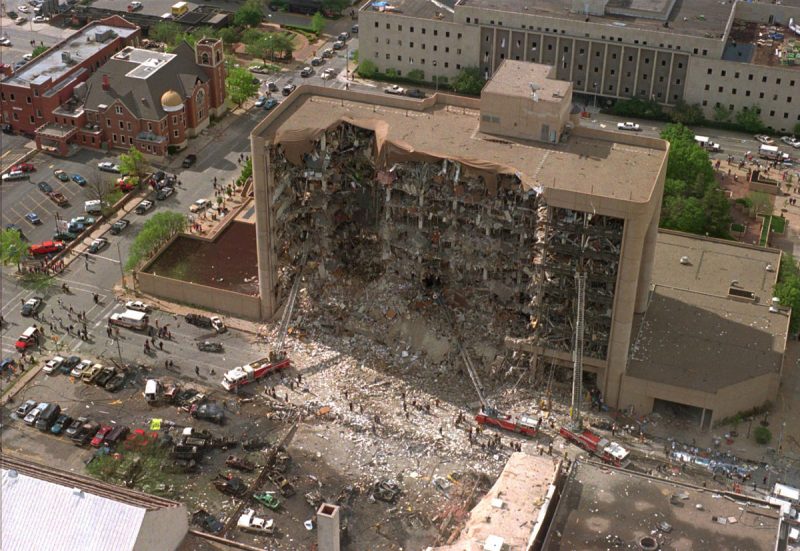
This past week marked the 27th anniversary of the Oklahoma City bombing. As the worst terrorist act committed on U.S. soil at the time, we all know the reported facts of the horrific event well: a 27-year-old Desert Storm-vet, Timothy McVeigh, acting with minimal help from Terry Nichols and Michael Fortier, detonated a 7,000-pound fertilizer bomb from a parked Ryder truck outside the federal Alfred P. Murrah building, killing 168 people, 19 of them children.
Two years later, in 1997, McVeigh was convicted of “Using a weapon of mass destruction resulting in death,” among other federal charges. For a time, he was held on the same cell block as the Unabomber and WTC-bomber Ramzi Yousef (who tried to convert him to Islam), before being put to death by lethal injection in 2001.
There is much we still don’t know about the case, however. Thanks to years of heroic work by people like Salt Lake City-based attorney Jesse Trentadue, writer and researcher J.M. Berger, and independent investigative reporter Wendy S. Painting, the American public is slowly learning more and more key (and disturbing) facts about the case. Facts involving the FBI’s possible incitement of McVeigh and the subsequent cover-up of these facts by Newsweek magazine.
FBI incitement is more topical than ever, of course. Reports of the FBI being involved in Michigan governor Gretchen Whitmer’s kidnapping plot and of FBI agents and assets being involved in the January 6th events has collapsed whatever level of trust the public had with federal law enforcement, not to mention the mainstream media whose related coverage rarely digs deeper than the government’s official line.
What other crimes have been committed or conspiracies planned, the public wonders, where the initial momentum was actually created the FBI? How much have FBI infiltrators pushed constitutionally protected “heated talk” into the unlawful planning and execution of deadly crimes? To what extent has the FBI been, as the saying goes, arsonists posing as firefighters? These are especially important questions when it comes to the OKC bombing.
Operation PATCON
As most know, the FBI and other law enforcement agencies have conducted surveillance and infiltration operations against right-wing groups for decades. Chief among them being the “Patriotic Conspiracy” or “PATCON” operation. Despite its official ending in late 1993 (although some say it was carried forward in some form), PATCON only became public in 2007 thanks to a public records request.
Partly citing internal FBI documents, Painting in her explosive 2016 book about PATCON and McVeigh, describes how the former’s secret operatives and paid informers “were given license to engage in provocateur activities and instructed to make known their willingness to commit violence and advocate for the violent overthrow of the U.S. government.”1 She quotes one informer who went public about the operation, John Matthews, saying he realized that although initially told “the objective was to infiltrate and monitor,” he would later come to understand that its real objective was to “to infiltrate and incite.”2 This, says Matthews, included providing “the ideas, detailed instructions, and even live C4 explosives and automatic weapons to targeted individuals as a way of entrapping them into terrorist plots, so the FBI could capitalize on foiled and actualized plots.”3 According to Trentadue, through PATCON, the FBI was actually trying to sow a full-on rebellion.
While the FBI has indeed infiltrated hard-left and Islamic groups in the past, the extent and complete failure of the FBI’s overreach when it comes to right-wing groups (which diversely included pro-gun, ultra-libertarian, survivalist, and white racist or advocacy groups) makes this area especially alarming. For instance, there was just one minor conviction over stolen military night-vision goggles that was ever made through PATCON, and it relied on army, not FBI, intelligence. As Oklahoma City journalist J.D. Cash said about PATCON and certain precursor programs of the 1980s, “there isn’t a neo-Nazi or racist group in the country that isn’t operationally controlled by the FBI.” This seems to concur with what a former young Aryan Nation-member told Painting for her book4:
It was well known that at any Aryan Nation event, in a crowd of 300 people, there’d be at least 30 undercover federal agents in attendance to monitor us, and another third of the crowd were informants… It was rampant, just like cops at a Grateful Dead show trying to sell people LSD.
One of those assets was Vietnam War veteran John Matthews. Up until 1986, the government had been supporting U.S. civilian groups conducting operations in Nicaragua for anti-communist contra forces; a cause which Matthews chose to serve. When such efforts turned into a political scandal, however, the government broke-off ties with these groups and refused to help its members. This included people like Matthews’ fellow soldier Tom Posey who would later be indicted on weapons-smuggling charges.5 While he beat the rap, Posey felt cheated and shifted his efforts to anti-U.S. government organizing. When he revealed plans to break into a federal armory, however, Matthews contacted the FBI, establishing a relationship with law enforcement that led him to infiltrate over 20 militia, libertarian, gun-rights, and racist groups over a 20-year period.
Matthews, who has long been suffering from an Agent-Orange-related cancer, is key to what understanding we have about PATCON’s connection to the OKC bombing. In the early nineties, Matthews was assigned to attend a PATCON-infiltrated, militia-training camp in Texas. While there, he met Timothy McVeigh. After the bombing and when McVeigh was arrested, Matthews immediately recognized him and called his FBI handler, Don Jarrett, to tell him this was the same man he saw at the Texas training camp. Jarrett assured Matthews they knew this already and told him to “forget about it.”
In interviews with Painting, Matthews says he was disturbed by this for a few reasons, a major one being, she paraphrases, that “if they were watching McVeigh and friends back then, they had likely continued watching them throughout the bombing plot.”6 “I felt Don knew more about this,” he said elsewhere.
What other items he knew may have been what came out later in Trentadue’s public records suit against the FBI. Dozens of witnesses to the bombing had apparently reported to police and the FBI they had seen someone in the passenger side of McVeigh’s truck while parked outside the Murrah building. Other witnesses reported seeing McVeigh with several people at his motel the night before, including someone sitting at some point behind the wheel of the truck—And Nichols himself (who was in Kansas when the bombing took place) told journalists in 2007 that FBI provocateurs had lent their support to McVeigh’s plans.7
Also disturbingly, using a fertilizer truck to blow up a federal building had been an idea Matthews had actually heard a few times before, including from suspected FBI infiltrators. For instance, he had heard it raised by two militia members he met who later became part of a busted plot to rob a bank, but who never got arrested, let alone jailed for it.
All of this would seem to point to the OKC bombing being something like 2010’s Operation Fast and Furious, in which the FBI intentionally put guns into the hands of criminals, but failed to close the loop leading to a border agent being killed by a Mexican cartel. Was OKC a similar ‘gunwalking case gone awry’? Only one, far, far deadlier? Someone who McVeigh contacted two weeks before the bombing, Andy Strassmeir, later told a journalist it is possible the FBI was “going to arrest McVeigh at the site with the bomb in hand, but he didn’t come at the right time.” “[M]aybe he changed the time”, he said, “you never know with people who are so unreliable.”8
Newsweek’s Complicity
In 2011, wishing to tell his story before he died, Matthews was put in touch with former Associated Press-writer and then-editor of Newsweek, John Solomon. At the time, Newsweek was still foremost in the U.S. media field, coming in second in circulation only to Time magazine. It was an important and respected news source. Over months, Solomon and article-author Ross Schneiderman worked with Matthews and other sources, including former FBI officials, to confirm everything he told them about the murky workings of PATCON, including the unanswered questions about its operatives’ possible involvement in the OKC bombing.
Enter Newsweek managing editor, Tina Brown. Above the heads of Solomon and Schneiderman, Brown (who left in 2013 and has been blamed for the periodical’s collapse) took what may have been a Pulitzer-worthy piece of journalism and cut away virtually all detail that could directly or indirectly impugn the government for the fallout of its PATCON operations. In the process, she reduced the original 7,000-word draft (found here) down to a mere 4,000 words (found here). As the since-defunct Examiner detailed at the time, all of the aforementioned suspicions Matthews aired about the FBI’s hand in the OKC bombing were cut.
Brown’s puzzling decision had real consequences for Matthews. As Painting recounts in her book, the dying Matthews had taken a lot of risk by coming forward. He was now Newsweek’s cover story, but for reasons that had been omitted. Now, he was still a target but “for no good reason and he regretted coming forward.”9
More broadly, by keeping such information away from the public, Brown was confirming the existence of a state-media axis in America. While examples of such direct state-interventions into our otherwise free media system are rare (although certainly plentiful enough), media analysts like Noam Chomsky have long posited that, yes, news outlets do profit off the circulation of their stories and are thus incentivized to objectively report on events potentially embarrassing to the powerful elite. But, the big media houses still need government access and wish to maintain good relations with major power centers; hence, their occasional compliance with direct government demands—One might add the promise of future political jobs as an incentive for compliance or, in cases such as this where right-wing groups were clearly being mistreated, plain old liberal media bias (consider, for instance, the fairly wide–reporting on the FBI’s infiltration of Islamic extremist groups).
It seems without a doubt that the FBI did get to Brown. At the time Matthews approached Newsweek, Attorney General Eric Holder’s Operation Fast and Furious-debacle was still in the news. How could the Obama Administration handle yet another and far bigger scandal involving the FBI helping dangerous people do harm against innocent Americans?
More Alarming Questions about FBI Conduct
Elsewhere, the FBI has demonstrated a serious interest in keeping any questions about the OKC bombing firmly under wraps. When Matthews was slated to testify in Trentadue’s 2014 public records case over the release of Murrah building surveillance footage, his fear of retaliation led to the judge allowing him to testify at a secret location by video—Trentadue thought what Matthews had witnessed while a PATCON operative would help provide a motive for what had become the FBI’s ongoing, unlawful refusal to provide the footage under public records law.
And despite the judge’s precautions, Matthews’s testimony still never took place. At the last minute, Matthews was supposedly threatened with having his VA medical benefits cut off and told to “stand down” by Jarrett and another FBI agent, Adam Quirk. Such a rank case of witness tampering, in fact, led to the judge ordering the FBI to reveal what exactly they had communicated to Matthews; an investigation that has been strangely ongoing since 2015.
At the heart of Trentadue’s marathon public records case certainly has the FBI worried. Someone who did manage to testify early on in the case was an Oklahoma police officer and first responder to the OKC bombing. He told the court he witnessed the FBI actually stop the beginning of the recovery process while victims were still under piles of rubble in order to remove a surveillance camera from the Murrah building. Some believe the camera would have recorded anyone else besides McVeigh who left the truck after it was parked and, in fact, did so.
Finally, there’s the questions about the FBI’s conduct vis-à-vis Trentadue himself. Why Trentadue got involved with the OKC case is because six weeks after the bombing, his brother Kenneth, another war vet, was taken into custody after a traffic incident triggered a parole violation relating to a minor event from years previous. Soon after, he was found hanging in a cell of a federal detention center.
Photos released to Trentadue following a subsequent lawsuit against the federal Bureau of Prisons, however, showed his brother’s throat having been cut and his body covered in bruises—authorities had apparently tried to cover his wounds with make-up before releasing it to Kenneth’s family. The theory behind his death is, having shared a close resemblance with someone called Richard Guthrie, a white supremacist who the FBI thought had information about the OKC bombing, Kenneth was mistaken as Guthrie and taken in by the FBI for interrogation. McVeigh himself called and advised Trentadue of this, telling him he heard that the FBI had indeed mistaken Kenneth for Guthrie and that his death was the result of a botched interrogation session.
Adding to suspicions, the DOJ formed a special team to handle media inquiries and the Trentadue family’s immediate requests for information. It apparently obstructed and delayed the Trentadue’s right to know what happened to Kenneth in every way it could, even when it came to releasing his corpse. Who happened to be the head of this operation (dubbed internally as “the Trentadue Mission”)?10 Then-Deputy Attorney General, Eric Holder.
Finally, there are the other related and mysterious deaths. After Guthrie himself was arrested, he told the LA Times he had “a couple grand juries to talk to” about what really happened with the OKC bombing, and was also later found hanging in his cell.11
And later in 1999, a supposed inmate and witness to Kenneth’s murder, Alden Gillis Baker, threatened to come forward about what he saw. He too was later found hanging in his cell.12
Conclusion
The details surrounding the OKC bombing show it to have all the elements of a “perfect,” post-war American tragedy: Vietnam vets disrespected by the liberal-media class and tossed aside by a government they loyally served; an unhinged federal bureaucracy using its sprawling resources to violate the civil rights of poor and ignored Americans; and, a state-liberal media-axis willing to cover up for government when the “cause” was right.
And consider the following. Even if we ignore the aforementioned evidence about the FBI’s hand in the OKC bombing, remember that the twin motivations for McVeigh’s crimes were Waco and Ruby Ridge—McVeigh chose April 19 as his bombing date because it was the same day as the Waco massacre two years previous. Matthews has actually expressed the view that both massacres had PATCON fingerprints all over them. That’s certainly the case with Ruby Ridge. There, a federal agent/infiltrator pushed former Green Beret Randy Weaver into selling him an illegal sawed-off shotgun. This led to his attempted arrest and an eventual standoff, which then led to the shooting deaths of his 14-year-son by federal marshals and his unarmed wife (baby in hand) by an FBI sniper.
In public and in private correspondence, McVeigh tore into the federal government over these events, expressing fear of a state that was at war with its own citizens. Without federal law enforcement acting so heinously in these events, it’s likely McVeigh would not have carried out the crime that he did.
Further, these rank FBI abuses ironically pushed “right-wing terror groups” to become the threat we were warned about all along. As the original Newsweek article rightly said about Ruby Ridge, the FBI’s conduct “quickly galvanized the radical right like never before” with talks between “various white supremacists, Neo-Nazis and anti-government groups… about joining forces… quickly turn[ing] to action.”
And as Painting writes, even more absurd perhaps, Ruby Ridge was used by federal law enforcement as a justification for increased PATCON resources and investigatory powers.13
So, we have FBI abuses leading to organized rage and resistance, which is then given even more momentum by FBI infiltration and incitement. And with the help of a media sphere that refuses to do its job, all of this works to amp up yet more fear, anxiety and division among the public. It’s a spinning wheel which loyal, patriotic Americans never asked for and certainly want off of.
While we should certainly hope these allegations can be explained away, it’s high-time the OKC victims and the American people generally get the transparency they deserve about what really happened that fateful day.
Meddling with modelling
Divisive and false claims that the unvaccinated are a danger
Health Advisory & Recovery Team | May 6, 2022
This paper, published in the “peer-reviewed” Canadian Medical Association Journal, quite simply represents an amoral, unethical and utterly transparent attempt to use pseudoscientific modelling to fabricate a false narrative. The apparent objective seems to be sowing divisions in society by marginalising and vilifying the unvaccinated.
The paper describes a “study” which is nothing of the sort. It actually describes a model which the authors have constructed. This is an unnecessarily complex model — and suspiciously so. The model itself has been very expertly taken apart by Jessica Rose here and Drs Rancourt and Hickey for the Ontario Civil Liberties Association here.
The authors appear to have tested their model to death to find the optimal combination of inputs which results in the “narrative” they wish to promote.
The logical flaws in this approach have been brilliantly analysed by Dr Byram Bridle, including a critique of the assumptions made for the various input parameters. Among the more egregious examples are:
(1) the model assumes 80% effectiveness against infection for the Covid injections vs omicron, whereas real-world data suggests zero — at best.
(2) the model assumes very little pre-pandemic immunity present within the community (they assume just 20% when for some time the evidence has suggested much higher levels, especially against severe illness).
(3) the model assumes no waning of efficacy at all over time, a claim not even made by the most ardent promoters of the covid vaccines.
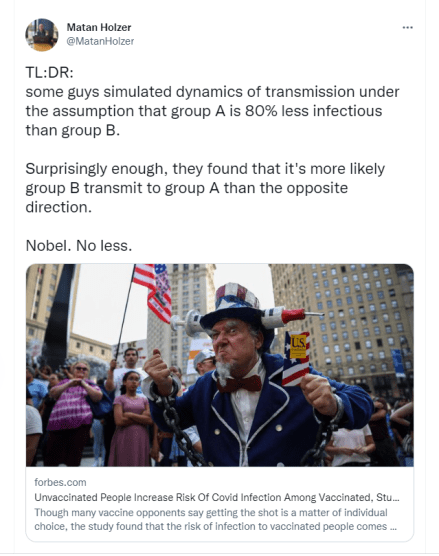
Many news outlets — including Forbes — appear to have been taken in by this sham science and are reporting it as a bone fide “study” with no critical analysis whatsoever, this being their key message:
“The findings counter the common argument that the decision to get vaccinated is a personal one, the researchers said, as the unvaccinated are ”likely to affect the health and safety of vaccinated people in a manner disproportionate to the fraction of unvaccinated people in the population.”
One commentator on Twitter acerbically — though rather accurately — summed up the Forbes article thus:
It is quite clear that the model and the entire article has been constructed to push a political agenda, namely to neutralise the growing realisation by the population that the story they were told in relation to the Covid 19 injections is entirely false. Contrary to the authorities’ official narrative, in the context of Omicron the injections don’t reduce infections or transmission, and actually probably even increase them. Far from being a selfish act, it was in fact entirely rational — and beneficial to one’s fellow man — to decline the injection.
To use Dr Bridle’s words, the paper is actually “Fiction Disguised as Science to Promote Hatred”.
We support and join the many voices calling for this paper to be retracted.
Postscript: When Denis Rancourt, one of the authors of the Ontario Civil Liberties Association’s statement, tweeted the essence of their complaint with it, the paper’s author — David Fisman — didn’t respond by way of any form of scientific justification — he threatened legal action.
US bragging about its direct involvement in Ukraine may lead to uncontrollable escalation
By Drago Bosnic | May 6, 2022
On May 4, the New York Times published a highly controversial article openly bragging about how the United States has been providing critical intelligence about the location and movement of Russian troops, which has allowed Ukrainians to target them. The publication also claims that “many Russian generals have died in action in the Ukraine as a result,” citing senior US officials. However, this is hardly news, since the US and NATO have been doing it since day one of the special military operation in Ukraine. The Russian military has been warning the political West about this issue. And yet, the US and NATO aren’t only ignoring the warnings, but are also openly bragging about their actions which are contributing to the death of Russian military personnel in Ukraine as we speak.
The claim that “many Russian generals have died” is questionable at best, but it does show the US and NATO’s determination, whose involvement is key to prolonging the conflict. An epidemic of fake news about alleged injuries or even murder of Russian High Command officers has become the mainstay, even among the once-respected Western media. According to these news outlets, Russian Defense Minister Sergei Shoigu has so far survived at least two heart attacks “due to bad performance and high casualties of the Russian military” and even “Putin’s order to shoot the Defense Minister for his failures in Ukraine”.
These claims are not just outright lies, but simply ridiculous. However, they expose the mainstream media in the US and other NATO countries as an inalienable part of the military and (geo)political structure. Their reporting is designed not just to demoralize the opponent, but also to boost public morale, galvanize it and push for more support for a potential war with the targeted country or even a group of countries. This is exacerbating the already high tensions between the political West on one side and Russia and its allies on the other.
When the special military operation started, the US and NATO at least claimed their non-involvement, even though everyone knew they were involved. But the very statement they weren’t sent a message that NATO will not escalate tensions. However, this report has now changed that. By admitting effectively direct involvement in the conflict, the US and NATO are opening the door for further escalation, which most certainly will not be appreciated by Russia, whose leadership has already given strong statements regarding this issue.
The intelligence sharing is part of “a stepped-up flow” in US assistance that includes heavier weapons and billions in military supplies, demonstrating how quickly the “early American restraint” on support for Ukraine has shifted as the war enters a new stage, the NYT reported. This is further proof that the US is not interested in de-escalation. On the contrary, the latest “lethal aid” package President Biden announced is said to be $33 billion, a truly staggering sum, orders of magnitude greater than Ukraine’s annual military budget.
“The administration has sought to keep much of the battlefield intelligence secret, out of fear it will be seen as an escalation and provoke President Vladimir V. Putin of Russia into a wider war. American officials would not describe how they have acquired information on Russian troop headquarters, for fear of endangering their methods of collection. But throughout the war, the U.S. intelligence agencies have used a variety of sources, including classified and commercial satellites, to trace Russian troop movements,” the NYT report added.
This statement alone should trigger alarm across the globe. The admission that the US military and intelligence services are using commercial satellites in their operations sets a dangerous precedent which further blurs the line between civilians and the military. This comes at a time when companies such as SpaceX are accused of using their products and services, most notably the Starlink satellites, to help the Ukrainian military target Russian and DLNR units. It’s clear the US is mobilizing all of its assets in an attempt to weaken Russia. In fact, this is exactly what US Defense Secretary Lloyd Austin openly stated. He went so far as to say that “we want to see Russia weakened to the degree it cannot do the kinds of things that it has done in invading Ukraine.”
However, there are still moments when the Pentagon and State Department are giving vague and even contradictory statements regarding this issue. When asked about the intelligence being provided to the Ukrainian side, Pentagon spokesman John Kirby said that “we will not speak to the details of that information.” But he acknowledged that the US provides Ukraine with intelligence information. After the NYT article was published, Adrienne Watson, a National Security Council spokeswoman, said that the battlefield intelligence was not provided to the Ukrainians “with the intent to kill Russian generals.”
“Not all the strikes have been carried out with American intelligence. A strike over the weekend at a location in eastern Ukraine where Gen. Valery Gerasimov, Russia’s highest-ranking uniformed officer, had visited was not aided by American intelligence, according to multiple U.S. officials. The United States prohibits itself from providing intelligence about the most senior Russian leaders,” the official said.
This statement clearly refers to the reports that the Chief of Russian General Staff, General Gerasimov was allegedly wounded in a Ukrainian strike during a visit to the frontline units. Again, this shows an almost schizophrenic nature of statements coming from US officials. First, they are bragging about the “decisive role” of their intelligence support to Ukrainians, but as soon as reports of Russian High Command officers being injured surface, they are quick to announce how this support might not be “as decisive as previously thought”.
This just goes to show how dangerous US involvement in Ukraine is. Even though we know the statements about Gerasimov are false, an obvious question arises, what if it were to happen? What if he or any other Russian High Command officer were injured in Ukraine? Does the US truly believe they could just say “it wasn’t our intelligence” in an attempt to control the level of escalation which could plunge all of us into a world-ending conflict?
Drago Bosnic is an independent geopolitical and military analyst.
Former NATO Commander Disguises War Propaganda as Novel
By Patrick Macfarlane | The Libertarian Institute | April 26, 2022
 On March 9, 2021, the former Supreme Allied Commander of NATO, Admiral James Stavridis, co-authored a fiction novel with Elliott Ackerman, another former U.S. military officer. The book, entitled 2034: A Novel of the Next World War, imagines a kinetic war between the United States and China.
Given the pedigree of its authorship, the novel provides a compelling window into the psychology of NATO’s military leadership and, correspondingly, the foreign policy establishment behind it. To those familiar with said psychology, the events of the novel will not be surprising.
It begins with a Chinese ambush of a U.S. vessel in the South China Sea; an Iranian capture of a U.S. pilot; a full scale naval battle between the U.S. and China (resulting in a total U.S. defeat); and a Russian invasion of Poland. The novel concludes with a limited nuclear exchange between the U.S. and China.
Given the last few decades’ hawkish hand wringing about Chinese and Russian cyber capabilities, the tactics employed in the novel are similarly unsurprising. A Chinese cyberattack disables U.S. hardware, allowing the naval rout. The Iranians, as allies of Russia and China, similarly disable U.S. aircraft. For their part, the Russians slice underwater communications cables leading to a complete internet blackout in the West.
To an uncritical reader, the novel appears to be a “cautionary tale” and a “warning” against global conflict. The novel’s dust jacket states:
Everything in 2034 is an imaginative extrapolation from present-day facts on the ground combined with the authors’ years working at the highest and most classified levels of national security. Sometimes it takes a brilliant work of fiction to illuminate the most dire of warnings: 2034 is all too close at hand, and this cautionary tale presents the reader a dark yet possible future that we must do all we can to avoid.
Mainstream outlets were as successful in their attempts to paint 2034 as a “warning” as their reviews were cringeworthy.
Wired, which ran a series of exclusive pre-print excerpts, had this to say:
WIRED HAS ALWAYS been a publication about the future—about the forces shaping it, and the shape we’d like it to take. Sometimes, for us, that means being wild-eyed optimists, envisioning the scenarios that excite us most. And sometimes that means taking pains to envision futures that we really, really want to avoid.
By giving clarity and definition to those nightmare trajectories, the hope is that we can give people the ability to recognize and divert from them. Almost, say, the way a vaccine teaches an immune system what to ward off. And that’s what this issue of WIRED is trying to do…
Consider this another vaccine against disaster. Fortunately, this dose won’t cause a temporary fever—and it happens to be a rippingly good read. Turns out that even cautionary tales can be exciting, when the future we’re most excited about is the one where they never come true.
The Washington Post’s review was almost worse.
This crisply written and well-paced book reads like an all-caps warning to a world shackled to the machines we carry in our pockets and place in our laps, while only vaguely understanding how the information stored in and shared by those devices can be exploited. We have grown numb to the latest data breach—was it a pollical campaign (Hillary Clinton’s), or one of the country’s biggest credit-rating firms (Equifax), or a hotel behemoth (Marriott), or a casual-sex hookup site (Adult Friend Finder), or government departments updating their networks with the SolarWinds system (U.S. Treasury and Commerce)?
In “2034,” it’s as if Ackerman and Stavridis want to grab us by our lapels, give us a slap or two, and scream: Pay attention! George Orwell’s dystopian masterpiece, “Nineteen Eighty-four: A Novel” was published 35 years before 1984. Ackerman’s and Stavridis’s book takes place in the not-so-distant future when today’s high school military recruits will just be turning 30.
Between Wired’s ham-handed COVID-19 vaccine analogy and the CIA Washington Post’s ironic Orwell reference, the mainstream marketing campaign clearly attempts to portray the novel as a cautionary tale.
It is impossible to gaze into the hearts of men, but we do have some clues. Those clues suggest that the co-authors really do seek to warn against war with China. However, in doing so, they advocate for it. Indeed, their warning is not against the folly of empire, but against a rising China.
Ultimately the co-authors’ MacBethian premonition of conflict necessitates escalatory U.S. policy.
On March 18, 2021, the pair were interviewed by NPR. Stavridis had this to say:
… a subtext in all of this [the novel] is to strike a warning bell about the rise of China and the propensity in human history going back 2,500 years almost any time a [sic] established power is challenged by a rising power, it leads to war. It’s a dangerous moment. And 15 years from now, I think, will be a moment of maximum danger because China will have advanced in its military capability and technology. Therefore, our military deterrent will somewhat decline. We’re standing in the danger, as we say in the Navy.
Ackerman embraces this view:
…and we’re not only sounding the alarm bell, but the book is also trying to situate where America is in this moment of 2034.
Further, the pair assert they do not believe in the American decline.
Interviewer (to both): “…do you believe this, that America will be the author of its own destruction?”
Stavridis: “I believe there are many in the world who do believe that. I personally do not… there are many in the world who believe our best days are somehow behind us. They would be miscalculating, in my view, to believe that.”
Ackerman: “I would add I am by no way a believer in the decline of America. And I am very much committed to the idea of the American ideal. That being said, looking back throughout our entire history, the greatest threat is us turning inward and destroying that ideal. Lincoln himself said – I’m paraphrasing, but basically said that if America is going to destroy itself, we will be the author and the finisher. And I think he says, a nation of free men will live forever or die by suicide. And I don’t think that’s Lincoln being a declinist about the United States. But I think it’s him recognizing that our divisiveness can oftentimes be the greatest threat and what leaves us the most unable to respond to challenges from outside the country.”
Indeed, a reader would be hard pressed to find any point where the co-authors suggest any strategy short of increasing military confrontation with China.
Instead, they warn that America must be more united against an outside threat. It must, by implication, build up its military force, and, oddly enough, confront Chinese technological advances with less reliance on our own technology.
Stavridis expanded on his China policy prescriptions in a June 2021 interview:
The South China Sea is a vital entry point for the United States today. It’s a massive body of water full of oil and gas as well as fisheries, and about 40 percent of global trade passes through it.
So, there are strong strategic reasons, as the United States values its alliances in Asia, to push back against Chinese claims.
It is not just the South China Sea but also the East China Sea, where the Senkaku Islands lie, that are vital to American interests as long as our allies operate there and trade flows through there.
And above all we simply as an international community cannot acquiesce to China’s preposterous claims, which have been rejected by international law.
Indeed, a number one red line would be an attack against our allies.
For example, if China attacked and tried to forcibly take the Senkaku Islands, that would be a red line for the United States. Or an attack against the Philippines, another treaty ally of the United States. An attack against any treaty allies would be the number one red line.
A second red line would be trying to attack U.S. military personnel operating in the South China Sea.
We conduct what we call “freedom of navigation patrols.” These are our warships sailing through international waters such as the South China Sea.
If China were to attack a U.S. ship to attempt to demonstrate their view that they own the South China Sea, that would be a red line. In fact, the book “2034” opens with an attack involving U.S. military personnel being killed in the South China Sea.
Stavridis believes that the U.S. must continue to devote itself to entangling alliances, against which the founding fathers warned. The U.S. must also continue to press its presence in the South China Sea.
Despite resolutely warning against a war against China, Stavridis commits the U.S. to myriad tripwires that would ignite it.
These China policy positions parallel Stavridis’ positions on Ukraine. It’s always more, more, more.
More funding, arming, and training Ukrainians, more U.S. commitment to NATO, more U.S. weaponization of Big Tech, more money to the U.S. State Department, more interagency cooperation, and more silencing dissent. These positions are escalatory. At the very least, they flirt with making Washington a direct party to the War in Ukraine. They may give Russia reason to attack U.S. and NATO forces.
Given Russia’s nuclear footing, these policies pose an existential threat to humanity itself.
Indeed, it will always be a mystery how the hawks convinced the American public that the path to peace leads through war. Perhaps those of us who survive the inevitable result of this mantra can ponder the answer while painting on the cave walls.
Patrick MacFarlane is the Justin Raimondo Fellow at the Libertarian Institute where he advocates a noninterventionist foreign policy. He is a Wisconsin attorney in private practice. He is the host of the Liberty Weekly Podcast at www.libertyweekly.net, where he seeks to expose establishment narratives with well researched documentary-style content and insightful guest interviews. His work has appeared on antiwar.com and Zerohedge. He may be reached at patrick.macfarlane@libertyweekly.net
PBS agitates to have Tucker Carlson taken off the air
By Russell Cook | American Thinker | May 4, 2022
The taxpayer-funded national network PBS is pushing for less viewpoint diversity, no doubt intended to accelerate the growing push for Tucker and Fox News to be taken off the air. From the PBS Newshour, May 2, 2022: “Tucker Carlson’s influence and his increasingly extreme views” (Amna Nawaz interviews New York Times’ Nick Confessore, who wrote the 4/30 “How Tucker Carlson Stoked White Fear to Conquer Cable“).
Excerpts (emphases added):
Nick Confessore: … He’s the highest rated cable show host in history. And it’s also the most racist show in history. … Every night, that show teaches fear and loathing. He may claim to be a person who opposes racism and prejudice, but what the show tells you every night is to be afraid, to be afraid of people who are in the street asking for police officers to not shoot Black people, be afraid of Afghan refugees who helped us in the war who are coming over here now, to be afraid of Dr. Fauci, and to be afraid of immigration in general, which he posits is part of a cabal, a plot to destroy Western civilization … it’s not just the anti-white racism kind of rhetoric on the show. He’s literally taking ideas that began on the very far right, on arcane corners of the Internet, on neo-Nazi sites …
… Amna Nawaz: Nick, he’s also aggressively defended January 6 insurrectionists and played down how violent that day actually was. … he’s very much in line with the Republican Party and their message. What did your reporting find about that relationship between the GOP and Tucker Carlson?
Nick Confessore: Look, I would say he is the high priest of Trumpism.
“Amy Walter and Annie Linskey on primary election season, Tucker Carlson’s role in the GOP”
Excerpts:
Judy Woodruff: … Amy, let’s start with what we just heard Amna talking to Nick Confessore about … Clarify for us, what is Tucker Carlson’s role in the Republican Party, in American politics?
Amy Walter: … Nick Confessore put it really well when he said that he’s filling the void that had been left by Donald Trump‘s voice being off of social media … He’s also being talked about as a potential 2024 candidate for president. And that’s not idle discussion. I think his name will be very seriously floated, and we may see more to come of a Tucker Carlson trial balloon in 2024.
… Judy Woodruff: And, Annie, what — the darker side of this, which we heard in that conversation, about race… and about the role of the threat that many white Americans feel, what does that say about our politics right now?
Annie Linskey: … I think that was one of the most stunning takeaways, for me at least, from the New York Times reporting, which was just so incredible, is just the extent to which they really documented the ways in which Carlson is normalizing discussions of race that I think would not be considered — are not considered appropriate in many parts of the country. … But Carlson’s show is moving through the window to where they’re becoming more appropriate. And I think that’s what many groups on the left worry about. And I think that is what The Times is reporting is kind of showing us, really the danger that Tucker Carlson and his show presents, is making it more OK to have those kinds of grievances voiced out loud…
According to the PBS NewsHour and the NYT, neither of which seems to have people who’ve watched Tucker’s show at any depth, Tucker espouses Bull Connor–style racism and enables people like you and me to freely advocate talk that escalates toward genocide. His show should therefore be silenced, he should be jailed for insurrectionist incitement before he announces his presidential run, and you and I need to be leery of saying anything against… well, anything. Obey.
Why Won’t They Say Who Funded These Ukraine Ads?

By Michael Tracey | May 2, 2022
On April 17, I was in London Bridge train station in central London, and couldn’t help but notice that the entire station was blanketed with these digital “Be Brave Like Ukraine” ads. Stylized in a nifty semi-Cyrillic font, the ads feature the classic blue and yellow color scheme that has now become so ubiquitous across “The West” — perhaps most prominently in London, where a local acquaintance told me she’s seen more Ukraine flags on display over the past two months than she ever saw of the UK’s own national flag.
I had a few natural questions upon seeing these ads. First, who crafted them? That answer came quickly: Just go to the “brave.ua” website and you’ll discover the ads were crafted by a consortium within the Ukraine government, including the office of Zelensky.
The answer to other natural questions have not come so quickly, though. Those questions include: Who paid for these ads? How much did they cost? Who organized their placement in some of the most expensive advertising real estate in the world? (They’ve also been displayed in Times Square, among other high-profile locations.)
Strangely, this information has proven difficult to acquire.
First I tried querying the TFL, the government body in charge of transport in London. They had no clue about the ads. Then I tried Network Rail, which runs most of the railways in England. They had no clue either. Finally I tried the massive global advertising agency which apparently owns the digital screens in question, JCDecaux. And… it initially seemed like they might have the answer. I know this because the “Corporate Communications Director” for JCDecaux inadvertently sent me an email where she deliberates with her colleague about how to answer my questions:
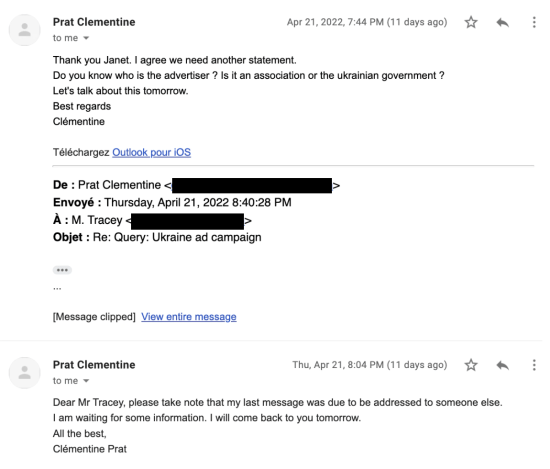
Kinda funny that the “Corporate Communications Director” still doesn’t have the hang of communications skills like sending your sensitive internal emails to the right recipient. Either way, this person did not in fact “come back to me tomorrow.” Days passed, and I heard nothing. Then, finally, here was the answer:

Curious, don’t you think? Why would a multinational advertising conglomerate based in France, with branches in the UK, US, and elsewhere, be so skittish about providing basic details about this Ukraine government advertising campaign? Shouldn’t they be proud of it, and therefore happy to provide the details? I thought the message of the ads was to “Be Brave Like Ukraine.” Apparently that “Bravery” doesn’t extend to allowing for transparency in the financial arrangements of these PR maneuvers, which have resulted in “Western” capitals being saturated with imagery that to the naked eye may seem benign — but, functionally, amounts to obvious pro-war propaganda.
Because bear in mind that these government-crafted ads have flooded London, NYC, Washington DC, etc. at the same time as Ukraine officials are furiously lobbying the UK and US governments to ramp up their military involvement in the war. Those lobbying efforts have been incredibly successful, with Respectable Mainstream outfits like The New Yorker finally now admitting that the scale of the US commitment constitutes “a full proxy war with Russia.” (Not so long ago, I was attacked as a peddler of “Putin’s talking points” for using the term “proxy war” on TV.)
It went largely unremarked upon when the head of the Pentagon, flanked by the head of the State Department, transited into Kiev for a secret mission on April 25 — and then hours later, a series of giant explosions ripped through a Russian military logistics hub approximately 90 miles inside Russia. This after US officials began leaking that they would no longer even pretend to recognize any distinction between “defensive” and “offensive” combat operations conducted by the Ukraine military — effectively acknowledging their willingness to provide both weaponry and real-time intelligence to launch attacks on Russia itself.
In the UK, the Armed Services Secretary, James Heappey, followed this up by declaring that it would be “entirely legitimate” for arms delivered by “Western countries” to be used for offensive strikes within Russian territory. Foreign Secretary Liz Truss then went further than even any US official when she declared that total “victory” in Ukraine must also include driving Russia out of Crimea, raising the stakes higher still.
With each passing week, both these countries adopt a more and more aggressive, bombastic war footing.
Meanwhile, the nice-seeming “Be Brave Like Ukraine” ads are covering major transportation centers. It doesn’t take much elaborate dot-connecting to apprehend that the ads are one facet of the larger PR campaign to draw the US, UK, and other governments further and further into the war. This campaign has been demonstrably effective. And the ad agency which facilitated the ads is choosing to conceal from the public basic details about their provenance — such as who even paid for them. Really makes you think.
Featured Video
Anthrax War – CBC The Passionate Eye
or go to
Aletho News Archives – Video-Images
Book Review
Shattered Dreams: The HPV Vaccine Exposed (2019)
By Christina England – 30 Q&As – Book Review & Summary
Lies are Unbekoming | September 4, 2026
… Gardasil received FDA fast-track approval in 2006, Cervarix followed in 2009, and Gardasil 9 was approved in December 2014 with more than double the aluminium adjuvant content of the original. The commercial context is specific. Merck was about to lose patent protection on Zocor and faced $18 billion in Vioxx injury claims from a cardiovascular drug the company had marketed while suppressing its own data showing a five-times increase in heart attacks. Analysts projected the global HPV vaccine market at $4 billion by 2011, contingent on government-funded national programs for teenage girls. The 1986 National Childhood Vaccine Injury Act had already granted manufacturers complete liability immunity. By 2013, Japan had withdrawn its HPV vaccine recommendation after cataloguing severe adverse reactions in hundreds of girls. No Western government followed. The establishment position across the UK, US, Australia, and most of Europe held, and still holds, that the vaccines are safe and effective, that reported injuries are coincidental, and that cervical cancer prevention justifies the program. The book was published into this position, not against a vacuum.
Shattered Dreams sits alongside Mary Holland’s The HPV Vaccine On Trial and Viera Scheibner’s foundational vaccination work as part of the documented record on what has been done to a generation of teenage girls under the banner of cancer prevention. The full summary unpacks three specific findings: that Merck used the aluminium adjuvant itself as the “placebo” control in 92.5% of trial subjects, making it structurally impossible to detect excess reactions from the adjuvant; that Dr. Sin Hang Lee found HPV DNA fragments bound to aluminium in every one of sixteen Gardasil samples tested, and in the blood and spleen of a New Zealand girl six months after her third dose; and that in every country with high vaccination coverage, including Australia, the UK, Norway, and Sweden, cervical cancer rates have stopped declining and started rising specifically in the vaccinated cohort. Martínez-Lavín’s 2017 calculation puts the number needed to seriously harm with Gardasil 9 at 140, and the number needed to vaccinate to prevent one case at 1,757. Thirteen young women are seriously harmed for every one who benefits. The vaccine was approved on the basis of trials that could not detect what the trials were supposed to detect, and it is still being given to twelve-year-olds today. … Read full review
Blog Roll
 Aletho News
- The Maidan Killings and the False-Flag Case
- Georgia’s Largest Healthcare System Will Fire Employees Who Refuse Flu Vaccine
- The Five-Year Fuel Crisis: Why the World Economy Is Paying for a War It Thinks Is Ending
- Trump’s Big Bluff on Iran
- Swiss scammed out of millions by Ukraine-linked call centers – media
- Germany facing potential ‘violent conflict’ with Russia – spy chief
- Ukraine’s EU neighbors reject new plea from Kiev – Politico
- British Transport Police Facial Recognition Trial Scanned 926,912 People With Zero Arrests
- House Bill Would Ban Federal Use of Flock ALPR Data
- Can a Spice Rival a Drug? 10 Head-to-Head Trials Put It to the Test.
- If Americans Knew
- “We See Our Homes Now From A Satellite, Like Strangers”
- Watch “Gaza: Doctors Under Attack”, originally censored by BBC
- NAZA: Israeli embassies in UK and US promote rival documentary to challenge Gaza genocide allegations
- David Ellison appoints Israeli to lead merged Paramount-Warner studios
- Turkish Red Crescent helps elderly Gaza man walk again after Israel confiscates his prosthetic limb
- Four Palestinians Killed in Israeli Attacks in Gaza
- Two Palestinian youths killed and village razed as Israeli attacks on West Bank continue
- Two more Christian women victims of Israeli raids on Gaza
- Cruelty, Deprivation, Indignity: A Journalist’s 22 Months in Israeli Prison
- New IDF Website Frames Slain Gaza Journalists as Terrorists
- No Tricks Zone
- Latest European Green Energy Debacle; Portugal’s Largest Flagship Solar Park Insolvent!
- Green Energy Debacle: German Expert Professor Fritz Vahrenholt Warns Of Severe Economic And Social Consequences
- Two More Paleo Reconstructions Affirm Meters-Higher Sea Levels Across Ireland, Brazil 7000-6000 Years Ago
- New Study: Earth And Venus Surface Warmth Largely Explained By Convection And Lapse Rate, Not CO2 Or Radiation
- 2025 Nature Paper Claiming Worsening Global Drought Gets RETRACTED …Heavily Flawed
- New Study: ‘Global Drought Shows No Detectable Recent Acceleration Under Climate Warming’
- Economic Masterminds: German Socialists Suggest Taxing Productivity Gains Stemming From Using AI
- The South China Sea Has Not Been Cooperating With The Climate Change Narrative
- Energy Crisis: Germany Enters Heating Season With Historically Low Gas Reserve Fill Levels
- New Study: The Antarctic Ice Sheet Gained Mass From 2020-2024 Due To Staggering Snow And Ice Accumulation


