West must face reality on Ukraine – Shoigu
RT | November 7, 2024
Western nations can either keep pouring money into Kiev or acknowledge Moscow’s advantage on the battlefield and seek an off-ramp in the Ukraine conflict, Sergey Shoigu, the secretary of the Russian Security Council, has said.
The senior official was commenting on the current state of what Moscow calls a US-led proxy war against Russia during a meeting with his counterparts from post-Soviet states in Moscow on Thursday.
”Now, as the situation in the war theater is not going well for the Kiev regime, the West has a choice to make: Keep financing the regime and the destruction of the Ukrainian people or acknowledge the reality and start negotiating a deal,” Shoigu said.
Russian forces have been pushing back Ukrainian troops in multiple parts of the lengthy front line. The progress made in October was the largest for Moscow in months, according to media estimates.
According to Shoigu, the leadership in Kiev has caused great damage to country by aligning with American interests, arguing that the West failed to let the country develop peacefully. Instead, the country was “robbed with no shame” and “forcefully transformed into a weapon to inflict a strategic defeat on Russia,” he said.
“Their plan has failed,” he added. Kiev has become “a remotely controlled dangerous terrorist that, unlike international terrorist networks, has its own industry and territory it controls.”
Ukraine’s fate is typical for nations where the US has supported uprisings in the past, Shoigu argued. They all experienced a “decrease in living standards, weakening of economic capacity, uncontrolled siphoning of capital and resources,” he said, adding that in the worst cases, these nations became mere tools for Western elites.
The 2014 armed coup in Kiev, which the US and its allies supported, was a turning point in Russia-Ukraine relations. The new government in Kiev declared NATO membership as a key foreign policy goal, which Moscow perceives as a major security threat. They also adopted policies targeting the Russian ethnic minority in Ukraine, which Moscow says amounted to an attempt to eradicate Russian culture.
Trump’s victory seals the coffin of “Bush-Clinton era” which lasted three decades
By Uriel Araujo | November 7, 2024
So much is being written now about Donald Trump’s victory in the United States’ presidential election. Few analyses however, if any, are paying attention to a remarkable development, namely the end of the Bush-Clinton era. You might have not paid much attention to it (in all likelihood, you never heard of it), but it started in the 1980’s, and lasted all the way to 2016. Let us go back in time, then.
This is how it worked: starting in 1981, either a Bush or a Clinton was in the White House (as a powerful Vice President or as the President himself) for years onwards. Or, later, in charge of foreign policy. If one recalls, from 1981 to 1898, Republican George H. W. Bush, also known as George Bush Senior, served as Vice President under Ronald Reagan. Being a former Director of the mighty Central Intelligence Agency (CIA), it is only fair to describe Bush Senior as a powerful Vice President. As the founding father of an era, he deserves a closer look.
Those were the Cold War years, and the CIA was quite a big deal (it still is, of course). The Agency is well known for teaching torture technices to foreign groups, as well as promoting “regime changes” (code for coup d’état) false flag terrorist attacks, assassinations of foreign leaders, and the like. During the Reagan years, keeping up with such a record, Bush admittedly played a role in the so-called Iran–Contra scandal which was about the illegal sale of arms to Iran and then clandestinely using the arms sale to fund the Nicaragua anti-communist rebel group known as the Contras. The Contras were involved in death squads, cocaine dealing, terrorism and torture. To make matters worse, the CIA was accused of getting involved in the Contras narcotraffic operations.
According to diplomat Peter Dale Scott, historian Alfred McCoy, and journalists Gary Webb and Alexander Cockburn, this is in line with a long record of CIA involvement in the dope trade. Back to the Iran-Contra affair: at the time, CIA agent Barry Seal took part in bringing at least three billion dollars worth of cocaine through Mena Airport (Arkansas). This is where Bush and Clinton meet: while Bush was part of the administration running the Iran-Contra, Bill Clinton, who later became President, was the then governor of Arkansas and was accused of being complicit in this operation. That is not the only alleged connection Clinton has to the organized crime world, by the way: his brother Roger Clinton had ties to the Gambino crime family and even served time for cocaine dealing – only to be later pardoned by President Bill Clinton.
Back to Bush Senior, he was so powerful a vice that when former American Nazi Party member John Hinckley Jr. shot and injured President Reagan in March 30, 1981, in an attempted murder, rumors and conspiracy theories were spread about Bush being involved in the deed so as to rise to the Presidency. The fact the Hinckley family had connections with the Bush family did not help much in that regard: for one thing, the shooter’s brother (Scott Hinckley, Vice President of the family’s Vanderbilt Energy Corp) was friends with George Bush’s son (Neil Bush). Scott Hinckley was in fact going to attend a dinner party at the Neil Bush home before the incident. It’s a small world.
George Bush Senior did not become President in March 1981, but he did in 1989, thereby succeeding Reagan. One of his greatest legacies, so to speak, is the first Gulf War. As President, he did not make it to reelection and was then succeeded in 1993 by someone very dear to him, someone whom he considered as a son, the aforementioned Democrat Bill Clinton. Again, a small world. Such was the rise of the New Democrats. For Clinton, I highlight two major achievements: pushing NATO expansion and having NATO bomb an European country which then ceased to be (the former state of Yugoslavia). The region is a ticking bomb to this day.
The family connection has remained strong – there are a number of Clinton-Bush initiatives, such as the Clinton Bush Haiti Fund, and the Bush-Clinton Katrina Fund. It is no wonder Bushes and Clintons are so close – they took turns running the country for decades. President Clinton, preceded by Bush Senior (whom he called “dad”), was then succeeded, in 2001, by none other than Republican George W. Bush, that is, the son of Bush Senior. George W. Bush would often call Clinton his “brother”. Those were the neocon years. Bush legacies include turning the country into a de facto dictatorship with the Patriot Act, and the two-decades long occupations of Afghanistan and Iraq, the former being a clear neocolonial enterprise, plus yet more NATO enlargement.
So there you have it with the Bush-Clinton era. That state of affairs lasted at least 28 years, that is, until 2009, when Hillary Clinton (none other than the former President’s wife) could not make it within the Democrat Party and, in a vicious internal struggle, Barack Obama instead was nominated and won in 2009. That’s not the end of the Bush-Clinton era yet. Obama still kept a Clinton (Hillary) in charge of foreign policy, as Secretary of State until 2013. She resigned after some scandals, and was replaced by John Kerry.
Kerry, if one recalls, is George W. Bush’s fellow bonesmen (both are members of the same elite secret society) who was defeated by him in the 2004 election – small world, once again. So much for American “anyone can become President” democracy. Even though Obama was then said to be “the least Atlanticist” President, Obama-Clinton-Kerry legacy includes the empowering of terrorist group ISIS/Daesh, adding fuel to the fire in the Syrian civil war, supporting the Maidan in Ukraine, the destruction of Libya by NATO bombing – and, again, further NATO expansion.
Then Clinton lost the presidential race to Republican Donald Trump in 2016. This ends the Bush-Clinton era. Trump was then defeated by Democrat Joe Biden in 2020 and was thought to be done with. Instead, he took control of the Republican Party, sidelining the Bushes and neocons. The Clintons did not make a comeback under Biden for a number of reasons. Biden-Harris’ administration legacy in any case includes being complicit with Israeli genocide in Palestine and playing with world war by increasing tensions with both Russia and China (over Taiwan). So much for Biden’s “America is back” motto.
Now Trump is back, which seals the coffin of the Bush-Clinton era – and this time with full control of the Republican party, with a Senate majority and much more. Trump, as I wrote, is by no means a “peacemaker” and it is not quite true that his 2016-2020 presidency was marked by “no wars”. He assassinated Iranian General Soleimani for one thing and did facilitate the Abraham Accords, which lie at the root of today’s crisis in the Middle East in a lot of ways.
In any case, Trump’s previous administration certainly was no match for his Bush-Clinton predecessors in terms of war-mongering, genocide and nation-destruction – and no match for Biden, for that matter. In all likelihood this time too he will not exceed the aforementioned legacy of his precursors. If such turns out to be the case, and if the slightest restraint is exercised, this in itself should already be good news for the world. The Bush-Clinton era is over, amen to that.
Israel chief of staff calls for end to Gaza war, prisoner exchange deal with Hamas
MEMO | November 6, 2024
Iran-Arab Rapprochement Gains Ground
By Salman Rafi Sheikh – New Eastern Outlook – November 6 2024
Israel’s escalation in Gaza and Lebanon has severely hindered U.S. efforts to expand the Abraham Accords by bringing Saudi Arabia into the fold.
When Israel began its brutal war on Gaza following Hamas attacks on Israel on October 7, 2023, the Arab-Israel peace deal became nearly impossible. Washington, however, did not abandon its efforts to pursue expanding the Abraham Accords by getting Saudi Arabia to sign them. However, Washington’s inability to control Netanyahu’s war has undermined its efforts to convince Saudi Arabia.
Simultaneously, this overall failure has also negatively affected Washington’s ability to drive a wedge between Iran and Saudi Arabia to undo the Beijing-mediated normalisation between the two erstwhile rivals in the Middle East. Instead, this normalisation seems to have found new grounds in the wake of Israeli expansion of the war into Lebanon against Hezbollah. Riyadh, as reports show, categorically denied Israel the leeway it needed to execute its plans to attack Iran’s oil and nuclear facilities. How Saudi Arabia reached this conclusion is an outcome of, among other things, Iran’s active diplomacy.
Iran-Arab Normalisation
According to a recent report in Reuters, Saudi Arabia, Qatar, and the UAE explicitly gave Washington an ‘enough is enough’ call when they asked it to stop Israel from attacking Iran’s oil and nuclear facilities. Simultaneously, all three of these states have also closed their space for Israeli jets and missiles to cross to attack Iran. As the report mentions, “the moves by the Gulf states come after a diplomatic push by non-Arab Shi’ite Iran to persuade its Sunni Gulf neighbours to use their influence with Washington amid rising concerns Israel could target Iran’s oil production facilities”.
The fact that Arab states conveyed Iran’s message – and explicitly took Tehran’s side – reveals many things. But, most importantly, it shows their ability to transcend the US-imposed narrow confines of ‘sectarian rivalry’ to follow a radically alternative line of foreign policy – one that prioritises long-term regional goals. In other words, while Arab states may have failed to bring Israel’s war on Gaza to an end, they have certainly succeeded in denying Israel an easy way to impose another war in the region – a war, if it breaks out, will affect Arab states more than the Gaza war.
It has turned out to be a source of confidence for Iran to confront Israel. The Foreign Minister of Iran recently noted Iran’s readiness to respond to any hostile actions by the Zionist regime, stating, “We are not seeking to escalate tensions or war.”
No Anti-Iran Alliance
In terms of regional politics, the Arab states’ refusal to become a party to tensions between Iran and Israel means that Washington – and Israel – will not be able to establish an anti-Iran regional alliance, which was one of the goals of The Abraham Accords. Thanks to the proactive diplomacy of China and Russia, Arab states no longer share with Washington and Israel the anti-Iran enthusiasm that, until recently, defined the very core of Arab geopolitics in the region. This is one of the reasons why the US and Saudi Arabia have not been able to finalize their otherwise ‘history making agreement’.
For one thing, if Saudi Arabia has openly declared its intentions to not engage Iran in a military fight, Washington sees no potential benefit arising out of this pact vis-à-vis the security of Israel and its ability to manipulate regional politics to its advantage and at the expense of its global rivals.
This failure, in many ways, has to do with how Washington behaved in 2019 when Saudi oil facilities came under Houthi attacks. The US failed to ‘protect’ Saudia Arabia – something that created an opening for China to push for an alternative to war.
For the Saudis as well, signing this treaty in the present context has become a lot more complicated than it would have been in a context with no Israeli war on Gaza and no prior Saudi-Iran rapprochement. Riyadh understands that tying its defence deeply with Washington via a treaty means it will have to, for instance, offer its space for the US/Israel to launch strikes on Iran. It would also mean Saudi Arabia exposing itself – once again – to Iran and Iran-backed Houthis. It also means Saudi Arabia going back to the past insofar as its ties with Iran are concerned and insofar as its plans to push for a multipolar order, both in the region and worldwide, are concerned. From the Saudi perspective, this treaty not only offers (an illusion of) protection but also comes with (the very real possibility of) a new phase of military conflict.
Alternatives to Washington
Middle Eastern states having become assertive vis-à-vis Washington’s dictates has also to do with the fact that the US is no longer the only global player in the region. Russia and China are already two major players that these states have deep ties with. Beijing, for instance, reportedly invested US$152 billion in the Middle East and North African (MENA) region between 2013 and 2021.
Russia’s sale of advanced missile and air defence systems to countries like Turkey and Iran showcases its willingness to deepen its defence with the region, presenting itself as an alternative to Washington. The availability of alternatives allows Arab states to better position themselves vis-à-vis Washington.
Will this pattern be permanent in the region? This is a key question. The Middle East, as it stands, is unlikely to see any major internal shift in terms of one state singularly dominating the region. Still, the region itself is surely moving towards a system that has multi-alignment as its central feature. It means Arab states are not necessarily becoming anti-US; it means they are diversifying in ways that give them a lot more leverage to manoeuvre and protect their interests. It means they are becoming stronger both regionally and globally.
Salman Rafi Sheikh is a research analyst of International Relations and Pakistan’s foreign and domestic affairs.
What Does Trump’s Win Mean For the Middle East?
By Ekaterina Blinova – Sputnik – 06.11.2024
Donald Trump has won the 2024 presidential election, but what impact will that have on Middle Eastern nations?
“Donald Trump, of course, makes his own policies, but it is also important to see who he surrounds himself with,” Mehran Kamrava, professor of government at Georgetown University Qatar, told Sputnik.
Kamrava defines Trump as “transactional” in contrast to Joe Biden, who is “ideological” and believes in a “particular world order”.
By “transactional”, Kamrava means Trump is first and foremost a pragmatic deal-maker.
“During Donald Trump’s first term, we saw extremely close relations with Saudi Arabia and Israel,” the pundit noted. “Those were the two pillars of America’s policy in the region, and I think we will continue to see that.”
“I think we’re going to see deeper transactional relationships between the Middle East and the United States, deeper economic relationships, particularly in the Persian Gulf,” he added.
Kamrava said Trump had two solutions to Israel’s war in the Gaza Strip. He could either give Israeli Prime Minister Benjamin Netanyahu full support, or call upon Tel Aviv to wind down the conflict in Gaza and in Lebanon “because it’s not good for business.” He believes the newly-elected president will pick the second option.
The professor also expects Trump to take a more cautious approach to Iran compared to his predecessor. During his first term Trump showed “an aversion to war” in the Middle East, he stressed.
“The Biden administration, in fact, did sleepwalk into a war, into escalatory conflict not just in Gaza and a genocide in Gaza, but then in the West Bank, in Lebanon, and of course, in relation to Iran,” Kamrava said.
Moscow reacts to Trump’s vow to ‘stop wars’
RT | November 6, 2024
US presidential election winner Donald Trump’s promise to end international conflicts should be backed up by concrete actions once he returns to the White House, Russian Foreign Ministry spokeswoman Maria Zakharova has said.
During his speech on Wednesday in which he declared victory in the US election, Trump also stated that during his first term from 2017 to 2021 “we had no wars, except we defeated ISIS (Islamic State/IS).” The 78-year-old dismissed claims by his opponents that he would “start a war” once he returns to office. “I am not going to start a war. I am going to stop wars,” the Republican insisted.
When asked to comment on Trump’s promise, Zakharova told the Russia 24 TV channel that “of course, those theses must be followed by actions, concrete actions.”
According to the spokeswoman, the international community will be judging Trump’s second presidency based on what he does, rather than what he says.
She also suggested that Trump’s promise to end foreign wars was an acknowledgment that the US needs to focus on its own problems.
Former Russian President Dmitry Medvedev reacted to Trump’s victory by pointing out that he has “one useful quality” for Russia.
“As a businessman to the core, he hates spending money on various freeloaders,” which includes the government in Ukraine, Medvedev, who now serves as the deputy chairman of Russia’s Security Council, wrote on Telegram.
However, he added that he does not expect the US funding of Ukraine to stop completely under the new president. “Trump might be stubborn, but the system is stronger,” Medvedev argued.
During his campaign against Democratic rival Kamala Harris, Trump repeatedly claimed that he would end the fighting between Russia and Ukraine within 24 hours if reelected, but did not explain how he would achieve this.
Last month, Trump said that the Ukraine conflict was “a loser” and that Zelensky “should never have let that war start.” He described the Ukrainian leader as “one of the greatest salesmen I have ever seen,” referring to his ability to persuade the administration of US President Joe Biden to provide him with more military aid every time he went to Washington.
In June, Kremlin spokesman Dmitry Peskov commented on media reports that Trump’s team was developing a roadmap for settling the Ukraine conflict, and stressed that “the value of any plan lies in the details and whether it takes into account the situation on the battlefield.”
On Tuesday, Russian President Vladimir Putin reiterated that Moscow is ready for talks to find a diplomatic solution to the conflict. He recalled that the two sides had already negotiated in Istanbul in late March 2022 and had reached a “mutually acceptable agreement.” However, Ukraine later rejected it, acting on “external advice,” Putin said.
Lavrov warns NATO of missiles red line
RT | November 5, 2024
Moscow would not hesitate to respond to “aggressive actions” by NATO, Russian Foreign Minister Sergey Lavrov has warned. Allowing the Ukrainian military to use Western-supplied long-range weapons for strikes deep inside Russia would be treated as one such step, the diplomat told Rossiya Segodnya on Tuesday.
Kiev’s forces would not be able to operate such weapons independently, and would require the presence of NATO specialists as well as intelligence data obtained through the bloc’s satellite systems, Lavrov stated.
“If such weapons are used, that would mean that not just Ukraine but the NATO nations are openly at war with Russia,” the diplomat stressed. “The nature of this conflict, which the Western leaders sought to conceal… would literally come out.”
According to Lavrov, Moscow is well aware of the US-led military bloc’s aggressive policies. It has designated Russia as the biggest direct threat to its security, and NATO troops are being trained to launch offensive operations based on this, the diplomat added.
“Europe is being militarized at a quickened pace,” Lavrov stated.
“Our opponents should not be mistaken. In case of any aggressive actions by NATO or its member states against our nation, adequate retaliatory measures will be taken in full compliance with Russia’s right for self-defense embodied in the UN Charter,” the diplomat said, adding that Moscow would use “any means to ensure its security.”
“No one will be able to sit it out either beyond the Atlantic or the English Channel,” the minister warned.
Russia has repeatedly stated that it would treat Ukrainian attacks deep inside its territory using Western-supplied long-range missiles as a direct assault by the countries that supplied those weapons. Last month, President Vladimir Putin expressed hope that NATO had “heard” Moscow’s warning about the possible consequences of such actions.
Moscow would have to respond accordingly, the president said at that time, adding that “our military is thinking about this and will be offering various options.”
Kiev has for months been pushing the US and its allies to lift a ban on strikes deep inside Russia with Western-supplied long-range weapons. Ukraine’s Vladimir Zelensky included this request in his so-called ‘victory plan’. The recently unveiled wish list for a conclusion to the ongoing conflict has been met with caution by many Western leaders.
The New York Times reported in late October that Zelensky had secretly asked Washington for Tomahawk missiles in order to strike deep into Russia. With a range of up to 1,500 miles (2,400km), Tomahawks have a greater reach than any of the Western-made weapons previously supplied to Kiev.
The Kremlin responded to the news by saying that Kiev is only seeking to drag its Western backers “into war as quickly as possible.”
Musk Calls Harris’ Statement on US Troops Not Being Deployed in Combat Zones Flat-Out Lie
Sputnik – 05.11.2024
US billionaire entrepreneur Elon Musk has designated as a lie the statement made by US Vice President and Democrat presidential candidate Kamala Harris that US troops are not deployed in any war zones.
During the presidential debate with Republican presidential candidate Donald Trump on September 10 Harris said that there currently was “not one member of the United States military who is in active duty in a combat zone in any war zone around the world.”
“I know [US] troops [are] in war zones. As vice president, you’re privy. You know the official troops and the unofficial troops. What she said was a flat-out bold-faced lie. Next-level bold-faced lie. An absurd lie,” Musk said in a podcast with Joe Rogan released on Tuesday.
The United States presidential election is being held on November 5. Harris and Trump are competing for the country’s top job.
Betting the Farm on the Imaginary War
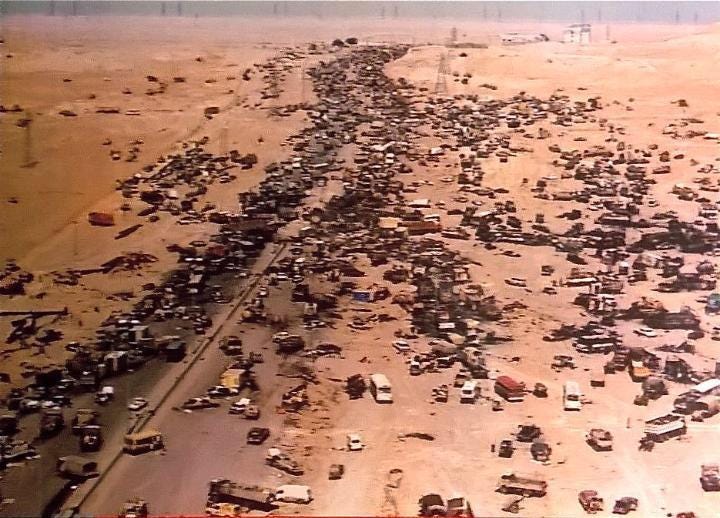
The Highway of Death, Iraq War, 1991
By William Schryver – imetatronink – November 4, 2024
It has now been ten years since I first turned my attention to the necessity of prudent financial investments in order to both preserve and hopefully enlarge the modest amount of wealth I had accumulated up to that time. I began by attempting to identify the wisest and most discerning “experts” in the field. This was no easy trick.
Fortunately, in the ten years preceding my late-2014 awakening to the importance of financial and macroeconomic matters, I had spent several years discovering that most of western academia is a sham dominated by highly credentialled ignoramuses. Therefore I was alerted to the likelihood that the so-called “experts” in other fields of study were similarly intellectually impaired, regardless of their seemingly impressive curricula vitae, how many framed certificates hung on their wall, and the size of their “assets under management”.
That said, it became apparent over time that even those I initially identified as reliable “experts” could be well-informed most of the time, and yet still be subject to blind spots that rendered them susceptible to fatal errors which could often nullify their seemingly correct judgment of everything else.
In the context of financial matters, it must be understood that the “Quantitative Easing” and near-zero interest rates that followed on the heels of the so-called “Great Financial Crisis” of 2007-2009 was a tide that floated a great many boats captained by fools whose folly would not be recognized until the consequences of central bank profligacy were revealed several years further down the road.
Even so, most of the investment “gurus” whose analysis I had come to respect managed to successfully navigate the hurricane of price inflation that roared ashore in the wake of the Covid hysteria – a storm that was then followed by the Federal Reserve’s subsequent raising of interest rates in a frantic attempt to stem the inflationary tide.
Then World War Three began.
Of course, even at this point, almost three years into that war, few people recognize it for what it is. Even fewer recognize the degree to which the geopolitical and military parameters of war itself have been radically altered in comparison to what they were during the “American Unipolar Interregnum” that commenced with the dissolution of the Soviet Union.
Indeed, the overwhelming majority of Americans believe the “unipolar moment” continues essentially intact and unthreatened. In the highly insulated environs of Wall Street and Silicon Valley, faith in the overwhelming supremacy of American high-tech and military prowess remains almost entirely unshaken, notwithstanding the ever-increasing indications to the contrary – things about which I have been writing for several years now.
Most of the gods of American high-tech and finance, and those who worship them, simply cannot discern the degree to which American power in all its forms has steadily eroded over the course of the 21st century, and that this erosion has accelerated dramatically in recent years.
For most of the western elite and their acolytes, it is still early 1991, and Norman Schwarzkopf is leading a million-man army against the hapless Iraqis in a demonstration of military might that would finally expunge the bitter humiliation of Vietnam from the American psyche.
Such people have religiously embraced the Hollywood fantasies of unassailable American superpower dominance. And given the reality that Ukraine and Israel are considered merely appendages of this assumed American military supremacy, the eastern European and Levantine theaters of World War Three have given rise to extreme examples of an unprecedented tsunami of propaganda I have been wont to call “The Imaginary War”.
This phrase I coined in the early stages of the war in Ukraine has its origins in something allegedly said by an unnamed Israeli general in the aftermath of the 2006 war in southern Lebanon – a war whose ultimate outcome was a decisive strategic defeat for Israel, but which the Israelis subsequently attempted to spin into a great victory. It was in this context that the Israeli general reportedly said, “If you can’t win a real war, win an imaginary one.”
This is precisely the narrative-building approach we have seen in Ukraine over the past two-plus years.
Most Americans, and most people around the world who believe in mainstream western narratives, are convinced that the Russians have been dealt an overwhelming strategic defeat in Ukraine; that the Russian military has been exposed as a poorly trained drunken mob; that Russian military doctrine is imbecilic; that Russian equipment is junk; that Russian military technology is decades behind its western counterparts; that American and other NATO war toys sent to Ukraine have dominated the battlefield, etc., etc.
The same types of things are believed about China, its culture, and its military capabilities.
And, of course, even greater derision is directed towards the Iranians and the North Koreans.
Just today I read a short article from a fairly prominent Wall Street hedge fund CIO, in which he wrote the following paragraph of utterly fictitious (and yet widely believed) nonsense:
Israel sent 100 aircraft for a 2000km flight to attack Tehran. Zero were shot down. First, the IDF took out Iran’s air defenses. Those Russian S-300 anti-aircraft systems can now be found disassembled in large craters through the region (Russia’s newer S-400 system underperformed expectations in Ukraine and the S-500 is in test phase). With Iran’s air defenses offline, Israeli aircraft had their way with whatever targets they chose in Tehran. They skipped over the mullahs this time. Next time who knows. Such is the nature of warfare for those with superior tech.
Never mind that literally ALL of his assertions are demonstrably false – this would-be titan of American finance intends to bet the farm on the fallacious assumptions of the imaginary wars he has convinced himself are actually taking place.
Of course, both the major party candidates for President, almost the entirety of the United States Congress, and much of the sprawling swamp of American government bureaucracy in Washington are similarly convinced of the indomitability of American imperial military might, and they are anxious to teach the current “axis of evil” in Moscow, Beijing, and Tehran a lesson they will not soon forget.
In the end – and it will come sooner than later – the only thing that will not be soon forgotten is how briefly the American unipolar moment endured, and how shockingly and suddenly it all came crashing down.
Iran slams US deployment of B-52 bombers as ‘destabilizing’
Al Mayadeen | November 4, 2024
Iranian Foreign Ministry spokesperson Esmail Baghaei criticized the United States on Monday, describing its presence in the region as “destabilizing” following its deployment of B-52 bombers in the Middle East.
At a news conference, Baghaei responded to questions about the military buildup, stating, “We have always believed that the presence of America in the region is a destabilizing presence,” adding, however, that this “will not deter (Iran’s) resolve to defend itself.”
The US military announced on Saturday the deployment of B-52 bombers to the Middle East as a warning to Iran, which has pledged to respond to the Israeli aggression that targeted several of its military sites on October 26.
The Pentagon stated that these deployments would occur in the coming months and highlighted the “flexibility of the US military movements around the world.”
“Should Iran, its partners, or its proxies choose to target American personnel or interests in the region during this time, the United States will take every measure necessary to defend our people,” Pentagon spokesperson Air Force Major General Patrick Ryder said in a statement.
Four Iranian soldiers were martyred during the latest assault on Iran, and officials reported limited damage to several radar systems.
Baghaei said that Iran’s retaliation would be “definite and decisive.” He also reaffirmed that Iran supports “all initiatives and efforts” to promote a ceasefire in Gaza and Lebanon, where “Israel” persists with its aggression.
During the news conference, Baghaei reaffirmed that Iran’s official stance against altering its nuclear doctrine and pursuing atomic weapons remains unchanged.
Quoting a recent speech by the Leader of the Islamic Revolution Sayyed Ali Khamenei, the Iranian diplomat emphasized that the Islamic Republic would be “equipped with everything necessary to defend” itself.
US, ‘Israel’ will bear the consequences
On Saturday, Sayyed Khamenei warned that the United States and the Israeli occupation will bear the consequences of their atrocities.
Speaking on National Day of the Fight against Global Arrogance, which commemorates the anniversary of the US embassy takeover by Iranian students on November 4, 1979, Sayyed Khamenei warned of the crushing response Iran would deliver in retaliation to the crimes carried out against the Islamic Republic and the Resistance.
Sayyed Khamenei stressed that Iran’s operations were not “revenge”, but rather “a logical action, an approach aligned with religion, ethics, and Islamic Law, in accordance with international regulations,” confirming that Iranian officials are constantly developing their political and military readiness to confront any hostility.
Elsewhere, he made it clear that Iran will not leave any aggression unanswered.
Iran’s missiles aimed at deterring attackers, not waging aggression: President Pezeshkian
Press TV – November 4, 2024
President Masoud Pezeshkian asserts that Iran’s missiles are aimed at deterring those seeking to potentially target the country, and are not meant to be used towards waging acts of aggression against other nations.
“We have [our] missiles [at our disposal] so they would not dare attack us. Our missiles are not meant [to be used] for carrying out attacks against anyone or [contributing to] expansionism,” the chief executive said during a ceremony on Monday.
He said the country has developed the defensive projectiles so parties such as the Israeli regime would not be able to target the Islamic Republic as they have been targeting the Gaza Strip or bomb any place or any person that they would desire.
Pezeshkian, meanwhile, hailed Gaza-based Palestinians for their “esteem and greatness” that has forbidden the Israeli regime from forcing them into surrender, despite targeting the coastal sliver with all that is at its disposal for more than a year now.
In the same context, the president slammed the regime for laying claim to respecting human rights and the international law, while its authorities perpetrate “violence, genocide, crime, and murder behind their neat and tie-wearing appearances.”
The remarks came amid the regime’s October 2023-present war of genocide against Gaza that has so far claimed the lives of more than 43,300 Palestinians, mostly women and children.
The contradiction between the regime’s claims and actions points to the regime’s “indecency and lack of identity,” he noted.
Pezeshkian berated those accusing Iran of failure to observe human rights, saying the parties that have leveled the accusations against the country were the same ones that have staged deadly attacks against the Iranian nation, including women and children, with chemical weapons and targeted the people’s sources of sustenance with sanctions.
Finnish Defense Minister Says More EU Funding for Ukraine Needed Through Taxes
Sputnik – 04.11.2024
The European Union will need to find more funds “in the wallets of European taxpayers” to support Ukraine if assistance from the United States weakens, Finnish Defense Minister Antti Hakkanen said on Monday.
He added that now was not the time for “war fatigue.”
“This means that more funds need to be found in the wallets of European taxpayers to support Ukraine,” Hakkanen told Finnish broadcaster when commenting on the potential decline in support for Kiev from Washington after the US presidential election.
In October, Finnish Foreign Minister Elina Valtonen said in an interview that the West was getting tired of supporting Ukraine, hoping for some form of resolution to the ongoing conflict.
Western countries have ramped up their military and financial aid to Kiev since the start of Russia’s military operation in Ukraine in February 2022. Russia has repeatedly said that arms supplies to Ukraine hinder the conflict settlement and directly involve NATO countries in the conflict.
Featured Video

Why Hamas Really Attacked Israel on Oct. 7
or go to
Aletho News Archives – Video-Images
From the Archives
Israel: Strategic Ally or Liability?
By Stephen Sniegoski | My Catbird Seat | June 12, 2010
The claim that Israel serves as a valuable ally for the United States is made by both pro-Zionists and much of the anti-war and anti-Zionist Left that is influenced by Noam Chomsky. As a result of the Gaza flotilla massacre, which has caused a world-wide uproar against Israel, the value of Israel to the United States is being publicly questioned in more mainstream foreign policy forums. … continue
Blog Roll
 Aletho News
- Why Hamas Really Attacked Israel on Oct. 7
- Declassified UK exposes British man who fought for ‘Israel’ in Gaza
- West’s death cult in a theater near you
- How the Yandex ‘Russian bots’ lie fell apart
- Burnham’s ‘Russia did Brexit’ ruse crumbles
- Estonia making movies and games to encourage war against Russia
- Four in five new UK jobs taken by foreigners – report
- Here’s what Trump’s latest U-turn really means for Russia and Ukraine
- The Houthis Are Not an Iranian Proxy
- Europe’s Energy Hypocrisy, Russian LNG Profits and US Dependence
- If Americans Knew
- Activists Abused By Israel Return to New Freedom Flotilla Mission
- 60 Minutes won’t tell the full truth about Israeli settler violence
- Nearly 50,000 women, girls killed or severely injured in Gaza since October 2023: UN Women
- ADL is working with AI companies to suppress alleged ‘antisemitism’
- Israeli occupation forces using social media surveillance unit to target hundreds of Palestinians in the West Bank
- Israel’s New – and Terrifying – Security Doctrine
- Israeli Attacks Kill Five in Gaza, Including a four-year-old and a woman
- Air Force Major Who Called for Trump’s Impeachment Held in Solitary Confinement
- It’s a Genocide, I’m Into It’: Seinfeld Mocks Protest over Palestinian Children Killed
- Universities fire dozens amid pressure from Zionist billionaires
- No Tricks Zone
- New Study Suggests Large Regions Of The Pacific Ocean Have Been Cooling For The Last 80 Years
- Germany’s Green Energy Debacle: High Energy Costs Force Kahla Porzellan to Close After 182 Years!
- New Study: 50 Years Of The Most Aggressive ‘Net Zero’ Policies Can Only Affect The Global Climate By 0.03°C
- US September “Heat” Was No Record…Many Records Set Decades Ago
- Latest European Green Energy Debacle; Portugal’s Largest Flagship Solar Park Insolvent!
- Green Energy Debacle: German Expert Professor Fritz Vahrenholt Warns Of Severe Economic And Social Consequences
- Two More Paleo Reconstructions Affirm Meters-Higher Sea Levels Across Ireland, Brazil 7000-6000 Years Ago
- New Study: Earth And Venus Surface Warmth Largely Explained By Convection And Lapse Rate, Not CO2 Or Radiation
- 2025 Nature Paper Claiming Worsening Global Drought Gets RETRACTED …Heavily Flawed
- New Study: ‘Global Drought Shows No Detectable Recent Acceleration Under Climate Warming’

