Pentagon Report Hypes ‘China Threat’ to Sustain Own Hegemony
By Wang Qi | Global Times | October 20, 2023
The US’ “China Military Power report,” like its previous editions, ignores the facts and is filled with bias, spreading the “China threat” theory which only serves as an excuse to maintain its military hegemony, a Chinese Foreign Ministry spokesperson said on Friday, in response to a Pentagon report that warned Beijing is building up its nuclear and long-range missiles arsenal “faster than previous projections.”
The newly-released annual Pentagon document claimed that China has more than 500 operational nuclear warheads as of May 2023, surpassing earlier projections, and forecast that China would likely have more than 1,000 operational nuclear warheads by 2030.
Describing China as a “pacing challenge,” the US Defense Department report also said that Beijing may be exploring the development of conventionally-armed long-range missiles that could reach the US. It said that Beijing has completed the construction of three new fields of long-range ballistic missiles silos.
Mao Ning, a spokesperson from the Chinese Foreign Ministry, said on Friday that China is firmly committed to a defensive nuclear strategy, and has always maintained nuclear forces at the lowest level required for national security, and has no intention of engaging in a nuclear arms race with any country.
China has a unique nuclear policy among nuclear weapon states and has maintained a high degree of stability, consistency and predictability, Mao said, “No country will be threatened by China’s nuclear weapons as long as it does not use or threatens to use them against China.”
We urge the US to abandon its Cold War mentality and hegemonic logic, to view China’s strategic intentions and national defense development objectively and rationally, to stop publishing such irresponsible reports year after year, and to take practical actions to maintain the stability of the military-to-military and overall relations between the two sides, Mao said.
Chinese military expert Zhang Junshe said that it’s hilarious that a country with more than 5,000 nuclear warheads says another nation poses a threat.
In 2020, Fu Cong, then director general of the Department of Arms Control and Disarmament, cited statistics from renowned international think tanks, pointing out that the US nuclear arsenal stands at about 5,800 nuclear warheads.
Even if China does have 500 nuclear warheads, they are not even close to the size of the US’ arsenal. In addition, the number of US strategic nuclear submarines, strategic bombers, and the number of warheads they carry are far higher than any other country in the world, including China, Zhang remarked.
For fiscal year 2024, the US defense budget request hit another record high of $842 billion, more than the gross domestic product of Saudi Arabia for the entire year of 2021, and 20 percent higher than the combined defense budgets of nine countries, including China, Russia, India, and the UK, according to Xinhua.
According to Zhang, the US is developing a new generation of strategic nuclear weapons, including intercontinental ballistic missiles (ICBMs), sea-based strategic missiles and airborne nuclear weapons, a new generation of nuclear submarines, and strategic bombers.
In addition, the US is miniaturizing nuclear weapons for so-called tactical use, namely, lowering the threshold for the use of tactical nuclear weapons, Zhang said. “The US is also considering resuming the storage of nuclear weapons in other countries, such as the UK, a Cold War era practice of nuclear sharing with allies.”
The hyping of the “China threat” is nothing but a search for excuses for Washington’s uncontrolled nuclear arsenal expansion, and to discredit and suppress China’s normal military development, so as to maintain absolute military superiority, Zhang said.
‘Undesirable hobby’
The report smeared China’s military modernization as a means of projecting power across the Pacific region and ultimately around the globe, saying China’s strength is growing in all the domains of warfare, including the traditional land, air and sea, as well as nuclear, cyber and space, according to CNN.
The 212-page report also mentioned the word “Taiwan” 261 times, highlighting the Chinese mainland’s “military pressure” against the island.
The US is worried that the increase of the Chinese People’s Liberation Army’s military capability could pose challenges to US military hegemony, thus affecting the US political hegemony and global hegemony, Chinese military expert and TV commentator Song Zhongping told the Global Times on Friday.
Given that the report was released ahead of the Beijing Xiangshan Forum, a China-hosted platform on defense and security issues, Chinese analysts believed it was also aimed at entrapping Chinese neighbors, cajoling them to resist and oppose China’s normal military development so that they can be better “utilized” by the US in the Asia-Pacific region.
As the world’s largest nuclear state, the US has not made a commitment not to be the first to use nuclear weapons, as China has done, as well as a commitment not to use nuclear weapons against non-nuclear countries and regions. Instead, the US has even been aggressive, emphasizing the pre-emptive use of nuclear forces, according to Zhang.
The nuclear strategy of the US is global in its scope. When it provides nuclear umbrellas and even nuclear sharing to some allies, it poses a serious threat to other countries, and at the same time is extremely destructive to nuclear disarmament and non-proliferation around the world, and ultimately exacerbates regional tensions, Song said.
In July, the US deployed a nuclear-armed ballistic missile submarine to South Korea for the first time since 1980s. North Korea later fired two short-range ballistic missiles into its eastern waters as a response to the “grave provocation,” media reported.
The problem that the US poses to global security is its nuclear superiority and military power, said a Beijing-based expert. “When it comes to the resolution of regional crises, the US is inclined to resort to the use of force, either by itself or through its allies. And the US’ absolute military strength and nuclear power has further encouraged that undesirable hobby.”
“The US, with the largest and most advanced nuclear arsenal in the world, follows a first-use nuclear deterrence policy, keeps making enormous investment to upgrade its nuclear triad, advances forward deployment of strategic forces, and strengthens extended deterrence for its allies,” Mao said. “These policies and acts heighten the risk of a nuclear arms race and nuclear conflict, and will only adversely affect the global strategic security environment.”
Russia’s top lawmaker slams Biden’s ‘new world order’ plan
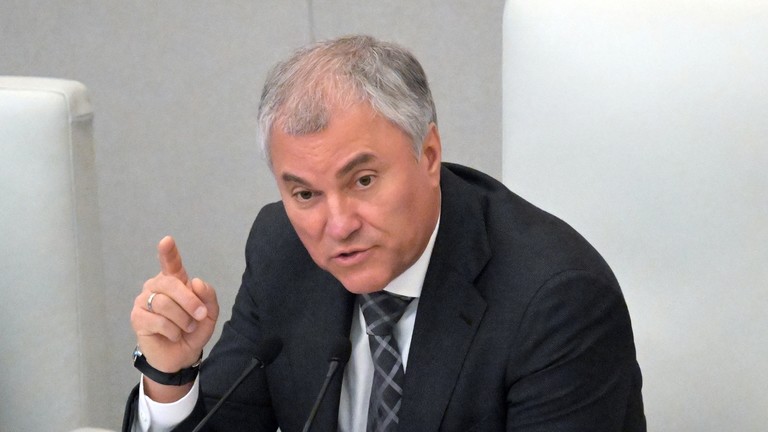
Russian State Duma Chairman Vyacheslav Volodin © Sputnik / Vladimir Fedorenko
RT | October 24, 2023
Russia’s State Duma chairman has compared the US government to a company executive, who has run a business into the ground and now wants to try again with a new corporation.
Vyacheslav Volodin was reacting on Tuesday to remarks by US President Joe Biden, who said last week that a new international order was needed, and that Washington can “unite the world in ways that it never has been”.
The speaker of the lower house of the Russian parliament said that just as a corporate manager with a bankruptcy on their hands would not be trusted with someone else’s money again, “nobody in the world will accept Biden and the US, who have destroyed the global security system, to build a new world order in their interests.”
The Russian official claimed the US has inflicted harm on the world “in attempting to save its hegemony,” causing a disruption of international commerce through trade wars, a deep crisis in the European Union, tensions over Taiwan, and hostilities in Ukraine and the Middle East.
“Attempts to reshape [the world] to fit the American mold will not lead to anything good and can only result in a global disaster,” Volodin warned, urging the US leader to be isolated “before he unleashes a world war”.
Biden’s “new world order” remark came on Friday, while he was meeting with donors as part of his re-election campaign. He touted the US as an indispensable nation and exemplified whipping up support of Washington-friendly governments for Ukraine as an example of his administration’s unifying endeavors.
He insisted that the US was up to the task of leading humanity, and that there has never been a crisis from which the country did not emerge stronger.
Kremlin spokesman Dmitry Peskov said on Monday that Biden was correct in saying that the old system of global governance has become obsolete, but that Moscow rejects the notion that another “American-centric world order” should replace it. Peskov stressed that Russia supports a multipolar world, in which the US would be one stakeholder among many equals.
Europe is suffering from ‘war psychosis’ in its unyielding military support for Ukraine: Hungary’s foreign minister
MAGYAR NEMZET | October 24, 2023
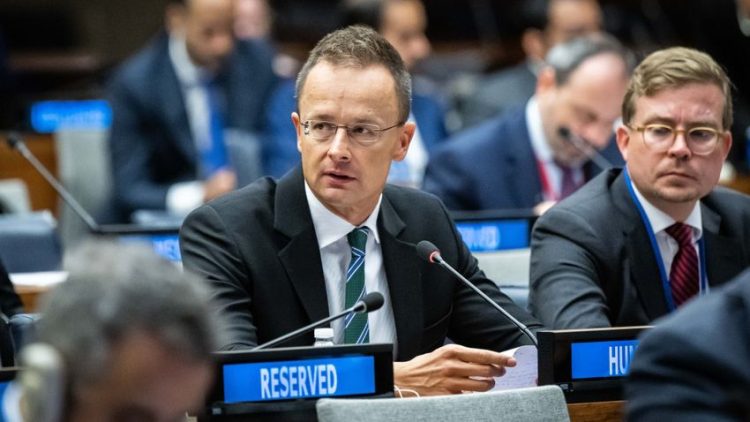
Instead of looking for ways to foster peace, the European Union’s current and planned actions only serve to extend the war, Hungarian Minister of Foreign Affairs and Trade Péter Szijjártó said after a meeting of the EU’s Foreign Affairs Council.
“It is all about war, there is no peace. Brussels is still pro-war, as shown by the fact that they would give €5 billion a year for arms over the next four years, which also shows that they expect the war to continue,” Szijjártó said. “No one in Western Europe is talking about peace, Europe is suffering from a war psychosis.”
He added that it is clear there will be no solution to the war on the battlefield. Europeans expect nothing but destruction and death, and the conditions for peace are getting worse.
“Taking arms production and training to Ukraine would drag the EU into an immediate war. We find this totally unacceptable. Nor should arms transfers be just about supplying the Ukrainians with as many weapons as possible, because the EU is not a security organization, and justifying a country’s future accession on security grounds is completely unacceptable,” Szijjártó added.
Energy sanctions are hurting Hungary, Szijjártó claimed
Speaking of the EU’s bans on Russian fossil fuels, Szijjártó said that Hungarians do not want to give up energy security in the name of some ill-defined ideals.
“On energy supplies: We didn’t talk nonsense by saying that it’s not a political issue, it’s a physical issue. We are not willing to risk the security of Hungary’s energy supply or the results of cuts in tariffs. Hungarians are not responsible for the war, we are not willing to make them pay for it,” he said.
The Hungarian foreign minister accused other member states of being covert about their dealings with Russia, unlike Prime Minister Viktor Orbán who has been honest and transparent through his recent meeting with Russian President Vladimir Putin in Beijing.
“My colleague, the Lithuanian foreign minister was blunt. He said that he expected me to clarify whether what is being said here is our own position or the Kremlin’s position. This is unacceptable to me. I reassured him that Hungary is a sovereign country with a sovereign opinion,” Szijjártó explained.
“As long as this government is in power, we are not prepared to accept any opinion from anywhere, from any geographical direction, whether there is a lot of water between us or not. I said to my Lithuanian colleague that I hope he can say the same thing with his hand on his heart,” he added.
US Treasury Deficit Doubles as Biden Bankrolls Multiple Foreign Conflicts
By James Tweedie – Sputnik – 23.10.2023
The US is going further into the red with as it arms its client states for a series of conflicts. Sergio Rossi, professor of macroeconomics and monetary economics at the University of Fribourg, Switzerland, said the strategies to avoid a default would only prove to be a “time-bomb.”
US President Joe Biden’s appeal for cash to arm Ukraine and Israel could meet resistance from Congress thanks to the runaway federal budget.
Treasury department figures released late last week showed the government deficit had hit almost £1.7 trillion, up from £1.37 trillion a year earlier, a 23 percent increase in the public debt — although lower than the $2.78 trillion left by the COVID-19 pandemic in 2021.
The news was worse than it sounded however. The 2022 deficit included the budget for Biden’s student loan repayment program, money that was never spent as the Supreme Court struck it down. The treasury then claimed those unspent public funds as a “saving” in 2023 — meaning the true deficit doubled from $1 trillion in 2022 to $2 trillion this year.
That news came a day before Biden asked Congress for a $106 billion emergency foreign military aid budget. The lion’s share, $61.4 billion, is earmarked for Washington’s proxy conflict with Russia in Ukraine, while another $14.3 billion is to arm Israel for its latest attempt to destroy the Hamas movement in the besieged Gaza Strip.
That request dwarfs the $77 billion in arms and cash gifted to the Kiev regime since the start of Russia’s de-Nazification operation in February 2022.
Economist Sergio Rossi told Sputnik that the mounting deficit would make it harder for Biden to persuade Congress to approve his $100 billion budget request for more arms to Ukraine and Israel “in light of the problematic economic situation and outlook for the US stakeholders, namely, households, firms, and a variety of financial institutions.”
“Usually, when the domestic economic situation worsens, these stakeholders and their political supporters reduce the volume of foreign aid, to focus on supporting their own national economy first of all,” Rossi said.
He said the funding the conflict in Ukraine — while preparing for a Pacific showdown with China over Taiwan — had already put too much strain on Washington’s finances before the Palestinian Hamas movement launched a surprise attack into southern Israel.
“The US government cannot continue financing two military conflicts, particularly if the latter will continue without any foreseeable peaceful agreement before long,” Rossi stressed. “There are already signs that the political consensus for such a financial support is diminishing across the US economy, notably where both the labour and the product markets are in a difficult situation for a number of middle-class workers and several small or medium-sized firms.”
The state of the US economy was “worrying,” he said, and the outlook for the next two years was “even worse,” thanks to “global macroeconomic issues related to different geopolitical problems.”
The “mushroom” of ensuing inflation has badly affected consumer purchasing power. “As a result, firms’ investment is discouraged, both because of this inflationary pressure and the Fed’s repeated increases in the policy rates of interest.”
“The US economy is even closer to a recession than it was one year ago,” Rossi warned, although “there is no potential risk of a default of the US federal government.”
He pointed out that Congress could simply raise the public debt ceiling and the US Federal Reserve could buy up government bonds as an effective loan.
“This, however, is a time bomb that eventually can burst, particularly once some viable and credible alternative to the US dollar will emerge across the global economy,” Rossi said. “The BRICS community could provide such an alternative in a not-too-distant future.”
The Damage Israel Does
Constitutional rights and genuine national interests are ignored as governments surrender to Jewish power
BY PHILIP GIRALDI • UNZ REVIEW • OCTOBER 23, 2023
There are numerous one-liners like “wag-the-dog” that constitute a long running joke about how Israel exploits Jewish power in the United States to limit and control Washington’s options in foreign policy as well as in many other aspects of international interaction. This has been accomplished by a cleverly executed neoconservative takeover of the foreign policy instruments of both major parties based on a series of nonexistent “threats” coupled with media control and billions of dollars in political donations that have bought the numerous politicians willing to be bought, which clearly constitutes a majority of Congress.
President Joe Biden and those who surround him are all about Israel and many of them are Jewish. His Secretary of the Treasury Janice Yellen claims that the US “can afford” two wars simultaneously and the Chuck Schumer led Senate has voted unanimously 97-0 pledging full and unconditional support for the Jewish state. Biden’s somewhat pathetic fifteen-minute speech last week justifying throwing another $105 billion of deficit spending at Ukraine and Israel could have been written by a neocon scribe in its attempt to demonstrate that the US is threatened by developments in those two countries. It is not, even Biden knows that, and his assertions were as hollow as the rhetoric used to support the false premise. My favorite argument being made by the president was that “American leadership holds the world together….and is necessary to keep freedom alive in both the Middle East and Eastern Europe… Hamas and Putin represent different threats, but they share this in common: They both want to completely annihilate a neighboring democracy.” As it turns out, Biden was wrong on every point. Opinion polls suggest that the world overwhelmingly sees the United States as the most disruptive and dangerous nation on the planet, so Biden’s unwillingness or inability to discern that he is presiding over the death throes of America’s global leadership is particularly troubling. And Joe even fails to realize that Russia is more democratic by most measures than is Ukraine, which is consistently rated as the most corrupt country in the world, while Israel is not a democracy at all unless one is a Jew.
Biden was certainly motivated to speak to the American public in prime time, only the second time he has done so, by his overriding concern to express and obtain absolutely total support for Israel no matter what it does. He is willing to lie, cheat and steal for Israel. In the wake of the devastating October 17th blast at al-Ahli Baptist Hospital, a Christian-run medical complex in central Gaza City, which killed at least 500 people and injured hundreds more, he immediately jumped on the protect-Israel bandwagon and declared that Israel had not done it, which is far from being demonstrated and is being hotly disputed by eyewitnesses and forensic specialists. Ukraine is a secondary issue but it too is a war supported overwhelmingly by international Jewry for various reasons, most notably visceral hatred of Russia.
Nevertheless, the control by the Israel Lobby aside, one is at a loss to understand the actual rationale behind the recent trips to Israel in the wake of the Gaza uprising made by Secretary of State Antony Blinken and “they beheaded the babies” Joe Biden since the United States has no genuine national interest that compels it to get involved in either war, even less so in Gaza where Israel has been indisputably the source of nearly all the trouble. Lest anyone be confused over what signal was being sent, two US aircraft carrier strike groups were also dispatched to the Eastern Mediterranean together with orders to prepare to deploy 2,000 Marines, suggesting that Washington was itself preparing for war. And the Muslim world, convulsed by what it is seeing happen to Gaza, is also heeding a call to arms. As of last Friday there have been seven separate drone and rocket attacks on US military bases in Iraq and Syria. Journalist Caitlin Johnstone has neatly summarized the legitimate rage on the ground in Palestine that the White House and Congress make no attempt to appreciate: “The status quo in Israel has been one of continually escalating violence, tyranny and abuse for generations… Stand on someone’s face for long enough and one day it will surprise you if he eventually bites your foot. You might even feel like you were the victim, because that’s just what you’d gotten used to.”
Blinken, citing his ancestors and the holocaust, presented himself as a Jew to his Israeli audience, which meant that no further justification was required as he totally rolled over to comply with the Prime Minister Benjamin Netanyahu’s interpretation of what had taken place on October 7th. Reports suggest that Blinken had initially sensibly supported a cease-fire on social media just after the Hamas attack, writing that he would be “encourage[ing] Turkey’s advocacy for a cease-fire and the release of all hostages by Hamas immediately.” Presumably under pressure from Biden and the Israel Lobby, he then deleted that and wrote, “Israel has the right to defend itself, rescue any hostages, and protect its citizens.” The State Department got the message and circulated instructions to staffers to not use the terms “de-escalation/ceasefire,” “end to violence/bloodshed” and “restoring calm” in regard to the Gaza/Israel situation, giving Netanyahu a free hand to do whatever he would choose to do.
Blinken was thus converted to fully support massive and indiscriminate Israeli retaliation against the civilian population, a war crime, and his reward was being stiffed by the Saudi Crown Prince, forced to wait in attendance all night before being allowed a short and non-productive audience. Biden outdid his colleague in being completely stonewalled by Saudi, Jordanian, Egyptian, Iraqi and Palestinian heads of state and government, which leads to the question “What did Biden seek to achieve apart from demonstrating that the United States was owned by Israel which is committing a war crime by its collective punishment of Gaza? Did he think the Arab and Muslim states would react positively to a developing massacre of the Gazans, which he specifically supported?”
So why were Biden and Blinken so willfully ignorant as to be unable to appreciate that they were bearing a message that could only succeed in infuriating their hosts? Israel, after all, is by law a Jewish state which not only does not provide equal rights to the non-Jewish citizens and residents, it also has a government that has senior officials and some leading religious figures describing Palestinian Arabs as something less than human or even “animals” and who, in some cases, openly consider it perfectly acceptable to exterminate them. It is the same government with a different cast of characters that has been stealing, killing and inflicting a host of war crimes and crimes against humanity on its captive and largely helpless Palestinian Christian and Muslim minority for the past 76 years.
Biden’s nice package of $105 billion, which will likely sail through Congress because it is “for Israel,” will include $14 billion for Netanyahu to buy some new heavy ordnance to exterminate the Palestinians, which guarantees that the Muslim world will hate the United States for the foreseeable future. The money is also funding the war in Ukraine for the next year and arming Taiwan with some shiny new weapons to ward off China. Ironically, a new CBS/YouGov poll finds that most Americans don’t want the US providing Israel with weapons and supplies in this war, but, of course ordinary voters are never asked their opinion when the White House chooses to demonstrate “American exceptionalism” towards the country that it loves beyond all others. Oh, and the bill will also include some cash to “fortify” America’s Mexican border, a sweetener that runs completely contrary to what Biden has been doing for the past three years. All this will be piled on to the United States government debt which, at just short of $33 trillion, is considered to be unsustainable and weighs in at $350,230 for every American family. And it is all being done for no good reason whatsoever in terms of genuine American interests, and probably illegally too as proxy wars run by the Executive Branch would seem to go against the Constitution’s separation of powers as well as the time constraints in the War Powers Act of 1973. Congressman Michael McCaul from Texas, the Israel firster fanatic who heads the House Foreign Affairs Committee, is currently pushing legislation that would provide an in-advance authorization to go to war on Iran and on Lebanon if Hezbollah were to come in to support the Gazans when Netanyahu starts his potentially genocidal ground attack. Another Congressional clown, Senator Lindsey Graham of South Carolina is already calling for an attack on Iran under the presumption that it assisted the Gazans.
Fortunately for all of us who care for such issues as life and death, some cracks are appearing in the wall surrounding total subservience to Israel and its interest. Some even suspect that the “US-based Middle East system,” which mandates blind support for Israel, has become so abusive that the public is becoming reluctant to support it. Indeed, public opinion polls suggest that support for the Palestinians is increasing while that for Israel is growing weaker as atrocities against the Arabs multiply with Israel new ultra-conservative government. The resignation letter of senior State Department official Josh Paul, who recently quit over the Biden administration’s position on the Gaza War, makes for interesting reading. Paul described the Hamas attack as a “monstrosity of monstrosities” but continued: “This Administration’s response – and much of Congress’ as well – is an impulsive reaction built on confirmation bias, political convenience, intellectual bankruptcy and bureaucratic inertia. Decades of the same approach have shown that security for peace leads to neither security nor peace, The fact is that blind support for one side is destructive in the long term to the interests of the people on both sides.”
Paul was responding to the latest arms package being rushed through congress for Israel, which he described as “shortsighted, destructive and unjust,” and the US veto early last week of a Russian proposal in the UN Security Council to call for a ceasefire. The US permanent representative to the UN Linda Thomas Greenfield submitted the veto and then erupted with “By failing to condemn Hamas, Russia is giving cover to a terrorist group that brutalizes innocent civilians. It is outrageous, it is hypocritical, and it is indefensible.” She is the hypocrite in that she obviously does not recognize or does not care that Israel’s record is far worse than Russia’s in “brutalizing innocent civilians” for the past 76 years.
There are also other reports of general “discomfort” and dismay among civil servants over what is happening vis-à-vis the US role in Gaza out of concern for Israel not being urged to show restraint and the White House lack of any genuine concern over the developing humanitarian crisis. It also appears that several of the few Muslim federal government officials have been removed from positions having anything to do with Middle East policy. The US media likewise has been transferring many of its Muslim journalists who were on the ground in Gaza and elsewhere in the Middle East for fear that they will actually try to tell the truth about what is going on and who is doing what to whom.
On a next to last final note, it has often been noted that the first victim of war is truth. The US government in its various guises has been lashing out at social media and other sites that have been making available material that can be construed as favorable to Gaza. So far, they have been less than successful, but the efforts persist and could lead to legislation. Also, there have been the usual claims regarding “antisemitism” which can be exploited in “hate crimes” prosecutions as well as the existing legislation in 35 states that protect Israel with potential criminal and civil penalties as well denial of jobs and services to applicants who are critics of the Jewish state’s behavior. In Israel itself, al-Jazeera journalists have now been detained and expelled as a consequence of legislation criminalizing the activity of journalists who report “facts” that are not approved by the Israeli government.
But some of the most bizarre lashing out by the Israel lobby and its friends is taking place in the United States. In Florida the state Attorney General has told prosecutors to “exercise zero tolerance” when dealing with the “anti-Jewish hate crimes” engaged in by college students who have been demonstrating in support of the Gazans. At Harvard, major donors who are mostly Jewish have cut off donations to the university due to its tolerance of pro-Gazan student demonstrators. A so called “conservative group” Accuracy in Media headed by one Adam Guillette, who is Jewish, has led the response to a coalition of more than 30 Harvard student groups that posted an open letter on the night of the Hamas attack, citing Israel as “entirely responsible” for the violence that killed more than 1,400 people, mostly civilians. The letter was posted on social media and did not include the names of the individual students in the groups. But within days, students connected to those groups were being identified together with their personal information, all of which was posted online. Families back home were threatened while presumed Harvard alumni businessmen and executives demanded a list of the student names to ban their hiring. And a truck with a digital billboard paid for by Accuracy in Media circled Harvard Square, flashing student photos and names, under the headline, “Harvard’s Leading Antisemites.” The students now have to deal with “people’s lives being ruined, people’s careers being ruined, people’s fellowships being ruined” because they opposed a certainly controversial war being fought. Guillette said his organization’s next move, which has already started, is to create online domains using the students’ first and last names to create sites identifying them as antisemites. Guillette boasted that “I think it’s incredibly important for people to know who the antisemites are on their campus and in their community.”
And on a final note, if you have wondered where the money is coming from to fund Israel’s wars and crimes beyond what Joe Biden and his buddies are willing to hand them, there is an interesting story out of Georgia. Republican Governor Brian Kemp has ordered his state treasurer to use tax revenues to purchase $10 million in Israel Bonds. The bonehead then issued a statement: “Israel is one of Georgia’s strongest allies and greatest friends, and our support for its people as they endure horrific attacks from terrorists is unwavering. Purchasing these bonds is just the latest expression of that support.” It is not clear if the purchase is completely legal and someone should have advised the governor that buying Israel bonds is in the nature of a gift as they lack liquidity and are generally regarded as a terrible investment. So it is a rip-off of the Georgia taxpayer. I wonder if anyone will notice!
Philip M. Giraldi, Ph.D., is Executive Director of the Council for the National Interest, a 501(c)3 tax deductible educational foundation (Federal ID Number #52-1739023) that seeks a more interests-based U.S. foreign policy in the Middle East. Website is councilforthenationalinterest.org, address is P.O. Box 2157, Purcellville VA 20134 and its email is inform@cnionline.org.
German MP announces formation of new anti-establishment party

RT | October 23, 2023
Germany will have a new left-wing political grouping in 2024 after prominent Left Party MP Sahra Wagenknecht announced the formation of her own party. Its platform will include the normalization of relations with Russia and a peace-oriented foreign policy.
Wagenknecht broke the news during a press conference in Berlin on Monday, saying she and fellow Left Party defectors had “decided to establish a new party.” Explaining the need for a new political force, she argued that things “can’t continue like this” or Germans “will probably not recognize our country in ten years.”
The politician plans for the new party to run candidates in regional elections in the eastern regions of Saxony, Thuringia and Brandenburg, as well as in the European Parliament election next year.
A fresh poll commissioned by Bild am Sonntag indicated that some 27% of Germans would not rule out voting for Wagenknecht’s new political force.
Until the party’s official formation at the start of 2024, Wagenknecht and nine other Bundestag colleagues who resigned from the Left Party said they wished to keep their current seats. Party leadership has, however, already indicated that the defectors could lose their mandates much earlier. In September, Wagenknecht hinted at her plans to branch out, claiming that many Germans felt that none of the existing political forces represented their views.
Not long after that, the “Sahra Wagenknecht Alliance – for reason and justice” was registered with the aim of laying the groundwork for the establishment of a new party. The politician clarified that the Left Party had, in her opinion, become increasingly irrelevant. She also blasted Chancellor Olaf Scholz’s government on Monday as the “worst government in the history of the federal republic.”
Wagenknecht said she would seek to preserve Germany’s “economic strengths” as well as work toward more social justice. With respect to foreign policy, Berlin should switch to diplomacy rather than weapons deliveries when dealing with conflicts, the politician insisted.
She has been a vocal critic of Scholz’s policies toward Moscow over the Ukraine conflict, arguing that the current approach risks leading to a global, and potentially nuclear conflict. Berlin, according to Wagenknecht, should assume the role of a peacemaker.
Commenting previously on the EU’s anti-Russia sanctions, the politician has repeatedly claimed that the punitive measures are doing more harm to the German economy than to the Russian one, and thus should be lifted.
Wagenknecht is also a prominent critic of the European Union’s “elite project” and NATO, and argues for more independence for national states.
Pro-neutrality party wins Swiss election
RT | October 23, 2023
The Swiss People’s Party (SVP), which campaigned on a pro-neutrality and anti-immigration platform, emerged as the main winner in Switzerland’s general election on Sunday, garnering 28.6% of the vote.
Amid the ongoing Ukraine conflict, some politicians and officials in the country had been calling for closer alignment with NATO and the abandonment of strict neutrality.
The result represented an increase of three percentage points from the SVP’s showing in 2019. The Social Democrats trailed behind with 18%, with several other parties receiving less than 15% each. The Green Party appears to have been the main loser with a little over 9% – almost four percentage points less than in the previous election.
The right-wing SVP thus gained nine seats in the 200-seat National Council, bringing the number of its representatives to 62.
The SVP has been the most popular political force in Switzerland over the past two decades, but the result on Sunday is among its best on record.
The party wants to restrict immigration to keep the country’s population under a threshold of 10 million, citing overstretched infrastructure and a lack of housing.
The SVP also insists that Switzerland should remain neutral despite recent geopolitical tensions in Europe.
Back in August, a policy document released by the Swiss Army detailed plans to step up its military cooperation with NATO “as much as possible.” Swiss military leaders advocated bringing the army’s operations in line with NATO doctrine, as well as joining the EU’s Permanent Structured Cooperation (PESCO) defense framework and its European Sky Shield Initiative.
These measures were necessary due to the Ukraine conflict, the report said, claiming that an “epoch of peace in Europe is coming to an end.”
Switzerland has maintained a policy of neutrality since 1815, and did not take sides in either of the two world wars. Since the start of the conflict in Ukraine, the country has imposed sanctions on Russia, taking its cue from the EU, and sent economic aid to Kiev, but has refused to supply weapons or allow other countries to send Swiss arms or ammunition to Ukraine.
However, some members of the Swiss government have been calling for the relaxation of this long-standing foreign policy. The Swiss People’s Party and the Social Democratic Party have been critical of such suggestions.
Speaking to the Russian media back in February, Russian Foreign Ministry spokeswoman Maria Zakharova said Russia no longer viewed Switzerland as neutral after it joined the “West’s illegal unilateral sanctions.” The diplomat noted that this move disqualified Bern as a potential mediator in the conflict.
Kremlin responds to Biden’s ‘new world order’ pledge
RT | October 23, 2023
Kremlin spokesman Dmitry Peskov told journalists on Monday that Russia agrees with US President Joe Biden’s comment made last week that the current global order has lost steam. However, he added that the outcome may not align with the White House’s expectations.
“The world indeed needs a new order, based on absolutely new principles,” the Russian official claimed.
According to Peskov, the new arrangement should be based on “international laws, not [arbitrary] rules” and devoid of attempts “to concentrate all mechanisms of global governance in the hands of a single nation.” He believes that Moscow differs significantly on this point.
“Whatever new world order the US envisions, it means an American-centric world order. A world revolving around the US. This will not be anymore,” Peskov added.
Biden delivered his comments about an impending shift during a speech at a fundraising event in Washington last Friday. The US president highlighted his successful effort in uniting Japan and South Korea to support Ukraine against Russia as an exemplar of his administration’s unifying endeavors.
Tokyo and Seoul agreed to do this “because they understand if they remain silent, they may be next,” Biden claimed, suggesting that Washington can “unite the world in ways that it never has been” if it is “bold enough.”
“We were in a post-war period for 50 years where it worked pretty damn well, but that’s sort of run out of steam,” Biden mused. “It needs … a new world order in a sense.”
This reality can be achieved, the president said, because “we’re the United States of America, for God’s sake” and there has “never been a thing we’ve set our mind to [that] we haven’t been able to accomplish.”
“Name me one crisis we ever got into where we haven’t come out stronger in America. Name me one. Name me one where we went in and didn’t come out stronger,” he challenged the audience.
During Biden’s term in office, the US ended a two-decade military engagement in Afghanistan, the longest in its history. Among other things, the campaign cost the lives of 2,448 US military service members and 3,846 US contractors, according to the Brown University Costs of War project.
The US had spent hundreds of billions of dollars on security and reconstruction efforts, which were mired with graft and waste, according to the office of the Special Inspector General for Afghanistan Reconstruction (SIGAR).
The Taliban militant group toppled the US-backed government in Kabul before the pullout was completed.
US-drafted resolution on Israeli war on Gaza does not call for ceasefire: Report
Press TV – October 22, 2023
The United States has submitted a draft for a UN Security Council resolution on Israel’s onslaught in Gaza without any mention of a ceasefire in it, a report says.
According to a document obtained by Russia’s TASS news agency, the US-drafted resolution condemned the Hamas resistance group’s Operation Al-Aqsa Storm, urged the release of war prisoners, and supported Israel’s so-called right to defend itself. However, it does not stipulate a call for a ceasefire.
It also calls for the full respect of international humanitarian law, including the protection of civilians, and recognizes the efforts of Qatar and other countries that led to the release of two Israelis on October 20, who had been kept as war prisoners by Hamas.
The United States on October 18 vetoed Brazil’s draft resolution on the Middle East. Russia abstained from voting in light of the UN Security Council’s rejection of its suggested amendments to the document.
The UK also abstained, while the remaining 12 members of the UN Security Council voted in favor of the resolution.
On October 17, the UN Security Council did not adopt the Russia-drafted resolution on the Israeli-Palestinian conflict, as only five countries voted in favor.
The draft resolution called for an immediate ceasefire and also blamed the United States for the unfolding situation in the Middle East.
A UNSC resolution needs at least nine votes in favor and no vetoes by the US, Britain, France, China, or Russia. The United States has traditionally shielded its ally Israel from any Security Council action.
Till now, none of the draft resolutions have received enough votes to pass.
The Israeli regime began the war on Gaza on October 7 following Operation Al-Aqsa Storm launched by Hamas in response to the Israeli regime’s incessant campaign of bloodshed and destruction against Palestinian people.
The war has so far claimed the lives of at least 4,385 Palestinians, mostly women, children, and the elderly.
US needs ‘Department of Offense, not Defense’ – presidential candidate
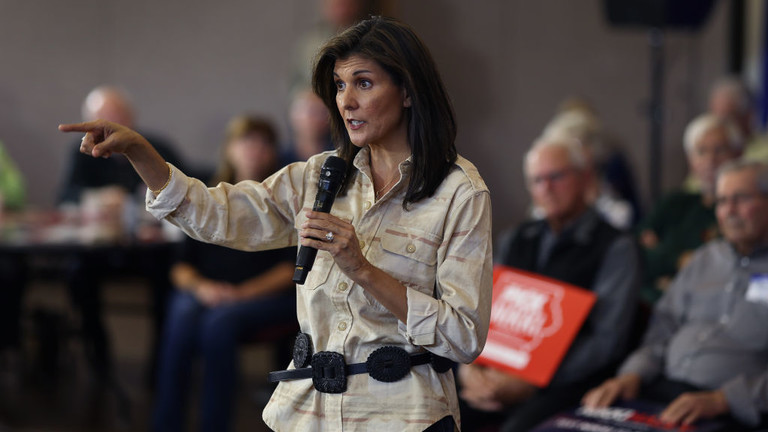
US presidential candidate Nikki Haley speaks at a campaign event on Saturday in Pella, Iowa. © Getty Images / Scott Olson
RT | October 22, 2023
Republican presidential candidate Nikki Haley has called for instilling fear in Washington’s foreign enemies by transforming the US Department of Defense into the “Department of Offense.”
Speaking at a campaign event on Friday in Cedar Rapids, Iowa, Haley demanded that the US respond to the Israel-Hamas war by providing the Israeli government and military with “whatever they need whenever they need it.” She added that Washington’s goal must be to “eliminate Hamas, not weaken them,” and she called for cutting off government funding to colleges whose students or employees hold protests in support of the Palestinians.
Haley, a former South Carolina governor who served as US ambassador to the UN under then-President Donald Trump, suggested that the administration of US President Joe Biden must not be fooled by Friday’s release of two American hostages by Hamas. “They are doing this to earn favor with America because they want to try and look good in the eyes of America,” she said. “Don’t fall for it.”
Having a stronger military and strong leadership in the White House could have prevented the war in Israel, as well as the Russia-Ukraine conflict, Haley argued. Biden’s botched withdrawal of US forces from Afghanistan in 2021 and his administration’s recent prisoner-swap agreement with Iran emboldened America’s enemies, she claimed, adding that only a stronger military can restore US credibility.
“We’ve got to be smart, and we’ve got to be ready,” Haley said. “I’m tired of talking about a ‘department of defense’. I want a ‘department of offense’. Every enemy needs to fear us.”
Haley is calling for a bigger and apparently more aggressive military despite the fact that the Pentagon already boasts annual spending of nearly $832 billion – exceeding the world’s nine next largest defense budgets combined. The US has about 750 bases in 80 countries, and it has a long history of regime-change programs and military interventions around the world.
“This woman is a crazed warmonger,” US podcast host Joey Mannarino said in an X (formerly Twitter) post. “Don’t let the sweet Southern accent fool you. She’d have us in every war she could find.”
Haley has reportedly been enriched by the US military industrial complex since resigning as Trump’s UN ambassador in October 2018. She was hired as a board member with US defense contractor Boeing in 2019. Although she left the company the following year, she still owned as much as $250,000 in Boeing stock as of a financial disclosure filing in May.
Haley has earned six-figure fees for speaking engagements, including over $230,000 from the Center for Israel and Jewish Affairs, and she was paid $127,500 for her work as a consultant to an advocacy group called United Against a Nuclear Iran, which has lobbied for military strikes against Tehran. She also netted more than $708,000 in consulting fees from Prism Global Management LLC, an investment fund, and her husband holds stakes in two firms with ties to the defense industry.
Ukraine’s leaders are controlled by US – German ex-chancellor

Former German Chancellor Gerhard Schroeder © Photo by Kay Nietfeld/dpa via Getty Images
RT | October 21, 2023
Former German Chancellor Gerhard Schroeder has argued in a newspaper interview that the US government didn’t “allow” any compromises that could have brought an end to the Russia-Ukraine conflict just weeks after Moscow’s military offensive began in February 2022.
Speaking in an interview published by Germany’s Berliner Zeitung newspaper on Friday, Schroeder said he was asked to help mediate the March 2022 peace negotiations between Ukrainian and Russian officials in Istanbul. He said that although representatives of Ukrainian President Vladimir Zelensky were open to making concessions on such key issues as renouncing efforts to join NATO, “the Ukrainians did not agree to peace because they were not allowed to. They first had to ask the Americans about everything they discussed.”
Russian officials have repeatedly claimed that the US and other Western backers of Ukraine discouraged Zelensky’s government from agreeing to a peace settlement. Schroeder, who has defended his continuing friendship with Russian President Vladimir Putin, essentially confirmed that allegation in the Berliner Zeitung interview. “My impression: Nothing could happen because everything else was decided in Washington,” he said.
The ex-chancellor described Washington’s strategy as “fatal,” saying it resulted in closer ties between Russia and China. “The Americans believe they can keep the Russians down,” Schroeder said. “Now, it is the case that two actors, China and Russia, who are limited by the USA, are joining forces. Americans believe they are strong enough to keep both sides in check. In my humble opinion, this is a mistake. Just look how torn the American side is now. Look at the chaos in Congress.”
Washington’s allies in Western Europe “failed” to seize the opportunity to push for peace in March 2022, Schroeder said. At the time, he added, Zelensky was open to compromise on Crimea and breakaway territories in the Donbass region. Since that time, hundreds of thousands of Ukrainian troops have been killed as Western military aid prolongs the conflict. Putin estimated earlier this month that Kiev lost over 90,000 soldiers in the failed counteroffensive that began in June.
“The arms deliveries are not a solution for eternity, but no one wants to talk,” Schroeder said. “Everyone is sitting in trenches. How many more people have to die? It’s a bit like the Middle East. Who are the victims on one side and on the other? Poor people who lose their children.”
Schroeder argued that only French President Emmanuel Macron and German Chancellor Olaf Scholz can revive peace talks in Eastern Europe. “Scholz and Macron should actually support a peace process in Ukraine because it’s not just an American matter, but above all a European matter.” He added, “Why did Scholz and Macron not combine the arms deliveries with an offer to talk? Macron and Scholz are the only ones who can talk to Putin.”
Russian leaders were threatened by the US push to bring NATO to Moscow’s western border by adding Ukraine to the Western military alliance, Schroeder said. However, he claimed that one of the justifications for arming Ukraine – alleged Russian expansionism – had no basis in reality.
“This fear of the Russians coming is absurd,” Schroeder said. “How are they supposed to defeat NATO, let alone occupy Western Europe?” He added, “That is why no one in Poland, the Baltics and certainly not in Germany – all NATO members, by the way – has to believe they are in danger.”
On the other hand, Schroeder insisted, Western leaders must understand that no matter who is in power in Moscow, Russia won’t allow either Ukraine or Georgia to be absorbed by NATO. “This threat analysis may be emotional, but it is real in Russia,” he said. “The West must understand this and accept compromises accordingly. Otherwise, peace will be difficult to achieve.”
Featured Video

Matt Bracken: US Plans Massive MOAB Strike on Iran?
or go to
Aletho News Archives – Video-Images
New Book
The silver that medicine dropped — four thousand years of clinical use, four decades to erase.
Colloidal Silver — First Edition, 2026, Paperback
Lies are Unbekoming | October 16, 2026
Silver was medicine. Not alternative medicine. Not folk medicine. Medicine. In surgery. In obstetrics. In the burn ward. In water treatment. In the household medicine chest. Every physician before 1938 knew this.
By the 1870s, silver nitrate was standard in surgical wound care across the leading hospitals of Britain, Germany, and the United States. Colloidal silver preparations — Collargol, Argyrol, Protargol — entered European and American practice through the 1890s and early 1900s and became standard antiseptics in military field medicine. By the time Fleming grew his first penicillin mould in 1928, silver was the first-line antimicrobial of the Western pharmacopoeia. The Lancet and the British Medical Journal carried the clinical reports in volume. The practice ran continuously through the Victorian era, the Edwardian era, the First World War, the interwar period. By 1980, almost all of it was gone.
What has not been treated at book length, until now, is how a four-thousand-year clinical record disappeared from mainstream medicine within four decades of the Flexner Report — and what the honest account of silver looks like once that record is reassembled.
Colloidal Silver reconstructs the pre-1938 record from The Lancet, the British Medical Journal, and the primary literature of the era; recovers Robert Becker’s bioelectric framework from the regeneration research the pharmaceutical model buried; and places silver inside a practical terrain-paradigm guide to its current place — in water, on the body, inside the body, and in the chronic conditions where antibiotics have failed. … continue
Blog Roll
 Aletho News
- Inside Bill C-22, Canada’s Patriot Act.
- China’s FM: Palestinian cause is ‘greatest injustice of the century’
- US sympathy for Palestinians surpasses support for Israelis
- Israeli rabbi permits occupiers to steal Palestinian olive harvest in West Bank
- Spanish firm sells Latvia vehicles equipped with Israeli tech despite arms embargo
- Saudi Arabia under fire… Yemen is burning down the House of Saud
- Israeli Spy Pollard stole the files, today’s it’s delivered through official channels
- Why Iran Didn’t Walk Away
- US arms supplied to Ukraine found in war-torn Sudan – Moscow
- The silver that medicine dropped — four thousand years of clinical use, four decades to erase.
- If Americans Knew
- NPR investigation finds evidence of widespread fraud at mall kiosks tied to Israeli skincare brand
- Tucker Carlson exposes Israeli Lies about the Oct 7th attack, Charlie Kirk, and the U.S.
- Israel has detained thousands of Palestinian children since Oct 7th – over half spent time in solitary, many uncharged
- Israeli Analysis: Is Netanyahu Planning an ‘October Surprise’ Attack Before Israel’s Election?
- Israeli settlers brutally attack Palestinians and Washington Post female photographer, 65
- Words Have Changed, Occupation Continues: The Reality of the Gaza Ceasefire
- Gaza’s child amputees are growing faster than their prosthetics allow
- Israel keeps Palestinians struggling just to survive–Daily Update
- Israeli firm used online ads to run vast spy operation, researchers say
- No, the world zionist movement is not an antisemitic conspiracy theory
- No Tricks Zone
- New Study Suggests Large Regions Of The Pacific Ocean Have Been Cooling For The Last 80 Years
- Germany’s Green Energy Debacle: High Energy Costs Force Kahla Porzellan to Close After 182 Years!
- New Study: 50 Years Of The Most Aggressive ‘Net Zero’ Policies Can Only Affect The Global Climate By 0.03°C
- US September “Heat” Was No Record…Many Records Set Decades Ago
- Latest European Green Energy Debacle; Portugal’s Largest Flagship Solar Park Insolvent!
- Green Energy Debacle: German Expert Professor Fritz Vahrenholt Warns Of Severe Economic And Social Consequences
- Two More Paleo Reconstructions Affirm Meters-Higher Sea Levels Across Ireland, Brazil 7000-6000 Years Ago
- New Study: Earth And Venus Surface Warmth Largely Explained By Convection And Lapse Rate, Not CO2 Or Radiation
- 2025 Nature Paper Claiming Worsening Global Drought Gets RETRACTED …Heavily Flawed
- New Study: ‘Global Drought Shows No Detectable Recent Acceleration Under Climate Warming’

