Hungarian PM makes Ukraine proposal
RT | July 11, 2023
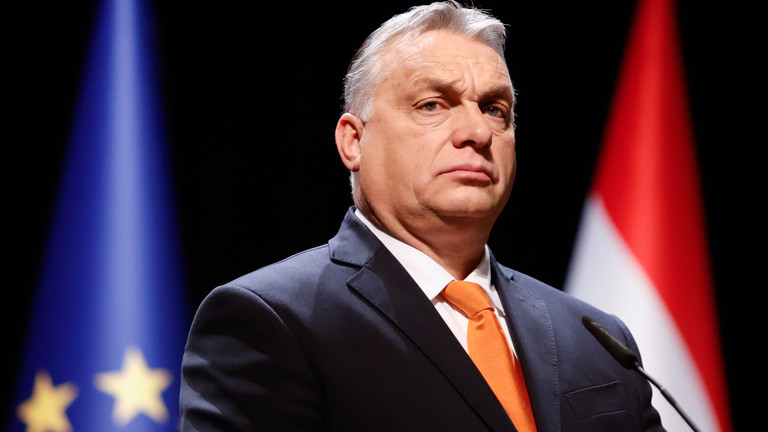
Hungarian Prime Minister Viktor Orban has urged NATO to promote a ceasefire and peace talks in Ukraine rather than continue to ship weapons to Kiev. He made the argument in a video clip posted on social media on Monday.
“Instead of bringing weapons to Ukraine, we should bring peace,” Orban said in the video, delivered in Hungarian with English captions. “A ceasefire is necessary, and instead of war, peace negotiations should start as soon as possible.”
NATO is supposed to defend member states, “not to carry out military actions on the territory of other countries,” Orban noted in the video, urging the US-led bloc to stay true to its official “defensive” mission.
Budapest’s position remains unchanged, the prime minister added, and is informed by the fact that Hungary borders Ukraine and that a significant ethnic Hungarian community in Transcarpathia is in danger from the hostilities.
Leaders of NATO countries met on Monday in Vilnius, Lithuania for the annual summit. The bloc doubled down on its rhetorical and logistical support for the government in Kiev, but stopped short of actually inviting Ukraine to join the bloc.
The US and its allies have poured over $100 billion worth of weapons, equipment, and ammunition into Ukraine since hostilities with Russia escalated in February 2022, and imposed a wide-ranging economic embargo on Moscow, while insisting they are not actually a party to the conflict.
Ukrainian President Vladimir Zelensky, who traveled to Vilnius but is not formally attending the summit, attacked NATO on social media Monday morning, accusing the bloc of not giving Ukraine the proper “respect” by daring to set conditions for membership and not offering a timeline.
Hungary has repeatedly argued for a peaceful resolution of the Ukraine conflict, refusing to send any weapons to Kiev or allow them transit across its territory. That stance has frequently led to a war of words with Zelensky and his officials.
Is the United States Pursuing a Permanent Cold War with Russia?
By Ted Galen Carpenter | The Libertarian Institute | July 11, 2023
There is growing speculation about how the Russia-Ukraine war might eventually end. Three competing scenarios are strong possibilities. The most likely outcome is a definitive Russian victory after a grinding, bloody struggle lasting several more years. As time drags on, Russia’s larger population and military will confer greater and greater advantages in the fighting, despite the lumbering, inefficient nature of the Kremlin’s forces.
The second most likely outcome is a frozen conflict roughly along the current battle lines. Fighting would end with an armistice rather than a formal peace treaty and reflect exhaustion on the part of both Ukraine and Russia. Such frozen conflicts already exist in places such as Kashmir, Cyprus, and most notably, Korea.
The least likely outcome would be a definitive victory by Ukraine, given Russia’s long-term logistical advantages. Unfortunately, both Washington and NATO have embraced that unrealistic objective, pledging continued Western military support and encouraging Kiev to stay the course, regardless of the mounting costs in blood and treasure to the Ukrainian people.
No matter how the war finally ends, the Biden administration and its NATO partners appear to have given surprisingly little consideration to what the West’s postwar relationship with Moscow will—or should—look like. Robert E. Hunter, a former U.S. Ambassador to NATO, touched on one important aspect in his recent article in Responsible Statecraft. He contended that there are more important issues than Ukraine’s NATO membership aspirations that need to be discussed at the 2023 NATO summit. “More consequential for the long term is an issue that won’t arise at Vilnius: what role Russia can play in European security after the war is over.”
Hunter points out the crucial reality that “unless Russia disintegrates, at some point in the future it will have to be dealt with as a revived great power, which under any leader will pursue what Russia considers to be its legitimate interests. (Already, a weakened Russia is challenging Western interests in the Middle East and elsewhere.) Russia’s European interests include not having a rival military alliance on its doorstep.” Unfortunately, “a consensus is rapidly forming in the United States, apparently shared in the Biden administration, that a new cold war confrontation with Russia is inevitable, whatever the risks, dangers, and longevity.”
Despite occasional conciliatory rhetoric, the United States has pursued a policy to constrain and humiliate Russia since the early years of Bill Clinton’s administration. The decision to expand NATO into Eastern Europe—with the ultimate objective of incorporating Ukraine into the alliance, despite Russia’s vehement objections and warnings that the West was crossing bright red lines threatening their core security interests—was the most provocative policy. But there were others. NATO’s military intervention in the Balkans against Russia’s longstanding ally, Serbia, was another. Terminating arms control agreements important to Moscow, especially the Intermediate-Range Nuclear Forces (INF) Treaty and the Open Skies Agreement, were other gestures of hostility and contempt toward Russia.
The extent of U.S. and NATO animosity surged in 2014 after Moscow’s seizure of Crimea in retaliation for the West’s meddling in Ukraine to help oust the country’s elected, pro-Russia president. Washington and its European allies imposed an array of economic sanctions against Russia. New, far more onerous, sanctions were imposed after Russia’s larger invasion in February 2022.
A full-fledged new cold war now exists between the West and Russia, with no end in sight. Early in the Russia-Ukraine conflict, Secretary of Defense Lloyd Austin admitted that Washington’s objective was to weaken Russia permanently. Other Biden administration officials, including the president himself, have indicated that there cannot be even a limited rapprochement as long as Vladimir Putin remains in power.
However, there is little indication that either the United States or the rabidly anti-Russia governments in NATO’s East European members would relent even if new political leadership emerged in the Kremlin. Instead, as Hunter notes, a hardline, uncompromising posture toward Russia seems to be increasingly entrenched. It is difficult to find even hints, much less explicit statements, coming from NATO capitals about which sanctions would be lifted and when, if a peace accord ending the Russia-Ukraine war was signed. A frozen conflict makes a substantial, prompt lifting of sanctions even less likely.
Even if the Biden administration wanted to change course and adopt a more conciliatory strategy toward Moscow, it is doubtful that hardliners in Congress or in several NATO countries would accept such a move. Instead, they seem inclined to push Washington to adopt a course more akin to the policies U.S. leaders have pursued for decades toward such rogue states as North Korea, Cuba, and Iran.
But trying to isolate Russia in such a fashion would be even more futile and potentially disastrous. North Korea and Cuba are small, impoverished countries. Even Iran is a mid-sized power with limited clout. Russia, however, is a major global economic player and possesses the world’s largest nuclear arsenal. NATO’s attempt to enlist the rest of the world to isolate Russia and aid Ukraine has faltered badly. Seeking global unity for such a hostile approach once the Ukraine war ends would be greeted with derision throughout the “Global South.”
Robert Hunter is correct that Russia is an essential player in any stable European security system and must be re-integrated once the war ends. However, Russia’s importance is even greater than what Hunter describes. The country is a crucial factor in the global economic and security systems. Pursuing an extended cold war against Moscow is impractical and potentially disastrous. The Biden administration needs to make a major course adjustment for a post-Ukraine war era.
Russia, NATO Confrontation Slipping Into Worst-Case Scenario – Ambassador
Sputnik – 11.07.2023
NATO leaders will gather in the Lithuanian capital Vilnius on July 11-12, 2023, to discuss a wide range of topics ranging from Sweden’s accession to the alliance to military assistance to Ukraine. It is expected that NATO leaders will also address Ukraine’s membership aspirations.
The situation in the confrontation between Russia and NATO is degrading to the most unfavorable scenario on the eve of the NATO summit in Vilnius, Russian Ambassador to Washington Anatoly Antonov said on Tuesday.
“On the eve of the NATO Summit, the atmosphere in the U.S. information landscape has heated up to the limit. Every possible effort is being made to prepare local public opinion for the acceptation of any anti-Russian decisions that will be taken in Vilnius in the coming days. The situation continues to degrade to the most unfavorable outcome of the confrontation between Russia and the NATO countries,” Antonov told reporters, as quoted by the Russian embassy in the United States.
He added that the measures taken by the Western countries created more and more insurmountable obstacles on the way out of the most acute military and political crisis, “fraught with the most serious consequences for international security.”
Poland’s right-wing Confederation soars in polls due to party’s skepticism on Ukraine, says senior academic
BY GRZEGORZ ADAMCZYK | WPOLITYCE.PL | JULY 10, 2023
The latest favorable polling for the right-wing Confederation party, which could see them become kingmakers in the Polish parliament after the next election, is mainly due to the party’s waning attitude towards Ukraine, says Prof. Henryk Dománski, a sociologist from the Polish Academy of Sciences (PAN).
Speaking with the wPolityce.pl news portal, Domański said the growing popularity for the nationalist group and economic libertarians was evidence that a rising number of Poles believe their government is doing too much for Ukraine.
The last poll placed the Confederation at 14 percent, giving a very real possibility the party could hold the balance of power after autumn’s parliamentary elections.
Domański said that many in Poland feel that the Ukrainians are privileged and getting too much from the Polish state at the expense of Poles. They also feel that Poland has over-engaged in the conflict.
“Confederation is the only party which is responding to these feelings and is not ashamed to be open about it,” said the academic, adding that the party is gaining votes at the expense of the ruling conservative Law and Justice (PiS) party.
Domański explained that it is not in the interests of Confederation to form a coalition with either the conservatives or the liberals after the election. He feels that any coalition with PiS would result in the Confederation having to compromise its stance on Ukraine and that would lead it to lose support.
“As an anti-establishment party, any coalition with parties perceived to be part of the establishment would be ruinous for Confederation,” he said.
According to polling research, the party has been polling most strongly among young men. However, as it rises in the polls, it is beginning to gain ground among women and older age groups.
NATO is ‘malicious poison’ – former Australian PM
RT | July 10, 2023
NATO has no place in Asia and should stick to its original focus, that is the security of the Transatlantic region, former Australian Prime Minister Paul Keating has argued. The Labour politician, who served in office from 1991 to 1996, also warned against attempts to “circumscribe” China.
In his statement published on Sunday, Keating appeared to refer to a recent report in Politico, which claimed French President Emmanuel Macron had blocked NATO’s plans to establish a liaison office in Japan.
The former premier lauded the French head of state for “doing the world a service” by apparently emphasizing the military bloc’s focus on Europe and the Atlantic.
According to Keating, the alliance’s very existence past the end of the Cold War “has already denied peaceful unity to the broader Europe.”
Exporting such “malicious poison to Asia would be akin to Asia welcoming the plague upon itself,” he insisted. The former prime minister warned that NATO’s presence on the continent would negate most of the region’s recent advances.
Keating went on to describe NATO Secretary General Jens Stoltenberg as the “supreme fool” on the international stage who is conducting himself like an “American agent.”
He cited a comment Stoltenberg made back in February when he called for the West not to repeat the “mistake” it had made with regard to Russia, suggesting it should work to contain China.
The former Australian leader noted that the NATO chief conveniently ignored the fact that “China represents twenty per cent of humanity and now possesses the largest economy in the world.” He added that Beijing, unlike Washington, “has no record of attacking other states.”
Over the weekend, Politico cited an anonymous Elysee Palace official who claimed that Paris is against NATO expansion beyond the North Atlantic. “NATO means North Atlantic Treaty Organization,” the French presidential staffer reportedly emphasized.
Back in May, the Japanese ambassador to the US, Koji Tomita, revealed that his country was working toward opening a NATO liaison office in Tokyo, which would become the bloc’s first in Asia. Prime Minister Fumio Kishida confirmed the plans to Japanese lawmakers, noting that Tokyo did not intend to join the US-led organization.
Commenting on the news, Chinese Foreign Ministry spokesperson Mao Ning advised NATO against “extending its geopolitical reach.” The diplomat pointed out that the “Asia-Pacific does not welcome bloc confrontation or military blocs.”
Most Finns Oppose Hosting NATO Nuclear Arms
By Igor Kuznetsov – Sputnik – 10.07.2023
Finns have been consistently averse to placing nuclear arms on their soil, a policy confirmed by the government despite reversing the decades-old policy of non-alignment, and would apparently be reluctant, if the newly-baked NATO membership were to entail it.
The majority of Finns don’t support either the transportation or storage of NATO nuclear arms in their country, according to a fresh survey by the University of Helsinki and the University of Turku.
61 percent firmly opposed allowing the transportation of nuclear weapons through Finland, while storing nuclear weapons on Finnish ground appeared to be an even bigger no-no, with some 77 percent against.
Finland filed a bid to join the alliance in the spring of 2022, citing a change in Europe’s security landscape, and joined the alliance in April 2023, upending decades of non-alignment. However, membership in the bloc is not a free ride, as its leadership has been pushing members to boost military expenditure, ensure costly upgrades of gear, and take part in overseas operations — which the population may be even less eager to do.
“Finland is protected by NATO’s nuclear umbrella, but the shared responsibility does not extend to a willingness to transport weapons here. This might be a reflection of a not-in-my-backyard mentality, but above all, it is indicative of Finland’s long history of nuclear disarmament,” Helsinki University Professor Hanna Wass commented in a statement.
Finns have long had a negative attitude towards nuclear weapons, and Finnish law openly prohibits them. So far, the Finnish leadership has largely maintained its historic line on nuclear arms, despite breaching the decades-old tradition of non-alignment. Former Social Democrat Prime Minister Sanna Marin, under whose watch Finland filed a bid for NATO and entered the alliance, called it “very unlikely” that nuclear weapons would be situated on Finnish soil. At the same time, she called it important not to set any kinds of preconditions that would limit Finland’s room for maneuvering.
Earlier this year, NATO’s newly-fledged member Finland announced that while the Defense Ministry had decided not to allow any nuclear arms on its soil, it is nevertheless going to participate in the Western military alliance’s nuclear planning and support operations.
Russian Deputy Foreign Minister Alexander Grushko said that Finland and Sweden must understand that Russia will certainly take into account “the growing threats associated with the possible deployment of military potentials on their territories in its defense planning.” He also cited the elevated risks of a clash between the forces of Russia and NATO and lamented how the the Baltic region, which used to be “most calm” in the military and political sense, has been turned into a zone of rivalry.
Left with few tanks and ammunition, Ukraine puts its hope in cluster munitions
By Ahmed Adel | July 10, 2023
The Ukrainian military lacks tanks, armoured vehicles, and ammunition to dislodge Russian forces from their well-entrenched positions, demonstrating that over half a year of planning and training for the current counteroffensive has dissipated into complete failure. The situation for Ukraine is so bad that it was even forced to withdraw its German-made Leopard 2 tanks from the front lines so they could be preserved for the future. This revelation comes as the Biden administration announced on July 6 that it would send cluster munitions to Ukraine.
According to the Wall Street Journal, “Ukraine is now attempting to dislodge an entrenched enemy, one of the most daunting operations any military can undertake. Russian troops have spent months building physical defences that include bunkers, tank traps and mine fields.”
The same outlet quoted Lt. Col. Oleksiy Telehin of Ukraine’s 108th Territorial Defence Brigade as saying that it was not only impossible to destroy well-prepared positions before advancing but that Ukrainian forces were suffering from a shortage of armoured vehicles, with infantry forced to advance on foot, which makes it vulnerable to flanking manoeuvres.
The Ukrainian military has only managed to capture a few villages in Zaporozhye and the Donetsk People’s Republic (DPR). A month of fighting has resulted in only the capture of some villages and failure to reach Russia’s first defensive line, and more disturbingly, at the cost of thousands of deaths and hundreds of destroyed tanks and armoured vehicles.
Ukrainian personnel admit to horrific losses, with soldiers “presumably in Zaporozhye, saying they could have lost dozens of men” in a single attack.
“We had to evacuate the evacuation team,” said a 19-year-old combat medical professional, according to the US outlet. The teenager also recalled a case where a mortar hit his vehicle during an evacuation of the wounded.
According to reports, Russian helicopters fly less than 8 kilometres from Ukrainian positions, which should ordinarily make them vulnerable to air defences, but as a platoon commander from the 108th Brigade said, “We don’t have proper air defence systems to deal with the threat. When we’re warned that an enemy plane has taken off, the only way to deal with it is to take cover.”
The Russian Defence Ministry reported on July 9 that since the beginning of the special military operation, their forces have destroyed from Ukraine 453 planes, 241 helicopters, 4,948 unmanned aerial vehicles, 426 air defence missile systems, 10,604 tanks and other armoured fighting vehicles, 1,137 fighting vehicles equipped with MLRS, 5,396 field artillery cannons and mortars, as well as 11,547 special military motor vehicles.
In the face of these major losses, the US will supply Kiev with cluster bombs even though this will do nothing to change the balance of forces, mainly due to the Ukrainian military’s lack of training and adequate experience of its officers.
“I can confirm from personal experience that cluster munitions are indeed quite powerful, but also that by themselves they will not tilt the balance of power in the war towards Ukraine,” retired US lieutenant colonel Daniel Davis wrote in an article on 19FortyFive.
According to Davis, the Armed Forces of Ukraine will not be able to benefit from these munitions due to insufficient training, officers’ lack of experience and lack of time to create cohesive and equipped combined arms formations.
“Regardless of how much more lethal they are than standard 155 mm HE rounds, [cluster munitions] will not make a difference in the outcome of the current offensive. The cluster rounds will increase the lethality of Ukrainian gunners against the Russian enemies, but alone cannot change the course of the war. The same, sadly, will be true of F-16s and long-range missiles which may be provided later this year,” he added.
One of the Pentagon representatives, Patrick Ryder, claims that the enhanced conventional dual-purpose munitions (DPICM) that Washington will supply to Kiev have a non-detonation rate of less than 2.35%. The percentage of failure, non-detonation, means that they will remain active in the location and could explode after civilians, including children, pass through.
Due to the risk that these weapons pose to civilians, 123 countries adopted in 2008 a convention that prohibits the use of cluster munitions since it is estimated that more than half of the victims of these munitions are civilians. Yet, with the Ukrainian military lacking any weapon to push back Russian forces, the delivery of cluster munitions is just a signal of the desperate situation it finds itself in.
Ahmed Adel is a Cairo-based geopolitics and political economy researcher.
Cluster Bombs for Ukraine? A Warning From Kosovo
By Phil Miller | Declassified UK | July 6, 2023
Gracanica, Kosovo – “In the village where we lived, there were nine bombs dropped by NATO in the space of two minutes,” Dzafer Buzoli recalls, as we discuss his traumatic childhood in Yugoslavia. A leading member of Kosovo’s Roma, his community went from pillar to post.
Many were dragooned into Slobodan Milosevic’s Serb-dominated Yugoslav army or targeted by Albanian rebels as suspected collaborators, before Bill Clinton and Tony Blair launched their ‘humanitarian intervention’ in 1999.
“When the first bomb fell, we were just confused and wondered what was happening,” he reflects. “But after the second bomb I felt the hot air and fell down from the pressure of the blast.”
“Ever since then I’ve had a heightened sense of hearing. When there’s a loud noise or people yelling I have to really back up, because it’s too much for me.”
Buzoli was lucky to survive the airstrike. Two soldiers and a five year old boy were killed in the attack on his village of Laplje Selo, which was hit with controversial cluster munitions.
These scatter a blizzard of ball-shaped bomblets over target areas, like a minefield falling from the sky. Human Rights Watch said NATO killed between 90 and 150 civilians with this weapon across Serbia and Kosovo.
Thousands of bomblets failed to detonate on impact, posing a hazard to children who mistook their little yellow parachutes for toys. In the decade after the war, these remnants claimed another 178 casualties in Kosovo.
While this war might seem like a distant memory for those beyond the Balkans, it offers a cautionary tale to Western states now assisting Ukraine’s fight against Russia.
US officials are said to be seriously considering supplying Kyiv with cluster bombs, possibly as soon as next month.
That’s despite the weapon being banned by more than 120 countries including the UK, following a UN treaty in 2008.
The US refused to sign up to the ban and there are suspicions it uses a loophole to store them at its air bases in Britain.
Both Russia and Ukraine, fellow non-signatories, have already fired cluster bombs in their current conflict and supplies from America could further complicate the situation.
Lessons from Kosovo
Unexploded cluster munitions remain a hazard in Kosovo long after NATO’s 11 week air war ended in 1999.
Goran, a Kosovo Serb, recalls how the weapon almost killed a farmer in a vineyard near Gracacina’s orthodox monastery, a world heritage site.
“He drove his tractor straight over the bomb,” Goran tells me. “He was lucky not to get killed.”
Goran, who likes to hunt wild boars in the forest, says he found a cluster munition – which locals call ‘cassette bombs’ – back in 2013.
His dates tally with a British demining charity – the Halo Trust – which said it was “still finding hundreds of cluster bombs” in Kosovo that same year.
At one site near Junik in western Kosovo they cleared 171 cluster bombs dropped by NATO, which stubbornly refuses to provide aid workers with access to its official database of airstrikes.
Instead the charity relies on old maps from the Yugoslav army (who preferred to plant landmines), which lack details of where NATO fired cluster bombs, what type they used, the direction of the strike, release altitude and fuze settings – all details that could assist clearance operations.
Partly as a result of these difficulties, 44 hazardous sites were yet to be fully demined by the end of 2021.
While the Atlantic alliance justifies its wartime conduct by saying the targets were Serb soldiers, the people now living in the liberated areas are often ethnic Albanians – the very people NATO set out to save.
Responsibility to protect
The UK was a particularly prolific user of cluster bombs in Kosovo, where they accounted for over half the bombs dropped by the Royal Air Force. British pilots fired 531 of the devices, each containing 147 bomblets with over 2,000 pieces of shrapnel.
Up to 12% of the bomblets failed to detonate on impact, according to a report by parliament’s defence committee. The cross-party group of MPs said: “That means the RAF left between 4,000 and 10,000 unexploded bomblets on the ground in Kosovo”.
The type of cluster bomb used by Britain – the BL755 – was designed in the late sixties and entered service in 1972 despite manufacturing challenges. A year later, a Treasury official noted dryly: “This weapon has had a long and chequered history. We note with some relief that it has now successfully completed its trials”.
Over the next decade, the RAF acquired a stockpile of 18,000 cluster bombs. Another 26,000 were sold abroad on the lucrative export market, mostly to Germany but even future enemies like Iran and Yugoslavia.
Margaret Thatcher’s government exported them to Robert Mugabe’s regime in Zimbabwe, where the British High Commission was anxious to prevent “offering the French an opening into the armament market”.
Exports to Saudi Arabia would follow and ultimately the BL755 earned the dubious distinction of being fired in such bloody conflicts as the Iran-Iraq war, Congo and Yemen.
‘Overkill weapon’
Some in the Foreign Office were less impressed and tried to resist exporting the weapon.
One diplomat, Ivor Lucas, commented: “There is no doubt that Cluster Bomb [sic] is generally considered ‘an overkill weapon’ affecting wide areas with consequent danger to civilians and causing particularly unpleasant multiple wounding.”
Its greatest selling point however, was the ability to destroy tanks from the sky. But by 1982, even that was already in question.
In a formerly secret file seen by Declassified, the Ministry of Defence (MoD) admitted: “The penetration capability of current BL755 against the frontal armour of current Soviet tanks (T-64/T-72) is poor and there are relatively few regions where full penetration, and hence kills, could be expected.”
If the RAF attacked a column of ten T-64s, pilots were only expected to destroy one tank per sortie – even with an improved variant of the weapon. Military officials lamented: “Effectiveness has been degraded by introduction of modern Soviet tanks”.
Their performance in the Balkans was woeful. An operational analysis by the MoD reportedly found only 31% of sorties hit their targets, despite pilots flying directly overhead.
‘Regrettable collateral damage’
Since Britain banned the bomb in 2008, Conservative and coalition governments have blocked the disclosure of six files about trials of the weapon in the 1970-80s – perhaps fearful that further embarrassing details of its deficiencies might emerge.
More recent Cabinet papers from Tony Blair’s handling of the Kosovo conflict are publicly available.
These show his deputy prime minister John Prescott told colleagues on 1 April 1999 – a week into the war – that: “Public opinion in the West should be prepared for more extensive collateral damage.”
Labour’s defence secretary George Robertson (who went on to lead NATO), noted at the end of that month: “The air campaign needed to be intensified, despite the unintended and regrettable collateral damage which might be inevitable.”
By mid-May the foreign secretary, Robin Cook, grew frustrated at how “the international media tended to be diverted by rare incidents of NATO errors in conducting the campaign, away from the positive news of its successes.”
Cook, renowned for his ‘ethical foreign policy’, was probably referring to the cluster bombing of Nis, a city in southern Serbia where Dutch-NATO jets killed 15 civilians in a botched airstrike that hit a hospital and crowded market.
The tragedy led the US to pause its own use of cluster bombs, but the RAF pressed on. Years later, a Serbian lawyer from Nis is trying to sue Nato over the killings.
Activists from the city played an important role in passing the international ban on cluster bombs, but Serbia’s president is yet to endorse it.
That impasse allows Belgrade to keep any remaining BL755s that Britain sold to communist-era Yugoslavia.
Clearing the remnants of these weapons from Kosovo is not expected to finish until 2024 – a quarter century after the war ended.
That marathon process, coupled with dubious performance on the battlefield, might give Joe Biden pause for thought about sending cluster bombs to Ukraine.
Phil Miller is Declassified UK’s chief reporter. He is the author of Keenie Meenie: The British Mercenaries Who Got Away With War Crimes. Follow him on Twitter at @pmillerinfo
US Congressman on Decision to Send Cluster Bombs: No One in Biden Admin Seeks Peace in Ukraine
Sputnik – 08.07.2023
WASHINGTON – Paul Gosar noted that Ukraine’s counteroffensive had gained little to nothing, as Russia had stopped the US weapon-backed Ukrainian troops.
The United States “has no business” to be involved in the Ukraine conflict, Republican Congressman Paul Gosar told Sputnik on Saturday, commenting on Washington’s decision to send cluster munitions to Kiev.
“I condemn the ongoing war and [US President Joe] Biden’s latest decision to escalate the conflict by sending cluster munitions to Ukraine. I continue to call for peace talks, as I have since March 2022, and I continue to maintain that the United States has no business in this war,” Gosar said.
No one in the Biden administration or in NATO is seeking peace to resolve the Ukraine crisis, so the conflict is still ongoing, Gosar added.
Moreover, he noted that Ukraine’s counteroffensive had gained little to nothing, as Russia had stopped the US weapon-backed Ukrainian troops.
On Friday, the United States unveiled a new military assistance package for Ukraine that includes cluster munitions. The weapons are banned by the international convention, which has been ratified by 123 countries, excluding the US and Ukraine.
Russian Ambassador to Washington Anatoly Antonov warned on Friday that the decision by the US to deliver cluster munitions to Ukraine was a “provocation” pushing humankind closer to a new world war.
Biden Admin Lying to Americans ‘About Everything to Do With Ukraine’ – RFK Jr
Sputnik – 08.07.2023
Robert F Kennedy Jr, the present 2024 presidential hopeful and nephew to assassinated former US President John F Kennedy, previously said at a town hall event that the Ukraine crisis had been turned by Washington into “a proxy war between Russia and the United States”.
The federal government under the Joe Biden administration has been blatantly lying to the Americans “about everything to do with Ukraine”, said Robert F Kennedy Jr, in an interview for Judge Andrew Napolitano on his Judging Freedom podcast.
“This was a sell job that they gave us on Ukraine,” insisted the 2024 Democratic candidate for US President.
“The Russians tried to avoid a war… wanted to sign the Minsk Accords – a reasonable document – to keep NATO out of Ukraine, with Ukraine remaining neutral… That [US] remove the Aegis missile systems from Romania, Poland, and that the murder… the wholesale killing of ethnic Russians in the Donbass by the Ukrainian government that America put in power stop. Those are all things that we should have agreed to,” stated the nephew of assassinated former US President John F Kennedy.
He added that Ukraine’s President Volodymyr Zelensky won in 2019 by promising to sign the Minsk accords. The complex series of measures negotiated by Russia, France, Germany and Ukraine in 2014-2015 in a bid to put an end to the armed conflict between the Kiev authorities and the breakaway region of Donbas. Moscow repeatedly stated that Kiev was not fulfilling the deal, for example not granting self-government to the Russian-speaking region of Donbass. In February, Ukrainian President Volodymyr Zelensky admitted he never intended to implement the Minsk agreements, with former German Chancellor Angela Merkel and Former French President Franсois Hollande, who participated in the Normandy format, admitting the same.
“It is existential for the Russians… they have a legitimate national security interest,” Robert F Kennedy Jr pointed out, referring to Moscow’s ongoing special military operation in Ukraine.
“[The US] wanted the war, for the reasons that Biden has said… The real reason for the war in Ukraine is regime change in Russia,” Kennedy emphasized in the interview on the Judging Freedom podcast.
Kennedy previously slammed decades of policy conducted by the US and NATO toward Ukraine and Russia for fueling the current conflagration.
“We have neglected many, many opportunities to settle this war peacefully,” Kennedy said in June during a live town hall event with NewsNation. He added that Washington had turned the ongoing conflagration in Ukraine into a proxy war waged by the United States against Russia.
“We were told this was a humanitarian exercise… But when President Biden was asked why we are over there, he said for regime change of [Russian President] Vladimir Putin,” the 2024 White House hopeful underscored.
Weighing in on remarks by US Defense Secretary Lloyd Austin, who said last year that Washington wanted “to see Russia weakened,” Kennedy scathingly remarked:
“That is the opposite of a humanitarian mission, that is a mission about a war of attrition.”
Keep Ukraine out of NATO, US experts argue
RT | July 7, 2023
Welcoming Ukraine into NATO would force the US to choose between nuclear war with Russia or abandoning its security commitments to Kiev, two American analysts claimed on Friday.
“The security benefits to the United States of Ukrainian accession pale in comparison with the risks of bringing it into the alliance,” Justin Logan and Joshua Shifrinson of the libertarian Cato Institute wrote in Foreign Affairs magazine.
If Ukraine were to join the alliance amid the ongoing hostilities, Logan and Shifrinson argued, the US and all of NATO’s European members would immediately be pulled into open war with Russia, with the potential for a nuclear exchange. However, even if the conflict were to be resolved, Ukraine and Russia will still have competing territorial claims, and a membership offer would risk reigniting the conflict, this time with NATO as a direct participant, they added.
“Under these circumstances, an American commitment to fight for Ukraine would be open to question,” they continued. If Ukraine were a NATO member and US policymakers chose not to intervene on its behalf, the bloc’s entire collective defense principle would be undermined, resulting in “a true credibility crisis for NATO.”
Furthermore, with the US protected by its nuclear arsenal and the vast Atlantic Ocean, the two analysts argued that America faces no direct threat from Russia, while Ukraine – due to its geography – forms “a bulwark” between Western Europe and Russia “irrespective of NATO membership.”
“American time, attention, and resources are needed elsewhere,” Logan and Shifrinson wrote, concluding that “the United States should accept that it is high time to close NATO’s door to Ukraine.”
Since the 2008 Bucharest Declaration, NATO’s official policy is that Ukraine will become a member of the bloc at an unspecified future date. Kiev, however, is unhappy with this non-commitment, with Ukrainian President Vladimir Zelensky reportedly threatening not to attend NATO’s upcoming summit in Lithuania unless the US-led bloc offers “concrete” security guarantees or a roadmap to full membership.
Lithuanian President Gitanas Nauseda has already ruled out a membership offer at the Vilnius summit. French President Emmanuel Macron, however, has called on the alliance’s leaders to offer Kiev bilateral or multilateral security guarantees, as well as a “path” to full-fledged membership. British Defense Minister Ben Wallace and a number of Eastern European leaders have called for Ukraine to be fast-tracked into the bloc without the usual “membership action plan” that prospective members must complete.
The White House, meanwhile, maintains that Ukraine “would have to make reforms to meet the same standards as any NATO country before they join.”
US military short of recruits with most youth disqualified
By Uriel Araujo | July 7, 2023
Already in September 2022 the Pentagon was voicing concerns about ammunition and arsenal shortages while US President Joe Biden was announcing an extra $3 billion military aid to Ukraine. Things are not so good with its transatlantic allies: in March 2023, Europe’s military was described as being in an “appalling state” by a Foreign Affairs article – a situation which is hard to escape amid today’s deindustrialization.
Last month, the US was announcing it would spend yet another $325 million to replace tanks destroyed by Russia during Ukraine’s costly and failed counteroffensive. The hard economic costs and depletion or arsenals, however, should not be Washington’s only concern: since 2020, merely 23% of young Americans (aged 17-24) are “eligible for military service without a waiver” and most ineligible youth are disqualified “for multiple reasons”, such as overweight, poor medical health, and drug abuse.
In their Atlantic piece, Former US Army Officer Jason Dempsey (an adjunct senior fellow at the Center for a New American Security) and former US Marine officer Gil Barndollar (a senior fellow at Defense Priorities) paint a very worrisome picture, from an American point of view. The 50-year old “all-volunteer force” (AVF), as the US military has come to be known after its last draftee in 1973, they write, has become “unsustainable”, facing threats in “three fronts” – namely cost, capacity, and, more importantly, “continued ability to find enough Americans willing and able to serve.”
Military pay and benefits have skyrocketed since 911, actually rising by more than 50 percent. Its high cost is one of the factors that make the US military small. When faced with medium-sized campaigns in Afghanistan and Iraq, it already found it challenging to provide just enough troops. Thus, Dempsey and Barndollar argue it could be broken by any “major conflict”. For example, they write, just over the past year of confrontation, Russia and Ukraine both have had casualties that are equal to at least half the active-duty U.S. Army, and current US military doctrine says that a force is destroyed after taking 30 percent casualties. In other words, the US itself could not endure what its ally Ukraine does.
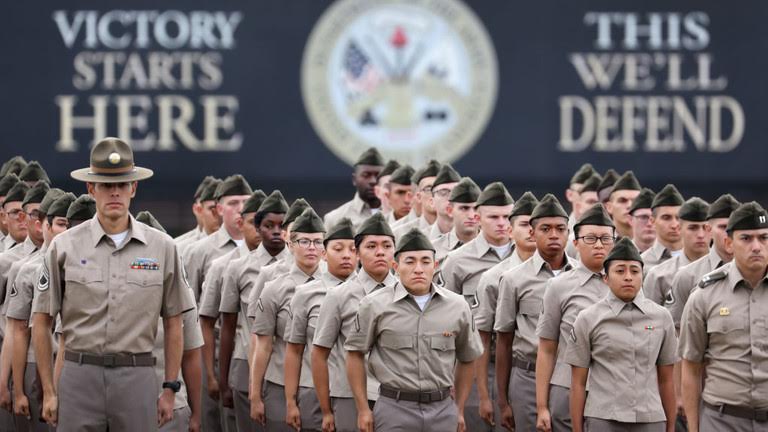
In any case, merely 9 percent of young US citizens would seriously consider military service, a figure which is near the all-time low since the so-called All-Volunteer Force began. To broaden the recruiting pool, service branches loosened their restrictions on things such as neck tattoos and other standards. In June last year, the US Army went so far as to briefly drop its requirement for a high school diploma. Even so, the US military simply can’t seem to find recruits and keeps falling short of its enlistment quotas.
The AVF crisis is part of a larger societal crisis, even civilizational. Consider this fact: US citizens are currently enduring its worst drug crisis ever, fueled by epidemic opioid abuse. According to Council on Foreign Relations deputy editor Claire Klobucista and expert Alejandra Martinez, this state of affairs endangers the US “public health, economic output, and national security.” Opioid drugs (both legally manufactured medications and illicit narcotics) already are by far the leading cause of fatal overdoses in the country.
Or consider this: right now, the US Subcommittee on Health Care and Financial Services says that the Food and Drug Administration agency (FDA) is still dodging oversight and failing to provide answers regarding an ongoing baby formula shortage crisis. There is more: even though it is supposedly the world’s richest nation, the US healthcare system is collapsing, with hospitals closing down, overcrowded and understaffed facilities, and lack of items such as ICU beds. The country is also facing a mental health crisis, with 40% of parents reporting their children struggle with anxiety or depression, among other issues.
Given all these domestic and systemic issues, it is no wonder that most youth either do not qualify or do not want to be part of the military. Considering that many young people, due to so many factors, simply do not qualify for service, bringing back the draft (with all the political costs) would simply not solve the issue. This is one of the reasons why the US increasingly needs to fight proxy wars.
In November 2022, while addressing the Naval Submarine League’s annual gathering in Arlington, Virginia, US Navy Admiral Charles Richard, then head of US Strategic Command had this to say about the Ukraine crisis: “this is just the warmup. The big one is coming.” He added: “It isn’t going to be very long before we’re going to get tested in ways that we haven’t been tested a long time.” At the time he urged policy makers and Pentagon chiefs to return to the 1950s and 1960s dynamism in order to face such challenges.
Those are bold and ambitious calls for a declining, overburdened and overextended superpower which is actively pursuing a dual containment policy targeting both Russia and China simultaneously. In addition, it aims to maintain its naval hegemony as a sea power while also engaging in land wars as part of a Mackinder-like struggle for the Heartland. Like the meme-famous pelican, it seems to want it all. However, appetite and capacity are not to be confused. It remains to be seen whether or not American society will continue to have what it takes for all that and just for how long. Right now, the prospect is not looking good.
Featured Video
John Mearsheimer Talking Iran with Iran
or go to
Aletho News Archives – Video-Images
Book Review & Summary
Calling of an Angel: The True Story of Rene Caisse and an Indian Herbal Medicine Called Essiac (1988)
Dr. Gary L. Glum – 30 Q&As – Book Review & Summary
Lies are Unbekoming | October 17, 2026
On June 10, 1975, Dr. Chester Stock, a vice president at Memorial Sloan-Kettering Institute for Cancer Research, wrote to a Canadian nurse named Rene Caisse: “Enclosed are test data in two experiments indicating some regressions in sarcoma 180 of mice treated with Essiac.” The sentence sat in a letter from one of the world’s largest private cancer research centers, concerning an herbal tea an elderly English woman had learned from an Ojibwa medicine man at a northern Ontario mining camp in the 1890s. The tests were terminated the following year after Sloan-Kettering admitted, in sworn affidavit three years later, that they had prepared the injectable solution improperly from the dried material supplied — freezing and thawing the herb rather than boiling it as Rene had instructed. By the time Calling of an Angel was published in 1988, Rene Caisse had been dead for a decade, having treated thousands of cancer patients across fifty-six years in her Bracebridge, Ontario kitchen, never charging a fee, and refusing every offer — from Memorial Sloan-Kettering, the National Cancer Institute, Merck, Parke Davis, and private corporations dangling contracts up to $1 million — to release her formula before the medical establishment admitted her remedy had merit. … continue
Blog Roll
 Aletho News
- Moscow blasts UN for ignoring torture of Russian POWs
- Millions of Books Could Have Been Destroyed in Lebanon During Israeli Bombings
- Moscow warns of ‘hunt for Russians’
- Calling of an Angel: The True Story of Rene Caisse and an Indian Herbal Medicine Called Essiac (1988)
- South Korean Assistance to the U.S. in the War with Iran: Between Allied Duty and National Interests
- Pharma- and Gates-Funded GAVI Seeks to Assure Parents
- John Mearsheimer Talking Iran with Iran
- Inside Bill C-22, Canada’s Patriot Act.
- China’s FM: Palestinian cause is ‘greatest injustice of the century’
- US sympathy for Palestinians surpasses support for Israelis
- If Americans Knew
- In West Bank, Israeli settlers are totally out of control – Daily Update
- NPR investigation finds evidence of widespread fraud at mall kiosks tied to Israeli skincare brand
- Tucker Carlson exposes Israeli Lies about the Oct 7th attack, Charlie Kirk, and the U.S.
- Israel has detained thousands of Palestinian children since Oct 7th – over half spent time in solitary, many uncharged
- Israeli Analysis: Is Netanyahu Planning an ‘October Surprise’ Attack Before Israel’s Election?
- Israeli settlers brutally attack Palestinians and Washington Post female photographer, 65
- Words Have Changed, Occupation Continues: The Reality of the Gaza Ceasefire
- Gaza’s child amputees are growing faster than their prosthetics allow
- Israel keeps Palestinians struggling just to survive–Daily Update
- Israeli firm used online ads to run vast spy operation, researchers say
- No Tricks Zone
- New Study Suggests Large Regions Of The Pacific Ocean Have Been Cooling For The Last 80 Years
- Germany’s Green Energy Debacle: High Energy Costs Force Kahla Porzellan to Close After 182 Years!
- New Study: 50 Years Of The Most Aggressive ‘Net Zero’ Policies Can Only Affect The Global Climate By 0.03°C
- US September “Heat” Was No Record…Many Records Set Decades Ago
- Latest European Green Energy Debacle; Portugal’s Largest Flagship Solar Park Insolvent!
- Green Energy Debacle: German Expert Professor Fritz Vahrenholt Warns Of Severe Economic And Social Consequences
- Two More Paleo Reconstructions Affirm Meters-Higher Sea Levels Across Ireland, Brazil 7000-6000 Years Ago
- New Study: Earth And Venus Surface Warmth Largely Explained By Convection And Lapse Rate, Not CO2 Or Radiation
- 2025 Nature Paper Claiming Worsening Global Drought Gets RETRACTED …Heavily Flawed
- New Study: ‘Global Drought Shows No Detectable Recent Acceleration Under Climate Warming’

