American civil war is good for world peace
By M K Bhadrakumar | Indian Punchline | March 22, 2017
The civil war in Washington between President Donald Trump and his detractors shows no signs of abating. Every day becomes a fresh start in the fighting. The latest salvo has been Monday’s hearing at the US House of Representatives Intelligence Committee where the Director of the Federal Bureau of Investigation James Comey acknowledged the existence of an on-going investigation by his agency over suspected Russian interference in the US presidential election with hacking to help the then Republican candidate Trump win the White House.
True, no smoking gun was produced by Comey, but his testimony implied that investigations are continuing. We may expect that many more such hearings are in the pipeline. A “big grey cloud” has appeared out of nowhere, as the chairman of the House Intelligence Committee Devin Nunes put it. The cloud will lift only if the various inquiries going on conclusively absolve Trump or, alternatively, if Trump leaves office, whichever comes first.
Such inquiries have a way of mutating, while moving ponderously, slowly in the cesspit tank. Comey admitted that it is difficult for him “to give you a timetable as to when it will be done.” Then, there is also a sub-plot – Comey himself is under investigation by the US Justice Department.
The next big day will be March 28 when two colorful personalities in the US intelligence system during the Obama administration – the ex-director of national intelligence James Clapper and the ex-CIA director John Brennan – will appear before the House panel. Both were instrumental in the January assessment that the Russians had interfered in the US presidential election in an attempt to benefit Trump. Clapper has a proven record of lying under oath, while Brennan is Barack Obama’s poodle. Trust both to resort to innuendos against Trump and mates, hitting them in the loins where it hurts. (Watch it “live”.)
To my mind, this is about the appropriate time to begin pondering about a world sans America. That is to say, an international system where America has taken “time out”. Is it a good thing to happen? Well, it is already having some salutary effect on the international climate. The global tensions have noticeably eased. If it was commonplace during the Obama era to discuss a potential war between Russia and the US, including a nuclear war, no one wastes breath over such things anymore.
A good case can be made that if the American civil war continues to be fought as savagely by the country’s elites as it has been so far, and if the fratricidal strife continues for another 4 or 8 years — ideally, through the entire Trump presidency — it will be a great boon for the world community. Never again will Americans be able to be preachy that the world cannot do without them. And the ruling elites in countries such as India will also get accustomed to a life without America.
Clearly, America’s “exceptionalism” is getting exposed as total sham. Second, the longer the civil war continues, the less possibility there is for US military interventions abroad. Quite obviously, we saw last week that China could prevail upon the US to be “cool-headed” and not to go to war with North Korea. It seems to me that US Secretary of State Rex Tillerson appeared relieved to agree with the Chinese that there is no option but to continue on the diplomatic track vis-à-vis the North Korea problem.
Again, some degree of predictability is appearing in the US-China relationship, since the last thing Trump wants now is a conflict with China. For us Asians also, it is singularly gratifying that there isn’t going to be a war in the region. This is what the Chinese Foreign Ministry spokesperson said earlier today at a media briefing in Beijing:
- During Secretary of State Tillerson’s stay in China, the two sides arrived at a clear consensus on ensuring a sound development of China-US relations at a new starting point in the spirit of non-conflict, non-confrontation, mutual respect and win-win cooperation. It should not be interpreted as a victory for any party. It is just the right way for China and the United States, two major countries, to get along with each other. Non-conflict, non-confrontation, mutual respect and win-win cooperation summarizes the reason for the steady growth of China-US ties in recent years and is worth carrying forward and being further developed. We would like to enhance communication, mutual understanding and mutual trust with the US so as to properly handle differences, expand bilateral, regional, and international cooperation, and elevate China-US relations to a greater height at a new starting point.
The comfort level in Beijing is palpably rising. Finally, there are some other good signs, too, which are not visible to the naked eye but are no less important. In the civil war conditions in America, with so much dust and noise in the air in Washington, and such poor visibility all around, Trump is quietly able to do a few things on the side, which he had promised to do.
A good friend of mine who watches Syria and Iraq through binoculars 24 x 7, wrote to me a couple of days ago that Trump is doing some incredible things out there in the neighborhood where she lives. Let me succinctly paraphrase her assessment:
- Trump has in fact prioritized the fight against terrorism. He is doing this quietly… The CIA has completely turned off the arms spigot to rebels in Syria and the US is bombing Al Qaeda and its allied groups now – something that Obama avoided (and tried to stop Russia/Syria/Iran from doing.) Equally, Trump is bombing the Al-Qaeda in Yemen too. And in Iraq, Trump is standing by while the Iran-trained Hashd ash-Shabi is annihilating ISIS in western Mosul and cutting off their route to Syria. Obama, on the contrary, had refused to let the Hashd fight in many of these battles. Trump now has not only given the go-ahead, but we have now seen the Iraqi Air Force participate in anti-ISIS bombing raids into Syria. Simply put, if the Obama administration’s policies only had led to the rise of the ISIS and Al-Qaeda in Iraq and Syria, Trump is actually fighting them and, importantly, he is allowing US’ regional foes – Iran and Iran-supported militia groups, in particular – to fight them unimpeded.
Meanwhile, Tillerson is likely to visit Moscow on April 12. As the saying goes, dogs bark but the caravan moves on. The world community cannot possibly ask for more.
Indeed, there will always be disgruntled elements – Brits and Germans, for example. But that is perfectly understandable. They realise that Trump regards them as a lower form of life – worse than leeches or bed bugs. They dearly want Trump to lose in the civil war, and lose very quickly. Without America to lead, they are afraid they might lose their gravitas in world politics. For us, Asians, that is not a bad prospect, either. Hopefully, the curtain is coming down on the “West”, as we knew it in modern history.
Russia Ready to Discuss Nuclear Arsenal Reduction – Lavrov
Sputnik – 23.03.2017
MOSCOW – Russia is ready to discuss the possibility of reducing nuclear arsenals, Foreign Minister Sergey Lavrov said at a Russian Armed Forces General Staff Military Academy lecture Thursday.
“We are ready to discuss the possibility of further reducing nuclear capabilities, but only taking into account all the factors and not just the number of strategic offensive weapons,” Lavrov said.
Meanwhile, he added that Russia is ready for dialogue with the United States on the reduction of strategic nuclear weapons and believes that more countries need to be involved in the process.
“We are ready, but the conversation must be conducted taking into account all factors that affect strategic stability,” Lavrov said at a Russian Armed Forces General Staff Military Academy lecture.
He underscored the need to wait for Washington to finalize its priorities in the area, and stressed the need for more countries’ involvement in the reduction of nuclear arms.
Both Russia and the United States agreed in 2010, under the New Strategic Arms Reduction Treaty (START) treaty, to decrease the number of deployed nuclear warheads to 1,550 and the number of deployed missiles and bombers to 700. The agreement will expire in 2021, and could be prolonged for no more than five years.
US President Donald Trump has been critical of the deal that he regards as “bad” and “one-sided,” raising concerns.
On February 24, Alexey Pushkov, a senior member of the Russian parliament’s upper house, said Trump’s pledge to boost US nuclear capacities could send the world back into the 20th century by challenging all treaties on strategic arms reduction. On February 28, Russian Deputy Minister of Defense Alexander Fomin said Moscow and Washington should work together under the existing treaty.
On March 8, head of US Strategic Command (STRATCOM) Gen. John Hyten said a potential cancellation of the New START could lead to an arms race.
EU foreign policy chief Federica Mogherini said on Monday that the European Union favored deeper cooperation between the United States and Russia on nuclear non-proliferation efforts.
Russia Warns Norway over Missile Defense Plans
By Alex GORKA | Strategic Culture Foundation | 23.03.2017
Russia has warned Norway over consequences of joining NATO ballistic missile defense (BMD) plans. According to Russian ambassador to Oslo, Moscow will retaliate. Norway’s possible accession to NATO’s missile shield «will be a new factor that will be considered in our strategic planning as the emergence of an additional problem in the Arctic region», Teimuraz Ramishvili told the Norwegian state media network NRK.
In 2017, Norway may become a part of BMD. The Norwegian government has appointed an expert group to consider a possible Norwegian contribution to the missile shield. A detailed report on the issue is currently being prepared by experts from the Norwegian Defense Research Establishment and the US Missile Defense Agency to be submitted the year.
Norway has no interceptors on its soil but there are other ways to contribute into the anti-missile plans. Denmark does not host missiles but it committed itself to the bloc’s BMD in 2014, working to equip its frigates with advanced radar systems capable of detecting and tracking ballistic missiles. The missile defense program continues to be implemented despite the fact that after the nuclear agreement with Iran in 2015, there is no rationale for it.
Оslo is a participant in the US-led Maritime Theater Missile Defense Forum. The Norwegian contribution to the missile defense system has not yet been decided on. Even without interceptors, Norway could contribute by integrating into the BMD system its Globus II/III radar in the Vardøya Island located near the Russian border just a few kilometers from the home base of strategic submarines and 5 Aegis-equipped Fridtjof Nansen-class frigates. The Vardøya radar can distinguish real warheads from dummies.
Another radar located in Svalbard (the Arctic) can also be used by US military for missile defense purposes. Senior US officials and politicians have visited the site during the last few years, including former Defense Secretary Ash Carter, former State Secretary John Kerry and Republican Senator John McCain. The radar is installed in violation of the 1925 treaty which states that Svalbard has a demilitarized status. The visitors invented different reasons, like viewing the effects of climate change (John Kerry) or highlighting the plight of polar bears (John McCain) to justify the need to inspect the site.
Installation of BMD sites might potentially undermine the efficiency of Russian strategic nuclear forces as a means of deterrence.
Norway is executing a drastic change in its military policy towards a far more aggressive posture. Even though the country is small, it has the sixth biggest military budget per capita, after the United States, Israel, Singapore and some ‘monarchies’ in the Persian Gulf. The country spends 7.3 billion dollars on the military, more than Sweden (5.7 billion), a country with twice the population. Its geographic position makes it a key element of NATO military planning. The nation’s leading political parties want an increased focus on ‘strategic assets’ like F-35, capable of striking deep into Russian territory, submarines and surveillance capabilities.
Norway hosts 330 US Marines in the central areas of the country, formally on a ‘rotating’ basis. The rotation does not change the fact that the forces are permanently present in Norway. They are deployed at the Vaernes military base, about 1,500 km (900 miles) from the Russian territory, but the training program involves traveling closer to the border. Norway and Russia share a small land border far in the north.
The Marines can be easily reinforced. The US forward storage areas have been upgraded to store cutting edge weapons and equipment for about 16,000 Marines. Building up stockpiles is a key part of US strategy to enhance its capabilities in Europe. There are plans to warehouse tanks, artillery and other fighting vehicles at other locations around the Old Continent.
The only purpose for the deployment is preparation for an attack against Russia. The Marines are first strike troops. The provocative move is taking place at the time the Russia-NATO relationship hit a new low as the bloc’s forces deploy in Eastern Europe and tensions run high in the Black Sea and elsewhere. According to Heather Conley, the director of the Center for Strategic and International Studies’ Europe Program, Northern Europe is now being viewed as a «theatre of operations».
There are other plans to increase US military presence in Norway. According to a report of Washington-based Center for Strategic and international Studies (CSIS), «The former Royal Norwegian Navy base at Olavsvern is ideal for supporting submarine operations in the extreme North Atlantic and Arctic Seas». The think tank believes it may be possible for Norway to nationalize and reopen a portion of the facility to support the rotational presence of US, UK, French, and Norwegian submarines. Olavsvern was NATO’s closest naval base to Russia’s submarine bases along the coast of the Kola Peninsula west of Murmansk.
It was reported last year that a study group from the US Navy visited both Andøya and Evenes airports in northern Norway to see if any of the two airports could be suitable to serve as a base for American P-8 Poseidon patrol aircraft.
The deployment of NATO forces to Norway is clearly a provocative act directed at Moscow. Norway shares a 121 mile border with Russia, while the Russian Northern Fleet is based in the Murmansk region, approximately 100 miles from the border.
Norway has pledged not to host foreign forces on its territory. It had stashed stockpiles of weapons in preparation for a possible conflict, but until recently, foreign troops were allowed into the country only temporarily for training purposes. Oslo had adhered to this principle even at the height of the Cold War.
Shifting away from the «no foreign forces on national soil» policy is fraught with consequences. Turning the national territory into a spearhead for an offensive against Russia inevitably makes Norway a target for a retaliatory strike. Russia did not start it. Actually, very few NATO members take part in the BMD plans. The decision to join would be seen as an outright provocation staged by a neighboring state. By doing so, Norway will deteriorate the relations and greatly reduce its own security which can only be achieved through developing of partnership and strengthening of centuries of good neighborly relations.
NDP Leadership Debate Fails to Mention Canadian Foreign Policy
By Yves Engler | Dissident Voice | March 18, 2017
Is the NDP establishment scared to have party members discuss Canada’s international posture?
At the party’s first leadership debate last weekend there wasn’t a single foreign policy question despite a host of contentious recent party positions on international affairs.
Certainly at a time when the mainstream media is giving prominence to militarist voices, many members would be keen to hear the four candidates’ positions on military spending. The party’s 2015 platform said an NDP government would “meet our military commitments by maintaining Department of National Defence budget allocations.” In addition to backing Stephen Harper’s budget allocations, the NDP aggressively promoted the National Shipbuilding Procurement Strategy, a $40 billion effort to expand the combat fleet over three decades (over its lifespan the cost is expected to top $100 billion). Defence critic Jack Harris bemoaned “Conservative delays” undermining “our navy from getting wanted equipment” and the platform said the NDP would “carry forward the National Shipbuilding Procurement Strategy to ensure Canada has the ships we need” even if this naval build-up strengthens Canadian officials’ capacity to bully weaker countries.
It would also be good to know the candidates’ views on the Trudeau government repeatedly isolating Canada from world opinion regarding Palestinian rights. In November, for instance, Canada joined the US, Israel, Marshall Islands, Nauru, Federated States of Micronesia and Palau in opposing UN motions titled “Israeli settlements in the Occupied Palestinian Territory, including East Jerusalem, and the occupied Syrian Golan” and “persons displaced as a result of the June 1967 and subsequent hostilities.” One hundred and fifty-six countries voted in favour of the motions, but the NDP stayed silent on the UN votes.
During the 2015 federal election the NDP responded to Conservative party pressure by ousting as many as eight individuals from running or contesting nominations because they defended Palestinian rights on social media. In the most high profile incident, Morgan Wheeldon was dismissed as the party’s candidate in a Nova Scotia riding because he accused Israel of committing war crimes in Gaza, when it killed 2,200 mostly civilians in the summer of 2014. Do leadership candidates plan to continue purging critics of Israel?
The grassroots would also be interested to know the candidates’ views on Ottawa ramping up its military presence on Russia’s doorstep. The NDP backed the 2014 coup in Kiev, war in eastern Ukraine and NATO military buildup in Eastern Europe. During a 2015 election debate party leader Tom Mulcair called for stronger sanctions against Russian officials and last summer NDP defence critic Randall Garrison expressed support for Canada leading a NATO battle group to Latvia as part of ratcheting up tensions with Russia. Alongside ongoing deployments in Poland and Ukraine, 450 Canadian troops will soon be deployed to Latvia while the US, Britain and Germany head missions in Poland, Lithuania and Estonia.
Are the candidates troubled by the protracted civil war in Libya that grew out of NATO’s bombing? In 2011 the NDP supported two House of Commons votes endorsing the bombing of Libya, which was justified based on exaggerations and outright lies about the Gaddafi regime’s human rights violations (see my The Ugly Canadian: Stephen Harper’s Foreign Policy for details). Additionally, the NATO forces explicitly contravened the UN resolutions sanctioning a no-fly zone by dispatching troops and expanding the bombing far beyond protecting civilians, while Ottawa directly defied the two Libya-related UN resolutions by selling drones to the rebels.
It would also be good to hear the candidates speak out against diplomatic efforts to promote mining interests abroad or Ottawa signing Foreign Investment Promotion and Protection Agreements (FIPAs) to protect mineral corporations in Africa.
But party insiders likely don’t want to discuss foreign policy because there is a substantial gap between members’ views on the issues and what the dominant media considers acceptable. The party’s grassroots would be open to reducing the $20 billion (plus) military budget and withdrawing from NATO. A good number would also be concerned about stoking tension with Russia and a new poll confirms that NDP members — and most Canadians — are critical of Israel and open to the Palestinian civil society’s call to boycott that country.
Fundamentally, party insiders do not want to rock the foreign policy status quo boat. The media backlash that would result from adopting progressive foreign policy positions terrifies the NDP establishment. Even debating the subjects mentioned above would drop the party’s stock in the eyes of the dominant media.
But maybe that’s a good thing. Maybe being perceived as outside the mainstream political consensus — fresh ideas and promoters of open debate — is exactly what the NDP needs.
If a leadership campaign is not a time for a rigorous foreign policy debate, when is?
Yves Engler is the author of A Propaganda System: How Canada’s Government, Corporations, Media and Academia Sell War and Canada in Africa: 300 years of aid and exploitation.
Korean War 2.0? Why US ‘Prompt Global Strike’ Won’t Work Against Pyongyang
Sputnik – 17.03.2017
US Secretary of State Rex Tillerson signaled on March 17 that military action against North Korea is “on the table.” Speaking to Sputnik, Russian political analyst Dmitry Verkhoturov described a three-phase war scenario which the Pentagon is likely to implement.
US Secretary of State Rex Tillerson stated Friday that military action against North Korea is “an option.”
“If they [Pyongyang] elevate the threat of their weapons program to a level that we believe requires action then that option is on the table,” Tillerson told journalists during his visit to South Korea.
“Certainly we do not want for things to get to a military conflict. But obviously if North Korea takes actions that threaten the South Korean forces or our own forces then that would be met with an appropriate response,” he added, as quoted by NBC News.
A day earlier, while in Tokyo, the US Secretary of State announced that “the policy of strategic patience [toward North Korea] has ended.”
Speaking to Sputnik Korean, Russian political analyst and expert on North Korea Dmitry Verkhoturov shed light on the potential consequences of a US military operation against the Democratic People’s Republic of Korea (DPRK).
While it is highly unlikely that Washington wants history to repeat itself for the US in North Korea, Verkhoturov noted, referring to the Korean War (1950-1953), they definitely have a blitzkrieg plan.
That said, the Russian expert described a three-phase war scenario which the Pentagon may be considering.
“The first element — a strike by hypersonic high-precision weapons on the most important military facilities,” Verkhoturov suggested.
The expert drew attention to the Trump administration’s “kinetic options,” mentioned by the Washington Post Friday.
According to Verkhoturov, the options allegedly envisage the use of penetrating munitions, such as BLU-113 bombs used by US Air Force in Iraq, or an X-51A Waverider hypersonic missile, tested in real flight in 2013.
“Both types use kinetic energy,” he remarked.
Most likely the Pentagon is planning to test its latest military strategy — the so-called Prompt Global Strike (PGS) that can deliver a precision-guided conventional weapon airstrike anywhere in the world within one hour, the expert believes.
“If it works against the DPRK, it will show the world the irresistible power superiority of the United States,” he said.
“The second element is a massive air raid with the newest unobtrusive F-22 aircraft (at least four F-22s have been transferred to South Korea) and F-35 (which are currently based at Iwakuni airbase in Japan),” he noted.
It is assumed that the DPRK air defense system will not be able to repel the raid of the newest aircraft and they will manage to destroy the country’s control systems and the most important facilities already struck by high-precision hypersonic weapons, according to Verkhoturov.
“The third element is the landing of a limited contingent of ground forces to promptly seize or eliminate the North Korean political and military leadership. After this, the war must be completed,” the expert suggested.
However, there is many a slip between the cup and the lip, as the proverb goes.
Verkhoturov underscored that North Korea is not Iraq or Libya: it is a hard nut to crack. Moreover, the US may face blowback from Pyongyang.
“First, there is a developed system of underground shelters in the DPRK to survive air strikes, which had been built in the course of more than 60 years after the Korean War. There are a lot of them and all of them cannot be destroyed,” the Russian expert stressed.
“Second, in the event of strike against military headquarters and communications, [Pyongyang] has spare command posts, special procedures for transferring powers and comprehensive plans for independent action in case of war. Third, the DPRK has the capability of launching its own preventive or rapid retaliation strike with new solid-fuel missiles,” he elaborated.
In this light, it is doubtful that Washington would be able to eliminate the country’s control system, command posts and ballistic missile silos with the Prompt Global Strike, the expert remarked. Given this, the US army would face a number of hurdles, giving the opportunity for the North Korean Army to swing the balance in its favor.
At the same time, the war of the Korean Peninsula may turn into a longstanding conflict and deal a heavy blow to South Korea’s economy; it may also seriously undermine Japan and upset the post-World War II balance of power in the region, according to Verkhoturov.
Therefore, the “military option” against North Korea should be off table, according to the Russian expert.
“One can only hope that the ‘new approach’ of the US toward the Korean peninsula will be truly ‘different’,” he concluded.
Russia calls UNSC meeting, warns against Saudi raid on Yemeni city
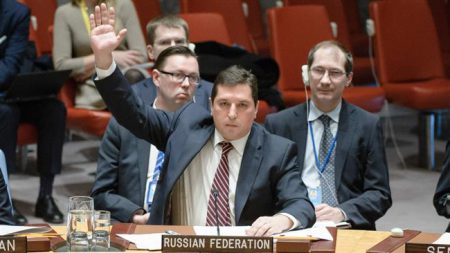
Russian Deputy Permanent Representative to the UN Vladimir Safronkov
Press TV – March 18, 2017
During a meeting of the UN Security Council convened by Russia, the Kremlin has warned about “grave humanitarian consequences” that would come if Saudi Arabia goes ahead with a plan to attack Yemen’s western port city of Hudaydah.
The attendants in the UNSC meeting discussed the grave humanitarian situation in Yemen and efforts toward a peaceful conclusion of the two-year-long war imposed by the Saudi regime on the Yemeni people, Russian Deputy Permanent Representative to the UN Vladimir Safronkov told reporters after the closed-door meeting in New York, which had been requested by Moscow on Wednesday.
Russia’s state news agency TASS quoted the Russian official as saying the meeting had been held in an attempt “to urge the UN to step up its efforts to establish a real diplomatic process.”
Elsewhere in his remarks, Safronkov said all the 15 member states of the council supported a non-military approach to the resolution of the crisis. It is, the Kremlin believes, “necessary to search for a political settlement,” Safronkov added.
Hudaydah is currently under the control of Yemen’s Houthi Ansarullah fighters, who have been defending the impoverished country against the Saudi aggression since March 2015. The city, Yemen’s fourth largest and its biggest port, served as a thoroughfare for the transit of about 70 percent of Yemen’s food imports in the pre-war years.
When the Saudi regime started pounding the crisis-hit country, Hudaydah turned into a primary entry point for humanitarian aid and fuel meant for areas inside Yemen, including the capital, Sana’a. If the city falls under the control of Saudi forces and mercenary soldiers, the flow of humanitarian assistance toward those areas would be blocked.
On March 13, Moscow also warned about the critical situation of the port city in providing its people with much-needed humanitarian aid.
The “plans to storm Yemen’s biggest port of Hudaydah give rise to serious concerns,” said Russian Foreign Ministry spokeswoman Maria Zakharova, adding that the fall of the city would cut Sana’a from “food and humanitarian aid supplies.” She also said the humanitarian situation in Yemen was “catastrophic.”
On Wednesday, the World Food Programme (WFP) said 60 percent of Yemenis, some 17 million people, faced a “crisis” and were in urgent need of food as a direct result of the Saudi war.
The Saudi campaign has so far killed over 12,000 Yemenis. The aggression was meant to reinstate Abd Rabbuh Mansur Hadi, Yemen’s president who has resigned and is a staunch ally of Riyadh. The campaign also sought to undermine Houthis. However, due to resistance from the Yemeni nation, the regime in Riyadh has so far failed to achieve success and suffered considerable human loss in its military.
Featured Video

Racist Seinfeld Dances for Joy as Bibi Unveils His New Map
or go to
Aletho News Archives – Video-Images
TV Drama Review
Japanese drama projects Japan’s wartime atrocities onto Chinese characters

Global Times | October 25, 2026
By portraying Chinese characters as perpetrators of ruthless violence while casting Japanese Self-Defense Forces (SDF) intelligence operatives as defenders, the season 2 of the Japanese drama Vivant has recently drawn criticism from Chinese netizens, who argue that its depiction turns historical reality on its head while ignoring Japan’s wartime atrocities.
The TBS drama series – a spy suspense story in which an alleged unofficial intelligence unit of the SDF operates across the globe — has attracted a passionate fanbase. Its currently airing season 2 opened with a household rating of 18.8 percent, the highest for a TV drama this year, according toa commentary article by Japanese media Toyo Keizai.
What draws attention is the portrayal of the enemies in the series, the article noted. Scenes in which the Chinese organization subjects kidnapped members of the SDF unit to brutal torture are repeated with unrelenting intensity.
It is rare for Japanese TV dramas to explicitly portray a real-life country as the enemy, the article noted.
Japanese Prime Minister Sanae Takaichi also made a reference to the drama, saying that she has been recording Vivant and hopes to binge-watch it over the year-end and New Year holidays, according to Japanese media outlets.
China’s CCTV News report on Sunday revealed that the drama features scenes in which Chinese personnel cut off the fingers of and stab Japanese intelligence operatives in the abdomen. Such acts bear striking similarities to the torture inflicted on Chinese nationals by invading Japanese troops during the World War II.
The drama distorts the truth by attributing these atrocities to modern Chinese characters. Beneath the surface, it subtly glorifies Japan’s cross-border overseas operations, blurs the functional boundaries of the SDF and implicitly promotes an expansionist narrative, per CCTV News. … continue
Blog Roll
 Aletho News
- Netizens condemn Japanese drama for projecting Japan’s wartime atrocities onto Chinese characters
- Racist Seinfeld Dances for Joy as Bibi Unveils His New Map
- A West Bank War for Netanyahu’s Election Campaign, Could It Backfire?
- Yemen denounces European Parliament’s ‘hypocritical’ push to blacklist Ansarullah
- Qalibaf: UAE’s UN bid aims to ‘clear the runway’ for ‘Greater Israel’, whitewash genocide
- Pakistan reopens Iran border after boosting security: Report
- Why are so many Brazilians voting for Flávio Bolsonaro?
- Democrats Put Anti-Russia Agenda Ahead of American Workers
- Elijah Magnier: Yemen’s Strikes Are Shattering Saudi Arabia’s Long-Term Strategy
- Pentagon designates Chinese cultural centers national security threat
- If Americans Knew
- Latest updates from Israeli assault on West Bank
- Tourism Ministry launches free food truck tour in US
- “So Much Worse Than People Realize”: Never-Before-Seen Images Reveal Damage at U.S. Bases as Troops Describe Being Abandoned
- UK Bell Review Confirms Only Anti-Israel Attitudes Are Rising, Not Antisemitism
- DAILY UPDATE: Latest essential news on Palestine, Israel, & region
- DAILY UPDATE: Latest essential news on Palestine, Israel, & region
- Damning report shows the media must confront its failures on Gaza
- BBC senior broadcaster speaks out on Gaza coverage
- Netanyahu vows vast West Bank invasion in response to 20-minute skirmish that left 2 Israeli soldiers and 2 Palestinian fighters dead
- Tied up and tortured: Israel using US-made electroshock weapons on Palestinian detainees
- No Tricks Zone
- Sudden Stratospheric Warming, Powerful El Niño Combination May Lead To Extreme Europe Cold, Energy Crisis!
- Two New Studies Find Thwaites Glacier Melt Cannot Be Driven By Human Activity Or A Warming Ocean
- E-Cars Reduce CO2 Emissions By Only 41% Compared To Internal Combustion Engine Vehicles
- Predictions Made By Renowned Climate Professor Over Past Decades Have Been Proven To Be Poor
- New Study Suggests Large Regions Of The Pacific Ocean Have Been Cooling For The Last 80 Years
- Germany’s Green Energy Debacle: High Energy Costs Force Kahla Porzellan to Close After 182 Years!
- New Study: 50 Years Of The Most Aggressive ‘Net Zero’ Policies Can Only Affect The Global Climate By 0.03°C
- US September “Heat” Was No Record…Many Records Set Decades Ago
- Latest European Green Energy Debacle; Portugal’s Largest Flagship Solar Park Insolvent!
- Green Energy Debacle: German Expert Professor Fritz Vahrenholt Warns Of Severe Economic And Social Consequences

