Pentagon understated cost of new bomber by $25bn, blames ‘human error’
RT | August 31, 2015
Very little is known about the US Air Force’s new long-range strike bomber (LRSB) – including, apparently, the cost. Facing questions over a $25 billion discrepancy in development costs, the Pentagon blamed “human error” and shrugged it off as a “mistake.”
The LRSB project is intended to replace the aging and expensive US bomber fleet by the mid-2020s, at the cost of $500 million per plane. Two aerospace conglomerates, Northrop Grumman and Boeing-Lockheed Martin, are bidding for the contract.
Last year, the Air Force told Congress that the 10-year cost of developing the bomber, between 2015 and 2024, would be $33.1 billion. This year, however, the estimate for 2016-2026 rose to $58.2 billion. The 76 percent increase prompted Representative Jackie Speier (D-California), ranking minority member on the House Armed Services oversight and investigations subcommittee, to ask about the $25 billion gap.
“This sudden 76 percent increase in estimated cost is alarming, because it raises questions about the management of a crucial program that lacks transparency, on which we cannot afford serious cost overruns, development errors, and reduced production numbers that would deprive the United States of one of its core military capabilities,” wrote Speier.
The response from Air Force Secretary Deborah Lee James only added to the confusion, by introducing another number to claim that the cost estimate hasn’t actually changed. According to James, the real figure was $41.7 billion all along.
“There has been no change in the costing factors over the last two years … it was a mistake. It was a regrettable mistake,” James said during a Pentagon press briefing last week. “It occurred in part because of human error and in part because of process error, meaning a couple of people got the figures wrong and the process of coordination was not fully carried out in this case.”
James said that senior officials have “counseled” the people involved, “tightened up” the process, corrected the price tag with Congress and double-checked all the other figures contained in the reports.
“The key thing is there has been no change in those cost figures,” she said.
Northrop Grumman was behind the B-2 ‘Spirit’ stealth bomber, manufactured between 1989 and 2000 at the cost of $737 million per plane. The total cost of the program stood at $45 billion in 2004. Only 16 B-2s are currently operational, and cost $135,000 per hour to fly, according to the Wall Street Journal.
Meanwhile, Lockheed Martin has been catching flak over the cost overruns that have plagued the F-35, a fifth-generation strike fighter produced in three separate configurations for the Air Force, Navy and the US Marine Corps. By 2011 estimates, the US government was going to spend $1 trillion on the fleet of F-35s – $382 billion to buy 2,443 aircraft, and another $650 billion in operating expenses. That was more than the entire GDP of Australia at the time ($924 billion), according to The Atlantic. The costs have only gone up since, even as the F-35 failed combat tests to a 1970s design currently in service.
Lockheed also produced the F-22A Raptor, the current US air superiority fighter, between 1997 and 2011. Fewer than 200 Raptors were made, at a cost of $150 million each and the overall program cost of $66.7 billion as of 2011.
The contract for developing the LRSB was supposed to be awarded in June or July, but the Air Force has already missed that deadline. Unconfirmed reports from defense sources speak of a September or October announcement.
NATO kicks off naval drills in Black Sea with Ukraine
RT | August 31, 2015
Ukraine is hosting naval military exercises in the Black Sea with NATO forces, involving 2,500 troops and some 150 military vehicles, from warships and helicopters to armored cars.
The host nation of Sea Breeze 2015 has deployed 1,000 troops, nine warships and eight aircraft for the drill. The US has sent 1,000 troops as well as five warships, two submarines and six aircraft.
The remaining 500 troops, six warships, three submarines and 6six aircraft were provided by Bulgaria, Germany, Greece, Italy, Romania, Turkey, the UK and the non-NATO nations Moldova and Sweden.
“The exercise is meant to boost trust and security in the region, [and to increase] the compatibility between the Ukrainian Navy and the navies of NATO members and partner countries,” the Ukrainian Defense Ministry said in a statement.
Sea Breeze is held in Ukraine’s Odessa and Nikolaevsk region not far from Russia’s Crimea, which Kiev and its foreign sponsors consider to be Ukrainian. It will last till mid-September. Ukraine will be participating in a total of 11 NATO drills in 2015.
NATO is also currently conducting another war game, called Swift Response, in Germany, Italy, Bulgaria and Romania. It is one of the largest such events since the Cold War and is planned to last until September 13. A separate exercise, called Simple Strike, is under way in the Baltic.
Bernie Sanders: I would continue assassination drone program

A US MQ-9 Reaper assassination drone
Press TV – August 30, 2015
Independent Senator Bernie Sanders, who is seeking Democratic nomination for the 2016 US presidential election, says he will continue the Pentagon’s assassination drone program.
In an interview with ABC News on Sunday, Sanders said that he would limit the use of US terror drones, but said that he would not end the targeted killing campaign.
“I think we have to use drones very, very selectively and effectively. That has not always been the case,” Sanders said.
“What you can argue is that there are times and places where drone attacks have been effective,” he added.
“There are times and places where they have been absolutely counter-effective and have caused more problems than they have solved. When you kill innocent people, what the end result is that people in the region become anti-American who otherwise would not have been,” said the junior senator from Vermont.
Since 2001, the United States has been carrying out drone attacks in several countries, including Yemen, Pakistan, Afghanistan and Somalia.
The aerial attacks were initiated by former US President George W. Bush but have been escalated under President Barack Obama.
Former US drone operator Brandon Bryant, who was involved in the killing of more than 1,600 people, revealed earlier this year that aerial strikes are conducted with complete uncertainty.
Bryant, who worked for almost five years in America’s secret drone program bombing targets in Afghanistan and other countries, such as Pakistan and Iraq, said operators lacked visibility and were not sure about the identity of the people they were shooting at.
“We see silhouette, shadows of people, and we kill those shadows,” he said.
SNP dubs belated Chilcot inquiry ‘ludicrous’
Press TV – August 30, 2015
The Scottish National Party (SNP) has called on the British government to set a deadline for the much-delayed report of the Iraq war inquiry.
SNP said it was unacceptable that the inquiry has not reported after six years and a cost of nearly 16 million dollars.
The ruling Scottish party, which on its website described the delays as ludicrous, called for a definitive answer to what it called the failures of the Iraq war.
It added that the current Conservative government is also responsible for the Labour-initiated war as Conservatives overwhelmingly backed the invasion of Iraq.
The so-called Chilcot inquiry, named after John Chilcot who chairs the Iraq war investigation, began in 2009 and has repeatedly delayed its report under the pretext that it needs to interview all individuals implicated in the US-led invasion of the country.
The last of the hearings of the inquiry was held more than four years ago.
Chilcot has already declined to set out a timetable for his Iraq inquiry despite a threat of legal action by families of British troops killed in the unpopular US-led war.
Earlier this month, Lawyers representing 29 families said they would move to the London High Court, if the Chilcot inquiry fails to give a publication deadline in two weeks.
“There have been outrageous delays to date and it seems as though those delays would simply be interminable,” Matthew Jury, a lawyer representing the families said.
The US-led invasion of Iraq began in 2003 and lasted for over 8 years. The war, which was initiated under the false pretense of weapons of mass destruction, took the lives of 179 UK personnel and nearly 4,500 US soldiers.
The number of Iraqi civilian deaths has been estimated to be over one million by some sources.
Kiev Defies Minsk Accords, Resists Western Demands for Donbass Self-Rule
Sputnik – 30.08.2015
France and Germany are pressing Ukrainian President Petro Poroshenko to ensure partial self-rule for the country’s independence-minded east before the upcoming local election there, Ukrainian media reported on Saturday.
Poroshenko refuses to comply, citing legal, political and organizational hurdles preventing the implementation of the law, which would grant broader autonomy to the self-proclaimed Donetsk and Lugansk People’s Republics, the Kiev-based Weekly Mirror newspaper reported, citing unnamed sources in the government.
In keeping with the provisions of the Minsk accords, reached in February 2015, President Poroshenko agreed to grant a special status to the self-proclaimed Donetsk and Lugansk People’s Republics.
Article 4 of the 13-point Minsk Protocol outlined the modalities of conducting local elections in particular districts of Donetsk and Lugansk regions and their future status.
Article 11 described decentralization of particular districts of Donetsk and Lugansk regions and their special status as the key elements of the proposed constitutional reform in Ukraine.
On August 24, President Poroshenko met in Berlin with German Chancellor Angela Merkel and French President Francois Hollande.
Briefing the media after the talks, Angela Merkel said that the three leaders had gathered in Berlin to endorse the Misk-2 accords, which she described as pivotal to a peaceful settlement of the Ukrainian conflict.
Addressing members of his Solidarity bloc shortly before the August 24 trip to Berlin, Petro Poroshenko said that the proposed constitutional reforms ruled out any federalization or other special statuses for any part of Ukraine.
Israeli forces evacuate Palestinian families for military drill
Ma’an – August 30, 2015
TUBAS – Israeli troops on Sunday morning evacuated 14 Palestinian families from their houses in the al-Ras al-Ahmar area of Khirbet Atuf village east of Tubas in the northern Jordan Valley area of the West Bank, local sources said.
Local sources reported that the “Israeli occupation” told the 14 families that Israeli forces will be carrying out military drills in the area for five days.
During the five days of military exercises, Palestinian residents in the area will be evacuated for six hours every day, local sources told Ma’an.
The evacuation was done under the argument that evacuating protects residents.
Earlier this year military drills in Tubas resulted in a fire that swept across some 3,000 to 4,000 dunams (750 to 1,000 acres) of Jordan Valley farmland.
The majority of the Jordan Valley is under full Israeli military control, despite being within the West Bank.The district of Tubas is one of the occupied West Bank’s most important agricultural centers.
According to the Applied Research Institute of Jerusalem, more than 15,000 dunams (3,700 acres) of land in the Tubas district have been confiscated by Israel for military bases with a further 8,000 dunams (2,000 acres) seized for illegal Israeli settlements.
Israel’s JINSA Earns Return on Investment: 190 Americans Admirals and Generals Oppose Iran Deal
By John Stanton | CounterPunch | August 28, 2015
According to Carol Greenwald writing at American Thinker on 27 August 2015, Washington Post writer “[Carol] Morello does not mention how incredible it was that a few people, mostly a woman named Marsha Halteman from New Orleans, in one week could get 190 flag officers to sign a public letter stating that “the JCPOA [Iran Deal] would threaten the national security and vital interests of the United States and, therefore, should be disapproved by the Congress.”
Well not so incredible at all thanks to the Jewish Institute of National Security Affairs (JINSA) very successful Generals and Admiral Program that has been in operation for many years. It has been the pipeline for 400 American military officers to visit Israel. Israel also runs similar programs for US military academy students and US law enforcement personnel.
The purpose of bringing American military personnel—and military academy students—is to maintain “Continued and robust military-to-military dialogue between the American and Israeli defense establishments is central to JINSA’s philosophy. The annual Generals and Admirals Program to Israel, in which recently retired American generals and admirals are invited to visit Israel with JINSA to meet the top echelon of the Israeli military and political leadership, ensures that the American delegation is well briefed on the security concerns of Israel, as well as the key role Israel plays as a friend and ally of the U.S. To date, JINSA has taken close to 400 retired officers to Israel, many of whom serve on JINSA’s Board of Advisors.”
As of this writing the Washington Post does not appear to have updated its story on the incredible effort of Marsha Halteman who is the recipient of a prestigious award from a US combatant command.
“It gives us great pleasure to announce that JINSA’s Marsha Halteman will be honored by the United States Special Operations Command (USSOCOM) with their Outstanding Civilian Service Medal for her tireless work on JINSA’s Soldiers Appeal, which raises funds for military members and their families who are in need of financial assistance. Her selfless and hard work is instrumental in actively supporting a USSOCOM priority – enhancing the quality of life of the individual warrior and family. Established by the Commander of USSOCOM in September 1998, the Outstanding Civilian Service Medal recognizes civilians who have provided outstanding support or service. For Marsha, this work has been both an act of love and admiration for our men and women in uniform, as well as above and beyond the call of duty. She has truly made a difference in the lives of so many soldiers and their families and she is most deserving of this award. This prestigious award will be presented to Marsha by a senior member of the USSOCOM Command at JINSA’s Spring 2014 Leadership Conference. Details of this meeting and a formal “Save the Date” will be released soon. We hope that many of you will be able to join us for the meeting and to honor Marsha.”
If the US national security and political establishment had the dedication, tenacity and thoroughness of the Israeli’s—in their pursuit of their national security interests, the USA would be a far more powerful country abroad and maybe at home. Israel’s interests are represented in every nook and cranny in the United States at the local, state and federal levels. They believe in Israel, nothing else. That deserves respect. American leaders, comparatively, are pathetic.
Purge of Corbyn voters unmasks Labour
By Jonathon Cook | The Blog From Nazareth | August 27, 2015
The British political and media elite have been agreed on one thing this summer: the need to character-assassinate Jeremy Corbyn, the only half-decent politician (make that, human being) running for the Labour leadership.
If Corbyn wins, it would be the first time in living memory that the UK has had a Labour leader who is actually of the left. It is a prospect terrifying our supposedly liberal media, including the BBC and most of the Guardian’s senior staff, from Polly Toynbee to Jonathan Freedland.
Because all indications are that Corbyn will win in a fair fight, the caretaker Labour leadership is trying to stitch up the election to ensure he loses. Corbyn’s entry into the race has led to a tripling of Labour’s membership, as those who had grown disillusioned with Labour politics or joined the Greens consider returning to the Labour fold. You would think the Labour party would be cock-a-hoop. Think again.
The problem is that, if Labour admits Corbyn is actually harnessing massive support from the real left, it would also have to concede that long ago it departed from its roots, becoming just another wing of the neoliberal elite. And more significantly, it would also have to be prepared to contemplate changing course, opening itself up to the possibility that someone with social democratic convictions might again lead the party.
Neither is about to happen, so Labour is finding the flimsiest of excuses to purge itself of any voters it can identify as likely to back Corbyn in the leadership vote. Farcically, among those is Mark Serwotka, the leader of one of the UK’s biggest trade unions, after he said he would consider affiliating his PCS civil servants union with Labour if Corbyn wins.
Below is a great article from Kerry-anne Mendoza, another of those purged. She’s not a Tory mischief-maker or a Militant entryist. She’s an old-fashioned Labour supporter. Her mistake was to tweet her local Labour MP before the last election to say she would be voting Green after becoming fed up with the neoliberal takeover of Labour. That was the pretext to bar her from the coming leadership vote.
As she points out, she’s exactly the kind of voter the Labour party needs if it ever wants to form a government again. Instead she’s been cast out.
Notice also how the self-righteous New Labour elites characterise her – a long-standing Labour supporter who became disillusioned with the party – as an “infiltrator”. They were so sure of themselves they even included her in a list of people they had barred from the vote that they then issued to the media. The list ended up being published uncritically by the Guardian.
If despite all this, Corbyn does win, there can be no doubt it will be far from the end of the story. The Labour party establishment will make the job of leading the party impossible, and Corbyn will face an even more intense campaign to discredit him from all parts of the media.
If there is any consolation to be drawn from these events, it is this: the pervasive myth that Britain still enjoys pluralism in its politics and media may finally be unmasked.
US Committed to Playing Active Role in Transnistria Dispute Negotiations
Sputnik — 26.08.2015
Washington is committed to be fully engaged in the talks aimed at settling the Transnistria conflict, US Secretary of State John Kerry stated in a statement on Wednesday.
“You may be sure that America will remain unwavering in its support for Moldova’s sovereignty and territorial integrity and will continue to play an active role in the 5+2 negotiations aimed at peacefully resolving the Transnistria dispute,” Kerry said.
Kerry issued his statement on the occasion of Moldova’s National Day. The secretary stressed the US support for Moldova government’s efforts to undertake reforms.
Transnistria, a region with a predominantly Russian and Ukrainian population broke away from the Soviet republic of Moldova in 1990, fearing its government could seek reintegration with neighboring Romania. The initiative triggered Moldova’s offensive on the region in 1992, after which it lost control over the Dniester River’s left bank.
The region is now striving for international recognition, while Moldova offers Transnistria autonomy within a unitary state.
The 5+2 format negotiators include Russia, Moldova, Transnistria, Ukraine, the OSCE and observers from the European Union and the United States.
Bernie Sanders’ Conservative Foreign Policy

By Margaret Kimberley | Black Agenda Report | August 26, 2015
It is obvious that Bernie Sanders functions as the political “sheepdog” of the 2016 presidential election. The sheepdog makes certain that otherwise disillusioned Democrats are energized enough to stay in line and support the eventual candidate, in this case Hillary Clinton. That is reason enough to oppose his campaign but it isn’t the only one. A hard look at Sanders on foreign policy issues shows that he is a progressive poseur, a phony, a conservative Democrat, and not a socialist by any means.
The Sanders website looks like every other candidate’s with a bio, donation information and of course “Bernie on the issues.” But it seems that Bernie doesn’t have any opinions on foreign policy because they are nowhere to be found. How can he be a serious presidential contender if he doesn’t discuss foreign policy? How does he differentiate himself from Hillary Clinton or Republicans if he won’t state for the record how his foreign policy differs from theirs? The truth is obvious. He isn’t a serious contender and his foreign policy views are no different from those of the other candidates.
Sanders’ candidacy is as grave a danger to the rest of the world as that of his rivals. In no way does he challenge the belief that the United States has the right to determine the fates of millions of people without regard to their human rights. He doesn’t believe that other nations have the right to oppose what the United States chooses to impose upon them.
Sanders makes quite a big deal about voting against the invasion of Iraq in 2002 and says he wants United States troops to leave that nation for good. But he never says that this intervention was wrong. He never said that the United States had no right to destroy that country or kill its people. He never said that these interventions are war crimes and violations of international law. Instead he speaks of the efficacy of particular interventions and how they impact Americans.
A presidential campaign should be an opportune moment to say that the Islamic State, ISIS, is a creation of the United States. Instead Sanders repeats that the United States must defeat this force but he only differs slightly in saying that he wants the Saudis to spend their money doing it. “I’ll be damned if kids in the state of Vermont – or taxpayers in the state of Vermont – have to defend the royal Saudi family, which is worth hundreds of billions of dollars.” That mealy mouthed opinion does nothing to end the premise of an American right to do what it wants anywhere in the world. Imagine if Sanders was willing to talk about support for jihadists going back nearly forty years and how each one delivers a more terrifying result.
In 2011 Obama was bombing Libya and planning to kill its president but Sanders didn’t see it as being particularly problematic. He repeated almost verbatim the rationales that assassinated a president and destroyed a nation. “Look, everybody understands Gaddafi is a thug and murderer. We want to see him go, but I think in the midst of two wars, I’m not quite sure we need a third war, and I hope the president tells us that our troops will be leaving there, that our military action will be ending very, very shortly.” Libya’s obliteration was no problem for Sanders as long as the process didn’t take very long.
In 2015 the Bernie Sanders foreign policy still does not digress from American political orthodoxy. He doesn’t question American policy towards Russia. “Well you totally isolate him [Putin] politically. You totally isolate him economically.” “Freeze assets that the Russian government has all over the world.” At no time did Sanders oppose the American policy of intervening in Ukraine and expanding NATO in eastern Europe, the actions which created the current confrontation with Russia. He doesn’t question why the United States has the right to dictate policy to another nation or interfere in its sphere of influence.
Sanders supports the Iran nuclear energy agreement with the P5+1 nations, but issues the same dishonest rationales about it expressed by president Obama. Sanders doesn’t say that Iran was never a nuclear power, an easily provable fact. He doesn’t question the sanctions which forced Iran to the table or point out that the 25 years of inspections called for in the agreement are a violation of Iran’s sovereignty. Instead he repeats the discredited mantra that the United States must make war in order to prevent Iran from becoming a nuclear nation when even the CIA said that it never had that capability.
The big elephant in the room, Israel, gets the standard Bernie Sanders treatment. When Israel killed 2,000 people in Gaza in 2014 he would only say that Israel “over reacted.” He didn’t like being questioned about his stance either. When protesters interrupted a speech he told them to shut up and repeated nonsense about Hamas missiles that rarely hit their targets while Israel massacred a civilian population.
When Sanders speaks out against American interventions he couches his opposition in terms of spending money at home instead of abroad. That is somewhat admirable, but there is no reason to cut the defense budget as he says he wants to do, if there is no change in how this country attempts to dominate the rest of the world.
The Sanders campaign may be an interesting footnote, but it won’t bring about needed conversation about United States imperialism. The supposedly socialist senator never even uses that word. There is blatant dishonesty in claiming to want a changed domestic policy in the United States without also changing foreign policy. The two are linked, and American workers can’t have a living wage or health care as long as imperialism goes unchecked. Liberals can’t claim superiority to followers of Donald Trump if they consent to war crimes and human rights violations. Their only requirement seems to be that Democrats ought to be in charge of the carnage. Sanders wouldn’t be a very good sheepdog if there weren’t so many willing sheep.
Margaret Kimberley can be reached via e-Mail at Margaret.Kimberley(at)BlackAgendaReport.com.
Who is doing the saber-rattling in Eastern Europe?
By Vladimir KOZIN | Oriental Review | August 25, 2015
Last week, NATO headquarters announced Exercise Swift Response-15, the largest Allied airborne training event on the European continent since the end of the Cold War. About 5,000 soldiers from 11 countries in the alliance will take part in the maneuvers, which will last until Sept. 13.
This is neither the first nor the last drill to be conducted by NATO, the largest military alliance in the world.
Over the past year and a half, NATO armed forces have almost doubled the number of military exercises they have staged near the Russian border: between 2012 and 2013 they conducted an average of 95 such training events per year, but there have already been 150 so far in 2015, and flights by reconnaissance aircraft along the Russian frontier have increased tenfold.
But in an attempt to unfairly place the blame on Russia for such exercises, the London-based European Leadership Network issued a report on Aug. 12 that uses a flawed methodology to compare one type of exercise held in Russia in 2015 with another kind of military drill organized by NATO this year. Criticism was only leveled at the large number of troops involved in the Russian exercise, because the alliance’s drill was smaller on that scale. The report’s purpose was obvious: to shift the entirety of the West’s own culpability for war preparations in Europe onto the Russians.
- First of all, it makes no sense to compare only two military drills conducted by opposing sides; one needs to take into account all the exercises that are being held, including the sum total of their scope and focus (the scenarios being rehearsed). In this regard, it should be noted that the aggregate number of NATO personnel taking part in the alliance’s military maneuvers is significantly greater than the estimate of troops involved in the Russian military exercises.
- Second, in regard to this matter, one must also acknowledge that it was not Russia who initiated this upsurge in military drills. The US and its closest NATO allies took that first step under contrived pretenses. For this reason, the European Leadership Network’s proposals to limit the number and scope of military exercises in Europe should be primarily directed at Washington and the alliance, not at Russia.
- Third, one cannot overlook the fact that many NATO members (the US, UK, France, Germany, and others) conduct their military drills far from their own borders. The Russian armed forces almost always oversee this training within their own country.
- Fourth, it should be noted that in addition to periodic military maneuvers, a special NATO Response Force has been created that will consist of up to 40,000 soldiers who can be quickly airlifted to wherever they need to be. In addition, the US Navy must now be able to instantly mobilize the resources to form “expeditionary forces” that can be rapidly deployed to any part of the world (for example, as part of a Marine brigade including up to 17 amphibious ships or a joint Marine Air-Ground Task Force with as many as 75,000 personnel). For comparison, a recent NATO Baltops naval exercise in the seas around northwestern Europe involved 49 warships and support vessels from 17 countries within the alliance.
- Fifth, it is important to note that while NATO has 24,000 combat aircraft and 800 ocean-going ships at its disposal, Russia does not own nearly so much equipment of that type. What’s more, the Pentagon is planning a further expansion of the forward deployment of its armed forces. That would station US troops, on a permanent or temporary basis, within more than 100 nations. There are plans to begin prepositioning weapons and military equipment in these countries, as is “needed to equip troops fighting in forward combat zones.”
- Sixth, during these military drills, the Pentagon is rehearsing scenarios for armed intervention intended to overthrow undesirable regimes. For example, throughout the post-war period, the United States and its allies have employed military force more than 50 times, and six times that has escalated into regional armed conflicts.
Even NATO’s leaders have acknowledged the alliance’s military buildup on Russia’s doorstep. According to NATO Secretary General Jens Stoltenberg, in 2014 these numbers have quintupled since 2013. And NATO member states’ naval operations have increased fourfold during this period.
In particular, the air forces of the 15 NATO countries that take part in the Baltic Air Policing operation over the Baltic states ramped up their activities more than 1,240 times (when calculated in flying hours) since it was launched 11 years ago. This operation is underway 24/7, year-round. Four of the types of planes used in this drill are considered “dual-capable” aircraft that can carry either conventional or tactical nuclear weapons.
At the same time the United States is refusing to adopt the new Treaty on Conventional Armed Forces in Europe (CFE), proposing to revive the former act, which also never went into effect through the fault of its NATO signatories. New talks on CFE-2 have not even begun. At the same time, eight additional military bases in Eastern and Southern Europe, as well as seven command and administrative centers, plus American heavy weaponry and AEW&C aircraft have been added to the 150 military bases belonging to the United States and its allies that are immediately adjacent or relatively close to Russia’s borders.
Without exception, every military exercise that the alliance has recently staged in Europe has had very focused objectives. They are rehearsing scenarios that test the use of the Rapid Reaction Force, which includes the transportation of personnel and heavy equipment over long distances, the interaction between different varieties and formats of armed forces, and the operational “coupling” between the command and control structures. There is no doubt that such exercises have an anti-Russian bias, mainly because, as already noted, they are primarily (up to 55%) conducted in zones adjacent to the Russian borders. For example, an exercise that included 140 armored vehicles and 1,400 troops near the Estonian city of Narva in February of this year was held only 300 meters away from the Russian border.
In mid-February of this year the Pentagon shipped twelve A-10 Thunderbolt II aircraft to Spangdahlem Air Base (Rhineland-Palatinate, Germany), which will be deployed in Eastern Europe. There is no doubt about the identity of the potential enemy. Eight of these aircraft were flown to the Ämari Air Base (Estonia) in June of this year. And five USAF B-52H and B-2 strategic heavy bombers were sent to RAF Fairford in Great Britain to participate in NATO military exercises.
In March of this year NATO organized the Joint Viking military exercises in northern Norway near the Russian border, which was an event unprecedented since 1990. Over 5,000 troops and 400 units of military equipment were involved. During these drills, the naval and air forces of the region’s NATO countries were placed on alert. The last time a similar drill was conducted was in 1967.
In March and April of 2015 the US, Swedish, and Finnish air forces directed military maneuvers near the Finnish town of Pori, flying sorties with Gripen, F-16, and Hornet fighter jets. In May, the air forces from eight NATO member states staged the Arctic Challenge Exercise in Norway, which included more than 100 aircraft. In early May of this year major military drills known as Siil-2015 were held in Estonia, involving 13,000 troops. This was the first time such large-scale drills had been conducted inside Estonia.
The Pentagon is planning to set up warehouses of military equipment in NATO’s eastern flank in order to conduct “ongoing exercises on a rotational basis.” For these purposes, 1,200 armored vehicles, including 250 Abrams tanks and Bradley Fighting Vehicles, as well as artillery systems, are to be stockpiled in Eastern Europe. US Secretary of Defense Ashton Carter claims that Estonia, Lithuania, Latvia, Bulgaria, Romania, and Poland have already agreed to house this military equipment within their borders. Some types of weaponry can also be stationed in Germany, where, just like after WWII, large numbers of American troops are already concentrated.
In light of the increased US military aid to the regime in Kiev that will be used in the genocide of Ukrainian citizens, these military preparations are taking on a plainly anti-Russian flavor.
Nor can we ignore America’s tactical nuclear weapons, which since the early 1950s have been deployed in four European countries (Belgium, Italy, the Netherlands, and Germany), as well as the Asian part of Turkey. Furthermore, a US missile defense system will be installed in Romania in 2015, and then another three years later in Poland. These military forces and infrastructures are certainly not aimed at Iran. So how should Russians react to all of this, and who is actually rattling his saber in Eastern Europe?
Featured Video
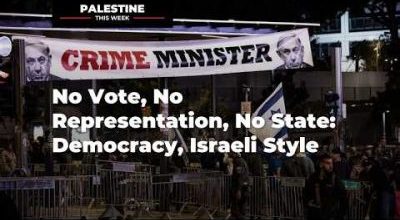
No Vote, No Representation, No State: Democracy, Israeli Style
or go to
Aletho News Archives – Video-Images
From the Archives
Sanctions, War and the Policy of Dual Containment
By SASAN FAYAZMANESH | March 17, 2008
It is now nearly three decades since the Unites States adopted the policy of dual containment of Iran and Iraq. While much has been written about the containment of Iraq, there has been very little in-depth analysis of this policy when it comes to Iran. In a book that is going to be released on March 31, 2008, entitled The United States and Iran: Sanctions, Wars and the Policy of Dual Containment (Routledge), I attempt to address this shortcoming by investigating when and why the US policy of containment of Iran came about, how it evolved, and where it stands today.[1] To the extent that Israel has been involved in US policy making, the study will also include the role that Israel has played in the containment of Iran. Also, since the fate of Iran has been inextricably linked to that of Iraq, occasionally the investigation will overlap with the containment of Iraq.
The policy of dual containment of Iran and Iraq originated during the Carter Administration, but it was not until the Clinton Administration that the expression “dual containment” became popular. … continue
Blog Roll
 Aletho News
- No Vote, No Representation, No State: Democracy, Israeli Style
- Zionist Bought Senate Blocks Information About American Citizens Killed By Israel
- While Gaza dominates the UN, these are the people keeping it alive
- New Report: “Scholasticide and Genocide in Gaza: Assessment, Testimonies and Legal Analysis”
- ‘THAAD Delusion’: Iran war exposes US missile shield limits – The Atlantic
- Moscow issues warning to NATO over Russian exclave
- Yes, the Iran war has destroyed Trump’s presidency
- The fallacy of US delusions about Iran’s economic collapse
- Hezbollah denies Syria cell link, warns of Israeli plan to sow discord
- The legacy of US sanctions, war, and occupation in Iraq
- If Americans Knew
- Mamdani releases plan to combat antisemitism and hate crimes in New York City
- Iran’s Revolutionary Guards Publish Letter to the American People
- DMFI launches $1 million ad campaign supporting Virginia’s Elaine Luria
- US Senate blocks resolution seeking report on Americans killed by Israel
- Israeli Attacks Kill Ten Palestinians in Gaza
- Massacre at Minab: The School That Became a Grave
- Israeli media: The IDF Shows It Doesn’t Turn a Blind Eye; It Actively Emboldens Settler Havoc
- As settlers ravage West Bank, Israeli forces kill 10 in Gaza – Daily Update
- New Report: “Scholasticide and Genocide in Gaza: Assessment, Testimonies and Legal Analysis”
- Ex-Biden officials are desperate for a Gaza scapegoat
- No Tricks Zone
- Green Energy Debacle: German Expert Professor Fritz Vahrenholt Warns Of Severe Economic And Social Consequences
- Two More Paleo Reconstructions Affirm Meters-Higher Sea Levels Across Ireland, Brazil 7000-6000 Years Ago
- New Study: Earth And Venus Surface Warmth Largely Explained By Convection And Lapse Rate, Not CO2 Or Radiation
- 2025 Nature Paper Claiming Worsening Global Drought Gets RETRACTED …Heavily Flawed
- New Study: ‘Global Drought Shows No Detectable Recent Acceleration Under Climate Warming’
- Economic Masterminds: German Socialists Suggest Taxing Productivity Gains Stemming From Using AI
- The South China Sea Has Not Been Cooperating With The Climate Change Narrative
- Energy Crisis: Germany Enters Heating Season With Historically Low Gas Reserve Fill Levels
- New Study: The Antarctic Ice Sheet Gained Mass From 2020-2024 Due To Staggering Snow And Ice Accumulation
- Study: Ocean Heating Rates From Thousands Of Years Ago ‘Dwarf’ Modern Ocean Heating Rates

