Winning a Nuclear War
The Prize: Extinction
By Bo Filter | Dissident Voice | May 4, 2015
Don’t expect the concept of extinction or omnicide to roll off the lips of nuclear warriors. Their brains focus on the win-ability of nuclear war to the exclusion of all other possibilities. Let’s take a minute to examine the myopic mindset of nuclear strategists and what we should be doing about it.
The story of nuclear weapons begins with the dropping of an atomic bomb named Little Boy on the city of Hiroshima, Japan on August 6, 1945. Since then, many authors have written and exposed this event as being more about starting a new war with our ally Russia than about ending WWII, more about continuing war so that the vast fortunes made by the US arms industry from WWII could continue indefinitely into the future.
Ever since Little Boy, the US has threatened Russia with nuclear bombs, and even had Russia ringed with nuclear weapons by 1951.1 Today the US is parading its nuclear arsenal in Ukraine along the Russian border in an unimaginable display of blatant aggression. Note that Russia is not posturing the same way by having Russian troops lined along the border of Canada or Mexico. The US claim that Russian aggression forces them to Russia’s doorstep with nuclear weapons is patently false. The Russian army remains in Russia, while the US military and its many mercenary armies are not only in Ukraine but run rampant across the planet.
Continuous aggressive nuclear posturing by the US over the years was memorialized in a military strategy called Escalation Dominance, wherein, rungs on a ladder of aggression escalate violence incrementally up the ladder until full domination is achieved. The principle of this stratagem was Dean Acheson, who laid out this plan in a now declassified top secret National Security Council Memorandum: NSCM-68, which was then received by President Harry S. Truman on April 14, 1950. It originated in the bowels of a secret meeting between the State Department and the Council on Foreign Relations in 1939 explicitly detailing the role of a US empire as a replacement for the British Empire.2
The Council was set up in 1921 as a bridgehead to bring America’s emerging power under the umbrella of the British throne. This had already been partially accomplished by modeling the Ivy League colleges after Cambridge. Imperial-minded professors were given free range to preach the gospel of privilege for an elite few. As Britain fell from the top position of colonial power, the aristocracy, although now in the back seat, remained in the lead limousine of a new arising phenomenon called globalization—turning the world into a singular vast colony for elite domination.
The Council produces an influential magazine called Foreign Affairs. Council director Isaiah Bowen wrote in 1942 that the US must secure areas “strategically necessary for world control.” Foreign Affairs editor Edwin Gay wrote, “When I think of the British Empire as our inheritance, I think simply of the natural right of succession.” America was on track to take over the world, country after country, in domino fashion. British imperialism reaching around the globe using American muscle would be distasteful to the American people, who thought they had escaped British influence through their revolution, so the creeping dominoes of world control had to be blamed on some other targeted enemy, still ally at the time, Russia.
Professors Michio Kaku and Daniel Axelrod summarized the new state of affairs:
The advent of atomic warfare gave a new twist to the plans to assume the mantle of the British Empire: just as the British used the battleship as an ultimate weapon of intervention, the US would use the atomic bomb. According to the Council’s study groups, naval superiority, which protected and expanded British investments around the world, would be replaced by atomic superiority. Gunboat Diplomacy would be replaced by Atomic Diplomacy. Pax Britannia would give way to Pax Americana.3
A US new world order was rising out of the crumbling British, French, and German colonial empires. Financial barons from Wall Street were eager to be the architects of this new world order. About 100 senior bankers and lawyers jelled into what was called the “old boys’ network or “national security establishment.”4 Like aristocracies of old, their enemy was any populist sharing of power. The people of America were to be left out, while the US Constitution was to be ignored or used only in limited cases to shore up the old boys grip on power.
The aristocracies of old Europe were now to be demoted to puppet dictators. For example, exiled White Russians and members of the Tsarist aristocracy who fled Russia after the Bolshevik Revolution would be allowed to set up a puppet government for Wall Street. Russia had to be dismembered to expose its vast resources to the new world order, the new internationalists.
Back home, Constitutionally-minded Republicans and Democrats were not keen on American expansionism, as imperialism emanating from any country is anathema to a global plurality of democracies. Non-interventionist Congressmen wanted the US to remain isolated, sovereign, and independent, leaving other countries to fend for themselves, choosing their own respective sovereign destinies in the spirit of freedom. This friction came to a head when a fistfight broke out in a Senate chamber between internationalist Dean Acheson and his arch-enemy, Senator Ken Wherry from Nebraska.
Acheson was an impeccable member of the Eastern Establishment, growing up as a member of the upper class. His father became an Anglican minister then bishop of Connecticut after serving as a British Army Officer. His family was steeped in the traditions and mores of British colonialism. His mother grew up in a wealthy banking family with business interests in England and Canada. As part of the old-boy network, he attended colleges like Groton and Yale, “where it was considered the birthright and perhaps even the duty of his social class to intervene in the affairs of other nations.”5
Acheson saw most Americans as his social inferior, including the low-class haberdasher from Missouri, President Truman. Acheson hated the right-wing Republican isolationists who opposed the interventionist policies of the Council. In his typical condescending manner, he called the isolationists “sub-humans” and “apes,”6 unenlightened by his own troglodytic tendencies of greed and selfish acquisitiveness through ruthless means.
Like Acheson, the Dulles brothers, John Foster and Allen, were sons of a well-to-do clergyman. As boys, they tagged along with their grandfather to conferences around the world that introduced them to international power politics. They, too, attended exclusive schools like Princeton, which were modeled after aristocrat-controlled Cambridge University in England. John Foster traveled extensively during WWII, making intimate friends with members of the British Colonial Office.
Lord Cranbourne argued that Britain could no longer run its Empire alone, and that US elites should join and help lead a new bigger British world empire. America supposedly had escaped the grip of the British Empire, only to have the likes of John Foster Dulles aspire to yoke Americans right back into the ranks of British servitude. No wonder there was a fistfight in the Senate chamber.
The Dulles brothers father, Allen Macy Dulles, reared his boys to embrace missionary Christianity. The world was to be led by a new imperial ministry and their weapon of choice for global domination was nuclear Escalation Dominance. Students at Groton even coined a name for it, muscular Christianity. The age-old “divine right of kings” seems to have changed only in faces and names. The new theological kings declare “onward Christian soldiers” with nuclear weapons at their side and an image of Armageddon as doable. President Reagan puzzled over the possibility of Armageddon, uncertain whether or not God was commanding him to destroy earth or to leave it in the hands of God.
Psychopathology in Aristocracy
Aristocrats commonly suffer from profound delusional thinking and Severe Narcissistic Personality. They live a seeming fairytale life style, floating above the normal mundane chores of life, like having to cook or clean, never having to wash dishes, clothes or toilets. Being raised like veal, as in a confined ideological world, lends itself to psychological anemia and disconnected thinking from reality, thus, setting the stage for delusional thinking. The unusual degree of pampering in their upbringing includes coaching them to believe that their station in life is above the masses, even elevated in some theocratic families to the status of demigod, born of and “chosen” by God to lead lower classes. By self-pronouncing, without question, that their power is derived by God, they need not defer to the people themselves. The masses are, in effect, irrelevant and completely disposable. History is rife with examples of the aristocracy amusing themselves with killing lower people, like in the Roman coliseums. Disconnection from reality causes some elites to become perplexed by the distaste of the masses being subjected to the cruelties of servitude.
In the nuclear age, profound consequences follow from a toxic brew of distorted, disconnected, and arrogant thinking. From secret minutes of the National Security Council, Allen Dulles repeatedly bewailed the ignorance of the American people, “who draw an ‘artificial’ distinction between nuclear and conventional weapons and cannot realize that atomic bombs should be treated like bullets.”7 By losing touch with the fire power difference of bullet that kills one person versus an atomic bomb, like Little Boy, that fell on Hiroshima and indiscriminately killed 100,000 plus civilians reveals a callous disrespect for life almost too incomprehensible to imagine.
In addition, the lust for power adds an aggravating element of addiction to the toxic mix of disassociation, as exemplified by Dulles. Pursuit of power can become so engrossing and self-absorbing as to preclude the outside world, disconnecting critical brain functions from life and consequences of intended actions, not unlike a drug addict, totally obsessed with a perceived need to rob and kill to acquire money for the next fix. Keep in mind too, that not all members of the very rich become psychopaths.
John Kenneth Galbraith grew up among the elite but didn’t lose his sanity. He often lamented, however, the fact of being hopelessly outnumbered by the others in the Council “who felt it was natural, proper, and even Christian to apply force against other nations.”8 Having self-declared demigod status, “Thou shalt not kill” was meant only for the lower-class masses. Being the indispensible exception, as part of the white mans’ burden, the son’s of theologians all too often become entrenched in the perceived higher missionary work of eradicating the world of nonbelievers.
Military Psychopathology
Adding another dimension to the toxic stew is the love of war, love of mass murder, which is so prevalent in military circles. John Hersey’s book: The War Lovers tells the story of how the fascination with annihilation drives men to obsess over death, like a moth flirting forward to test a candle’s flame.
Former US Attorney General Ramsey Clark warned:
The pitiful mentality and ethic that can tirelessly banter, threaten, and toy with omnicide cannot be permitted to wield such power… The obvious joy that men like Teller, Kaysen, LeMay, Rostow, Kissinger, Haig, Brzezinski, Allen, and Reagan reflect in wielding such power provides a clear warning of our peril.9
We certainly can add the names of Bush, Cheney, Wolfowitz, Perle, Netanyahu, and a slew of neoconservatives. While working in a Top Secret war room, I personally witnessed officers planning wars of untold destruction. If necrophilia exudes a tone, then the prevailing mood in that war room was necrophilia. The clear warning is that we have allowed civilization to drift into the hands of necrophiliacs.
General Patton said that war is the “cataclysmic ecstasy of violence.” Nazi torturers described an almost orgasmic fascination with killing—almost a feeling of omnipotence. One psychopath described to Dr. Helen Caldicott how, as a boy, he experienced feelings of ecstasy by piercing the belly of a frog with a stick and watching it squirm and burn to death as he roasted it over a fire.10
 These individuals are disconnected from humanity and reality, lost in pleasure seeking and intoxication with power, the power to destroy. The ultimate climax would be to destroy all life, creating a planetary-wide necropolis, as exemplified by the sinking of the gods into the sea, as the final climax in Wagner’s opera, Twilight of the Gods, which fascinated and held captive the mind of Adolf Hitler.
The general public finds it difficult to relate to this whole discussion of torture, narcissistic demigods, and necrophiliacs because the masses do not suffer the drama of these disturbed personalities. It takes one to know one, or you have to study psychopathology. Psychopaths flock together in the high echelons of power, out of view of the general populace. Therefore, the general public, out of ignorance, fails to conceive of remedies that could address such a strange disconnection from reality.
Keep in mind that psychopathology in war is not exclusive to other countries. As part of NATO, Canada plays a junior role in US gang murders around the planet. Nuclear threats to Russia and Iran are ongoing. This puts the Prime Minister’s office right in the thick of things, even escalating tensions in neighboring countries. Stephen Harper now claims that his administration can escape unharmed from bombing Syria and Libya, because (a) the US has world courts in a head lock, unable to prosecute him for war crimes, and (b) that victim countries cannot fight back because they lack the missiles required to shoot down Canadian fighter-bombers flying at high altitudes.
Of course, bombing little weak countries evokes mass casualties, mass murder. So Harper is claiming, in effect, that he can get away with a bloodbath scot-free. Does this evoke from you an image of a national hero personally bearing arms in a fight to stop a foreign invading army of Canada, or does it solicit more of an image of an emasculated leader who hides his cowardice behind the apron of a western gang murder force called NATO? Since none of the civilians he will have killed will ever have had the right to be tried for any crime, should he not personally go there to accuse, convict, condemn, then slay all these people with his own two hands in a spectacular showing of imperial just cause? You be the judge.
NATO consistently makes a patently false claim that bombing countries is done in order to free them. These countries are left in ruble. Churches, schools, hospitals, drinking water and food supplies are all destroyed in what NATO calls their responsibility to protect, the pretext they use to self-invite their bombing campaigns.
The real reason is stated behind closed doors, far away from the evening television news. The real goal is to further imperialism, to clear the land of all obstacles so that western corporations can access and take all the resources for free [more accurately, to be dominant over economic relations]. Dead people don’t complain or resist the taking of their lands. Psychopaths drive these wars of conquest.
These bombings constitute wars of aggression, what the UN now defines as the most egregious human behavior ever imagined. Yet, this is the current state of world affairs. For the record, US war-planners created and exploded the first atomic weapons over Japan in 1945. Their descendants have gone on to use tactical nuclear weapons in eight countries. No other country has used atomic or nuclear weapons on another country.11
The use of nuclear weapons has become so routine, that killing and poisoning the landscape of other countries has become part of an American nuclear culture. Imbued into the political landscape, nuclear weapons are never discussed in Congress, in Parliament, or the nightly news as weapons of mass destruction.
In fact, they are now claimed to be conventional weapons, you know, like rocks and spears. War-planners claim they are defensive weapons. Logically, this means that any number of them could be exploded over North-American soil to stop an incoming invasion. Can you imagine nuclear bombs going off all over the country in the name of protecting the land? I can’t. It’s just another example of disconnected, ignorant, and arrogant thinking.
Final Analysis: Sanity as a Path to Recovery
The most fundamental war facing humanity is the conflict between psychopathology and sanity. If we intend to survive, we need to begin a new mode of thinking. If we don’t we will continue to drift toward unparalleled catastrophe as Einstein warned us. We need to start educating ourselves about the causes and cures of wars. This new endeavor could be called warology. To some degree, each of you needs to become a warologist.

You need to understand that the role of Escalation Dominance in nuclear power politics, as carefully researched and explained by professors Kaku and Axlerod, is a move towards a state of total global domination and servitude. Seeking absolute power over other human beings is seeking the power of gods, the ultimate folly of an egocentric narcissistic personality, a self-anointed demigod that finds little room for other people on this earth except in the service of the narcissist’s pleasures.
Nuclear-war planners live in a world of make-believe, where they disconnect themselves from reality. They have to pretend that a god gives them the right to make and use hideous weapons of mass destruction. They have to pretend that the bomb dropped on Hiroshima did not produce mass destruction and ought not be of any more concern than a bullet. They have to pretend that evaporating people is part of a new normal. They have to pretend that shooting off nuclear weapons all over the world would be a permissible defensive posture. They have to pretend that by disallowing any media discussion of the use of nuclear weapons renders such weapons automatically safe for use. They have to pretend that nuclear weapons are not offensive weapons, which involves war crimes of the highest dimension.
The public is not trained to directly change the egomaniac delusions of the demigods, but it must not fall prey to collusion by accepting another set of delusional beliefs:
— that we are completely innocent and therefore free of all responsibility;
— that we are helpless;
— that our voices won’t count even if we do express ourselves;
— that public opinion is 100% ignored by the politicians;
— that any effort we put forward must show immediate results and rewards;
— that we can control nuclear war once it breaks out;
— that since an all-out nuclear war has not yet happened, it never will, so we can relax and ignore the problem.
You would likely scrub this last belief if you informed yourself of the many near misses we’ve had. For instance, in a single 18 month period, fail-safe mechanisms malfunctioned 151 times, and there were 32 broken arrow accidents between 1950-1980 alone.12
Sanity must come to power. To be sane, we have to live in the real world, not fantasy-land. Pretending that nuclear weapons are legitimate, legal, defensive weapons is insane. War-planners are insane, but what about the rest of us? Are we absolutely innocent? We must own our part.
We allow nuclear posturing to go on as if nothing has changed with the splitting of the atom. We look the other way. We, too, pretend that nuclear weapons are legal by virtue of our silence.
A thick blanket of nothingness hangs over the land: no media debate, too little rational-fear, too little rational-anger, considering the massive number of deaths thus far. If our collective-psyche is too numb to register fear, anger, and remedial action, then we need to question our own sanity. Is censoring a public debate in the media sufficient to make us numb and unwittingly insane? Well, we better start talking about it.
Sanity requires rational thought, rational discussion, and remedial action. Any one of the following: making, storing, transporting, using, or threatening to use nuclear weapons is an international war crime, yet collectively, we have not created the proper courts to enforce war crime statutes.
Independent war crimes tribunals already have been conducted, showing the world how proper legal proceedings are done, like the Kuala Lumpur War Crimes Tribunal and the International Tribunal on U.S./NATO War Crimes Against Yugoslavia. We, the people of the world, need to get behind the findings of these tribunals and push. This will take precious time that we can hardly spare. Meanwhile, the people of the world have a right to vote on the question of extinction, exactly where an all-out nuclear war is leading.
What to do right now
Would it not be logical for everyone in the world who has a computer to contact the White House with a clear message that nuclear war is not an option? Please don’t pretend that stopping nuclear war is the job of someone else, someone out there in fairyland.
We should not need to be told that having and raising children with a long bloodline loses all of its meaning and value when extinction arrives. Surely, a fight for the survival of posterity is something worth waging. St. Thomas Aquinas wrote: “No nation or individual, can be permitted to possess the power to destroy the world.”
The good news is that public opinion does have a dramatic effect on governments. Professors Kaku and Axlerod give ample examples of where, when, and how public opinion pulled nuclear policy makers back from triggering nuclear war.
Contact the White House. Keep contacting the President from time to time. Don’t expect a response, but they do count votes, pro and con, to every subject people raise and praise or complain about.
If you need to be energized, borrow a little psychological power from the movie, Network. You first have to get mad as hell. Get off your chairs, but I don’t want you to go to the window and shout out, “I’m mad as hell, and I’m not going to take it any more.”
Instead, I want you to go to your computers and type “The White House” into your web search window. When you get on site, click on “Contact US.” Find the blue box that says, “Submit comments online.” Click on it. Fill out the required information. In the comment window, I want you to type just three words, “No Nuclear War.” That’s it. Hit the send button.
If you then spread this message through social media, millions of people could flood the White House with a message too large in number for the President to ignore. This gives the President ammunition to show to the Pentagon warriors who are itching to conduct nuclear war. Be proud of yourselves. Tell your children and friends that you are at work on the right side of history.
- Caldicott, Dr. Helen. Missile Envy: The Arms Race and Nuclear War. 1984. William Morrow and Company, Inc. New York, 69.
- Kaku, Michio and Axlerod, Daniel. To Win a Nuclear War: The Pentagon’s Secret War Plans. 1987. Black Rose Books, Montreal-New York, 63.
- Kaku & Axelrod, 64.
- Kaku & Axelrod, 39.
- Kaku & Axelrod, 67.
- Kaku & Axelrod, 69.
- Kaku & Axelrod, 314.
- Kaku & Axelrod, 161.
- Kaku & Axelrod, viii.
- Caldicott, 296-297.
- Eight countries attacked with tactical nuclear weapons—one country with atomic bombs—all sponsored by the US government: Egypt by Israel in the 1973 Yom Kippur War; Iraq in 1991 US attack called Desert Storm; Yugoslavia during 1999 US continuous bombing raid of 78 days and nights; after 9/11: Afghanistan, Pakistan, North Africa, Libya, Syria.
- Caldicott, 17, 44.
~
Bo Filter is a social scientist, speaker, and author of The Cause of Wars and Aggression: Book 1.
US-Saudi Led Blitzkrieg against Yemen is “An Ego Boost”
By Ahmad Barqawi | Global Research | May 3, 2015
“Slaughter Yemenis civilians, and win a free Bentley.” That pretty much sums up Saudi Arabia’s frivolous four-week military jamboree in Yemen otherwise known as Op “Decisive Storm”, if not its entire foreign (and now military) policy in the region; it may have been a “slip of the tweet” on the part of Saudi Prince Al Waleed Bin Talal, a Forbes top 100 billionaire who offered via his Twitter account to award Saudi fighter-jet pilots a fleet of 100 Bentley luxury cars, a bonus if you will, for their (bombing) services rendered; nonetheless it paints a vivid, albeit repulsive, picture of how politics are conducted in the oil-rich sheikhdoms of the Gulf: at the deviant whims of their Kings and Princes.
No wonder the Arab World is a complete mess of constant wars and conflicts; everything is subject to the often violent impulses of the ruling monarchies in the GCC club who now seem more than intent on leading the entire region, Kamikaze style, into a sectarian abyss with no foreseeable point of return; and Op Decisive storm, a codename that was shamelessly borrowed from America’s wars on the Arab World, was just that; a violent outburst that started, ended and now has even morphed into Op “Restoring Hope” at the mere sectarian fancies of Saudi Arabia with the helpless lot of Arab governments tagging along for the now routine trip of bombing yet another Arab country back to the stone age, and when you have a seemingly bottomless well of petrodollars, wield all the clout of mainstream media and a far-reaching religious authority; then forming a military coalition, especially one that is purely based on vicious sectarian grounds, is almost as easy as picking players for a football squad.
This is, in a nutshell, how the Saudi Government managed to crowbar eight countries into a military coalition comprising a mishmash of Gulf Cooperation Council members (sans Oman), Gulf Cooperation Council rejects (Jordan and Morocco) and Gulf Cooperation Council scroungers (Egypt and Sudan) to intervene in Yemen against a local political movement that just so happens to adhere to a religious sect that is often faintly (and inaccurately) traced back to Shia Islam. You could almost instantly smell the vile stench of oil and sectarianism all over Saudi Arabia’s latest, ongoing still, disastrous endeavor in Yemen.
The Saudis’ delusional sales pitch this time was that Iran (who else?) was about to take over Yemen via local militant “Shia” proxies attempting a coup against the “legitimate” government of outgoing/incoming/fleeing president Abed Rabbo Mansour Hadi (still holed up in Riyadh till now); therefore a military intervention with all (Sunni) guns blazing was in urgent order to safeguard “legitimacy” and maintain “stability” in an already impoverished and war-torn Yemen, and we know just how much the GCC club adores peace and stability in the region, its horrific portfolio of destabilization handiwork in Libya, Syria and Iraq is a bloody testament to that.
Of course legitimacy in this (Saudi) context refers to a flip-flopping, weakling of an interim president who, only with the help of Saudi money and support, managed to win a presidential election where he was actually the only candidate on the ballot, a president who outstayed both his tenuous welcome and his presidential term, resigned, fled to the port city of Aden, rescinded his resignation and declared himself president again only to flee once more, chased after by his people, into the waiting arms of the Saudis (perhaps better known to everyone else as his sole meal tickets) but of course not before demanding that his oil-rich patrons bomb his own country into smithereens because evidently that’s what “legitimate” presidents do, at least in the GCC’s book (of horrors).
Show me one of Saudi Arabia’s (many) lackeys in the region who didn’t ask for foreign military intervention into his own country, and I’ll show you Flying Pigs! The standard refrain of extending open invitations for foreign powers to wage devastating wars is strictly (and curiously) espoused by those whom the Saudi Kingdom considers (or designates) “legitimate representatives” of their people. From the Bahraini monarchy to the current Libyan government to the 14th of March alliance in Lebanon and the entirety of the Syrian opposition mismatched posses; not one of these handpicked Saudi puppets has missed an opportunity to ask, in fact beg, for the bombardment of his own country by a foreign government, as if it’s a mandatory rite of passage for those who wish to be on the Saudi payroll/leash and get the GCC’s stamp of approval. And this Abed Rabbo Mansour Hadi (none) character, whose return to power in Yemen was the only stated goal behind Saudi Arabia’s genocide in Yemen, is no different.
We’re told that the current blitzkrieg in Yemen is all about “restoring legitimacy”, but it’s near-impossible to take that claim seriously without bursting into an uncontrollable wave of laughter; none of the Saudi-led coalition members are exactly known for their democratic credentials, on the contrary; If you played a word-association game, the words “dictatorship”, “tyranny” and “authoritarianism” (or any random combination thereof) would elicit every single time the exact member list of the coalition currently bombing Yemen today into their warped versions of democratic rule and legitimacy.
In fact the war on Yemen is essentially nothing but an ego-boost for the Saudis in response to what’s perceived by the Kingdom as Iran’s growing influence in the region especially after an interim nuclear deal was signed with the west; a shot of (military) adrenaline for the oil-rich Kingdom to assert its political relevance and nothing beyond that at a time when its foreign policy is beginning to resemble a non-stop tragic-comedy of errors and blunders.
This ego-trip masquerading as a military operation has left, so far, more than a 1,000 Yemenis killed, countless others wounded and the wanton destruction of the country’s infrastructure; and although we’re thankfully spared the sight of Saudi-led coalition forces’ spokesman waffling around, trying in vain to finagle a military feat out of indiscriminately bombing civilian areas in Yemen in his daily briefings (or awkward rendezvous with his pro-war, GCC-funded media entourage); the war still goes on, given a new lease of life under a new codename; “Restoring Hope”, despite its “rosy” moniker which has tasteless PR written all over it, promises to be just as vicious and devastating as Decisive Storm if not more; now that free Bentleys are at stake here for outstanding achievements in criminality, I’m sure these hefty royal “incentives” will show in the destructive zeal the next time coalition pilots fly their sorties and drop their load of explosives on unsuspecting Yemenis.
We were told that Decisive Storm had “fulfilled its objectives”, according to a statement by Saudi Defense Ministry. What objectives? We don’t know; deposed Yemenis president is still in Riyadh and the Houthis along with the Yemenis army control much of the ground in Yemen, now unless the real objective was the step-by-step reenactment of Israel’s wars on the Gaza strip, in which case: mission accomplished indeed with flying colors (or overflowing blood of Yemenis!), the Saudis cannot claim any success whatsoever beyond reducing the country to debris and waste; a feat that was bizarrely celebrated in GCC-funded media as a “decisive blow” to Iranian influence in the region.
At the start of Operation Decisive Storm; then Saudi Ambassador to the U.S., current foreign minister, Adel Al-Jubeir said that the military operation was “…designed to protect the people of Yemen and its legitimate government from a takeover by a violent extremist militia”; protecting the people of Yemen… by bombing them into blind submission and a state of near-servitude, to keep the country an impoverished Saudi implantation and nothing more, I mean how dare the Yemenis even entertain the outrageous notion of self-determination when (Saudi) fate has ordained they be reduced to nothing more than an Oil-rich Kingdom’s backyard for gutter politics and inglorious exploits (or Achilles heel for that matter).
And no, in his statement; Ambassador Al Jubair was not referring to Al Qaida or the Islamic State militias which have been laying all manner of terror and destructive waste to Libya, Iraq and Syria with complete financial, logistical, political and ideological cover from the legitimacy-loving GCC folk, by “violent extremist militia”; Al Jubair was referring to the Ansarullah group; an indigenous Yemeni faction accused of being a mere tail for Iran, you know unlike the very independent Abed Rabbo Mansour Hadi, when in fact it does enjoy considerable political sway and popularity in Yemen.
Al Jubair also said that “all of Saudi Arabia’s allies were consulted before launching military operations in Yemen”. I’m guessing the consultations went something like this: the Saudis telling their allies to jump and everyone replying in unison, with a-cheese-eating-grin on their faces: “how high? … and please write those checks out to cash”.
And that’s the long version too.
“Coalition of the Willing…. to Get Paid from the GCC”
Only Pakistan, which the Saudis were hoping would join in the fun of leveling another impoverished Arab country into rubble; solely based on its “Sunni credentials” of course… and nuclear power, managed to bow out of this “coalition of the unwitting” escapade; thanks, ironically, to the only problem the Saudis can’t just fix or deal with no matter how much money they throw at it: Democracy… or a semblance thereof; when the Pakistani Parliament unanimously voted to remain neutral in the war on Yemen (i.e.: not to be a member of the GCC’s Suicide Squad parade).
There you can find a group of people with enough sense about them not to blindly follow the Saudis’ caprices into the Yemenis quagmire for a handful of cash and oil barrels, and heed instead the national interests of their own country first. Sadly this was not the case with the rest of coalition members whom are mostly made up of Arab governments posing as hired yes-men for Saudi Arabia (or yes-men posing as governments for that matter).
First we have Egypt; fresh out of an economic bash in Sharm Al Sheikh, which will sure keep Egypt locked in a tight GCC financial death grip for years to come, with billions of (petro) dollars dropping off his pockets; General Abdel Fattah al Sisi (“legitimate” President of Egypt, lest we forget, because this war is all about defending legitimacy against coup’d’etats) was the first in line to fully commit to Operation Decisive Storm, ground-troop-warts and all.
The man who sold himself to Egyptians as the Second Coming of President Jamal Abdel Nasser trampled all over Nasser’s legacy by fighting the Saudis’ dirty war in Yemen in an unholy alliance with the reactionaries of the Gulf (to paraphrase Nasser himself who’s probably rolling in his grave right about now).
Suddenly and at the flick of a (Saudi) switch; Egypt’s priorities were reshuffled beyond recognition or even the slightest bit of logic to best suit the GCC’s depraved interests in the region; the Houthis taking control of the Yemeni capital somehow became an existential threat to Cairo’s national security, trumping even threats coming from a terrorism-infested Sinai peninsula or over 1,000 km of open borders with the abyss of lawlessness and violence that is Libya today. And Bab Al Mandeb Strait in Yemen became the top priority for Sisi’s Egypt at a time when the land of the Nile faces potential drought and is threatened with the vanishing face of its landmark river, thanks to Ethiopia’s Renaissance Dam, along with another coalition member: Sudan.
Desperately wanting to prove that he too can wade in sectarian blood with the best of them; Sudanese President Omar al Bashir, probably lured by the promise of future-petrodollar-riches and the perfect opportunity to break his ICC-imposed isolation, stumbled over himself to heed Saudi Arabia’s call to (Sunni) arms and bomb some “infidel” Yemenis into god-forsaken oblivion (according to Sudanese state owned media). Never mind the embarrassing fact that the Sudanese “Air Force”, which is now dropping its load of bombs with a wanton exuberance on Yemeni civilians, stood completely idle and useless when Israel, on more than one occasion, practically used the entire country of Sudan as an open-field target practice for its fighter jets and F-16s under the pretext of targeting weapons’ depots and convoys destined for Palestinian Resistance factions in Gaza. Talk about priorities gone south.
It was only two years ago when the Saudis practically humiliated Sudanese President Omar Al Bashir when they blocked their own airspace to his plane as he was heading to… yes you guessed it, Iran to attend the inauguration of then newly elected president Rouhani, and now here is Al Bashir jumping into (criminal) action alongside the Saudis to bomb another Arab country into the throes of sectarian discord and potential partition.
Give that a moment’s thought and you might get a headache: Sudan, a country which itself is still reeling from a Western-sponsored partition scheme, is actively (and foolishly) participating in carving up yet another Arab country into two warring entities. There’s an almost Alice-in-Wonderland feel to it.
GCC hopefuls Jordan and Morocco of course happily tagged-along with the Saudis into yet another sectarian misadventure in what’s starting to look like a long drawn out series of auditions to join the GCC club which entail the two tiny monarchies to get down and dirty in the destruction of other Arab countries for the benefit (and amusement) of the Saudis; starting with Libya and Syria, and God knows where it’s going to go after Yemen; but you can be sure it’ll be under the spurious pretext of the “Shiite threat”,
And then you have the Arab League whose complete transformation from a schlocky, ineffectual entity into the proverbial make a wish foundation for the imperial West was epitomized in full shameless splendor in the unfortunate case of Yemen.
Gone are the days when the Arab League would grovel at the feet of NATO governments to intervene militarily somewhere in the Arab world or co-conspire with the West for yet another foreign invasion of one of its member states, now the Arab League, essentially nothing more than a mere echo chamber for the mercurial whims of the GCC nowadays, is finally taking matters into its own unreliable hands and summoning its American-made military might.
No time for niceties of the UNSC resolutions under the seventh chapter sort à la Libya or good-ol’ fashioned UN sanctions; Nah, the Arab League will no longer stoop to such pedestrian and banal methods, in the latest Arab League summit in Sharm Al Shaikh, the one which hastily rubber-stamped the Saudi war on Yemen, Arab leaders decided to resurrect a 65-year old near-dead defense pact and form a joint military force, which was about as thoughtful and welcome a notion as a fourth Netanyahu term, to counter… the Shiite threat in Yemen; kind of makes you yearn for the not-so-distant days when Arab Summits were all about vacuous, fig-leaf statements and “strong-worded” condemnations at best and public bickering and laughable finger-pointing at worst.
To put things into proper, albeit depressing perspective; neither Israel’s illegal occupation of Palestine nor America’s criminal invasion of Iraq has ever prompted Arab governments to even get near that defense pact; the GCC’s unhealthy obsession with Iran, bordering on hysteria, did.
Sectarianism is the New Black
“The Israel occupation of Palestine does not exist; it is a figment of our collective imagination. Iran is the enemy and Netanyahu and co. are allies.” that’s the only way we can reconcile ourselves with the bleak reality of the Arab world today which can be summed up in one word: Iranophopia… on Wahhabi steroids.
It’s quite telling when Netanyahu’s latest address to the Congress and the entirety of the last Arab league summit seem blurred into one big anti-Iran screed; Netanyahu could’ve made the same exact firebrand speech in Sharm Al Shaikh, steeped in anti-Iran buffoonery and short on intelligence, and it wouldn’t have seemed out of place or different… except for the number of standing ovations which I suspect would have been significantly higher than what he received from the jump-and-applaud-every-other-line U.S. Congress back in March.
So Iran… or Shiism (two interchangeable terms in GCC political discourse) is the enemy, evidently the alleged threat posed by Iran (and represented through the mere “presence” of Shiite indigenous communities in some Arab countries) supersedes the real existential threat posed by the Israeli expansionist project in Palestine (does anybody remember Palestine these days?) and beyond, notions like “Arab unity” and “Arab joint military pact”, which were constantly mocked by the monarchies of the Gulf as “wooden language” whenever they’re used in the context of the Palestine/Israel conflict, are now being used (and abused with a xenophobic fervor) by the GCC-camp only in relation to Iran.
So the GCC is perfectly fine with droves of illegal European settlers migrating all the way to Palestine, expelling Palestinians from their lands and squatting comfortably in their midst, but when it comes to indigenous Yemenis for instance, god forbid they “march towards the city of Aden”.
Pan-Arabism is for suckers; sectarianism is the new black in the Arab world… in the literal and most depressing sense of the word. The map of the Arab world has been reconfigured into areas of contending Saudi and (alleged) Iranian influence, and feuding mini-statelets laden with sectarian discord and internal bloodletting thanks only to Saudi Arabia’s growing and self-inflected paranoia against the “Shiite threat”.
Nothing makes sense in the Arab world unless put in a sectarian bracket; this is what more than ten years’ worth of a constant barrage of fear-mongering against Shiites has yielded so far; a trail of failed Arab states and conflict-ridden regions.
The Saudis (controlling the majority of media outlets in the Arab World along with the rest of the GCC) have managed to turn a minority religious sect, approximately one-fifth of the world’s Muslims if not less, into the new big bad boogeyman for the remaining majority of Muslims, and what started as laughable, clumsy attempts courtesy of the GCC at provoking friction among Muslims in the wake of Bush’s invasion of Iraq; is now a no-holds-barred sectarian confrontation engulfing the Arab world where everything from suicide bombings all the way up to F-16s goes, with Israel comfortably cheering from the sidelines, unencumbered in its occupation of Palestine, as both sides of the Sunni-Shiite divide tear each other to shreds.
Dangerous Parallels
Speaking of Israel; “the coalition of willing… to get paid from the GCC” is taking entire pages right out of the Israeli military’s own scorched-earth playbook by carpet-bombing civilian areas, vital infrastructure, schools, hospitals, factories, dairy plants, airports, one football stadium and, on at least two occasions, refugee camps, all the while imposing a no-fly-zone (we all know how the GCC is fond of those) coupled with a draconian siege reminiscent of that forgotten Israeli blockade on Gaza, which by the way, went totally unreferenced in the final statement of the latest gung-ho Arab Summit. Collective punishment is the name of the military campaign here, a strict “disciplinary” treatment delivered via extensive aerial bombardment to keep the Yemeni population in check and obediently toeing the Saudi line. I wonder where we have seen all of this before.
The parallels between Operation Decisive Storm/Restoring Hope and Israel’s own criminal wars on Gaza are ominously striking and equally horrid; the guilty-by-nonexistent-association doctrine, pioneered and espoused by Israel to justify its deliberate targeting of civilians by deeming all Palestinians in Gaza, including newborns and children, to be members of Hamas, was adopted with a demented zeal by the GCC in their own military misadventure in Yemen.
Thus all these ashen-faced victims of the coalition’s bombing campaign are militant “Shia Houthis”, and every charred skeleton, burned beyond recognition and crumbling in the arms of a shrieking loved one, is that of an Iranian agent’s, or so it’s reported in the callous sectarian coverage of Gulf-funded media which seem to fetishize the murder of Yemenis and the destruction of the country’s infrastructure with frenzied abandon, even the “courtesy” of at least shoving some of the nameless casualties of the air strikes under the euphemism of “Collateral Damage” is not extended to the Yemenis; just like it wasn’t extended to the Libyans when the city of Sirte was virtually flattened to the ground during Operation “Odyssey Dawn for Benghazi/Living Hell for the rest of the country”, these weren’t residential areas and universities that NATO was bombing back then we were told, but Gaddafi’s military command and control centers. In Yemen it’s Houthis’ training camps or “concentration centers”, whatever that means.
The deliberate de-Yemenization and even dehumanization of the victims of Operation Decisive Storm/Restoring Hope is practiced on a daily basis on Al Jazeera and Al Arabiya channels. Constantly referring to the victims of the bombing campaigns strictly as “Houthis”, prompting the viewer to think they’re an invasive alien breed and not indigenous people comprising almost 40% of the Yemeni population, while true Yeminis, according to the GCC, are those Hadi-supporters pathetically paraded all over Gulf-funded networks rallying in support of the Saudi airstrikes on their country.
Aljazeera Arabic TV talk-show host Faisal Al Qasem (known for his vulgar and trashy persona which makes Jerry Springer look like the paragon of classy journalism) summed up the entire sordid coverage of GCC funded media of the war on Yemen when he screamed at one of his guests; “look at the Houthis, just look at their faces… they don’t even look like us Arabs”.
Remember those leaflets with badly translated, “pseudo-apologetic” Arabic messages that the Israeli Army used to dump on Gazans before bombing the living daylights out of them with all manner of cluster ammunition and dime bombs? Well the same leaflets with the same exact clumsy messages are being dropped on Yemenis courtesy of the GCC’s coalition of the unwitting in another disgusting display of kinship verging on pathological idol-worship towards the IOF’s criminal tactics. Thus claims by Houthi rebels that the coalition is using White Phosphorous (Israel’s favorite weapon of choice) may not be that farfetched; the harrowing images trickling out of Yemen and shown on (few) Media outlets are proof positive that Yemen is being used as a test ground for GCC’s multi-billion dollar, American-made arsenal of death and destruction, including the use of internationally banned weapons.
The complete lack of subtlety in borrowing from the Israeli military’s book (of terrorism) and openly recycling its brand of criminality up to the smallest details against the Yemenis leaves no doubt that the alliance between the GCC and the Zionist entity has taken another gigantic leap forward into an all-hands-on-deck political, military and diplomatic integration.
The war on Yemen, like all wars waged on defenseless populations including Israel’s mass murdering sprees against Palestinians, is nothing but an ego boost, Decisive Storm/Restoring Hope was probably prompted by the Interim nuclear agreement Iran managed to strike with the West last month; I don’t even want to imagine how the Saudis will react if and when a full comprehensive deal is reached come June 30.
Saudi Arabia Deploys Ground Troops in Yemen
Al-Manar | May 3, 2015
Saudi Arabia has deployed a “limited” ground force to Yemen’s southern port city of Aden on Sunday, officials said.
“A limited coalition force entered Aden and another force is on its way” to the southern port city, said the official who requested anonymity.
The Saudi-led coalition has been conducting an air on Yemen since March 26 but this is the first reported ground deployment inside the country. The strikes have claimed the lives of many civilians, mostly women and children.
A leading member of a militia loyal to fugitive President Abedrabbo Mansour Hadi, told AFP that the force “will start helping us in fighting the Houthis and (former president Ali Abdullah) Saleh’s forces”.
He said the troops will mainly back Al-Qaeda militants around the international airport, which was the focus of renewed heavy fighting overnight.
Other militia commanders confirmed that a few dozen coalition soldiers, mostly Saudis and Emiratis, were on the ground in Aden.
Coalition spokesman Ahmed Assiri had said repeatedly during the first phase that a ground intervention was on the table ‘if needed’.
US House committee approves funds for Israel missile system
Press TV – May 2, 2015
The US House of Representatives Armed Services Committee has approved funding for Israel’s missile systems and an amendment authorizing research and development of an anti-tunneling system.
The committee allocated $474 million for the Iron Dome short-range missile system, the David’s Sling medium-range system and the Arrow program. The bills are now awaiting approval from the US Senate.
The $267.6 million funds for research on the anti-tunneling system show Washington and Tel Aviv’s concern about the underground tunnels in the Gaza Strip.
The tunnels are used by the Palestinian resistance movement of Hamas to bring in vital goods and other necessities for the people living under Israel’s blockade of the coastal enclave.
The Gaza Strip has been under a crippling Israeli siege since 2007. The blockade, which has cut off the territory from the outside world, has led to an economic and humanitarian crisis in the densely-populated enclave.
On April 30, the UN urged Israel to end its crippling blockade of the Gaza Strip.
The American Israel Public Affairs Committee (AIPAC) has urged the US Congress to approve the funds.
“AIPAC urges the full House and Senate to include these vital funds in the final versions of the Fiscal Year 2016 defense authorization and appropriations bills,” AIPAC said in a statement.
The United States provides Israel with some $8.5 million in military aid per day, adding up to over $3 billion annually.
The Fall of Saigon
By JEAN BRICMONT | CounterPunch | May 1, 2015
On April 30, 1975, Saigon fell. The last Americans fled the country. Vietnam was reunited, as it was supposed to have been twenty years earlier according to an international agreement sabotaged by Washington. The Vietnam War, which had been going on for thirty years ever since France began its attempt to reconquer its lost Indochinese colonies, finally came to an end.
For the Vietnamese who died in that war, there will be no minute of silence, no solemn commemoration, no “duty to remember”, no vows of “never again”. After all, the millions of Vietnamese who died are not considered victims of “genocide”. They were merely killed by years of massive bombing and the systematic slaughter of a people who wanted to be independent. What’s so special about that?
In old Europe we are warned every day against repeating the crimes of Nazism, a phenomenon that has been dead for over half a century. In contrast, the sources of the slaughter in Vietnam have remained alive and active, whether through U.S. policy in Central America or Southern Africa and now for several years in the Middle East. The “war against terror” has already cost over a million lives and is far from over.
What do our great European humanitarians have to say on this subject? Do those who deplore the rising number of refugees drowning in the Mediterranean see the connections? Do they realize that the same United States military drive to remake the world is the fundamental source of these ongoing disasters? How many calls do we hear to leave the sinking ship of U.S. imperialist wars? To make a real peace with Russia and Iran? To end our policy of perpetual intervention as obedient auxiliaries of the United States?
At the time of the Vietnam war, enlightened European leaders, Olaf Palme in Sweden and De Gaulle in France, openly stood up against U.S. policy. Intellectuals like Bertrand Russell and Jean-Paul Sartre mobilized public opinion against war. Demonstrations took place even in countries that were far from the conflict. And today? Nothing. Public opinion was almost entirely in favor of the war that destroyed Libya, notably on “the left”.
The end of the war in Vietnam was the end of an era, the era of national liberation struggles which no doubt constituted the most important political movement of the 20th century. In the West, it marked the start of the reconstruction of imperial ideology under the cover of “human rights”. Instead of stopping liberation struggles, the emphasis would be on subverting and destroying countries that had gained independence. The media-savvy campaign to arouse “solidarity” with the plight of Vietnamese boat people and victims of the Khmer Rouge massacres in Cambodia enabled a large sector of the French and U.S. intelligentsia to drop any effort to understand the causes and effects of events. After all, the Khmer rouge would never have taken power without the combination of U.S. bombing of the Cambodian countryside and regime change in Phnom Penh. Analysis was shoved aside in favor of immediate emotional reaction to unexplained events. A moralism without context favored the invention of “the right of humanitarian intervention” in order to destroy national sovereignty, international law and the United Nations Charter.
In France, the anti-communist “new left” that emerged from May ’68, influenced by the intellectual bluff of Bernard-Henri Lévy and cohorts, completely reversed the position of the old left. Whereas the traditional left defended international peace and opposed U.S. interventionism, the “new left” welcomed every uprising regardless of political content and showed no concern for the underlying relationship of forces. All that mattered were the “human rights” as defined and highlighted by mainstream media.
Today that new left is at a dead end, whether in the Middle East or in relations with Russia or China, along with the American policy that it has helped to disguise ideologically. Forty years after Vietnam gained its freedom, it is high time for new evaluations and drastic changes. But who has the courage to meet these challenges?
JEAN BRICMONT teaches physics at the University of Louvain in Belgium. He is author of Humanitarian Imperialism. He can be reached at Jean.Bricmont@uclouvain.be
Translation by Diana Johnstone.

The First Fall of Saigon
Bad Attitudes | April 29, 2015
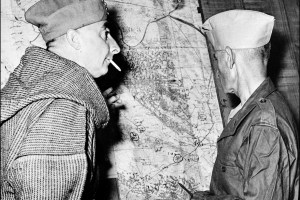 Forty years after the Vietnam phase of our eternal war ended we might want to go back another 30 years, to Saigon in September of 1945 when it all really began. What follows is from the diary of a war correspondent in French Indochina named Germaine Krull. The full diary ends with these words:
The Annamites [Vietnamese] will win their independence because they are ready to die for it … It may be too late already. We may never regain face, but if we do, it won’t be with the assistance of machine guns.
Mme Krull saw the future way back then, but the new American president didn’t. President Roosevelt had wanted to see the French colonies freed. Ho Chi Minh had even worked for the OSS during the war, and sought our friendship as it ended. But Harry Truman saw France as an ally in the struggle against communism, and so he chose the machine guns. Millions upon millions of people have paid the price ever since, as our insane eternal wars roll on.
I’m posting below the last few pages of Mme Krull’s fascinating accounts of Saigon in September of 1945. The full text is available here as a PDF.
***
Nothing in particular happened; there were still fewer Annamites to be seen on the streets and almost all of them had left their former jobs and masters. For the first time, French women were forced to do all their own work themselves, which did nothing to temper their feelings toward the Annamites. This mass desertion, reducing them temporarily to the rank of domestics themselves, was the one sin they could not forgive.
A few British officers and I went for lunch at the house of some wealthy colonials. It was a magnificent repast, complete with wines and champagne, pleasant conversation’ and immaculate service. The cooks and houseboys were Chinese. “Oh, we could not dream of employing Annamites. You can’t trust them. What a relief it will be finally to leave this wretched country. If only they would let us have a good, strong reprisal, everything would be over in a few days. This same sort of thing happened in 1942, but we put a swift end to it. The leaders were sentenced and most of the followers arrested — that was all. It is the only way to deal with people like that. Force is the only thing they understand. Everything else is useless.
“Colonel Cedil isn’t ruthless enough. We hear that General Gracey is worried because he doesn’t have enough troops. If so, why don’t they let us take over? We could muster enough arms and volunteers. We have ways of making them wish they had never started this. In 1942, I was in charge of re-establishing order at X. Well, we burned a few villages, jailed a few hundred natives, sentenced their leaders and that was all there was to that disturbance. Everything went back to order and the coolies went on working as before. They don’t want anything else. They expect that of us…”
An Australian journalist arrived by car from Hanoi with a permit from the Viet-Minh. He reported that: “Everything is all right in Hanoi. The people are well off and the French are safe. This movement is widespread, however, and the Annamites will fight for their freedom. Everything is in the hands of the Viet-Minh and is being well administered. There is no fighting or disorder. There are a few British there and one French correspondent who can’t do much. Ho Chi Minh is a wise and admirable old man. You should go there and see for yourself. There wasn’t a single incident on the road from Hanoi to Saigon. The whole way was clear and with a Viet-Minh permit, it was perfectly easy to get by the few Annamite posts.”
From time to time, an Annamite dwelling would burst into flame. Women and children were fleeing. That night, French soldiers strolled on the Rue Catinat, a gun on one arm, a woman on the other. I have never been so deeply ashamed as on that day of September 23rd. When I returned to the hotel the faces of the English were expressionless and conversations stopped as I went by. I remember the horror and shame I had felt in June of 1940 when Vichy was established, but never in my life had I felt such utter sadness and degradation as on this night.
These men, who were supposed to be the soldiers of France, this undisciplined horde whose laughing and singing I could hear from my window, corrupted by too many years in the tropics, too many women, too much opium and too many months of inactivity in camp, they were the ones to whom the task of re-establishing “order” I had been entrusted. That night I realized only too well what a serious mistake we had made and how grave the consequences would be. It was the beginning of a ruthless war. Instead of regaining our prestige we had lost it forever, and, worse still, we had lost the trust of the few remaining Annamites who believed in us. We had showed them that the new France was even more to be feared than the old one.
The last ten days in Saigon proved to me that the French population understood nothing of the situation and knew nothing of the outside world; that it consisted of people who would not tolerate the least infringement upon their comfort and who also were incredibly cowardly. Never have cause and effect been so closely linked. The events of the 22nd of September determined the issue of the conflict. Everything which happened thereafter can be directly traced to that date — women captured and mistreated, men and children assassinated, Dutch, English and American officers killed, shooting, burning factories, mysterious disappearances, all these and more happened. The French, terrorized by the lack of foresight and motivated by avarice, were unwilling to give up even one piaster. They are responsible for what happened.
The Annamites will win their independence because they are ready to die for it. We must recognize this inevitable fact — in a month, a year at the most, we will have to come to an agreement with them.
It may be too late already. We may never regain face, but if we do, it won’t be with the assistance of machine guns. The “good old days” are gone forever.
Saudi Arabia training tribal ground force in Yemen – report
RT | April 30, 2015
In order to break the stalemate in the ongoing conflict in Yemen, Saudi Arabia has reportedly started training hundreds of Yemeni tribesmen to fight the Houthis on the ground, while Riyadh continues its bombardment campaign.
“You cannot win a war against the Houthis from the air – you need to send ground forces in, but now there’s a program to train tribal fighters on the border,” a Doha-based military source familiar with the matter told Reuters.
According to another Yemeni official source, some 300 fighters have already managed to return to Yemen after getting Saudi training. They were allegedly sent to the Sirwah district in the central Marib province to battle Houthis in the area. According to the source the newly trained unit managed to push the Houthis back.
Saudi Arabia’s coalition spokesman failed to either confirm or deny the reports.
“We always confirm that we are helping the resistance and the popular groups, the loyal army … but we cannot go into details on where, how, how much,”Brigadier Ahmed Asseri said.
The training received by the Yemeni tribesmen in Saudi Arabia allegedly includes light weapons and tactical advice knowledge. According to another Reuters source, the Kingdom plans to boost deployment of such units to fight the Houthis resistance.
Rhiayad is reportedly gathering all tribal leaders loyal to the ousted president Abd-Rabbu Mansour Hadi, who fled to Saudi Arabia, to unite their tribal forces against those of the Houthis.
“Saudi Arabia wants to unite tribal leaders in this meeting but the feeling is that there’s not much hope for that,” a Yemeni source in Riyadh told Reuters. Apparently the tribal delegations seem more concerned battling the jihadi elements in Yemen in addition to the Houthi opposition.
“The Saudis have decided that they are going to intensify the unstable situation by providing arms to an oppositional group, a group that has been traditionally oppositional to the Houthis,” Ajamu Baraka, Middle East expert told RT.
On the ground in Yemen, the Shiite Houthi fighting force and army units loyal to former president Ali Abdullah Saleh are in control of central and southern areas.
The fighting is ongoing on a number of major fronts. In Aden, the Houthis are engaging tribesmen who are supported by Saudi-led air forces. In Yemen’s third largest city, Taiz, Houthis are fighting the Sunni Islamist fighters. The Houthis and their allies have been also fighting both Islamists and local tribesman in Marib and in Shabwa provinces.
The forces in Yemen which Saudi Arabia is arming can turn jihadi, Baraka says, as they have some “traditional, Whabis, Islamic leanings,” which is the “main ideological, Islamic foundation for Al Qaeda.”
“The only force that is gaining as a consequence of this conflict is in fact Al-Qaeda,” he went on to stress.
Meanwhile, the airstrikes continued throughout the country on Wednesday, targeting Houthi forces in Aden, Saada, Hajja, Taiz, Ibb and Bayda.
‘US funding of Sunni militia groups would further partition Iraq’
RT | April 29, 2015
The US is boosting its military support for security forces fighting against Islamic State in Iraq. The Republicans have proposed a bill to directly fund militia groups operating in the country, such as the Kurdish Peshmerga and Sunni irregular forces. If the bill is passed, tribal groups could receive up to $429 million in aid from the US.
The US Republicans’ proposal to fund Peshmerga and Sunni militias in Iraq, if approved, would entrench the country which is already partitioned by war, defense analyst Ivan Eland told RT.
RT: Do you think America’s funding of tribal security forces such as the Peshmerga might encourage further sectarian tension in such a volatile region?
Ivan Eland: Definitely. I think that’s true. Of course the US during its occupation was helping out the Peshmerga, so they were kind of undermining a unified Iraq even back then. But now Iraq basically is partitioned by war and I don’t think we can put it back together again. And so the Republicans are actually facing reality, but certainly this effort to fund individual militias will hasten the effort and entrench already partitioned Iraq.
RT: The bill also requires these security forces to be an independent entity from Iraq, so they can receive the aid separately from Iraqi national forces. What implications could that have on the US-Iraq partnership?
IE: The Republicans are unhappy with the Iraqi government’s dependence on Iran for training its Shia militias, and the Shia militias have been accused of some atrocities against Sunnis. The US doesn’t like Iranian influence in Iraq and so this bill says it funds the Peshmerga and other militias which would be Sunnis, but it also says that [if] the government of Iraq doesn’t [dis]associate itself with the Shia militias; they’ll give even more funds to the Peshmerga and other Sunni militias. So it doesn’t totally go away from the Iraqi government, but it puts a lot of pressure on them to dissociate themselves from the Shia militias which the Iraqi government probably is not going to do.
RT: If the bill does recognize these tribal security forces, they will gain a large amount of aid assigned for Baghdad. How will that affect the ability of Iraqi forces to counter Islamic State’s offensive?
IE: I think the Iraqi forces are already sort of a shell; they cut and ran when the ISIS forces attacked. The Iraqi government is depending on the Shia militias to defend them and they had the greatest role in the campaign to recapture Tikrit. The US Congress – if they pass this bill – will be asking the Iraqi government to remove the only reliable military force it has. The Iraqi armed forces are not reliable. And the Shia militias are the only groups that can adequately, even have a priority, of taking on ISIS.
RT: There are also reports of Kurds recruiting former US military members to fight the terrorist group. Apparently, a dozen Americans have already joined their ranks. What do you think about that?
IE: This may be the US government giving a wink and a nod to this without officially sanctioning it because they want to shore up the Peshmerga against the ISIS fighters and the administration doesn’t really want to do this. Most probably – what the Republicans are suggesting – giving direct aid – because of course implications can lead to the breakup of Iraq officially. Iraq is already broken up on the ground but the administration probably doesn’t want to encourage officially supporting the Peshmerga. So this could be a way of winking and nodding to get more expertise and to help them fight ISIS.
Baltimore and the Human Right to Resistance: Rejecting the framework of the Oppressor
By Ajamu Baraka | Black Agenda Report | April 29, 2015
Anti-Black racism, always just beneath the surface of polite racial discourse in the U.S., has exploded in reaction to the resistance of black youth to another brutal murder by the agents of this racist, settler-colonialist state. With the resistance, the focus shifted from the brutal murder of Freddie Gray and the systematic state violence that historically has been deployed to control and contain the black population in the colonized urban zones of North America, to the forms of resistance by African Americans to the trauma of ongoing state violence.
The narrative being advanced by corporate media spokespeople gives the impression that the resistance has no rational basis. The impression being established is that this is just another manifestation of the irrationality of non-European people – in particular, Black people – and how they are prone to violence. This is the classic colonial projection employed by all white supremacist settler states, from the U.S., to South Africa and Israel.
The accompanying narrative is that any kind of resistance that does not fit the narrow definition of “non-violent” resistance is illegitimate violence and, therefore, counter-productive because – “violence doesn’t accomplish anything.” Not only does this position falsely equate resistance to oppression as being morally equivalent to the violence of the oppressor, it also attempts to erase the role of violence as being fundamental to the U.S. colonial project.
The history of colonial conquest saw the U.S. settler state shoot and murder its’ way across the land mass of what became the U.S. in the process of stealing indigenous land to expand the racist White republic from “sea to shining sea.” And the marginalization of the role of violence certainly does not reflect the values of the Obama administration that dutifully implements the bi-partisan dictates of the U.S. strategy of full spectrum dominance that privileges military power and oppressive violence to protect and advance U.S. global supremacy. The destruction of Libya; the re-invasion of Iraq; the civil war in Syria; Obama’s continued war in Afghanistan; the pathological assault by Israel on Palestinians in Gaza and the U.S. supported attack on Yemen by the Saudi dictatorship, are just a few of the horrific consequences of this criminal doctrine.
Race and oppressive violence has always been at the center of the racist colonial project that is the U.S. It is only when the oppressed resist — when we decide, like Malcolm X said, that we must fight for our human rights — that we are counseled to be like Dr. King, including by war mongers like Barack Obama. However, resistance to oppression is a right that the oppressed claim for themselves. It does not matter if it is sanctioned by the oppressor state, because that state has no legitimacy.
No rational person exalts violence and the loss of life. But violence is structured into the everyday institutional practices of all oppressive societies. It is the deliberate de-humanization of the person in order to turn them into a ‘thing’ — a process Dr. King called “thing-afication.” It is a necessary process for the oppressor in order to more effectively control and exploit. Resistance, informed by the conscious understanding of the equal humanity of all people, reverses this process of de-humanization. Struggle and resistance are the highest expressions of the collective demand for people-centered human rights – human rights defined and in the service of the people and not governments and middle-class lawyers.
That resistance may look chaotic at this point – spontaneous resistance almost always looks like that. But since the internal logic of neoliberal capital is incapable of resolving the contradiction that it created, expect more repression and more resistance that will eventually take a higher form of organization and permanence. In the meantime, we are watching to see who aligns with us or the racist state.
The contradictions of the colonial/capitalist system in its current expression of neoliberalism have obstructed the creation of decent, humane societies in which all people are valued and have democratic and human rights. What we are witnessing in the U.S. is a confirmation that neoliberal capitalism has created what Chris Hedges called “sacrificial zones” in which large numbers of black and Latino people have been confined and written off as disposable by the system. It is in those zones that we find the escalation of repressive violence by the militarized police forces. And it is in those zones where the people are deciding to fight back and take control of their communities and lives.
These are defining times for all those who give verbal support to anti-racist struggles and transformative politics. For many of our young white comrades, people of color and even some black ones who were too young to have lived through the last period of intensified struggle in the 1960s and ‘70s and have not understood the centrality of African American resistance to the historical social struggles in the U.S., it may be a little disconcerting to see the emergence of resistance that is not dependent on and validated by white folks or anyone else.”
The repression will continue, and so will the resistance. The fact that the resistance emerged in a so-called black city provides some complications, but those are rich and welcoming because they provide an opportunity to highlight one of the defining elements that will serve as a line of demarcation in the African American community – the issue of class. We are going to see a vicious ideological assault by the black middle class, probably led by their champion – Barack Obama – over the next few days. Yet the events over the last year are making it more difficult for these middle-class forces to distort and confuse the issue of their class collaboration with the white supremacist capitalist/colonialist patriarchy. The battle lines are being drawn; the only question that people must ask themselves is which side they’ll be on.
Missile Defense Agency Spent $10 Billion on 4 Projects that were Cancelled
By Noel Brinkerhoff | AllGov | April 29, 2015
The Department of Defense started, then discarded, four massive missile defense projects, wasting $10 billion on technology that wasn’t capable of protecting the United States from foreign attack.
An investigation by the Los Angeles Times identified four programs developed by the Missile Defense Agency (MDA) that did not work as advertised:
The Sea-Based X-Band Radar (SBX), an enormous floating radar ship, was supposed to be able to detect even tiny incoming objects into U.S. airspace from thousands of miles away. SBX, built by Boeing and Raytheon, was going to guide rocket interceptors to enemy ballistic missiles before they could reach U.S. soil. But after a $2.2 billion investment, MDA realized SBX couldn’t distinguish between missiles and decoys. The technology has been mothballed at Pearl Harbor in Hawaii.
The Airborne Laser was going to allow the U.S. to blast enemy missiles using lasers mounted on converted Boeing 747s. But it turned out the lasers couldn’t be fired from long distance, requiring the planes to fly so close to an enemy country that they would be vulnerable to being shot down. So the MDA shut down the project, which cost $5.3 billion, according to the Times’ David Willman.
The Kinetic Energy Interceptor was a rocket that was supposed to be fired from land or from a ship to intercept enemy missiles during their boost phase. However, the interceptor didn’t fit on ships and didn’t have the necessary range to be fired from land. After six years of development and $1.7 billion of investment, the program ended. “No matter how successful tests might one day have been, the system would have had negligible utility,” a National Academy of Sciences review panel said.
The Multiple Kill Vehicle, a cluster of small interceptors that could take out enemy warheads and decoys, never even got a test flight. It burned through nearly $700 million.
“You can spend an awful lot of money and end up with nothing,” Mike Corbett, a retired Air Force colonel who oversaw the agency’s contracting for weapons systems from 2006 to 2009, told the Times. “MDA spent billions and billions on these programs that didn’t lead anywhere.”
Another retired officer, Air Force Gen. Eugene E. Habiger, former head of the U.S. Strategic Command and a member of a National Academy panel that reviewed MDA’s missteps, said the agency failed to analyze alternatives or seek independent cost estimates. Or, as he put it: “They are totally off in la-la land.”
To Learn More:
The Pentagon’s $10-Billion Bet Gone Bad (by David Willman, Los Angeles Times )
Another Missile Defense Test, Another Failure (by Matt Bewig, AllGov )
Reagan’s Star Wars Program…More than $200 Billion Later (by Noel Brinkerhoff, AllGov )
Congress Coughs up $300 Million to Extend Work on Useless Nuclear Waste Plant
By Noel Brinkerhoff and Steve Straehley | AllGov | April 29, 2015
What’s $300 million when a project could end up consuming more than $50 billion over its lifetime? That’s what Congress seems to have said about one of the greatest boondoggles by the Department of Energy (DOE): the Mixed Oxide Fuel Fabrication Facility (MOX).
MOX was conceived more than a decade ago, when the U.S. and Russia were working on converting plutonium into mixed oxide fuel that could be used in commercial nuclear power plants.
The DOE first said it would cost $1.6 billion to build the MOX at the Savannah River Site in South Carolina, which was supposed to open in 2007. It’s now 2015 and the plant is still only 65% complete. The final cost of just building the MOX is projected to be $7.7 billion, according to the Government Accountability Office. A study by The Aerospace Corporation also pointed out that the life-cycle cost of the facility will be $47.5 billion, according to the Project on Government Oversight (POGO).
That’s assuming there would be any reason to operate it because the deal with Russia is now over, and there are no other customers lined up to bring their unwanted plutonium to have it converted.
The project has its critics. Rep. Jim Cooper (D-Tenn.) called the continued funding of the MOX facility a “zombie earmark.” DOE officials are so fed up with the project that they were ready to put it on “cold-standby”—in other words, shut it down.
But backers in Congress, including Sen. Lindsay Graham (R-South Carolina), made sure there was $300 million in the 2014 year-end spending bill for MOX. They even prohibited the Energy Department from using the money to put MOX in cold standby.
Aerospace Corporation’s assessment was based on $500 million per year being appropriated to the project. With the lesser number, it ends up costing more: a life-cycle cost of $114 billion and a completion date of 2100, POGO reported.
What a thoughtful gift for our grandchildren!
To Learn More:
Cost Estimate on Useless Nuclear Facility Skyrockets (Project on Government Oversight)
Energy Dept. Gives up on Expensive Nuclear Waste Plant (by Noel Brinkerhoff, AllGov )
Cleanup of Radioactive Bomb Waste in South Carolina: The Endless Project (by Noel Brinkerhoff, AllGov )
The Government Project that is $6 Billion Over Budget and 10 Years Late (by Matt Bewig, AllGov )
Featured Video
No Vote, No Representation, No State: Democracy, Israeli Style
or go to
Aletho News Archives – Video-Images
From the Archives
Sanctions, War and the Policy of Dual Containment
By SASAN FAYAZMANESH | March 17, 2008
It is now nearly three decades since the Unites States adopted the policy of dual containment of Iran and Iraq. While much has been written about the containment of Iraq, there has been very little in-depth analysis of this policy when it comes to Iran. In a book that is going to be released on March 31, 2008, entitled The United States and Iran: Sanctions, Wars and the Policy of Dual Containment (Routledge), I attempt to address this shortcoming by investigating when and why the US policy of containment of Iran came about, how it evolved, and where it stands today.[1] To the extent that Israel has been involved in US policy making, the study will also include the role that Israel has played in the containment of Iran. Also, since the fate of Iran has been inextricably linked to that of Iraq, occasionally the investigation will overlap with the containment of Iraq.
The policy of dual containment of Iran and Iraq originated during the Carter Administration, but it was not until the Clinton Administration that the expression “dual containment” became popular. … continue
Blog Roll
 Aletho News
- Elmo Sold mRNA Jabs to Your Toddler. Now They Are “Off-Label.”
- British state targets Palestine Action with yet another crooked trial
- Americans are paying the price to preserve Israel’s nuclear hegemony
- Resistance factions are necessary to ensure a permanent US Iraq withdrawal
- How Israel destabilizes the Middle East: Denying sovereignty and the right to exist
- Europe’s Establishment Is Embracing War – and Losing Voters
- NATO chief advocates war of aggression
- No Vote, No Representation, No State: Democracy, Israeli Style
- Zionist Bought Senate Blocks Information About American Citizens Killed By Israel
- While Gaza dominates the UN, these are the people keeping it alive
- If Americans Knew
- Israeli Soldiers Abduct At Least 22 Across Occupied West Bank
- Eight Palestinians Killed in Israeli Attacks on Gaza
- Israeli former leaders and security chiefs threaten legal action over ‘Jewish terrorism’
- Israel map in LA Times ad includes all land from the river to the sea
- Inside Lebanon’s 200-page dossier on Israeli war crimes
- Flydubai, genocide, settler violence, Trump abuse of power to deport – Daily Update
- Counting Antisemitic Incidents: What the ADL Audit Reveals — and Obscures
- Mamdani releases plan to combat antisemitism and hate crimes in New York City
- Iran’s Revolutionary Guards Publish Letter to the American People
- DMFI launches $1 million ad campaign supporting Virginia’s Elaine Luria
- No Tricks Zone
- Green Energy Debacle: German Expert Professor Fritz Vahrenholt Warns Of Severe Economic And Social Consequences
- Two More Paleo Reconstructions Affirm Meters-Higher Sea Levels Across Ireland, Brazil 7000-6000 Years Ago
- New Study: Earth And Venus Surface Warmth Largely Explained By Convection And Lapse Rate, Not CO2 Or Radiation
- 2025 Nature Paper Claiming Worsening Global Drought Gets RETRACTED …Heavily Flawed
- New Study: ‘Global Drought Shows No Detectable Recent Acceleration Under Climate Warming’
- Economic Masterminds: German Socialists Suggest Taxing Productivity Gains Stemming From Using AI
- The South China Sea Has Not Been Cooperating With The Climate Change Narrative
- Energy Crisis: Germany Enters Heating Season With Historically Low Gas Reserve Fill Levels
- New Study: The Antarctic Ice Sheet Gained Mass From 2020-2024 Due To Staggering Snow And Ice Accumulation
- Study: Ocean Heating Rates From Thousands Of Years Ago ‘Dwarf’ Modern Ocean Heating Rates

