Navajo Nation struggles with fallout from uranium mining
RT | May 9, 2015

Waste outside an abandoned uranium mine on the Navajo Nation, Cameron, Arizona (Image from ehp.niehs.nih.gov)
As part of a cleanup settlement, the US will pay out more than $13 million to start dealing with hundreds of abandoned uranium mines on Navajo Nation territory. Navajo officials tell RT it is just the first step on a long road ahead.
The money will be put into an “environmental response trust” managed by the Navajo Nation with the support of the US Environmental Protection Agency (EPA), according to the US Department of Justice (DOJ).
“It will provide us with funding to do a very specific task under the cleanup process that’s authorized by the federal superfund law,” Stephen Etsitty, executive director of the Navajo Nation’s EPA, told RT’s Ben Swann.
The funds will cover evaluations of 16 abandoned mines throughout Navajo lands, chosen from a list of 46 priority sites. There are hundreds of sites that still need to be addressed. By one estimate, there are more than 1,200 abandoned uranium mines within the borders of the Navajo Nation, a 27,000-square-mile territory stretching across Utah, New Mexico and Arizona.
The EPA says it has repaired 34 homes, surveyed 521 mines, compiled a list of 46 priority sites for cleanup, and performed stabilization or cleanup work at nine mines so far. The agency has also provided safe drinking water to more than 1,800 families.
A 2014 settlement set aside $985 million from a multi-billion dollar settlement with subsidiaries of Anadarko Petroleum Corp to clean up approximately 50 abandoned Kerr-McGee mining operations in the Navajo Nation.
Federal surveyors found rich uranium deposits on Navajo lands in the 1940s, and the government authorized private contractors to extract the ore for US weapons and energy needs. About 4 million tons of uranium ore were extracted from the area between 1944 and 1986, after which the mining was halted. The federal government, through the Atomic Energy Commission, was the sole purchaser of the ore until 1966.
Navajo miners worked without any kind of protective gear or decontamination protocols for wages sometimes less than $1 an hour. In her 2011 book, Yellow Dirt: A Poisoned Land and a People Betrayed, journalist Judy Pasternak wrote that the miners suffered radiation exposure four times that of the Japanese exposed to nuclear bombs during World War II.
In the 1950s, cancer rates among the Navajos were so low, they were thought naturally immune, wrote environmental journalist Sonia Luokkala. By 2004, cancer had become the leading cause of illness and death among the Navajo.
A 2014 survey by the EPA of about 500 abandoned mines found radiation levels up to 25 times higher than normal. Many of the mines with the highest radiation levels were found within a quarter mile of human habitation.
“Chronic exposure is definitely one thing we want to get a better understanding of,” Etsitty told RT. Many of the Navajo live in the remote areas of the reservation, often close to the abandoned mining pits that have since filled up with water. Humans and animals drink the water from the pits, often not aware of the possible issues with radiation or toxicity.
“We still have not completed meaningful public health studies to begin answering those questions,” Etsitty said. The DOJ settlement should offer a little bit of help in the process, but merely surveying the extent of the contamination and environmental impact will take much more money and time.
Hillary Clinton’s Dirty Money
By ROBERT FANTINA | CounterPunch | May 8, 2015
As she bulldozes her way to the Democratic presidential nomination, former First Lady, New York Senator and Secretary of State Hillary Clinton is leaving no gold nugget unturned as she finances her campaign. Having amassed a wide variety of very wealthy friends throughout the global community, she is in an excellent position to call in favors and promise new ones in return for their financial assistance, as she purchases a four-year lease on the most exclusive real estate in the world.
One recent donation, not directly to her campaign, that has raised some eyebrows, although not in Democratic circles, where Mrs. Clinton, who has done little right can do nothing wrong, is money the Clinton Foundation accepted from a company owned by the government of Morocco. One might ask what the problem with such a donation might be. Cannot a foreign government donate funds to a charitable organization based in the United States?
Unfortunately, it isn’t quite as simple as that. This is not the American Red Cross we are talking about, but an organization operated by one of the most politically active and connected families in U.S. history. As late as 2011, when Mrs. Clinton was Secretary of State, the State Department accused the government of Morocco of ‘arbitrary arrests and corruption in all branches of government’. Now, we could discuss the concept of the kettle calling the pot black in terms of government corruption, but we’ll leave that for a later essay. Let’s look at some detail from the State Department report:
“The most significant, continuing human rights problems were the lack of citizens’ right to change the constitutional provisions establishing the country’s monarchical form of government, arbitrary arrests, and corruption in all branches of government.
“Other human rights problems reported during the year included police use of excessive force to quell peaceful protests, resulting in dozens of injuries and at least four deaths; torture and other abuses by the security forces; incommunicado detention; poor prison and detention conditions; political prisoners and detainees; infringement of freedom of the press; lack of freedom of assembly; lack of independence of the judiciary; discrimination against women and girls; trafficking in persons; and child labor, particularly in the informal sector.”
Following the announcement of the $1 million donation from the government-owned Office Cherifien des Phosphates (OCP), Mrs. Clinton announced that the money would be used to sponsor a conference for the Clinton Foundation in Marrakech. She called Morocco “a vital hub for economic and cultural exchange”, eliminating any mention of political prisoners, police violence or human trafficking. Might that sum of money have been sufficient to blind the former Secretary of State to facts she was aware of when she had that job?

The donation was made, and the conference announced, prior to Mrs. Clinton’s long-expected declaration of candidacy for president. But still one wonders what possible benefit there could be for the OCP in making this donation? Is this anything more than a sincere desire to help those who might benefit from the Clinton Foundation largesse?
Well, yes, there may be another beneficiary. The OCP is involved in the extraction of mineral resources from the Western Sahara, disputed territory often referred to as the ‘last colony in Africa’, that Morocco controls. It is illegal under international law for an occupying or controlling power to extract for profit the natural resources of the country in dispute. The OCP is owned by the Moroccan government. The U.S. has a long history of allowing occupying powers to exploit, in violation of international law, the natural resources of their victims: note Israel’s extraction of resources from the Dead Sea. The money that the American Israel Political Affairs Committee (AIPAC) funnels to U.S. politicians is sufficient to cause the U.S. to look the other way; there is no equivalent lobby group representing Morocco, so perhaps this donation will suffice.
Money talks in U.S. governance. The same State Department report that detailed Moroccan abuses also commented on Israel. The influence of AIPAC is clear in these so-called ‘findings’:
* “The law prohibits arbitrary arrest and detention, and the government generally observed these prohibitions for all citizens.” This, despite the almost constant arrests without charge and detention of countless Palestinian men, women and children, both in Palestine and those living in Israel.
* “Criminal suspects are apprehended with warrants based on sufficient evidence and issued by an authorized official. Authorities generally informed such persons promptly of charges against them.” See above.
* “Defendants enjoy the right to presumption of innocence and the right to consult with an attorney, or if indigent, to have one provided at public expense.” This, of course, does not apply to Palestinians.
* “Arbitrary Interference with Privacy, Family, Home, or Correspondence. The law prohibits such actions, and the government generally respected those prohibitions in practice.” Israel Defense Forces (IDF; read: Terrorists) break into Palestinian homes at any time of the day or night, search the homes, steal valuables and generally terrorize the residents. Palestinian homes are arbitrarily bulldozed to make room for illegal and internationally-condemned settlements.
The list goes on, but this should suffice to indicate the degree to which money runs roughshod over human rights in U.S. governance. One thinks that the executives of the OCP can now sleep peacefully, confident that there will be no U.S. interference in their rape of the Western Sahara.
What other foreign governments may see benefit to themselves in a future Hillary Clinton presidency? Since the U.S. is always ready to invade a nation that displeases it, often by some perceived threat to U.S. economic dominance, one would think that most nations will be running to Mrs. Clinton with checkbook in hand, wanting to please the fairy queen and appease the economic gods so worshiped by the U.S. Additionally, such homage would enable them to ignore human rights and exploit the poor for the benefit of the rich, without the U.S. complaining about such abuses. And who will the presumptive Democratic nominee turn away? Anyone? After all, with an alleged target of $2 billion dollars for her campaign, there really are no human rights abuses that can’t be overlooked. Perhaps Syria will make a substantial donation, and thus end U.S. aggression against it.
But are there not built-in protections against this sort of thing, government ‘watchdogs’, if you will, to assure that no such collusion exists? In an article published in The New York Times on May 3, Federal Election Commission (FEC) chairwoman Ann M. Ravel said that “…her organization is powerless to safeguard against misconduct in 2016 presidential campaign fundraising and spending”, mainly due to partisan gridlock. So no, there is nothing to stop Mrs. Clinton, and any and all other candidates, from taking donations from whomever and wherever those donations are offered. And it is unlikely that any of those proffering untold amounts of money have the best interest of the common U.S. citizen at heart. No, they will be foreign governments who wish to begin or continue the exploitation of oppressed people without interference from the U.S., or domestic corporations seeking to continue the vast profits their shareholders earn from war, or from manufacturing products with limited safety or environmental restrictions.
As each presidential election approaches, pundits from the right and left proclaim that this is the most important in the history of the U.S., and that the very survival of the country depends on the outcome. Yet following each election, the nation does not implode in a ball of flames, but continues on, mainly with business as usual. That business is war, disregard for human rights at home and abroad and the worship of the almighty dollar. Mrs. Clinton will usher in no change; her every action speaks volumes to that fact.
Robert Fantina’s latest book is Empire, Racism and Genocide: a History of US Foreign Policy (Red Pill Press).
Saudi Arabia’s Attack on Yemen
By RANNIE AMIRI | CounterPunch | May 8, 2015
The Saudi regime is notoriously adept at funding wars, but exceptionally poor at fighting them.
On March 25, a massive aerial bombing campaign began against Zaidi Houthi rebels who had recently assumed control of Yemen’s capital and forced its U.S. and Saudi-backed president, Abd Rabbuh Mansour Hadi, to flee first to the southern port city of Aden and then to Riyadh.
This is the second Saudi attack on Yemen—the Arab world’s poorest country bordering one of its richest—in less than six years. “Operation Scorched Earth” was launched by the Yemeni government against the Houthis in August 2009. In November of that year, Saudi troops amassed on the border and began shelling Saada governorate in northwest Yemen where the rebels were based.
The Saudi offensive created tens of thousands of internally displaced civilians, teeming refugee camps and rampant malnutrition. The Houthis, in the face of overwhelming firepower and far worse off in 2009 than today, nevertheless kept Saudi troops at bay and inflicted higher than expected causalities on their forces. Six years later and with nearly all Arab countries aligned against them, they are doing so again.
To put Yemen’s current predicament in context some background history is helpful.
The Zaidi Shia form at least a quarter of Yemen’s population and are concentrated in the north of the country. This area was once ruled by Hashimite Zaidis (those descended from the line of the Prophet Muhammad) for more than 1,000 years until they were overthrown in 1962 by an alliance of nationalist military officers who then founded the Yemen Arab Republic. Zaidi Muslims are nominally categorized as Shia Muslims although they are actually closer to the Sunni schools of jurisprudence.
The rebels were first led by Zaidi cleric Hussein Badr al-Din al-Houthi—from whom the Houthis derive their name—and his Shabab al-Momineen group who fought the government of President Ali Abdullah Saleh. Their dispute dates to June 2004 when Saleh, the Saudi-backed strongman, charged the Houthis with sedition and claimed their true aim was to revive Zaidi Shia Imamate rule deposed four decades earlier. For their part, the Houthis sought to reverse the systemic political and socioeconomic marginalization their community faced as well as stem the rise of Salafi/Wahabi ideology and the al-Qaeda presence it fostered, both of which had gained an increasing foothold in the country.
Hussein al-Houthi was killed by the army in September 2004 and his brother, Abdul Malik assumed leadership. He now leads the Houthi movement under the group Ansarullah. Worried that the Houthis could transform into a Hezbollah-like organization, the Saudis attacked in 2009. Then, as now, this was done with U.S.-supplied advanced weaponry including surface-to-air missiles, Apache attack helicopters and Phantom jet fighters. Despite their sophisticated arms, Saudi Arabia lost an unusually high number of soldiers in the campaign.
The Houthis persevered; their resilience and desire for equitable representation in government led Saudi Arabia and a coalition of Gulf Cooperation Countries (with the exception of Oman) to attack in March of this year when “Operation Decisive Storm” began. Predictably, its pretext was the tired canard of curbing Iranian influence in the Arabian Peninsula. Direct, material support for the Houthis by Iran has never been clearly demonstrated however.
The real motive for the assault and the process it intended to disrupt was revealed by former U.N. envoy Jamal Benomar in an April interview with the Wall Street Journal. Benomar remarks, “When this campaign started, one thing that was significant but went unnoticed is that the Yemenis were close to a deal that would institute power-sharing with all sides, including the Houthis.”
The Saudi offensive led by the young defense minister and newly-appointed deputy crown prince, Muhammad bin Salman, has again exacted a tremendous humanitarian toll: 1,200 killed and more than a quarter of a million people displaced. In 2009, the Saudis were accused of using white phosphorus (as the Israelis had been in their wars on Gaza). Today, they are charged with using cluster bombs (as the Israelis had been in their wars on Lebanon). Human Rights Watch said in a statement, “Credible evidence indicates that the Saudi-led coalition used banned cluster munitions supplied by the United States in air strikes against the Houthi forces.”
Even after all tools of war were placed at their disposal by the West, the House of Saud still pleaded with Pakistan to send (Sunni-only) troops to fight for them. The regime has blockaded the port at Aden and has even resorted to bombing Sanaa’s airport to prevent the delivery of needed relief supplies.
All of these measures have failed to halt the Houthi advance.
Only a political solution will end Yemen’s bloodshed. The GCC though prefers to frame the conflict as an existential one pitting Arabs against Iranians, Sunnis versus Shias. This serves to stoke the sectarian flames already engulfing the region and makes a practical resolution near impossible.
The war has been a disaster for the Yemeni people from the start, both politically and on the most basic humanitarian level. Al-Qaeda now has the potential to flourish as Yemenis are pitted against one another based on sect; the possibility of a just compromise and representative government without Saudi Arabia’s hand-picked man at the helm well forestalled.
Will the Saudi regime find themselves in a military quagmire? The Houthis show no sign of withering under relentless bombing. Or is a decisive ground invasion in the works? There are early signs this may yet occur. But as in Iraq and Syria, the monarchy appears content with the status quo, ensuring chaos, instability and sectarianism prevail.
US policies could deadlock nuclear disarmament – Russian Foreign Ministry

RT | May 7, 2015
Washington’s current course in relations with Moscow could prevent any resolution of urgent problems in bilateral relations, including nuclear disarmament, the Russian Foreign Ministry warns.
“The White House’s line on aggravation the relations with Russia threatens to lead the whole complex of sensible issues on the modern bilateral agenda to a dead end,” reads the annual review of the foreign policy and diplomatic activities for 2014 that was published on the ministry’s website on Thursday.
“The discussion of such pressing issues has become sporadic and non-systematic,” the document reads.
Russian diplomats emphasized that the plans of the United States and its allies to deploy the global missile defense system is one of the typical examples of such hostile approach.
“Practical discussion of how Russian worries can be eased was curtailed at the initiative of the US. Now we are forced to develop adequate countermeasures,” the ministry wrote.
“In addition, when [President] Barack Obama’s administration promoted further cuts in the Russian and US nuclear arsenals, it completely ignored Russian arguments that other states with nuclear potential should be included in this process,” the report reads.
The Russian side noted that the United States continued to implement its concept of immediate global strike that uses conventional strategic weapons and continued to avoid making any concrete statements regarding their refusal to deploy weapons in space.
The released plans to beef up US and NATO military presence near Russian borders pose direct risks of a shift of the European balance of forces, the report states.
In late April, President Vladimir Putin stated that Russia had brought its nuclear arsenal to the minimum ordered by the Non-Proliferation Treaty and plans to continue work in this direction.
“We have reduced our nuclear weapons stockpiles to minimal levels, thereby making a considerable contribution to the process of comprehensive and complete disarmament,” Putin wrote in his address to the international conference on nuclear non-proliferation.
He also emphasized Russia’s commitment to Article VI of the treaty, which states that each party “undertakes to pursue negotiations in good faith,” and agrees to disarmament “under strict and effective international control.”
In mid-January the head of the Russian Foreign Ministry’s Security and Disarmament Department, Mikhail Ulyanov, said unfriendliness by the US could cause Moscow to review its approach to the New START agreement on cutting nuclear weapons and their delivery.
“So far we have not taken any particular steps in this direction, but I cannot exclude that in the future Washington will force us into taking them, into making corrections to our policies regarding this direction,” he stated in a press interview. “This would only be natural, considering the unfriendly character of the US actions.”
Read more: Preemptive nuclear strike omitted from Russia’s new military doctrine – reports
Phantom Russian Sub Hunts Gave Birth To NATO’s Viking Bloc
By Andrew KORYBKO | Oriental Review | May 5, 2015
The largely unobservant public had previously been under the impression that the Baltic Sea was a zone of peace and stability, thinking that all the region’s states lived in harmony with one another. This may have been the case prior to 1991, but immediately afterwards, NATO’s expansion into the Baltic basin seriously upset the balance of power, as the incorporation of Poland and the former Soviet Baltic States in 1999 and 2004 attests. Through this manner, NATO was able to surround Kaliningrad and directly push up against part of Russia’s western border.
The military tension remained just below the surface (literally), until Shadow NATO states Sweden and Finland started initiating highly publicized ‘Russian sub’ scares, designed with the sole intent of scaring their publics into formal NATO membership and opening up an additional front in the New Cold War. Taking it further, this is all part of NATO’s new policy of regional blocs, as Brussels hopes to see the formation of a ‘Viking Bloc’ that would apply pressure against Russia in the Arctic. The most dangerous development, however, is with Finland, which is capitalizing off of the sea scare to call up nearly one million reservists (1/5 of the total population) in the event of a “crisis situation”, thereby presenting a dangerous test run in conflict escalation that might be applied all over Europe in the future.
Regional Hysteria
To put everything into focus, it’s best to begin by documenting the latest hysteria stemming from supposed ‘Russian sub’ sightings. Sweden started the trend when it claimed to be hunting a believed-to-be Russian sub back in October, and when nothing came out of the stunt except for a scared public and a couple million dollars spent, Stockholm continued to insist that it had evidence that a foreign sub did trespass through its waters, but curiously kept the details to itself. Be that as it may, it didn’t stop legislators from increasing the defense budget by a whopping $1.18 billion for the period 2016-2020, earmarking an additional $945 million for the future purchase of two subs, and announcing plans to reopen a military base on the Baltic island of Gottland. The ultimate irony is that there was never a ‘Russian sub’ to begin with, and that it was eventually revealed that the whole scandal started over a simple workboat, thus making it seem like Sweden exaggerated the situation simply to push through more defense funding and militarize its society against Russia.
 Being the regional leader that it is, it appears as though Sweden’s spectacle of the phantom Russian sub rubbed off on Finland, which soon after its latest elections began detonating underwater charges against its own suspected ‘Russian sub’. Finnish political analyst Jon Hellevig assessed that this was simply Helsinki’s application of Stockholm’s decades-long tactic of using phantom Russian subs to increase the population’s acceptance of future NATO membership. While Finland isn’t a de-jure member of the alliance, both it and Scandinavian military hegemon Sweden signed a NATO host nation agreement last fall to intensify their relations with the bloc, essentially making them Shadow NATO members in an even deeper capacity than Ukraine has become (the latter of which has been the bone of contention sparking the New Cold War in the first place).
Given such a relationship, it may not even be needed for either state to formally join NATO at this point, since the alliance can already reap the resultant military advantages of their territory in any possible anti-Russian crisis scenario. However, putting the provocative issue up for a referendum vote or making a unilateral government decision in this regard might be a forthcoming tactic towards creating the aforementioned crisis needed to ‘justify’ the indefinite hosting of NATO troops in those countries. It’s quite clear that Sweden is already de-facto participating in NATO, since they just partook in the group’s “Dynamic Mongoose” anti-submarine drills off the Norwegian coast. This would have obviously raised eyebrows among its domestic citizenry had it not been for the earlier ‘Russian sub’ scare that created the social pretext for its acceptance, showing how such false crises can be manipulated by the media for predetermined military gain.
The Viking Bloc
Everything going on in Scandinavia right now, from the phantom ‘Russian sub’ scares to the de-facto NATO-ization of the region’s last formal holdouts, is designed to create the northern component of NATO’s regional bloc strategy. In sum, the alliance is reverting to history and using Polish interwar leader Josef Pilsudski’s Intermarum concept to establish a Baltic-to-Black-Sea coalition of anti-Russian states to which it can more efficiently outsource its military prerogatives, all per the Lead From Behind strategy. The ‘Viking Bloc’ which consists of the Greater Scandinavian states of Sweden, Norway, Denmark, Iceland, and Finland (centered on Sweden, possibly incorporating Estonia and Latvia as well) is envisioned to complement the emerging Commonwealth Bloc of Poland, Lithuania, and Ukraine (centered on Poland), and the forthcoming Black Sea Bloc of Romania, Bulgaria, and Moldova (centered on Romania, possibly even expanded to Georgia).
Focusing more specifically on the characteristics of the Viking Bloc, its members have a maritime identity, so it’s predicted that they’ll focus their activity on the Baltic Sea, North Sea, and Arctic Ocean, accordingly making them all one large naval base. Sweden’s demographic and economic strength makes it the obvious leader amongst the identified members and the control node of its activity, while wealthy Norway can provide the natural resources needed to keep it running. Denmark controls the entrance to and from the Baltic Sea, and together with its colony country of Greenland, Iceland, and Norway, the three can patrol the North Sea and Arctic Ocean in hunting ‘Russian subs’. It’s also not a coincidence that all of these states are members of the Arctic Council, meaning that this dialogue configuration has essentially become one of confrontation between North America & the Viking Bloc on one side and Russia on the other. The odd member out of this naval configuration is Finland (also a member of the Arctic Council), which has recklessly adapted a land-based anti-Russian policy that’s bound to ratchet up tension with its neighbor. One should also note that the Viking Bloc’s members signed a multilateral defense cooperation agreement in April that basically institutionalized the organization as an official regional bloc.
The Finnish Amphibian
The most dangerous sub-bloc strategy being adopted by NATO is its Finnish affiliate’s advance preparation of 900,000 reservists in the event of a “crisis situation”, which obviously could only refer to a military conflict with Russia. The Finnish government is trying to account for all of its former reservists aged 20-60 in order to inform them of what their “crisis situation” role would be, as well as to collect updated information about them. This dramatic movement of anti-Russian initiatives from sea onto land represents an amphibious strategy that’s likely only in its initial test-run phase. NATO wants to gauge Russia’s reaction and monitor its response in order to fine-tune this template for eventually export throughout the bloc as a whole.
The Finnish Amphibian is a very simple strategy. All that the practicing states or regional blocs have to do is report on a phantom ‘Russian sub’ sighting, preferably with as much media paranoia as possible but providing no proof whatsoever, and then use the subsequent buzz to justify the potential mobilization of a massive land-based reservist force. This leads to the militarization of society within the targeted state and initiates a siege mentality that makes its citizens feel as though they’re constantly under some type of Russian attack. None of the accusations have to be proven, let alone even seen by the citizens themselves, so long as the media and supportive political figures repeat the chorus of conflict enough to make it believable. An added touch would be to implement Sweden’s strategy of publicly accusing 1/3 of all Russian diplomats there as being spies, which when coupled with the existing paranoia about phantom ‘Russian subs’, sends the populace’s paranoia into overdrive and all but assures that they’ll support whichever military or surveillance solutions their government or NATO suggests.
Concluding Thoughts
NATO’s northernmost regional fighting group, the Viking Bloc, owes its speedy creation to the utilization of phantom ‘Russian sub’ scare tactics to galvanize support for this new initiative. Greater Scandinavia is rapidly being transformed into one giant NATO naval base that’s meant to confront Russia on the neighboring high seas. As destabilizing as that is, it moves into the realm of flashpoint danger with the fact that Finland is preparing to mobilize 1/5 of its population against Russia, thus presenting an amphibious land-based component to the majority sea-focused strategy. Even worse, the template of using false sea-based scares to ‘justify’ massive land-based mobilizations could likely be applied elsewhere in Europe, thereby serving as an ideal model of militarization all throughout NATO. It’s this hybrid of media-military strategic collaboration that may eventually prove to be more destabilizing than the unveiling of the Viking Bloc itself.
EU Parliament Drafts New Anti-Russian Resolution Calling for More Sanctions
Sputnik – 06.05.2015
A proposed declarative resolution by a group of MEPs has called on the European Union to step up sanctions against Russia, provide Ukraine with weaponry and further strengthen NATO forces in Eastern Europe, should Russia refuse to return Crimea to Ukraine or fail to abide by the Minsk ceasefire, a press statement for the body stated Tuesday.
The aggressively worded document, drafted Monday and liaised by Romanian MEP Ioan Pascu for the parliament’s Committee on Foreign Affairs, warns that increased Russian military presence in Crimea necessitates EU nations to strengthen their military capabilities, stating that NATO must give its East European members a “strong strategic reassurance.”
Commenting on the proposed resolution, Pascu suggested to the EU’s news service that the strengthening of Russian defense capabilities in Crimea is “in practice creating another launching pad, of the proportions of Kaliningrad, this time in the Black Sea.” The MEP threatened that “in one year the defensive force which existed there has been transformed into a strike force… with which Russia can threaten Central Europe, the Balkans, Southern Europe and also [the] Eastern Mediterranean and even the Middle East.”
Supported by MEPs from Lithuania, Estonia, Poland and Spain, the belicose resolution, pending Foreign Affairs Committee approval, also accuses Russian authorities of mistreating the Crimean Tatars. Furthermore, it suggests that Russia may next move to cut off Ukraine from the Black Sea entirely by annexing its coastal territories. Pending approval, the belligerent document will face a vote at the parliament’s upcoming session in June, asking “EU member states to speak with one united voice,” regarding “EU relations with Russia.”
France delivered weapons to Syria militants despite EU arms embargo: Hollande
Press TV – May 6, 2015
French President Francois Hollande has confessed that the country delivered various kinds of weapons, including lethal ones, to foreign-backed militants fighting in Syria, a new book reveals.
“We began when we were certain they (weapons) would end up in the right hands. For the lethal weapons it was our services who delivered them,” Hollande told author Xavier Panon in an interview in May last year.
The book, titled “In the corridors of French diplomacy,” is coming out in France this month.
According to Hollande, France sent canons, machine guns, rocket launchers and anti-tank missiles to the militants fighting the government of Syrian President Bashar al-Assad in 2012 despite an arms embargo.
The European Union’s arms embargo on Syria’s foreign-sponsored militants was in place from March 2011 to May 2013.
The book also discloses a series of diplomatic and military measures against the Syrian administration by the French government both under Hollande and previous president Nicolas Sarkozy.
One of the moves was a series of planned August 2013 air raids against the Syrian government allegedly for its use of chemical weapons, which Washington and its Western allies rescinded after a diplomatic deal, under which Syria agreed to eliminate its stockpile of chemical weapons by mid-2014.
The planned attacks had two objectives, to change the “political order” in Syria and to destabilize Russia, which supports Damascus, in order to pressure Moscow into changing its approach to the crisis, a political advisor told the author.
Syria has been grappling with a deadly crisis since March 2011. The US and its regional allies – especially Qatar, Saudi Arabia and Turkey – have been supporting the militants operating inside Syria since the beginning of the crisis.
The violence fueled by Takfiri groups has so far claimed the lives of over 222,000 people, according to the so-called Syrian Observatory for Human Rights.
The United Nations High Commissioner for Refugees (UNHCR) says over 7.2 million people have been internally displaced, and more than 3 million have been forced to flee the country.
Sheldon Adelson: Wild card
By KENNETH P. VOGEL | POLITICO | April 31, 2015
LAS VEGAS — Luxury buses pulled up to the front entrance of the private hangar here where Sheldon Adelson keeps his corporate jets, dropping off Republican donors to hear Jeb Bush speak.
But Adelson arrived late — and in more extravagant style, pulling right into the massive structure in his Maybach limousine with dark tinted windows trailed by a second Maybach carrying glaring bodyguards.
The grand entrance was vintage Adelson. And it kicked off a Republican Jewish Conference four-day retreat this past weekend in which the 80-year-old casino mogul wowed his guests with a distinct blend of megawatt GOP politics and Vegas opulence, keeping them — and the political class, as a whole — waiting and wondering about what would come next.
The guessing game is creating anxiety among Republican Party elites eager to avoid a repeat of 2012, when Adelson and his family dumped more than $20 million into a super PAC supporting Newt Gingrich’s long-shot GOP presidential campaign. The Adelsons went on to give even more money to help Mitt Romney, but by the time he was the party’s nominee, the damage was done. The infusion to boost Gingrich roiled and prolonged the primary and hurt the party’s chances of winning the White House.
When Adelson summoned Bush and Govs. Chris Christie of New Jersey, John Kasich of Ohio and Scott Walker of Wisconsin to Las Vegas for the annual spring RJC meeting, GOP stalwarts hoped it might mean the megadonor was committing to get behind one of the establishment favorites for 2016, and not going rogue again.
But interviews with Adelson intimates, an analysis of his political alliances and reporting from the Las Vegas retreat suggest that the headstrong billionaire isn’t a new man, but the same gambler he has always been: a true wild card.
“If anybody tells you what Sheldon is going to do, or how or why he is going to do it, they don’t know Sheldon. Sheldon makes up his own mind,” said Ari Fleischer, a longtime Adelson confidant. Fleischer, an RJC board member, was scheduled to lead a board discussion about what Republicans are doing to improve on their 2012 effort.
The possibility that Adelson might use his checkbook to upend the 2016 primary “is worrisome,” Fleischer conceded, though he stressed the same could be said of other very wealthy Republicans.
The new big-money political landscape — in which a handful of donors can dramatically alter a campaign with just a check or two — explains both the eagerness of busy governors to make pilgrimages to Las Vegas, and the obsession with divining Adelson’s 2016 leanings.
All manner of national media flocked to Adelson’s Venetian casino and resort hotel, which hosted the RJC meeting. But reporters were kept away from Adelson by coalition staff, as well as casino and personal security, and his team turned down interview requests, including for an appearance on NBC’s “Meet the Press.”
As Adelson whizzed around his Venetian kingdom on a motorized scooter during the retreat, he was often trailed by GOP operatives, politicians and fellow donors eager to assess his state of mind, advise him on what he should do or just lavish him with praise and gratitude.
The son of poor Jewish immigrants, Adelson was raised in a working-class Massachusetts town. He amassed a fortune estimated at $40 billion today by following his gut and bucking conventional wisdom, forging a business- and family-travel industry in Las Vegas and rushing into the uncertain middle-class gambling market in the Macao region of China.
He donates huge sums to Israeli causes and has ramped up his domestic political giving in recent years, culminating in an unprecedented $100 million spending spree in 2012. Despite his paltry success rate, he has said he intends to spend even more in future campaigns.
At a closed-press Saturday night gala, Adelson quipped that he couldn’t oblige a request from the RJC for a $50 million contribution because the group’s executive director, Matt Brooks, didn’t have change for $1 billion.
Neither Adelson’s speech nor his private conversations over the weekend provided those closest to him with any clearer sense of which way his gut was leading him in the 2016 presidential race, leaving all grasping at clues.
“His priority is Israel. So, if you look at his vetting process, I haven’t sat in any of the meetings, but I assure you that the first question is ‘tell me where you are on the safety and security of the state of Israel,’” said GOP bundler Fred Zeidman, a Houston private equity investor who is friendly with Adelson.
All the prospective candidates who turned up in Vegas stressed their support for Israel in speeches and private meetings with Adelson. There were several veiled swipes at GOP politicians and prospective presidential candidates with more noninterventionist foreign policy perspectives, like Sens. Rand Paul of Kentucky and Ted Cruz of Texas, who are considered unlikely candidates for Adelson’s support. Yet most of the governors who were invited to Vegas have fairly limited foreign policy chops.
Walker conceded as much in a Saturday speech, explaining foreign affairs is “not an area that governors typically look at,” though he mentioned that he is commander in chief of the Wisconsin National Guard. He also sought to forge cultural common ground with RJCers by explaining that he lights a menorah at the governor’s mansion during Hannukah and named one of his two sons Matthew — which means “gift from God” in Hebrew.
Christie’s efforts at playing the Israel card backfired when he inadvertently used a term [occupied territories] for disputed Middle East territory during a Saturday speech that offended Adelson and some of his guests. The New Jersey governor apologized in a private meeting in the casino mogul’s Venetian office shortly afterward.
The foreign policy deficit may, in fact, be a side effect of another factor Adelson has identified as important, according to sources close to him — “executive experience.” That could potentially rule out prospective candidates with more hawkish foreign policy attitudes, like Sen. Marco Rubio of Florida.
Kasich of Ohio played straight to Adelson.
“Hey, listen, Sheldon, thanks for inviting me,” Kasich told Adelson during a Saturday luncheon speech.
“Sheldon and I were kind of talking about his background. I come from a little town outside of Pittsburgh called McKees Rocks — it was very blue collar,” Kasich said, in one of several Adelson-related non sequiturs.
Even when he discussed his effort to clamp down on prescription drug dissemination, he said Adelson — who took as many as 25 medications in a day in 2001 to manage pain from a neurological condition, and whose wife, Miriam Adelson, is a physician who specializes in treating drug addiction — “is someone who knows about this.”
Some possible candidates who seem to meet Adelson’s criteria either weren’t invited or didn’t come to Las Vegas, including former Arkansas Gov. Mike Huckabee. He has both executive experience and a track record of supporting Israel, but seems to face electability hurdles similar to those that hamstrung Gingrich.
Yet late last year, when Adelson at a Zionist Organization of America dinner presented the Adelson Defender of Israel award to Huckabee, he called the ordained Southern Baptist minister “a great politician,” as well as “a great person, a great American and a great Zionist.” Since then, the two have met privately twice — once with their spouses — and are “very good friends [who] share a deep commitment to Israel,” according to a source close to Huckabee.
Mel Sembler — a Florida mall developer, former U.S. ambassador to Italy and major GOP rainmaker — in 2012 urged Adelson to halt his Gingrich super PAC funding stream for the good of the party, as did fellow RJC board member Zeidman. As Sembler boarded a bus taking donors from Adelson’s Palazzo hotel to the Bush speech at the private hangar Thursday night, he suggested that Adelson may have recalibrated his approach based on the 2012 failure. “Sheldon has his own mind, but he’s learned. He’s learned a lot. He’s matured.”
Plus, Zeidman suggested that Adelson’s personal feelings on the various 2016 possibilities won’t factor into his decision as they did in 2012. “None of them have a 20-year history like Newt Gingrich did,” Zeidman said of the former House speaker’s relationship with Adelson.
The goal of hearing from the candidates was to start a vetting process that will produce a consensus — one that includes Adelson — of the best candidate, according to Sembler.
“We’re going to talk about that one,” he said. “We’re going to support the best candidate we can possibly get. That’s who we’re going to support.”
Adelson may have done that in his closed-door meetings with the candidates (he also met privately with House Speaker John Boehner, who was in town for other business). But when it came to the official RJC sessions, the mogul was often late and frequently seemed more interested in kibitzing than in official business. “He mingles pretty good,” remarked Rep. Billy Long of Missouri, as he left a Friday evening Shabbat dinner at which the Israeli ambassador to the U.S. spoke.
Adelson — who is not known as a morning person and also was nursing a cold — skipped Saturday morning speeches from Walker and former Ambassador to the U.N. John Bolton. He entered the hall midway through Christie’s address, walking with the help of a bodyguard to a reserved seat in the front row as Christie talked about his governing style.
He showed up 20 minutes late to a Friday morning RJC board meeting, zipping up to the entrance on his scooter flanked by two Hebrew-speaking bodyguards, one of whom helped him to his feet to walk into the meeting. As other board members queued up to greet him, Adelson perused the breakfast buffet of bagels, lox, pastries and eggs, using his fingers to sample a pinch of shredded cheddar cheese in a serving bowl. The spread was certified kosher by Rabbi Tzvi Braunstein and the Chabad of Southern Nevada, according to an agenda.
“Who let you in here?” he demanded when POLITICO approached. “You can’t come in. This is a private meeting,” he said, rejecting a question about whether he’d try to avoid a costly and protracted primary this time around. “You can ask anything you want, but you’ll have to talk to the wall, because I’m not talking to you,” he said, as one of his bodyguards stepped in, ushered POLITICO from the room, and later called hotel security to bar the reporter from the adjacent hallways.
At the meeting, board members got a briefing on Senate races and were informed of efforts by the group to assist hawkish allies including Sens. Mitch McConnell of Kentucky and Lindsey Graham of South Carolina, and GOP Senate nominee Bill Cassidy of Louisiana in their 2014 Senate primaries. The weekend’s private events drew appearances by Reps. James Lankford of Oklahoma and Cory Gardner of Colorado, both running for Senate, as well as Rep. Sean Duffy of Wisconsin.
Other closed-press sessions included a scotch tasting, a poker tournament and a panel on “the lessons of 2012 and the current path forward for the GOP.” Then there were VIP discussions and photo ops with former Vice President Dick Cheney, Walker and Kasich, four Jewish prayer services for the more devout, and a Saturday night gala featuring a speech by Cheney. He warned against “what I sense to be an increasing strain of isolationism, if I could put it in those terms, in our own party. It’s not taking over, by any means, but there is without question a body of thought now that’s supported by many Republicans and some candidates that the United States can afford to turn its back on that part of the world.”
Cheney said “it’s crucial” to have candidates with muscular foreign policies and for Republicans to “take back the Senate and take back the White House so we can deal with what has been developing” around the world.
Regardless of any shared ideology on foreign policy or other issues, an adviser to former Pennsylvania Sen. Rick Santorum suggested it’s distasteful for the party’s prospective candidates to be flocking to court Adelson.
“It sets a bad precedent for a billionaire to say ‘come hither’ this early on, and some people actually do,” said John Brabender, who was a leading strategist on Santorum’s 2012 presidential campaign and is helping him build a political foundation that could serve as a springboard to a 2016 campaign. Santorum, who is an ardent defender of Israel, didn’t attend the RJC meeting, and Brabender questioned the optics for the possible 2016 rivals who did. “I don’t know why any prospective candidate wants to be seen as the mainstream Republican, because that’s got negative connotations among most Republican primary voters.”
The narrative that holds Adelson went rogue in 2012 and now is realigning himself with the GOP mainstream is flawed, asserted RJC president Matt Brooks, who works closely with Adelson. “The notion that somehow he was a rube and got duped and made awful investments in 2012, and has all these lessons to learn, is misreading what happened,” said Brooks. “The fact is, Republicans got wiped out all across the board. So it’s not like everybody else won and he was the outlier who put his money into losing causes.”
Except that Adelson is distinct from other conservative megadonors in his willingness to choose sides in primaries, then go it alone, seemingly immune from peer pressure. The only conservative donors who rival his spending power, Charles and David Koch, mostly avoid major involvement in primary fights and focus instead on building consensus among a wide network of donors. Plus, they try — increasingly unsuccessfully — to keep a lower profile.
Still, there is growing overlap between Koch world and the Adelson-RJC crew, with Adelson attending a 2012 Koch donor seminar and Tim Phillips, president of the Kochs’ Americans for Prosperity group, attending his first RJC meeting last weekend.
Democrats have mostly kept their deepest pockets in line, thanks to a smaller universe of super PACs and megadonors, and greater ideological unity — not to mention the rallying of deep pockets behind early presumed front-runner Hillary Clinton.
“The parties have to some degree switched procedures,” said Fleischer. “Republicans used to be the hierarchical, organized party.” Now, though, “Democrats, because they have the White House, and because so many of them are lined up behind Hillary, if she runs, are the hierarchical party, at least for the moment.”
Still, he said, all it takes is one headstrong billionaire to throw everything into chaos, and nobody can stop it.
“If you think that people like Sheldon or George Soros or Tom Steyer are going to be influenced by the thinking of others, you don’t know the mindset of highly successful, entrepreneurial individuals who have made it their own way their whole lives,” said Fleischer. “At the end of the day, these individuals are going to do what they think is the best right thing to do, and it may not necessarily be reflective of the good of the greater party.”
Also on POLITICO:
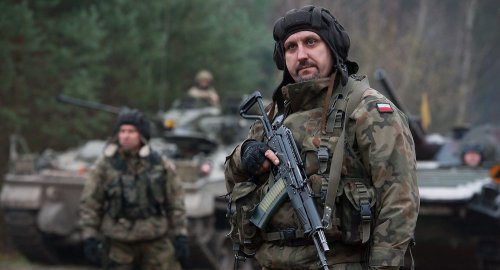
Poland approves joint force with Ukraine & Lithuania, calls on EU to spend more on defense
RT | May 4, 2015
Poland’s President Bronislaw Komorowski has signed a resolution approving the organization of a joint Lithuanian-Polish-Ukrainian brigade, whose creation has been in the works since 2007.
When brought to full operation in 2017, the brigade is set to constitute 4,500 servicemen. They will operate separately from the three countries’ respective militaries, but will take part in NATO exercises and missions. Preliminary drills are scheduled for later this year. The brigade will be stationed at its headquarters in Libulin, Poland. So far, it only houses 250 servicemen and 50 command staff contributed by the Polish military.
The joint force was discussed as far back as 2007, but the agreement to create it was signed by the three countries’ defense ministers in September 2014, in response to the Ukrainian crisis and what they call Russian aggression.
Creating the joint force is “part of a wider plan … to support Ukraine, among others, in the area of modernization,” President Bronislaw Komorowski said as cited by Reuters.
He also urged other European countries to spend more on defense. To that end, President Komorowski has suggested excluding defense spending from EU rules on budget deficit limits. This means that EU nations will be able to allocate more money to the military without fearing increased budget controls from Brussels. Komorowki’s offer comes at a time of heightened tensions with Russia.
Poland now has the fifth-strongest army in the EU, and has ambitious plans to modernize it, spending about $36 billion until 2022. However, the Polish government is unhappy about a lack of similar eagerness in some of the other European nations, the Rzeczpospolita newspaper reports.
While NATO is advising its member states to spend the maximum allowed of three percent of GDP on defense, most are spending far less: Germany allocates 1.2 percent of its GDP, the Netherlands 1.3 percent and Spain under 1 percent. France is the only Western European country that is boosting defense spending. However, some Eastern European nations are increasing their military expenses citing what they call Russian aggression. Lithuania, for instance, wants to allocate twice as much on defense as last year.
NATO & allies stage thousands-strong drills across Europe
RT | May 4, 2015
Three sets of military exercises kicked off in Europe on Monday, involving thousands of servicemen from a variety of NATO nations and their allies, amid a wave of similar action across the area.
Estonia is holding its largest-ever military drills. Named Siil-2015 (Hedgehog), the maneuvers involve about 13,000 personnel. The number includes about 7,000 reservists, along with members of the volunteer Estonian Defense League.
Siil-2015, scheduled to last until May 15, also involves forces from the US, the UK, Germany, Latvia, Lithuania, Belgium, Poland and the Netherlands. American troops, who are staying in Estonia as part of the massive training operation Atlantic Resolve, will bring four Abrams main battle tanks to the exercise. British, Belgian and German air defense units, as well as several NATO warplanes, will also take part.
The Lithuanian Army is holding its own maneuvers as part of the largest national drills called Zaibo Kirtis (Lightning Strike). The training involves over 3,000 troops. It is focused on joint action by the army and civilian authorities against so-called hybrid threats combining both military and non-military methods of fighting, according to Army Commander Major-General Jonas Vytautas Zukas.
In a statement cited by TASS, the major-general said: “The exercises will simulate situations when the Interior Ministry’s forces and resources are insufficient to neutralize various extreme situations unrelated to the direct repulsion of an imaginary enemy’s attack and the army should be involved.”
Lightning Strike will also be testing the country’s mobilization system and cyber security works, according to the Defense Ministry’s press release.
In Norway, NATO and its allies have gathered for annual anti-submarine exercises. About 5,000 servicemen from 10 NATO countries and Sweden are taking part. The drills, codenamed Dynamic Mongoose, involve simulated sub hunts utilizing surface vessels, aircraft and a variety of radar and sonar technologies. The US, Germany and Sweden are providing the submarines.
The two-week exercise follows reports of a suspected foreign underwater vessel off the coast of Finland, which prompted the use of depth charges to scare it off. In autumn last year, a similar scare triggered a week-long search in the sea near Stockholm, for what later turned out to be a civilian workboat. In the latter case, the finger of blame was unequivocally pointed at Russia, amid rising tensions over the Ukrainian conflict.
When speaking to the media about Dynamic Mongoose, NATO commanders avoided sending a message to any country in particular: “Obviously we’re aware of the incidents that have happened in some of our partner nations’ waters,” NATO Rear Admiral Brad Williamson said. “I think what it does is it focuses our efforts and our training here.”
Read more:
NATO ‘Tornado’ military drills in Estonia to use laser training system
Sweden confirms mystery ‘Russian sub’…was in fact a workboat
Featured Video
No Vote, No Representation, No State: Democracy, Israeli Style
or go to
Aletho News Archives – Video-Images
From the Archives
Sanctions, War and the Policy of Dual Containment
By SASAN FAYAZMANESH | March 17, 2008
It is now nearly three decades since the Unites States adopted the policy of dual containment of Iran and Iraq. While much has been written about the containment of Iraq, there has been very little in-depth analysis of this policy when it comes to Iran. In a book that is going to be released on March 31, 2008, entitled The United States and Iran: Sanctions, Wars and the Policy of Dual Containment (Routledge), I attempt to address this shortcoming by investigating when and why the US policy of containment of Iran came about, how it evolved, and where it stands today.[1] To the extent that Israel has been involved in US policy making, the study will also include the role that Israel has played in the containment of Iran. Also, since the fate of Iran has been inextricably linked to that of Iraq, occasionally the investigation will overlap with the containment of Iraq.
The policy of dual containment of Iran and Iraq originated during the Carter Administration, but it was not until the Clinton Administration that the expression “dual containment” became popular. … continue
Blog Roll
 Aletho News
- Elmo Sold mRNA Jabs to Your Toddler. Now They Are “Off-Label.”
- British state targets Palestine Action with yet another crooked trial
- Americans are paying the price to preserve Israel’s nuclear hegemony
- Resistance factions are necessary to ensure a permanent US Iraq withdrawal
- How Israel destabilizes the Middle East: Denying sovereignty and the right to exist
- Europe’s Establishment Is Embracing War – and Losing Voters
- NATO chief advocates war of aggression
- No Vote, No Representation, No State: Democracy, Israeli Style
- Zionist Bought Senate Blocks Information About American Citizens Killed By Israel
- While Gaza dominates the UN, these are the people keeping it alive
- If Americans Knew
- Israeli Soldiers Abduct At Least 22 Across Occupied West Bank
- Eight Palestinians Killed in Israeli Attacks on Gaza
- Israeli former leaders and security chiefs threaten legal action over ‘Jewish terrorism’
- Israel map in LA Times ad includes all land from the river to the sea
- Inside Lebanon’s 200-page dossier on Israeli war crimes
- Flydubai, genocide, settler violence, Trump abuse of power to deport – Daily Update
- Counting Antisemitic Incidents: What the ADL Audit Reveals — and Obscures
- Mamdani releases plan to combat antisemitism and hate crimes in New York City
- Iran’s Revolutionary Guards Publish Letter to the American People
- DMFI launches $1 million ad campaign supporting Virginia’s Elaine Luria
- No Tricks Zone
- Green Energy Debacle: German Expert Professor Fritz Vahrenholt Warns Of Severe Economic And Social Consequences
- Two More Paleo Reconstructions Affirm Meters-Higher Sea Levels Across Ireland, Brazil 7000-6000 Years Ago
- New Study: Earth And Venus Surface Warmth Largely Explained By Convection And Lapse Rate, Not CO2 Or Radiation
- 2025 Nature Paper Claiming Worsening Global Drought Gets RETRACTED …Heavily Flawed
- New Study: ‘Global Drought Shows No Detectable Recent Acceleration Under Climate Warming’
- Economic Masterminds: German Socialists Suggest Taxing Productivity Gains Stemming From Using AI
- The South China Sea Has Not Been Cooperating With The Climate Change Narrative
- Energy Crisis: Germany Enters Heating Season With Historically Low Gas Reserve Fill Levels
- New Study: The Antarctic Ice Sheet Gained Mass From 2020-2024 Due To Staggering Snow And Ice Accumulation
- Study: Ocean Heating Rates From Thousands Of Years Ago ‘Dwarf’ Modern Ocean Heating Rates

