Pelosi’s 9/11-Type Commission to Give More Powers to US Domestic Spying Apparatus
By Ekaterina Blinova – Sputnik – 18.02.2021
On 15 February, House Speaker Nancy Pelosi announced plans to form a “9/11-type commission” to probe the Capitol protests. The Dems real aim is to give more powers to US spy agencies, expand homeland security, and anti-terrorism measures and use them against the American right-wingers, US observers say.
A new independent 9/11-type Commission will be assigned to “investigate and report on the facts and causes relating to the January 6, 2021 domestic terrorist attack upon the United States Capitol Complex,” Pelosi wrote to her party fellows on Monday. According to CNN, the commission of this nature is typically established by a statute, passed by both chambers of the Congress and signed into law by the president.
9/11-Type Commission to Bolster Domestic Surveillance
The original 9/11 Commission was established on 27 November 2002 by President George W. Bush and the United States Congress with the aim “to prepare a full and complete account of the circumstances surrounding the September 11 attacks.” The bipartisan body consisted of five Democrats and five Republicans and was chaired by former New Jersey Republican Governor Tom Kean.
”The 9/11 Commission was supposed to be a bipartisan effort to find out what went wrong on 9/11,” says American author and political analyst William Stroock. “Today the Dems will use this ‘9/11’ style commission to stoke fears of Q, white nationalism, Trump and his supporters in general. This commission will not be independent at all and will not be interested in ascertaining facts, only in assigning blame to Republicans, conservatives and Trump supporters.”
Nearly 20 years on, it’s clear that 9/11 has proven disastrous for the US in many ways, according to Strook. However, first and foremost it led to the creation of a “vast domestic spying apparatus with secret courts and gave the Feds vast new spying powers,” says the political analyst. Stroock suggests the Democrats “will want to give even more power to the domestic spying apparatus and turn it upon the right.”
Irreconcilable Contradictions in Democratic Party’s Policies
Meanwhile, the Biden administration plans to expand grants from the Department of Homeland Security (DHS) for studying and preventing “domestic violent extremism”, according to NBC News’ Friday report. Earlier, on 27 January, the DHS released its first-ever national terrorism bulletin warning about the looming threat of violent domestic extremism supposedly encouraged by the Capitol Hill protests.
In the wake of the DC incident, the Democratic Party also pushed ahead with the Domestic Terrorism Prevention Act (DTPA). Andrew McCarthy, former assistant United States attorney for the Southern District of New York, suggested in his January op-ed for National Review that the bill “is not about countering terrorism” but “weaving a political narrative.”
The legislation fell short of targeting jihadists, Antifa or Black Lives Matter militants, while focusing on white supremacists, “or, more specifically, Trump-inspired insurrectionists in the wake of the January 6 Capitol riot,” according to the lawyer.
“The double standard here is appalling,” says Stroock. “The Democrat Party has winked and nodded at the BLM/Antifa riots… The media even invented a new term to describe the orgy of looting and destruction, ‘mostly peaceful.’ To see them comparing the Capitol Hill riot to the 9/11 terrorist attacks is pretty rich.”
It’s not the only controversy haunting the Democrats, according to American independent journalist Max Parry: the Dems have previously supported the BLM’s “defund the police” movement and now they are advocating the expansion of homeland security and anti-terrorism measures.
“These are an inherent and irreconcilable contradictions,” Parry says. “Meanwhile, curiously absent is any mobilisation to demilitarise the police, which under the 1033 Program with the Pentagon has hyper militarised US domestic law enforcement even in small towns in the past few decades, yet numerous studies shows has not resulted in lower crime rates… So the irony of calling to ‘defund’ the police while trying to ram through legislation that would likely increase their counter-terrorism training and militarisation is incompatible.”
The movement to “defund the police” was well intentioned but potentially misguided where the legitimate concerns of citizens about the need to reform law enforcement could be used for other agendas, the journalist warns.
How GOP May Give Dems a Taste of Their Own Medicine
While cracking down on Trump supporters in the aftermath of the DC protests, the Dems have failed to convict former President Donald Trump over the alleged incitement of insurrection. As a result, Trump was once again acquitted in the Senate.
”It seems they really thought they would convince 17 Republicans to crossover and vote to convict”, notes Stroock. “Only seven Republicans did so and they’re now in deep trouble with their voters back home. Several have already been censured by their state parties. The Democrats had a plan, a bad one, and had no idea what to do when the plan was foiled by reality.”
Now that the Dems created a new legislative tool, the “snap impeachment,” the GOP could hypothetically fight back and give their political opponents a taste of their own medicine, the political analyst presumes.
“Given the way political gravity works, the Republicans will almost certainly win control of the House and Senate in 2022,” he says. “The Republican base will call for the GOP to impeach Joe Biden. Given the Dem’s own precedent, why not?”
Kamala Harris may also find herself in a heap of trouble given that she earlier tweeted support for a fund that bailed out rioters, according to Strook. Following Trump’s acquittal Republican Senator Lindsey Graham warned that Harris could be impeached because she “actually bailed out [BLM] rioters,” pointing to her support of a Minnesota-based bail fund.
“It’s quite a bit of a stretch to say that Harris could be impeached for asking to contribute to a fund that went towards bailing out activists, especially since there is no evidence she herself bailed anyone out,” Parry suggests. “However, that Graham made such threats does show how the prospect of impeachment is now being thrown around so loosely as a political football since the bar has been set so low by the Democrats who impeached Trump over a dubious phone conversation.”
While a lot may happen before the 2022 midterms, the GOP should jump at the opportunity to instrumentalise the potential 9/11-style Commission, argues Strook.
“The Republicans will (or should) approach this commission with great skepticism, turn the camera around and highlight the violence and racism of the left. This commission is a tremendous opportunity for the GOP,” the political analyst believes.
Tehran to halt Additional Protocol unless other parties return to full JCPOA compliance
Press TV – February 15, 2021
Tehran says it will end its voluntary implementation of the Additional Protocol to the nuclear Non-Proliferation Treaty (NPT) Safeguards Agreement should the other parties to the 2015 Iran nuclear agreement fail to honor their commitments by the deadline of February 21.
“This measure means an end to inspections beyond the Safeguards Agreement, but does not mean an end to all inspections. In fact, Iran is a member of the Safeguards Agreement and the NPT, but the implementation of the Additional Protocol will be halted,” Foreign Ministry spokesman Saeed Khatibzadeh said at a weekly press conference on Monday.
Khatibzadeh emphasized that Iran will nonetheless continue to cooperate with the International Atomic Energy Agency (IAEA) and report its new nuclear undertakings to the IAEA beforehand, as has always been the case.
He reiterated Tehran’s position that all of its measures are “easily reversible” provided that the other parties to the nuclear deal, officially called the Joint Comprehensive Plan of Action (JCPAO), return to fulfilling their abandoned commitments.
The JCPOA was unilaterally ditched by former US President Donald Trump in May 2018, in pursuit of what he called the “maximum pressure” policy against the Islamic Republic through unilateral sanctions. Iran has denounced the policy as an act of “economic terrorism”.
The US withdrawal from the deal was met with worldwide criticism, and was followed, a year later, by Iran’s gradual reduction of its nuclear commitments. However, Tehran has repeatedly proclaimed that it will return to its nuclear obligations as soon as its interests under the JCPOA are met.
Khatibzadeh’s announcement comes more than two months after the Iranian Parliament passed a law to further accelerate the development of the country’s nuclear program.
The law, among other things, tasked the Iranian administration to stop allowing inspections beyond the Safeguards Agreement, including the voluntary implementation of the Additional Protocol, if the other parties to the JCPOA failed to deliver on their commitments, normalize Iran’s banking relations and remove obstacles to Iran’s oil export.
“According to this law, the inspections beyond the Safeguards Agreement will be halted, which we had voluntarily accepted within the framework of the Additional Protocol,” Khatibzadeh reiterated.
Nothing changed under Biden admin
Asked to offer his take on the new US administration of Joe Biden’s Iran policy almost a month into his presidency, the spokesman said the Biden administration, unfortunately, treads in the footsteps of the Trump administration.
“What is happening today is not different from what was happening before January 20 … The same maximum pressure and crime, committed through the cruel sanctions against the Iranian people, continues today,” he said.
“This should actually bring a stain of disgrace to those who based their election campaign on distancing themselves from the bullying policies of the Trump administration,” Khatibzadeh said, referring to Biden, who prior to the November presidential election promised to rejoin the deal but has so far reneged on his promise.
In similar remarks on Wednesday, Foreign Minister Mohammad Javad Zarif said, “I feel that the Americans have not yet decided on their policies. That’s why the White House had to correct Mr. Biden’s remarks many times.”
Zarif made the remarks a week after Biden said in an interview with CBS that he would not lift sanctions in order to encourage Iran to return to the negotiating table.
Iran’s stance on nuclear weapons unchanged
Elsewhere in his presser, Khatibzadeh said the Islamic Republic’s stance on the use of nuclear weapons has not changed.
Iran underlines the peaceful nature of its nuclear activities and this stance has not changed, he said.
“The fatwa (religious decree) issued by the Leader of the Islamic Revolution on the prohibition of the use of weapons of mass destruction and nuclear weapons remains in place,” he added.
In recent days, Intelligence Minister Mahmoud Alavi has been rebuked over saying that persistent Western pressure on Iran could push the country to fight back like a “cornered cat”.
“If they push Iran to that [corner], then it will not be Iran’s fault,” he said in a televised interview last Monday, in remarks that were widely viewed in the world as a threat on Iran’s part to seek nuclear weapons.
The Islamic Republic of Iran’s nuclear program, however, is based on a fatwa issued by Leader of the Islamic Revolution Ayatollah Seyyed Ali Khamenei that categorically bans the production, possession and stockpiling of nuclear weapons and other weapons of mass destruction.
Trump Acquitted (Again), But Trump Hatred Continues
By Ron Paul | February 15, 2021
Last week’s second impeachment trial of former President Trump should serve as a warning that something is very wrong in US politics. Far from a measured, well-investigated, rock-solid case against the former president, America was again abused with day after day of character assassination, innuendo, false claims, and even falsified “evidence.”
The trial wasn’t intended to win a conviction of Trump for “incitement” because the Democrats already knew that the votes were not there. So, just as with the last impeachment trial, the goal was to fling as much dirt at Donald Trump as they could while the cameras were rolling. Their hatred of Donald Trump is so deep and visceral that probably a psychologist would have been more beneficial to them than yet another impeachment trial.
It would be incorrect to say that the House managers’ case fell apart, because they had no case to begin with. They never had a case because they made no effort to develop a case. The Chief Justice of the Supreme Court saw from the beginning that this was no legitimate impeachment trial and informed Senate Majority Leader Chuck Schumer that he would not preside. Without the Chief Justice, there was no Constitutional impeachment trial. So they put on a show trial instead.
As Constitutional law professor Jonathan Turley kept asking, why didn’t the House schedule a single hearing to investigate what really happened up to and on the day of the Capitol melee on January 6th? They had weeks to do so. Professor Turley believes they might even have been able to make a decent case if they had tried.
Why did they not call witnesses? Were there no rioters who could be called to explain under oath how Trump’s speech had inspired them to enter the Capitol building to overturn the election?
Were they afraid that under cross-examination we might have found out more about Trump chief of staff Mark Meadows’ claim that Trump offered to deploy 10,000 National Guard troops in Washington before January 6th but that his offer was rebuked? What about reports that Capitol Hill Police were left without back-up and unprepared for what happened? House and Senate leadership is responsible for security at the Capitol and they obviously failed. Why?
The House and Senate Democrats (and a few Republicans) did not succeed in their ultimate goal: preventing Trump from ever running again for political office. But that doesn’t mean they are giving up. They are not about to give citizen Trump a moment of peace. They are intent on continuing their witch hunt but it looks less and less like any desire for justice. It looks like fear. They are afraid if he is allowed to run again he may be elected. So they cannot allow that vote to happen.
And they accuse Trump of undermining democracy.
There were a number of reasons to impeach and convict President Trump while he was in office. Bombing Syria on bogus grounds without authorization was one of them. But Democrats love war as much as Republicans so they weren’t about to uphold their Constitutional obligations.
Impeachment 2.0 may be over, but those blinded by hatred for Trump are not about to give up. They are irrational and obsessed. They are also dangerous.
Copyright © 2021 by RonPaul Institute.
Trump won the Super Bowl
By William Stroock | February 15, 2021
Last Sunday, the Tampa Bay Buccaneers defeated the Kansas City Chiefs in Super Bowl LV (55). This was the 7th Super Bowl victory for the Buc’s starting quarterback Tom Brady (the guy who takes the ball and throws it). Without a doubt, Brady is the greatest quarterback of all time and one of the greatest athletes in American history. Brady is also a friend of Donald Trump’s. Some in the increasingly Woke sports world have criticized Brady for not disavowing the former president and remaining his friend.
Everything in America today is political, even the television commercials. In the midst of the Covid-19 pandemic, the Super Bowl commercials, usually a highlight of the telecast, were restrained. In one advertisement, rock star Bruce Springsteen drove a Jeep to a chapel in Kansas and spoke of Americans ‘meeting in the middle’, a message of unity in the politically polarized post-Trump world. Previously, Springsteen had called Trump, ‘a threat to our Democracy’, a ‘con man’, and said his presidency was a ‘nightmare’. A few days after the game, TMZ revealed that last year Springsteen was arrested for drunk driving.
After the Bucs victory, tens of thousands took to the streets of Tampa and central Florida in raucous but peaceful celebration. Seeing her constituents enjoying themselves in large crowds, many without masks, Tampa Mayor Jane Castor declared, ‘I’m proud of our community, but those few bad actors will be identified, and the Tampa Police Department will handle it.’ Soon after, critics produced photographs of Mayor Castor celebrating the Tamp Bay Lightning (National Hockey League) winning the Stanley Cup.
Florida Governor Ron DeSantis has opposed strict lockdown measures and, for the most part, he has kept the state’s economy open. DeSantis has even made masks optional in many circumstances. As of this writing, Florida ranks 15th in Covid-19 cases per 100,000 while locked down New York is 5th and New Jersey is 6th. Last Wednesday, The Miami Herald reported that the Biden Administration was actively considering travel restrictions within the United States, including restrictions on travel to Florida. DeSantis and other Florida Republicans condemned the idea, and the Biden Administration denies it has any such plans.
Super Bowl LV’s ratings were down 8% from the previous year. The second impeachment’s ratings are down as well. The broadcast drew fewer television viewers than former FBI director James Comey’s testimony in 2017 and the Brett Kavanaugh Supreme Court nomination hearings in 2018. On Saturday night, the local news here in the New York metro area led with the impending ice storm. The second impeachment was, as they say in American television, a ratings bust. First, the Senate heard arguments about the constitutionality of the single article of impeachment charging Trump with ‘incitement’. The senate voted 56-44 that the trial was constitutional, with six Republican Senators breaking ranks. Even if the GOP had maintained party discipline resulting in a 50-50 tie, the article of impeachment still would have gone to trial as Vice President Kamala Harris is President of the Senate and has the tie breaking vote.
On Saturday, the Democrats second impeachment of Trump ended with almost comic ineptitude. Democrat impeachment managers spent their time accusing Trump of inciting a riot. In response, Trump’s lawyers presented a video montage of Democrats using violent rhetoric to encourage their voters. On Saturday morning, the Senate voted to call witnesses. But, when the GOP threatened to call House Speaker Nancy Pelosi and DC mayor Muriel Bower to testify, the Dems panicked and agreed to hold the final vote. Only 57 senators voted to convict, resulting in an acquittal. Trump is the most acquitted president in American history, the Deplorables joke.
Though he voted to acquit, Senate Minority leader Mitch McConnell excoriated Trump and seven GOP senators voted to convict. Several of these senators have already been censured by their state Republican parties. Censure is the base’s preferred way of expressing displeasure with the GOP Establishment. Wyoming representative and GOP house caucus chair Liz Cheney has been formally condemned by the Wyoming Republican Party for voting for impeachment. The South Carolina GOP censured House Member Tim Rice for doing the same. In Arizona, where pro-Trump forces just won a bruising battle for party control with the Establishment GOP, the state GOP censured former Senator Jeff Flake and John McCain’s widow for criticizing Trump. Meanwhile, Trump’s former national security advisor, Nikki Haley slammed her former boss, ‘We need to acknowledge he let us down,’ said the presidential hopeful. ‘He went down a path he shouldn’t have. And we shouldn’t have followed him. And we shouldn’t have listened to him. And we can’t let that ever happen again.’
Haley will certainly gain favor with the media for slamming Trump, but she has severely hurt her standing with the GOP base, which already suspected the former South Carolina governor of being a female version of failed presidential candidate Jeb Bush. Perhaps Haley, Bush, and company can find a home in the new political party several dozen former GOP operatives and Bush Administration alumni are building. She may have to. A Morning Consult Poll taken in late January found 81% of Republicans approved of Donald Trump and 50% said Trump should play a ‘major role’ in the Republican Party. A CBS poll found that 70% would consider joining a Trump Party. The GOP establishment is badly losing the war for control of the Republican Party.
As fears rise over SF-area attacks on elderly Asians by Black assailants, NPR finds the real culprit: White people
RT | February 14, 2021
The Lunar New Year passed in the San Francisco Bay area with fears rising over a series of unprovoked attacks on elderly Asians by black men, but leftists may have found some solace by finding the real perpetrators: white people.
As Pulitzer Prize-winning novelist Viet Thanh Nguyen explained, Asians shouldn’t respond to the horrific attacks with “knee-jerk” calls for more policing but must instead recognize the violence as “part of a pattern of white supremacy.” Even if the assailants are “people of color,” he added, “the solution is not to fall back on racist assumptions of our own but to hold the system of white supremacy responsible for dividing us.”
Despite his literary talents, Nguyen apparently missed the irony in the notion of avoiding “racist assumptions” by blaming people of a certain skin color for the attacks – in this case, people of a different skin color than those involved in the incidents – but he wasn’t alone in identifying whites as the problem.
Manju Kulkarni, executive director of the Asian Pacific Policy and Planning Council, told NPR that “xenophobic policies and racist rhetoric” pushed by former president Donald Trump was behind the violence. Oakland City Council President Nikki Fortunato Bas told local Fox TV affiliate KTVU that crimes against Asians and “anti-blackness” are both on the rise “because we live in a system rooted in white supremacy.”
The rise in violence forced many businesses in Oakland’s Chinatown area – where there have reportedly been more than 20 attacks against Asians in the past two weeks – to reduce hours during the busy shopping season before Friday’s Lunar New Year. Those cutbacks came on top of the effects of the Covid-19 pandemic, which curtailed celebrations for the holiday.
In addition to robberies and other crimes involving theft, there have been unprovoked, daylight attacks on elderly pedestrians. An 84-year-old immigrant from Thailand was killed in late January in San Francisco when a man came running from across the street and slammed into him, knocking him to the ground. A 19-year-old black man, Antoine Watson, has been arrested in the case and was charged with murder last week.
Another high-profile incident came on January 31 in Oakland, when a man shoved a 91-year-old Chinese man to the pavement from behind. The suspect proceeded to knock down two other Chinese, a 55-year-old man and a 60-year-old woman, on the same day and on the same block. Yahya Muslim, a 28-year-old black man, has been arrested for the attacks. He was already in custody for a separate elder-abuse case when police identified him as the alleged perpetrator of the Oakland attacks.
The effort to transfer guilt for the crimes to white people was met with scorn on social media. Author Ben D’Alessio said he is removing Nguyen’s novels from his reading list. Writer Wesley Yang said Nguyen was essentially “telling poor Asian people that they’re racist for wanting police protection.”
“How sheltered do you have to be for ethnic-studies jargon to be more real to you than the bodies of grandma and grandpa laid out on the street?” Yang asked. He added that such race rhetoric gave cover for the “vicious sadists” who are committing the crimes while denying protection for the vulnerable people who are being targeted.
The American establishment has lost its mind in its obsession with trying to discredit Trumpism
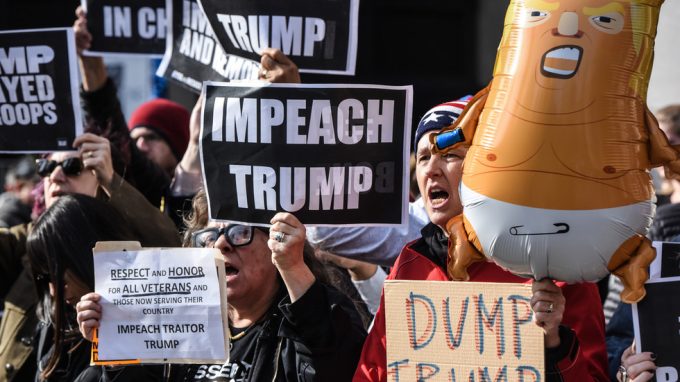
Protest against U.S. President Donald Trump on Veterans Day on November 11, 2019 in New York City. © Getty Images / Stephanie Keith
By Michael Rectenwald | RT | February 12, 2021
An appallingly biased new article on Trumpism in Foreign Affairs shows that if the American establishment was an individual, it would be diagnosed as clinically insane, likely suffering from delusions of persecution and paranoia.
Yet this same establishment calls half the population of the US conspiratorial, delusional, and terroristic, even as it parades a lunatic’s version of events during a second unfounded, evidence-free impeachment trial of former President Donald J. Trump, and as it continues lamentations over the supposed malignancy of his presidency, weeks after it has ended.
At this point, it would be a misdiagnosis to call this illness Trump Derangement Syndrome. The idée fixe persists unabated, even in the absence of its favorite bogey, and extends well beyond any reasonable obsession with Trump himself. This syndrome, whatever it is, appears to be resistant to treatment. The ministrations of political outsiders have only left the patient with a firmer ideational conviction. Electoral engineering and repeated political exorcisms have apparently been to no avail.
This illness has affected every element of the broad political left, the political and corporate establishment, and the mainstream media. Unsurprisingly, the nation’s foreign policy “experts” remain in its thrall. Like Jonathan Kirshner, political science and international professor at Boston College, they display its symptomology without remission.
In an article titled Gone But Not Forgotten: Trump’s Long Shadow and the End of American Credibility, Kirshner exhibits the signs of the recalcitrant derangement with a fact-free, hyperbolic prognosis of US foreign policy in the wake of the Trump presidency. Like others bewitched by him, Kirshner repeats the tired shibboleths associated with hallucinatory Trump repudiation: he cozied up with dictators, scorned long-term allies, and represents “a deeply regrettable, and in many ways embarrassing, interlude” in American international relations.
The patient refers to Trump’s management of North Korean leader Kim Jong-un, and alludes to Trump’s most unreasonable demand that NATO partners pay their fair share of dues to the European peace-keeping organization that’s waning in importance. Yet evidence of the widespread “anarchy” caused by Trump is never given–no doubt because it doesn’t exist.
Kirshner exhibits the typical apriorism expected from the afflicted. Trump is guilty–of something, anything–in advance. The point of the exercise is to look for crimes committed by the presumed villain, even as the language for conviction must remain forever nebulous and abstract, as it does in this piece of feigned objectivity.
Somewhat off-topic for a commentator on foreign policy, Kirshner immediately excoriates Trump’s handling of “a pandemic that killed well more than a quarter of a million of the people under his charge.” Kirshner’s guilty verdict is meted out without evidence, and despite the fact that the death rate in the US is broadly on par with that of Europe and elsewhere.
It’s not as if Italy has fared any better, or that Sweden, which eschewed draconian lockdown laws, did any worse than Italy or France. But carrying on about Trump’s supposedly disastrous pandemic response measures is a requisite symptom of the establishment’s disorder, and Kirshner must display it like all the others. Never mind that, soon after taking office, Biden stated that there was nothing he could do to stem the spread of the virus.
As Kirshner sees it, one of Trump’s most egregious transgressions was the withdrawal from the Trans-Pacific Partnership (TPP) during the first week of his presidency. No mention is made of the fact that no one really knew what was in the deal. Never mind that, like NAFTA, it would likely cost more Americans their jobs, jobs probably shipped to China, where wage slaves work under penal colony conditions. And never mind that it would likely gut environmental regulations to please China.
Kirshner levies the usual charges against Trump’s foreign policy: “isolationism,” “nationalism,” and “knuckle-dragging Americafirstism.”
“America first” has been the most maligned and misrepresented element of the Trump doctrine, and Kirshner’s declamation is no exception. Like other detractors, he refuses to acknowledge what Trump meant by the phrase: the interests of the majority of Americans should come before all else when making any political decision, not that America should become a selfish, dominating player on the world stage. From the standpoint of the economic and political oligarchy, who stood to lose the most by it, “America first” was unconscionable, and remains impossible to excise from national and international consciousness.
Kirshner barely acknowledges the fact that the Trump doctrine follows from a particular brand of populist American nationalism, including a foreign policy stemming from 19th-century Republican politics. Those who have subscribed to this political position have been traditionally non-interventionist, while demanding that a premium be laid on national self-determination, the protection of national sovereignty via strong borders, and the promotion of national self-interest over international or “globalist” entanglements. Instead, Kirshner misrepresents “America first” by surreptitiously associating it with fascism and Nazism.
No mention is made of the fact that, of the past five presidents, Trump was the only one not to begin a new war, and the only one not to extend the American military presence throughout the world. Instead, Kirshner gives away his hand by mourning that the US may “soon simply be out of the great-power game altogether.” This admission signals Kirshner’s allegiance to the neocon military establishment, and practically disqualifies him as an interlocutor supposedly concerned with international order and stability. It’s as if George W. Bush’s unprovoked and disastrous invasions of Afghanistan and Iraq have been entirely forgotten and forgiven, while Trump’s partially flouted attempts to withdraw troops from the Middle East and Afghanistan are the real international crimes.
Yet the biggest specter haunting Kirshner’s storyline is “the significant possibility of a large role for Trumpism” in the future, regardless of whether or not Trump himself continues to play a role in national politics. This is the crux of the matter, and the real problem Kirshner sees. How can the US be a reliable international partner while Trumpism persists? Kirshner’s real concern is that Trump’s policies were actually popular, and that Trumpism thus cannot instantly be extirpated from the national identity.
This fear of Trumpism haunts the entire political establishment. It explains the second impeachment trial, the calls for re-education, and the characterization of Trump supporters as “terrorists” and “the enemy within.” It is this new leftist McCarthyism, and not Trumpism, that really afflicts the country. And it is this which makes the US an unreliable player on the international stage. For how can the US act as a single nation when the entire establishment suffers from schizophrenia?
Michael Rectenwald is an author of 11 books, including the most recent, Thought Criminal. He was Professor of Liberal Arts at NYU from 2008 through 2019. Follow him on Twitter @TheAntiPCProf
Jolani gets a make-over in Idlib
By Steven Sahiounie | Mideast Discourse | February 9, 2021
The administration of [proclaimed] President Joe Biden may use a new tactic to bring Damascus to its knees. The ‘regime-change’ policy of Obama, which spawned ‘forever-wars’ in Libya and Syria, has a new twist.
Biden could choose to solve the Syrian conflict through diplomacy, but he may have tasked Secretary of State Anthony Blinken with re-inventing a terrorist following Radical Islam, and with a $10 million bounty on his head, as the new leader of Syria.
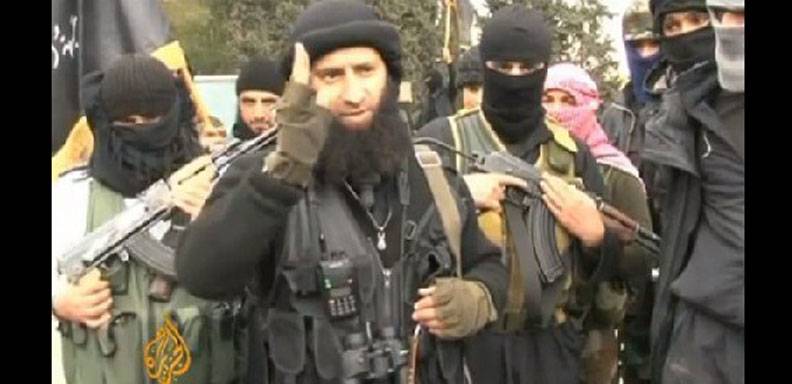
Abu Mohammed Al-Jolani, the leader of Syria’s Hayat Tahrir Al-Sham (HTS), which had been previously named Jibhat al-Nusra, and where the Al Qaeda affiliate in Syria, had changed their name in a previous bout of re-branding their image.
The US is now in the process of changing the mask on HTS in Syria, as the group is listed by the US, EU, Russia, the UN, and Turkey as a terrorist group. Jolani took off his guerrilla warfare uniform and switched to a business suit recently in a PBS “Frontline” interview with journalist Martin Smith. Western audiences may be fooled by the new look, but the residents of Syria know the true Jolani. Washing away the gallons of blood on his hands will take a much deeper sanitizing than a new suit. Biden may have a hard time explaining the support of Jolani to French President Macron, who has officially declared war on Radical Islam.
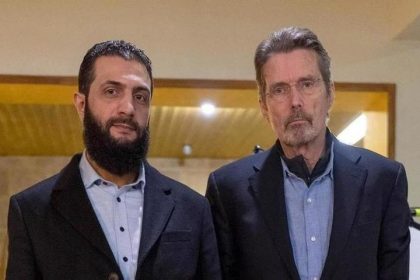
The US had justified their illegal occupation of Syria as necessary to fight Islamic State (IS) terrorist group. The group was successfully dislodged from the territory they had held in northeast Syria.
The sole remaining territory held by an armed group following Radical Islam is Idlib, in the northwest, an area which US officials once described as “the largest al-Qaeda safe haven since 9/11”. Western media describes Idlib as ‘a last stronghold of Syrian rebel groups’. The US and its media outlets have used the terms ‘terrorists’ and ‘rebels’ interchangeably, which has effectively re-branded blood-thirsty criminals into freedom fighters.
Trump had inherited the Syrian conflict from Obama, and he did not work toward any solution but held the status-quo, which saw US troops illegally stationed in Syria to steal the oil. Trump allowed Saudi Arabia to write the US foreign policy on Syria, due to his tight relationship with Crown Prince Mohammed bin Salman.
The US refused to beat HTS, instead, they protected them in Idlib, and have denounced Syrian and Russian attacks on the group. Now, the US has joined with HTS leader Jolani as their new man to lead Syria, still committed to the US policy of ‘regime change’.
The names change, but the essence is the same. In Syria, there were many armed groups, from the Free Syrian Army to Al Qaeda, and IS. Each had a leader, and a name, but in essence, all were the same: men killing people in the name of God. Their goal is ‘regime change’ and the regime they seek to install in Damascus is an Islamic government, with Sharia as the constitution and rule of law.
Turkey invaded Idlib and has 20,000 troops there, but has been reluctant to publically support HTS, because of the ‘terrorist’ listing. The US may begin a process to remove HTS from the terrorist label, which would open up greater aid and western investment in Idlib. At the same time, this close cooperation in Idlib between the US and Turkey could strengthen a fragile relationship between the two NATO partners. However, Turkey is ruled by a Muslim Brotherhood party, AKP, and there are calls by many in the US and the Arab Gulf states, to designate the Muslim Brotherhood a terrorist group.
The sizable Christian population in Idlib has suffered greatly at the hands of HTS and other Radical Islamic terrorist groups. Not only physical suffering but their properties were seized and they were made destitute and homeless.
The Russian-Turkish ceasefire remains fragile, while joint patrols along the M4 highway have essentially halted since August from terrorist attacks on trucks and civilians. The March 2020 agreement between Russia and Turkey explicitly calls for both sides to “combat all forms of terrorism, and to eliminate all terrorist groups in Syria as designated by the UN Security Council, which includes HTS.
Jolani fought in the post-2003 Iraq war as a member of the Islamic State of Iraq (ISI, which later became ISIS), and in 2011 brought ISIS to Syria. He left ISIS in 2013, and declared allegiance to Al Qaeda, and established their affiliate in Syria, Jibhat al-Nusra.
Al-Nusra became known for being more brutal than all others and was feared and loathed by the Syrian civilians who were their victims. The group carried out war crimes and massacres of unarmed civilians sleeping in their own homes near Latakia in 2013. Killing, maiming, raping, and kidnapping was their calling card.
Jolani has been recast as the local Syrian leader capable of governing Idlib. However, Syria is a much bigger place than Idlib, which is a small agricultural area, only known for its olives. What about the biggest city, Aleppo, or the capital Damascus: what would the residents there think of an ex-ISIS member being in charge of Syria? The Syrian people have lived under a secular form of government for 40 years, and have fought against Radical Islam for ten years. Morphing a terrorist into a leader is a fantasy conjured up in Washington, DC. but will not play well to a Syrian audience.
Steven Sahiounie is an award-winning journalist.
The Trump Political Show Trial
By Ron Paul | February 8, 2021
The Senate trial for now twice-impeached former President Donald Trump is set to begin this week, with little doubt over the outcome. A procedural vote in the Senate on the constitutionality of “removing from office” someone who is not in office revealed that nowhere near enough Republicans were willing to join their Democrat counterparts in voting to convict.
Supreme Court Chief Justice John Roberts, who is required by the Constitution to preside, has by refusing to participate made it clear that he does not consider the upcoming action in the Senate to be a legitimate impeachment trial.
So if it is not a legitimate trial, what is it, then? Judging from the House impeachment resolution, it looks more like a banana republic “show trial” than a careful case detailing Trump’s “high crimes and misdemeanors.”
Trump was impeached by the Democrat-controlled US House for “incitement of insurrection” over the January 6th melee at the US Capitol. Telling his supporters they must fight or they’re “not going to have a country any more” was cited in the impeachment resolution as evidence that Trump “gravely endangered the security of the United States and its institutions of Government” and has “demonstrated that he will remain a threat to national security, democracy, and the Constitution if allowed to remain in office.”
Trump also told them to march to the Capitol “peacefully and patriotically” to encourage Congress to consider his claims of election fraud, but Democrats in the House say that he didn’t really mean it.
Why the snap impeachment? Why not, as Constitutional law professor Jonathan Turley has written, hold hearings and call witnesses to explore whether the former president actually had insurrection on his mind? Did he call off or delay the National Guard troops from protecting the Capitol, for example?
Or was he simply using heated political rhetoric that his accusers in Congress have also used plenty of times?
Weeks of hearings in the House with dozens of witnesses could have helped make the case for the Senate that Trump was guilty of inciting insurrection. Such hearings could have turned the tide against Trump in the Senate, where he is certainly not universally supported within his own party.
But the House had no interest in such hearings. They wanted a snap impeachment. They wanted no witnesses. They wanted to benefit from the universal mainstream media narrative that the mob who entered the Capitol building was not just unruly Americans angry over what they believed was a rigged election, but was actually trying to overthrow the government to keep Trump in power.
The House Democrats knew that the “insurrection” narrative would not stand the test of time – anyone familiar with “color revolutions” or coups overseas would easily recognize that this was not one. So they rushed through the impeachment not because they wanted to remove him from an office he no longer occupied, but because they wanted to bar him from ever running for office again.
It does raise the question: what are they afraid of? They called their impeachment a victory for democracy, but isn’t preventing Trump from running again a subversion of democracy?
Trump would do well to ignore the Senate proceedings. There is no reason to participate in a show trial. The media has reported that he intends to focus on the “stolen” election in his defense before the Senate. That would be counterproductive. The right question to ask is, “what if they held a show trial and nobody came”?
Copyright © 2021 by RonPaul Institute.
Iran to withdraw from NPT if US does not lift sanctions: FM spokesman
By Yusef Jalali – Press TV – February 8, 2021
Tehran – You first, me next.
Since Joe Biden became the [proclaimed] new US president, Tehran and Washington have each been asking the other side to return to the 2015 nuclear deal.
On Sunday, Joe Biden said the US will not lift the sanctions until Iran stops enriching Uranium.
Leader of the Islamic Revolution Ayatollah Seyyed Ali Khamenei, however, made it clear, saying his country will live up to its commitments under the 2015 nuclear deal IF the US removes the sanctions it illegally re-imposed against Tehran.
Once hailed as a victory for diplomacy, the nuclear deal has been hanging in the balance since Donald Trump pulled his country out of the international accord unilaterally and reinstated sanctions against Iran in 2018.
In return, Tehran began a gradual suspension of its nuclear commitments, the last of which was the resumption of Uranium enrichment at the 20-percent purity level.
In December last year, the Iranian parliament also passed a bill requiring the government to limit the International Atomic Energy Agency’s inspection of the country’s nuclear sites. The law also tasks the government to pull Iran out of the Non-Proliferation Treaty as of February the 20th.
I asked Iran’s Foreign Ministry spokesman if Tehran is determined to do so; he said it was up to the US.
Since the US left the deal, the remaining signatories to the Joint Comprehensive Plan of Action have been trying to save the deal, which promised Iran the lifting of sanctions in return for the country’s curb on its nuclear program.
Iran says the three European parties to the pact have done nothing to offset the impact of the US’s withdrawal from the accord.
The Islamic Republic says its steps toward suspending its JCPOA commitments are within the framework of the nuclear deal and seek to keep the balance between its obligations and rights under the agreement.
Now as Iran and the US are stuck in a standoff, Tehran says the ball is in Joe Biden’s court. The Islamic Republic has made it clear that there’s only one way ahead to save the 2015 nuclear deal; the US should lift all sanctions; or else, Tehran will continue to scale back its obligations to the JCPOA.
India needs course correction on Myanmar
By M. K. BHADRAKUMAR | Indian Punchline | February 7, 2021
The Modi government made a strident call on February 1 that the “rule of law and the democratic process must be upheld” in Myanmar. The statement, following a prodding from Washington, was unabashedly intrusive, and, ironically, completely overlooking that human rights, rule of law, democratic pluralism, etc. are universal values that India also can (and should) be held accountable for. Lapping up the neocon prescriptions from Washington may not serve India’s interests, in general, and they are very specific to Myanmar.
The government failed to fathom the US’ motivations in riding the high horse of democracy so soon after the Capitol Riots in Washington, DC. Human rights issues come handy for Washington to rally allies at a juncture when its leadership of the transatlantic alliance is in drift and major European powers do not see eye to eye with its global strategies on Russia and China and mock at its nostalgia-laden slogan that “America is back.”
Alas, the government failed to consult the ASEAN despite Delhi’s refrain that it attributes “centrality” to that grouping.
The ASEAN Chair’s statement of Feb, 1 recalled the “purposes and the principles enshrined in the ASEAN Charter” which include respecting the principles of sovereignty, equality, territorial integrity, non-interference, consensus and unity in diversity.”
The ASEAN Chair’s statement of Feb, 1 recalled the “purposes and the principles enshrined in the ASEAN Charter.” Simply put, India chose to bandwagon with the US, Japan and Australia while the ASEAN and China took a differentiated stance. Geopolitics crept in. But the US has since realised the folly and National Security Advisor Jake Sullivan scrambled to contact the ASEAN ambassadors in Washington.
How come Delhi goofed up? Primarily, it is due to a flawed understanding of the Myanmar situation. The Indian analysts increasingly view world developments through their China prism and began fancying that with the massive victory of Aung San Suu Kyi in the November election provided an opportunity for India to “gear up to implement a major strategy with Myanmar under its ‘Neighbourhood First’ policy… to bring Myanmar under the Indo-Pacific construct” so as to align that country “more with ‘like-minded’ countries… to stand firm against China… to make Myanmar a part of the Indo-Pacific policy… (and) steer Myanmar away from the Chinese grip.”
Such views betray a zero sum mindset borne out of blind Sinophobia. Whereas, the ground realities are much more complex. The point is, Beijing brilliantly succeeded over the years in building a close relationship of mutual trust and mutual respect with Suu Kyi, parallel to the nurture of links between the Chinese Communist Party and her party National League for Democracy.
Unlike the western narrative of Aung Suu Kyi as Myanmar’s democracy icon, Beijing regarded her as a pragmatic politician who never uttered remarks to the detriment of China-Myanmar ties, was manifestly eager to maintain good relations and consistently adopted a soft stance on the South China Sea issue.
Beijing was greatly impressed that although Suu Kyi wanted Western support, she was adamant about national sovereignty. Arguably, it was in sync with what China would like its neighbours to practice. Chinese President Xi Jinping received Suu Kyi seven times since 2015.
State Counselor Wang Yi visited Myanmar recently on Jan. 12, met Suu Kyi and expressed strong support for her government and conveyed a strong commitment that China wants to work with her during the second term. And they agreed to push ahead with Belt and Road projects and lock in a five-year pact on trade and economic cooperation. Clearly, the prospect for the China-Myanmar Economic Corridor under Belt and Road Initiative has become uncertain now, as compared to a month ago.
In fact, the Chinese media reports already sound a word of caution that “Chinese companies operating in Myanmar need to watch out for contractual and default risks amid the current political upheaval… Government default is a major risk, especially for major and strategic projects in sectors including transportation and energy… But Chinese companies can seek international arbitration if they face illegal confiscation of their property.”
It is no secret that the Myanmar army marks a certain distance from China. Suffice to say, Myanmar developments present an extraordinary case study where Beijing silently feels distressed over the sudden eclipse of western style democracy in a neighbouring country. (See the Reuters analysis Myanmar coup does China more harm than good.)
Surely, the coup creates political baggage for China insofar as it cannot (and will not) take a position against the military, but also comes under compulsion to cover or provide protection for the military internationally. On the whole, this situation poses a major political and diplomatic liability for Beijing and cannot bring good news. Therefore, China prioritises that the concerned parties to solve their differences mutually, according to the constitution and within the legal framework, while maintaining peace and stability. Chinese expert opinion is that Suu Kyi’s political career is in jeopardy.
Of course, Suu Kyi made some serious errors, too. She heavily depended on people loyal to her personally, without bothering about their competence or integrity. It not only spawned corruption but also led to government failure to deliver, especially in job creation. Her leadership style was often dictatorial. She resorted to draconian laws to muzzle or jail critics. (See the Singapore-based Channel News Asia video titled Aung San Suu Kyi: A Fading Legacy dated October 22, 2020 on the eve of the November elections.)
Suu Kyi had no control over some major sectors of the national economy through two entities, Myanmar Economic Holdings Limited and Myanmar Economic Corporation as well as a network of domestic private business enterprises, known as “crony companies,” which generate revenue for the military and strengthen its autonomy.
Suu Kyi’s biggest mistake was in believing that she could, through her brand of nationalism, dismiss accusations of genocide directed against the Rohingya. In the process, Suu Kyi lost western support. From that point, she has been on borrowed time and the military barely hid its distaste for Suu Kyi.
To be sure, the military anticipated the impact and the reaction from the international community and took into consideration the Biden administration’s preoccupations with domestic issues. Myanmar doesn’t even figure in the top 10 priorities of Biden’s foreign policy. But the US Congress is not going to tolerate a coup in Myanmar and will mount pressure on the Biden administration to punish the military by imposing sanctions, cutting aid or targeting the generals and their companies.
However, a reversal of the military takeover is not to be expected and the probability is that Washington may lose whatever little leverage it would have had in Naypyidaw. Washington is mulling over policy options.
But there may be a Plan B. Indeed, the former US Ambassador to the United Nations Bill Richardson, who is no stranger to Myanmar, voiced the opinion last week that the time has come for the West to look beyond Suu Kyi for new faces among the opposition. One way is to mould a leadership that will be friendly to the US. There are signs that the western agencies are inciting the youth in Myanmar to stage protests, as had happened in Hong Kong and Thailand. The military has clamped down on Facebook and internet. Shades of colour revolution?
This is where Russia’s role merits attention. The struggle for influence in Myanmar has a geopolitical dimension, for obvious reasons. Since 2015, following the signing of a military cooperation agreement, Russian presence has increased, and, importantly, it coincides with the lengthening shadows of Russian presence in the Indian Ocean.
Russia has emerged as a major military partner for Myanmar. Russia operates a servicing centre in Myanmar. The Russian Deputy Defense Minister Alexander Fomin told the media last month that Myanmar plays “a key role in maintaining peace and security in the region.”
It is entirely conceivable that Russia, which has great expertise in countering colour revolutions, shares intelligence with the Myanmar military. Over six hundred military officers from Myanmar are studying in the Russian military academies presently. Myanmar’s military chief Min Aung Hlaing visited Russia six times in the recent years, more than to any other country.
During the visit of Defence Minister Sergei Shoigu to Naypyidaw last month, the Russian media quoted Gen. Hlaing as saying, “Just like a loyal friend, Russia has always supported Myanmar in difficult moments, especially in the last four years.” An agreement was signed for supply of a batch of Russian missile and artillery air defense systems Pantsir-S1.
Tass reported that the “command of Myanmar’s armed forces has shown interest in other advanced weapon systems of Russian manufacture.” Shoigu has reportedly expressed interest to establish visits of Russian warships to Myanmar’s ports.
All things taken into consideration, we may expect China and Russia to provide a firewall for Myanmar to ward off western penetration, as is happening in Central Asia. (The UN Security Council statement avoids any reference to the military or a coup as such in Myanmar and lays emphasis on national reconciliation, with pointed reference to Suu Kyi’s release.) Russia shares China’s perception of Quad as a destabilising factor in regional security.
Clearly, India needs to keep the “big picture” in view. It will not be to India’s advantage to create misperceptions that it is bandwagoning with some neocon Anglo-American project for regime change in Myanmar. In regard of Myanmar’s stability, India too is a stakeholder and would have a convergence of interests with Russia and China.
There WAS a color revolution in the US after all – its architects now boast they ‘fortified’ the 2020 election
By Nebojsa Malic | RT | February 5, 2021
The 2020 US presidential elections wasn’t “rigged,” oh no, but “fortified” by a conspiracy of activists united in saving “Our Democracy” from the Bad Orange Man, now proud to share their story in a friendly tell-all piece in TIME.
“There was a conspiracy unfolding behind the scenes,” writes Molly Ball – a biographer of House Speaker Nancy Pelosi, by the way – in TIME magazine this week, describing it as a “vast, cross-partisan campaign to protect the election – an extraordinary shadow effort.”
Ball’s article reveals a lot, from why there were no street riots by Democrats either on November 4 or on January 6 – the organizers of this “conspiracy” stopped them – to who was behind the push to alter election rules in key states and set up mail-in voting, who organized “information” campaigns about the results of the election, and who even threatened election officials into making the “right” decision to certify the vote.
While everyone – myself included – was focused on the summer riots as a possible “color revolution,” they turned out to be misdirection. According to TIME, the real action was taking place behind the scenes, as Democrat activists and unions joined forces with NeverTrump Republicans, Chamber of Commerce, corporations, and Big Tech to make sure the 2020 election turns out the way they wanted. They call this a victory of democracy and the will of the people, of course, for no one is ever a villain in their own story.
“Their work touched every aspect of the election,” Ball writes, from getting states to “change voting system laws” and fending off “voter-suppression lawsuits,” to recruiting “armies” of poll workers and pressuring social media companies to “take a harder line against disinformation.”
Then, after Election Day, “they monitored every pressure point to ensure that Trump could not overturn the result.” Alarmed yet? Maybe you should be.
So who are these shadowy saviors of Our Democracy? One of them is union organizer Mike Podhorzer of AFL-CIO, a traditional Democrat powerhouse. Another is Ian Bassin, associate White House counsel in Barack Obama’s first administration. The roster of his “nonpartisan, rule-of-law” outfit called Protect Democracy includes a lot of Obama lawyers, a John McCain campaign aide, an editor from the defunct neocon Weekly Standard, and someone from SPLC, while among their advisers is the NeverTrump failed presidential candidate and ex-CIA spy Evan McMullin.
Bear that in mind when you read Bassin’s quote that “Every attempt to interfere with the proper outcome of the election was defeated,” (emphasis added) but “it’s massively important for the country to understand that it didn’t happen accidentally. The system didn’t work magically. Democracy is not self-executing.” Chilling words.
A leading member of this effort is Norm Eisen, another White House counsel under Obama. The pro-Trump Revolver News even raised the alarm about Eisen plotting a “color revolution” in September – but by then it was too late, even if anyone had been paying attention.
By then, the National Vote at Home Institute – an organization barely two years old, and part of the effort – had already instructed secretaries of state across the US with “technical advice on everything from which vendors to use to how to locate drop boxes,” and even provided them “communications tool kits,” i.e. talking points.
In November 2019 – a full year before the election! – Facebook’s Mark Zuckerberg hosted “nine civil rights leaders” for dinner, one of whom was Vanita Gupta, Obama’s assistant Attorney General for Civil Rights. It was part of this shadowy coalition’s campaign for “more rigorous rules and enforcement” on social media platforms – just in case you were wondering how Trump ended up deplatformed, or the New York Post’s story about Hunter Biden’s laptop got suppressed before the election.
Podhorzer’s messaging efforts were informed by Anat Shenker-Osorio, who “applies tools from cognitive science and linguistics in her work with progressive organizations globally,” according to her 2018 fellowship bio from George Soros’s Open Society Foundation. Ironically, as part of their pressure on Big Tech Democrats had whipped up a moral panic about super-targeted “Russian” internet memes that somehow “influenced” the 2016 election – yet Ball’s article says that two groups involved with the conspiracy “created state-specific memes and graphics, spread by email, text, Twitter, Facebook, Instagram and TikTok, urging that every vote be counted.”
Though Ball doesn’t mention it specifically, those Twitter and Facebook “pre-bunking” labels about safety of mail-in ballots and the winner not being known on Election Day are also the activists’ talking points.
Remember how Republican observers were thrown out of the ballot-counting facility in Detroit? Reports at the time said it was because of overcrowding, but the Time article reveals that a Democrat activist mobilized “dozens of reinforcements” to “provide a counterweight” to them, so eventually “racial-justice activists from Detroit Will Breathe worked alongside suburban women from Fems for Dems and local elected officials.”
It was activists who came up with a strategy of denouncing any challenge to Detroit vote counts as racist, too.
When President Donald Trump asked Michigan’s Republican-majority legislators to challenge the results, Eisen called it “the scariest moment” of the election, and the “democracy defenders” sprung into action.
Eisen’s lawyers dug up dirt on the two lawmakers invited to Washington, activists hounded them at airports, NeverTrump Republicans made calls to party friends, and Bassin’s outfit commissioned an op-ed threatening criminal charges by Michigan’s Democrat AG – whose office then retweeted it. The two were even picketed at the Trump Hotel in DC. The brigading eventually worked, as Michigan Republicans agreed to certify the elections – and other contested states followed.
Perhaps the most intriguing part is buried towards the end. Ball reveals that she got a text from Podhorzer – the AFL-CIO organizer – on the morning of January 6, hours before what the Democrats would describe as “insurrection” by Trump supporters at the US Capitol, saying that the “activist left” was “strenuously discouraging counter activity” in order to “preserve safety and ensure they couldn’t be blamed for any mayhem.”
How did Podhorzer know there would be “mayhem,” hours before the “storming” of the Capitol that Democrats claim Trump “incited” at the rally outside the White House at noon? It’s a mystery.
What’s not a mystery is the result of the “conspiracy” Ball has revealed: a de facto one-party state in which Democrats hold absolute power at every level of government and seek to prosecute dissent and disenfranchise the opposition.
Last month, with no inkling of the behind-the-scenes operation just revealed in Time, I wrote of a non-kinetic “fifth-generation” civil war that had unfolded as “a battle for hearts and minds, a series of psychological operations that played out on the media, political and economic fronts.” I argued it had successfully swapped the American Republic for something called “Our Democracy,” which maintains the form but has a radically different content.
One of the “heroes” of Ball’s piece, NeverTrump Republican Jeff Timmer, has a quote in the article about how “Our democracy only survives if we all believe and don’t look down,” referring to the cartoon character Wile E. Coyote.
It’s an interesting admission, as the coyote is the villain of those cartoons – and the one actually immune to the effects of gravity is the roadrunner bird. But you’re not supposed to notice this – and besides, noticing will soon be a crime in Our Democracy.
Nebojsa Malic is a Serbian-American journalist, blogger and translator, who wrote a regular column for Antiwar.com from 2000 to 2015, and is now senior writer at RT. Follow him on Telegram @TheNebulator
Why Always Israel? Only One Country Matters to Congress and the Media
By Philip Giraldi | Strategic Culture Foundation | February 4, 2021
The job of U.S. Ambassador to the United Nations must have some kind of curse on it as it seems to attract a type of woman who seeks to prove her suitability by running up a tally of how many wars she can start and how many people she can kill. One recalls fondly Bill Clinton’s monstrous Madeleine Albright, who famously declared the deaths of 500,000 Iraqi children as “worth it” due to the sanctions that Washington had imposed and enforced. And then there was Barack Obama’s darling Samantha Power, who was the spokesperson for the completely unnecessary slaughter of Syrians and Libyans to bring them democracy. And, most recently, we have had Nikki Haley, who didn’t start her own war but kept the ones ongoing during her watch on the boil while also taking on the task of being the most strident defender of Israel’s war crimes.
And now we have Honest Joe Biden’s nominee to be the U.N. ambassador, Linda Thomas-Greenfield. She is predictably black and is a career diplomat who ended up as head of the State Department’s Bureau of African Affairs. Upon retirement in 2017, she took a position, predictably, with the Albright Stonebridge Group in Washington. The Albright in the name comes from Madeleine and the Group is where many Democratic Party establishment foreign policy types wind up. Thomas-Greenfield might not be a drama queen like Nikki Haley or evil incarnate like Albright or Samantha Power, but she demonstrated in her confirmation hearing before the Senate that she knows the lines she has to speak as well as anyone in Washington.
Thomas-Greenfield dutifully spouted the usual cant relating to the Palestinians, which means that she did not mention them at all and is completely indifferent to the gross violations of their human rights by Israel. In response to several queries from legislators about how she would work to fend off international criticism against Israeli policies, she unleashed an attack against the non-violent Boycott, Divestment and Sanctions (B.D.S.) movement which criticizes Israel’s human rights record and urges people to support Palestinian rights by pressuring Israel’s economy through boycotts, divestment, and sanctions. It deliberately eschews violence or punishing ordinary Israelis for the actions of their government and it’s economic approach is a tactic that was used successfully against the apartheid South African regime in the 1980s.
One assumes that Thomas-Greenfield, as a black American diplomat who was active when South Africa adopted majority rule, is fully aware of the fact that Israeli apartheid backed by an army of occupation that does not hesitate to shoot to kill is more pervasive than the South African version ever was. She may even be aware that what Israel does is driven by racism and amounts to genocide. Nevertheless, she told the Senators “[B.D.S.] verges on anti-Semitic, and it’s important that they not be allowed to have a voice at the U.N., and I intend to work against that… I look forward to standing with Israel, standing against the unfair targeting of Israel, the relentless resolutions proposed against Israel unfairly.” In short, Thomas-Greenfield sounded more than a little like Nikki Haley, who used to amuse the U.N. General Assembly with her homilies in defense of the Jewish state that culminated in U.S. withdrawal from the Human Rights Council, refugee agency (UNRWA), and its cultural organization (UNESCO) over claims that they all had an anti-Israel bias.
There should be no question but that the friends of Israel constitute the most powerful foreign policy lobby. It’s ability to shift policy in its favor is unmatched by any other organization that promotes the interests of a foreign nation at the expense of the United States itself. No other nation comes close to having the power to actually write legislation that is then approved by Congress while also influencing decision making in the White House. No other country avoids accountability for its actions either among politicians or in the media to anywhere near the same extent as Israel. If anyone doubts that that is true, it is only necessary to review the recent confirmation hearings of Biden appointees, where foreign policy discussions are limited to bashing China and Russia followed almost immediately by the question “And what have you done for Israel lately?”
Politicians are quite aware that giving the wrong answer on Israel can be fatal for one’s career. In many congressional districts the training of lawmakers begins early, with representatives of the hundreds of Israel Lobby affiliates interviewing potential candidates on their views relating to the Jewish state. In many cases, attempts are made to get possible candidates to sign statements affirming that they hold the correct views on Israel versus its neighbors. The sensitivity towards Israeli and Jewish issues must continue after one is elected, resulting in questions in public fora like confirmation hearings. It never hurts to advertise one’s loyalty to Israel early and often.
Questions about Israel inevitably also came up in the Senate confirmation hearing for Secretary of State Anthony Blinken. Blinken is Jewish, a confirmed Zionist, and now heads a State Department where his deputy and political affairs chief are both Jewish women hardliners who basically share his views. Biden, Blinken and company advocate policies in the Middle East that are definitely pleasing to the Israeli government, such as de facto continuing a hard line with Iran.
In a press statement last year Blinken confirmed the outlines of the Biden Administration relationship with Israel as follows: “You can count on Joe Biden to make sure Israel has what it needs to defend itself, to honor the bipartisanship traditions of U.S. support for Israel, to safeguard, not put at risk, Israel’s future as a Jewish, and democratic state. Joe Biden has spoken out strongly and stood strongly against the B.D.S. movement. He’s also been very clear that he would not tie military assistance to Israel to things like annexation or other decisions by the Israeli government with which we might disagree.”
In other words, Israel has a free hand to do whatever it wants and there will be no pushback from the Biden White House in terms of the only thing that matters – the billions of dollars in “military assistance” the Jewish state receives each year. Oh, and Blinken surely realizes that while Israel is Jewish by law it is ipso facto hardly democratic.
Blinken’s apparent first telephone call to a Foreign Secretary counterpart was to Gabi Ashkenazi of Israel. Their warm and fuzzy exchange was tweeted, with Blinken enthusing “Great speaking with @Gabi_Ashkenazi today to discuss the steadfast partnership between the U.S. and Israel. Our commitment to Israel’s security is sacrosanct, and I look forward to working with the Foreign Minister and others toward our common goals.” Ashkenazi replied “I had a warm call with @secBlinken & affirmed Israel’s commitment to the robust Israeli-US strategic partnership. I welcomed very much the POTUS commitment to IL security.”
The point is that pandering to Israel as part of the political process in the United States has become part of the DNA of both major parties. Trump was shameless in his gifts to the Jewish state all through his four years and Biden promises to deliver more of the same. But the really bad news for Americans is the fact that the wag the dog relationship with Israel ties the United States into failed policies in the Middle East for the foreseeable future. It is time for the federal government to stop focusing on doing favors for Israel and instead start talking about how the policies that mandate force projection in the Middle East to protect the Jewish state are not really working out very well for the American people. When that becomes clear to the public, change will come.
Featured Video
What Does Russian Retaliation Look Like? | Col Doug Macgregor
or go to
Aletho News Archives – Video-Images
From the Archives
A Climate Scientist Who Engages Skeptics
By Judith Curry | November 27, 2009
An open letter to graduate students and young scientists in fields related to climate research:
Based upon feedback that I’ve received from graduate students at Georgia Tech, I suspect that you are confused, troubled, or worried by what you have been reading about ClimateGate After spending considerable time reading the hacked emails and other posts in the blogosphere, I wrote an essay that calls for greater transparency in climate data and other methods used in climate research. The essay is posted over at climateaudit.org.
What has been noticeably absent so far in the ClimateGate discussion is a public reaffirmation by climate researchers of our basic research values: the rigors of the scientific method (including reproducibility), research integrity and ethics, open minds, and critical thinking. Under no circumstances should we ever sacrifice any of these values; the CRU emails, however, appear to violate them. … continue
Blog Roll
 Aletho News
- Why Iran Hawks Are Now Hyping ‘Radical Shiite’ Threats
- What Does Russian Retaliation Look Like? | Col Doug Macgregor
- Araghchi: ‘Israel’ seeks to drag US into war on Iran
- NYT’s Iran dam-missile narrative crumbles under statistical scrutiny and engineering evidence
- USAID Files: The Trusted Flaggers Nobody Can Audit
- How Western media weaponizes unverified claims to justify military aggression
- Content control: USAID docs expose Biden admin’s grip on Ukraine coverage
- Ukraine destroying itself: every attack on the Crimean Bridge will come at a price
- NATO capital under protest siege, so NATO escalates war
- A Climate Scientist Who Engages Skeptics
- If Americans Knew
- An error has occurred; the feed is probably down. Try again later.
- No Tricks Zone
- Alarmist Climatologists In Shock! 2026 Atlantic Hurricane Season Sees Lowest Count In 101 Years
- New Study: Modern Temps Are Among The Coldest Of The Last 10,000 Years In East Central Europe
- Germany’s Renewable Energies Lead to 1.4 Billion Euro Electric Power Trade Deficit
- Argentina’s Perito Moreno Glacier Joins Antarctica and Arctic In Defying Doomsday Melt Claims
- New Study: Barents Sea Temperatures Were Warmer And Sea Ice Less Extensive In The 1700s Than Today
- German Authorities Start Initiative To Evaluate Public Register For Climate “Disinformation” Spreaders!
- Zonal Asymmetry of Temperature Change in the Antarctic Circumpolar Current
- New Study: The Net Fossil Fuel Contribution To Rising Atmospheric CO2 Has Been Zero For 500 Years
- Germany’s Green Energy Transition Becoming Increasingly Expensive…Another 6 Trillion Euros!
- Sudden Stratospheric Warming, Powerful El Niño Combination May Lead To Extreme Europe Cold, Energy Crisis!

