Biden blames Russia & OPEC for high oil and gas prices in US
RT | November 3, 2021
President Joe Biden has called out Russia and OPEC countries for causing US energy prices to rise, even as he implements policies to curtail domestic oil and natural gas production.
“If you take a look at, you know, gas prices and you take a look at oil prices, that is a consequence of, thus far, the refusal of Russia or the OPEC nations to pump more oil,” Biden told reporters on Tuesday at the COP26 climate summit in Scotland. “We’ll see what happens on that score sooner than later,” he added.
Prices for the leading US crude benchmark, West Texas Intermediate (WTI), have surged to around $84 per barrel from $48 per barrel since the beginning of 2021, contributing to the nation’s highest inflation rate in 13 years. Gasoline prices are at a seven-year high. The key natural gas benchmark, Henry Hub, is nearing $6/mmBtu in Nymex futures trading after starting the year below $2.50/mmBtu.
While the president pointed the finger at Russia and OPEC for failing to help bring down oil prices, he said that inflation more broadly is being spurred by the Covid-19 pandemic’s impact on supply chains. US Transportation Secretary Pete Buttigieg said on Sunday that the supply-chain woes will continue until the pandemic ends.
The Biden administration called on OPEC in August to help bring oil prices down, raising the ire of major US producers, who argued that he should be encouraging higher domestic supplies.
The day he took office in January, Biden revoked a federal permit for a new pipeline needed to bring more Canadian oil to US refiners. A week later, he suspended the leasing of new oil and gas properties on federal lands and waters as part of his plan to slash reliance on fossil fuels.
The US surpassed Russia and Saudi Arabia as the world’s largest crude producer in 2018 and became the third-biggest exporter of liquefied natural gas in 2019. That same year, the country achieved net energy independence for the first time since the 1950s – reaching a goal that many observers thought impossible.
But US oil and gas output stumbled last year amid the Covid-19 pandemic, and domestic volumes are projected to decline again in 2021.
RT to continue legal battle after UK Court of Appeal backs Ofcom’s £200,000 fine against broadcaster
RT | October 26, 2021
RT says it’s going to challenge a ruling by the Court of Appeal in London, which decided that the six-figure fine imposed by British broadcast regulator Ofcom for an alleged breach of impartiality rules was “proportionate.”
The Court of Appeal announced its decision on Tuesday, saying that the High Court of Justice was right to rule that the enforcement action taken by Ofcom against RT was “necessary in a democratic society” in order to protect the public. It added that the action taken was “proportionate.”
RT’s deputy editor-in-chief, Anna Belkina, reacted to the development by announcing that the broadcaster is planning to appeal the decision.
“We… firmly believe that both Ofcom’s code and the law have been misapplied,” she insisted. “We shall continue the fight to protect the validity of diverse views in media discourse.”
The British broadcast regulator imposed a huge fine of £200,000 ($276,000) on RT in July 2019 after saying earlier that it found seven instances of failure to adhere to the country’s impartiality rules.
The alleged violations occurred during coverage of such controversial issues as the suspected poisoning of double agent Sergei Skripal and his daughter in Salisbury in 2018, as well as the role played by the US in the conflict in Syria, according to Ofcom. The regulator initiated most of the probes on its own, without receiving complaints from viewers.
RT has rejected the allegations of breaching impartiality rules and went to court to appeal against the regulator’s sanctions. It also insisted that the fine seemed “particularly inappropriate and disproportionate per Ofcom’s own track record,” pointing to instances in which cases of hate speech and incitement to violence resulted in much lower financial penalties.
NATO, Not Russia, Perpetuates Cold War Logic… It is a Relic Best Ignored
Strategic Culture Foundation | October 22, 2021
It was the end of an era this week when Russia announced that it was severing diplomatic links with the North Atlantic Treaty Organization. For the past 30 years since the dissolution of the Soviet Union, the Russian Federation has engaged with the US-led military bloc in a bid to establish partnership and secure peace.
The incipient detente culminated in the NATO-Russia Founding Act in 1997 which demarcated certain boundaries for peaceful coexistence. Those boundaries were subsequently flouted as NATO doubled its members over the ensuing years to stand at the current membership of 30 countries, including states that share a border with Russia.
There was also established in 2002 a NATO-Russia Council which in principle provided a forum for dialogue between delegations hosted in the Belgian capital Brussels where NATO has its headquarters.
But the truth is initial promises of partnership have waned. For several years now, at least since the 2014 Ukraine crisis, NATO’s relations with Russia have been characterized more and more with an imperious attitude of lecturing Moscow over a litany of alleged transgressions. These allegations are more accurately described as slanders because they are never substantiated beyond bald accusation.
Russia is routinely accused of posing a threat to Europe and plotting to sabotage Western democracies. This week the NATO defense ministers held a summit in which it was breathlessly claimed that Russia is becoming an even greater threat to the transatlantic alliance. On the back of that hysterical claim, NATO has now moved to implement a “master plan” to “defend” Europe from a “potential Russian attack on multiple fronts”.
Reality check. Moscow has repeatedly stated that it has no intent of aggression towards the United States, NATO, Europe or anyone else for that matter. Despite this categorical assurance, the Western bloc has persisted in talking up tensions with Russia.
It is the United States that has abrogated several arms-control treaties and introduced new missile systems into Europe. It is NATO that is encroaching on Russia’s territory. Reality is turned on its head by Western accusations.
Indeed there have been conflicts over Georgia in 2008 and ongoing in Ukraine. But in each case, there are substantial grounds for laying the blame of these conflicts on NATO. How did the coup d’état in Kiev happen in 2014, who supported it? And why did the people of Crimea vote in a constitutional referendum to secede from Ukraine to join the Russian Federation with which they have centuries of shared history and culture?
In any case, if there were proper partnership and dialogue between NATO and Russia then such concerns and disputes could have been appropriately aired and discussed in the assigned forum. But the fact is there was never any genuine attempt at dialogue by NATO. Russia has become an object of harangue and hostility. The supposed partnership envisaged some three decades ago became a travesty. Instead of dialogue and debate there was simply disdain. Instead of equality there was vilification, opprobrium, and sensationalized smears without the slightest due process afforded to Russia (the Skripals, Navalny, Novichok, electoral interference, cyberattacks, shooting down a Malaysian airliner, and so on and so on, like an old skipping vinyl record incapable of moving on.)
The supposed diplomatic channels were nothing but echo chambers for NATO propaganda talking points, rather than being used as a means to resolve misapprehensions through mutual dialogue and presentation of evidence.
As the Russian foreign ministry noted this week in explaining the severance of diplomatic ties, it is NATO that systematically destroyed relations and “chose the Cold War logic”.
Alexander Grushko, Russia’s deputy foreign minister, commented that normal relations were not possible amid unfriendly steps taken by NATO “sliding into Cold War schemes”.
The last straw was the expulsion earlier this month by NATO of Russian diplomats from the NATO forum in Brussels. The Russian staff were accused of being “undeclared spies” allegedly working for military intelligence. No evidence was provided, as usual, by the accusers. It was the familiar high-handed approach of fait accompli and Russia “guilty until proven innocent”.
Everyone recognizes that relations between the Western states and Russia are at their lowest since the end of the former Cold War. Thus it may be put to Moscow that it is being reckless to close down channels of communication at this precarious time.
Russia has not ruled out pursuing a more productive relationship in the future. It has said, however, that it is up to NATO to make the first move towards improving relations. Until then, henceforth, any communications can be submitted through Russia’s ambassador to Belgium.
It is our view that Russia has made the correct call to drop diplomatic channels with NATO. Russia will pursue bilateral relations with individual nations as it does already, for example, with the United States on the vital issues of arms control and cybersecurity. NATO has proven to be incapable of progressive negotiations owing to an organizational “groupthink” that is encumbered with Russophobia and Cold War ideology.
By engaging directly with individual nations, it may be more productive for mutual understanding to be advanced because the noise of “groupthink” and of competing group negativity is removed.
Unfortunately, it has to be noted that the original purpose of NATO when it was formed in 1949 was rooted in Cold War hostility towards the Soviet Union. Such animosity has not abated even though the Soviet Union no longer exists.
Fundamentally, NATO is an organization in search of enemies in order to justify the militarism that is essential for the functioning of Western capitalism. There is a pivotal contradiction between NATO and today’s emerging world of multipolar cooperation and peaceful development. Its disgraceful, diabolical destruction of Afghanistan alone debars that organization from having any progressive role in today’s world.
Russia is right to disabuse the illusion of “partnership” with NATO. It is a relic of Cold War hostility that belongs in a war museum not in a modern forum for diplomacy.
Russia to suspend direct diplomatic ties with NATO from November
RT | October 18, 2021
Moscow has announced that it will completely suspend the operations of its mission to NATO, two weeks after the US-led bloc expelled eight Russian diplomats for alleged ‘undisclosed espionage’ at its Brussels headquarters.
Speaking on Monday, Russian Foreign Minister Sergey Lavrov also revealed that the NATO information bureau in Moscow will be forced to shut down as part of retaliatory measures.
Earlier this month, NATO officials decided to slash the size of the permanent Russian delegation to the bloc, revoking the credenitals of eight envoys, in response to what it called “suspected malign Russian activities.”
Following NATO’s decision, Foreign Ministry spokeswoman Maria Zakharova warned that Moscow would work on a response.
Now, if the US-led bloc wants to talk to Russia, it must deal with the embassy in Belgium, Lavrov said.
“As a result of purposeful steps by NATO, we do not have the right conditions for elementary diplomatic activities,” he told TASS news agency.
“In response to NATO’s actions, we are suspending the work of our permanent mission, including the work of our chief military representative.”
“The NATO International Secretariat has already been notified.”
“If NATO members have any urgent matters, they can contact our ambassador in Belgium, who ensures bilateral relations between Russia and the Kingdom of Belgium,” the minister said.
IEA: More Renewable Investment Required to Stabilise European Energy Markets
By Eric Worrall | Watts Up With That? | October 17, 2021
According to Dr. Fatih Birol, $4 trillion per year of global renewable investment would reduce European dependence on Russian Gas, though Russia is also to blame for the recent energy crisis for not sending more gas.
IEA: Green energy needed to avoid turbulent prices
By Jonathan Josephs
Business reporter, BBC NewsA failure to invest sufficiently in green energy means “we may well see more and more turbulence in the energy markets”, the head of the International Energy Agency has told the BBC.
Dr Fatih Birol said that “is not good news for the global economy.”
Energy prices in the UK, Europe and Asia have hit record highs in recent weeks triggering inflation concerns.
IEA’s annual World Energy Outlook warns clean energy and infrastructure need a $4 trillion a year investment.
Such an outlay would mean the world could limit the rise in global temperatures to 1.5 degrees above pre-industrial levels, as agreed in Paris six years ago.
The warning has been timed to greet the COP26 climate change summit, due to take place in Glasgow at the end of this month. Dr Birol said it was up to world leaders to incentivise the necessary investment at the summit.
“If you push clean energy, energy efficiency, solar electric cars and other [solutions], you don’t need any more to use fossil fuels, you switch to clean energy sources. […]
Russia, which is one of the world’s biggest producers of natural gas has been accused of withholding supplies that could ease those price pressures for political reasons. Dr Birol said “Russia could have been, and still can be more helpful. Our numbers show that Russia can easily increase the gas it is sending to Europe by 15%, which could underscore that they could be qualified as a reliable partner.
“There are some statements coming from Moscow, which are helpful. But in addition to the statements, I would be very happy to see some gas volumes come to Europe”. […]
The IEA boss says that government money could be the trigger for renewed private investment in clean energy and the he is optimistic about what can be achieved in Glasgow.
“It’s also very important that in COP government leaders around the world come together, unite and give a unmistakable signal to investors, saying that you investor, you see we are united to build a clean energy future”, but that “if you continue to invest in the old energy [such as fossil fuels], you may well lose money.”
“If you invest in the clean energy, you can make handsome profits. That’s [the] political signal I hope will go to investors.”
Read more: https://www.bbc.com/news/business-58901566
My question to Dr. Birol – how is Russia expected to supply more gas to Europe, without investing in “old energy”? Is IEA head Dr. Fatih Birol demanding Russian investors sacrifice themselves for the greater good of Europe?
Can you imagine what it must be like for Russian trade representatives discussing energy sales with their European counterparts? “You guys are evil, but please send some more evil right now, because your withholding of evil is evil.”
No doubt President Putin has tears of laughter streaming from his eyes, whenever he receives an update of the latest insanity of his trading partners.
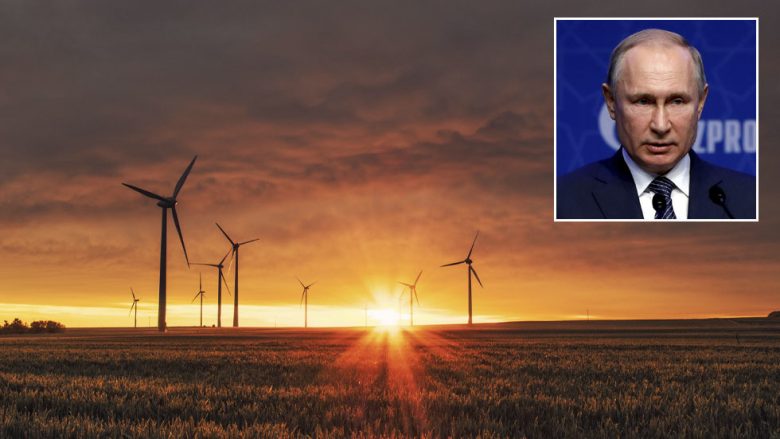
Soaring gas prices in Western Europe due to mistaken reliance on wind farms, Russia on track for record exports in 2021 – Putin
RT | October 13, 2021
A surge in the cost of gas which has seen bills shoot up for households and industry is down to a shortfall in electricity generation, and not because Russia is somehow squeezing supplies, President Vladimir Putin has argued.
Speaking as part of a keynote address at Russian Energy Week on Wednesday, Putin said that a fall in output from wind farms had meant electricity prices shot up, having a knock-on effect on demand for gas. Wind power makes up an increasingly large share of Europe’s energy generation, particularly in the west of the continent, he went on.
“The rise in gas prices in Europe was the result of a shortage of electricity, and not vice versa,” the president insisted.
Putin went on to accuse Western leaders of “trying to cover up their own mistakes,” following a series of claims that the situation is because Russia is withholding supplies. He added that “proper analysis of the situation is often replaced by empty political slogans.”
According to the Russian president, an exceptionally long winter drained the continent’s energy reserves and disrupted pricing. Now, “the invisible hand of the market” is at play, Putin said.
Contrary to Russia seeking to worsen the crisis, Putin insisted that the country could well see record levels of exports in 2021 as Moscow works to meet the growing demand. That said, though, he claimed that the Kremlin doesn’t relish the prospect of shortages and that “the high price environment can have negative consequences for everyone, including producers.”
Some countries have seen gas prices rise by as much as 250% in recent days, with a knock-on effect being felt in the industry. Homeowners also face higher heating bills with winter fast approaching. Several energy companies in the UK, which has seen some of the sharpest increases, have entered into talks with the government to prevent them from potentially going bust.
Last month, Putin’s spokesman, Dmitry Peskov, said that the state energy firm, Gazprom, is already fulfilling all of its contracts and no customers have been denied deliveries. According to him, “nobody has any grounds to claim otherwise,” and the company is making preparations to strike new deals and increase the volumes flowing westwards.
Biden signs ‘Havana Syndrome’ law, Berlin police report new ‘cases’ blamed on mystery weapons scientists say don’t exist
RT | October 8, 2021
As President Joe Biden signed a law funding the treatment of 200-plus US officials who claim to have been affected by so-called Havana Syndrome, German police said they were looking into more possible cases.
Berlin police confirmed on Friday they were investigating an “alleged sonic weapon attack on employees of the US Embassy,” in response to reporting by the tabloid Der Spiegel. The embassy declined to comment on the investigation.
Meanwhile in Washington, Biden signed into law the Helping American Victims Afflicted by Neurological Attacks (HAVANA) Act, passed unanimously by Congress last month, providing money for the treatment of more than 200 government employees who claim to have been affected by the mystery syndrome.
“Civil servants, intelligence officers, diplomats, and military personnel all around the world have been affected by anomalous health incidents,” Biden said in a statement. “Some are struggling with debilitating brain injuries that have curtailed their careers of service to our nation. Addressing these incidents has been a top priority for my administration.”
White House Press Secretary Jen Psaki told reporters the US government is “determined to get to the bottom as quickly as possible of the attribution and cause of these incidents,” with the intelligence community “in the lead on that.”
“They’re actively examining a range of hypotheses, but they have not made a determination about the cause of these incidents or who is responsible.”
US media and many members of Congress, however, seem convinced that the symptoms – which were first reported at the US Embassy in Cuba in 2016 – were the work of some kind of weapon, and have pointed the finger at Russia. About half of the Americans who claim to have been affected are employees of the Central Intelligence Agency.
CIA Director William Burns said in July that there was a “very strong possibility” the symptoms were caused deliberately, and pointed to a study by a National Academy of Sciences panel from December 2020 that listed “directed energy” beams as a plausible cause.
Last month, however, the State Department released a redacted version of the classified 2018 report by JASON, a scientific advisory group, that ruled out microwave or ultrasound energy, saying that the power requirements were prohibitive and pointing out that electronics were not affected.
The JASON report said that a third of the original reports were “most likely” caused by the noise made by a specific species of cricket – a conclusion a US Berkeley scientist reached independently in early 2019 – while others may have been of psychological origin.
‘Superspreader of misinformation’: NYT corrects story that exaggerated child Covid-19 hospitalizations by over 90%
RT | October 8, 2021
The New York Times had to issue a doozy of a correction on an article by its Covid-19 reporter Apoorva Mandavilli, who somehow inflated the number of US children hospitalized with the virus to 14 times the actual level.
Mandavilli claimed in her article, published on Tuesday, that nearly 900,000 Covid-infected children had been hospitalized in the US since the pandemic began. As the Times admitted on Thursday, the available data shows that the correct figure from August 2020 to October 2021 was more than 63,000.
The inaccuracies didn’t stop there. The correction also noted that contrary to Mandavilli’s reporting, Sweden and Denmark haven’t begun offering single-dose vaccines to children. The newspaper added that the story misstated the timing of an upcoming FDA meeting regarding proposed use of the Pfizer-BioNTech vaccine in children as young as five years old.
The scale of the erroneous hospitalization figure was reminiscent of gaffes by President Joe Biden, such as saying 120 million Americans had died from Covid-19 and 150 million had been killed by gun violence. It’s not clear how the blunder occurred, but the mainstream media has been accused of hyping the severity of the pandemic. A hidden-camera investigation by Project Veritas in April purported to show a CNN technical director saying the outlet purposely stoked fears of Covid-19 to boost ratings.
Ironically, the Times itself has decried Covid-19 misinformation. For instance, the newspaper posted an article earlier this week vilifying Dr. Joseph Mercola as “the most influential spreader of coronavirus misinformation.” In August, the Times said ‘Russian disinformation’ was being spread to suggest that the Biden administration would impose a Covid-19 vaccine mandate. A month later, Biden ordered that healthcare facilities, federal contractors and businesses with more than 100 employees force their workers to be inoculated, taking the choice over getting the jab away from about 100 million Americans.
While the Times and other mainstream outlets have billed themselves as the arbiters of truth, Mandavilli’s error-laced article is only the latest in a long line of inaccurate reporting by the newspaper. For example, the newspaper falsely claimed that Russia had offered bounties on American troops in Afghanistan and that police officer Brian Sicknick was murdered by pro-Trump rioters at the US Capitol.
“The New York Times is a superspreader of misinformation,” said Christina Pushaw, press secretary for Florida Governor Ron DeSantis.
Mandavilli stirred anger among conservatives in May, when she said the theory that Covid-19 leaked from China’s Wuhan Institute of Virology had “racist roots.” She later deleted her Twitter post, lamenting that the pushback to her remark had been “ridiculous.”
“Someday, we will stop talking about the lab-leak theory and maybe even admit its racist roots,” Mandavilli said in the original tweet. “But alas, that day is not yet here.”
It’s not clear why the reporter was rooting for the lab leak theory to go away, as even chief White House medical adviser Dr. Anthony Fauci said it should be investigated after previously trying to squash the notion.
The Wall Street Journal had reported two days earlier that three scientists at the Wuhan lab had been hospitalized with Covid-19 symptoms in the fall of 2019, near the time when the first cases of the virus were reported in China.
The Times’ former lead reporter on Covid-19, Pulitzer Prize nominee Donald McNeil Jr., resigned under pressure in February after co-workers campaigned for his firing. His sin was responding to a high school student’s question about a classmate’s use of the N-word by repeating the slur when he asked for context on how it was used. He had worked for the newspaper since 1976.
FULL OF GAS
By Paul Robinson | IRRUSSIANALITY | October 8, 2021
It’s 20 degrees here in Ottawa. For October, that’s something of a heatwave, and it’s meant to stay this way for a week or so, well into the middle of the month. Beyond that, the weather guys say that we’re in for a generally warm autumn. No need for the winter tires just yet.
Europe, though, is said to be headed for a deep cold spell in the coming months. So good for us, bad for Europe – unless you like winter sports, of course, in which case it’s the other way around. But regardless of what weather you prefer, cold has consequences, one of which is that you have to turn the heating up, for which you need fuel. And in the modern post-coal world, that increasingly means burning natural gas.
Unfortunately, this is a bad time to do so, for the price of natural gas has shot up in recent months, as you can see from the chart below. This is a result of increased demand, reduced output from wind turbines, and a reduction in supplies as Europe’s main suppliers – Norway and Russia – fill up their own stocks before winter. This has apparently ‘all but wiped out stocks’ in the rest of Europe. The markets have responded with a binge of frenzied speculation, shoving natural gas prices up to unnaturally high levels.
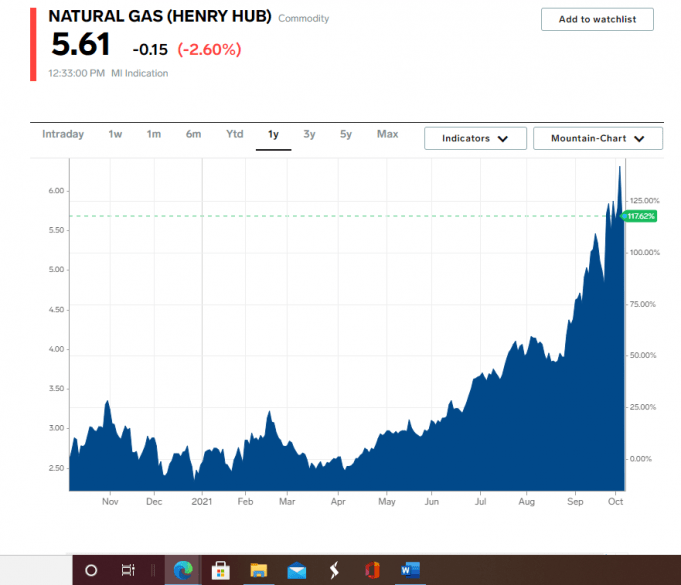
Which is obviously Russia’s fault. Because, well … it’s bad, and it’s natural gas, and so Russia must be to blame. After all, we know that all those traders on the futures markets take their orders from the Kremlin.
To give example of the hysterical rhetoric floating around, CNBC ran this headline yesterday: ‘The US was right – Europe has become a “hostage” to Russia over energy, analysts warn.’ The following story then told readers that ‘Europe is now largely at Russia’s mercy when it comes to energy,’ citing analyst Timothy Ash (who regularly pops up on the pages of the Kyiv Post) denouncing Russia’s ‘energy blackmail’ and saying that:
‘Europe has now left itself hostage to Russia over energy supplies … [It’s] crystal clear that Russia has Europe (the EU and U.K.) in an energy headlock, and Europe (and the U.K.) are too weak to call it out and do anything about it … Europe is cowering as it fears [that] as it heads into winter Russia will further turn the screws (of energy pipelines off) and allow it to freeze until it gets its way and NS2 [North Stream 2] is certified.’
If I get this right, the logic is that Russia is deliberately withholding supplies from Europe in order to force Germany to complete the certification of the North Stream 2 pipeline linking Germany and Russia. Unfortunately, Ash fails to provide a shred of evidence for this claim, and it’s not as if the Russians are expressing any sort of concern that the certification may not happen, or that they are specifically targeting Germany.
In fact, there’s no evidence that Russia is blackmailing anybody. Russia’s president Vladimir Putin even sought to calm international markets by telling the Russian gas company Gazprom to keep sending supplies through Ukraine even though it would be cheaper to send them via alternative routes. It’s important to maintain Russia’s reputation as a reliable supplier of energy, he noted, adding that Russia would indeed increase supplies to Europe this year, with exports possibly reaching a record high.
Critics complain that Russia could be pumping more gas to Europe than it currently is. It is apparently true that the volume of deliveries has been down in the past couple of months, as Russia fills up its own stocks before what is expected to be a harsh winter. But, deliveries for 2021 as a whole are on par with last year and Russia is meeting all its contracts. Furthermore, as Ben Aris has pointed out, it’s not that easy for Russia to greatly increase the quantity of gas it supplies Europe via existing pipelines. This is because different gas fields serve different pipelines, with limited connections. The line going via Ukraine comes from fields that are already ‘maxed out’. Additional gas would have to come from the Yamal peninsula – i.e. via North Stream or North Stream 2. With the former already at capacity, that in essence means the latter. In other words, Aris concludes:
‘It is possible for Russia to send more gas west without using NS2 but it’s limited & most expensive option for Gazprom. By far easiest & cheapest option for both Gazprom & EU is to turn NS2 on. This would solve the current gas crisis.’
It seems to me that Russia’s critics need to decide what they want. For years, they’ve been complaining that Europe is buying too much Russian gas. Now, though, they’re complaining that the Russians won’t sell them more! The Russians sell you gas – that’s a sign that they’re out to get you. They won’t sell you gas – proof that they’ve got you!
Frankly, it makes no sense.
Besides which, people don’t sell you stuff unless you ask them to, which in business terms means signing a contract with them. Russia, as previously said, is fulfilling its contracts. What more is it meant to do? As German chancellor Angela Merkel pointed out this week, if European states haven’t signed up to buy Russian gas, they can’t really complain if they don’t get it. She said:
‘To my knowledge, there are no orders where Russia has said we won’t deliver it to you, especially not with regard to the pipeline in Ukraine. Russia can only deliver gas on the basis of contractual obligations, and not just only like that.’
Absolutely.
Of course, if Russia was exploiting the rising cost of gas by engaging in price gouging, there might still be some grounds for complaint. But that’s not the case. Russia prefers to lock its customers into long-term contracts. Anybody who had the good sense to sign such a contract with Gazprom a while back when prices were low will now be laughing: their supplies are guaranteed and they’ll be cheap. Germans, Hungarians, Serbs, and the like are probably feeling a bit smug right now. Others who preferred to gamble on the market, or to dump Russia for an alternative supplier such as American LNG will now have to pay the price. But that’s their fault not Russia’s. As Putin pointed out:
‘The practice of our European partners has confirmed it once more that they made mistakes. We talked to the European Commission’s previous lineup, and all its activity was aimed at phasing out of so-called long-term contracts. It was aimed at transition to spot gas trade. And as it turned out, it has become obvious today, that this practice is a mistake.’
None of this, unfortunately, has stopped the flood of stories blaming Russia for Europe’s gas crisis, a crisis that is in large part due to the latter’s own errors. To give a flavour, here’s some of the headlines in the American and British press this past 24 hours:
‘Don’t Fall For Putin or Orban as They Try to Exploit Europe’s Energy Crisis’ – Washington Post
‘As Europe Faces a Cold Winter, Putin Seizes on the Leverage From Russia’s Gas Output’ – The New York Times
‘Russia has the West over a barrel: Fury at “bullying” Putin for offering Europe more natural gas IF his Nord Stream 2 pipeline is approved.’ – Daily Mail
‘Gas price crisis: Is Putin using energy supply as a weapon and what is its new Nord Stream 2 pipeline?’ – Sky News
‘UK dubbed “Putin’s puppet” as “Soviet” Britain’s gas prices plummet after Russian offer’ – Daily Express
‘How “Sleepy Joe” handed Putin the bargaining chip he is using to hold Europe to ransom in gas crisis’ – Daily Mail
Now, I can understand why Western politicians would want to find a scapegoat for their own failings, but why does the press go along with this? Wasn’t there a time when the Fourth Estate prided itself on holding the powers that be at home to account? Apparently no more. Blaming Russia obviously sells more copy. As long as that remains the case, expect the pipelines of BS to keep on flowing profusely!
US is only country still hanging on to chemical weapons, Russia says, after Washington unveils ‘Novichok’ questions
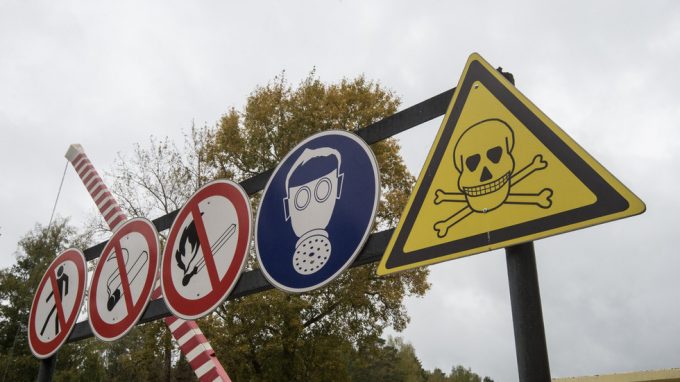
An open storage for the collection of burnt ammunition containing toxicant agents. © Sputnik / Ilya Pitalev
RT | October 6, 2021
Russian diplomats have hit out at the US after American officials signed a letter demanding information on the circumstances of the purported poisoning of opposition figure Alexey Navalny, accusing Washington of double standards.
On Tuesday, Moscow’s embassy in Washington issued a fiery statement after the US and 44 other countries presented a series of answers from Russia over the incident as part of a missive passed over to the Organization for the Prohibition of Chemical Weapons (OPCW). Navalny and his German doctors insist that he was poisoned with the nerve agent Novichok last year. The envoys blasted the allegations as “unfounded,” and the Kremlin has argued that all requests for evidence from Berlin have gone unanswered.
In response to the allegations, the embassy argued that Russia “is committed to its obligations” under chemical weapons treaties and, “in 2017, our country destroyed all national stocks of chemical warfare agents, which was documented by the OPCW.”
However, the envoys argue that “the US continues to be the only country in the world that has not destroyed its impressive arsenal of chemical weapons.” In 1991, then-US President George H.W. Bush committed to destroying its stockpiles of lethal agents, but progress has since been hampered by a number of issues and decommissioning is still underway, leaving large quantities of chemical munitions, including mustard gas shells.
In March, the US slammed Russia with sanctions, urging Moscow to get rid of the country’s chemical weapons stockpile following the allegations of the use of Novichok against Navalny. Kremlin Press Secretary Dmitry Peskov, however, maintained that “Russia declared and verified the destruction of all chemical weapons on its territory many years ago and fully complied with international conventions… Russia has no chemical weapons.”
“By the way,” Peskov added, “we expect that our counterparts will also comply with these conventions.”
This is not the first time that Russia has called on the US to dispose of its chemical weapons. In 2018, the spokesperson for the country’s Foreign Ministry, Maria Zakharova, responded to former US President Donald Trump’s request for Russia to “stop the arms race” developing between the two nations. “Great idea,” Zakharova said. “Let’s start by getting rid of chemical weapons. American ones.”
In response to the US’ latest accusations regarding Russia’s supposed chemical warfare capabilities, the embassy said that it is in the world’s interest that Washington complies with the UN’s international regulations surrounding disarmament. “We call on Washington to complete the chemical demilitarization program as soon as possible and fulfill international obligations, making the world safe from the potential use of this type of weapon,” the embassy added.
Featured Video

The Truth About the Trump Shootings with Ken Silva
or go to
Aletho News Archives – Video-Images
From the Archives
The Geopolitics behind the War in Yemen (I)
By Mahdi Darius NAZEMROAYA | Strategic Culture Foundation | 30.03.2015
The United States and the Kingdom of Saudi Arabia became very uneasy when the Yemenese or Yemenite movement of the Houthi or Ansarallah (meaning the supporters of God in Arabic) gained control of Yemen’s capital, Sanaa/Sana, in September 2014. The US-supported Yemenite President Abd-Rabbuh Manṣour Al-Hadi was humiliatingly forced to share power with the Houthis and the coalition of northern Yemenese tribes that had helped them enter Sana. Al-Hadi declared that negotiations for a Yemeni national unity government would take place and his allies the US and Saudi Arabia tried to use a new national dialogue and mediated talks to co-opt and pacify the Houthis.
The truth has been turned on its head about the war in Yemen. The war and ousting of President Abd-Rabbuh Manṣour Al-Hadi in Yemen are not the results of «Houthi coup» in Yemen. It is the opposite. Al-Hadi was ousted, because with Saudi and US support he tried to backtrack on the power sharing agreements he had made and return Yemen to authoritarian rule. The ousting of President Al-Hadi by the Houthis and their political allies was an unexpected reaction to the takeover Al-Hadi was planning with Washington and the House of Saudi. … continue
Blog Roll
 Aletho News
- Imran Khan’s entire immediate family detained in Pakistan ahead of mass protest demanding his release
- EU nation detains former presidential frontrunner
- Leaked: Britain’s Sham Conviction Of Hashim Thaci
- Seyed M. Marandi: U.S. Strike Imminent – Toward Total War in the Middle East
- Russia Voted Under Fire. Washington Is Loading the Tankers.
- 12 Things Your Oncologist Was Trained Not to Tell You
- Anthrax Attacks Paved Way for COVID-Era ‘Junk Drugs and Vaccines’
- How Real Is the Impact of Western Sanctions on Israel?
- France, You Are Guilty: How Paris Turned Western Sahara into the Maghreb’s Powder Keg
- 2025 Nature Paper Claiming Worsening Global Drought Gets RETRACTED …Heavily Flawed
- If Americans Knew
- An error has occurred; the feed is probably down. Try again later.
- No Tricks Zone
- 2025 Nature Paper Claiming Worsening Global Drought Gets RETRACTED …Heavily Flawed
- New Study: ‘Global Drought Shows No Detectable Recent Acceleration Under Climate Warming’
- Economic Masterminds: German Socialists Suggest Taxing Productivity Gains Stemming From Using AI
- The South China Sea Has Not Been Cooperating With The Climate Change Narrative
- Energy Crisis: Germany Enters Heating Season With Historically Low Gas Reserve Fill Levels
- New Study: The Antarctic Ice Sheet Gained Mass From 2020-2024 Due To Staggering Snow And Ice Accumulation
- Study: Ocean Heating Rates From Thousands Of Years Ago ‘Dwarf’ Modern Ocean Heating Rates
- Climate Extremists Target, Attack Large-Scale Power Grid Infrastructure In Germany!
- New Study: Antarctic Ice Melt Has Contributed Less Than 1 Centimeter To Sea Level Rise In The Last 30 Years
- Fear Of Debate: Alarmist German Climate Scientist Calls On Mainstream Media To Discredit Skeptic Voices
 Aletho News